• Skip to primary navigation
  • Skip to main content
  • Skip to primary sidebar
  • Home
  • About Us
    • Privacy Policy
    • Comment Policy
    • Disclosures & Disclaimers
  • Resources
    • Links, Essays & Articles
    • Fandomology!
    • CLAMP Directory
    • BlogRoll
  • Features & Columns
    • 3 Things Thursday
    • Adventures in the Key of Shoujo
    • Bit & Blips (game reviews)
    • BL BOOKRACK
    • Bookshelf Briefs
    • Bringing the Drama
    • Comic Conversion
    • Fanservice Friday
    • Going Digital
    • It Came From the Sinosphere
    • License This!
    • Magazine no Mori
    • My Week in Manga
    • OFF THE SHELF
    • Not By Manga Alone
    • PICK OF THE WEEK
    • Subtitles & Sensibility
    • Weekly Shonen Jump Recaps
  • Manga Moveable Feast
    • MMF Full Archive
    • Yun Kouga
    • CLAMP
    • Shojo Beat
    • Osamu Tezuka
    • Sailor Moon
    • Fruits Basket
    • Takehiko Inoue
    • Wild Adapter
    • One Piece
    • After School Nightmare
    • Karakuri Odette
    • Paradise Kiss
    • The Color Trilogy
    • To Terra…
    • Sexy Voice & Robo
  • Browse by Author
    • Sean Gaffney
    • Anna Neatrour
    • Michelle Smith
    • Katherine Dacey
    • MJ
    • Brigid Alverson
    • Travis Anderson
    • Phillip Anthony
    • Derek Bown
    • Jaci Dahlvang
    • Angela Eastman
    • Erica Friedman
    • Sara K.
    • Megan Purdy
    • Emily Snodgrass
    • Nancy Thistlethwaite
    • Eva Volin
    • David Welsh
  • MB Blogs
    • A Case Suitable For Treatment
    • Experiments in Manga
    • MangaBlog
    • The Manga Critic
    • Manga Report
    • Soliloquy in Blue
    • Manga Curmudgeon (archive)

Manga Bookshelf

Discussion, Resources, Roundtables, & Reviews

Manga Critic

The Emperor and I

May 10, 2017 by Katherine Dacey

The Emperor and I reads like a Sunday comic strip: it has a faintly absurd premise that’s easy to grasp, a small cast of characters, and a well-honed repertoire of jokes that it trots out with clockwork precision.

The story begins with Kaho, an ordinary teenage girl, discovering an extraordinary thing in the refrigerator: a penguin. Without a second thought, she coaxes him out of the crisper drawer, feeds him a snack, and persuades her mom to let him stay. Emperor turns out to be less a pet than a weird houseguest, however, doggedly pursuing penguin behaviors — carrying eggs on his feet, sliding across the floor on his belly — while assiduously ignoring his human companions.

What gives the series its odd comic energy is the artist’s fierce commitment to depicting Emperor as a wild animal. Emperor doesn’t talk or have a winsome face with big, soulful eyes; he’s a silent, hulking presence who molts and sleeps standing up. The gulf between Emperor and his human hosts is further underscored by the full-color artwork. As Mato draws him, Emperor looks like an illustration from a biology textbook, with every patch of orange and feather rendered in meticulous detail. By contrast, Kaho and her family look like stock characters from a Shonen Sunday manga; you’d be forgiven for thinking they were part of Kagome Higurashi’s extended clan. Color also enables Mato to conceal Emperor in plain sight so that he’s visible to the reader but plausibly hidden from the characters, a gimmick that proves essential to one of the series’ better running gags: Emperor’s talent for disappearing inside Kaho’s very small house. (That’s no small feat, considering he stands four feet tall and reeks of mackerel.)

Perhaps the best thing about The Emperor and I is that it wears its conceit lightly. We learn a lot about penguin behavior and anatomy over the course of the series, but other critical details are left to the readers’ imagination. Although Kaho and her family acknowledge the bizarreness of their situation — remember, they found a penguin in the crisper drawer — none of them seem particularly bothered by it, or curious to discover how Emperor arrived there. By keeping the focus on Emperor’s natural avian behaviors, Mato mines a richer comic vein of material, highlighting the incongruity between the setting and Emperor’s attempts to carry on as if he were still living in Antarctica.

Like any Sunday strip, The Emperor and I is best in small doses, as the “Where’s Emperor?” jokes grow tiresome when read in rapid succession. Consumed in weekly doses of three to nine pages, however, The Emperor and I works well; the routine jokes have a pleasantly familiar ring that brings the genuinely novel gags into sharper relief. You won’t forget the silent encounter between Emperor and a neighborhood cat, or Kaho’s frantic efforts to turn her bathtub into a salt-water pool, even if the comic bits that surround these sequences are pat.

How to read The Emperor and I: VIZ is serializing this manga on its website, making a new chapter available every week. Access is free, though expect to see at least one or two pop-up ads for VIZ’s digital edition of Weekly Shonen Jump.

THE EMPEROR AND I • BY MATO • VIZ MEDIA • RATING: ALL AGES
Filed Under: Manga, Manga Critic, REVIEWS Tagged With: Comedy, mato, Penguin, VIZ

My Brother’s Husband, Vol. 1

April 30, 2017 by Katherine Dacey

The world has changed since Heather Has Two Mommies was published to controversy and acclaim in 1989. Here in the US, we’ve seen the legalization of gay marriage, first on the state and then on the federal level. We’ve also witnessed a slow but meaningful change in the way that our judicial system conceptualizes parental rights, as evidenced by a recent decision overturning Alison D. v. Virginia M., a 1991 lawsuit in which the court held that non-biological, non-adoptive parents have no legal standing in custody disputes. Writing in 2016, the New York Court of Appeals declared that “the definition of ‘parent’ established by this Court 25 years ago in Alison D. has become unworkable when applied to increasingly varied familial relationships,” recognizing the degree to which gay and lesbian partnerships had been marginalized by the original ruling.

Our recent presidential election offered a powerful reminder, however, that the initial firestorm over Heather Has Two Mommies was never fully extinguished; no matter how much the law had evolved to reflect shifting cultural attitudes, some Americans still clung tenaciously to the idea that the only legitimate families were headed by a father and a mother. In this moment of uncertainty, Gengoroh Tagame’s My Brother’s Husband is a welcome arrival in American bookstores, offering younger readers a warm, nuanced portrayal of gay life that challenges the idea that the only families that “count” are based on blood relations.

Tagame’s story focuses on Yaichi and Kana, a single father and his curious, outspoken daughter. Their cosy household is upended by the arrival of Mike Flanagan, a good-natured Canadian who was married to Yaichi’s deceased twin brother Ryoji. Yaichi is reluctant to host Mike, but seven-year-old Kana warmly embraces their visitor, insisting that Mike stay with them as an honored family member.

In the early chapters of the story, Mike represents a direct challenge to Yaichi’s unexamined beliefs about homosexuality. Tagame uses a split screen to make us privy to Yaichi’s internal monologue, contrasting Yaichi’s public actions with his private thoughts, in the process revealing the extent to which Yaichi uses stereotypes to justify his discomfort with Mike. Not surprisingly, Yaichi initially treats Mike as a nuisance, but his attitude changes as he watches Kana interact with Mike; her natural curiosity and warmth bring out the same qualities in their guest, encouraging Yaichi to view Mike as an individual, rather than a type.

In the later chapters of the story, Mike’s role in the household begins to evolve. He joins Yaichi and Kana in their daily activities — going to the store, visiting the community center — and talks openly with Kana about his marriage to Ryoji. When Yaichi’s ex-wife arrives for a visit, she marvels at Mike, Yaichi, and Kana’s closeness, recognizing the degree to which they’ve formed their own impromptu family in just a short amount of time.

My Brother’s Husband might feel like an Afterschool Special if not for the crispness of Gengoroh Tagame’s artwork, which conveys both the small-town setting and characters’ feelings with great specificity. In particular, Tagame does a fine job of suggesting just how conspicuous Mike really is in the village where Yaichi and Kana live, using the scale of Yaichi’s house — the rooms, the tatami mats, the bathtub — to drive home the point. Tagame proves equally adept at using the characters’ body language and facial expressions as a window into their feelings. In one of the story’s most poignant scenes, for example, a drunken Mike mistakes Yaichi for Ryoji, dissolving into tears as he collapses into Yaichi’s arms; it’s the only moment in which the strong, confident Mike seems vulnerable, his posture and face convulsed in grief over losing the husband he cherished. Yaichi’s grimaces, smiles, and gasps likewise reveal his vulnerability, documenting his ambivalent feelings about Mike in particular and homosexuality in general; the dialectical process by which Yaichi comes to embrace Mike as part of his family registers as much on Yaichi’s face as it does in his words and his actions.

Though some of the conflicts are resolved with sitcom tidiness, My Husband’s Brother earns points for its well-rounded characters and frank acknowledgment of Yaichi’s initial discomfort with Mike. That we believe in Yaichi’s transformation from skeptic to ally, and embrace Mike as a complex individual and not a cardboard saint, is proof of Tagame’s ability to tell a nuanced all-ages story that will resonate with readers on both sides of the Pacific. Highly recommended.

A word to parents, teachers, and librarians: My Brother’s Husband is appropriate for readers in middle and high school. Though the subject of Mike’s relationship with Ryoji is discussed at length, the story focuses on Mike’s romantic feelings for Ryoji; the sexual dimension of their relationship is not depicted.

Review copy provided by the publisher. My Brother’s Husband will be released on May 2, 2017.

MY BROTHER’S HUSBAND, VOL. 1 • BY GENGOROH TAGAME • PANTHEON BOOKS • NO RATING (SUITABLE FOR READERS 10+)

Filed Under: Manga, Manga Critic, REVIEWS Tagged With: Gengoroh Tagame, LBGTQ Manga, Pantheon

Flying Witch, Vol. 1

April 25, 2017 by Katherine Dacey

If you’ve dipped a toe in the online dating world, you’ve undoubtedly arranged a date with someone who turned out to be pleasant, polite, and attractive, but not terribly interesting. I had a similar experience with volume one of Flying Witch, a manga that looked promising but lacked the necessary spark of weirdness or wit to make it worth a second chance.

Flying Witch has a simple but fertile premise: Makoto Kowata, a teenage witch-in-training, moves from Yokohama to her cousins’ farm and enrolls in the local high school. Though Makoto’s parents warned her not to reveal her true identity to other people, Makoto blithely confesses her avocation to peers and strangers alike, almost always without prompting.

That running gag is indicative of what works — and what doesn’t — in Flying Witch. In the manga’s best scenes, artist Chihiro Ishizuka wryly juxtaposes the banality of the setting with the strangeness of Makoto’s witchcraft, whether Makoto is test-driving brooms at the local supermarket or pulling up a mandrake from an abandoned field. In these moments, Makoto’s enthusiasm overwhelms her desire to escape detection; she’s astonished that her classmate Nao recoils from the noisy, squirming mandrake, and begins regaling Nao with a list of its medicinal uses in an effort to explain why mandrakes, are in fact, awesome gifts.

In other scenes, however, the punchline is toothless, coming at the end of a long monologue about witchcraft or a chance encounter with a villager who isn’t the least bit scandalized by Makoto’s true calling. Makoto’s blushing and stammering is overplayed to diminishing returns; any reasonable person would wonder why Makoto hasn’t realized that her big secret isn’t a big deal. The same is true for other recurring “jokes” about Makoto’s terrible sense of direction, which are as unfunny on the third or sixth iteration as they were on the first.

The artwork, like the script, is lackluster. Though Ishizuka’s lines are clean and her layouts easy to read, the characters’ blank faces do little to sell the jokes. Chinatsu, Makoto’s ten-year-old cousin, is one of the few characters to register any emotional response to Makoto’s behavior, reacting with a mixture of saucer-eyed fear and astonished exuberance. The rest of the characters drift through the story without much purpose, functioning more like props or set decoration than actual people. Only cameo appearances by the aforementioned mandrake root and the Harbinger of Spring inject the proper note of piquant strangeness to the proceedings, reminding us that Makoto’s existence straddles the fence between the ordinary and the supernatural.

I wish I liked Flying Witch more, as it has all the right ingredients to be a quirky, fun series. Alas, reading Flying Witch is like having dinner with a handsome bore who collects vintage lunch boxes or builds crystal radios; you just know there’s a good story there, but it never comes across in the telling.

FLYING WITCH, VOL. 1 • BY CHIHIRO ISHIZUKA • VERTICAL COMICS • NO RATING (SUITABLE FOR ALL AGES)

Filed Under: Manga, Manga Critic, REVIEWS Tagged With: Chihiro Ishizuka, Comedy, Flying Witch, Vertical Comics

Toppu GP, Vol. 1

April 17, 2017 by Katherine Dacey

In a week when The Fate of the Furious is roaring into theaters, it seems only fitting that Kodansha is releasing the first volume of Toppu GP, a manga that extols the virtues of “family values and hot rides” almost as doggedly as Vin Diesel and the rest of his car-boosting gang. The similarities don’t end there, either: both series boast cartoonish villains, pretty girls in skimpy outfits, and dialogue so ham-fisted you could serve it for Easter dinner.

I love them both.

The “family” unit in Toppu GP consists of Toppu, the eleven-year-old hero; Myne, the local motorcycle racing champion; and Teppei, Toppu’s father. Toppu is a classic shonen type: he’s sullen, brilliant, and reluctant to try anything outside of his nerdy comfort zone. (He likes to build elaborate Gundam models.) There are hints, however, that Toppu is destined for the track: he accurately gauges Myne’s qualifying times without benefit of a stopwatch, for example, and instinctually rides to victory in his second race by copying Myne’s technique.

Myne, too, is a familiar type, the sexy “big sister” who squeals and fusses over a smart, promising boy a few years her junior. (Toppu even calls her “Big Sis,” emphasizing the degree to which she’s part of his “family.”) She strides around in a tight-fitting tracksuit dispensing advice and hugs to her protege, goading him to victory with bribes. And just in case we find her more competent than adorable, she suffers from one of those only-in-manga ailments: pathological clumsiness so acute it strains credulity.

The third family member is Teppei, a single parent who’s raising Toppu while writing a novel. Though Teppei professes to be working hard on his book, his actions suggest he’d rather hang out at the track than sit at a typewriter; he spends most of volume one playing coach and mechanic to his kids, dispensing wisdom about the art of motorcycle racing. Dad’s editor must be a forgiving guy.

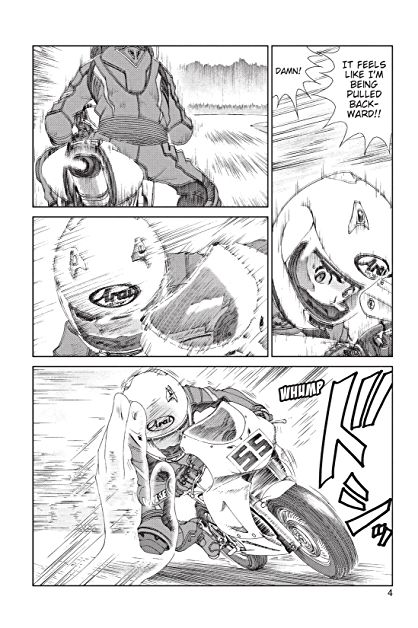
In contrast to the characters, who are painted in broad strokes, the layouts are executed with thrilling precision. Veteran artist Kosuke Fujishima drops us into the action through deft use of perspective and speedlines, capturing the bikes’ velocity and the riders’ positions, as well as the sheer danger of high-speed maneuvers in close proximity. Fujishima complements these images with a handy primer on G-forces, using an invisible hand to show us what Toppu and Myne feel when they accelerate down a straightaway or bank a sharp turn at high speed:

Perhaps the most astonishing aspect of Fujishima’s layouts are their economy. While many shonen artists might be tempted to stretch Toppu’s racing debut over several chapters, Fujishima uses just a handful of panels to show us how Toppu succumbs to the pleasures of competition. This transformation is bookended by two closeups, the first of Toppu’s terrified face as he pulls back on the throttle for the first time, and the second of Toppu’s gleaming eyes as he completes his final lap of the track. We see just enough action between these two panels to grasp the disparity between how quickly the race is unfolding and how slowly time passes for Toppu as he struggles to gain control of the bike, snapping back to “real” time only when Toppu realizes just how much he’s enjoying himself.

In a nod toward gender parity, Fujishima dedicates an entire chapter to showcasing Myne’s tenacity on the track as well. Though Fujishima employs many of the same strategies for immersing us in Myne’s race as he does Toppu’s, Fujishima periodically interrupts the competition with goofy, arresting images of Myne as a tracksuit wearing, sword-wielding avenger and a fiery, Medusa-haired biker. These fleeting visions are a nice bit of comic relief, echoing iconic scenes from Kill Bill and Ghost Rider, but they serve an equally important purpose: showing us how Myne’s rivals see her in competition.

As dazzling as these racing sequences are, I’d be the first to admit that the familial banter between Myne, Toppu, and Teppei feels as perfunctory as the dastardly scheming of the the Niimi brothers, the series’ first villains. (They resent Toppu’s meteoric rise in the standings and want to put him in his place.) The dialogue, too, often veers into the faintly pompous, with characters declaring how much they love “the roar of the exhaust pipe,” “the smell of burning gas and oil,” and “the gaze of the crowd” when they’re at “home.” But when Toppu or Myne jump on their bikes, the series shifts into high gear, offering the same kind of thrills as The Fate of the Furious: fast rides, fierce competition, and the ever-present threat of crashing. Recommended.

A word about buying Toppu GP: Kodansha is simultaneously publishing Toppu GP with the Japanese edition; readers can purchase new installments through Amazon and ComiXology on a weekly basis. Folks who prefer print will find the first volume available in stores now, with volume two to follow in September.

TOPPU GP, VOL. 1 • BY KOSUKE FUJISHIMA • KODANSHA COMICS • RATED T, FOR TEENS (13+)


Filed Under: Manga, Manga Critic, REVIEWS Tagged With: Kodansha Comics, Kosuke Fujishima, Moto GP, Shonen

Altair: A Record of Battles, Vol. 1

April 4, 2017 by Katherine Dacey

Altair: A Record of Battles seems tailor-made for fanfic: it’s got a cast of achingly pretty men, a labyrinthine plot, and an exotic setting that freely mixes elements of Turkish, Austrian, and Bedouin cultures. Like other series that inspire such fan-ish activity — Hetalia: Axis Powers comes to mind — Altair is more interesting to talk about than to read, thanks to an exposition-heavy script and an abundance of second- and third-string characters; you’ll need a flowchart to keep track of who’s who.

The first volume begins promisingly enough. While visiting the Türkiye capitol, a diplomat from the neighboring Balt-Rhein Empire is assassinated in the streets, an arrow lodged in his back. Though the murder weapon suggests that someone in the Balt-Rhein military engineered the hit, Emperor Goldbalt’s mustache-twirling subordinate Louis Virgilio points the finger at Türkiye, insisting they produce the killer or face the ultimate consequence: war. Mahmut, the youngest member of the Türkiye generals’ council, impulsively decides to visit Goldblat’s court in an effort to prevent bloodshed and reveal the true culprit in Minister Franz’s death.

No matter how intensely the characters ball their fists or glower at each other, however, their drawn-out arguments over troop mobilization, international diplomacy, and rules of order are only moderately more entertaining than an afternoon of watching C-SPAN. Author Kotono Kato further burdens the script with text boxes indicating characters’ rank and title, and diagrams showing the distribution of power under the Türkiye “stratocracy,” details that add little to the reader’s understanding of why Balt-Rhein and Türkiye are teetering on the brink of war. Only a nighttime ambush stands out for its dynamic execution; it’s one of the few scenes in which Kato allows the pictures to speak for themselves, effectively conveying the ruthlessness of Mahmut’s enemies without the intrusion of voice-overs or pointed dialogue.

The characters are just as flat as the storytelling. Kato’s flair for costume design is symptomatic of this problem: she’s confused surface detail — sumptuous fabrics, towering hats, sparkling jewels — with character development. With the exception of Mahmut, whose passionate intensity and youthful arrogance are evident from the very first scene, the other characters are walking, talking plot devices whose personalities can be summed up in a word or two: “brash,” “devious,” “enthusiastic,” “mean.” (Also “hot” and “well dressed,” for anyone who’s keeping score.) The shallowness of the characterizations robs the Türkiye/Balt-Rhein conflict of urgency, a problem compounded by Kato’s tendency to wrap things up with epilogues that are as baldly worded as a textbook study guide. At least you’ll be prepared for the quiz.

The bottom line: History buffs will enjoy drawing parallels between the Türkiye and Balt-Rhein Empires and their real-life inspirations, but most readers will find Altair too labored to be compelling — unless, of course, they’re looking for fresh opportunities to ‘ship some handsome characters.

ALTAIR: A RECORD OF BATTLES, VOL. 1 • BY KOTONO KATO • KODANSHA COMICS • RATED T, FOR TEENS • DIGITAL ONLY

Filed Under: Manga, Manga Critic, REVIEWS Tagged With: Fantasy, Kodansha Comics, Kotono Kato

Boruto: Naruto Next Generations, Vol. 1

March 28, 2017 by Katherine Dacey

Since its 1999 debut, Masashi Kishimoto’s Naruto has sold more than 220 million volumes in 35 countries and spawned a cottage industry of anime adaptations, costumes, trading cards, video games, figurines, and stage plays. VIZ published the final English-language volume in 2015, but the series’ popularity endures; walk through any American comic-con, and you’ll find small gangs of Narutos and Sasukes roaming the floor alongside Superman, Batman, and Sailor Moon.

In the post-Naruto era, VIZ has supplied hardcore fans with a steady stream of spin-off products, from light novels to coffee-table books. The company’s latest offering is Boruto: Naruto Next Generations, a manga written and illustrated by Ukyo Kodachi and Mikio Ikemoto under Kishimoto’s supervision. The story focuses on three new characters: Boruto (Naruto and Hinata’s son), Sarada (Sasuke and Sakura’s daughter), and Mitsuki (a young ninja of uncertain origins), all of whom enter the Chunin Exam, a tournament for aspiring ninjas. Running in tandem with the trio’s quest for victory are two subplots, the first centering on the return of the Otsutsuki clan and the second on a cloning scheme orchestrated by one of Naruto’s old nemeses.

While it’s obvious that Next Generations is aimed at ride-or-die fans, Kodachi deserves a medal for his efforts to make the story accessible to the uninitiated as well. Some of these expository passages are a little clumsy, but the pacing is brisk enough to smooth over the less graceful exchanges. The artwork, too, is competently executed; Ikemoto’s character designs create a strong visual continuity with the original series, making it easier for readers to grasp who’s related to whom.

On the minus side, Next Generations straddles the fence between remake and sequel, never fully settling on one approach. In an effort to show us that Boruto is just like his dad, for example, Kodachi portrays Boruto as impatient, brash, and… well, that’s about it. Reduced to a third-generation photocopy of his father, Boruto lacks a real identity or purpose of his own, despite Kodachi’s efforts to manufacture father-son drama. The decision to enter Boruto in the Chunin Exam is further evidence of the creators’ unwillingness to take risks. Boruto’s experiences may be a little different than his dad’s, but the tasks and outcomes tack so closely to the original that they, too, register as bad facsimiles, rather than an organic continuation of the Uzumakis’ saga.

The other problem with Next Generations is that the bad guys are cooler than the good guys. To be sure, this is a frequent issue in shonen manga; villains often get the snappiest lines and deadliest weapons while heroes are reduced to blustering about courage, teamwork, and loyalty. This problem nearly sinks the first volume of Next Generations, however, as Orochimaru — one of the most memorable villains in the original series — oozes sinister purpose in his cameo appearance, making a more immediate impression than any of Konoha’s do-gooder teens; he’s compulsively “watchable,” whether he’s browbeating one of his minions or playing at fatherhood.

Whether Orochimaru will be Next Generations’ principal baddie is unclear, as volume one introduces yet another flamboyant villain: Kawaki. If I had to hazard a guess about who Kawaki is, I’d say he was a refugee from JoJo’s Bizarre Adventure, as his two-tone hairdo and dramatic tattoos are just a little too fabulous for the Naruto universe. I’m not sure if he’s a portent of what’s to come in volume two or a hint of what Kodachi and Ikemoto might have created if they’d been given more latitude by Kishimoto; either way, finding out who Kawaki is the only reason I’d continue reading Next Generations.

The bottom line: If you’re a self-professed Naruto fan, Next Generations will offer just enough fresh material to affirm your love of all things Kishimoto; if not, you may find Next Generations a tedious slog.

Review copy provided by VIZ Media.

BORUTO: NARUTO NEXT GENERATIONS, VOL. 1 • CREATED BY MASASHI KISHIMOTO, ILLUSTRATED BY MIKIO IKEMOTO, AND WRITTEN BY UKYO KODACHI • VIZ MEDIA • RATED T (FOR TEENS)

Filed Under: Manga, Manga Critic, REVIEWS Tagged With: Boruto, Masashi Kishimoto, naruto, Ninja, Shonen, Shonen Jump, VIZ

Ne Ne Ne, Chapters 1-4

March 20, 2017 by Katherine Dacey

Ne Ne Ne sounds like E.L. James fanfic: the lead character is a virginal lass who’s forced into an arranged marriage with a sexy, mask-wearing man twenty years her senior. The actual story, however, is much less kinky than my capsule summary would suggest. Like millions of other nineteenth-century couples, sixteen-year-old Koyuki and thirty-seven-year-old Shin begin their married life as strangers, their union one of familial expediency rather than romance. Each entertains different ideas about what constitutes a proper marriage: for Koyuki, being married means homemaking and child-rearing, while for Shin, being married means mindful companionship. Most of their conflict stems from Koyuki’s immaturity, as she bursts into tears every time she burns a meal, tumbles off a ladder, or ruins one of Shin’s yukatas.

Though Koyuki’s bungled chores and teary monologues scream “moe,” Ne Ne Ne retains a core of emotional honesty that’s missing from other rom-coms about clumsy young girls and their older male admirers. The secret lies with the manga’s nuanced portrayal of Koyuki and Shin. Artist Daisuke Hagiwara does a fine job of showing us the degree to which the characters’ ages influence their expectations about married life, using small gestures — a shrug of the shoulder, a chaste kiss, a longing glance — to reveal how carefully the two are approaching their new roles. Author Shizuno Totono also raises the question of sex, hinting at the characters’ mutual attraction while acknowledging the moral and ethical dilemmas posed by Shin and Koyuki’s age gap.

Ne Ne Ne isn’t all angst and meaningful glances; Totono and Daisuke dish out plenty of jokes and sight gags, too, going to great lengths to demonstrate that Shin never takes his mask off. (Not even when he’s doing the laundry! Or snoring on a futon!) Shin’s mask serves a legitimate purpose beyond generating jokes and occasional moments of erotic tension, however: it’s a symbol of his profession — priest — and his connection to the supernatural world. In one of the story’s loveliest scenes, Shin gives Koyuki an impromptu lesson on how to spot yokai. Koyuki’s face conveys her profound sense of wonder at seeing her first dragon, and her delight at forging a small but meaningful connection with Shin — something she’s struggled to do in their more routine interactions as husband and wife.

Totono and Daisuke are less successful at wringing humor out of the couple’s interactions with supporting players. These characters are two-dimensional at best, defined by a single trait or habit that determines how they react to Koyuki and Shin’s marriage. Their brash neighbor Shouta, for example, cracks wise about the age gap between Shin and Koyuki — at one point, he implores Koyuki to marry him “when that old guy dies” — but his comments are anachronistic; it’s hard to imagine a young man in Meiji-era Japan finding an arranged marriage unusual, or speaking to his elders with such blatant disregard for etiquette. Koyuki’s father is similarly two-dimensional, a walk-on role whose main function is to defend his daughter’s chastity with comic fury. (He forbids Shin to consummate the marriage until Koyuki turns 20.) As with Shouta, these scenes don’t contribute much to our understanding of the period setting or the family dynamics that brought Shin and Koyuki together; they do, however, remind us that Shin is waaaaaaaay older than Koyuki.

If Totono and Hagiwara sometimes seem too intent on proving to the reader that Ne Ne Ne is more than just a pervy tale about an old guy in a mask and his child bride, the manga nevertheless manages to be funny, sweet, and honest about the challenges of marital life — something I didn’t expect from a story with such a ludicrous premise. Recommended.

Yen Press is simultaneously publishing the English-language edition of Ne Ne Ne as it’s released in Japan. As of March 20, 2017, four chapters are available. They can be purchased individually or as a package through Amazon, Barnes & Noble, Book Walker, ComiXology, Google Play, iBooks and Kobo.

NE NE NE, CHAPTERS 1-4 • STORY BY SHIZUKO TOTONO, ART BY DAISUKE HAGIWARA • YEN PRESS • NO RATING (APPROPRIATE FOR TEENS 13+)

Filed Under: Manga, Manga Critic, REVIEWS Tagged With: Daisuke Hagiwara, Ne Ne Ne, Romance/Romantic Comedy, Shizuku Totono, yen press

Anonymous Noise, Vol. 1

March 7, 2017 by Katherine Dacey

Anonymous Noise is to manga what “Talk Dirty to Me” is to contemporary hit radio: both have a killer hook — that plot! that sax! — and inane lyrics.

The story begins with a vorspiel of sorts. Nino, a tot with a golden voice, bonds with her next-door neighbor Momo, who shares her enthusiasm for singing, if not her sense of pitch. The two are inseparable until Momo’s family abruptly moves away. While pining for her lost friend, Nino crosses paths with Yuzu, a short, feisty songwriter whose tunes help Nino discover her true potential as a vocalist. He, too, unexpectedly skips town, leaving Nino despondent once again — so despondent, in fact, that she begins wearing a surgical mask to prevent herself from screaming. (No, I’m not making that up.)

Flash forward to the present: Nino is now in middle school, roaming the halls in a mask and obsessing about Momo. A chance encounter reunites her with Yuzu, who’s penning tunes for the school’s struggling Popular Music Club. What Nino doesn’t realize is that Yuzu’s bandmates are, in fact, members of In No Hurry to Shout, a pop act as famous for their identity-concealing costumes as their chart-topping songs. (Apparently no one else has put two and two together, either, as the snotty school council president regularly threatens the club with termination.) Nino agrees to sit in for the club’s vocalist, unwittingly auditioning for In No Hurry to Shout in the process.

Despite its soap-opera plotting, Anonymous Noise never gels into a compelling story. One contributing factor is the characters, who are barely fleshed out. Nino, for example, is defined almost exclusively by her capacity for self-pity; she mopes incessantly, mooning over Momo as if he’d just moved away. (Six years have elapsed since Momo’s family skipped town.) Her romantic prospects are also one-note characters: Yuzu is a blustery jerk who yells, cajoles, and insults Nino, while Momo is sweetly chivalrous, the perfect boyfriend-in-training.

Another contributing factor is the lackluster artwork. Though other characters gush about Nino’s voice, Ryoko Fukuyama never *shows* us that Nino has the goods. We see close-ups of Nino’s gaping mouth and a smattering of musical notes whenever she warbles a tune, but we could just as easily infer that she was shouting, yodeling, or yawning from the lifeless, unimaginative way in which she’s drawn. A quick glance at Nodame Cantabile, Your Lie in April, Ludwig B., solanin, or Nana, demonstrates that it *is* possible to show how much physical effort it takes to produce a good sound, and what effect that sound is having on the audience. While such gestures don’t replicate the full experience of hearing a great band in person, they suggest what it might be like — something that Anonymous Noise fails to do on any level.

The bottom line: Anonymous Noise is too bland to be memorable, and too earnest to be fun. Not recommended.

ANONYMOUS NOISE, VOL. 1 • BY RYOKO FUKUYAMA • VIZ MEDIA • RATED T, FOR TEEN

Filed Under: Manga, Manga Critic, REVIEWS Tagged With: Anonymous Noise, Romance/Romantic Comedy, Ryoko Fukuyama, shojo, VIZ

Dissolving Classroom

March 1, 2017 by Katherine Dacey

The title of Junji Ito’s latest work is a nod to one of his seminal influences: Kazuo Umezu, author of such bat-shit classics as Cat-Eyed Boy, Orochi Blood, and, of course, The Drifting Classroom. Using the same techniques as Umezu — shocking imagery, gross-out humor, and far-out plot twists — Ito spins an elaborate yarn about the mysterious Azawa siblings. Yuuma, the handsome older brother, seems like a model teenager: he strenuously avoids conflicts with peers, and is unfailingly polite to his elders. Younger sister Chizumi, by contrast, is a hellion. With her kohl-rimmed eyes and Cheshire-cat sneer, she looks like a junior Harley Quinn as she gleefully stalks classmates, harasses her brother’s girlfriend, and vigorously disputes her brother’s claims of parental neglect.

Each chapter of the Dissolving Classroom hinges on the discovery that Yuuma and Chizumi are not who they seem to be. In “Dissolving Apartment,” for example, the Azawas’ new neighbors are initially impressed by Yuuma’s composure and maturity, and are moved to intervene when they overhear nightly rows at the Azawas’ unit. Though appalled by Chizumi’s crude pranks and bizarre comments, the neighbors see her behavior as evidence that Mr. and Mrs. Azawa are abusing their children, an impression confirmed by the parents’ secretive behavior. Only when the neighbors interrupt one of the family’s heated skirmishes do they realize the true parent-child dynamic in the Azawa home — knowledge that comes too late to save them from a gory fate.

Other stories approach the question of false appearances from a different angle. In “Dissolving Beauty,” for example, Yuuma behaves like a teenage girl’s fantasy of the perfect boyfriend: he’s attentive and reassuring, always ready to declare, “Your beauty is exceptional.” What his girlfriend doesn’t realize is that Yuuma’s flattery is toxic — that in appealing to her vanity and insecurity, Yuuma’s words are warping her into a grotesque caricature of her former self. And when I say grotesque, I mean it; the poor thing resembles Margaret Hamilton in The Wizard of Oz, right down to the boils and pointy chin.

Although Ito’s scenarios lack the visceral weirdness of Kazuo Umezu’s, Ito’s superior draftsmanship serves him well in Dissolving Classroom. Yuuma provides an instructive example: as Ito draws him, he’s the epitome of the nice young man, a blandly handsome canvas onto which adults and teens can project their own desires. His exaggerated gestures — downcast eyes, supplicating posture — initially register as desperation, as if he’s apologizing for a political scandal or an international diplomatic incident. Look closer, however, and we see a note of eroticism in the way Ito draws Yuuma’s face; those rolled eyes are more expression of ecstasy than shame, hinting at Yuuma’s real reason for bowing and scraping.

Ito seeds the narrative with other visual clues about what’s motivating Yuuma: demonic eyes peering through a veil of fog, a clandestine animal cemetery. When we finally learn Yuuma’s not-so-surprising secret, Ito pulls out all the stops. The climax is a molten flow of brains, limbs, and entrails that’s amusingly reminiscent of the Ark of the Covenant scene in Raiders of the Lost Ark. The effect is less scary than preposterous, but suggests that we’re all too willing to believe that a grand display of manners is evidence of good character, rather than an effort to deflect attention away from egregious behavior.

It’s only in the bonus story “Children of the Earth” that we see Ito at his most Umezian — the Ito familiar from Gyo, Uzumaki, and Tomie. In this brief vignette, parents frantically scour the woods for a missing kindergarten class. What they discover is genuinely unnerving: their children have transformed into something not quite human, not quite animal, and not quite vegetable, sitting uncomfortably between these three planes of existence. Ito’s nightmarish imagery harkens back to the yokai prints of Tsukioka Yoshitoshi and Utagawa Kuniyoshi in which ordinary creatures — catfish, tanuki — became monstrous through the addition of exaggerated human features. But “Children of the Earth” also has affinities with Umezu’s manga; like Umezu, Ito is good at excavating the subconscious, making us confront our most disturbing thoughts and dreams in Grand Guignol fashion.

If the rest of Dissolving Classroom doesn’t quite reach the same Umezian heights — or is that depths? — as “Children of the Earth,” it still makes a fine introduction to Ito’s work. It’s coherently plotted, crisply drawn, and provocative enough to make all that gory excess meaningful. Recommended.

DISSOLVING CLASSROOM • BY JUNJI ITO • VERTICAL COMICS • NO RATING (SUITABLE FOR TEENS 13 AND OLDER)

Filed Under: Manga, Manga Critic, REVIEWS Tagged With: Horror/Supernatural, Junji Ito, vertical

A First Look at We Never Learn

February 22, 2017 by Katherine Dacey

We Never Learn follows a tried-and-true shonen formula: an ordinary joe finds himself at the apex of a love triangle with two pretty girls. The points of this particular triangle are Yuiga, a bright, hard-working student from a poor family; Ogata, a math whiz whose classmates call her “Thumbelina Calculator”; and Furahashi, a budding literary talent whose classmates call her “Sleeping Beauty of the Literary Forest.” (Something tells me those nicknames were funnier in the original Japanese.) In keeping with the dictates of the genre, Ogata and Furahashi are physical and temperamental opposites: Ogata is petite, cold, and disdainful, while Furahashi is lanky, spazzy, and cheerful. Both girls initially appear to be out of Yuiga’s league, as they outperform him in the classroom and outclass him in looks.

The story takes an interesting turn midway through chapter one: Yuiga’s school hires him to tutor Ogata and Furahashi, both of whom are blissfully unaware of their natural strengths. Ogata dreams of enrolling in a prestigious liberal arts school, while Furahashi hopes to attend an engineering college. In trying to help Ogata and Furahashi achieve their goals, Yuiga discovers that his high EQ is a better asset than his book smarts. Yuiga knows how to cope with failure: as we learn in a flashback, he was once a mediocre student who gradually improved through trial and error. Ogata and Furahashi, by contrast, are portrayed as naturally brilliant in their respective fields but lacking the experience or maturity to master their weaker subjects.

Of course, there are plenty of elements you’d expect to see in a shonen rom-com: gratuitous shower and bath scenes, melodramatic proclamations, and a supporting cast of interchangeable classmates, none of whom make much of an impression. The manga’s generous portrayal of its principle characters and its genuine sincerity, however, suggest that We Never Learn has the potential to be sweetly funny without making Yuiga into an insufferable know-it-all or a dweeby doormat.

The bottom line: Try before you buy! The first chapter is available free on the VIZ website; readers wishing to continue the story can do so through the digital version of Shonen Jump. 

WE NEVER LEARN • BY TAISHI TSUTUI • VIZ MEDIA • RATED T, for teen (13+)

Filed Under: Manga, Manga Critic, REVIEWS Tagged With: Shonen, Shonen Jump, VIZ

A First Look at Tokyo Tarareba Girls

February 13, 2017 by Katherine Dacey

Are you breathlessly awaiting the next installment of Princess Jellyfish? Still fuming over Tokyopop’s cancellation of Suppli? Eagerly searching for a manga romance whose heroine is old enough to drink? Then I have the cure for what ails you: Akiko Higashimura’s Tokyo Tarareba Girls, which makes its digital debut tomorrow (2/14) courtesy of Kodansha Comics. This fizzy, fast-paced comedy is every bit as good as Higashimura’s Princess Jellyfish, deftly mixing wacky misunderstandings and witty banter with moments of genuine rue and self-reflection.

The first chapter begins with the narrator declaring, “I spent all my time wondering ‘What if,’ and then one day I woke up and was 33.” As Rinko fills us in on her career, female readers will feel an immediate sense of identification with her — she’s smart, capable, and constantly imagining her future instead of being fully invested in the present, something many of us are guilty of doing in our twenties and early thirties. Though Rinko has forged her own career path, she frets over being single. Rinko isn’t alone in her frustration, since Kaori and Kayuki — her gal pals and drinking buddies — are in the same boat.

The plot is set in motion by a cryptic message from Rinko’s co-worker Hayasaka. In a brief flashback to 2004, we see Rinko and Hayasaka on an uncomfortable date: she focuses on his shyness, his clothing, and his fumbling efforts to be suave, while he ignores her squirming and tries to give her an unwanted gift. Ten years later, both still work for the same company, although there’s a lingering note of tension — or is that romantic frisson? — between them. When Hayasaka sends Rinko a text asking, “I would like to discuss something with you. Could I trouble you for some time later this week?” Rinko immediately declares a “four-alarm” emergency and reaches out to her girls for counsel: after all this time, is Mr. Hayasaka planning to propose? And if so, should she say yes?

If you’re thinking been there, seen that, I get it. Tokyo Tarareba Girls sounds like a hundred other comedies about single women navigating a paired-off world, from Bridget Jones’ Diary to How to Be Single. What prevents Tarareba Girls from reading like a Sex in the City clone is Higashimura’s storytelling chops.

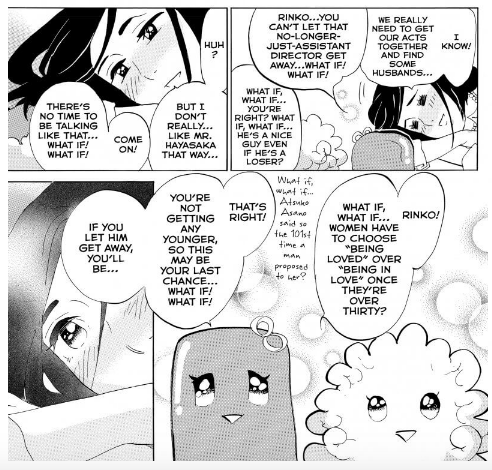
Consider Higashimura’s strategy for making us privy to Rinko’s thoughts. Though Rinko often functions as the series’ narrator, Higashimura looks for more imaginative ways to dramatize Rinko’s emotional life than simple disclosure. In one scene, for example, Rinko’s food — yes, you read that right — cheerfully engages her in a conversation about her romantic dilemma:

Coming from one of her gal pals, this exchange would sound too on-the-nose, a bald statement of the manga’s main thesis. But coming from an izakaya dish? That’s genius! It allows us a window into Rinko’s state of mind (and her state of intoxication) without falling back on such shop-worn devices as the “Dear Diary” entry or the “Little did I know then…” voice-over.

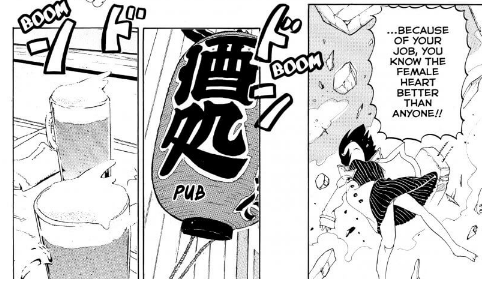
Elsewhere in chapter one, Higashimura uses a similar technique of transposing Rinko’s inner thoughts onto the outer world, using the visual language of action movies — explosions, falling debris — to evoke the intensity of Rinko’s embarrassment over misunderstanding a friendly overture:

This sequence, too, is genius: anyone who’s ever read too much into an email, a voice mail, a text, or a friendly conversation knows exactly how Rinko feels in that moment and can laugh — or cringe — in self-recognition. At the same time, however, the reader can also see that Rinko’s romantic delusions are blinding her to the real lesson of turning 33: that she should learn what — or who — she really wants instead of settling for Mr. Not Quite Right.

The first chapter ends with the introduction of a prickly, truth-telling character whose appearance adds a welcome jolt of energy to the story; his barroom sermon about self-defeating female behavior is a show-stopper, both for its blunt honesty and for the impact it has on Rinko and her pals. Whether he becomes Rinko’s enemy or love interest, his memorable exit leaves the reader wanting to know what happens next — further proof of Higashimura’s storytelling mojo.

TOKYO TARAREBA GIRLS, VOL. 1 • BY AKIKO HIGASHIMURA • KODANSHA COMICS • RATED OT, FOR OLDER TEENS (16+) 

Filed Under: Manga, Manga Critic, REVIEWS Tagged With: Akiko Higashimura, Josei, Kodansha Comics, Romance/Romantic Comedy

The Manga Critic’s Guide to Jiro Taniguchi

February 11, 2017 by Katherine Dacey


Word of Jiro Taniguchi’s death spread quickly this afternoon via Twitter and Facebook. It was a sobering moment for American fans; most of us imagined that he was only one great series away from mainstream recognition in the U.S., and eagerly hoped that his next release — whatever it might be — would wow new readers and make bank. Alas, the only appreciation we may see is in the value of his older, rarer titles like Icaro (a collaboration with French artist Moebius) and Samurai Legend (a collaboration with Kan Furuyama).

Manga lovers who haven’t yet discovered Taniguchi’s skill may be surprised to learn just how versatile and prolific he was. He leaves behind a rich assortment of historical dramas, hard-boiled crime thrillers, samurai swashbucklers, alpine adventures, food manga, and coming-of-age stories. As an introduction to Taniguchi’s sizeable oeuvre, I’ve compiled a list of my favorite titles, as well as a complete list of Taniguchi’s work in English.

Benkei in New York
With Jinpachi Mori • VIZ Media • 1 volume
Originally serialized in Big Comic Original, Benkei in New York focuses on a Japanese ex-pat living in New York. Like many New Yorkers, Benkei’s career is best characterized by slashes and hyphens: he’s a bartender-art forger-hitman who can paint a Millet from memory or make a killer martini. Benkei’s primary job, however, is seeking justice for murder victims’ families. Part of the series’ fun is watching him set elaborate traps for his prey, whether he’s borrowing a page from the Titus Andronicus playbook or using a grappling hook to take down a crooked longshoreman. Though we never doubt Benkei will prevail, the crackling script, imaginatively staged fight scenes, and tight plotting make Benkei in New York Taniguchi’s most satisfying crime thriller. – Reviewed at The Manga Critic on 3/20/12

A Distant Neighborhood
Fanfare/Ponent Mon • 2 volumes

A Distant Neighborhood is a wry, wistful take on a tried-and-true premise: a salaryman is transported back in time to his high school days, and must decide whether to act on his knowledge of the past or let events unfold as they did before. We’ve seen this story many times at the multiplex — Back to the Future, Peggy Sue Got Married — but Taniguchi doesn’t play the set-up for laughs; rather, he uses Hiroshi’s predicament to underscore the challenges of family life and the awkwardness of adolescence. (Hiroshi is the same chronological age as his parents, giving him special insight into the vicissitudes of marriage, as well as the confidence to cope with teenage tribulations.) Easily one of the most emotional, most intimate stories Taniguchi’s ever told. – Reviewed at The Manga Critic on 2/23/11

Furari
Fanfare/Ponent Mon • 1 volume

One part Walking Man, one part Times of Botchan, this elegant collection of stories focuses on Ino Tadataka (1745-1818), the cartographer responsible for the first complete map of Japan’s coastline. We meet Tadataka shortly before he embarks on the arduous task of surveying the main island. As we follow him through the parks and streets of Edo, we realize that Tadataka is consumed with measuring; he makes mental note of every step he takes, calculating and re-calculating his routes. That’s a slender premise on which to hang a manga, but Taniguchi’s fine eye for detail transforms Tadataka’s daily walks into an immersive experience, capturing the energy, light, and sounds of the eighteenth century cityscape in all its vitality. These walks are so vividly drawn, in fact, that you could read Furari in blissful ignorance of Tadataka’s identity and still find it utterly engrossing.

Guardians of the Louvre
NBM/Comics Lit • 1 VOLUME

Guardians of the Louvre has a simple premise: a Japanese artist dreams about the world’s most famous museum. In each chapter, our unnamed protagonist is temporarily transported to a particular place and time in the Louvre’s history, rubbing shoulders with famous artists, witnessing famous events, and chatting with the Nike of Samothrace, who chaperones him from exhibit to exhibit. The set-up provides Taniguchi with a nifty excuse to draw rural landscapes, gracious country manors, war-ravaged cities, and busy galleries, as well as convincing recreations of Van Gogh and Corot canvasses. If the story lacks the full emotional impact of A Zoo in Winter or A Distant Neighborhood, the gorgeous, full-color illustrations and deluxe presentation make Guardians a natural gateway for exploring Taniguchi’s work. – Reviewed at The Manga Critic on 1/6/17

Hotel Harbour View
With Natsui Sekikawa • VIZ Media • 1 volume

The two stories that comprise Hotel Harbour View are among the pulpiest in the Taniguchi canon. In the first, a man waits in a seedy Hong Kong bar for the person who’s supposed to kill him, while in the second, an assassin returns to Paris for a showdown with his former associates. Both stories can be enjoyed as simple exercises in hard-boiled crime, but attentive readers will appreciate Taniguchi and Sekikawa’s sly nods to film noir, yakuza flicks, and the French New Wave. The characters in both stories self-consciously behave like gangsters and molls, trading quips and telling well-rehearsed stories about their pasts; they even wear fedoras, a sure sign that they’re reliving their favorite moments from the silver screen. A mirrored shoot-out is the highlight of the volume, demonstrating Taniguchi’s crisp draftsmanship and mastery of perspective. – Reviewed at The Manga Critic on 1/14/11

Kodoku Gourmet
With Masayuki Qusumi • JManga • 1 volume*

If you’re a fan of Kingyo Used Books, you may remember the chapter in which Japanese backpackers shared a dog-eared copy of Kodoku no Gourmet (a.k.a. The Lonely Gourmet) in order to feel more connected to home. Small wonder they adored Gourmet: its hero, Goro Inoshigara, is a traveler who devotes considerable time and energy to seeking out his favorite foods wherever he goes. While the manga is episodic  — Goro visits a new restaurant in every chapter — Jiro Taniguchi does a wonderful job of conveying the social aspect of eating, creating brief but vivid portraits of each establishment: its clientele, its proprietors, and, of course, its signature dishes. Best of all, Taniguchi and writer Masayuki Qusumi have the good sense to limit the story to a single volume, allowing the reader to savor Goro’s culinary adventures, rather than ponder its very slight premise. – Reviewed at The Manga Critic on 5/24/12

The Summit of the Gods
With Yumemakura Baku • Fanfare/Ponent Mon • 5 volumes

On June 8, 1924, British explorer George Mallory started up the summit of Mt. Everest, never to be seen again. His disappearance drives the plot of The Summit of the Gods, a pulse-pounding adventure in which two modern-day climbers retrace Mallory’s steps up the Northeast Ridge, searching for clues to his fate. Although the drama ostensibly focuses on Fukumachi, a hard-charging photographer, and Habu, a tough-as-nails mountaineer, the real star of Summit is Everest. Taniguchi captures the mountain’s danger with his meticulous renderings of rock formations, glaciers, and quick-changing weather patterns, reminding us that Everest is one of the remotest places on Earth; at the top of the world, no one can hear you scream. – Reviewed at The Manga Critic on 10/12/2009

The Times of Botchan
With Natsuo Sekikawa • Fanfare/Ponent Mon •  5 volumes**

In The Times of Botchan, Natsuo Sekikawa and Jiro Taniguchi immerse readers in the tumult of the Meiji Restoration. Novelist Soseki Natsume (Botchan, I Am a Cat) functions as our de facto guide, introducing us to the suffragettes, anarchists, novelists, poets, and politicians whose struggle helped create modern Japan. Taniguchi invests small details with great meaning, using them to reveal the characters’ ambivalent relationship with the West; some embrace European dress, others flatly reject it, and most, like Natsume, strike a compromise, combining a yukata with a button-down shirt and bowler hat. Though Sekikawa’s script is not as nimble as Taniguchi’s artwork, the series leaves a vivid impression nonetheless, offering modern readers a window into Natsume’s world. – Reviewed at The Manga Critic on 5/19/2010

Venice
Fanfare/Ponent Mon • 1 volume

Venice — one of the last projects Jiro Taniguchi completed before his death in 2017 — is perhaps the most beautiful work he ever produced, a paean not only to the great Italian city, but to his own superb command of light, color, and line. Rendered in watercolor and ink, Venice‘s subtle palette and expansive treatment of the page are reminiscent of Taniguchi’s Guardians of the Louvre, while its premise recalls The Walking Man, Furari, and The Solitary Gourmet, three manga in which an unnamed male character strolls through the thoroughfares and byways of a major city, stopping to admire a blossoming tree or duck into an unassuming noodle shop. Taniguchi does more than recreate the Venetian landscape, however; he conveys the rhythms and emotions of a journey as the hero retraces his grandparents’ steps through 1930s Venice. – Reviewed at The Manga Critic on 3/2/18.

The Walking Man
Fanfare/Ponent Mon • 1 volume

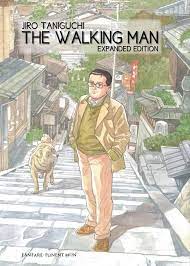
This nearly wordless manga follows an ordinary man through his daily routines. He walks his dog; he swims laps at the pool; he retrieves a model airplane from a tree. In less capable hands, the sheer lack of conflict would result in a dull comic, but Taniguchi invests these activities with meaning by interrupting them with moments of simple beauty: a rare bird alighting on a branch, a rooftop view of a neighborhood in spring bloom. Though we learn very little about the protagonist — he remains nameless throughout the story — his capacity for noticing and savoring these details becomes a small act of heroism, a conscious effort to resist the indifference, complacency, and impatience that blinds us to our surroundings and dulls our imaginations.

A Zoo in Winter
Fanfare/Ponent Mon • 1 volume

Drawing on his own experiences, Jiro Taniguchi spins an engaging tale about a young man who abandons a promising career in textile design for the opportunity to become a manga artist. Though the basic plot invites comparison with Bakuman, Taniguchi does more than just document important milestones in Hamaguchi’s career: he shows us how Hamaguchi’s emotional maturation informs every aspect of his artistry — something that’s missing from many other portrait-of-an-artist-as-a-young-man sagas, which place much greater emphasis on the pleasure of professional recognition than on the satisfaction of mastering one’s craft. Lovely, moody artwork and an appealing cast of supporting characters complete this very satisfying package.  —Reviewed at The Manga Critic on 5/28/11

* * * * * *

Below is a complete list of Jiro Taniguchi’s manga in English. Please note that I’ve provided the publication information for the English translations, not the original Japanese editions. This list was last updated on August 28, 2023 to include several books that have been released since 2017.

As Artist and Author

  • Taniguchi, Jiro. A Distant Neighborhood. Fanfare/Ponent Mon, 2009. 2 vols.
  • Taniguchi, Jiro. Furari. Fanfare/Ponent Mon, 2017. 1 vol.
  • Taniguchi, Jiro. Guardians of the Louvre. NBM/Comics Lit, 2016. 1 vol.
  • Taniguchi, Jiro. The Ice Wanderer and Other Stories. Fanfare/Ponent Mon, 2010. 1 vol.
  • Taniguchi, Jiro. A Journal of My Father, Fanfare/Ponent Mon, 2021. 1 vol.
  • Taniguchi, Jiro. The Quest for the Missing Girl. Fanfare/Ponent Mon, 2010. 1 vol.
  • Taniguchi, Jiro. Sky Hawk. Fanfare/Ponent Mon, 2019. 1 vol.
  • Taniguchi, Jiro. Venice. Fanfare/Ponent Mon, 2017. 1 vol.
  • Taniguchi, Jiro. The Walking Man. Fanfare/Ponent Mon, 2007. 1 vol.
  • Taniguchi, Jiro. A Zoo in Winter. Fanfare/Ponent Mon, 2011. 1 vol.

As Artist

  • Boilet, Frederic and Jiro Taniguchi. Tokyo Is My Garden. Fanfare/Ponent Mon, 2010. 1 vol.
  • Furuyama, Kan and Jiro Taniguchi. Samurai Legend. Central Park Media, 2003. 1 vol.
  • Moebius and Jiro Taniguchi. Icaro. IBooks, 2003-2004. 2 vols.
  • Mori, Jinpachi and Jiro Taniguchi. Benkei in New York. VIZ Media. 2001. 1 vol.
  • Qusumi, Masayuki and Jiro Taniguchi. Kodoku Gourmet.  JManga, 2012. 1 vol.*
  • Sekikawa, Natsuo and Jiro Taniguchi. Hotel Harbour View. VIZ Media, 2001. 1 vol.
  • Sekikawa, Natsuo and Jiro Taniguchi. The Times of Botchan. Fanfare/Ponent Mon, 2007-2010. 5 vols.**
  • Yumemakura, Baku and Jiro Yaniguchi. The Summit of the Gods. Fanfare/Ponent Mon, 2009-2015. 5 vols.

*This title was only released digitally through the JManga platform.

**This series is incomplete in English; the complete Japanese edition spans 10 volumes.

Filed Under: Manga, Manga Critic, Recommended Reading Tagged With: Fanfare/Ponent Mon, Jiro Taniguchi, JManga, NBM/Comics Lit, VIZ

Kuma Miko: Girl Meets Bear, Vol. 1

February 5, 2017 by Katherine Dacey

By all rights, Kuma Miko: Girl Meets Bear should be interesting: it takes place in a rural village where talking bears and humans have peacefully coexisted for centuries. The story focuses on Machi, a priestess-in-training who’s learning the ropes from Natsu, her ursine mentor. Though Machi is determined to serve the village in her capacity as miko, she’s also determined to attend high school in a nearby city — something none of her predecessors have done.

While the set-up is ripe with potential, the execution is oddly flat. Part of the problem is that the leads feel more like ideas than characters. Machi, in particular, is a collection of quirks in search of a personality. In an effort to endear her to the reader, author Masume Yoshimoto makes her naive, ditsy, shy, and spazzy — a veritable catalog of manic pixie dream girl traits — but never reveals why she behaves so irrationally. Natsu is a little more fleshed out: he has wisdom to impart, and frets about Machi’s welfare. Worrying about another person, however, isn’t the same thing as having a personality, and here, too, Yoshimoto falls short. Natsu’s concern doesn’t suggest any deeper knowledge of Machi’s past or her reasons for wanting to leave the village; any reasonable person would worry about someone who seems as impetuous and dim-witted as Machi.

The only character with any presence is Yoshio, Machi’s pervy 25-year-old cousin. In one memorable scene, Yoshio gets so carried away describing the village’s history that he forgets his audience, accidentally regaling third graders with salacious details of a human-bear union. This scene might be funny, but the author wants to have it both ways, aiming for a mixture of titillation and tee-hees that’s just plain uncomfortable; I’m with the little girl who declares, “Sexual harassment!” before covering her ears.

If any of the other five stories had left as vivid an impression as “Village Legends,” I might cautiously recommend Kuma Miko to fans of off-beat slice-of-life comedies, but the rest of volume one was vanilla in comparison. Competent but undistinguished artwork and sluggish pacing pushed the title further into the “No” column for me; if I’m going to read about talking bears, dammit, I’d like to see a little more imagination on display.

KUMA MIKO, VOL. 1: GIRL MEETS BEAR • BY MASUME YOSHIMOTO • ONE PEACE BOOKS • NO RATING (SOME SUGGESTIVE MATERIAL; THIS TITLE IS BETTER SUITED FOR READERS 13+)

Filed Under: Manga, Manga Critic, REVIEWS Tagged With: Kuma Miko, Masume Yoshimoto, One Peace Books

Deathtopia, Vol. 1

February 1, 2017 by Katherine Dacey

It’s never a good sign when you enjoyed the Baka-Updates thread about a manga more than the actual manga, but that’s the case for Deathtopia, a title that scores a hat trick for being gory, exploitative, and boring. Part of the problem is the story: it’s the umpteenth example of an ordinary teen discovering that he’s been chosen to save the world. Koh Fujimura, the hero of Deathtopia, is the only person who can detect the presence of “Them,” a group of super-human predators that commit sadistic, stagey murders. Aiding him in the quest to ferret out these menaces are Maya Hoshimiya, Yui Kisagari, and Saki Yagami, a trio of buxom special agents who favor bustiers and short skirts over traditional uniforms. (Call me crazy, but where do you holster a gun if you’re not wearing any pants?)

All of this would be easier to swallow if manga-ka Yoshinobu Yamada had bestowed any personality on his characters, or supplied them with motives for the work they do. None of the cast, however, show any traces of wit or curiosity; all of them behave like well-programmed robots, dutifully marching from one grotesque crime scene to the next. Yamada allows Koh a few moments of fear and confusion, but these beats land with the emotional force of a Linux manual since we know almost nothing about him. Even the character designs are generic: there’s a pretty girl with short hair and hot pants, a pretty girl with a pony tail and a school uniform, and a pretty girl with long hair and a suit. (Actually, she’s the only one who looks like a law-enforcement agent, since she’s wearing comfortable shoes.) The bad guys, by contrast, are so uniformly and cartoonishly ugly it’s a wonder that Koh, Maya, Yui, and Saki can’t identify them at 50 paces.

Perhaps the most telling sign that Yamada is more interested in cheesecake than plot is that he draws the female characters’ breasts with more individuality than their faces. Yamada further diminishes his female characters by reducing them to types — the psychopathic bitch, the aloof older woman — and making his teenage male hero miraculously “better” at monster-hunting, despite his young age and lack of training. The only evidence of Maya, Yui, and Saki’s superior skill is supplied by Koh himself in the form of a voice-over; he muses that “These women are amazing! Even I can tell that their every move is calculated,” although that statement is undermined by the way Yamada stages a subsequent shoot-out.

The manga’s best gambit is shamelessly pilfered from John Carpenter’s They Live! (1988). In this Reagan-era cult classic, sunglasses enabled the hero to see that aliens were living amongst us, using subliminal messaging to subdue and control humanity:

In Deathtopia, Koh gains a similar ability after eye surgery: he sees the monsters as humans with scribbly, mouthless faces, drifting unnoticed through Tokyo streets. Only when Koh dons glasses does he lose sight of “Them”; in an original touch, glass blocks his monster vision. For all the promise this idea holds, however, Yamada makes no attempt to explore its allegorical potential, instead lavishing most of his attention on dismembered corpses and topless girls. Carpenter, by contrast, used They Live! to explore the evils of consumerism and conformity and deliver one of the longest, goofiest, and most admired fight sequences in B-movie history.

In sum, Deathtopia is the sort of manga you might think was cool if you hadn’t read any manga, or were just hoping to steal a glimpse of naked girls. Anyone who’s read Alive: The Final Evolution, Bloody Monday, Death Note, Platinum End, or even Yamada’s Cage of Eden, however, won’t find much to distinguish Deathtopia from these other teenage male fantasies, as it lacks the verve, polish, and imagination of the best examples in this genre.

DEATHTOPIA, VOL. 1 • BY YOSHINOBU YAMADA • KODANSHA COMICS • RATED M, for MATURE

Filed Under: Manga, Manga Critic, REVIEWS Tagged With: Action/Adventure, Kodansha Comics, Yoshinobu Yamada

Happiness, Vols. 1-2

January 27, 2017 by Katherine Dacey

The first chapter of Happiness reads like a teenage boy’s answer to Are You There, God? It’s Me, Margaret. Makoto, the principle character, is doing his best to cope with the indignities of being fourteen: he’s bullied by the popular kids, pestered by his well-meaning but clueless mother, and embarrassed by his lustful reactions to pretty girls. Though he has one friend — the equally uncool Nunota — Makoto spends most of his time alone.

A nighttime trip to the convenience store, however, jolts Makoto out of his routine. In a dark alley, a female vampire tackles and pins him to the ground, offering the following ultimatum: “Do you want to die like this, or do you want to be like me?” With tears and snot streaming down his face, Makoto whimpers, “I don’t want to die,” thus beginning his transformation from ordinary teen to bloodsucker.

If Makoto thought that wet dreams and wedgies were awful, he soon discovers that they pale in comparison with the first stages of vampirism. He suffers from an unquenchable, almost violent thirst and finds direct sunlight blisteringly painful. Worse still, his sense of smell is now so acute that he swoons and sweats in the presence of bloody noses, cuts, and girls, a symptom that sends him into an even deeper spiral of shame. The only potential upside to his condition is his supernatural strength: though he still looks like a 100-pound weakling, he can leap from great heights and deliver a lethal karate chop when the scent of blood is in the air.

Given Makoto’s age, it’s not surprising that author Shizuno Oshimi treats his hero’s transformation as a metaphor for puberty itself. In the manga’s earliest scenes, Oshimi frankly documents Makoto’s efforts to cope with hormonal surges and maternal helicoptering, capturing Makoto’s discomfort in his own skin. As Makoto begins turning into a vampire, however, his increasingly urgent thirst for blood amplifies the very aspects of puberty that most embarrass him — his keen interest in sex, his inability to conceal his arousal from others — making him feel even more powerless.

To capture Makoto’s turbulent emotions, Oshimi employs a variety of artistic styles. Some panels are rendered in smudgy pastels, suggestive of a foggy evening, while other panels are rendered in swirling, pulsating lines reminiscent of The Scream. These visual interludes last only a page or two, but vividly capture the nausea, pain, and confusion Makoto experiences in the grips of bloodlust.

Perhaps no scene is as evocative as that first encounter between Makoto and the female vampire. Oshimi uses rapid shifts in perspective and a few fleeting images — a shadowy figure plunging through space, a dark smear of blood — to indicate what’s happening. The extreme close-ups and feverish pacing neatly mimic Makoto’s growing sense of panic as he considers the possibility of dying in an alleyway — and not just any death, but a potentially humiliating one. (And really, what could be worse than that from a fourteen-year-old’s perspective?)

The pacing, like the artwork, is expertly handled. Oshimi has a knack for lulling readers into a false sense of security that Makoto will transcend (or master) his vampirism and silence his tormentors. Then — bam! Oshimi inserts a twist or introduces a new character who contradicts our sense of how socially maladroit or invulnerable Makoto really is. The appearance in volume two of a new bloodsucker, for example, reveals the extent to which vampires pose an active threat to one another — something that Makoto in his solipsistic misery never considered when he agreed to become a vampire himself.

And speaking of volume two, Oshimi does an excellent job of expanding and developing the cast of characters. By volume’s end, there’s more at stake than Makoto’s desire to escape humiliation; Makoto must decide whether to become a full-fledged vampire or fight for his humanity, a decision complicated by his budding friendship with a female classmate. How Makoto resolves this dilemma remains to be seen, though his struggle should provide plenty of dramatic grist for volume 3 (available February 14th).

The bottom line: Happiness is a rare vampire manga with bite: it’s smart, stylish, and unsettling, drawing readers into Makoto’s world with an honest look at the horrors of being fourteen. And what could be scarier than that?

HAPPINESS, VOLS. 1-2 • BY SHIZUNO OSHIMI • KODANSHA COMICS • RATING: OT, for OLDER TEENS (16+)

Filed Under: Manga, Manga Critic, REVIEWS Tagged With: Happiness, Horror/Supernatural, Kodansha Comics, Shizuno Oshimi, Shonen, Vampires

  • « Go to Previous Page
  • Page 1
  • Interim pages omitted …
  • Page 6
  • Page 7
  • Page 8
  • Page 9
  • Page 10
  • Interim pages omitted …
  • Page 39
  • Go to Next Page »
 | Log in
Copyright © 2010 Manga Bookshelf | Powered by WordPress & the Genesis Framework