• Skip to primary navigation
  • Skip to main content
  • Skip to primary sidebar
  • Home
  • About Us
    • Privacy Policy
    • Comment Policy
    • Disclosures & Disclaimers
  • Resources
    • Links, Essays & Articles
    • Fandomology!
    • CLAMP Directory
    • BlogRoll
  • Features & Columns
    • 3 Things Thursday
    • Adventures in the Key of Shoujo
    • Bit & Blips (game reviews)
    • BL BOOKRACK
    • Bookshelf Briefs
    • Bringing the Drama
    • Comic Conversion
    • Fanservice Friday
    • Going Digital
    • It Came From the Sinosphere
    • License This!
    • Magazine no Mori
    • My Week in Manga
    • OFF THE SHELF
    • Not By Manga Alone
    • PICK OF THE WEEK
    • Subtitles & Sensibility
    • Weekly Shonen Jump Recaps
  • Manga Moveable Feast
    • MMF Full Archive
    • Yun Kouga
    • CLAMP
    • Shojo Beat
    • Osamu Tezuka
    • Sailor Moon
    • Fruits Basket
    • Takehiko Inoue
    • Wild Adapter
    • One Piece
    • After School Nightmare
    • Karakuri Odette
    • Paradise Kiss
    • The Color Trilogy
    • To Terra…
    • Sexy Voice & Robo
  • Browse by Author
    • Sean Gaffney
    • Anna Neatrour
    • Michelle Smith
    • Katherine Dacey
    • MJ
    • Brigid Alverson
    • Travis Anderson
    • Phillip Anthony
    • Derek Bown
    • Jaci Dahlvang
    • Angela Eastman
    • Erica Friedman
    • Sara K.
    • Megan Purdy
    • Emily Snodgrass
    • Nancy Thistlethwaite
    • Eva Volin
    • David Welsh
  • MB Blogs
    • A Case Suitable For Treatment
    • Experiments in Manga
    • MangaBlog
    • The Manga Critic
    • Manga Report
    • Soliloquy in Blue
    • Manga Curmudgeon (archive)

Manga Bookshelf

Discussion, Resources, Roundtables, & Reviews

Manga Critic

A Certain Scientific Railgun, Vol. 1

June 6, 2011 by Katherine Dacey

Question: what do you get when you cross Sunshine Sketch with X-Men? Answer: A Certain Scientific Railgun, a story about a quartet of schoolgirl psychics who fight crime, go shopping, and eat parfaits. If that combination sounds like the manga equivalent of a peanut butter and tunafish sandwich, it is; the story see-saws between sci-fi pomposity and 4-koma cuteness, never combining these two very different flavors into an appetizing dish.

The story takes place in Academy City, a metropolis whose entire population consists of psychics and psychics-in-training. After a series of bank robberies and bombings, members of Justification, Academy City’s teen police force, make a disturbing discovery: some psychics — or “espers,” in the series’ parlance — are using an illicit drug called Level Upper to enhance their natural ability. (Level Upper is, in essence, steroids for teleporters and mind-readers.) Though the drug grants them tremendous power, that power comes with a terrible price, causing the user to slip into an irreversible coma. The girls must then track the drug to its source before it can spread through Academy City.

As promising as the plot sounds, it often feels like an afterthought, something that happens in between the principal characters’ trips to the mall, the cafe, and the gym. (There’s an entire scene devoted to one character’s efforts to find the perfect pair of pajamas. No, I’m not kidding.) The lead character, Mikoto, is the strongest and best-defined of the bunch; she’s described as a “level-five esper” capable of channeling up to one billion volts of electricity, a skill she gleefully unleashes on robbers, perverts, and her arch-nemesis, a male psychic named Toma Kamijo. Though Mikoto is an unappealing heroine, she’s the only female character who has a real personality; Mikoto is angry, unpredictable, and stubborn, but she’s also very disciplined, cultivating her skills with practice and study. Kuroko, Ruiko, and Kazari, the remaining members of the quartet, are less developed: each girl has one psychic ability that she uses in combat and one adorable tic that she exhibits while hanging out with friends. (Actually, “adorable” is up for debate; grabbing another girl’s breasts seems more predatory than cute.)

Thin as the characterizations may be, A Certain Scientific Railgun faces an even bigger problem: many important plot elements are poorly explained. Not that the series wants for exposition-dense conversation; the opening ten pages are filled with characters narrating Mikoto’s rise from level-zero nobody to level-five bad-ass. But many other details remain unexplored: who is Toma and why does Mikoto detest him? why do so many characters have supernatural abilities? why has the government created an entire city just for young psychics? Perhaps the most egregious example is Mikoto herself; though we learn a lot about her education, the fact that she’s been cloned is glossed over, as if having six genetic doppelgangers was entirely unremarkable.

Given Railgun‘s origins — it’s a side story within A Certain Magical Index, a long-running light novel series — it’s not surprising that so many of these crucial details remain unexamined; the author might reasonably expect Japanese fans to know the Magical Index universe well enough to jump into Railgun with a minimum of exposition. For a newcomer, however, the experience is frustrating; uninteresting plot points are explored in excruciating detail, while many of the things that seem more fundamental to the story (e.g. the characters’ psychic abilities) are barely addressed at all.

The final chapter suggests that future installments may feature more scenes of crime-solving and fewer scenes of tweenage girls showering, eating desserts, and horsing around. An honest-to-goodness mystery would go a long way towards giving the story some dramatic shape; right now, A Certain Scientific Railgun feels as aimless and airy as a volume of Sunshine Sketch, even if Mikoto and friends have cooler talents than the Sunshine girls.

Review copy provided by Seven Seas. Volume one will be released on June 30, 2011.

A CERTAIN SCIENTIFIC RAILGUN, VOL. 1 • STORY BY KAZUMA KAMACHI, ART BY MOTIO FUYUKAWA • SEVEN SEAS • 192 pp. • RATING: TEEN (13+)

Filed Under: Manga, Manga Critic, REVIEWS Tagged With: Certain Magical Index, Seven Seas

Tenjo Tenge: Full Contact Edition, Vol. 1

June 3, 2011 by Katherine Dacey 26 Comments

When I tell people that I review manga, they often ask me, “Isn’t it all porn and ninjas?” No, I assure them, there are manga about cooking, gambling, dating, teaching, crime solving, alien fighting, computer programming, ghost busting, mind reading, wine tasting, dog training, and just about any other topic you can imagine; if there’s an audience to be served, Japanese publishers will find a way to reach them through comics.

“But it seems like every manga I’ve seen has a girl in a short skirt waving a sword,” they reply. I usually offer a counter-example — say, Ouran High School Host Club or What’s Michael? — but I know the kind of manga they have in mind. It’s filled with female characters who have women’s bodies and girls’ faces; schoolgirls who wear their uniforms twenty-four hours a day; fighters who use swords, even though the story is set in the present; and supporting characters who dress like Edo-era refugees, even though their cohorts are wearing sneakers and hoodies. In short, what they’re seeing in their mind’s eye looks a lot like Tenjo Tenge.

Plot-wise, Tenjo Tenge isn’t much more complicated than “girls in skirts waving katanas.” The story takes place at Todo Academy, one of those only-in-manga institutions where students study martial arts technique to the exclusion of anything else. (If anyone attends a math class in Tenjo Tenge, I missed it.) First-year students Soichiro Nagi and Bob Makihara fully expect to rule the roost with their awesome fighting skills, but are quickly disabused of the notion when they run afoul of Todo’s Executive Council. Mindful of their greenhorn status, the boys join the Juken Club, an organization lead by Maya Natsume, a third-year student who’s handy with a sword. In so doing, however, Soichiro and Bob become targets for the Executive Council, which carries on an energetic, bloody feud with Maya and her younger sister.

Flipping through the first volume of VIZ’s “Full Contact” edition, it’s easy to see why DC Comics censored the original English print run. The story abounds in the kind of gratuitous nudity and sexual encounters that make an unadulterated version a tough sell at big chain stores like Wal-Mart and Barnes & Noble. DC Comics’ solution was an inelegant one: they re-wrote the script, drew bras and panties on naked girls, and cut some of the most offensive passages. As an advocate of free speech, I can’t condone the bowdlerization of any text, especially in the interest of a more commercially viable age-rating , but as a woman, it’s hard to celebrate the restoration of a graphic rape scene or images of naked girls throwing themselves at the heroes.

Whether those scenes are really necessary to advancing the plot is another issue. The rape, in particular, is an ugly exercise in exploitation, pitting a grown man against a teenager who has a twelve-year-old’s face and a porn star’s body. Though Oh!Great shows us the victim’s terrified expression in several panels, he lavishes far more attention on her anatomy, twisting her body into the kind of grotesque, provocative poses that were a stock-in-trade of Hustler. What makes this passage especially nasty is its underlying intent; we’re not being asked to identify with the victim, or burn with outrage over her violation, but to be aroused by her naked body. In a word: yuck.

From time to time, Oh!Great gives the Natsume sisters a chance to strut their martial arts stuff, suggesting that both girls are as tough and cunning as their male counterparts, but he can’t resist tearing off their clothes, or showing us their panties, especially when they’re in the middle of intense, hand-to-hand combat. And if the characters’ complete objectification wasn’t bad enough, Oh!Great draws such grossly misshapen bodies that it’s hard to imagine who would find them sexy; say what you will about Ryoichi Ikeda and Kazuo Koike’s Wounded Man — and yes, there’s plenty to say about the exploitation of its female characters — but Ikeda knew how to draw beautiful women. Oh!Great’s female characters, on the other hand, look like blow-up dolls, incapable of standing on their own two feet, let alone brandishing a sword or high-kicking an opponent.

Tenjo Tenge fans who were angered by the first English-language edition will be pleased with VIZ’s new translation. Many of the elements that had been eliminated or camouflaged in the first version have been restored; characters drop f-bombs and drop trou without editorial intervention. As an added enticement, VIZ has formatted the story as a series of two-in-one omnibuses, complete with glossy color plates and oversized trim. Given the care with which the new Tenjo Tenge was prepared, I wish I could say that the uncensored version convinced me that I’d unfairly dismissed the genius of Oh!Great the first time around. Alas, the answer is no; the story comes is too perilously close to the porn-and-ninjas stereotype for my taste.

Review copy provided by VIZ Media, LLC. Volume one of Tenjo Tenge will be released on June 7, 2011.

TENJO TENGE: FULL CONTACT EDITION, VOL. 1 • BY OH!GREAT • VIZ MEDIA • 386 pp. • RATING: MATURE (18+)

Filed Under: Manga Critic Tagged With: Martial Arts, Oh!Great, Tenjo Tenge Full Contact Edition, VIZ

Tenjo Tenge: Full Contact Edition, Vol. 1

June 3, 2011 by Katherine Dacey

When I tell people that I review manga, they often ask me, “Isn’t it all porn and ninjas?” No, I assure them, there are manga about cooking, gambling, dating, teaching, crime solving, alien fighting, computer programming, ghost busting, mind reading, wine tasting, dog training, and just about any other topic you can imagine; if there’s an audience to be served, Japanese publishers will find a way to reach them through comics. “But it seems like every manga I’ve seen has a girl in a short skirt waving a sword,” they reply. I usually offer a counter-example — say, Ouran High School Host Club or What’s Michael? — but I know the kind of manga they have in mind. It’s filled with female characters who have women’s bodies and girls’ faces; schoolgirls who wear their uniforms twenty-four hours a day; fighters who use swords, even though the story is set in the present; and supporting characters who dress like Edo-era refugees, even though their cohorts are wearing sneakers and hoodies. In short, what they’re seeing in their mind’s eye looks a lot like Tenjo Tenge.

Plot-wise, Tenjo Tenge isn’t much more complicated than “girls in skirts waving katanas.” The story takes place at Todo Academy, one of those only-in-manga institutions where students study martial arts technique to the exclusion of anything else. (If anyone attends a math class in Tenjo Tenge, I missed it.) First-year students Soichiro Nagi and Bob Makihara fully expect to rule the roost with their awesome fighting skills, but are quickly disabused of the notion when they run afoul of Todo’s Executive Council. Mindful of their greenhorn status, the boys join the Juken Club, an organization lead by Maya Natsume, a third-year student who’s handy with a sword. In so doing, however, Soichiro and Bob become targets for the Executive Council, which carries on an energetic, bloody feud with Maya and her younger sister.

Flipping through the first volume of VIZ’s “Full Contact” edition, it’s easy to see why DC Comics censored the original English print run. The story abounds in the kind of gratuitous nudity and sexual encounters that make an unadulterated version a tough sell at big chain stores like Wal-Mart and Barnes & Noble. DC Comics’ solution was an inelegant one: they re-wrote the script, drew bras and panties on naked girls, and cut some of the most offensive passages. As an advocate of free speech, I can’t condone the bowdlerization of any text, especially in the interest of a more commercially viable age-rating , but as a woman, it’s hard to celebrate the restoration of a graphic rape scene or images of naked girls throwing themselves at the heroes.

Whether those scenes are really necessary to advancing the plot is another issue. The rape, in particular, is an ugly exercise in exploitation, pitting a grown man against a teenager who has a twelve-year-old’s face and a porn star’s body. Though Oh!Great shows us the victim’s terrified expression in several panels, he lavishes far more attention on her anatomy, twisting her body into the kind of grotesque, provocative poses that were a stock-in-trade of Hustler. What makes this passage especially nasty is its underlying intent; we’re not being asked to identify with the victim, or burn with outrage over her violation, but to be aroused by her naked body. In a word: yuck.

From time to time, Oh!Great gives the Natsume sisters a chance to strut their martial arts stuff, suggesting that both girls are as tough and cunning as their male counterparts, but he can’t resist tearing off their clothes, or showing us their panties, especially when they’re in the middle of intense, hand-to-hand combat. And if the characters’ complete objectification wasn’t bad enough, Oh!Great draws such grossly misshapen bodies that it’s hard to imagine who would find them sexy; say what you will about Ryoichi Ikeda and Kazuo Koike’s Wounded Man — and yes, there’s plenty to say about the exploitation of its female characters — but Ikeda knew how to draw beautiful women. Oh!Great’s female characters, on the other hand, look like blow-up dolls, incapable of standing on their own two feet, let alone brandishing a sword or high-kicking an opponent.

Tenjo Tenge fans who were angered by the first English-language edition will be pleased with VIZ’s new translation. Many of the elements that had been eliminated or camouflaged in the first version have been restored; characters drop f-bombs and drop trou without editorial intervention. As an added enticement, VIZ has formatted the story as a series of two-in-one omnibuses, complete with glossy color plates and oversized trim. Given the care with which the new Tenjo Tenge was prepared, I wish I could say that the uncensored version convinced me that I’d unfairly dismissed the genius of Oh!Great the first time around. Alas, the answer is no; the story comes is too perilously close to the porn-and-ninjas stereotype for my taste.

Review copy provided by VIZ Media, LLC. Volume one of Tenjo Tenge will be released on June 7, 2011.

TENJO TENGE: FULL CONTACT EDITION, VOL. 1 • BY OH!GREAT • VIZ MEDIA • 386 pp. • RATING: MATURE (18+)

Filed Under: Manga, Manga Critic, REVIEWS Tagged With: Martial Arts, Oh!Great, Tenjo Tenge Full Contact Edition, VIZ

The Best Manga You’re Not Reading: Rica ‘tte Kanji!?

June 1, 2011 by Katherine Dacey 17 Comments

The most basic yuri plotline — what publisher Erica Friedman calls “Story A” — traces its roots back to the pioneering Class S fiction of Nobuko Yoshiya (1896-1973). In works such as Hana monogatari (1916-24) and Yaneura no nishojo (1919), schoolgirls developed intense, often romantic, feelings for other schoolgirls. Given the period in which Yoshiya wrote, it’s not surprising that her characters’ relationships were never consummated; the girls might exchange passionate letters or meaningful glances, but marriage, graduation, or death prevented them from being together as a couple. Fifty years later, when manga artists such as Ryoko Yamagishi and Riyoko Ikeda began writing girls’ love stories, they, too, favored tragic endings; Yamagishi’s Shiroi Heya no Futari (1971), for example, culminates in a melodramatic death (suicide by ex-boyfriend, to be exact), as do Ikeda’s Oniisama e… (1975) and Claudine…! (1978).

Small wonder, then, that manga-ka Rica Takashima saw a vacuum that needed filling. “There were very few manga with lesbian stories,” Takashima explains in the afterword to Rica ‘tte Kanji!? “Only depressing, sad stories about ‘forbidden love’ and with a break-up in the end. For example, ‘If I were a man, I could marry you.’ That kind of thing, but I wanted to read a HAPPY story.”

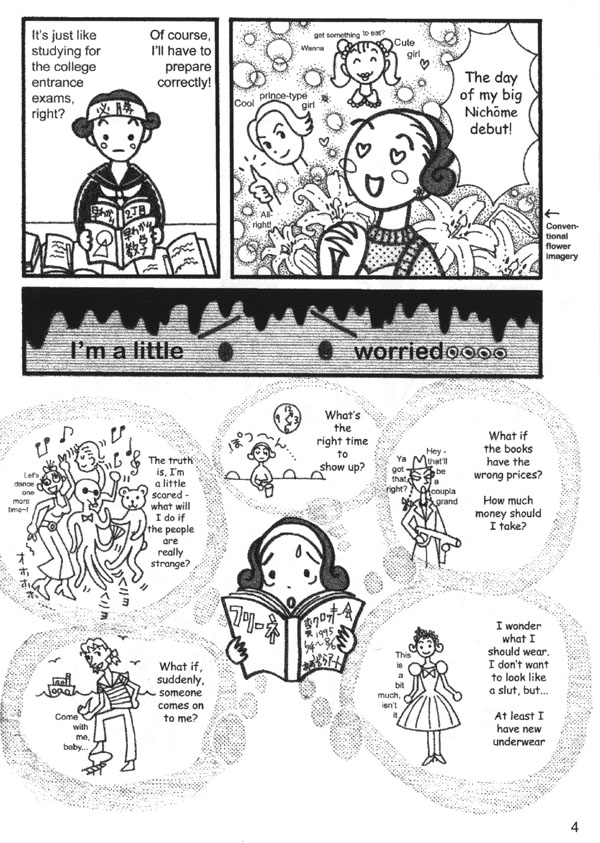
And “happy” is the perfect adjective to describe Rica ‘tte Kanji!? Rica, the heroine, is a cheerful optimist who moves to Tokyo to attend junior college (she plans to major in early childhood development) and explore the Nichome district, home to the city’s gay community. At the beginning of the series, Rica is nervous about visiting Nichome for the first time, worrying about what to wear and how to handle pick-up lines:

Rica’s fears are quickly allayed when she’s introduced to Miho, a sardonic art student a few years Rica’s senior. The two meet cute on Rica’s first trip to Nichome’s Lily Bar, where Rica confesses that she’s never met “an actual lesbian.” “I grew up out in the country,” she explains to Miho. “It’s the same for everyone in the beginning,” Miho assures her, prompting Rica to declare Miho her first gay friend. Though Miho falls for Rica right away, Rica’s lack of experience and general ditziness makes her oblivious to Miho’s advances. Their relationship has another hurdle to clear as well: Rica is just as nervous about the idea of having sex as she was about making a good impression at the Lily Bar, and keeps Miho at arm’s length — figuratively and literally — as she tries to decide what she’s comfortable doing.

What Takashima does better than most is to find the comedy in these situations, not by creating artificial misunderstandings between the characters, or manufacturing romantic rivals, but by making us privy to Rica and Miho’s thoughts. The two women’s internal monologues are funny, peppered with cute and weird observations, but they’re also very truthful; who among us hasn’t worried about putting the moves on a friend or being naked with a new partner?

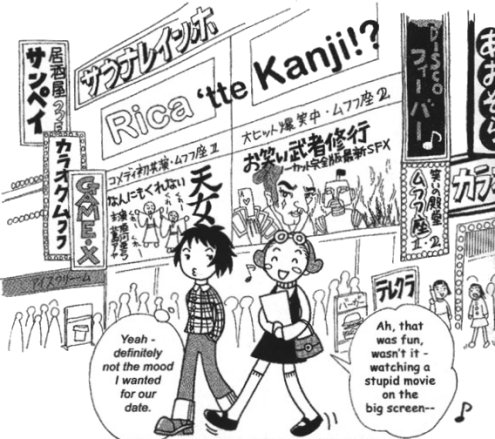
Though Takashima’s script is charming, what really makes Rica ‘tte Kanji!? work is the art. That may seem like a funny thing to say about a story in which the characters are little more than well-dressed stick figures with cute, round faces, but Takashima’s illustrations have a warm, handmade quality. Better still, the artwork never panders to male yuri fans; by rendering the characters as cute, paper-doll figures, Takashima directs the eye away from Rica and Miho’s bodies towards their faces, compelling the reader to see the women as two people fumbling through a relationship, not fantasy objects.

And speaking of fantasy, a few reviewers have pointed out the absence of real conflict in Rica ‘tte Kanji!?. Though Miho and Rica’s relationship hits a few minor snags, their romance takes place in a bubble untouched by homophobia or workaday concerns. It’s a fair criticism, I suppose, but one that misses the point; Rica ‘tte Kanji!? is a cheeky, cheerful rebuke to the Tragic Gay Story, substituting a happily-ever-after ending for death and separation.

Impatient readers can find copies of Rica ‘tte Kanji on Amazon for about $24.00. If you’re willing to wait a few months, however, ALC Publishing will be releasing a new omnibus edition that will include the original Rica ‘tte Kanji stories, as well as material written for ALC’s Yuri Monogatari anthologies.

RICA ‘TTE KANJI!? • BY RICA TAKASHIMA • ALC PUBLISHING • 96 pp.

Filed Under: Manga Critic Tagged With: ALC Publishing, Rica 'tte Kanji Review, Rica Takashima, yuri

The Best Manga You’re Not Reading: Rica ‘tte Kanji!?

June 1, 2011 by Katherine Dacey

The most basic yuri plotline — what publisher Erica Friedman calls “Story A” — traces its roots back to the pioneering Class S fiction of Nobuko Yoshiya (1896-1973). In works such as Hana monogatari (1916-24) and Yaneura no nishojo (1919), schoolgirls developed intense, often romantic, feelings for other schoolgirls. Given the period in which Yoshiya wrote, it’s not surprising that her characters’ relationships were never consummated; the girls might exchange passionate letters or meaningful glances, but marriage, graduation, or death prevented them from being together as a couple. Fifty years later, when manga artists such as Ryoko Yamagishi and Riyoko Ikeda began writing girls’ love stories, they, too, favored tragic endings; Yamagishi’s Shiroi Heya no Futari (1971), for example, culminates in a melodramatic death (suicide by ex-boyfriend, to be exact), as do Ikeda’s Oniisama e… (1975) and Claudine…! (1978).

Small wonder, then, that manga-ka Rica Takashima saw a vacuum that needed filling. “There were very few manga with lesbian stories,” Takashima explains in the afterword to Rica ‘tte Kanji!? “Only depressing, sad stories about ‘forbidden love’ and with a break-up in the end. For example, ‘If I were a man, I could marry you.’ That kind of thing, but I wanted to read a HAPPY story.”

And “happy” is the perfect adjective to describe Rica ‘tte Kanji!? Rica, the heroine, is a cheerful optimist who moves to Tokyo to attend junior college (she plans to major in early childhood development) and explore the Nichome district, home to the city’s gay community. At the beginning of the series, Rica is nervous about visiting Nichome for the first time, worrying about what to wear and how to handle pick-up lines:

Rica’s fears are quickly allayed when she’s introduced to Miho, a sardonic art student a few years Rica’s senior. The two meet cute on Rica’s first trip to Nichome’s Lily Bar, where Rica confesses that she’s never met “an actual lesbian.” “I grew up out in the country,” she explains to Miho. “It’s the same for everyone in the beginning,” Miho assures her, prompting Rica to declare Miho her first gay friend. Though Miho falls for Rica right away, Rica’s lack of experience and general ditziness makes her oblivious to Miho’s advances. Their relationship has another hurdle to clear as well: Rica is just as nervous about the idea of having sex as she was about making a good impression at the Lily Bar, and keeps Miho at arm’s length — figuratively and literally — as she tries to decide what she’s comfortable doing.

What Takashima does better than most is to find the comedy in these situations, not by creating artificial misunderstandings between the characters, or manufacturing romantic rivals, but by making us privy to Rica and Miho’s thoughts. The two women’s internal monologues are funny, peppered with cute and weird observations, but they’re also very truthful; who among us hasn’t worried about putting the moves on a friend or being naked with a new partner?

Though Takashima’s script is charming, what really makes Rica ‘tte Kanji!? work is the art. That may seem like a funny thing to say about a story in which the characters are little more than well-dressed stick figures with cute, round faces, but Takashima’s illustrations have a warm, handmade quality. Better still, the artwork never panders to male yuri fans; by rendering the characters as cute, paper-doll figures, Takashima directs the eye away from Rica and Miho’s bodies towards their faces, compelling the reader to see the women as two people fumbling through a relationship, not fantasy objects.

And speaking of fantasy, a few reviewers have pointed out the absence of real conflict in Rica ‘tte Kanji!?. Though Miho and Rica’s relationship hits a few minor snags, their romance takes place in a bubble untouched by homophobia or workaday concerns. It’s a fair criticism, I suppose, but one that misses the point; Rica ‘tte Kanji!? is a cheeky, cheerful rebuke to the Tragic Gay Story, substituting a happily-ever-after ending for death and separation.

Impatient readers can find copies of Rica ‘tte Kanji on Amazon for about $24.00. If you’re willing to wait a few months, however, ALC Publishing will be releasing a new omnibus edition that will include the original Rica ‘tte Kanji stories, as well as material written for ALC’s Yuri Monogatari anthologies.

RICA ‘TTE KANJI!? • BY RICA TAKASHIMA • ALC PUBLISHING • 96 pp.

Filed Under: Manga, Manga Critic, Recommended Reading, REVIEWS Tagged With: ALC Publishing, Rica 'tte Kanji Review, Rica Takashima, yuri

A Zoo in Winter

May 28, 2011 by Katherine Dacey 19 Comments

One of the best-selling manga in the US right now is Bakuman, a drama about two teens trying to break into the Japanese comics industry. Flipping through the first two volumes, it’s easy to see why the series has such an ardent following: Tsugumi Ohba and Takeshi Obata have portrayed the characters’ journey not as an aesthetic or introspective process, but as an adventure story in which the boys battle progressively more talented opponents while they work toward their ultimate goal of creating a hit series.

For all its lip service to perseverance and craft, Bakuman is, at heart, a fantasy that trumpets youth, native ability, and confidence as the keys to artistic success. To be sure, Ohba and Obata make a concerted effort to show their characters engaged in the less dramatic aspects of manga-making: brainstorming story ideas, working with an editor, experimenting with unfamiliar tools. These scenes aren’t really meant to chart the boys’ growth as artists, however, but to reinforce the idea that Mashiro and Takagi are naturals.

Jiro Taniguchi’s forthcoming A Zoo in Winter offers a very different perspective on breaking into the manga industry, one in which the principle character engages in a long, complicated, and frequently humbling process of refining his skills. When we first meet seventeen-year-old Mitsuo Hamaguchi, he’s working at a manufacturing company, contemplating a future designing textiles while harboring dreams of becoming an artist. Hamaguchi spends his free time sketching animals at the local zoo, and chaperoning his boss’ wayward daughter on excursions around town.

At loose ends, Hamaguchi visits Tokyo on a whim, landing a position as an assistant to popular manga-ka Shiro Kondo. The work is anything but glamorous: Hamaguchi frequently pulls all-nighters, erasing pencil marks, blacking in objects, drawing speedlines, and copying backgrounds from other assistants’ drawings. Working on Kondo’s manga rekindles Hamaguchi’s own childhood ambition to become an artist, inspiring Hamaguchi to take live drawing classes and start work on his own story — a goal that proves more elusive than Hamaguchi imagined.

Hamaguchi’s emotional development is as fitful as his artistic. Though he’s savoring his independence, he frequently reverts to adolescent behavior whenever he hits a roadblock, wallowing in self-pity when another assistant seems poised to get his big break, for example, or drinking himself into a stupor when his girlfriend moves away. Hamaguchi’s relationship with his older brother is particularly telling: separated by ten years, Hamaguchi continues to view him as a father figure, squirming in embarrassment when his brother visits Kondo’s studio. (“Please, brother, try to mind your own business,” Hamaguchi pleads.) As their visit progresses, however, Hamaguchi marvels at his brother’s ability to chat up Kondo and mix with the bohemian element at the assistants’ favorite dive-bar, gradually realizing that his older brother isn’t as judgmental or rigid as Hamaguchi assumed, just deeply concerned with the family’s welfare.

In another artist’s hands, Hamaguchi’s brother might have been a sterner figure, one who dismissed an artistic career as a frivolous or irresponsible choice. Yet Jiro Taniguchi resists the temptation to make Hamaguchi’s brother into a straw man, instead allowing Hamaguchi to discover his brother’s relaxed decency for himself; Hamaguchi’s epiphany is a small one, but one that brings him a few steps closer to adulthood. Taniguchi manages the difficult feat of honoring the sincerity of Hamaguchi’s feelings while creating emotional distance between Hamaguchi and the reader; we’re not invited to experience Hamaguchi’s embarrassment so much as remember what it was like to learn that our parents were, in fact, just like all the other adults we knew and liked.

What makes these passages even more effective is Taniguchi’s draftsmanship. Though he has always been a superb illustrator, capable of evoking the bustling sprawl of a Japanese city or the craggy face of a mountain, his characters’ faces often had an impassive, Noh-mask quality. In Zoo in Winter, however, the characters’ facial expressions are rendered with the same precision he usually reserves for landscapes and interiors, capturing subtle shifts in their attitudes and emotions. Not that Taniguchi neglects the urban environment; one of the manga’s loveliest sequences unfolds in a zoo on a snowy day. Anyone who’s had the experience of running in Central Park on a rainy November afternoon, or walking a winter beach will immediately recognize Hamaguchi’s elation at having the zoo to himself, and of seeing the landscape transformed by the weather.

It’s the subtlety of the characterizations, however, that will remain with readers long after they’ve finished A Zoo in Winter. The story does more than just dramatize Hamaguchi’s journey from adolescence to adulthood; it shows us how his emotional maturation informs every aspect of his artistry — something that’s missing from many other portrait-of-an-artist-as-a-young-man sagas, which place much greater emphasis on the pleasure of professional recognition than on the satisfaction of mastering one’s craft. To be fair, Ohba and Obata address the issue of craft in Bakuman, but I’ll take the quiet honesty of A Zoo in Winter over the sound and fury of a Shonen Jump title any day. Highly recommended.

Review copy provided by Fanfare/Ponent Mon. A Zoo in Winter will be released on June 23, 2011.

A ZOO IN WINTER • BY JIRO TANIGUCHI • FANFARE/PONENT MON • 232 pp.

Filed Under: Manga Critic Tagged With: Fanfare/Ponent Mon, Jiro Taniguchi, Seinen

A Zoo in Winter

May 28, 2011 by Katherine Dacey

One of the best-selling manga in the US right now is Bakuman, a drama about two teens trying to break into the Japanese comics industry. Flipping through the first two volumes, it’s easy to see why the series has such an ardent following: Tsugumi Ohba and Takeshi Obata have portrayed the characters’ journey not as an aesthetic or introspective process, but as an adventure story in which the boys battle progressively more talented opponents while they work toward their ultimate goal of creating a hit series.

For all its lip service to perseverance and craft, Bakuman is, at heart, a fantasy that trumpets youth, native ability, and confidence as the keys to artistic success. To be sure, Ohba and Obata make a concerted effort to show their characters engaged in the less dramatic aspects of manga-making: brainstorming story ideas, working with an editor, experimenting with unfamiliar tools. These scenes aren’t really meant to chart the boys’ growth as artists, however, but to reinforce the idea that Mashiro and Takagi are naturals.

Jiro Taniguchi’s forthcoming A Zoo in Winter offers a very different perspective on breaking into the manga industry, one in which the principle character engages in a long, complicated, and frequently humbling process of refining his skills. When we first meet seventeen-year-old Mitsuo Hamaguchi, he’s working at a manufacturing company, contemplating a future designing textiles while harboring dreams of becoming an artist. Hamaguchi spends his free time sketching animals at the local zoo, and chaperoning his boss’ wayward daughter on excursions around town.

At loose ends, Hamaguchi visits Tokyo on a whim, landing a position as an assistant to popular manga-ka Shiro Kondo. The work is anything but glamorous: Hamaguchi frequently pulls all-nighters, erasing pencil marks, blacking in objects, drawing speedlines, and copying backgrounds from other assistants’ drawings. Working on Kondo’s manga rekindles Hamaguchi’s own childhood ambition to become an artist, inspiring Hamaguchi to take live drawing classes and start work on his own story — a goal that proves more elusive than Hamaguchi imagined.

Hamaguchi’s emotional development is as fitful as his artistic. Though he’s savoring his independence, he frequently reverts to adolescent behavior whenever he hits a roadblock, wallowing in self-pity when another assistant seems poised to get his big break, for example, or drinking himself into a stupor when his girlfriend moves away. Hamaguchi’s relationship with his older brother is particularly telling: separated by ten years, Hamaguchi continues to view him as a father figure, squirming in embarrassment when his brother visits Kondo’s studio. (“Please, brother, try to mind your own business,” Hamaguchi pleads.) As their visit progresses, however, Hamaguchi marvels at his brother’s ability to chat up Kondo and mix with the bohemian element at the assistants’ favorite dive-bar, gradually realizing that his older brother isn’t as judgmental or rigid as Hamaguchi assumed, just deeply concerned with the family’s welfare.

In another artist’s hands, Hamaguchi’s brother might have been a sterner figure, one who dismissed an artistic career as a frivolous or irresponsible choice. Yet Jiro Taniguchi resists the temptation to make Hamaguchi’s brother into a straw man, instead allowing Hamaguchi to discover his brother’s relaxed decency for himself; Hamaguchi’s epiphany is a small one, but one that brings him a few steps closer to adulthood. Taniguchi manages the difficult feat of honoring the sincerity of Hamaguchi’s feelings while creating emotional distance between Hamaguchi and the reader; we’re not invited to experience Hamaguchi’s embarrassment so much as remember what it was like to learn that our parents were, in fact, just like all the other adults we knew and liked.

What makes these passages even more effective is Taniguchi’s draftsmanship. Though he has always been a superb illustrator, capable of evoking the bustling sprawl of a Japanese city or the craggy face of a mountain, his characters’ faces often had an impassive, Noh-mask quality. In Zoo in Winter, however, the characters’ facial expressions are rendered with the same precision he usually reserves for landscapes and interiors, capturing subtle shifts in their attitudes and emotions. Not that Taniguchi neglects the urban environment; one of the manga’s loveliest sequences unfolds in a zoo on a snowy day. Anyone who’s had the experience of running in Central Park on a rainy November afternoon, or walking a winter beach will immediately recognize Hamaguchi’s elation at having the zoo to himself, and of seeing the landscape transformed by the weather.

It’s the subtlety of the characterizations, however, that will remain with readers long after they’ve finished A Zoo in Winter. The story does more than just dramatize Hamaguchi’s journey from adolescence to adulthood; it shows us how his emotional maturation informs every aspect of his artistry — something that’s missing from many other portrait-of-an-artist-as-a-young-man sagas, which place much greater emphasis on the pleasure of professional recognition than on the satisfaction of mastering one’s craft. To be fair, Ohba and Obata address the issue of craft in Bakuman, but I’ll take the quiet honesty of A Zoo in Winter over the sound and fury of a Shonen Jump title any day. Highly recommended.

Review copy provided by Fanfare/Ponent Mon. A Zoo in Winter will be released on June 23, 2011.

A ZOO IN WINTER • BY JIRO TANIGUCHI • FANFARE/PONENT MON • 232 pp.

Filed Under: Manga, Manga Critic, REVIEWS Tagged With: Fanfare/Ponent Mon, Jiro Taniguchi, Seinen

A Bride’s Story, Vol. 1

May 24, 2011 by Katherine Dacey 29 Comments

For nearly 3,000 years, the Silk Road connected Asia with Africa and the Middle East, providing a conduit for the ancient world’s most precious commodities: silk, spices, glassware, medicine, perfume, livestock. By the nineteenth century, when A Bride’s Story takes place, the overland trade routes had been eclipsed in importance by maritime ones that linked China directly with India, Somalia, and the Mediterranean. Yet the Silk Road continued to play a vital role in bridging smaller geographical divides, as the main plot in A Bride’s Story demonstrates.

Set in Central Asia, A Bride’s Story focuses on two clans: the Halgal, a nomadic tribe whose livelihood depends on a mixture of hunting and herding, and the Eihon, farmers with a permanent homestead near the Caspian Sea. The families arrange a marriage between twenty-year-old Amir, the oldest Halgal daughter, and twelve-year-old Karluk, the future Eihon patriarch. As that age gap implies, Amir and Karluk’s union is one of political and economic expedience, designed to help the Eihon clan preserve its territory. Each family has reservations about the match: the Eihon believe that Amir is too old to bear Karluk a good-sized family, while the Halgal want to dissolve the union and betroth Amir to the leader of a neighboring tribe.

Amir and Karluk, however, seem more content with the arrangement than their elders. Given their age gap, Amir is more mother than wife to Karluk. There’s a note of urgency and purpose in Amir’s ministrations — she’s keen to prove her worth to the Eihons, especially when Karluk falls ill — but there’s also a genuine warmth and kindness in her gestures. Karluk, for his part, seems very much like a young teenager, intrigued by Amir’s beauty and charisma, but still too uncomfortable in his own skin to be physically demonstrative with her; Amir seems much keener to consummate their marriage, lest she lose her standing with the Eihon clan.

One of the great pleasures of A Bride’s Story is its strong cast of female characters. Balkirsh, the Eihon matriarch, proves Amir’s staunchest ally, fiercely rebuffing the Halgal’s efforts to reclaim Amir with a well-placed arrow. Though Balkirsh never explicitly states why she identifies with her daughter-in-law, the bow-and-arrow scene is telling, hinting at a shared cultural heritage that binds the two women. Amir, too, is a memorable character; she’s a terrific physical specimen, agile and fearless on horseback, but her true strength is her keen emotional intelligence. She accepts her new marriage without complaint, rapidly insinuating herself into the Eihon clan while preserving her own sense of self by introducing Karluk to her family’s customs.

The artwork, too, is another compelling reason to read A Bride’s Story. As she did in Emma and Shirley, Kaoru Mori pours her energy into period detail: clothing, furnishings, architecture. By far her most striking designs are the tribal costumes worn by the Eihon and the Halgal. Mori painstakingly draws embroidery, ornaments, and layers of fabric; watching Amir mount her horse, one can almost hear the swish of her skirts and the jingle of her earrings. Mori is similarly meticulous when rendering the surfaces of common household objects; she etches an intricate floral design into a silver tea set and weaves elegant, delicate patterns into the rugs that grace the walls and floors of the Eihon compound, luxuriating in the artistry with which these items were made.

At the same time, however, the Central Asian setting grants Mori greater license to make her characters move — something she rarely did in the overstuffed parlors  and crowded London streets in Emma and Shirley. To be sure, Mori’s flair for staging dynamic scenes was evident in Emma, when Hakim Atawari made a show-stopping entrance astride an elephant. In A Bride’s Story, however, Mori’s active sequences are less flashy and more fluid; they feel less like dramatic stunts than an organic part of the story, helping the reader understand how physically taxing Amir and Karluk’s labors are while helping us appreciate the scale and severity of the landscape.

Perhaps the most striking aspect of volume one is just how uneventful it is. Kaoru Mori is content to let her narrative follow the rhythms of everyday life, pausing to show us a master carver in his wood shop, or a group of women cooking a meal, or a young boy tending chickens. Yet A Bride’s Story is never dull, thanks to Mori’s smart, engaging dialogue; as she demonstrated in Emma and Shirley, Mori can make even the simplest moments revealing, whether her characters are preparing a manor house for the master’s return or discussing the merits of rabbit stew. By allowing her story to unfold in such a naturalistic fashion, A Bride’s Story manages to be both intimate and expansive, giving us a taste of what it might have been like to live along the Silk Road in the nineteenth century. Highly recommended.

A BRIDE’S STORY, VOL. 1 • BY KAORU MORI • YEN PRESS • 192 pp. • RATING: OLDER TEEN (16+)

Filed Under: Manga Critic Tagged With: A Bride's Story Review, Kaoru Mori, Silk Road, yen press

A Bride’s Story, Vol. 1

May 24, 2011 by Katherine Dacey

For nearly 3,000 years, the Silk Road connected Asia with Africa and the Middle East, providing a conduit for the ancient world’s most precious commodities: silk, spices, glassware, medicine, perfume, livestock. By the nineteenth century, when A Bride’s Story takes place, the overland trade routes had been eclipsed in importance by maritime ones that linked China directly with India, Somalia, and the Mediterranean. Yet the Silk Road continued to play a vital role in bridging smaller geographical divides, as the main plot in A Bride’s Story demonstrates.

Set in Central Asia, A Bride’s Story focuses on two clans: the Halgal, a nomadic tribe whose livelihood depends on a mixture of hunting and herding, and the Eihon, farmers with a permanent homestead near the Caspian Sea. The families arrange a marriage between twenty-year-old Amir, the oldest Halgal daughter, and twelve-year-old Karluk, the future Eihon patriarch. As that age gap implies, Amir and Karluk’s union is one of political and economic expedience, designed to help the Eihon clan preserve its territory. Each family has reservations about the match: the Eihon believe that Amir is too old to bear Karluk a good-sized family, while the Halgal want to dissolve the union and betroth Amir to the leader of a neighboring tribe.

Amir and Karluk, however, seem more content with the arrangement than their elders. Given their age gap, Amir is more mother than wife to Karluk. There’s a note of urgency and purpose in Amir’s ministrations — she’s keen to prove her worth to the Eihons, especially when Karluk falls ill — but there’s also a genuine warmth and kindness in her gestures. Karluk, for his part, seems very much like a young teenager, intrigued by Amir’s beauty and charisma, but still too uncomfortable in his own skin to be physically demonstrative with her; Amir seems much keener to consummate their marriage, lest she lose her standing with the Eihon clan.

One of the great pleasures of A Bride’s Story is its strong cast of female characters. Balkirsh, the Eihon matriarch, proves Amir’s staunchest ally, fiercely rebuffing the Halgal’s efforts to reclaim Amir with a well-placed arrow. Though Balkirsh never explicitly states why she identifies with her daughter-in-law, the bow-and-arrow scene is telling, hinting at a shared cultural heritage that binds the two women. Amir, too, is a memorable character; she’s a terrific physical specimen, agile and fearless on horseback, but her true strength is her keen emotional intelligence. She accepts her new marriage without complaint, rapidly insinuating herself into the Eihon clan while preserving her own sense of self by introducing Karluk to her family’s customs.

The artwork, too, is another compelling reason to read A Bride’s Story. As she did in Emma and Shirley, Kaoru Mori pours her energy into period detail: clothing, furnishings, architecture. By far her most striking designs are the tribal costumes worn by the Eihon and the Halgal. Mori painstakingly draws embroidery, ornaments, and layers of fabric; watching Amir mount her horse, one can almost hear the swish of her skirts and the jingle of her earrings. Mori is similarly meticulous when rendering the surfaces of common household objects; she etches an intricate floral design into a silver tea set and weaves elegant, delicate patterns into the rugs that grace the walls and floors of the Eihon compound, luxuriating in the artistry with which these items were made.

At the same time, however, the Central Asian setting grants Mori greater license to make her characters move — something she rarely did in the overstuffed parlors  and crowded London streets in Emma and Shirley. To be sure, Mori’s flair for staging dynamic scenes was evident in Emma, when Hakim Atawari made a show-stopping entrance astride an elephant. In A Bride’s Story, however, Mori’s active sequences are less flashy and more fluid; they feel less like dramatic stunts than an organic part of the story, helping the reader understand how physically taxing Amir and Karluk’s labors are while helping us appreciate the scale and severity of the landscape.

Perhaps the most striking aspect of volume one is just how uneventful it is. Kaoru Mori is content to let her narrative follow the rhythms of everyday life, pausing to show us a master carver in his wood shop, or a group of women cooking a meal, or a young boy tending chickens. Yet A Bride’s Story is never dull, thanks to Mori’s smart, engaging dialogue; as she demonstrated in Emma and Shirley, Mori can make even the simplest moments revealing, whether her characters are preparing a manor house for the master’s return or discussing the merits of rabbit stew. By allowing her story to unfold in such a naturalistic fashion, A Bride’s Story manages to be both intimate and expansive, giving us a taste of what it might have been like to live along the Silk Road in the nineteenth century. Highly recommended.

A BRIDE’S STORY, VOL. 1 • BY KAORU MORI • YEN PRESS • 192 pp. • RATING: OLDER TEEN (16+)

Filed Under: Manga, Manga Critic, REVIEWS Tagged With: A Bride's Story Review, Kaoru Mori, Silk Road, yen press

Moon and Blood, Vol. 1

May 22, 2011 by Katherine Dacey 11 Comments

If Rumiko Takahashi and Kaoru Tada collaborated on a manga, the results might look a lot like Nao Yazawa’s Moon and Blood, a cheerful mish-mash of slapstick humor, romance, and light horror.

Sayaka, the protagonist, walks into her kitchen one morning to discover that a handsome, imperious teenager named Kai has taken up residence with her family. “He’s the son of an old friend,” dad explains, though no one seems to remember which friend’s son Kai might be or when Kai’s family arranged the visit. Kai promptly enrolls in Sayaka’s school, where he distinguishes himself primarily by sleeping through every class, stirring only to solve a complex equation or dunk a basketball. Though Sayaka is annoyed by her new house guest, she’s also deeply curious about his nocturnal wanderings, as he slips out of the house every night, returning only at dawn. (Gee, I wonder what he could be up to?)

For a manga that covers such familiar territory, Moon and Blood proves surprisingly nimble and charming, poking gentle fun at many of shojo mangadom’s hoariest tropes. The first chapter reads like an affectionate parody of Itazura na Kiss, as Sayaka struggles to adjust to living under the same roof as Kai — he’s as smart and smug as Itazura‘s Naoki — and tries to fend off Takeshi, her big, goofy neighbor who’s adored her since childhood. Moon and Blood also scores points for allowing the reader to figure out what’s happening, rather than relying on an omniscient narrator to explain who Kai is, and why he’s insinuated himself into Sayaka’s home. Better still, Yazawa doesn’t artificially prolong that mystery by insisting the other characters behave like willful idiots; by the end of volume one, Sayaka and her brother are both on the verge of uncovering Kai’s true identity.

Art-wise, the characters boast the same upturned noses and rubbery faces of the Itazura na Kiss gang. The notable exception is Ai, a shape-shifting vampire who looks more like one of Takahashi’s sinister child minions, with her feline eyes, doll-like clothes, and blank, bored expression. (Her cat-form, too, has a Takahashian flair; Ai wouldn’t be out of place in Rin-ne, perhaps as Rokumon’s arch-nemesis.) Though Yazawa’s linework is clean, and her use of tone sparing, Yazawa isn’t quite Tada or Takahashi’s artistic peer; her character designs aren’t as refined as either Tada or Takahashi’s, and her reaction shots distort the characters’ faces and bodies to near-abstractions.

On the whole, however, Moon and Blood is a light, entertaining read that feels like something Tada or Takahashi might have produced in the late 1980s or early 1990s. That’s not a knock on Yazawa; if anything, the story’s character-driven plotlines, bickering antagonists, and horror-lite subplot are a welcome departure from the kind of intense, sexually fraught supernatural romances that are posting big numbers on the New York Times Manga Bestseller List in 2011. Recommended.

Review copy provided by Digital Manga Publishing, Inc.

MOON AND BLOOD, VOL. 1 • BY NAO YAZAWA • DMP • 70 pp. • RATING: TEEN (13+)

Filed Under: Manga Critic Tagged With: DMP, Nao Yazawa, shojo, Vampires

Moon and Blood, Vol. 1

May 22, 2011 by Katherine Dacey

If Rumiko Takahashi and Kaoru Tada collaborated on a manga, the results might look a lot like Nao Yazawa’s Moon and Blood, a cheerful mish-mash of slapstick humor, romance, and light horror.

Sayaka, the protagonist, walks into her kitchen one morning to discover that a handsome, imperious teenager named Kai has taken up residence with her family. “He’s the son of an old friend,” dad explains, though no one seems to remember which friend’s son Kai might be or when Kai’s family arranged the visit. Kai promptly enrolls in Sayaka’s school, where he distinguishes himself primarily by sleeping through every class, stirring only to solve a complex equation or dunk a basketball. Though Sayaka is annoyed by her new house guest, she’s also deeply curious about his nocturnal wanderings, as he slips out of the house every night, returning only at dawn. (Gee, I wonder what he could be up to?)

For a manga that covers such familiar territory, Moon and Blood proves surprisingly nimble and charming, poking gentle fun at many of shojo mangadom’s hoariest tropes. The first chapter reads like an affectionate parody of Itazura na Kiss, as Sayaka struggles to adjust to living under the same roof as Kai — he’s as smart and smug as Itazura‘s Naoki — and tries to fend off Takeshi, her big, goofy neighbor who’s adored her since childhood. Moon and Blood also scores points for allowing the reader to figure out what’s happening, rather than relying on an omniscient narrator to explain who Kai is, and why he’s insinuated himself into Sayaka’s home. Better still, Yazawa doesn’t artificially prolong that mystery by insisting the other characters behave like willful idiots; by the end of volume one, Sayaka and her brother are both on the verge of uncovering Kai’s true identity.

Art-wise, the characters boast the same upturned noses and rubbery faces of the Itazura na Kiss gang. The notable exception is Ai, a shape-shifting vampire who looks more like one of Takahashi’s sinister child minions, with her feline eyes, doll-like clothes, and blank, bored expression. (Her cat-form, too, has a Takahashian flair; Ai wouldn’t be out of place in Rin-ne, perhaps as Rokumon’s arch-nemesis.) Though Yazawa’s linework is clean, and her use of tone sparing, Yazawa isn’t quite Tada or Takahashi’s artistic peer; her character designs aren’t as refined as either Tada or Takahashi’s, and her reaction shots distort the characters’ faces and bodies to near-abstractions.

On the whole, however, Moon and Blood is a light, entertaining read that feels like something Tada or Takahashi might have produced in the late 1980s or early 1990s. That’s not a knock on Yazawa; if anything, the story’s character-driven plotlines, bickering antagonists, and horror-lite subplot are a welcome departure from the kind of intense, sexually fraught supernatural romances that are posting big numbers on the New York Times Manga Bestseller List in 2011. Recommended.

Review copy provided by Digital Manga Publishing, Inc.

MOON AND BLOOD, VOL. 1 • BY NAO YAZAWA • DMP • 70 pp. • RATING: TEEN (13+)

Filed Under: Manga, Manga Critic, REVIEWS Tagged With: DMP, Nao Yazawa, shojo, Vampires

Ginga Legend Weed, Vol. 1

May 19, 2011 by Katherine Dacey 9 Comments

As a critic, I tend to focus on how stories are told, rather than how they make me feel. Much as I’d like to chalk up that tendency to rigorous academic training or a Vulcan-like disposition, I’m afraid the underlying reason is much simpler and less flattering: I’m a snob.

I should qualify that statement by saying that I’m not really a snob, but I’ve spent enough time in the Ivory Tower to know that I’m supposed to appreciate the difference between Great Art and commercial crap, between penetrating explorations of the human condition and cheap sentiment. Crying while watching Sansho the Bailiff? Perfectly OK — it’s a Criterion film based on a critically regarded novel! Crying while watching Marley & Me? Intellectually suspect — it’s a mawkish paean to dog ownership, and an obvious play for the audience’s sympathy!

Except I’m more likely to weep buckets while watching Marley & Me.

OK, that’s only partially true. I cried harder during the final reel of Marley & Me than I did during the final reel of Sansho the Bailiff, though both left me devastated. But you grasp the point: Sansho the Bailiff may be a deep, moving statement about cruelty, sacrifice, and loyalty, but on an autonomic level, Zushio and Anju’s plight can’t hold a candle to a pooch in peril.

Which leads me to Ginga Legend Weed. The story is, in fact, a sequel to Ginga: Nagareboshi Gin, an eighteen-volume manga about an Akita who abandons his human master, joins a pack of feral dogs, and wrests control of the Ōu Mountains from a powerful, demonic bear nicknamed “Red Helmet.” Ginga Legend Weed picks up the thread several years after Akakabuto’s defeat: Gin’s mate, Sakura, has given birth to a pup, but is unable to raise him. On her deathbed, she implores an English Setter named GB to bring Weed to his father, thus initiating the first of many battle arcs that will pit Weed against a genetically altered dog, a vicious baboon troupe, a dog army led by an evil German Shepherd named Victor, and a “large hybrid bear.” (Actually, I have no idea what a “large hybrid bear” is, though it certainly sounds dangerous and impressive. Thanks, Wikipedia!)

As a well-trained product of a fancy-pants university, I can say with confidence that Ginga Legend Weed suffers from a host of structural problems. The pacing is uneven; the action sequences are repetitive, recycling the same attacks again and again; and the script is both tin-eared and thoroughly sentimental, ascribing a full complement of human emotions and motivations to its canine characters. Were I to judge Ginga purely on the quality of its execution, I’d have to proclaim it a mediocre specialty product calculated to appeal to a particular audience, the kind of readers who aren’t likely to roll their eyes dismissively when a puppy cries out for his mommy. Readers like… well, me.

Trading my critic’s cap for a dog lover’s,  I can see the obvious skill behind Yoshihiro Takahashi’s drawings; he’s spent many hours observing canine body language and facial expressions, and uses flattened ears, tucked tails, and raised hackles to show the full extent of his characters’ emotional states. Takahashi is also a student of canine social behavior. His dog societies may use human terms to describe each member’s rank — general, captain, and so forth — but Takahashi clearly grasps pack dynamics; canine power struggles frequently drive the plot, as dogs vie for alpha status and bully weaker members of the group.

What Ginga Legend Weed does most powerfully, however, is take the core values of a Shonen Jump manga — “friendship, effort, victory” — and apply them to a story about a young dog trying to find his place in the world. Weed’s unswerving commitment to his friends, his willingness to risk his life for others, and his ability to rally dogs to his cause are, perhaps, a bit absurd — he’s Naruto in quadriped form — but his efforts remind us that dogs are emotionally complex, intelligent creatures capable of forming deep attachments. For an animal lover like me, Ginga affirms the warm, affectionate bond I have with my own dog while stoking my indignation that many human-canine relationships are fraught with violence and neglect. (Many of the characters have been abandoned or abused by their human masters.) That may not have been Takahashi’s intended message, but that’s how Ginga Legend Weed made me *feel.*

And speaking of my emotional response to Ginga Legend Weed, yes, I did sniffle a bit while I read, especially during a story line involving a pup who’d been cruelly separated from his mother. And yes, I felt compelled to write a check to the Humane Society when I finished. I don’t know if either of those actions are testament to Ginga‘s quality, exactly, but they speak to its ability to push my emotional buttons. And sometimes knowing that I’m still attuned to my inner sap is reward enough for a highbrow gal like me.

Filed Under: Manga Critic Tagged With: Animals, Comics One, Dog Manga, Ginga Legend Weed, Shonen

Blood Alone, Vols. 1-3

May 14, 2011 by Katherine Dacey

In his essay Moe: The Cult of the Child, Jason Thompson argues that one of the most pernicious aspects of moe is the way in which the father-daughter relationship is sentimentalized. “Moe is a fantasy of girlhood seen through chauvinistic male eyes,” he explains, “in which adorable girls do adorable things while living in questionable situations with adult men.” The idealized “daughters” found in Kanna, Tsukuyomi: Moon Phase, and Yotsuba&! adore their “fathers” in an uncritical fashion, showering them with affection and trying — often unsuccessfully — to play the role of wife and mother, in the process endearing themselves to both the hero and the reader with their burnt meals, singed shirts, and sincere desire to please.

Blood Alone provides an instructive example of this phenomenon. The story focuses on Misaki, a young female vampire whose appearance and mental age peg her as an eleven- or twelve-year-old girl. Misaki lives with Kuroe, a twenty-something man who’s been appointed as her guardian — though in Yotsuba-eqsue fashion, the circumstances surrounding their arrangement remain hazy in the early volumes of the manga. When we first meet Kuroe, he seems as easygoing as Yotsuba’s “dad,” a genial, slightly bumbling man who supports himself by writing novels and moonlighting as a private detective. And if that isn’t awww-inducing enough, Kuroe’s first gig is to locate a missing pet, a job that Misaki takes upon herself to complete when Kuroe bumps up against a publisher’s deadline.

As soon as Misaki’s cat-hunting mission goes awry, however, we see another side of Kuroe: he’s handy with his fists, quickly dispatching a rogue vampire who threatens Misaki’s safety. Small wonder, then, that Misaki has a crush on her guardian; not only is he the kind of sensitive guy who writes books and rescues kitties, he’s also the kind of guy who goes to extreme lengths to protect his family.

If that were the extent of their relationship, Blood Alone would provide enough heart-tugging moments to appeal to moe enthusiasts without offending other readers’ sensibilities, but Masayuki Takano plays up the romantic angle to an uncomfortable degree. The most unsettling gambit, by far, is Kuroe and Misaki’s penchant for sleeping in the same bed together. That a grown man would even entertain such behavior is disturbing enough, but what makes it particularly egregious is that Kuroe rationalizes this arrangement because Misaki is afraid of “ghosts and monsters.” I think we’re supposed to find this endearing — a vampire who’s afraid of the dark! — but it serves to infantilize Misaki even more than her little-girl dresses, terrible cooking, and fierce jealousy of Sainome, the one adult woman in Kuroe’s life. If we only saw things from Misaki’s point of view, one could make a solid argument that Masayuki Takanao is deliberately showing us things through a distorted lens, but Takano’s narrative technique simply isn’t that sophisticated; Kuroe’s behavior — his solicitousness, his guilt — suggests that Misaki’s understanding of their relationship isn’t as far off the mark as an adult reader might hope.

This kind of confusion extends to other aspects of the manga as well. About one-third of the stories fall into the category of supernatural suspense. The dialogue favors information dump over organic revelation of fact, while the plot frequently hinges on characters suddenly disclosing a convenient power or revealing their vampire connections. Yet these chapters are more effective than the slice-of-life scenes, blending elements of urban fantasy, police procedural, and Gothic horror into atmospheric stories about vampires who use the anonymity of cities to hide among — and prey on — the living.

The rest of the series, however, is jarringly at odds with the suspenseful mood of these stories; we’re treated to numerous chapters in which very little happens, save a Valentine’s Day exchange of chocolates or a jealous spat. As a result, the series feels aimless; whatever overarching storyline may bind the supernatural element to the domestic is too deeply buried to give the series a sense of narrative urgency.

Art-wise, Blood Alone boasts attractive, cleanly executed character designs and settings, but stiff, unpersuasive action scenes. Backgrounds disappear when fists fly, and the bodies look like awkwardly posed mannequins, their legs and arms held away from the torso at unnatural angles.

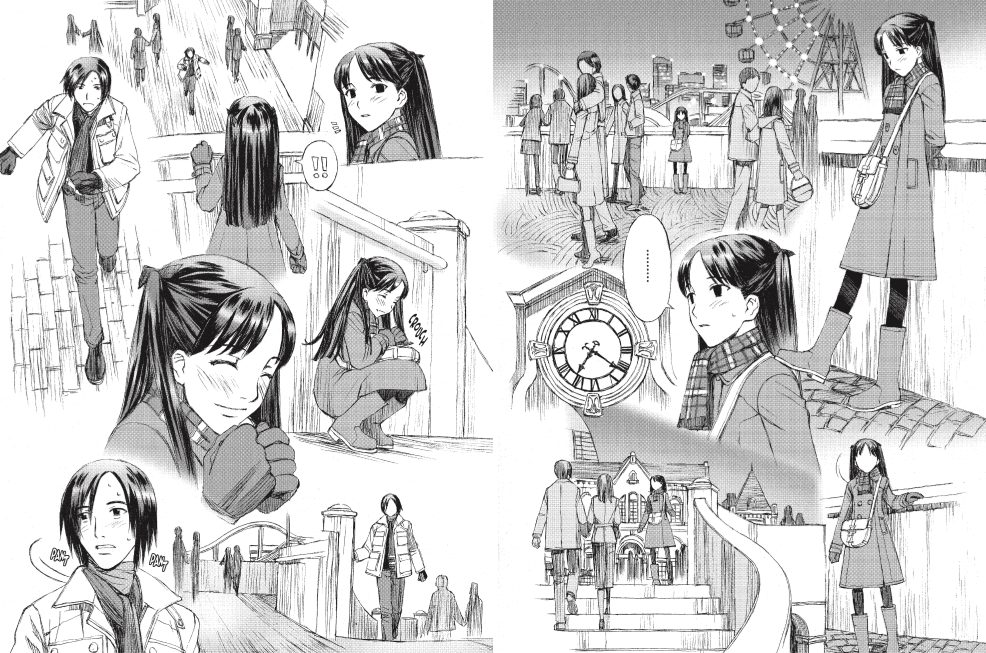
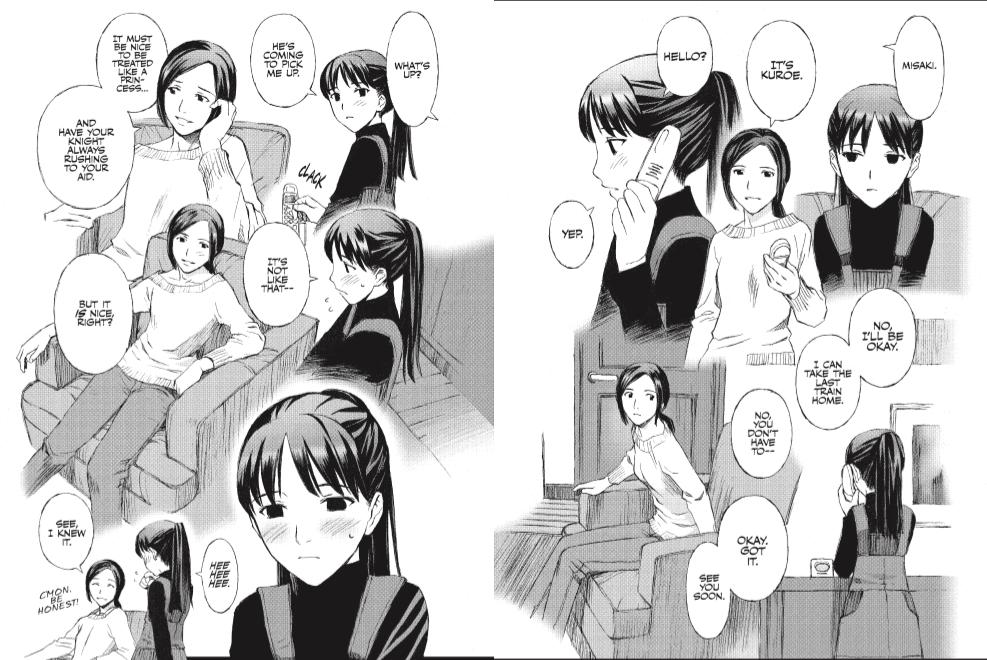
The most distinctive element of the artwork is Takano’s willingness to abandon grids altogether, creating fluid, full-page sequences in which the characters’ faces play a similar role to panel boundaries and shapes in directing the eye across the page. In this spread, for example, Sainome gently teases Misaki about her relationship with Kuroe:

The undulating lines and overlapping images give these pages a pleasing, sensual quality, but what’s most striking is the way in which the strongest lines on the page point to Misaki’s eyes and mouth, showing us how difficult it is for Misaki to conceal her feelings for Kuroe. The wordless sequence below — in which Misaki waits for Kuroe to join her on a date — works in a similar fashion, using the direction of Misaki’s gaze to lead us through the proper sequence of events:

Though these two scenes are gracefully executed, they point to the biggest problem with Blood Alone: Misaki and Kuroe aren’t portrayed as ward and guardian, or brother and sister, but as star-crossed lovers whose age and circumstance make it impossible for them to fully express their true feelings for one another. Some readers may find their unconsummated romance heartwarming, the story of a love that can never be, but for other readers, Misaki and Kuroe’s relationship will be a deal-breaker, a sentimental and uncritical portrayal of an inappropriate relationship between a young vampire and her adult protector.

Review copy provided by Seven Seas.

BLOOD ALONE, VOLS. 1-3 • BY MASAYUKI TAKANO • SEVEN SEAS • 600 pp. • RATING: TEEN (13+)

Filed Under: Manga Critic Tagged With: Blood Alone, Seven Seas, Vampires

Blood Alone, Vols. 1-3

May 14, 2011 by Katherine Dacey

In his essay Moe: The Cult of the Child, Jason Thompson argues that one of the most pernicious aspects of moe is the way in which the father-daughter relationship is sentimentalized. “Moe is a fantasy of girlhood seen through chauvinistic male eyes,” he explains, “in which adorable girls do adorable things while living in questionable situations with adult men.” The idealized “daughters” found in Kanna, Tsukuyomi: Moon Phase, and Yotsuba&! adore their “fathers” in an uncritical fashion, showering them with affection and trying — often unsuccessfully — to play the role of wife and mother, in the process endearing themselves to both the hero and the reader with their burnt meals, singed shirts, and sincere desire to please.

Blood Alone provides an instructive example of this phenomenon. The story focuses on Misaki, a young female vampire whose appearance and mental age peg her as an eleven- or twelve-year-old girl. Misaki lives with Kuroe, a twenty-something man who’s been appointed as her guardian — though in Yotsuba-eqsue fashion, the circumstances surrounding their arrangement remain hazy in the early volumes of the manga. When we first meet Kuroe, he seems as easygoing as Yotsuba’s “dad,” a genial, slightly bumbling man who supports himself by writing novels and moonlighting as a private detective. And if that isn’t awww-inducing enough, Kuroe’s first gig is to locate a missing pet, a job that Misaki takes upon herself to complete when Kuroe bumps up against a publisher’s deadline.

As soon as Misaki’s cat-hunting mission goes awry, however, we see another side of Kuroe: he’s handy with his fists, quickly dispatching a rogue vampire who threatens Misaki’s safety. Small wonder, then, that Misaki has a crush on her guardian; not only is he the kind of sensitive guy who writes books and rescues kitties, he’s also the kind of guy who goes to extreme lengths to protect his family.

If that were the extent of their relationship, Blood Alone would provide enough heart-tugging moments to appeal to moe enthusiasts without offending other readers’ sensibilities, but Masayuki Takano plays up the romantic angle to an uncomfortable degree. The most unsettling gambit, by far, is Kuroe and Misaki’s penchant for sleeping in the same bed together. That a grown man would even entertain such behavior is disturbing enough, but what makes it particularly egregious is that Kuroe rationalizes this arrangement because Misaki is afraid of “ghosts and monsters.” I think we’re supposed to find this endearing — a vampire who’s afraid of the dark! — but it serves to infantilize Misaki even more than her little-girl dresses, terrible cooking, and fierce jealousy of Sainome, the one adult woman in Kuroe’s life. If we only saw things from Misaki’s point of view, one could make a solid argument that Masayuki Takanao is deliberately showing us things through a distorted lens, but Takano’s narrative technique simply isn’t that sophisticated; Kuroe’s behavior — his solicitousness, his guilt — suggests that Misaki’s understanding of their relationship isn’t as far off the mark as an adult reader might hope.

This kind of confusion extends to other aspects of the manga as well. About one-third of the stories fall into the category of supernatural suspense. The dialogue favors information dump over organic revelation of fact, while the plot frequently hinges on characters suddenly disclosing a convenient power or revealing their vampire connections. Yet these chapters are more effective than the slice-of-life scenes, blending elements of urban fantasy, police procedural, and Gothic horror into atmospheric stories about vampires who use the anonymity of cities to hide among — and prey on — the living.

The rest of the series, however, is jarringly at odds with the suspenseful mood of these stories; we’re treated to numerous chapters in which very little happens, save a Valentine’s Day exchange of chocolates or a jealous spat. As a result, the series feels aimless; whatever overarching storyline may bind the supernatural element to the domestic is too deeply buried to give the series a sense of narrative urgency.

Art-wise, Blood Alone boasts attractive, cleanly executed character designs and settings, but stiff, unpersuasive action scenes. Backgrounds disappear when fists fly, and the bodies look like awkwardly posed mannequins, their legs and arms held away from the torso at unnatural angles.

The most distinctive element of the artwork is Takano’s willingness to abandon grids altogether, creating fluid, full-page sequences in which the characters’ faces play a similar role to panel boundaries and shapes in directing the eye across the page. In this spread, for example, Sainome gently teases Misaki about her relationship with Kuroe:

The undulating lines and overlapping images give these pages a pleasing, sensual quality, but what’s most striking is the way in which the strongest lines on the page point to Misaki’s eyes and mouth, showing us how difficult it is for Misaki to conceal her feelings for Kuroe. The wordless sequence below — in which Misaki waits for Kuroe to join her on a date — works in a similar fashion, using the direction of Misaki’s gaze to lead us through the proper sequence of events:

Though these two scenes are gracefully executed, they point to the biggest problem with Blood Alone: Misaki and Kuroe aren’t portrayed as ward and guardian, or brother and sister, but as star-crossed lovers whose age and circumstance make it impossible for them to fully express their true feelings for one another. Some readers may find their unconsummated romance heartwarming, the story of a love that can never be, but for other readers, Misaki and Kuroe’s relationship will be a deal-breaker, a sentimental and uncritical portrayal of an inappropriate relationship between a young vampire and her adult protector.

Review copy provided by Seven Seas.

BLOOD ALONE, VOLS. 1-3 • BY MASAYUKI TAKANO • SEVEN SEAS • 600 pp. • RATING: TEEN (13+)
Filed Under: Manga, Manga Critic, REVIEWS Tagged With: Blood Alone, Seven Seas, Vampires

Where to Buy Manga: Book-Off

May 8, 2011 by Katherine Dacey 19 Comments

Used bookstores can be a terrific place to score cheap manga, but the dusty, rummage-sale vibe at many second-hand establishments isn’t necessarily conducive to browsing. That’s where Book-Off comes in: this Japanese chain promises a Borders-like shopping experience while offering consumers steep discounts on used books, CDs, DVDs, video games, and — most importantly, from an otaku standpoint — manga. There are currently eight Book-Off stores here in the United States, concentrated mostly in California and Hawaii, with a single East Coast location in Manhattan. And while you’re unlikely to find the sixth edition of The Concise Baker’s Biographical Dictionary of Musicians at Book-Off, it’s a swell place to hunt for the sixth volume of Ranma 1/2 , a Japanese magazine, or The Art of Tokyo Babylon.

Inventory at Book-Off generally favors the new and the popular, especially with hardcover books and CDs. Book-Off certainly carries recent manga — I spotted volumes of Black Jack, Kingyo Used Books, and Neko Ramen on a visit to the Manhattan store — but the manga section’s best deals are on older, out-of-print titles that are commanding high prices on Amazon and eBay — say, Cyborg-009 or Sanctuary — or on titles whose popularity crested a few years ago — say, InuYasha or Le Chevalier d’Eon.

Book-Off has a two-tiered pricing system for manga: books in excellent condition sell for 30% off the cover price (generally around $7.00), while gently used books sell for $1.00. On my last visit to the New York City location, I purchased three volumes of The Drifting Classroom, one volume of From Eroica With Love, and one volume of Firefighter! Daigo of Company M for $18.00. I’d be hard-pressed to say which books cost me $1.00 and which ones cost me $7.00, as the condition of all five ranged from very good to immaculate:

Which ones cost $1.00?

Other trips have yielded similar results: I nabbed the tenth volume of Cyborg-009 for $7.00, the fifth volume of Sanctuary for $7.00, three volumes of Tower of the Future for $3.00, and had to stop myself from buying the full run of Land of the Blindfolded for $9.00. (Only Jason Thompson’s tepid review in Manga: The Complete Guide saved me from my worst bargain-hunting impulses.)

Strapped for cash? Book-Off will buy your unwanted manga, provided the books are in good condition, odor-free, and unmarked; Book-Off won’t accept advanced reader copies or books which have visible damage to the cover or pages. I’m not sure what the going rate is — Book-Off doesn’t advertise that information on their website — but for folks within striking distance of a Book-Off location, it’s an easy way to unload manga that might otherwise gather dust.

The bottom line: Book-Off is a fun place to browse, especially for readers interested in manga published before 2007. I’ve found it a terrific place for plugging holes in my manga collection and for sampling unfamiliar titles. (Organizational nerd that I am, I always bring a shopping list with me so that I don’t overlook an opportunity to snag a volume of Worst or What’s Michael.) My only word of caution: online retailers can match Book-Off’s prices on recent titles, so if it’s important to buy your manga new, you may find Amazon or Lulu.com a better bet for series that are still in print.

KNOW BEFORE YOU GO

There are eight US locations: two in Hawaii, five in California, and one in New York. Click here to view the full list.

Book-Off will purchase gently used books, CDs, DVDs, and videogames. Sellers do not need an appointment, but should bring ID with them if they are selling a substantial amount of books, CDs, etc. Selling guidelines can be found here.

In addition to carrying manga in English, Book-Off also stocks a good selection of Japanese-language material: magazines, novels, art books, and, of course, manga.

Filed Under: Manga Critic Tagged With: Book-Off, Where to Buy Manga

  • « Go to Previous Page
  • Page 1
  • Interim pages omitted …
  • Page 18
  • Page 19
  • Page 20
  • Page 21
  • Page 22
  • Interim pages omitted …
  • Page 39
  • Go to Next Page »
 | Log in
Copyright © 2010 Manga Bookshelf | Powered by WordPress & the Genesis Framework