• Skip to primary navigation
  • Skip to main content
  • Skip to primary sidebar
  • Home
  • About Us
    • Privacy Policy
    • Comment Policy
    • Disclosures & Disclaimers
  • Resources
    • Links, Essays & Articles
    • Fandomology!
    • CLAMP Directory
    • BlogRoll
  • Features & Columns
    • 3 Things Thursday
    • Adventures in the Key of Shoujo
    • Bit & Blips (game reviews)
    • BL BOOKRACK
    • Bookshelf Briefs
    • Bringing the Drama
    • Comic Conversion
    • Fanservice Friday
    • Going Digital
    • It Came From the Sinosphere
    • License This!
    • Magazine no Mori
    • My Week in Manga
    • OFF THE SHELF
    • Not By Manga Alone
    • PICK OF THE WEEK
    • Subtitles & Sensibility
    • Weekly Shonen Jump Recaps
  • Manga Moveable Feast
    • MMF Full Archive
    • Yun Kouga
    • CLAMP
    • Shojo Beat
    • Osamu Tezuka
    • Sailor Moon
    • Fruits Basket
    • Takehiko Inoue
    • Wild Adapter
    • One Piece
    • After School Nightmare
    • Karakuri Odette
    • Paradise Kiss
    • The Color Trilogy
    • To Terra…
    • Sexy Voice & Robo
  • Browse by Author
    • Sean Gaffney
    • Anna Neatrour
    • Michelle Smith
    • Katherine Dacey
    • MJ
    • Brigid Alverson
    • Travis Anderson
    • Phillip Anthony
    • Derek Bown
    • Jaci Dahlvang
    • Angela Eastman
    • Erica Friedman
    • Sara K.
    • Megan Purdy
    • Emily Snodgrass
    • Nancy Thistlethwaite
    • Eva Volin
    • David Welsh
  • MB Blogs
    • A Case Suitable For Treatment
    • Experiments in Manga
    • MangaBlog
    • The Manga Critic
    • Manga Report
    • Soliloquy in Blue
    • Manga Curmudgeon (archive)

Manga Bookshelf

Discussion, Resources, Roundtables, & Reviews

Reviews

Requiem of the Rose King, Vol 3

January 18, 2016 by Anna N

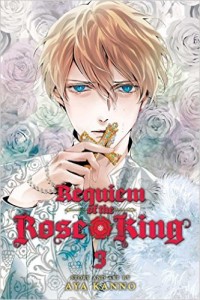
Requiem of the Rose King Volume 3 by Aya Kanno

This manga just keeps getting better and better as Kanno adds even more royal intrigue to her unique story of Richard III and the Wars of the Roses.

The second volume closed with Richard embodying a demonic spirit of vengeance when he discovered that his father was killed. The third volume opens with Richard’s older brother Edward, the new king, making questionable decisions about women. Edward is utterly captivated by the widow Elizabeth Woodville, who secretly detests the House of York. She maintains Edward’s interest by continually refusing him until he is desperate enough to make her his queen, going against the other alliances his court is arranging for him. Richard proves to be an unenthusiastic ally in Edward’s courtship, going along with his brother on hunting trips to provide cover for Edward’s visits to Elizabeth. When Edward is staying in a hunting cabin, he again meets the wayward Lancaster King Henry. Richard and Henry are drawn to each other, without fully knowing who each other are.

Henry’s dreamy outlook on life has made him one of the few people who relates to Richard as just Richard, without the “demon child” legend that has poisoned everyone against him. But Henry’s distance from his own family ensures that when his son Edward discovers the men together, his jealousy over his father’s relationship with Richard looks like it is going to have horrible consequences.

Kanno’s art continues to be both dark and lavish, fitting the settings and themes of this tragic story excellently. I’m always in awe of her facility with facial expressions and how it contributes so well to character development. Just a couple panels of Elizabeth Woodville’s gleefully staring eyes as she contemplates her plans for Edward establish that she’s up to no good. Henry’s abstracted expression show him to not fully live in the world, while Richard’s sensitivity and hesitancy in trusting Henry is clearly portrayed. This continues to be such a standout title in Viz’s current publishing lineup.

rerok3

Filed Under: REVIEWS Tagged With: requiem of the rose king, VIZ, viz media

Ranma 1/2, Vols. 23-24

January 17, 2016 by Sean Gaffney

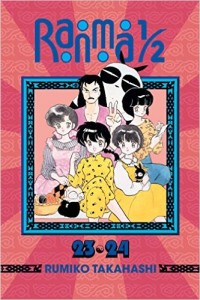
By Rumiko Takahashi. Released in Japan by Shogakukan, serialized in the magazine Shonen Sunday. Released in North America by Viz.

Ranma fandom these days is a different beast from where it was in the halcyon days of 1996-1997. Then it was striding the anime world like a colossus, at least in North America, and not even Sailor Moon seemed to have quite as many people discussing or writing fanfics about it. Nowadays it’s a small fish in a big pond, somewhat forgotten but retaining a nostalgic glow. This has, however, allowed some newer aspects of fandom to infiltrate, notably the BL fandom. Back in the day there was BL, but it seemed to get drowned out by all the male fans arguing about which girl Ranma should end up with. The idea that the best man for Ranma might be Ryouga is something that is dealt with in this volume, albeit not in a serious way.

ranma23-24

Ryouga comes across yet another magical item that will help him to win Akane, this time a fishing rod whose mark on a body leaves it with ever-increasing feelings of love. To be fair to Ryouga, he does seem to have moral qualms about using such a device to win Akane over. To be unfair to Ryouga, he tries it regardless. And when it hits Ranma, Ranma starts feeling very friendly indeed towards Ryouga. It starts off as washing his clothes and cooking for him, But as the mark expands, things get more serious, to the point where Takahashi feels obliges to urn Ranma female for the rest of the story. Akane, of course, becomes convinced that Ryouga is using the rod on Ranma because he can’t confess to him. Not exactly progressive, but honestly, this is exactly the sort of plot hook that many a BL story could work with. It’s also the best story of the first half of the book, which otherwise deals with annoyances such as Pantyhose Taro’s return (boring), Akane’s cooking (very boring), and Gosunkugi winning an enchanted suit of armor (really super boring and bad).

Luckily, the second half of the volume, is fantastic, and consists of one long story – indeed, there’s a cliffhanger, so it will carry over to the next volume. Herb is a villain who gives Ranma a challenge that he hasn’t really had to face in a long time, and his goofy yet deadly sidekicks Lime and Mint are just as dangerous – Ryouga is even brought to the point of death, though thankfully is able to triumph due to his super-depression. It allows Ranma to be clever and analytic again, one of my favorite sides of him, as he’s unable to see how Herb’s martial arts works – and how it’s actually LESS powerful than expected – without knowing the secret – like Ranma, Herb changes to female in cold water. This is the first time we’ve seen someone with the same exact curse as Ranma, and it helps to showcase their different styles – Herb has modesty, for one, something Ranma does not care about a bit. We also briefly see Ryouga and Mousse work together with Ranma, even if they have murderous motivation at the start. They make a good team.

Ranma sometimes seems a bit hoary and sexist (and homophobic as well) compared to some of the more popular works today, but Takahashi’s creativity usually shines through, and fans of the series will find most of this omnibus highly rewarding.

Filed Under: REVIEWS

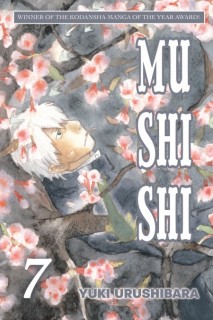
Mushishi, Vol. 7

January 15, 2016 by Ash Brown

Mushishi, Volume 7Creator: Yuki Urushibara
U.S. publisher: Del Rey
ISBN: 9780345505590
Released: May 2009
Original release: 2006
Awards: Japan Media Arts Award, Kodansha Manga Award

Mushishi, Volume 7 by Yuki Urushibara was originally published in Japan in 2006. It was the first volume of the award-winning manga series to be released after the first of several anime adaptations began airing. 2006 was also the year that Mushishi earned Urushibara a Kodansha Manga Award, having previously won a Japan Media Arts Award in 2003. In English, the seventh volume of Mushishi was initially published in print in 2009 by Del Rey Manga and then was later re-released in a digital edition by Kodansha Comics in 2014 along with the rest of the series. Mushishi is one of my favorite manga and one of the first series that I made a point to follow and collect as it was being released in translation. I love the manga’s atmosphere, subtle horror, and the obvious influence that traditional Japanese folklore and legends have had on Urushibara’s storytelling in the series.

The seventh volume of Mushishi collects four stories. Interestingly, the mushi in these particular chapters tend to be somewhat tangential to the real issues that the characters are struggling with. While the mushi have an impact on the way events unfold and develop, it is the interaction between people that forms the core of the individual stories. “Lost in the Blossoms” is about several generations in a family of skilled landscapers who obsessively care for the embodiment of a peculiarly beautiful and ancient cherry tree. In “The Mirror in the Muck,” a young woman falls ill after the man she loves leaves her behind, her love sickness putting her life in real danger. A young boy has become a host to a mushi that attracts lightning in “At the Foot of Lightning,” but the even greater problem is the nearly nonexistent relationship between him and his mother. The volume concludes with the series’ first multi-part story, “The Ragged Road,” about the head of the Minai, a clan of mushishi responsible for investigating forbidden mushi no matter what the personal cost.

Mushishi, Volume 7, page 3While Mushishi generally tends to be episodic, “The Ragged Road” directly ties in with an early story, “The Sea of Brushstrokes,” collected in Mushishi, Volume 2. The Minai family serves under the Karibusa family which is responsible for recording and protecting information about mushi; the fate of both families is intertwined with that of the forbidden mushi. I especially like “The Ragged Road” because it further develops the world of Mushishi. The other three stories in Mushishi, Volume 7 technically do as well, but because they’re only loosely connected to previous chapters their contributions to the series’ lore generally add more breadth rather than depth. Still, bits of the characterization of Ginko, the manga’s protagonist, continue to be revealed with the telling of each story, showing just how much of an outsider he is even within the community of mushishi.

Although the plots of the individual stories collected in Mushishi, Volume 7 aren’t directly connect to one another, they do all share some similar themes. In some ways, the manga feels more horror-like than some of the previous installments of the series. Mushi in the case of this volume are creatures that can steal away a person’s senses, identity, life, or even soul. But as terrifying as that can be, the most chilling thing that Ginko encounters aren’t mushi but failed human relationships. I find these four stories to be some of the most heartbreaking in the series for that reason. Ginko is faced with situations where, while he can deal with the mushi, he is powerless to completely ease the distress of the people involved and their troubled families. However, as sad and tragic as some of the stories in Mushishi can be, there’s still an underlying sense of hope that in time people will be able to heal and move forward through their pain.

Filed Under: REVIEWS Tagged With: del rey, Japan Media Arts Award, Kodansha Manga Award, manga, mushishi, Yuki Urushibara

The Manga Revue: Idol Dreams and Monthly Girls’ Nozaki-Kun

January 15, 2016 by Katherine Dacey

Happy New Year! (Is it too late to extend that greeting to readers?) For my first column of 2016, I dove into my pile of unread books and chose two that I’d meant to review last year. The first is Arina Tanemura’s Idol Dreams, a body-swap comedy about a thirty-something office lady; the second is Izumi Tsubaki’s Monthly Girls’ Nozaki-Kun, a 4-koma series about a hunky high school manga artist who just happens to be the author of a popular girls’ comic.

idol-dreams-vol-1Idol Dreams, Vol. 1
By Arina Tanemura
Rated T, for readers 13 and up
VIZ Media, $9.99

Chikage Deguchi is at a crossroads: once a pretty, popular high school student, she’s become a sexless, thirty-something office drone who’s mocked by her co-workers. After making a fool of herself at a high school reunion, Chikage’s childhood friend Tokita stages a unique intervention, offering Chikage a drug that transforms her into a 15-year-old girl for a few hours a day. Chikage then does what any self-respecting 31-year-old would do: she pursues a (part-time) career as a teen idol.

Setting aside the question of whether anyone would voluntarily relive their teenage years, Idol Dreams has a bigger problem: tone. Arina Tanemura can’t decide if her story will revel in its absurdity or play things straight, and veers wildly between wacky show-biz hijinks and clumsy office scenes that are meant to establish just how awful Chikage’s adult life is. In the afterword to the story, Tanemura cheerfully vents her frustrations at being asked to do “a magical girl series for adults” without recourse to “too much screentone,” “gags and comedic touches,” or “super-stylish atmosphere.” Oddly enough, I don’t think these restrictions are the true source of the problem; if anything, Tanemura’s artwork is more polished and appealing in Idol Dreams than in Phantom Thief Jeanne or I.O.N. The real issue is the lead character: Tanemura never really explains why temporarily impersonating a 15-year-old would solve any of Chikage’s issues, especially since Chikage’s teenage alter ego is a wet noodle, too. The underlying message seems to be that recapturing youthful beauty is a pathway to empowerment–not a particularly novel or uplifting idea, given the developed world’s obsession with Botox, face lifts, wrinkle cream, and 17-year-old models.

The bottom line: I never thought I’d say this, but Idol Dreams is the rare Tanemura manga that would benefit from more zaniness and sparkly backgrounds.


monthly_girlsMonthly Girls’ Nozaki-Kun
, Vol. 1
By Izumi Tsubaki
Rated T, for teen readers
Yen Press, $13.00

Monthly Girls’ Nozaki-Kun is a textbook example of what happens when a great idea bumps up against the limitations of a restrictive format. The set-up is comedy gold: tenth-grader Chiyo Sakura confesses her romantic feelings to hunky classmate Umetarou Nozaki, only to have him casually respond, “Do you want to come to my place right now?” Flustered, Chiyo agrees but is surprised when Nozaki doesn’t put the moves on her; instead, he puts her to work on a chapter of his hit shojo manga Let’s Fall. Chiyo’s attempts to extricate herself from Nozaki’s employ or clarify her feelings for him only make things worse, as Nozaki is both romantically inexperienced and genuinely obtuse.

So far, so good: the concept provides plenty of fodder for jokes and pratfalls. The four-panel format, however, locks each character into a holding pattern in which he or she is doomed to repeat the same behavior over and over again. The supporting cast is big enough to prevent Monthly Girls from reading like a month’s worth of Cathy or Garfield strips, but the rhythm of every gag is virtually the same, whether author Izumi Tsubaki is introducing a new character, poking fun at shojo manga cliches, or demonstrating just how socially inept Nozaki really is; long stretches of Monthly Girls read like a Henny Youngman set, albeit with stranger–and funnier–material. Take my manga… please!

The bottom line: Some of the jokes are genuinely funny, but the series already feels like it’s chasing its tail by the end of chapter three.

Odds and Ends: Organization Anti-Social Geniuses has a new look, a new name, and a new URL. You’ll now find Justin Stroman and the gang at http://www.theoasg.com/. Manga vlogger Pluto Burns took a break from reviewing books and conducted a great interview with Carolina Manga Library founder Laura Mehaffey. If you’re not familiar with the good work that Mehaffey and her staff are doing, click here to learn more about this traveling book collection.

Reviews: Sean Gaffney, Anna N. and Michelle Smith post their first Bookshelf Briefs column of 2016. On the agenda: D-Frag!, My Love Story!!, Pandora Hearts, and Saki. Elsewhere on the web, Rebecca Silverman and Kory Cerjak review the first volume of Yowamushi Pedal, my pick for Best New Manga of 2015.

Chris Kirby on vol. 1 of 7 Billion Needles (The Fandom Post)
Karen Maeda on vol. 7 of Assassination Classroom (Sequential Tart)
Matthew Warner on Ayako (The Fandom Post)
Sheena McNeil on vol. 1 of Bloody Mary (Sequential Tart)
Megan R. on CLAMP School Detectives (The Manga Test Drive)
Justin on Confession (The OASG)
Kate O’Neil on vol. 5 of Demon from Afar (The Fandom Post)
Sean Gaffney on vol. 3 of Emma (A Case Suitable for Treatment)
Sean Gaffney on vol. 1 of Honey So Sweet (A Case Suitable for Treatment)
Ash Brown on vol. 3 of JoJo’s Bizarre Adventure, Part 1: Phantom Blood (Experiments in Manga)
Sheena McNeil on vol. 19 of Kamisama Kiss (Sequential Tart)
Ken H on vol. 1 of LD♥K (Sequential Ink)
Rebecca Silverman on vol. 1 of Livingstone (Anime News Network)
Lori Henderson on vol. 1 of Monthly Girls’ Nozaki-Kun (Manga Xanadu)
Dustin Cabeal on vol. 2 of My Hero Academia (Comic Bastards)
Sean Gaffney on vol. 1 of Of the Red, the Light, and the Ayakashi (A Case Suitable for Treatment)
Kane Bugeja on vol. 3 of One-Punch Man (Snap 30)
David Brooke on vol. 4 of One-Punch Man (AiPT!)
Dustin Cabeal on vol. 4 of One-Punch Man (Comic Bastards)
SKJAM! on vol. 18 of Rin-ne (SKJAM! Reviews)
Ken H. on vol. 9 of Say I Love You (Sequential Ink)
Helen on vol. 1 of Student Council’s Discretion (The OASG)
Patrick Moore on vol. 8 of Tiger & Bunny (Bento Byte)
Che Gilson on Tokyo Ghoul (Otaku USA)
Marion Olea on vol. 2 of Tokyo Ghoul (No Flying No Tights)
Frank Inglese on vols. 8-9 of Vagabond: VIZBIG Edition (Snap 30)
Ash Brown on vol. 7 of Vinland Saga (Experiments in Manga)
SKJAM! on vol. 7 of Vinland Saga (SKJAM! Reviews)
Megan Rupe on vols. 1-2 of Yo-Kai Watch (No Flying No Tights)


Filed Under: MANGABLOG, REVIEWS Tagged With: 4-koma, Arina Tanemura, Manga Review, shojo, viz media, yen press

Honey So Sweet, Vol. 1

January 15, 2016 by Sean Gaffney

By Amu Meguro. Released in Japan as “Honey” by Shueisha, serialized in the magazine Bessatsu Margaret. Released in North America by Viz.

In general I try to avoid reading back cover copy when I get a book, as it frequently tends to spoil the entire volume, particularly with manga titles. That said, I wouldn’t have to worry about that with Honey So Sweet, which wastes absolutely no time telling us what our premise is. Bad boy delinquent is secretly a big sweetie pie. We’ve seen this before, and not just in shoujo, and if that’s all there was to this title I’d likely be saving it fro a Brief review and moving on. But it also has the heroine, Nao, who is shy in all the worst ways – life has left her with an intense desire to avoid conflict, and so when Taiga confesses to her the initial reaction is “if I say no, he’ll kill me’.

sweet1

I’ve talked before about how difficult it can be to keep readers from abandoning a series when you write someone with major character flaws. To be fair, it is easier to do so when your heroine is of the wallflower variety than if she’s a selfish ball of temper. But Nao is the early parts of this volume is someone that is seemingly making all the wrong choices in an effort to just slide by in life – and she knows it, as she keeps repeating it to herself. Her parents have passed away at an early age, and much of her narrative monologue is done as communication with their souls in heaven. Her She’s living with her mother’s younger sister, who she has a massive complex for since he took her in and has sacrificed quite a bit for her. And she (not surprisingly) always seems depressed.

So it’s great seeing Taiga slowly manage to get Nao to have fun, and show actual effort, and elicit feelings from her that aren’t “go along with him because SCARED!”. We learn less about him in this volume, except that he tries a bit too hard to help out everyone, particularly Nao, but that’s the point – he’s the nice guy at heart, and you have to look past his face. By the end of the volume, Nao’s uncle is remarking on the fact that she’s smiling a lot more these days, and it’s a great thing to see, as now we can see her moving forward in life and doing things she’s good at.

In many ways this is very typical shoujo romance – we’ve seen Taiga’s sort in hundreds of other titles. We have two others who form a core group with our hero and heroine, and one is the tsundere hothead guy who speaks before he thinks, which again we’ve seen before. The other is Kayo, who’s grumpy, stoic, and seemingly written as a gift to me – I really want to see more from her in future volumes. Together they don’t make this title unmissable, but they make it enjoyable, and by the end Nao has developed enough so that you’re rooting for her as well.

Filed Under: REVIEWS

Vinland Saga, Omnibus 7

January 13, 2016 by Ash Brown

Vinland Saga, Omnibus 7Creator: Makoto Yukimura
U.S. publisher: Kodansha
ISBN: 9781612628035
Released: September 2015
Original release: 2013-2014
Awards: Japan Media Arts Award, Kodansha Manga Award

I honestly believe Makoto Yukimura’s Vinland Saga to be one of the best manga series currently being released in English. An epic tale of revenge, idealism, and the tremendous cost of violence, Vinland Saga is an incredibly engaging work with impressively compelling characters. In addition to being a personal favorite of mine, over the course of its publication the series has also won a Japan Media Arts Award and a Kodansha Manga Award among other honors. Kodansha Comics has been releasing Vinland Saga in English as a series of hardcover omnibuses. The seventh omnibus, released in late 2015, collects the thirteenth and fourteenth volumes of the manga originally published in Japan in 2013 and 2014 respectively. The seventh omnibus of Vinland Saga also includes two exclusives: the continuation of “Ask Yukimura,” where Yukimura responds to questions about the series, and a four-panel tribute comic by Faith Erin Hicks, another creator whose work I greatly admire.

After years of hard labor, Thorfinn’s freedom was near at hand until he and his fellow slave Einar became involved in an escape attempt. They helped Arnheid, Ketil’s favorite slave and mistress, aid her enslaved husband as he tried to run away from another farm. The attempt failed, resulting in multiple deaths. Now the three of them—Thorfinn, Einar, and Arnheid—must face the terrible consequences of their actions. Meanwhile, Ketil and his sons are returning from Jelling with King Canute and his finest warriors following close behind. In addition to dealing with his slaves, Ketil must also prepare for Canute’s inevitable attack before the farm falls into chaos. Canute plans on taking Ketil’s farm and wealth for his own in order to expand his kingdom, determined to create a paradise on earth for all who suffer from war and violence. Although he would prefer a peaceful resolution, Canute is more than prepared to stake his claim through questionable political maneuvering and force.

Vinland Saga, Omnibus 7, page 92Like so many of the other omnibuses of Vinland Saga, the seventh is brutal and at times even gruesome. The artistic detail and research that Yukimura has applied to the portrayal of the day-to-day lives of eleventh-century nobility, warriors, merchants, and slaves has also been applied to the battles and wars they wage. Men and women are beaten to the brink or point of death; limbs are severed; skulls are crushed; eyes are gouged out—Vinland Saga is an intense and violent series. But that violence isn’t idealized or glorified by Yukimura. Even while an individual’s martial skill and battle prowess are respected and admired, violence is shown to be the truly terrible and destructive force that it is, not just physically, but mentally and emotionally as well. Some of the most important themes in Vinland Saga revolve around violence, how it impacts people and society, and whether it can be avoided or whether humanity is trapped in a never-ending cycle of bloodshed.

In addition to the plot of Vinland Saga as a whole, violence and its effects are also crucial to the development of the individual characters. Many of them are trying to break free from the violence that pervades their lives, facing moral quandaries over how to enact their ideals. The characters of Vinland Saga aren’t safely philosophizing over what is ethical, they are literally risking their lives for what they believe in. But even when their ultimate goals are the same, they approach them differently. Canute is now in a position of power as king and will use any method necessary to ultimately achieve his earthly paradise. Thorfinn, on the other hand, is reluctant to use violent force in order to gain peace. And there are plenty of other characters in the series who fall somewhere between these two perspectives. Seeing the realistic interplay among all of these different worldviews in the series has been immensely engrossing. Vinland Saga is well-worth reading even in part, but I sincerely hope to see the rest of the series translated as well.

Filed Under: REVIEWS Tagged With: Japan Media Arts Award, kodansha, Kodansha Comics, Kodansha Manga Award, Makoto Yukimura, manga, Vinland Saga

Of the Red, the Light, and the Ayakashi, Vol. 1

January 10, 2016 by Sean Gaffney

By nanao and HaccaWorks*. Released in Japan by Media Factory, serialization ongoing in the magazine Comic Gene. Released in North America by Yen Press.

I’ve spoken before about how it can sometimes be difficult to review a new volume of a shoujo romance whose basic premise is ‘girl in high school likes guy, feelings ensue’, as there’s just so many of those out in North America. I am very happy to say that I’m starting to feel that way about the influx of yokai manga over here as well. We have all different types of yokai titles over here, including those for kids, for young adults, for men, for women. After a year that saw the loss of Shigeru Mizuki, it’s heartwarming to see his legacy, and that of Japan’s folklore, carry on. And so we have this new series, which is actually based off of a visual novel, and brings together the yokai genre with mystery, horror, and a bit of not-quite-BL – exactly what a shoujo reader would enjoy.

ayakashi1

Our hero is Yue, a name that longtime readers of manga will know always seems to be connected to the supernatural in some way. (I believe in Chinese it means moon.) He’s a yokai, and seems to be very important, but is unfamiliar with much of the world beyond the temple area in which he lives. So he and his friend/familiar descend the mountain to attend a festival, and run into two contrasting humans, one quiet and serious, the other angry and a bit over the top. As the series goes on, and he gets permission to visit his new wannabe friends, though, we discover the village where this is taking place is slightly off to begin with, and that there’s more going on here than meets the eye.

This series is an excellent example of what you want in a first volume. It gives you enough backstory and characterization to satisfy while making you want to read more to see what happens. Yue is sweet and naive without seeming foolish, and Tsubaki is reserved but shows a genuine love of family. As for Akiyoshi, he provides some of the series’ few laughs with his stalker-ish ways, but also gets to carry the bulk of the exposition, as he knows about the yokai without being part of them. Honestly, the three leads make a good team.

As for the horror and mystery, well, it would appear the danger is not just of having your life taken, as if a typical vampire manga, but having your very existence removed from the world. An old kindly elementary school principal vanishes one day, and those connected to the school deny he was ever there – or that they even had a principal. It gives an extra frisson of creepy to the whole deal. For more old-fashioned horror, there’s also the standard scary black ghosts that try to eat you, which also pop up a lot in these sorts of manga. Basically, AkaAka (its fan nickname) may not tread all that much original ground, but it hits all the right notes and really makes you want to read on. A definite good read, despite a double bad sign of both a name all in lowercase *and* a name with a special character in the authors.

Filed Under: REVIEWS

JoJo’s Bizarre Adventure, Part 1: Phantom Blood, Vol. 3

January 8, 2016 by Ash Brown

JoJo's Bizarre Adventure, Part 1: Phantom Blood, Volume 3Creator: Hirohiko Araki
U.S. publisher: Viz Media
ISBN: 9781421578804
Released: August 2015
Original release: 1988

Although I had been previously aware of the manga series for some time, my real introduction to Hirohiko Araki’s multi-generational shounen epic JoJo’s Bizarre Adventure was in 2012 through the standalone spinoff Rohan at the Louvre. I then proceeded to read the third story arc Stardust Crusaders, at the time the only other part of JoJo’s Bizarre Adventure to have been released English. It wasn’t until 2015 that Phantom Blood, the very beginning of JoJo’s Bizarre Adventure was translated, published in a beautiful hardcover edition under Viz Media’s Shonen Jump imprint. When Phantom Blood was originally collected in Japan it was released in five volumes between 1987 and 1988. However, in 2002 it was re-released in three volumes which is what Viz Media’s edition is based on. Phantom Blood, Volume 3, published in English in 2015, is largely equivalent to the fourth and fifth volumes of the original Japanese release.

Having arrived in Wind Knights Lot in pursuit of his adoptive brother Dio, Jonathan Joestar must first successfully defeat two of Dio’s strongest undead minions and then traverse a town with a population that is steadily being turned into a hoard of zombies before he even has the chance to confront his brother. The Dark Knight Blueford, who is filled with hatred for the world and loyalty to Dio, is determined to take JoJo’s life. The other knight, Tarukus, is also exceptionally skilled when it comes to dealing out death and takes great delight in it. Should JoJo and his allies manage to survive their encounter with these two undead foe, they face an even more formidable adversary in Dio. Having used an ancient stone mask to turn himself into a vampire, Dio has gained untold strength and powers. Fortunately, JoJo is a quick and talented study—under the tutelage of Baron Zeppeli he has been able to begin to master Hamon energy, the only thing other than the sun itself that can harm to Dio.

JoJo's Bizarre Adventure, Part 1: Phantom Blood, Volume 3, page 147JoJo’s Bizarre Adventure truly is a bizarre series; Phantom Blood makes this very clear from the very start. From the characters’ weird anatomy and disproportionate musculature to the story’s strange mix of melodrama, horror, and fantastic martial arts, Phantom Blood doesn’t just strain readers’ suspension of disbelief, the manga completely shatters it. Entire backstories are revealed in the time it takes for characters to tumble down cliff sides; combatants continue to live on after suffering injures that even the undead couldn’t survive; fights quickly escalate to unbelievable extremes, opponents continuously outdoing and outmaneuvering one another. Although the “why” of what’s going on is sometimes questionable, even considering Araki’s pseudo-scientific explanations, most everything is blatantly narrated by the participants and observers, so it’s fairly easy to at least follow the “what” of all of the strangeness. JoJo’s Bizarre Adventure is admittedly ridiculous and absurd, but that’s part of what makes the series so entertaining.

Phantom Blood is a relatively short series, especially when compared to the later story arcs of JoJo’s Bizarre Adventure. While Phantom Blood is a complete story in its own right, if often feels even more like a prologue to the rest of the series, laying the groundwork for all of the weirdness and machismo to come. Phantom Blood introduces the noble Joestar family—Jonathan in particular being especially gallant and large-hearted, even towards his enemies—but even more important is the introduction of Dio, an extraordinary villain. As Araki points out in the volume’s author notes, what make Dio so terrifying isn’t his impressive powers or brute strength, it’s his stunning ability to control others. Dio is arrogant but extremely charismatic, gaining many willing followers and easily manipulating those who aren’t. Phantom Blood is frequently gruesome and grotesque, with over-the-top violence, outrageous story developments, and audacious, larger-than-life characters. JoJo’s Bizarre Adventure is a peculiar work, but I’m definitely looking forward to reading the next arc, Battle Tendency.

Filed Under: REVIEWS Tagged With: Hirohiko Araki, JoJo's Bizarre Adventure, manga, Shonen Jump, viz media

Emma, Vol. 3

January 7, 2016 by Sean Gaffney

By Kaoru Mori. Released in Japan in two separate volumes by Enterbrain, serialized in the magazine Comic Beam. Released in North America by Yen Press.

The entire first half of this omnibus gives the reader the opportunity to watch a giant other shoe dropping, and the back half then shows the shoe’s impact, with horrible consequences for many people, but mostly for Emma. Last time I talked about how well the repressed yet burgeoning love between William and Emma is, and it flowers here, with Emma visibly getting happier and less repressed. William too is different now that he accepts his feelings and is determined to do something about them. Sadly, that determination runs up against absolutely everyone – his own family, who are determined that he not make the same mistakes they made, and more importantly his fiancee’s family, who may cross over the line into actually being evil, or at least willing to commit slow murder.

emma3

The author is very fond of big, dramatic moments – you see it in her Bride’s Story series as well – and you can see why, as she’s fantastic at handling them. The arrival of William at the Molders estate, and Emma running out to embrace him (the the surprise and amusement of the ENTIRE household) is fantastic, and reminds you again that it’s nicely coincidental that Emma ended up in the one household in Britain that wouldn’t be appalled at this. That said, that’s why William came up to meet her – the rest of society is not going to be quite as forgiving. The volume starts off with a flashback showing us how William’s parents, Richard and Aurelia, met and married. Aurelia is not of a lower class like Emma is, but she’s still “eccentric”, and that’s deadly for the time. More to the point, she’s introverted, and the pressures of society exhaust her to a damaging degree. Which is why they now live apart. It’s very bittersweet.

As for Eleanor’s father, wooooow. It’s rare we meet someone in a manga like this who gets to be pure evil. He’s really well handled, too, being extremely polite to William’s father, then throwing away his gloves in disgust afterwards, as he had touched someone of a merchant class – horrors! When William breaks off his impetuous and foolish engagement to Eleanor, to her horror, the Viscount calmly sees what needs to be done – Emma needs to disappear. Luckily, he knows some thugs who can fairly easily trick and abduct her (though the cliffhanger seems to hint she may be rescued soon). This sequence may be the weakest in the book – it’s a bit overmelodramatic, to be honest – but it’s earned, at least, and the true high point of the last half of the book is Williams’ screaming match with his father in any case.

I expect things to be resolved soon, even though we have two full omnibuses to go – the last three volumes of Emma were side stories and sequels, so these two wacky kids should get their happy ending soon. Which is good, as this volume could get pretty depressing at times – as Mori herself notes in the afterword. No worries, the journey is still very much worth the effort.

Filed Under: REVIEWS

Saki, Vol. 1

January 5, 2016 by Sean Gaffney

By Ritz Kobayashi. Released in Japan by Square Enix, serialization ongoing in the magazine Young Gangan. Released in North America digitally by Yen Press.

Variations on a theme is one of the cornerstones of writing, and it’s just as true for manga. While it’s always nice to see something that no one’s ever done before, the true prizes for publishers are the series that are what’s been done before countless times, but with a variation or twist that makes it different enough so that people won’t get bored. This is especially true of sports manga, which tend to hit the same plot beats. There’s a ragtag bunch of misfits, an eccentric team leader, fighting to get to the national tournament… we’ve seen this before in soccer, baseball, and football manga here in North America. And now, with Saki, we get to see it happen with mahjong. Because trust me, mahjong is serious business in Japan, definitely worthy of a cute seinen sports series.

sakivol1

Saki is our reluctant heroine, a girl who’s not a fan of mahjong because she always played it with her family, and lost her allowance when she did badly. As a result, when she plays now she’s learned to end up not winning or losing, but getting precisely zero points, thus taking the heat off. Of course, this is much harder than it sounds, and the club quickly realizes they have a second prodigy on their hands. Second because they already have Nodoka, a mahjong prodigy whose skill is almost unparalleled… until she meets Saki, who has intuition in-game that’s almost supernatural. Can the two of them learn from each other’s weak points and become even better? And is Saki’s family really just a cutthroat family that happens to like mahjong?

As I said, this is a sports manga with mahjong, and family angst is part of that. You may also remember similar issues in Girls Und panzer, which was a spots manga with tanks, and shares quite a few qualities with Saki. This series is also not afraid to be ridiculous – Kobayashi knows from prior mahjong series that dramatic flourishes and poses are what make the genre, and so tiled will be flipped earnestly and with pure hearts. There is a lot of discussion of how mahjong works, but if you don’t know it doesn’t really detract from the story, any more than not knowing how football worked detracted from Eyeshield 21.

The main reason to read this is the characters. Saki clearly has issues, and is also somewhat introverted. Nodoka has different issues, but a similar personality, and finds Saki’s ambivalence towards the game intensely frustrating. And even when Saki decides to join the club, there’s no guarantees – the first thing that the president does is have the two of them get crushed by a professional mahjong player, so that they know how far they both have to go. Oh yes, and there’s plenty of eccentricity here as well, mostly from Yuuki, a young girl who enjoys starting off with huge wins (which she can’t hold), tacos, and teasing the supposed male lead, though more accurately he’s the male extra.

Saki can get a bit dry in its mahjong chat, and the fanservice reminds you this runs in a seinen magazine, but it’s a lot of fun, with two likeable heroines. I will definitely be getting more of it.

Filed Under: REVIEWS

Honey So Sweet, Vol. 1

January 3, 2016 by Anna N

Honey So Sweet Volume 1 by Amu Meguro

I always look forward to checking out new Shojo Beat series, but I was wondering before I picked up this title if it would be a bit TOO sweet. Once the characters and backstory got set up, I enjoyed this volume.

The volume opens up with a flashback scene of Nao Kogure walking away from a boy recovering from a beating in the rain, saying that people might consider her helpless, but she doesn’t want to get involved with delinquents. The delinquent in question is Taiga Onise, nicknamed Oni at his school. He promptly announces to Nao that they need to talk, and when she follows him he presents her with a bouquet of roses and asks her if she’ll “date him with marriage in mind.” Nao is so intimidated by her suitor that she accepts immediately because she’s afraid of retaliation.

Nao discusses the situation at home with her guardian, her Uncle Sou. He points out that judging Onise by his outward appearance is unfair and she should get to know him first. The next day at school she sees Onise doing chores, helping teachers, and he makes an incredibly cute bento for them to share at lunch. One of the most annoying thing about this manga in the early chapters was Nao’s fear of Onise, long after the point where it should be clear to everybody that dyed hair and random piercings aside, he’s an absolute sweetheart. The other thing that has Nao hesitating about getting involved with her first boyfriend is that she’s decided she’s in love with her Uncle.

Nao and Onise continue their friendship, and one of the things I enjoyed very much about this series were cute details that showcase their personalities, like Onise’s tendency to write elaborately formal text messages when he’s nervous. Nao has her own trauma to deal with due to being an orphan, and she finds it difficult to get close to people. Much of the plot centers around some typical shoujo set pieces like a class trip, but Nao and Onise gradually start collecting a small group of misfit friends, and the series is so genuinely warm-hearted, it is hard to resist.

I found myself enjoying Meguro’s art style very much. So much shoujo manga art tends to be overly polished, but Meguro uses thin whispy lines that make the illustrations in Honey So Sweet seem delicate and not overworked. The storylines centered on friendship, combined with Nao’s psychological issues reminded me a bit of some of the old Banri Hidaka series published by CMX. This first volume was mostly set-up, so I’m curious to find out what happens next in this series.

honeysosweet1

Filed Under: REVIEWS Tagged With: honey so sweet, shoujo, viz media

The Devil Is A Part-Timer!, Vol. 3

January 3, 2016 by Sean Gaffney

By Satoshi Wagahara and 029. Released in Japan by ASCII Mediaworks. Released in North America by Yen Press.

After Sariel proved to be a rather creepy and awful villain in Book 2, I was not going to be surprised if another archangel showed up to make trouble for Maou and company, and sure enough, Gabriel pops up halfway through the book to alternately threaten and be amusing. As with Emeralda, he seems to have some sort of regional accent in the original, which is conveyed by giving him a sort of ‘valley girl’ style voice – if you imagine Poland from the Hetalia books, you’re on the right track. In any case, as a villain he’s merely OK, mostly as we’re used to these guys being taken out fairly easily by now. As a comic character he’s funnier, being a whining slacker who seems to simply be very bad at his job, and he naturally ends up staying in Japan once the book ends.

devil3

That said, clearly the more important new character here is Alas Ramus, the magical child who appears from inside an apple (Ringotaro?) and immediately declares that Maou and Emi are her mother and father. She’s cute and clingy, as you’d expect from a girl who acts one year old most of the time, but she’s also a magical macguffin, so is allowed to do things like explain the plot in baby talk. Somewhat less successful is her resolution of the battle with Gabriel, mostly as the author wants to pretend briefly that Alas Ramus is returning to the fantasy world, so we get a brief “oh no, she sacrificed herself” beat. The trouble is that, as I indicated earlier, this isn’t the sort of series that would seriously do that, so of course it turns out she actually merged with Emi’s Holy Sword, which is now even more holy.

The bigger impact that Alas Ramus has is on the pseudo-harem that the books continue to tease. Chiho has a brief crisis of conscience when she realizes that, even after Maou says he depends on her, she still can’t help getting jealous about Maou and Emi raising a child together. (It’s almost as if she’s a teenager or something…) And Emi is again starting to realize that perhaps Maou is not quite the Fantasy Hitler that she wants to imagine him as, and continues to have more of the worldview that she keeps intact in order not to have a complete nervous breakdown kicked out from under her. (The cliffhanger implies the breakdown will not be long in coming.) And Maou gives us some backstory that suggests that most of the atrocities that happened while he ruled Ente Isla were less “I am evil” and more “I wasn’t really paying attention to my underlings”. And, more importantly, that he bitterly regrets that was the case. This is the best part of the book.

So while I don’t think this was quite as good as the first two books, it’s still very entertaining, and also continues the story past the anime, for those who hate to read already adapted novels. And the prose style, particularly the snarky narration, is excellent – as I’ve said before, this is one of Yen On’s smoothest translations. Definitely a fun read.

Filed Under: REVIEWS

Oishinbo, A la Carte: The Joy of Rice

January 1, 2016 by Ash Brown

Oishinbo, A la Carte: The Joy of RiceAuthor: Tetsu Kariya
Illustrator: Akira Hanasaki

U.S. publisher: Viz Media
ISBN: 9781421521442
Released: November 2009
Original release: 2005
Awards: Shogakukan Manga Award

At well over one hundred volumes, Oishinbo is one of the most successful and long-running food manga in Japan, winning the Shogakukan Manga Award in 1987. Written by Tetsu Kariya and illustrated by Akira Hanasaki, Oishinbo first began serialization in 1983 and is still ongoing although currently the manga is on indefinite hiatus following a controversy of its depiction of the aftermath of the 2011 Fukushima Daiichi nuclear power plant disaster. Between 2009 and 2010, Viz Media released seven volumes of Oishinbo, A la Carte under its Signature imprint, becoming the first food manga that I ever read. Oishinbo, A la Carte is a series of thematic anthologies collecting chapters from throughout the main Oishinbo manga. Oishinbo, a la Carte: The Joy of Rice was the sixth collection to be released in English in 2009. However, The Joy of Rice was actually the thirteenth volume of Oishinbo, A la Carte to be published in Japan in 2005.

The Joy of Rice collects eight stories and one essay in which rice, an important staple of Japanese diet and cuisine, is featured. In “A Remarkable Mediocrity,” the wrath of a wealthy businessman and gourmand who made his fortune dealing in rice is able to be appeased by the simplest of dishes. “Brown Rice Versus White Rice” examines how people can be mislead even when they make an effort to eat healthily. The structure of rice and how proper storage can make a difference when it comes to cooking it are the focus of “Live Rice.” Yamaoka, Oishinbo‘s protagonist, makes a case against the importation of foreign rice into Japan in “Companions of Rice.” In “The Matsutake Rice of the Sea,” a wager between friends over a rice dish becomes more important than they realize. Kariya opines about the eating manners of Chinese, Japanese, and Koreans in his essay “The Most Delicious Way to Eat Rice.” A debate on the proper way to eat rice is central to “No Mixing” as well. Rice takes a supporting role in “The Season for Oysters,” but once again takes the spotlight in the three-part “Rice Ball Match.”

Oishinbo, A la Carte: The Joy of Rice, page 215Because Oishinbo, A la Carte compiles various stories together by theme rather than by chronology, the series can feel somewhat disjointed. Having read nearly all of the Oishinbo, A la Carte collections available in English, for the most part I’ve gotten used to and even expect this, but it seemed to be particularly glaring in The Joy of Rice. From story to story it’s often difficult to anticipate the status of the characters’ relationships with one another and those relationships are often very important to understand. For example, “A Remarkable Mediocrity” is one of the earliest episodes to be found in Oishinbo proper—it’s a little awkward to have the chapter that originally introduced several of the established recurring characters appear so late in A la Carte. Admittedly, the point of Oishinbo, Al la Carte is to highlight specific foods or themes; only a basic understanding of the underlying premise of Oishinbo and of its characters is absolutely necessary. The translation notes help greatly, but it can still make for an odd reading experience.

The Joy of Rice examines the place of rice within Japanese culture and cuisine, addressing both social and scientific aspects of the grain. Like the other volumes in Oishinbo, A la Carte, The Joy of Rice places a huge emphasis on organically and locally produced food, railing against pesticides, herbicides, and the use of antibiotics in agriculture. The series is not at all subtle about the stance it takes, and Yamaoka can frankly be a jerk about it at times. Initially I was hoping that The Joy of Rice would explore the different varieties of rice found and used in Japan, but the volume instead focuses on the significance of rice in the lives of the country’s people—the nostalgia and memories associated with it and the pure enjoyment and complete satisfaction that it can bring—which was ultimately very gratifying. However, my favorite story in The Joy of Rice, “Rice Ball Match,” uses rice to delve into Japanese culinary culture and history as a whole, which was an excellent way to round out the volume, bringing all of the manga’s themes together in one place.

Filed Under: REVIEWS Tagged With: Akira Hanasaki, manga, Oishinbo, Shogakukan Manga Award, Tetsu Kariya, viz media, VIZ Signature

Dorohedoro, Vol. 17

January 1, 2016 by Sean Gaffney

By Q Hayashida. Released in Japan by Shogakukan, serialization ongoing in the magazine Hibana. Released in North America by Viz.

Despite all its violence and loving depictions of chopped-up corpses, Dorohedoro has always had a loose relationship with actually killing characters off, given that there are several deus ex machinas in this universe able to resurrect someone from the dead given enough time and materials. No one really doubts En is eventually going to be back, for example, and even though Fujita lay at death’s door and lost an arm in the last volume, he’s fully healed early on here. This is why when we do see genuine death it has an impact, even if there’s something in the back of our heads saying “are they reeeeeaaallly dead?”.

doro17

Natsuki’s death in Vol. 13 was such a death, and it gets confirmed here in the worst way, as Ton, the one most dedicated to finding her true fate, ends up sharing it. This is actually sort of sweet and touching in a horrible way, as Ton comes across her body, now strangely mute, but can’t escape where he thinks they are. There’s even a ‘going into the light’ cliche to show off that yes, they are indeed dead. The same can’t be said for the rest of the cross-eyes, though, as even though the majority of them are horrible butchered by their boss, who they’ve finally decided is not worthy of following, we could still see them come back, as we were able to save the corpses’ heads. It’s that kind of series.

Meanwhile, En’s party is also discussing death. Sure, they have Noi, and Judas’ Ear, but there’s still some kinds of lethal blows that you just can’t fix. Luckily, there’s an operation that makes a person virtually unkillable, even if they get their brains blown out. Admittedly, the operation is almost always lethal, but that’s why you do it on someone like Noi, who already has amazing resurrection powers. I love that Noi hates this, and regards it as a safety measure because she’s too weak – something Ebisu is quick to point out is basically correct. When you have the ability to heal anyone from certain death, you get coddled a bit, whereas Noi just wants to keep punching people till their bodies are piles of goo.

And then there’s Nikaido, whose motives are becoming more and more questionable as she gains more and more of her devil powers – her usually expressive eyes get narrowed to pinpricks, and the gyoza she made in a devil-induced flurry last time seem to be dangerously addictive. It’s a bit difficult to talk about morality in a series like Dorohedoro, where even the nice and sweet people happily go around butchering passersby. But you get the sense that something here is off, that Nikaido is heading down a dangerous road. This is not helped by the absence of Caiman – Risu just does not have the same ability to restrain her weirder impulses. In the meantime, we’ve now gathered the entire cast at the department store setting, and Fujita has managed to find En’s tumor, so I suspect the next volume may contain even more gore than this one, if that is strictly possible. Assuming you can get past the gore, highly recommended as always.

Filed Under: REVIEWS

The Best and Worst Manga of 2015

December 30, 2015 by Katherine Dacey

After a two-year hiatus from blogging, I donned my critic’s cap again in 2015. I’ve enjoyed writing my quasi-weekly column, but composing a year-end list reminded me why I stepped off the reviewing treadmill in 2012: mediocre books! This year yielded a veritable bumper crop of so-so manga, titles that were competently executed but otherwise unmemorable thanks to an abundance of generic characters, cliché settings, and predictable plot twists; you’d be forgiven for feeling that you’d read many of 2015’s debuts before, even if the artists were new to the US market.

Lurking among the paint-by-number romances and boy-saves-world titles, however, were a few gems. I’ve done my best to highlight the titles that made me feel something, whether that feeling was love, hate, or a mixture of both. To that end, I’ve included my nominees for the worst manga of 2015 alongside the books that made me laugh and cry.

Yowamushi-Pedal-Volume-1Best New Series: Yowamushi Pedal
By Wataru Watanabe • Yen Press
You know the rap on sports manga: American readers won’t buy it, and don’t like it. Yowamushi Pedal might just change that, however, thanks to a story that plays well across the nerd-jock divide. Onoda, the hero, is a self-professed otaku whose weekly bike rides into Akihabara have transformed him into a secret Lance Armstrong clone. Though Onoda wants to revive his school’s anime club, his amazing hill-climbing skills and stamina get noticed by more seasoned riders, all of whom convince Onoda to join the cycling team. The series’ races are nail-biting, page-turning affairs, but it’s the in-between stuff that makes Yowamushi Pedal work. Onoda doesn’t just discover a new skill; he discovers a community of people who share his passion for riding and respect his talent. In short, Yowamushi Pedal is a coming-of-age story in which a bike becomes the nerdy hero’s vehicle—pun intended—for self-actualization.

One-Punch ManBest New Shonen Series: One-Punch Man
By ONE and Yusuke Murata • VIZ Media
One-Punch Man is the ultimate have-your-cake-and-eat-it-too manga. On the surface, it’s an affectionate spoof of shonen clichés that pokes fun at goofy costumes, over-the-top training sessions, and speech-prone villains. On a deeper level, however, One-Punch Man is a great adventure series about an ordinary but strong-willed individual who sets out to rid his city of monsters, only to discover that there’s a much greater threat to mankind than the lobster-men and were-lions that roam the streets. The result is a sincere, gut-bustingly funny manga that reads like a Silver Age superhero comic, splats and all. (Reviewed at Manga Blog on 6/12/15.)

Horimiya_cover1Best New Romance Manga: Horimiya
By Hero and Daisuke Hagiwara • Yen Press
Horimiya is one of 2015’s most pleasant surprises, a teen rom-com that avoids cliché situations by focusing on the characters’ lives outside school. At first glance, its lead characters look like opposites: Kyouko is the class queen, while Izumi is a quiet loner. When they bump into each other off campus, however, they quickly realize they have more in common than their carefully constructed identities would suggest–a realization that leads to friendship and flirtation. In less imaginative hands, Kyouko and Izumi’s budding romance would be subjected to endless tests–school plays, beach trips, hot transfer students–but the authors resist the urge to trot out these over-used scenarios, relying instead on more ordinary settings for comedic (and dramatic) grist. It’s the perfect antidote to the wacky misunderstandings that drive the plots of Cactus’ Secret, Special A, and a dozen similar titles.

Cat_DiaryBest New Gag Manga: Junji Ito’s Cat Diary: Yon & Mu
By Junji Ito • Kodansha Comics
Draw a Venn diagram that shows the overlap between Junji Ito fans and cat lovers, and you’ve found the small but perfect audience for Junji Ito’s Cat Diary, a collection of anecdotes about Ito’s beloved pets Yon and Mu. Though the manga’s jokes explore familiar terrain, Ito’s exaggerated reaction shots are priceless, capturing the mixture of love and disgust that cats inspire in their owners. (Imagine Edvard Munch drawing a gag manga about cats, and you get the general idea.) Ito is refreshingly honest about the way animals change the dynamic between people, too; in some of the manga’s most memorable scenes, Ito and his fiancée compete fiercely for their cats’ affection, plying Yon and Mu with toys, treats, and cuddles. Though the prevailing tone is campy, Ito’s obvious affection for his cats helps prevents the Diary from becoming too arch. (Reviewed at Manga Blog on 12/12/15.)

ludwig_kansiBest Historic Title: Ludwig B.
By Osamu Tezuka • DMP, Inc.
Left unfinished at the time of Osamu Tezuka’s death, Ludwig B. is a fictionalized biography of Beethoven. Tezuka only completed two volumes, but oh, those two volumes! Tezuka draws evocative scenes of Beethoven at the keyboard, using striking visual metaphors to convey the sound of Beethoven’s music. Tezuka also does a good job of capturing the dynamic between Beethoven and his father, revealing the extent to which Johann’s drinking, gambling, and stage-parenting cast a long shadow over Beethoven’s adult life. Purists should note that Tezuka takes frequent liberties with the historical record, creating a mustache-twirling villain named Franz Kreuzstein to serve as a foil for the young, determined Beethoven. If you’re not offended by such creative license, however, Ludwig B. offers an interesting glimpse into Beethoven’s development as a composer, and Tezuka’s lifelong fascination with Beethoven.

planetesBest Reprint Edition: Planetes
By Makoto Yukimura • Dark Horse
Listen up, manga publishers: if you’re going to do a new edition of a fan favorite, Dark Horse’s two-volume omnibus of Planetes is a swell example of how to do it right. The story has a crisp new translation, full-color pages, and a bigger trim size that gives Makoto Yukimura’s artwork room to stretch out. Better still, the new edition collects more chapters in each volume, allowing newcomers to read far enough into Planetes for Yukimura’s episodic character studies to gel into a more coherent story about space travel and social inequality; by the time newbies reach the end of volume one, they’ll be hooked, too.

sakamotoBest Manga I Thought I’d Hate: Haven’t You Heard? I’m Sakamoto
By Nami Sano • Seven Seas
In theory, Haven’t You Heard? I’m Sakamoto is a one-note samba: the titular character is handsome, good at everything, and unfailingly logical in all situations. In practice, however, Haven’t You Heard? is the Goldberg Variations of gag manga, taking stock scenes and putting a bizarre twist on them. The secret? Sakamoto is just a little too perfect, behaving more like a well-programmed android than a flesh-and-blood person. His peculiar brand of sangfroid confounds enemies and admirers alike; no one can decide if he’s cool or crazy, or where his loyalties might lie, making it impossible to predict how he’ll respond to each new challenge. (Reviewed at The Manga Critic on 8/7/15.)

jojo_phantom_blood1Worst Manga I Thought I’d Love: JoJo’s Bizarre Adventure, Part 1: Phantom Blood
By Hirohito Araki • VIZ Media
At the risk of becoming the Armond White of manga critics, I’m nominating Hirohito Araki’s bone-crunching, chest-thumping saga for Most Exhausting New Series of 2015. That’s because Phantom Blood is a prime example of all-caps theater, the sort of manga in which every word balloon is filled with emphatic punctuation, and every plot twist seems like the brainchild of six teenage boys hopped up on Mountain Dew. In small doses, this more-is-more approach to storytelling can be amusing, but in longer installments, the cumulative effect of so much narrative excess is numb resignation; I didn’t feel entertained so much as punched in the face. (Reviewed at Manga Blog on 5/22/15.)

mizuki_hitlerMost Disappointing Manga: Shigeru Mizuki’s Hitler
By Shigeru Mizuki • Drawn & Quarterly
Shigeru Mizuki’s Hitler is one of the artist’s lesser works, uncomfortably see-sawing between character study and history lesson in its efforts to show us the man behind the Third Reich. Mizuki’s signature blend of cartoonish figures and photo-realistic backgrounds have been deployed to powerful effect in Non Non Ba and Onwards Towards Our Noble Deaths. Here, however, Shigeru’s hybrid style is a poor match with the subject; seeing Hitler reduced to a crude caricature makes it all too easy to view the book as a curiosity, rather than a serious meditation on evil. The virtual absence of the Holocaust is an even greater shortcoming; Shigeru Mizuki’s Hitler never grapples with the Fuhrer’s most disturbing legacy save for one blurry image of stacked corpses. Perhaps Mizuki felt the subject was too complex to explore in this biography, but it’s hard to imagine any dramatization of the Fuhrer’s life that fails to examine his virulent anti-Semitism.

* * * * *

So what are other folks saying about 2015’s best titles? My Manga Bookshelf colleagues just posted their Pick of the Year, with Ash Brown posting a separate, more detailed run-down of his favorite titles at Experiments in Manga. At the B&N Sci-Fi & Fantasy Blog, Brigid Alverson has posted separate lists for her favorite new and continuing series.

Filed Under: MANGABLOG, REVIEWS Tagged With: Best Manga of 2015, Dark Horse, DMP, Drawn & Quarterly, Junji Ito, Kodansha Comics, Osamu Tezuka, Seven Seas, Shigeru Mizuki, viz media, yen press

  • « Go to Previous Page
  • Page 1
  • Interim pages omitted …
  • Page 233
  • Page 234
  • Page 235
  • Page 236
  • Page 237
  • Interim pages omitted …
  • Page 355
  • Go to Next Page »
 | Log in
Copyright © 2010 Manga Bookshelf | Powered by WordPress & the Genesis Framework