• Skip to primary navigation
  • Skip to main content
  • Skip to primary sidebar
  • Home
  • About Us
    • Privacy Policy
    • Comment Policy
    • Disclosures & Disclaimers
  • Resources
    • Links, Essays & Articles
    • Fandomology!
    • CLAMP Directory
    • BlogRoll
  • Features & Columns
    • 3 Things Thursday
    • Adventures in the Key of Shoujo
    • Bit & Blips (game reviews)
    • BL BOOKRACK
    • Bookshelf Briefs
    • Bringing the Drama
    • Comic Conversion
    • Fanservice Friday
    • Going Digital
    • It Came From the Sinosphere
    • License This!
    • Magazine no Mori
    • My Week in Manga
    • OFF THE SHELF
    • Not By Manga Alone
    • PICK OF THE WEEK
    • Subtitles & Sensibility
    • Weekly Shonen Jump Recaps
  • Manga Moveable Feast
    • MMF Full Archive
    • Yun Kouga
    • CLAMP
    • Shojo Beat
    • Osamu Tezuka
    • Sailor Moon
    • Fruits Basket
    • Takehiko Inoue
    • Wild Adapter
    • One Piece
    • After School Nightmare
    • Karakuri Odette
    • Paradise Kiss
    • The Color Trilogy
    • To Terra…
    • Sexy Voice & Robo
  • Browse by Author
    • Sean Gaffney
    • Anna Neatrour
    • Michelle Smith
    • Katherine Dacey
    • MJ
    • Brigid Alverson
    • Travis Anderson
    • Phillip Anthony
    • Derek Bown
    • Jaci Dahlvang
    • Angela Eastman
    • Erica Friedman
    • Sara K.
    • Megan Purdy
    • Emily Snodgrass
    • Nancy Thistlethwaite
    • Eva Volin
    • David Welsh
  • MB Blogs
    • A Case Suitable For Treatment
    • Experiments in Manga
    • MangaBlog
    • The Manga Critic
    • Manga Report
    • Soliloquy in Blue
    • Manga Curmudgeon (archive)

Manga Bookshelf

Discussion, Resources, Roundtables, & Reviews

Reviews

Witch Hat Atelier, Vols 1-3

September 22, 2019 by Anna N

Witch Hat Atelier Volumes 1-3 by Kamome Shirahama

It is rare to find a series that is so fully realized in terms of both art and story that there is absolutely nothing to nitpick, but Witch Hat Atelier is one of those manga. Coco is a young girl who helps her mother who is a seamstress. Coco lives in a world where magic is practiced only by a select few, but she’s extremely curious about how it all works. Her life is changed when she sees a flying carriage land near her mother’s shop and she runs into a mysterious gentleman who wears glasses with one tinted lens. Coco ends up cutting a length of cloth for the man, and she recounts a story that ties in with her fascination for magic. When she was younger, she encountered an enchanter who wore a hat decorated with a single eye, fringed with fabric that obscured his face. He offered to sell Coco a book of magic spells and even gave her a wand. Coco soon found out that people need to be born to magic, and gave up on her dream. When the flying carriage is damaged, the mysterious man identifies himself as Qifrey the Witch, and he decides to fix it. Coco spies on him and discovers that magic isn’t something one is born with, it relies on careful drawing with a pen. She promptly decides to experiment.

witch hat atelier

Like most books that feature a child adventurer and inconvenient parents, Coco’s mother is quickly dispatched when Coco’s first spell goes awry, turning her into a statue. The only solution is for Coco to dedicate herself to learning magic in order to reverse the spell. She becomes Qifrey’s newest apprentice, and travels with him to his school where he is already teaching several other girls her age. Coco has an enthusiasm for knowledge and a unique way of looking at magic but her fellow apprentices are suspicious of her. Coco’s roommate Agott in particular has a cranky attitude which backed up with unusual expertise in magic. The world of magic can be dangerous, for example when Agott goads Coco into taking a test that she’s unprepared for. The girls later get whisked away to a labyrinth guarded by a dragon due to some machinations of the witch with the eyeball hat, and later help with a rescue. The world is filled with odd magical contraptions that take the place of technology, like a water bubble for transporting water, bricks that light up under people’s feet, and shoes that are enchanted to give the power of flight.

Shirahama has a detailed style that is reminiscent of illustrations that might be in a classic childrens’ book. Panels are occasionally decorated with botanical motifs, with a nod to art nouveau. The various costumes of the witches have elaborate decoration, and spells look intricate, causing effects that look both elegant and unnatural. The worldbuilding and illustrations are lovely, but there’s an undercurrent of menace, as the one-eyed hat magical practitioner is intervening in Coco’s life for an unknown reason. The secretiveness of the witches also causes Coco to be threatened with a memory wipe spell multiple times. Her status as an outsider gives her an innovative and instinctive feel for magic, and she often manages to improvise spells due to her unique mindset. Coco’s new found family keeps expanding as the series develops, and it seems like she’s meeting other magic practitioners that ultimately will help her if there’s a confrontation with the dark witches who seem to be far too interested in her. There’s certainly some Harry Potter parallels, but not enough to make it seem like Witch Hat Atelier isn’t original. I’m equally entertained by both the art and the story in Witch Hat Atelier, and highly recommend it if you are looking for a fantasy series that lets the reader disappear into another world for a little while.

Filed Under: Manga Reviews, REVIEWS Tagged With: kodansha, witch hat atelier

Cats of the Louvre

September 22, 2019 by Sean Gaffney

By Taiyo Matsumoto. Released in Japan as “Louvre no Neko” by Shogakukan, serialized in the magazine Big Comic Original. Released in North America by Viz Media. Translated by Michael Arias.

In the beginning there was Rohan at the Louvre, a one-volume collection published by Musée du Louvre Editions in an effort to publicize the famous museum. It was written by Hirohiko Araki, the author of JoJo’s Bizarre Adventure, and I believe also serialized in Ultra Jump. Then we get Guardians of the Louvre, by the late Jiro Taniguchi, author of The Walking Man (he gets a cameo signing said manga at the end of this volume, which made me tear up.) Both of these were published here by NBM Publishing. And now we have Cats of the Louvre, by Taiuyo Matsumoto, author of Tekkon Kinkreet and Sunny. Each of these volumes, despite all being about the Louvre Museum, have also been books you can pick up and immediately know who drew it. They are all very distinctive artists. And this applies whether we are seeing cats, humans, or the odd cat-human hybrids that Matsumoto decides to use through the story, a choice I was not a big fan of at first but grew to like. Best of all, the plot is terrific.

The cat on the cover is the main protagonist, Snowbebe, a small white kitten who has remained small and a kitten for about six years now. He’s one of many cats that live secretly in the museum, helped out by the night watchmen who know they’re there but don’t say anything. There’s also Cecile, a middle-aged Louvre tour guide who dislikes large crowds and is therefore not at peace with her job. She sees Snowbebe during one of her guided tours, but then he vanishes. Talking about it with the night watchmen, Patrick and Marcel, she is asked – as Marcel has asked everyone for the decades he’s worked there – if she can hear the voices of the paintings. Turns out there’s a very good reason for this question, which ties in with his sister, who also disappeared looking at a painting – but unlike Snowbebe, she did not return. Can the cat really walk through paintings, and if so, which painting is the one Marcel’s sister went into?

This is the basic plot, but I’ve left out all the other cats who also inhabit the Louvre, many of whom have personalities of their own and one of whom is very unhappy with Snowbebe wandering through the museum and paintings when he pleases and getting them in trouble. Usually with a book like this you’d expect to empathize with Snowbebe’s innocent sense of wonder, but after a while you start to see the other cat’s point – it’s looking less like innocence and more like a refusal to grow up (you never age in paintings, which is why Snowbebe is still a kitten). I also liked the minor plotline with Cecile trying to find the correct painting Marcel remembered, and then trying to meet with her old teacher, who is restoring it – we hear that she was on the fast track to be a restorer as well, till her father died and she had to leave school. I do wonder if she might be enticed back to that side of the business, which seems far more her speed.

The plot and characters are very good, but I’d argue the art and mood of the book is the main reason to get it. Matsumoto’s quirky, “indie” art style fits the Louvre well, and there’s many times when I found myself having to go back and read the dialogue as I’d been concentrating too much on the images. This deluxe hardcover edition should be read by anyone who loves manga.

Also, the art opposite the title page has Snowbebe looking just like Kitten Kong from the Goodies, which I loved. Whole lotta cat…

Filed Under: cats of the louvre, REVIEWS

Full Metal Panic!: Trembling Into the Blue

September 21, 2019 by Sean Gaffney

By Shouji Gatou and Shikidouji. Released in Japan by Fujimi Shobo. Released in North America by J-Novel Club. Translated by Elizabeth Ellis.

This third book in the series serves as the climax of the first season of the anime, and thus is quite well-remembered. It takes place mostly on the Tuatha de Danaan, as unfortunately Sousuke inviting Kaname to spend time on a south sea island is thwarted by the plot: terrorists are attacking US Special Forces, supposedly for ecology reasons, but in reality it’s all related (as indeed everything in this series is) to Tessa’s brother, still unseen but controlling things from afar (apparently giving orders while having sex too, in case we didn’t dislike him already) and Gauron, who it turns out- surprise! – is not as dead as first thought. Combine this with some evil moles within Tessa’s own people, and you have the basis for another action movie, which is what FMP does best. Unfortunately, Kaname is upset thinking that Sousuke is only with her out of a sense of duty, and Sousuke is still having trouble dealing with his Very Special AS, so they need to get past mental burdens before the day can be saved.

After briefly appearing to be more of a femme fatale in the second book, Tessa slides into the girl we know and love here, who loves Sousuke but has a sneaking suspicion that ship has sailed, and more importantly is more devoted to her ship and crew. She gets to be extra badass here, helped by Kaname, who finally gets to learn more about what she is and how it’s both valuable and incredibly dangerous. The rest of the crew are mostly just names, with the exception of our designated traitors and designated victims of said traitors. Their identities are fairly obvious as they’re the ones who are constantly moaning and bitching about being in MITHRIL while on this mission, and (unlike Kurz) are easily swayed by money and/or racism. And then there’s Gauron, far more competent than any of them but again seemingly just in this for the lulz rather than any sort of agenda. Fortunately, he’s blown up AND drowned at the end of the book, and I’m sure we’ll never see him again.

There are some funny parts of this book, rest assured. The first fifth or so is hilarious, going from Sousuke’s festival fortress to the way that they have to board the Tuatha de Danaan, which seems designed solely to be animated. And I won’t even get into Kaname and Tessa both singing Get Up (I Feel Like Being a) Sex Machine. Which I’m fairly certain was NOT in the anime. But once the terrorists arrive, the mood quickly turns serious. You’re especially reminded that neither Kaname nor Sousuke are quite what the other one thinks of them: Kaname is beset with self-doubt and hesitation, belying the idea that she’s always the confident “hits him all the time” tsundere. And Sousuke screws up a LOT in this book, to the point where Kurz punches him in the face for making Kaname cry. He’s certainly not the stoic superman Kaname thinks he is. They’re made for each other, honestly.

All in all, an excellent addition to the series, and fans of the anime will want to read this to see what else was left out besides James Brown. Next time we get the series’ first two-parter. Oh yes, and thank you, Elizabeth Ellis, for keeping the iconic “everything is gonna happy” from Kaname’s “I’m good at English but not great” message to the crew.

Filed Under: full metal panic!, REVIEWS

The Way of the Househusband

September 20, 2019 by Anna N

The Way of the Househusband Volume 1 by Kousuke Oono

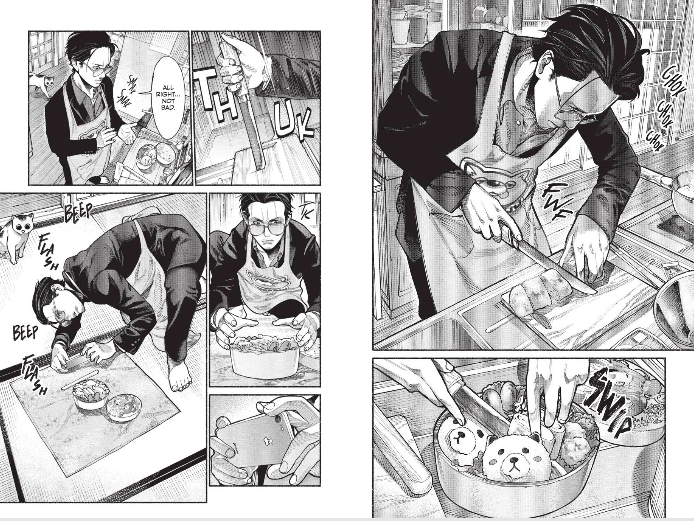
I was looking forward to The Way of the Househusband very much, because the title, premise, and subtly menacing cover art made it seem like just the type of action and humor manga I would enjoy. The househusband in question is a former yakuza member whose nickname was “The Immortal Dragon.” I think it is easy for a reader to tell if they will like this series from the first few pages, which show the househusband waking up, clothing himself grimly in all black, putting on an apron, and then making an adorable bento box for his wife. The househusband loves coupons, sales, and going to grocery stores while wearing his shibainu apron. Unfortunately his past has a tendency to catch up with him. While the Immortal Dragon still has the skills to administer a severe beatdown, often he disarms situations with his househusband hobbies by breaking through people’s emotional barriers with homemade cookies or a pair of deeply discounted gloves.

househusband

I particularly enjoyed the marriage scenes in this manga. The househusband’s wife is a designer who loves anime, and the lengths to which he will go to make her happy display the same relentless attitude that I’m sure helped helped him ruthlessly dispatch his enemies. It would be hard to pull off this title without solid art, and Oono excels at showing the househusband with epic resting bitch face that basically means that regular people find him terrifying. He seems to always be surrounded by film noir shadow effect lighting that throws his features in stark contrast. The larger format of the Viz Signature line makes it easier to appreciate the fight scenes taking place in mundane locations. I had high expectations for this title and I wasn’t disappointed.

Filed Under: Manga Reviews, REVIEWS Tagged With: the way of the househusband, viz media

The Way of the Househusband, Vol. 1

September 20, 2019 by Sean Gaffney

By Kousuke Oono. Released in Japan as “Gokushufudou” by Shinchosha, serialization ongoing in the magazine Comic Kurage Bunch. Released in North America by Viz Media. Translated by Sheldon Drzka. Adapted by Jennifer LeBlanc.

Sometimes, it has to be said, an author comes up with a premise that is so magical that you are tempted to say that it writes itself. This is never a good thing to say, especially to the person writing it, but let’s face it: the premise of this manga, which is that a yakuza thug is trying his hardest to go straight and become a househusband, is magical. You should read it for that alone. Fortunately, the execution is also very good, showing off a minimal cast and going in several directions that I wasn’t expecting. I have to admit, I suspected that the gag would be how good the husband is at typical housewife things, but no. He’s really good cooking with knives (a holdober from his former job), but is otherwise trying to learn on the job, so to speak, and we see him fail several times. There’s also the matter of his face. Let’s face it, he has a face that yearns to stare someone down and yell “Huuuuh?!” menacingly.

At some point in the past, our hero met his wife, fell in love, and decided to give up his unlawful career to be a homemaker while she became the breadwinner. In general the series falls into three different scenarios: one where he’s trying to do a housewife thing, and we are amused at the results and at the faces he makes; another where he’s interacting with his wife, who can seemingly beat him up (we see her strongarm him through a window when he overreacts to buying her a birthday gift she had already by cutting off his pinky) and loves PreCure; and interacting with an old member of his gang, who looks up to him and wants to get him back into the old yakuza (mostly, from what I can tell, so that said guy can be protected, as he’s a bit of a wannabe schlub). Through it all, our hero makes it clear: being a househusband is what he does now. And he’s going all in.

Again, the author knows his strength, and it’s in drawing that “Huuuuuuh?” face that our hero wears seemingly all the time. He may no longer be “the Immortal Dragon”, but his face seems to be stuck that way, causing lots of misunderstandings. Sometimes this causes problems for his more down-to-Earth wife, who has to explain to the store clerk that the “white powder” he wants is flour. At one point she tries to do something about his image by dressing him in less stereotypical clothing, which leads to a series of hilarious fashion disasters. It’s also the best chapter for showing off their marriage, as we see them fighting but also trying to accommodate each other. They make a pretty great couple. Oh yes, they also have a cat and a Roomba, and the two combined may make the funniest chapter in the book, at least for pet owners.

There’s not much plot development here beyond the basic premise, but why would you want it? I hope at some point we see a flashback as to how our couple met and fell in love. But other than that, the main reason to get this is that it’s funny. Recommended.

Filed Under: REVIEWS, way of the househusband

I’ve Been Killing Slimes for 300 Years and Maxed Out My Level, Vol. 5

September 19, 2019 by Sean Gaffney

By Kisetsu Morita and Benio. Released in Japan as “Slime Taoshite 300 Nen, Shiranai Uchi ni Level MAX ni Nattemashita” by Softbank Creative. Released in North America by Yen On. Translated by Jasmine Bernhardt.

I tend to enjoy this series, and so I will try to be charitable about some of its… quirks. A lot of the series involves revisiting plots and characters that we’ve seen before, and this gets turned up to eleven in this book, which starts with a dungeon crawl that turns out to be a tourist trap… much like the tourist trap we saw in the previous book. There’s also another festival, which gives our heroes the opportunity to run another cafe, only this time they have more people on their side, which is good as the cafe has a LOT more visitors. The festival itself is a cavalcade of “oh, that’s where they got to” reunions. It might be annoying if it weren’t for the matter-of-fact, blase tone of our heroine, whose tendency towards lack of surprise helps ground the reader as well. Even when she does react, it sounds more like tsukkomi than anything else. This series “chugs along”, in the best and worst sense of the term.

There’s a new character introduced here, who ticks off a few more boxes. She’s an intelligent mandragora, one that’s been around for a century or two but still tends to act exactly like a child who’s intellectually mature but emotionally stunted. Sandra quickly moves in with the others and becomes the tsundere they never knew they needed, as well as giving Azusa a child who is not essentially perfect. In fact, her other two slime children may be a bit TOO perfect, as we find when they attempt to go to a local elementary school and blow away the competition… and the teacher. Speaking of imperfections, Sandra, being a walking plant, is quick to point out what a horrible garden Azusa has, and this may be why no one likes to eat their veggies in this hourse. With the addition of some really good soil, we briefly get a nice foodie manga scene.

The highlight of the book, though, is the spinoff at the end, giving an origin story for Beelzebub, who (no surprises here) turns out to have been a LOT like Azusa, to the point of being a low-level officer worker for 1500 years as she didn’t really want more responsibility or trouble. Unfortunately, the new Demon Lord takes notice of her and immediately appoints her Minister, thereby upending her entire life. There’s lots of fantastic scenes in these two chapter, including Beelzebub trying to perfect her new over the top haughty personality, and dealing for the first time with the Leviathan Sisters and their complete opposite personalities. It also makes you realize why she’s always dropping in on Azusa, and why she keeps asking the slime kids to come live with her: after 1500 years on her own, she’s discovered what friendship is, and wants more.

If you’re looking for surprises or emotional depth, these books must be like Kryptonite for you. If, on the other hand, you want a relaxing book that goes at its own pace and does what it likes (even if it’s the same things it’s done before), this is another good volume.

Filed Under: i've been killing slimes for 300 years, REVIEWS

Koyomimonogatari: Calendar Tale, Part 02

September 18, 2019 by Sean Gaffney

By NISIOISIN and VOFAN. Released in Japan by Kodansha. Released in North America by Vertical, Inc. Translated by Daniel Joseph.

There are spoilers towards the end of the review for the end of the book, which is hard to talk about without spoiling.

The second half of Koyomimonogatari feels like it’s sliding slowly towards a darkness that you really don’t want to see. The first half of the collection (i.e. the first book, as Vertical split it in two) was fairly lighthearted and bantery, with only Nadeko’s story coming across as ominous. But as we get into the events of the 2nd half of Araragi’s school year, and things take a darker turn, it’s no surprise that the short stories do as well. The exception to this, oddly enough, involves Shinobu, whose donut-filled discussion with Araragi ends in a punchline so sweet that I’m glad it was delivered by the matter-of-fact Hanekawa. (Hanekawa is away almost the entire book, but the magic of cell phones means she can still be there to provide Araragi with the right answer. Honestly, these two need to see less of each other, it’s not good for them.) But even Tsukihi’s story involves a presumed extra person in the tea ceremony ghost story, and the last two stories almost end up defining everything that goes before them.

NISIOISIN said in the afterword that he wanted to have a look back at the series as he wrote this, and, as with the first book, there’s a lot of foreshadowing and backshadowing going on here. This is particularly true of Nadeko, who isn’t actually in these stories (she had hers already) but of course ends up lurking in the background as her main story took place from late October to early January – almost a three-month chunk. We saw that in the original stories through the point of view of Kaiki and Nadeko herself, but here we see Araragi’s own perspective on things, which is rather fatalistic, something that is no longer surprising with someone like hm. Araragi would be perfectly fine sacrificing everything he has to help someone who needed help, and I wonder how he and Shirou Emiya would get along. (Oh God, the idea of Araragi as Archer is horrific and hilarious.)

The last two stories in the book focus on two of the heroines that aren’t in the “harem” per se. Kagenui is there to try to help Araragi solve his “I’m turning into a real vampire” problem, but there are other forces getting in the way here, mysterious and unknown though they may yet be. (That said, it’s Ogi. Come on, of course it’s Ogi.) As such, the ending of her story has her removed from the plot – it’s called Koyomi Nothing, which fits as there’s a blank space where an ending should be. As for Koyomi Dead, well, the story spoils you as to what’s going to happen from the start. Gaen is the final heroine, in more ways than one, and her pragmatic disposal of Koyomi is both in character and also mind-boggling. (I like how she says that Shinobu won’t go on a rampage after his death because she’s seen the bad future where she does. Um, correct, but she can still kill YOU, Gaen.) It does solve Koyomi’s problem, though!

This is a pretty big cliffhanger, ending with Koyomi seemingly in the afterlife (Mayoi’s presence implies that). Unfortunately, folks are going to have to wait a while to see how it’s resolved, as we’re once again going back in time to fill in gaps. Owarimonogatari 1 will show us how Araragi first met Ogi, and also delve into why he became such a misanthrope before the series began. In the meantime, enjoy these short stories that shed light on why he is who he is now. (No, not dead. You know what I mean.)

Filed Under: monogatari series, REVIEWS

The Devil Is a Part-Timer!, Vol. 14

September 17, 2019 by Sean Gaffney

By Satoshi Wagahara and 029. Released in Japan by ASCII Mediaworks. Released in North America by Yen Press. Translated by Kevin Gifford.

As hinted in my previous review, this does not give us the next installment of the main series, but is another series of short stories that are interspersed throughout the series’ timeline. Most of them, with the exception of the last one, were published in magazines, something that happens quite frequently in Japan but is not always collected into a volume, and even when it is sometimes is not picked up in North America (hi, Index). As you can imagine, the stories here range from merely OK to quite good. None of them are too serious and none of them really advance the plot, but they’re fun and make you smile. Ashiya’s reaction to winning a pressure cooker in a contest is as hilarious as you’d expect given his frugality. Maou finds buying a new phone to be a lot more difficult than he expected, as he has memories attached to the old, broken one. And Maou also bikes a lot, so needs new pants, in possibly the slightest story here.

Three stories do get a little more depth, though. In the first, which takes place between the first and second books, Chiho meets up with Emi, Albert and Emeralda for sushi and they discuss Maou’s past, why he hasn’t erased her memories, and Chiho’s own feelings for Maou. This is well done but also feels a bit unrealistic in terms of Emi’s personality – it feels like Vol. 13 Emi is overlaid with Vol. 1 Emi so that she doesn’t explode in rage. The funniest bits are probably Albert and Emeralda experiencing conveyor belt sushi and revealing their hideously large appetites to us. Another story deals with Kisaki’s past, as when the manager of the Sentucky Fried Chicken across the street comes into McRonald’s (with Sariel in tow, of course), Kisaki literally throws her out, and has to face disciplinary action. The revelation that they have a past is not exactly surprising, but it’s fun. I really liked the revelation that she’s stalling her career a bit because she’s debating asking Maou to join her in her dream. I suspect that ain’t happening, though.

The best story is the last one, the only one written especially for the book, which shows us Emilia’s life after arriving in Japan for the first time. Naturally, she’s chased all over the place by cops, particularly when she tries to live in a park and drink from the central fountain. She ends up at a familiar apartment building, though it’s empty at the moment, and the moment she broke into it I knew exactly what would happen, but that didn’t make this less funny or endearing. I am somewhat relieved that she did not drive her realtor namesake into an institution or get her fired, as I was expecting one or the other. It also helps to emphasize how, when not driven to kill by the likes of Olba, Emi is really a sweet, kind person at heart. Even when she’s being a samurai ghost.

So this is not essential in terms of plot, but is a nice, fun read with more of the characters you know. Next volume should get back to the plot, and has a Christmas theme – will it come out by Christmas Day?

Filed Under: devil is a part-timer!, REVIEWS

Daytime Shooting Star, Vol. 2

September 16, 2019 by Anna N

Daytime Shooting Star Volume 2 by Mika Yamamori

I can usually tell if I’ll like a series after I read the first volume, but after two volumes I can more easily decide if I really like it. The second volume of Daytime Shooting Star still features plenty of angst over a potential student-teacher romance, but the supporting cast was featured a little more and I started to find this series endearingly quirky.

The second volume opens with the shoujo staple of a school trip, and when Suzume finds herself accidentally trapped in a ravine with Mamura the boy who is pathologically afraid of being touched by a girl, they actually have a couple moments of conversation. Suzume passes out just in time for Mr. Shishio to come to the rescue, and Yuyuka quickly figures out that Suzume has a crush when she visits her in the aftermath of the forest adventure. Yuyuka’s offhand gestures of friendship and blunt personality are a useful contrast to Suzume’s tendency to get lost in thought about her new life. There’s a hilarious scene when Suzume is studying and Yuyuka’s usual social mask slips as she launches into a tirade and Suzume grabs Mamura’s arm in a desperate attempt at distraction. Yuyuka then finds herself beset with a group of boys who follow her around in hopes of being berated. In the meantime, Mamura seems to have gotten over his fear of girls, but only with Suzume.

This volume sets up an entertaining soap opera with plenty of humor as well as more quiet moments of reflection. I’m also enjoying the art in Daytime Shooting Star, Yamamori’s character designs have a touch of whimsy, and she easily shifts from more cartoonish exaggeration to panels that highlight contemplation and internal emotion.

Filed Under: Manga Reviews, REVIEWS Tagged With: daytime shooting star, shojo beat, shoujo, viz media

Become You, Vol. 1

September 16, 2019 by Katherine Dacey

Ichigo Takano’s orange may be one the of best shojo manga published in the last ten years, offering readers a vivid, sympathetic portrait of five friends who get an unexpected chance to save a suicidal classmate’s life. Though orange explored dark emotional terrain, it was never mawkish; instead, orange ended on a hopeful note that showed younger readers that life goes on after tragedies big and small.

Become You, Takano’s latest series, mines a similar thematic vein, this time focusing on two emotionally damaged boys who form an improbable bond through music. And by “improbable,” I mean Taiyou and Hikari are temperamental opposites who initially seem ill-suited for friendship, let alone artistic collaboration. Taiyou is one of those only-in-manga characters whose dogged optimism shades into fanaticism—the kind of character who calls everyone his friend, and wears down skeptics with his relentless overtures. Hikari, by contrast, is a classic Character With a Secret, a former prodigy who abruptly abandoned the piano despite (or perhaps because of) his phenomenal success, keeping his classmates at bay with blunt comments. Naturally—by the immutable laws of Shojo Manga Plot Mechanics—Taiyou tries to recruit Hikari for a band, despite the fact that Taiyou is a tyro guitar player.

At first glance, Become You seems to be following a well-worn path in which an enthusiastic novice persuades a reluctant genius to mentor him, in the process drawing out his teacher and helping his teacher recover something that he lost—say, his joy in playing the tuba, or his relationship with an estranged family member. But Takano adds an interesting wrinkle to this familiar plotline: midway through volume one, we learn that Taiyou originally wanted to be an artist, but lost his desire to paint after being bullied by a teacher. In the aftermath of this encounter, what Taiyou really wants is to be good at something—anything, really—and will work diligently towards achieving that goal, even if he shows little or no aptitude for his chosen pursuit. Equally important, Taiyou is just as emotionally vulnerable as his would-be mentor, even though Taiyou papers over his anguish with bright smiles and cheerful comments.

As with orange, a magical plot device brings Become You‘s principal characters together–in this case, a mysterious cloaked figure who presents Taiyou with an electric guitar and words of Yoda-like encouragement. It’s not entirely clear if Taiyou is fantasizing or having a premonition, since his guardian angel looks an awful lot like Hikari. And while the ambiguity of these scenes has little impact on the reading experience, they occupy more space than the time-traveling letters did in orange—a mistake, I think, because Taiyou’s daydreams don’t add any special urgency or poignancy to the story. By contrast, orange‘s letters served a twofold purpose, setting the plot in motion and highlighting all the small ways that innocent comments or decisions could hurt someone as fragile as the suicidal Kakeru.

The other drawback to Become You is that Takano doesn’t seem to know much about music. Taiyou, for example, cheerfully states his intention to attend a “music college,” but lacks the rudimentary skills to play in sync with a metronome or sight-read sheet music. (He also seems blissfully unaware that conservatories require an entrance audition.) The concert sequences are similarly revealing: though Takano draws attractive, animated characters, and can put them through their emotional paces, she struggles to make Taiyou and Hikari’s musical performances come to life on the page, either by showing the physical effort necessary to making a sound—embouchure, hand position, posture—or by drawing convincing crowd shots that convey the impact of the music on listeners.

I’m not ready to give up on Become You just yet, however, as Takano has something worthwhile to say about pursuing activities for emotional fulfillment, rather than for personal achievement. She also explores the idea of artistic mentorship with honesty, acknowledging that the teacher-student relationship can have a profound effect on how a young artists finds his voice; any violation of that compact—an unkind comment, a dogged insistence on doing things the “right” way—can leave deep scars and stunt one’s artistic growth. Here’s hoping volume two strikes a better balance between the magical realism and the realities of being a musician. Tentatively recommended.

BECOME YOU, VOL. 1 • STORY & ART BY ICHIGO TANAKA • TRANSLATED BY AMBER TAMOSAITIS • SEVEN SEAS • RATED TEEN • 200 pp.

Filed Under: Manga, Manga Critic, REVIEWS Tagged With: Drama, Ichigo Takano, Musical Manga, Seven Seas

Aria the Masterpiece, Vol. 3

September 16, 2019 by Sean Gaffney

By Kozue Amano. Originally released in Japan by Mag Garden, serialized in the magazine Comic Blade. Released in North America by Tokyopop. Translated by Alethea and Athena Nibley and Katie McLendon.

Having given a long introduction to the main character of Aria – the city itself – Amano can now set about fleshing out the cast. Of course, the fleshing out is done at the exact same “slow pace” that the rest of the series has, but we do get two new regulars at the start of this third omnibus. Alice is from Orange Planet, the main competitor to Aika’s Himeya and the top gondolier company in Neo-Venezia. (Great gag when Akari asks about Aria Company and is reminded they have two employees.) Alice is one of those people who is really good at what she does but also somewhat introverted and bad at people skills, which has left her much like a prickly cat – well, prickly in a different sort of way than Aika, who’s more of an angry cat. Alice, naturally, attempts to tell Akari and Aika to go away when they first meet. Also naturally, Alice is totally unable to resist Akari’s natural in your face niceness and becomes a friend.

The other main character we meet in this volume is Aika’s mentor Akira. She’s there to underscore the fact that the gondoliers in Aria seem to get apprentices who blend well with them… or in some cases mirror them. This is readily apparent with the hit-headed Akira, who arrives after Aika runs away from her harsh training and decides to hang out with her crush, Alicia, instead. Naturally, we find that Akira and Alicia have a very similar relationship to Aika and Akari, complete with not allowing things and their competitive nature. Fortunately, Akira and Aika make up fairly quickly (it turns out Aika is actually the heir to the Himeya Company, which is one reason Akira is so strict) and she mellows out a bit for subsequent appearances. I will note it does seem odd that Athena is not mentioned several times, particularly when Alicia and Akira take their changes – and Alice – to the beach, but of course that’s hard to do when you aren’t written in yet.

The rest of the book contains more of the usual reasons to read Aria. There’s ‘sense of wonder’ chapters galore here, one of the best being a treasure hunt where the three girls run around the city finding clues and hints. As you’d expect, Akari also has another run in with Cait Sith, this one brought about by being outside on the hottest day of the year. Don’t drink that cold milk too fast, you’ll get a tummy ache. Oh yes, and we also meet Woody, who is a minor character whose main feature is that he looks – and acts – a lot like Vash the Stampede from trigun, something I suspect is mostly unintentional. And of course there’s the main reason to buy these books again – the larger trim size and nicer paper mean that it’s a treat to look at, and you want to go back and go over the art in slow motion after you finish it.

The next omnibus will have Vols. 5-6 of Aria, aka right before the series originally got cancelled by Tokyopop. Let’s hope it does better the second (no, wait, third – sorry, ADV Manga, no one remembers you) time around.

Filed Under: aria, REVIEWS

Baccano!: 1705 The Ironic Light Orchestra

September 15, 2019 by Sean Gaffney

By Ryohgo Narita and Katsumi Enami. Released in Japan by ASCII Mediaworks. Released in North America by Yen On. Translated by Taylor Engel.

In general, those who are really obsessive about the Baccano! series fall into two camps: anime obsessives and light novel obsessives. The anime obsessives tend to stick to the 1930s, which is, after all, what the anime adapted, with the exception of one episode. The light novel obsessives, though, really love the non-1930s books and their deep look at some of the more… broken members of the cast. In particular Huey Laforet, the “mastermind villain” of some books in the 1930s, last seen escaping from Alcatraz, and Elmer C. Albatross, who loves to try to make everyone smile but has something distinctly wrong with his way of thinking and moral compass in regards to smiling. They both cried out for an origin story, and we get it in in this, the first of the “1700s trilogy”, and possibly the most anticipated book since the series was initially licensed. This is the story of a city in Naples, Lotto Valentino. In particular, three students who are learning alchemy at a secret library: Huey, Elmer, and Monica Campanella. And let me say this: they are written as the OT3 you never knew you wanted.

The subtitle is, of course, a take on the 70s band ELO, aka the Electric Light Orchestra. No, Monica’s not the meek-looking brunette in the foreground; that’s Niki, a teenage girl and slave who spends most of the book awaiting her longed-for death, only to run into the power of Elmer and decide to live a little longer after all. Monica’s the blonde inn the background. You get the sense that Narita may have had the idea of Niki and Elmer as a beta couple to Huey and Monica, only to find that he simply could not remove Elmer from their orbit. I was rather startled to see how much of this book read like a genuine rom-con, and even the darker moments are about “will you still love me if you find out my SECRET” stuff. These are three adorable kids who, well, hate the world and want to destroy it in many ways. Elmer isn’t quite like that, but it’s clear that if it would make everyone smile, he’d be totally fine with the world’s destruction as well. Cute broken kids.

There are other things going on in the book, of course. Huey’s past is told via flashback and is a tragic nightmare, revolving around the just-dying out practice of witch-hunting in Europe. Monica’s is barely touched on, and I suspect we may go into it more in the next book. And Elmer’s is also just barely touched on, likely as it would simply be TOO horrific to do anything but merely glance at it. Remember, none of these folks are immortal yet (except, oddly, their teachers, who seem to be immortal from some other source than the one we know), so bad, permanent things can still happen to them. There’s a woman-loving Count who is an odd combination of Isaac Dian and Chikage from Durarara!!. There’s also a young gang member named Aile, who seems familiar but we’re not sure how familiar till the end. This book is a great example of why you shouldn’t read this series in chronological order by date. And a main plotline that reminds me a bit of The Lottery by Shirley Jackson.

The end of the book really makes you want to see the ongoing adventures of Huey, Monica and Elmer, which is why I hate to break it to you, but we’re jumping forward again. This time we go all the way to 2002, to see Firo and Ennis’ long-awaited (no, seriously, very, very long awaited) honeymoon on a luxury liner. Surely nothing can possibly go wrong!

Filed Under: baccano!, REVIEWS

Konosuba: God’s Blessing on This Wonderful World!: Crimson Fate

September 13, 2019 by Sean Gaffney

By Natsume Akatsuki and Kurone Mishima. Released in Japan as “Kono Subarashii Sekai ni Shukufuku o!” by Kadokawa Sneaker Bunko. Released in North America by Yen On. Translated by Kevin Steinbach.

This is another one of those books where the last sixth or so of the novel completely dwarfs everything that comes before it, so let’s use the time before the cover art to talk about the rest of it. Despite wanting to hang around the mansion and do nothing aside from get involved in wacky binding adventures with Darkness, Kazuma is coerced into going to a nearby castle that is beset by another Demon General. This one seems familiar to Kazuma, as he’s seen her before in the hot springs about five books ago. She’s also very familiar to Megumin and Yunyun, for backstory reasons that drive a lot of the plot. The demon general keeps blowing up the castle every day with Explosion. Fortunately, they have Aqua’s extraordinary public works gifts (no, really, not making a joke here) and also the ability to beat her at her own game. But whose Explosions are best? And oh yes, will Megumin find time to confess?

I’ve always been impressed with Konosuba, despite the occasional murmur of other girls, keeping itself to a simple love triangle. Megumin and Darkness both love Kazuma, despite his… well, Kazuma-ness. That said, one of these girls is MUCH MORE POPULAR among fans than the other. And it has to be said, at a base personality level that leaves out eccentricities, Megumin and Kazuma are the most compatible and similar. Here she does confess, and though there’s no kiss there’s a little snuggling. He also says he loves her back, but she accurately points out this is because he doesn’t want to upset her, and his own feelings are somewhat ambiguous. I was very amused by his apologizing to all the other waffling harem protagonists he always yelled at for not jumping the girl’s bones in manga he read. I also liked Megumin and Darkness inviting him to wash their backs at one point knowing he’s never going to actually do it.

ARE they now together? Well, Kazuma is wondering that himself at the end of the book. The author, though, implies that they plan to put romance on the back burner for the next volume, so it might be a while before we see any further development here, and in any case, few people are reading KonoSuba primarily for the sweet romantic bits. This isn’t good news for Darkness, though she does get an extended scene at the start of the book, possibly to apologize for doing almost nothing else the rest of the book. Darkness is Kazuma’s “type” more than Megumin, but her own eccentricities, i.e her masochism, is much more difficult to turn off than Megumin’s chuuni behavior, so a realistic relationship doesn’t seem in the cards. As for Aqua, once again the story emphasizes how they’re like brother and sister and not romantic. Which, honestly, thank God. That said, Aqua’s skills at building walls in this book may be the best part of the volume. Stop being a goddess, become a foreman!

As with the last book, this one ends with a cliffhanger where Princess Iris writes to say that she’s being married off. No way Kazuma lets that happen. In the meantime, enjoy a very good KonoSuba volume, essential for Megumin fans.

Filed Under: konosuba, REVIEWS

Fate/Grand Order: mortalis:stella, Vol. 1

September 12, 2019 by Sean Gaffney

By Type-Moon and Shiramine. Released in Japan by Ichijinsha, serialized in the magazine Comic Zero-Sum. Released in North America by Kodansha Comics. Translated by Kevin Gifford.

Sometimes you really have no choice but to do a series of spinoffs. Fate/Grand Order is huge, the visual novel/game that everyone is playing on their phone or tablet these days. Well, everyone but me, of course, as while I started it, and liked the visual novel aspects, the”pick these cards and see if you win” part drove me nuts. That said, I like to think I have enough of a passing familiarity with Fate in general that I’d have no issues with this. It does approximately the right things, adapting the start of the game, where you as a player (you’re male in this adaptation, because in general Fate adaptations don’t go the yuri route) arrive at a top secret facility for a top-secret mission, assisted by your new friend and possible love interest Mash. Sadly, halfway through the book everything blows up and you end up in a Fuyuki that’s had the Grail War go horribly wrong. Unfortunately, this is also about where the manga loses me as well.

Some of the problems seem to be things I suspect I’d have issues with in the original as well. Mash is a fairly passive, bland female protagonist, some of which is explained seemingly by her origins, but we don’t really get into those here. She turns out to be a Servant of some sort, but doesn’t seem to be the Saber or Archer sort. She needs the sort of development that you get in a visual novel which can use 20 hours of text to go deeper, and she’s not getting that here. Likewise Ritsuka is a ‘you are the player’ sort of protagonist, which means that he’s also fairly bland, as PCs never have much personality so that the reader/player can overlay themselves on them. He’s sort of Shirou-esque at times, minus the complete lack of self-worth. Perhaps most aggravatingly, a death scene that I think is meant to be both horrifying and tragic is so confusing, and the person being killed got so little attention, that it ended up being “what just happened?” more than anything else. Sorry about the black hole, Olga. Whatevs.

It’s not all bad, of course. Lancer is here and is awesome, though amusingly he’s not Lancer, but Caster. (I suppose I should call him Cu Chulainn instead, really.) He grumbles several times about this totally not being a class he’s best at, and I can’t blame him really. On the bright side, he’s also missing Lancer’s tremendously bad luck stat, meaning he’s allowed to be competent and do things. It’s also nice to see Archer (erm, EMIYA, I guess) and Saber Alter (Arturia Alter?), who are there to show off that this is a Fuyuki gone wrong. And we get the first of the main reason a lot of people play Fate/GO, which is too see famous historical figures as hot babes. Leonardo da Vinci is pretty hot. Honestly, if this were 9-10 volumes long, like Fate/Zero or Stay Night, I’d be more inclined to cut it some slack. But it ends in Vol. 2, and as a result I’m not even sure it was worth starting. Play the game instead.

Filed Under: fate grand order, REVIEWS

An Archdemon’s Dilemma: How to Love Your Elf Bride, Vol. 7

September 11, 2019 by Sean Gaffney

By Fuminori Teshima and COMTA. Released in Japan by Hobby Japan. Released in North America digitally by J-Novel Club. Translated by Hikoki.

As the author indicates in the afterword, this series has gotten reasonably successful, to the point where they can now plan foreshadowing and deeper plots for future volumes. It also means that they can afford to have the cast simply hanging out on the beach for half the book as well. We get lots of swimsuit watching, everyone goes deep-sea fishing, there’s a barbecue, there’s yukatas, and everyone has lots of fun watching Chastille and Barbatos be the worst Ranma and Akane ripoff ever. Yes, it’s all fun and games till someone loses an eye… that someone being a mysterious man who has been going around killing archdemons (well, an archdemon) and has now decided he wants to go after Zagan using the strength of his mighty fists and the power of his mystical silver cursed eye giving him tons of mana. Unfortunately for him, Zagan has both of those to spare. Fortunately, there are a few additional twists and turns to help the story along its merry path.

Zagan’s past has always been given to us in dribs and drabs, but we get a lot more of it now than we did before, including mention of other kids on the streets he was living with in his pre-archdemon days (stories of which seem to reduce his entourage to tears). And I hate to spoil things, but if you’re surprised you haven’t read too many light novels; it turns out those same kids may now be getting involved with his life as adults! One is a older brother figure wearing glasses, so he has to be a Big Bad going down the road. The other is more of a spoiler I won’t give away, but I was very impressed with how the author handled it, making it obvious to the reader just before the actual revelation, in the best mystery tradition, though this isn’t much of a mystery. We also meet a new Archangel who helps us to understand that the relationship between the Church and the Archdemons is not nearly as cut and dry as some people think it is, and they also provide the best battle scene in the book.

Nephy and Zagan both mention in this volume how much they’ve changed since they first met, and it’s a good reminder that in Vol. 1 Zagan was stiff and sullen and inclined to brutally murdering bandits in front of young women just because he didn’t really think much of it, while Nephy was a death-seeking stoic who was an abuse survivor. It’s quite heartwarming to see how far they’ve come, even though they STILL have not gone on a cliched love-ydovey date the way that Zagan really wants, nor has their relationship advanced physically. Still, they’re way ahead of Chastille and Barbatos, who are trapped at the “embarrassment = love” stage of things, or Richard (assistant to Chastille) and Nephteros, in the “hopeless suitor” stage. They’re still the best couple to watch.

The final scene implies that future volumes may get darker. That said, I suspect they won’t get that dark. We know why readers want to read this series, and it can be summed up in one word: ‘D’awww!’.

Filed Under: archdemon's dilemma, REVIEWS

  • « Go to Previous Page
  • Page 1
  • Interim pages omitted …
  • Page 146
  • Page 147
  • Page 148
  • Page 149
  • Page 150
  • Interim pages omitted …
  • Page 355
  • Go to Next Page »
 | Log in
Copyright © 2010 Manga Bookshelf | Powered by WordPress & the Genesis Framework