As one must on a long weekend, I’ve been watching marathon television, particularly the most recent season of Doctor Who on BBC America. In spite of our extended time together, I’m just not warming up to the Eleventh Doctor. To be honest, I’m shocked that I miss the Tenth Doctor, as I always found him to be a bit much (his five minutes in Harry Potter and the Goblet of Fire felt like 40), but there you go. So, if you’re up to the point that you can have an opinion of the Eleventh Doctor, what might that opinion be? In favor? Opposed? Abstaining?
Features & Reviews
MJ’s Best of 2010
With so much great manga filling the shelves this year, picking out a small batch of the “Best” is an especially daunting task. Even now, I feel a strong sense of mourning for titles that haven’t made the list (some of which you can track down in my 2010 Gift Guide). Yet after much deliberation, I’ve managed to choose just ten, divided into demographic categories to ease the pain of choosing.
Best New Shoujo of 2010:


The Story of Saiunkoku (Viz Media)
The Secret Notes of Lady Kanoko (TOKYOPOP)
Though this was a competitive category this year, what pushed these two series above the rest for me is what they most have in common: smart, independently-minded heroines I’d be proud to share with any teen girl. Though shoujo heroines don’t need to be role models in order to be enjoyable to read about, and sometimes they’re more relatable when they’re not, it’s certainly a great pleasure when they happen to be both.
Best New Shounen of 2010:


Code: Breaker (Del Rey Manga)
Bakuman (Viz Media)
Unlike 2010’s shoujo catalogue, the year’s shounen offerings were a weak point for me, making this category tough in a very different way. Still, there were two shounen series that especially caught my interest, if not always is the most flattering way. Regardless of any quibbles, however, what these two series have in common is that they’ve compelled me to want to read more of them, which is not something I can say for most of this year’s new shounen series.
Best New Josei of 2010:


All My Darling Daughters (Viz Media)
Bunny Drop (Yen Press)
What a pleasure it is to have such choices amongst this year’s new josei releases! What’s particularly notable about both these manga is how deeply they speak to the experiences of women. Even Bunny Drop‘s male protagonist is living out a struggle between parenthood and career generally allotted only to women, even today. Both of these titles are thoughtful, warm, and emotionally complex–basically my ideal recipe for satisfying manga.
Best New Seinen of 2010:


Twin Spica (Vertical, Inc.)
House of Five Leaves (Viz Media)
Though these series may appear to have little in common, and perhaps that’s true, what they do both offer is careful characterization and an otherworldly tone, each different than the other. Both Asumi’s rich inner life and Masa’s avoidance of his own provide a glimpse into the human heart and mind I find especially appealing, earning them both, perhaps, the title of Favorite Manga of the Year.
Best Classic Manga of 2010:


A Drunken Dream and Other Stories (Fantagraphics)
Ayako (Vertical, Inc.)
2010 was a great year for re-issues, but it also offered up a number of wonderful older manga, published in English for the very first time. Both Moto Hagio’s collection of short manga and Osamu Tezuka’s post-war epic focus particularly on issues of family, delving deep into some of the ugliest impulses of our biological tribes and the damage they can do to their least valued members, if from wildly different perspectives.
For some alternate picks, take a look at these lists from Manga Critic Katherine Dacey and Manga Curmudgeon David Welsh. Or for a wider look at this year’s critical consensus, check out Deb Aoki’s 2010 Critics’ Choice roundup.
3 Things Thursday: Resolutions
With the holidays finally over and our excess cookie weight staring up at us from the bathroom scale, we’ve reached that very special time when we look back at the year behind us and think about all the things we’ve failed to accomplish. New Year’s resolutions may be a time-honored tradition, but they’re also a time-honored source of depression and guilt, so I like to keep mine as realistic as possible. Fortunately, if there’s one thing I can count on doing every year, it’s reading a whole lot of manga, so it’s not too ridiculous to hope that I might finally get around to some important series I’ve continuously let slide.
As a relative n00b to the manga scene, I started out with a huge amount of catching up to do. And though I’ve accomplished quite a bit of reading over the past three-and-a-quarter years, there are still quite a number of previously-released series I’ve embarrassingly held out on, whether for lack of time, money, or organizational skills.
Since most of these series are must-reads for anyone hoping to be respected as a manga critic, I’d like to make a resolution to read at least three of them this year. So let’s make a list, shall we?
3 series I resolve to finally read in 2011:
 1. Buddha | Osamu Tezuka | Vertical, Inc. – Though I’ve come a long way with Tezuka over the past year or so, when my best friend mentioned that her pre-teen daughter was reading (and loving) Buddha, a series I’ve never even started, I felt quite keenly that I’d hit a very special low. Though I tend to leave much of the serious criticism to those more knowledgeable than I, there’s no excuse for not reading a classic like this.
Fortunately, Vertical’s paperback editions are fairly easy on the pocketbook, and I got some Borders gift cards for Christmas. I may be slow, but there’s hope for me yet!
 2. Fushigi Yûgi | Yuu Watase | Viz Media – What kind of self-proclaimed shoujo fan hasn’t read Fushigi Yûgi? This kind, apparently. Though I’m a fan of this series’ prequel, Genbu Kaiden, I’ve never actually picked up the original, despite any number of chances to do so. Sure, I’ve been told not to expect a lot from the story’s female lead, and I’ve read enough about it to know that I’m unlikely to enjoy it quite as much as Watase’s more recent work, it’s still fairly unbelievable that I’ve never read a shoujo series as popular and iconic as this one.
Lucky for me, the very awesome Michelle Smith gifted me with the first two VIZBIG editions as a Christmas present this year, so I’ve no longer got any excuse to put it off. Fushigi Yûgi, this will be the year!
 3. One Piece | Eiichiro Oda | Viz Media – Though I have indeed read the first three volumes of this series (again, thanks to the urging of Michelle Smith), popular opinion suggests that I’ve never gotten far enough in for it to truly grab me, and with brilliant folks such as David Welsh and Erica Friedman singing its praises, further reading is not merely warranted, but downright required. Sadly, the series’ recent appearance at the Manga Moveable Feast turned out to be badly timed for me (and my sluggish library system), and I let yet another opportunity slide.
At 60 volumes and counting, it’s a daunting task for sure. Thank goodness for omnibus editions?
So, readers, what are your manga resolutions, if any, for 2011?
Off the Shelf: First reads, second chances
Welcome to another edition of Off the Shelf with MJ & Michelle! I’m joined, as always, by Soliloquy in Blue‘s Michelle Smith.
We’ve got another Tokyopop debut series to look at this week, and a mix of debuts and continuing series from Yen Press and Viz Media as well.
MJ: I like fruitcake.
MICHELLE: You have my deepest condolences.
MJ: Hater.
MICHELLE: I tend to generally not like bread-like items with things in them. That said, I was a kid the last time I tried it so would give it another chance.
Can you say the same about the manga you read this week?
MJ: Hmmmm, well, not quite. Or, I should say, “not necessary.” But I’m guessing you can?
MICHELLE: More like a “probably not” and a “this one was on its third chance already” kind of thing. :) But first, the former!
 I really wanted to like AiON, TOKYOPOP’s new series by Yuna Kagesaki, the creator of Chibi Vampire. The cover is pretty attractive, after all (if you can get past the moe factor), and shows off the publisher’s snazzy new trim dress. Plus, the back cover blurb starts with six tantalizing words I never expected to see strung together in this order: “Mermaids and mind-controlling parasites wage war…”
Unfortunately, despite the cracktastic potential suggested by that phrase, the story as presented in the first volume is exceedingly dull. Wealthy Tatsuya Tsugawa has lost both his parents the week before, and yet seems largely unaffected by this aside from trying to live up to his dying father’s wish that he become a great man. This compels him to intervene when he notices a classmate, Miyazaki, being bullied. She tells him several times that she wants the bullying to continue, but he can’t leave her alone and eventually learns that she was purposely antagonizing the bully the better to extract a parasite that was infecting her.
Perhaps the story doesn’t seem so boring in summary form, but it really, really is. I lay most of the blame at the feet of Tsugawa, who is just so utterly generic that the only thing remarkable about him is the extent of his blandness. At the halfway point, when he questions why Miyazaki’s opinion matters to him and wonders if this means that he likes her, I quite literally set the book aside and had a brief nap. That’s how believable and meaningful the scene was.
Tsugawa and Miyazaki interact a few more times, with the inevitable result that she winds up moving in with him. Love and parasites will surely ensue, but man, I can’t imagine sitting through a second volume.
MJ: I’ll admit the story doesn’t sound *so* boring in summary form, but your nap anecdote is difficult to ignore. Also, where are the mermaids?
MICHELLE: An excellent question! I don’t recall a single mention of them. More vividly, I recall the half dozen grammar errors that plague the text. All in all, it’s not a very auspicious debut.
Did you fare better with your picks this week?
 MJ: I did, particularly with my first selection, which I found quite charming. This week, I finally got around to picking up Julietta Suzuki’s Kamisama Kiss, a supernatural romantic comedy from Viz’s Shojo Beat imprint.
Like AION, this series begins with its protagonist, Nanami, being essentially orphaned, though in this case our teenaged heroine’s father has not actually died but skipped town to avoid his gambling debts, leaving his daughter to face the collectors all alone. Once she’s been evicted from her apartment, Nanami ends up in the park where she meets a strange man who offers her his home if she’ll take over his job. Before she knows what’s happening, he’s sent her on her way, but when Nanami reaches the home that’s been promised her, it turns out to be a shrine–of which she’s just been made god!
An argument could be made that this premise sounds much less interesting than AION‘s as you’ve described it, but fortunately this one is well-executed and genuinely fun.
Nanami’s cut from pretty standard shoujo cloth–a spunky young woman with no obvious talent aside from her determined optimism, but she’s got a great foil in the form of Tomoe, a fox (the supernatural kind, though the other kind too) who served the shrine’s former kami and who is beyond dismayed to find himself bound to someone like Nanami. Tomoe is catty and cynical but excellent at his job, and watching him work and argue with Nanami is the source of most of this volume’s charm.
What I especially appreciate about this series, is that regardless of Tomoe’s tremendous superiority complex, he’s far too lazy to be controlling like so many shoujo love interests, and even his surliness is kept staunchly at bay thanks to Nanami’s power of kotodama, which forces him to do her bidding whether he wants to or not. In a way, Kamisama Kiss is everything that Black Bird could have been if not for its heavy misogynist overtones. Like Misao, Nanami’s surrounded by yokai who would just as soon eat her if they had the chance, but unlike Misao, Nanami has agency, and that makes all the difference in the world.
MICHELLE: It’s interesting that you mention Black Bird, because I did the same in my recent review of Kamisama Kiss, though mine was more in the context of being worried about some of Tomoe’s comments as contrasted by his kindliness. You’re right about the kotodama giving Nanami an advantage, though—actually, this combined with Tomoe’s white ears puts me in mind of Kagome’s ability to compel InuYasha‘s titular hero to “Sit!”—so perhaps I oughtn’t be so concerned.
MJ: It’s interesting to me that you had that concern, because this series didn’t ping me that way at all, and not just because of Nanami’s kotodama. Tomoe may be surly and condescending, but he’s expressed zero sexual interest in Nanami so far, and he thankfully lacks Kyo’s predatory lust and possessiveness, which is what makes Kyo so controlling and repulsive. Tomoe’s neither as clingy nor as abusive as Kyo, and though it seems clear that Tomoe and Nanami are being set up for romance, I feel like they’re starting on even ground, thanks to their individual strengths and weaknesses.
MICHELLE: Yeah, you’re right. And it wasn’t so much that I thought there relationship was like the one in Black Bird, but more that it made me think of Black Bird, which is usually not a good sign! :)
MJ: Yeah, I can relate to that. :D
So what else have you been reading this week?
 MICHELLE: You’ll be pleased to hear that the series to which I gave a third chance is Nabari No Ou! It’s very rare that you and I should disagree about a series, but it happened with this tale of a reluctant ninja. I found the first two volumes to be mighty boring, but I’m happy to report that things pick up a lot in volume three and stay pretty interesting through volume five!
The basic gist of the plot is that a middle schooler named Miharu Rokujou is inhabited by an immense power known as the “Shinra Banshou,” and two factions of ninja clans are fighting over him. Both are after a set of five scrolls containing the “secret arts” of the various ninja clans, though one group thinks they can use these scrolls to dispel Shinra Banshou while the other seeks to activate it. In volume three, Miharu and his protectors (they of the “dispel” camp) accept a job to assassinate a scientist in exchange for one such scroll, which leads Miharu’s protector Kumohira-sensei to question his convictions and ultimately, to a chilling culmination of the assignment. Volumes four and five deal primarily with the backstory for one of the characters’ brothers, and manage to sustain much of the momentum gained in volume three.
Don’t get me wrong, I still yawn when reading about the squabbling clans or the all-powerful scrolls, but the characters and their relationships are what have piqued my interest at last. Largely this is facilitated by the head of a rival clan—the one who hired them for the assassination job—who possesses the ability to read minds and threatens to reveal everyone’s “grave secrets.” This gets everyone suspicious of one another, with some pretty dramatic results. I’m most interested in the dynamic between Miharu and Kumohira, because the latter seeks to obtain the former’s trust while revealing as little as possible about what he remembers of some cataclysmic past event, but I also quite like scenes between Miharu and Yoite, another young man who should be Miharu’s enemy but for whom he seems willing to do just about anything. I’m sure there is loads of fanfic written about these two.
Anyway, I am finally on board the Nabari train.
MJ: I am very pleased to hear this! I feel like this series has been the skeleton in the closet of our friendship! Or something like that.
I agree that it’s the relationships that really make this series come alive, though I liked them earlier on than you did. Or maybe I just liked Miharu so much, I felt more patient about the rest. He’s the kind of enigma I enjoy most. I haven’t fully dug in to volume five yet, but now I’m really looking forward to it.
I feel like I should have many smart questions to ask you, now that you’ve read further into the series, but I find I mainly just agree, particularly on your feelings about where the most interesting relationship drama currently resides.
MICHELLE: I found Miharu petulant at first, but once the mind-reader arrived and saw that his indifference is just a front, I found him more appealing. I must say, it is somewhat of a relief for us to be on the same page at last! :)
What else have you been reading this week?
 MJ: I’m a bit tardy on this one, but I’ve just finished the second volume of Shunjo Aono’s I’ll Give It My All… Tomorrow from Viz’s SigIKKI line.
I enjoyed the first volume of this series, but my greatest concern at the time was that the series might quickly become unreadable if something didn’t change for its painfully lost protagonist. Fortunately, that pitfall has not yet come to pass, though not for the reasons one might imagine.
The second volume finds Shizuo still plugging along in his half-hearted, humiliating way, creating bad manga that may never be accepted for publication, imagining romantic interest from a woman who is merely kind to him, and imposing on the few people who inexplicably care for him, including his daughter and his younger friend, Shuichi. A bit of backstory helps to put his stunted personality in perspective, but it’s truly agonizing to watch him fumble through life, especially should one catch a glimpse of oneself in Shizuo’s plight, which, believe you me, is uncomfortably easy for many of us to do.
What really saves this volume, however, is that it miraculously develops a hero, and that hero is, surprisingly, Shuichi. Here’s a quiet, pretty much expressionless guy, who manages somehow in the least likely arena to display the kind of compassion and fearlessness one might expect from a shounen battle hero. I won’t spoil you by telling you what happens, but I will say that I actually cheered audibly at one point in this volume. Being a melancholy seinen comedy, Shuichi’s heroism doesn’t get him much but a messed up face and the loss of his job, but it’s still a damn good read.
Of course, Shuichi isn’t actually the hero of this manga, and even now I find myself wondering how long the story’s premise can last without becoming too depressing to bear. But Aono’s won my confidence enough to compel me towards volume three, and that’s no small feat.
MICHELLE: I haven’t even been able to work up the desire to give this series a first chance, much less a second or third. It just sounds so… horribly frustrating and bound to leave the reader depressed. Maybe it’s shallow of me, but I’d much rather read something utterly frivolous.
MJ: It’s not necessarily an easy read, that’s for sure, though it is genuinely a comedy. It’s not self-consciously dark.
MICHELLE: Yeah, but I have a history of finding unfunny series that others find very amusing, like Detroit Metal City. I think I’ll continue to stay away from this one.
MJ: Probably a good call. Though I hope you’ll give fruitcake another try someday. ;)
MICHELLE: It might take some time to muster up the nerve.
MJ: So it’s often been said.
MICHELLE: Many times, many ways?
MJ: “Merry fruitcake… to yoooooou.”
MICHELLE: *pachi pachi*
Many thanks to Michelle for indulging me in 22 installments of this feature since we first began back in August! Join us again in the new year for an all new Off the Shelf!
The Seinen Alphabet: V
“V” is for… well, not very much, when you make a conscious choice to ignore “Vampire” and “Virgin,” but that’s just how I roll.

Vagabond (Viz), written and illustrated by Takehiko Inoue. This is one of those Japanese comics that’s highly regarded both by manga devotees and by comics omnivores, though I think that’s generally true of all of Inoue’s work. Vagabond, which is still running in Kodansha’s Morning, though I believe it’s on hiautus, tells the tale of the “quintessential warrior-philosopher.”

Mizu Sahara adapted a one-volume manga of Makoto Shinkai’s animated film, The Voices of a Distant Star. The manga was originally published in Kodansha’s Afternoon, and it was later published in English by Tokyopop.
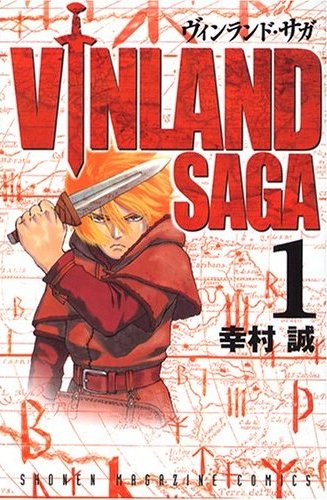
Lots of people would love for someone to publish Makoto (Planetes) Yukimura’s Vinland Saga, myself included. This sprawling tale of Vikings is still running in Kodansha’s Afternoon.
“V” is also for Viz, obviously, still barreling along as North America’s major manga publisher. It’s jointly owned by Shogakukan and Shueisha, and Viz makes a great deal of seinen manga available for free online in the form of its SigIKKI initiative.
And nobody should ever overlook Vertical, which initially made its manga name by focusing on classic works by Osamu Tezuka and Keiko Takemiya, but has recently begun publishing more contemporary (but still excellent) works, in addition to its prose fiction and non-fiction catalog.
Update:

On Twitter, Scott Green reminded me of Voyeurs, Inc. (Viz), written and illustrated by Hideo Yamamoto. It follows the misadventures of a group of surveillance experts. It originally ran in Shogakukan’s Young Sunday.
Chi’s Sweet Home 4 by Konami Kanata: B+
 From the back cover:
Welcome to the neighborhood, Chi and family! Now in her new residence, Chi will be introduced to many friends of the furry and feathery kind. With so many fresh smells to investigate, endless adventures await. So settle in, because here pets will never be chased… unless they are chasing each other.
Review:
Chi’s Sweet Home is one of those series that goes to the top of the to-read pile whenever a new volume is released. It’s always a true pleasure to read, with colorful cuteness guaranteed on every page.
This volume focuses mostly on the Yamada family’s move to a new, pet-friendly apartment complex and Chi’s reactions to her new environment. I love that so much time is devoted to her acclimation, and how familiar smells gradually embolden her enough to rub herself all over all the new stuff and proclaim it to be hers, too. She also meets a few animals at the new place, though more of her interactions so far have been with a gregarious (but well-trained) dog named David than with snooty long-haired kitty, Alice.
As usual, mangaka Konami Kanata perfectly captures several moments that ought to be familiar to cat owners: the pitiful mewling and pawing at a door that separates the kitty from its people, the inability to fathom what a scratching post is for, and the perils of claw trimming. In fact, I think this last was actually understated; I’ve had cats practically all my life and I still feel unqualified to attempt this task!
It’s not all cuteness, though. Chi’s Sweet Home has occasionally had some bittersweet moments—early volumes contrasted Chi’s cozy new home to her fading memories of her mother and siblings—and this volume is no exception. It’s sad to see how much confusion human-induced change causes to poor Chi and how baffled she is by her friend Blackie’s abrupt departure. I don’t know whether to hope and/or expect that a reunion will be forthcoming or to admire this slightly darker streak in the story.
We’re getting close to being caught up with the series in Japan. The fifth volume is due in February and then, after being spoiled on a bimonthly release schedule, we will suddenly be called upon to wait much longer for our Chi fix. I guess we could always turn to Crunchyroll for solace.
Review copy provided by the publisher.
Manhwa Monday: Quick roundup
 Welcome to another Manhwa Monday! Here’s a quick round-up of manhwa-related news and reviews from the past two weeks.
The folks at Dramabeans report that popular drama Secret Garden is going to be made into both a novel and a girls’ manhwa series.
At Funky Doodle Donkey, Mireille shares her love for Korean icon Pucca.
The iSeeToon blog has been a busy place, as Jeong-Woo Seon continues their series on types of Korean manhwa, with an entry on Jab-Ji Manhwa (Manhwa for magazine). Check out the entire series here. In other iSeeToon news, they’ve uploaded a YouTube video to demonstrate their Magician iOS app. They’ve also started a Facebook page.
New in reviews, Anime Maki’s Todd Douglass takes a look at a handful of Yen Press manhwa. Both Lori Henderson and Michelle Smith review volume four of Time and Again (Yen Press) at Comics Village and Soliloquy in Blue, respectively. Michelle also checks out the final volumes of Angel Diary (Yen Press) in our latest Off the Shelf column at Manga Bookshelf. And Lori gives us the rundown on the latest issue of Yen Plus at Manga Xanadu. At Kuriousity, Andre Paploo looks at volume four of Raiders (Yen Press). At Slightly Biased Manga, Connie talks about volume five of Sugarholic (Yen Press).
If anyone happened to notice the predominance of manhwa from a single publisher in this week’s review roundup, it’s a pretty good indication of the state of the American manhwa industry over the past year. Though the year’s most promising new series, There’s Something About Sunyool, came to us from NETCOMICS, only Yen Press maintained a significant print release schedule for manhwa. And even from Yen, we saw many more series endings than beginnings this year. What will 2011 bring us? Stay tuned as we find out!
That’s all for this week!
Is there something I’ve missed? Leave your manhwa-related links in comments!
Highschool of the Dead, Vol. 1
A poor man’s Dawn of the Dead — that’s how I’d describe Highschool of the Dead, a slick, violent zombie story that borrows shamelessly from the George Romero canon. Whether that’s a good thing depends a lot on your relationship with Romero. If you thought Dawn of the Dead was a sly poke at American society — its consumerism, class divisions, and latent racism — Daisuke Sato and Shouji Sato’s manga will seem awfully thin, as the authors are more concerned with dishing out panty shots than revealing how threadbare the social fabric really is. If you found Romero’s film unnecessarily burdened with subtext, however, you might just cotton to the Satos’ ultra-violent update.
As the title implies, the story begins at an ordinary high school in Tokyo. When the staff contract a mysterious disease that transforms them into zombies, they wreak havoc, infecting hundreds of other people as they chomp, rend, and tear their way through campus. A small band of students take refuge on the roof, hoping for a helicopter rescue. What they discover, however, is that the entire city has descended into chaos, leaving them little choice than to find a safer place to wait out the crisis.
From a narrative point of view, Highschool of the Dead follows the zombie playbook to the letter. The zombies are slow and shambling; the the story takes place in a closed environment where the zombies’ sheer numbers give them a decided advantage; and the characters can barely stand each other, setting aside their mutual contempt only for the zombie-fighting cause. But while Romero made the most of his film’s shopping mall setting, the Satos treat their high school’s corridors and classrooms as just another indoor space filled with convenient weapons. (Call me crazy, but I don’t remember nail guns lying around the Newton North science labs.) The fight scenes are choppy and poorly staged, giving little indication of how the characters are moving through the space or where, exactly, they are in relation to the school’s main entrance. Even the violence-porn flourishes lack imagination: zombies die by baseball bat, power drill, broom handle, sword, and fire hose, but none of the characters improvises an interesting weapon out of something unique to the school.
The script is as predictable and clumsy as the fight scenes; the characters speak in exposition-heavy soundbites that bear little resemble to real conversation. (Sample: “Rumor has it that your childhood girlfriend ended up in your class when she stayed back and is going out with Igou now, right?”) Daisuke Sato assigns each character a few defining personality traits, raising the possibility that the characters’ economic and social disparities might inform the way they interact. The characterizations are so meager and inconsistent, however, that it’s tough to remember who’s who; I learned more from reading the Wikipedia article on Highschool of the Dead than from the manga itself, never a good sign when the characters, in fact, do have important backstories that shape their opinions of one another.
The biggest problem with Highschool of the Dead is its relentless commitment to cheesecake. The Satos work fanservice into as many scenes as possible, taking full advantage of every stairwell, fight, fall, and female death to flash derrieres and panties; only an episode of Strike Witches has more up-skirt imagery. Adding insult to injury is Shouji Sato’s willful disregard for basic female anatomy. Several of the female characters’ bust lines are so monstrously distended that it would be impossible for the characters to actually stand up and walk in real life, let alone fight zombies. (Hint to aspiring manga artists: large breasts do not look like grossly misshapen lemons or balloon animals.) I realize that costume failures and nubile girls are a staple of horror movies, but when the cheesecake is so poorly done, it’s hard to imagine who would find it arousing; the Satos could take a few tips from Robert Rodriguez on how to incorporate plausible, sexy women into a monster flick.
And when the scariest thing about a zombie story is the way the female characters’ breasts are drawn, well… I’d say the creators have fallen down on the job. The bottom line: unless you’re a die-hard zombie fan or panty-shot connoisseur, you’re better off seeking undead thrills elsewhere.
Review copy provided by Yen Press. Volume one of Highschool of the Dead will go on sale January 25, 2011.
HIGHSCHOOL OF THE DEAD, VOL. 1 • STORY BY DAISUKE SATO, ART BY SHOUJI SATO • YEN PRESS • 160 pp. • RATING: MATURE (18+)
License Request Day: Cooking Papa

One of the many important things I’ve learned from the entertainment industry is that Christmas is the time of year to make unreasonable demands of higher powers that they are obligated to fulfill if they want people to keep believing in them. We’ve basically got them in a corner, so why not go for the big ask? Why not say, “Hey, someone should throw caution and logic to the wind and publish a 100-plus-volume cooking manga”?
 While working on this week’s letter of the Seinen Alphabet, I ran across a mangaka named Tochi Ueyama, who basically only has one title to his credit. This isn’t due to laziness, as he’s been working on it since 1984. 112 volumes have been published to date. It’s called Cooking Papa, and it runs in Kodansha’s Morning.
As near as I can tell, it’s about an average family where the father, a white-collar worker, does the cooking. (The mother, a journalist, isn’t very good at it.) Papa helps their son learn his way around the kitchen. Every chapter includes recipes.
 Now, I can hear all the “buts” to the point that they sound like an outboard motor. But it’s way too long! But cooking manga doesn’t have a great commercial track record! But we should pester Viz to publish more Oishinbo instead! But Kodansha isn’t taking that many risks yet!
All of those things are true. But if we all adopt our best Cindy Lou Who miens, perhaps manga’s heart will grow several sizes. It’s Christmas. We’re entitled to expect miracles. TV said so.
What are some of your Christmas Miracle license requests?
3 Things Thursday: Manga for Christmas
So, I know I put a lot of new, awesome manga in my gift guide this year, but when it comes to my own Christmas list, I admit I bulked it up with oldies. There are a few older shoujo series in particular that I’ve been collecting over time, and it looks like this Christmas, I just might complete my collections! At least one I’ve read all the way through already, and all I’ve read to a point, with the help of libraries, friends, and (in one case) scanlations, as some volumes have rapidly fallen out of print and are difficult to purchase without paying hundreds of dollars to some unscrupulous Amazon or Ebay seller.
Out-of-print shoujo is one of my deepest woes, and since the more we talk about these dwindling series, the more likely Viz is to consider omnibus treatment (or so we hope and dream), I’ll dedicate today’s 3 Things to three shoujo series I’m hoping to own in completion after this Christmas!
I’m Gettin’ Manga For Christmas
 1. Basara, vols. 24-27 | Yumi Tamura | Viz Media – Oh, how long I’ve been collecting this series! Perhaps my greatest regret as a latecomer to manga is that I wasn’t aware when this series was originally being published of what it was, or how sad I’d one day be when its middle volumes started going out of print after I became a fan. Fortunately, most of the trickiest ones I’ve already picked up, including the legendary volume 20, which goes for $125+ online, but which I happened to stumble upon at a convention two years ago for 20% off the original retail price. My quest for this series has seemed endless, but with just four volumes left, I’m counting on Santa to pick up the slack. You wouldn’t let me down, Santa, right? RIGHT? And by “Santa” I mean “my in-laws.” :D
My post-Christmas marathon reads will be epic.
 2. Please Save My Earth, vols. 11, 12, 15, & 18 | Saki Hiwatari | Viz Media – Back when I was a manga n00b, I read this series scanlated in its entirety, with no concept of how difficult its volumes would be to find once I started trying to buy them up myself. I’ve been cobbling together my collection since late 2007, buying new when possible, but also snatching up some of the harder-to-buy volumes as trades or used books when I could find them. Having recently acquired the elusive volume 7, I have just a few, scattered volumes to pick up before I can re-read that series, which I shall do with relish as soon as my collection is complete.
This series is a special pet of mine, because it’s one that I desperately want to recommend, but with a major stumbling block. “This is the greatest series ever. You’ll have to pay upwards of $25 (plus shipping) just to read the first volume, and after that, well… But seriously, it is the greatest ever!”
 3. X/1999, vols. 8, 9, 16-18 | CLAMP | Viz Media – I’ve slacked off on collecting this series, partly because I’m a bigger fan of Tokyo Babylon (which I own in its entirety and have reread several times), and partly because it’s unfinished anyway, but I realize my assessment of it is hardly fair, since I’ve never read past volume 7. My collection’s holes begin there, and I’ve never been able to move forward. I thought it was time I persevered, so I put my missing volumes near the top of the list this year.
My greatest difficulty with X/1999 of course, as a fan of Tokyo Babylon, is that it’s painful for me to watch what’s become of my beloved Subaru in the aftermath of that series. It’s also a bit painful to know that the story is not about him, when he’s the one who’s already got all my loyalty and interest. Can I overcome my issues and join the ranks of other CLAMP fans, who laugh at my TB obsession in the face of their obvious superiority? Thanks to Santa, we may soon find out!
So, that’s what I’m hoping to score this holiday season. How about you?
Pretty maids all in a row
I saw a story on the BBC about these all-girl pop groups that are cropping up in Japan under the sponsorship of just about everyone, from corporations to vegetable growers associations to urban redevelopment committees. And it reminded me of the truth that, when you put four or more attractive people in a row and give them some common purpose, your chances of achieving your aims improve at least slightly, depending on how appealing those four or more young people are.
They can come together by inspiration or design, it really doesn’t matter all that much. Origins in inspiration are obviously more highly regarded than manufacture, but, one or the other, people can still develop attachments to even the most cynically constructed assemblages. If they look good standing in a row, if their types connect in comforting ways, you’re in good shape.
The tale of local-produce promotional singing sensations mentioned above also reminded me of the truth that success replicates, even if you’ll never quite capture the lightning in a bottle that inspired the original. Entire comics companies have been born out of a desire to replicate the grim and gritty success of Wolverine. Intriguing notions become franchises, for better or worse.

In the case of the cast of Kiyohiko Azuma’s Azumanga Daioh (Yen Press), they are the best they are at what they do, and what they do is be funny and cute, particularly funny. Azuma’s ensemble seems to have inspired a host of imitators, temperamentally balanced groups of girls with their weapons set on “charm.” That they will almost certainly never rank any higher than second place, given that it’s unlikely that Azumanga Daioh will ever drop from first, isn’t reason for them not to exist. People didn’t stop writing plays about crazy, southern drunks after Tennessee Williams or musicals about neurotic people after Stephen Sondheim.
 Of course, not all of these imitations fully justify their existence. I thought the four cute girl students of Ume Aoki’s Sunshine Sketch (Yen) were totally forgettable, like adorable collectibles rather than proper characters, in spite of their promising art-school setting. The music-club girls of Kakifly’s K-On (Yen) are just better enough that I can see myself spending a few volumes with them.
Yes, there’s the serious one, the loud one, the dingbat, and the rich girl. Yes, there’s the obnoxious teacher who should probably find another career. Yes, they go to the beach and wear kimonos and maid costumes. They basically go through all of the Stations of the Cross. But I enjoyed their company, and I got a reasonable number of chuckles out of their delivery of admittedly familiar situations. I can even abstractly appreciate the thoroughness with which Kakifly has abetted the audience’s wish fulfillment – there isn’t even the silhouette of a male character to present competition.
But, at the same time, I’m not the author’s ideal reader, either. I didn’t read the magazine, then collect the paperbacks, then watch the anime, then download the soundtrack of the anime, then buy the DVDs, then collect the figurines, play the video game, and track down the sexy fan comics, all while discussing with my friends which character I’d ideally like to marry, judging them for their choices. If that sounds like I’m judging the franchise for being cynically commercial, I’m not. Kakifly and company took a successful formula, turned it into something likable, and built a mini empire out of that. It’s better than building an empire based on something awful, right?

BL Bookrack: December
Welcome to 2010’s final installment of BL Bookrack, a monthly feature co-written with Soliloquy in Blue‘s Michelle Smith.
This month, we take a look at four one-shots from Digital Manga Publishing’s Juné imprint, Intriguing Secrets, The Object of My Affection, A Place in the Sun, and Temperature Rising.
 Intriguing Secrets | By Rize Shinba | Published by Juné | Rated YA (16+) | Buy at Akadot – After an accidental collision with a teacher in the hallway, high school student Mizue is sentenced to weed the school’s overgrown yard alongside his classmate Umehara, known to be the “class clown.” Umehara’s also been the center of some ugly classroom gossip, so Mizue is surprised to discover that he’s actually a pretty nice guy. He’s even more surprised to find himself drawn to Umehara in a vaguely romantic way, something of which he becomes immediately ashamed. When Umehara seeks him out in the art club room and asks him to paint his portrait, Mizue begins to wonder if his new friend might feel the same way, but every potential advance by Umehara is followed by a joke. Could Umehara’s teasing be a cover for something more?
Admittedly, it would be difficult to think of a more generic BL premise than the one just described. But if the worst that can be said about Intriguing Secret is that it’s unremarkable, that’s also its greatest strength. With its quietly mundane atmosphere, this manga promises love in the most ordinary places. Even its leads are an example of this message. Sure, Mizue seems to have some artistic talent, and Umehara is able to charm his classmates with a joke, but the two are so resoundingly noncommittal to who they are as people, it’s difficult to know what, if anything, they actually value. Mizue is reluctant to even say that he “likes” painting, while Umehara shrugs off everyone with a nearly audible “whatever.” Yet somehow, over the course of the series, they learn to be certain of each other, at the very least.
Though it may seem like I’m not making much of a point in the series’ favor, this practiced indifference is what actually makes the story work. With so little to build itself around, really nothing exists here but the romance itself, and this romance is undeniably sweet, from start to finish. Rize Shinba’s artwork is nearly as nondescript as her characters’ ambitions, yet, like everything else in this story, there is a quiet sweetness about it that holds everything together, as long as nobody’s trying to dig too deep.
Like a gauzy fabric on a warm summer day, Intriguing Secrets is comfortable and pretty, if not quite substantive.
-Review by MJ
 The Object of My Affection | By Nanao Okuda | Published by Juné | Rated YA (16+) | Buy at Akadot – Sometimes it’s not such a bad idea to judge a book by its cover. I knew nothing about The Object of My Affection or its creator, Nanao Okuda, but found the art style so appealing that I had to check it out. I’m very glad I did, because Okuda spurns typical yaoi characterizations, instead creating some sympathetic and emotionally accessible characters.
Back in high school, shrimpy Hiroki Wakamiya was dazzled by the athleticism of Wataru Anzai, a player on a rival school’s basketball team. He promised to catch up to him, and by the time college rolls around, he has improved (and grown) enough that he is recruited by the school Anzai plays for. His hopes of competing directly against his hero are dashed, however, when it’s revealed that Anzai has a busted knee and can no longer play.
Wakamiya is disappointed, but still finds himself drawn to Anzai, especially for his “inner strength contrary to the image given by his slender physical frame.” Anzai doesn’t like to show his vulnerability to anyone, but finds himself able to trust the honest and forthright Wakamiya. Though confessions of love are a little abrupt, their relationship unfolds at a believable pace, with Anzai taking on the role of encouraging coach as Wakamiya competes for a starting position on the team. I love that Okuda is much more concerned with depicting what these guys mean to each other than what they do in the bedroom.
Unfortunately, only the first four stories in this volume are about Wakamiya and Anzai. The rest focus on other players on the team and, though all are good and feature a head-over-heels seme in love with a guy who is elusive in some way, they lack the feeling of mutual need that makes the featured couple so compelling. Still, I enjoyed this title enough that a copy of Okuda’s only other English release—Honey/Chocolate—is now on its way to my front door.
-Review by Michelle Smith
 A Place in the Sun | By Lala Takemiya | Published by Juné | Rated YA (16+) | Buy at Akadot – “The things we could do if only we had more freedom,” muses Shu Tonosawa, one of the lead characters in the title story of A Place in the Sun, a collection of quirky tales by Lala Takemiya. Although Tonosawa is the only character to state this aloud, it’s actually a theme Takemiya plays with in several of the stories.
“Topping Boys” features a pair of long-time friends now in culinary school together. Yusuke, the more serious and talented of the two, compares his friend Hirosue to pasta, because he’s compatible with just about anything. To him, Hirosue’s seemingly endless string of short-term relationships is due to his propensity to fall in love too easily. In fact, the only person Hirosue really loves is Yusuke, but because he thinks all relationships are doomed to end, he’s not willing to destroy what they have.
“Afraid to Love” takes a similar approach, with one guy unwilling to admit his feelings to his friend because he’s afraid boredom will ultimately result. “A Place in the Sun” isn’t as overt with the characters’ emotions, but one definitely gets the sense that Tonosawa would be happy simply to bask in the radiance of his bright and cheerful coworker Midori, glad to be able to support him in all his endeavors without ever introducing romance into the equation.
While such a book might be disappointing for hardcore BL fans, I personally love stories that don’t turn out how one expects. When three of five stories in a collection don’t end with the couple getting together, and yet are still clearly love stories, I’m pretty impressed. I’m guess I’m just a sucker for the bittersweet.
I’m also a sucker for the awesomely random, so the fact that “Dustbin Space,” the longest story in the collection, features a romance between a guy who fails to sort his trash properly and an irascible garbageman is just icing on the cake!
-Review by Michelle Smith
 Temperature Rising | By Souya Himawari | Published by Juné | Rated Mature (18+) | Buy at Akadot – Teens Minori and Mizumo have grown up together, ever since Mizumo’s irresponsible parents left most of their children in the care of Minori’s family. Unwilling to take money from his caretakers, Mizumo has struggled to support himself and his siblings since he was in the fifth grade. When, in high school, Minori finally discovers that Mizumo’s primary income has been coming from compensated sex with older men, he offers to pay Mizumo for the service himself, in order to keep him out of strangers’ beds. But when Minori eventually realizes he’s fallen in love with Mizumo, he isn’t sure how to handle the new lack of balance in their relationship.
What a profoundly mixed bag this manga is. To a great extent, everything about it is horrifyingly wrong. A fifth grade boy is caught stealing and subsequently blackmailed into sex by the college student who catches him. Though the experience is (in his words), “gross and scary,” the kid lights up afterwards when the college student pays him and decides to make it into a career, since it’s a way to make money that “feels pretty good.” This is the backstory for a decidedly lighthearted romance? Seriously? Add to that a huge cast of characters, including a mass of half-developed siblings (carried over from the less explicit Happiness Recommended) so ultimately unimportant to the story that’s being told, it’s odd that any time was spent inserting them at all, and you end up with something both hopelessly confused and perhaps outright offensive.
Though this manga’s execution leaves much to be desired, what’s not quite clear is what mangaka Souya Himawari’s intentions were for it in the first place, and that’s where she gains herself back some points. There’s a strong scent of ambition here in all the intricately created (yet barely used) supporting characters and even in Mizumo’s presumably damaging background that is undeniably intriguing, despite the lack of follow-through. And for all that’s wanting in this story’s development, the book’s primary romance is actually pretty compelling, thanks to the real sense of history and unspoken familiarity Himawari creates between them, even in the book’s earliest pages. There’s so much untapped potential in these characters she obviously loves, it’s almost painful to watch their story play out as some kind of twisted, schoolboy retelling of “Pretty Woman.” Yet it’s difficult to turn away when there’s so much natural depth to be found.
While it’s impossible not to conclude that Temperature Rising ultimately fails, there’s enough romantic potential and strong characterization to warrant the read. And I’d really love to see the fanfiction.
-Review by MJ
Review copies provided by the publisher.
Manga Artifacts: Princess Knight
What Osamu Tezuka’s New Treasure Island (1946) was to shonen, his Princess Knight (1953-56) was to shojo. Both were long-form adventure stories that employed the kind of camera angles, reaction shots, and action sequences that suggested a movie, rather than an illustrated novel or a comic strip. Neither could be said to be the “first” shonen or shojo manga, but both had a profound influence on the artists who came of age in the 1940s and 1950s, offering a new storytelling model for them to emulate.
Princess Knight debuted in Shojo Club magazine in 1953, serialized in three-to-four page installments over a three-year period. The story proved so popular it inspired a radio play, a ballet, and a sequel, Twin Knight (1958-59), which followed the adventures of Princess Sapphire’s children. Ever the tinkerer, Tezuka revisited the story twice in the 1960s: first for Nakayoshi magazine, from 1963-66, and then for Shojo Friend, from 1967-68. Both the Nakayoshi and Shojo Friend versions re-told the original story with new artwork and subtle changes to the cast of characters. While the Nakayoshi version was a certifiable hit, and came to be regarded as the definitive edition of Princess Knight, Tezuka’s fourth go-round with the series was, by the author’s own admission, a commercial flop, an ill-conceived tie-in with an anime version that was airing on Fuji TV at the same time.
The basic outline of the 1953 and 1963 stories is the same: a mischievous angel named Tink gives the unborn Princess Sapphire an extra heart — and a boy’s heart, no less. Before Tink can recover the spare, however, Sapphire is born into the royal family of Goldland, a country in which only men can inherit the throne. Eager to avoid a crisis of succession, Sapphire’s parents raise her as a boy — a fraud that their enemy, Duke Duralmin, reveals just before Sapphire is crowned the new king. Sapphire escapes, then adopts a new, masked persona, using the skills she acquired as a king-in-training — horseback riding, swordsmanship — and the physical strength granted by her male heart to rescue her subjects from Duralmin’s tyranny.
Reading Princess Knight in 2010, it’s impossible to ignore Tezuka’s myriad borrowings. The story is an affectionate pastiche of Christianity, Greek mythology, and European fairy tales, at once utterly derivative and completely fresh in the way it appropriates plot points from “Cinderella,” Hamlet, Dracula, and “Eros and Psyche.” A Disney-esque sensibility smooths over the rough edges of this collage; resourceful mice and talking horses provide both aid to the heroine and comic relief, while the deities bear a strong resemblance to the prancing satyrs and nymphs of Fantasia‘s “Pastoral” interlude. Characters even burst into song, prompting Tezuka to draw several elaborate, full-page spreads that resemble Busby Berkeley routines.
What makes this pastiche especially interesting is the way in which Tezuka’s childhood fascination with the Takarazuka Revue informs his female characters. As Natsu Onoda Power observes in God of Comics: Osamu Tezuka and the Creation of Post-World War II Manga, Tezuka never fully camouflages Sapphire’s female identity; Sapphire adopts male speech patterns and dress, yet retains feminine attributes — a shapely waist, thin eyebrows — when in drag. Neither the reader nor the other characters doubt she is a woman; only Friebe, a beautiful female knight who falls in love with Sapphire, is convinced of Sapphire’s maleness. Like the otoko yaku (male role specialists) of Takarazuka, Sapphire doesn’t impersonate a man so much as embody a feminine ideal of masculinity. Kobayashi Ichizo, founder of the Takarazuka Revue, intuitively understood that female audiences favored such idealized portrayals over verisimilitude. “When a woman performs as a man,” he explained, “she is able to craft an image of a man that is better than a real man, from a woman’s perspective.” (Power, 118)
For young readers, however, the real draw is the story’s mixture of swashbuckling adventure and conventional romance. Sapphire scales walls, dons disguises, duels with her rivals, and escapes from prison several times, yet is still beautiful enough to win the heart of a pirate king and a Prince Charming (no, really — her primary love interest is named Franz Charming), even when she’s posing as a man. It’s an irresistible fantasy: a girl can be brave, strong, and resourceful, and still inspire the kind of devotion normally accorded more passive, conventionally feminine characters. Small wonder Princess Knight beguiled several generations of Japanese girls.
American readers interested in reading Princess Knight have two options. The first is a bilingual edition published by Kodansha in 2001, which reproduces the Nakayoshi version from 1963-66. The small trim size and occasionally colorful translation don’t do the material any favors (“Get away from me, you shitty little cherub!” an evil witch screeches), but the artwork is reproduced very cleanly, making it easy to appreciate Tezuka’s draftsmanship. A number of Japanese booksellers have been offering used copies on eBay; expect to pay anywhere from $7.00 to $30.00 per volume. (I purchased all six volumes through mkbooks2003.) The second is a brief excerpt from the Shojo Club version, which was reproduced in the July 2007 issue of Shojo Beat. For readers who don’t want to commit to buying the bilingual editon, the chapters reproduced in Shojo Beat offer a nice, representative sample of the work, and are accompanied by a helpful contextual essay. Expect to pay $6.00 to $18.00 for a back issue in good condition.
UPDATE, 1/28/11: Vertical, Inc. has just announced that it has licensed the Nakayoshi edition of Princess Knight for the North American market. The series will be published in two installments: volume one will be released on October 4, 2011 and volume two on December 6, 2011. Both volumes will retail for $13.95. Anime News Network has more details. Hat tip to CJ for breaking the news to me!
Manga Artifacts is a monthly feature exploring older, out-of-print manga published in the 1980s and 1990s. For a fuller description of the series’ purpose, see the inaugural column.
From the stack: Ayako
I’m not going to claim that I’ve loved everything of Osamu Tezuka’s that I’ve read. Pinocchio remodels are right after Peter Pan tales in the list of things that make me lose patience, so I’ve only sampled Astro Boy (Dark Horse). Swallowing the Earth (DMP) had a crazy verve that couldn’t quite compensate for its ultimate clumsiness.
 Ayako (Vertical) adds another to the roster of Tezuka works that I just can’t fully endorse, and I’m still figuring out why that is. It’s a sprawling, serious-minded saga of familial disintegration, which can promise all kinds of good times, but those fail to materialize in this case. Tezuka is on his almost-best behavior here, and while it makes me feel rather shallow for saying so, I wish he’d worn the lampshade a bit more often.
The weird and marvelous thing about Tezuka is that the puckish quality of his storytelling – the human tempura, the pansexual masters of disguise, the just-a-trunk warriors – doesn’t diminish its force. He can still make moving and persuasive arguments about morality, family and leadership without resorting to austerity. It seems that, without those flights of fancy, his gruesome assessment of selfishness and cruelty becomes almost exhausting, even rote.
The title character is the illegitimate daughter of the patriarch of a family of landed gentry trying to hold onto their property after the end of World War II. Ayako is the fulcrum of all of the family’s greedy, sexy secrets, and she suffers accordingly as her extended clan vent their frustrations, ambitions and shame on her. Given the structure of her life, it’s hard to imagine how she could emerge as a proper character, and she really doesn’t. She’s an acre of family land where the bodies are buried.
With her rendered somewhat useless in terms of specific reader empathy, who’s left? Ayako’s half-siblings seem united only in their willingness to abdicate anything like responsibility or conscience. Her prisoner-of-war older brother is spying for the occupying forces. Her sister is dabbling with the socialists, politically and emotionally. Even her amateur sleuth youngest brother is unwilling to translate his curiosity and surprisingly developed sense of justice into sustained action.
But that’s the point, I think – that moral compromise is kind of an incurable cancer, and that people, no matter what they were like at the beginning, are doomed once they take that wrong step. A tale like that can have compelling moments, but I think that progressive decay as a narrative structure becomes exhausting after a while. It certainly does here. It’s a harangue at the characters and the culture they inhabit, not an argument in which the audience can engage, which is usually the nature of Tezuka’s morality plays.
Since I’m (obviously) still working out my thoughts on this piece, I’ll point you to a couple of better-argued pieces on Ayako (which I didn’t let myself read until after writing the above). First up is Kate (The Manga Critic) Dacey, whose evaluation tracks with my own. Then, there’s Alexander (Manga Widget) Hoffman, who finds a lot to admire in the work.
(This review is based on a complimentary copy provided by the publisher.)
Let’s Get Visual: Duds
MICHELLE: After a few months of this column, I feel like I’m better able to think critically about the artistic aspect of manga. I expected to be able to better appreciate good art when I see it, but hadn’t anticipated that I’d also more readily notice flaws. This month, MJ (of Manga Bookshelf) and I turn our attention to problematic pages or, as I like to call them, “duds.” (Click on images to enlarge.)
Fairy Tail, Volume 10, Page 84 (Del Rey)

MJ: Wow. I’m… a little bit stymied by that image.
MICHELLE: It is a doozy, isn’t it? Actually, that page was the inspiration for this whole column. There I was, innocently reading volume ten of Fairy Tail, then I turned the page and was brutally accosted by that monstrosity!
So, as is probably pretty obvious, the speaker is unhinged. Mangaka Hiro Mashima has opted to depict this by freezing the guy in the act of making a weird face and forcing readers to read two huge bubbles full of ranting speech before we can proceed to the final (and uninteresting) panel on the bottom of the page. Now, maybe this is a tactic to make us feel as trapped as the girl does, having to sit there and listen to this lunatic ramble on, but it doesn’t do a good job at conveying his insanity. The page feels flat and lifeless; a better choice would have been to inject more movement into the scene, break up the speech, and maybe allow the guy the opportunity to change expressions throughout his tirade.
MJ: I honestly feel accosted by the page. Its primary image is loud, but not particularly expressive in any other way than that, and the text feels overwhelming to the point where I can’t really even bring myself to try to read it all. Not only that, the page is so top-heavy, I find it difficult to even look at. That bottom image is completely wasted there, not that it’s much of a waste.
MICHELLE: Yeah, it’s weird how an amount of text that would be perfectly reasonable to read in a prose novel suddenly looks so daunting in a speech bubble, but it really does. And you’re absolutely right that it’s loud without being expressive. Everything about this page is just so glaringly bad that I knew we had to build a column around lousy art so that I’d have an excuse to talk about it with someone!
MJ: Well, feel free to talk as much as you like, because I’ve rarely seen something so pointlessly hideous. And though I hate to think that I’m reacting purely out of aesthetics, I can’t deny that it offends me greatly on that level.
MICHELLE: I think that’s pretty much the only basis on which you can be expected to react, since you haven’t read the manga in question. For me, it completely yanked me out of the story, which I find inexcusable.
And though I appreciate the offer to further vent my spleen, perhaps we should proceed on to your dud of choice.
Baseball Heaven, pages 133-134 (approx.) (BLU Manga)

MJ: Okay, then. My “dud” comes from Ellie Mamahara’s Baseball Heaven, a BL manga I expressed no great love for in our BL Bookrack column a couple of months ago. I assume I don’t need to describe what’s happening in the scene, and chances are I don’t need to tell anyone what’s wrong with it, either, but of course that’s why we’re here.
I look at this scene, and there’s simply no passion in it. None at all. Here we have a guy, supposedly in an altered state of mind, making the moves on his teammate who has rebuffed him in the past, and not only do we not get any real sense of how either of them are feeling (we wouldn’t even know the one was drunk if it wasn’t for indications in the word balloons and flushed cheeks), but there’s absolutely no sexual tension between them conveyed through the artwork. And while I can appreciate that perhaps we’re meant to believe that athletes might be stiff and awkward with each other, surely the drunk guy, at least, would have a little heat in his body language here.
The artist goes through the motions, placing them physically near each other and indicating that the one is, perhaps, touching the other’s behind, but there is just no real feeling between them at all. Even when their faces are so close together, Mamahara is unable to provide any magnetic reaction between them. I should feel that they *want* to touch each other. It should feel painful for them not to. Instead, it leaves me completely cold.
MICHELLE: I definitely see what you mean! Personally, I keep staring at that first panel on the second page. They look so stiff and awkward. It’s not that I expect the position of a character’s legs to help drive the emotional content of a scene, but when they’re as oddly placed as the blond guy’s are, it feels unnatural and, by extension, makes everything else going on in the scene feel the same way.
MJ: I think I’d go so far as to say that in a scene like *this* one, I kind of *do* expect the position of a character’s legs to help drive the emotional content of the scene. It’s just as I was saying before, there should be a sense that the characters want desperately to touch each other (this includes legs) even if they might be scared to do so. I should see that in the legs and every other part of the body, at least in the drunk guy who is initiating the contact in the first place. It’s a seduction scene with no actual seduction going on.
Also, I feel like the panels are getting in the way of us viewing the scene, which is a weird and uncomfortable feeling. And unlike in last month’s selection where this was done to elicit response from the reader, here it just feels like clumsiness on the part of the artist. She provides these little glimpses of their faces and legs in the smaller panels, but since there is no tension in those panels, they don’t add anything to the scene. They just steal space from the main action, such as it is.
Wow, I’m really ranting now, aren’t I? Please stop me.
MICHELLE: You’re quite right, but I shall stop you as requested by introducing my second dud!
Moon Boy, Volume 9, Page 3 (Yen Press)

MICHELLE: Initially, it was the affronted rooster in the lower left that caught my eye and made me pause to really take in the complete and utter randomness of this page.
You’ve got a young person of indeterminate gender, swaddled in coat and boots, flushed and exhaling a gust of wintry air, possibly due to the exertion of just having decapitated a nearby snowman. This person is surrounded by such seasonal items as a piece of pie, a cookie, a beehive (with fake bees), an inverted dog bowl, and a pair of barnyard pals.
This was enough to have me snickering, but closer inspection reveals several problems in proportion and perspective. For one, take a look at that snowman’s nose. I’m pretty sure that is supposed to be the traditional carrot, but the artist was unable to draw it from a head-on perspective so instead it looks like a giant almond. Secondly, check out the boots. The right foot is clearly much larger than the left, and I don’t think it’s just an issue of angle—the detail on the top of each foot is different! Finally, actually wearing the mitten dangling by the person’s right hand on said hand would cause the heart pattern to appear on the palm side rather the back of the hand, where such designs typically go.
This is just sloppy and, above all, weird. What do these items have to do with each other? I also found it odd that one of the designs in the border is actually a musical symbol called a mordent. The mordent belongs to a class of musical embellishments called “ornaments,” which could carry a Christmassy connotation, except that I don’t credit this artist with that much cleverness.
MJ: I’ll admit I’m not too picky about things like perspective and such, but I am somehow disturbed by the way his fingers are digging into the poor snowman’s head. What did that poor (decapitated) snowman ever do to anyone? It’s as though he’s digging right into its scalp. Which looks oddly fleshy. And now I’m feeling shuddery.
MICHELLE: I don’t think I would have noticed the perspective problems if not for the chicken, to be honest, but spotting it here did spur me to notice other problems in the rest of the volume, notably a few deformed thumbs and some confusing action scenes that I wrote about in my review of the volume. I wasn’t sure what to make of the hands, honestly. If it’s that cold, why aren’t you wearing your mittens, kid?
MJ: If he put on his mittens, he wouldn’t be able to grab that piece of pie when it comes down. ;)
MICHELLE: Well, pie is important…
And that’s it for us this month. Do you have some duds of your own you’d like to share? We’d love to hear about them!