• Skip to primary navigation
  • Skip to main content
  • Skip to primary sidebar
  • Home
  • About Us
    • Privacy Policy
    • Comment Policy
    • Disclosures & Disclaimers
  • Resources
    • Links, Essays & Articles
    • Fandomology!
    • CLAMP Directory
    • BlogRoll
  • Features & Columns
    • 3 Things Thursday
    • Adventures in the Key of Shoujo
    • Bit & Blips (game reviews)
    • BL BOOKRACK
    • Bookshelf Briefs
    • Bringing the Drama
    • Comic Conversion
    • Fanservice Friday
    • Going Digital
    • It Came From the Sinosphere
    • License This!
    • Magazine no Mori
    • My Week in Manga
    • OFF THE SHELF
    • Not By Manga Alone
    • PICK OF THE WEEK
    • Subtitles & Sensibility
    • Weekly Shonen Jump Recaps
  • Manga Moveable Feast
    • MMF Full Archive
    • Yun Kouga
    • CLAMP
    • Shojo Beat
    • Osamu Tezuka
    • Sailor Moon
    • Fruits Basket
    • Takehiko Inoue
    • Wild Adapter
    • One Piece
    • After School Nightmare
    • Karakuri Odette
    • Paradise Kiss
    • The Color Trilogy
    • To Terra…
    • Sexy Voice & Robo
  • Browse by Author
    • Sean Gaffney
    • Anna Neatrour
    • Michelle Smith
    • Katherine Dacey
    • MJ
    • Brigid Alverson
    • Travis Anderson
    • Phillip Anthony
    • Derek Bown
    • Jaci Dahlvang
    • Angela Eastman
    • Erica Friedman
    • Sara K.
    • Megan Purdy
    • Emily Snodgrass
    • Nancy Thistlethwaite
    • Eva Volin
    • David Welsh
  • MB Blogs
    • A Case Suitable For Treatment
    • Experiments in Manga
    • MangaBlog
    • The Manga Critic
    • Manga Report
    • Soliloquy in Blue
    • Manga Curmudgeon (archive)

Manga Bookshelf

Discussion, Resources, Roundtables, & Reviews

Features & Reviews

Ai Ore!, Vol. 1

March 29, 2011 by Katherine Dacey

Androgyny is as much a part of rock-n-roll as sex, drugs, and three-minute guitar solos, so it seems only natural that a music-obsessed manga-ka would write about a female guitarist who struts like Mick Jagger, or a male singer who can wail like Whitney Houston. Putting two such androgynous rock-n-rollers together in the same manga seems like a stroke of genius — think of what Moto Hagio could do with those characters! — until you realize that Ai Ore! is written by the author of Sensual Phrase, quite possibly the silliest manga ever written about rock musicians.

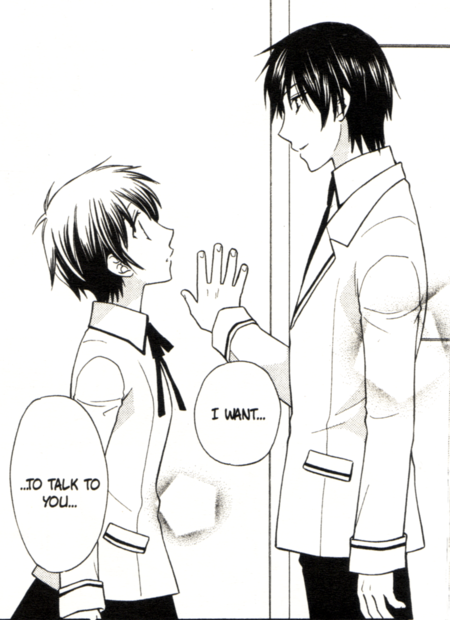
Ai Ore! begins promisingly enough. Mizuki — a tall, masculine girl — reluctantly allows Akira — a short, feminine boy — to join her band Blaue Rosen. At first, Mizuki seems to be the dominant one; not only is she taller and stronger than Akira, she’s also more charismatic, commanding her friends’ loyalty through the strength of her personality, rather than her sexual allure. (Akira, by contrast, relies on his delicate good looks to get what he wants.) Mizuki claims to hate men, but it doesn’t take long before her cover is blown: she’s besotted with Akira.

So far, so good: Mizuki is a believable character, embracing a masculine persona to camouflage how uncomfortable she feels in her own skin. (As someone who was also tall and broad-shouldered in high school, I can attest to the special misery of being bigger than many of my female peers: I vacillated between striding the halls like General MacArthur and secretly wishing I was four inches shorter.) Even Mizuki’s desire to be softer and prettier for Akira makes sense; she can’t imagine that a boy would be interested in a girl who was unconventionally feminine, despite abundant evidence that both her female and male peers find her attractive.

No, where the story really goes off the rails is in its dogged insistence on including every shojo cliche in the Hana to Yume playbook. A few chapters into the series, for example, we learn that Mizuki’s ambivalence about men stems from a distressing childhood experience in which she became so infatuated with a cute boy that she felt physically ill. (In a line straight out of Guys and Dolls, Mizuki declares, “Men are bad for your health!”) Shinjo doesn’t bother to conceal the mystery prince’s identity from readers, nor does she use that revelation to bring her leads closer together; the whole episode feels completely perfunctory, as if Shinjo were ticking off plot points from a checklist. The same goes for a story line that sends Mizuki, Akira, and a bus full of girls on a retreat. You probably don’t need me to tell you that their destination is a resort with hot springs, or that Akira infiltrates the group by pretending to be girl, or that Mizuki’s virtue is threatened by one of Akira’s classmates who’s tagged along for the express purpose of putting the moves on Mizuki.

It’s too bad that the story settles for such predictable plot twists; there’s a germ of a good idea in here, a chance to challenge the way teenagers define “feminine” and “masculine” by celebrating kids who can’t be neatly pegged as either. Instead, Mizuki and Akira revert to stereotypical female and male roles in the drama, with Mizuki sobbing and trembling and needing rescues, and Akira playing the hero. Now where’s the rock-n-roll in that?

Review copy provided by VIZ Media, LLC. Volume one will be available on May 3, 2011.

AI ORE!, VOL. 1 • BY MAYU SHINJO • VIZ • 300 pp. • RATING: OLDER TEEN (16+)

Filed Under: Manga, Manga Critic, REVIEWS Tagged With: Mayu Shinjo, Musical Manga, shojo beat, VIZ

Don’t Fear the Adaptation: House of Five Leaves

March 29, 2011 by Cathy Yan 27 Comments

House of Five Leaves | by Natsume Ono | Manga: Shogakukan/Viz Media | Studio: Manglobe/Funimation

Watch streaming from Funimation

House of Five Leaves cast

Regular readers of Manga Bookshelf will need no introduction to House of Five Leaves. MJlisted it as one of her best new seinen series of 2010, Kate has reviewed all three volumes, and David himself wrote a smart little ode to it recently when he reviewed volume two. For those of you still new to the series, House of Five Leaves is Natsume Ono’s seven volume samurai story. The main character, Akitsu Masanosuke, referred to in the series as Masa, is a masterless samurai determined to change himself while looking for work in Edo. One afternoon, Masa is hired by a suspicious man named Yaichi as a bodyguard. But all is not as it seems: Yaichi is actually the leader of a band of kidnappers who call themselves “Five Leaves”, and he doesn’t just want Masa to be his bodyguard — he wants Masa to join them as a comrade in crime. Masa, by nature a righteous and naïve man, resists Yaichi’s attempts to draw him in. However, he soon finds himself entangled in the fate of Five Leaves and, more importantly, in the mystery of Yaichi.

There are so many wonderful things about the anime adaptation of House of Five Leaves that it’s hard to know where to start. Thankfully, Natsume Ono’s distinct art style makes my job easier. Manglobe and the series director Tomomi Mochizuki transferred Ono’s art effortlessly into animation. The character designs are instantly recognizable, especially in Masa’s wide, childish eyes and Otake’s playful lipsticked smile. The sweatdrops, stray hairs, and blush lines of Ono’s characters are rendered in loving detail in every episode. There are even moments — the candy pieces of episode four, the pillars of the bridge in episode twelve — where the lines look like calligraphy, as if they were penned by Ono herself.

Often anime simplifies manga artwork. House of Five Leaves, the anime, does the opposite. While the manga tends to be very “white” on the page, full of negative space, the anime is full of textures: the unpolished wood of Goinkyo’s home, the tatami mat of the Katsuraya house, the smooth rice paper doors of Ume’s restaurant. Even more impressive is the interplay of light and shadow in the anime. Characters constantly move in and out of candlelight, open doors to let in sunlight, or sit with their backs to a window, hiding their faces in the dark. Ono is no slob herself when it comes to lighting in the manga, but the anime takes full advantage of its color palette — earthy browns and subdued gray-greens — to make Edo come alive.

The soundtrack features a combination of rumbling drums, wistful koto melodies, and reedy flute-like tunes that helps ground us in a historical Edo that, amazingly, never comes off as antiquated or forced. Likewise, the voice actor choices are almost flawless. Daisuke Namikawa as Masa is exactly the kind of guy who wears his heart on his sleeve and never says anything less than what he means. Veteran voice actor Takahiro Sakurai’s performance as Yaichi is by turns teasing, seductive, spiteful, and, at his best, all three at once. A shout out must be given to Masaya Takatsuka, who never misses a beat conveying Ume’s my-bark-is-worse-than-my-bite personality, especially in episode three when Ume makes a crack at Matsu. But the anime adaptation goes that extra mile: if you listen carefully, you can hear Edo in the background, in the soft drone of water boiling in a kettle, or the river streaming past, or the birds of Goinkyo’s backyard, or the shuffling of Yaichi’s wooden shoes. Ono’s manga might not think to comment on the “shaaa chhk” sound of a rice door sliding open or the faint crackle of straw as Ume unloads their latest hostage out of a basket, but it would be a pity to go through this anime without appreciating these little details.

At first glance, House of Five Leaves is about the journey Five Leaves takes from a ragtag group of misfits to a family who looks out for their own, even when there’s no money involved. For lack of a more nuanced, less cheesy word, the story is heart-warming. The more you uncover the crisscrossing ties of responsibility that connect the Five Leaves members, whether it be the reluctant life debts Matsu shoulders or the reason Ume remains in Five Leaves, the more you enjoy seeing them together at Ume’s restaurant, making fun of each other as they drink sake. Sadly, the anime does cut out one of my favorite scenes from the manga so far (Ume and Matsu bickering in volume one), and I imagine the later episodes similarly streamline forthcoming volumes. But the heart of the story comes through unscathed, which is a testament both to the strength of Ono’s writing and Manglobe’s talent at adaptation.

Underlying this story, though, is another tried and true theme: appearances are deceiving. Yaichi shows up in the first episode as a sage and benefactor to Masa, so naturally Masa, along with the viewer, looks upon Yaichi as a voice of authority. When we meet Yagi, the police chief who seems to know more about Yaichi than he lets on, we’re immediately suspicious of him because Yaichi tells us to be. But the more that’s uncovered about Yaichi, the more we realize Yaichi is the unreliable one. Just as Ume, Matsu, and Otake are more virtuous than the criminals we first meet them as, Yaichi is not at all the kind-hearted character we first encounter. In fact, he’s the most dangerous one of them all.

The anime has restructured the pacing of Ono’s series, favoring episodes that end on jarring cliffhangers and jumps in the timeline, often through flashbacks. Some might prefer the more measured pacing Ono shows in the manga; others might find the anime benefits from a more coherent focus, especially when it comes to Yaichi’s storyline. I for one felt like I could guess the events of episode twelve from the flashback sequence in episode one — a flashback sequence, I should add, that does not exist in the manga. But anime being the inherently action-based medium it is, I can’t fault Manglobe for wanting to ratchet up the tension just a little on what is, overall, a slow-moving story.

In the end House of Five Leaves is one of those series that I enjoy for reasons I can’t put into words. It’s not plot driven, and the characters never really change, even if they become more well-rounded. Certainly Masa never learns to get over his fear of being watched and remains the clumsy, shy samurai we first meet. But there is a marvelous je ne sais quoi to House of Five Leaves, an atmosphere of rambling down a countryside path on a late autumn afternoon, knowing that you’ll get to your destination eventually but not really knowing when. The anime luxuriates in that feeling. You could spend your time trying to piece together all the threads of the story, but you’d be missing the point. It’s meant to be savored, like a dango shared with a friend while hungry.

P.S. Next month’s anime adaptation will be Antique Bakery, just in case you haven’t had enough of stories about people making their own families. As always, if you have any anime you’d like taste-tested, drop me a line.

Filed Under: Don't Fear the Adaptation Tagged With: anime, house of five leaves

Bookshelf Briefs 3/28/11

March 28, 2011 by MJ, David Welsh, Katherine Dacey and Michelle Smith 12 Comments

Welcome to the first installment of Bookshelf Briefs, a new, weekly collection of short reviews from the Manga Bookshelf crew covering both recent releases and some blasts from the past. This week, David, Kate, and MJlook at ongoing series from Viz Media and Yen Press, while guest Michelle Smith chimes in with an oldie from Dark Horse.


Black Butler, vol. 5 | by Yana Toboso | Yen Press – The fifth volume of Black Butler pits Sebastian against a rival butler in a curry cook-off reminiscent of an Iron Chef episode. (Queen Victoria stands in for Chairman Kaga as the ultimate arbiter of whose curry reigns supreme.) As inspired a development as the curry battle may be, it reveals the biggest problem with Black Butler: the story relies so heavily on gruesome supernatural plot twists that the narrative comes to a grinding halt whenever Yana Toboso depicts more mundane situations. The supporting characters are two-dimensional at best, doomed to sound the same notes over and over, while Sebastian is so relentlessly perfect that the outcome of every conflict is never in doubt. About the best I can say for volume five is that Toboso pulls out all the stops while drawing the interior of the Crystal Palace; every steel arch and palm tree are rendered with loving precision. – Katherine Dacey

Itsuwaribito vol. 2 | by Yuuki Iinuma | Viz Media – This series has such a terrific premise – an habitual liar decides to use his inherent dishonesty to help people – that I keep hoping it will start to make the most of it. Unfortunately, Utsuho is a rather inscrutable protagonist, and there aren’t enough hints at hidden depths to give his adventures the kind of weight the premise promises. It’s pleasant and attractively drawn, but it doesn’t really go any farther than that. Iinuma could build an interesting and novel mythology with the underlying idea, which could transform the series into something quite special. I’ll probably stick with it for a bit longer to see if that happens. – David Welsh

Kimi ni Todoke, vol. 7 | by Karuho Shiina | Viz Media – Sawako’s slowly burgeoning relationship with Kazehaya leaps boldly forward in this installment, leaving Sawako finally certain of her own feelings. Unfortunately, insecurity prevents her from recognizing that those feelings are returned. Though the pace of this series remains as leisurely as the growth of its heroine’s self-confidence, its unabashed sweetness saves this from ever becoming stale. Shiina’s smart, honest writing and expressive artwork serve as a how-to manual for creating effective shoujo manga, with a touch of wry humor as a special bonus. A scene in which Chizu and Ayane give Sawako a whirlwind makeover is worth the cover price, alone. Still recommended.– MJ

Seiho Boys’ High School!, vol. 4 | by Kaneyoshi Izumi | Viz Media -Though Seiho Boys’ High School pretends to be a soap opera about hunky, horny guys trapped at a geographically isolated boarding school, it’s actually a smart comedy about teenage dating rituals. Male and female characters alike struggle mightily to impress the opposite sex: they pretend to be easygoing, or feign indifference, or mistake friendship for romantic attraction, embarrassing themselves in the process. In keeping with the realistic spirit of the comedy, Kaneyoshi Izumi doesn’t always find a way to unite her would-be couples; their interactions are as messy and complicated as real-life relationships, even if her characters are handier with snappy one-liners than most teenagers. Only the dorm room hijinks fall flat, with predictable jokes about the slovenly habits of the adolescent male — a minor complaint about an otherwise entertaining series. Recommended. – Katherine Dacey

Seiho Boys’ High School!, vol. 5 | by Kaneyoshi Izumi | Viz Media – A series of ghost sightings at Seiho High force Maki to confront his lingering feelings for the love of his past, while his present girlfriend pushes for some understanding of where she stands. Meanwhile, Hana finds a new calling in providing photos of his classmates to a nearby girls’ school, and townie Fuyuka makes unexpected progress with her crush, Kamiki. Kaneyoshi Izumi may not be revolutionizing the genre, but she’s surely livening it up with this decidedly indelicate, humorous look at the inner lives of boys left to wallow in each others’ company. As a die-hard fan of shoujo, it’s hard not to be charmed as she alternately mocks and pacifies her readers, and her increasing focus on deeper characterization only makes the series stronger. Five volumes in, Seiho continues to be one of Shojo Beat’s most enjoyable current reads. – MJ

Toriko, vol. 3 | by Mitsutoshi Shimabukuro | Viz Media – It’s hard to imagine a manga that both Ted Nugent and Michael Pollan could agree on, but Toriko comes pretty close: while it celebrates the manly valor of hunting game, it also focuses on the importance of eating “real” food. (Or what counts for “real” food in the fantasy-universe of the manga.) The tonal shifts can be dramatic, with characters waxing poetic about the delicate properties of puffer whale meat in one panel and engaging in brutal, hand-to-hand combat with rival gourmet hunters in the next, but the prevailing spirit is exuberant; every line of dialogue is delivered with emphatic punctuation, and every character seems thoroughly committed to the pursuit of delicacies. I’d be the first to admit that many of the game animals seem more ferocious than delicious, but Mitsutoshi Shimabukuro’s feverish energy and imagination help sell the more improbable story lines. Recommended.
– Katherine Dacey

From the Archives

Metropolis | by Osamu Tezuka | Dark Horse – According to the back cover, the 1949 Tezuka work Metropolis inspired an “astonishing” animated film. Alas, it didn’t inspire me much. For the most part, the narrative consists of a band of vertically challenged middle-aged sleuths pursuing an over-the-top villain who is himself pursuing Michi, an artificial being who is neither male nor female. Later, the villain’s robot slaves, led by Michi, stage a revolt. True, one could talk about the themes present in the work, most notably that life is sacred, no matter if it’s biological or artificial, but the story zooms by too quickly for anything to make much of an impact. I’m left wondering what Naoki Urasawa could make of this one. – Michelle Smith

Filed Under: Bookshelf Briefs

From the stack: Kingyo Used Books vol. 3

March 28, 2011 by David Welsh

Seimu Yoshizaki’s Kingyo Used Books (Viz) has been rightly (if harshly) criticized for its reliance on formula and simplistic sentimentality, so I thought it was worth noting that the third volume expands the boundaries of the series in some successful and satisfying ways.

For those who haven’t sampled the series online, it’s about a bookstore that specializes in manga. Customers come in and reconnect with an old favorite in ways that resonate with something that’s going on in their lives. It’s very affirming of fandom across the lifespan, and a little of that can go a long way, particularly in a fairly rigidly episodic format.

There’s a nice two-part story in the third volume that steps away from Kingyo and its customer-of-the-month fixation. In it, a salaryman leaves the corporate world to take over a manga rental library. Remembering a youthful transgression, he sets out to collect the books that were never returned to the library. He’s not punitive about it, but he’s willing to go to rather ridiculous extremes to reclaim some of the lost volumes.

It’s a nice change of pace. It also features (or possibly creates) another kind of shared fan touchstone that’s pleasant to see, even if Yoshizaki has manufactured it entirely. (Do Japanese people actually swap manga when they chance to meet each other abroad? I have no idea, but it’s a nice notion.) And the chapters give me fodder for another license request. (Jiro Taniguchi worked on a food manga? The mind reels.)

On the down side, an episodic structure sometimes promises a predictable number of duds. For me, the biggest disappointment in this volume was a piece spun around the manga of the wonderful Kazuo Umezu. It’s about a ladies’ man who sets his sights on a hardcore Umezu fan in spite of his aversion to horror. Given how distinctive Umezu’s work is, you’d think Yoshizaki might have tried to incorporate some of Umezu’s iconic weirdness into the piece. You’d think wrong. Nobody even wears a striped shirt.

But, stumbles and sentiment aside, Kingyo Used Books is never less than gently likable. I’m not sure it benefits from reading in big chunks, but you don’t have to, what with the SigIKKI serialization.


Filed Under: REVIEWS

Breaking Down Banana Fish, Vols. 14-16

March 26, 2011 by MJ, Michelle Smith, Connie C., Robin Brenner, Eva Volin and Khursten Santos 12 Comments

Hello and welcome once again to our roundtable, Breaking Down Banana Fish!

We continue this month with our new three-volume format, and with just six volumes left to discuss, that means we’ll have the entire series covered by the end of our May installment.

Volumes fourteen through sixteen are action-packed, as Eiji and the others manage to (mostly) pull off their ambitious rescue operation, followed by a declaration of war by Golzine that places all three of our major gangs at the center of a military-style siege. Meanwhile, Yut-Lung declares a war of his own with assassin Blanca on board as his bodyguard.

I’m joined again in this round by Michelle Smith (Soliloquy in Blue), Khursten Santos (Otaku Champloo), Connie C. (Slightly Biased Manga), Eva Volin (Good Comics For Kids), and Robin Brenner (No Flying, No Tights).

Continued thanks to these wonderful women for their hard work and brilliance!

Read our roundtable on volumes one and two here, volumes three and four here, volumes five and six here, volumes seven and eight here, volumes nine and ten here, and volumes eleven through thirteen here. On to part seven!

…

Read More

Filed Under: FEATURES Tagged With: banana fish, breaking down banana fish, roundtables

How to Pen & Ink: The Manga Start-Up Guide

March 25, 2011 by Katherine Dacey

Type the words “how to draw manga” into the Amazon.com search engine, and you’ll net over 575 results. These books run the gamut from Manga-for-Dummies manuals, designed to teach beginners the basics of figure drawing and paneling, to highly specialized texts focusing on a specific skill — say, applying screentone or drawing buxom warriors.

One of the biggest drawbacks to these manuals is the lack of examples culled from actual manga; for licensing reasons, many of these how-to books feature original art that may not be drawn by a professional working in the Japanese publishing industry. And while many of these books possess genuine educational value for the beginning artist, teaching from a copy — however good it might be — isn’t the same thing as learning from the original. That’s where DMP’s How to Pen & Ink: The Manga Start-Up Guide comes in: the book is liberally illustrated with sketches, pin-up art, and finished pages from the work of Oh!Great (Tenjo Tenge, Air Gear), Yasuhiro Nightow (Trigun), and Satoshi Shiki (Kami-Kaze), as well as a half-dozen other established artists.

The book is divided into two sections. In the first, billed as a “close-up of how a manga is born,” each of the three featured manga-ka takes readers step-by-step through the creation of a pen-and-ink drawing, offering insights into their own work process. In the second, readers practice drawing their own manga. This section, which comprises most of the book, contains a list of tools used by professional manga artists, a lengthy Q&A section aimed at novice creators, and a variety of exercises, the most useful of which focus on working with pens. Over a four-week period, readers learn how to draw lines of varying weight, length, and straightness; how to draw effective speedlines; and how to use crosshatching to define space and volume.

What distinguishes Pen & Ink from other how-to manuals is its approach: manga isn’t treated as a style but as a storytelling medium. Almost of the advice focuses on how to draw effective stories, whether readers are learning where to place word balloons or how to use speedlines and panel frames to direct the eye to a key element in the layout. Though some of the tips are too vague to be helpful, the book is chock-full of examples culled from the pages of Air Gear, Kami-Kaze, and Trigun, as well as Hikou x Shonen, Oudo no Kishi Moro, Sgt. Frog, Trigun, and Vampire Princess Yui — a diversity that nicely underscores the manga-as-medium message.

Anyone who’s taken a few life drawing courses should be able to complete most of the exercises, though they may wish to supplement Pen & Ink with a manual on character design. (Tips for drawing eyes, hands, and bodies are too scarce to be very helpful to novice cartoonists.) For readers just learning the basics — anatomy, perspective drawing — most of the information in the book is too advanced to be immediately beneficial; the ideal audience is someone who already owns a few pens and drawing tools but needs guidance on how to work more effectively with them.

Review copy provided by Digital Manga Publishing, Inc.

HOW TO PEN & INK: THE MANGA START-UP GUIDE • VARIOUS AUTHORS • DMP • 114 pp. • NO RATING (BEST SUITED FOR TEENS, AS THE SECTION ON OH!GREAT INCLUDES SOME NUDITY)

Filed Under: Books, Classic Manga Critic, Manga Critic, REVIEWS Tagged With: DMP, How-To, Oh!Great, Satoshi Shiki, Yasuhiro Nightow

At the moment

March 25, 2011 by David Welsh

What with a significant license request so recently fulfilled, I thought it would be a good excuse to take stock, go through the roster, and try and figure which five top my personal wish list at the moment. Here they are:

50 x 50, written and illustrated by Saika Kunieda, originally serialized in Kadokawa Shoten’s Comic Charge. Libre Shuppan’s Magazine Be x Boy.

Bartender, written and illustrated by Araki Joh, serialized in Shueisha’s Super Jump.

Gokusen, written and illustrated by Kozueko Morimoto, originally serialized in Shueisha’s You.

Nasu, written and illustrated by Iou Kuroda, originally serialized in Kodansha’s Afternoon.

The Rose of Versailles, written and illustrated by Riyoko Ikeda, originally serialized in Shueisha’s Margaret.

What five books top your current wish list?


Filed Under: LICENSE REQUESTS

3 Things Thursday: Arts in Manga

March 24, 2011 by MJ 27 Comments

One of the things that seems to naturally go along with a career in the arts is a love/hate relationship with fictional portrayals of people engaging in such, and that definitely applies to my experience with arts-focused manga. Still, after a fevered late night open letter directed at the TV show Glee, I can’t help but have those exact portrayals on the brain.

Most artists are going to be more sensitive to the inaccuracies and overworked clichés in fiction written about their own field than any other, so I suppose I’m lucky that there hasn’t yet been a manga (imported here, at least) about singers and actors in musical theater (though there are some fairly funny scenes with Broadway hoofer Art in Reiko Shimizu’s Moon Child). When there is, I’ll surely cringe. But for now, I’ll enjoy these fine series, glossing over the bits that chafe and taking them as they are. As a side note, I find it interesting that its subjects are all students.

3 Performing & Visual Arts Epics:

1. Nodame Cantabile | Tomoko Ninomiya | Del Rey Manga | Classical Music – While I know at least one classical musician who despises this manga, as a former classical voice student, this series evokes memories of what I loved most about my college years, when I was surrounded by other students just as serious about music as I was. For me, coming from high school in the depressed midwest, this was actually pretty novel, and definitely inspiring in a whole lot of ways. What perhaps works so well for me here, is that my own personality as a young music student was pretty much equal parts ambitious Chiaki and free-spirited Nodame. My relentless drive was weirdly balanced by hippie-like clothing and a persistent absence of shoes, something that drove at least one of my studio teachers absolutely crazy. It was actually my experience with her that convinced me to avoid a career in opera. I really, really didn’t like wearing shoes.

2. Swan | Ariyoshi Kyoko | CMX | Ballet – Unbelievably, I’ve only read one volume of Swan, and one of my greatest fears at this point is that I’ll miss picking up the others, now that CMX is no more. Though I never was a real dancer despite years of classes (lack of physical discipline & wrong, wrong body type), I spent quite a bit of my youth obsessed with ballet, and spent no small amount of my “spare” cash buying tickets to ABT performances during my NYC years. For me, reading Swan is a natural extension of my teenaged fixation with The Children of Theatre Street and The Red Shoes, confirmed for me by Jason Thompson’s detailed writeup in his column at ANN. Will I find the rest of this series? (what was published of it, at least?) Let’s hope it’s not too late!

3. Honey and Clover | Chika Umino | Viz Media | Visual Art – I suppose it’s a little tragic that the type of art that provides me with the greatest mystery is also the inspiration for the series on this list that has (so far) taught me the least about its characters’ vocation. I expect its later volumes may focus more heavily on career, but as I’ve (shockingly) just begun the series, I’m so far mainly lured by its delicious soap-opera. Regardless of how it plays out, however, I suspect there is no manga on earth powerful enough to help me understand how visual artists do what they do–that is how magical it is for me. Even as a music student, I learned early on that I would never create true beauty with my hands, no matter how much I tried and practiced. My voice was the only thing I could ever make real music with… the only instrument I could ever command with my own will.


So, readers, gimme your arts-centric manga! I want to read more! MORE!

Filed Under: 3 Things Thursday Tagged With: honey and clover, nodame cantabile, swan

Off the Shelf: Cranky

March 23, 2011 by MJ and Michelle Smith 8 Comments

MJ: Hello. It is snowing at my house and I’m feeling very cranky. How about you?

MICHELLE: *points and laughs* It’s warm and sunny here! Internet connectivity woes are making me slightly cranky, though. Perhaps we can get our minds off what ails us by talking about some manga!

MJ: Perhaps so! Do you have some healing manga to share this week?

MICHELLE: There’s one that always brightens my mood, but I think I’ll save that for last. First up, I’ve got the debut volume of Pavane for a Dead Girl, a new series from TOKYOPOP.

I read one volume of a Koge-Donbo series back in 2004 and thought that was quite sufficient for one lifetime. Pavane for a Dead Girl tempted me, though, with its late-Meiji music school setting. We begin—in an inauspicious and jumbled way—as a new student named Nanao Kaga is about to commence studying at the school where she once long ago heard a lovely violin melody being played by a boy whom she dubbed the “prince of harmony.” lmost immediately, Nanao runs into the boy again, who just so happens to be playing the same tune. “What beautiful music. Like a dazzling jewel overflowing with love and radiance,” Nanao opines.

The boy is named Takenomaru Sagami, and gives Nanao a brooch that is at first clear but progressively becomes a deep amber in color. She’s soon head-over-heels in love with him, but what she doesn’t know is that, in exchange for good looks and musical talent, Takenomaru has made a bargain with the “great angel” to “capture the tears of Maria.” What this basically means is that he has to bestow a brooch upon a pure-hearted girl, encourage her to love him, and then stab her in the heart once the brooch indicates that her feelings have reached maximum capacity.

In the right hands, this could be an interesting concept. Dark, brooding hero is doomed to be eternally alone, because he must kill every girl who loves him in order to survive. Perhaps it will even go there eventually—I can’t believe I’m actually willing to read a second volume of a Koge-Donbo series!—but the execution is hampered by this being the most moe-tastic thing I’ve ever seen. None of the female characters registers even remotely as a fleshed-out person, and one gets the impression that they’re only there to fall for and be slain by Takenomaru in turn.

Maybe this could end up being something like Higurashi When They Cry, in which moe and darkness coexist, but I’m a little dubious. Curious, but not wholly convinced.

MJ: I think overall I have a more generous view of “moe” and what that can mean for a series, but semantics aside, this sounds pretty dubious. There’s the potential for a sort of Princess Tutu-flavored darkness in the scenario you describe, but it sounds like the execution has a looong way to go to match that kind of depth. I’m quite sad to hear it, actually.

MICHELLE: Admittedly, I don’t have a lot of experience with moe and don’t mean to blast it in ignorance, but the flatness of the female characters is inescapable. Takenomaru doesn’t really fare much better, but at least he has a traumatic backstory and a cruel bargain to live up to.

How about you? Read any doldrum-vanquishing things this week?

MJ: One of my titles definitely falls into that category, and I’ll start with that in hopes of buoying us up for the evening! That heart-warming manga would be volume three of Yumi Unita’s Bunny Drop, out just this week from Yen Press. Honestly, it’s hard to imagine that this series could ever become anything but warm and charming.

This volume begins with a milestone, as Rin’s first day of elementary school approaches. As Daikichi finds himself unexpectedly anxious about letting Rin walk to school without him, he’s also faced with a reality check at work, when a flirtatious female coworker abruptly loses interest after he tells her he’s raising a child. This volume’s biggest challenge, however, continues to be Rin’s birth mother, whose dispassionate attitude towards her child leaves Daikichi alternately angry and confounded.

I know I already made this comparison in my discussion of the first two volumes, but it’s continuously fascinating to me just how differently this series reads from Yotsuba&! thanks simply to its marketing demographic. Nothing against Yotsuba&! of course, but the focus on actual parenting in Bunny Drop stands in such stark contrast to that series, it’s almost funny. As a non-parent, I might expect this to be tedious, but in this artist’s hands, it’s anything but.

What Unita manages to capture here is not just the challenges of parenting or the (presumably) relatable humor and fear, but the honest-to-goodness joy of it, in terms that even a child-free old biddy like me can appreciate. Rin may not be as unique a soul as Yotsuba is, or at least less obviously so, but she’s such a little person, it’s impossible to avoid slipping into Daikichi’s POV. We experience everything here just as he does, and we experience it intimately, as though immersed in his feelings.

It’s a beautifully written series, and it just keeps getting better, volume after volume.

MICHELLE: I probably said this exact same thing last time, but I am totally committed to reading this series in the near future. Your description warms the cockles of my poor, withered heart. I also love how Rin gets progressively older on each cover. The series just ended recently in Japan, I believe, and I wonder if she makes it to adulthood by the end.

MJ: You will love it, Michelle. Really and truly. It’s one of my favorite manga series currently running.

So, what’s this mood-brightening card you’ve been holding onto over there?

MICHELLE: Only my beloved Skip Beat!

For those not in the know, this is the story of Kyoko Mogami, a teenager who was betrayed by her first love after she followed him to Tokyo and supported him while he made it big as a pop star. After learning how he really viewed her, she vowed to get even by surpassing him in show biz. This might sound a bit like Honey Hunt, but trust me, Skip Beat! is the better series.

For one, it focuses pretty intensely on Kyoko’s evolution as an actress. In this volume, for instance, she is practically living the role of Natsu, the leader of a group of mean girls, a part she initially had trouble getting into until she succeeded in differentiating it from another villainous role for which she’s become moderately well known. Although Kyoko does have a love interest of sorts (although she’s oblivious to his feelings) in fellow actor Ren Tsuruga, he appears for all of three pages. Instead, it’s all about Kyoko’s professional growth and the rivalry her ability to transcend a notorious role inspires in a costar who hasn’t been able to get beyond a certain part she played as a child.

It’s immensely satisfying to watch Kyoko embody a part, particularly when she had struggled to understand the character, even if the reactions of astounded spectators can sometimes be a little over-the-top in their appreciation. One thing that’s particularly neat is that when Kyoko acted opposite Ren early on in the series, he was able to coax a good performance from her simply from his own acting. Now she’s capable of doing the same thing with her costar, but doesn’t even realize it. She’s such a great character, normally kind-hearted and fond of girly things, but capable of summoning a demonic aura when she is wronged. When said costar pushes her down a flight of stairs, for example, her first concern is for an armload of sodas she was carrying, but then she laughs evilly and declares, “I’m going to have so much fun with this.”

Have I gushed sufficiently? Skip Beat! may be lighthearted, but it’s tremendous fun to follow Kyoko’s rise to stardom and to root for her and Ren to get together one day, though I’m certainly in no hurry about that. I’ve read twenty-three volumes without tiring of the series in the least, and would happily read twenty-three more.

MJ: You know I’m embarrassed to have never gotten into this series, and now I’m chomping at the bit as well! So much manga, so little time! This really sounds delightful. How many volumes are there in total?

MICHELLE: Volume 27 came out in Japan in February. I’m not spoiled on the goings-on, but I haven’t heard any murmurings of it ending any time soon.

So, if you started with the buoying title, does that mean your other one’s a bit of a downer?

MJ: Mmmm, I’d say “downer” is a pretty strong word, but it’s definitely dark and not as expertly crafted. My other read this week was the second volume of Kim Hyung-Min and Yan Kyung-Il’s March Story, due out soon from Viz.

This series is still very much finding its feet, and nowhere is this more obvious than in this volume’s storylines. While the series’ first volume fell pretty squarely in what’s become known as “Comeuppence Theater,” in which foolish or selfish characters suffer horribly for their vices, this volume leans heavily towards poignance and compassion–still dark, but with a very different tone.

As in the debut volume, “Ciste Vihad” March encounters a number of demons known as “Ill” who lurk in beautiful objects, hoping to possess unwitting humans. In this set of stories, however, most of the Ill are deliberately sympathetic characters whom March feels compelled to help rather than destroy. March’s associates, too, all fairly terrifying in the series’ first volume, have been quite humanized here, particularly the giant-headed Jake and supernatural antique dealer Rodin.

Quite a few of the tales are genuinely touching, involving Ill motivated by love or other emotional attachment they simply can’t let go of. Add in the series’ intricate, latticed artwork, and one must acknowledge some moments of real beauty. It’s a real step forward, I’ll happily admit. I like the series’ new, softer tone.

What this volume suffers miserably from, however, is a maddening lack of its title character. After finally winning us over in the first volume’s late chapters by getting us really invested in March, her creators have all but tossed her aside in favor of these “touching” episodes, sucking out some of the life they’d so painstakingly put into it.

I’m not giving up on this series by any means, and honestly I’d pick it up just for the pictures! But I’m not sure yet what kind of story this wants to be, and I’d guess its creators are (or were, at least) in the same boat.

MICHELLE: Yeah, it does sound pretty uneven. The progress of March’s relationships withi the demons reminds me a bit of Natsume’s Book of Friends, in which the yokai quickly establish themselves as sympathetic. I hope March Story evolves into something as nice as that series.

MJ: I’d be a bit surprised, if only because I think it’s got a different agenda. But there’s definitely stuff to work with if its creative team can find its feet.

So, hey, are you feeling better?

MICHELLE: Yep! And my internet seems to have stabilized. How’s the snow?

MJ: Pretty much petered out, at least for the moment it seems! I call this a job well done!

MICHELLE: I concur!

MJ: Well, goodnight then!

Filed Under: OFF THE SHELF

The Josei Alphabet: H

March 23, 2011 by David Welsh

“H” is for…

Hatenko Yuugi, written and illustrated by Minari (Maria Holic) Endou, serialized in Ichijinsha’s Comic Zero-Sum, currently at 12 volumes. This one’s a quest tale about a young girl out to see the world and the guy trying to avenge his father’s death. Oh, and they both use magic. Update: This has actually been partially published in English by Tokyopop as Dazzle.

Helter Skelter, written and illustrated by Kyoko Okazaki, originally serialized in Shodensha’s Feel Young, one volume, published in French by Casterman. A gruesome and award-winning tale of obsessive beauty gone horribly wrong. Someone should publish this in English.

Heptagon, written and illustrated by Chiaki Hijiri, originally serialized in Shueisha’s Chorus, one volume. Usually, when a fictional adult gets the chance to relive their youth, that fictional adult is a guy. In this story, a twenty-something woman spends some time in her fourteen-year-old life.

Hi no Matoi, written and illustrated by Miku Inui, originally serialized in Ichijinsha’s Zero-Sum Ward, three volumes. This is about the son of a samurai who learns to be a firefighter.

Honey and Honey, written and illustrated by Sachiko Takeuchi, originally published by Media Factory, two volumes. Erica (Okazu) Friedman says this book “educates the nonke (straight/heterosexual) audience, explaining what lesbian life is about; the good, the bad, the annoying, the funny, with a cheerful attitude of ‘you’re a woman – you’ll understand what I mean.’” Erica also reviews its sequel, Honey and Honey Deluxe.

Licensed josei:

  • Happy Mania, written and illustrated by Moyocco (Hataraki Man, Sugar Sugar Rune) Anno, originally serialized in Shodensha’s Feel Young, published in English by Tokyopop, 11 volumes.
  • Haunted House, written and illustrated by Mitsuzaki (The Embalmer) Mihara, originally published by Shodensha, published in English by Tokyopop, one volume.
  • Honey and Clover, written and illustrated by Chica (March Comes in Like a Lion) Umino, variously serialized in Shueisha’s Chorus and Young You, published in English by Viz, 10 volumes.

What starts with “H” in your josei alphabet?

Reader recommendations and reminders:

  • Haigakura, written and illustrated by Shinobu Takayama, currently serialized in Ichijinsha’s Zero-Sum Ward, three volumes to date,
  • Hapi Mari, written and illustrated by Maki Enjouji, currently serialized in Shogakukan’s Petit Comic, six volumes to date, published in French by Kaze, due for release in German by Tokyopop.
  • Harutsuge Komachi, written and illustrated by Miyuki Yamagachi, originally serialized in Hakusensha’s Melody, four volumes.
  • Heart no Ousama, written and illustrated by Aki Yoshino, originally serialized in Shogakukan’s Petit Comic, one volume.
  • Hito Yuri Touge, written and illustrated by Miyuki Yamagachi, originally serialized in Hakusensha’s Melody, one volume.
  • Hotaru no Hikari, written and illustrated by Satoru Hiura, originally serialized in Kodansha’s Kiss, 15 volumes, published in French by Kana.

Filed Under: FEATURES

From the stack: Blue Exorcist vol. 1

March 21, 2011 by David Welsh

I would have loved to be a fly on the wall in the editorial meetings following the publication of the first chapter of Kazue Kato’s Blue Exorcist (Viz), because they must have been intense. That first chapter is terrible – bland, boring, and baffling, a triple threat in the realm of bad shônen. Aside from being ably drawn, it didn’t have a single aspect that would make me want to read the second chapter if I was a follower of Jump Square, its original home.

Someone at Shueisha, and possibly Kato herself, must have agreed, because the series rights itself completely in the second chapter and stays on course for the remainder of the first volume. It’s downright weird to see all of your complaints and criticisms answered in the space of a month. Even Viz must admit to this, since the free preview of the series is from the second chapter, not the first.

Blue Exorcist is about the son of Satan, Rin Okumura, but this fact has been kept from him by his foster parent, Father Fujimoto. Things go very badly when Rin learns this fact, but the experience leaves him with a goal – he wants to fight demons as an exorcist, even though his chosen profession views him as a likely threat and thinks everyone would be better off if he just died. It’s an awkward situation, compounded by the fact that Rin’s teacher at exorcist school is his fraternal twin, Yukio.

It’s nice to see another fraternal relationship as the crux of an action manga, what with the days of Hiromu Arakawa’s Fullmetal Alchemist (Viz) sadly numbered. Rin is rough around the edges, and Yukio is polished and restrained (and obviously much more studious than his elder twin). Beyond that, there are some dark undertones to their relationship. Yukio doesn’t have the burden of their demonic legacy, and he’s grateful for Rin’s protection throughout their sickly childhood. But Yukio is an exorcist, and his brother is half demon with very poor impulse control. It adds nice tension to the series.

It’s also nice to see Kato’s storytelling become sprightly and thoughtful after the first chapter’s muddle. There’s some solid resonance in the second and third chapters, and the supporting characters show a lot of promise. I’m particularly smitten with Mephisto Pheles, headmaster of the school for exorcists, the True Cross Academy. Mephisto looks ridiculous, both in human form and in those moments when he transforms into a dog (a West Highland White, if I’m not mistaken). He’s one of those grown-ups who seem more intent on amusing themselves than behaving in a strictly responsible fashion, and Mephisto certainly amused me, so I’d love to see more of him.

It seems like the fictional world of Blue Exorcist is moving towards some interesting coherence. The funny, quirky bits aren’t so ludicrous that they throw you out of the story, and Kato shows real flair in the more ostentatiously supernatural visuals. I wasn’t even bothered by the quasi-Catholicism of the whole affair, even though that’s almost always an indicator of a series I’ll despise. (For the record, that’s not due to any protectiveness for the Catholic church on my part. It’s just that manga Catholics are often the presented in exactly same kind of confusing cosplay fashion as manga vampires.) I didn’t find the demons very persuasive or interesting, but Kato seems to be building up a taxonomy.

Blue Exorcist really seems to have a lot of potential, which I never would have believed halfway through that first chapter. In fact, I’d suggest you skip that first chapter entirely, as its events are explained and reframed later (and better), and there’s really no reason to subject yourself to it. If you’re looking for an attractive shônen fantasy-adventure with a decent amount of wit and heart, it’s a likely candidate.

(These comments are based on a review copy provided by the publisher. You may remember that Blue Exorcist was a candidate in my first “readers’ choice” Previews experiment. Believe me, if it hadn’t shown up at random, I wouldn’t have bothered. It still sounds like a formulaic drag on paper.)

Filed Under: REVIEWS

Manga Bookshelf talks Sailor Moon

March 19, 2011 by MJ, Michelle Smith, Katherine Dacey and David Welsh 21 Comments

Join the Manga Bookshelf bloggers and special guest Michelle Smith in our spontaneous Sailor Moon squee roundtable!


MJ: As most of our readers probably have heard, the big news yesterday in the manga blogosphere was that Kodansha USA is re-releasing Naoko Takeuchi’s Sailor Moon. I was pretty excited when I got the press release (there may have been a caps-locked e-mail), but I admit when I examine that, I’m not exactly sure why.

I’m thrilled at the prospect of being finally introduced to a series that was so key in bringing shoujo manga to the US, but beyond that I’m a little bit lost. My only personal experience with the series is a couple of episodes of the anime adaptation that Michelle showed me last year, and from that alone, I don’t feel like I have any real basis for understanding why the series means so much to its American fans.

I think Kate may be in a similar position, so I’m hoping that our squeeful cohorts can shine some light on the subject. Why do you love Sailor Moon, and why will we?

DAVID: I should jump in and admit that my familiarity with the series is entirely based on the anime, though I was quite charmed by it. This was decades ago when it would just randomly be aired on those third-tier non-networks, and I was always game for a half an hour with these girls. This might have been because I was a huge fan of super-hero teams at the time and had a particular weakness for super-heroines who also had rich emotional lives.

While I always loved comics like The Avengers and The Uncanny X-Men, part of me always muttered about the fact that there were too many boys hogging the glory. Every team had its own version of “the girl,” and sometimes they’d even have two, but it was always clear that she was “the girl.” Sailor Moon was such a nice change of pace for that reason — all of the really important, powerful characters were girls, and they had lives outside of the big battles.

MICHELLE: It seems I’m the only one of us, then, who’s read the manga before (albeit with the help of fan-made translations). I was introduced to the anime first, specifically the third or ‘S’ season, and though I probably thought it was a little silly and episodic at first, I was new at the time to the concept of gender-bending characters, so fell hard for the allure of the older sailor senshi, Uranus and Neptune. Perhaps because it was one of the first shoujo anime I ever saw, it holds a very special place in my heart, and really exemplified—especially in its dramatic conclusion, at which all Sailor Moon seasons excel—how different that genre is from American cartoons.

The manga is fun, too, and definitely worth squeeing about, but in some ways I prefer the anime, especially as it allows more time with some of my favorite characters, like Fish-Eye (a villain from Super S) and the Sailor Starlights, and also plays up the flirtatious angle between Uranus and Neptune.

Rereading this response, it seems that I may love Sailor Moon primarily for its gender hijinks, but the drama really is the best part.

KATE: My interest in Sailor Moon is the same as MJ’s — as a historically important shojo manga that introduced a generation of female readers to Japanese comics. What little I’ve seen of the art suggests that I’ll probably be reading the manga as a historian more than a fan, as it’s the kind of wide-eyed, sparkle-riffic style that doesn’t really speak to me. I’m keeping an open mind, however, as the series’ gender politics sound genuinely subversive.

I’m glad that Kodansha decided to re-issue the series. The nostalgia factor will undoubtedly fuel sales, especially among women who want to share Sailor Moon with daughters and nieces, but I also think there’s a new audience for Sailor Moon as well. As David points out, there’s still a dearth of stories about super-powered women (or girls) banding together to save the day. When I was eight or ten years old, that kind of fantasy would have had irresistible appeal, as it was never much fun to fight with female friends over who got to play the token female character when we re-enacted the latest Superfriends episode or favorite scenes from Star Wars.

MJ: I’d love to hear more about the gender politics, actually, should anyone care to elaborate. Squee optional.

MICHELLE: Jason Thompson talks some about that in his excellent piece on Sailor Moon for his House of 1000 Manga column. To quote him:

“But amazingly, years later, when I reread Sailor Moon, I realized it’s actually not even that shojo. Oh sure, it’s got hearts and kisses and accessories, but it’s also got a heavy dose of shonen manga, from the melodramatic fights and deaths and reincarnations to the earth-shattering explosions to the touching friendships. Sailor Moon is shojo for the era of Dragon Ball Z and Saint Seiya. The heroines of series like Wedding Peach and Tokyo Mew Mew can’t match the Sailor Scouts for self-discipline and steely fighting power. By the standards of magical girl manga, that ever-popular genre of manga which is part girl power and part short skirts and pink things, Sailor Moon is butch.”

Plus, in this case it’s the “hero” of the piece, Sailor Moon’s boyfriend, who is chiefly there to look handsome and be rescued.

KATE: That low, throaty sound you just heard? That’s me squeeing. Sign me up!

MJ: I’m with Kate!

Though, interestingly, as a big fan of 1980s & 90s shoujo, I have to say I already associate things like melodramatic fights, deaths, reincarnations and so on with shoujo manga. I guess those things are less common now (at least in the titles we see coming over), but when I think of the stuff that defines “shoujo” for me, those things are a big part of it. Glancing at the section of my bookshelf that is populated with titles from Viz’s old shôjo imprint (Banana Fish, Basara, Please Save My Earth, X/1999), they’re filled with elements like that.

All of you are more knowledgeable about manga history than I am–where does Sailor Moon fall in terms of the evolution of shoujo in Japan?

DAVID: I don’t know that it broke any new ground, but Paul (Manga: Sixty Years of Japanese Comics) Gravett credits it with revitalizing the magical-girl genre, which is pretty significant when you consider how much of a staple that genre is, especially in terms of the kind of books that got licensed in the early wave of manga in translation. And it’s generated an enduring franchise, with all kinds of spin-offs and a merchandising empire. Again, that’s not unique, but properties that manage that are always worth noting.

MJ: That’s a great point, David.

Let’s talk magical girl for a moment… I admit it isn’t my favorite shoujo genre. In fact, I can only think of one manga title in that vein I genuinely love. In some ways, I think that is probably what makes Sailor Moon a tougher sell with me (outside of its historical significance) than other older shoujo might be. Do I have a skewed view of the genre?

MICHELLE: I don’t think so, at least given what’s been made available here. Compared to something saccharine like Tokyo Mew Mew, for example, Sailor Moon is by far the better series. Compared to something like Cardcaptor Sakura, though… That’s a tougher choice.

I will say that, while in other series the whole “donning the costume” bit is usually cheesy, I kind of love it whenever it happens in Sailor Moon. I can’t really explain why. In this series, I like their different-colored costumes and various powers, whereas in other series I couldn’t possibly care less. Is some of this nostalgia speaking? Quite possibly. I’m not sure how this would play to a seasoned manga reader who is encountering it for the first time.

DAVID: I think those transformations are so important, like the ones in the Lynda Carter Wonder Woman. Instant, empowering makeover, style plus power.

KATE: For me, my reluctance to embrace magical-girl manga is a direct reflection of the advanced age at which I started reading comics. I found tough, adult women more appealing as avengers, enforcers, and butt-kickers than teenage girls because they were a lot closer to me in age than the heroines in Sailor Moon and Cardcaptor Sakura.

MICHELLE: If you want tough, determined enforcer types, then you will probably like Sailor Uranus. I mean, these aren’t just a bunch of girls in cute, matching outfits. They have individual personalities, though I do think these are probably more fully explored in the anime. Some of the girls are more frivolous (Minako is actually more serious in the manga, if I recall rightly), but the older senshi in particular are pretty poised and mature. One of them is a college student studying physics, for example.

KATE: That’s good to hear, Michelle! The few magical girl manga I’ve read just made me feel hopelessly old, you know?

MJ: I’m glad you mentioned age, Kate, because though I find I still personally identify with my long-gone teenaged self much more than a woman my age should, I think my age might have something to do with my reaction to most magical girl manga. I’m ashamed to say, though, that even more of it may have to do with the point Michelle and David brought up, and that would be… the clothes. Heh.

This is something I’m struggling to reconcile in myself, actually. I look at this cover, for instance, and I have two negative reactions immediately. One is to seeing a character I know is supposed to be a warrior of sorts in a tiny little skirt, and the other is to the use of the word “pretty.” There’s a part of me that really hates for these things to be important. I know none of this is unique to magical girl manga (or even manga in general) and it’s not that I have a problem with style. I just want it to be less important than other things. Yet, I know that when I was a young girl, I would have loved that little skirt and thought it was the prettiest thing in the world! I also actually quite like the color pink. I’m a mess of contradictions, really. But is it just me?

DAVID: Obviously not. I contradict myself constantly. And I’ll do so again by saying I’d love to see a josei take on this genre.

KATE: Oh no — me, too, MJ! I love me a nice dress and pair of shoes as much as the next gal, but my inner warrior chafes at popular entertainment that unironically packages strength, intelligence, and competence in frills and sparkles. At the same time, however, I’d have to concede that looking good can be a powerful confidence-booster. Even though I dress like a slob when I go for a run, I always make an effort to look smartly coordinated when I participate in a road race.

I guess I’m a confused hypocrite, too.

MICHELLE: Does it help if I say these girls aren’t sexualized at all even though they wear these outfits? And it’s Sailor Moon who declares herself pretty. It’s kind of empowering, actually.

MJ: Michelle, that does help a bit. And David and Kate, I’m grateful to hear I’m not the only self-contradictory soul in the room. David, I love the idea of a josei “magical woman” series. That’s something we really haven’t seen over here have we? Would you put Wonder Woman in the western version of that category? Or is she too much written for male readers?

MICHELLE: Oh, I’d love to see a josei magical woman series. There’d be so many extra complications. I think Fumi Yoshinaga should write it.

KATE: I love the idea of josei Wonder Woman — I would totally read that!

Actually, Wonder Woman’s costume is just as absurd as the Sailor Moon girls’, though I loved Jim Lee’s recent WW makeover. Her new outfit is sleek and sexy, but still conveys WW’s physical strength. Plus it actually looks like something that a real female athlete could wear while she was running or jumping, something I can’t say for most superhero or magical-girl costumes.

MJ: I think one of the things that always gets me about these types of costumes is all the bare flesh. And I don’t mean that in terms of how revealing they might be. I just keep thinking how horribly scraped and bloodied up a person would get, fighting with bare legs. Human skin is so fragile!

MICHELLE: I seem to recall them getting scraped up a little, but most of the enemies’ attacks are of the energy-draining variety, so there’s very little close combat going on.

DAVID: I have to admit that I always found the battles in the anime to be amusingly baffling. Maybe it’s because I didn’t watch it from start to finish in a coherent order, but the combat moves, the announcing of everything that was happening, the sparkly visual effects… I’m obviously used to that sort of thing now, but back then, it was almost hallucinogenic.

KATE: Switching gears a bit, do you agree with me that there’s a new audience out there just waiting to discover Sailor Moon, or is its appeal strictly nostalgic? If there is a new audience for Sailor Moon, do you think the series will play a critical role in bringing new readers to the medium again, or will it be a blip on the manga radar?

DAVID: I was wondering the same thing, but one thing I’ve noticed in the responses I’ve seen to the news is excitement over the chance to give it to a new generation of readers. It seems like there’s an army of Sailor Moon fans from its original run waiting to hand it off to their daughters and nieces and little sisters and so on. I don’t know if that guarantees commercial success, but I think it will help. And the fact that this is a different, by all accounts more attractive package with a sure-to-be-excellent translation from William Flanagan suggests to me that the original audience will also be going back to the well.

kATE: I also wonder if Sailor Moon will look too dated to teens — the artwork in Sailor Moon isn’t as radically different from what VIZ and Tokyopop are licensing now as, say, Swan or From Eroica With Love, but it definitely has its own look and feel. Teens tend to be pretty ruthless critics when it comes to judging manga artwork, especially if the characters’ clothing or hairstyles obviously belong to another era.

MJ: I’d like to think there could be a new audience. Tween girls in particular I think would be less turned off by the series’ dated look than teens might. I know I never noticed things like that when I was their age. Those girls would be its best chance of bringing new readers to the medium, I think. The other new audience is perhaps readers like you and me, Kate, who missed out on the manga when it was released by Tokyopop, and would be looking at it as a significant historical specimen. But we’re already manga readers, of course.

DAVID: I know I pick on her a lot, but Arina Tanemura’s manga seems to do okay with a contemporary audience, and I don’t think her aesthetic is that far away from Naoko Takeuchi’s, though Takeuchi’s seems to possess more clarity. (It would have to.) It does raise the good question of whether or not to brand the book as a classic, relatively speaking. “Your mom loved it when she was your age” may not be the best incentive for certain consumers.

KATE: Good point — a lot of Tanemura’s hardcore fans love her primarily for her distinctive artwork and elaborate costume designs, so maybe the art will be a selling point for Sailor Moon.

MICHELLE: Somehow I missed the fact that William Flanagan is doing the translation! Now I’m even more excited!

I, too, would hope that the influence of mothers and other fans upon the younger generation will help guide them in that direction. The beautiful new covers, too, ought to help temper the more dated interior artwork, and make the series something that beckons from the shelf.

MJ: I know when I was young, the secret to “classics” for me was to discover them myself. I might not have loved something that adults were actively pushing on me, but if I found it in the library or a box in the basement, that was pure gold. Obviously these books aren’t going to be in the basement, but if just a few tweens and teens discovered them on their own, they’d be the best ambassadors to other girls their age.

Before we wrap up, I’d like to open the floor for any general squee that’s been suppressed here in this very orderly, grownup conversation. Got any?

MICHELLE: I think I pretty much exhausted my supply of squee yesterday, like when I proposed marriage (bigamy, really) to Kodansha on Twitter, but I admit that I am really looking forward to how others are going to react to this manga. I hope I haven’t hyped it up too much because, again, it’s not flawless or anything, but it really is fun. I’m especially keen to see the reaction to those incantations David mentioned, because some of them are… special. My own beloved Seiya has a doozy in “Star Serious Laser,” but there is one that surpasses that which I will allow you two to discover on your own.

Okay, in thinking about that, I found a hidden reserve of squee. Here goes: OMG, THE SAILOR STARLIGHTS!

MJ: Okay, given what I’ve already said in this discussion, I am definitely not supposed to love those outfits. BUT I DO.

MICHELLE: I love the Starlights so much that even when I thought I had calmed my squee, they proved me wrong.

DAVID: I just want to say that I was uninspired by Kodansha’s initial announcements, but this gives me reassurance that they’re going to be ambitious from time to time, and that makes me squee.

KATE: I’m not much for squeeing, but I’m also delighted that Kodansha is digging into its back catalog; it gives me hope that they’ll take a risk on even older material like Haikara-san ga Toru.

MICHELLE: And, actually, maybe Sailor Moon will help fund some less commercially successful titles, like a continuance of Nodame Cantabile, perhaps! And I’ll still hold out hope for Hataraki Man.

MJ: I share all your hopes, indeed. Thanks everyone, for joining me in this conversation today!

Filed Under: FEATURES Tagged With: kodansha usa, roundtables, sailor moon

Manga Artifacts: Memories

March 18, 2011 by Katherine Dacey

Given the speed with which DC Comics shuttered CMX Manga last year, it’s easy to forget that both DC and Marvel actually wanted to publish manga back in the day. Marvel’s manga output paled in comparison with DC’s, but is notable nonetheless, as Marvel helped introduce American readers to one the most influential manga-ka of the last thirty years: Katsuhiro Otomo. Like Dark Horse, Eclipse Comics, and other companies who dabbled in manga publishing in the 1980s and 1990s, Marvel licensed work that it believed would appeal to the direct market. Marvel’s first acquisition was Katsuhiro Otomo’s dystopian epic AKIRA. Between 1988 and 1995, Marvel published the story in thirty-eight issues, each colorized and flipped in a calculated bid to woo American sci-fi fans. Though Marvel never finished collecting the original issues into bound editions, AKIRA proved important nonetheless, offering many American readers their first exposure to Japanese comics.

Marvel licensed work from other countries as well — including Airtight Garage and Blueberry, both by French artist Moebius — but never developed a substantial manga catalog; aside from AKIRA, the only manga it published were two short, stand-alone stories from early in Otomo’s career: “Memories” and “Farewell to Weapons.” “Memories” was issued in two forms: the first, in 1992, was a standard, thirty-two-page pamphlet with flipped, colorized artwork. The second, in 1995, was only released in the UK; Mandarin Books re-printed “Memories” and “Farewell to Weapons” as part of a longer anthology of Otomo’s short stories. (That anthology is called Memories and is out-of print; the ISBN is 0749396873.)

Plot-wise, “Memories” is simple but effective: a three-man salvage crew accepts a job clearing the “Sargasso Sea,” a debris field in deep space. They begin receiving a mysterious transmission from a large, rose-shaped ship inside the field, and decide to investigate. Once aboard, the crew makes an astonishing discovery: the interior resembles an English manor house with a formal dining room, an immense library, and a mysterious hallway guarded by robot sentries. As the men begin searching the ship for clues to the owner’s identity, a constellation of forces — including a fierce magnetic storm — threaten to compromise their mission.

It’s a tried-and-true sci-fi plot that’s enlivened by the efficiency of the set-up and the specificity of the art. Otomo wastes few pages establishing the crew members’ personalities and reasons for accepting the assignment. Though he teases the reader with hints about what awaits the men aboard the ghost ship, Otomo doesn’t belabor the introduction, swiftly transferring the action from the salvage vessel to the “magnetic rose.” The contrast between the ships is arresting; the Disposer is cramped, with plain steel walls and banks of computers, while the ghost ship is opulent and cavernous, festooned in elk heads, gilt-framed oil paintings, mirrors, and the kind of expensive bric-a-brac one might expect to find at Thornfield or Chesney Wold.

Normally, I’m a purist about black-and-white imagery, but Steve Oliff’s expert coloring brings clarity and emotion to the work that might otherwise be absent. Many of Otomo’s finer details — the pattern in an elaborate rug, for example, or the grain in a wood panel — pop with the judicious use of color, giving the ghost ship’s interior a more palpable feel. The use of rich reds, purples, and golds colors further reinforces strangeness of the environment; we, too, want to know why this lavish ship is adrift inside a cloud of metal, glass, and machine parts. Most importantly, however, Oliff uses color to underscore the characters’ emotional state, using an intense, disturbing green backdrop in the final pages of the story to suggest their growing state of panic as they discover the ship’s true purpose.

Readers curious about “Memories” won’t have any difficulty scaring up inexpensive copies on eBay; I paid less than a dollar for a bagged and boarded one in great condition. Anime fans may prefer to seek out the big-screen adaptation, which is longer and more detailed than the source material. (More information about the anime can be found here.) In either format, this short story is surprisingly eerie and graceful, proof that even the most familiar plot lines can acquire new power in the hands of an expert storyteller.

Manga Artifacts is a monthly feature exploring older, out-of-print manga published in the 1980s and 1990s. For a fuller description of the series’ purpose, see the inaugural column.

MEMORIES • BY KATSUHIRO OTOMO • EPIC COMICS (MARVEL) • 32 pp. • NO RATING

Filed Under: Manga, Manga Critic, Recommended Reading, REVIEWS Tagged With: Classic, Katsuhiro Otomo, Marvel Comics

I Wish I Wrote That!

March 18, 2011 by MJ 1 Comment

Is it really Friday already? Assuming my calendar’s not lying, that means it’s time for new installment of I Wish I Wrote That!, a monthly feature in which I provide links to a articles about comics that I’ve especially envied as a writer.

First off, I’d like to point you to Khursten Santos’ Spotlight on Fumi Yoshinaga at her website, Otaku Champloo. In it, Khursten chronicles Yoshinaga’s career and the evolution of her work, writing from the perspective of both a journalist and a fan.

A quote from Khursten’s introduction to the article:

My journey in writing this spotlight was nothing but enlightening. My rule of thumb is to try to read the artist’s work in sequence and try to see their development as a mangaka, both in art, their themes, their interests, and their stories. Strangely though, I have read Yoshinaga-sensei in various points in my life that when I started to look back, I couldn’t exactly pin-point where she started. When I started asking if she had grown as a writer, in the back of my head, I was thinking… she had always felt mature as a writer.

Khursten’s insights are valuable not only for their personal touch, but for the rich knowledge they reveal. I admire Khursten particularly for her background in manga and her understanding of visual storytelling, both of which are demonstrated in this piece. I wish I had even half her expertise!


There are a couple of pieces I’ve appreciated this month involving Tsugumi Ohba and Takeshi Obata’s shounen series Bakuman, namely this thoughtful review by Chris Mautner at the newly-revamped Comics Journal, and this charming look at the third volume by Manga Curmudgeon David Welsh.

Also from The Comics Journal, Ken Parille offers up a detailed discussion of Moto Hagio’s short manga “Bianca,” as published in A Drunken Dream and Other Stories last year by Fantagraphics. Whether or not I agree with all of Parille’s points, I simply love reading his analysis of the piece. It’s one of the most thought-provoking essays on the subject I’ve seen, and it’s made me anxious to re-read the story as well. I wish I wrote that!

Lastly, Manga Critic Kate Dacey held me in her thrall this month with her write-up of Aki Shimizu’s Quan. Filled with scans of the series’ artwork and Kate’s brilliant prose, this article not only made me envy her skill, but also her manga library!


That’s all from me this month! Readers, what do you wish you wrote?

Filed Under: I WISH I WROTE THAT!, UNSHELVED

Sing me an Opera

March 18, 2011 by David Welsh

Last year, Digital Manga released Reversible, an anthology of short boys’-love comics. It was a terrific idea, to provide a sampler of work by relatively unknown talents. Unfortunately, I found the reality of the book to be a bit tepid. The notion of the book has stuck with me, though, so I would like to propose that someone else take a crack at it, using Akaneshinsha’s edgy yaoi anthology Opera as its source.

I don’t have a ton of Japanese-language comics on my groaning bookshelves, but I do have a copy of an issue of Opera, thanks to Christopher (Comics212) Butcher. I can’t read a symbol of it, but I flip through it all of the time, always marveling at the sheer variety of styles it encompasses. There seem to be a range of character types and story tones, from slice-of-life to comedy to heavy drama to period pieces and even some fantasy.

It’s one of the magazines where Natsume Ono’s yaoi (created under the pen name “Basso”) has been published, including Amato Amaro. Looking at the anthology’s roster of titles at Baka-Updates, it seems like there are several one shots that could be included in an Opera sampler. Titles that reach volume length could even be published under some kind of subsequent “Opera presents…” label, but maybe I’m getting ahead of myself. (Of course, getting ahead of one’s self is what license requests are all about.)

I’ve made no secret of my fascination with comics that fall under what Erica (Okazu) Friedman has described as “the fifth genre.” I could be wrong about this, but I get the sense that Opera is very much fifth-genre yaoi, at least in the sense that it doesn’t seem at all concerned with conventional, commercial concerns of its category, taking a more inclusive and experimental approach. And the possibilities of that excite me very much.

I also think it’s smart (and generous) when publishers give you a low-risk taste of what might be considered higher-risk material. I don’t know how much of a market there is for the kind of yaoi Opera publishes, but I’d certainly relish the opportunity to explore it in depth in the form of a licensed, translated sampler. A similar approach seems to be working for Viz with SigIKKI, so maybe Akaneshinsha could partner with someone to try and expand horizons. And the magazine has a blog, so you know they’re at least a little bit down with this whole internet outreach thing.

Filed Under: LICENSE REQUESTS, Link Blogging

  • « Go to Previous Page
  • Page 1
  • Interim pages omitted …
  • Page 462
  • Page 463
  • Page 464
  • Page 465
  • Page 466
  • Interim pages omitted …
  • Page 547
  • Go to Next Page »
 | Log in
Copyright © 2010 Manga Bookshelf | Powered by WordPress & the Genesis Framework