• Skip to primary navigation
  • Skip to main content
  • Skip to primary sidebar
  • Home
  • About Us
    • Privacy Policy
    • Comment Policy
    • Disclosures & Disclaimers
  • Resources
    • Links, Essays & Articles
    • Fandomology!
    • CLAMP Directory
    • BlogRoll
  • Features & Columns
    • 3 Things Thursday
    • Adventures in the Key of Shoujo
    • Bit & Blips (game reviews)
    • BL BOOKRACK
    • Bookshelf Briefs
    • Bringing the Drama
    • Comic Conversion
    • Fanservice Friday
    • Going Digital
    • It Came From the Sinosphere
    • License This!
    • Magazine no Mori
    • My Week in Manga
    • OFF THE SHELF
    • Not By Manga Alone
    • PICK OF THE WEEK
    • Subtitles & Sensibility
    • Weekly Shonen Jump Recaps
  • Manga Moveable Feast
    • MMF Full Archive
    • Yun Kouga
    • CLAMP
    • Shojo Beat
    • Osamu Tezuka
    • Sailor Moon
    • Fruits Basket
    • Takehiko Inoue
    • Wild Adapter
    • One Piece
    • After School Nightmare
    • Karakuri Odette
    • Paradise Kiss
    • The Color Trilogy
    • To Terra…
    • Sexy Voice & Robo
  • Browse by Author
    • Sean Gaffney
    • Anna Neatrour
    • Michelle Smith
    • Katherine Dacey
    • MJ
    • Brigid Alverson
    • Travis Anderson
    • Phillip Anthony
    • Derek Bown
    • Jaci Dahlvang
    • Angela Eastman
    • Erica Friedman
    • Sara K.
    • Megan Purdy
    • Emily Snodgrass
    • Nancy Thistlethwaite
    • Eva Volin
    • David Welsh
  • MB Blogs
    • A Case Suitable For Treatment
    • Experiments in Manga
    • MangaBlog
    • The Manga Critic
    • Manga Report
    • Soliloquy in Blue
    • Manga Curmudgeon (archive)

Manga Bookshelf

Discussion, Resources, Roundtables, & Reviews

Features & Reviews

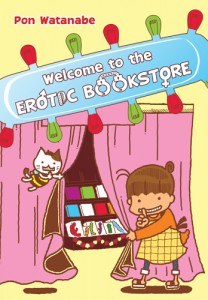
Welcome to the Erotic Bookstore, Vol. 1

March 26, 2013 by Sean Gaffney

By Pon Watanabe. Released in Japan as “Momoiro Shoten e Youkoso” by Media Factory. Released in North America digitally by Yen Press.

This was definitely one of the most intriguing announcements of SDCC, and I wondered what sort of title it would be like? How mature were we walking here? Was it plot-oriented, or just a slice-of-life gag comedy? Well, having now seen it, slice-of-life is definitely the road it travels down. If it weren’t for the sex talk, this would be almost a typical workplace gag manga. It’s just that here, the workplace sells pornography and sex toys as well as the regular used books, and the clientele it gets can be a little special.
Watanabe_WelcomeToTheEroticBookstoreV1_TP

There’s only one scene that I would call so questionable that I’d grab it away from the under-18s (where the bookstore staff goes to the shooting of a porn movie… the most explicit parts of which are drawn using cute cat mascots instead), but make no mistake about it, this book is about a sex shop, and every single chapter is filled with sex talk. Masturbatory aids, adult videos, exhibitionists, voyeurs, you name it, they’re all in here. The author, by the way, is also the narrator/star, but mostly serves to stand aside and make snarky comments – she doesn’t get involved in any of the activities.

Judging by Watanabe’s other two titles, she seems to specialize in slice-of-life gag works like this. It’s broken up into short 8-page chapters, which examine the lives of the owner and staff, the varied customers, and also gets quite philosophical at times. The general rule of thumb in this book seems to be that sexuality is good and nothing to hide provided that it’s not hurting other people. This seems to be an especially good moral to have in times like these, where propriety is seen as everything.

The title is also quite funny, in a mild “causes a smile” way usually, but sometimes the more risque humor made me jaw drop a bit. It’s mostly about the shop, its merchandise, and the customers, but the real world intrudes quite a bit – you see Watanabe having to bust middle school students pretending to be over 18, dealing with yakuza and undercover police (she wasn’t arrested, but had to give a statement – no uncensored porn, please!), and going on karaoke nights with her co-workers. She’s also a female, and quite tall, so there’s talk about how sex shop customers react at having to pay for things through her. And yes, her manga skills do come up once or twice, as she tries drawing things for the shop. We also see her naivite occasionally, such as when she tries to lure more females into the store, only to find that this depletes the much larger male customer base (as they feel even more uncomfortable).

Overall, it’s a cute little title. That said, I wouldn’t get it unless you like slice-of-life mild humor stories, sexual content or no. The style is very “superdeformed” and abstract, so there’s no real nudity or sexual situations. It simply is what it is, a cute title about a woman who manages a used bookstore that has a back room filled with sex stuff.

Filed Under: REVIEWS

Bookshelf Briefs 3/25/13

March 25, 2013 by Sean Gaffney, Anna N and Michelle Smith Leave a Comment

This week, Sean, Anna, and Michelle look at recent releases from Kodansha Comics and Viz Media.


dawn9Dawn of the Arcana, Vol. 9 | By Rei Toma | Viz Media – Dawn of the Arcana is shaping up to be a decent fantasy adventure! Nakaba and friends are presently in Lithuanel, attempting to broker an alliance with Senan, but the foreign land is no stranger to ruthless political machinations, as Nakaba soon knows all too well, thanks to her power, the Arcana of Time. In fact, this volume makes it clear that the ability to see into the past and the future is far more of a curse than a blessing, as Nakaba learns just what it is that her attendant Loki has been hiding and soon faces a terrible choice. Meanwhile, her husband, Caesar, sails home to an uncertain fate. A little bit of sloppy plotting and art that’s a bit too simple keep this title from achieving true epic status, but it’s still quite entertaining. Highly recommended. – Michelle Smith

genshiken2Genshiken: Second Season, Vol. 2 | By Shimoku Kio | Kodansha Comics – Most of the original cast of Genshiken has moved on by this volume – Sasahara barely appears, Saki is absent, etc. But Madarame has always been Genshiken’s heart, so it’s no surprise that he can’t drag himself away from the narrative for long. Which is good, as it’s becoming clear that he’s having a mini-harem form around him. Not that he’s aware of it or anything. It’s good as this is a goldmine of humor, and allows Genshiken’s funniest characters – particularly Sue, who gets her own omake devoted to how awesome she is – shine. But what the 2nd season really seems to be about is Hato and his gender identity, and that’s handled quite realistically and sensitively. In short, it may be a second season with a new cast, but Genshiken still does what it’s always done best – give otaku nerds depth and heart.– Sean Gaffney

kimi16Kimi Ni Todoke, Vol 16 | by Karuho Shiina | Viz Media This is one of those shoujo series that is just always excellent. We see Sawako and her friends move forward with more self-awareness and maturity into their developing relationships. Sawako senses some distance between her and Kazehaya and attempts to deal with the issue. Kento attempts to develop his relationship with Ayane. Some of the best moments in this manga are when characters are just sitting and talking to each other, as Kento and Kazehaya discuss their relationship woes. Shiina’s use of paneling and shifting perspective makes everything visually interesting even when most of the manga focuses on heartfelt discussions as opposed to action. – Anna N

psyren9Psyren, Vol. 9 | By Toshiaki Iwashiro | Viz Media – I’ve been more of a fan of the modern day parts of Psyren than the dystopian future, though the leveling up of the Elmore Wood kids helped a lot in Vol. 9. Still, in a manga where the future can change such as this one, it’s hard to invest in it. Which is why it’s good to see a subplot with someone like Amakusa, a slimeball who is determined that since the world is destroyed, he may as well rule it. There’s always going to be people like him around after a tragedy. Luckily, he’s merely small fry, getting taken out merely by Marie getting very mad… and crumpling the entire building into a ball around him. Still, there’s no getting around it – this is a “fighting volume” of a Jump series, meaning that the plot mostly takes a pause… with the exception of Nemesis Q’s creator, whose big appearance is the cliffhanger of this good but not great volume. – Sean Gaffney

rinne11Rin-Ne, Vol. 11 | By Rumiko Takahashi | Viz Media – One of the big reasons that I go on about Sakura having her negative emotions stolen when she was in the afterlife is that she’s so normally passive that it’s hard to get a grip on her and understand her, and thus she runs the risk of becoming dull. Dull Takahashi characters make me sad. That said, the start of Vol. 11 continues to make me think there’s something to it, as Sakura gets some candy that allows her to not see ghosts… including Rinne himself. And, in her own subtly, low-key way, she realizes that she’s bored out of her gourd without them. (On the bright side, she does miss the many, many attempts on her life.) Other than that, we get the usual: ship tease that doesn’t really go anywhere, unhappy spirits who can easily move on because the whole things a misunderstanding, and lots of violence. Rin-Ne is what it is. – Sean Gaffney

strobe3Strobe Edge, Vol. 3 | By Io Sakisaka | Viz Media – This third volume of Strobe Edge is primarily devoted to Ando, who is being groomed to take over the rival spot from Daiki now that he’s been quickly paired off. It’s always fun seeing the so-called player who’s found a girl that he’s genuinely fallen for, but can’t make that clear. Ando’s player tendencies have a serious past to them, much like every other character in this series. The pain of teenage love, and the fact that it doesn’t work out most of the time, is why we read Strobe Edge, a series that so far has no real bad guys. Even Mayuka seems beset by doubts when she shows up towards the end. But of course, if things remain as they are, we won’t have a plot, so that’s no surprise. Strobe Edge is slow paced, and may frustrate some people, but its bittersweet feelings seem just about right for me. – Sean Gaffney

Filed Under: Bookshelf Briefs

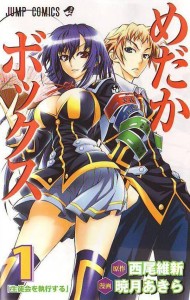
License Request Day: Another Look At Medaka Box

March 24, 2013 by Sean Gaffney

By NisiOisiN and Akira Akatsuki. Released in Japan by Shueisha, serialization ongoing in the magazine Weekly Shonen Jump.

Back in 2010, I did a License Request post regarding a Shonen Jump manga called Medaka Box, and explained why I thought it was a great series, and also why I thought it was unlikely to get picked up. Well, it’s now almost two and a half years later, and the series is still running in Weekly Jump, and gotten two anime seasons (which, sadly, animated the least interesting part of the manga) and has more reasons I’d love to see it licensed… as well as even more reasons it won’t. So let’s discuss.

medakabox1

Since my original post, the manga has kept going, and gotten even more ludicrous. It now projects to be over 20 volumes, and just began a new arc after faking readers into thinking it was ending – the 2nd time the authors have done that! It’s introduced even more overpowered characters, including Najimi Ajimu, who can seemingly control the narrative and utilizes her 12,858,051,967,633,865 skills to waltz around the story being smug. And it still has a small core of hardcore fans who enjoy discussing what it’s really trying to say – even if they all disagree with each other, and half of them are fans of the series but despise the lead.

So, why do I want to see this series over here? Let’s see…

1) Tons of strong female characters, including many leads, several of which have no romances whatsoever. Medaka Box sails through the Bechdel test, honestly. Medaka herself is currently one of two Jump series with a female lead (and the other, Novice Policewoman Kiruko-san, may not last long). We also meet characters such as the aforementioned Najimi Ajimu, Youka Naze (a genius mad scientist with a knife sticking out of her bandaged head), Hansode Shiranui (who is primarily comic relief in the anime-adapted shows, but proves to be far more dangerous – and far more broken – than everyone expected), and Mukae Emukae (who makes anything she touch rot and die, including animals and, presumably, people. )

Each arc has at least one or two major female antagonists or protagonists, and some are entirely female, such as the Jet Black Bride arc. Now yes, there is some romance, with some characters falling in love or obsessing over a person. But it’s not a requirement. More to the point, almost every single female in this series beyond about chapter 26 can kick anyone’s ass right ways from Sunday. I have never seen such a larger group of BAMFs. It’s pretty amazing.

2) Examination, parody, and deconstruction of shonen themes. Many series do this subtextually, but Medaka Box goes right ahead and makes this text. Misogi Kumagawa, who is easily the most popular character among Western fans of the series (and probably Japanese fans as well – the anime did a final episode just devoted to him as if to make up for its likely cancellation), often refers to events by saying “If this were in Weekly Shonen Jump”. Ajimu takes it one step further, and seems entirely aware that this is a serial – it’s made into a plot point, and once led to one of the greatest lines in the entire series, “Manga that go longer than 10 volumes just coast on their success, and this has already gone three volumes over that. So just watch… I’ll end this manga before the anime begins.” (Spoiler: she didn’t.)

But it’s not just pointing out the series is fictional. Medaka Box goes to great pains to mock and undercut many of Shonen Jump’s most treasured values, with several monologues noting that while Jump is supposedly about “Friendship, Training, Victory”, the reality is that the stronger characters defeat the weak ones, so more power always wins. And indeed that is the case throughout Medaka Box. Medaka is insanely powerful, so she wins despite everything. The only exceptions are characters who are (temporarily) stronger than she is. Kumagawa is set up to rebel against this – his entire purpose in life is to be the one representing the weak, loser characters whose only purpose is to fail.

But with all that said, the beauty of a series like Medaka Box – and something that a few of its fans don’t quite get – is that for all that it’s deconstructing Jump series, it also IS a Jump series, and thus in the end it serves what Jump strives for after all. This is not a series that will end with our heroes broken and Medaka humiliated and tarnished – that’s not its goal. Its goal is to show the wonders of humanity in all its forms, even when humans are equipped with various types of superhuman abilities. (Medaka Box sometimes seems like X-Men there’s so many people with insane superpowers.) It may say Jump is all about who is most powerful, but Medaka succeeds because of the bonds she has with Zenkichi – and his bonds with all the others.

3) It’s simply fun. Everyone acts gloriously over the top, almost in a Higurashi sort of way. The series is peopled with larger than life superheroes, so it’s only natural that they are larger than life. Kumagawa can be terrifying or hysterically funny, often in the same chapter, and his juvenile pursuit of seeing girls’ panties, girls in naked aprons, and girls in “hand-bra jeans” (don’t ask) is a nice reminder that all these superhuman geniuses really are teenagers after all. There’s fun wordplay, and later volumes introduce Nienami, who seems determined to be the ultimate boke just to have everyone scream at her. You’re never quite sure if the manga is a parody or not – which is the point, of course.

Now, I mentioned I don’t think this will be licensed. Why? I already discussed in my prior post that it starts off very slowly. In fact, it’s quite mediocre for the first few volumes. (You know, the ones they chose to animate). But let’s update things.

1) It’s now over 20 volumes and counting, and is not a huge hit the way Toriko or Bakuman were. This is reason #1 with a bullet.

2) It would make the translators cry. There is an entire ARC given over to battles using kanji and wordplay, culminating in a final confrontation involving the Japanese game where the next person starts a word with a syllable that the previous person ended with. Oh yes, and there’s a chapter where Ajimu tries to inspire Zenkichi by recalling about 25 old Shonen Jump heroes, many of whom never appeared over here and would require extensive translation notes – something which Viz has never used in its shonen series.

3) One character, Shori Wanizuka, walks around at times with a revolver sticking out of her mouth, sucking on the barrel. Oh, Viz would just LOVE that.

4) Medaka herself. Not since Ichigo Kurosaki has there been a more polarizing lead character in Shonen Jump. Medaka is meant to be a deconstruction of the “Mary Sue” sort of character – she is perfect at anything she tries, has a killer body, is genius level IQ, a physical powerhouse, etc. Despite this, Medaka throughout the series is shown to have difficulty with basic humanity. This is a thread that exists in a lot of NisiOisiN’s works, where he shows the basic disconnects anyone that far ahead of/in front of us would have with average people.

As such, a lot of the time, Medaka is unlikeable, particularly when dealing with Zenkichi, her childhood friend. Now, one of the main plots in the series is showing that she is gradually improving at human interaction, and is not a superhuman freak but merely a teenage girl like everyone else. Of course, character development is frequently not welcome by some fans, who form their opinions and then refuse to change them ever. I’d argue that a majority of the fans support Zenkichi or (especially) Kumagawa as a “main character”, seeing Medaka as an antagonist. In addition, a small minority of fans seem to suffer from “nice guy syndrome”, demanding that Medaka treat Zenkichi nicer because, well, he’s the male love interest and why won’t she learn her place?

5) For those who like Jump for its BL elements, you’ll find some of that here as well. (There’s a couple of yuri teases too.) That said, Medaka’s figure and habit of exhibitionism can also put off female readers who might see the title as pure fanservice.

With all that said, I remain fascinated by this series, one of the most addictive I’ve seen in Jump in years. Even with all the pitfalls, I’d still love to see someone take a chance on it. Hey, it’s licensed in France! Can North America be that far away?

Filed Under: FEATURES, LICENSE REQUESTS

Drama Diary: My Princess Eps. 8-16

March 24, 2013 by Anna N 3 Comments

Here’s my first My Princess post covering the beginning of the series, if you haven’t read it before!

The second half of My Princess becomes more serious as the political machinations pick up and everybody has to deal with Events From The Past, as one does in kdramas. The restoration of the Monarchy is going to go up to a public vote, so the President and other politicians are very interested in the outcome. The President supports the Monarchy on the surface because he owes Hae Young’s Grandfather a great deal, but in reality he is not thrilled about a new ceremonial Korean Monarchy pulling focus from the elected government. The toppling of the Monarchy is aided by the evil Yoon Joo, who gets a willing accomplice in Seol’s sister Lee Dan. Lee Dan manages to steal a royal artifact from Seol’s house and starts claiming to be the real princess. Professor Nam tries to head off Yoon Joo, but isn’t entirely successful. While most of the time in kdramas the evil second woman isn’t particular sympathetic, I thought that Yoon Joo was so irredeemably bitchy that as a viewer I wouldn’t really be satisfied unless she was somehow seriously maimed by a runaway truck at the end of the series. Unfortunately, no maiming of Yoon Joo actually happens.

Please die in a fire, evil lady!

Please die in a fire, evil lady!

Seol and Hae Young are pushed apart by the rumor that his father persecuted her father and caused his death. Seol is dedicated to bringing back the monarchy in order to restore his reputation, and the idea that Hae Young’s father might have caused her tragic early life is very painful to her. One of the repetitive aspects of this kdrama that actually gets a bit wearying as the series goes on is the sheer number of times that Seol runs away from Hae Young, only to be reunited with him a half hour later. Also, it seems like the South Korean government just places travel bans on people willy nilly, as everyone is always fleeing to the airport only to be told that they are unable to leave the country. Seol’s constant fleeing might have decent motivations, but it does make me question her sanity in avoiding a brooding rich diplomat who clearly adores her.

Seriously, would you run away from a man with this face!?

Seriously, would you run away from a man with this face!?

As things begin to get worse for the would be Monarchy, Professor Nam and Hae Young begin to grudgingly work together. One of the most amusing things about this series are the random displays of alpha male posturing when they start arguing over ridiculous things like cuts of meat in an attempt to establish who is doing a better job looking out for Seol.

Who is more handsome!  I am!  No, I am!

Who is more handsome!
I am!
No, I am!

This series manages to last for 16 episodes purely because Seol and Hae Young are each determined to suffer in silence and not burden each other with their problems. While this might be noble, it is a bit infuriating that Seol never comes out and tells the Professor or Hae Young how badly Yoon Joo is bullying her, although both men figure out what is going on. Hae Young ends up solving many problems through his sneaky diplomatic skills, but by putting the Monarchy first, the Princess and the Diplomat might have to put romance aside.

So cute, I can't stand it.

So cute, I can’t stand it.

Hae Young and Seol are one of my favorite couples out of all of the kdramas I’ve watched so far. The actors have great chemistry. The relationship between them has an amusing dynamic, because while Hae Young tends to act in a very high-handed manner most of the time, when Seol decides to get back at him by doing something like pretending to go to a marriage meeting he immediately drops his arrogant pretenses and starts acting overly concerned. I enjoyed rewatching this series, because I was reminded of some of my favorite moments, like Seol trying to erase her slightly perverted internet history and Seol and Hae Young bonding by sitting together in an antique car museum exhibit. The final episode pairs everybody off nicely, and while I would like to see the villains of the series be punished even more, there’s something to be said for the comfort found in happy endings.

Watch now at DramaFever!

Filed Under: Drama Diary Tagged With: dramas, kdramas, my princess

Off the Shelf: Shoujo Fantasy Double Feature

March 23, 2013 by MJ and Michelle Smith 22 Comments

MJ: Good morning, Michelle! I greet you this morning, dizzy with the particular brand of glee that can only be brought on by epic shoujo fantasy. How about you?

MICHELLE: Much the same, actually! With a side of gratitude that the epic shoujo fantasy in question is a) completely available in English and b) in the process of becoming easier to obtain!

MJ: Indeed it is! And really, it is a dream come true. When manga publishers first began launching their various digital initiatives, one of the things many of us hoped for was that these venues would eventually become a platform for re-releasing out of print manga. In particular, I expressed a hope that we might see some of Viz Media’s “scads of fantastic 80s and 90s shoujo,” most of which has become difficult to obtain in print.

Fortunately, Viz seems to be on the same page, as they’ve recently begun releasing some of these older shoujo series in digital form! They began with one of my favorite series of all time, Saki Hiwatari’s 21-volume epic Please Save My Earth (volumes 1-6 are available now), originally serialized in Japan beginning in 1987, followed recently by three series from the early 1990s, Kaori Yuki’s Angel Sanctuary, Chie Shinohara’s Red River, and Kyoko Hikawa’s From Far Away. This week, Michelle and I decided to delve into the latter two of these series, whose first volumes are now available at both vizmanga.com and on Viz’s mobile apps.

Michelle, would you like to choose which we’ll discuss first?

redriver1MICHELLE: I’m inclined to save the best for last, which means that in my personal opinion, Red River should go first!

I actually own all of Red River in print, but had never read any of it ’til now. It has the distinction of being the final series in the now-defunct “shojo” imprint to reach completion. Though it starts off rated for older teens, I have a distinct memory of the later volumes being shrinkwrapped, so presumably sexy times will eventually ensue.

Anyway! Both of the series we’re going to discuss today involve a modern-day Japanese schoolgirl being transported to an unfamiliar environment. In the case of Red River, things are looking good for fifteen-year-old Yuri Suzuki. She has just passed the entrance exam for the high school of her choice and shared a first kiss with her good friend turned love interest, Satoshi. But on the evening of her family’s celebration dinner for her achievement (the exam, not the smooch), she begins to notice that water is acting strange around her. Soon, a pair of arms is reaching out to her from fish tanks and bath tubs, trying to pull her in. Though she manages to avoid water for a little while, she’s eventually captured via a puddle and transported to the Hittite Empire in 14th century B.C., where a scheming queen seeks to use her as a sacrifice to ensure that her son (currently sixth in line for the throne) becomes king.

MJ: Fortunately, Yuri quickly becomes acquainted with Kail, third son of the king and no friend to his stepmother, the scheming queen. Though he’s a notorious player (whose methods of “saving” Yuri generally involve pretending she’s his sexual conquest—something he’d clearly like to achieve in reality as well), Kail appears to be genuinely trustworthy, at least when his own life is on the line. Unfortunately, though Yuri is grateful for his protection, her desire to return to her own land drives her to recklessness, placing both her life and that of a devoted slave, Tito, in peril.

As it happens, I agree with your choice of which to discuss first (and why), which isn’t to say that I disliked Red River in the slightest. It’s immediately engaging and action-packed, with a relatable, plucky heroine and a fascinating historical setting. Even playboy Kail manages to be a genuinely attractive love interest, despite my weariness with his classic rake persona. What does weaken this story, however, is just how easy things are for Yuri, at least in this first volume.

While it may seem odd that I’d consider her path “easy” at this point—she has been marked for death, after all—there are some ways in which things really are inexplicably so. The issue of language, for instance, is immediately discarded, as Yuri finds she can suddenly understand the Hittite’s tongue simply by kissing Kail (insert inappropriate “tongue” joke here). Because of this, she’s able to grasp her situation immediately, including recognizing exactly where (and when) she is. Also, by being under Kail’s protection, she’s also suddenly a princess, with the ability to stop executions and generally direct people to do her bidding, which puts her in an immediate position of power, at least within Kail’s realm.

MICHELLE: Your last paragraph there neatly encapsulates my main criticism of Red River, though there are things about Kail that bother me, too. (I don’t think he’d follow through with the threat, but dialogue like “Now stop grousing or I’ll bed you for real” will never sit well with me.) It feels a little like Shinohara is squandering this rich environment and the potential for adventure in favor of romance. True, Yuri does end up in peril by the end, but it’s due to her impetuous, uninformed insistence on retrieving her clothes from the scheming queen and pretty much just a plot device designed to allow Kail to swoop in and save the day.

However! This series does run for 28 volumes, so I am willing to acknowledge that the story could move beyond its origins and go interesting, complicated places.

MJ: Wholeheartedly agreed! Despite my quibbles (and I do share your discomfort with Kail’s threats—hello, rape culture), 28 volumes of 90s shoujo fantasy is not something I can possibly reject, and my expectations are high!

MICHELLE: Of course, 14 volumes of shoujo fantasy is nothing to sniff at, either. Want to do the honors of introducing From Far Away?

fromfaraway1MJ: I’d love to! Though half the length of Red River, Kyoko Hikawa’s From Far Away took several years longer to complete, running in Hakusensha’s LaLa magazine from 1993 to 2003. And if the first volume is any indication, this was time well-spent.

High school student Noriko has been experiencing a recurring dream set in a mysterious land filled with gorgeous landscapes and unfamiliar wildlife. As she walks home from school with her friends on one ordinary afternoon, television news anchors warn of a terrorist threat involving small bombs planted around the city by a recently captured suspect. While her friends hash out theories about Noriko’s dream—whether it’s a past life, a portal to another dimension, or pure fantasy fueled by Noriko’s sci-fi author dad—Noriko’s attention is drawn by a stray ball, leading her to an abandoned paper bag which explodes just as she approaches.

Though no trace is left of her body, Noriko is presumed dead. Meanwhile, Noriko has fallen into the same world she’s been dreaming about, where she is identified as “The Awakening,” a supernatural being prophesied to grant power over the legendary Sky Demon—the most destructive evil known in that world—to any nation that possesses it.

MICHELLE: Like Yuri, Noriko is fortunate enough to encounter a formidable ally right off the bat, though things are distinctly less easy for them. Izark might be a powerful warrior who saves Noriko from the political factions attempting to capture her (not to mention gigantic caterpillar things), but the language barrier prevents them from understanding one another and her fear and confusion seems to get on his nerves. Still, he’s unable to ignore her when she’s obviously upset and she comes to trust him. The non-verbal storytelling here is great, and I love that Noriko grows ashamed of her earlier behavior and starts trying to learn the language so that they may better communicate.

Despite being an imaginary fantasy world, the setting here feels more real than the Hittite setting in Red River, and has an abundance of the adventure feeling that I was missing in the other series.

MJ: My feelings exactly, Michelle, on all counts. And really, much of this story’s strength is due to the author’s inclination to prioritize adventure over romance, at least in the first volume. Though strong, roguish Izark is clearly leading man material by any shoujo fan’s standards, both he and Noriko are entirely focused on survival at this point in the story, with no romantic action to be found.

Another factor in From Far Away‘s success as fantasy-adventure is its overall complexity and sense of intrigue. While Red River‘s villain is firmly established from the beginning, things are less clear-cut in Noriko’s new world. With every nation competing for control over The Awakening, everyone is a potential enemy, and it’s not clear at all whom we should be rooting for—including Noriko herself! Though it seems fair to hope that our heroine can’t really be the harbinger of evil, it’s little more than a hope this early in the story, and Izark’s origins and intentions are even less clear. Furthermore, the series is already peppered with some extremely interesting supporting characters, including pint-sized seer Geena Haas, her mercenary father Agol, and a whole host of potential enemies who are aggressively hunting The Awakening.

Perhaps most telling is the fact that as soon as I finished From Far Away‘s first volume, I rushed to purchase the second. I suspect I’ll begin reading it the moment we’ve finish this column.

MICHELLE: I also wanted to immediately proceed to the second volume! I actually read and reviewed the first five volumes of From Far Away a little over three years ago, and though I no longer remember specifics, I remember feeling that it just kept getting better and better.

I do want to mention a couple of random thoughts. Something about the setting of this world—probably the huge insects and people standing whilst piloting flying craft/creatures—reminds me of Nausicaä of the Valley of Wind, and it’s not a comparison in which From Far Away suffers. Too, I wonder if the story will take on a Life on Mars idea… like, is Noriko dead/injured in the present day or is she really experiencing all of this? Granted, it doesn’t seem at all like Hikawa plans to go in this direction, but what with the bombing and witnesses to Noriko’s disappearance, it makes me wonder.

MJ: I’ve been wondering that, too, Michelle! Unlike Yuri in Red River, Noriko really is assumed to be dead in her world—and reasonably so—which immediately puts her mortal status in question, and also raises questions about what place she’ll have back in her world if she really is alive and able to return. I also can’t help being curious about Noriko’s father, whose career as a science fiction writer just makes him… interesting. And potentially involved somehow? Who knows?

I think it’s pretty obvious that we find this series compelling.

MICHELLE I’d say so!

Of course, no column like this would be complete without me throwing in a plea for Basara to be the next out-of-print epic shoujo fantasy in VIZ’s catalog to receive the digital treatment.

MJ: I second that plea and add (predictably) Akimi Yoshida’s Banana Fish! Because, let’s face it, Yoshida’s New York is every bit the fantasy that is Tamura’s post-apocalyptic Japan. Bring ’em on, Viz!


Read Red River and From Far Away at vizmanga.com.

Filed Under: OFF THE SHELF Tagged With: Digital Manga, from far away, red river, viz media, vizmanga.com

Weekly Shonen Jump Recap: March 18, 2013

March 22, 2013 by Derek Bown Leave a Comment

Screen Shot 2013-03-23 at 3.25.33 PMWell, this is the week that One Piece is not the best manga chapter in the magazine. But not so much thanks to the merits of the other contenders, rather it’s because One Piece was on hiatus this week. It’s kind of amazing how the only way other manga seems to have a chance is when One Piece isn’t around to act as a comparison.

Toriko Ch. 226
It looks like Sunny and Tommyrod’s fight is about to come to a close. Considering how large this arc is and how many fights we have to get through, I’m not surprised that one of the main fights of this arc is going to be resolved in what will apparently be less than five chapters. It definitely helps that this week’s chapter explains where Sunny got his power up from. As long as they’re done with style, I don’t mind unexplained power ups, but the fact that we actually got an explanation helps a great deal. This arc has been a lot of fun, and while it may not be the best for non-action fans, anyone already enjoying Toriko is most definitely enjoying this along with me.

Bleach Ch. 530
I generally avoid places where manga fans congregate, but even my absence from tumblr wasn’t enough to keep me from feeling the waves of “shipping enthusiast” metaphorically breaking over me. There’s just a sense—a disturbance in the force I suppose you could say—whenever I see something that could be used as fuel for shipping debates. And while I try to avoid those debates with a passion, I can’t help but chuckle every time I find a nugget. I’ll leave you to find out what exactly I’m talking about here.

As for the chapter itself, I’m continuing to enjoy seeing the previous generation. Ryuuken was a lot more sympathetic than I thought he would be, after all the times we’ve seen him in the manga before. It’s the small pieces in the manga that make it all the more enjoyable. Ultimately though, I can’t wait to find out what the deal is with the apparent Vasto Lorde revealed at the end of the chapter. I think Bleach fans will recognize that particular design, hm?

Screen Shot 2013-03-23 at 3.26.12 PM

Cross Manage Ch. 025
After all the romance and relationship elements this manga has been throwing at us, I’ve started to refer to it as a shoujo manga in disguise. This was the first chapter in which a clear shounen element was introduced. Until this point, we’ve never really heard the characters flat out say how much they want to win. Seeing them confronted by an insurmountable opponent and having them decided to win no matter what is such a shounen element that I’m surprised it took so long to introduce into this series. Here’s hoping Cross Manage has a chance to keep moving forward.

Screen Shot 2013-03-23 at 3.26.22 PM

One-Punch Man Ch. 009
One-Punch Man‘s greatest charm is its refusal to play by the rules. When faced with the villain’s lair, do the heroes fight their way up from level one to the very top? Nope. They just blow the place away. Fortunately for the villains, the real complex is underground. Still, there is a sense of logic to the series. After all, if you have the power to demolish a building of bad guys, why not just do that, rather than bothering to fight your way through the complex? One-Punch Man is a satire not just of the superhero genre, but of shounen action adventure series in general. Granted it does make for shorter arcs, but we already know how each fight will end, so why not have some fun with the tropes of the genre?

Screen Shot 2013-03-23 at 3.26.30 PM

Dragon Ball Z Ch. 007
Quick question, was the Kamehameha ever shown in color in the original Dragon Ball manga? If yes, was it colored yellow? Did the anime get the color wrong by coloring it blue? It’s not like this would be the first time that an anime got the color scheme wrong. However, if it never was colored in the manga before, then why is it being colored yellow here? It may not seem like a big deal, but it’s such an arbitrary change, and I can’t see how anyone wouldn’t know what color the Kamehameha is meant to be. It’s only the most iconic attack of the series, and in every incarnation I’ve seen it in it’s been blue. And yet, somehow, they got the color of Picolo’s attack correct. Does anyone know who exactly has been coloring these chapters? Because either they made the silliest mistake in the world, or I’ve had it wrong this entire time. I’m going to stick with the colorist making a mistake until proven otherwise.

World Trigger Ch. 006
I liked this chapter. I can’t really put my finger on why exactly why I liked it more than other chapters (after the first one), but there’s just something about this week’s that works better. Perhaps it’s the interaction with the other Border characters. Perhaps it’s seeing Yuma lay the smack down on the pretentious Ai. Perhaps it’s Jun’s unexpected reaction. Perhaps it’s Yuma having to explain to Osamu that he, Osamu, was the one to save everyone (the only one who Yuma saved was Osamu, when the latter couldn’t protect himself). Either way, I’m looking forward to seeing whether this series continues to rise or starts the rapid descent into cancellation.

Nisekoi Ch. 066
Once again, Nisekoi manages to combine adorable and hilarious in the same neat package. The class finally have to switch seats, but because of the teacher’s relaxed attitude, they keep switching them over and over. Again, this is a chapter that needs to be read; it’s just too funny and adorable to explain without spoiling the experience. Just be warned, this chapter contains Shu’s crowning moment of the series.

Screen Shot 2013-03-23 at 3.27.00 PM


Which was your favorite chapter this week? Or are you holding out choosing until One Piece returns next week? Do you have any suggestions that would make this column better? We’ve been running this for a while, so I would love to get feedback for what I could be doing better.

If you want to hear more, check out the Manga^3 Podcast Archives. Or go directly to last week’s episode, Episode 039 – March 11, 2013 – Women in Shonen Manga | Toriko Vol. 1

Filed Under: FEATURES & REVIEWS, WSJA Recaps Tagged With: bleach, naruto, nisekoi, One Piece, one punch man, toriko

Manga the Week of 3/27

March 21, 2013 by Sean Gaffney, Michelle Smith, MJ and Anna N 2 Comments

SEAN: Last week of the month, and we have a few interesting tidbits from around the mangasphere.

Dark Horse has the 2nd and final omnibus of CLAMP’s Angelic Layer. I seem to recall there was some big complaint with this book, but can’t recall what it was. Whatever it was, this is the big series where folks prefer the anime to the manga, so I’ll be interested to see how much CLAMP break their own premise this time. As we’ve seen, they later got in the habit of breaking every series they did in some way. Was this the first?

MICHELLE: Somehow I missed the first omnibus of Angelic Layer coming out! I still have my TOKYOPOP editions, which I’ve read, but I don’t remember what the difference between the manga and the anime was. (Tangent: my big series where I prefer the anime to the manga is Gravitation!) I liked it enough to keep it, at least!

MJ: I’ve been saving these up to read together, as it’s one of the few CLAMP series I never picked up. I’m looking forward to finding out whether it’s my kind of CLAMP.

ANNA: I’ve also never read this, so I am curious to hear what you guys think before I dive into another CLAMP series.

SEAN: Kodansha has the 2nd season of Genshiken continue with Vol. 2. The cover features the new characters, and I’m hoping the focus is put squarely on them before it returns, as it inevitably will, to the original cast.

21stcen2We have finally hit the end of Naoki Urasawa’s 20th Century Boys, with the 2nd volume of the 21st Century Epilogue. It’s been an epic journey, thank you, Viz. And I fear, bar a major surprise, it will be the last Urasawa we see over here for some time.

MICHELLE: I like to marathon my Urasawa, so I actually haven’t read 20th Century Boys beyond the first volume. At some point I will have to find the time to remedy this.

MJ: Fortunately, Urasawa is eminently re-readable, so if nothing else, we can revisit old worlds while waiting for the new.

ANNA: I think I’m only halfway through this series, but I intend to catch up one day!

SEAN: And then there’s Yen, not arriving at Midtown but arriving everywhere else. First off, we have a digital Light Novel, Another (which I believe is Part 1 of 2) hitting Kindle and Nook. Horror has sold quite well for Yen, and so we’re going to continue to see more of it – I think the manga adaptation of this is due out in the summer. It has supposedly dead students who aren’t quite the urban legend folks thought, creepiness, and lots and lots of corpses.

MJ: Well, hm, that sounds like it might be fun.

The 2nd omnibus of Blood Lad is out. The first one wasn’t a huge hit with me, but I liked it better than I expected, and I’m hoping for good things for this one as well. Though I’m sure it will have lots of fanservice as well. As these titles often do.

MICHELLE: I’m actually interested to read this too, after the intrigued reactions volume one received ’round these parts.

MJ: As you probably know, I quite enjoyed volume one of Blood Lad—much more than Sean did. So I’m definitely looking forward to digging into the second volume.

SEAN: Durarara!! hits the 2nd arc, called the Saika arc. Something is going around slashing people in Ikebukuro! Who is it, and what do they have to do with our heroes?

Watanabe_WelcomeToTheEroticBookstoreV1_TPMICHELLE: I liked this volume. Celty gets her sleuth on!

SEAN: Higurashi: When They Cry wraps up its penultimate arc, as the Massacre Arc shows us why it has that title. Expect heartwarming moments intermixed with appalling tragedy and death. As usual.

Jack Frost is manwha, and I haven’t read it since the first few chapters, but hey, let’s throw it in here. Vol. 7 is out. Is the girl still just a head?

MJ: I’m behind on this series, but I’ve lately had the hankering to dig back in, so perhaps I’ll be able to answer that for you soon, Sean!

SEAN: Soul Eater hits lucky Vol. 13 and Baba Yaga Castle gets a lot louder with the addition of Black*Star. This is rapidly becoming one of my favorite shonen series, so I can’t wait to read more.

Lastly, there’s the release – also digital only – of Welcome to the Erotic Bookstore, an odd ecchi title about a used bookstore that decides to add some adult videos and sex toys to its merchandise. It’s already out on Nook, and apparently will have an iPad app. It may be on Amazon’s Kindle site soon as well. So, if you are able, check it out!

What’s your springtime manga?

Filed Under: FEATURES, manga the week of

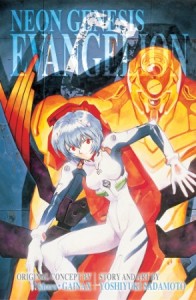
Neon Genesis Evangelion Omnibus, Vols. 4-6

March 21, 2013 by Sean Gaffney

By Yoshiyuki Sadamoto and GAINAX. Released in Japan by Kadokawa Shoten, serialized in the magazine Shonen Ace. Released in North America by Viz Media.

These volumes of Evangelion were coming out just as the TV series was finishing, so by now readers had a general idea where things were going to go. And so that allows Sadamoto to start to mix things up and change what we expect to see. There’s no radical alterations here, but some introductions are different, and one character’s fate is changed – for the worse.

evangelion2

Rei features on the cover, but really has very little to do in these three volumes. That said, her one major scene is quite good. Shinji is still angsting about his father, and how he hates him but knows he’d like that to change. Rei points out that being silent isn’t changing anything, and he should talk to his father. So he does! And he gets shut down cold, as it becomes clear that Gendo is never going to bond with Shinji in any parental way, or stop using him as a tool. (Ironically, telling Shinji to stop trying to get closer to him might be the nicest thing Gendo does for him.) Rei also realizes that for all that Gendo is supposedly closer to her, it’s merely a facade, and I think that bothers her, in her own Rei sort of way.

Of course, the majority of this omnibus is focused on the arrival of Asuka. As noted above, she gets a different and far cooler introduction to the story, taking out an Angel by herself and then beating up a group of street punks to save Shinji’s butt. That said, she’s as harsh and abrasive as ever – except around Kaji, of course. (Kaji shutting Asuka down towards the end of this volume is handled quite well – he clearly knows what is going on and has been ignoring the hell out of it, but Asuka stripping in front of him lets him know he can’t do that anymore. Actually, Kaji in general is handled really well in the manga.) Shinji’s scenes with Asuka are usually the funniest parts of the books, and they also get some sweet bonding moments, showing them starting to open up to each other a little bit.

Then there’s the last third of this omnibus. I wonder if Sadamoto had heard people talking about how the manga was a lighter, more optimistic take on the anime and said “Oh yeah? Well take this!” All of Vol. 6 is devoted to Toji being selected as the 4th pilot, and all that stems from that. And it’s horrible, in the best possible way. In particular, Hikari’s tsundere antics (genuine tsundere, as opposed to Asuka’s “I am at heart emotionally broken” tsundere) are simply impossible to read as anything but tragic, and the last scene of the volume is a perfect “OK, gonna go sob in the corner now” capper. I hated reading it, but it was handled in a fantastic way.

So with that cliffhanger, we’ve been shown that the happy fun times of Evangelion are over. How Shinji reacts to his role in all this – as well as what his father did – will no doubt take up part of the next book. In the meantime, if you never read this series, this oversize omnibus with color pages and detailed notes explaining the confusing backstory is a perfect introduction.

Filed Under: REVIEWS

Library Wars: Love and War, Vol. 9

March 19, 2013 by Anna N

Library Wars: Love and War, Vol 9 by Kiiro Yumi

This manga is one of my go-to comfort reads. As a librarian, I am always happy to read about Library Wars‘s slight goofy premise of librarians becoming a paramilitary force to fight censorship, and while the development of the inevitable romance between overly tall rookie recruit Iku Kasahara and her intense, slightly short, and ever capable instructor Dojo might not be filled with much suspense, there are plenty of adorable and amusing moments along the way.

Iku now knows that Dojo is her fabled “Prince”, the long lost officer from her past who inspired her to join the Library Force. Dojo doesn’t yet know that she knows, but it is growing more and more difficult for the would-be couple to hide their feelings for each other. This volume is fairly episodic, but the stories do serve to push Iku and Dojo closer together. Iku takes part in a sting operation to catch a pervert that is preying on disabled women in the library, and Dojo isn’t very happy that she was placed in harm’s way even though she does manage to finish off the mission capably. Most of the volume centers around the skill test that Iku, Tezuka, and Shibazaki must pass to move up a level. Tezuka and Shibazaki don’t need to worry about passing the written part of the test, but Dojo volunteers to subject Iku to some merciless tutoring to make sure that she’ll be able to advance in her chosen profession. The skills test is where Iku will shine, because it involves leading a storytime for little kids. Tezuka has a bit of a child phobia, and he isn’t sure how to handle it. Iku seems incredibly casual about the situation but as she wanders around going on extra walks, she’s actually designing an incredibly successful active learning activity that ensures she’s going to pass the skill test with high marks. There are some great moments of awkwardness as Dojo apologizes to Iku for not having more faith in her, and she tries to give him a present in thanks for his help on the test.

In many ways, Library Wars is a standard sort of shoujo title, but Yumi’s art easily shifts between showing details of blushes and cartoonish negative emotions as the characters experience the agony of unexpressed love. The paramilitary library plotlines are amusing if one doesn’t think too hard about them, and Iku and Dojo are such a cute couple that I’d happily read many more volumes of the manga.

I didn’t realize that a live action movie adaptation was going to be released in Japan next month! Check out the trailer, what do you think?

Filed Under: REVIEWS Tagged With: library wars, shojo beat, viz media

Bringing the Drama: Stars Falling from the Sky

March 19, 2013 by Anna N, Michelle Smith, Nancy Thistlethwaite and Emily Snodgrass 1 Comment

Anna: Stars Falling From the Sky is a drama with an unusual plot twist as the circumstances of the heroine change dramatically between the first and second episode. Jin Pal Kang is the worst insurance saleswoman in Korea. She’s superficial and spends most of her time shopping and spending her meager salary on items to attract the attention of her crush, an emotionless lawyer named Won Kang Ha. Pal Kang’s family life is extremely chaotic as her parents have adopted five younger siblings. Pal Kang’s life drastically changes when her parents get killed in a car accident. She manages to secure a job as a housekeeper for the handsome lawyer, but becoming the sole provider for five adopted siblings and actually maintaining her insurance job is going to be difficult! Won Kang Ha’s house is also occupied by his feckless nephew and his overly kind brother, providing a perfect set-up for a love rectangle. Stars Falling From the Sky is available on Dramafever.

Stars Falling From the Sky!

Stars Falling From the Sky!

I found this series immensely addicting and I watched all 20 episodes in a couple weeks. What were your reactions to the first few episodes?

Michelle: I went from almost violently hating everyone—except Pal Kang’s long-suffering best friend—in episode one to feeling pretty addicted myself by the end of episode two! The heroine turns around overnight, practically, and even the kids grow more distinct. I think I might end up actually making it to the end of this series (which would be a kdrama first for me), which I didn’t think would be possible when it took me several sittings to get through just the first episode.

Anna: The first episode was rough going, just because really the only characters that I liked were Pal Kang’s parents. That being said, I had a certain amount of sympathy for how selfishly she was behaving just based on her hectic home life. If I was a young 20something and was still living at home with a gaggle of siblings causing chaos everywhere, I might become overly fixated on snobby lawyers and shopping myself. I thought the ending of the first episode was so shocking I immediately started watching the second, and then I was hooked. One of the things I like so much about this series is the more realistic way the characters develop. Pal Kang becomes a much better person but it doesn’t happen overnight.

Michelle: I suppose I never did hate her dad, but her mother frustrated me with her refusal to do anything about the younger siblings destroying Pal Kang’s things and, in fact, blaming it on Pal Kang. But you’re right, the end of the first episode suddenly gets riveting starting with the parents going to the site of the proposed hospital. When I wrote that Pal Kang turns around overnight, I didn’t mean that she completes a transformation, but that she suddenly sees how frivolous she has been. And even when times are tough in her housekeeping situation and her first instinct is to complain about unfairness, she quickly follows it up with gratitude that they’ve all got a roof over their heads. She’s no saint, but she has matured a great deal quite abruptly.

Pal Kang sports the latest in apron fashions.

Pal Kang sports the latest in apron fashions.

Emily: Yeah, this is something I really enjoyed about this series – the unconventional heroine, Pal Kang. Yes, in episode 1 she starts off as very immature and flighty and irresponsible. It is almost painful to watch. But when times get rough, she makes a difficult decision and then STICKS to it. She changes herself, and then abides by her choice even when all the other characters around her try to drag her into the usual kdrama love triangle nonsense. While it does take her some time to ramp up her skills- it’s one thing to make a decision, and another to actually have the knowledge about exactly how to make things work, she keeps pushing forward and puts family first. Other characters put her into typical kdrama situations – especially the amazingly awful and delusional obligatory female rival – but Pal Kang doesn’t have time for her crap, and pretty much says so repeatedly. She has an iron resolve.

I also enjoyed the family bond between Pal Kang and the kids. They do all develop distinct personalities and each one supports the family in a unique way. And the child actors are great.

Pal Kang, the Cranky Lawyer, and a Gaggle of Children.

Pal Kang, the Cranky Lawyer, and a Gaggle of Children.

Our grumpy hero doesn’t have much to work with for a while, other than, ‘be grumpy and mean,’ but he does loosen up eventually and have more to do later. Pal Kang’s influence changes him a lot, and even he learns to respect and understand her choices.

Anna: The child actors were an aspect of the show that I wasn’t expecting to enjoy as much as I did. But they all had very distinct personalities, and I thought the oldest boy’s storyline portraying his anger at being suddenly orphaned was particularly good. Grumpy hero Won Kang Ha was grumpy, but I thought the writers at least gave him more history and motivation to explain his grumpiness, so I felt like his emotional remoteness was earned as opposed to being a bit of a stock character.

Michelle: I definitely came to like the kids more than I expected, especially since at the beginning their storylines revolve almost exclusively around having to go to the bathroom (complete with over-the-top squirming and facial expressions). Gradually, their distinct personalities do emerge and it’s fun seeing, for example, Cho-Rok and Pa-Rang have a discussion amongst themselves whilst the older kids are out of the room. I confess that clever Cho-Rok is my favorite.

Anna: The bathroom stuff was a bit excessive, but I will say as a parent to young children it is alarming how much you end up having to deal with bathroom stuff.

Nancy: I’ll touch on a few points already brought up. I hated this drama at first. Then it became engrossing, but I’m not sure it was worth all the hours in the end. I did dub this “Defecation Drama”–there should be a drinking game for every time a character has to go the bathroom, is constipated, is grabbing their ass (like that will help?!), or is grimacing while seated on the toilet. Oh, and the baby poop scene in the car… I thought they might actually slow-mo it or do a dramatic flashback because the makers of this show seem to be so enamored with poop!

Do NOT test a bottle that way!

Do NOT test a bottle that way!

Pal Kang was the high point of this drama. Her struggle to survive with her young siblings was very moving. There was enough drama without adding the scheming female relatives from the Jung family. Jae Young, the wannabe fiancée, was interesting before they made her jump off the deep end. The motivations of the Jung relatives made no sense after a while. Like in so many kdramas, the focus of the story was lost to its detriment.

The inevitable confrontation between lead guy and second lead guy!

The inevitable confrontation between lead guy and second lead guy!

I must bring up grandpa. He collapsed so many times in this drama after hearing startling news that I found it hilarious. If you watch this drama, see if you can predict each time grandpa will keel over.

Anna: It would be easy to come up with a drinking game for this drama based on bathroom issues, housekeeping problems, and grandpa’s collapses. There was something about the pacing and the cliffhangers at the end of each episode which were particularly compelling to me. I marathoned this series in a way I haven’t done with a kdrama in quite some time. Part of what interested me so much were the aspects of the series that were a bit unusual like Pal Kang’s unsympathetic character in the beginning. But I can see Nancy’s point about the standard kdrama plot points coming in and derailing the unique aspects of the show.

Emily: I could have done without most of the subplot involving grandpa’s family/corporate maneuvering and the obligatory Birth Secret, but I suppose it can’t be a kdrama without those things :) I liked watching the bond between Grumpy Hero and Sleepwalker ^^

Michelle: I reacted much the same to the cliffhangers, Anna. There was just something so compelling about them that made me forget all about bathroom ridiculousness. And I have actually not yet gotten to the bond between the Grumpy Hero and the Sleepwalker. Do you mean Pa-Rang? I anticipate some adorableness.

Nancy: Grumpy Hero and Sleepwalker were sweet. :3

Turn a lawyer into a marshmallow by making him deal with a child with an adorable sleep disorder!

Turn a lawyer into a marshmallow by making him deal with a child with an adorable sleep disorder!

Anna: So Stars Falling From the Sky features a heroine who is maddening at the start of the show but who redeems herself by the end, an over reliance on bathroom issues as a plot point, a grumpy lawyer lead guy, cute kids, a fainting grandpa, and some adorable sleepwalking. If you are going to embark on this show, I recommend watching at least the first two episodes before making a decision to continue or not, because it really does change drastically from the first to the second episode.

The family that scams grocery store samples together, stays together?

The family that scams grocery store samples together, stays together?

Watch now at DramaFever

Filed Under: Bringing the Drama, Dramas Tagged With: dramas, stars falling from the sky

It Came from the Sinosphere: The Nine Provinces

March 19, 2013 by Sara K. Leave a Comment

The cover of volume 1.

The Story

In ancient China, Asule is the son of the leader of a powerful northern tribe. As a child, he was sent to another tribe for rearing, then his father’s tribe came along a few years later and wiped out the tribe. Asule regarded a number of the people from that tribe as family, so to say that he is distressed is an understatement.

Asule has been designated as the heir of the tribe, even though he has older brothers, and his body is frail and weak. He’s afraid that his brothers will kill him one day, and he’s frustrated that, with his weak body, he can’t protect the people he loves.

He eventually learns that he has inherited the “green-copper blood.” If he rouses it, it grants him great physical strength, but at the cost of his ability to reason. His grandfather wants to rouse the “green-copper blood” in him to carry on the family legacy, whereas Asule’s father wants Asule to live a nice, happy life. It turns out that Asule’s father had imprisoned his grandfather because his grandfather had killed his own daughter, Asule’s aunt (it’s hinted that his grandfather killed his aunt because of the “green-copper blood”).

Though there’s a lot more about Asule’s family, but I think it’s enough to say that becoming merely dysfunctional would be an improvement.

Eventually, Asule is sent to Donglu, where he takes the name “Lü Guichen.” In Donglu, he makes two good friends, Jieye and Yuran, and interesting things are happening in Donglu…

Background

This is a novel by Jiangnan, one of China’s most popular active wuxia writers, published in traditional Chinese characters by Kadokawa.

The cover of volume 2.

Wait a minute … isn’t Kadokawa a Japanese publisher? Why are they publishing an wuxia novel from mainland China in Taiwan and Hong Kong?

I would like to know the answer to that. I’m sure they hope to make a profit, but I’d like to know more a bit more about their reasoning. Most of what Kadokawa publishes in Taiwan are Japanese manga and novels translated into Chinese—for example, they publish the Taiwanese edition of A Bride’s Story. Recently, I learned that they have branched into publishing original Taiwanese light novels, but as far as I know, this is the only wuxia novel as well as the only novel from China that they have published (if you know of others, please comment).

Actually, maybe I shouldn’t call this a wuxia novel. Though this novel tends to get labeled as ‘wuxia’ by bookstores, marketers, etc., and Jiangnan is considered a “wuxia” writer, Jiangnan himself says that this novel is a “betrayal”—not fantasy, not historical, not romance, and not wuxia (emphasis mine).

Jiangnan is from Anhui province, and earned a Ph.D. at Washington University. He started reading a lot about ancient Chinese history, in particular, he wanted to understand the motivations of various historical figures. It was he was trying to get into the heads of ancient Chinese strongmen that he got the inspiration which eventually led this this novel.

Speaking of history…

The History (or My Ignorance and Confusion)

As I’ve said before, I actually do not know that much about Chinese history, and that is especially true of ancient Chinese history. “The Nine Provinces” is a reference to China in the Xia and Shang dynasties. However, I couldn’t find any information about most of the geographical locations mentioned in the novel. Does that mean they are fictional, or am I so ignorant that I am looking at the wrong references? Also, I couldn’t find any information about the emperor mentioned, which makes me thing he almost certainly is fictional.

My guess is that Asule’s homeland is not in “China” since, well, “Asule” is not exactly a Chinese name. I reckon that “Donglu” is China since, after moving to Donglu, Asule takes the name “Lü Guichen,” which does sound like a Chinese name, and more significantly, he felt a need to take a “Chinese” name.

In case you don’t know, in Chinese-speaking societies, everybody who is somebody is expected to have a Chinese name, regardless of ethnicity. In Taiwan, there are some legal/business things which are impossible to carry out without a Chinese name. Though I do not have a formal Chinese name, I get asked fairly often what it is, and I eventually made one up for myself. In Chinese-speaking culture, people are supposed to change their name to fit whatever cultural context they are operating in, which includes ethnic Chinese operating outside of Chinese-speaking culture. That’s why many ethnic Chinese have “English” names like “Betty,” “Harold,” “Robin,” and so forth—to them, that is the way that different cultures should interact. That, more than the name “Lü Guichen” itself, makes “Donglu” feel like China to me.

In short, I think that Jiangnan is making up his own alternate ancient Chinese history, but I am so ignorant of Chinese history that I don’t know how much is based on actual history, and how much is based on his imagination. Maybe writing a historical novel based on his own re-imagined history is what he means when he says that this novel is a “betrayal.”

The cover of volume 3.

My Own Reaction

The first time I read the first volume, it didn’t engage me. I didn’t get what the big fuss was about Jiangnan. I think the problem is that it was so different from anything else I’ve read that I didn’t know where to sink in my teeth.

On the other hand, I kept it around, and eventually, I figured it was worth a second chance.

The second time, I got hooked.

It’s fascinating partially because Asule’s personal circumstances are amazingly messed up (basic rule of fiction = the more hurt the characters are, the more the audience cares), it’s fascinating partially because of the contrast of Asule’s sensitivity and perceptiveness with his “uselessness,” and it’s fascinating because Jiangnan creates a world which feels truly fresh and original (though it sure is not a world I would want to live in).

I think it makes a difference that Jiangnan’s starting point was nonfiction rather than fiction. Even though he apparently tossed out most of the facts to pursue his own ideas, his ideas come from his thoughts on ancient Chinese history, not the tropes of any particular fictional genre (though I have nothing against recycling tropes, particularly tropes I like). Reality, being stranger fiction, in some ways is more creative.

Availability in English

Ha ha ha ha ha ha ha.

However, the mere fact that contemporary wuxia from mainland China is getting published outside of China at all is intriguing. I certainly do not expect this to get translated into English in the near future (or ever), but I wonder … would Kadokawa consider publishing this into Japanese?

Conclusion

If all wuxia novels were the same, even if they were all just like my favorites, I would be thoroughly bored of wuxia by now. However, just when I think I have a rough idea of the parameters of wuxia, surprise surprise, I find a story which falls outside of those parameters. The main reason I keep on trying different wuxia novels and writers is not because I want to relive the wonderful experiences I’ve had with certain books—re-reading those books would be much more efficient—but because discovering the range of the genre is exciting.

Granted, Jiangnan claims this is not actually an wuxia novel, but I think it’s fair to say it at least belongs to the wuxia tradition (hey, if you’re betraying tradition, you still have a relationship with it). And this novel is certainly quite different from any other wuxia novel I’ve read, or for that matter, any other novel I’ve read.

This novel is not complete, at least not in traditional Chinese characters, so I don’t know how it concludes. But I certainly intend to read future volumes.

Next Time: Ashes of Time (movie)


Sara K. actually ended up ordering volume two of The Nine Provinces online. She finds the Taiwanese system of buying books online a lot more convenient that the system in the United States (she can get the books the next day AND free shipping AND she can pay with cash, no credit card necessary). Though this is partially because Taiwan is a densely populated island, she still can’t help but feel a bit disappointed in the services offered by online booksellers in the United States.

Filed Under: It Came From the Sinosphere Tagged With: China, Jiangnan, Novel, wuxia

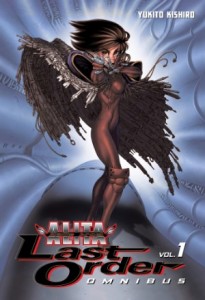
Battle Angel Alita: Last Order, Omnibus 1

March 19, 2013 by Sean Gaffney

By Yukito Kishiro. Released originally in Japan as “Gunnm: Last Order” by Shueisha, serialized in the magazine Ultra Jump; currently owned by Kodansha and serialized in the magazine Evening. Released in North America by Kodansha Comics.

In the beginning, there was Gunnm, which ran in Shueisha’s Business Jump from 1990-1995, and told the story of Gally, a cyborg creation who was revived and had lots of awesome Rollerball-type adventures, killed bad guys, and battled the evil Desty Nova. Then in 1995 the series was wrapped up fast as the author was ill. Like “get your affairs in order” ill. Luckily, he got better, and 5 years later revived the series for new magazine Ultra Jump, retconning most of the last volume and restarting with Gally’s adventures in the sky. Viz Media licensed both series, renamed Gally to Alita, and released the first series as Battle Angela Alita and the second with the Last Order tag.

Then a few years ago, Shueisha was going to re-release the original Alita manga, but decided to remove the word “crazy” from the manga as it might upset the mentally ill. Kishiro was quite upset, and after a long, protracted battle, pulled his manga and moved to Kodansha, where it is currently running in Evening. Over here, the manga likewise leaped from Viz to Kodansha, who have started to put it out from where Viz left off (Vol. 16), but are also going back and re-releasing Last Order as large omnibuses, based off Kodansha’s bunko releases. The fate of the original series remains up in the air, but I suspect a re-release is unlikely.

lastorder1

Which is a shame, as I think the omnibus would read much better if people could refresh their memories of the original. Kodansha Comics puts a 2-page “what has gone before” at the start, but despite trying to make Last Order as newbie-friendly as possible, every time Alita starts wondering about Figure Four, or obsessing over Lou, the reader is left thinking that they missed the first 20 minutes of this movie. Admittedly, if they did re-release the original people might be reminded that some characters who originally got happy endings now are suffering much more gruesome fates. Speaking of Lou.

With all that said, this is a really entertaining read once you get past starting in the middle. Alita’s a cute, sullen heroine who the author makes sure not to take seriously at times. Desty Nova reappears as a crazy awesome mad scientist, still amoral but no longer bwa-ha-ha evil, and now apparently mentoring her. We meet a few of her cyborg duplicates, like Sechs, who is obsessed with “defeating the original”, and Elf and Swolf, who I think are just there to be cute and snarky. And there are new characters, all of whom are dealing with a world that really, really seems to hate everyone. It’s a good thing that there’s elements of humor sprinkled throughout, as otherwise this would be the most depressing thing ever written.

There are also a lot of action sequences, which are equally excellent. James Cameron wants to turn this into a movie, and it’s not hard to see why. Not only does the artist draw a lot of fights, but you can actually tell how the characters are moving in those fights – a rarity with manga writers. Alita is amazing, of course, but still manages to get her ass kicked several times – which, given she’s a cyborg, usually involves her getting ripped in half. Indeed, she spends a good chunk of this book as only a top half. In amongst this action, there’s a whole lot of worldbuilding (I admit I skipped the textual diagrams, and don’t think I missed much), and hammering home the basic theme of the entire series, which is “what does it mean to be human” and “what makes humans different from others?” Having dreams, having goals, believing in yourself – there’s shiny shonen manga ideals buried under all this dystopia.

The omnibus is huge – 670 pages – and padded out even more by two early short stories Kishiro wrote about a year before starting Gunnm. The first is the better of the two, about a man trying to build his own plane meeting an Angel-like creature who has wings but hasn’t really had the gumption to use them. The other story, about a giant tank the size of a mountain that destroys towns and tends to mind control those who try to stop it, is less good. That said, both do continue the basic themes here – strive to survive, maintain your humanity, even if you’re a cyborg, an Angel, or a demon, and don’t let others dictate your goals.

There’s a lot going on in this volume. I didn’t even mention the Martian Queen (who appears to be Orihime Inoue’s descendant), or the obviously evil Venusian guy offering everyone roast babies just to be a dick; or my desire to see this cross over with A Certain Magical Index. But the basics of the series are laid out here, and there are a number of directions the series could go. Lots of politics, lots of action. Unless the author somehow gets distracted by writing 100+ chapters of a fighting tournament or something, I think he can’t possibly lose here.

Filed Under: REVIEWS

Bookshelf Briefs 3/18/13

March 18, 2013 by Sean Gaffney, Anna N, MJ and Michelle Smith 1 Comment

This week, Sean, Anna, MJ, and Michelle look at recent releases from Dark Horse Comics, VIZ Media, Kodansha Comics, and Vertical, Inc.


bloodc1Blood-C, Vol. 1 | By Ranmaru Kotone, based on a concept by Production I.G. and CLAMP | Dark Horse Comics – I haven’t read any of the Blood the Last Vampire/Blood+ series that this one is supposedly part of, but I think I get the gist. A cute clumsy girl is revealed to be the last stand humanity has against demonfolk who are attacking innocents, which she then kills with her big sword. Most of this first volume focuses on her cute and sweet classmates (who will no doubt die horribly), except for one sullen guy who avoids her (who screams ‘love interest’) The battles are OK, and the character designs are sort of CLAMP-ish, but I won’t be trying any more of this for one big reason: I was bored to tears reading it. Every single page of this reeks of media tie-in, and not the good kind. Readers who like CLAMP are advised to get the Tokyo Babylon omnibus instead. – Sean Gaffney

dawn9Dawn of the Arcana, Vol 9 | By Rei Toma | VIZ Media – Nakaba’s powers of magical vision have revealed the depth of Loki’s feelings to her, and to her credit her reaction is to be very concerned about all that her faithful servant must have suffered, both due to his actions in shielding her from harm and Nakaba’s ignorance of his emotions. There isn’t much time to dwell on romance, as the political situation in Lithuanel grows even more tense, and Nakaba sees how scheming royalty use the life of an Ajin to bolster the succession. Nakaba and Caesar’s relationship is stronger than ever and I hope Loki is able eventually to find some sort of happiness. Dawn of the Arcana continues to be an entertaining fantasy manga, made more interesting by Nakaba’s use of her powers. – Anna N

devil7A Devil and Her Love Song, Vol. 7 | by Miyoshi Tomori | VIZ Media – A Devil and Her Love Song is unique in the way that emotions that tend to be buried in more typical shojo series are drawn out and discussed in detail. Here Maria is dealing with the fallout of her friendship with Anna, relying more on Yusuke (at his insistence) but still being drawn towards Shin despite his attempts to distance himself from her. The manipulations of a voice coach who seems to take a marked interest in Maria makes it seem like he will play a larger role in upcoming volumes. This series continues to be a go-to read when I want a manga packed full of drama, with a few sweet moments along the way. – Anna N

fairytail24Fairy Tail, Vol. 24 | By Hiro Mashima | Kodansha Comics – We’ve finally come to the end of the Edolas arc, with Natsu resolving things with his usual straight-ahead heroics… or in this case, villain posing. The next arc will show the characters competing in a battle to be the next S-class wizard, which promises to shed some light at last on Cana, who’s mostly just been “the pretty alcoholic” till now. But most folks remember this volume for the BIG SPOILER. I have no issues with the spoiler itself – god knows I’ll do anything for my happy endings. That said, the premise behind it coming about does require a large amount of disbelief suspension in a series that already has issues with that sort of thing. As for how it affects future volumes, who knows? After all, the extras already hint that Mashima has rewritten his future outline to be quite different from his original plan. – Sean Gaffney

limit3Limit, Vol. 3 | By Keiko Suenobu | Vertical, Inc. – Out of the three currently-available volumes of Keiko Suenobu’s Limit, the third is perhaps the cruelest (and certainly the best). Things begin on an unexpected upswing, as most of the group begins to recover their humanity in the wake of unstable Morishige’s fall from power, which is solidified further by the appearance of another surprise survivor. But as Morishige’s mental condition deteriorates, things eventually become more frightening than ever which, by Limit‘s standards, means quite a bit. I left this volume experiencing a hopeless, sinking sensation in the pit of my stomach that felt far more real than it should have. And isn’t that a shining example of the power of good fiction? This series continues to become more compelling and addictive with each new volume. Wholeheartedly recommended. – MJ

strobe3Strobe Edge, Vol. 3 | By Io Sakisaka | Published by VIZ Media – I am officially beginning to love Strobe Edge, by which I mean I’ve developed an affection that goes beyond simply being happy to see that a new volume has come out. Slowly, and whilst tip-toeing around some stock shoujo scenarios, Strobe Edge has grown more compelling with each volume. The love… shape between Ninako, Ren, Mayuka, and Ando grows more complicated and painful, and is so well done that any accusations of this being “generic” shoujo should be firmly squashed by this volume. Not only do I love that Ren’s friends are becoming concerned that maybe he does like Ninako, but I love that Mayuka is intimidated, too, and now we have two thoroughly likeable girls both in love with the same boy and feeling awkward about the presence of the other in his life. This is so much better than malicious rivals or wacky hijinks! Highly recommended. – Michelle Smith

Filed Under: Bookshelf Briefs

Knights of Sidonia, Vol. 1

March 17, 2013 by Anna N

Knights of Sidonia, Vol 1 by Tsutomu Nihei

I was excited to see that Vertical was releasing Nihei’s Knights of Sidonia, because I greatly enjoyed Biomega. As I was reading this manga, I realized that there really is a dearth of giant mecha manga being published in English. One viewing of the Evangelion anime was enough for me, so I haven’t been following the various manga spinoffs. Most shonen seems to be more of the monster of the week/fantasy variety now, and it wasn’t until I was reading Knights of Sidonia that I realized how much I missed GIANT ROBOTS FIGHTING IN SPACE!

Nihei’s manga centers on Nagate Tanikaze, a human on the seed spaceship Sidonia which is carrying humanity away from the destruction of the solar system by aliens called Guana. Nagate lives in an underground area, sharing his cramped apartment with his grandfather’s corpse and spending his time training in an alien combat simulation fighter. The human race has been split to an extent, with most opting for a procedure that allows them to photosynthesize. Nagate still needs regular human food and he is captured by others on the spaceship when he ventures out for rice. Nagate begins to assimilate into current human society, and he gets signed up to pilot a Garde – the mecha who fight the Guana that attack the Sidonia. Nagate is socially awkward but seems to have an odd ability to tolerate pain and heals up very quickly. Being a regular human might give him a bit of an edge over his modified compatriots?

As Nagate trains to fight he meets Izana, a human who can be both genders. He also meets a variety of photosynthesizing clones. Nagate’s isolation causes him to be several years behind with recent developments, but he throws himself into piloting the Tsugumori, the Guarde unit he is assigned to. There isn’t anything else going on with his life. The space battles are where a horror element comes in as the semi-sentient Guana can shift their shapes, even taking on the outward appearance of a human that they’ve killed. They’re blobby and somewhat fetus-like, if a fetus was a giant shifting alien.

One of the things I like about Nihei’s work is that he tells a compelling story without over-explaining everything. I’m getting to the point where having an origin spelled out in the first couple chapters of a manga starts making my eyes glaze over, but Knights of Sidonia manages to be intriguing without being frustrating. I’m interested to find out more about the human society on the Sidonia, the reasons for Nagate’s previous exile, and to learn more about his progress as a Guarde pilot. Knights of Sidonia doesn’t yet have some of the great desolate scenes of beauty that I enjoyed so much in Biomega, but one of the things I enjoy about Nihei’s art is his ability to convey scale and space in his backgrounds. When Nagate falls through a hole into an enormous rice storage bin, it is easy to get a sense of just how massive the Sidonia is.

Most importantly for fans of Biomega, there is a talking bear in Knights of Sidonia. She doesn’t have a machine gun yet, but she does have an artificial arm. Seriously, a talking bear in outer space with an artificial arm is reason enough to buy this manga, and all the great mecha/alien battle scenes and Nagate’s journey are really just a bonus.

Filed Under: REVIEWS Tagged With: knights of sidonia, talking bears, vertical

Adventures in the Key of Shoujo: Strobe Edge, Vol. 1

March 17, 2013 by Phillip Anthony Leave a Comment

Strobe Edge Vol.1 | By Io Sakisaka | Published by VIZ Media | Rated: Teen

strobe_Edge

Here is your basic relationship equation: Girl (Ninako Kinoshita) likes school friend (Daiki Korenaga) but develops feelings for other school boy (Ren Ichinose). After finding out she might love Ren, Ninako discovers Daiki has feelings for her. So, Boy + Boy / Girl = Story. Not the most original idea but Strobe Edge uses what it’s got and delivers a good slice of teenage angst with some aplomb. Some parts I liked in its execution, some I did not. Shall we begin?

Understanding love is one of the fundamental questions of humanity. What is it? Why is so good and bad at the same time for us? Why do we need it so much? What does it feel like? For teenager Ninako, the fact that she’s never been in love, never been loved (that she knows of) and doesn’t know how it feels is the smartest and dumbest thing about this manga. I would like to say that there’s more to it than that but I respect when authors can just explore a simple idea and run with it, warts and all.

On one hand you want to scream at the girl for being so naïve that she doesn’t know what love is, presumably because she must be loved at home. I mean, I haven’t seen her family yet but she gives no indication that things are bad. Plus she has her friends in school, so she must know what love is! Yes, I know, love for your friends is not the same as love for a significant other. But the basic feeling is the same. I don’t understand why Io Sakisaka tries to present Ninako as laughing with her friends in school and then have her go into automaton mode around Ren. It’s like “What is feeling I have? I … feel? What is feel?” (Sorry, I’m being really simplistic with that last sentence but you get the idea). It’s a set of mental tracks that doesn’t seem like it’s going anywhere. I don’t know if I have the fortitude to root for a character who is that emotionally stunted.

Yet, in the same way, it is fun to watch her as she tries to make sense of these two guys and their attempts (or non-attempts) at getting her to like them. If I had to choose, I would say that Ren is a better character than Daiki. Daiki comes across as a nice guy but there’s something off about a guy who wants the girl but when he finds out that somebody who is dating his sister is interested in the girl, he warns them off from the girl but not his sister. I dunno, but Ren for all of his aloof slightly bad boy angle is a better idea in action as everybody, and I mean everybody, reacts against him. He doesn’t need to do anything and people take notice of him or are aware of him. Ninako is aware of him but as she gets into the mystery of who Ren is as a person we see her change as she realizes that by studying him, she fell in love with him. This is done in a slowly unfolding manner rather than BOOM! I LOVE HIM. Which would cheese me off as that isn’t what Sakisaka is possibly going for here.

The best way of describing the three kids; relationship is this: imagine if they were part of a solar system, OK? Ninako is in the middle of the system and Daiki is the sun. The sun in Ninako’s world is bright, happy to have her around and has always been in her view. But one day a gas giant, Ren, which had always been there but did nothing, suddenly exerts an influence over the planet in the middle. Not enough to completely dislodge it from the sun’s view but once the gas giant has started, a critical change occurs on the planet in the middle. Daiki isn’t going to give up Ninako to someone like Ren but I don’t think it’s as simple for them as “I must possess her!” because Ninako is trying to sort out her own head at the same time. Speaking of Ren, I don’t know why the author chose to insert that final revelation about Ren and his relationship with Ninako at the point she did. I can’t go into specifics without spoiling certain things, but it felt like it was an attempt to promote the idea that Ren really was too good to be true. I am not saying that it is unwelcome but it could have been left until volume two and that would have been a better jumping point for the cast to deal with in the rest of volume two. It’s kind of happily maddening, that’s how I would describe it.

Is there a point in saying that the artwork in this is gorgeous? It’s not master craftsmanship levels at work but the story that it tells, the work on display suits it perfectly and I don’t have a problem with the amount of daydreaming the cast seem to engage in as long as the art looks like this.

I am a bit of a soap drama watcher and while I don’t need to obsess over every episode of the shows I watch, I would say that Strobe Edge has some of that going on here. This first volume presents a few problems for me, that much is certain, but there’s just enough in the way Sakisaka presents the cast and the setup that doesn’t allow me to dismiss it out of hand without giving it a proper whirl. Much like those soaps I am not supposed to like.

Filed Under: Adventures in the Key of Shoujo Tagged With: shojo, shojo beat, VIZ

  • « Go to Previous Page
  • Page 1
  • Interim pages omitted …
  • Page 383
  • Page 384
  • Page 385
  • Page 386
  • Page 387
  • Interim pages omitted …
  • Page 541
  • Go to Next Page »
 | Log in
Copyright © 2010 Manga Bookshelf | Powered by WordPress & the Genesis Framework