• Skip to primary navigation
  • Skip to main content
  • Skip to primary sidebar
  • Home
  • About Us
    • Privacy Policy
    • Comment Policy
    • Disclosures & Disclaimers
  • Resources
    • Links, Essays & Articles
    • Fandomology!
    • CLAMP Directory
    • BlogRoll
  • Features & Columns
    • 3 Things Thursday
    • Adventures in the Key of Shoujo
    • Bit & Blips (game reviews)
    • BL BOOKRACK
    • Bookshelf Briefs
    • Bringing the Drama
    • Comic Conversion
    • Fanservice Friday
    • Going Digital
    • It Came From the Sinosphere
    • License This!
    • Magazine no Mori
    • My Week in Manga
    • OFF THE SHELF
    • Not By Manga Alone
    • PICK OF THE WEEK
    • Subtitles & Sensibility
    • Weekly Shonen Jump Recaps
  • Manga Moveable Feast
    • MMF Full Archive
    • Yun Kouga
    • CLAMP
    • Shojo Beat
    • Osamu Tezuka
    • Sailor Moon
    • Fruits Basket
    • Takehiko Inoue
    • Wild Adapter
    • One Piece
    • After School Nightmare
    • Karakuri Odette
    • Paradise Kiss
    • The Color Trilogy
    • To Terra…
    • Sexy Voice & Robo
  • Browse by Author
    • Sean Gaffney
    • Anna Neatrour
    • Michelle Smith
    • Katherine Dacey
    • MJ
    • Brigid Alverson
    • Travis Anderson
    • Phillip Anthony
    • Derek Bown
    • Jaci Dahlvang
    • Angela Eastman
    • Erica Friedman
    • Sara K.
    • Megan Purdy
    • Emily Snodgrass
    • Nancy Thistlethwaite
    • Eva Volin
    • David Welsh
  • MB Blogs
    • A Case Suitable For Treatment
    • Experiments in Manga
    • MangaBlog
    • The Manga Critic
    • Manga Report
    • Soliloquy in Blue
    • Manga Curmudgeon (archive)

Manga Bookshelf

Discussion, Resources, Roundtables, & Reviews

Features & Reviews

No. 6, Vol. 1

June 11, 2013 by Sean Gaffney

By Atsuko Asano and Hinoki Kino. Released in Japan by Kodansha, serialization ongoing in the magazine Aria. Released in North America by Kodansha Comics.

Dystopias are, as a general rule, not my cup of tea. Those who read this blog on a regular basis already know that I’ll forgive a lot of a story if it has a happy ending; likewise, if a series is just unrelentingly grim, all I really feel is exhausted. But that isn’t to say that a series can’t still win me over with enough interesting things going on. No. 6 is indeed one of those series. It takes place in a supposed elite utopia that turns out to have many deep, dark secrets, and our hero quickly finds out how fast events can turn against him. It’s also shoujo – it runs in Aria, Kodansha’s upscale magazine that’s competing with titles like Asuka and Wings to get the teen “not quite BL” market.

number6

Our hero’s name is Shion, a stoic and reserved young man who is on the fast track for the elite school (and this is among a city of elites) until he lets a young fugitive, who seems to be called Rat, briefly stay at his place, and sews up his wounds. This causes him to lose that elite privilege, something which… really doesn’t bother him much. Several years later, he’s working part-time jobs and staring blankly at his female best friend, who blatantly says she wants to sex him up but is just not registering on his radar, when he comes across a hideous government conspiracy that is killing people by aging them to death. He’s rescued by Rat, and is forced to abandon his life and go on the run, where he’ll find out what the city is really like.

Passive characters like Shion have to be handled very carefully not to be boring. Luckily, these creators are doing a good job so far. Shion may be reserved, but he’s not unemotional, and I like his youthful enthusiasm (which sadly wears down as the volume goes on) and bluntness when he first meets Rat. The scenes with Safu, the aforementioned best friend, are also both quite funny and very telling. It’s not entirely clear if he’s uninterested because he’s not into girls (certainly he bonds better with Rat than he has with Safu) or if the concept of sexual love has simply never occurred to him, but it’s another thing that serves to make him watchable. (By the way, Safu will be dying at some point in this series, sacrificing her life for Shion. I don’t know any spoilers, but bank on this happening anyway, because DUR HEY.)

Rat is less successful, being more of a standard smug pretty boy who has learned not to trust anyone but can’t help but be drawn to our hero. Likewise, the government conspiracy itself, along with its Orwellian officers who administer it, are very much out of the school of Dystopias 101. The aging-to-death thing is pretty horrific, but we don’t know either of the victims long enough for it to really sink in. And the art is serviceable, but doesn’t really pull you in much.

That said, I’m interested to see what happens with Shion, who’s an intriguing enough character that I’ll try another volume of this. The genre isn’t my cup of tea, but the lead may be. And it’s a definite must-buy for anyone who likes conspiracy thrillers with overtones of possible BL romance.

Filed Under: REVIEWS

Bookshelf Briefs 6/10/13

June 10, 2013 by Sean Gaffney, MJ, Michelle Smith and Anna N 2 Comments

btooom2BTOOOM!, Vol. 2 | By Junya Inoue | Yen Press – No, sorry. You don’t get to have vivid shots of “cool violence”, showing lingering closeups of blown-up corpses and a young deviant raping dead women, culminating in a teaser for the new volume whose entire point is “will this hot girl get naked and raped? Tune in to find out!” … you don’t get to do that and then have the hero go on about how violence is wrong and that it’s self-evident that Kira is a psycho. The manga itself is not practicing what it preaches, and there’s basically no reason not to identify with Kira rather than Ryouta if you’re a typical fan of hentai doujinshi where things like this happen. This *isn’t* hentai doujinshi, but it’s aiming for a similar market – guys who like sexy danger, sexy corpses, and sexy assault – and it’s pretty much lost me. Sorry, BTOOOM!. I’m sure your backstory is interesting, but bye. – Sean Gaffney

limit5Limit, Vol. 5 | By Keiko Suenobu | Vertical, Inc. – I admit I’m starting to hit my limit with Limit, and I’m a bit relieved that it’s wrapping up with Vol. 6. My main problem is that I don’t like Hinata that much – yes, he’s not supposed to be likeable here, but I don’t even sympathize with him in a “what a broken guy” way. I was bored to tears during his long monologue. Luckily, Konno is a far more interesting protagonist, and when she’s in control of the narrative things get quite good indeed – particularly the attempt on her life, which was probably the best scene in the book. I’m not entirely sure how this is going to end – it cold go either way, despite the occasional page or two we get devoted to the grieving families – but I’m hoping the final volume has put murder and long, tortured monologues behind it and gets back to a fight to survive. -Sean Gaffney

newmoon1New Moon, Vol. 1 | By Stephenie Meyer and Young Kim | Yen Press – Now several volumes in to Yen Press’ adaptation of Stephenie Meyer’s incredibly popular Twilight saga, I’m more convinced than ever that graphic novels are the ideal format for her storytelling. Though Bella’s obsession with her controlling undead boyfriend is no less disturbing than it ever was (and New Moon, in particular, suffers from one of the most trying cases of Guy #2 in YA fiction history), without Meyer’s cringe-worthy prose dragging them down, these books are vastly more palatable than I ever dreamed they could be. Young Kim’s TV-pretty artwork continues to suit the story’s tone, and though some of the italic text in this volume is questionably readable, it’s possible we’re better off missing some of Bella’s internal narrative. If you’re looking for great girls’ comics, there are far better series available. But if you’re determined to read Twilight, this is absolutely the way to go. – MJ

onepiece67One Piece, Vol. 67 | By Eiichiro Oda | Viz Media – When I recently talked about the first arc of the “New World” segment of One Piece for Off the Shelf, I described it as fun, but not the series as its best. The problem was that the characters weren’t invested with what they were doing. Happily, that changes with volume 67, which manages to not only be genuinely funny and absurd in several places—not the least of which is the fact that four members of the crew wind up swapping bodies—but also involves injustices that fire our heroes up (particularly Chopper). This is the best volume in a while, and on top of that, there’s some juicy political intrigue at the end when a fellow pirate proposes an alliance with Luffy in his plan to depose one of the Four Emperors. I have no idea if Luffy will go for it, but that could really take the story in an exciting direction! – Michelle Smith

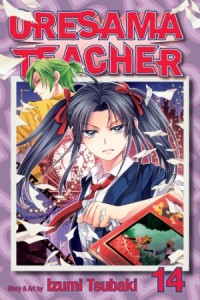
oresama14Oresama Teacher, Vol. 14 |By Izumi Tsubaki | Viz Media – This is my favorite stress-relief manga. The ridiculous comedic set pieces in Oresama Teacher entertain me so much that I don’t even mind the lack of forward -moving plot. In this volume Mafuyu manages to restore Kanon’s faith in the male species by saving her while dressed up as Natsuo, a scrappy boy student. Takaomi gives Mafuyu a lift back home for a school break, resulting in a ridiculous scavenger hunt on her old stomping grounds as a juvenile delinquent. We get a brief and hilarious glimpse into Mafuyu and Takaomi’s past, as we see her hanging out with him when she was a young girl and he was the revolutionary gang leader who united rival high schools. Overall, this was a fun volume to read, and Takaomi has been absent from recent volumes, so it was nice to see him more present in the story again. – Anna N

skipbeat31Skip Beat!, Vol. 31 | By Yoshiki Nakamura | Viz Media – I wonder if this arc is coming out due to Nakamura missing all the awesome blood and violence she used to draw with Tokyo Crazy Paradise? In any case, they’re still filming as Cain Heel and his sister Setsu, and Ren is still having tremendous difficulty dealing with it. The timing of the chapters here is quite interesting, really – several scenes are flashbacks later on, which allows us to get the maximum drama when Setsu walks in on a murder attempt. (Again, I note I have genuine issues with how the cast handles method acting, but pretty much have to let that go.) I’m also pleased we’re still seeing Sho here – he’s an immature brat, but as a character I love how he interacts with Kyoko. Far more than Kijima, who I merely find a smarmy bastard. Ah well, Skip Beat! 31 is fantastic as always. – Sean Gaffney

souleater14Soul Eater, Vol. 14 | By Atsushi Ohkubo | Yen Press – Another chapter of fighting, but things are starting to get a bit desperate – indeed, our heroes suffer a major loss (not a death, I don’t think, and I have no doubt this will be the next major “arc” of the series. The cover is quite stark and memorable, and reminds me that it’s the weird art that drew me into this series in the first place – indeed, the scenes with Soul and Maka as puppets is some of the creepiest stuff I’ve seen in Soul Eater, and this is from a series that had a snake crawling down a little girl’s throat. But they’ve finally hit Arachnae’s base, and Black*Star seems to have emerged victorious, so I suspect we may be nearing an ending of sorts. Excellent shonen with lots of fights, great characters, and weird stuff going on all the time. No surprise this is running in the same magazine that Fullmetal Alchemist did. -Sean Gaffney

thermaeromae2Thermae Romae, Vol. 2 | By Mari Yamazaki | Yen Press – Thermae Romae‘s debut volume was enjoyable, no doubt, but even as I reveled in Mari Yamazaki’s playful humor and detailed artwork, I’ll admit to having harbored grave doubts regarding its sustainability as a series. Gag manga in general tends to wear quickly with me, and I couldn’t help but wonder how much mileage a single gimmick could possibly provide, however beautifully drawn. I must now apologize for my lack of faith. With much study and obvious passion, Yamazaki-sensei has created much more than a gimmick with her time-traveling Roman bath engineer, and his story remains both genuinely funny and oddly moving—especially during this volume’s last few chapters in which Lucius has found himself trapped in modern Japan with no apparent means of return. And is romance on the horizon as well? Thermae Romae succeeds as both comedy and long-form storytelling—a rare combination indeed! Highly recommended. – MJ

Filed Under: Bookshelf Briefs

Umineko: When They Cry, Vol. 3

June 9, 2013 by Sean Gaffney

Story by Ryukishi07; Art by Jiro Suzuki. Released in Japan in two and 1/2 separate volumes as “Umineko no Naku Koro ni: Turn of the Golden Witch” by Square Enix, serialized in the magazine GFantasy. Released in North America by Yen Press.

(In case there are any Umineko obsessives reading this, please avoid any future spoilers in comments. No need to Yasu this up till we have to.)

We’ve had our first go-round, and now Umineko begins its second arc. Surprisingly, for most of this volume Battler isn’t the protagonist, either. I was expecting, as with Higurashi, a few arcs that are simply “Battler is dumb” before things really got going. Here, though, we get a wider view of the cast. The fist half of this has the servants Shannon and Kanon as the dual protagonists, showing Shannon’s love for George and how she got a chance to make that love happen, as well as Kanon’s combination of jealousy and self-loathing that balance this out. Between the two of them, Beatrice has a lot to manipulate, and that’s exactly what she does here – though Shannon, at least, is starting to see through Beatrice’s motivations. Certainly more than Battler is.

RYUKISHI07_UminekoV2E1_TP

The second half of the “island story” (more on the meta world later) focuses more on Maria and her mother Rosa, and oh dear I worry about the fandom just dropping this like a hot potato. Parental abuse is not unique to anime and manga, certainly, but it’s rare in a protagonist, and I think that’s what Ryukishi07 is trying to set Rosa up as here – particularly after the events of the first Twilight that remove the other potential adult protagonists. Her bipolar tendencies are simply hard to read, and we definitely see why Umineko fandom has sarcastically nicknamed her “BEST MOM EVER”. Maria’s not exactly helping her case, either – she’s just as hyper-annoying and creepy as she was in the first arc, and it’s easy to see (though not justify) why she would grate on every one of Rosa’s nerves. Basically, this is a horribly broken family, and putting them in a situation like this is just mean.

Which brings me to Battler and Beatrice. No, not the Battler who’s on the island, or the Beatrice who’s showing up doing magic things and dressing in stockings and short skirts; I’m talking about the Beatrice and Battler from the first arc, who are sitting over a gameboard watching as Battler tries to prove that the murders are human-caused, and Beatrice tries to prove they’re all due to magic. The arcs certainly tie together more than they do with Higurashi, and even more than that series, this one rewards re-reads – and is harsh to those who don’t pay attention. I have to say that I think Beatrice’s ‘move’ here is excellent – Battler could easily deny witches in the first arc when she was just portraits and butterflies, but now Beatrice is everywhere, flouting Battler by simply existing and doing supposed magic.

No one really reads this to identify with or bond over the characters, I hope – leaving aside the fact that they always die, these folks are simply far more unlikeable and broken than even Higurashi’s broken cast, and they’re explicitly compared to “game pieces”. No, we read this to try to figure out what’s actually happening here – particularly now that we have multiple realities stacking up with the ‘meta’ gameboard. I’m pretty sure that this arc isn’t going to give us any answers – in fact, as with Higurashi, I’m not expecting anything concrete till at least the 5th arc – but it does have a lot of pointing and shouting, and over the top faces (sometimes too over the top – I think the artists overdo it in Umineko based on the fan reaction to Higurashi’s faces), and grand guignol horror.

A manga that requires you to think about everything that’s happening, while also trying not to overthink things, seems very contradictory. But that’s Umineko in a nutshell, and if you don’t mind horrible things happening to horrible people, it’s still a great deal of fun. Especially now that Beatrice, who is pure evil on a stick, has made her grand debut.

(By the way, for those curious, Yen didn’t leave out any extras – the 2nd volume in Japan also lacked the extras Vol. 1 had.)

Filed Under: REVIEWS

Off the Shelf: Kisses & Crosses

June 8, 2013 by MJ and Michelle Smith 3 Comments

MICHELLE: Hey, MJ! What did the water say to the boat?

MJ: Um. I got nothin’.

MICHELLE: Nothing. It just waved.

MJ: Okay, that actually made me giggle a little bit.

MICHELLE: Victory! While I wallow in this feeling, care to introduce our first selection? (I note this is another week in which MJand I have two mutual reads instead of just one.)

kissessighs_vol1_fullMJ: Sure! Hmmmm… now the question is, which one? I guess I’ll start with the book I read last, since it’s freshest in my mind, and that would be Kisses, Sighs, and Cherry Blossom Pink, a double-sized volume of yuri short stories from Milk Morinaga, creator of Girl Friends, a five-volume series that we discussed in this column last year. Though Girl Friends was released here first, Kisses predates it, and it’s easy to see how one grew out of the other.

The volume’s opening chapter, “Not Friends Anymore,” begins the story of Nana and Hitomi, long-time best friends who are about to start high school together—or so Nana thinks. When Hitomi abruptly announces that she’s decided to attend a different school, Nana struggles with feelings of hurt and loss, until she finally realizes that it was her own rejection of Hitomi’s stronger feelings that drove her away. Eventually, Nana comes to terms with her own feelings and the two begin to explore a romantic relationship. Initially they are relieved to have ended up at different high schools, since they’d have a harder time concealing their romance as classmates, but over time they become dissatisfied with living in secrecy and find themselves longing for friends with whom they can share the truth about their relationship.

Though the book is a series of short stories, Morinaga uses Nana and Hitomi’s story to thread the collection together; each story is set at one of the two girls’ schools, utlimately bringing things back to their romance by the end. The stories are lovingly woven together, creating a feeling of real cohesion unusual in the short manga I’ve read. Since short stories aren’t my favorite format for manga, I found this quite gratifying.

MICHELLE: It was that sense of cohesion that kind of threw me, actually, since Sean’s comments about it for the last Pick of the Week column had led me to expect more couples, and more sad stories.

It’s not that I disliked Nana and Hitomi, though I did find them a little dull. More, I liked the stories with ambiguous or less cheery endings, like “Remember This Love Someday,” in which a girl confesses to her boyish friend, only to be kindly rejected by her, or “My True Feelings,” which ends with one girl declaring that she’ll make another like her. It doesn’t really seem likely, in my eyes, so I like it for that, even if it’s played a bit comedically.

MJ: I wouldn’t say that I found Nana and Hitomi dull, but the volume as a whole did really make me aware of just how much I crave more grown-up (or at least more complicated) romance. Like Girl Friends, Kisses is nothing if not sweet, but there’s a sameness to even the less overtly happy stories that makes me long for something more. Kisses‘ various romantic protagonists are all nice, pretty girls, carrying on relatively uncomplicated relationships in relatively comfortable environments. Even Hitomi and Nana’s brief stint as runaways is stunningly uncomplicated, as the two shack up in a hot springs resort before heading home to discover that all their problems have magically been resolved. The whole thing is, as I mentioned, unambiguously sweet, and though that’s often enough for me, I couldn’t help wishing for something just a bit meatier.

MICHELLE: “Sweet” is generally enough for me, too, but I think “sameness” aptly describes the aspect that left me feeling a bit blah. Nobody really stands out. None of the background characters is particularly significant. There’s nothing in these girls lives except other girls. It’s like they’re just drifting along, occasionally fancying each other, and not engaging with anything else.

MJ: Well said, Michelle. It’s a lovely little collection, don’t get me wrong, just… not much more than that.

So, shall we move on to our second selection?

MICHELLE: Okay!

CrossManage1Cross Manage is a relatively new Weekly Shonen Jump series in Japan, beginning in 2012, but we’ve already got a taste of it here, courtesy of VIZ’s digital manga site. (I have no idea whether there are plans for a print edition of the title.) Given that I generally adore sports manga, I really wanted to like this, and though I was kind of disappointed by its first half, it won me over in the end.

Tsunenori Sakurai used to be the star of the soccer team, but after a knee injury resulted in doctors telling him he’d never play again, Sakurai quit the team and has been adrift ever since, trying multiple clubs in the hopes of finding something that interests him. One day, he comes upon Misora Toyoguchi, who is enthusiastically practicing lacrosse by herself. Eventually, his innate sports sensibilities (or something) enable him to see where she is going wrong, and he is able to coach her through a breakthrough in her technique. When he accidentally touches her chest, Misora decides to exploit the situation and get him to manage the girls’ lacrosse team, of which she is captain, despite her lack of skills. At first, Sakurai resists, but can’t help responding to Misora’s passion for the sport, and ends up unashamedly giving it his all.

I just couldn’t get into Cross Manage at first, and kept seeing it ticking off items on, like, the Hikaru no Go checklist or something. Pro jock who has lost his own chance to play who is now mentoring someone else? Check? Underdog school club that has to undergo last-minute recruitment for a game? Check! First game against the most renowned school, with its super-refined, untouchable ace? Check! Gradually, though, I found myself won over. I like that Sakurai can tell Misora frankly how amazing he thinks she is, and of course the whole “I’ve finally found it” (regarding a place to belong) revelation pushes my buttons in a big way. And though Misora herself is somewhat of a cipher at this point, I like some of her teammates quite a lot, especially chubby, shy Noto, who is actually the most skilled player on the team.

MJ: In general, you’re a much bigger fan of sports manga than I, so I’m surprised to report that I had no problem whatsoever getting into Cross Manage from the beginning. Now, I’ve actually been following the series for a while, by way of Derek Bown’s Weekly Shonen Jump Recaps, so it may be that his increasingly positive impressions predisposed me to cut it some slack early on, but I liked both Sakurai and Misora right away and felt invested in their stories from the start. Also, I enjoyed the story’s examination of the difference between Misora’s initial raw enthusiasm for lacrosse and her growing seriousness, and how this progression affects her ability to play without caring about playing well.

Since you’ve brought up Noto, though (who is, indeed, awesome), I’ll take this opportunity to mention my one real issue with the series so far. I’ve complained before about overweight manga characters being portrayed as lacking normal facial features, and while this applies to Noto to a small extent (though even Misora’s facial features are pretty basic, Noto’s are disproportionally tiny in comparison to her over-round face), there is another heavy member of the girls’ lacrosse team whose physical features… well… I can only ask “WTF?”

IMG_0466

I mean… Yeah. I don’t know what to else say.

MICHELLE: I don’t either. I kept being reminded of Kurita and Komusubi from Eyeshield 21, who are also large and fat and small and fat, respectively. Both have very simple facial features compared to the other characters, but they’re male instead of female. (They’re my favorite characters in that series, actually.)

I guess we could look on the bright side and note that (in both cases) they’re portrayed positively, and their characterization is not based on weight at all.

MJ: I guess so? It really bothered me, though, I’ll admit. Not enough to keep me from continuing with the series, but enough to cause persistent discomfort, which is disappointing considering how much I enjoyed the volume otherwise.

MICHELLE: Possibly One Piece has inoculated me against being too distracted by strange body types, since that series is full of them. Granted, it feels much more out of place for just one character to look so weird. In One Piece, there’s a bevy of folks looking weird.

MJ: Yeah, I know that odd-looking manga characters are nothing unusual, but my discomfort in this instance is specifically related to the portrayal of fat people as having less complete or less “real” facial characteristics than other people, which implies that they are less complete or less real themselves. It’s a thing.

That said, Cross Manage has a lot going for it, and I’m likely to stick with it.

MICHELLE: Yeah, me too!

Filed Under: OFF THE SHELF Tagged With: Cross Manage, kisses sighs and cherry blossom pink, milk morinaga, yuri

Attack on Titan, Vol. 5

June 8, 2013 by Sean Gaffney

By Hajime Isayama. Released in Japan by Kodansha, serialization ongoing in the magazine Bessatsu Shonen Magazine. Released in North America by Kodansha Comics.

(There may be spoilers in this review for people who are only following the anime.)

In general, I tend to do a lot of reviews for this blog. But sometimes, I don’t have as much to say. So I am very grateful to the Manga Bookshelf team, who allow me, with their Bookshelf Briefs column, to do quick reviews of titles I can’t really spend 500+ words talking about. That said, I have my pet series, which will always get full reviews no matter what. Sailor Moon. Excel Saga. Higurashi. And now, after a few briefs, I’ve decided that Attack on Titan is going to join that crowd. Because guys, this is seriously one of the best manga out there. Its popularity is very much on the rise, helped by the release of the anime, but also by its compelling plot and fantastic characterization, which has been helped by greatly improved facial art. The art is still the weak point, but it’s not enough to make this any less gripping.

attackontitan5

Things pick up right where last volume left off, as we’re dealing with the fallout from Eren’s Titan reveal. Eren is not quite sure about it himself, and that’s the wrong answer to give to a city that’s very much had enough of its family and friends being eaten by Titans. The military trial that follows is great, showing off the “kill him before he kills us all” folks (who are more than one group, and for different reasons) and contrasting him with the Survey Team group, who think Eren may be the best way to help them gain ground and learn about the other Titans. Levi in particular makes an instant impression (that’s him in the foreground on the cover), being that sort of commanding officer who appears cold and unfeeling but has your best interests at heart.

Eren is thus taken to a new squad, and for a moment we worry that we may not see our other main heroes again. Fear not, though: their training is over and they’re all given the opportunity to join the Survey Team themselves. The speech inspiring this is stark and depressing, deliberately so, and it’s no surprise that the majority of those who’ve been through basic training walk away. We then get a great montage of the decisions the others make to join the team. Mikasa and Armin are givens, and I’m not surprised by Reiner and Bartolt either, as they’re the strong stoic types. But Jean, Connie and Sasha are genuinely worried and scared. Sasha, in fact, is absolutely terrified, having almost been taken out by a Titan in Volume 2, to the point where she begged for her life. We get a horrific image of what it would be like for those three to be assaulted and eaten by Titans. Connie recalls his mom back home would love him to be safe with the military police. And yet, in the end, they stay and join the Team, even if Sasha and Krista are crying. (Annie leaves, though. I’m sure she’ll pop up again, though, if only to beat up more guys.)

(Note that we also have some cast who have been around, but aren’t named yet. Gosh, who is that freckled girl next to Krista, and why is she so grumpy and yet always next to her? On a completely different note, there was a somewhat depressing side story at the start of the volume, where a survey team member tries to take notes regarding the Titans before she is brutally eaten. We later see her notebook is rescued, so it’s not all for naught. This chapter was far more important in retrospect, but I think a lot of people may have been spoiled about something or other, so it’s an odd case where those spoiled go “Oh my God!” more than those who haven’t.)

So yes, we now get a merging of the two casts, as Levi and Eren’s group (which also has Zoe Hange, who is marvelous and tortures Titans FOR SCIENCE and is a great reminder that Sasha is not the only weirdo in this series) merge with Mikasa and Armin’s crowd and go merrily off to train and capture Titans. And again we’re reminded how brutal this series is, as many of the people we’ve only just come to know are cut down by Titans who are simply too fast, too large, too homicidal, and (for a cliffhanger) too clever to go quietly. Armin, in fact, realizes what the rest of us may have not – if Eren can transform into a Titan, maybe the other Titans are actually humans as well? Does that mean that the entire Corps could be full of secret Titan spies?

Leaving aside the truly ludicrous “next time” page spread – the author allows himself to have fun with these – this is another very serious volume of Attack on Titan, and you really shouldn’t get too attached to many of the people in this cast. But man, it’s an amazing read, and I just can’t wait to find out what happens next.

Filed Under: REVIEWS

No. 6, Volume 1

June 8, 2013 by Ash Brown

Creator: Hinoki Kino
Original story: Atsuko Asano

U.S. publisher: Kodansha
ISBN: 9781612623559
Released: June 2013
Original release: 2011

Hinoki Kino’s manga adaptation of No. 6 is the second adaptation of Atsuko Asano’s nine-volume series of science fiction novels to be released in English. The first, and my introduction to No. 6, was the 2011 anime adaptation directed by Kenji Nagasaki. While I largely enjoyed the anime, the rushed and fumbled ending left me disappointed. The first volume of the No. 6 manga was originally published in Japan in 2011, a few months before the anime began airing. Kodansha’s English-language edition of No. 6, Volume 1 was released in 2013. It’s highly unlikely that Asano’s original novels (which are really what I would like to read) will ever be licensed in English, and so I was intrigued when Kodansha announced that Kino’s manga adaptation would be published. Since the series is still currently being serialized in Japan, I’m hoping that the story will have a properly executed ending this time around.

On the surface, the city of No. 6 appears to be an ideal, utopic society. The crime rate is negligible. Medical and technological advancements offer its citizens unprecedented comfort and care. Shion is among the elite of the elite. Identified at a young age as a prodigy with a particular affinity for medicine and ecology, he and his mother have their every need provided for by the city. But when Shion saves the life of a young fugitive named Rat, helping him to escape, Shion is stripped of his status and special privileges. He has seen a brief glimpse of the darker side of No. 6. Four years later he’ll see even more when he stumbles upon a pair of bizarre deaths and he becomes the perfect scapegoat for the supposed murders. With his own life now in danger, Shion has a decision to make: flee No. 6 and the only life he knows or remain in a city that no longer considers him human.

The first volume of No. 6 does a nice job of establishing the series’ two main protagonists: Shion and Rat. Although the two young men share an important connection with each other, they come from very different backgrounds and have very different personalities. Shion is intelligent but sheltered and there’s a certain innocence about him. He comes across as a bit naive and socially awkward, but he is intensely curious and searches for the significance behind things. Even though most of Rat’s past hasnt’ been revealed, it is quite clear by the end of the first volume of No. 6 that he has had a much rougher time of it. He is quick-witted but world-weary and cynical. The underlying meaning of a situation isnt’ nearly as important to him as is the immediate reality. It’s simply a matter of survival. In part because they are so different, Rat and Shion find themselves drawn to each other.

After only one volume, No. 6 has yet to really distinguish itself from other dystopian fiction. It’s a fairly standard set up with a seemingly perfect society that’s not quite everything it appears to be. The manga itself often feels very rushed in places and lacking in details in others. There were a few scenes that had I not previously seen the anime would have left me momentarily confused. In the afterword Kino admits to having had to cut much more from the manga than was ideal in order not to surpass page limits. Even so, No. 6, Volume 1 provides the needed introduction to the story and outlines the world in which it takes place. I hope that now that the stage has been set that the manga will have room to breath and slow down a little. It is a different version of the story than was seen in the anime; I’m looking forward to seeing where Kino takes it.

Filed Under: REVIEWS Tagged With: Atsuko Asano, Hinoki Kino, kodansha, Kodansha Comics, manga, no. 6

Manga the Week of 6/12

June 6, 2013 by Sean Gaffney, Anna N, Michelle Smith and MJ 5 Comments

SEAN: Between Amazon and Diamond, I’ll sort out this release date schedule yet! (cries) So confusing…

Dark Horse has a 3rd Trigun Maximum omnibus. This was, I seem to recall, right around the point where the art during the fight scenes made me jump ship, but maybe it reads better in a 600-page shot.

ANNA: I couldn’t get into more than three volumes or so of Trigun as a manga, but I did enjoy the anime.

SEAN: Digital Manga Publishing has the 2nd of their Tezuka 3-fer with the done in one Atomcat! It combines Astro Boy and cats. What more is there to say?

number6

Kodansha Comics has two debuts this week. The first, No. 6, looks fairly serious and science-fiction oriented, and invokes the popular plot of “nice, popular guy discovers the secret facade behind everything he’s ever known”. I suspect his popularity will not last long.

MICHELLE: Possibly interesting!

MJ: Count me in! I haven’t loved many of Kodansha Comics’ debuts, but this one sounds genuinely interesting.

ANNA: That does sounds interesting. If Michelle and MJlike it, I might check it out!

SEAN: There’s also Vol. 1 of Sankarea: Undying Love. I reviewed this title already here, but suffice it to say this should please fans of both romantic comedies AND zombie films, and shows some promise that it won’t be just another harem series.

MICHELLE: I have to say, I am really weary of zombies.

MJ: And I am weary of harem series, but I’ll give it a chance to follow through on that promise.

ANNA: I am also weary of harem series. Not reverse harem though, that will always entertain me.

hisfavorite4

SEAN: His Favorite 4… I can’t with you. Seriously, that cover. That face. Those eyes. This is the best BL series ever. Based just on how the covers make me laugh. Also because it’s Luffy and Rule 63 Robin getting it on. >_>

MICHELLE: *snerk* I haven’t actually read any of this one yet.

MJ: I have read *all* of this series so far, and it is exactly as charming as it looks. It is one of my favorite SuBLime releases so far.

ANNA: That does look hilarious.

SEAN: There’s also a new BL series, Sleeping Moon. The cover is far more serious and broody, which likely suits its time-traveling angst shenanigans. The author had 3 one-shots come out from Deux back in 2008, so this is a grand return!

MICHELLE: I liked the oneshots, as I recall, so I’m looking forward to this one!

MJ: I am optimistic as well!

ANNA: Huh, this was not on my radar at all, but it looks intriguing.

SEAN: Arata: The Legend hits Vol. 14, which means it only has a few to go before it passes the original Fushigi Yuugi. I understand there are god swords.

MICHELLE: I enjoy Arata in a very Shonen Sunday kind of way.

ANNA: It is very well executed, I just really like Watase’s other series more.

SEAN: And oh look, I bet this gets some Pick of the Week. Loveless has Vol. 11 coming out, in which Seimei reveals that this has all been a wacky scheme to buy Ritsuka the perfect birthday present. Or something.

MICHELLE: Hooray! Except… I can’t read this (or volumes nine and ten) until the omnibus of seven and eight comes out next month. But I’m still happy about it. But perhaps not as happy as *somebody* in this post…

MJ: Aaaaaand that would be me. Like Michelle, I won’t be able to catch up to this volume until the fourth omnibus edition comes out next month, but I am pretty much DYING over that.

ANNA: This is another series I need to try – I have the first omnibus somewhere in my house.

SEAN: What’s your June Manga Bride?

Filed Under: FEATURES, manga the week of

Are You Alice?, Vol. 1

June 6, 2013 by Sean Gaffney

By Ikumi Katagiri and Ai Ninomiya. Released in Japan by Ichijinsha, serialization ongoing in the magazine Comic Zero-Sum. Released in North America by Yen Press.

I have often joked in the past about how North American licensors will pick up any manga with the word ‘Vampire’ in the title. It’s now looking as if that may apply to two other genres that are exploding over here: Alice in Wonderland pastiches, and survival games. Alice in the Country of Hearts sells quite well, and BTOOOM!/High School Of The Dead/Battle Royale/Doubt stuff has been in Yen’s wheelhouse for some time. As such, this book may be one of the least surprising licenses of all time. Shame it’s so dull.

areyoualice1

In its favor, the book does seem to get the dreamlike atmosphere and the sense that it would make more sense if only you could figure out the rules of the world. It’s also drawn quite well, with lots of pretty boys being crafty and/or manacing while looking really hot. (This ran in Zero-Sum, one of those “BL only not really” magazines Japan has.) Unlike Alice from the ‘Country Of’ series, this Alice seems to have a very clear awareness of his past in the real world, and is quite willing to do anything to escape it. That said, he’s running into problems, mostly as everyone else in this world is so smug and aggravating.

I’ve read books that start off with everyone being unlikeable before, but never have I had such a sense that this is where they’re going to be in 5-6 books time. And Alice is 7+ volumes and still running in Japan, so that’s quite an investment to have in these guys. For a lead character, Alice sure does come across as a whiny brat. The Mad Hatter’s stoicness seems more like malaise, the Cheshire Cat is amazingly two-faced… I did like The Duchess, but not only does it look like we won’t see much more of her, but it’s somewhat aggravating that the only female character in the entire series is the one placed in peril, and indeed Alice is specifically told “Your weapon cannot protect her, it can only kill”.

But my biggest problem with the series is that 200 pages later, I’m still not really sure where this is going beyond a cat and mouse game. Alice has to kill the White Rabbit in order to stay in this land (presumably Wonderland, though the backgrounds look more like an Italian cityscape than any Wonderland I’ve seen before), but they don’t meet here, so there’s no emotional investment behind it. Indeed, Alice doesn’t seem emotionally invested in much of anything, which is fine if you’re bouncing off a bunch of freaks and weirdos in the cast (say, like the Country Of series), but in a series like this where everyone else is equally detached, it leaves the reader with nothing to grab.

If I was a BL fanfic writer, I’d probably love this series. There’s lots of hot pretty guys who could get into a relationship, and none of that pesky character development that makes writing canon fics harder. They’re just two-dimensional enough to make flesh9ing out an appealing choice. I hope that in future volumes the authors might also try to do something with them, because for now, this is all flash, no substance.

Filed Under: REVIEWS

Sunny, Vol. 1

June 4, 2013 by Anna N

It makes me feel good that there are still new series coming out from Viz in the Viz Signature imprint. Sunny by Taiyo Matsumoto is also an addition to the trend of nicely packaged manga hardcovers. With a slightly larger trim size (the same as the other IKKI titles) and color pages before most chapters, this is a volume that will delight manga collectors looking for something nicer than the average paperback. I’ve only read Blue Spring by Matsumoto before, I really need to get around to reading Tekkon Kinkreet.

Sunny is written in one of my favorite fiction formats – a collection of interrelated short stores with shifting main characters that are all tied together. The Sunny of the title of the book refers to a broken down old Nissan Sunny car that sits in the back of a group home for abandoned children. The Sunny is a secret hideout, place to stash porn and other illicit materials, and a means of escape for a group of kids that doesn’t have much security or fun in their daily lives. The volume opens with a brief glimpse of foster home chaos, quickly inter cut with a scene showing the imagination of Haruo, who sits in the car imagining that he’s bleeding out in the desert like a tragic movie tough guy. Haruo’s reverie is abruptly interrupted by Junsuke, an overly hyper snotty-nosed kid who eagerly announces that there’s a new arrival in the house. The readers of Sunny and the new kid Sei both get an abrupt introduction to the children’s home as Sei goes through the house and sits in the Sunny with Haruo and Junsuke. When Sei says that his mom is going to pick him up before summer Haruo says, “No way you’re goin home. You got dumped.”

Sunny captures Haruo’s frustration and anger about his own situation, combined with his helplessness about being able to change anything. Junsuke struggles with his instinct to grab anything shiny, even stealing from his classmates at times. While Haruo is a central viewpoint character, Sunny fluidly moves among different points of view, showing Megumu’s concern for a dead cat and the real-world concerns of older kid Kenji. While there’s a lot of hopelessness in the lives of the kids who live at the home, they also stick up for each other and come together when one of them goes missing.

Matsumoto has a scratchy pen and ink style in his drawings, which incorporate cartoonish elements like circles for rosy cheeks. Washes of ink in varying intensity and hand-drawn textures instead of screentones give Sunny a hand-crafted feel that stands out among more corporate glossy manga. Matsumoto’s detailed backgrounds firmly establish the neighborhood the kids live in, as well as the run-down environment of their house. Overall, Sunny is exactly what I’d expect from the Viz Signature line – a nuanced work that is set apart from more commercial manga due to its artistic and literary value .

Filed Under: REVIEWS Tagged With: SigIKKI, sunny, viz media

It Came from the Sinosphere: The Duke of Mount Deer (Part 2)

June 4, 2013 by Sara K. Leave a Comment

First, a Song!

I’ve never seen any of the TV adaptations of The Duke of Mount Deer, but I do like the opening song of the version starring Tony Leung and Michael Miu.

Hey, I Know That Place!

I have never been to China. While I know where places like ‘Beijing’ are, a lot of the action in these stories takes place in rural areas I’ve never heard of. Likewise, my knowledge of Chinese history is very, very basic, so when certain prominent historical figures pop up I know little, if anything, about them.

But while I’ve never been to China, I have most definitely been in Taiwan (I’m in Taiwan now).

This novel has many references to Taiwanese history and places in Taiwan, and eventually our protagonist even goes to Taiwan.

Furthermore, I read part of the novel in Penghu, which was a stronghold of Shi Lang, one of the characters in the novel. So, while I was reading about the fictional Shi Lang, I was learning about the historical Shi Lang by wandering around his old stomping ground.

A view of an old village in Wangan, Penghu County.

This village in Penghu was around when the events of this novel took place.

So, for once, not only did I understand a lot of the historical references being dropped and know quite a few of the places being mentioned, they were mentioning places which I have physically visited and have vivid memories of. For example, at one point Wei Xiaobao thinks about five concubines of King Ningjing. I have visited the temple dedicated to the five concubines, and seen the very wooden rafter where they hung themselves.

I had not expected to see places I’ve been to in my travel around Taiwan to pop up in a Jin Yong novel. It’s exciting to see a bit of one’s life represented in fiction, and it made my reading experience even richer.

The Island

Something that comes up again and again in Jin Yong stories is 2-8 characters going to an island where they live together in isolation from the rest of humanity. Or maybe they go to a remote mountain instead. This is the happiest part of the characters’ lives, and if/when they leave the island/mountain, they suffer.

In other words, happiness is setting up one’s own isolated micro-society, while people living within a huge, hierarchal society are doomed to suffer. There, I’ve just summarized about 5000 pages of fiction.

(this section contains some spoilers for this novel)

But there is one protagonist who is not happy with living on his own island, namely Wei Xiaobao.

He thinks the greatest pleasures in life are watching theatre shows, gambling, and having sex with beautiful women. But on the island, only the ‘sex with beautiful women’ is an option, which is why Wei Xiaobao doesn’t want to be on the island in the first place. He does try to gamble with the beautiful women, but since they are not really into gambling, it’s not much fun. Then some gamblers come to the island, so Wei Xiaobao gets sex with beautiful women and gambling. But he’s still unhappy. Then a theatre troupe comes to the island … no, I’m making that one up, but I bet even if a theatre group had come to the island and performed for Wei Xiaobao every day, he would still be unhappy.

It is then said that Wei Xiaobao can only be happy in a bustling city, such as Yangzhou or Beijing. But I wonder, is that really it? He seems happiest when he’s with his friends. If his friends were on the island with him, would he be so unhappy?

In any case, I find it interesting that Jin Yong subverts his own island/mountain fantasy.

deercauldron2

Not a Good Person

Jin Yong has received many complaints from readers about the novel because the protagonist is … not a good person. Jin Yong’s response is that protagonists don’t have to be ‘good’, his novels are not supposed to be morality textbooks, and nobody is completely ‘good’ anyway. He does say to any impressionable people who may read the novel that Wei Xiaobao’s loyalty to his friends is a virtue, but aside from that, his behavior should not be imitated.

I like to pride myself in being someone who wants complex characters with shades of grey and all that … yet Wei Xiaobao also frustrated me. Which makes me realize that I also like to sort characters into ‘good people’ and ‘bad people’, much as I don’t like to admit it.

Wei Xiaobao simply does not fit in the ‘good person/bad person’ dichotomy. He some some horrible things in the story, and never regrets them, let alone apologize for them. He also does some good things at personal cost to himself. At times I would be cheering him on, and then think ‘wait a minute, I’m cheering on the guy who did [horrible thing].’ And then there were times when Wei Xiaobao was suffering, and I would think ‘that’s not fair.’

Many of Wei Xiaobao’s ‘bad’ features are actually him living out fantasies we are not comfortable to admitting we have. For example, he is too lazy to study, and always finds clever workarounds for actual work. Many of use would love to have the benefit of work being done without doing the work ourselves. And while I personally do not have fantasies about having sex with a harem of beautiful women, based on some of the search results I’ve gotten, this seems to be some people’s favorite part of the story.

I have Asagi from Basara on my mind lately (thanks, MJ) and even he fits in the good person / bad person dichotomy. He’s a bad, broken person who becomes a good, healed person. Wei Xiaobao, however, is not broken – in fact, he is the least angst-ridden of all Jin Yong characters. While he does grow up over the course of the story, whether he becomes a ‘better’ person is open to debate.

To a large extent, Wei Xiaobao is just adapting to his environment. He often gets rewarded for lying and cheating, so he lies and he cheats. He grew up around people who treat young women as sex objects instead of as people, so he treats young women as sex objects instead of as people (though he gets a little better about this towards the end of the story). Older women tend to shower affection on him when he flatters and papmers them, so guess what, he flatters and pampers older women. His friends express their gratitude when he tries to help them, so he tries to help his friends. While Wei Xiaobao is individually repsonsible for his actions (especially since it is demonstrated that he CAN resist his social conditioning), to a large extent, his virtues and flaws are reflections of the society he lives in.

What a vexing character.

Wei Xiaobao and His Mother

(this is mildly spoilerific)

For most of the novel, Wei Xiaobao hardly thinks about his mother at all, and he certainly does not wonder how she’s doing. Finally, he returns to Yangzhou and sees her. From her point of view, her young son had disappeared years ago, and no matter how hard she searched for him, she couldn’t even find a clue about his whereabouts. She is understandably extremely upset about his long absence, and makes sures Wei Xiaobao knows it. At the same time, she is overjoyed to know that her son is alive and well. Wei Xiaobao also observes that she is getting older, and that some day she will need somebody to take care of her.

At first, this encounter doesn’t seem to change Wei Xiaobao, but looking back, that was a major turning point in his development. Before their reunion, Wei Xiaobao has a very self-centered lifestyle – everything is about making himself safe, comfortable, and happy. After being separated from her again, Wei Xiaobao actually misses his mother, and worries about how she is doing. And it’s not just his mother – Wei Xiaobao starts considering how his actions affect other people, not to manipulate them, but because he starts to care about their well-being. He realizes that there are people who depend on him. And thus his carefree existence is finished.

This is actually not unlike my own life. I haven’t seen my own mother in years, unless you count the *one* conversation we had over Skype last year, which incidently was the only time I talked to her in all of 2012. She would probably count that, for she said was that it was so wonderful to see her daughter’s face moving and smiling again after having not seen me for so long. Though I don’t think my behavior is nearly as harmful as Wei Xiaobao’s, I am currently living a self-centered life myself. I am only taking care of myself, and though Wei Xiaobao and I do very different things for fun (well, we do have ONE passion in common – live theatre), we are both trying to please ourselves to the greatest extent feasible.

I consider my eventual reunion with my parents to be the end of my carefree existence, for I see that, between my parents and myself, the direction of the caregiving is going to reverse. One reason I value my current self-centered lifestyle is that, by my reckoning, I will never be able to live like this ever again.

Availability in English

This novel has been published in English as The Deer and the Cauldron by John Minford. I haven’t read any of it myself, but this translation gets very, very mixed reviews. Currently, it’s out of print and expensive, so I suggest borrowing it from a library.

The cover of the third volume of the English language edition.

There is also an incomplete fan translation by ‘Foxs’. I’ve looked at it, and it’s very literal (on purpose, according to Foxs). It’s not the smoothest reading experience in English, but it’s close to the original Chinese. Some people say that the best way to read The Deer and the Cauldron in English is to read the Minford and the Foxs translations side-by-side.

Conclusion

A lot of people say this is Jin Yong’s best novel, and dammit, they are right, this is Jin Yong’s best novel.

If you can get the Minford translation from a library, or get the novel in a language you understand by some other means, then this novel needs to be on your reading list now (caveat: I am not going to blame people who avoid the novel because of the sexual abuse it depicts).

I am a bit sad to finish this novel. I had held off on reading this for a long time because it is the last Jin Yong novel. Now, I will never read a fresh Jin Yong novel ever again. Re-reads are not the same. That said, this was the right novel to save for last.

Thanks, Jin Yong. It was a great ride.


What does it say about Sara K.’s life that she saw some Beijing opera, learned how to open up encrypted filesystems with a liveCD, and was bitten by wild leeches in the same week?

Filed Under: It Came From the Sinosphere Tagged With: jin yong, Novel, The Deer and the Cauldron, The Duke of Mount Deer, wuxia

The Sacred Blacksmith, Vol. 1

June 4, 2013 by Sean Gaffney

By Isao Miura and Kotaro Yamada. Released in Japan as “Seiken no Katanakaji” by Media Factory, serialization ongoing in the magazine Comic Alive. Released in North America by Seven Seas.

In general, the review of Sacred Blacksmith is simple. This is a fantasy manga that takes place in a world recovering from a Demon war, which features girls with swords, bandits, elf-girl companions, etc. If you like fantasy like that, this is probably right up your alley. It doesn’t seem to have too much problematic content so far – the hero completely and utterly outclasses the heroine, but she also gets her share of badass things to do. If I have any complaints, it’s that I wasn’t really ‘wowed’ by anything in it – “a pretty good read” is not a bad thing, but doesn’t add up to 500 words very often.

sacredblacksmith1

There is the old standard “the anime changed things and made male fans hate the girl more” discussion, which I’ve used before in talking about Zero’s Familiar. Cecily as seen in the manga is an OK swordswoman who gets by on guts a lot, but doesn’t back away from an enemy and has a few badass moments towards the end of the volume. In the anime, I’m led to understand, she’s a lot less competent, because… well, no idea. She’s also a tsundere, and we know how much male Western fandom hates them. The manga at one point does the “it’s my fault I’m naked in front of you but I’m embarrassed so will hit you anyway” standard, and I was amused that Luke immediately called her on this.

As for Luke, he clearly has a tragic past, and does not suffer fools gladly, but at least isn’t outright horrible to Cecily, possibly as this isn’t a shoujo manga. His familiar Lisa is there to be adorable, and she is indeed cute as a button. The art is also very good at showing the awfulness of the demonic casting, and several scenes made me wince as people were basically possessed (and sometimes consumed) by monsters. There’s sort of a tense peace going on as the book begins, and the plot is no doubt going to be attempting to stop that peace.

There’s also a lot of discussion of katanas, which are unknown to this fantasy world that is no doubt supposed to be Western Europe. Lisa even has a long, mostly textual discussion at the end of the book on how they are made and why they are superior to straight Western swords. The katana is a nice weapon, but there’s just a touch of ‘and this is why Japan is better’ to the whole thing (not that this is exclusive to this series – off the top of my head, Attack on Titan is doing similar things as well). The action scenes are solid as well, which speaks well to the artist. I never had to go back and reread to figure out what was happening.

So while there’s nothing really wrong with Sacred Blacksmith after one volume, I’m not sure it has enough oomph to really excite me either. It seems like the authors are making tick boxes on a ‘fantasy anime franchise’ checklist. Hopefully a second volume will give me a bit more to chew on.

Filed Under: REVIEWS

Bookshelf Briefs 6/3/13

June 3, 2013 by Sean Gaffney, MJ and Michelle Smith Leave a Comment

This week, Sean, MJ, and Michelle look at recent releases from Seven Seas, Yen Press, Viz Media, Kodansha Comics, and Vertical, Inc.


joker2Alice in the Country of Joker: Circus and Liar’s Game, Vol. 2 | By QuinRose and Mamenosuke Fujimaru | Seven Seas – Despite the cover showing a seductive moment between Alice and Peter White, there’s less romance in this series than ever before – and the series is all the better for it, as it’s allowed to dig a bit deeper into the darkness that haunts the entire Alice series. The cast make it perfectlyu clear that their goal is simply to keep Alice distracted and not thinking of returning to her world – and that having her fall for one of them is merely a means to that end. But Joker is a wildcard – at least one of his personalities is – and he’s just as determined to dredge up all the things everyone wants Alice to forget – particularly her older sister. This is possibly one of the more twisted spinoffs of the Alice series, and thus one of the most intriguing. – Sean Gaffney

areyoualice1Are You Alice?, Vol. 1 | By Ikumi Katagiri and Ai Ninomiya | Yen Press – Given the number of titles that currently match this description, one simply has to ask, do we really need another manga series involving characters from Alice in Wonderland? If that series is Are You Alice?, the answer is… I really don’t know. The premise is this: bishonen “Alice” falls into the clutches of several more bishonen playing roles like the Mad Hatter and the Cheshire Cat. In order to win his freedom, Alice must kill the White Rabbit, as per rules set in place by the (bishonen) Queen of Hearts. Violence and BL subtext ensues. Though there are some intriguing aspects to this series’ first volume (for instance, former “Alice” candidates have lost their identities once they’d failed), it’s difficult not to see it as an excuse to dress up a bunch of pretty men in pretty, pretty costumes. Whether there’s really more to it remains to be seen. – MJ

arisa10Arisa, Vol. 10 | By Natsumi Ando | Kodansha Comics – With the King’s identity revealed at the end of volume nine—and coming as no great surprise—we turn now to some explanation of how things came to be as they are. Arisa has awoken, and after a period of coldness that her twin, Tsubasa, thaws with her shoujo heroine powers, begins telling her sister the truth about the origins of the wish-granting sovereign of Class 2-B. I can’t say that the explanation is particularly plausible or anything, but at least it offers us a break from characters suffering from amnesia, falling down stairs, or finding themselves in other positions of peril thanks to over-the-top evil villains. For a series that started off promisingly, Arisa became kind of snickerworthy in its later volumes. I’m still going to see this one through to the end, but I doubt this’ll be something I’m interested in rereading in the future. – Michelle Smith

cageofeden10Cage of Eden, Vol. 10 | By Yoshinobu Yamada | Kodansha Comics – While not spoiling anything specific for this volume, it’s worth noting that after so many volumes where the only characters who die are minor students we don’t really care about, here we see both the death of a major character as well as the non-death of a villainous character I was totally expecting to die. In a series like Cage of Eden, keeping the suspense and surprises coming is the entire reason for reading the series, so that’s definitely a good thing. Well, I admit many may also be reading this for the fanservice, and this volume gives them a long, involved bathing scene with lots of nude women. The cliffhanger teases a couple of answers to our questions, but in general we’re still just watching everyone battle huge animals. But really, this volume is about (spoiler)’s death, and they died well. – Sean Gaffney

demon3Demon Love Spell, Vol. 3 | By Mayu Shinjo | Viz Media – So I’ll admit that, despite my immediate adoration of Demon Love Spell, previous experiences have kept me on edge, and some part of me has waited fearfully for that thing to happen—you know the thing—that moment when I’d be suddenly expected to find a super-controlling love interest super-duper sexy. I mention this now, because it almost happened. There’s a moment early on, when hot demon Kagura, jealous as all hell, demands that heroine Miko “Shut up!” and “Stop arguing,” and in her mind, she apologizes. My heart sank, truly. I thought I was done for. Fortunately, the moment passed quickly and never repeated itself; furthermore, the rest of the volume is just as charming and funny as the rest of the series has been so far, and I found myself taking phone photos of particularly charming moments. Don’t scare me like that, Demon Love Spell. Please? – MJ

shonan9GTO: 14 Days in Shonan, Vol. 9 | By Toru Fujisawa | Vertical, Inc. – I admit, there were two things that disappointed me in this final volume. One of the bad guys changed his stripes in a very convenient way, and I’m not sure there was enough buildup to make it work. The other is the 2nd half – the GTO story proper finished halfway through, and the rest is devoted to the Twins from an earlier arc dispensing Onizuka-style justice in their own high school. It’s just not as much fun watching them as it is watching Onizuka, and feels more like a typical Shonen Magazine fanservice chapter. But that still leaves lots of Onizuka being awesome, and a big chase, and a jetpack out of nowhere, and all the other fun ludicrousness we’ve known from this series. And, in the end, most of the kids get a happy ending. Which is all we really wanted. (Romantic resolution? Ha!) – Sean Gaffney

bookstore2Welcome to the Erotic Bookstore, Vol. 2 | By Pon Watanabe | Yen Press – This was an intriguing experiment from Yen, and I’m glad they put it out. That said, I feel it’s safe to say that one volume of this series was absolutely enough. The second volume has less about the lives of the heroine and the various employees around her, and more examination of customers and their kinks. Including some fetishes that I’d really rather not get to know the reason behind, thanks very much. The message here is positive – as long as it’s not hurting anyone, sex is a wonderful and varied thing. But after a while the plotless gag format took its toll on me, and I was sort of flipping quickly towards the ending. If you’re a completist, then by all means pick this up. But for those who were simply curious, I’m pretty sure Vol. 1 will meet all your needs.. – Sean Gaffney

Filed Under: Bookshelf Briefs

Off the Shelf: Sunny, Lone Wolf & Cub

June 2, 2013 by MJ and Michelle Smith 5 Comments

MJ: Good morning, Michelle! It’s been a while since we met here, just the two of us. I miss it!

MICHELLE: Me, too! I really enjoy talking about manga with you.

MJ: So, with a whole slew of debut volumes to catch up on, we’ve decided to spend the next few columns on mutual reads only, so we can give these books the attention they deserve. Michelle, would you like to introduce our first selection for this week?

sunny1MICHELLE: Sure!

Sunny is the latest series by Taiyo Matsumoto (Tekkonkinkreet, GoGo Monster) to be released in North America. Serialized in Shogakukan’s IKKI magazine, Sunny is a slice-of-life story about kids living together in a group facility. Their circumstances vary—some might be orphans, but it seems that most have parents who are unable to care for them for some reason—but one thing they have in common is the use of an old, broken-down Nissan Sunny as a kind of playhouse.

Junsuke is a snotty-nosed kid with a penchant for shiny things. Haruo is a white-haired boy whose play-time daydreams always involve being a cool, grown-up version of himself. Sei is the new kid, taciturn and utterly opposed to thinking of the facility as his new home. Episodic chapters ensue, and somehow Matsumoto uses quick, short scenes in such a way that the pace feels frenetic and leisurely at the same time. Hyper, but with that “we’ve got a few hours ’til dinnertime” quality, if that makes sense.

MJ: Oh, what a wonderful way to describe the general feel of this book! The book’s structure and pacing seem so in tune with a child’s sense of time—that feeling of impatience on top of the endless landscape of imagination. These kids have more reasons than most to escape into their fantasy worlds, but they spend just as much time being shuffled along the familiar routines of childhood. Meals, school, sleep, play—their daily lives are similar to most young kids, but with an edge of anxiety most of us were privileged to do without. And it’s these points of anxiety that make Sunny feel moving and real, and not a nostalgia piece in the slightest.

Some anxious moments that stood out for me were things like teenaged Megumu’s instinct to head for the nearby bridge when one of the home’s children goes missing, because being left to die in the river is actually her own worst fear, and young Junsuke’s desperate bouts of kleptomania. I was also very moved by Haruo’s fitful attchement to visiting adult Makio, the one person to whom he’s willing to confess that he dreads seeing his own mother because seeing her only makes not seeing her that much harder.

Also, while the Sunny itself is certainly central to the story, somehow it’s the kids’ time spent out of the Sunny that shows us who they are even more than their stolen moments alone with their imaginations. That’s not what I would have expected, but Matusmoto is so deft at revealing his characters through their actions, everything they do feels significant.

MICHELLE: There were so many things here that I loved. I love that Matsumoto depicts what it is that the kids are imagining, particularly Sei’s fantasy ride back to the place he considers his true home. I love the ridiculous song Junsuke makes up. I love the way Matsumoto’s art—not pretty but still oh-so-charming—delivers some poignant moments, like a subtle establishing shot showing the home as a place of warmth to go to when it gets dark (both literally and figuratively). I love that he never actually says “and this little kid is Junsuke’s brother,” but simply shows it through their physical similarity and interaction. And I love the whole bit at the end where said little kid, Shosuke, is intent on informing everyone he meets that he found some four-leaf clovers when, in fact, this is actually a lie.

You know a manga is exceptional when even the presence of a dead kitty isn’t something that upsets me (because the kitty is treated with the utmost respect).

MJ: The scene with Megumu, Haruo, and the kitty reminded me immediately of one of my favorite scenes from one of the later volumes of xxxHolic, in which Doumeki confides to Kohane that he’d decided to help Watanuki after having witnessed him standing alone in the rain, cradling a dead animal and wondering if he’d be left the same way one day. Yet as moving as the xxxHolic scene is, and as strongly as it affected me at the time, with Matsumoto’s straightforward storytelling in place of CLAMP’s self-conscious drama, I found that the scene in Sunny moved me more.

MICHELLE: I must admit that though I own other works by Matsumoto, I haven’t read them yet. I’m thinking that will have to change, and pronto. Because when I finished this volume, what I felt most was “I want more.”

MJ: I own no other works by Matsumoto, but I will soon. I felt the same way.

MICHELLE: Luckily, Sunny isn’t a oneshot—it’s up to three volumes in Japan so far—so eventually there will be more.

Speaking of renowned creators whose work we’d not read before, want to introduce our next selection?

MJ: Sure!

lwc1Moving swiftly from contemporary to classic, our second read this week was the first omnibus volume of Kazuo Koike and Goseki Kojima’s Lone Wolf and Cub, just released by Dark Horse Comics. Though this series first ran in Futabasha’s Weekly Manga Action in the early 1970s, and Dark Horse has been publishing its English-language editions since 2000, these new omnibus editions offer new readers a chance to experience Lone Wolf and Cub, and in a larger, easier-to-read format than Dark Horse’s original small-trim editions. This is a series I’d spotted many times in book stores and comic shops over the years, but never picked up, at least in part because of the small size. Now I feel rather silly about it, of course, because I’ve clearly been depriving myself!

The book opens by introducing us to Ogami Itto, a master samurai now traveling as a ronin along with his toddler son, Daigoro, known collectively to most as “Lone Wolf and Cub.” The story’s structure is largely episodic, but though early chapters focus on tales of Itto’s fearlessness and skill (as well as his terrifying reputation across Edo-era Japan), we later discover that he took the “assassin’s road” as a last-ditch attempt to clear his family’s name after being wrongly ousted as the shogun’s executioner. In fact, one of the most oddly chilling scenes in this omnibus is one in which he leaves it to his infant son to decide whether he’ll join his mother in the afterlife or accompany his father on his blood-soaked journey, based on whether the son chooses to crawl towards a bouncy-ball or a knife.

The series is action-packed and very compelling, filled with creative swordplay and expressive artwork that carefully depicts both the beauty and brutality of the era, but its greatest draw for me as a reader is Itto himself, whose sense of honor in combination with his unforgiving career path presents us with a protagonist as complicated and problematic as the era itself.

In a modern series, I think a character like Itto would be written as a sort of “assassin with a heart of gold.” He’d be someone we could root for wholeheartedly even when he killed—a sort of Edo-era Mal Reynolds. But Koike and Kojima’s protagonist is no such thing. He’s reliable, trustworthy, and eminently honorable, but he always gets the job done, no matter who it is he’s been sent to kill; he could never be considered merciful, and only occasionally compassionate. He defends those he believes to be vulnerable or in the right, but only so long as it doesn’t interfere with his mission. And he’s utterly unapologetic at every turn, even when it comes to the plight of his son. I find him fascinating.

MICHELLE: That would’ve been a great introduction even without the Firefly reference!

I’ve never read Golgo 13, but I do have to wonder whether Itto might be a comparable hero to that famously inscrutable lead, in that he is consistently shown to be a major badass. This is a guy who’ll commit a robbery to get himself sent to prison to be nearer to his target, and once he discovers that said target is on death row, he kills a bunch of his fellow prisoners in order to pursue his goal. He’s not just deadly with a sword, he is a brilliant strategist, and not above using Daigoro in his plans. (And he’s also able to satisfy the ladies even when his life is in jeopardy.)

At first, I was intimidated by the sheer size of the omnibus (over 700 pages!), but found that Kojima-sensei’s artistic style boded well for quick reading. The panel layout is simple, but Kojima does especially well with establishing a sense of time and place, and I quite loved the establishing shots we get for each new location Itto finds himself. My only complaint about the art is that a lot of the clients and other characters look like. Sometimes I wasn’t sure if I was supposed to remember seeing anyone in particular before, but usually there are clues in the text that help to dispel confusion.

Daigoro is the most endearing aspect of the story, as one might expect, but his presence for all these gory scenes is kind of disturbing. There’s one panel in particular in which he and his father are watching an opponent slowly topple, and once the guy finally goes down, Diagoro smiles. It made me wonder how warped he is gonna be! Of course, with all this bushido business, probably he’ll just be some hardened warrior who greets the concept of death casually.

MJ: Heh, yes, there’s a chapter late in the volume that gives us the beginnings of a look at the man Diagoro might one day be, in which he fearlessly attacks much older characters with a look that one describes as, “eyes that see between life and death… the eyes of a swordsman able to place his heart in the nothingness of mu.” Later, Itto asks his son if he’s going to be able to reap what he’s sown, as Daigoro has thrown an entire household into deadly turmoil. Somehow, I imagine he’ll grow to be an even scarier adult than his father, assuming he lives that long.

I, too, was intimidated by the length of this omnibus when I started, but I was stunned to find myself suddenly at the end, it read so easily. And it’s definitely worth the time! Most of my favorite stories were at the end of the volume.

MICHELLE: Yeah, that part about Daigoro’s eyes was rather creepy. I can’t help but feel bad that he’s been shaped by witnessing all this slaughter, yet cannot deny the appeal of watching his dad dispatch his enemies with such skillful ease. I guess probably the mangaka wanted us to feel this way.

MJ: Yes, I’m sure that’s the case. One of the things that I think makes this manga so interesting, is that its sense of morality is so clearly of another time and place. Often, modern storytellers will insert their own sensibilities into a period piece, either viewing it with rosy nostalgia or, perhaps, horror. But Koike and Kojima leave it entirely up to us to figure out how we feel about an era in which the value of a person’s life was viewed so differently than it would be today—and the value of death, for that matter. It can be hard to swallow at times, but it’s never sugar-coated.

I’m really grateful for the opportunity to delve into this series at last! It’s certainly worthy of its classic status.

MICHELLE: Well said! And I, too, am glad we decided to check this one out. As much as I love Takehiko Inoue, I actually enjoyed this more than Inoue’s Vagabond, and will probably keep reading it!

Filed Under: OFF THE SHELF Tagged With: lone wolf and cub, sunny

Sankarea: Undying Love, Vol. 1

June 2, 2013 by Sean Gaffney

By Mitsuru Hattori. Released in Japan as “Sankarea” by Kodansha, serialized in the magazine Bessatsu Shonen Magazine. Released in North America by Kodansha Comics.

I have been running into the same sort of problem lately with many new manga, even though most of them are completely different on the face of it. They all seem to boil down to the same thing when I review them, which is “quite readable and even better than I expected, the big downside being crushing unoriginality”. This probably does the title a disservice, as originality, particularly in recent Japanese manga, is what DOESN’T sell. In general, what readers want is “something familiar with a slightly new spin on it”. And Sankarea provides that in a perfectly readable way.

sankarea1

I should note that the cover you’re seeing is one created by the artist especially for the North American market. The original Japanese cover just has Rea staring at the reader in that sort of cute seductive ‘girl posing’ way, with absolutely nothing to suggest what the content within is like. Except, of course, the title, which is a play on words based off of a very popular zombie movie (seen over here as Zombi 2, and one of the most terrifying movies of the late 70s, if I recall.) Kodansha decided that they’d need more than ‘generic cute girl staring at reader’ to sell this, so asked for the more… gruesome shot. I approve. It’s a better cover.

As for the content, it’s mostly a fairly standard romantic comedy. Nice if somewhat weird hero, who has a cousin who’s busty and secretly likes him, as well as a younger sister who’s an emotionless stoic. At his all-boys school, we see him with his two friends, one of whom is girl-crazy and overdramatic, the other pleasant and unmemorable. They are most impressed by the perfect Japanese princess girl who’s going to the all-girls’ school across the river, who is gorgeous and popular. Except that it turns out she has a secret, which our hero quickly finds out.

So far so boring, but it’s the nature of the secret, and the nature of our hero’s weirdness, that perks things up. Rea’s father is not so much possessive as disturbing. We don’t see a lot of him in this volume, but given she’s talking about him taking nude pictures of her and his increasing paranoia at Rea being touched by other men, I think Daddy’s shaping up to be our main villain here, with a side of incestuous creeper. (To the book’s credit, this ISN’T played for laughs at all – after all, he’s not an older brother.) As for Chihiro, he’s trying to resurrect his dead cat using a magic potion that turns things into zombies. Which is presented as mildly eccentric – he’s a normal guy at heart, he just wants to bring back his cat. From there, things start to go desperately wrong.

Rea is probably the best part of the title – she’s written very well. Her sheltered upbringing is warring with her desperate Attempts to get away from her father’s smothering. Her immediate attraction to Chihiro could be read as romantic, but could also be read as a little bit unnerving – fitting for a title like this. Her zombification (yeah, sorry if I spoiled that for you, as if the cover didn’t) reads almost like a rite of passage – she demands Chihiro “accept responsibility” in a seductive voice, equating death/resurrection with loss of virginity.

The question is which direction this goes in. If it continues to do fanservice and comedy (and there is quite a bit of fanservice – particularly from Chihiro’s cousin Ranko), I’m not sure it would keep my attention. But there’s a lot of potential for both depth and darkness here. If it manages to mine those two veins, Sankarea could be a real winner.

Filed Under: REVIEWS

Manga the Week of 6/5

May 30, 2013 by Sean Gaffney, Michelle Smith, Anna N and MJ 4 Comments

SEAN: Can’t talk, too much manga!

The 2nd Blood-C from Dark Horse. CLAMP’s character designs surrounding another storyline. I was bored to tears by Vol. 1. Does it improve?

MICHELLE: No clue.

ANNA: I cannot bring myself to care about this, and as someone who read a bunch of CLAMP back in the day, that makes me a little sad.

MJ: I think that doesn’t actually compromise you as a CLAMP fan, Anna, because it’s not really CLAMP… just someone else’s storytelling with CLAMP-looking characters in it. And. Yeah. I can’t get into it either.

lonewolf

SEAN: Lone Wolf and Cub has been a quiet perennial for Dark Horse over the years, and it’s getting an omnibus release to introduce it to those who missed it the first time round. Which would include me.

MICHELLE: Oh, interesting! I was unaware of this.

ANNA: Yay! I read the first 6 or so volumes of this, and I’m happy it is getting a rerelease.

MJ: I’m definitely excited about this. It’s one of those series that has intimidated me with its length, so I’m thrilled to have a second shot at it!

SEAN: Kodansha has Vol. 5 of Attack on Titan, which is now officially Huge In Japan, and with the appearance of the anime I suspect will get even bigger in America. Get in on the ground floor now, kids, this is a keeper.

MJ: I’ve seen this series getting incredible buzz on Twitter, Tumblr, and other fannish spaces, that’s for sure.

SEAN: Seven Seas has another (another!) Alice in the Country of _____ spinoff. Well, given they’ve all hit the bestseller lists, you can’t fault their logic. This one stars Ace (the “of Hearts” in the title), who is possibly the most unhinged character in the series. Mmmm, can’t wait.

MICHELLE: The Ace pairing is the hardest for me to imagine, but we shall see!

ANNA: Ace is my favorite Alice character just because of the ever growing body count that piles up wherever he goes (I’m sure that says something about me but I’m not going to speculate what that means). I’m sure I’ll be buying this.

MJ: I’m really lukewarm on this series, yet even I am intrigued by the thought of an Ace-centric spinoff.

SEAN: I’ve been surprisingly entertained by Haganai, the best of Seven Seas’ ‘Moe Fall of 2012’ series, which digs deeper for both its comedy and sympathy, and is not afraid to make its horrible people deeply lonely and somewhat broken. That said, it still is a bit creepy. Fair warning.

kissessighs_vol1_full

If you want to talk about the touchstones of Yuri Fandom in North America, among the Maria-sama Ga Miterus and Utenas of the world, Kisses, Sighs and Cherry Blossom Pink was the first big hit from Ichijinsha’s “Yuri Hime” magazine. It’s actually an anthology of stories based around a high school, and the various girls’ love passions within. This was the precursor to Girl Friends, which came out over here first. Everyone I know read the scans. Now buy the manga, dammit. :)

MICHELLE: Ooh, somehow I missed this one, too!

MJ: I did too! Count me in!

SEAN: Vertical has the third volume of Knights of Sidonia, which surely has run out of ways to make everything bleak. Of course, I look forward to it proving me wrong.

MICHELLE: I don’t normally go for bleak, but Tsutomu Nihei has got my number.

ANNA: Another “yay!” from me for bleak mecha manga!

MJ: Yes, yes, YES. I’m all about this series.

SEAN: And then there’s Viz. Dawn of the Arcana has hit the big 1-0. And leaves me even further behind.

MICHELLE: I continue to enjoy this one.

ANNA: This is one of those series that gets better as it goes along, for sure.

MJ: Indeed.

SEAN: Demon Love Spell continues to be the Mayu Shinjo book of choice for those not fond of her Sensual Phrase/Ai Ore types of heroes and heroines. I want more fun, more cute romance, and perhaps more hot semi-consensual dream sex, because Shinjo has to have SOME kinks in there.

ANNA: I really enjoy Demon Love Spell! This volume was fun.

MJ: I’m definitely looking forward to more of this! It’s pretty adorable.

SEAN: A Devil And Her Love Song 9 is spinning out its new subplot, and rapidly running out of ways to break up its hero and heroine. Will we get more love triangles? Will Maria be snarky? Will that irritating teacher finally get his comeuppance? My guess is yes, yes, and no.

MICHELLE: I recently got caught up with this one, so I’m looking forward to staying current. Surely that teacher must get his due eventually!

MJ: We can only hope.

SEAN: For those who missed Dragon Ball, and the Dragon Ball VizBIG editions, there is now a Dragon Ball 3-in-1. There are ALWAYS new fans of Dragon Ball.

Nura: Rise of the Yokai Clan 15 is STILL. IN. KYOTO.

One Piece 67 means we are 2/3 of the way to 100 volumes. And we’re also starting the Punk Hazard arc in earnest. There is some comedy gold in this volume I don’t want to spoil.

MICHELLE: Yay, One Piece!

SEAN: There’s also an omnibus of One Piece, featuring Chopper’s introduction.

There’s two Pokemon books, which I usually ignore here despite them selling very well indeed. So: Black and White 10 and Diamond and Pearl 8.

kenshin1

And there’s Rurouni Kenshin: Restoration’s debut, which I am… not optimistic about (my favorite Kenshin character is Kaoru, so I’m used to disappointment) but will give a shot.

MICHELLE: I read the first few chapters for a Going Digital column a while back. It’s not horrible, but I am rather afraid of what will become of the glorious Kyoto Arc.

ANNA: This is OK, but reading it made me want to reread the original series more than it made me interested in this revised parallel series. I need to unearth it from my storage closet.

SEAN: Sakura Hime is edging towards a conclusion, but Vol. 10 is not it. Tanemura fans are sure to love it.

ANNA: I need to fill in the gaps in my collection and just mainline this series sometime. Tanemura is fun when you are in the mood for super-girly shoujo.

SEAN: Skip Beat! 31 continues to edge closer to Ren and Kyoko’s inner demons. This volume is still mostly Ren’s, as Cain Heel’s persona, as well as BJ’s, continue to distance him from his current ‘role’ as Ren Tsuruga.

ANNA: The Heel siblings storyline in this series fills me with glee.

SEAN: Slam Dunk is basketball! 28 volumes of it! (Must catch up one of these days…)

MICHELLE: Slam Dunk and Skip Beat! are two of my absolute favorites. I will definitely be procuring them both.

ANNA: A new volume of Slam Dunk is always an excuse to celebrate.

SEAN: The last Toriko split Komatsu off from Toriko and Zebra, and rescue seems a very long way away. Since Komatsu has become the main reason I read the series, I’m intrigued to see how he manages to survive this.

And lastly, there is Yu-Gi-Oh Zexal 3, whose title is so representational of its content that to summarize would only seem vulgar.

Does anything in this huge pile interest you?

Filed Under: FEATURES, manga the week of

  • « Go to Previous Page
  • Page 1
  • Interim pages omitted …
  • Page 385
  • Page 386
  • Page 387
  • Page 388
  • Page 389
  • Interim pages omitted …
  • Page 551
  • Go to Next Page »
 | Log in
Copyright © 2010 Manga Bookshelf | Powered by WordPress & the Genesis Framework