• Skip to primary navigation
  • Skip to main content
  • Skip to primary sidebar
  • Home
  • About Us
    • Privacy Policy
    • Comment Policy
    • Disclosures & Disclaimers
  • Resources
    • Links, Essays & Articles
    • Fandomology!
    • CLAMP Directory
    • BlogRoll
  • Features & Columns
    • 3 Things Thursday
    • Adventures in the Key of Shoujo
    • Bit & Blips (game reviews)
    • BL BOOKRACK
    • Bookshelf Briefs
    • Bringing the Drama
    • Comic Conversion
    • Fanservice Friday
    • Going Digital
    • It Came From the Sinosphere
    • License This!
    • Magazine no Mori
    • My Week in Manga
    • OFF THE SHELF
    • Not By Manga Alone
    • PICK OF THE WEEK
    • Subtitles & Sensibility
    • Weekly Shonen Jump Recaps
  • Manga Moveable Feast
    • MMF Full Archive
    • Yun Kouga
    • CLAMP
    • Shojo Beat
    • Osamu Tezuka
    • Sailor Moon
    • Fruits Basket
    • Takehiko Inoue
    • Wild Adapter
    • One Piece
    • After School Nightmare
    • Karakuri Odette
    • Paradise Kiss
    • The Color Trilogy
    • To Terra…
    • Sexy Voice & Robo
  • Browse by Author
    • Sean Gaffney
    • Anna Neatrour
    • Michelle Smith
    • Katherine Dacey
    • MJ
    • Brigid Alverson
    • Travis Anderson
    • Phillip Anthony
    • Derek Bown
    • Jaci Dahlvang
    • Angela Eastman
    • Erica Friedman
    • Sara K.
    • Megan Purdy
    • Emily Snodgrass
    • Nancy Thistlethwaite
    • Eva Volin
    • David Welsh
  • MB Blogs
    • A Case Suitable For Treatment
    • Experiments in Manga
    • MangaBlog
    • The Manga Critic
    • Manga Report
    • Soliloquy in Blue
    • Manga Curmudgeon (archive)

Manga Bookshelf

Discussion, Resources, Roundtables, & Reviews

Features & Reviews

More and More of You and Other Stories

January 9, 2015 by Ash Brown

More and More of You and Other StoriesCreator: Takeshi Matsu
Publisher: Bruno Gmünder
ISBN: 9783867877930
Released: November 2014

Takeshi Matsu is a popular creator of gay manga in Japan, his work appealing to both male and female readerships. He initially started out working for shounen magazines, at one point even winning an award for his manga. Matsu moved on to creating erotic gay manga around the age of thirty and was successful enough that he was actually able to make a career of it. It wasn’t until 2014 that any of Matsu’s work was officially translated and released in English. He was one of the nine mangaka featured in Massive: Gay Erotic Manga and the Men Who Make It which included his short manga “Kannai’s Dilemma,” and he became the first creator after Gengoroh Tagame to have a major release of gay manga printed in English. More and More of You and Other Stories, published by the Germany-based Bruno Gmünder as part of its Gay Manga line, collects several of Matsu’ self-published doujinshi in a single volume for the very first time. Although the individual manga are available in Japanese, the anthology itself is an original English-language release.

More and More of You and Other Stories collects four of Matsu’s manga, beginning with the titular and longest, “More and More of You.” It’s a surprisingly sweet and even romantic story about a young man named Kosuke who is in love with his childhood friend and neighbor Shokichi, who just so happens to now be one of his high school teachers as well. Sho actually returns his feelings, although neither one of the men has admitted it to the other, and the romantic inclinations of some of Kosuke’s classmates only complicate matters further. “Go West” is an erotically charged parody of the Chinese classic The Journey to the West, following the sexual escapades and battles of Sanzo and his small crew as they cruise their way through the gay clubs from Ni-chōme to Doyama-chō. Things get a little heated in the kitchen and in the bedroom when two cooks of rival cuisines begin dating in “Recipe for Love” while “Tales from the Kitchen” features several autobiographically-based gag manga.

Because More and More of You and Other Stories is a collection of erotic doujinshi, it’s not too surprising that each chapter somehow incorporates the characters’ masturbatory fantasies or other sexual encounters. Matsu’s men tend to be lanky, muscular, and very well-endowed. More and More of You and Other Stories can be explicit, but there’s also a lot of playfulness and humor to the sex. Even when the plot includes drama and conflict, ultimately Matsu’s manga is delightfully upbeat and sometimes even hilarious. As just one example, the absolutely ridiculous pillow talk of “Recipe for Love” as the two men rhapsodize about their lover’s body in terms of food is highly amusing. A few of the jokes and references made in “Go West” will make more sense to readers who have at least passing familiarity with The Journey to the West, but no prior knowledge is needed to appreciate the impressive sexual prowess and the rather interesting, psychically-enhanced sexual abilities and powers of the characters.

It’s very clear that Matsu enjoyed creating the manga collected in More and More of You and Other Stories. Because the selections were originally all self-published, he had the freedom to develop the works exactly in the way that he wanted and chose to do. As a result More and More of You and Other Stores is both a fun and funny volume. Even the manga included that aren’t primarily comedies have humor and charm to them. The characters are likeable and by and large are obviously enjoying all of the sex that they are having. Another thing that I particularly welcomed about More and More of You and Other Stories is that in part it’s a food manga, which I love. I also happen to have an interest in The Journey to the West in its various incarnations, so it was as if More and More of You and Other Stories was made with me in mind. In the afterword Matsu mentions that he hopes to have the opportunity to release additional collections of his manga in English; I know that I’d certainly like to see them!

Filed Under: REVIEWS Tagged With: Bruno Gmünder, Gay Manga, manga, Takeshi Matsu

Manga the Week of 1/14

January 8, 2015 by Sean Gaffney, Ash Brown, Michelle Smith, MJ and Anna N 2 Comments

SEAN: In between two fairly hefty weeks, we have a low number of titles out this week. Let’s take them one by one.

Kodansha has a 6th volume of its shonen fantasy The Seven Deadly Sins.

seki1

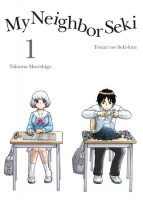
Vertical has a debut I’ve been waiting for ever since it was announced: My Neighbor Seki, from Media Factory’s Comic Flapper. The story of a girl who is constantly distracted in class by her next-desk neighbor’s attempts to… well, revealing more would spoil the surprise. It’s been nominated for awards, it’s had an anime, and it is really, really funny. Absolutely one to watch out for.

ASH: I’ve been really looking forward to this debut! The anime adaptation was absolutely delightful.

MICHELLE: I didn’t have this on my radar at all and then Vertical kindly sent me a copy. Researching it yielded cautious optimism and now I’m downright eager.

MJ: I am so ready for this.

ANNA: I also didn’t have this on my radar before, but it sounds interesting!

SEAN: Lastly, there’s a 53rd volume of Case Closed, and Shinichi… sorry, Jimmy… is still a kid.

MICHELLE: I have occasionally dabbled in Case Closed and found it entertaining enough, but I just can’t get excited about it.

SEAN: What (Seki) will you be buying (Seki) next week? (hint: Seki.)

Filed Under: FEATURES, manga the week of

Drug & Drop, Vol. 1

January 8, 2015 by Sean Gaffney

By CLAMP. Released in Japan by Kadokawa Shoten, serialization ongoing in the magazine Young Ace. Released in North America by Dark Horse.

And so, after a 10-year hiatus, Legal Drug returns, with added plot! It began right about the time that xxxHOLIC was wrapping up in Young Magazine, which is appropriate given the similarity between the two series. Indeed, CLAMP underlines this by having Watanuki show up in the middle of this first volume, assigning the team a task that he, being unable to leave the shop, cannot accomplish himself. It’s somewhat disappointing that the Watanuki we see her is the post-series calm, reserved, smirking Watanuki, as of course during most of the best parts of xxxHOLIC, he and Kazahaya were like peas in a pod – little balls of frustration and anger who screamed at their close friend/rival whenever life became too much for them, which was all the time.

drugdrop1

I had thought that the art style would be greatly changed from the first 3 volumes in the past, but it turns out that’s just the cover, which has our heroes prettied up and I suspect is drawn by another member of the team. Once inside the art is much the same as it was before, although 10 years more experience has made Nekoi’s eye for composition even better than it was before. As with so much CLAMP, this is simply pretty to look at, with even noble suffering being given a languorous tone, and where smoke wafting around the room can have a smirking quality to it, just like its owner. And, of course, where a crow being ripped apart by human hands can also looks quite pretty, if devastating.

One problem with Legal Drug is that its main ‘plot’, so to speak, was very much held back, with the series kept on as a ‘monster of the week’ sort of story till it found its feet – and then, of course, came the hiatus. Now that it’s returned, we thankfully don’t need that incubation period, and a lot of what was suggested in the first series is brought into sharper relief here. Rikuo has someone (sister or lover, I’m not sure), who he keeps searching for even though all signs point to her being dead. Kazahaya has a sister he loves dearly but who he is desperately hiding from, and the cliffhanger of the book shows us why. And the shop the two work in seems to have been created as a place for the two of them to have their Big Destiny together – Kakei and Saiga are just helping them along.

There’s a lot less humor here as well, sadly – the amusing overreactions are kept to a minimum, and Rikuo outright gets a prophecy that says he has to make an impossible choice and will fall into despair no matter what. It works out, though, because the two leads seem better equipped to deal with whatever tragedy comes their way. Kazahaya is still impulsive, but not to the point of being socially inept like in Legal Drug. Rikuo is stoic, but is actually bothering to explain things to Kazahaya this time around instead of merely rescuing and smirking at him. They FEEL more like the two chained by destiny that they’re supposed to be.

So in the end, Drug & Drop is much like its earlier incarnation, only more serious and with better written characters. I can’t guarantee it will end well, given my experience with CLAMP’s endings over the years, but for now let’s just enjoy the ride.

Filed Under: REVIEWS

Legal Drug Omnibus

January 6, 2015 by Sean Gaffney

By CLAMP. Released in Japan by Kadokawa Shoten, serialized in the magazine Asuka. Released in North America by Dark Horse.

I had first read Legal Drug when it came out from Tokyopop back in the day, but I have to admit it didn’t leave as strong an impression on me. Possibly it was too BL for my tastes (I was so much younger them), or possibly I wasn’t taken with the lack of forward plot progression. These days, though, it’s hard not to read Legal Drug and think to yourself “…this is just xxxHOLIC, only a lot gayer, right?” Legal Drug went on ‘hiatus’ in 2003, right around the time CLAMP were arguing with Kadokawa about the ending to X. Coincidentally, around the same time, xxxHOLIC started in Young Magazine, and also featured a grumpy hero who likes to shout and his cooler, more stoic friend solving supernatural mysteries at the behest of an eccentric mentor.

legaldrug

When this series first came out, CLAMP’s work sort of subdivided into two main groups separated by art: there were the books that looked like Magic Knight Rayearth and X, and the books that looked like Suki and Legal Drug. The latter have Tsubaki Nekoi as their chief artist – as did xxxHOLIC, come to that. Her style has evolved a lot over the years, though, and it felt nostalgic to go back and see the cuteness in the character designs for Kazahaya and Rikuo. This isn’t as fluffy as Suki, though – there’s a lot of deep subtextual backstory here, very little of which is actually wrapped up. Rikuo is desperately looking for a woman everyone thinks is dead. Kazehaya is hiding from his sister, who he seems to love dearly, and who loves him just as dearly – in fact, possibly a bit too dearly? As for the owner of the shop where they work, Kakei, he seems familiar, and you might find yourself wondering if he’s from another CLAMP title.

Speaking of which, there was actually less crossover from other CLAMP works than I’d expected here. The most obvious one is from Suki, but that makes perfect sense in a meta way: the plot requires Kazehaya to have a high school girl give him her uniform at graduation, in exchange for a cute outfit. There is literally NO ONE IN THE WORLD who would be naive enough to do this – except Hina, of course. CLAMP readers who might have found this unbelievable now smile and nod, as all is right in the world.

I joked in some earlier posts about the BL quotient of Legal Drug compared to xxxHOLIC, but re-reading it really brought it home. Compared to this series, xxxHOLIC is straight as an arrow. Kazehaya is a social misfit (from what little background is revealed, he seems to have grown up with only his sister and no one else till about 6 months ago), and Rikuo doesn’t seem to care about much (though does show a preference for teasing Kazehaya). But Kakei and Saiga are clearly a couple, which is why I was trying to figure out what series they’d been in before, and the last third of this omnibus is set in a boys’ school where one of the students straight up admits they all get into relationship0s as there are no girls around. (Given the sheer amount of yuri titles that use the same approach, it’s nice to see things reversed here.)

The supernatural mysteries are excellent, and sometimes creepy, as you’d expect from a series whose spiritual sequel was xxxHOLIC. But the main reason to read Legal Drug is the character interaction, which can range from hilarious to heartbreaking. And now, of course, we get to see the actual sequel, as Drug & Drop began in Young Ace (thus changing genres from shoujo to seinen, though there appears to be no difference in content) in 2011. We’ll come back here soon to see how the years have changed our two leads.

Filed Under: REVIEWS

Bookshelf Briefs 1/5/15

January 5, 2015 by Michelle Smith, Sean Gaffney and Anna N Leave a Comment

This week, Michelle, Sean, & Anna look at recent releases from Seven Seas, Viz Media, Kodansha Comics, and Vertical Comics.

d-frag3D-Frag!, Vol. 3 | By Tomoya Haruno | Seven Seas – That’s a new character on the cover, and she has potential to be a new harem member, but I think that may end up, as always, taking a back seat to the comedy. Funabori liking Kazama is not as important as Funabori dressing up in a nurse outfit with wings just because she was asked. Likewise, Takao may also have a crush on Kazama, but the jokes still stem from her inability to speak her mind and her large chest, which becomes weaponized here. As for Kazama, he’s made it clear what kind of girls he likes – strong girls who win fights. This is why the tournament arc ends with Kazama vs. Shibasaki – it leads to the most drama AND the most comedy. D-Frag! continues to be hilarious, and a great read.-Sean Gaffney

sidonia12Knights of Sidonia, Vol. 12 | By Tsutomu Nihei | Vertical Comics – By the end of volume eleven, Knights of Sidonia was starting to feel a bit like “Love Hina in space,” but happily, the focus shifts in this installment from all the females (not necessarily human) who fancy Nagate to a mission to test the capabilities of Sidonia’s new defense cruiser, “Mizuki.” One of the things I really love about this series is the way in which some of said females are proving themselves to be awesome—Izana’s bravery and quick thinking recently resulted in a promotion, and here it’s Yuhata’s turn, as she impressively pilots the cruiser and takes out a cluster ship. I still fear for these characters’ lives constantly—I confess that before I even began the volume I flipped to the end to make sure Tsumugi was okay—so it is wonderful to see them make a bit of headway against their enemy. Ever so highly recommended. – Michelle Smith

magi9Magi: The Labyrinth of Magic, Vol. 9 | By Shinobu Ohtaka | Viz Media – Six months have passed since the battle in Balbadd and Aladdin, Alibaba, and Morgiana are recuperating and training on the island nation of Sindria, where Sinbad is king. And, really, that’s kind of all this volume is—training and learning more about magic and Sindria—and yet it’s still interesting and entertaining. Aladdin and Alibaba each acquire a teacher to help hone their abilities, and while Morgiana does as well, she’s also in a position to augment her already impressive strength courtesy of Alibaba’s djinn, which shares its power with members of his household. For that, she needs a vessel, and for that, she chooses her old slave shackles, choosing to see them now as “a proud symbol of my gratitude.” Next, they’re off to a dungeon to activate her vessel. So, essentially this arc is, like, “Let’s help the badass girl get even more awesome.” I’m down with that! – Michelle Smith

mylovestory3My Love Story!, Vol. 3 | By Kazune Kawahara and Aruko | Viz Media – My Love Story! continues to be consistently heartwarming and hilarious. Takeo’s unconventional romance with Yamato hits some additional milestones in this book as they get lost while hiking and endure an extremely shy trip to the beach with classmates.Takeo and Yamato also take Sunakawa out for his birthday, where they fall over each other in making sure that their friend is having a good time. Sunakawa’s stoic responses contrast with the over to top eager to please mannerisms of the unlikely couple. When Yamato and Takeo study together at his house, his mom reacts in classic fashion to meeting her son’s girlfriend for the first time, as her careful deadpan expression doesn’t hide her enthusiasm in the slightest. I always look forward to this quirky shoujo manga. – Anna N

sayiloveyou5Say “I Love You”, Vol. 5 | By Kanae Hazuki | Kodansha Comics – Poor communication isn’t fixed overnight, and Mei is lucky that in this volume she gains an ally as well as a strong enemy. Megumi started to show her true colors in the prior volume, but here she goes into full-on evil mode, intent on removing Mei not just from Yamato’s orbit but everyone else she’s now friends with. That said, just like the rest of the cast, Megumi’s backstory seems to hint greater depth is coming besides “I’m the standard evil rival”. This manga’s strength is in showing off the way that its characters think and how they got to be the way they were – and in turn, how it leads to stronger bonds. This has rapidly become one of my favorite shoujo manga. Absolutely recommended. – Sean Gaffney

whatdidyoueatyesterday6What Did You Eat Yesterday, Vol. 6 | By Fumi Yoshinaga | Vertical Comics – As tasty as the food looks in this volume (at one point inspiring a serious case of gyoza envy), I most love how Yoshinaga-sensei uses meals and shopping to convey how Shiro and Kenji feel about each other. Both guys cook to cheer the other up, whether it’s Shiro trying to get Kenji to quit apologizing for his jealousy or Kenji trying to help Shiro get over a disappointing verdict at trial, but it’s also revealed that Shiro is so intensely frugal because Kenji isn’t, and he wants to have enough saved for the both of them. And then, once he sees how much Kenji loves having bento in the park, he relaxes his stance on being seen together in public. Never before has two guys going out grocery shopping been so significant! Can I end a review with a <3? – Michelle Smith

Filed Under: Bookshelf Briefs

My Week in Manga: December 29, 2014-January 4, 2015

January 5, 2015 by Ash Brown

My News and Reviews

Happy New Year, everyone! Things are already off to a good start at Experiments in Manga. The last manga giveaway of 2014 is currently underway and there’s still time to enter for a chance to win No Matter How I Look at It, It’s You Guys’ Fault I’m Not Popular!, Volume 1 by Nico Tanigawa. All you have to do is tell me a little about some of your favorite otaku. The honor of the first in-depth manga review of the year, and in fact the very first post of 2015, goes to Hiroaki Samura’s Vigilance, the thirtieth and penultimate volume of Blade of the Immortal. I still love the series after all this time, and this installment has some particularly nice fight sequences. Finally, December’s Bookshelf Overload was posted over the weekend as well.

There were a few interesting things from Vertical this week, including a roundup of the happenings of 2014 and what fans can look forward to from the publisher in 2015. Another enlightening read from Vertical’s Tumblr account tackles sports, sports fiction, and sports manga and the challenges it presents to the North American market. Also, in case you missed it, Vertical is now on ask.fm and is answering all sorts of questions there. Last but not least, thanks to the success of its release of Mobile Suit Gundam: The Origin, Vertical is looking into publishing more Gundam manga. If you’re interested and haven’t already, be sure to take Vertical’s Gundam survey which will be open through the end of today.

Elsewhere online, Khursten has made a manga resolution for the year to feature josei more at Otaku Champloo. Organization Anti-Social Geniuses debuted a new feature, Inside the Industry, with Inside the Manga Industry with Lillian Diaz-Przybyl. The Hairpin has an excellent interview with Anne Ishii who, among other things, is the translator and one of the editors of the newly released Massive: Gay Erotic Manga and the Men Who Make It (which I recently reviewed; it’s great).

Quick Takes

Blue Morning, Volume 1Blue Morning, Volumes 1-5 by Shoko Hidaka. I’ve been meaning to read Blue Morning for a while but have only now gotten around to it. The benefit of this is that I had five volumes that I could read all at once. The drawback, of course, is the long wait until the sixth volume is released. I loved Blue Morning. It’s a moody, slow-burning boys’ love series with beautiful, elegant artwork and well-developed, subtly nuanced characters. A dramatic period piece, the manga takes place during Japan’s Meji era in which the country’s social, political, and economic structures underwent great change. The story focuses on Akihito Kuze who, after being orphaned, is suddenly thrust into Japan’s peerage as a viscount at the age of ten. Tomoyuki Katsuragi, the Kuze family steward, becomes his tutor and guardian. As he grows Akihito ends up developing feelings for Katsuragi and their relationship undergoes an intense evolution and power reversal. The romantic elements of Blue Morning are important, but much of the plot is actually focused on the political maneuverings of both Katsuragi and Akihito to raise the family’s status, though the each of the men have their own reasons for doing so.

KnightsSidonia10Knights of Sidonia, Volumes 10-12 by Tsutomu Nihei. I decided to save up a few volumes of Knights of Sidonia since they read so quickly and I wanted to enjoy a larger chunk of the story. But even though there are quite a few major developments in these particular volumes, including the introduction of an important new character, somehow it just feels like Nihei is stalling for time and that there wasn’t actually much forward movement in the series. Even so, it was still an enjoyable read and I still like the manga. Knights of Sidionia remains a rather peculiar series, a combination of horror, science fiction and, of all things, romantic comedy. Sidonia’s hero Tanikaze, despite being incredibly awkward socially, has managed capture the romantic interest of quite a few of the other characters, basically amassing one of the most unusual harems that I’ve ever come across in manga. And while he has all sorts of domestic challenges to deal with now that his house has five residents more or less living there, he’s also one of humanity’s best pilots in the fight for survival against the Gauna. The war is entering a new stage, new technology has been developed, and the Gauna continue to gain new abilities.

Say I Love You, Volume 4Say I Love You, Volume 4 by Kanae Hazuki. Four volumes in, Say I Love You continues to set itself apart from many of the other shoujo manga series that are currently being released with its very realistic approach to young adult relationships, romance, and sexuality. The characters show a believable mix of maturity and immaturity, at times handling themselves extraordinarily well and at other times ending up a mess of confused emotions. This volume also introduces a new character, Kai, whom I’m particularly looking forward to seeing more of. In the afterword Hazuki mentions that she believes that manga “isn’t just for showing the nice side of things,” a belief that I think comes through in Say I Love You. There are the wonderful moments between characters as they grow closer, but every relationship has its ups and downs and Hazuki isn’t afraid to show the emotional pain and turmoil experienced by her characters as part of that growth. Regret, jealousy, selfishness, and uncertainty all have a role to play as do happiness, affection, altruism, and confidence. None of the characters are perfect and they all make mistakes as they navigate new and sometimes surprising relationships.

Ping Pong: The AnimationPing Pong: The Animation directed by Masaaki Yuasa. Taiyō Matsumoto’s breakout manga was a five-volume series from the mid-1990s called Ping Pong. I’ve become a fan of Matsumoto’s work and would love to read Ping Pong, but it’s probably unlikely to ever be licensed. However, the eleven-episode anime adaptation made me very happy. The style of animation is somewhat unusual, reminiscent of Matsumoto’s loose but deliberate lines and uses a variety of palettes ranging from monochrome to pastel to vivid colors. I was particularly impressed by the series’ sound design and effective use of music. Smile and Peco are close friends and the strongest members of their school’s table tennis club but they both approach the game very differently. On its surface, Ping Pong is a fairly straightforward tale about competitive table tennis, but the series has prominent psychological elements and more depth than it might appear at first glance. Peco and Smile aren’t the only important players in Ping Pong; the protagonists and antagonists of the series are in constant flux. I enjoyed the Ping Pong anime immensely; I’ll definitely be picking up the physical release this summer.

Filed Under: FEATURES, My Week in Manga Tagged With: anime, blue morning, Kanae Hazuki, knights of sidonia, manga, Ping Pong, Say I Love You, Shoko Hidaka, Tsutomu Nihei

Citrus, Vol. 1

January 4, 2015 by Sean Gaffney

By Sabu Routa. Released in Japan by Ichijinsha, serialization ongoing in the magazine Comic Yuri Hime. Released in North America by Seven Seas.

I was in a somewhat cranky mood when I read Citrus, so wasn’t as appreciative of it as I could have been. The cover makes it seem a bit more salacious than it actually is, though that may change later. The back cover copy tells us it’s reminiscent of Girl Friends and Strawberry Panic, which is certainly true in terms of genre. But as I read it, I realized it felt more like standard shoujo with a female lead who fights back against the system and changes in her life. If it weren’t for the yuri, this could have been written by Natsumi Ando. And thus the difference between this and, say, Girl Friends is the level of drama it brings to the table.

citrus1

Yuzu has just moved to an all-girls’ school, and finds that the strict regulations pretty much demand she change everything about herself. Things aren’t helped by the class president, Mei, who appears to be rather uptight and straightlaced, but is apparently having a secret relationship with the teacher. She then returns home to find that her mother, who has recently remarried (the father is absent, and honestly the mother seems a bit not all there), has asked her new stepdaughter to stay with them. No prizes for guessing who it is. Then when Yuzu, who acts worldly but isn’t, talks about a magical first kiss, Mei shuts her up by kissing her.

I like Yuzu. She’s a good heroine, easily outraged, emotional and exasperated. She is perhaps portrayed as a bit too naive, but the whole “ah, so this is what love feels like” situation is a staple of shoujo manga. In fact, most of the situations we see here are staples of shoujo rather than yuri (though the genres overlap quite a bit): outing the sleazy teacher, the threat of expulsion for doing what’s right rather than following the rules, the jealous classmate catching the lead couple in the classroom and staring at the cliffhanger ending of the volume with an “I will DESTROY her” expression…

Mei is harder to like right away, but that’s because she’s the repressed, stoic one. Her kissing of Yuzu seems oddly out of character, and you get the impression she did it entirely to drive her away and shut her up rather than out of any lingering affection. The trouble is that she also lit a fuse in Yuzu, and now has to take responsibility for Yuzu’s turbulent feelings. (This makes up the other half of the cliffhanger in Vol. 1.) She’s not quite the Sachiko-type – not enough oneesama tendencies for that – but close, and I fear that dealing with Yuzu and all her extroversion will lead to Vol. 2’s crisis point.

So as I said at the start, Citrus is a decent shoujo potboiler of a manga. It’s not very original, but that’s not unusual. If you like dramatic shoujo, and don’t mind the leads both being girls, this is a title you may want to check out. If you like yuri, of course, you’ve probably already read it by now.

(Oh yes, and Harumin is fantastic. She’s the Tsutako of the series, and plays her role admirably.)

Filed Under: REVIEWS

Blade of the Immortal, Vol. 30: Vigilance

January 2, 2015 by Ash Brown

Blade of the Immortal, Volume 30: VigilanceCreator: Hiroaki Samura
U.S. publisher: Dark Horse
ISBN: 9781616554842
Released: October 2014
Original release: 2012
Awards: Eisner Award, Japan Media Arts Award

Vigilance is the thirtieth and penultimate volume in the English-language edition of Blade of the Immortal, the long-running and award-winning manga series by Hiroaki Samura. In Japan, the series was only thirty volumes long, but due to slight differences in how the manga was released early on in its English-language run, Dark Horse’s edition of consists of thirty-one volumes. Vigilance, published in 2014, is equivalent to the twenty-ninth volume of the series’ Japanese edition originally released in 2012. Blade of the Immortal is a series that has particular significance for me. It was one of the very first manga that I ever read and it was one of the first series that I decided to collect in its entirety. I have been reading and collecting Blade of the Immortal for years now. The previous volume, Beyond Good and Evil, marked the beginning of the series’ end and Vigilance brings it that much closer. I was very curious to see how Samura would continue to advance the series.

The final confrontation between the remnants of Anotsu Kagehisa’s Ittō-ryū and Habaki Kagimura’s Rokki-dan has begun. Numerous casualties have been incurred by each side and countless innocent lives have been caught in the fray as the two groups try to destroy each other. At one point they were fighting for their ideals–Anotsu striving to restore martial glory and the way of the sword to Japan while Habaki worked to prevent that from happening in order to maintain the dominance of the shogunate–but now they are fighting simply to survive long enough to crush the other. Even if they are successful in killing their foes they may not live to see the fruits of their victory. Habaki is challenging Anotsu head on while the Ittō-ryū’s strongest fighter, Makie, is left to face multiple opponents under Habaki’s direct command despite her failing health. And on the periphery of this all, Manji and Rin stand against one of Habaki’s most imposing men even though they, too, seek Anotsu’s demise.

At this point in Blade of the Immortal the series’ story is drawing very close to its ultimate conclusion. There is very little plot development in Vigilance, and there doesn’t need to be; the series has been building up to these final volumes. Instead, the focus of Vigilance is on the deadly battles currently in progress. Samura’s artwork has always been dynamic in Blade of the Immortal, conveying a tremendous sense of movement and drama, but the action sequences and fight choreography in Vigilance may very well be some of the series’ best. Makie’s fight against an entire team of adversaries is particularly impressive and breathtaking. Her talent is astounding and on full display. She is constantly in motion, with an acute awareness of her surroundings, using both her weapon and her body in tangent to strike and defend. While she may not have the brute strength that so many of the other fighters in Blade of the Immortal possess, her agility and martial skill far surpass any of them.

The other two battles being simultaneously waged in Vigilance are also well-developed and each has a different feel than Makie’s. Manji’s style of fighting has come to rely very heavily on his near-immortality, leading him to attempt feats that would otherwise be unthinkable. He is also able to put to good use in some rather curious ways the bizarre regenerative powers of his body. The manga’s horror elements are readily apparent in his fight. There’s even a hearkening back to the death mandalas of the early series, which is a particularly nice touch. The confrontation between Anotsu and Habaki is different still. Like all of the other fighters who have managed to survive this long they are both exceptionally skilled swordsmen, however tactics and strategy play a much more prominent role in their death match. The way they fight is both intelligent and refined. Manji, Rin, Makie, Anotsu, and Habaki are now locked into their final battles. It will be very interesting to see exactly how things will turn out in the series’ conclusion, Final Curtain.

Filed Under: REVIEWS Tagged With: Blade of the Immortal, Dark Horse, Eisner Award, Hiroaki Samura, Japan Media Arts Award, manga

Mini Manga Reviews and Links, 1/2/15

January 2, 2015 by Katherine Dacey

Did you receive an Amazon or RightStuf gift certificate this holiday? If so, this post is for you! Below, I’ve reviewed the first volumes of three series that debuted in 2014, offering a quick-and-dirty assessment of each. Already read Food Wars? Fear not—I’ve also rounded up reviews from around the web as well.

thumb-10857-FDW_01_webFood Wars, Vol. 1
Story by Yuto Tsukada, Art by Shun Saeki
Rated T+, for Older Teens
VIZ Manga, $9.99

Food Wars begins with an only-in-manga scenario: Soma Yukihira’s dad shutters the family’s greasy spoon restaurant and lights out for America, leaving his son behind. With no place to go, Soma enrolls at Totsuki Culinary Academy, a hoity-toity cooking school that prides itself on its wealthy alumnae, rigorous curriculum, and high attrition rate. Soma’s working-class background is a major handicap in this environment, but his can-do attitude and culinary instincts allow him to triumph in difficult situations, whether he’s salvaging an over-salted pot roast or wowing an unscrupulous developer with a simple potato dish.

In theory, I ought to hate Food Wars for its cartoonish characters and abundant cheesecake, two qualities I generally despise in a manga. But here’s the thing: it’s fun. Soma repeatedly shows up bullies and snobs with his ability to transform everyday dishes into haute cuisine, proving that good food doesn’t need to be fancy. Though Soma’s foes are stock types—the Busty Bitch, the Rich Mean Boy, the Teacher With Impossibly High Standards—Shun Sakei’s crisp caricatures make them seem like fresh creations. I wish I could say the same for Sakei’s abundant fanservice, which quickly wears out its welcome with porny images of women enjoying Soma’s cooking. These pin-up moments are supposed to be funny, I guess, but the heavy emphasis on heaving cleavage and bare skin seems more like a concession to teenage male taste than an organic part of the story.

The verdict: I can’t decide if Food Wars is a guilty pleasure or a hate read, but I’ve just purchased volumes 2-4.

Manga Dogs 1Manga Dogs, Vol. 1
By Ema Toyama
Rated T, for Teens
Kodansha Comics, $10.99

Manga Dogs has a terrific premise: a teenage artist decides to enroll in her school’s manga program, only to discover that her teacher is inept, and her classmates are pretty-boy otakus with no skill or work ethic. When Kanna’s classmates discover that she’s actually a published artist, Fumio, Fujio, and Shota glom onto her in hopes of breaking into the business—even though her debut series is on the verge of being cancelled.

With such a ripe set-up, it’s a pity that Manga Dogs is DOA. Part of the problem is that the script panders to the reader at every turn, whether it’s poking fun at reverse-harem tropes or saddling the characters with pun-tastic names inspired by famous manga creators. The author spends too much time patting the reader on the back for “getting” the jokes and not enough time writing genuinely funny scenarios or imbuing her characters with more than one personality trait each. The other issue is pacing: the story and artwork are both frenetic, with characters screaming, jumping, and flapping their arms on almost every page. By the end of the third chapter, I felt as if someone had beaten me up for my lunch money while asking me, “Do you think I’m funny? No? Now do you think I’m funny?”

The verdict: Just say no.

1421575906Yukarism, Vol. 1
By Chika Shiomi
Rated T, for Teen
VIZ Media, $9.99

Yukarism combines the supernatural elements of Rasetsu with the historical drama of Sakuran, then adds a dash of gender-bending weirdness for good measure. The story revolves around Yukari, a best-selling author whose novels explore the history of Edo’s red-light district. Though fans attribute the abundant details in his writing to research, Yukari has an even better strategy for learning about the past: he visits it! When he returns to the 1800s, however, Yukari becomes Yumurasaki, a top-earning oiran (or courtesan) enmeshed in a web of political intrigue, lust, and violence.

Given the complexity of the plot, it’s not surprising that the first volume of Yukarism is a bumpy ride. The tone see-saws between broad physical comedy and brooding melodrama, making it difficult to know if Yukari’s plight is being played for laughs or sniffles. The script, on the other hand, is too pointed; manga-ka Chika Shiomi is so intent on telling us what Yukari is thinking and seeing that she forgets the old dictum about showing, not telling. The same kind of editorial interventions result in at least one character waxing profusely about how handsome and cool Yukari is, just in case we haven’t realized that he’s supposed to be handsome and cool. Now that the basic parameters of the story have been established, however, Shiomi can dispense with the heavy-handed dialogue and do what she does best: write sudsy supernatural romances with beautiful characters in beautiful costumes.

The verdict: Volume two should be a pure guilty pleasure.

Reviews: Here at Manga Bookshelf, Michelle Smith, Sean Gaffney, and Anna N. post a fresh crop of mini-reviews. Further afield, Megan Purdy discusses est em’s Carmen, a swell-looking manga treatment of the Bizet opera.

Laura on vol. 1 of Ani-Imo (Heart of Manga)
Kate O’Neil on vol. 2 of Attack on Titan: No Regrets (The Fandom Post)
Johanna Draper Carlson on vol. 1 of Barakamon (Manga Worth Reading)
Johanna Draper Carlson on vol. 6 of A Bride’s Story (Manga Worth Reading)
Jenny Ertel on vols. 1-13 of Dorohedoro (No Flying No Tights)
Sean Gaffney on vol. 14 of Dorohedoro (A Case Suitable for Treatment)
Johanna Draper Carlson on vol. 1 of Drug & Drop (Manga Worth Reading)
Johanna Draper Carlson on The Garden of Words (Manga Worth Reading)
Matthew Alexander on vol. 25 of Higurashi: When They Cry (The Fandom Post)
Rebecca Silverman on vol. 1 of Milkyway Hitchhiking (ANN)
Kory Cerjak on vol. 1 of Prophecy (The Fandom Post)
Lori Henderson on vols. 1-6 of Strobe Edge (Good Comics for Kids)
Sean Gaffney on vol. 8 of Umineko: When They Cry (A Case Suitable for Treatment)
Megan R. on vol. 1 of What Did You Eat Yesterday? (The Manga Test Drive)

Filed Under: MANGABLOG, REVIEWS

Manga the Week of 1/7

January 1, 2015 by Sean Gaffney, Michelle Smith, Ash Brown, Anna N and MJ 4 Comments

SEAN: January is a relatively quiet month for manga, usually, and this is a quieter first week of the month, though you might not guess it by the large number of titles coming out way. It’s COMPARATIVELY smaller.

drugdrop1

CLAMP fans have been waiting for this one forever, and it’s finally here. The first volume of Drug & Drop comes out next week. The sequel to Legal Drug, which ran in the shoujo magazine Asuka, this runs in Young Ace, a seinen title. Despite that, I suspect the audience is still the same: CLAMP fans. Expect crossovers.

MICHELLE: *Kermit flailing*

ASH: Looking forward to seeing where things go!

ANNA: Yay!

MJ: This, this, this, this, HAPPY NEW YEAR TO ME. Yes.

SEAN: There’s also a 7th omnibus of Lone Wolf & Cub.

ASH: I’m really enjoying the omnibus edition of this series.

SEAN: Digital Manga Publishing has a pile of new titles. KinokoInu – Mushroom Pup looks adorable, and its 2nd volume ships next week.

ASH: I was pleasantly surprised by the first volume of Mushroom Pup, but then I like quirky manga.

SEAN: The third volume of Lovephobia is not something I’d call adorable based on its cover, but hey, the inside might prove me wrong. (For the record, the series runs in ‘Comic B’s Log Kyun!’. I’m always wary of magazines with onomatopoeic sounds in their name.)

And A Waltz in the Clinic, which is the sequel to A Murmur of the Heart, seems to have sensuous hand-licking, judging by the cover.

Alice in the Country of Clover gives us The Lizard Aide, which I believe is the first volume in this series to have Gray as the love interest. So, Gray fans, this is for you! Sadly, the artist is the same one as the Nightmare Trilogy, so don’t read it for the prettiness.

Girls Und Panzer has taken its tankery games to much higher stakes with Volume 3, as Miho now faces expulsion from her family if she loses. How will she fare? And what will Yukari do, given she’s the ‘star’ of the manga series?

Strike Witches begins a new tie-in series with the first volume of One-Winged Witches. I’m trying not to be critical, but even its FANS say this 2-volume manga series is for lovers of panties and that’s about it.

Viz has a smaller but robust set of shonen and shoujo for us. 07-GHOST trundles along with Volume 14. There seems to be a woman on the cover! Wait, 07-GHOST has women in the cast? :)

MJ: Heh.

SEAN: Bleach and Naruto both have their 10th 3-in-1 omnibuses out next week.

Jaco the Galactic Patrolman is a one-shot manga from the creator of Dragon Ball and Dr. Slump! I’m not sure if it was always meant to be this short, but in any case, more Toriyama is always nice to see, especially when he’s funny, as he seems to be here.

MICHELLE: I have yet to read Dragon Ball, and Dr. Slump! wasn’t my thing, but I have quite enjoyed Toriyama’s one-shots (especially COWA!), so I’m looking forward to this one a lot!

ASH: Oh, COWA! That was a delightful manga.

SEAN: Kiss of the Rose Princess has a 2nd volume. I thought the first was goofy fun, but a bit slight. Can it grab me further with this one?

MICHELLE: I am wondering that myself.

ANNA: It is fun, but I agree about the first volume being on the slight side. Still, nothing wrong with shoujo brain candy!

meteor1

SEAN: Viz’s new shoujo debut is Meteor Prince, by Meca Tanaka. it’s another short one, only two volumes, and is likely far more acceptable than the student/teacher romance of her more famous series Faster Than A Kiss. Old-school fans will also recognize her as the author of Omukae Desu and Pearl Pink.

MICHELLE: Wow, what a premise on this one. “It’s hardly surprising then that a naked alien prince falls from the sky to tell her that out of all the girls in the universe, he’s come to Earth to mate with her.”

ANNA: OK, that sounds hilarious.

MJ: Agreed. Like, Moon Child hilarious.

SEAN: My Love Story!! was one of the most exciting releases of 2014, and the start of 2015 sees its 3rd volume. Will our lead couple progress in their romance, or is shyness the order of the day? (I can take an educated guess…)

MICHELLE: <3 <3 <3

ASH: Love this series so much!!

ANNA: Agreed!

SEAN: Nisekoi continues to be one of the better harem series I’ve seen in ages, and I am greatly looking forward to the 7th volume (which, yes, has been out digitally since March of last year).

And there’s One Piece, with its 73rd (!) volume. The last cliffhanger promised Rebecca would have a moment of awesome, but I admit I’m skeptical. Perhaps more important to its Western fans, will Doflamingo and Law square off?

MICHELLE: In the most recent volume of Magi, there’s a scene of happy islanders feasting on a giant sea monster and man, that made me crave more One Piece like whoa. I’m glad I won’t have to wait too long.

SEAN: I tend to skip the endless Pokemon releases when I talk about manga here, so I will guiltily note that we see the 26th Pokemon Adventures ship next week, along with the 6th Black and White volume.

Lastly, there’s a 6th Ranma 1/2 omnibus, and a new semi-regular, as Kuno and Kodachi’s father returns from an extended vacation, and he’s just as bad if not worse than his offspring.

What are you starting off the year with?

Filed Under: FEATURES, manga the week of

A Bevy of Buffy

January 1, 2015 by Michelle Smith

Because I am a great big geek, one of my personal goals is to read all of the novels inspired by Buffy the Vampire Slayer. This is the first in what will be a series of posts collecting reviews of these books in a somewhat shorter-than-usual format. In this installment: Afterimage, Bad Bargain, Blooded, Carnival of Souls, One Thing or Your Mother, and Portal Through Time. All are set during the show’s second season.

Afterimage by Pierce Askegren
I’m pretty sure Afterimage is set between “What’s My Line” and “Ted”—the former is a definite, despite the season being referred to as early autumn even though “What’s My Line” takes place after Halloween, but the latter is a guess based on a couple of thoughts Joyce has about needing to get out more, which the author (writing in 2006) might’ve intended as a lead-in to “Ted.”

The book gets off to a slow start and, in fact, not much seems to happen for the first sixty pages. Our heroes encounter some strange folks about town, and it’s pretty obvious to the reader that “Hey, these are characters from the movies being shown at the new drive-in!” but it takes quite a while for the characters to catch up. That said, around page 100 things begin to improve, which is right about where Jonathan appears. I knew he was in this, and was hoping for more of an active role. Sadly, all he does is go to the movies with Xander and then get afflicted by a mysterious sleeping sickness, along with 29 other Sunnydale residents.

Speaking of the drive-in, it occurred to me that this is totally a Sailor Moon plot. Creepy yet charismatic bad guy comes into town and advertises a free drive-in. The local residents swarm the place and then creepy guy feeds on their energy. Our heroine destroys the evil projector with her tiara machete, and the bad guy dissolves. He does not, alas, proclaim “Refresh!”

Still, this was a pretty enjoyable outing, and had some nice touches, like a glimpse at Xander’s bickering parents, a spot-on depiction of petulant Harmony, and Cordelia demonstrating her intelligence and leadership skills. In fact, while Buffy is important, I think Xander comes across more like the protagonist of this one, which is a nice change.

Bad Bargain by Diana G. Gallagher
Bad Bargain is set in season two (between “What’s My Line?” and “Ted” would be my guess) but written in 2006, three years after the end of the series, which allows author Diana G. Gallagher to use her knowledge of later events to color what would otherwise be a fairly dull tale of demonic critters infesting a rummage sale.

In another of her attempts to recapture a normal teen life, Buffy is volunteering at the school rummage sale to benefit the marching band. She’s roped Willow and Xander into participating, too, and this scintillating event has even come to the attention of Spike and Dru, who head to Sunnydale High for a spot of shoplifting. All goes awry when a spell to locate one kid’s missing amulet ends up inviting a host of microscopic Hellmouth beasties, who proceed to infect most of those present. The day is ultimately, of course, saved, though Willow theoretically suffers trauma from being parted from the cute-looking critter who beguiled her into becoming its protector. That part is kind of dumb (and I didn’t think Gallagher captured Drusilla’s mode of speech well, either).

What’s interesting, though, is that Andrew is in this. In fact, he and Jonathan have fairly prominent roles, which I thought was quite fun. In a nice bit of dramatic irony, Jonathan has become possessed by some demonic whip thing and subsequently angsts when he realizes that he nearly killed his best friend. In addition, Gallagher includes a few comments that suggest that these events spurred actions by the characters as seen in the show. For example, Oz muses about painting his van and, after the pests have been sent back where they belong, Princpal Snyder remarks, “Next year’s fund-raiser for the marching band will be something simple, like selling candy.” Hee!

Blooded by Christopher Golden and Nancy Holder
It’s difficult to pinpoint the timeline for this one. Angel’s stint as Angelus is mentioned, as is the death of Jenny Calendar, but he was apparently able to regain his soul in a way that did not involve Willow. (This book was published in August 1998, and I have to wonder if Whedon wasn’t willing to give away the plot details for the season two finale, so Golden and Holder had to be super vague about it.) I do think this is the end of season two—despite what Wikipedia claims—because Oz and Willow’s relationship is still new, her hair is still long, etc.

Anyway, the gang goes to a museum for a field trip and Willow ends up freeing and being possessed by the spirit of an ancient Chinese vampire-sorcerer. She gathers minions, attacks Xander, and causes her friends to fret. Eventually, Xander gets possessed by a Japanese mountain god and there’s a big battle and spells and Giles wears a headband with a kanji on it. In the end the day is saved through teamwork (yes, really).

On the whole, this book is pretty boring. However, there are a few things to recommend it. For every two or three bits of clunky dialogue, there is occasionally one that is at least slightly amusing or which I can easily hear in the actor’s voice. It was also prescient about a few things. Cordelia’s lack of skill as an actress is mentioned, which will come into play on Angel, and she makes the comment, “I’ll never admit it if you tell her I said it, but I’d hate to think about what Sunnydale would be like if we didn’t have a Slayer in town.” This is interesting, because she is the one who allows us to see exactly that in season three’s “The Wish.” There’s also some good stuff here with Willow’s desire for power and strength, and how that made her vulnerable to the vampire-sorcerer dude. Most of the resulting darkness is played as his fault, but it dovetails nicely with her eventual character arc on the show.

In the end, there are far better Buffy tie-in books, but this wasn’t too bad.

Carnival of Souls by Nancy Holder
Carnival of Souls turned out to be a lot better than I was expecting. Wedged snugly between “Ted” and “Surprise,” the story is set around the episode “Bad Eggs,” which is a great place to put it because, hey, if the book’s at least moderately good, it’ll still be on par with that notoriously rather lame episode.

The premise is that a carnival has come to town, and its proprietor is some kind of devil demon thing that uses prisms to hypnotize visitors into giving in to the temptation of the seven deadly sins so that it might feed off of their souls. Our heroes are not immune, so Buffy becomes proud, Cordelia greedy, Xander gluttonous, Willow envious, Giles angry, Angel lustful, and Joyce slothful.

Really, the specifics of the carnival itself are not very interesting. What I most liked were the many scenes of the group all together, doing their investigation thing, and how good a lot of the dialogue was. Some of Xander’s lines are especially easy to hear in the actor’s voice, and I actually laughed at one of Buffy’s mid-slaying puns. Plus, I liked that they gave Jenny Calendar something significant to contribute.

All in all, I’d recommend it wholeheartedly if not for the matter of the kittens.

Early on, Giles acquires a pair of kittens with the intent to use them as payment to Clem in exchange for information, fully cognizant they’ll be used as currency in a demonic poker game. And as if that weren’t bad enough, when Angry!Giles summons a demon that destroys his apartment, no one asks what happened to the kitties, including Buffy and Willow, who were loving on them in a previous scene! Still worse, if you interpret the text in a certain way, you might conclude that Giles sacrificed them as part of the ritual. Ugh! Why?! It was absolutely not necessary to include them and taint this otherwise decent book.

One Thing or Your Mother by Kirsten Beyer
One Thing or Your Mother is the best Buffy tie-in novel that I have ever read. Well done, Kirsten Beyer! I’m sorry that, as this is also the last Buffy tie-in novel to be published, you never got to write another one.

Set between “I Only Have Eyes for You” and “Go Fish,” One Thing or Your Mother finds Buffy contending with several different problems. Aside from the recurring menace of Angelus, there’s the fact that Joyce has been contacted by the school about her daughter’s poor grades (with the end result that Buffy acquires a tutor), the disappearance of a young girl followed by sightings of a child vampire, and the strange behavior exhibited by Principal Snyder that ultimately imperils the whole town. True, none of these elements is particularly exciting, but each is competently executed, and done in a way that has bearing on what’s going to happen next in the series.

Where Beyer really shines is in capturing the characters—not just in dialogue, at which she admittedly excels, but in thought as well. Too many times to count, the thoughts attributed to Buffy and the others in these books have been downright insipid, but not this time. In addition, the scenes with the Scooby Gang together in the library are so spot-on they’re just about episode quality. Granted, this doesn’t match up to the very best of Buffy—a lot of which can be found in season two—but with a little reworking and simplifying, this could’ve made a solid episode better than the worst of Buffy—some of which can also be found in season two. I also thought Beyer did a great job with Spike.

Perhaps once I’ve completed this project I’ll have to come up with the Top Ten Buffy Novels for those who only want to read the cream of the crop. One Thing or Your Mother has definitely secured itself a spot on that list.

Portal Through Time by Alice Henderson
Set between “Bad Eggs” and “Surprise,” Alice Henderson’s Portal Through Time evidently takes place very early in 1998, because Buffy is still sixteen (she turns seventeen on January 19th) and Angel has not yet lost his soul. A vampire called Lucien has done a lot of research into time-traveling magic and recruits some assistants to help him with his plan: go back in time and kill four very famous Slayers so as to disrupt the line and allow the Master (of whom he is a devotee) to rise unimpeded. Angel gets wind of the plan, so Buffy and pals end up traveling to Wales in 60 C.E., to Sumeria in the time of Gilgamesh, to Tennessee during the Battle of Shiloh, and to Paris during the French Revolution.

Sometimes being a reviewer (or at least being one who sets geeky goals) means reading things so that others don’t have to. Such is the case with Portal Through Time. Although there are some things Henderson does well—I like her attempts to recapture the feel of the show by employing quick cuts between scenes to humorous effect, for example—the overall concept of a magical means to travel back in time is just not very well thought out.

For one, if such magic did exist, you can bet that Willow would’ve used it to wipe out Warren before he could do harm to anyone she cared about. And two, even within this book there are complications and possibilities that are not pursued. Near the end, for example, Buffy stakes Angelus and then reuses the incantation to go back in time to the same spot and keep that from happening. So why does everyone seem so secure that once they’ve thwarted the vamps in a given time period the Slayer is now safe? The vamps could just go back and try again!

On top of this, Henderson’s writing is frequently redundant, like when she reiterates several times that if the vampires arrive at their destination during the day they will have to wait until nightfall to take action, and sometimes just plain bad. During an interminable passage in which Buffy is creeping through the woods around the perimeter of Shiloh, she ends up getting shot in the leg and suddenly develops a fondness for deer. Behold:

She forced herself to focus on the grand trees and shadowed valleys, golden fields in which the deer gathered at dusk… She imagined the fields and groves of trees without the thousands of bleeding and broken soldiers, but instead full of foraging deer and black bear.

I should not be snickering when there are thousands of bleeding and broken soldiers in a scene. And maybe you see nothing wrong with that quote, but to me it sounds nothing like Buffy and is just the author clumsily inserting an anti-war message.

Sometimes it can be fun to read a lousy book, but in the end this one is just too long and boring for me to recommend doing even that.

Filed Under: Books, Media Tie-In, Supernatural Tagged With: Alice Henderson, Buffy the Vampire Slayer, Christopher Golden, Diana G. Gallagher, Kirsten Beyer, Nancy Holder, Pierce Askegren

Umineko: When They Cry, Vol. 8

January 1, 2015 by Sean Gaffney

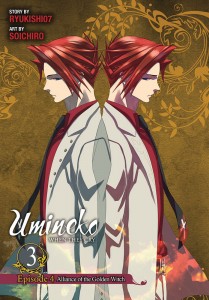
Story by Ryukishi07; Art by Soichiro. Released in Japan in two separate volumes as “Umineko no Naku Koro ni: Alliance of the Golden Witch” by Square Enix, serialized in the magazine Gangan Online. Released in North America by Yen Press.

This review is a couple of months late, partly as so many others things came out at the same time, but mostly as this particular Umineko arc is so hard to read. Like Higurashi’s third arc, the Curse Killing Chapter, this arc deals extensively with abuse, particularly child abuse. Ange is bullied at school to the point where she wishes out loud for death, and the “magic” that she was once able to manipulate is lost to pure despair. Likewise, Maria can’t simply paper over her relationship with Rosa anymore, and when her mother goes too far, Maria’s wellspring of rage threatens to overwhelm the entire book.

umineko8

One of the key features in Umineko is ridiculous over-the-top melodrama, and for the most part it’s been well-balanced between ridiculous light-heartedness and Grand Guignol awful violence. This volume, though, like the previous one, alters the original visual novel’s structure. The first omnibus was almost all Ange, with Battler and Beatrice relegated to the very end. Here it’s Ange’s struggles in 1998 that are missing – you’d be forgiven for thinking that she had genuinely been transported to Battler’s game, as we see nothing of her search with Amakusa to find the truth of what happened 12 years earlier. While I realize that these manga are done with the approval and supervision of Ryukishi07 (though not as much as the heavily rewritten 7th and 8th arcs), I wish that they’d kept the timeline of the original work.

Thematically we get more examination of what Magic is and how it can help you… and when it can’t. One of the most important scenes in the book is when Ange, tormented by the constant bullying she gets at school, orders the Stakes to kill all her classmates. It’s up to Mammon to state the obvious – they can’t do it as Ange is unable to commit murder. Magic may be able to hide actions in some other guise, but the responsibility remains with whoever uses it. And this shatters Ange, whose struggle to avoid crushing sadness and loathing is lost here. Likewise, once Maria faces the severed head of Sakutarou, ripped apart by Rosa in one of her angry rages (speaking of which, I wish we had a better look at Maria seeing it as a human severed head Rosa is holding up – censorship, I suspect, but another lost opportunity), there’s nothing left for her but dark magic, the magic of murdering people. And the fact that she kills her mother over and over again in the magical world shows she has the killing intent Ange doesn’t.

The other very important scene here is the one between Ange and Lambdadelta. Lambda has been shown to be cruel when it serves her purpose, and she’s incredibly cruel to Ange here, but she’s also trying to tell her the truth, which Bernkastel is avoiding in order to make Ange the perfect pawn. Nothing Ange does here can affect her own future. This isn’t Higurashi, where everything snaps back each time. Even if Ange somehow arranges it so no one dies in 1986, the her of 1998 can’t go back. This Ange is essentially doomed, something Lambda gleefully points out, before offering her own deal – keep the game going forever, with no winner or loser. It’s a sign of how much Ange has lost that she’s sorely tempted.

Of course, there’s also the problem of October 4th, and Beatrice’s game. We get a new Truth introduced here, the Blue Truth (again, colored ink is expensive, so have a different font). It allows the game to move faster, but I suspect won’t end well for Beatrice. We also get more sacrifices, and a focus on George and Jessica, who have to fight to prove they can be family head, and also for their loved ones. (For those who were expecting a focus on Kyrie, while she does get more attention here, there isn’t nearly as much as there was on the other three mothers in the first three arcs. It’s almost suspicious…) Of course, this whole volume is devoted to cruel reality. And thus, we do not end with Jessica and George being awesome, but rather with their sudden death.

We’ve got one more omnibus to go (well, for this arc – fear not, End is solicited), and at this point it’s all up to Battler. He’s been given a lot of help, things have been made more obvious, but does he really have the desire to win? And does he know what winning will cost him? As for this manga adaptation, I’ve mentioned my reservations with this adaptation, but that’s mostly as I’ve read the visual novel. For new readers, they may not notice. In the end, this is a hard arc to read, but it’s essential to understand what’s going on.

(One last whine: the manga left out the ridiculous parody fight between Krauss and the Goat. I may never forgive it for that.)

Filed Under: REVIEWS

Bringing the Drama: Master’s Sun

December 31, 2014 by Anna N, Nancy Thistlethwaite, Eva Volin and Emily Snodgrass Leave a Comment

ANNA: Master’s Sun is a drama from the nearly always excellent writing team of the Hong Sisters, who brought the world the beloved shows You’re Beautiful and The Greatest Love among others. Master’s Sun is the story of an incredibly sleep-deprived woman who sees ghosts, and the arrogant yet secretly vulnerable President of a mega mall, who happens to have a ghost repelling ability and an inexplicable affection for wearing cravats in confusing ways.

I absolutely adored Master’s Sun, from the opening credits to the last scene of the final episode! What are your thoughts?

The-Master’s-Sun-Poster5

EMILY: I was wary going into this drama because the Hong Sisters had a serious misstep with their previous drama, Big. However, after watching this, I can say that they’ve returned in top form. This was a great drama. The characters are all so warm and weird and flawed, and they all really grew and changed as the story progressed. So Ji Sub, who I haven’t seen in any sort of comedic role in – I don’t even know how long – was great, playing his part with a quirky restraint, which allowed the always delightful Gong Hyo-Jin to go all out and be more outgoing and expressive and clingy. And ghost repellent– what a delightful excuse to get all touchy-feely!

Perplexed by cravats!

Perplexed by cravats!

EVA: As you know, I’m absolute crap when it comes to watching shows to the end. I bail at the first sign of boredom. But this time I was hooked. The characters had chemistry, the ghosts were scary (at least during the first few episodes — the horror scaled back quickly), and the side characters were appealing and never overshadowed the main couple. Even better, the plot holes (there are always plot holes) weren’t so deep that I couldn’t step over them on my way to the next episode. And the weirdly styled cravats! And the bad hair! And the impossibly high heels! And the overbearing relatives! Sigh. Oh, k-dramas, how I’ve missed you.

ANNA: I really loved the way the characters were so idiosyncratic. I do enjoy more predictable k-drama shows, but when a show stands out like this for the quality of the writing and character development, it reminds me just how good k-dramas can be! The main couple are both broken in different ways, and their relationship slowly starts them on the path towards change. I thought that that the bodyguard Kang Woo and spoiled model Tae Yi Ryung were also a great counterpoint to the main couple. I loved the way Kang Woo nonchalantly turned down all the attempts to ask him out.

EMILY: True, I do like shows where the female second lead is likable. So often K-dramas will go out of the way to make the male second lead extremely appealing (thus causing second-lead syndrome where fans like him better than the main guy) while the female second lead is stuck being a mean and nasty character. In Master’s Sun, while Yi Ryung was certainly not always friendly, she also had her really cute, sympathetic moments.

Scary ghost shenanigans!

Scary ghost shenanigans!

EVA: Exactly! The only truly evil character was the actual villain (which I won’t name here because spoilers). Yi Ryung is a brat, but she’s not evil and doesn’t try to do evil things. Is she mean? Yep. Does she try to embarrass her nemesis? You bet. But it’s not like she tries to get Gong Sil run over by a truck.

ANNA: I thought the number of times she got turned down in her romantic conquests made her seem much more sympathetic than the typical female second lead. Really, the entire main cast of the show was so quirky and memorable.

I have to say I really enjoyed the way Gong Shil’s need for ghost repellent caused her to get handsy with Joong Won at every opportunity. It was an amusing relationship dynamic that we don’t see very much in kdramas.

EVA: I really liked the way Joong Won’s character developed over the course of the show. Gong Shil’s need for his protection forced him to interact with people in a way he hadn’t since his kidnapping. As a result he learned empathy, humor, and that not all people suck. I was absolutely delighted the first time he smiled. It wasn’t until then that I realized he hadn’t smiled at all (smirks don’t count) in the first, what?, twelve episodes?

ANNA: I also enjoyed the way Joong Won’s character developed! I also thought that the central mystery for the show with the truth behind Joong Won’s kidnapping was well done. I was a little bit disappointed that some of the development towards the end of the series for Gong Shil happened off screen, but she had changed so much already throughout the course of the series.

EMILY: I liked how Joong Won accepted Gong Shil’s eccentricities. Her problem is a bit unusual, but he rolled with it fairly well. In particular, I liked his relationship with that ghost in the mall that communicated via trash can. I also appreciated how blunt he was in admitting his feelings. There was a bit less denial and dancing around emotions in this show than in typical kdramas. Everyone felt things strongly and expressed it right away. I could have done without the obligatory kdrama amnesia plot, but even that was not dragged on for too long. All in all, this is another solid show from the Hong Sisters, who prove once again how good they are at taking a standard kdrama plot and tilting it just a bit to make it fresh and enjoyable.

Filed Under: Bringing the Drama

Manga Giveaway: WataMote Giveaway

December 31, 2014 by Ash Brown

It may be the last day of December, but there’s still time for one more manga giveaway before the year is through. For this month’s giveaway, participants will have the opportunity to win the first volume of Nico Tanigawa’s manga series No Matter How I Look at It, It’s You Guys’ Fault I’m Not Popular! as published by Yen Press. (From here on out, I’m just going to refer to it by its Japanese abbreviation WataMote). As always, the giveaway is open worldwide!

No Matter How I Look at It, It’s You Guys’ Fault I’m Not Popular!, Volume 1

I enjoy reading manga about otaku. It’s a term that has a slightly different meaning in English than it does in Japanese, but generally speaking otaku refers to someone with an extreme or obsessive interest in something.  Often this is assumed to be an interest in anime or manga, but it can really be a specific interest in anything. I myself could probably be considered an otaku, which is probably one of the reasons I like otaku manga–it’s easy for me to identify with many of the characters and the things they enjoy. Some otaku manga though, like Watamote, do occasionally make for uncomfortable reads. Watamote can be hilarious, but it can also be a bit painful since Tomoko is so incredibly and terribly awkward. I do like her, though, and find her endearing in her odd sort of way.

So, you may be wondering, how can you win the first volume of WataMote?

1) In the comments below, tell me a little about your favorite otaku manga or favorite otaku from manga. (If you don’t have one, you can just mention that.)
2) If you’re on Twitter, you can earn a bonus entry by tweeting, or retweeting, about the contest. Make sure to include a link to this post and @PhoenixTerran (that’s me).

There it is! Each person can earn up to two entries for this giveaway and has one week to submit them. If you have trouble leaving comments, or if you would prefer, entries can be sent directly to me by e-mail using the address phoenixterran(at)gmail(dot)com. The comments will then be posted here in your name. The giveaway winner will be randomly selected and announced on January 7, 2015. Happy New Year, everyone!

VERY IMPORTANT: Include some way that I can contact you. This can be an e-mail address in the comment form, a link to your website, Twitter username, or whatever. If I can’t figure out how to get a hold of you and you win, I’ll just draw another name.

Contest winner announced–Manga Giveaway: WataMote Giveaway Winner

Filed Under: FEATURES Tagged With: manga, Nico Tanigawa, Watamote

Dorohedoro, Vol. 14

December 30, 2014 by Sean Gaffney

By Q Hayashida. Released in Japan by Shogakukan, serialization ongoing in a Shogakukan magazine to be named later. Released in North America by Viz.

I pretty much had my jaw on the floor through this entire volume, though halfway through it changed from boggling at Nikaido to boggling at Kai and company. As always with Dorohedoro, there’s a lot going on and it’s pretty unforgiving to those who don’t remember previous volumes, but that doesn’t stop it from being a stunning read every time. In addition, we get another reminder that behind all these masks, many of the main characters are female. Gender reveals of Nikaido and Noi occupied Volume 1, but Hayashida still enjoys doing it, so we get two more here (though I think we already knew them and I had forgotten).

doro14

A couple of vlumes ago I had discussed Nikaido dealing wht her past and childhood, and how the misuse of her magic led to her best friend being erased from existence. This in turn led to her suppressing her own powers. So now that her power is needed, we have to have some shock therapy to speed things along. I could have done without the attempted rape dream sequence, to be honest, but it is a dream sequence, and ends up being more about Nikaido confronting her own fears and demons. Once that happens, not only is she gaining the abilities (and looks!) of a devil, but her power is now kind of scary. We see this as she returns to her own past, and this time manages to save her childhood friend and set time right (sort of). Nikaido’s abuse of time powers was a powerful message in the earlier books, but it’s now come full circle, and I was stunned.

Meanwhile, most of the second half of the volume deals with Kai’s rampage against sorcerers, who he and his gang have been slowly killing off. Dokuga and company are feeling a bit uncomfortable with this, but “the boss” is still “the boss”. Natsumi has disappeared, though, and just isn’t answering her calls. There’s an air of something about to snap here, and it all comes to a head in Tanba’s restaurant (also providing a good excuse to put him on the cover), with a huge fight that ends with Kai getting his face literally cut off by Kirion… not that this stops him, as several more heads (apparently devil tumors?) arise from the wreckage, and now Kai seems to be Aikawa. The whole Kai/Ai/Caiman/Aikawa thing the series has been playing with is about as close to getting confirmed as possible here.

The remains of En’s merry band don’t get as much to do here, though they do send Fujita off on a reconnaissance mission to find En’s devil tumor. No one is more surprised at this than Fujita himself, but Sho informs him that he is “the one who loves En’s family the most’, which is really sweet. Oh, and in case you were wondering about Ebisu, she provides the best moments of humor, with her puppet conversations, and also a brief moment of heartwarming, as she wishes Fujita good luck after he’s left (because God forbid he should hear her or something).

When Dorohedoro finishes, it’s going to be one of those series that’s amazing to marathon in one whole sitting. Till then, we are grateful for getting these volumes at four-month intervals, and the next one can’t come fast enough.

Filed Under: REVIEWS

  • « Go to Previous Page
  • Page 1
  • Interim pages omitted …
  • Page 336
  • Page 337
  • Page 338
  • Page 339
  • Page 340
  • Interim pages omitted …
  • Page 551
  • Go to Next Page »
 | Log in
Copyright © 2010 Manga Bookshelf | Powered by WordPress & the Genesis Framework