• Skip to primary navigation
  • Skip to main content
  • Skip to primary sidebar
  • Home
  • About Us
    • Privacy Policy
    • Comment Policy
    • Disclosures & Disclaimers
  • Resources
    • Links, Essays & Articles
    • Fandomology!
    • CLAMP Directory
    • BlogRoll
  • Features & Columns
    • 3 Things Thursday
    • Adventures in the Key of Shoujo
    • Bit & Blips (game reviews)
    • BL BOOKRACK
    • Bookshelf Briefs
    • Bringing the Drama
    • Comic Conversion
    • Fanservice Friday
    • Going Digital
    • It Came From the Sinosphere
    • License This!
    • Magazine no Mori
    • My Week in Manga
    • OFF THE SHELF
    • Not By Manga Alone
    • PICK OF THE WEEK
    • Subtitles & Sensibility
    • Weekly Shonen Jump Recaps
  • Manga Moveable Feast
    • MMF Full Archive
    • Yun Kouga
    • CLAMP
    • Shojo Beat
    • Osamu Tezuka
    • Sailor Moon
    • Fruits Basket
    • Takehiko Inoue
    • Wild Adapter
    • One Piece
    • After School Nightmare
    • Karakuri Odette
    • Paradise Kiss
    • The Color Trilogy
    • To Terra…
    • Sexy Voice & Robo
  • Browse by Author
    • Sean Gaffney
    • Anna Neatrour
    • Michelle Smith
    • Katherine Dacey
    • MJ
    • Brigid Alverson
    • Travis Anderson
    • Phillip Anthony
    • Derek Bown
    • Jaci Dahlvang
    • Angela Eastman
    • Erica Friedman
    • Sara K.
    • Megan Purdy
    • Emily Snodgrass
    • Nancy Thistlethwaite
    • Eva Volin
    • David Welsh
  • MB Blogs
    • A Case Suitable For Treatment
    • Experiments in Manga
    • MangaBlog
    • The Manga Critic
    • Manga Report
    • Soliloquy in Blue
    • Manga Curmudgeon (archive)

Manga Bookshelf

Discussion, Resources, Roundtables, & Reviews

Features & Reviews

Bookshelf Briefs 11/22/16

November 22, 2016 by Michelle Smith and Sean Gaffney 1 Comment

barakamon12Barakamon, Vol. 12 | By Satsuki Yoshino | Yen Press – The absence of Naru’s immediate family was always very unstated in the series, and it’s unsurprising that Handa thought they were both dead—the reader likely did as well. But her father, at least, is shown not to be dead, but to be away at sea most of the year, and his return for Christmas is what carries most of this volume. Naru is very Yotsuba-esque most of the time, but she is a seven-year-old girl with real feelings, and her need for her father is telling even as she sort of elides it. Her dad, meanwhile, is a well-meaning goof, but should really step up more, and Handa is, as always, a good bridge between the two. Barakamon is sweet and good-hearted and always puts a smile on my face. – Sean Gaffney

nozaki5Monthly Girls’ Nozaki-kun, Vol. 5 | By Izumi Tsubaki | Yen Press – I don’t normally watch the anime versions of the manga I read, but a friend introduced me to the Nozaki-kun anime and it’s pretty great. In fact, watching it gave me a better sense of the comic timing in the series, and I think that has carried over to how I read the manga, because I enjoyed it even more than before. Scenarios in this volume include Kashima having a cold and various guys volunteering to speak for her, the gang going on a drama club training camp, and Nozaki’s search for a cute merchandise-friendly mascot for his series. There is a gag relating to the latter that made me laugh out loud, but I also enjoyed a glimpse at the process for how such things are incorporated into a series, as well as a brief lesson on how cover designs come to be. A little informative, a lot amusing! – Michelle Smith

9781421588667_manga-my-hero-academia-6-primaryMy Hero Academia, Vol. 6 | By Kohei Horikoshi | Viz Media – I did ask for villains, and here they are, including one who seems to be angry at people who are heroes for the wrong reason. This volume has a lot to say about what makes a good hero and what makes a villain. Midoriya gains a mentor, who is impressed at the fact that he can think on his feet and is trying to teach him how to be more intuitive. But more importantly, Ida is bent on revenge against the man who destroyed his hero brother, who will likely never walk again. This is understandable, but revenge is always a BAD reason to be a hero. Luckily, we also see Midoriya being clever here, and he not only saves Ida but also calls for help, something I wish more shonen heroes did. Excellent series. – Sean Gaffney

onepiece80One Piece, Vol. 80 | By Eiichiro Oda | VIZ Media – For a while now, I’ve been ready to move on from Dressrosa, but I’ll be damned if Oda’s farewell narration to the island and its inhabitants didn’t make me a little verklempt. That said, this is one of those volumes full of updates on the world at large, hints about plots to come, and glimpses at future foes. I always enjoy it when the story’s scope widens this way, though it makes me wonder exactly how long the series is going to be (and whatever happened with those obelisk things Robin was studying?). The crew reunion at the end of the volume comes as a welcome relief, and I am further manipulated by Oda into being totally invested in the Sanji cliffhanger. Still addicted after 80 volumes! – Michelle Smith

ooku12Ooku: The Inner Chambers, Vol. 12 | By Fumi Yoshinaga | VIZ Media – When last we left off, ineffectual Ienari was the shogun and his odious mother, Harusada, was capriciously poisoning those of his heirs that displeased her. In this volume, she gets her comeuppance in a satisfying way, plus Ienari grows a spine and makes perfecting and distributing the redface pox vaccine his priority. The story could almost end here, with a victory for the good guys, except that wouldn’t be nuanced enough for Ooku. Instead, time passes swiftly and we see Ienari gradually being corrupted by power and the knowledge of his (and Aonuma’s, Gennai’s, and Kuroki’s) contributions lost to history because Japan cannot admit any weakness with foreigners literally on the horizon. Captivating and bittersweet, this is a series with broad scope and I trust that Yoshinaga has a destination in mind. I’ll be waiting for volume thirteen! – Michelle Smith

yamadakun11Yamada-kun and the Seven Witches, Vol. 11 | By Miki Yoshikawa | Kodansha Comics – And so Yamada-kun finally wraps things up and comes to an end. Yamada cleverly uses his wish to get rid of the witch powers, most of the witches are pretty happy with that, and most importantly, he confesses to Shiraishi and they become an official couple. This has been a terrif… wait, what? The series is still going? Yes, that’s right, welcome to “this is too popular to cancel,” the inverse of “cut short,” as we now have the adventures of the new student council, with some old friends but also some new characters. How this will develop I’m not sure, given it’s barely begun, and I’ll definitely give it a shot, but I do sort of wish that things had ended here, as it was perfect. – Sean Gaffney

Filed Under: Bookshelf Briefs

Monthly Girls’ Nozaki-kun, Vol. 5

November 22, 2016 by Sean Gaffney

By Izumi Tsubaki. Released in Japan as “Gekkan Shoujo Nozaki-kun” by Square Enix, serialization ongoing in the online magazine Gangan Online. Released in North America by Yen Press. Translated by Leighann Harvey.

It’s a stretch to say that reading this series can teach you the ins and outs of how the manga industry works – this isn’t Bakuman, or Even a Monkey Can Draw Manga. But when it’s able to be mined for humor, anything is game. And so we get things like Nozaki trying to draw his shoujo heroine as a superdeformed character, or having a mascot for the series, much like Yukari’s endless tanukis (which litter the cover of this volume, so I can’t even make my tanuki joke at the end of the review). We also get a hilarious look at cover art, where the artist likely has to work with a different editor. There may be a seasonal theme. You may have to try to translate your editor’s art, which shows at a glance why they edit and don’t draw manga. So things are learned, but the humor comes first.

nozaki5

This series does not have plot and character development per se, but there are some amusing chapters that make it look as if things might develop. Mikoshiba discovers the tragic truth behind Wakamatsu’s crush on “Lorelai”, and is as horrified as you’d expect. Waka, meanwhile, continues to think that Kashima is a guy, though the beach episode may have cleared that up – it’s left up in the air. Actually, the beach episode is probably the highlight of the volume – the anime actually adapted it into a later OVA as it was too good not to animate. This features the famous “those are just lumps of fat, aren’t they?” line, Seo stealing the drawstrings of all the boys’ swimtrunks, Kashima and Mikoshiba continuing to be endlessly attractive to the same sex, “I’m wearing that lame pink bra you picked out!”, and more.

As for romance, as you’d expect, it’s status quo. Nozaki-kun is about the comedy. This volume, though, does show how natural Hiro and Kashima are with each other when she’s not driving him to violence, and has some lovely Seo/Waka tease, which is really all she wants from Waka at the moment. The majority of the shipping here, though, is Sakura’s seeming one-sided crush on Nozaki. She even admits to Mikoshiba she’s now too scared to confess as she knows it will just be used for manga fodder. She tries changing her attitude in order to get him to notice her more, but that just makes him worry. In the end, as we know, being herself is the best, even if it means Nozaki is still his oblivious self. The sweetest chapter in the book is the final one, where we flash back to Sakura first falling in love with Nozaki – as you’d expect, it was as much from him being a giant loser as it was his looks – and how she unconsciously influenced his heroine for the manga.

Nozaki-kun remains a wonderfully hilarious title, and now has finally gotten away from the anime, so fans of that will want to pick it up to read new material. Go read it, or the tanuki will be sad. (Oh look, I got to work in the joke anyway.)

Filed Under: REVIEWS

My Week in Manga: November 14-November 20, 2016

November 21, 2016 by Ash Brown

My News and Reviews

Nothing except the usual My Week in Manga feature was posted last week at Experiments in Manga. I was hoping to have my random musings on Ichigo Takano’s Orange ready for November, but the month has been particularly stressful and energy-draining so at this point it looks as though December will be far more likely. Hopefully, I’ll have an in-depth feature of some sort to share soon. I also have my list of notable release from 2016 to work on, too!

There is one thing from last week that I’m very excited for–the most recent Sparkler Monthly Kickstarter! The campaign is raising funds to support the print edition of Heldrad’s highly-amusing send-up to shoujo manga Orange Junk. I greatly enjoyed the first volume of Orange Junk, which I’ve previously reviewed, but the series gets even better as it goes along. Never read any of Orange Junk? Give it a try over at Sparkler Monthly and if you like what you see please consider contributing to the Kickstarter!

Quick Takes

Ajin: Demi-Human, Volume 3Ajin: Demi-Human, Volumes 3-8 by Gamon Sakurai. For a variety of reasons, while I’ve continued to stockpile Ajin, I’ve been rather lax when it some to actually reading the manga. The eighth and latest volume in English was released relatively recently, so I figured it was probably about time that I finally got around to catching up with the series. In retrospect, I’m actually kind of glad that I had a whole stack of Ajin to read all at once. The manga generally tends to be very quickly paced so it was nice to be able to move directly from one volume to the next in succession. Ajin is best, both in art and in storytelling, when there’s action going on. Sakurai’s fight sequences are tremendously dynamic and exciting. The use of the demi-humans’ immortality and black ghosts can actually be quite clever at times, too. While the series continues to be exceptionally violent and brutal, it doesn’t seem to be as gruesome and grotesque as it once was when the demi-humans were shown to be the subjects of live experimentation. The story can be a little heavy-handed, especially when it comes to government corruption and the revelation of everyone’s tragic backstories, but the psychological elements do tend to be handled well in spite of this.

Happiness, Volume 1Happiness, Volume 1 by Shuzo Oshimi. I’m not especially interested in vampires and they seem to have been so overdone lately that there often has to be some sort of extra impetus for me to actually pick up a vampire manga. In the case of Happiness, the additional push that was needed came from the fact that Oshimi is also the creator of The Flowers of Evil, a manga series which left a pretty big impression on me. Oshimi is incredibly skilled at establishing the mood and atmosphere of a series. Happiness is about Okazaki, a bullied high school student who survives being attacked by a vampire only to become one himself. The pacing of Happiness is leisurely, showing only the first few days of Okazaki’s new existence as he struggles to adjust to his emerging symptoms. Given how the first volume unfolds, Okazaki’s descent into vampirism can easily be read as a metaphor for puberty and sexual awakening; it will be interesting to see if the manga continues in that direction. Happiness has an underlying sense of eroticism mixed in with its horror which, at least in my opinion, is exactly how a vampire story ought to be. There is also a fair amount of angst in the manga, something that I’ve come to expect from Oshimi’s work.

Kitaro, Volume 2: Kitaro Meets NurarihyonKitaro, Volume 2: Kitaro Meets Nurarihyon by Shigeru Mizuki. I am still absolutely thrilled that more of Mizuki’s Kitaro manga is being released in English. However, I was a little sad that the second volume of Drawn & Quarterly’s new series didn’t include the same sort of bonus activities that were present in the first. Those were fun. But then again, Kitaro Meets Nurarihyon is plenty of fun in and of itself. In addition to an opening essay and a closing set of yokai files by the series’ translator Zack Davisson,  the volume collects seven of Mizuki’s short Kitaro manga, most of which are from the latter part of the 1960s although one is from the late 1970s. Generally when I think of yokai, I think of traditional Japanese folklore. However, the term can also be applied more broadly. In Kitaro, Mizuki doesn’t limit himself and incorporates mythology, urban legends, and popular culture from both within and outside of Japan. For example, in Kitaro Meets Nurarihyon, a descendant of Dracula plays a very important role in one of the stories. Sometimes the results are more cohesive than others, but I particularly enjoy and find it interesting how Mizuki is able to meld seemingly disparate elements and traditions together.

Nekogahara: Stray Cat Samurai, Volume 1Nekogahara: Stray Cat Samurai, Volume 1 by Hiroyuki Takei. Best known as the creator of Shaman King (which I somewhat surprisingly haven’t actually read yet), one of Takei’s most recent manga series is Nekogahara. Story-wise, it’s a fairly familiar tale of a ronin wandering the country, doing good deeds while trying to outrun past tragedies. There are numerous manga, novels, anime, and film that follow a similar premise. What makes Nekogahara stand out from all of those is that all of the principal players are literally cats. Granted, they’re cats dressed in kimono, carrying swords, and so on. Humans exist in Nekogahara, too, more or less as the daimyo, though they are generally discussed rather than seen. The lead of Nekogahara is Norachiyo, a scarred tom who was once a kept cat but who is now living his life as a stray. He is an extremely capable fighter and legend has it that he once even killed a person. Both the story and the visuals of Nekogahara rely on chanbara tropes. The actual flow of movement and action can sometimes be difficult to discern, but overall the artwork and character designs are rather stylish. Nekogahara is played fairly straight, but the characters’ more cat-like behaviors do bring levity to the manga.

The Black Cat Takes a Stroll: The Edgar Allan Poe LecturesThe Black Cat Takes a Stroll: The Edgar Allan Poe Lectures by Akimaro Mori. Bento Books doesn’t release very many titles, but the publisher’s books tend to be interesting so I make a point to keep an eye out for them. The Black Cat Takes a Stroll is one of Bento Books most recent releases. In addition to being the first volume in Mori’s Black Cat series, it was also the winner of Japan’s inaugural Agatha Christie Award for mystery fiction. The book collects six largely episodic but related short stories featuring the Black Cat, a young but respected professor specializing in aesthetic truth, told from the perspective of his personal assistant, a female graduate student whose research focuses on Edgar Allan Poe. I really wanted to like The Black Cat Takes a Stroll more than I actually did. I love the series’ basic concept and all of the literary and cultural references found in the stories. Sadly, the mysteries come across as trying too hard to be intellectual or overly academic and their solutions are frequently convoluted and coincidental. In addition to that, despite having a few charming and endearing quirks (such as his fondness for strawberry parfaits), the Black Cat tends to be infuriating more than anything else, misusing his intelligence in a way that is deliberately cryptic and intentionally manipulative of both the narrator and readers.

Filed Under: FEATURES, My Week in Manga Tagged With: Ajin, Akimaro Mori, black cat, Gamon Sakurai, Happiness, Hiroyuki Takei, Kitaro, manga, Nekogahara, Shigeru Mizuki, Shuzo Oshimi

Re: ZERO ~Starting Life in Another World~, Vol. 2

November 21, 2016 by Sean Gaffney

By Tappei Nagatsuki and Shinichirou Otsuka. Released in Japan by Media Factory. Released in North America by Yen On. Translated by ZephyrRz.

I always enjoy it when the second volume of a new series is stronger than the first, and that’s exactly what we have here. Subaru has managed to finally defeat death and get out of that crossroads, thus proving he is better than Robert Johnson. Now he’s recovering at the castle of Emilia’s eccentric mentor, who is apart of a series of strong new characters, including sarcastic twin maids, a grumpy loli that Subaru promptly labels as such, and, sadly, a new save point, as about 1/3 of the way through the book, Subaru dies… again. Only this time he dies in his sleep, and now has a harder job: figuring out who’s killing him and why.

rezero2

Of course, the book does still have its faults, chief among them still being Subaru. I mentioned while I was reading the series that he reminded me a bit of Bugs Bunny, mostly in the way that he enters a situation he knows very little about and responds with glib sarcasm and tsukkomi retorts. This makes the book a breezy, fun read, but at the expense of realism a bit – Subaru’s one-liners still feel overwritten, in a way that, say, the twins’ abuse does not. He’s doing much better when he’s emotionally stressed or panicking, which means the second half of the book is much stronger. Of course, this also means he’s failing downwards – he goes from blithely befriending everyone, to running away, to holing himself up in his room and avoiding everyone. Finally he even gets protection from a magic user, which saves him, but… at what cost?

We do learn a bit more about the world we’re now in here, though it’s a bit limited as the entire book remains right around the castle that the bizarre Roswaal lives in. His appearance and manner of speech scream out “I am secretly evil”, and while it would be refreshing if that proves not to be the case, I’m not holding my breath. Fandom, however, seems to have fallen in love with the two maids – well, to be more accurate, with one of the two maids. Ironically, Rem gets the lesser focus in this volume, as Subaru finds it far easier to bounce off the more outwardly vindictive Ram than her meeker, but just as vindictive sister. An afterword tells us that the two maids are based off Ran and Lum from Urusei Yatsura, redesigned for the modern age. Given much of this volume implies they are more than they seem, don’t be surprised if horns come up in the next book.

And there will be a next book to resolve this, as this has a cliffhanger ending – well, really, the opposite of a cliffhanger ending, but I meant metaphorically. I assume that Subaru will learn he can survive more than 3 deaths, and we’ve also found that even if he gets past the predestined time of his death, horrible things can still happen. We also learn, in the creepiest scene in the book, that he’s not allowed to tell anyone about his power. Basically, Subaru has his work cut out for him, but I suspect he will blunder into success somehow in the third volume. This is an excellent read, depending on your tolerance of the hero being flip every other line.

Filed Under: re: zero, REVIEWS

Platinum End Vol. 1

November 20, 2016 by Anna N

Platinum End Volume 1 by Tsugumi Ohba and Takeshi Obata

I approached reading Platinum End with mixed feelings, I was interested because this series is another work from the team that brought the world Death Note, and I greatly enjoyed Death Note. On the other hand, I wasn’t looking forward Death Note 2: Electric Boogaloo. I ended up putting down the first volume feeling like I was cautiously interested in seeing where Platinum End was going.

The volume opens with Mirai Kagehashi, a high school student who has decided to kill himself. He’s foiled in his attempt by the sudden appearance of an angel who rescues him. Mirai is stuck in despair because he was orphaned when he was young, and taken in by relatives who abused him. His new angel announces that she’s going to make him happy and gives him some new abilities – he can choose between having wings to fly anywhere or mystical red arrows that will cause anyone to fall in love with him. Mirai responds that he’ll ponder what he wants if he’s given both gifts and the angel agrees.

Mirai’s angel Nasse functions more like the devil on his shoulder than a good conscience, as she encourages him to use his powers for the most selfish of reasons. Mirai gets a sense of how deadly the ability to make anyone fall in love with him can be, when he returns to his aunt and uncle and learns the truth behind the death of his parents. In true shonen fashion it turns out that Mirai is caught up in a cosmic game, where God has decided that he’s going to elevate a human to become the next God. 13 angels have been assigned to 13 chosen humans, and the last one left gets to be in charge of the universe.

Mirai says that he would be just content with normal happiness, but Nasse keeps pushing him to use his angel-given superpowers to manipulate and murder his way to having money and happiness. In a way, Platinum End seems more like a horror title than anything else, as Mirai wakes up from nightmares with horrific visions. The other contestants for godhood aren’t using their powers for good either, as one of them decides to disguise himself as a superhero and pick off his opponents one by one, killing a comedian who decides to use the love arrows to assault a group of women.

Platinum End is rated mature and aside from that, one could develop a drinking game centered on the number of panels where Nasse’s disembodied butt is hanging in the air randomly in many panels. The art from Obata is good as always. Overall, this was an interesting manga to read, but not very pleasant. It seems like Platinum End is going to be even darker in tone than Death Note, and that series was pretty dark. At the same time, seeing if Mirai’s inherent sense of morality is going to hold up to the temptation of godlike power is an interesting story to explore, even though it is thematically a bit too close to Death Note. I put this volume down feeling a bit cautious about this series. I’ll be curious to see if in the next couple volumes Platinum End develops into a manga that I’m looking forward to reading. If not, there’s always Death Note!

pe1

Filed Under: REVIEWS Tagged With: Platinum End, Shonen, viz media

Oresama Teacher, Vol. 21

November 20, 2016 by Sean Gaffney

By Izumi Tsubaki. Released in Japan by Hakusensha, serialization ongoing in the magazine Hana to Yume. Released in North America by Viz. Translated by JN Productions.

I have a confession to make. While I love Oresama Teacher, and try to recommend it to everyone I know, I love some parts of it more than others. And I must admit that whenever the narrative turns its attention back to Mafuyu’s old stomping grounds and her underclassmen delinquents, I groan a little. Mostly the reason is that the cast has become nightmarishly huge – check out both the character sheet at the start of the volume and the relationship chart at the end – but the East High/West High guys aren’t as well defined as Midorigaoka’s cast. Kangawa may be the exception, and I’m glad he’s here at the start, but the beginning of this volume, revolving around Mafuyu pretending to be a boy so that Sakurada (a boy who likes to dress as a girl) can let down another guy who’s fallen for “her”. Mafuyu looks bored, and so are we.

oresama21

Luckily, the rest of the volume is back at Midorigaokoa, and proves far more interesting, as a new as yet unrevealed antagonist is setting out to go after the Student Council and blame “Super Bun”, which of course means Mafuyu. Her secret identity isn’t threatened, at least not yet, but she’s offended at the very idea of someone using Super Bun for nefarious purposes. Also tying into this is the cliffhanger for Vol. 20, where Hayasaka seems to have almost figured out Super Bun’s true identity. Of course, now that there’s a doppelganger running around, that’s all gone to hell. Speaking of doppelgangers, the most intriguing choice this volume was to have Mafuyu, unfamiliar with the concept, end up being rather terrified of discovering just who it is impersonating her – what if it really IS her evil twin?

The titular teacher also takes a backseat in this volume, with Takaomi reminding Mafuyu how easy it is to impersonate Super Bun but not doing much beyond that – he doesn’t seem to care much about what’s going on as long as it doesn’t impact his bet. Also uncaring is Hanabusa, even though the culprit shoves him down the stairs and breaks his arm and leg. Hanabusa is pretty unflappable to begin with, but this is a bit unusual even for him. I have a suspicion that whatever the explanation for this is, it will prove to be far less threatening than we’d expected.

Despite evil doppelgangers, there’s still plenty of humor to go around, though not quite as much of the standard ‘tsukkomi’ variety. Shibuya and Komori’s budding relationship is still adorable, and the fact that the Public Morals Club has been shunned to an extent also makes life difficult for Yui’s relationship with Wakana – though sadly not for the reason everyone expects. As for Mafuyu, aside from Kangawa’s one-sided crush, there’s no romantic movement here at all. But this is not really a romantic manga, even though it may end up with a pairing. It’s a comedy with lots of kicking ass, and that’s what you get here in Vol. 21, same as you did in Vol. 1.

Filed Under: REVIEWS

A Certain Magical Index, Vol. 9

November 19, 2016 by Sean Gaffney

By Kazumi Kamachi and Kiyotaka Haimura. Released in Japan as “To Aru Majutsu no Index” by ASCII Mediaworks. Released in North America by Yen On. Translated by Andrew Prowse.

Long ago, before this series was licensed and published, I tried to read a fan translation of these novels. I read eight volumes very easily, then bogged down about halfway through this one. A while later I tried again – and the same thing happened. The read came to a grinding halt. This time, with the official release, I am at last able to get to the end of the book, but I do note that the middle section is still a slog. I’ve complained before that Kamachi loves his worldbuilding more than his actual story and characters, and nowhere is this more apparent than in Kamijou, Tsuchimikado and Stiyl discussing the proper use of magic to try to catch Oriana Thomson. It’s fascinating if you’re a D&D-type gamer who loves learning how to use fictional concepts. For a casual reader it’s absolutely deadly. Be warned.

index9

Introduced in this volume: Misaka Misuzu, Fukiyose Seiri, Oriana Thomson, Lidvia Lorenzetti. We also see Touma’s mother Shiina for the first time with her actual appearance, as opposed to Index’s. Continuity-wise, this takes place, obviously, at the same time as Railgun’s Athletic Festival arc in the manga, though most of the events that happen there take place after all this. It’s about 4 days after the events of Book 8, which is why Kuroko is in a wheelchair, and the Railgun manga may now finally make sense to those who wondered that. The events of the Index movie Miracle of Endymion have also just taken place shortly before this.

This is, believe it or not, the first Index arc to take up more than one book. Given the predominance of multi-volume arcs in light novels these days, you’d think it would have happened before this, but no. It’s also the fist book where Kamachi had to admit in the afterword that he wasn’t sure who the heroine was for this particular book. I sort of see why he said this, given that there was attention paid to several girls, but I think at least for this book, Seiri comes closest to being the heroine. It’s just… Kamijou fails to save her, a rarity in this series. Sure, she’s not dead, but I expect her out of commission for the next book. Personality-wise, many might think she’s another tsundere like Mikoto, but that’s not quite accurate – Kamachi may use cliches, but he’s good at shading them. She’s the ‘class president’ sort, which means she’s uptight and rule oriented, and (the class assures us) she isn’t in love with Kamijou, though that’s somewhat suspect. She also has an eccentric love of online shopping products. She’ll never be relevant again, but she was fun to meet.

Oriana is the villain of this book, and possibly the next. She’s yet another magic world user invading Academy City, supposedly to deliver a weapon that cam take out any Saint from a distance, but in reality her motivations – or those of her partner, Lidvia – are far more apocalyptic. Once again religion is used as sort of a D&D class, and that’s not going to change. I liked that she never used the same move twice, to the point that even if it’s a detriment, she CAN’T. There were also several fun and cool moments in the book, such as the class uniting to get revenge on the teacher who made Komoe-sensei cry, as well as various moments when you realize that behind his ‘normal guy’ facade, Kamijou is actually really, really clever about figuring things out.

Sadly, this is to be continued in the next book, so there isn’t much closure here. Instead, I am left with what I was the first two times I tried to read this: Tsuchimikado telling me about magic use and religious systems for what seems like 800 pages. Luckily, I’ve passed it now, and hope Book 10 is less academically dense.

Filed Under: REVIEWS

Manga the Week of 11/23

November 18, 2016 by Sean Gaffney, Michelle Smith, Ash Brown, Anna N and MJ 2 Comments

SEAN: Are you giving thanks for so much manga? Hope so, as there is SO MUCH.

MICHELLE: It’s a cornucopia!

ASH: I always give thanks for manga!

SEAN: Kodansha has a bunch of stuff. A 5th Forget Me Not should please romance fans.

inspectre1

Their debut this week is In/Spectre, a yokai manga from Shonen Magazine R (the 2nd season of Shonen Magazine?) which is by the author of Spiral.

ASH: Yokai, you say? Then I’m in!

MJ: Hmmmm, maybe me too.

SEAN: The Prince and His Dark Days has a 2nd volume, which I’m hoping is a bit less Dark Days, to be honest.

ASH: It does seem to be an aptly named series.

SEAN: Real Account has its 5th volume – though technically this is the third volume of Real Account II. The distinction is something no one would ever notice, but that’s why I’m here.

ASH: Huh. I was unaware.

SEAN: Lastly, a third volume of Tsubasa World Chronicle, which I haven’t tried yet. Have Michelle or MJ?

MICHELLE: Nope.

ANNA: I am saddened by how indifferent I am to CLAMP when I used to love them so much.

MJ: I haven’t, which surprises me more than anyone, honestly.

SEAN: One Peace has a 6th novel of Rise of the Shield Hero. I would think he’d have risen by now – even Christ only took 3 days.

Seven Seas gives us a 5th and mercifully final omnibus of I Don’t Like You At All, Big Brother!!.

Magia the Ninth is their first debut, another Gene Pixiv title (which I think is Media Factory’s equivalent to Zero-Sum or Wings), from the creator of Black Bard. The plot is essentially “classical music composers hunt demons”.

ASH: Okay, I can’t help it, I really want to read this series. And I did rather enjoy Black Bard.

MJ: Sean knows he can get my attention by invoking the names “Zero-Sum” and “Wings.” So. Yes.

SEAN: In case you worried there were no monster girls this week, well, there’s monster guys, as we get a 5th Merman in My Tub.

galkochan

The other debut is Please Tell Me, Galko-chan!, a comedy title that runs on the Comic Walker website. It seems to involve a blunt girl and her friends.

ASH: I’ve heard good things and so am curious.

ANNA: I enjoy blunt girls and friends.

SEAN: And the title that always gets me mixed up, The Testament of Sister New Devil, has a 4th volume.

Vertical has another spinoff novel in the Attack on Titan series, called The End of the World. It’s a novelization of the live-action movie.

And there’s a 3rd volume of To The Abandoned Sacred Beasts.

The rest is Yen, though it’s not even all of Yen – they pushed a few titles back to the week after next. For Yen On, we have a 3rd volume of The Isolator, the dark thriller from the creator of Sword Art Online.

Black Butler is still popular, I hear, even in these days of Monster Girls. Vol. 23 is out next week.

And popular as well is BTOOOM! 15, which may never really surpass that whole ‘bomb bounces off the boob’ scene that is the only reason anyone remembers it.

Corpse Party: Blood Covered has a 3rd omnibus of, well, blood and corpses, no doubt.

Fruits Basket has a 7th omnibus, as past traumas collide with present abuse to hopefully lead to future healing.

MICHELLE: Seven volumes already!

ANNA: Yay for healing and Fruits Basket!

MJ: This, always!

SEAN: There’s a 6th volume of the Danmachi manga, aka Is It Wrong To etc etc etc.

And a 6th Karneval omnibus as well.

konosuba1

Another title better known by its fan nickname, Konosuba: God’s Blessings on This Wonderful World! *still* ends up being a mouthful to say. It’s a parody of ‘guy ends up in fantasy game world’ titles, is based on the light novel due out here next year, and runs in Dragon Age, which means it must have fanservice.

Always welcome on my shelves, we have a 5th volume of Monthly Girls’ Nozaki-kun, which means more hilarious tsukkomi faces.

MICHELLE: I recently watched some of the anime on Crunchyroll. It’s pretty great!

ASH: YESSS!!! (I love this series so much.)

ANNA: Woo hoo!

SEAN: There’s a 9th volume of the Watamote manga, aka No Matter How I Look etc etc etc.

Madoka Magica now has spinoffs or spinoffs, as the Oriko Magica spinoff gets a new side-story, Sadness Prayer. Given it’s Madoka Magica, I think sadness is guaranteed.

Rose Guns Days begins its Season 2 arc. Will Rose be able to get by without Leo?

School-Live! has a 5th volume of friendship and zombies.

I always love it when a title and its volume match. Have Trinity Seven Vol. 7.

Yen’s big debut is another title from Natsuki Takaya, creator of Fruits Basket. Back in the day, there was thought to be a licensing war over this series, but nothing came of it. Now we get Twinkle Stars in omnibus format. It’s about half the size of Fruits Basket, but has the same amount of drama.

MICHELLE: I’m so happy about this. I read the Australian editions of the first two volumes back in the day, but they were pricey to import. My plan to buy and painstakingly read the French editions did not get far.

ANNA: Officially on my holiday wishlist!

MELNDA: This, this, this.

SEAN: Lastly, we have a lucky 13th omnibus of Until Death Do Us Part, which is also the final volume.

Full of turkey? Or full of manga?

Filed Under: FEATURES, manga the week of

Ranma 1/2, Vols. 33-34

November 18, 2016 by Sean Gaffney

By Rumiko Takahashi. Released in Japan by Shogakukan, serialized in the magazine Shonen Sunday. Released in North America by Viz. Translated by Kaori Inoue, Adapted by Gerard Jones.

When Viz first started its omnibus re-release of Ranma 1/2, I told myself I was going to give every volume a full review, despite the fact that with one or two exceptions there is no plot or characterization development from around Vol. 10 to Vol. 36. And for the most part it’s been a good decision. I’ve been surprised at how much there is to talk about here, and how much more I’m getting out of the series twenty years on. That said, we’re definitely near the end of the series, and it’s starting to show. None of the chapters in this omnibus are horrible, but they are starting to feel tired, and you can sense Takahashi is ready to wrap this up. We’ll begin to see that wrapup with the next omnibus, but for now we have this mediocre book.

ranma33-34

There are a few stories that are fairly well remembered by the Ranma fandom, but they ended up being more plotless runaround types than I expected. Ryouga eats a mushroom that turns him into a little kid, and Ranma rapidly follows. While the kids are adorable brats, the emphasis is on the brat part, of course, and so there’s mostly a lot of yelling and fighting. There’s also a lot of Mousse in this book, and readers familiar with my reviews will know that I simply dislike him. Probably the most famous story in the book is the one where the entire family become convinced, after deciding to eat out rather than going home and then returning to find various broken things, that Kasumi has finally snapped and actually gotten angry. It made me wonder if Takahashi was actually following the Western fandom, as a lot of the jokes (and resolution) here could be taken straight from it – except if it were the Western fandom, Kasumi really WOULD have been angry.

There are also some good bits here, as you’d expect for a series of such varying quality as Ranma 1/2. The Valentine Chocolate chapter was genuinely sweet towards the end, and shows off a bit of the ‘yes, they are in love’ that we enjoy so much from Ranma and Akane. And the chapters involving Hinako and Principal Kuno are a Takahashi runaround done right, with great comedy that works, including the revelation of “The Evil Tree… sorry, Three” which had me laugh out loud, and may be the best use of Nabiki ever. And while I felt the whole “Akane’s breasts are growing” arc with Nodoka was drawn out far too long, both that and the previous Nodoka story earlier in the book show this really isn’t going to last much longer – sooner or later, Ranma IS going to meet his mother.

Anyone picking up a 17th omnibus of Ranma is in it for the long haul, of course, and as usual it’s worth getting for the improved reproduction of the art and unflipped state. But we’ve only got two omnibuses to go after this, and I must admit I’m rather relieved.

Filed Under: REVIEWS

The Prince in His Dark Days, Vol. 1

November 17, 2016 by Michelle Smith

By Hico Yamanaka | Published by Kodansha Comics

princedark1Seventeen-year-old Atsuko is desperate for cash. Her father is an ungrateful drunk, they’re so poor that she’s mocked by classmates for her lack of personal hygiene, and she has resorted to fleecing perverted old men just so she can eat. Shortly after a chance meeting in which she runs into her male doppelganger, Itaru, she is kidnapped by his rich friend, Ryo Sekiuchi, and hired to impersonate Itaru (who has gone missing) for one million yen. Atsuko agrees and tutoring commences. She meets some nice people who are concerned for her welfare and appreciative of her effort, which is something she hasn’t experienced before, and learns that happiness isn’t automatic, even if you live in a huge, beautiful mansion.

I’m on the fence with how I feel about this volume. It’s not nearly as insightful as it could be, and so far the focus is more on Atsuko’s circumstances (first crappy, then unfamiliar) than on Atsuko herself. Her insta-love—after opening the manga by declaring that the greatest misfortune in the world is to fall in love— for Itaru’s friend Nobunari is also completely sudden and unconvincing. A more nuanced interpretation would suggest that Atsuko is so starved for affection that she’ll latch on to any form of kindness, but I have doubts that the mangaka is thinking that deeply about it at all.

That said, there were some things I liked about it. Ryo’s backstory, for example, and his reasons for wanting to protect Itaru from future repercussions from his controlling family. I also like that Itaru may have run off because he is gender nonconforming and that Nobunari seems to be in love with him. It’s probably not good to be more interested in the person who’s off-screen than the actual protagonist, but at least that’s something. Another point in the series’ favor is that it is short. I reckon I like it well enough to see it through to the end.

The Prince in His Dark Days is complete in four volumes. Kodansha will release volume two later this month.

Filed Under: REVIEWS

Durarara!!, Vol. 5

November 17, 2016 by Sean Gaffney

By Ryohgo Narita and Suzuhito Yasuda. Released in Japan by ASCII Mediaworks. Released in North America by Yen On. Translated by Stephen Paul.

Lately these days when I’m reading light novels I come at it from a different perspective than most North American readers, in that I really am reading it in this format first. I haven’t seen the anime for, say, The Irregular at Magic High School or Strike the Blood, so my opinions tend not to be swayed in advance beyond shamelessly spoiling myself on TV Tropes. But DRRR!! is different – I’ve seen the anime multiple times, and also read Yen’s manga (though the novels have finally passed the manga series timeline-wise), and therefore know where the books are going to go, even if I may be surprised by a narrative quirk or inner monologue. This also allows me to enthuse about characters I love finally showing up, even if it is somewhat baffling as to why I love them.

drrr5

Case in point: Vorona, one of the two Russians who arrive in this book as professional goons-for-hire. I love Vorona. She’s in my top 5 favorite DRRR!! characters. That said, you’d be hard pressed to see why here, as she’s merely a quirky villain. She speaks in a clipped, soundbite way that not only works very well for a Russian who’s learned Japanese, but also contrasts with all the other Russians speaking Japanese around her, who speak it much more fluently. She’s a repository of useless information, which she doles out to her goofy and somewhat dim partner Slon – be it why cows eating grass makes them fat or why the number 13 is unlucky. And, like the rest of the cast in this series, she’s a little bit broken on the inside, finding her thrills in killing and finding progressively stronger people to fight against. She thinks she’s found someone interesting in this volume with Celty, who is seemingly easily killed only to show up later. Book 6 onward will show more of why I love her.

Knowing the anime can also be a drawback as well, of course. Mikado is written here to be a hopelessly naive dupe, in over his head and trusting Izaya of all people, even thinking to himself that he’s “really a nice guy”, which is so untrue you wonder how on earth Mikado can even survive day-to-day. But as the astute fan knows there’s far more going on in Mikado than just naivete. Aoba can sense it, I think – he sees Mikado grinning as he’s being blackmailed towards the end of the book – but he pretty much thinks he can use Mikado as the public face for his own machinations. This is definitely the first book in a two-book arc, and we’ll learn later on it’s not as simple as that.

As ever with a Narita volume, there’s too much going on here to talk about everything in a review. I didn’t mention Shizuo’s subplot, as Izaya seems determined to irritate him as much as possible, be it sending a young yakuza princess to kill him or framing him for murder. It’s a great plot, and gives us the best interstitial art of the entire series, as Shizuo tries to convince Akane he’s not a bad guy by winking and sticking his tongue out. And Anri’s involved as well, as she also falls under Vorona’s large category of ‘strong monsters that I can try to kill’. And there’s Chikage, the gang leader lothario who’s determined to destroy all the men in the Dollars gang – but don’t hurt the women or you’ll be in trouble. The big downside is, of course, this is all setup. It’s those early episodes of the season that no one liked as they were all preparation for a payoff. Stay tuned for the payoff in Vol. 6.

Filed Under: REVIEWS

Everyone’s Getting Married Vol. 3

November 15, 2016 by Anna N

Everyone’s Getting Married, Volume 3 by Izumi Miyazono

Is everyone getting married? I see no evidence of it yet in this series where aspiring housewife Asuka and committed bachelor Ryu continue to fall in love with each other despite their utterly incompatible life goals. This manga manages to balance the twists and turns of a soap opera with some very touching moments as Ryu and Asuka continue to struggle with their feelings for each other, balance their demanding work schedules, and navigate their possibly doomed relationship.

One of the things I like about this series is how little it relies on conflict due to people not talking to each other. Sure it happens sometimes, but not talking about a problem isn’t stretched over multiple volumes as sometimes happens in romance manga. Even when some standard plot elements pop up in the form of Ryu’s Complicated Ex-Girlfriend and Asuka’s Flirty Co-Worker, this continues to lead the couple to reflect on their relationship.

Two events happen in fairly short succession that cause some strain. Yuko, a married actress who Ryu had a long-term affair with years ago is back in town. She’s touched by scandal due to her philandering husband, and Ryu is maneuvered by combative questions from the press into joking on tv that he’d dump his girlfriend for a chance to date her. In addition, Asuka gets news of a upcoming work transfer and is spending time with Kamiya, a colleague. They’re walking down the street together and they agree to do a “couple interview” as a joke, only Asuka is shocked when she sees that Ryu is interviewing her.

These additional people popping up near Asuka and Ryu cause them to confront some of the issues in their relationship. Asuka wonders if Yuko is the reason why Ryu is so set against marriage. Ryu is jealous of Kamiya, even though his relationship with Asuka is professional. But while the only person Asuka wants to marry is Ryu, she wonders what might happen if she takes Kamiya’s overtures seriously since it seems he does really want to get married.

As always the art is attractive and easy to follow, easily handling cute scenes of Ryu and Asuka supporting each other in addition to some tumultuous relationship drama. I wish Shojo Beat could bring out more series like this all at the same time, but I’ll be happy with what I can get.

egm3

Filed Under: REVIEWS Tagged With: everyone's getting married, Josei, shojo beat, viz media

Fire Force, Vol. 1

November 15, 2016 by Sean Gaffney

By Atsushi Ohkubo. Released in Japan as “Enen no Shouboutai” by Kodansha, serialization ongoing in the magazine Weekly Shonen Magazine. Released in North America by Kodansha Comics. Translated by Alethea & Athena Nibley.

It was always going to be difficult, following up on a series as popular as Soul Eater. And so Ohkubo decided to move to a bigger company (this is discussed in an absolutely hilarious afterword where he bemoans, like so many other artists who write for Magazine or Sunday, not getting into Jump) and started a brand new series. This is a bit more realistic than Soul Eater was, which sadly means a bit less gonzo background art details, but it’s still not quite in the real world. It’s a sublte first volume – I went through most of it thinking this was something of a step down from his last work, but as I reached the end of the volume I realized that I wanted to learn more about these characters. Which is all you can ask, really.

fireforec1

Our hero, who looks like Soul with black hair because manga artists have a style, let’s face it, is Shinra, a boy with a tragic past who has dedicated his life to being a hero, and the best way to do that in this world is to become a fireman. Why? Because all over the world people are spontaneously combusting for no reason, and turning into demonic creatures as they do. Shinra joins a squad dedicated to stopping these former humans and sending them to their eternal rest (they even have a nun/exorcist on hand). There are, of course, a few problems. He has a bad habit of grinning widely when he’s nervous or upset, something that always causes people to get the wrong idea. And he’s never done this before, so quickly has to get used to the fact that as a firefighter in THIS world, they will always be dealing with death – in fact, as is bluntly pointed out, they are murdering these people.

Did I forget to mention most of the cast has superpowers? Of course I did, because frankly, a firefighter manga is what I want. But yes, Shinra can run so fast his feet catch fire (or maybe it’s the fire that lets him run fast), and another girl on the squad can’t create fire, but can manipulate it beautifully. We also meet Arthur, who I suspect changed his name to be more apropos. He’s dedicated himself to being a knight – and has a past history at school with Shinra, so they don’t get along, as they both war as to whether knights or heroes are better. (The astute reader, of course, realizes they’re both idiots.) Probably my favorite character was the captain, who has no powers at all, but is a really good firefighter – and dispenses excellent advice.

So yes, a solid first volume, with a better plot and character but less style and moxie than Soul Eater’s first volume. There’s also some fanservice, ranging from mild (a brief shower scene with the two female firefighters) to pointless (one firefighter from another squad seems to have the ability to be constantly groped – mo, really, it seems like it’s her superpower). And we’re also meeting some villains, who no doubt will tie into the death of Shinra’s family. All in all, it’s a promising start.

Filed Under: REVIEWS

Bookshelf Briefs 11/14/16

November 14, 2016 by Sean Gaffney and Michelle Smith Leave a Comment

centaurlife10A Centaur’s Life, Vol. 10 | By Kei Murayama | Seven Seas – What I said in my last review applies, only more so. I’m wondering if the author even has a plan at all, or is just happy to coast on monster girls as long as possible. Here we wrap up the arc in the alternate universe, which ends with the ‘it was all a dream’ cliche so dreaded by readers everywhere. We get a test of strength among the class, which a baffled Hime wins without ever really knowing why. We get the introduction of Suu’s sister, which gives us the idea of a giant snake as a bratty goth-loli wannabe. For the most part, though, this wasn’t really very funny, and didn’t have as much of the total bafflement I’ve enjoyed before. Also, stop showing us girl monsters on the toilet. Jeezus. – Sean Gaffney

haikyu5Haikyu!!, Vol. 5 | By Haruichi Furudate | VIZ Media – This was another excellent installment of Haikyu!!. The Inter-High qualifiers are upon us, and I loved getting glimpses of some of the other participating teams. I especially loved Furudate’s extended look at those who were defeated in the first round, including a poignant montage and emphasis on the losers’ regrets. In this way, we also meet Karasuno’s girls’ team, and now I want a spinoff. For their part, the Karasuno boys also bring the feels as they overturn the prevailing opinion that they merely used to be good. The panel with an about-to-jump Hinata superimposed over a crow spreading its wings actually made me verklempt, as did the moment when he realizes how cool being a decoy can be. I wish I had more to read! – Michelle Smith

nichijou5Nichijou, Vol. 5 | By Keiichi Arawi | Vertical Comics – I was happy to see more Mai here as I requested, whether she’s torturing her friends in a game of Red Light Green Light, torturing her friends by drawing baffling buddha backgrounds on their yaoi manga, torturing the Professor by letting her dogs “play” with her, to the point where they bite Mio and Yukko for the lulz, and in general shows that she does not remotely grasp human interaction whatsoever. In non-Mai news, we see more of the scientist who’s desperate to examine Nano but gets tripped up by… well, everything. Western fans will be baffled by the surreal chapter based around nagashi somen. And in the best chapter in the book, our three girls struggle against the rain and her vagaries of an angry temple god. Terrific. – Sean Gaffney

nisekoi18Nisekoi: False Love, Vol. 18 | By Naoshi Komi | Viz Media – The field trip continues, and has many sweet and funny moments, but it’s not what the meat of this volume is. No, we’ve reached what appears to be the start of a final arc (spoiler: it’s not), where Chitoge is told that they’re moving back to the US, so she can come with and stop pretending to be Raku’s girlfriend. Needless to say, she’s devastated by this, as are the others, as she’s never had friends like this before, and of course is also in love with Raku. We’re starting to realize he’s in love with her as well—Shu blatantly asks who he likes, and while he says it’s Onodera it’s the first time he’s really waffling on the question. Will she leave? Will she stay? Will Claude kill Raku before that’s decided? Yup, cliffhanger. One of the best volumes yet. – Sean Gaffney

princessjelly3Princess Jellyfish, Vol. 3 | By Akiko Higashimura | Kodansha Comics – The effort Kuranosuke expends to support the dreams of others is truly impressive. Not only does he spearhead the fashion designer idea as a way to earn enough money to avoid Amamizu-kan’s destruction, but he manages to provide costumes and audience to a struggling student production, nudges Mayaya out of her comfort zone, and utilizes his politican father’s party to drum up attendees and press for a Jelly Fish fashion show. I love that he both accepts the Amars as they are and challenges them to participate in the outside world. In this way, he’s given them, and particularly a fired-up Tsukimi, an outlet for their hopes and fears as the reality of their neighborhood’s eventual destruction begins to hit home. Highly recommended. – Michelle Smith

roseking5Requiem of the Rose King, Vol. 5 | By Aya Kanno | VIZ Media – Wow, what a volume! Political scheming abounds in the action-packed moments, as Richard’s rescue of his brother forces Warwick to abandon his plan to make George the king and pivot instead back to the Lancasters, just as the other Edward (the one in love with Richard) counted on when he agreed to help Richard out. And in the quiet moments, we spend time with a couple of people still in love with Richard (Edward and Anne), and in the worst/best part of all, Henry and Richard manage to have another blissful interlude together, during which Richard finally admits to himself that he’s in love with Henry just as Henry says he will not permit himself to love anyone. Oh, the treachery and the angst! It’s riveting. Keep ’em coming, Kanno! – Michelle Smith

shuriken2Shuriken and Pleats, Vol. 2 | By Matsuri Hino | Viz Media – Well, that was one big thud of an ending. When this was licensed I heard it was two volumes long, which made me wary, and that after it ended the author returned to Vampire Knight material, which made me warier. Sure enough, this has “cancelled early due to low reader support” written all over it. Mikage’s stoic ninja finds many things to feel emotional about, but alas, we’re left with the uncomfortable ‘father role’ as the main romance, though it’s blessedly one-sided. And, this being a ninja manga, there’s plots, counterplots, fights on top of speedboats, etc. The main problem with this series, though, is that in the end there was not one plot twist I didn’t guess beforehand. Hino fans should reread Vampire Knight instead. – Sean Gaffney

wolfboy2That Wolf-Boy Is Mine!, Vol. 2 | By Yoko Nagiri | Kodansha Comics – The trouble with getting rejected and saying “I hope we can still be friends!” is that you need to actually have the resolve to do that, which is difficult when you’re still massively in love, not to mention getting mixed signals. As for Yu, we see signs of him getting jealous, but I don’t think he’s even consciously aware of what that is. Honestly, I wonder if Yu’s grumpy friend Rin might be a better match for Komugi, though as a blonde guy in a shoujo manga, he’s inevitably going to be second-best. What’s more, we’re getting some suggestion that Komugi’s background may not be what it seems, something that will no doubt lead to much drama but also allow her to end up with one of these guys. Good, but can be dull at times. – Sean Gaffney

uqholder9UQ Holder, Vol. 9 | By Ken Akamatsu | Kodansha Comics – As a Negima reader, I found it somewhat hilarious that as part of her training Tota, she sends him into the jungle in order to imitate his predecessor’s “cross a world in a short period” plotline. Even worse, his companion is Kirie, the Chisame lookee-likee, making it even more obvious that he’s just having fun for his fans. That said, this is quite a strong volume, showing off cool fights, embarrassed blushes, aborted love confessions, and our hero literally PUNCHING TIME in order to meet Evangeline’s young self again. New readers will suffer even more, though, as Ayake and Chachamaru show up at the end here, Konoka and Setsuna’s descendants are coming, and that Shinobu clone as well. Akamatsu’s greatest hits, but they’re good hits. – Sean Gaffney

Filed Under: Bookshelf Briefs

My Week in Manga: November 7-November 13, 2016

November 14, 2016 by Ash Brown

My News and Reviews

Last week was pretty quiet at Experiments in Manga (like most weeks these days, really) but I did finally get around to posting October’s Bookshelf Overload for those interested in some of the cool things I picked up last month. Last week was pretty stressful for a variety of reasons so I wasn’t online much, but I did recently find out about two Japanese novels scheduled to be released in translation next year that I’m very excited about. In May be on the lookout for Minae Mizumura’s Inheritance from Mother. Only two of Mizumura’s long works have been translated so far–A True Novel which in part is a reimagining of Emily Brontë’s Wuthering Heights, and the utterly fascinating nonfiction treatise The Fall of Language in the Age of English–both of which were tremendous, so I’m really looking forward to reading more by Mizumura. And in June look for Tomoyuki Hoshino’s Me, a novel exploring themes of identity. Hoshino’s stories are frequently challenging and unsettling but I find that it’s well-worth the effort it takes to read them. Like Mizumura, currently there are only two books by Hoshino available in English–the novel Lonely Hearts Killer and the short fiction collection We, the Children of Cats which in particular left a huge impression on me–so I’m happy that there will be a third.

Quick Takes

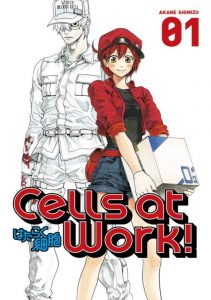
Cells at Work!, Volume 1Cells at Work!, Volume 1 by Akane Shimizu. Sometimes the premise of a manga is so fantastically odd that I can’t help but be curious. Cells at Work, in which the cells of the human body, bacteria, and such are literally personified, is one such series. It’s also an educational manga–readers may very well learn a thing or two about microbiology and human anatomy and physiology thanks to Cells at Work (assuming they weren’t already familiar with how the body functions). Although there are recurring characters, the first volume of Cells at Work is fairly episodic, mostly focusing on the immune system’s response to injury and potential infection. Things are more exciting when the world seems like it’s about to end and a catastrophe must be averted. Bacteria are portrayed like monsters and villains out of some sort of super sentai show. White blood cells are fairly cool and laid-back, at least until they’re fighting off invaders and are completely overcome by maniacal bloodlust. Influenza causes a zombie outbreak. Cedar pollen triggers an apocalyptic allergies. Sneezes take the form of enormous missiles. Cells at Work is actually kind of ridiculous and over-the-top (with artwork to match), but it’s a great deal of fun.

ghostlady1The Ghost and the Lady, Volume 1 by Kazuhiro Fujita. As far as I can tell, The Ghost and the Lady actually makes up the last two volumes of the three-volume series The Black Museum. I don’t believe Kodansha Comics has any current plans to release the rest of The Black Museum, but if it’s anywhere near as good as the first volume of The Ghost and the Lady then I hope to one day see it. The Ghost and the Lady is admittedly somewhat peculiar. Basically it’s a supernatural retelling of the life and legends surrounding Florence Nightingale. Tormented by eidolons–spectral manifestations of ill-will and malice–Florence seeks her own death, asking a ghost known as the Man in Grey to kill her. He agrees, but declares he will only take her life once she reaches the depths of despair. (Grey, who haunts a theater, has perhaps seen Shakespeare’s tragedies one too many times.) The Ghost and the Lady is intense and enthralling with both Grey and Florence precariously balanced on the edge of insanity. The series is a little difficult to describe in a way that conveys just how great it is. Honestly, I wasn’t quite sure what to expect from The Ghost and the Lady, but I loved the first volume and am looking forward to reading the second half of the story.

Requiem of the Rose King, Volume 4Requiem of the Rose King, Volumes 4-5 by Aya Kanno. I continue to thoroughly enjoy Requiem of the Rose King, Kanno’s dark and sensual reimagining of Shakespeare’s plays Henry VI and Richard III and of the historical Wars of the Roses. Shakespeare took some liberties when dramatizing England’s dynastic conflicts and Kanno has as well. The most notable difference in Requiem of the Rose King is the deliberate ambiguity of Richard’s sex–the perceived imperfection of his physical body contributing to his supposed demonic nature and already established mental and emotional anguish. Kanno’s artwork in the series is fittingly provocative, moody, and atmospheric. Dreams and reality are heavily intertwined which can occasionally make some of the transitions in the story difficult to follow, but for the most part it’s a marvelously effective technique. Anyone even remotely familiar with Shakespeare or history will know that Requiem of the Rose King can only end in tragedy. The never-ending political and personal betrayals along with the characters’ constant struggles to determine the destiny of the kingdom and of their selves makes for an immensely engrossing and provocative tale. I absolutely love the series.

Welcome to the Ballroom, Volume 1Welcome to the Ballroom, Volume 1 by Tomo Takeuchi. Even with the resurgence of sports manga in translation, I still wasn’t expecting that Welcome to the Ballroom would be licensed. Competitive ballroom dancing, despite being very physically demanding, probably isn’t what immediately comes to most people’s mind as a sport. In addition to that, in my experience many people are unfairly dismissive of dance and especially of men who dance. I, however, more than welcome a series on the topic. Welcome to the Ballroom is about a high school student, Tatara Fujita, who ultimately becomes interested in dance after finding refuge from a group of bullies at a local studio. At first he’s embarrassed and he hides the fact that he’s taking lessons, but at last he’s finally found something in his life to be passionate about. Unfortunately for him, he doesn’t seem to have any natural talent for dance except for the uncanny ability to shadow and mimic another dancer. The first volume of Welcome to the Ballroom didn’t engage me as much as I thought or hoped that it would and some of the characters’ casual sexism was bothersome, but I’m still curious to see where the series goes from here, in part because it ends with quite a cliffhanger.

Filed Under: FEATURES, My Week in Manga Tagged With: Akane Shimizu, Aya Kanno, Cells at Work, Ghost and the Lady, Kazuhiro Fujita, manga, requiem of the rose king, Tomo Takeuchi, welcome to the ballroom

  • « Go to Previous Page
  • Page 1
  • Interim pages omitted …
  • Page 270
  • Page 271
  • Page 272
  • Page 273
  • Page 274
  • Interim pages omitted …
  • Page 538
  • Go to Next Page »
 | Log in
Copyright © 2010 Manga Bookshelf | Powered by WordPress & the Genesis Framework