• Skip to primary navigation
  • Skip to main content
  • Skip to primary sidebar
  • Home
  • About Us
    • Privacy Policy
    • Comment Policy
    • Disclosures & Disclaimers
  • Resources
    • Links, Essays & Articles
    • Fandomology!
    • CLAMP Directory
    • BlogRoll
  • Features & Columns
    • 3 Things Thursday
    • Adventures in the Key of Shoujo
    • Bit & Blips (game reviews)
    • BL BOOKRACK
    • Bookshelf Briefs
    • Bringing the Drama
    • Comic Conversion
    • Fanservice Friday
    • Going Digital
    • It Came From the Sinosphere
    • License This!
    • Magazine no Mori
    • My Week in Manga
    • OFF THE SHELF
    • Not By Manga Alone
    • PICK OF THE WEEK
    • Subtitles & Sensibility
    • Weekly Shonen Jump Recaps
  • Manga Moveable Feast
    • MMF Full Archive
    • Yun Kouga
    • CLAMP
    • Shojo Beat
    • Osamu Tezuka
    • Sailor Moon
    • Fruits Basket
    • Takehiko Inoue
    • Wild Adapter
    • One Piece
    • After School Nightmare
    • Karakuri Odette
    • Paradise Kiss
    • The Color Trilogy
    • To Terra…
    • Sexy Voice & Robo
  • Browse by Author
    • Sean Gaffney
    • Anna Neatrour
    • Michelle Smith
    • Katherine Dacey
    • MJ
    • Brigid Alverson
    • Travis Anderson
    • Phillip Anthony
    • Derek Bown
    • Jaci Dahlvang
    • Angela Eastman
    • Erica Friedman
    • Sara K.
    • Megan Purdy
    • Emily Snodgrass
    • Nancy Thistlethwaite
    • Eva Volin
    • David Welsh
  • MB Blogs
    • A Case Suitable For Treatment
    • Experiments in Manga
    • MangaBlog
    • The Manga Critic
    • Manga Report
    • Soliloquy in Blue
    • Manga Curmudgeon (archive)

Manga Bookshelf

Discussion, Resources, Roundtables, & Reviews

Features & Reviews

Star Wars: Episode I – The Phantom Menace

January 5, 2020 by Katherine Dacey

As The Rise of Skywalker brings the Star Wars saga to its official close, now seems like the right time to revisit the very first chapter in the series, The Phantom Menace. Episode I debuted in 1999, making the leap from screen to print the following year with Kia Asamiya providing the illustrations. Readers familiar with Asamiya’s Silent Möbius will immediately understand why he was tapped for this project: he has a penchant for drawing detailed space ships and cityscapes, two important qualifications for translating George Lucas’ vision into a compelling comic.

Alas, Asamiya was also saddled with Lucas’ original script, leaving him little room to make the story more interesting on the page than it was on the screen. Asamiya faithfully preserves the film’s most frustrating elements—the tin-eared dialogue, the unfortunate minstrelsy of JarJar Binks—as well as its surfeit of plot points, secondary characters, and clumsy discussions of Federation trade policy. To his credit, Asamiya’s version is brisk and streamlined in contrast with Lucas’, marching from one scene to the next with a sense of urgency that’s often lacking from the film. Some of the film’s most tedious scenes—the blockade of Naboo, the first interactions between Padme and Anakin, the Imperial Senate’s deliberations—have been telescoped, giving Asamiya room for more detailed treatments of chases, light saber fights, and space battles.

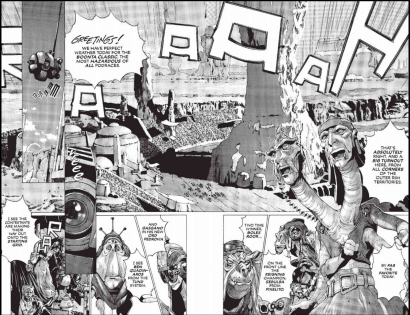
The artwork, on the other hand, is a hit-or-miss affair. Asamiya’s skill at drawing aliens, robots, space craft, and futuristic cities is unquestionable; his evocation of Otoh Gunga and Coruscant do justice to the complexity and specificity of Lucas’ original designs, while Asamiya’s establishing shots of Naboo convincingly evoke the planet’s lush jungles and Greco-Roman palaces without the added benefit of color. His ability to compress lengthy action sequences is likewise impressive; in just a few artfully constructed pages, for example, he captures the excitement and danger of Anakin Skywalker’s pod race, using panels-within-panels to juxtapose the racers’ progress with the crowd’s ecstatic reaction to the event:
Asamiya’s human characters, by contrast, are as expressionless as their big-screen counterparts—a key failing, as the characters register as pawns, not people, dutifully shuttled from one scenario to the next with almost no sense of how the violence and chaos they’ve encountered has affected them. Only the two principle non-human characters—JarJar Binks and C3PO—are drawn in an animated fashion, providing the series’ few moments of genuine emotion and surprise.

And that, in a nutshell, is why Asamiya’s take on The Phantom Menace is so frustrating: it improves on certain aspects of the source material while emphasizing its fatal flaws, making for an efficient but affectless gloss on Lucas’ original story that reads a lot like Cliff Notes. Not recommended.

STAR WARS: EPISODE I – THE PHANTOM MENACE, VOLS. 1-2 • ART BY KIA ASAMIYA • MARVEL COMICS • NO RATING (SUITABLE FOR READERS 10 AND UP)
Filed Under: Manga, Manga Critic, REVIEWS Tagged With: Kia Asamiya, Marvel Comics, Sci-Fi, star wars

A Double Dungeon review

January 5, 2020 by Sean Gaffney

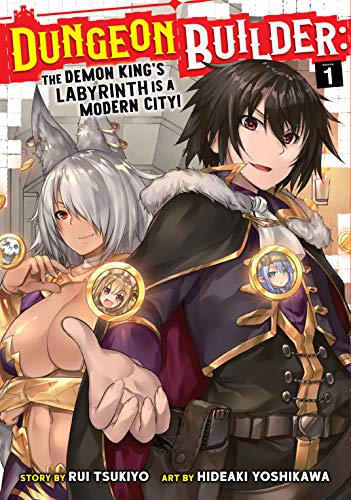
Dungeon Builder: The Demon King’s Labyrinth Is a Modern City!. By Rui Tsukiyo and Hideaki Yoshikawa. Released in Japan as “Maou-sama no Machizukuri! ~Saikyou no Danjon wa Kindai Toshi~” by Overlap, serialization ongoing in the magazine Comic Gardo. Released in North America by Seven Seas. Translated by Elina Ishikawa-Curran. Adapted by Julia Kinsman.

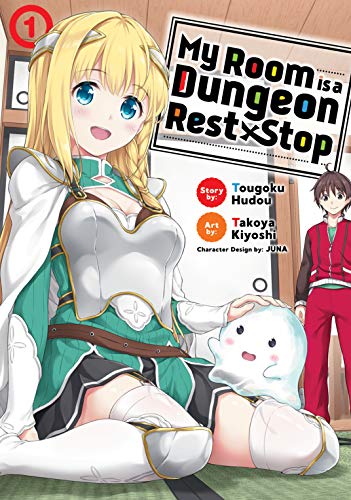
My Room Is a Dungeon Rest Stop. By Tougoku Hudou and Takoya Kiyoshi. Released in Japan as “Boku no Heya ga Dungeon no Kyuukeijo ni Natteshimatta Ken” by Takeshobo, serialization ongoing on the online site Web Comic Gamma. Released in North America by Seven Seas. Translated by Wesley O’Donnell. Adapted by Kim Kindya.

After reading both of these titles I decided to review them together. Yes, they both have ‘dungeon’ in the title, but more than that, they’re both clearly catering to the exact same audience: light novel fans who enjoy fantasy manga, or in this case adaptation of light novels we don’t have licensed over here. They both have suitably generic male leads – one may be a demon lord and the other may be a schlub in a tracksuit, but at the end of the day they’re not why you’re reading this. And there’s also plenty of fanservice. Which is why folks are reading this.

Dungeon Builder might be an isekai – we do see the new Demon Lord has lost his memories but knows what guns are – but the isekai part is mostly irrelevant. Procel is new Demon Lord of Creation, and has to create minions and dungeons that feed on people’s despair and fear. As the flash forward at the start of the book tells you, however, he is too nice a guy, so decides to make his dungeon the happiest place on Earth. It’s not clear yet how he’ll do this – the first volume doesn’t get too far into the story. He’s joined by Marcho, his busty demon lord mentor (that’s her on the cover) and two cute minions, both of whom look underage (something cheerfully pointed out by Marcho, who nicknames him “Lolicel”. This has slightly less service than the other title, and might develop into something interesting, but also seems to run on cliche power – his rival Demon Lord of Wind is a classic tsundere with shaky self-esteem that shows as arrogance. There’s also a dwarf girl who ticks the “rei Ayanami Expy” box.

My Room Is a Dungeon Rest Stop is more of a reverse isekai. Our hero Touru (Why? What that romanization now for that specific name? Don’t get me wrong, I was an ‘ou’ fan for the longest tine, but really?… sorry, back to the review) gets an apartment that’s dirt cheap… because once he moves in, the front door turns out to lead to a dungeon! Luckily, he can go out the window to his modern-day life. Exploring the dungeon, he comes across a passed-out adventurer girl and takes her back to his apartment, where she discovers the wonders of modern lie and explains a bit to him about dungeon life. Like Dungeon Builder, this title has barely gotten started. It’s a lot heavier on the fanservice – there’s a long sequence regarding the girl wetting herself from fear and the consequences of this that I really did not need to read about – and Touru is slightly more generic than the already generic Procel. As with Dungeon Builder, it opens with a brief flashforward showing us other characters who have fallen into our lead’s orbit.

I’d argue that both titles deliver what the intended audience wants, and will irritate anyone who is not in that narrow audience bracket. I’d say Dungeon Builder, based on its first volume, has more promise than Dungeon Rest Stop. I may get a second volume of the former. Still, if you like fantasy dungeon series with cute girls, these two books exist for you.

Filed Under: dungeon builder, my room is a dungeon rest stop, REVIEWS

Skull-Face Bookseller Honda-san, Vol. 1

January 4, 2020 by Katherine Dacey

If you’ve ever worked a thankless retail job, you’ll appreciate Skull-Face Bookseller Honda-san, a candid, fitfully funny series about working in the customer service industry. The titular character works in the manga section of a large Tokyo bookstore, helping buyers find the perfect series, taking inventory, and meeting with representatives from major publishers.

Some of her adventures are genuinely amusing, as when a handsome male customer requests explicit doujinshi for his daughter, or an American fujoshi explains her penchant for a particular seme-uke dynamic; other chapters are more matter-of-fact, conveying the difficulties of keeping popular titles in stock, or documenting the social and professional interactions among the staff members. Though none of its is laugh-out-loud funny, the artwork is terrific, capturing Honda-san’s sweaty anxiety every time a customer or colleague makes an uncomfortable request of her—no mean feat, given that the artist has depicted herself with a skeleton head and androgynous, apron-clad body. (Her colleagues’ identities have been camouflaged in a similar fashion: one has a paper bag for a head, and another wears a gas mask.) Amanda Haley’s thoughtful translation complements Honda’s crisp illustrations, offering useful context for understanding the unique challenges of selling manga to the general public, and plenty of footnotes to decode the insider shop-talk.

Yet for all the craft with which Skull-Face Bookseller is written, I never fully succumbed to its charms. I found the pacing uneven and the publishing-focused chapters long-winded, especially when contrasted with the snappy staging of Honda-san’s encounter with the international BL brigade. I’m still curious about the series, but would put Skull-Face Bookseller in the same category as Saint Young Men: a comedy that’s better in principle than in practice. Your mileage may vary.

SKULL-FACE BOOKSELLER HONDA-SAN, VOL. 1 • STORY AND ART BY HONDA • TRANSLATION BY AMANDA HALEY • YEN PRESS • NO RATING • 166 pp.

Filed Under: Manga, Manga Critic, REVIEWS Tagged With: Comedy, Skull-Face Bookseller, yen press

Bookshelf Briefs 1/4/20

January 4, 2020 by Ash Brown, Sean Gaffney and Michelle Smith Leave a Comment

Dead Dead Demon’s Dededede Destruction, Vol. 7 | By Inio Asano | Viz Media – Every time a new volume of this fantastic series comes out I avoid reading it, possibly as I still expect it to end with everyone depressed or dead, because Asano. Despite that, things trundle along in this volume. Oran’s starting to have ominous feelings that she’s seen some of this before, and even the main cast heading to the beach, with lots of silly beach comedy, can’t quite stop you thinking things aren’t going to be the same anymore, especially after that cliffhanger. Makoto is on the cover, and gets a fair number of scenes as well, something you can’t always say about the covers. Most of all, this continues to examine the nature of conspiracies and media frenzies. Great stuff. – Sean Gaffney

My Hero Academia, Vol. 22 | By Kohei Horikoshi | Viz Media – What I remember about this volume’s chapters when they came out weekly was the fandom going ballistic attacking Momo after her loss. Possibly because the main cast praised her abilities regardless, possibly as she lost another fight and Jump fans are all secret wrestling fans complaining about “Jobbers.” It’s an excellent battle, though. The other fights are good as well. You’d expect Todoroki to clean up, but that battle too does not go as expected. Bakugo shows off that he can be kind and heroic while STILL being a loud asshole, and Izuku shows that the fact that he’s trying to learn his powers on the fly is leading to bad things. Fortunately, Uraraka and Shinso are there. Excellent. – Sean Gaffney

Queen Bee, Vol. 3 | By Shizuru Seino | Kodansha Comics (digital only) – In Queen Bee’s second volume, Toma realized he had feelings for Hirata while on a forest field trip, during which she displayed extreme competence (and fought off a bear). Now, they’ve become an official couple, but Hirata’s insecurity, coupled with the reveal of a junior high ex-girlfriend that Toma might still have feelings for, makes her worry that he’s just trying to make himself love her. Ordinarily, the emergence of a love rival in the latter half of the final volume of a short series would irritate me a great deal, but I actually liked that it gave Hirata one more opportunity to show that Toma’s happiness is her top priority. She may look scary, but she’s pure and valiant, and in the end, this series kind of gave me gender-flipped My Love Story!! feels. Truly delightful. – Michelle Smith

Queen’s Quality, Vol. 8 | By Kyousuke Motomi | Viz Media – Answers are here, with extended flashbacks showing us what actually happened years ago, and who Fumi is. It’s helpful to have Kyutaro’s late mother explaining things to them, admittedly, and she’s super cool—I’d be OK with more adventures of her. Meanwhile, as Fumi tries to take this all in, Kyutaro adds to things by confessing to her, something which is perhaps not timely but is at least heartfelt. That said, it may be relatively irrelevant, as the cliffhanger suggests that we may be seeing some memory loss/destruction of alternate selves going on. Still, as far as dream-laden fantasy shoujo with comedic undertones go, QQ is tops. And love that they still have Dengeki Daisy cameos in them. – Sean Gaffney

Saint Young Men, Vol. 1 | By Hikaru Nakamura | Kodansha Comics – The premise of Saint Young Men is both simple and kooky. Jesus and Buddha have rented an apartment in Japan to enjoy some well-earned time off, where they enter into a sort of odd-couple existence, with Buddha being the serious guy who does all the chores and Jesus being the carefree guy who has a popular TV review blog. The situations are pretty fun—the guys go to an amusement park and ride a roller coaster, they experience a packed commuter train, Jesus buys a Shinsengumi costume to wear as pajamas, Buddha wins a statue of himself while trying to win a trip to Okinawa…—but I’m sad to report that I never actually laughed at anything. Perhaps that will change with later volumes, as I did think this one got more amusing as it went along. We shall see! – Michelle Smith

Species Domain, Vol. 7 | By Shunsuke Noro | Seven Seas – The bulk of this volume is based around the school athletics festival, which gives us a chance to revisit several ongoing issues: Kazamori trying to live up to the “elf” standard everyone sees in her, ship tease between Hanei and Mikasagi, and the usual athletic festival cliches. The most interesting part of the book was showing us that Mizuno, who is frustrated at the mermaid classmate who’s going to put the swimming competition out of reach, also is a mermaid. That said, the reason they’ve been hiding it is fascinating, getting into both monster cliches and the sort of thing that LGBTQ people deal with daily, and I thought the reaction of the class was great. All in all, another solid volume. – Sean Gaffney

Sword Art Online: Hollow Realization, Vol. 5 | By Tomo Hirokawa, based on the story by Reki Kawahara | Yen Press – Despite Genesis being a clear bad guy, one who’s even taking drugs to enhance his gaming “performance,” he’s still able to make a huge impression on Tia. Sadly, when he is then “killed,” that proves the impetus for her to pick up where he left off, and she’s now out to remove humans from this MMORPG. As always with SAO lately, there’s some good discussion of what constitutes an NPC, and Premiere also goes through some emotional crises, especially given Tia is her dark twin. The next volume is the final one, so we’ll see if Kirito and the cast of every other video game spinoff can help. Despite the high entry level of this series, it’s pretty decent. – Sean Gaffney

The Trial of Kitaro | By Shigeru Mizuki | Drawn & Quarterly – Collecting five short manga originally published in shonen magazines between 1968 and 1971, The Trial of Kitaro brings to a close Drawn & Quarterly’s delightful seven-volume compilation of selections from Mizuki’s influential series GeGeGe no Kitaro. Combining creepiness with comedy (including some literal potty humor—beware haunted mountainside toilets), the stories in this volume are tremendous fun. As with previous installments, the episodic chapters were in part chosen specifically to be kid-friendly, so there’s a certain amount of grossness and just plain strangeness to them. But, regardless of intended audience, I’m enamored with these yokai tales of horror. I love how Mizuki has taken traditional Japanese folklore and incorporated his own ideas and even some Western legends to create something truly special. Along with the other volumes, I will treasure The Trial of Kitaro. I am sad that this is the series’ end, but I am so incredibly happy that these stories were translated. – Ash Brown

Filed Under: Bookshelf Briefs

Full Metal Panic!: Ending Day by Day, Part 2

January 4, 2020 by Sean Gaffney

By Shouji Gatou and Shikidouji. Released in Japan by Fujimi Fantasia Bunko. Released in North America by J-Novel Club. Translated by Elizabeth Ellis.

This is also quite a short book, though not as short as the first part, and it might have flowed better as one long volume. But light novels were shorter in general back when FMP! came out. What’s more, it might have simply been too exhausting: the events in this book are designed to grind our hero and heroine down to the point where they’re both mentally broken, and succeed in doing so, though thankfully no permanent harm is done. Having this as the entire second half of one book might have demoralized the reader. As it is, be prepared for Sousuke to get more and more depressed and distracted, to the point where he’s zoning out and thinking of Kaname during an actual mission, leading to an accident and Mao having to try to clean up after him. (One weakness of the book is that we don’t see him meeting Mao after this occurs and he stalks off, possibly as she’d break his jaw and he needs that jaw.)

After spending most of the last few books seemingly getting killed and then coming back like Richard Nixon, Gauron finally bows out here, though not before making Sousuke’s life even more miserable than it already is. His new squad commander shows he doesn’t trust the Arbalest, which Sousuke agrees with – this despite talking with “Al” and finding the AI a lot more human than he had imagined. Unfortunately, he does not have the opportunity to work this out off-duty, as Hing Kong is about to descend into civil war thanks to Amalgam, whose leader turns out to be Tessa’s brother Leonard, who is there to give us a new bad guy to hate now that Gauron (finally) dies. Gauron was after Sousuke – Leonard is after Kaname. Kaname is possibly helping out, as after finding that Sousuke has removed himself from her life, she goes on a rampage in an effort to get her new “watcher” to take action… something that has almost lethal consequences.

It has to be said, a number of Kaname’s actions in this book beggar belief, and are the very definition of “don’t try this at home”. In particular, if you are being watched and want your tail to make themselves known, don’t take some stranger to a love hotel so he can try to assault you. However, Kaname gets a number of good (if fanservicey) scenes in this book, none more so than her reappearance and thrashing of Sousuke after he had been told she was dead, which is one of the best moments in the entire series. Unfortunately, it also highlights the pacing problems – this book is all backloaded, meaning the front part drags. Clouseau wipes the floor with Sousuke, but then seems to mostly vanish, with only a brief suggestion that his trashing of their late commander was entirely an act. Oh yes, and Tessa’s apology to Sousuke was cute, but reminds us again that she’s a very, very distant second in this love comedy race for Sousuke’s heart.

The next volume promises to be a longer one, and also lighter in tone, likely with more of the “wacky” comedy parts of FMP that sometimes work and sometimes read like the author read too many shonen manga with tsunderes. This is a flawed but readable angst-and-action book in the meantime.

Filed Under: full metal panic!, REVIEWS

Ms. Kozumi Loves Ramen Noodles, Vol. 1

January 3, 2020 by Katherine Dacey

Ms. Kozumi Loves Ramen Noodles is pretty much what you’d expect from the title: a manga about a high school student whose interest in noodles crosses the line from simple enthusiasm into full-blown mania. While Kozumi’s peers go to the mall or the malt shop, she visits out-of-the-way restaurants to sample every conceivable type of ramen, from spicy to sour to sweet. Her passion is so extreme, in fact, that she ditches school for a 200-mile trip to Iwaki just to taste a local specialty: no-bake natto ramen. Though Kozumi is uninterested in socializing with her classmates, three girls—Yu, Misa, and Jun—find Kozumi’s reticence an irresistible challenge, and repeatedly seek her company outside of school. Yu, in particular, is one of those only-in-manga characters whose cheerfully inappropriate behavior would be considered creepy in almost any other context, as she follows Kozumi to ramen joints around Tokyo, copying Kozumi’s behavior and—more egregiously—her orders. When Yu’s pals befriend Kozumi before she does, she flies into a jealous tizzy, and doubles down on her efforts to show Kozumi that she, too, appreciates ramen.

These scenes are clearly intended to be funny, but the social dynamic among the four principal characters is too strained to elicit laughter, as it relies almost entirely on the characters behaving idiotically for effect. The artwork, too, leaves something to be desired, juxtaposing hyper-realistic drawings of food and condiments with ultra-cutesy character designs that seem ready-made for key chains and body pillows. The cuteness would be less off-putting if the characters weren’t frequently drawn in rapturous close-up, sucking down noodles while suggestive trickles of broth dangled from their lips—a potent reminder that Ms. Kozumi runs in a seinen magazine and not, say, Bessatsu Friend.

The shop talk, by contrast, is genuinely enlightening. If your primary experience with ramen has been limited to steaming bowls of noodles, scallions, and chicken broth, the sheer range of dishes will come as a revelation; in one sequence, for example, Kozumi describes a form of ice cream ramen, while in another, Jun discovers the savory pleasures of a salted pineapple ramen bowl. A solid translation by Ayumi Kato Blystone helps convey what’s distinctive about each dish, and offers good insight into how dishes are prepared—more so, in fact, than many ostensibly “serious” food manga. So on that front, at least, Ms. Kozumi succeeds in communicating why the title character likes ramen so much; too bad the reader has to soldier past so much resolutely unfunny slapstick to enjoy the tastiest bits. Your mileage may vary.

MS. KOZUMI LOVES RAMEN NOODLES, VOL. 1 • ART AND STORY BY NARU NARUMI • TRANSLATED BY AYUMI KATO BLYSTONE • DARK HORSE COMICS • 136 pp. • NO RATING

Filed Under: Manga, Manga Critic, REVIEWS Tagged With: Comedy, Cooking and Food, Dark Horse

Takane & Hana, Vols 11 and 12

January 3, 2020 by Anna N

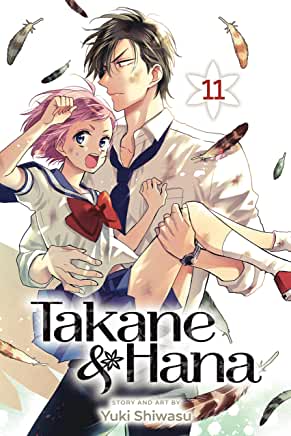
Takane & Hana, Volumes 11 and 12 by Yuki Shiwasu

Sometimes my interest tends to wane a bit at more long-running comedic series, but Takane and Hana is still going strong, even when some of the plot points tend to get repetitive. The main way this manga manages to actually get me rooting for a romance between an emotionally stunted businessman and a high school girl is the way it deliberately shies away from things progressing very far physically. As the 11th volume opens Takane and Hana are dealing with the emotional fallout from when Takane got carried away….and kissed Hana on the nose. The over-the-top angst combined with Shiwasu’s dynamic rendering of psychological turmoil makes the opening chapter extremely amusing. Things aren’t kept light for long, as Takane’s evil cousin Yakumo figures out the relationship between Takane and Hana and decides to kidnap her. I’m trying to remember if this is the second or third kidnapping in this series, but it does provide the opportunity for some impressive, action-movie heroics as Takane and Okamon attempt to rescue Hana.

takane and hana 11

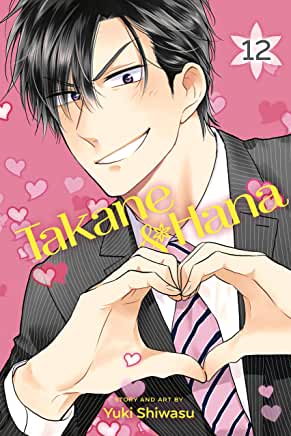
Volume 12 features my favorite cover so for this series, Takane’s twisted grin combined with heart hands captures the wacky appeal of this manga. Takane is recuperating from his dramatic rescue attempt, and Hana is determined to put more distance between them again because she doesn’t want their relationship to cause issues for Takane. This is circling back to a reset of their previous relationship dynamic, where Takane is bombarding Hana with an endless stream of unsuitable gifts and she’s growing more and more frustrated. Okamon ends up enlisting himself as Hana’s beard as he prevents Takane from grabbing Hana and carrying her out of a diner by proclaiming that he and Hana just recently started going out.

takane and hana 12

Takane ends up getting relationship advice from Nicola on a speedboat, and his attempts to rehearse speaking to Hana as well as “chill out” feature the emotional anguish and hilariously tortured facial expressions that Shiwasu is so excellent at portraying. These two volumes continue doing what Takane & Hana does so well – set up over the top comedic situations combined with a core relationship that is actually very sweet.

Filed Under: Manga Reviews, REVIEWS Tagged With: shojo beat, shoujo, takane & hana, viz media

Tomo-chan Is a Girl!, Vol. 6

January 3, 2020 by Sean Gaffney

By Fumita Yanagida. Released in Japan as “Tomo-chan wa Onnanoko!” by Star Seas Company, serialized on the online site Twi 4. Released in North America by Seven Seas. Translated by Jennifer and Wesley O’Donnell. Adapted by T Campbell.

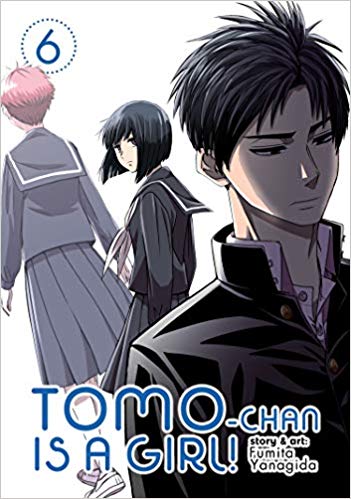
After the first volume, as I do with most series I follow, Tomo-chan Is a Girl! moved to Bookshelf Briefs. But sometimes you have things to say that cannot be condensed into 150 words, and this volume is a very good example – it’s almost the perfect Tomo-chan volume. We resolve Carol and Misaki’s romance, and given Carol possibly the best material she’s ever gotten, as Misuzu’s attempts to “break” her work all too well. The marathon chapter is one big long take on the Japanese saying “idiots don’t catch colds”, which Tomo proves wrong, to everyone’s shock and horror. And we get two chapter’s worth of flashbacks, showing how we got to the present setup – Tomo and Jun’s middle-school years, Jun’s own realization of his feelings, and possibly the most disastrous couple in the history of manga. If you love this manga series, this may be the pinnacle – there’s two more volumes after this, but it’s hard not to argue that this is the high point.

Carol has sort of been the breakout star of Tomo-chan, and her default reaction is, of course, smiles and good cheer. Now we, as the reader, and also Misuzu, have seen that cheer fall sometimes – notably when thugs were threatening Misuzu and she tried to protect Carol by saying they weren’t friends. But Misaki doesn’t see this, partly as Carol will never deliberately show that side to him, and partly as he’s scared to look further for fear there’s nothing behind her smile. Now, arguably Misuzu’s action here are appalling – something she realizes immediately. But they do work, and we get, as Tomo says, a wonderful few pages that show us that Carol can have real human emotions as well. (I was also amused at Carol’s mother cutting her off before she can go in for a kiss – given Ferris had Carol when she was thirteen, you can see why she’s going to step in. That said, given the omake chapter at the end, Ferris has little to worry about on Misaki’s end.)

I will admit that the two flashback chapters do run on a very old and creaking cliche, which is that Jun does not realize, for years, that Tomo was a girl, despite seeing her literally using the girls’ bathrooms at events. It always makes the main lead feel a bit too stupid, and it does here as well. But what follows is all too real and familiar, as Jun cuts himself off from Tomo after he doesn’t know how to be around her, and she too is hurt and retreats. Jun then realizes he needs to make an effort here, and does so… in a bizarre way. The brief, a few days relationship between Jun and Misuzu feels so wrong you want to scream, and both of them know it. Despite that, I loved that even though they knew that, both acknowledged that dating another person, having those feelings, felt good.

So we now have all the backstory, all we need to do is get Tomo and Jun on the same page and confessing. This has taken 6 volumes and we’re still not there yet, but the good news is that the end is in sight. Till then, Tomo-chan Is a Girl! is one of the best 4-komas I’ve read in some time. Funny and sweet.

Filed Under: REVIEWS, tomo-chan is a girl!

Junji Ito’s No Longer Human

January 2, 2020 by Katherine Dacey

Of all the famous works of literature to get the Classics Illustrated treatment, Osamu Dazai’s No Longer Human is an odd choice. Its protagonist is Oba Yozo, a tortured soul who never figures out how to be his authentic self in a society that places tremendous emphasis on hierarchy, self-restraint, and civility. Over the course of the novel, he binges, gambles, seduces a string of women, joins a Communist cell, attempts suicide, and succumbs to heroin addiction, all while donning the mask of “the farcical eccentric” to conceal his “melancholy” and “agitation” from the very people whose lives he ruins.

Though the novel is filled with incident, its unreliable narrator and relentless interiority make it difficult to effectively retell in a comic format, as Junji Ito’s adaptation demonstrates. Ito’s No Longer Human is largely faithful to the events of Dazai’s novel, but takes Dazai’s spare, haunting narrative and transforms it into a phantasmagoria of sex, drugs, and death. In his efforts to show us how Yozo feels, Ito leans so hard into nightmarish imagery that the true horror of Yozo’s story is overshadowed by Ito’s artwork—a mistake, I think, as Ito’s drawings are too literal to convey the nuance of what it means to exist, in Peter Selgin’s words, in a state of “complete dissociation… yet still capable of feeling.”

In Ito’s defense, it’s not hard to see what attracted him to Dazai’s text; Yozo’s narration is peppered with the kind of vivid analogies that, at first glance, seem ideally suited for a visual medium like comics. But a closer examination of the text reveals the extent to which these analogies are part of the narrator’s efforts to beguile the reader; Yozo is, in effect, trying to convince the reader that his mind is filled with such monstrous ideas that he cannot be expected to function like a normal person. There’s a tension between how Yozo describes his own reactions to the ordinary unpleasantness of interacting with other people, and how Yozo describes the impact of his behavior on other people—a point that Ito overlooks in choosing to flesh out some key events in the novel.

Nowhere is that more evident than in Yozo’s brief affair with Tsuneko, a destitute waitress. After hitting rock bottom financially and emotionally, Yozo persuades her to join him in a double suicide pact. Dazai’s summary of what happens is shocking in its brevity and matter-of-factness:

As I stood there hesitating, she got up and looked inside my wallet. ‘‘Is that all you have?” Her voice was innocent, but it cut me to the quick. It was painful as only the voice of the first woman I had ever loved could be painful. “Is that all?” No, even that suggested more money than I had — three copper coins don’t count as money at all. This was a humiliation more strange than any I had tasted before, a humiliation I could not live with. I suppose I had still not managed to extricate myself from the part of the rich man’s son. It was then I myself determined, this time as a reality, to kill myself.

We threw ourselves into the sea at Kamakura that night. She untied her sash, saying she had borrowed it from a friend at the cafe, and left it folded neatly on a rock. I removed my coat and put it in the same spot. We entered the water together.

She died. I was saved.

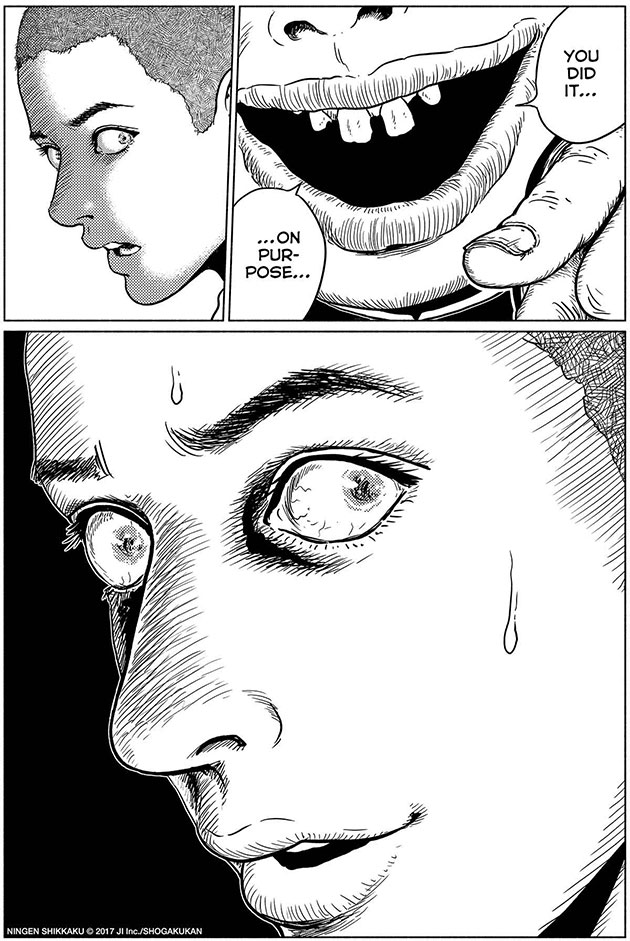
As Ito recounts this event, however, Tsuneko’s death is caused by a poison so painful to ingest that she collapses in a writhing heap, eyes bulging and tongue wagging as if she were in the throes of becoming a monster herself. Yozo’s reaction to the poison, by contrast, is to plunge into a hallucinatory state in which a parade of ghostly women mock and berate him, an artistic choice that suggests Yozo feels shame and guilt for his actions—and a reading of Dazai’s text that makes Yozo seem more deserving of sympathy than he does in Dazai’s novel:

Throughout this vignette, Yozo’s contempt for Tsuneko creeps into the narrative, even as he assures the reader that she was the first woman he truly loved. Yozo’s disdain is palpable, as is evident in the way he off-handedly introduces her to the reader:

I was waiting at a sushi stall back of the Ginza for Tsuneko (that, as I recall, was her name, but the memory is too blurred for me to be sure: I am the sort of person who can forget even the name of the woman with whom he attempted suicide) to get off from work.

Only a few episodes capture the spirit of Dazai’s original novel, as when Yozo’s father gives an inept speech to a gathering of businessmen and community leaders. Ito skillfully cross-cuts between three separate conversations, allowing us to step into Yozo’s shoes as he eavesdrops on the attendees, servants, and family members, all of whom speak disparagingly about each other, and the speech. By pulling back the curtain on these conversations, Ito helps the reader appreciate the class and power differences among these groups, as well as revealing that this episode was a turning point for Yozo: the moment when he first realized that adults maintain certain masks in public that they discard in private. Though such a moment would undoubtedly trouble a more observant child—one need only think of Holden Caulfield’s obsession with adult “phoniness”—this discovery plunges Yozo into a state of despair, as he cannot imagine how anyone reconciles their public and private selves in a truthful way.

Ito also wisely restores material from Dazai’s novel that other adaptors—most notably Usamaru Furuya—trimmed from their versions. In particular, Ito does an excellent job of exploring the dynamic between Yozo and his classmate Takeichi, the first person who sees through Yozo’s carefully orchestrated buffoonery:

Just when I had begun to relax my guard a bit, fairly confident that I had succeeded by now in concealing completely my true identity, I was stabbed in the back, quite unexpectedly. The assailant, like most people who stab in the back, bordered on being a simpleton — the puniest boy in the class, whose scrofulous face and floppy jacket with sleeves too long  for him was complemented by a total lack of proficiency in his studies and by such clumsiness in military drill and physical training that he was perpetually designated as an ‘‘onlooker.” Not surprisingly, I failed to recognize the need to be on my guard against him.

As one might guess from this passage, Yozo’s terror at being discovered is another critical juncture in the novel. “I felt as if I had seen the world before me burst in an instant into the raging flames of hell,” he reports, before embarking on a campaign to win Takeichi’s trust by “cloth[ing his] face in the gentle beguiling smile of the false Christian.” Though Ito can’t resist the temptation to draw an image of Yozo engulfed in hell fire, most of Yozo’s fear is conveyed in subtler ways: a wary glance at Takeichi, an extreme close-up of Yozo’s face, an awkwardly placed arm around Takeichi’s shoulder:

What happens next in Ito’s version of No Longer Human, however, is indicative of another problem with his adaptation: his decision to add new material. In Dazai’s novel, Takeichi simply disappears from the narrative when Yozo moves to Tokyo for college, but in Ito’s version, Yozo cruelly manipulates Takeichi into thinking that Yozo’s cousin Setchan is in love with him—a manipulation that ultimately leads to Takeichi’s humiliation and suicide. That violent death is followed by a gruesome murder, this time prompted by a love triangle involving Yozo, his “auntie,” and Setchan, who becomes pregnant with Yozo’s child. Neither of these episodes deepen our understanding of who Yozo really is; they simply add more examples of how manipulative and callous he can be, thus blunting the impact of the real tragedy that unfolds in the late stages of his story.

Ito’s most problematic addition, however, is Osamu Dazai himself. Ito replaces the novel’s original framing device with the events leading up to Dazai’s 1948 suicide, encouraging us to view No Longer Human as pure autobiography through reinforcing the parallels between Dazai’s life and Yozo’s. And while those parallels are striking, the juxtaposition of the author and his fictional alter ego ultimately distorts the meaning of the novel by suggesting that the story documents Dazai’s own unravelling. That’s certainly one way to interpret No Longer Human, but such an autobiographical reading misses Dazai’s broader themes about the burden of consciousness, the nature of self, and the difficulty of being a full, authentic, feeling person in modern society.

VIZ Media provided a review copy. You can read a brief preview at the VIZ website by clicking here. For additional perspectives on Junji Ito’s adaptation, see Serdar Yegulalp‘s excellent, in-depth review at Ganriki.org, Reuben Barron‘s review at CBR.com, and MinovskyArticle’s review at the VIZ Media website.

JUNJI ITO’S NO LONGER HUMAN • ORIGINAL NOVEL BY OSAMU DAZAI • BASED ON THE ENGLISH TRANSLATION BY DONALD KEENE • TRANSLATED AND ADAPTED BY JOCELYNE ALLEN • VIZ MEDIA • RATED M, FOR MATURE AUDIENCES • 616 pp.

Filed Under: Manga, Manga Critic, REVIEWS Tagged With: Junji Ito, no longer human, Osamu Dazai, VIZ, VIZ Signature

Manga the Week of 1/8/20

January 2, 2020 by Sean Gaffney, Ash Brown, Anna N, Michelle Smith and MJ Leave a Comment

SEAN: OK, now it’s actually January. You can tell as the Viz books are all pouring in. But first…

J-Novel Club has a giant pile of things due out. For print books, we have Animeta! 2, An Archdemon’s Dilemma 3, Ascendance of a Bookworm 3, and Infinite Dendrogram 4.

ASH: I’ve been meaning to give Animeta! a try now that it’s available in print.

MICHELLE: I thought the first volume was pretty fun.

SEAN: On the digital side, there’s Animata! 3, Demon Lord Retry! 2, Der Werwolf 6, In Another World with My Smartphone 18, the 2nd Marginal Operation manga, Otherside Picnic 2, and There Was No Secret Evil-Fighting Organization (srsly?!), So I Made One MYSELF! 2.

From Kodansha Comcis, we get, in print, Grand Blue Dreaming 9 and Tales of Berseria 2.

There’s a lot more digitally. The debut is That Blue Summer (Ao Natsu), a Betsufure series from the creator of To Be Next To You, which we saw debut digitally this week. That’s a big grin that girl has on the cover.

And we get All-Rounder Meguru 12, Chihayafuru 18, Magical Sempai 6, My Sweet Girl 10, Smile Down the Runway 5, and To Write Your Words 2.

ASH: Both J-Novel Club and Kodansha Comics have some great digital offerings this week.

ANNA: Nice, maybe I’ll use my remaining week of vacation to get more caught up on Chihayafuru.

MICHELLE: Yay for more shoujo and super yay for more Chihayafuru!

SEAN: Seven Seas has quite a bit, including a couple of debuts. Dungeon Builder: The Demon King’s Labyrinth is a Modern City! (Maou-sama no Machizukuri! ~Saikyou no Danjon wa Kindai Toshi~) is a manga adaptation of a light novel (which I don’t believe is licensed) that runs in Overlap’s Comic Gardo. Demon Lords create labyrinths to trap people and consume their despair… but this one just wants to be super nice.

ASH: That actually sounds kind of amusing.

SEAN: My Room Is a Dungeon Rest Stop (Boku no Heya ga Dungeon no Kyuukeijo ni Natteshimatta Ken) is also based on a light novel… which again I don’t think we have here… that runs in Takeshobo’s Web Comic Gamma. A guy buys a dirt-cheap apartment, then finds that it also leads to a fantasy dungeon. Can he help adventurers in trouble and show them the wonders of modern plumbing?

Also out from Seven Seas: Akashic Records of Bastard Magical Instructor 8, the print edition of the 2nd Arifureta ZERO novel, the print edition of Vol. 1 of Magic User: Reborn in Another World as a Max Level Wizard, the print version of the 4th Mushoku Tensei novel, and Tomo-chan Is a Girl! 6.

Vertical has a 2nd volume of the Bakemonogatari story, which finishes up Senjogahara’s story and starts Hachikuji’s.

Viz has no debuts next week, but it does have the 18th and final volume of Anonymous Noise. Will the romantic triangle resolve?

MICHELLE: I mean, it’s gotta, right?

SEAN: We also get, on the shonen/seinen side, Black Clover 19, Demon Slayer: Kimetsu no Yaiba 10, Dr. STONE 9, Haikyu!! 36, Kaguya-sama: Love Is War 12, and The Promised Neverland 13.

ANNA: Good stuff!

On the shoujo/josei side, we get Daytime Shooting Star 4, An Incurable Case of Love 2, and Snow White with the Red Hair 5.

ASH: I’ll read all of those, honestly.

ANNA: Nice! It is a week for Anna!

MICHELLE: I enjoy quite a few of these but am most excited about Snow White with the Red Hair and Haikyu!!.

MJ: I can’t believe this is the first time I’m speaking up here with all this manga, but I’m here for Snow White with the Red Hair!

SEAN: Lastly, Yen has two stragglers that got delayed from December. Yen On gives us the 18th and NOT final volume of Sword Art Online, though this does wrap up the giant massive-10-volume Alicization arc.

For manga, we get Chio’s School Road 7.

Some interesting stuff there. What are you picking up?

Filed Under: FEATURES, manga the week of

Beatless, Vol. 1

January 2, 2020 by Sean Gaffney

By Satoshi Hase and redjuice. Released in Japan by Kadokawa Bunko. Released in North America digitally by J-Novel Club. Translated by Ben Gessel.

This is a doorstopper of a book, and I think my largest issue with it is that it could easily have been split into two normal-sized books. There’s a lot going on in it, yes, with a large number of very cool action set-pieces, but the book also wants you to know that it’s going to be talking about what hakes a human and what makes an artificial intelligence, and it does. In great detail. It’s quite interesting, but after a while it can be exhausting. I also wish we had spent a bit more time with hIEs (that’s the series name for the artificial intelligences mankind has built) other than the five main modern units, as they’re clearly meant to be more special and more human than the usual shopkeeper hIEs and the like. It’s a bit difficult to hear one of the cast talking about them as if they’re cars that can be sold when you get to see their POV briefly and see they do have wants and needs beyond their owners.

This takes place almost a century from now, where humanoid intelligences (hIEs) have gotten to the point where they’ve started doing the “drudge” jobs for humanity and also are hard to tell apart from humanity. Our hero is Arato, who at times almost seems a parody of “generic anime protagonist”. He’s aggressively normal, except for the fact that he always wears his heart on his sleeve and tries to think of everyone as basically kind. He’s also kind to hIEs, seeing them as people, which his friends Ryo and Kengo certainly don’t. His father is a major player in the hIE world, but we barely meet him. His sister is even a classic anime little sister. That said, it all changes when, coming across a bizarre flower attack on the hIEs in the street, he’s rescued by Lacia, a clearly far more advanced than the usual hIE who asks him to become her “owner”. He agrees, but she also has a lot of secrets – like how she’s connected to five hIEs who broke out of a lab and are being hunted down.

This book does get a lot of things right. Arato is simple and earnest without being boring, and you get why people naturally like him. Yuka is a spoiled little sister but also not annoying. Ryo, his best friend and the heir to a hIE organization, is probably the most interesting and nuanced character in the book, and we watch him slowly go from being Arato’s best friend to a villain in stages so gradual you barely notice it. The action movie set pieces are fantastic, the best being a massive firefight at an airport that also involves one of the cast trapped in a slowly burning limo. It does, however, love to have everyone and their brother talk about the role of hIEs in society, and whether they are like people (Arato’s view) or like toasters (seemingly everyone else’s view). Towards the end the book even becomes a zombie survival novel, but never lets go of the nature of hIEs even then.

Given its length, there’s a lot more I didn’t get into here, like Lacia’s modeling career, or the somewhat abbreviated terrorist career of Arato’s other best friend Kengo (who is then mostly removed from the rest of the book, presumably as his function is finished). I think it might read better if you pace it out over several days. I do recommend it for fans of action-filled works, near-future SF what-ifs, and of course those who have seen the anime.

Filed Under: beatless, REVIEWS

Silver Spoon, Vol. 12

January 1, 2020 by Sean Gaffney

By Hiromu Arakawa. Released in Japan as “Gin no Saji” by Shogakukan, serialized in the magazine Weekly Shonen Sunday. Released in North America by Yen Press. Translated by Amanda Haley.

You can tell that the new year is starting in Silver Spoon because there’s a new freshman, and she’s interested in horses. This despite being in the dairy program. Again, it’s great to see that even at an agricultural school like Ezo, you don’t have to necessarily be slotted into the drawer that your family farm and/or business puts you in. It also once again shows the value of trying even after failure (she tried to get in on the science track, failed, and tried again on the ‘general’ track), which is good, as Hachiken is also dealing with some repeated failures in his life as well. On the positive side, his father is reading his business proposals and taking them seriously. On the negative side, they’re still not good enough, and he’s still not investing any money in them. That could change as we see the start of something that seems obvious but was never thought of much before: Hachiken needs to earn money and invest in his own business.

Of course, sometimes taking that once-in-a-lifetime chance can also lead to failure in the end – there’s a two-week student program in France that’s offered to Hachiken but he passes it on to cheese-loving Yoshino, who jumps at it… and then finds that for the two weeks, she’s at a high school specializing in fish. And yet, even with this obvious punchline, she manages to eat lots of French cheese and has a better idea about the direction she wants to go in. Any experience is good experience if it can show you a better way forward. That also applies to Komaba, who9 still has everyone telling him not to simply give up and abandon all his dreams, including his own family, and Mikage – indeed, the scene between him and Mikage is possibly the best in the volume.

As for Hachiken, he’s sticking with what he knows best – which is to say, pigs. Pigs and pizza. The section of the book dealing with pasturing pigs, free-range style, is fascinating, as with most of the “here is how you do agriculture” stuff in this series. He’s also found a way to solve the problem of Ookawa’s ongoing awfulness – hire him as company president, as when he’s working he’s far more reliable. It’s a character development that makes sense and is hilarious. As for romance, well, it’s pretty much on the back burner until Mikage manages to get into college – though that’s not stopping others (Sakae) from trying to get them to “go all the way”. And there’s also a suggestion that more equestrian action may be in his future – this despite the fact that he’s not picked for the preliminaries. They’re saving him! Again, seeing Hachiken from Vol. 1 and comparing him to this Hachiken is like night and day.

I’m not sure what to add. Another very good volume in a stellar series. Read it.

Filed Under: REVIEWS, silver spoon

I’ve Been Killing Slimes for 300 Years and Maxed Out My Level, Vol. 6

December 31, 2019 by Sean Gaffney

By Kisetsu Morita and Benio. Released in Japan as “Slime Taoshite 300 Nen, Shiranai Uchi ni Level MAX ni Nattemashita” by GA Novels. Released in North America by Yen On. Translated by Jasmine Bernhardt and Taylor Engel.

There is a literary device known as lampshade hanging, wherein the author, knowing that a plot point is ridiculous or obvious, points this out in the narrative, thus taking the curse off it a bit. A classic example is Bruce Willis in Die Hard 2 bemoaning that he’s having the same bad Christmas as Die Hard 1. Readers of Killing Slimes for 300 Years, therefore, should be ready for a number of instances in this book, even more than the usual, where our heroine just straight up says “wow, it’s just like we have in Japan”. The temple visits, the way that weddings happen, various types of spirits… boy, it seems really familiar somehow. This, of course, is because the author is Japanese and doesn’t want to spend too much of a slice-of-life book developing a world when she can have the cast go to the beach instead. Even the Beelzebub side story (which makes a welcome return) has as the central gag Japanese office politics, only with demons.

As with previous volumes, it’s a grab bag of what are basically short stories with Azusa and the gang. While visiting her “mother”, she eats something that turns her small, allowing her a few days to be treated like a real child. She goes to a “singles event” that turns out to be filled with much older men than expected, then meets the local spirit, who tries to officiate weddings but has had bad luck with no one coming by lately. No one in the cast is ready to get married, so they do a “sister’s wedding” between Falfa and Shalsha, inviting most of the regulars. After an injury causes her to revert to her slime form, Fighsly enters a fighting tournament anyway. The cast, as I said above, go to a jellyfish-filled beach, and then we see Halkara’s hometown, and find she’s the responsible one. Then we get more of Beelzebub’s origin story, as she has to deal with crooked administrators and murderous former colleagues.

There’s nothing really to analyze here – it’s not as if people have character development in a series like this – so the goal is to see how cute and fluffy everything is. The answer is very. The wedding may be between two sisters, but features all the things you’d expect, and will put a smile on your face. Halkara’s family were funny and also helped make a character who can grate on a reader fairly easily more sympathetic. There’s more wacky spirits – one talks like a dazed hippie a lot of the time, and another is interested in painting portraits… but the portraits may not come out the way others like. And the Beelzebub chapters are great, showing how even when she’s unsure of herself she still kicks eleven kinds of ass.

Anyone wanting depth and ongoing plot should run far away from this series. But if you like “cute girls doing cute things”, it’s right up your alley.

Filed Under: i've been killing slimes for 300 years, REVIEWS

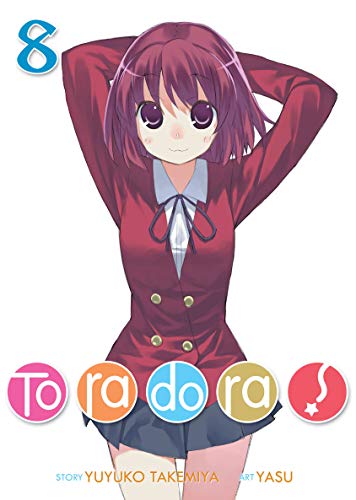
Toradora!, Vol. 8

December 30, 2019 by Sean Gaffney

By Yuyuko Takemiya and Yasu. Released in Japan by Dengeki Bunko. Released in North America by Seven Seas. Translated by Jan Cash & Vincent Castaneda. Adapted by Will Holcomb.

Last time everything was terrible, and I asked is some of that could be fixed by the end of this book. The answer is mostly no, though we do get one major revelation that I expect will eventually lead to the endgame. Till then, though… this was a good volume, with lots of relatable teenage angst, but I have to admit that it feels very much like an author being told to stretch out a series to a nice round ten books and therefore just having everything continue to disintegrate. Minori in particular is still making all the wrong choices, trying to pretend that everything between her and Ryuuji is still exactly the same. Sadly, she’s much better at pretending than he is, so he assumes that his almost-confession meant nothing to her. Ami calls her out on her bullshit, which leads to a major fight between them. And then there’s the ending of the book, which I’ll get into later but leaves Minori sobbing alone in a corner. This is not a wacky fun Toradora! volume.

The tone of the book is set up right off the bat, as the much-awaited trip to Okinawa is cancelled when the hotel they were supposed to stay in burns down. As such, the class trip is a much shorter skiing trip, which pleases absolutely no one. As for Ryuuji, he’s still devastated by events of the previous book, and only JUST manages to get back to himself by halfway through the book. This thankfully allows for the brief bit of comedy we get – the tracksuit outfits picked out for the class are deliberately tacky and awful, and there’s various “Ryuuji and Taiga can’t ski” jokes that are a lot of fun – at least till the end. The main plotline remains the love septangle going on. Taiga is trying to distance herself from Ryuuji, and has also gone so far as to give Minori the hairclip Ryuuji was going to give her. She’s really pushing Ryuuji/Minorin hard. As for her crush on Kitamura, well…

As with the previous book, events in the last twenty pages of the volume almost consume everything else. After another fight, Taiga ends up disappearing off a cliff, and Ryuuji is the one to go down and rescue her. Unfortunately, Taiga, who is groggy from concussion and blood loss from the fall, sees Ryuuji’s goggles and thinks it’s Kitamura. We’ve heard that Taiga and Kitamura had a talk at New Year’s (which Ryuuji, in the hospital with flu, missed) and now we get the pretty obvious answer of what it was about – Taiga is incredibly devastated that despite her best efforts, she still loves Ryuuji. Naturally, she’s unaware she’s telling this TO Ryuuji. It’s so sweet and sad and heartwarming and terrible all at once, and I do feel that Ryuuji made the right choice for the moment of pretending that he was not her rescuer, but this isn’t going to go away.

If you like Toradora! and its teen comedy-drama, this one is almost all drama, but should definitely appeal. Next time, one hopes, Minori will finally open up, but I suspect nothing will really be resolved until the final volume.

Filed Under: REVIEWS, toradora!

Bookshelf Briefs 12/29/19

December 29, 2019 by Ash Brown, Sean Gaffney and Michelle Smith Leave a Comment

As Miss Beelzebub Likes, Vol. 8 | By Matoba | Yen Press -Aside from the cute slice-of-life aspects of the series, much of it revolves around the fact that everyone seems to have a crush on someone in the cast, but it’s either the wrong person or they’re too shy/tsundere/unable to see it to do anything. I was reminded of that in this volume, which literally has Beelzebub and Mullin going on a date to the aquarium… but they’re still not actually a couple, even if they are treated as an eventual one. We see this again with a mixer that Mullin is forced to go to, where we see a girl who a) is so cute she even gets Mullin’s brain briefly off his boss for a bit, and b) has a great meet cute scene with Samyaza… who it turns out has a crush on Eurydice, the shotacon. Sigh. That’s the manga. – Sean Gaffney

Komi Can’t Communicate, Vol. 4 | By Tomohito Oda | Viz Media – One thing I really like about this series is that, while Komi has trouble communicating and is trying to improve, the series never shows it as a bad thing per se, and never really judges her for it. Her family is the same way, with the exception of her talkative mother, who we get more of here. A bulk of the story is devoted to the athletic festival, where, as you might expect, both Komi and Tadano are in a position to save the day and win for their group. There’s a bit of selfishness, mostly courtesy of Yamai, who is still around, but for the most part the series really runs on sweet kids doing their best, and also finds the time to be funny. I admire that. – Sean Gaffney

My Father Is a Unicorn | By Monaka Suzuki | Seven Seas – Sometimes you get a book that falls between two stools, and it can be even more disappointing than if it was too much of one thing or the other. This wants to be a funny comedy about a guy trying to live with his out-of-touch stepfather who is really a unicorn, bad at transforming at the worst of times, and also a big flake. This also wants to be a series about found family and giving new people a chance when they mean well and are trying. Unfortunately, too often it tries to do both at once, and the tone is wrong. There’s also a number of times when, even for the broad comedy this is sometimes going for, the characters are so stupid they beggar belief. If you like silly monster “guy” manga you may like it, but… eh. – Sean Gaffney

One-Punch Man, Vol. 18 | By ONE and Yusuke Murata | Viz Media – Another volume that is very funny when it’s trying to be, but isn’t trying 3/4 of the time anymore, so it’s just serious fighting stuff. The best bits were the restaurant and the dining and dashing, which felt a lot like the OPM of old. We’re also making Garo into less of a villain by having him do more protecting of a kid, which is fine but does remind you that everything about this world is absolutely terrible—in the end, the kid even ends up captured anyway. Now, arguably you could call this a pastiche of the tendency in modern comics, especially superhero comics, for “grim and gritty,” but this isn’t a parody anymore—it’s just a lot of serious fighting with more gore. My Hero Academia is looking better by the day. – Sean Gaffney

Saint Young Men, Vol. 1 | By Hikaru Nakamura | Kodansha Comics – It’s a Christmas miracle! Despite great interest in the series, Saint Young Men has been unlicensable in North America for years, at least in part due to concerns over how more conservative Christian groups in the United States might react to the manga’s blatantly irreverent humor. The premise is simple enough—Jesus and Buddha are taking a break from their heavenly duties and are sharing an apartment together in Japan. Hilarity ensues as they live their day-to-day lives while trying to keep their identities a secret. Readers who already have some familiarity with Christianity and Buddhism—and to to some extent Japanese culture, as well—will likely appreciate and get the most out of the series, but Kodansha has included plenty of notes after each chapter of this release to help along those who aren’t. Personally, Saint Young Men brings me great joy and laughter; I’m thrilled it’s being translated. – Ash Brown

Seven Days: Monday→Sunday | By Venio Tachibana and Rihito Takarai | SuBLime – Handsome Toji Seryo has a reputation for agreeing to go out with the first girl to ask him on Monday morning and then breaking up with her on Sunday evening, saying, “I’m sorry I couldn’t fall for you.” Impulsively, Yuzuru Shino (also popular with girls due to his looks) asks Seryo out and is surprised when he agrees. From there, their week as a couple unfolds, during which each guy develops feelings for the other, with Seryo convinced that Yuzuru is not going to seriously return his feelings and Yuzuru convinced that what’s happening between them has also happened with all the other girls Seryo has dated. It’s sweet and angsty and features some poor communication, and I enjoyed it a lot. They each finally found someone who loves them for who they really am and I am totally happy for these fictional boys. Strongly recommended. – Michelle Smith

Yuri Is My Job!, Vol. 5 | By miman | Kodansha Comics – Despite the events of the last volume, this one is devoted to showing us that nothing is really solved. Hime is trying a bit harder but is still too much of a flake to really be a good waitress (though she’s better as a schweister), Kanoko is still really in love with Hime, a situation not helped by them going out on a shopping “date” and Hime giving Kanoko a special present. Most importantly, Mitsuki is still tortured and tormented, and it’s coming out by her lashing out at Hime whether she deserves it or not. This is a good story in a tortured sort of way, but I have to admit this specific volume was not so much “fun to read” as “crawling across broken glass.” But the glass *is* very pretty and shiny, and there is hope things will get better. – Sean Gaffney

Filed Under: Bookshelf Briefs

  • « Go to Previous Page
  • Page 1
  • Interim pages omitted …
  • Page 166
  • Page 167
  • Page 168
  • Page 169
  • Page 170
  • Interim pages omitted …
  • Page 542
  • Go to Next Page »
 | Log in
Copyright © 2010 Manga Bookshelf | Powered by WordPress & the Genesis Framework