• Skip to primary navigation
  • Skip to main content
  • Skip to primary sidebar
  • Home
  • About Us
    • Privacy Policy
    • Comment Policy
    • Disclosures & Disclaimers
  • Resources
    • Links, Essays & Articles
    • Fandomology!
    • CLAMP Directory
    • BlogRoll
  • Features & Columns
    • 3 Things Thursday
    • Adventures in the Key of Shoujo
    • Bit & Blips (game reviews)
    • BL BOOKRACK
    • Bookshelf Briefs
    • Bringing the Drama
    • Comic Conversion
    • Fanservice Friday
    • Going Digital
    • It Came From the Sinosphere
    • License This!
    • Magazine no Mori
    • My Week in Manga
    • OFF THE SHELF
    • Not By Manga Alone
    • PICK OF THE WEEK
    • Subtitles & Sensibility
    • Weekly Shonen Jump Recaps
  • Manga Moveable Feast
    • MMF Full Archive
    • Yun Kouga
    • CLAMP
    • Shojo Beat
    • Osamu Tezuka
    • Sailor Moon
    • Fruits Basket
    • Takehiko Inoue
    • Wild Adapter
    • One Piece
    • After School Nightmare
    • Karakuri Odette
    • Paradise Kiss
    • The Color Trilogy
    • To Terra…
    • Sexy Voice & Robo
  • Browse by Author
    • Sean Gaffney
    • Anna Neatrour
    • Michelle Smith
    • Katherine Dacey
    • MJ
    • Brigid Alverson
    • Travis Anderson
    • Phillip Anthony
    • Derek Bown
    • Jaci Dahlvang
    • Angela Eastman
    • Erica Friedman
    • Sara K.
    • Megan Purdy
    • Emily Snodgrass
    • Nancy Thistlethwaite
    • Eva Volin
    • David Welsh
  • MB Blogs
    • A Case Suitable For Treatment
    • Experiments in Manga
    • MangaBlog
    • The Manga Critic
    • Manga Report
    • Soliloquy in Blue
    • Manga Curmudgeon (archive)

Manga Bookshelf

Discussion, Resources, Roundtables, & Reviews

Features & Reviews

Altina the Sword Princess, Vol. 3

April 24, 2020 by Sean Gaffney

By Yukiya Murasaki and himesuz. Released in Japan as “Haken no Kouki Altina” by Famitsu Bunko. Released in North America digitally by J-Novel Club. Translated by Roy Nukia.

Having given us a military story for the first two volume, Altina now dives headfirst into the politics of medieval succession, as she and Regis return to her Empire’s home for a formal get together. Of course, there’s a lot more to it than that. She was set up to fail as the commander of her remote base, and succeeded; she was set up to fail by taking an untakeable fortress, and succeeded; now she’s back home so that her brothers can make use of her once and for all in their own power struggles. Of course, each has their own problem. The first prince was poisoned recently, and since recovering has looked rather weak… among other things. The second prince is in the strongest position, and has his own version of Regis, but still feels the need to reach out to Altina. And there’s a third group of nobles also jockeying for position, and their leader seems to really, really like Regis. Fortunately, this is the one area where he’s an idiot.

It has to be said, Altina is a much better military commander than she is a princess, and she likely realizes this; she’s too straightforward and honest to manipulate. Which at times is a problem, such as when Latrielle, the second prince, offers to have her join him and her hot-headed response is exactly what the situation doesn’t need. Fortunately, she is smart enough to realize Regis needs to be there, and he comes up with a very elegant solution to a difficult problem though admittedly it also involves immediately fleeing as quickly as possible to avoid being killed. He is helped out by Auguste, the first prince, who has a rather poorly kept secret that nevertheless has persisted. Speaking of secrets, Eric continues to be a good, if excitable bodyguard to the princess, but gosh, it’s so odd how he doesn’t want to change in front of Regis and keeps blushing all the time about it. And asks him about daughters who are trying to keep their family traditions no matter what. Wonder what that could be?

These are short books, and the writing is snappy, so the prose flies by. Unlike some other series by this author, there’s also minimal fanservice, so it’s safe to recommend to other folks. I will admit that we do lean very hard on Regis being so self-loathing and modest that he is unable to see why any woman would possibly be interested in him, despite Altina, Clarisse, Elenore, and Eric (oh what a giveaway) all making overtures of some kind or another. This doesn’t just apply to his non-romance either; he regards his tactics as fake because they come from books he’s read, and therefore has a low opinion of his own brilliance. It’s frustrating, but makes sense for his character, and I hope he slowly grows out of it. (Also, we get some details on the books he enjoys reading, and wow, this world has some bizarro fantasy novels.)

There’s setup for a war that looks like it will happen next volume. In the meantime, if you like political intrigue, fiery redheads, and something you can polish off in an hour or two, this is your book.

Filed Under: altina the sword princess, REVIEWS

Manga the Week of 4/29/20

April 23, 2020 by Sean Gaffney, Michelle Smith, Ash Brown, Anna N and MJ 1 Comment

SEAN: The last week of April, and the last week of normal manga releases. Also, I want to go in reverse order.

Yen On has a debut light novel, one that is long awaited and which has already had an anime. It’s a Haruhi Suzumiya-esque title scheme, so I’ll just note the first volume is called Rascal Does Not Dream of Bunny Girl Senpai. It’s about a guy who discovers that his upperclassman is walking around wearing a bunny girl outfit… and no one notices except him. (I suspect it’s about far more than that.) Despite a questionable premise, it’s gotten much praise.

MJ: Huh.

SEAN: We also get The Devil Is a Part-Timer! 16, KonoSuba 11, Our Last Crusade 3, and Torture Princess 4.

No manga debuts, but there is As Miss Beelzebub Likes 9, Goblin Slayer Side Story: Year One 4, High School Prodigies Have It Easy Even in Another World 7 (the manga, the LN got pushed back a bit), Is It Wrong to Try to Pick Up Girls in a Dungeon: Sword Oratoria 11 (manga version), Kemono Friends a La Carte 3, Overlord the Undead King-Oh! 3, Silver Spoon 14, and Yowamushi Pedal 14.

MICHELLE: Yay Yowamushi!. At this point, I’m just gonna wait ’til Silver Spoon finishes and read it in one chunk.

ASH: Silver Spoon is so good, Michelle! You’ll be in for a treat. Also, a second hooray for Yowamushi Pedal!

MJ: SILVER SPOOOOOOOOOOOOOOOON. Hi.

SEAN: Vertical has To the Abandoned Sacred Beasts 10.

Square Enix debuts The Misfit of Demon King Academy (Maougakuin no Futekigousha), a manga based on a light novel (no, it’s not licensed) with an anime coming this summer (unless it’s delayed). It runs in Manga UP!, and the plot… um… is about a young demon going to a magic school… and is not, amazingly, The Hero Life of a (Self-Proclaimed) “Mediocre” Demon, The Greatest Demon Lord Is Reborn As a Typical Nobody *or* The Demon Sword Master of Excalibur Academy, all of which seem to have very similar premises. (Haven’t I discussed this before? Possibly two weeks ago?)

ASH: Ha!

MJ: I guess when it works, it works? Or something?

SEAN: Square Enix also has the 2nd Hi Score Girl.

Seven Seas sees the print edition of At Night, I Become a Monster (Yoru no Bakemono). It’s from the author of I Want to Eat Your Pancreas, so expect good writing and melancholy. A boy turns into a monster during the evenings, and runs into a classmate.

ASH: I’m looking forward to giving this one a read.

SEAN: Also debuting, and I absolutely cannot wait for this, is BL Metamorphosis (Metamorphose no Engawa), from Kadokawa’s Comic Newtype. It’s about a 75-year-old and a 15-year-old who find their love of BL manga gives them something in common. It is HIGHLY recommended.

MICHELLE: I have been looking forward to this for ages!

ASH: Yes, yes, yes! One of my most anticipated debuts this year!

ANNA: Also looking forward to this.

MJ: What everyone else said.

SEAN: Also out, and not quite as highbrow, we get A Certain Scientific Accelerator 10, Dragon Goes House-Hunting 4, High-Rise Invasion 11-12, the 7th How NOT to Summon a Demon Lord manga, The King of Fighters: A New Beginning 2, and Nameless Asterism 5, the final volume.

Kodansha has, in print, Drifting Dragons 4, Grand Blue Dreaming 10, Sweat & Soap 2, and Tales of Berseria 3.

ANNA: I keep meaning to read Drifting Dragons.

ASH: I’ve been enjoying Drifting Dragons so far (glad it’s being released in print!), and probably should get around to trying Sweat & Soap before too long.

SEAN: There’s no digital debut for once. But we do get Altair: A Record of Battles 17, Hotaru’s Way 13, I Fell in Love After School 3, Kounodori: Dr. Stork 14, Let’s Kiss in Secret Tomorrow 3, Star⇄Crossed!! 2, That Blue Summer 4, and Watari-kun’s ****** Is about to Collapse 5.

MICHELLE: I Fell in Love After School is quite good. Hotaru’s Way is close to ending (volume 15 is its last) so that’s another one where I’ve decided to just wait. But hooray for josei anyway!

SEAN: We end with J-Novel Club, which debuts a new J-Novel Heart series, The Extraordinary, the Ordinary, and SOAP! (Hibon, Heibon, Shabon!). This sounds like a typical fantasy LN plot: the commoner with a dull, useless magical power suddenly finds it’s super useful after all – but the fact that it’s a heroine still interests me.

ASH: I like seeing more heroines these days, too.

SEAN: Also out next week: BEATLESS 2, the 2nd Cooking with Wild Game manga, How a Realist Hero Rebuilt the Kingdom 11, My Next Life as a Villainess! 5, the 4th Seirei Gensouki manga, Teogonia 2, and The Underdog of the Eight Greater Tribes 2.

Manga! Get it while it lasts!

Filed Under: FEATURES, manga the week of

My Dress-Up Darling, Vol. 1

April 23, 2020 by Sean Gaffney

y Shinichi Fukuda. Released in Japan by Square Enix, serialization ongoing in the magazine Young Gangan. Released in North America by Square Enix Manga. Translated by Taylor Engel.

Despite the tendency of modern-day folks to say that it’s OK to be introverted and that not everyone needs to be brought out of their shell, there’s no denying that the number of works dedicated to that continue to proliferate. In manga, who the introvert is depends very much on who the series is meant for: in shoujo works, it’s a shy young girl who runs into a brash and outgoing young man, and in shonen or seinen works, it’s the opposite. Since this runs in Young Gangan, you can guess what we have here. That said, as I have always said, just because a story is familiar does not make it bad. Both leads are quite likeable and the whole thing put a smile on my face – despite the M rating (mostly due to frank discussion of a game), so far it’s pretty wholesome, and its premise of “don’t be ashamed of your hobbies even if they are seen as girly” is a good one. Plus that cover is fab.

Our hero is Gojo, a young man who has a deep and abiding love of Hina dolls – those little dolls with the fancy head and hairpeieces – but alas, a childhood friend said that this was a girly hobby and she hates him now, and this led him to lose all confidence and become a shy loner who is constantly doubting himself. Into his life one day comes Kitagawa, a popular “gal’ in his class who has no trouble both saying what’s on her mind and also admitting to hobbies that might be seen as uncool. When she finds Gojo working on a sewing machine one day, and realizes he can make clothes, she asks him to help her cosplay, something she’s been trying but failing to do as she can’t sew at all. There is, perhaps, one catch – she wants to cosplay a character from an ero-game – again, something she’s not shy in saying.

As I said, this title is rated M. Though there are fanservicey shots of Kitagawa in her underwear – indeed, it’s on the first color page – the relationship between her and Gojo is pretty PG so far – she tries to tease him a few times, but is also starting to like him in a way that makes her shy off of that. The M rating comes from the game she loves, “Saint♥Slippery Academy for Girls–The Young Ladies of the Humiliation Club: Debauched Miracle Life 2”. It’s a title that you know a company like MangaGamer would snap up in real life, and, like a lot of these sorts of games, balances out the sex scenes with emotional moments of “love” – dubious though it may sound. Kitagawa talks about this a LOT, and as Gojo plays it and they discuss it, sometimes there are misunderstandings.

That said, the main reason to get this title is the main couple – they’re really cute, bond immediately, and I want to see them open up to each other more. (I do also wonder if the series will earn its rating more in future volumes.) I definitely recommend it for those who like comedic romance with a touch of spice – well, OK, given the game Kitagawa is a fan of, a touch of sleaze.

Filed Under: my dress-up darling, REVIEWS

Ascendance of a Bookworm: I’ll Do Anything to Become a Librarian!, Part 2: Apprentice Shrine Maiden, Vol. 3

April 22, 2020 by Sean Gaffney

By Miya Kazuki and You Shiina. Released in Japan as “Honzuki no Gekokujou: Shisho ni Naru Tame ni wa Shudan wo Erandeiraremasen” by TO Books. Released in North America digitally by J-Novel Club. Translated by quof.

A very telling quote comes about a quarter of a way into this volume of Bookworm, with the High Priest and Benno meeting to talk about Myne. “We must think of a plan at once. Benno, what means are there to control this thing?” The “thing” is Myne, and it seems very rude, but to the regular citizens of this world, it’s absolutely true, especially in this volume, as Myne is about to invent movable type and the printing press. In previous volumes we’d seen Myne come up with ridiculous ideas, but they were ideas – even the paper – which could still reasonably fit into a very class-based world and not create too much of a fuss. This is a very different story – nothing will ever be the same again. If you add that to the ridiculous amount of mana she has, it means that Myne is not so much a young girl as a nuclear weapon. Sadly, this means she may lose her family.

This is the third of a four-volume arc. The first arc was “Daughter of a Soldier”, and this one is “Apprentice Shrine Maiden”. Glancing at the subtitle of the next arc shows that Myne will be moving up in the world once again. It’s a horrible decision for her, as she loves her family, and they love her. Notably, the High Priest is not compromising one bit at this point – there’s no “oh, but you can still see your old family” here, mostly as if Myne is a noble, she’ll be nowhere near her old life. The book also hammers home why this is important. We see suspicious guild leaders trying to kidnap her, suspicious nobles trying to kidnap her, and the cliffhanger shows another evil noble on the way – one who likes small children, which is very disturbing given that this world shows off how young girls can “move up in the world” mostly by becoming concubines. Myne can’t simply walk around town coming up with cool new ideas anymore.

The book is well-written as always, and very long, also as always. The main new character we meet is Sylvester, another noble who, as Myne describes him, is an adult with the mind of a 6-year-old boy. There’s clearly more to him than that, but she’s also not wrong, and I admit that I found him to be more obnoxious than anything else. Fortunately, the noble who’s supposed to adopt her looks a lot more reasonable. Myne also gets a permanent bodyguard, one of the two knights who were “protecting” her in the past book. He’s a bit of a schmuck, to be honest, though he’s nice at heart. And, as noted above, Myne has her movable type thanks to a craftsman who loves working with small, detailed pieces. Now Myne is sponsoring him, something he’s rapidly coming to regret, as it’s hard to deal with Hurricane Myne. Oh yes, and new baby! Myne gets to be a big sister… if only briefly.

Supposedly Myne has until she’s ten years old until she’s to be adopted. That said, the cliffhanger implies not only bad things for Delia (who I worry about even though she’s a spy), and I suspect that that timeline may be moved up. Till then, this remains one of the most addicting light novels around. Watch the anime as well!

Filed Under: ascendance of a bookworm, REVIEWS

Yona of the Dawn, Vol. 23

April 20, 2020 by Sean Gaffney

By Mizuho Kusanagi. Released in Japan as “Akatsuki no Yona” by Hakusensha, serialization ongoing in the magazine Hana to Yume. Released in North America by Viz Media. Translated by JN Productions, Adapted by Ysabet Reinhardt MacFarlane.

After escaping from the burning building, complete with another round of “Jesus Christ, Zeno, MUST YOU?” self-sacrifice, our heroes are ready to deal with the plot. Unfortunately, the plot is forcing them to do something that’s been a long time coming. For most of the beginning and middle of this series, the goal has been to hide Yona’s identity and have her and the others function as a rogue band of do-gooders while also learning more about the country where her father was (a pretty crappy) king. But sometimes things can’t be solved by anonymous bandits, and here Yona is forced to not only reveal who she actually is, but goes off to negotiate with Su-Won as herself, something that I’m sure will go well and not be a disaster at all. Unfortunately, we have to wait till Vol. 24 for the fallout. Again, though, Yona’s “beacon of hope shining in the darkness” personality trumps all subterfuge. Well, that and the fact that 3/4 of the cast are hostages.

We also meet Princess Kouren, Tao’s older sister, in the best possible way – Yona shoots down a bird that lands directly on her face. I expect we will get more from her in the next volume, but it’s worth noting that Tao here is allowed to have the longer view of trying to save more lives of her kingdom’s people (and it’s shown here that they’re really trying to conscript EVERYONE into the army here) because she has not been traumatized by the violence of the kingdom’s enemies. If you see all of your friends brutally murdered in front of your eyes, it is absolutely valid that you are not going to want to simply barter a peace treaty with those who did it. That said, I worry that she may end up needing to be killed by the plot in order to posthumously learn to let go. Let’s hope not.

Elsewhere, as I mentioned, most of Yona’s group are either seriously injured, captured, or both, allowing us to get a good dose of their captor, who has a truly disturbing slasher smile. I hope something bad happens to him, he is not a nice man. As for Yona, she’s pushing herself so hard she almost collapses, which is a shame, as it means she misses Hak murmuring some very important words to her. (There’s also a side story showing how few real friends she had as a child – two is the correct answer – and again you marvel how how much she’s been forced to change, and how she’s blossomed as a result. and just in case you worried there was no humor in this volume, there’s a hilarious side story where Gija, Sinha, and Yona all eat a mystery candy and turn violent. Yona, of course, being the reason this is so funny.

The best volumes make you want to read the next one right away, and that’s definitely the case here. Read it now.

Filed Under: REVIEWS, yona of the dawn

Samurai 8: The Tale of Hachimaru Vol 1

April 19, 2020 by Anna N

Samurai 8: The Tale of Hachimaru Vol 1 by Masashi Kishimoto and Akira Okubo

Samurai 8 is a retro futuristic manga that mashes up The Last Starfighter with Samurai tropes, with very detailed art and maybe a little bit too much exposition in the first volume. The art is incredibly detailed, and I’m hoping a more coherent story emerges in the second volume since the exposition will be out of the way.

The volume opens with a futuristic battle between questing samurai, and some of the story elements resemble a video game… because it is. Hachimaru is a sickly child who is kept alive due to the inventions of his father, but takes refuge in gaming. He isn’t able to go outside at all, but this situation is quickly resolved when a Samurai in the shape of daruma appears and asks Hachimaru if he has heroism within him. Daruma announces that he’s seeded the video game throughout the galaxy in order to find young people with potential. In just a few panels, Hachimaru’s father is fending off a band of ronin, Hachimaru undergoes a bodily transformation and becomes a samurai, and Daruma takes him on as a new pupil.

Samurai 8 Volume 1

The art is incredibly detailed and many of the futuristic landscapes are stunning. There are so many floating armor plates hovering around the characters, it made the action scenes a bit difficult to follow for me, just because I wasn’t sure where my eyes should go. There’s a lot of potential with this series, but I think both the story and art needed a bit more room to breathe. My kids read this manga and liked it, but thought it was “too fast.” I’m hoping that things settle down a little bit in the next volume, because there is plenty of potential here.

Filed Under: Manga Reviews, REVIEWS Tagged With: Samurai 8

The Economics of Prophecy: Dealing with Guild Politics in Another World

April 19, 2020 by Sean Gaffney

By Norafukurou and Rei Shichiwa. Released in Japan by Legend Novels (Kodansha). Released in North America by J-Novel Club. Translated by Hikoki.

I have to admit, if you asked me what the next volume of The Economics of Prophecy, a work whose core audience is made up of older men already in the Japanese workforce, would be about, “school festival arc” is not what would have sprung to mind. And yet our heroes are at a school for sons and daughters of guild nobility, and therefore it stands to reason that a festival would be just as cutthroat as anything else. Naturally, it’s once again the strong vs. the slightly less strong, with Ricardo (who presents himself as the weakest but is anything but) trying to walk a fine line so that he can get what he wants in the end. The fine line is the most interesting part of this book, as it becomes clear to the reader that denseness about women might not be Ricardo’s only fault; he doesn’t really seem to realize how deep into the political world he has to get till it’s spelled out for hi8m at the end.

As you might expect, the school festival is an excuse for the kids to show off their future inheritance, with the best rooms taken by the stronger family simply by dint of rewriting the rules. Ricardo and Mei do not have a booth (they are, after all, a mere copper family) but they do need to help Alfina the Prophecy Princess, who has been exiled to a courtyard because she has her own politics to deal with. Also, one of the lesser families’ heirs is Mei’s friend (though you get the sense that Mei is less and less thrilled with this as the weeks go on), and, most importantly, he happens to be in the wrong place at the wrong time and gets drawn in. That said, he has a plan. A plan that involves modernizing this kingdom’s concept of dining to take in the outdoor cafe and the single-plate lunch.

I noted the first volume was a bit dry, and that’s also a fault with the second volume: the start in particular is a massive economics lecture that will make you yearn for the plot to begin. Once it does, however, the book picks up considerably: the interfamily politics and Ricardo’s navigating through it all with ease is immensely fun (he’s just as OP as any other isekai hero, just in terms of economic theory and political savvy). He continues to be unaware that both Alfina and Mei are in love with him, and in fact explicitly notes that Alfina, due to his live lived in Japan added to his years here, is more of a niece to him. He’s also, however, of the impression that he can magically manipulate events behind the scenes to perfection, explain exactly how he did so, and then quietly go back to his honey company and keep plugging away. That is just not going to happen, as the families explain to him at the end. It’s amusing.

There’s setup for a third book towards the end, a book that, as of this review, has not come out in Japan. So it may be a while before we see more of this. Still, if you want less dungeon crawling and magical swords and more explanations of sunk cost fallacies, this is the series for you.

Filed Under: economics of prophecy, REVIEWS

Bookshelf Briefs 4/18/20

April 18, 2020 by Ash Brown, Sean Gaffney and Michelle Smith Leave a Comment

Bloom Into You, Vol. 7 | By Nakatani Nio | Seven Seas – The majority of this volume is devoted to Sayaka, who finally works up the resolve to confess to Touko, despite knowing that she’s in love with Yuu. It goes exactly as you’d expect, but that does not diminish how well told this is. (The second novel might go into more detail.) We also get some backstory for the teacher and her partner, explaining how they got together and reminding both Sayaka and the reader that being in love with another woman is something that does not have to be confined to high school. As for Yuu and Touko, well, they’re almost there (and I will admit the scene where Seiji bluntly tells Yuu that they’re not the same (meaning Yuu isn’t asexual) was very well done). This remains fantastic. – Sean Gaffney

Hatsu*Haru, Vol. 11 | By Shizuki Fujisawa | Yen Press – I’ve pretty much resigned myself to reading this for the side couple, so I was delighted with their half of the manga, as Ayumi, after attempting to analyze love to death in an effort to run away from her own feelings gets a Big Damn Kiss and turns into a sop. It’s sweet, and god knows Takaya deserves it. Unfortunately, I’m still uninterested in Kagura and Tarou—she’s much better when she’s not being a weak drip, which she is here, and he’s so passive and understanding that it’s what’s actually preventing anything from happening. I suspect this story, despite a double convention, is not quite over, particularly given Tarou’s “huh? what’s love? can you eat it?” expression, but maybe twelve will give me more Ayumi. – Sean Gaffney

I Fell in Love After School, Vol. 2 | By Haruka Mitsui | Kodansha Comics (digital only) – While initially reluctant to become the manager of the boys’ volleyball team at her high school, Kao Hayama is now really putting her all into the role. That’s what makes I Fell in Love After School unique, when it otherwise would be a fairly straightforward shoujo romance. Often, when such a series involves a boy passionate about sports (like Waiting for Spring, for example) readers only see an occasional glimpse of games, which is never really enough to suit a sport manga enthusiast like me. Because Kao is the manager, however, much of the plot is sport-related, which I appreciate. On top of this, Kao’s burgeoning relationship with Nagisa Kuze is compelling. I appreciate that she is never a spaz, and that he’s not some cool prince type, but has flaws and vulnerabilities that Kao is adept at perceiving. I look forward to reading the rest of this series! – Michelle Smith

An Incurable Case of Love, Vol. 3 | By Maki Enjoji | Viz Media – I seem to be surprised lately with shoujo or josei romances hooking up faster than I expected. I guess Moonlighting Syndrome is not what it once was. In any case, yes, our lead couple are now a couple, though they haven’t gotten very far and he still tends to be a bit of a jerk if prodded. I am also rather impressed with the book continuing to emphasize the aspects of being a nurse, and what Sakura does well and does badly at, showing how she can’t simply use her natural empathy to win the day all the time. This comes in handy when she deals with a new nurse who is VERY interested in Tendo, and is also a better nurse on the non-empathic side of things. As always with this author, a very well-written heroine carries the day. – Sean Gaffney

My Hero Academia: School Briefs, Vol. 4 | By Kohei Horikoshi and Anri Yoshi | VIZ Media – This fourth installment of the My Hero Academia light novel series centers around the school festival. In “Prep,” Shinso takes out some trash and witnesses the other classes hard at work. (And thinks regarding Mineta, “He’s gotta get expelled for sexual harassment one of these days, right?” I SURE AS HELL HOPE SO, SHINSO!) The longest story depicts class 1-B’s play, and is pretty fun, but mostly just made me wish these characters got their own spinoff a la Vigilantes. My actual favorite was “Festival for All,” which takes a collage of panels from the manga and extrapolates scenes from them, like Shinsho hanging upside down in a haunted house, Midoriya making candy apples for Eri, et cetera. I will try very hard to forget the absolutely VILE thing Mineta says at the end of this otherwise very nice story. I think it was his grossest comment yet. – Michelle Smith

My Next Life as a Villainess: All Routes Lead to Doom!, Vol. 3 | By Satoru Yamaguchi and Nami Hidaka | Seven Seas – The gag here, and it really is a great one, is that despite winning the hearts of literally everyone around her, Katarina STILL ends up in the exact same cutscene from Fortune Lover that her evil version did. Of course, the cast IS all in love with her, so the scene goes south rather quickly—with everyone noting the bullying plot is far too well thought out to be planned by our Bakarina. The rest of the volume is more serious, as Maria goes missing, and dark magic is suspected. The suspect is obvious, but that doesn’t make the danger to Katarina any less great, and she ends the book in a coma. Can she manage to charm her way out of things while asleep? Fantastic. – Sean Gaffney

The Swamp | By Yoshiharu Tsuge | Drawn and Quarterly – As the first volume in Drawn & Quarterly’s series of Tsuge’s complete mature works, The Swamp brings together eleven of Tsuge’s short manga along with an essay by Mitsuhiro Asakawa which provides them with additional historical context. The stories collected in The Swamp were originally published between 1965 and 1966, most of them appearing as contributions to the influential alternative manga magazine Garo. Tsuge’s narratives are compelling, at times unsettling and at times humorous, but always offering insightful commentary on humanity. Even those that are more surreal have an underlying sense of truth. Most of the short manga featured in The Swamp have at least one twist to them to give the reader pause, whether in delight or in disquiet, or some combination of the two. Overall, it’s an immensely satisfying volume. I’ll definitely be on the lookout for Drawn & Quarterly’s second Tsuge collection, Red Flowers; this is not a series to miss. – Ash Brown

Takane & Hana, Vol. 14 | By Yuki Shiwasu | Viz Media – I will admit, Hana falling off their cruise ship into the water took me by surprise—I had to read it three times to get what was happening. Naturally, Takane goes after her, and so we end up with, of all things, a “castaways on an island” plotline, though it goes in a very Love Hina direction when it turns out that civilization is across the island. On the brighter note, we get the main couple telling the immediate romantic rivals about their coupledom, which is honestly better handled on Hana’s end. And because the only thing better than one problematic age-difference couple is TWO, there’s more with Nicola and Mizuki, as she still has a crush on him, and he is… at least getting to know her better. Unbalanced, but good. – Sean Gaffney

What’s Michael? Fatcat Collection, Vol. 1 | By Makoto Kobayashi | Dark Horse – What’s Michael? is a series I’d wanted to read for years, but quickly discovered is best enjoyed in small doses. The manga consists of six-page chapters that do not tell a cohesive narrative. Michael might live with a yakuza in one chapter and with a single lady in the next. Sometimes he has a mate and children. I liked best the chapters that employ nonverbal storytelling, like when Michael keeps laying on objects people need or when getting a ribbon stuck on his claw leads Michael to perform several pages of rhythmic gymnastics. As usual, I took some things too seriously, getting pissed off at an idiot who punches Michael for being disinterested in playing fetch and utterly failing to find anything funny in the plight of a poor, neglected dog. That said, the majority of this chunky omnibus was enjoyable, and I look forward to the second half. – Michelle Smith

Filed Under: Bookshelf Briefs

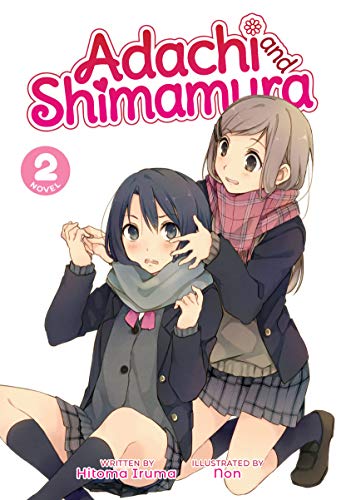
Adachi and Shimamura, Vol. 1

April 18, 2020 by Sean Gaffney

By Hitoma Iruma and Non. Released in Japan by Dengeki Bunko. Released in North America by Seven Seas. Translated by Molly Lee.

It is, to be honest, rare that a light novel catches me completely by surprise. For one thing, I tend to spoil myself as to what the content of a series is going to be. I thought I knew about this one. I knew it was an extremely popular yuri light novel series. I also knew it was supposed to be a bit boring. Both are true. The story begins with Adachi and Shimamura already knowing each other (though we get a later flashback to how they meet). They’re both delinquents who tend to cut class. Adachi, the black-haired girl, is seemingly stoic and unapproachable. Shimamura, who has dyed light brown hair, is more open and has more friends than the aloof Adachi, but also seems to have a disconnect when it comes to emotions. Seeing them flapping around in their interior monologue trying to connect is what’s meant to be the point of the book. That said, it doesn’t quite keep the reader’s attention. Then the girl in the spacesuit shows up…

So yes, this is my own fault. I knew that the author of this series has written a large number of other series for both Dengeki Bunko and other publishers (including the Bloom Into You light novel spinoffs). I had also heard of the much older series Ground Control to Psychoelectric Girl (Denpa Onna to Seishun Otoko), but didn’t realize that it was also by this author. And that series has, as one of its supporting cast… a girl who dresses in a spacesuit and has seemingly supernatural powers. In the context of that other series, which stars another girl who says she is an alien, Yashiro as a mysterious maybe alien with supernatural abilities works fine. But when she shows up here and starts hanging out in what is, let’s face it, the cast of K-On! without the band, it’s quite jarring. Especially when she takes over the scenes she’s in… and proves to be more interesting than the two leads.

Let’s get back to the title characters. Three fifths of the book is narrated by Shimamura, and is the poorer for it. I’m not sure what the author is really trying to convey with her headspace. She seems to be pretending to be a normal, outgoing high school girl to hide her own inner lack of empathy and interest, but she’s too good at it externally and too bad at it internally, so it doesn’t quite come off. She’s the reason the book is seen as dull. When the narrative shifts to Adachi, things pick up a great deal, as she has the actual character conflict – she’s in love with Shimamura, something she starts the book off denying (in the classic “not in a gay way or anything!” sense) but accepts, at least to herself, by the end of the book. I think she’d have confessed to Shimamura on their “date” if Yashiro hadn’t ruined her chances. Hopefully future books will give Shimamura the chance to develop beyond “how do I connect to other humans” as well.

So I am very fifty-fifty about this book. The most interesting character in it is from another series. The narrator for most of the book struggles to connect with not only everyone around her but also the reader. On the other hand, Adachi’s inner monologue of panicked love epiphany was genuinely involving. I’ll be reading another volume, but so far it’s more Adachi than Shimamura for me.

Filed Under: adachi and shimamura, REVIEWS

Manga the Week of 4/22/20

April 16, 2020 by Sean Gaffney 1 Comment

SEAN: Yes, there’s still manga. May is the apocalypse, April is packed.

Ghost Ship gives us a 2nd Saki the Succubus Hungers Tonight and the 10th Yokai Girls.

No debuts, for once, for J-Novel Club, but we do get Ascendance of a Bookworm 6, The Combat Baker and Automaton Waitress 5, Isekai Rebuilding Project 2, Kobold King 2, and Der Werwolf 7.

Kodansha’s print debut is Perfect World, which had a digital release a while back. I enjoyed the first volume, but never did follow up on it. I should do that.

MICHELLE: Same here. It’s a tough series to marathon. Keeping pace with the print release should be easier than catching up on all the extant digital volumes.

ASH: I’ve been waiting for this one to come out in print!

SEAN: Also in print: Cardcaptor Sakura Collector’s Edition 4, Cardcaptor Sakura Clear Card 7, Fire Force 18, and Sailor Moon Eternal Edition 8.

ASH: The collector’s edition of Cardcaptor Sakura is pretty.

MJ: I haven’t been picking up the new edition, but it’s sooooo tempting. It’s such a pretty manga. And Dark Horse’s mid-release shift in trim sizes damaged the prettiness of the last edition for me. (Yes, I still have not forgiven them for that.)

SEAN: The digital debut is Dolly Kill Kill, which ran on the Mangabox App back in the day. A young man’s life is destroyed by monsters that look like mascot costumes. Can he get back what he lost? For fans of weird horror.

There’s also GE: Good Ending 4, I’ll Win You Over Sempai! 3, Kakushigoto 2, The Quintessential Quintuplets 12, Saint Young Men 5, and Shojo FIGHT! 10.

MICHELLE: I have no idea how I got four volumes behind on Shojo FIGHT!, but it has somehow happened! Not that I mind having a decent chunk to devout at once.

SEAN: Seven Seas has the 2nd Bloom Into You light novel (digitally), The Ideal Sponger Life 5, If It’s for My Daughter I’d Even Defeat a Demon Lord 5 (manga version), My Monster Secret 20, and Shomin Sample 12.

Vertical has an 8th Flying Witch, a highly underrated series.

Viz has two debuts. The Art of Junji Ito is what it sounds like, and will probably not give TOO many nightmares.

ASH: Always glad to see more of Ito’s work released!

MJ: Same!

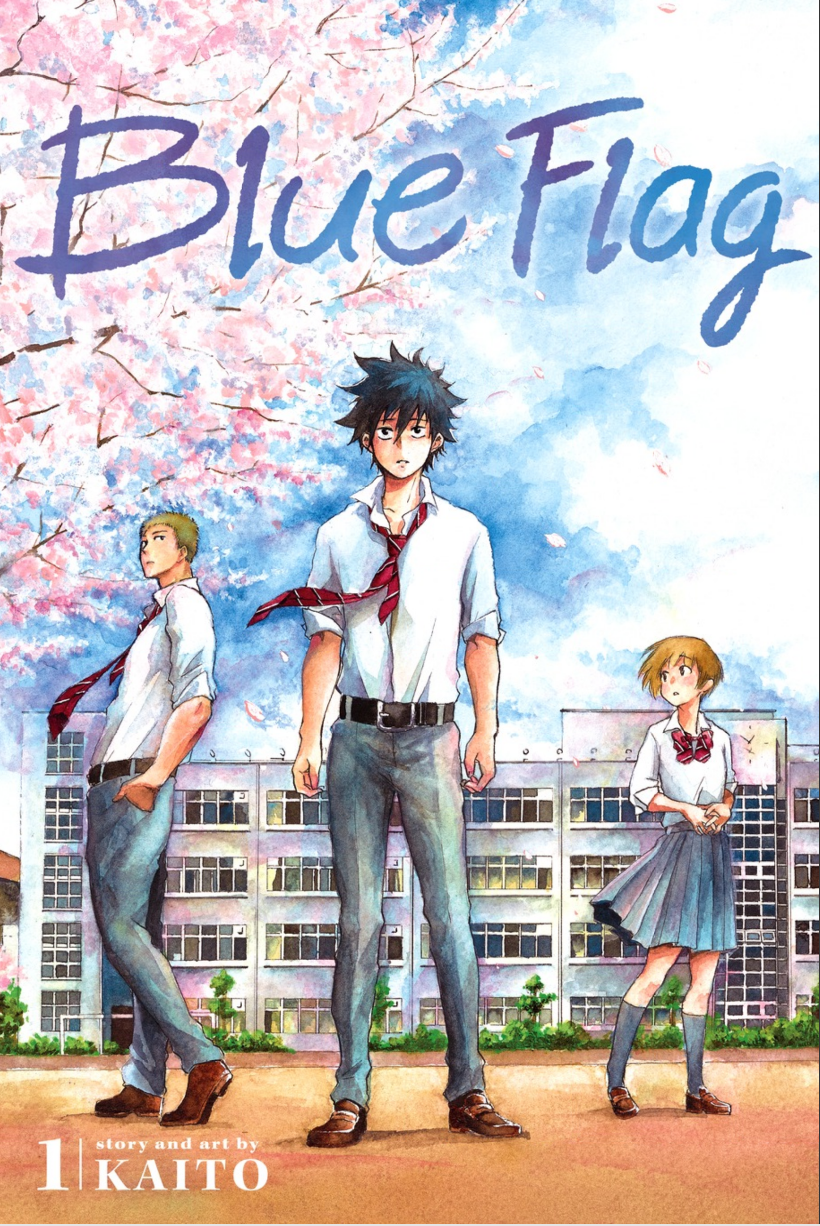
SEAN: The other debut is Blue Flag, a title with SO much buzz and hype I worry it can’t live up to it. A Shonen Jump + series, it is apparently about sweet, painful and heartrending days.

MICHELLE: I am soooooo excited for this.

ASH: Same!

ANNA: Me too!

SEAN: Also from Viz: Golden Kamuy 15, Tokyo Ghoul: re 16, and Ultraman 13.

ASH: Here for Golden Kamuy (though I’ve enjoyed some of the earlier volumes more than some of the later ones).

ANNA: Golden Kamuy is one of those series I keep meaning to read but there is so much manga!

SEAN: Yen On split its main April release schedule across two weeks: this is the first. We get Accel World 21, Baccano! 13, Bottom-Tier Character Tomozaki 3, Combatants Will Be Dispatched! 3, and Sword Art Online 19.

The manga debut has a light novel coming out in June. I’m a Behemoth, an S-Ranked Monster, but Mistaken for a Cat, I Live as an Elf Girl’s Pet (S-Rank Monster no Behemoth Dakedo, Neko to Machigawarete Erufu Musume no Kishi (Pet) Toshite Kurashitemasu) is one of THOSE series. A reincarnated as a powerful beast series, with added elf, this runs in Hakusensha’s Young Animal, so expect boobs.

MJ: I know every publisher has a niche, but Yen Press… I’m begging for more stuff like Silver Spoon. With a few exceptions, I’ll admit they’ve kind of lost me as a reader. Our tastes just don’t line up anymore.

MICHELLE: I’m still in it for Nozaki-kun and Yowamushi Pedal, but I’m close to being in the same boat. I’m boat-adjacent. I also miss manhwa.

MJ: Me too, Michelle, ME TOO.

SEAN: I have good news for you about the week after next, then, MJ…

MJ: YESSSSSSSS.

SEAN: The rest? A Certain Magical Index’s 21st manga volume, Chio’s School Road 8, Gabriel Dropout 8, Kaiju Girl Caramelize 3, Plunderer 4, Reborn as a Polar Bear 3, Shoulder-a-Coffin Kuro Side Story (yay!), Teasing Master Takagi-san 8 (also yay!), Val x Love 8, and A Witch’s Printing Office 2.

ASH: I finally picked up the first volume of A Witch’s Printing Office… I should probably get around to actually reading it.

SEAN: What manga cries out… for JUSTICE?

Filed Under: FEATURES, manga the week of

The Hitchhiker’s Guide to the Isekai

April 16, 2020 by Sean Gaffney

By SAKKA KEIHAN and Shinobu Shinotsuki. Released in Japan by the authors at Comiket 96. Released in North America by J-Novel Club. Translated by Emily Balistrieri, Noboru Akimoto, Roy Nukia, Andrew Cunningham, Andrew Hodgson, and Mike Langwiser.

First of all, I really like the fact that this was licensed. I appreciate publishers taking a flyer on titles like this, especially when it’s something that was not published professionally in Japan, but rather was the author’s own fan work they sold at one of the Comikets. It’s also an amusing idea, the sort of thing you can imagine a writer’s group brainstorming about – deconstructing and parodying the isekai genre by putting themselves into the genre, and showing the pitfalls that most isekais manage to avoid by not thinking about them too closely. These stories think about things far too closely, and that’s part of the humor. It’s also a doujinshi, so it’s not too long (and don’t expect illustrations beyond the cover art – these are writers, not artists). That said, I feel it could stand to be a bit shorter. The danger of anthologies is that you find stories you like and stories you don’t, and this did not have a great batting average overall.

The cover art alone should tell you how seriously to take it. We start with Carlo Zen (the author of The Saga of Tanya the Evil) writing isekai as a travel guide for tourists. Tappei Nagatsuki (the author of Re: ZERO) then steps in with what amounts to a broadsided attack/homage of his friend Natsume Akatsuki’s work KonoSuba, as well as other “goddess grants you powers” works. Natsuya Semikawa (the author of Otherworldly Izakaya Nobu) has the isekai as a day trip to escape the burdens of deadlines. Natsu Hyuuga (the author of The Apothecary Diaries) writes the straightest isekai of the bunch, where they are not only transported to another world but are a “piglet” (the word “orc” is studiously avoided) and having trouble surviving; Katsuie Shibata trades on the fact that he took his penname from a Sengoku military commander and does the “accidentally summoned instead of someone else” story, and Hoko Tsuda is transported via delicious ramen into a “everyone mistakes everyone’s intentions all the time” world.

I’ll start with the good: Nagatsuki’s section is reason enough alone to buy this book, as it’s hilarious, especially if you’ve read KonoSuba. Getting hit by a truck, magical power lotteries, and Aqua herself (well, a 2nd rate expy of her) combine to make this tremendous fun. Carlo Zen’s section suffers from his dry, textbook prose (something Tanya readers will find familiar) but is an amusing “what about inoculations/money/customs declarations/etc.” guide. After that, though, things start to sink a bit, though I will admit I found the idea of Shibata’s (penname authors summoned as Sengoku commanders for a real fight) to be a very good one, but the execution was also a tad boring. Semikawa’s story was simply tedious, Hyuuga’s was far too normal (it read like a standard isekai), and Tsuda’s, I suspect, depends on knowing the work that he is riffing on, which I do not.

So again, your mileage may vary, and I like the concept and would like to see more author anthologies like this. But this particular anthology had more misses than hits for me.

Filed Under: hitchhiker's guide to the isekai, REVIEWS

Prince Freya, Vol. 1

April 15, 2020 by Sean Gaffney

By Keiko Ishihara. Released in Japan as “Itsuwari no Freya” by Hakusensha, serialization ongoing in the magazine LaLa DX. Released in North America by Viz Media. Translated by Emi Louie-Nishikawa.

One of the habits that I’ve noticed a lot of creators have, particularly in series that have afterwords, is that they can sometimes apologize for the flawed behavior of the main character. Rarely is this an actual apology, it’s more to let the reader know that yes, the author did in fact plan for this character to be weak/annoying/overpowerful/perverse, and that it is a function of the plot, so don’t worry too much about it. We get that here as well, as the author tells us she is aware that Freya is a bit of a crybaby, but to hang in there because the story is about her character growth. What makes this amusing is that the author also starts the book with a startling image of Freya leaping off a giant cliff. Again, this is a fakeout (she looks tragic and doomed, but it turns out was gathering herbs that grow in dangerous places) but it does set up up to see her as bold and fearless… THEN shows us what she is is coddled.

Freya is a teenage girl in “fantasy medieval Europe”, whose mother is sick and whose adopted brothers are part of the Prince’s elite guards. We get a chapter or so showing us her life, where she tends to be sweet but also shy. Fortunately both brothers are awesome, so she need not worry (her mother is also awesome, we are told, despite now being ill). That said, there is a problem. Their kingdom is under threat, and the prince is actually dying. A prince who, it turns out, is a dead ringer for Freya. The brothers have been sent to get her so that she can imperso9nate the prince, but neither of them want this outcome. Unfortunately for them, Freya overhears them and decides to follow them to the castle. She may regret this: by the end of the volume the country is still in great danger both from without and within, and her resolve to impersonate the prince is derailed by personal tragedy and her own skittish personality.

It feels a bit strange, particularly from this publisher/magazine, to have a first volume that is almost all setup. I’m so used to one-shots that slowly turn into series, or stories that appear to be complete but then we get more of when they get popular. Prince Freya, though, is designed to run for a few volumes, and it shows. Freya is an interesting heroine, who is instinctively very brave and bold, but when she thinks about things she locks up and falls to pieces. It’s not helped that she suffers a horrible trauma halfway through the book (I’ll just say that one of her adopted brothers is incredibly cool, nice, loves her, etc. and let you take a wild guess) and that those in the book who aren’t her family are a lot less patient with her hysterics given that the country is in danger. Fortunately, the end of the book sees her acting instinctively, jumping off a building (she really does jumping from great heights)… and ending up accidentally kidnapped. Whoops.

It’s just a start, but there’s a lot here to make readers want to read more. We’ll see how Freya does as prince next time around.

Filed Under: prince freya, REVIEWS

86 –Eighty-Six–, Vol. 4: Under Pressure

April 13, 2020 by Sean Gaffney

By Asato Asato and Shirabii. Released in Japan by Dengeki Bunko. Released in North America by Yen On. Translated by Roman Lempert.

The author brags about how this volume of 86 is much lighter in tone than the previous three, and I guess that’s true? Certainly the first quarter of the book makes a determined effort to be amusing, sweet and heartwarming in turns, with the only big drama being the arrival of Annette and her realization that her childhood friend Shin does not recall her at all, which makes atoning for her guilt rather difficult. Lena and Shin are VERY shippy here, despite the fact that Shin has difficulty getting that sort of thing. Frederica and Kurena play the part of the wacky jealous not-girlfriends to a T. But there is a plot here, which leads to the battle and action sequences, and that’s when the reader realizes that even in the lightest of 86 novels, things are still going to take a turn for the very dark, as we find out exactly what the Legion has been doing all this time, and how hard it’s going to be to defeat them going forward.

After the two-volume interqual, Lena is finally reunited with her former team, and she’s brought friends, as we add to the cast a great deal of the 86 who were fighting with her after Shin and company left and ended up in the Federation. Things are… still not great in terms of the Republic. In fact, they’re still monstrously bad, with lots of “give us back our animals they are not people” racism from their side – 86 has never been subtly about such things, and that doesn’t change here. Unfortunately, just because Lena (and Annette) have reunited with Shin doesn’t mean things are going to be happily ever after. Leaving the Legion aside, it’s pointed out that the 86 have had to cut away everything that is not related to battle in order not to go mad. If Lena wants them to regain that, she’ll just be forcing them to feel the unbearable pain again. Can she live with that? And as for Annette, isn’t this all just about her?

The second two-thirds of the book are an extended battle against the Legion in an underground subway complex with shopping mall attachment, which is annoying to our heroes as their powered suits don’t function as well there. The fight introduces a new variety of bad guy to the stage, and they’re pretty lethal right up front, taking out all of Annette’s bodyguards and almost managing to kill Shin. The exact nature of how they came to be, as well as how the Legion used the republic to get to that stage, I shall briefly gloss over except to say that it was disturbing and also disgusting. It’s well-written, though I was a bit annoyed by the return of the Legion with Kaie in them to taunt our heroes. We already got a sequence where they destroy the possessed Legion and seemingly send her to the afterlife properly, I didn’t need it all over again.

Future cover art makes me think the lighter tone will stick around, and none of the named cast that we remember died here, so in that respect this is a bit of a breather novel in the series. It’s also extremely well-written as always. Fans of the 86 won’t be disappointed.

Filed Under: eighty-six, REVIEWS

One Piece, Vol. 93

April 12, 2020 by Sean Gaffney

By Eiichiro Oda. Released in Japan by Shueisha, serialization ongoing in the magazine Weekly Shonen Jump. Released in North America by Viz. Translated by Stephen Paul.

Because One Piece has been running for so long, there aren’t a lot of plots that it hasn’t at least taken a glance at along the way. That’s probably why Oda is having so much fun with the time travel angle introduced here, with the long-lost heroes reappearing twenty years later, seemingly the same as before. The eventual beat when they all finally arrive hasn’t happened yet, but we do meet Momonosuke’s little sister, who is now of course a young woman, and also a striking reminder of how Oda loves to contrast ugly men and gorgeous women when he draws. (Or in this case ugly boys.) She’s got a lot going on in this volume, so it’s amusing that the thing I noticed most was Oda mocking shippers in her interactions with the completely sexless Zoro. (To be fair to Zoro, he does get that people would take them sleeping together the wrong way.) And then there’s Toko, which… well, I’ll get to her.

As with previous Wano volumes, the action slips from place to place almost too fast to follow, trying to make sure that everyone gets something to do. This means we get to see Nami and Robin in the baths (and Nami accidentally flashing everyone, which reminds me of her deliberately doing this in Alabasta); Sanji being, well, Sanji; Luffy, still in prison, having to fight off most of the guards one by one for entertainment, and meeting up with an old, seemingly feeble man who of course has a very badass past; and Shopper trying to deal with the fact that he’s now allied with Big Mom, who has lost her memories and thus is bright, cheery and friendly again. Chopper, of course, knows this will only last till her memories return, so spends a lot of the time terrified. (There’s some interesting lettering going on in these scenes to show “girly’ speech – excellent job by Vanessa Satone, the letterer and touch-up person.)

And then we get to the end of the book, where Oda reminds us how well he can have chaos quickly turn to tragedy, with the public execution of Yasu, who turns out to have a secret identity (not a surprise). He’s spent much of the time bopping around the manga dressed up as the stereotypical Japanese jester, with a giant grin on his face. The grin remains even as he’s about to be executed (by firing squad, a particularly dishonorable death in the period that Oda is riffing on here), and there is an explanation of everyone smiling and laughing in the face of tragedy… but then after his death, it turns far too creepy for that to really be the case, especially when his daughter sees his death and can’t stop giggling (as she has the entire book) even as she cries out that her father is dead. The cliffhanger, unfortunately, implies that it may be the One Piece equivalent of drugs at work once more.

So yeah, everything is kind of terrible at the moment. Sure would be nice if we could start a revolution soon. Still, this was a chaotic but solid volume of One Piece, a bit better than the last couple of books.

Filed Under: one piece, REVIEWS

An Incurable Case of Love, Vol 3

April 11, 2020 by Anna N

An Incurable Case of Love Volume 3 by Maki Enjoji

I’ve found it difficult to concentrate on reading much in the past few weeks. That being said, I thought that the workplace romance of An Incurable Case of Love was the best series to try to get back into my somewhat irregular rhythms of manga reading. This volume immediately picks up with the scary situation of Nanase being menaced by a stalker. When Dr. Tendo attempts to protect her, she immediately puts her self between Dr. Tendo and danger. She ends up getting knocked to the ground in a pool of blood and rushed to the hospital in an ambulance. What follows is Nana’s elaborate love confession that manages to capture the combination of sweetness and absurdity that makes this manga such an enjoyable read. She announces that she’s happy because she got to kiss Tendo one time and she has no regrets except “I wanted to be your girlfriend…I wanted to kiss and cuddle you…” Alarmed, Tendo grips her hand and says that if she pulls through “I’ll be your boyfriend or whatever you want.” Nana promptly falls asleep saying “Don’t forget about me…”

An Incurable Case of Love

She wakes up to Tendo’s glare, because she fell asleep as opposed to fainting, and while she was injured her head wound wasn’t life threatening. They quickly get back into the regular rhythms of work, except they are officially dating. Dating means not actually going out on any dates due to their hectic schedules. They fall back into the usual rythms of this series, briefly dealing with distractions in the form of a super cute but not very compassionate new trainee nurse who has her own crush on Dr. Tendo, traveling to an educational seminar, and cooking lessons from the too handsome Kisugi. Tendo gradually is starting to show some genuine emotion and concern despite his extremely dispassionate demeanor. Nana’s relentless devotion and affection despite her general lack of encouragement will have readers agree that her workplace nickname of “Valiant One” is fairly earned. I definitely recommend picking up the three volumes of this series if you are looking for a fun josei escape.

Filed Under: Manga Reviews, REVIEWS Tagged With: An Incurable Case of Love, Josei, shojo beat, viz media

  • « Go to Previous Page
  • Page 1
  • Interim pages omitted …
  • Page 154
  • Page 155
  • Page 156
  • Page 157
  • Page 158
  • Interim pages omitted …
  • Page 538
  • Go to Next Page »
 | Log in
Copyright © 2010 Manga Bookshelf | Powered by WordPress & the Genesis Framework