• Skip to primary navigation
  • Skip to main content
  • Skip to primary sidebar
  • Home
  • About Us
    • Privacy Policy
    • Comment Policy
    • Disclosures & Disclaimers
  • Resources
    • Links, Essays & Articles
    • Fandomology!
    • CLAMP Directory
    • BlogRoll
  • Features & Columns
    • 3 Things Thursday
    • Adventures in the Key of Shoujo
    • Bit & Blips (game reviews)
    • BL BOOKRACK
    • Bookshelf Briefs
    • Bringing the Drama
    • Comic Conversion
    • Fanservice Friday
    • Going Digital
    • It Came From the Sinosphere
    • License This!
    • Magazine no Mori
    • My Week in Manga
    • OFF THE SHELF
    • Not By Manga Alone
    • PICK OF THE WEEK
    • Subtitles & Sensibility
    • Weekly Shonen Jump Recaps
  • Manga Moveable Feast
    • MMF Full Archive
    • Yun Kouga
    • CLAMP
    • Shojo Beat
    • Osamu Tezuka
    • Sailor Moon
    • Fruits Basket
    • Takehiko Inoue
    • Wild Adapter
    • One Piece
    • After School Nightmare
    • Karakuri Odette
    • Paradise Kiss
    • The Color Trilogy
    • To Terra…
    • Sexy Voice & Robo
  • Browse by Author
    • Sean Gaffney
    • Anna Neatrour
    • Michelle Smith
    • Katherine Dacey
    • MJ
    • Brigid Alverson
    • Travis Anderson
    • Phillip Anthony
    • Derek Bown
    • Jaci Dahlvang
    • Angela Eastman
    • Erica Friedman
    • Sara K.
    • Megan Purdy
    • Emily Snodgrass
    • Nancy Thistlethwaite
    • Eva Volin
    • David Welsh
  • MB Blogs
    • A Case Suitable For Treatment
    • Experiments in Manga
    • MangaBlog
    • The Manga Critic
    • Manga Report
    • Soliloquy in Blue
    • Manga Curmudgeon (archive)

Manga Bookshelf

Discussion, Resources, Roundtables, & Reviews

My Week in Manga

My Week in Manga: March 24-March 30, 2014

March 31, 2014 by Ash Brown

My News and Reviews

Posts last week at Experiments in Manga included a new manga giveaway as well as two new in-depth manga reviews! There’s still time to enter the giveaway, too. Head over to the Battle Angel Alita Giveaway to enter for a chance to win the first omnibus in Yukito Kishiro’s manga series Battle Angel Alita: Last Order. As for the reviews: I took a look at the most recent Moyoco Anno manga to be released in English, Insufficient Direction. It’s an autobiographical manga about her married life with Hideaki Anno and is quite funny. I adore Anno’s work, so was happy to learn a little more about her. I also wrapped up my Manga March Madness project. I was rather pleased that I managed to pull it off. Every weekend in March I reviewed a volume of Takehiko Inoue’s basketball manga Real. Since there were five weekends in March and I started with the first volume in the series, my last review for the project was for Real, Volume 5. I hope I was able to at least begin to express why Real is such a fantastic manga in my reviews, because it really is a phenomenal series.

Speaking of Takehiko Inoue, David Brothers, writing for Comics Alliance back in 2010, had a great article that was recently brought to my attention again–From Samurai to Shooting Hoops: Takehiko Inoue, Art Chameleon. As for other things found online: Nahoko Uehashi (the author of Moribito) won the 2014 Hans Christian Andersen Author Award, which is a pretty big deal. As usual, Organization Anti-Social Geniuses had some great manga content last week. I particularly enjoyed What Manga Publishers Can Actually License in The US and Advice on Manga Editing, From Manga Editors. Tokyopop’s Stu Levy participated in a recent “Ask Me Anything” on Reddit. The daughter of Osamu Tezuka opened a drawer of her father’s desk that had been locked since 1985 and found some pretty cool stuff. And finally, I was pointed towards a brief biography of Takashi Nagasaki, who works closely with Naoki Urasawa.

Quick Takes
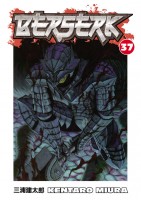
Berserk, Volume 37Berserk, Volume 37 by Kentaro Miura. I love the early story arcs of Berserk and continue to enjoy the series, so I’m always excited when another volume of the manga is finally released. After reading the thirty-seventh volume, I’m particularly anxious to get my hands on the next installment, whenever that may be. The battle between Guts and the rest of the crew against the sea god and its minions reaches its climax in this volume. They are aided by the merrow, Berserk‘s mermaids. Even though Miura’s version of mermaids is fairly traditional, though perhaps slightly more fish-like, I did like them. The thirty-seventh volume also contains a long flashback to Guts’ past as a young mercenary, which I particularly enjoyed reading. It’s set during a time when magic and the supernatural were more hidden and uncommon in the world, though hints of it could still be seen. The end of the volume also turns towards the current activities of Griffith’s army, which recently hasn’t had much prominence in the manga. After so much action and fighting, which I do enjoy, I’m very glad to see more story and plot development.
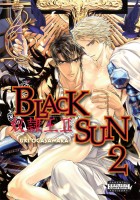
Black Sun, Volume 2Black Sun, Volume 2 by Uki Ogasawara. It’s been quite a while since I read the first volume of Ogasawara’s boys’ love manga Black Sun. I had a few issues with the story itself, mostly that the lead characters’ relationship moved a little too quickly from lust to possible love, but overall I thought the manga had good potential. I particularly liked the setting of Black Sun, a medieval fantasy inspired in part by the Crusades. Ogasawara’s artwork was also excellent, with particular attention given to the beautiful details of clothing and weaponry as well as attractive, muscular men. When I read the first volume of Black Sun I didn’t actually realize that it was a first volume. I appreciated it’s somewhat ambiguous ending, but was ultimately glad to discover that there was more to the series. The ending of the second and final volume is much less ambiguous, and much happier than I expected that it would be. Black Sun is part of Digital Manga’s 801 Media imprint, so unsurprisingly there is a fair amount of sex to go along with the plot. And Black Sun actually does have a plot. The relationship between Jamal and Leonard plays out against a backdrop of war and political intrigue.
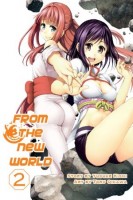
From the New World, Volume 2From the New World, Volumes 2-3 written by Yusuke Kishi and illustrated by Toru Oikawa. I was very torn over the first volume of the From the New World manga. I absolutely loved its dark tone, but found the blatant, pandering fanservice to be a bit off-putting and out-of-place. Thankfully, the fanservice in the second volume is greatly toned down. The outfits worn by the young women are still fairly ridiculous and revealing, though, especially when compared to the male characters who tend to be covered from head to toe in oversized clothing. The lesbian sex returns in the third volume, but it makes much more sense within the context of the series than it did in the first volume. Part of this is because the worldbuilding has progressed significantly. From the New World suffers a little from large info dumps, but at least all of the information is new to the characters, too, so it’s not as egregious a problem as it could be. I’m still loving the actual story of From the New World. The series atmosphere is creepy and ominous, contrasting magnificently with what is supposed to be a perfect and pristine society. What humanity is willing to give up and the terrible steps that have been taken to maintain that system are now being revealed.
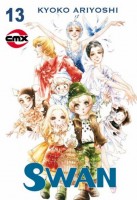
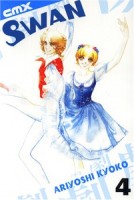
Swan, Volume 13Swan, Volumes 13-15 by Kyoko Ariyoshi. In Japan, Swan lasted for twenty-one volumes, only fifteen of which were released in English. It’s too bad that CMX folded before the series could be completely released. Swan is fantastic, and I’m very glad for the fifteen volumes that were translated. These last three volumes of the English edition follow Masumi as she travels to New York with Leonhardt to continue her study of ballet following the aftermath of the Tokyo World Ballet Competition. It’s the beginning of an important new story arc. Masumi has grown tremendously as a ballerina as well as a person, but her time in the United States presents new challenges. Her foundation is in classical ballet but now she is faced with modern ballet which is completely outside of her experience. She has trouble understanding modern ballet and so struggles greatly with its performance. Also introduced in these volumes are new characters and even a potential new love interest, which offers another set of problems for Masumi to deal with. Swan is a beautiful and surprisingly intense series; I was very impressed by it.
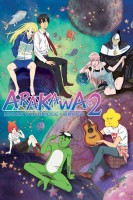
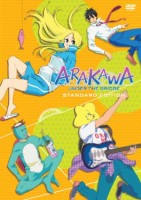
Arakawa2Arakawa Under the Bridge x Bridge, Season 2 directed by Akiyuki Shinbo. I enjoyed the first season of Arakawa Under the Bridge a great deal. I very much enjoyed the second season, too, but for some reason wasn’t quite as taken with it. I’m not really sure why that is though since not much really changed between the two. Arakawa Under the Bridge is still funny and absurd. I still like the humor and the characters. While the first season focused on Rec as he gets to know everyone living along the banks of the Arakawa River, everyone’s personalities and quirks have been well established by the start of the second. Maybe it’s that sense of newness and discovery that the second series lacks. But then again maybe not: the second season introduces new cast members as well as a storyline that provides an ongoing framework for some of the gags. (Ultimately it doesn’t really end up going anywhere, though.) One of the things that particularly amused me about the second season of Arakawa Under the Bridge is that Rec has more or less become a shoujo heroine, complete with flowers and sparkles. Nods to Riyoko Ikeda’s series are right at home alongside references to Fist of the North Star and other “manly” anime.

Filed Under: FEATURES, My Week in Manga Tagged With: anime, Arakawa Under the Bridge, Berserk, Black Sun, From the New World, Kentaro Miura, Kyoko Ariyoshi, manga, swan, Toru Oikawa, Uki Ogasawara, Yusuke Kishi

My Week in Manga: March 17-March 23, 2014

March 24, 2014 by Ash Brown

My News and Reviews

Experiments in Manga featured two manga reviews as well as something a little different last week. First up, I took a look at Saki Nakagawa’s Attack on Titan: Junior High, Omnibus 1. It’s a rather absurd and ridiculous series, but I was amused. The manga does require some familiarity with both Attack on Titan and Attack on Titan fandom to fully appreciate it, though. Not too long ago, I read Jeffrey Angles’ Writing the Love of Boys which introduced me to the work of Kaita Murayama. Not much about Murayama has been written in English, and only two of his short stories have ever been translated, but I was interested in learning more about him and his work. The result was a Spotlight on Kaita Murayama. (I’m actually very happy with how the post turned out!) Finally, as the actual March Madness begins, I posted the penultimate review in my own Manga March Madness–Real, Volume 4 by Takehiko Inoue, which delves more deeply into Togawa’s past. Real is a fantastic series, and one of my favorite manga.

And now for a few things found online! Vertical’s tumblr often has something interesting to read. Last week’s response to a question about licensing old Tokyopop titles was particularly informative. I enjoy House of 1000 Manga, but the most recent column focuses on Usamaru Furuya and his work, which I’m always happy to read more about. Sequart has a great interview with Kumar Sivasubramanian, the translator of some of my very favorite manga. Gay Manga posted an excellent article about the censorship of a billboard designed by artist Poko Murata promoting HIV awareness which also addresses some of the history of gay artwork in Japan. And in other censorship news, it looks like the manga series Barefoot Gen, after running into some trouble last year, may end up being banned again in parts of Japan.

Quick Takes

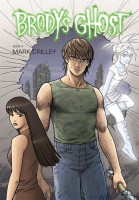
Brody's Ghost, Book 4Brody’s Ghost, Book 4 by Mark Crilley. It’s been quite a while since I’ve read any of Brody’s Ghost, but I do enjoy the series. Each installment is frustratingly thin though (each is less than a hundred pages) and only one book is released per year. Once the story is finished, I’d love to see Brody’s Ghost collected into a single omnibus. I think the series would benefit from being read in larger chunks or all at once. Which is not to say the individual books aren’t enjoyable. Each one has a great mix of action, story, and character development. I enjoy Crilley’s artwork, too. I also enjoy the bonus content that Crilley includes, outlining some of his design choices and storytelling decisions. In this particular volume of Brody’s Ghost, Brody is doing everything that he can to track down the Penny Murderer, including impersonating a detective. His ex-girlfriend, who he still cares about, may very well be the next victim and he is desperate to prevent that from happening. Things are even more complicated now that he has discovered that Talia–the ghost who pressured him into the investigation–has been lying to him.

FlutterFlutter by Momoko Tenzen. I appreciate it when a boys’ love manga includes a character who is actually openly gay, so that aspect of Flutter particularly appealed to me. Mizuki is that man–a respected and skilled project leader at his company. He presents himself as someone who is extremely well put together, but that public face is deliberately crafted to hide his weaknesses and insecurities. Asada is one of Mizuki’s coworkers. He finds himself inexplicably drawn to Mizuki. After the two of them are assigned to the same project they get to know each other, first as friends and then as something possibly more as Mizuki begins to drop his guard around Asada. Flutter is a slowly paced and relatively quiet manga, which is somewhat surprising as Mizuki’s backstory is fairly melodramatic. However, that melodrama is completely lacking from Mizuki and Asada’s somewhat awkward relationship; I enjoyed watching it develop. Asada’s personality is very kind and candid and his inability to hide what he is thinking and feeling is adorable. This open honesty is just what Mizuki needs, whether he realizes it or not.

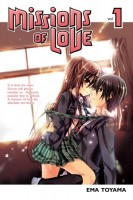
Missions of Love, Volume 1Missions of Love, Volumes 1-4 by Ema Toyama. I’ll admit it, I’m addicted to Missions of Love. I actually began reading the series with the fifth and sixth volumes, but I enjoyed them enough that I wanted to go back and read it from the beginning to learn how the whole mess between Yukina, Shigure, Akira, and Mami came to be. Missions of Love isn’t the most believable series and some of it is admittedly silly, but I don’t think I would enjoy the manga as much as I do if Toyama took a more serious or realistic approach. The story itself might be somewhat ridiculous, but the complicated relationships and emotions are real enough. Ultimately, that’s what appeals to me about Missions of Love–the intensity of the characters’ feelings paired with a plot that can be over-the-top. In the beginning, Yukina and Shigure don’t even like each other which is what allows them to resort to blackmail and manipulation. But as the series progresses, they come to care for and rely on each other in a way that is incredibly twisted. All of the relationships in Missions of Love are like that. I can’t help but want to watch the emotional chaos and turmoil unfold.

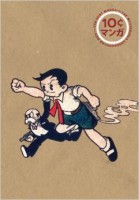
The Mysterious Underground MenThe Mysterious Underground Men by Osamu Tezuka. The Mysterious Underground Men is the second volume in Ryan Holmberg’s Ten-Cent Manga series which explores classic manga influenced by classic American comics and cartoons. Tezuka, often called the grandmaster of contemporary manga and anime, has had many of his works released in English. Granted, only a small fraction of his total output has been translated. As much as I appreciate Tezuka’s manga and his importance as a creator, I’m actually much more interested in the work of other classic mangaka who are less likely to be licensed. Initially, I wasn’t even planning on reading The Mysterious Underground Men. But because I was so impressed by the first volume of Ten-Cent Manga, I decided to give it a try after all. I’m glad that I did, not so much for the manga itself (which I did enjoy), but more for the supplementary material–Tezuka’s afterword, in which he describes The Mysterious Underground Men as his first story manga, and Holmberg’s essay which puts the manga into historical context, specifically noting its Western pop culture influences.

Time of EveTime of Eve directed by Yasuhiro Yoshiura. It’s not a secret that I have a fondness for stories about androids, so it probably shouldn’t be too surprising that I liked Time of Eve, a six episode anime series that was first released online. The series revolves around an unusual cafe, the titular Time of Eve, where humans and androids can interact while ignoring the laws that normally separate them. The cafe has only one rule, that there is to be no discrimination between the two groups. Rikuo discovers the cafe while looking into the unexpected behavior of “Sammy,” his household’s android. Along with his close friend Masaki, Rikuo’s assumptions about androids and how humans treat them are challenged as he gets to know the other customers at the cafe. Time of Eve doesn’t break any new ground when it comes to androids and makes good use of Asimov’s Three Laws of Robotics. I’ve read and watched so much android fiction that nothing about the series surprised me (including what were supposed to be dramatic reveals), but I still found the anime to be immensely enjoyable.

Filed Under: FEATURES, My Week in Manga Tagged With: anime, Brody's Ghost, comics, Ema Toyama, manga, Mark Crilley, missions of love, Momoko Tenzen, Osamu Tezuka, Ten-Cent Manga, Time of Eve

My Week in Manga: March 10-March 16, 2014

March 17, 2014 by Ash Brown

My News and Reviews

I managed to post three in-depth reviews last week, and two of them were for manga! First up was my review of Mieko Kanai’s delightful novel Indian Summer. Technically, it’s the third book in her Mejiro series, following Oh, Tama!, which I also recently read and enjoyed. However, Indian Summer was actually her first novel to be translated in English. As part of my Year of Yuri review project, I took a look at the omnibus edition of Milk Morinaga’s manga Kisses, Sighs, and Cherry Blossom Pink. So far it has been my favorite yuri manga by Morinaga to have been released in English. It’s very cute, sweet, and romantic. And to wrap things up, over the weekend I posted the next review in my “Manga March Madness” project which focuses on Takehiko Inoue’s wheelchair basketball series Real. It was the third week in March, so I reviewed Real, Volume 3. I still think that Real is one of the best comics currently being released in English.

Quick Takes

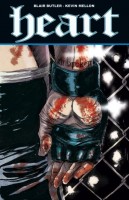
HeartHeart written by Blair Butler and illustrated by Kevin Mellon. At one point Oren “Rooster” Redmond was a run-of-the-mill office worker. Bored with his job, he decides to take control of his life. Following in the footsteps of his older brother he starts by becoming an amateur MMA fighter. After months of grueling training he finally has the opportunity to go pro, but that’s when the hard work really begins. Heart follows the rise and fall of Rooster and the sacrifices that he makes. There’s too much face punching, blood, and machismo to call Heart sentimental, but it is a very human story. Rooster’s fights both in the cage and internally with himself are also representative of anybody’s struggle to accept themselves for who they are. Sometimes, no matter how hard someone tries or how much they improve, it will simply never be enough. It’s how someone deals with that fact that really determines who they are as a person. Heart is a great comic and one that I personally found to be inspirational, and not just because I’m a martial artist.

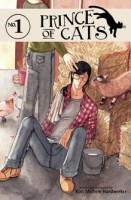
Prince of Cats, Issue 1Prince of Cats, Issues 1-4 by Kori Michele Handwerker. Prince of Cats is an ongoing webcomic that is free to read, however the print edition of the series includes some bonus content not available online. I knew going into Prince of Cats that the comic was a queer love story, but what I didn’t realize is that the series also features a transgender character, which I was rather pleased to discover. Handwerker hand paints each page of the comic and the watercolors are beautiful. The story itself is also lovely, focusing on the relationship between Lee and Frank who were once very close but who are starting to drift apart. Despite the high school drama, Prince of Cats tends to be quiet and subdued but very realistic (with the exception of talking cats, of course.) I could easily empathize with the characters and the portrayal of growing up in a conservative, rural area. It’s hard enough trying to fit in to begin with, let alone while also being a member of a minority (of any sort). I’m definitely looking forward to reading more of Prince of Cats.

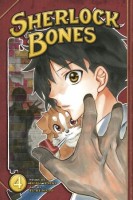
Sherlock Bones, Volume 4Sherlock Bones, Volume 4 written by Yuma Ando and illustrated by Yuki Sato. In previous volumes of Sherlock Bones the answer to the various mysteries were known from the beginning. The challenge was simply to find evidence to prove who was guilty. However, in the fourth volume Sherdog and Takeru actually have to do some legitimate investigation and sleuthing. Granted, in all but one case the readers are already aware who the culprit is. I’m still enjoying Sherlock Bones more than I expected I would. The silliness of the premise is a bit at odds with the seriousness of many of the crimes (homicide, accidental and otherwise, is the one that is most frequently encountered), but for the most part it somehow works; Sherlock Bones can be unexpectedly entertaining. I would like to say that I will be extremely disappointed if Meowriarty doesn’t make another appearance in the series. As if Sherlock Holmes as a small puppy wasn’t ridiculous enough, Moriarty as a bruiser of a cat is marvelously absurd. Also, Sherdog needs an arch-nemesis.

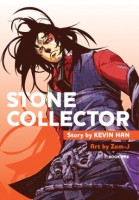
Stone Collector, Volume 1Stone Collector, Book 1 written by Kevin Han and illustrated by Zom-J. Stone Collector is Gen Manga’s first manhwa series, but it reads from right to left, which is a little odd. I was rather surprised when I saw the first volume of Stone Collector; I’m used to the smaller trim sizes used by Gen Manga and hadn’t realized that Stone Collector was going to be so much larger. The oversized format shows off Zom-J’s artwork, which is very clean and fairly dynamic with great facial expressions. Frequently, I found that I was vaguely reminded of Kohta Hirano and especially Hellsing. Some of the battle sequences in Stone Collector are a little difficult to follow, and the lack of backgrounds often made it seem more like a storyboard than a fully realized comic. More attention is given to the fights and monsters than is given to a completely comprehensible plot or well-developed characters. However, it is a quickly paced, action-packed series. I could see a film adaptation of Stone Collector actually doing quite well.

Filed Under: FEATURES, My Week in Manga Tagged With: Blair Butler, comics, Kevin Han, Kevin Mellon, Kori Michele Handwerker, manga, manhwa, Prince of Cats, Sherlock Bones, Stone Collector, Yuki Sato, Yuma Ando, Zom-J

My Week in Manga: March 3-March 9, 2014

March 10, 2014 by Ash Brown

My News and Reviews

Last week the Smuggler Giveaway Winner was announced. As usual, I took the opportunity to compile a list. In this case, I pulled together some of the manga licensed in English that feature assassins. And speaking of assassins, last week I reviewed Hiroaki Samura’s Blade of the Immortal, Volume 28: Raining Chaos which focuses on the confrontation between the remnants of the Ittō-ryū and the Rokki-dan warriors and the Mugai-ryū assassins. There isn’t much plot development in the volume, but there are some great battle sequences. I also reviewed Real, Volume 2 by Takehiko Inoue, which features battles of an entirely different sort. Real is a mix of human drama, tragedy, and hope as its characters deal with events in their lives beyond their control. It’s a truly fantastic series.

There was quite a bit of manga industry news and analysis last week. I’m particularly excited that Moyoco Anno will be a featured guest at TCAF! ICv2 interviewed Dark Horse’s manga editor Carl Horn (Part 1, Part 2). Deb Aoki took a look at the state of digital manga for Publishers Weekly. Vertical’s licensing survey is currently underway. Vertical also posted a little more information about past surveys and how they’ve been used. Sean Gaffney rounds up some of the recent licensing announcements at A Case Suitable for Treatment. Not directly related to the current state of the manga industry but still worth a read is Dan Mazur’s post about early shōjo manga.

Quick Takes

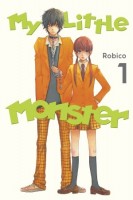
My Little Monster, Volume 1My Little Monster, Volume 1 by Robico. On the first day of school, Haru was suspended and he hasn’t been back since. As a favor to a teacher, Shizuku agrees to bring him his homework which Haru interprets as a sign of friendship. Now, much to Shizuku’s dismay, the two of them have become nearly inseparable. Because of Haru’s propensity towards violence and his almost complete lack of understanding as to what is socially appropriate behavior, some of the situations in My Little Monster can be extremely uncomfortable and worrisome. However, although they are often used as a source of humor, I was very happy to see that Haru’s actions were not romanticized. His tendency to lash out and physically intimidate others, whether out of fear or for some other reason, was not generally portrayed as a desirable characteristic. It’s completely understandable that some people are afraid of him. However, Haru’s naivety and earnestness can be very endearing. Shizuku, one of the few people who can seem to handle the volatile Haru, is an interesting character in her own right with both flaws and strengths. They are both social misfits in their own ways; I’m very curious to see how their relationship continues to develop.

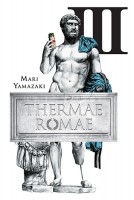
Thermae Romae, Omnibus 3Thermae Romae, Omnibus 3 by Mari Yamazaki. If it seems like it’s been a long time since the last Thermae Romae omnibus was released, that’s because it’s been almost a year. Thermae Romae is a series that started out more like a gag manga, following the exploits of the Roman bath engineer Lucius as he somehow time travels to modern-day Japan and back after repeated near-drownings. With the second omnibus, the series shifts into a romantic comedy when Lucius meets Satsuki after becoming stuck in Japan. That ongoing plot continues through the rest of the series. Although there is still plenty of humor in the third omnibus, Thermae Romae takes a decidedly more serious turn when it looks like Satsuki and Lucius will be torn apart. Satsuki’s grandfather, an incredibly skilled massage artist (as well as a man who should definitely not be trifled with), plays an increasingly important role in the story. Thermae Romae is a great deal of fun. It has drama and romance and comedy, not to mention great art. The ending does feel a little abrupt, but Yamazaki notes that she hopes to write additional Thermae Romae stories that address some of the lingering questions that readers may have about the series and its characters.

Arakawa Under the BridgeArakawa Under the Bridge, Season 1 directed by Akiyuki Shinbo. The Arakawa Under the Bridge anime series is based on an ongoing manga by Hikaru Nakamura. Kou Ichinomiya lives his life following one very simple rule that has been instilled in him by his father: never be indebted to another person. So when Nino, a rather strange young woman living on the banks of the Arakawa River, saves him from drowning, Kou wants to repay the favor and move on as quickly as possible. Except, the only thing that she wants is for him to stay with her and so Kou finds himself obligated to move in under the bridge. There he meets the other residents of the Arakawa River, all of whom are not just a bit peculiar and strange. Though Kou is supposedly the “normal” one, it quickly becomes obvious that he fits right in and is just weird as the rest of them. I found Arakawa Under the Bridge to be highly entertaining and enjoyable in all of its absurdity. The series doesn’t have much of an ending, which makes some amount of sense seeing as there is a second season (which I’ll definitely be watching), but the anime tends to be fairly episodic so I wouldn’t necessarily expect it to have a definitive conclusion, either.

Like Father, Like SonLike Father, Like Son directed by Hirokazu Kore-eda. Ryota and Midori Nonomiya are stunned when they discover that their son Keita isn’t related to them biologically. Six years ago at the hospital where he was born, Keita was somehow switched with Ryusei, the son of Yudai and Yukari Saiki. Now the two families must decide how to handle the situation and whether blood ties are stronger than those of time. Ryota, who has his own father issues to work out and whose relationship with Keita wasn’t especially strong to being with, is having a particularly difficult time, but his wife is struggling tremendously as well. The members of the Saiki family tend to be a little more easy-going in comparison, but the situation is a challenge for them as well. And caught up in the whole mess are Keita and Ryusei, who have very little say in the matter. The revelation of the two boys being switched at birth disrupts both families, resulting in both joy and heartbreak as they grow to know each other better. Like Father, Like Son is a beautiful film about parental and familial love as Ryota learns what is important in life and what it really means to be a father.

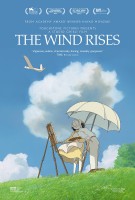
The Wind RisesThe Wind Rises by Hayao Miyazaki. The anime film The Wind Rises is historical, biographical fiction, following the life of Jiro Horikoshi, an aeronautic engineer who designed fighter planes for Japan during World War II. Almost as much of the film takes place in Jiro’s dreams as it does in his waking life. At first, the designs of the planes in The Wind Rises are very fantastical but as the film progresses they become more and more realistic as Jiro makes his dreams a reality. There is an emphasis placed on the beauty of design and creativity, but this is contrasted with the ugly, destructive forces of war and the terrible applications of those innovations. His planes may have been beautiful, but their purposes were not, which begs the question–how much responsibility do artists hold over their creations and their use? The Wind Rises‘ answer to that question is left ambiguous. As with many of Miyazaki’s other films, The Wind Rises has gorgeous flight sequences and an anti-war sentiment. Some of the time skips were a little difficult to follow at first, and I think the film was a little longer than it really needed to be, but overall The Wind Rises was well done. It’s far from my favorite Miyazaki film, though.

Filed Under: FEATURES, My Week in Manga Tagged With: anime, Arakawa Under the Bridge, film, manga, Mari Yamazaki, My Little Monster, Robico, Thermae Romae

My Week in Manga: February 24-March 2, 2014

March 3, 2014 by Ash Brown

My News and Reviews

Last week ended up being surprisingly busy here at Experiments in Manga. The most recent manga giveaway was posted, and there’s still some time left to enter for a chance to win a copy of the new edition of Shohei Manabe’s Smuggler. All you have to do is tell about your favorite assassin in manga. Last week I also posted my review of Hinoki Kino’s manga No. 6, Volume 5. I already knew going into the series that I liked the characters and story, having seen the No. 6 anime, but each volume of the manga is progressively stronger than the last. Over the weekend, I posted February’s Bookshelf Overload for those of you who are interested in that sort of thing. Also over the weekend, I reviewed Real, Volume 1 by Takehiko Inoue. I honestly believe Real to be one of the best manga currently being released in English. The review is part of what I’m calling “Manga March Madness.” Each weekend in March I will be posting a review for another volume of Real. At least that’s the plan. We’ll see if I can pull it off or not.

On to other interesting thing online! The Guys with Pencils podcast posted the second part of their interview with TCAF-founder Chris Butcher. Organization Anti-Social Geniuses has some Advice on Manga Lettering, From Manga Letterers. Khursten Santos wrote about The Silence on Josei Manga on Otaku Champloo, and had some feedback and followup to the post show up on Tumblr. Finally, the Comics Book Legal Defense Fund has an interesting article about the impact government regulations can have on creative freedom–History Repeats Itself: How Korean Manwha Met the Same Fate as American Comics

Quick Takes

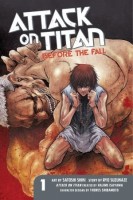
Attack on Titan: Before the Fall, Volume 1Attack on Titan: Before the Fall, Volume 1 written by Ryo Suzukaze and illustrated by Satoshi Shiki. Set some seventy years before the main events of Hajime Isayama’s original Attack on Titan manga, Before the Fall is based on a series of light novels by Ryo Suzukaze (which Vertical will begin releasing later this year). Despite having a different author than the original manga, Before the Fall fits right in with Isayama’s worldbuilding and the tone set by Attack on Titan–there is still plenty of fear and darkness. The most striking difference, which didn’t come at all as a surprise, is that the artwork in Before the Fall is much stronger overall. The story follows Kuklo, a young man who, due to the unusual circumstances of his birth, is feared, abused, and reviled by those around him. It’s not pretty. People who have read the original Attack on Titan will have a slightly better understanding of the world than those who haven’t, but so far Before the Fall seems to stand quite well on its own. Before the Fall has a lot of potential; I look forward to seeing how it develops.

I Give to YouI Give to You by Ebishi Maki. As far as I can tell, I Give to You is Maki’s first and currently only boys’ love manga. It’s not a typical boys’ love story, either. The focus is very much on the characters themselves and their personal struggles and less on romance. The manga addresses what it means to be normal and lead a normal life, which isn’t an option for either of the leads. Ryoichi is being pursued by debt collectors after his ex-boyfriend defaults on a loan they co-signed together. He takes shelter from a storm in a teahouse run by Ren, another young man with a past he’d like to put behind him. The two are very different–despite his financial worries, Ryoichi tends to be fairly warm and happy-go-lucky while Ren is cooler and much more reserved. In the beginning, it’s Ryoichi who needs help and acceptance from Ren, but by the end of I Give to You their roles have almost completely reversed. The evolution of their relationship happens so slowly and naturally over the course of the manga that I was quite impressed with how it was handled. I would definitely be interested in reading more of Maki’s manga.

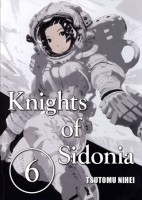
Knights of Sidonia, Volume 6Knights of Sidonia, Volumes 6-7 by Tsutomu Nihei. For most of Knights of Sidonia, it has been the Gauna who have been adapting and evolving by adopting human strategies, techniques, and even form. In these volumes, it’s the humans who have begun to apply the abilities and characteristics of the Gauna to their own technologies, creating terrifying and powerful human-Guana hybrids in the process. Understandably, not everyone is comfortable with these developments, but humanity is running out of options if it wants to survive. Knights of Sidonia has this odd mix of comedy and creepiness that somehow works. Although by this point in the series he has largely been accepted by the rest of the population of Sidonia and even has a few romantic interests, Nagate continues to be incredibly awkward socially. Because of this he still has a tendency to unintentionally create quite a commotion, often with humorous results. At the same time, Knights of Sidonia is also a horror manga. The Gauna, and now the hybrids as well, have very disconcerting designs that can be both grotesque and beautiful.

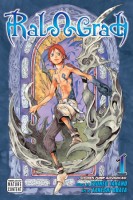
Ral Ω Grad, Volume 1Ral Ω Grad, Volumes 1-4 written by Tsuneo Takano and illustrated by Takeshi Obata. The primary reason I decided to read Ral Ω Grad was because I’m a fan of Obata’s artwork. Ral Ω Grad is a loose adaptation of the 2006 video game Blue Dragon. The manga definitely has a fantasy RPG feel to it–a young hero with special abilities fights against the destruction of the world by gathering together a party of other gifted individuals around him–but familiarity with Blue Dragon isn’t at all necessary to understand what’s going on. Generally, Ral Ω Grad manages to be vaguely entertaining even though it’s breaking no new ground. I found that I enjoyed the series more when I approached it as a parody rather taking it too seriously. (I’m pretty sure it wasn’t intended to be a parody, though…) Ral’s motivation for saving the world? Because he loves women. And boobs. Consequently, there’s fanservice and groping aplenty, but Ral spends quite a bit of his time running around mostly naked, too. In the end, the series’ highlight really is Obata’s artwork, which is consistently excellent. The story, sadly, is less engaging.

Filed Under: FEATURES, My Week in Manga Tagged With: attack on titan, Ebishi Maki, knights of sidonia, manga, Ral Ω Grad, Ryo Suzukaze, Satoshi Shiki, Takeshi Obata, Tsuneo Takano, Tsutomu Nihei

My Week in Manga: February 17-February 23, 2014

February 24, 2014 by Ash Brown

My News and Reviews

Two reviews posted last week! First up was Jeffery Angles’ Writing the Love of Boys: Origins of Bishōnen Culture in Modernist Japanese Literature. It’s a very interesting work examining the portrayal of male-male desire in Japanese literature in the early twentieth century. I discovered Writing the Love of Boys while looking for more information about Edogawa Rampo and his writing. The work even briefly addresses boys’ love manga, which I didn’t realize that it would when I first picked up the volume. The second review from last week was of Yoshikazu Yasuhiko’s Mobile Suit Gundam: The Origin, Volume 4: Jaburo. I’ll be honest, since I wasn’t already a Gundam fan, I didn’t anticipate that I would be enjoying this series as much as I am. I’ve actually been quite impressed with the manga. Yasuhiko’s artwork is fantastic and the balance between the individual characters’ struggles and the war as a whole has been excellent. And It doesn’t hurt that Vertical’s edition of The Origin is simply gorgeous.

As for interesting things online: Matt Thorn received An unambiguous response from Asano Inio regarding the use of pronouns and has some final thoughts on the whole affair. I had somehow forgotten about Ryan Holmberg’s What Was Alternative Manga? column at The Comics Journal. The latest article examines Shinohara Ushio’s Action Cartooning. In the most recent House of 1000 Manga column, Jason Thompson uses the return of two boxes of manga amounting to 64 Pounds of Porn as a jumping off point to discuss some of the history of the publication of hentai and ecchi manga in English. Manga translator Amanda Haley was interviewed over at Organization Anti-Social Geniuses. In somewhat older news, but Brigid Alverson and Publishers Weekly now have bit more information about it–Digital Manga, Inc. to Publish Tezuka Backlist.

Quick Takes

Gangsta, Volume 1Gangsta, Volume 1 by Kohske. Other than having seen some of the artwork and having a rough sense of the series’ premise, I actually didn’t know much about Gangsta going into the first volume. It turns out that the manga is Kohske’s first series and it seems to be doing fairly well for her. At the very least, I can say that I’m definitely interested in reading more of Gangsta. Worick and Nicolas are two “handymen” who are brought in to deal, often quite violently, with people and situations that for one reason or another the authorities would rather avoid. The two men have dark pasts, ties to organized crime, and a very close relationship with each other, but only one volume in the details have mostly just been hinted at. I like Nic and Worick a lot, and am particularly interested in learning more about Nic and his background. At one point a mercenary, he’s an incredibly skilled and powerful fighter. He’s also a “tag” with superhuman abilities, considered to be a monster or freak by many. Worick can hold his own, too, though. They’re both badasses with attitudes. The supporting cast is also pretty great.

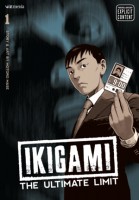
Ikigami: The Ultimate Limit, Volume 1Ikigami: The Ultimate Limit, Volumes 1-2 by Motoro Mase. In order to encourage the population to value life and increase social productivity, the National Welfare Act is passed. During inoculation, 1 out of 1,000 people are randomly injected with a nano-capsule that will kill them sometime between the age of 18 and 24. The day before they are scheduled to die, they receive death papers–Ikigami–so that they can prepare for their last hours. Ikigami follows those people and how they deal and cope with their impending deaths. It’s a grim subject matter, but handled well. The manga manages to show that even seemingly senseless deaths matter and can have a purpose–people can continue to influence others even after they are gone. At this point, Ikigami seems to be largely episodic. However, there is also an overarching framing story that ties everything together. Kengo Fujimoto is one of the government workers responsible for delivering Ikigami to those who are about to die. He struggles to come to terms with his work and the role he plays within the system as he (and therefore the readers) learn more about it.

The Manzai Comics, Volume 1The Manzai Comics, Volume 1 written by Atsuko Asano and illustrated by Hizuru Imai. I discovered The Manzai Comics due to the fact that it is written by the author of No. 6. It’s a five-volume series, but only the first volume was ever released in English. I was actually quite surprised by The Manzai Comics; it’s a rather delightful and amusing manga. And touching, too, as transfer student Ayumu struggles to overcome his hikikomori tendencies and is almost forcefully befriended by his new classmates. One of the major running jokes is that almost everything that Takashi says to Ayumu when taken out of context makes it sound like he’s hitting on him. When he’s talking about “doing it” and so on, he’s talking about becoming a manzai duo, not boyfriends. (Although it may very well be that Takashi is gay; it’s left as an ambiguous possibility.) In some ways, The Manzai Comics is like a boys’ love manga without actually being a boys’ love manga. People who are at least passing familiar with manzai stand-up comedy will probably get a little more out of it than those who aren’t, but that knowledge isn’t at all necessary to enjoy the story as a whole.

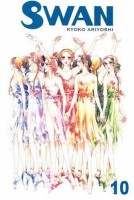
Swan, Volume 10Swan, Volumes 10-12 by Kyoko Ariyoshi. I am still absolutely loving Swan. The Second Annual Tokyo World Ballet Competition is drawing to a close, but the passion and intensity of the dancers is as strong as ever. They are all pushing themselves to the breaking point in order to give their very best performances. Ultimately the competition is too much for some of the dancers, both physically and emotionally, as they are confronted with their own limitations. These particular volumes of Swan emphasize the importance of a dancer’s personal strength and abilities, but also the importance of a dancer’s partner and their ability to work with, rely upon, and support each other. This extends beyond the realm of dance and spills over into the rest of their lives, as well. Years have passed since the story first began; it’s marvelous to see how much Masumi has changed and developed as the Swan has progressed, not just as a dancer but as a person. I like her even more now than I did the beginning. She’s gone through a lot of trials, pain, and suffering for her art, but she has also experienced great joy and satisfaction because of it.

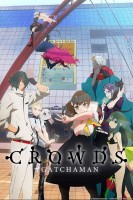
Gatchaman CrowdsGatchaman Crowds directed by Kenji Nakamura. I am only vaguely familiar with the Gatchaman franchise and so wasn’t initially intending to watch Gatchaman Crowds, but after hearing nothing but good things about the series I decided to give it a try. I’m glad that I did because I ended up quite enjoying Gatchaman Crowds. Hajime Ichinose is the most recent member of the Gatchaman team, a group of humans and aliens granted superpowers in order to protect the planet from aliens that would do it and the population harm. She’s an extraordinarily vibrant and optimistic young woman, and at first I thought she was going to be terribly annoying, but Hajime turns out to be a fantastic character and is not nearly as naive as one might expect. Her presence on the team has a huge effect on the other members and they all begin to rethink what it means to be Gatchaman and what their roles as superheros should be. Basically, it’s a series about using your skills and talents to the best of your ability no matter who you are and how even dangerous powers (and technology) can be harnessed for good.

Filed Under: FEATURES, My Week in Manga Tagged With: anime, Atsuko Asano, Gangsta, Gatchaman, Hizuru Imai, Ikigami: The Ultimate Limit, Kohske, Kyoko Ariyoshi, manga, Manzai Comics, Motoro Mase, swan

My Week in Manga: February 10-February 16, 2014

February 17, 2014 by Ash Brown

My News and Reviews

Not one, but two in-depth manga reviews were posted last week at Experiments in Manga. It wasn’t intentional on my part, though it did make me happy, but both manga deal with queer themes. The first review was for Takako Shimura’s Wandering Son, Volume 6. Even though it can be a somewhat difficult read for me personally since the subject matter often hits very close to home, I’m still absolutely loving this series. The seventh volume of Wandering Son is currently scheduled for release in August, which feels like a long ways off right now. As part of my “Year of Yuri” review project, last week I also took a closer look at Kiriko Nananan’s Blue, the only example of her long-form manga available in English. It’s a sweet and melancholic story of first love which follows the relationship of two young women who are classmates at an all-girls high school. The artwork in particular is very striking.

I’ve come across plenty of interesting reading and news over the last week. Brigid Alverson attended the Angoulême International Comics Festival this year and has been writing several reports on the experience. One of those explores the current state of the French manga market. In other festival news, The Guys with Pencils podcast interviewed Christ Butcher to talk about the fantastic Toronto Comics Arts Festival which he co-founded in 2003. Justin Stroman recently wrote two articles that I found to be particularly interesting: The Great Tumblr Industry Experience for Organization Anti-Social Geniuses and The Legal Manga Reading Sites You Don’t Know About for Manga Bookshelf. Finally, there has been some more movement on the licensing front. Yen press announced three new manga titles (Übel Blatt by Etorouji Shiono, Barakamon by Satsuki Yoshino, and Hiroyuki Aigamo’s adaptation of Accel World), as did Vertical (Gamon Sakurai’s Demi-Human, Ryū Mizunagi’s Witchcraft Works, and Midori Motohashi’s adaptation of The Garden of Words).

Quick Takes

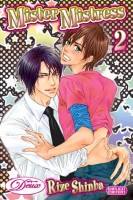
Mister Mistress, Volume 2Mister Mistress, Volume 2 by Rize Shinba. It’s been quite a while since I read the first volume of Mister Mistress, but I did enjoy it enough that I made a point to track down the now out-of-print second volume. (Happily, both volumes are now available digitally from SuBLime, though I don’t believe there are currently any plans to continue the series.) Mister Mistress works best for me when it sticks to being a comedy. Shinba introduces a somewhat tragic backstory for Rei in this volume, but fortunately it doesn’t take too long for this to be turned around and played for laughs. The series’ strength really isn’t its plot, but its humor. Fujimaru is a bit of a goofball who can’t quite decide what to do about Rei. He halfheartedly attempts to exorcise the incubus several times, but on occasion he actually appreciates having him around. Though I’m not entirely convinced by their developing feelings for each other, it can be rather convenient for a horny teenager to have a personal incubus to aid in the realization of his sexual daydreams. As such, the sex scenes in Mister Mistress tend to be a little unusual.

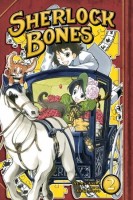
Sherlock Bones, Volume 2Sherlock Bones, Volumes 2-3 written by Yuma Ando and illustrated by Yuki Sato. I wasn’t sure after reading the first volume of Sherlock Bones, but after reading the second and third volumes it appears as though the series will be mostly episodic. Which is just fine and works pretty well. After the basic premise of the series has been established–Sherlock Holmes reincarnated as a mix-breed puppy–the mysteries tend to be fairly self-contained. I was pleasantly surprised by the first volume of Sherlock Bones and, if anything, I think these two volumes are even better than the first. Sherdog seems to always be present when a murder is taking place, so Sherlock Bones isn’t really a “whodunit.” Instead, the series focuses on outwitting the criminals and finding ways to reveal their attempts to cover up what they have done. For the most part this means relying on circumstantial evidence and pressuring the killers into confessing. Although murder seems to be the crime du jour, Sherlock Bones features some more lighthearted and silly investigations as well which take advantage of the fact that Sherdog is adorable.

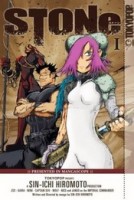
Stone, Volume 1Stone, Volumes 1-2 by Sin-ichi Hiromoto. In 2004, the editor of the English edition of Hiromoto’s short manga series Stone called it a “tribute to all of the fantastic sci-fi/action/fantasy films of the past thrity-odd years.” That seems to be a fairly accurate description of Stone. Hiromoto borrows and remixes elements from many films and franchises along with his own creations to devise something entirely his own. I was frequently reminded of Waterworld and to some extent Dune, and I definitely caught nods to Hellraiser and Star Wars. I get the feeling that there were references that I completely missed, too. Stone is a quickly paced manga with plenty of action set in a post-apocalyptic world in which the planet has been covered in a literal sea of sand. My favorite parts of Stone are the nightmarish sand creatures that Hiromoto has designed. Zizi, a fiesty young woman and the series’ lead, is also pretty great. I did prefer the series’ beginning over its end. As the manga becomes increasingly chaotic as the story progresses. The artwork remains visually interesting and engaging, but the plot makes less and less sense as it goes along.

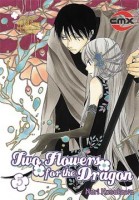
Two Flowers for the Dragon, Volume 5Two Flowers for the Dragon, Volumes 5-6 by Nari Kusakawa. I have now reached the point in this series where I must lament the fact that the final volume wasn’t able to be released in English before CMX folded. These two volumes form the climax of Two Flowers for the Dragon and include some extraordinarily significant plot developments and betrayals. The direction the story has taken was definitely foreshadowed, but that doesn’t make it any less heart-wrenching to see play out. I thought it was all very well done. One of the things that I like the best about Two Flowers for the Dragon is how well-developed and complicated the main characters are. They all have their strengths and their weaknesses, flaws as well as redeeming qualities. The supporting cast is likewise well-rounded, though at this point the series’ true villain unfortunately seems to be less so. The characters and their interactions are a highlight of Two Flowers for the Dragon, but I’m really enjoying the story as well. I like the mix of action, fantasy, romance, and intrigue. So much so, that I’m tracking down a copy of the last volume in Japanese. I want to know what happens!

Filed Under: FEATURES, My Week in Manga Tagged With: manga, Mister Mistress, Nari Kusakawa, Rize Shinba, Sherlock Bones, Sin-ichi Hiromoto, Stone, Two Flowers for the Dragon, Yuki Sato, Yuma Ando

My Week in Manga: February 3-February 9, 2014

February 10, 2014 by Ash Brown

My News and Review

Last week I announced the winner of the Vinland Saga manga giveaway. The post also includes a list of the manga with memorable snowy scenes that were mentioned during the contest. (Just in case you haven’t had enough snow where you are this winter.) And speaking of Makoto Yukimura’s Vinland Saga, I also reviewed the second omnibus of the manga. I’m really loving the series and enjoyed the second volume even more than I did the first. Over the weekend I reviewed Mieko Kanai’s award-winning novel Oh, Tama! which I greatly enjoyed. I know quite a few people who find it to be a boring work, but I found it to be delightfully low-key with a quirky sense of humor.

As for news and interesting reading seen online this week: The fourth issue of the international edition of Monkey Business will be released later this month. I quite enjoy Monkey Business, so I’m looking forward to it. Seven Seas answered a question about some of the decisions that go into licensing manga for omnibus release over on its Tumblr. At Organization Anti-Social Geniuses, Justin posted a great List of Where You Can Buy Anime/Manga in 2014. Hooded Utilitarian’s Ng Suat Tong writes about some of the best online comics criticism of 2013, including some great articles on manga that I hadn’t previously come across.

Quick Takes

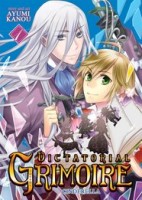
Dictatorial Grimoire, Volume 1: CinderellaDictatorial Grimoire, Volume 1: Cinderella by Ayumi Kanou. I have a feeling that Dictatorial Grimoire may very well be one of those manga that is so bad that it’s good. The story is admittedly a bit of a mess and sometimes doesn’t even make a whole lot of sense. However, I can’t deny that I had fun reading the manga. It’s all sorts of ridiculous. (I’m not sure that all of it is entirely intentional, though.) Otogi Grimm is the descendant of the Brothers Grimm which turns out to be a rather dangerous thing to be. The Brothers made a pact with demons offering up the lives of their descendants in exchange for the stories that formed the basis of their famous fairy tales. Many of those demons–such as the progenitor’s of Cinderella and Snow White–are now after Otogi in one way or another. He does seem to maintain some control over them, though it’s never explained how he learned, developed, or perhaps inherited this power. I did love that Cinderella is a complete masochist, although that fact is used mostly as a gag rather than for any meaningful characterization. I was, however, amused.

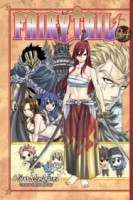
Fairy Tail, Volume 34Fairy Tail, Volume 34 by Hiro Mashima. The thirty-fourth volume of Fairy Tail gets off to a good start with the conclusion of Natsu’s confrontation with the Saber Tooth Guild. Then it’s back to the Grand Magic Games for the third day of competition. After a nice buildup to the day’s challenge event, called Pandemonium, Erza’s epic battle is largely reduced to a two-page spread. More time is spent on what basically amounts to target practice for the other teams than on what could have been a glorious combat sequence; it was extremely disappointing. Some of the other fights in this volume fare better, but others are completely rushed through. I’m more interested in the plots going on behind the scenes than I am in the tournament itself, but it seems that to some extent Mashima has given up on the Grand Magic Games. Even the event challenges, which were initially interesting because they required some actual thought and strategy to be put into them in addition to magic and martial skill, have become little more than all-out brawls in this volume. That, too, was a rather disappointing development.

Manic LoveManic Love by Satomi Yamagata. Manic Love is a prequel of sorts to Yamagata’s Fake Fur; it delves deeper into the back story of Maki Sonoda, an important side character. Yamagata jokes in the afterword that she had challenged herself to write a manga that was half nude scenes, so there’s quite a bit of sex in Manic Love. But it’s actually handled quite tastefully and the sex scenes are an important part of the manga and the themes with which Yamagata is working. As was the case with Fake Fur, Manic Love explores the relationship between romantic love and sexual desire and how they can influence each other. Sex is used as a form of communication and connection between the characters in addition to being something that they enjoy. One of the things that I particularly liked about Manic Love is that each chapter it told from a different characters’ point of view. Maki is in what is probably best described as a sort of love triangle, but it’s one without hard feelings or anger. It’s interesting to be able to see that unusual relationship from multiple perspectives, including one from someone who is outside of that triangle entirely.

Filed Under: FEATURES, My Week in Manga Tagged With: Ayumi Kanou, Dictatorial Grimoire, Fairy Tail, Hiro Mashima, manga, Satomi Yamagata

My Week in Manga: January 27-February 2, 2014

February 3, 2014 by Ash Brown

My News and Reviews

I only posted one review last week, but there were a couple of other posts as well. As for the review, I took a look at Haruki Murakami’s award-winning Kafka on the Shore. Of the two Murakami novels that I have so far read, this is my favorite. Still, at times I found it to be a rather frustrating reading experience, although there were parts of the novel that I absolutely loved. For the few people who are actually interested, I also posted January’s Bookshelf Overload last week. But, perhaps most importantly, my first manga giveaway of the year is currently in progress! I accidentally ended up with two copies of the second Vinland Saga omnibus, so now you have a chance to win one for your very own! The winner will be announced on Wednesday, so there’s still some time to enter the giveaway.

On to other things online! Matt Thorn has tracked down the interview with Inio Asano that sparked the whole discussion about his gender identity among fandom and offers some of his own comments. Over at All About Manga, Daniella Orihuela-Gruber writes about Hetalia’s Version of History: What Does It Offer Readers?. The fourth episode of Fujojocast has been posted, which takes a look at some award-winning and award-nominated manga. And speaking of honor-worthy manga, Wandering Son made the Rainbow List again this year and quite a few manga appear on YALSA’s 2014 list of Great Graphic Novels for Teens (which is actually a great list of graphic novels for anyone, not just teens). Finally, Seven Seas has had a week full of license announcements, including Vampire Bund doujinshi, Kokoro Connect, and it’s newest yuri acquisition Citurs.

Quick Takes

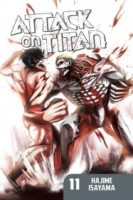
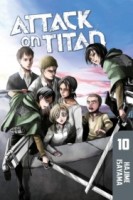
Attack on Titan, Volume 11Attack on Titan, Volume 11 by Hajime Isayama. To be honest, I’ve recently been a little worried reading Attack on Titan due to the sheer number of plot twists that seem to be included in every volume. While this does make for some exciting (and occasionally confusing) storytelling, it also makes the series feel like Isayama barely has it under his control. Fortunately, the eleventh volume of Attack on Titan is relatively the free of any “big reveals.” (At least in comparison to previous volumes.) Instead, the characters must deal with the fallout from some of the most recent developments–there are a surprising number of Titans who have come out of the 104th Corps. So, while there aren’t many dramatic plot twists in the eleventh volume, there is a major Titan battle between Eren and some of the people he once considered to be his comrades. Some nice character development comes out of it, too, as well as some more hints regarding what the Titans really are and who is behind it all. I’m still sticking with the series at this point.

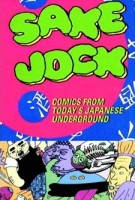
Sake JockSake Jock: Comics from Today’s Japanese Underground edited by Adam Glickman. Published in 1995, Sake Jock is described as being “the first collection of Japanese alternative artists to appear in English.” Sadly, this slim volume from Fantagraphics can be rather difficult to find nowadays. Sake Jock collects seven short manga, most if not all of which were originally published in the influential alternative manga magazine Garo. Some of the creators I was already familiar with from other underground comics anthologies while others I was encountering for the first time. I was particularly happy to see a work by Kiriko Nananan included since I love her style. Overall, I appreciated and enjoyed the manga collected in Sake Jock. I’m not sure that the collection will hold much general appeal except to those who already have an established interest in alternative manga; there have since been other anthologies published that would make a better introduction. It’s kind of a cool artifact, though, and I am glad to have it as part of my collection.

Two Flowers for the Dragon, Volume 2Two Flowers for the Dragon, Volumes 2-4 by Nari Kusakawa. It’s actually been a few years since I read the first volume of Two Flowers for the Dragon, but I remember being quite taken with it so I figured it was about time to get around to reading more of the series. I’ve rediscovered that I really enjoy the manga. It’s a wonderful mix of fantasy and romance with great character dynamics. There’s also a bit of court intrigue and some assassination plots for good measure.(And some unexpected gender-bending, too, for that matter.) Shakuya, the princess and heir of the Dragon Clan, has two fiancés vying for her affections. Kuwan is a capable but somewhat arrogant captain of the guard while Lucien is a kind-hearted young man who has lost many of his memories. The two of them obviously care for her dearly and are understandably a little antagonistic towards one another. Much to her dismay, Shakuya has developed feelings for both of them to varying degrees. But trying to figure out the workings of her own heart is only one of her many concerns.

The Tyrant Falls in Love, Volume 7The Tyrant Falls in Love, Volume 7-8 by Hinako Takanaga. Volumes seven and eight of The Tyrant Falls in Love form the last story arc in the series although Takanaga does promise that she hasn’t completely abandoned the story and characters. She plans on creating more manga–side stories, epilogues, and so on–but The Tyrant Falls in Love forms a complete story on its own, even considering the fact that it was a sort of follow-up to her debut series Challengers. Throughout The Tyrant Falls in Love, Morinaga and Souchi’s communication has been absolutely terrible. Their relationship is an extraordinarily rocky and volatile one; I honestly wasn’t sure what sort of ending Takanaga was going to go for. Overall, I was very satisfied with the series’ conclusion and I think it works. The only thing I wasn’t entirely convinced by is the direction that Masaki’s relationship with Morinaga’s older brother seems to be taking. Granted, that particular development did set in motion a pretty critical realization on Morinaga’s part.

Filed Under: FEATURES, My Week in Manga Tagged With: attack on titan, Hajime Isayama, Hinako Takanaga, manga, Nari Kusakawa, Two Flowers for the Dragon, Tyrant Falls in Love

My Week in Manga: January 20-January 26, 2014

January 27, 2014 by Ash Brown

My News and Reviews

Last week I declared it to be Usamaru Furuya Week here at Experiments in Manga. Ostensibly, it was to celebrate Furuya-sensei’s birthday, but mostly it was just an excuse for me to finally get around to reviewing more of his manga. I have now written an in-depth review of all of Furuya’s manga currently available in English. As for last week’s Furuya reviews, I have for your reading pleasure Short Cuts, Volume 2 (the final volume of one of my favorite gag manga), the second and third volumes of Genkaku Picasso (probably the most accessible entry into Furuya’s English manga), and the second and third volumes of No Longer Human (an excellent adaptation of Osamu Dazai’s novel No Longer Human). I’d love to see more of Furuya’s work translated. Although there are no immediate plans, I know that Vertical has expressed interest, so I am hopeful that someday we’ll see more.

Elsewhere online, manga translator and scholar Matt Thorn has an excellent piece Regarding Inio Asano’s gender identity. (He also talks a bit about his own gender identity.) And speaking of the complexities of gender, sexuality, and translation, a few months back I attended the lecture “Out Gays” or “Shameless Gays”? What Gets Lost, and What is Gained, when U.S. Queer Theory is Translated into Japanese? and posted some random musings about queer theory, Japanese literature, and translation. Well, the video of the lecture was posted earlier this month and is freely available to view. The most recent ANNCast, Vertical Vortex, features Ed Chavez from Vertical and included a license announcement for Takuma Morishige’s comedy manga My Neighbor Seki. In other licensing news, Seven Seas has acquired Kentarō Satō’s horror manga Magical Girl Apocalypse. Also, Seven Seas will soon be announcing licenses for a new yuri manga and a doujinshi (which is very unusual in English). Finally, Shawne Kleckner, the president of Right Stuf (one of my favorite places to find manga), recently participated in a Reddit Ask Me Anything.

Quick Takes

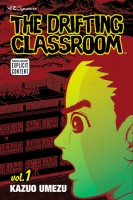
The Drifting Classroom, Volume 1The Drifting Classroom, Volumes 1-3 by Kazuo Umezu. An award-winning horror manga from the early 1970s, The Drifting Classroom is a series that I’ve been meaning to read. After a bizarre earthquake, Yamato Elementary School along with more than 860 students and staff disappear, leaving behind an enormous hole in the ground and very few clues as to what has happened. From the students’ perspective, everything outside the school has been turned into a wasteland. The situation they find themselves in may be extreme and unbelievable, but the consequences that follow are terrifyingly probable. The series’ setup allows Umezu to freely explore humanity’s darkness. The Drifting Classroom isn’t frightening because of the unknown; the true horror comes from how people react out of fear to the unexplainable. There are immediate concerns for survival, such as the lack of food and water, but even more problematic is the violence the erupts among the school’s survivors. The Drifting Classroom is an intense horror and survival manga with extremely dark psychological elements. I’ll definitely be reading more.

Missions of Love, Volume 6Missions of Love, Volume 6 by Ema Toyama. I started reading Missions of Love in the middle of the series. Although there is some background information that I am missing, I was still able to pick up on the major plot points fairly quickly. I really should go back and read the earlier volumes, though, as I’m enjoying the series much more than I anticipated. None of the characters are particularly nice people; their relationships are a twisted and tangled mess because of how they are all manipulating one another. And in the process, they’re confusing their own personal feelings as well. Missions of Love is intentionally scandalous and deliberately suggestive. However, it’s not exactly what I would call fanservice since it is meant more for the story and characters’ sakes rather than for the readers’. There are intimate moments and scenes of extreme vulnerability that challenge appropriateness but never quite cross the line, although Toyama frequently pushes the limits. I’m just waiting for something really terrible to happen. At this point, I can’t imagine that any of the characters in Missions of Love will be able to make it through the series unscathed.

Red Colored ElegyRed Colored Elegy by Seiichi Hayashi. Another manga from the early 1970s, originally serialized in the alternative manga magazine Garo, Red Colored Elegy is only one of two volumes of Hayashi’s work available in English. The story follows Ichiro and Sachiko, two young animators in love and living together, but who are struggling to make ends meet as life slowly drives them apart. Hayashi’s artwork is deceptively simple and often free of backgrounds, placing the emphasis on the characters and their tumultuous lives and relationships. He conveys a tremendous amount of emotion through a minimalist, almost stream-of-conscious approach. Hayashi’s style in Red Colored Elegy can make it feel a bit disjointed from page to page, as though it were a collection of closely related vignettes rather than a single continuing story, but the overall melancholic mood created by the manga is consistent. Red Colored Elegy is about falling into and out of love and about pushing through life’s tragedies, both small and large. Emotionally compelling and beautifully crafted, Red Colored Elegy stands up to multiple readings.

Yowamushi PedalYowamushi Pedal, Episodes 1-14 directed by Osamu Nabeshima. The Yowamushi Pedal anime series is based on an ongoing manga by Wataru Watanabe. Sakamichi Onoda is an otaku trying to revive the anime club at his new high school, but he quite unexpectedly finds himself caught up in the bicycle racing club instead. He has some natural talent at cycling–his frequent 90 km trips by bike to Akihabara probably didn’t hurt–but he has had no formal training. That’s about to change, though. The series so far has mostly focused on Onoda and the Sohoku High School racing club. The other teams that they will be facing have only been shown briefly. However, now that Onoda has started to get the basics of cycling down, the other cyclists are becoming more prominent in the story. I particularly like Yowamushi Pedal‘s casting; all of the characters have very distinctive speech patterns and voices which are very entertaining. I’m enjoying the series a great deal. Although I never was a racer and I don’t cycle as much as I used to (once upon a time, it was my primary mode of transportation), Yowamushi Pedal makes me want to get my bike out again.

Filed Under: FEATURES, My Week in Manga Tagged With: anime, Drifting Classroom, Ema Toyama, Kazuo Umezu, manga, missions of love, Seiichi Hayashi, Yowamushi Pedal

My Week in Manga: January 13-January 19, 2013

January 20, 2014 by Ash Brown

My News and Reviews

There were three posts at Experiments in Manga last week, only two of which were mine. First up was my review of Negi Banno’s S.S. Astro, Volume 1, a yonkoma manga about a group of young, twenty-something high school teachers. Sadly, the series was canceled before a second volume could be released. The review is the second manga for my Year of Yuri review project. My other post last week is a part of my continuing efforts to track down manga podcasts. Discovering Manga: Podcasts, Part 3 takes a look a three ongoing podcasts that started in 2013. Also last week, I was happy to welcome Jocilyn Wagner as a guest to Experiments in Manga with her review of Hiroki Ugawa’s Shrine of the Morning Mist, Volume 1.

On to interesting things found online! Alexander Hoffman posted a Lessons from the Crater Project over at Manga Widget, which is a great summary of the events surrounding the Kickstarter project for Osamu Tezuka’s The Crater. The Daily Dot has an excellent overview of the debate over Zoë Hange gender in Attack on Titan, which has apparently become rather heated in some circles. Opening Ceremony took time to talk to the wonderful folks behind Massive–New-to-OC Brand MASSIVE on Husky Gay Asian Erotica. I also particularly enjoyed reading Tony Yao’s post The Beautiful Negativity of Seinen over at Manga Therapy.

One last thing: Usamaru Furuya’s birthday is on January 25. In honor of that, I’m declaring this week Usamaru Furuya Week at Experiments in Manga. Basically, it’s an excuse for me to get around to reviewing the rest of his manga, which I’ve been meaning to do ever since I hosted the Usamaru Furuya Manga Moveable Feast a couple of years ago. So, I’ll be posting a whopping five reviews this week! I hope you enjoy.

Quick Takes

Arisa, Volume 12Arisa, Volume 12 by Natsumi Ando. Since its beginning Arisa has gone through so many disconcerting twists and turns, how is it possible that the twins look so utterly happy on the cover of the final volume? For the most part, I was satisfied with the ending of Arisa. Things aren’t resolved as happily as the cover might imply, which I find appropriate considering the darker aspects of the story. And I wouldn’t want everything to be tied up neatly. Once again though, some of the plot twists are a little ridiculous and over-the-top. I’m all for heightened drama, but I also like it to at least make some logical sense. Admittedly, Arisa can be a bit of a mess. Even so, I really enjoyed reading the series. Also included in this volume is a rather silly side story that takes place before the events of the main series. In this case it’s Arisa posing as her sister instead of the other way around. The results are amusing though not particularly believable. Granted, at this point I’m not expecting Arisa to be particularly believable anyway.

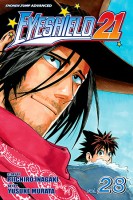
Eyeshield 21, Volume 28Eyeshield 21, Volumes 28-31 written by Riichiro Inagaki and illustrated by Yusuke Murata. I’ve discovered that, for some reason, I really like sports manga, even when that sport is something that I’m not particularly interested in in real life. For example, American football. Yet here I am thoroughly enjoying Eyeshield 21, completely caught up in the Deimon Devil Bats’ fight to reach the Christmas Bowl. And a fight it is. These volumes focus on the game between the Devil Bats and the Hakushu Dinosaurs with an emphasis placed on football as a combat sport. (I’ve actually never really thought of football that way before, so that was an interesting take on the sport for me.) The Dinosaurs have a habit of intentionally sending their opponents to the hospital, so it’s a fairly rough game. The face-off between the two teams also shows just how far Sena has come as a player since the beginning of the series. Once a weakling pushover, he’s now become much more confident in his abilities and in himself. I’m very excited to read more of Eyeshield 21.

Hetalia: Axis Powers, Volume 4Hetalia: Axis Powers, Volumes 4-5 by Hidekaz Himaruya. I know just as many people who absolutely hate the Hetalia franchise as I do people who absolutely love it. I wouldn’t necessarily call myself a rabid fan, but it is a series I follow. I do, however, generally prefer the anime adaptation over the original manga. For some reason, even though the anime and the manga both make the same jokes, I find the anime to be funnier. There are times that I just can’t seem to figure out what the punchline is supposed to be in the manga. The manga still can make me laugh, though, and I even occasionally learn a bit of history in the process, which I appreciate. The number of countries involved in Hetalia continues to grow with these volumes, including more female personifications which is nice to see. The Netherlands in particular seems to get a fair amount of page time this time, too. Hetalia does rely heavily on stereotypes for its humor, but I don’t get the feeling that they’re being used maliciously or to be deliberately offensive.

White BrandWhite Brand by Youka Nitta. Although I didn’t realize it until reading the afterword, apparently White Brand was Nitta’s first collection of boys’ love short stories. I’ve now read several of Nitta’s manga, but it seems that they tend to be fairly hit-or-miss for me. Despite Embracing Love actually being one of my favorite yaoi series, none of Nitta’s other works have really grabbed me. That hasn’t especially changed with White Brand, though I did like it more than The Prime Minister’s Secret Diplomacy. White Brand collects five short boys’ love manga. I’m not sure if it was an intentional or not, but a recurring theme throughout most of the stories is opposites. “White Brand” is about cousins with different color skin tones. “Teal End” is about two men from different countries. “Exhibition Painting” features men from very different classes and walks of life. “One Size Fits All” is somewhat frivolous story about a tall model and a much shorter man. “Hasta la Vista, Baby” is the only story that this play on opposites isn’t immediately obvious.

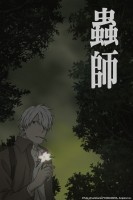
MushishiMushishi: Sun-Eating Shade directed by Hiroshi Nagahama. I won’t lie–I love both the Mushishi manga and the anime. I was very excited when the special episode was announced and thrilled when Crunchyroll picked it up so that I could actually watch it. Although about twice as long as the individual episodes of the anime series, Sun-Eating Shade matches the tone, atmosphere, and ambiance perfectly. I was very happy to see that the same animation style was kept for the special episode. The backgrounds are still gorgeous, the music is still haunting, the pacing is still relaxed and unhurried. Mushishi has always been a rather episodic series, but I liked how Sun-Eating Shade made references to and loosely tied together several stories adapted in the first season of the anime. If someone didn’t enjoy the original anime series, there is nothing in Sun-Eating Shade that will change their mind. But established Mushishi fans (like me) probably won’t be disappointed with the special episode. I’m looking forward to the second season of Mushishi a great deal.


Filed Under: FEATURES, My Week in Manga Tagged With: anime, arisa, Eyeshield 21, Hetalia, Hidekaz Himaruya, manga, mushishi, Natsumi Ando, Riichiro Inagaki, Youka Nitta, Yusuke Murata

My Week in Manga: January 6-January 12, 2014

January 13, 2014 by Ash Brown

My News and Reviews

Two reviews were posted at Experiments in Manga last week! The honor of the first in-depth manga review of the month (and of the year, for that matter) goes to Tetsu Kariya and Akira Hanasaki’s Oishinbo, A la Carte: Fish, Sushi & Sashimi. I love food, I love manga, and so I love Oishinbo, too. I happen to really like fish and sushi as well, so I particularly enjoyed this volume. I also posted a review for Edogawa Rampo’s mystery adventure The Fiend with Twenty Faces which is the first novel in his series The Boy Detectives. I’ve read some of his stories and essays written for adults, but this was his first work for younger audiences that I read. It’s a lot of fun.
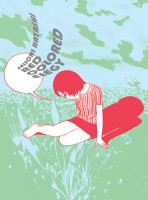
As for news and other interesting things found online: The English translation of Toh EnJoe’s Self-Reference Engine (one of my most notable release of 2013) has been nominated for a Philip K. Dick Award. The University of Michigan will be hosting an international conference on Natsume Sōseki from April 18 through April 20. (If you happen to be in Michigan around then, it’s be free and open to the public!) After months of no news, it looks like those who supported the Kickstarter for Osamu Tezuka’s The Crater may actually receive their rewards. And finally, Joe McCulloch takes a look at some of Suehiro Maruo’s most recent work over at The Comics Journal. Now if only more of his manga would be licensed in English!

Quick Takes

Basara, Volume 6Basara, Volumes 6-10 by Yumi Tamura. I love this series so much! It really is a shame that Basara is going out-of-print in English, but at least Viz has begun to release it digitally as well. The story is epic and engaging and the characters are complex and multi-layered. These particular volumes of Basara include the Okinawa story arc, which I especially enjoyed. It’s very interesting to see how Tamura is using events and politics from throughout Japan’s history to inform her post-apocalyptic world and culture. There are definite echos from the Warring States period, World War Two, and so on. Just as it was historically, in Basara Okinawa is a separate country from Japan that maintains its own traditions, relies heavily on trade, is largely at the mercy of foreign military influence, and is beset by natural disasters. Also, it’s the homeland of karate, which plays a part in some of the battles. (As a karateka myself, I couldn’t help but appreciate this.) I’m really looking forward to reading more of the series.

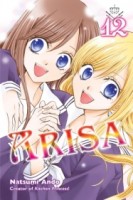
Entangled CircumstancesEntangled Circumstances by Kikuko Kikuya. I ended up enjoying Entangled Circumstances much more than I thought I would. I found the first chapter or so to actually be a little boring, but by the end of the volume Entangled Circumstances had managed to turn itself into a rather funny, and even a little sweet, boys’ love story. Actually, bonus chapters after the main story were the funniest and probably the favorite part of the manga for me because of that. Shibui and Himeko were once college classmates, but now they work at the same advertising agency. Himeko’s been in love with Shibui for a while now, but after a past awkward love confession, things have been strained between the two men. Often they seem to act like high schoolers rather than full-grown adults, so it’s difficult to take Entangled Circumstances completely seriously. It’s a lighthearted and fluffy sort of manga. The manga is nothing extraordinary, and I don’t know that I will necessarily need to read it again, but it was quite enjoyable.

ZooZoo by Andy MacDonald. I haven’t read the original novel Zoo, a science fiction thriller written by James Patterson and Michael Ledwidge, but MacDonald’s graphic novel adaptation somehow came into my possession, so I figured I’d give it a try. Since I haven’t read the original, I can’t definitively say how the graphic novel works as an adaptation, but I get the impression that MacDonald has been very faithful to the source material. The Zoo graphic novel can be somewhat text-heavy and some of the plot lines are a little compressed (though not exactly rushed) but I was never confused as to what was going on. Even so, I may have rolled my eyes a bit at the plot’s development and some of the rather predictable “twists.” Unfortunately, Zoo just doesn’t have that original or great of a story to begin with and I had a difficult time suspending my incredulity. The ending in particular was rather disappointing. Zoo starts out as a fairly action-packed, and bloody, doomsday scenario, but its heavy-handed moral can be a bit much.

MeganebuMeganebu! directed by Soubi Yamamoto. I already knew that I enjoyed Yamamoto’s visual style from her previous work and so I wasn’t disappointed by Meganebu!‘s brightly colored and slightly eccentric animation. Even so, it took a few episodes for the series to really grow on me. There’s not really much of a plot to Meganebu!. There are the members of the Glasses Club and their continuing efforts to create a pair of glasses with X-Ray vision (with some very unexpected and explosive results) but mostly the series just follows their daily lives and the trouble they all get into. Once I got over the fact that Meganebu! is fairly pointless, I could sit back and enjoy its peculiar sense of fun. As a glasses wearer myself, I could particularly appreciate all of the humor surrounding eyeglasses. To the members of the Glasses Club, glasses are more than just a fashion accessory. Neither are they simply used to correct vision. Glasses have the power to change the world. Meganebu! is an absurd anime, but I’ll admit to enjoying it.

Filed Under: FEATURES, My Week in Manga Tagged With: Andy MacDonald, anime, basara, comics, Kikuko Kikuya, manga, Meganebu, Yumi Tamura

My Week in Manga: December 30, 2013-January 5, 2014

January 6, 2014 by Ash Brown

My News and Reviews

Last week I announced the 4-Koma for You Winner. In case you’re looking for something to read, the post includes a list of yonkoma manga that have been released in print in English, too. I also posted December’s Bookshelf Overload last week, for those of you interested in following my adventures in buying way too much manga and other media. Finally, over the weekend I posted a review of Delavier’s Mixed Martial Arts Anatomy. This is one of the most tangentially related reviews I’ve written at Experiments in Manga. Why is it here? Simply because I’m a karateka and found it to be a useful book. It’s a great strength training resource for any martial artist. Plus, it has lots of illustrations.

I’ve more or less been on vacation for the last two weeks, so I haven’t been online much except to make sure that things were updated here at Experiments in Manga. Even so, there were two things in particular that caught my eye recently. First and foremost, the Massive anthology of gay manga originally scheduled to be published by PictureBox has been picked up by Fantagraphics! Right now, it looks like we should see the release sometime in October 2014. The other news that I was excited to hear about is that we’ll be getting a second season of the Mushishi anime nearly ten years after the first season aired. I loved Yuki Urushibara’s original manga (which is now unfortunately out-of-print in English) and I loved the first anime series so I’m looking forward to the second season a great deal.

Quick Takes

A Bride's Story, Volume 5A Bride’s Story, Volume 5 by Kaoru Mori. The art in A Bride’s Story always blows me away. Mori’s illustrations are so beautiful and detailed that it’s no surprise that there’s such a long wait in between each volume’s release. Most of the fifth volume of the series is devoted to the wedding between the twins and their husbands-to-be. The best word that I can think of to describe this volume is “joyous.” Mori shows the preparations that both families make for the happy occasion–a celebration that lasts an entire week. There’s dance and song, levity, plenty of food, and numerous guests. It’s extremely satisfying to see the entire community’s participation in the event. The manga as a whole is a gorgeous work, but the wedding itself is quite lovely. I enjoyed seeing the twins’ story develop. Their outgoing personalities might be annoying for some readers, but in the end I found the two of them to be quite endearing. Now begins the long wait for the next volume of A Bride’s Story.

Castle Mango, Volume 1Castle Mango, Volume 1 written by Narise Konohara and illustrated by Muku Ogura. Despite what the cover and title page of Digital Manga’s release indicate, Konohara wrote Castle Mango while Ogura was responsible for the artwork. Konohara is the same author who wrote About Love, which I quite enjoyed, so I was interested in reading Castle Mango. Both manga are slightly atypical boys’ love stories. Instead of being straightforward man-meets-man romances, the stories are more layered. There is an emphasis on well-developed characters and actual plot; it’s not just about getting guys into bed with each other. The leads of Castle Mango are rather unusual as well. Yorozu’s family owns and runs a love hotel while Tagame is a well-known porn director. Yorozu more or less blackmail’s Tagame into a relationship in order to keep him away from his brother, but he doesn’t even really like the older man. Their story is concluded in the second and final volume of Castle Mango. I’m very curious to see how things unfold, so I’ll definitely be picking it up.

A Centaur's Life, Volume 1A Centaur’s Life, Volume 1 by Kei Murayama. One of several “monster girl” manga recently released by Seven Seas, A Centaur’s Life is far less ecchi than the other titles. Plus, this one includes plenty of monster boys in addition to the monster girls, which I greatly appreciate. The manga is definitely centered around the series’ young women, though. The titular centaur is Kimihara Himeno; the manga is mostly a slice-of-life story which follows her and her other high school friends. (As a side note, I adore Himeno’s wild mass of hair on the cover.) Some people might find reading the first chapter a little uncomfortable as the story revolves around the girls’ privates, but following chapters are much less questionable. Overall, the manga was rather charming. And I am interested in learning more about the world that Murayama has imagined; it seems that some significant thought has been put into it. Although not the focus of the series, politics, law, cultural differences, disputes between races, and history have all been taken into consideration.

Ranma 1/2, Volume 15Ranma 1/2, Volumes 15-20 by Rumiko Takahashi. It’s been so long since I’ve read any of Ranma 1/2 that I had forgotten how much I love the series. After the main characters and basic premise are established, the manga becomes fairly episodic so it’s easy to pick up part way through the series and still know what’s going on. I find Ranma 1/2 to be hilarious and particularly enjoy the absurd martial arts that Takahashi comes up with. These particular volumes feature martial arts based around eating food extremely quickly and cheerleading, just to give two examples. I like the characters and I like the story, as silly and superfluous as it can be. Akane and Ranma seem to be no closer to getting married than they were at the beginning of the series. They argue quite a bit, but there are moments of genuine affection, too. Granted, those moments are frequently interrupted and don’t tend to last very long. The series’ off-the-wall comedy won’t be to everyone’s taste, but for me Ranma 1/2 is highly entertaining and a lot of fun.

Otome Yokai ZakuroOtome Yokai Zakuro directed by Chiaki Kon. The Otome Yokai Zakuro anime is based on an ongoing manga series by Lily Hoshino (which hasn’t been licensed in English.) The story takes place in an alternate version of Japan’s Meiji Era in which yokai and humans coexist. The office of Spirit Affairs is created in order to improve relations between the two groups. It’s made up of a small contingent of military officers and half-spirit girls who team up to work together. I’ll admit, I liked the first part of the series which explored the concerns over Japan’s Westernization and loss of traditions through the conflicts between humans and yokai much more than I did its end. Seeing as the opening has a bit of a spoiler in it, the series’ major plot twist was clearly planned well in advance, but it just didn’t seem to flow well as a whole as the narrative suddenly changes direction. The romantic subplots are broadcast from the very first episode–it’s obvious who will be falling in love with who–so none of those developments were particularly surprising or unexpected, either.

Filed Under: FEATURES, My Week in Manga Tagged With: anime, Bride's Story, Castle Mango, Centaur's Life, Kaoru Mori, Kei Murayama, manga, Muku Ogura, Narise Konohara, Otome Yokai Zakuro, Ranma 1/2, Rumiko Takahashi

My Week in Manga: December 23-December 29, 2013

December 30, 2013 by Ash Brown

My News and Reviews

Last week I posted a review of Hinoki Kino’s manga No. 6, Volume 4. The series has been getting better with each installment and things are starting to get really good. I also wrote a little bit about some of the manga, comics, and fiction releases that for me were particularly Notable in 2013. It’s not exactly a “best of” list, and it isn’t exactly a list of my favorite manga of the year, either. Basically it’s a list of interesting releases from 2013. And speaking of 2013, there’s still time to enter the last manga giveaway of the year! Check out the 4-Koma for You manga giveaway for a chance to win the omnibus edition of Kiyohiko Azuma’s yonkoma manga Azumanga Daioh.

Quick Takes

FairyTail, Volume 33Fairy Tail, Volume 33 by Hiro Mashima. It’s the second day of the Grand Magic Games and it’s still not looking good for the two Fairy Tail teams, although some of their members have surprising victories. Unfortunately, considering their prior string of defeats, it’s not enough to make much of a difference this early in the tournament. There are some great battles and moments of humor in this volume, but I still don’t find the tournament arc to be as compelling as the arcs that came before it. New characters continue to be introduced; I particularly enjoyed the addition of Bacchus, a powerful wizard from the Quatro Cerberus guild. Personality-wise, he can be a bit of a drunken jerk and isn’t always particularly likeable. What caught my interest is that his style of magic is based on Piguaquan, a legitimate Chinese martial art. Not too surprising considering his name, Bacchus combines this with Zui Quan, or “drunken fist.” Granted, it’s the fictionalized version of drunken fist that requires the practitioner to actually be intoxicated, but this is fitting and meshes well with the existing magic systems in Fairy Tail.

SmugglerSmuggler by Shohei Manabe. Originally released in English by Tokyopop, Smuggler is now available in a new edition from One Peace Books. I missed the manga the first time around, and since it also received a live-action film adaptation, I was particularly curious to read it. Kinuta is a failed actor who has accumulated a fair amount of debt. In order to pay back what he owes he has been smuggling and illegally dumping cargo outside of Tokyo. What he didn’t initially realize was that he was helping to transport and dispose of dead bodies for the yakuza. And now that he does know, Kinuta owes the mob his life as well as his money. When a job goes terribly wrong and an extraordinarily dangerous assassin escapes on his watch, Kinuta suddenly finds himself pulled even deeper into Japan’s underworld. Smuggler is a dark and violent manga, quickly paced, and unrelenting. It’s definitely not for the faint of heart. Smuggler held my interest, and there were some marvelously gut-wrenching scenes, but in the end I can’t say that the manga left much of a lasting impression on me.

Swan, Volume 4Swan, Volumes 4-9 by Kyoko Ariyoshi. I am still completely in love with Swan and am astounded that it has taken me this long to actually get around to reading it. The series is incredibly well done–it’s just so intense and passionate, not to mention beautifully drawn. I’m also learning a bit more about ballet and its history as I read, which I count as a bonus. There are quite a few themes being addressed in these particular volumes. One of the themes that is especially prominent deals with sacrifice and what people are willing to give up in order to pursue what the truly love. It’s not always an easy decision. As someone who was deeply involved in the performing arts (in my case music, not dance), it’s a conflict with which I can personally identify. The characters in Swan all have to struggle to find the balance between their lives as dancers and their relationships with other people. Matters of love and romance complicate things greatly, but they also serve as a source of inspiration for creative expression. Swan piles on the drama and it’s fantastic.

Wolfsmund, Volume 2Wolfsmund, Volume 2 by Mitsuhisa Kuji. While the first volume of Wolfsmund was violent and intense, the second volume is arguably even more so. In response to the rebellion gaining strength and numbers, the questioning of those trying to cross through the Wolf’s Maw at Sankt Gotthard Pass has become even more invasive and thorough. The gate’s overseer Wolfram–who is almost always shown with a terrifyingly pleasant smile on his face–seems to take particular delight in this. In order to get the information he needs, he’s more than willing to order the death or torture of a person no matter who they are. Cruelty isn’t limited to Wolfram. Even the rebellion’s heroes are capable of terrible deeds. I am a fan of dark historical manga, so Wolfsmund is right up my alley. Wolfsmund is definitely for mature readers. Considering its brutal nature (women and girls in particular suffer greatly in this volume) it’s not a series that I would recommend to just anyone. That being said, I am looking forward to the next volume.

Filed Under: FEATURES, My Week in Manga Tagged With: Fairy Tail, Hiro Mashiba, Kyoko Ariyoshi, manga, Mitsuhisa Kuji, Shohei Manabe, Smuggler, swan, Wolfsmund

My Week in Manga: December 16-December 22, 2013

December 23, 2013 by Ash Brown

My News and Reviews

Two reviews were posted last week at Experiments in Manga. The first review was for Yaya Sakuragi’s boys’ love manga Bond of Dreams, Bond of Love, Volume 3. Although the series isn’t my favorite work by Sakuragi, I tend to enjoy her manga and Bond of Dreams, Bond of Love has been growing on me. The second review was for Tales of Moonlight and Rain, the most recent English translation of Ueda Akinari’s Ugetsu monogatari, a collection of short stories about ghosts and other mysterious happenings that was originally published in Japan in 1776. It may be over two centuries old, but it’s still a great read.

I came across quite a few interesting things online last week: The Advocate posted its 10 Great Graphic Novel Gifts. It’s a great list of queer comics that came out this year and it includes a few excellent manga selections as well; Some Fog uses Kazuo Umezu’s Drifting Classroom as an example on how to creat comics–Lessons from Umezu; Voting has opened for the second Manga Translation Battle; The Comic Book Legal Defense Fund reports that Core Magazine Pleads Guilty in Japanese Obscenity Case, feeling that a “guilty plea would be a better option than a protracted legal battle.; On a happier note, the Toronto Comic Arts Festival has announced it’s initial list of featured guests. Among other great comics creators, Est Em will be coming to TCAF 2014!

Quick Takes

About LoveAbout Love written by Narise Konohara and illustrated by Tomo Ootake. Despite his family’s misgivings over his choice of career, Asaka has become an enthusiastic wedding planner. But recently things haven’t been going so well–several of the couples that he has been working with have canceled their weddings. That’s when he reunites with his first client, a man by the name of Sasagawa who has the perfect marriage and serves as an inspiration to Asaka. However, his marriage isn’t nearly as perfect as it seems. About Love is a slow-burning romance; Asaka and Sasagawa’s relationship takes a great deal of time to develop and solidify, but it’s a natural progression from acquaintances, to friends, to possibly something greater. About Love focuses on the emotional connection between the two men more than it does on their physical intimacy, although that has a role to play as well. In addition to their evolving relationship, About Love addresses some issues of same-sex marriage and there are other gay and lesbian couples important to the story as well.

Attack on Titan, Volume 10Attack on Titan, Volume 10 by Hajime Isayama. I’m not entirely sure how Isayama pulls it off, but it’s rather impressive how many twists and turns Attack on Titan has been taking lately. I went into this volume expecting a respite from major plot reveals since there have been so many recently. I was wrong. The focus of the tenth volume is on 104th’s struggle to survive against a massive titan attack on the castle in which they were hoping to hide and recover. They are without weapons or maneuvering gear, making their situation particularly precarious. This alone would have been enough to carry the volume and there are some very exciting moments in the fight. But no. After an extended action sequence, Isayama throws in not one but two (well, maybe three depending on how you’re counting) major story twists. Although there are still plenty of questions that need to be answered, the titans themselves are becoming less of a mystery. I actually kind of miss when they were beyond humanity’s comprehension, but I’m still interested in seeing how things play out.

Baron Gong Battle, Volume 1Baron Gong Battle, Volumes 1-6 by Masayuki Taguchi. Only six out of the nine volumes of Baron Gong Battle have been released in English. After his girlfriend is horrifically murdered by a Neo Hume, Baron is determined to seek revenge against those who killed her. The Neo Hume’s are extraordinarily powerful creatures born out of the Nazi’s biological experiments. Baron Gong Battle is an utterly absurd and violent action-packed manga series that can be a tremendous amount of trashy fun when it’s not being completely offensive. Baron is an over-the-top badass and the dialogue is extreme. However, the more that I read, the less enamored I became with Baron Gong Battle. The manga’s utter ridiculousness is highly entertaining, and it becomes more and more outrageous as the series progresses, but I soon became tired of the role that the women play. Occasionally they can be very competent fighters, but more often than not they seem to only be a part of the series in order to fawn over Baron and to run around mostly if not entirely naked.

PinkPink by Kyoko Okazaki. While I didn’t find Pink to be as brutal or as hard-hitting as Okazaki’s later work Helter Skelter, I still think that the manga is an excellent work and I enjoyed it a great deal. Pink is rather curious manga filled with rather curious characters. In general, they are much more likeable than those in Helter Skelter, but they are definitely an odd bunch. Yumi works as a part-time call girl in order to feed her pet crocodile Croc. Although Yumi’s on great terms with her younger stepsister Keiko–a precocious girl with a bottomless stomach–she and her stepmother hate each other. Things get a little complicated when Yumi becomes involved with Haruo, her stepmother’s manstress and wannabe novelist. I was actually surprised by how much of the Pink was told from Haruo’s perspective. His strange relationships with these three women, and Croc, forms the basis for much of the story. But even so, it’s Yumi who really seems to be the focus of the manga. Pink has a very cynical and oddball sense of humor which I could appreciate.

From the New WorldFrom the New World directed by Masashi Ishihama. Overall I really liked the story and setting of the From the New World anime, an adaptation of the novel by the same name written by Yusuke Kishi (which sadly has yet to be licensed in English.) However, I frequently found the series’ pacing and narrative structure to be frustrating and somewhat disjointed. Saki, the main protagonist, also had an annoying habit of echoing back whatever was being said to her by someone else. I did like that the story focused on the characters at several different points in their lives. From the New World takes place in what is eventually revealed to be a post-apocalyptic environment. I actually would have liked to have seen more about how society reached the point that it is at in the series; most of the past events are merely hinted at. From the New World deals quite a bit with the terrible lengths humanity is willing to go to when driven by fear. It’s very well done in places. The anime also gets bonus points for the nice use of music from Dvořák’s From the New World symphony.

Filed Under: FEATURES, My Week in Manga Tagged With: anime, attack on titan, Baron Gong Battle, From the New World, Hajime Isayama, Kyoko Okazaki, manga, Masayuki Taguchi, Narise Konohara, Tomo Ootake

  • « Go to Previous Page
  • Page 1
  • Interim pages omitted …
  • Page 12
  • Page 13
  • Page 14
  • Page 15
  • Page 16
  • Page 17
  • Go to Next Page »
 | Log in
Copyright © 2010 Manga Bookshelf | Powered by WordPress & the Genesis Framework