• Skip to primary navigation
  • Skip to main content
  • Skip to primary sidebar
  • Home
  • About Us
    • Privacy Policy
    • Comment Policy
    • Disclosures & Disclaimers
  • Resources
    • Links, Essays & Articles
    • Fandomology!
    • CLAMP Directory
    • BlogRoll
  • Features & Columns
    • 3 Things Thursday
    • Adventures in the Key of Shoujo
    • Bit & Blips (game reviews)
    • BL BOOKRACK
    • Bookshelf Briefs
    • Bringing the Drama
    • Comic Conversion
    • Fanservice Friday
    • Going Digital
    • It Came From the Sinosphere
    • License This!
    • Magazine no Mori
    • My Week in Manga
    • OFF THE SHELF
    • Not By Manga Alone
    • PICK OF THE WEEK
    • Subtitles & Sensibility
    • Weekly Shonen Jump Recaps
  • Manga Moveable Feast
    • MMF Full Archive
    • Yun Kouga
    • CLAMP
    • Shojo Beat
    • Osamu Tezuka
    • Sailor Moon
    • Fruits Basket
    • Takehiko Inoue
    • Wild Adapter
    • One Piece
    • After School Nightmare
    • Karakuri Odette
    • Paradise Kiss
    • The Color Trilogy
    • To Terra…
    • Sexy Voice & Robo
  • Browse by Author
    • Sean Gaffney
    • Anna Neatrour
    • Michelle Smith
    • Katherine Dacey
    • MJ
    • Brigid Alverson
    • Travis Anderson
    • Phillip Anthony
    • Derek Bown
    • Jaci Dahlvang
    • Angela Eastman
    • Erica Friedman
    • Sara K.
    • Megan Purdy
    • Emily Snodgrass
    • Nancy Thistlethwaite
    • Eva Volin
    • David Welsh
  • MB Blogs
    • A Case Suitable For Treatment
    • Experiments in Manga
    • MangaBlog
    • The Manga Critic
    • Manga Report
    • Soliloquy in Blue
    • Manga Curmudgeon (archive)

Manga Bookshelf

Discussion, Resources, Roundtables, & Reviews

Features

3 Things Thursday: Newsworthy

April 4, 2013 by MJ 1 Comment

Several articles and announcements have caught my eye this week in the manga (and comics) blogosphere, but there are three in particular that had me pressing the “retweet” button with the power of my whole heart. So with that in mind, I’d like to devote this week’s column to giving these items a signal boost.


3 must-click links in the comics blogsphere

1. Off*Beat Returns! – Normally I’d try to save the best for last, but I’m so genuinely giddy about this particular bit of news that I can’t help blurting it out right off the bat. Though new publisher Chromatic Press had announced a while back their intention to revive Jen Lee Quick’s unfinished series (originally published by Tokyopop), last night, they launched a Kickstarter campaign to fund the re-release of the series’ first two volumes as well as part of the cost to launch their upcoming Sparkler magazine, in which Off*Beat will continue to be serialized.

If you’re wondering what I’m raving about, check out my review of the first two volumes here at Manga Bookshelf.

2. Ryan Matheson speaks – Earlier this week, the Comic Book Legal Defense Fund released a short documentary on the story of Ryan Matheson—a manga fan who was arrested at the Canadian border for having images of manga on his computer that Canadian authorities deemed obscene. I wrote a post in 2011 about why I thought Ryan’s case should be of vital concern to all manga fans, and the CBLDF’s assistance and advocacy was key to his victory. Read more about the documentary (funded by the Gaiman Foundation) here in the CBLDF blog.

3. Gimme these clothes. Just gimme. – Also earlier this week, io9 (and everyone else in the comics world) pointed us to these fantastic (and sadly, theoretical) costume designs for a number of prominent female superheroes by artist Michael Lee Lunsford, in which they are actually dressed like people who could be comfortable and protected in a fight—or even just cold weather.

My personal favorite is Zatanna, on the left below, who just looks freaking awesome. As I said on Facebook when I first saw this, if I had the money, I’d dress like that every day.

awesomeness


That’s it for me this week! Readers, any favorite links to share?

Filed Under: 3 Things Thursday Tagged With: cbldf, Michael Lee Lunsford, off*beat, Ryan Matheson

Humming a Love Song with LaLa Dx

April 2, 2013 by Erica Friedman 2 Comments

laladxSo, we’ve talked many times about the vague lines that differentiate shounen/seinen and shoujo/josei. In real life, there is no one age when all boys shift from caring about becoming ninjas to liking looking at girls in bikinis and there is no one moment when girls stop wanting to be a princess and suddenly start paying attention to the cute boy in class.

When we read manga that has been licensed from Japan, we’re often seeing the very best of the bunch—the Fruits Baskets and the One Pieces—and yet, when you see pictures of manga stores in Japan, there are acres of shelves filled with…what?

Today we’ll talk about LaLa Dx, one of those fields filled with flowers of shoujo romance that you are never likely to see here in the US.

LaLa is a relatively well-known monthly magazine, home to several properties that have made to our shores, such as  Yuki Midorikawa’s Natsume’s Book of Friends and Hiro Fujiwara’s Kaicho wa Maid-sama, because of the relationship Viz has with LaLa publisher Hakusensha. LaLa Dx was originally a supplement to LaLa and is now its own bimonthly shoujo manga magazine. Like most of the Bestu, Za and Dx issues of monthly manga magazines, LaLa Dx is smaller than it’s better-known sister—international size A5 rather than the typical B5 size for the monthly magazines. According to the Japanese Magazine Publisher’s Association, Dx comes in at about 67,050  per issue circulation in 2011 (as compared with LaLa‘s 155,950). Small, but packed, Dx comes in at a hefty 850 pages with surprisingly little advertising—none of these series are making it to anime. So for the 690 yen ($7.32 at time of writing) you’re getting a lot of love.

LaLa Dx has a website, but perched in that vague space between childhood and maturity, it’s not quite interesting enough to be appealing to children, and doesn’t quite have content for an older audience. Part of the LaLa family of websites, the site is mostly and advertisement for the current issue. Interviews and other features are integrated with the other magazines on the site. Giveaways are, as well. These days, you’re likely to find a LOT of nyanko-sensei items as LaLa gifts and contest prizes.

When one opens the pages of Dx, one is looking at story after story of young women and young men not getting together for any number of reasons—you know, typical romance stuff. The plot might be driven by horror or comedy, but the story is romance. Friendships will be torn, secrets will be revealed, kind faces will become stern and angry faces will prove to be protective.  This magazine is a field of smiles, of tears, of love. This is what you see, when you look at all those shelves in manga stores. And this is the space between pop idols and cute boy in class…with a little princess thrown in for good measure. ^_^

LaLa Dx by Hakusensha: http://www.hakusensha.co.jp/lala/mag_laladx/now.html


Filed Under: Magazine no Mori Tagged With: Erica Friedman, Hakusensha, Magazine no Mori, Manga Magazines

License This! Tera Girl by Mizusawa Megumi

March 31, 2013 by Travis Anderson Leave a Comment

Tera Girl vol. 1

Today’s title is one I really think stands very little chance of seeing the light of day in the US, but that won’t stop me from gushing over it and hoping for a miracle to occur.

Tera Girl (or Temple Girl) by Mizusawa Megumi is the story of three sisters whose dad is a Buddhist priest. The three girls, Satoru, Hikari, and Ogami, could not be more different. Satoru is a university student studying medicine. She doesn’t hate that her family owns a temple, but she decided to focus on her own goals rather than the family business. Ogami is the youngest. She hates living in a temple and chose to go to a high school in another town so that no one would know about her family. Then there’s Hikari, the middle daughter. Also still in high school, she loves everything about the way she was raised and is a devout Buddhist. As a daughter, she can’t take over the temple herself, but her dad is counting on her to marry a man who is willing to become a priest and take over the temple.

Not only is this just a cute story in general and my favorite genre of shoujo (sweet romance with genuinely nice male characters, strong female friendships, no magic or anything out of the ordinary), it’s also a really neat look at how Buddhism works in Japan. Most Japanese people are culturally Buddhist, but not at all religious, so the manga is written for an audience who has little in common with Hikari’s upbringing. One reason I like school manga and workplace manga is that I like reading about everyday life in different places (though I also love things that take place in familiar settings, so maybe I just like stories about ordinary stuff), and this hits that same kink.

Tera Girl is a fairly recent series, with its third volume just released in February, and it’s by a very prolific, popular author, so that should mean it has a good chance at getting picked up, right? But no. I don’t know what it is about Mizusawa Megumi, maybe she is one of those authors who do doesn’t want her work translated, or maybe publishers just don’t think anyone is interested in the sort of stories she writes, but not a single one of her manga have ever been published in the US. Even scanlators don’t seem to care for her (so maybe that is a sign that there isn’t a lot of interest in what she writes, I don’t know).

If you were into anime in the mid ’90s, you probably remember Hime-chan no Ribbon, which while never officially licensed in the US, was very popular on the fansub circuit at the time and often shown at anime clubs. That’s probably her most well-known series outside of Japan, and that was twenty years ago. It’s also not at all typical of what she writes, since it’s a sort-of magical girl story, whereas the vast majority of her manga is the sort of everyday romance/slice-of-life stuff I love.

I know I said much the same thing in my post about Aozora Yell, but I feel like the US manga industry could really use more shoujo of this sort. So much of what’s put out here skews towards obnoxious love interests and female rivals. Kimi ni Todoke is popular, so it’s not like no one at all is interested in stories where the majority of the characters are nice and friendship is as strongly valued as romance, but there’s so much more like that in Japan and I don’t know why more of it isn’t given a chance.

Filed Under: License This! Tagged With: Mizusawa Megumi, shojo

Manga the Week of 4/3

March 29, 2013 by Sean Gaffney, Anna N, MJ and Michelle Smith 3 Comments

SEAN: Too much manga next week. Luckily, a good chunk of it came in everywhere except Diamond *this* week, so that takes a bit of the curse off.

Attack on Titan 4 still has lots of horrible death, grotesque horror, and the fear that this series will end with *everyone* dead. But – BUT – it has Potato Girl. More on her in my weekend brief. Suffice to say, she’s a great reason to grab this.

lastorder1

ANNA: I remember being vaguely intrigued when I saw the license announcement for this manga, but I never really followed up on that. Should I give it a whirl? I’m feeling a bit ambivalent knowing that there’s a “Potato Girl” in it.

MJ: I really liked the first volume of Attack on Titan, yet never bought more. “Potato Girl” might be the tipping point, though, for getting me into the bookstore.

SEAN: Battle Angel Alita: Last Order starts its omnibuses. I already reviewed this one, and suffice to say that I was mostly pleased, even if it is losing something by Kodansha being unable/unwilling to license the original Alita.

Fairy Tail 24 wraps up its Edolas arc and starts a new one, with a competition to see who will be the next S-class mage. Oh, and a surprise return! Big surprise – it divided the fandom when this came out in Japan.

Love Hina finishes its re-release with the 5th omnibus, a slightly smaller one containing the last two volumes. No surprises to see who gets paired off in the end, but the amount of focus on swordswoman Motoko may surprise people.

Sailor Moon hits the big 1-0 and wraps up the SuperS arc. (That’s right, there’s no cliffhanger for once.) This was the first Sailor Moon manga I ever read back in the day, and its disturbing nightmarish imagery still stays with me.

MICHELLE: Volume 10 wasn’t the first Sailor Moon manga I read, but it was the first one I reviewed. The review mostly consisted of squee about the Outers and Amazoness Quartet, though. Up next – the Sailor Starlights! I might be in the minority, but I do love them so. (Probably more in the anime, though.)

ANNA: Several years ago I would not have thought that there would be such an abundance of Sailor Moon. I am unfortunately behind on this series, but am looking forward to indulging in some binge reading one day.

MJ: Same here. I bogged down after a few volumes, mainly due to a limited budget. I need to pick up the pace!

SEAN: Meanwhile, on the Vertical beat, we have the penultimate volume of GTO: Shonan 14 Days. Given the cliffhanger from 7, I expect most of this volume to be things going very, very badly. Luckily, Onizuka doesn’t know how to give up.

MJ: I have so much love for this little series. I can’t believe it’s nearly over!

SEAN: Limit hits Vol. 4, and has a new girl on the cover, and no doubt lots of tense survivalist horror and teen drama.

MJ: After volume three, I’m really on the edge of my seat, though I approach volume four with some real apprehension. This series is that tense.

gundam1

SEAN: Mobile Suit Gundam: The Origin 1 is Vertical’s big release. It’s a deluxe omnibus hardcover, and simply looks expensive and gorgeous. I’ve heard good things about the content as well, as many Gundam fans apparently cherish this.

ANNA: I am sooooooo annoyed that my copy of this is currently languishing on a FED EX truck somewhere.

MJ: I really want to love this, though I’m a little nervous, given the weight of its fandom. Having never watched the anime nor read any of the other manga adaptations, will I be able to approach it as a fresh, new fan?

SEAN: The rest of the list is aaaaaall Viz. Barrage ends its short run with Vol. 2, hitting the Shonen Jump new series wall. Still, this does not necessarily mean that it’s a failure as a story. It’s worth checking out.

MICHELLE: I definitely liked volume one enough to check out volume two. I agree that it’s worth reading.

ANNA: This was an enjoyable series.

MJ: Indeed!

SEAN: Bleach hits Vol. 56, and has probably survived that early cancellation problem that befell Barrage. It’s not as popular as it once was, but it’s still a mainstay.

MJ: Heh. Yes.

SEAN: Blue Exorcist is the cream of the crop at Jump Square, and every volume brings fresh new delights. I think they’re still fighting toxic monsters from beyond, so it’ll be nice to see how they fix that.

MICHELLE: I really need to catch up on this!

SEAN: Also at Volume 9 is Dawn of the Arcana, which runs in Cheese! but so far has not been nearly as saucy as I was expecting from that shoujo/josei straddling magazine title.

MICHELLE: There are a couple of small “huh?” moments in the plot in this volume, but overall it provides some good drama, as Nakaba’s power proves to be quite a burden.

ANNA: I enjoy it, mostly because it has a sensibility that reminds me of some of CMX’s great fantasy titles.

SEAN: Anna may be gone, but Maria’s problems are still around as Devil and Her Love Song enters its second half. Vol. 8 will no doubt introduce new plot twists. I suspect the choral director may feature. (At least we haven’t seen the evil teacher lately…)

MICHELLE: Another one I intend to catch up on soon.

ANNA: The choral director seems a bit too invested in Maria. I am suspicious of him.

SEAN: By popular demand, Hana-Kimi continues its cheap 3in-1 omnibuses, containing Vols. 10-12. Do you like crossdressing, misunderstandings, and as close to BL as Hana to Yume ever gets these days? Then this is for you.

MICHELLE: Snerk. I read this the first go ’round, and while I liked it for most of the time, the ending profoundly irked me. I have a hard time recommending it because of that.

ANNA: I love this series!

SEAN: Jiu Jiu has hits Vol. 4, and I’m still on the fence about it. It has its good points and its bad points, but I’m not sure there’s enough good points to keep up with it. Still, wolf boys. Gotta love ’em.

MICHELLE: Yeah, I think I’m done. I really did try.

ANNA: I am not feeling this series either.

MJ: I really wanted to like wolf boys, but… no. Not really.

SEAN: I have no such issues with Kimi ni Todoke, which is at Vol. 16 but will never be unwelcome in my come. With one exception (sorry, Kent, I still have issues), the cast is absolutely perfect. Who isn’t reading this?

MICHELLE: If you aren’t, get on it!

ANNA: Kimi ni Todoke is so great. I love reading the stories of the supporting cast.

MJ: What they said!

librarywars9

SEAN: Library Wars: Love & War is yet another Vol. 9, and has hit the dreaded “caught up with Japan” stage (or at least as caught up as Viz allows itself to get). When we left off, they were using Iku as cute bait to catch a molester. I expect CUTE VIOLENCE will ensue.

MICHELLE: I ended up enjoying the eighth volume a lot more than I expected to, so I’m looking forward to volume nine. Also, don’t forget to check out the trailer for the movie that Anna recently posted!

ANNA: There is no way I wasn’t going to love a series about weaponized librarians, but let’s face it, this series is mega adorable.

SEAN: Nura: Rise of the Yokai Clan. Saigon. I can’t believe we’re still in Saigon. Substitute “Kyoto” for Saigon and you have the gist of where I am with Nura. Still, I like it enough to soldier on. Especially as I know we still have at least two volumes to go.

Slam Dunk hits Vol. 27. I think basketball is involved in this particular volume.

MICHELLE: Hee. I’ve gotten to the stage where I’m starting to hoard the final volumes of Slam Dunk so I can read them back-to-back. That means I’ll have to wait ’til December, but it’ll be totally worth it.

ANNA: It is amazing how Slam Dunk can spread out one basketball game over several volumes and still manage to be utterly engrossing.

SEAN: Our last Vol. 9, as Story of Saiunkoku continues to be the shoujo Yes, Minister. Civil Service intrigue has never been so pretty.

MICHELLE: I’m looking forward to this one, too!

ANNA: I am sorry to see this series end as I would happily have read 9+ more volumes.

MICHELLE: Oh, is this the end?! Somehow I completely missed that.

SEAN: It is the last one, and I totally missed it as well. The story continues in the 11 billion light novels that will never, ever come over here.

ANNA: That makes me sad, as I really enjoy this story. But I’m glad we at least got the manga!

MJ: I, too, am really sorry to see this series end. It was a rare and wonderful treat.

SEAN: Toriko is up to Vol. 15, and has a cover that can best be described as TEETH. I think we start a new arc here as well.

MICHELLE: Yeesh. I intend to read Toriko, really I do, but this cover is giving me pause.

MJ: I have never been able to stomach this series. So to speak.

SEAN: Lastly, there’s Vol. 4 of Yu-Gi-Oh 5Ds, which I dunno, whatever, I fell off about 4 Yu-Gi-Ohs ago.

There has to be something in that pile for everyone. What’s yours?

Filed Under: FEATURES, manga the week of

3 Things Thursday: Late to the Party

March 28, 2013 by MJ 7 Comments

Having become a manga fan quite a while after its arrival to North America, I often find myself in the position of being “late to the party.” Which is to say, I’m often discovering newly beloved series years after everyone else. Though I’ve occasionally acquired such series slowly and painstakingly (and often expensively) long after they’ve gone out of print, new trends in omnibus and digital re-releases have recently made such discoveries much easier and more accessible than ever before. With that in mind, here are a few series I’ve belatedly discovered over the past few months!


3 older series to which I’m (fashionably?) late:

loveless1-21. Loveless | By Yun Kouga | Viz Media – This series should not have been a surprise for me in the slightest, given my well-established fondness for Yun Kouga’s work, notably Crown of Love and Gestalt. Yet somehow, it was. After rescuing its license from Tokyopop’s now-defunct North American publishing division, Viz has not only continued where Tokyopop left off (volume 9), but has also begun re-releasing Loveless from the beginning in 2-in-1 omnibus format, making it possible for latecomers like me to catch up with relative haste. Viz’s third omnibus volume (containing volumes 5-6) comes out in just a couple of weeks, leaving only one more to collect before I can finally dig into their new releases, and that day can’t come too soon. Yun Kouga’s genius for wrapping up complex characterization in the most decadent genre tropes may leave her generally underrated—but certainly not by me. For my thoughts on Viz’s first two omnibus editions, check out Off the Shelf and My Week in Manga.

fromfaraway12. From Far Away | By Kyoko Hikawa | Viz Media – I’ve talked about this series a lot lately, but it’s been just that difficult to get out of my mind. As part of Viz’s new wealth of digitally re-released shoujo epics, the reappearance of From Far Away is what I’ve long dreamed of, even just in concept. And in practice, it’s even better. Its high fantasy setting, fast-paced adventure, and brave, determined heroine add up to pretty much my ideal shoujo fantasy, trumped by Yumi Tamura’s Basara perhaps only due to length. From my review of the first volume: “Another factor in From Far Away‘s success as fantasy-adventure is its overall complexity and sense of intrigue … everyone is a potential enemy, and it’s not clear at all whom we should be rooting for—including Noriko herself!” I’ll take fourteen volumes of that any day. Thanks, Viz, for giving this series a second chance!

kurosagi13. The Kurosagi Corpse Delivery Service | By Eiji Ōtsuka and Housui Yamazaki | Dark Horse Comics – This horror manga about five Buddhist college graduates who use their (sometimes supernatural) abilities to provide paid services to the dead had always sounded intriguing, and with other members of the Battle Robot (along with half the manga blogosphere) frequently singing its praises, you’d think I’d have hopped on board without question. But I’ll admit that series’ high (still rising) volume count and the sketchy availability of its early volumes kept me at arm’s length. Fortunately, its availability on Dark Horse’s iPad app has given me the opportunity not only to obtain the first few volumes without having to rely on Amazon third-party sellers, but also to feel comfortable buying and reading at my own pace, for a reasonable price ($5.99 a pop) on the device I most prefer. I’ve just finally read this series’ first volume, and I’ve become a fast fan.


Readers, what manga parties have you been late to?

Filed Under: 3 Things Thursday Tagged With: from far away, kurosagi corpse delivery service, loveless

It Came from the Sinosphere: Ashes of Time

March 26, 2013 by Sara K. 2 Comments

ashes16

This movie is a critics’ darling and a box office flop. It often gets placed on lists of “Best Chinese-Language Movies”—for example, this movie is ranked at #35 in the Hong Kong Film Awards list of 100 Best Chinese Movies (this is a bit like the AFI 100 list).

This movie is also plain weird.

The Story

Ouyang Feng contracts sword fighters and martial artists to carry out paid assassinations. His best friend is Huang Yaoshi. Someone called Murong Yang wants Ouyang Feng to kill Huang Yaoshi for jilting his sister. Then Murong Yin (the sister) comes to ask Ouyang Feng to kill Murong Yang (her brother) for getting between her and Huang Yaoshi, and … *sigh* … I quit this synopsis.

A shot of Ouyang Feng

I don’t want to spoil anything, and even if I did write a comprehensible plot summary (which would be spoilerful), it would completely miss the point. Just know that this takes place in a desert, there are love polygons, and that the men, at least, are all skilled fighters.

More Background

This is a film by Wong Kar-wai, one of Hong Kong’s most recognized film directors. He’s the only Chinese-language director who has won an award at the Cannes Film Festival. He’s famous for making movies with lots of lush visual imagery that explores personal relationships and memories, which describes this specific film to a T.

This film also features many of Hong Kong’s top stars of the era.

This movie is supposedly a prequel to Jin Yong’s Condor Trilogy. Indeed most of the main characters (Ouyang Feng, Huang Yaoshi, and Hong Qi) are also significant characters in the trilogy, and a few of the plot points in this movie (specifically Ouyang Feng’s relationship with his brother’s wife) are also mentioned in Jin Yong’s work. But this movie is so different, that I would describe it as fanfiction loosely inspired by the Condor Trilogy rather than an actual prequel (though being a work of fanfiction doesn’t mean that it has any less merit).

ashes09

It took a lot of time to shoot this movie, which caused it to go over-budget. To try to get some more cash, the makers of this movie spent about a week putting together a spoof of the The Eagle-Shooting Heroes, which ironically made more money than Ashes of Time itself.

In 2005, Wong Kar-wai put together Ashes of Time Redux. I haven’t seen it (I saw the original film), but I’ve read that the story is easier to understand in the “redux” version.

The Cinematography

I generally don’t talk much about cinematography or editing, since I know close to nothing about such things. However, even someone like me who has never taken a film class in her life can tell that this movie has great imagery. This movie also makes creative use of moving light/show, such as in scenes where light shines through a twirling wicker cage, which causes the light to shine in moving lines across the actors’ faces.

Wicker cage shadows!

Wicker cage shadows!

Another example is this scene with a woman on horseback, in which the light reflected off the water makes the woman’s face look almost white (the whiteness of her face is starkly contrasted with her otherwise dark surroundings).

The woman on horseback with light reflecting off the water (this is really hard to convey in a single screenshot)

The woman on horseback with light reflecting off the water (this is really hard to convey in a single screenshot)

Reflections in the water is actually a theme in this movie.

reflection in the water

reflection in the water

And the desert is … very scenic. I won’t say “beautiful,” since that’s not the intention, but it certainly has visual impact.

landslide in the desert

ashes02

ashes11

ashes12

I’m sure somebody who actually knows something about cinematography could make more insightful comments.

Position in Wuxia

This is obviously a wuxia film, and it’s the kind of wuxia film which defies what many non-Asians imagine wuxia is. Though there are a few furious fights, they are also furiously brief, therefore I can’t enjoy this film in the same way I would enjoy a Lau Kar-leung film for the exciting kung-fu choreography. It’s also not a tearjerking melodramatic romance. This, in a way, makes it the opposite of a Jin Yong story, since Jin Yong stories tend to be very high in technically-detailed fighting and melodramatic romance (soap operas with swords!)

This is a quietly-meditative kind of wuxia story, which uses the psychologically heightened setting of wandering fighters to look at personal relationships (I’ve seen this before in novels, though not in a movie—in fact, I’m impressed it works at all in a film format). The relationships aren’t there to make drama; the drama is there to reveal the relationships.

The Pacing

If you haven’t guessed it already, this is a slow movie, and it’s not until the end that the various bits and pieces of the story cohere into something that feels complete.

Being familiar with The Eagle-Shooting Heroes makes it a little easier to understand what is going on, but not much easier. I understand why this bombed at the box office.

ashes10

On the other hand, I did not find the film boring at any point. Aside from the eye-catching imagery, the individual moments were usually pretty interesting, even though it was sometimes hard to understand what was connecting the various moments together.

And the fact that this film feels so disjointed actually helps make its point. It’s a film about memory and personal reflection, and when we think back on our own memories, we generally think of them in sets of particular vivid moments, rather than a linear narrative.

Personal Relationships and Regret

This movie is basically about how we let our personal relationships deteriorate, how we fail to value the most meaningful things in life, and how we mourn for that loss when it’s too late. The most positive reviews I’ve seen of this movie came from people who watched it after a breakup, and a few people recommend watching it alone (then again, some people recommend watching it in a theater if possible to fully experience the cinematography).

ashes08

The current state of my life is not such that I can fully appreciate this film. It does not speak to what are currently my deepest personal issues. Therefore, I feel that I haven’t felt the full impact of this film. Perhaps I should revisit this film again when my life is different.

ashes06

However, the film still has some relevance to my current life. I have spent most of my life in San Francisco, and prior to moving to Taiwan, I had spent all of my life living in northern California (aside from brief trips to other places). Modern technology makes it much easier to maintain the relationships which are most important to me … but not being in the Bay Area has meant that relationships which are not so close, but still valuable, have gradually withered away.

During my first year in Taiwan, I didn’t think at all about returning to the United States since I was still dazzled by the novelty of being on a different continent, but now I often think about returning, and of all the things I should do to re-establish myself before it’s too late (the United States as a whole, and my neighborhood specifically, has changed since I left, and if I wait too long, I will only be able to return as a stranger). The fact that I think so much about returning also affects my relationships here in Taiwan—I’m afraid to go deeper into relationships, lest they break when I leave. Heh, maybe this film is a preview of how I’ll feel after I return to the United States, in which case, it’s a bit scary.

Availability in English

This movie is readily available with English subtitles, and they don’t suck. Since this movie is in Cantonese, I actually used a combination of Chinese and English subtitles to watch it, so I was able to compare the two. While I’m certain the Chinese subtitles are closer to what is being said in Cantonese, most of the departures in the English subtitles make the English feel more natural, and a more literal translation would feel much stiffer.

Non-Conclusion

I think I need to see the film again before I have a conclusion. And seeing the film again right now wouldn’t count—I need to wait at least six months before seeing the film again. I might conclude that this film is really deep, or I might conclude that it’s bullshit dressed up with impressive cinematography. Perhaps I’ll watch the redux version next time.

ashes13

Next time: Burning Moon (manhua)


Sara K. finally went to Sun Moon Lake. She had been warned that she shouldn’t get her expectations too high, but she thinks Sun Moon Lake is gorgeous, and that Nantou County is fantastic. She suspects the people who find Sun Moon Lake disappointing/boring either have a different temperament from her, were doing/seeing the wrong things, or simply had super-high expectations (Sara’s learned to never have super-high expectations during travel).

Filed Under: It Came From the Sinosphere Tagged With: condor trilogy, movie Wong Kar-Wai, wuxia

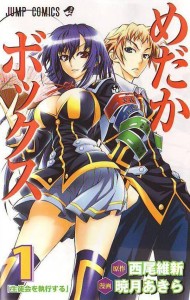
License Request Day: Another Look At Medaka Box

March 24, 2013 by Sean Gaffney

By NisiOisiN and Akira Akatsuki. Released in Japan by Shueisha, serialization ongoing in the magazine Weekly Shonen Jump.

Back in 2010, I did a License Request post regarding a Shonen Jump manga called Medaka Box, and explained why I thought it was a great series, and also why I thought it was unlikely to get picked up. Well, it’s now almost two and a half years later, and the series is still running in Weekly Jump, and gotten two anime seasons (which, sadly, animated the least interesting part of the manga) and has more reasons I’d love to see it licensed… as well as even more reasons it won’t. So let’s discuss.

medakabox1

Since my original post, the manga has kept going, and gotten even more ludicrous. It now projects to be over 20 volumes, and just began a new arc after faking readers into thinking it was ending – the 2nd time the authors have done that! It’s introduced even more overpowered characters, including Najimi Ajimu, who can seemingly control the narrative and utilizes her 12,858,051,967,633,865 skills to waltz around the story being smug. And it still has a small core of hardcore fans who enjoy discussing what it’s really trying to say – even if they all disagree with each other, and half of them are fans of the series but despise the lead.

So, why do I want to see this series over here? Let’s see…

1) Tons of strong female characters, including many leads, several of which have no romances whatsoever. Medaka Box sails through the Bechdel test, honestly. Medaka herself is currently one of two Jump series with a female lead (and the other, Novice Policewoman Kiruko-san, may not last long). We also meet characters such as the aforementioned Najimi Ajimu, Youka Naze (a genius mad scientist with a knife sticking out of her bandaged head), Hansode Shiranui (who is primarily comic relief in the anime-adapted shows, but proves to be far more dangerous – and far more broken – than everyone expected), and Mukae Emukae (who makes anything she touch rot and die, including animals and, presumably, people. )

Each arc has at least one or two major female antagonists or protagonists, and some are entirely female, such as the Jet Black Bride arc. Now yes, there is some romance, with some characters falling in love or obsessing over a person. But it’s not a requirement. More to the point, almost every single female in this series beyond about chapter 26 can kick anyone’s ass right ways from Sunday. I have never seen such a larger group of BAMFs. It’s pretty amazing.

2) Examination, parody, and deconstruction of shonen themes. Many series do this subtextually, but Medaka Box goes right ahead and makes this text. Misogi Kumagawa, who is easily the most popular character among Western fans of the series (and probably Japanese fans as well – the anime did a final episode just devoted to him as if to make up for its likely cancellation), often refers to events by saying “If this were in Weekly Shonen Jump”. Ajimu takes it one step further, and seems entirely aware that this is a serial – it’s made into a plot point, and once led to one of the greatest lines in the entire series, “Manga that go longer than 10 volumes just coast on their success, and this has already gone three volumes over that. So just watch… I’ll end this manga before the anime begins.” (Spoiler: she didn’t.)

But it’s not just pointing out the series is fictional. Medaka Box goes to great pains to mock and undercut many of Shonen Jump’s most treasured values, with several monologues noting that while Jump is supposedly about “Friendship, Training, Victory”, the reality is that the stronger characters defeat the weak ones, so more power always wins. And indeed that is the case throughout Medaka Box. Medaka is insanely powerful, so she wins despite everything. The only exceptions are characters who are (temporarily) stronger than she is. Kumagawa is set up to rebel against this – his entire purpose in life is to be the one representing the weak, loser characters whose only purpose is to fail.

But with all that said, the beauty of a series like Medaka Box – and something that a few of its fans don’t quite get – is that for all that it’s deconstructing Jump series, it also IS a Jump series, and thus in the end it serves what Jump strives for after all. This is not a series that will end with our heroes broken and Medaka humiliated and tarnished – that’s not its goal. Its goal is to show the wonders of humanity in all its forms, even when humans are equipped with various types of superhuman abilities. (Medaka Box sometimes seems like X-Men there’s so many people with insane superpowers.) It may say Jump is all about who is most powerful, but Medaka succeeds because of the bonds she has with Zenkichi – and his bonds with all the others.

3) It’s simply fun. Everyone acts gloriously over the top, almost in a Higurashi sort of way. The series is peopled with larger than life superheroes, so it’s only natural that they are larger than life. Kumagawa can be terrifying or hysterically funny, often in the same chapter, and his juvenile pursuit of seeing girls’ panties, girls in naked aprons, and girls in “hand-bra jeans” (don’t ask) is a nice reminder that all these superhuman geniuses really are teenagers after all. There’s fun wordplay, and later volumes introduce Nienami, who seems determined to be the ultimate boke just to have everyone scream at her. You’re never quite sure if the manga is a parody or not – which is the point, of course.

Now, I mentioned I don’t think this will be licensed. Why? I already discussed in my prior post that it starts off very slowly. In fact, it’s quite mediocre for the first few volumes. (You know, the ones they chose to animate). But let’s update things.

1) It’s now over 20 volumes and counting, and is not a huge hit the way Toriko or Bakuman were. This is reason #1 with a bullet.

2) It would make the translators cry. There is an entire ARC given over to battles using kanji and wordplay, culminating in a final confrontation involving the Japanese game where the next person starts a word with a syllable that the previous person ended with. Oh yes, and there’s a chapter where Ajimu tries to inspire Zenkichi by recalling about 25 old Shonen Jump heroes, many of whom never appeared over here and would require extensive translation notes – something which Viz has never used in its shonen series.

3) One character, Shori Wanizuka, walks around at times with a revolver sticking out of her mouth, sucking on the barrel. Oh, Viz would just LOVE that.

4) Medaka herself. Not since Ichigo Kurosaki has there been a more polarizing lead character in Shonen Jump. Medaka is meant to be a deconstruction of the “Mary Sue” sort of character – she is perfect at anything she tries, has a killer body, is genius level IQ, a physical powerhouse, etc. Despite this, Medaka throughout the series is shown to have difficulty with basic humanity. This is a thread that exists in a lot of NisiOisiN’s works, where he shows the basic disconnects anyone that far ahead of/in front of us would have with average people.

As such, a lot of the time, Medaka is unlikeable, particularly when dealing with Zenkichi, her childhood friend. Now, one of the main plots in the series is showing that she is gradually improving at human interaction, and is not a superhuman freak but merely a teenage girl like everyone else. Of course, character development is frequently not welcome by some fans, who form their opinions and then refuse to change them ever. I’d argue that a majority of the fans support Zenkichi or (especially) Kumagawa as a “main character”, seeing Medaka as an antagonist. In addition, a small minority of fans seem to suffer from “nice guy syndrome”, demanding that Medaka treat Zenkichi nicer because, well, he’s the male love interest and why won’t she learn her place?

5) For those who like Jump for its BL elements, you’ll find some of that here as well. (There’s a couple of yuri teases too.) That said, Medaka’s figure and habit of exhibitionism can also put off female readers who might see the title as pure fanservice.

With all that said, I remain fascinated by this series, one of the most addictive I’ve seen in Jump in years. Even with all the pitfalls, I’d still love to see someone take a chance on it. Hey, it’s licensed in France! Can North America be that far away?

Filed Under: FEATURES, LICENSE REQUESTS

Manga the Week of 3/27

March 21, 2013 by Sean Gaffney, Michelle Smith, MJ and Anna N 2 Comments

SEAN: Last week of the month, and we have a few interesting tidbits from around the mangasphere.

Dark Horse has the 2nd and final omnibus of CLAMP’s Angelic Layer. I seem to recall there was some big complaint with this book, but can’t recall what it was. Whatever it was, this is the big series where folks prefer the anime to the manga, so I’ll be interested to see how much CLAMP break their own premise this time. As we’ve seen, they later got in the habit of breaking every series they did in some way. Was this the first?

MICHELLE: Somehow I missed the first omnibus of Angelic Layer coming out! I still have my TOKYOPOP editions, which I’ve read, but I don’t remember what the difference between the manga and the anime was. (Tangent: my big series where I prefer the anime to the manga is Gravitation!) I liked it enough to keep it, at least!

MJ: I’ve been saving these up to read together, as it’s one of the few CLAMP series I never picked up. I’m looking forward to finding out whether it’s my kind of CLAMP.

ANNA: I’ve also never read this, so I am curious to hear what you guys think before I dive into another CLAMP series.

SEAN: Kodansha has the 2nd season of Genshiken continue with Vol. 2. The cover features the new characters, and I’m hoping the focus is put squarely on them before it returns, as it inevitably will, to the original cast.

21stcen2We have finally hit the end of Naoki Urasawa’s 20th Century Boys, with the 2nd volume of the 21st Century Epilogue. It’s been an epic journey, thank you, Viz. And I fear, bar a major surprise, it will be the last Urasawa we see over here for some time.

MICHELLE: I like to marathon my Urasawa, so I actually haven’t read 20th Century Boys beyond the first volume. At some point I will have to find the time to remedy this.

MJ: Fortunately, Urasawa is eminently re-readable, so if nothing else, we can revisit old worlds while waiting for the new.

ANNA: I think I’m only halfway through this series, but I intend to catch up one day!

SEAN: And then there’s Yen, not arriving at Midtown but arriving everywhere else. First off, we have a digital Light Novel, Another (which I believe is Part 1 of 2) hitting Kindle and Nook. Horror has sold quite well for Yen, and so we’re going to continue to see more of it – I think the manga adaptation of this is due out in the summer. It has supposedly dead students who aren’t quite the urban legend folks thought, creepiness, and lots and lots of corpses.

MJ: Well, hm, that sounds like it might be fun.

The 2nd omnibus of Blood Lad is out. The first one wasn’t a huge hit with me, but I liked it better than I expected, and I’m hoping for good things for this one as well. Though I’m sure it will have lots of fanservice as well. As these titles often do.

MICHELLE: I’m actually interested to read this too, after the intrigued reactions volume one received ’round these parts.

MJ: As you probably know, I quite enjoyed volume one of Blood Lad—much more than Sean did. So I’m definitely looking forward to digging into the second volume.

SEAN: Durarara!! hits the 2nd arc, called the Saika arc. Something is going around slashing people in Ikebukuro! Who is it, and what do they have to do with our heroes?

Watanabe_WelcomeToTheEroticBookstoreV1_TPMICHELLE: I liked this volume. Celty gets her sleuth on!

SEAN: Higurashi: When They Cry wraps up its penultimate arc, as the Massacre Arc shows us why it has that title. Expect heartwarming moments intermixed with appalling tragedy and death. As usual.

Jack Frost is manwha, and I haven’t read it since the first few chapters, but hey, let’s throw it in here. Vol. 7 is out. Is the girl still just a head?

MJ: I’m behind on this series, but I’ve lately had the hankering to dig back in, so perhaps I’ll be able to answer that for you soon, Sean!

SEAN: Soul Eater hits lucky Vol. 13 and Baba Yaga Castle gets a lot louder with the addition of Black*Star. This is rapidly becoming one of my favorite shonen series, so I can’t wait to read more.

Lastly, there’s the release – also digital only – of Welcome to the Erotic Bookstore, an odd ecchi title about a used bookstore that decides to add some adult videos and sex toys to its merchandise. It’s already out on Nook, and apparently will have an iPad app. It may be on Amazon’s Kindle site soon as well. So, if you are able, check it out!

What’s your springtime manga?

Filed Under: FEATURES, manga the week of

It Came from the Sinosphere: The Nine Provinces

March 19, 2013 by Sara K. Leave a Comment

The cover of volume 1.

The Story

In ancient China, Asule is the son of the leader of a powerful northern tribe. As a child, he was sent to another tribe for rearing, then his father’s tribe came along a few years later and wiped out the tribe. Asule regarded a number of the people from that tribe as family, so to say that he is distressed is an understatement.

Asule has been designated as the heir of the tribe, even though he has older brothers, and his body is frail and weak. He’s afraid that his brothers will kill him one day, and he’s frustrated that, with his weak body, he can’t protect the people he loves.

He eventually learns that he has inherited the “green-copper blood.” If he rouses it, it grants him great physical strength, but at the cost of his ability to reason. His grandfather wants to rouse the “green-copper blood” in him to carry on the family legacy, whereas Asule’s father wants Asule to live a nice, happy life. It turns out that Asule’s father had imprisoned his grandfather because his grandfather had killed his own daughter, Asule’s aunt (it’s hinted that his grandfather killed his aunt because of the “green-copper blood”).

Though there’s a lot more about Asule’s family, but I think it’s enough to say that becoming merely dysfunctional would be an improvement.

Eventually, Asule is sent to Donglu, where he takes the name “Lü Guichen.” In Donglu, he makes two good friends, Jieye and Yuran, and interesting things are happening in Donglu…

Background

This is a novel by Jiangnan, one of China’s most popular active wuxia writers, published in traditional Chinese characters by Kadokawa.

The cover of volume 2.

Wait a minute … isn’t Kadokawa a Japanese publisher? Why are they publishing an wuxia novel from mainland China in Taiwan and Hong Kong?

I would like to know the answer to that. I’m sure they hope to make a profit, but I’d like to know more a bit more about their reasoning. Most of what Kadokawa publishes in Taiwan are Japanese manga and novels translated into Chinese—for example, they publish the Taiwanese edition of A Bride’s Story. Recently, I learned that they have branched into publishing original Taiwanese light novels, but as far as I know, this is the only wuxia novel as well as the only novel from China that they have published (if you know of others, please comment).

Actually, maybe I shouldn’t call this a wuxia novel. Though this novel tends to get labeled as ‘wuxia’ by bookstores, marketers, etc., and Jiangnan is considered a “wuxia” writer, Jiangnan himself says that this novel is a “betrayal”—not fantasy, not historical, not romance, and not wuxia (emphasis mine).

Jiangnan is from Anhui province, and earned a Ph.D. at Washington University. He started reading a lot about ancient Chinese history, in particular, he wanted to understand the motivations of various historical figures. It was he was trying to get into the heads of ancient Chinese strongmen that he got the inspiration which eventually led this this novel.

Speaking of history…

The History (or My Ignorance and Confusion)

As I’ve said before, I actually do not know that much about Chinese history, and that is especially true of ancient Chinese history. “The Nine Provinces” is a reference to China in the Xia and Shang dynasties. However, I couldn’t find any information about most of the geographical locations mentioned in the novel. Does that mean they are fictional, or am I so ignorant that I am looking at the wrong references? Also, I couldn’t find any information about the emperor mentioned, which makes me thing he almost certainly is fictional.

My guess is that Asule’s homeland is not in “China” since, well, “Asule” is not exactly a Chinese name. I reckon that “Donglu” is China since, after moving to Donglu, Asule takes the name “Lü Guichen,” which does sound like a Chinese name, and more significantly, he felt a need to take a “Chinese” name.

In case you don’t know, in Chinese-speaking societies, everybody who is somebody is expected to have a Chinese name, regardless of ethnicity. In Taiwan, there are some legal/business things which are impossible to carry out without a Chinese name. Though I do not have a formal Chinese name, I get asked fairly often what it is, and I eventually made one up for myself. In Chinese-speaking culture, people are supposed to change their name to fit whatever cultural context they are operating in, which includes ethnic Chinese operating outside of Chinese-speaking culture. That’s why many ethnic Chinese have “English” names like “Betty,” “Harold,” “Robin,” and so forth—to them, that is the way that different cultures should interact. That, more than the name “Lü Guichen” itself, makes “Donglu” feel like China to me.

In short, I think that Jiangnan is making up his own alternate ancient Chinese history, but I am so ignorant of Chinese history that I don’t know how much is based on actual history, and how much is based on his imagination. Maybe writing a historical novel based on his own re-imagined history is what he means when he says that this novel is a “betrayal.”

The cover of volume 3.

My Own Reaction

The first time I read the first volume, it didn’t engage me. I didn’t get what the big fuss was about Jiangnan. I think the problem is that it was so different from anything else I’ve read that I didn’t know where to sink in my teeth.

On the other hand, I kept it around, and eventually, I figured it was worth a second chance.

The second time, I got hooked.

It’s fascinating partially because Asule’s personal circumstances are amazingly messed up (basic rule of fiction = the more hurt the characters are, the more the audience cares), it’s fascinating partially because of the contrast of Asule’s sensitivity and perceptiveness with his “uselessness,” and it’s fascinating because Jiangnan creates a world which feels truly fresh and original (though it sure is not a world I would want to live in).

I think it makes a difference that Jiangnan’s starting point was nonfiction rather than fiction. Even though he apparently tossed out most of the facts to pursue his own ideas, his ideas come from his thoughts on ancient Chinese history, not the tropes of any particular fictional genre (though I have nothing against recycling tropes, particularly tropes I like). Reality, being stranger fiction, in some ways is more creative.

Availability in English

Ha ha ha ha ha ha ha.

However, the mere fact that contemporary wuxia from mainland China is getting published outside of China at all is intriguing. I certainly do not expect this to get translated into English in the near future (or ever), but I wonder … would Kadokawa consider publishing this into Japanese?

Conclusion

If all wuxia novels were the same, even if they were all just like my favorites, I would be thoroughly bored of wuxia by now. However, just when I think I have a rough idea of the parameters of wuxia, surprise surprise, I find a story which falls outside of those parameters. The main reason I keep on trying different wuxia novels and writers is not because I want to relive the wonderful experiences I’ve had with certain books—re-reading those books would be much more efficient—but because discovering the range of the genre is exciting.

Granted, Jiangnan claims this is not actually an wuxia novel, but I think it’s fair to say it at least belongs to the wuxia tradition (hey, if you’re betraying tradition, you still have a relationship with it). And this novel is certainly quite different from any other wuxia novel I’ve read, or for that matter, any other novel I’ve read.

This novel is not complete, at least not in traditional Chinese characters, so I don’t know how it concludes. But I certainly intend to read future volumes.

Next Time: Ashes of Time (movie)


Sara K. actually ended up ordering volume two of The Nine Provinces online. She finds the Taiwanese system of buying books online a lot more convenient that the system in the United States (she can get the books the next day AND free shipping AND she can pay with cash, no credit card necessary). Though this is partially because Taiwan is a densely populated island, she still can’t help but feel a bit disappointed in the services offered by online booksellers in the United States.

Filed Under: It Came From the Sinosphere Tagged With: China, Jiangnan, Novel, wuxia

Manga the Week of 3/20

March 14, 2013 by Sean Gaffney, Anna N, Michelle Smith and MJ 1 Comment

vagabond34SEAN: So yeah, remember me bragging I got Yen releases a week early? Not this month.

What does that mean?

It means Vagabond 34, that’s what it means. And that’s it. Luckily, Vagabond is pretty damn awesome. So for Vagabond fans, new volume!

ANNA: Vagabond is pretty great.

SEAN: For everyone else, catching up on the stacks of manga to read next to you, like me?

MICHELLE: And how! Seriously, there are literally stacks.

MJ: What she said!

Filed Under: FEATURES, manga the week of

It Came from the Sinosphere: My Lucky Star, Part 2

March 12, 2013 by Sara K. Leave a Comment

luckystar

Welcome back. You can find Part 1 here, and here is the opening song again (yes, I do like the song).

Background on the Actors

For an idol drama, this drama has remarkably few idols. It rose to popularity mainly on the strength of the story. The only actor who really qualifies as an idol is Jimmy Lin, who plays Zhong Tianqi. This role was pretty made for him, for in addition to being an actor, he is a real-life professional car racer. However, his most famous role as a actor was not in an idol drama, but in wuxia (specifically, he played Duan Yu in the 2003 version of Demi-Gods and Semi-Devils).

Jimmy Lin as Duan Yu, Prince of Dali.

Jimmy Lin as Duan Yu, Prince of Dali.

Arguably, Leon Jay Williams (who plays Zhong Tianjun) is also a quasi-idol, since he is a professional model, and quite easy on the eyes, even compared to most idol drama stars.

Interestingly, they cast a Korean actress, Yoo Ha-na, to play Xia Zhixing, which occasionally happens in Taiwanese television. It seems that her lines were dubbed, and I’m not sure who the dub artist (which I think is a pity, since the dub artist deserves as much credit as Yoo Ha-na). While I think their acting is okay, I think there are a number of Taiwanese actresses who could have played the role even better (I would have cast Barbie Hsu). There is a scene where Zhong Tianqi overhears some very soap-opera-ish dialogue, and Xia Zhixing claims “Oh, it’s just a K-drama.” I found that line doubly funny because the very character claiming that it was just a K-drama was being played by a Korean actress.

Location Location Location!

This drama features Ruifang, Wulai, and Pingxi, three of the top tourist attractions in the Taipei region.

However, rather than setting the story in Ruifang/Wulai/Pingxi, the story combines all three of them into the fictional village of “Mingde,” which is Xia Zhixing’s hometown. As someone who is familiar with Ruifang, Wulai, and Pingxi, this is a bit confusing, since sometimes the characters are in Ruifang one moment, and then they are in Pingxi the next moment.

However, I don't think the drama shows the *really* beautiful parts of Pingxi, such as this spot, which just happens to be one of my favorite spots in all of Taiwan

However, I don’t think the drama shows the *really* beautiful parts of Pingxi, such as this spot, which just happens to be one of my favorite spots in all of Taiwan

Actually, Ruifang, Wulai, and Pingxi are more than just tourist attractions: they are important symbols of Taiwanese culture. Pingxi is often held up as being an idyllic Taiwanese rural town, which is why is it often featured in commercials, movies, etc (part of You Are the Apple of My Eye is set in Jingtong, which is in the Pingxi district). Wulai is the location of northern Taiwan’s highest waterfall.

The town of Wulai (I am resisting the urge to share even more photos of Wulai).

The town of Wulai (I am resisting the urge to share even more photos of Wulai).

However, Ruifang in particular has an important place in Taiwanese culture. The towns of Jiufen, Jinguashi, and Shuinandong are all in the Ruifang district. Jiufen was once so prominent as a cultural center that it was called “little Shanghai.” As I’ve mentioned before, Jiufen and Jinguashi are the location of Hou Hsiao-Hsien’s A City of Sadness, which not only a famous Taiwanese film, it’s often ranked as one of the best Chinese-language movies ever made. Furthermore, Jiufen inspired Hayao Miyazaki to make Spirited Away, which is why the town is almost always full of Japanese tourists.

My own photo of the Thirteen Levels

My own photo of the Thirteen Levels

The “Thirteen Levels,” one of Taiwan’s most recognizable landmarks, is in Shuinandong, and it appears in this drama (it also appears in Fated to Love You). One of my favorite works of art in the Tapei Fine Arts Museum permanent collection depicts the Thirteen Levels, and it’s featured in many films, both professional and amateur. I have never been inside the Thirteen Levels since it’s technically forbidden to enter, but I know someone who has been inside, and he said that he saw other people inside too, so apparently a lot of people ignore the restrictions.

In other words, watching this drama is a bit like taking a tour of the most popular destinations in rural Taipei.

Okay, I can't help it, here's a picture I took in Shuinandong looking up at Chahushan, which is in Jinguashi (if you're confused, just know that this is all in the Ruifang district).

Okay, I can’t help it, here’s a picture I took in Shuinandong looking up at Chahushan, which is in Jinguashi (if you’re confused, just know that this is all in the Ruifang district).

Fashion

I mostly find the costuming choices in Taiwanese idol dramas uninteresting, but this drama is definitely the exception, which is what you would expect from a drama which deals a lot with jewelry. And the guys’ clothes are just as interesting as the girls’ clothes.

luckystar22

See Zhong Tianqi and Xia Zhixing together. They’re clothes are not boring. I think Zhong Tianqi’s checkered collar is a particularly nice touch.

luckystar23

See Xia Zhixing and Han Zhiyin together. Again, their clothes are not boring.

luckystar24

Xia Zhixing and Han Zhiyin together, again. You can’t tell from this picture, but this outfit makes Xia Zhixing look a little pregnant. I actually like that, since it emphasizes her motherly qualities.

The Silliness and the Sadness

Whereas Fated to Love You has tongue-in-cheek humor, this drama is straight-up silly. In fact, part of the appeal for me is seeing just how far the drama will go. Just as protagonists are fearlessly themselves, this drama is fearless in is silliness.

Xia Zhixing and Zhong Tianqi are sitting on a toilet, and it looks like they are having sex, even though they are actually not.

Zhong Tianqi and Xia Zhixing get into awkward positions.

(Tangent: in a world free of rape culture, I would think it is totally funny that certain things the characters happen to be doing seem to be sexual assault, even though that is not the character’s intent at all, just I would think it’s funny if the characters seemed to be murdering somebody when actually it’s just an innocent mistake. But victims of sexual assault are so often disbelieved and told that the assault was “just a misunderstanding,” in fact, I can tell you from personal experience that victims sometimes tell themselves that it’s just a misunderstanding so that they don’t have to face that they are victims of harassment/assault, that I’m not completely comfortable with laughing when it’s revealed what certain characters *reasonably* suspect is sexual assault really turns out to be a misunderstanding).

Some of it gets pretty corny, but that, weirdly, is part of the charm.

It’s also full of melodrama (this fan music video, featuring the theme song, offers a good taste of the melodrama). Many of the plot twists are awfully cliché, but, well, it’s boldly cliché. And considering that a five-year-old girl gets Xia Zhixing to spend 8 hours publicly handcuffed to the hot and handsome Han Zhiyin, I am willing to overlook a couple cliches.

And I think this drama just might have the saddest moment of any idol drama I’ve watched. Specifically, the scene where Ou Yaruo listens to the MP3 player.

luckystar26

Why is listening to the contents of an MP3 player sad? Part of me wants to explain the context, but I do hope that this drama will eventually get licensed in English, so I don’t want to spoil it.

Someone on Youtube claims that (spoiler warning, especially if you understand Mandarin) this is the most moving scene in My Lucky Star, but I found it too cliché. Okay, I’ll be honest, I got totally emotionally invested in that scene too, but at least I’m embarrassed that such cliché melodrama got to me.

However, the moment which really got my tears flowing was when Xia Zhixing falls down on the road between Jinguashi and Shuinandong (even though I know this is supposed to the fictional village Mingde, I still can’t help but think of these places as being Ruifang/Pingxi/Wulai). There is nothing original at all about this scene, but the story is so bold, and so sincere, in its melodrama, that I really could not help myself. Even if I forget everything else in this drama, I don’t think I’ll ever forget this particular moment.

Availability in English

Currently, there is no legal way to watch this drama in English. It would be really nice if someone changed this state of affairs.

Conclusion

When I first started watching idol dramas, I stuck with idol dramas adapted from Japanese manga, since the stories were familiar to me, and I didn’t have enough confidence in my Mandarin comprehension skills to delve into completely new territory (and how is it that I have yet to discuss a single idol drama adapted from manga?)

This is the first idol drama I watched which a) was not adapted from a manga and b) had a plot that was totally unknown to me. I was not just concerned about my language skills, I was also concerned about whether or not it would be a good story (if I had read the manga, at least I could reasonably predict whether or not I would like the drama). Not only was I totally capable of understanding this drama, I fell in love with it.

It definitely has its flaws, and overall, I have to say that Fated to Love You is a higher-quality production. Nonetheless, this is one of my top favorite idol dramas, and when I say that somebody should license this in English, I’m serious.

Next time: The Nine Provinces (novel)


An earthquake is happening right now as Sara K. is writing this. Many Taiwanese people expect Sara K. to be freaked out at every single earthquake. Sara K. then points out that she grew up in San Francisco. She does feel a lot less earthquakes in Taoyuan than in other parts of Taiwan (such as Taipei and Hualien), most likely because Taoyuan has more stable ground than Taipei, and the faults around Hualien are more active.

Filed Under: Dramas, It Came From the Sinosphere Tagged With: idol drama, Jimmy Lin, My Lucky Stare, Pingxi, Ruifang, taiwan, Wulai

JManga the Weeks of 3/7 and 3/14

March 11, 2013 by Sean Gaffney, MJ and Michelle Smith 4 Comments

SEAN: I have to admit I am impressed with the anonymous teams behind these series that are all coming out at a rapid rate, even if I don’t know who they are because they aren’t credited. The translation quality, while still not perfect, has risen considerably since the start back in August 2011, and the series are cranking out so that, presumably, we can focus on fresh new series in the future.

All of which is a nice way of saying I still don’t have much to say. The big manga for me this week and next is Joshi Kousei (aka High School Girls), which wraps up with the release of Vols. 8 & 9, and finally resolves the unanswered question about the Takarazuka pair. No, not whether they’re actually lesbians, that’s still unanswered. (Though obvious.)

MJ: I admit I don’t have much to say, either, which isn’t to say that I’m necessarily disappointed with what’s happening at JManga. Sure, I miss some of the weeks when they introduced scads of new series, and it’s been a while since some of my personal favorites have been updated. But I appreciate the fact that they’re carrying on, updating what they can, when they can.

MICHELLE: My sentiments exactly. I’m sure at some point, there’ll be something for us to squee over again.

SEAN: There’s also Vol. 5 of Biscuit Hammer, which puts us at the halfway point, and Vol. 6 of Crime and Punishment: A Falsified Romance, which is also 10 volumes, but otherwise quite different from Hoshi no Samidare.

tactics12

And Vol. 12 of Tactics, which has blown past the old Tokyopop releases (which ended with 8, I believe) and is blazing its own trail. The series is still ongoing from Mag Garden, I believe, and I still can’t remember what it’s about aside from “fantasy”.

MJ: Though I lost interest in Tactics midway through the Tokyopop run, I’ll admit that seeing so many available volumes pop up has re-awakened my curiosity. Should I give the series another shot? I’m thinking I just might.

SEAN: Speaking of fantasy (indeed, they’re by the same author), there is also Vol. 5 of The Mythical Detective LOKI. Please note that this version is not played by Tom Hiddleston, despite what Tumblr may tell you.

Lastly, Tsumanuda Fight Town still has maids who fight. I should really actually read this rather than mocking it, as it does run in Young King OURS, home of many of my beloved titles.

Anything catch your eye here?

Filed Under: FEATURES, manga the week of

BL Bookrack: March 2013

March 10, 2013 by MJ and Michelle Smith 2 Comments

Welcome to the March installment of BL Bookrack! This month, Michelle takes a look at Where a Person Is Most Vulnerable at JManga, while MJchecks out the latest volumes of Awkward Silence and His Favorite from SuBLime. In Brief: Punch Up!, Vol. 3 (SuBLime).


awkward-coverAwkward Silence, Vols. 2-3 | By Hinako Takanaga | Published by SuBLime | Rated Mature – As a somewhat finicky BL fan, I have a complicated relationship with Hinako Takanaga. Though I have several favorites among her works (You Will Fall in Love springs immediately to mind), I often find her romances too rushed to be satisfying (Little Butterfly). Furthermore, even some of my favorites of her work (The Tyrant Falls in Love) include elements I dislike so thoroughly that they send me hurtling from hatred to love and back again. Though Awkward Silence is far too mild-mannered a title to incite anything like hatred, its first volume fell easily into the “too rushed” section of Takanaga’s catalogue, thus robbing itself of the emotional resonance required to elicit anything close to love.

Volume two opens with blank-faced Satoru (who carefully reminds us every chapter that his face is incapable of expressing emotion) sulking over his boyfriend Keigo’s upcoming sleep-away baseball camp. Having been unable to properly express his feelings to Keigo before he departed, Satoru is tormented over the fact that Keigo may have left believing that Satoru was angry with him for going in the first place. Naturally, the only option is for Satoru to sneak into the camp in the middle of the night in order to explain himself. He does, and the two have sex.

Okay, a little bit more than that happens. Satoru’s antics lead Keigo’s baseball team to believe that the west wing of the school is haunted and minimal wackiness ensues, but the series’ chapters are so carefully formulaic, it’s obvious that the point of it all is to create an opportunity for the obligatory sex scene. And this is really the crux of the issue. While I certainly have no objection to sex scenes in a BL manga—and such scenes can contribute significantly to both plot and characterization—as is all too common in contemporary romance, Takanaga’s scenes are largely just… in the way. With so few pages available per chapter in which to develop her characters’ relationship, every panel is precious, and panels spent on perfunctory sex scenes are, frankly, nothing more than a waste.

Volume three plays a bit stronger, as it shifts its focus from Satoru and Keigo to a couple of amusingly mismatched upperclassmen (whose relationship vibe is not unlike Morinaga and Souichi’s in Tyrant), and Satoru’s charming (also blank-faced) mom is an unexpected highlight. But this relationship, too, suffers from a whirlwind approach that doesn’t feel quite earned. Takanaga’s expressive artwork particularly shines in this volume, making its shortage of emotional substance even sadder, in my view. Not recommended.

– Review by MJ


hisfavorite3His Favorite, Vols. 2-3 | By Suzuki Tanaka | Published by SuBLime | Rated Mature – If I’m a sucker for any particular romance trope, it’s “friends-turned-lovers”—a predilection largely responsible for my obsession with writers like Keiko Kinoshita and Yeri Na, among others. In volume one of His Favorite, author Suzuki Tanaka proved that she’s got my number as well, with her story of childhood friends, Sato and Yoshida, whose developing “hot guy”/”spazzy guy” pairing is the best thing since Doumeki and Watanuki (with fewer ghosts and bento lunches).

In volume one, class stud Sato revealed to unpopular goofball Yoshida that he was the (once overweight, bullied) boy whom (once popular, badass) Yoshida fiercely protected all through grade school. Having nurtured a crush on Yoshida for years, Sato’s new “hot guy” status gives him the confidence to finally pursue Yoshida romantically, though the entire thing is baffling to both Yoshida and the rest of their high school class.

Volume two opens with Yoshida beginning to acknowledge that he has reciprocal feelings for Sato, though he’s desperate to hide it—not only from Sato, but from his group of misfit friends who expect him to share their unrequited longing for female companionship. This escalates in volume three when Yoshida is coerced into attending a disastrous group date. Meanwhile, Sato’s dealing with his frustration by bullying their classmates, whom Yoshida (in true form) angrily defends, leaving Yoshida feeling even more conflicted over his growing attraction for Sato. Nothing comes easy for the two of them, but despite the fact that what I’ve described so far sounds rather like a serious teenage drama, it’s absolutely romantic comedy in every way. And, really, that contradiction is what makes the series work so well.

Though nearly everything in His Favorite is deliberately overblown and played for laughs, the entire thing is firmly anchored by real emotional truth, which renders the series not only genuinely funny, but also genuinely affecting on a number of levels. Amidst the laughs, we really feel Yoshida’s inner turmoil over his unpopularity and small size, his fierce sense of fairness, and his developing feelings for a guy who pushes all his buttons in not-always-positive ways. And like Yoshida, we both love and revile Sato’s messy mix of loyal devotion and outright sadism. Tanaka’s characterization is deceptively effortless—clearly established with just a few deft strokes—allowing her to tell a emotionally complex story with the light touch of a screwball comedy. Even the story’s secondary (firmly comedic) romance, about a steadfast guy who only falls for sleaze-balls, manages to operate on multiple levels. And Tanaka’s clean, energetic artwork is just icing on the cake.

Obviously I’ve become a fan, but the best news of all is that there’s more of this series to come! His Favorite stands at five volumes and counting in Japan, so now’s the time to jump on board! Heartily recommended.

– Review by MJ


vulnerableWhere a Person Is Most Vulnerable | By Fumiko Shusai | Libre Publishing/JManga | Rated Mature – “I put all my short pieces I forgot about in one book,” writes Fumiko Shusai in the Afterword to Where a Person Is Most Vulnerable, and man does it show.

The anthology starts off promisingly enough. The title story is about neurotic Yamashita, who hates ants, and his bug-loving neighbor, Shimabara, who helps him overcome his fears a bit. “Strays Will Leave, Over and Over Again” is also pretty good, featuring a gigolo who keeps returning to his friend’s place every time he gets dumped. Less successful is “The End Is in a Dream, Silent,” about a guy who’s repaying a debt to a clotheshorse by cleaning his messy “room.” It’s okay, but extremely rushed.

In the titular story, the “place” in question refers to the delicate nether-regions where ants dared to crawl when Yamashita was a boy—as well as to his heart—but after the third story I began to think that apartments were somehow a theme, too. That while we might feel safe in our own homes, this complacency would also cause us to let down our guard. And it may even be true that Shusai meant to make some point along those lines, but the rest of the stories in this collection are so thoroughly disappointing that I soon began to doubt that such an intent ever existed.

Brief and insubstantial “Sculptures of Us” is about friends who get into fisticuffs over whether they had a drunken hookup the night before. “Love That Reaches the Other Side of Earth!,” about a seemingly hopeless boy and the childhood friend who takes care of him, had the potential to be something good, but is rushed beyond redemption. The real villain of the piece, however, is the horrible “Daddy, My Love” strip, all about the way in which a guy accidentally mistreats/mishandles his ex-girlfriend’s abandoned toddler, culminating with a panel suggesting they’ll become lovers in the future. EW! Gallon of brain bleach, stat!

So, are the first two stories worth 499 JManga “points”? I must regretfully conclude that they are not.

– Review by Michelle Smith


In Brief:

PunchUp_03_Cover_print_5x7.125.inddPunch Up!, Vol. 3 | By Shiuko Kano | Published by SuBLime | Rated Mature – For its first two volumes, I wasn’t quite sure what to make of Punch Up!. On the one hand were the well-defined protagonists, Kouta and Maki, who had plausible conflicts and insecurities, but on the other were the frequent and explicit sex scenes that left nothing whatsoever to the imagination. Was this a compelling drama or a smutty romp? Volume three caters to my personal preferences by establishing itself clearly as a drama (or melodrama, at least) when a workplace accident leaves Kouta with no memory of the last four years and effectively returns him to his mindset as a fifteen-year-old. This development could’ve easily taken the story in a cheesy direction, but it actually doesn’t, instead providing even more opportunity for conflicts and insecurities to flare. I had debated whether to continue with this series, but now I am truly glad I did! – Michelle Smith


Review copies provided by the publishers.

Filed Under: BL BOOKRACK

Comic Conversion: Nursery Rhyme Comics

March 8, 2013 by Angela Eastman 1 Comment

Nursery Rhyme Comics | Edited By Chris Duffy | Published by First Second

Nursery Rhyme ComicsMost people gain some familiarity with nursery rhymes as children, reciting “Humpty Dumpty” in school or picking out favorites from a big collection. This introduction usually comes through a Mother Goose story book, but that fictional old lady (or goose in a bonnet, depending on what book you have) isn’t with whom these rhymes originated.

While a lot of rhymes can be traced back to a certain time and place, many came to be the same way as folklore and fairy tales—passed down over the centuries with no precise origin or even meaning. Because of that, not only has some of the wording of the rhymes changed over time, but any version can be treated with varying interpretations and imagery. Despite their age, these sing-songy, fun, sometimes weird rhymes continue to resonate with children, so it makes perfect sense for publisher First Second to reinterpret the stories through one of the more popular mediums today—comic books—in their collection Nursery Rhyme Comics.

Altogether there are 50 rhymes presented in this book, each one drawn by a different artist. In my experience, such a wide variety of creators almost inevitably leads to just as much variety in quality. Somehow, this is not the case. Instead, First Second has gathered 50 amazingly talented artists who, despite their differences in design and technique, make each page a treat.

Thanks to the brevity of the rhymes, the comics take up no more than three pages each, so very little time is spent with any single artist. These sudden shifts do create a little bit of abruptness as you move from short rhyme to short rhyme. Fortunately, editor Chris Duffy managed to arrange the comics in a sort of arc, beginning with “The Donkey” playing a saxophone “to wake the world this sleepy morn,” moving into more active comics, and then slowing down towards the conclusion of “Wee Willie Winkie” as the story’s children fall asleep with their own copy of Nursery Rhyme Comics.

The DonkeyWith so many great artists on board, it would have been a shame to have them all adhere to a certain theme or mood, and it seems that First Second wisely allowed their artists to interpret the rhymes in any way they wanted. Style and mood range from things like the calm watercolors of Patrick McDonnell’s “The Donkey” to Reina Telgemeier’s bright cartoons. But the artists also give us their own takes on the rhymes themselves. Telgemeier’s “Georgie Porgie,” for instance, is a kid at his birthday party getting pie all over the girls he kisses. And in Andrew Arnold’s version of “Hot Cross Buns,” a pigeon steals cakes from a pair of bratty kids.

Artists interpreting some of the more nonsensical rhymes, like the weird non sequitor at the end of “I Had a Little Nut Tree,” have fun with stories that just don’t make much sense anymore. Then there’s “Hush Little Baby”—a song with pretty general action—transformed by its artist into an active conversation between a father and his daughter, making excellent use of word bubbles and creative panels.

Some of the artists did choose to take more traditional or literal views of the rhymes, like in Richard Sala’s version of “Three Blind Mice”, and while these are still well done, they aren’t quite as memorable as some of the other selections. But even some of the more literal takes do an excellent job evoking emotion, like the blow-by-blow account of the very short rhyme “The North Wind Doth Blow,” in which we see a robin tumble through the air before finally coming to a rest, or the pure romance of Edward Lear and Craig Thompson’s “The Owl and the Pussy-cat.”

One thing Nursery Rhyme Comics proves by the end is how effectively nursery rhymes can converted into comics. These sing-songy stories have no narration that the artist must carve out, and no descriptive prose that they must decide whether to write or visualize. Instead, these are stories so simple that the artists may come at them with all their creative talent.

This collection serves as a pretty great introduction to nursery rhymes for kids, covering all the bases, from weird and funny to calm and peaceful rhymes. This book can also be used as a sly way to introduce comics into the life of a kid you know—offering up so many styles and tones that any kid is sure to find a graphic novel niche to enjoy. Dialogue and narration are spaced out nicely, preventing the pages from becoming overly cluttered with words, which makes this an easy book to read out loud with a child, but also fun for an older kid (or an adult) to read by him/herself.

Thanks to the artists First Second gathered together, this was a thoroughly enjoyable book. And whether or not you’re already acquainted with the rhymes included, it’s so much fun to see how the artists chose to adapt them.

Filed Under: Comic Conversion, FEATURES & REVIEWS Tagged With: First Second, Nursery Rhyme Comics

Manga the Week of 3/13

March 7, 2013 by Sean Gaffney, Michelle Smith, MJ and Anna N 3 Comments

SEAN: I have a sneaky suspicion I know what the Pick of the Week is going to be next week… regardless of that, let’s see what publishers have to offer.

Blade of the Immortal may have come to a close recently in Japan, but Dark Horse still has a few more to go. The back cover to Vol. 26 hints that Tonight Someone Dies, so it is no doubt very important that everyone grab this.

MICHELLE: Someday I will continue with this series.

tokyobabylon1SEAN: And then there’s the first Tokyo Babylon omnibus. Which is filled with Hokuto, who is awesome and the only real reason to read this early CLAMP title! Oh yeah, there’s her brother as well. And some guy. I suppose a few people might read it for them instead.

MJ: TOKYO BABYLON TOKYO BABYLON TOKYO BABYLON. Okay, yes, I’m a fangirl on a massive level, here, but there are so many reasons why this is my favorite CLAMP series (and one of my favorite manga series of all time). I’ll save my loudest raving for Pick of the Week (and Off the Shelf), but out of all the CLAMP re-releases Dark Horse has undertaken over the past few years, this is the one I’ve anticipated most eagerly. I’m so looking forward to re-reading the series.

MICHELLE: I agree, but cannot possibly match MJfor sheer enthusiasm!

ANNA: Maybe I should give this series another try? I read the first few volume and found it so much less gripping than X\1999 that I don’t think I ever finished it. That being said I do have feelings of pleasant nostalgia whenever I think of early CLAMP series in general.

SEAN: SubLime has the third volume of His Favorite, whose cover makes it look like this is a manga about Luffy the uke and Robin the seme. I’m sure it’s not about that at all. Not that that would not be a highly entertaining title in its own right.

MJ: This is one of my favorite recent series from SuBLime, though your comment adds an element of hilarity I hadn’t considered!

MICHELLE: Wow, I had never noticed the similarity in scars before.

SEAN: Vertical has the 3rd and final re-release of Paradise Kiss, which most everyone else got this week. It’s a terrific series, and I particularly love the ending. If you didn’t get it yet, get it.

MJ: I’m a bit sad that the debut of Dark Horse’s Tokyo Babylon omnibus will probably overshadow the end of Paradise Kiss, so I’ll do my best to rave about both. I had some quibbles early on regarding Vertical’s adaptation of some beginning chapters, but these have long since been made up for by subsequent volumes. And if I had to choose the loveliest of Vertical’s work on this series, I’d have to go with volume three, which is stunning in every way. This is absolutely a must-buy this week. It’s on my personal top ten as well!

MICHELLE: There are things about the ending to Paradise Kiss that give me geekbumps to even *recall*, even though it’s been years since I last read it.

ANNA: I’ve been enjoying the Vertical editions of this series and plan on buying this!

SEAN: The rest is all Viz. 07-Ghost hits Vol. 3 and shows us that the best answer for ‘who is ready to lead the Church’ is ‘how much TRAINING have they had’? I bet the Papal Conclave doesn’t concentrate on that at all.

MJ: I never got any further than volume one of this series, but I’ll catch up eventually! And I’m looking forward to it, too.

MICHELLE: Ditto.

ANNA: I have been hoarding the 2nd and 3rd volumes and plan to read them together very soon. I enjoyed the world building and action in the first volume very much.

SEAN: Arata the Legend hits lucky Vol. 13, whose luck is to come out a week after a Fushigi Yuugi release and thus likely be ignored. Shame.

MICHELLE: Aw. Arata is quite good, too, though it’s true I don’t love it as well as Genbu Kaiden.

ANNA: I don’t think Genbu Kaiden can help it though because it is so intrinsically loveable.

SEAN: Fullmetal Alchemist has a 3-in-1 out, covering Vols. 10-12. This is, in my opinion, the only shonen manga to give One Piece a run for its money at perfection. It’s that good.

MJ: Since this series also made my all-time top ten list, I certainly agree with you. Wow, it’s a banner week for my favorites, isn’t it?

MICHELLE: It is. And it’s high time you read some One Piece, missy, so that could be your favorite, too!

evangelion2ANNA: I agree that Fullmetal Alchemist is a magnificent series and it is unfortunately one that I stopped reading due to it having so many volumes. I intend to reread the whole thing and finally finish it one day though.

SEAN: Neon Genesis Evangelion also says it’s a 3-in-1, but the first volume was deluxe, more like their VizBIG line. Re-reading the start of the series re-kindled my interest in it again, so I’ll definitely be taking a look at it.

Lastly, RIN-NE Vol. 11 continues to have cute little one-shots, occasional dramatic mini-plots, and no forward progression. (sniffle) It makes me so nostalgic for Ranma and UY’s lack of any progress… it’s like Takahashi has come home!

MICHELLE: I really enjoy RIN-NE for what it is, and without any expectations for it to be anything else. I’ve described Takahashi’s comforting, homey works before as “manga meatloaf,” and I think RIN-NE epitomizes that ethos.

SEAN: What are you folks reading this week?

Filed Under: FEATURES, manga the week of

  • « Go to Previous Page
  • Page 1
  • Interim pages omitted …
  • Page 74
  • Page 75
  • Page 76
  • Page 77
  • Page 78
  • Interim pages omitted …
  • Page 114
  • Go to Next Page »
 | Log in
Copyright © 2010 Manga Bookshelf | Powered by WordPress & the Genesis Framework