• Skip to primary navigation
  • Skip to main content
  • Skip to primary sidebar
  • Home
  • About Us
    • Privacy Policy
    • Comment Policy
    • Disclosures & Disclaimers
  • Resources
    • Links, Essays & Articles
    • Fandomology!
    • CLAMP Directory
    • BlogRoll
  • Features & Columns
    • 3 Things Thursday
    • Adventures in the Key of Shoujo
    • Bit & Blips (game reviews)
    • BL BOOKRACK
    • Bookshelf Briefs
    • Bringing the Drama
    • Comic Conversion
    • Fanservice Friday
    • Going Digital
    • It Came From the Sinosphere
    • License This!
    • Magazine no Mori
    • My Week in Manga
    • OFF THE SHELF
    • Not By Manga Alone
    • PICK OF THE WEEK
    • Subtitles & Sensibility
    • Weekly Shonen Jump Recaps
  • Manga Moveable Feast
    • MMF Full Archive
    • Yun Kouga
    • CLAMP
    • Shojo Beat
    • Osamu Tezuka
    • Sailor Moon
    • Fruits Basket
    • Takehiko Inoue
    • Wild Adapter
    • One Piece
    • After School Nightmare
    • Karakuri Odette
    • Paradise Kiss
    • The Color Trilogy
    • To Terra…
    • Sexy Voice & Robo
  • Browse by Author
    • Sean Gaffney
    • Anna Neatrour
    • Michelle Smith
    • Katherine Dacey
    • MJ
    • Brigid Alverson
    • Travis Anderson
    • Phillip Anthony
    • Derek Bown
    • Jaci Dahlvang
    • Angela Eastman
    • Erica Friedman
    • Sara K.
    • Megan Purdy
    • Emily Snodgrass
    • Nancy Thistlethwaite
    • Eva Volin
    • David Welsh
  • MB Blogs
    • A Case Suitable For Treatment
    • Experiments in Manga
    • MangaBlog
    • The Manga Critic
    • Manga Report
    • Soliloquy in Blue
    • Manga Curmudgeon (archive)

Manga Bookshelf

Discussion, Resources, Roundtables, & Reviews

Blog

Random Musings: Three Years of Experiments in Manga

August 18, 2013 by Ash Brown

Three years? Three years?! Three years ago today I began writing at Experiments in Manga in an attempt to share my love of manga and Japanese literature. Well, to be perfectly honest I started the blog for myself, but I am delighted that other people have on occasion found it to be helpful and interesting. It’s been a lot of work and I certainly have plenty of room for improvement, but I have largely been enjoying myself. I’m rather pleased that I’ve been able to keep the blog going this long.

So what am I particularly proud of looking back on the year? One of my biggest accomplishments was hosting the Moyoco Anno Manga Moveable Feast. I’ve been regularly participating in the Feast since December 2010, but this was only the second time that I acted as host. It wasn’t quite as nerve-wracking as the first time, but I was still very anxious about it. I like to think that it went well. Not as many people participated in the Feast as did in the first one I hosted, but the contributions were great.

I don’t tend to get very personal in my posts at Experiments in Manga, but I made one notable exception last year–Random Musings: A Note of Thanks for Wandering Son. This article was very difficult for me to write because it was so extremely and intimately personal. I had no idea what the response to it would be. Much to my relief, it was very well received. As nervous as I was, I ended up being very glad that I put myself out there writing it.

Another post from the last year of Experiments in Manga that seemed to go over well was Finding Manga: Right Stuf. Finding Manga and the closely related Discovering Manga are two features that I’ve really been meaning to update more frequently. I’ll have to make a point to try to do that over the next year. I tend to focus on reviews at here at Experiments in Manga, but it’s fun to mix it up every once in a while, too.

Two of my reviews from the past year have been particularly popular. My review for The Passion of Gengoroh Tagame: The Master of Gay Erotic Manga has been, by far, one of the most frequently visited pages at Experiments in Manga in the blog’s entire history. I was pretty excited about the manga–the first volume of Tagame’s work to be released in English–so hopefully the review has been useful. I was rather surprised to see how popular my review of Tomoyuki Hoshino’s volume of short fiction We, the Children of Cats proved to be. The review did receive some support from the publisher, so that probably helped. We, the Children of Cats is a difficult but very good collection.

And speaking of reviews: I continued my Blade of the Immortal review project. Every month I have been reviewing one volume of the series. Although Blade of the Immortal is still being published in English, I have just about caught up with Dark Horse’s release. I will continue to review the series as the new volumes come out, but I plan on taking on another monthly review project as well. I’ll be putting it to a vote, too, so look out for a poll in the near future if you’d like to help choose which manga I focus on next.

Over the last year I was able to consistently release at least two “extra” posts a month. This pace has seemed to work pretty well for me and tends to be manageable. I still run into the problem where there’s more that I want to write about but I simply don’t have the time. In general, my coverage of manga has increased and I post at least one manga-centric feature or review a week. At this point the balance between manga posts and non-manga posts is close to where I want it, but I may have over-compensated a bit. I miss reading and reviewing non-manga materials to the same extent that I used to do.

Oh! And some big news before I close: I am very pleased to announce that I and Experiments in Manga will soon be joining the Manga Bookshelf network of blogs. I was greatly honored and very excited to be invited to the group and after much careful thought and deliberation I decided to accept. Not much will actually change here at Experiments in Manga, but by being a member of Manga Bookshelf I’ll have even more opportunities to write about and discuss manga. More information about the move will be coming very soon. I am really looking forward to it and am delighted to be joining a group of manga bloggers that I sincerely admire.

Finally, but perhaps most importantly, I would like to thank everyone who has read and supported Experiments in Manga over the years. As I previously mentioned, I started Experiments in Manga mostly for myself, but I sincerely appreciate all of my readers. Whether you’re a regular reader or just drop by on occasion, thank you so much! I hope that I can continue to build upon what I’ve already done and make Experiments in Manga even better over the coming year.
Filed Under: UNSHELVED Tagged With: Experiments in Manga

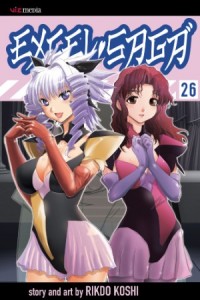
Excel Saga, Vol. 26

August 18, 2013 by Sean Gaffney

By Rikdo Koshi. Released in Japan by Shonen Gahosha, serialized in the magazine Young King OURS. Released in North America by Viz.

In between all the body swaps, and personality wipes, and past lives, and pure hostile mind takeovers, it’s become increasingly apparent that one of the core themes of Excel Saga (the manga) has been identity. What is it that makes us who we are? Is it the bag of meat we currently inhabit? Is it that we think, therefore we are? What if we have amnesia? What if we’re put into a robot body? What if we are a reincarnation of someone else with similar memories? Lately it seems that our cast, especially Excel, need to have this question answered. And while I’m not sure this volume gives us anything definitive, it is one of the best at showing just how complicated this can actually be.

excel26

Let’s start with Excel, who is now back in her regular old human body after a couple volumes as a Ropponmatsu. Of course, ‘regular old human body’ has never quite applied to Excel, given she is capable of lifting several hundred pounds if she doesn’t think too hard about it, can open doors to ancient civilizations, and clearly has a past which Doctor Kabapu is trying hard to deny. (Kabapu and Shiouji’s greek chorus is one of the more frustrating things going on in this volume, mainly as Kabapu clearly has the answers but doesn’t want to say them out loud, and Shiouji doesn’t care enough.) Unfortunately, Excel, newly invigorated and with Hyatt and Elgala by her side, runs into Il Palazzo, and the shock causes her to have a mental breakdown for the last half of the volume.

Because of course that isn’t really Il Palazzo. Oh, it’s his body, all right. This is actually a major reason why Excel breaks down, as she can’t get over how Il Palazzo-ish he really is… until he speaks. And we finally get to see the truth about Shiouji’s father, Tenmangu. I’ve gotta say, we’ve been expecting him to be possessing Miwa’s body since about Vol. 13, which is… sort of true, only not. No, he’s now in control of Il Palazzo, and Miwa is a Ropponmatsu – one far more powerful than anything Shiouji could ever invent. Of course, this may not really matter all that much, as we’ve never really delved too deeply into who Il Palazzo really is. Excel figures out something is wrong purely due to the ideals she holds so dear – Il Palazzo talks about this “wonderful world”, and she knows her real love believes that this world is truly corrupt. (Given Excel Saga’s plotline, I really have to lean more towards Il Palazzo than Tenmangu here.)

Even if you can understand who someone really is, there’s always the chance of them disappointing you. Both Umi and Hyatt seem to hold Teriha/Excel on an impossible pedestal, one that she’s never really going to live up to. Elgala is more realistic about her expectations of Excel, but gets too lost in her own la-la land to be of any help. Misaki still has trouble rationalizing her love for Iwata, given what a giant doofus he is 90% of the time. Sumiyoshi always found Ropponmatsu 2 to be a loli pain, but is rather surprised by how angry her destruction makes him. And Watanabe disappoints EVERYONE, as his love for Hyatt has clearly not lessened (or ind3eed deepened) one iota.

The next volume of Excel Saga is the final one, and I’m fairly certain that we won’t be getting everything answered. But we should at least clear up a few things, and hope that at least some of these people can live happily ever after. Or at least get a good night’s sleep. God knows they need it.

(Also, Excel’s face when she realizes that’s not Il Palazzo is beautiful yet achingly sad at the same time. This series can still hit the heartstrings when it wants to.)

Filed Under: REVIEWS

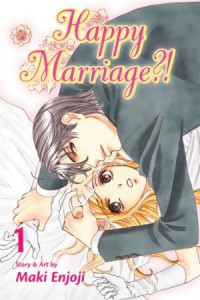
Happy Marriage?!, Vol. 1

August 17, 2013 by Sean Gaffney

By Maki Enjoji. Released in Japan as “Hapi Mari” by Shogakukan, serialized in the magazine Petit Comic. Released in North America by Viz.

Viz has started to slowly dip its toe into the waters of josei, first a few years back with Butterflies, Flowers, and now with two new series, of which this is the first. They’re all being put under the Shojo Beat imprint, because a) it’s a brand people look for, which a Signature title isn’t necessarily; and b) honestly, most of these titles hit the same beats as their shoujo titles, it’s just that the protagonists are adults and there is sexual content. It wouldn’t be hard to see something like Happy Marriage?! reimagined to high school and Sho-Comi, with Hokuto as the hot new transfer student or something.

hapimari1

The basic premise isn’t too hard. Chiwa is an office lady whose father is a bit of a naive idiot, so their family is in heavy debt. She’s trying to deal with it by taking extra jobs, but that’s not going so well. Then the company chairman has the brilliant idea of marrying her to the company president, a smooth yet vaguely jerk-like guy naked Hokuto. Neither of them are really enthused about the idea, particularly Chiwa, who is a twitchy virgin who has no idea how to handle anything like this. Will they gradually grow to love each other as husband and wife and find true love and sexual satisfaction?

It’s hard not to compare this title with Butterflies, Flowers, Viz’s first foray into the world of Petit Comic. Both have the same types of hero and heroine, both involve company power issues (he has far more power than she does), and both heroines tend to freak out when bad or confusing things happen to them. Happy Marriage?!, though, is a far more natural and mellow title than Butterflies, Flowers ever was. There’s no real exaggeration for comedic effect here. No superdeformed heroines, no over-the-top sexist behavior as of yet, and zero Gundam references. Hokuto seems a bit standoffish, and like many shoujo/josei heroes likes to smirk smugly on occasion, but compared to other types I’ve seen he’s not too bad. Likewise we see Chiyo standing up for herself on occasion, though her lack of life experience and self-confidence is no doubt going to be one of the issues this manga deals with through its 10-volume run.

Of course, the problem with not having the appalling lows of Butterflies, Flowers is it doesn’t have the amazing highs either. The comedy and gratuitous appallingness of the latter title was what kept audiences reading, as they wanted to see what outrageousness would happen next. There’s not as much outrageousness in Happy Marriage?!, so what you’re left with is just a bit duller. It feels like one of many other shoujo titles, just grown up. Which is something you could say for a lot of josei, really. Chiwa in particular hasn’t really done much to separate herself from other blushing blonde heroines. Hokuto at least is more reserved than this type usually is, and I liked that we see he doesn’t really understand his new wife any more than she understands him, he’s just better at hiding it.

This is a good start to a romantic series, and I look forward to seeing if it avoids other ‘smutty shoujo’ traps once our heroes get hot and heavy (which they don’t here). I’ll check out another volume. But it’s not making my jaw drop the way its predecessor at Viz did.

Filed Under: REVIEWS

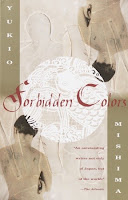
Forbidden Colors

August 16, 2013 by Ash Brown

Author: Yukio Mishima
Translator: Alfred H. Marks
U.S. publisher: Alfred A. Knopf
ISBN: 9780375705168
Released: February 1999
Original release: 1951/1953

In Japan, Yukio Mishima’s novel Forbidden Colors was released in two parts. The first eighteen chapters were compiled in 1951 while the collection with the final fourteen chapters was published in 1953. The English translation of Forbidden Colors by Alfred H. Marks was first published by Alfred A. Knopf in 1968. Like Mishima’s earlier novel Confessions of a Mask, Forbidden Colors deals with prominent homosexual themes, although the two works approach the material in vastly different ways. Also like Confessions of a Mask, and many of Mishima’s other works, Forbidden Colors contains some autobiographical elements. In addition to being my introduction to Japanese literature, Mishima and his works fascinate me. I’ve been slowly making my way through all of his material available in English, but I was particularly interested in reading Forbidden Colors.

After being betrayed time and again the aging author Shunsuke Hinoki has developed an intense hatred of women. Seeking revenge, he enters into a peculiar arrangement with a beautiful young man by the name of Yuichi Minami. Yuichi has come to realize that he loves men and is tormented by what that means living in a society which doesn’t accept homosexuality. Shunsuke is willing to assist Yuichi in hiding his secret by helping to arrange his marriage and to develop a reputation as a philanderer. In exchange, Yuichi promises Shunsuke to make the women he seduces miserable. They may fall in love with him, but he will never love them in return. The agreement is advantageous for both men. Yuichi will have a perfect cover allowing him the freedom to explore his sexuality–no one would suspect a married man and a womanizer to have male lovers–and Shunsuke will have the revenge he so greatly desires.

Shunsuke is an unapologetic misogynist. His anti-women rhetoric can be difficult to take, but without it the plot of Forbidden Colors would never go anywhere. It is necessary and important as the story’s catalyst. Mishima has very deliberately created a distasteful character who at the same time is enthralling in his extremes. Yuichi, despite being loved by all, isn’t a particularly pleasant person, either. However, I did find his portrayal to be much more sympathetic. He’s vain and self-centered, but he also has an air of naivety and innocence about him. Both men and women fall victim to his charms but Yuichi himself is often manipulated as well. Forbidden Colors is an absorbing tale as Yuichi struggles to keep his two lives separate, sinking deeper into Japan’s underground gay community while trying to keep up appearances in his public life. It’s an outlandish battle of the sexes that is hard to look away from and no one comes out unscathed.

Forbidden Colors explores and deals with a number of dualities: homosexuality and heterosexuality, love and hatred, youth and old age, beauty and ugliness, truth and deceit, cruelty and kindness, morality and immorality, and so on. Mishima plays the dichotomies off one another, but also reveals how closely intertwined they can be. The complexities of the characters’ relationships show that opposites are rarely just that and how at times in the end they aren’t really all that different. Yuichi, for example, comes to genuinely care for his wife but in his twisted way of thinking expresses that love through cruelty. There is a certain logic to his decision and his concern is real, though someone else might not reach the same conclusion. At it’s heart Forbidden Colors is a fairly dark story with erotic underpinnings and characters who, though often unlikeable, are captivating. I found the novel to be incredibly engrossing.

Filed Under: REVIEWS Tagged With: Novels, Yukio Mishima

Tezuka Week, A Bride’s Story, and CBLDF goes to Comiket

August 16, 2013 by Brigid Alverson

Here’s my look at this week’s new releases (plus a new license from Yen) at MTV Geek. The list includes vol. 1 of Magi and the Tiger & Bunny short story anthology from Viz, the second volume of No. 6 from Kodansha Comics, new Knights of Sidonia from Vertical, and more. Lissa Pattillo gives her take in her latest On the Shelf column at Kuriousity.

The Manga Bookshelf folks, one step ahead as always, are already looking at next week’s new releases.

Jason Thompson writes about Kaoru Mori’s A Bride’s Story in his latest House of 1,000 Manga column at ANN.

Charles Brownstein, executive director of the Comic Book Legal Defense Fund, went to Comiket this year, not to shop (well, not only to shop) but to deliver this speech about manga and the importance of freedom of expression in both North America and Japan.

It’s Tezuka Week at Digital Manga, and they are announcing a contest as well as discounts on the first ten issues of Weekly Astro Boy Magazine.

News from Japan: Some sad news: Ramen Fighter Miki creator Jun Sadogawa has died, and police suspect it was a suicide. Two new series are debuting in Princess Gold: Makoto Tateno’s Vampire Romanshiki and Yuu Higuri’s Princess Ledalia: Bara no Kaizoku (Princess Ledalia: The Rose Pirate) It looks like Negima creator Ken Akamatsu will have a new series as well, Uo Holder, which will run in Weekly Shōnen Magazine. And ANN has the latest Japanese comics rankings.

Reviews

Chris Kirby on vol. 2 of 21st Century Boys (The Fandom Post)
Ash Brown on vol. 24 of Blade of the Immortal (Experiments in Manga)
Josh Begley on vol. 9 of Bloody Monday (The Fandom Post)
Lissa Pattillo on Body Guard (Kuriousity)
Connie C. on The Dark-Hunters, Sabrina the Teenage Witch: The Magic Within, and Soulless (Comics Should Be Good)
Lesley Aeschliman on vol. 1 of Dengeki Daisy (Blogcritics)
John Rose on vol. 4 of The Disappearance of Nagato Yuki-Chan (The Fandom Post)
Lesley Aeschliman on vol. 10 of Kamisama Kiss (Blogcritics)
Kory Cerjak on vol. 1 of Magi (The Fandom Post)
Erica Friedman on vol. 6 of Morita-San ha Mukuchi (Okazu)
Lesley Aeschliman on vol. 17 of Pokemon Adventures (Blogcritics)
Lesley Aeschliman on vol. 10 of Pokemon Black and White (Lesley’s Musings on Manga)
Anne Ishii on Sunny (Guernica)
Anna N. on vol. 1 of Takasugi-San’s Obento (Manga Report)
Kate O’Neil on The Twin Knights (The Fandom Post)
Ken H. on The Two Faces of Tomorrow (Comics Should Be Good)
Erica Friedman on vol. 7 of Yuri Hime Wildrose (Okazu)

Filed Under: MANGABLOG

Manga the Week of 8/21

August 15, 2013 by Sean Gaffney, MJ, Michelle Smith and Anna N 4 Comments

SEAN: Third week of the month, which is traditionally Yen Press time, and that’s true this month as well. But before we get to Yen, we have a few choice tidbits.

Kodansha has the 11th volume of Cage of Eden. Now that it’s getting serious enough to kill off some of its main cast, will things continue to take a turn for the deadly? And what will this mean for the female cast’s ability to strip naked and bathe in rivers? (Likely not much.)

helterskelter

Vertical continues to dip its toes into the josei market, this time with Kyoko Okazaki’s Helter Skelter: Fashion Unfriendly, a done-in-one manga volume from the pages of Shodensha’s Feel Young. The premise reminds me of the movie Death Becomes Her, though I suspect this won’t be as funny as that was. It’s still a highly awaited release.

MJ: I’m absolutely looking forward to this, and have been since the announcement last year at NYCC. I’ll be picking it up for sure.

MICHELLE: Me, too!

ANNA: I am looking forward to this as well! I think Vertical putting out more josei is a great thing, and I’ll absolutely be picking this up.

SEAN: Viz has its annual release of Ikigami: The Ultimate Limit, but it’s almost over, as I think the series ends with 10. I’m not sure if it’s still doing the ‘let’s see how people deal with impending death’ thing or if it’s moving into a big climax. Honestly, it was a bit too depressing for me.

MJ: I haven’t read this in a long time, and had actually thought it was already over. Oops?

MICHELLE: I have a bunch of volume of this but I haven’t read beyond volume two ‘cos it was too depressing for me, too.

SEAN: And now about that Yen. There’s Vol. 3 of BTOOOM!. Indeed. There is that.

MJ: Um. No.

MICHELLE: Big fat no.

SEAN: We have reached Vol. 9 of Bunny Drop, which ends the main storyline, though there is one more volume of side-stories coming out next year. This is the biggie, and now at last everyone can discuss THAT spoiler. Though not till next week, please. (It’s also still quite well-written, but I fear any discussion of it tends to be dwarfed by THAT.)

MJ: I’m diving in… with a little fear, I’ll admit, but I wouldn’t miss this for the world.

MICHELLE: I definitely feel that I have to read it for myself before formulating an opinion, but there is definitely some trepidation.

ANNA: I honestly stopped reading this because of THAT spoiler, I think I stopped at volume 3 or so.

SEAN: For those who liked the Doubt omnibus, we have Vol. 1 of Judge. I didn’t, so will be passing. But hey, more students trapped in a survival game who die one by one. We can never get enough of that. Apparently.

MJ: Heh.

pandora17

SEAN: Pandora Hearts 17 will no doubt excite MJas much as 15 and 16 did. Or perhaps even more. One day I’ll read it. (Likely whenever Squeenix titles are available digitally again.)

MJ: Definitely more! After volume 16, I’m pretty much dying for what comes next. DYING, I say.

MICHELLE: Big fat yes!

ANNA: Everyone is such a fan of this, one of these days I’m going to have to check this series out.

SEAN: Puella Magi Kazumi Magica is apparently the fluffier of the two spinoffs, but that’s really not saying much. Any series with Kyubey in it is guaranteed to get very dark, very fast. Vol. 2 is here.

Spice and Wolf’s 9th novel drops. Wolves. Economics. Econowolves.

Lastly, Umineko: When They Cry wraps up its 2nd Arc, Turn of the Golden Witch. In case you needed reminding, this manga contains some scary scenes that may not be suitable for children. PARTICULARLY the tea party. (shudder)

MICHELLE: I gave up on this a while ago. Has that kid stopped going “Uuuuu! Uuuuu!!” yet?

SEAN: Pretty much no, though we do eventually find out why she does that.

What manga are you reading with your tea and cake?

Filed Under: FEATURES, manga the week of

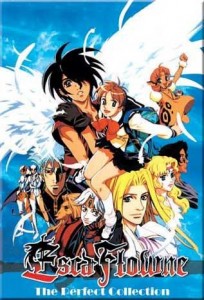
Escaflowne Eps 1-4

August 14, 2013 by Anna N

escaflowne

It was a funny coincidence that I decided that I would embark on a rewatch of The Vision of Escaflowne and finished the first disc the day before Funimation announced that they’d acquired rights to make this classic anime available again. I haven’t watched a ton of anime, but Escaflowne is by far my favorite series. Every two years or so I decide to watch it again, and I’m generally fine with just watching a show once or twice. This show really rewards those who see it multiple times, as the characterization, setting, and storyline are so rich and complex, I often feel like I find something new to appreciate with each viewing. I’ll see if I can work through my old Bandai DVDs by the time the new edition from Funimation comes out, and feel free to dig out your copies of Escaflowne and join me in a rewatch in anticipation of what Funimation decides to do with the rerelease.

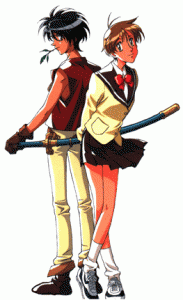
Hitomi the heroine of the show is sympathetic without being cloying. She’s a bit of a jock, as she’s dedicated to her track team. Hitomi also indulges in a bit of mysticism as she’s her school’s resident tarot card reader. She has a goofy crush on the captain of the boys’ track team at her school, and she spends plenty of time with her best friend awkwardly blushing and obsessing about him. Hitomi starts seeing visions as she’s running of destruction, giant metal monsters, and a young boy fighting. Her visions become true as Van Fanel appears on the high school track, pursued by a dragon. Hitomi and her friends narrowly escape while Van kills the dragon, but Hitomi and Van are carried off to to his world Gaea, where Earth appears as a second moon in the sky.

Van-Fanel-and-Hitomi-Kanzaki

Van is the reluctant prince of the country Fanelia, a place with a strong martial arts tradition, a missing older prince (this is significant), and a hazardous habit of sending out future rulers to slay dragons as a rite of passage. Van has a habit of initially addressing Hitomi by yelling “Hey Girl!” (and not in a Ryan Gosling sort of way) but he seems to call her by her first name whenever she’s in danger. Van seems to be doing the best he can in a role he doesn’t want, but he’s affected by violence and doesn’t particularly want to fight even though he can be good at it.

The world of Gaea is an interesting place. It is quasi-medieval, but people have ancient mecha called Guymelefs. There’s a bit of a steampunk and mystical vibe to the technology shown on Gaea, as you see cogs and gears snap into position, and the mecha seem to have the creaky joints of old machines. In addition to humans, there are humanoid animals that live on Gaea as well, with the most prominent being Van’s catgirl Merle. There’s trouble for Fanelia as the Zaibach Empire has cloaking technology for their mecha (like the Romulans!), and an insane military captain in the form of the androgynous and dangerously emotionally unstable Dilandau. Fanelia is razed to the ground and Van is suddenly a prince without a country. He manages to escape with Hitomi and his country’s greatest treasure – the Escaflowne Guymelef.

escaflownehitomialan

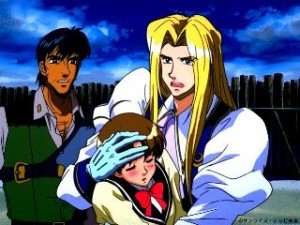
As Van and Hitomi try to figure out what to do, they fall in with Allen Shezar, whose talents as a swordsman are rivaled only by the puffiness of his sleeves. Alan is a Knight of the country Asturia, and he leads a somewhat piratical crew aboard the airship The Crusade. Hitomi promptly develops a crush on Allen, while Merle jealously guards Van’s attention. One of the things I enjoy about this series is that the world seems so rich, and there is plenty to think about between viewings. What were Allen’s adventures aboard his airship? How did Van and Merle develop a close bond? The world of Escaflowne just seems to exist in a special place where there’s space to ponder the history and relationships between the characters going beyond just the animated episodes.

The show was developed in 1996, but despite the limitations of animation at the time, it doesn’t feel all that dated. The rich setting combined with the strong orchestral and vocal score give the series an epic feel. The theme of the horrors of war and violence is established early, as the fighting provoked by the Zaibach Empire is portrayed as devastating, not glamorous. Even though I’ve probably seen Escaflowne already 5 or 6 times, it sill seemed fresh and interesting when I watched it again, which is the mark of a series that is just timeless. I’m looking forward to watching the rest of my old DVDs now and finding out more about the new edition of this series coming soon.

Filed Under: FEATURES Tagged With: bandai, funimation, Vision of Escaflowne

It Came from the Sinosphere: Laughing in the Wind

August 14, 2013 by Sara K. 1 Comment

xajh03

Ah, Laughing in the Wind. While I simply couldn’t resist putting this screenshot at the top, I think I should begin at the beginning.

The Opening Scene

I at first was planning to describe the opening scene fully, but then I realized that it would be easier to direct readers to Dramafever so they can watch the opening scene themselves. If you can, I suggest you watch the first eight minutes or so (up to the point where the horse-riders come in) before I share my observations. I realize not everyone can (for example, *I* cannot access this show on Dramafever, so I’m assuming that it’s the same as my DVD version), so I’ll try to provide enough description so that even those without access can follow along.

First of all, do you notice the theme song? I think that is one of the most low-key TV theme songs I have ever encountered. On the one hand, by being so low-key, it invites the viewers to judge the show for what it is. On the other hand, by being so low-key, it’s also saying ‘this show is different’.

A man is riding a donkey cart through a forest

Then, we see two strangers get along very well, playing music and drinking wine. However, it turns out that these two strangers belong to different factions – factions which insist that the other is Totally Awful and Should Always Be Treated as an Enemy. The older man seems to have no problem associating with a member of the other faction, and offers his friendship in spite of the difference in faction. The younger man, however, refuses, because *his* elders forbade him from having any dealings with the Sun Moon Cult.

An old man plays music while sitting on a tree branch.

Thus, in less than ten minutes, the viewers learn what pretty much the entire TV show is about: Montagues and Capulets (with lots of music, swords, and wine, of course).

The Story

I’ve already summarized this story once as a political allegory, but I’ll summarize it again, this time time with a Romeo-and-Juliet theme.

There is a group known as the Montagues Five Mountain Sword Sects, and another group known as the Capulets Sun Moon Cult. They are bitter enemies. Romeo Linghu Chong belongs to the Huashan Sect, which is part of the alliance. He has some rather antagonistic encounters with Juliet ‘Shenggu’ (that’s Chinese for ‘holy maiden’ or ‘lady saint’), who is of course part of the Sun Moon Cult.

xajh04

Liu Zhengfeng belongs to one of the Five Mountain Sword Sects, and love music. Qu Yang belongs to the Sun Moon Cult, and also loves music. In spite of the enmity between the Five Mountain Sword Sects and the Sun Moon Cult, these two become great friends, and compose a wonderful work of music which they title ‘The Laughing Proud Wanderer’.

Well, when the Montagues Five Mountain Sword Sects learn about Liu Zhengfeng and Qu Yang’s relationship, things turn out really badly. Before the conclusion of this particular story, Liu Zhengfeng and Qu Yang pass on the score of ‘The Laughing Proud Wanderer’ to Linghu Chong. They ask him to preserve it so that it may not be lost to the ages.

Ren Yingying plays music with Linghu Chong

The thing is, Linghu Chong knows nothing about music, so he can hardly play the tune itself. Now, ‘Shenggu’ is a musical expert, but … that would require Linghu Chong and ‘Shenggu’ to cooperate. And if they cooperated by pooling the musical score (Linghu Chong) and musical skills (Shenggu), they might start liking each other, which would be fascinating dangerous. Look at what happened to Liu Zhengfeng and Qu Yang because of their musical collaboration. Might the tune ‘The Laughing Proud Wanderer’ cause Romeo and Juliet Linghu Chong and ‘Shenggu’ to have a similar fate?

Background

This TV series is adapted from Jin Yong’s novel The Laughing Proud Wanderer (notice that the novel is named after the piece of music).

This series is significant because a) it is producer Zhang Jizhong’s first Jin Yong adaptation (I’ve written about Zhang Jizhong before) and b) the first Jin Yong TV adaptation ever made in mainland China.

For many years, all of Jin Yong’s works were banned in China, and as Jin Yong’s most political novel, The Laughing Proud Wanderer was probably especially unwelcome by the Chinese Communist Party. The fact that this was the first novel they adapted is, to me, quite interesting.

Shenggu holds a chick

I wonder if the makers of this TV series ever felt like a chick in Shenggu’s grasp.

Just before this series was produced, Jin Yong revoked TVB’s (in Hong Kong) license to adapt his works because he strongly disliked their last couple adaptations. I’ve read that he sold the rights to Zhang Jizhong for a single yuan on condition that he produce an adaptation as good as his adaptations of Water Margin and Romance of the Three Kingdoms.

In other words, the people making this series had pressure on them. They definitely had pressure from Jin Yong, who might never allow another adaptation to be made in mainland China if they disappointed him, they had indirect pressure from Chinese censors (my understanding is that, even when Chinese censors do not directly interfere, it’s always a lingering concern), and most of all, they had to prove to fans that a mainland Chinese Jin Yong production could be good.

The Scenery

One thing which really stands out about this TV show is the embarrassing abundance of gorgeous landscapes. Mist-filled forests, serene waterfalls, lofty mountains, you name it. This is actually pretty common in wuxia (just as it’s common in Westerns), but I know of no other work of wuxia which excels at natural scenery as much as this series.

Shenggu stands among mist-filled mountains

Obviously, some of the scenery is the ‘Wu Yue’ (Five Great Mountains), which according to this article are ecologically in better shape than equivalent non-sacred areas in China.

A traditional Chinese lotus pond

You gotta have a lotus pond.

I also get the feeling that most of this TV show was filmed in southern China – which would make sense since part of the story is set in southern China. The main reason I get this feeling is that much of the scenery looks similar to Taiwan, which (at lower elevations) is ecologically similar to south-eastern China.

Sandstone cliffs with lots of plants and a stream.

This looks like Taiwan.

After moving to Taiwan, I’ve become an outdoor enthusiast – I generally try to go out to Taiwan’s forests/grasslands/waterfalls etc. whenever feasible. And I’ve developed a personal attachment to Taiwan’s environment. Much of the landscape in this TV show feels really familiar to me – particular the landscapes which looks like subtropical forests on top of sandstone. That the characters live in a place which looks very much like where I like to hang out in my free time gives me an odd yet warm feeling.

A broad-leaf forest full of mist

This does not look so much like Taiwan (though maybe one could find something like this in Taiwan at the right elevation).

Faithfulness?

Since this is an adaptation, some people want to ask ‘is this faithful to the original novel?’

My short answer is ‘no’.

That said, I still consider it an adaptation, rather than fanfiction. Most of the overall plot and characters come through. However, there are a lot of changes, most of them small, but they add up.

Two broad changes stand out to me:

– The ‘Romeo-and-Juliet’ Slant. My summary above might have thrown off people familiar with the original novel. Trust me, it reflects the TV show.
– Courtesy. The characters show much more tact in this TV show than in the original novel. I actually didn’t realize just how rude the characters are until I saw their rudest behavior stripped away. No caves full of blind men insulting their enemies’ grandmothers in this adaptation. While I think the outrageous comments are the most memorable dialogue from the novel, the story actually stick works very well without the rudeness. Plus, one side-effect of the characters’ cleaning their mouths is that this TV show is significantly less trans-phobic than the original.

Blood mixes with flower petals as the lovers die (I'm not saying *which* lovers die, so this is not a spoiler)

Blood mixes with flower petals as the lovers die (I’m not saying *which* lovers die, so this is not a spoiler)

I don’t mind most of the changes. If I want something exactly like the original novel, I should just go re-read the original novel (and let me tell you, some parts of the novel are so flawed that even the most faithful adaptations alter them). I demand quality, not faithfulness to the source.

Speaking of changes…

Ren Yingying

Ren Yingying (aka ‘Shenggu’) has a much bigger presence in this show than in the novel. She appears in the very first episode, and appears in most episodes after that. By contrast, she doesn’t appear at all in the first half of the novel.

Ren Yingying wearing a veil

I had felt that the Linghu Chong / Ren Yingying romance was not as powerful as that of some of Jin Yong’s other romantic couples simply because they do not spend enough time together. This TV show definitely takes care of this, and I felt the rapport between them much stronger here than in the novel. Besides, some of the ‘new’ scenes between them are just plain fun (which, for me, compensates for the omission of Ren Yingying’s tartest comments in the novel).

However, it’s not just the romance which benefits from Yingying’s increased screentime – it’s her entire character development.

Ren Yingying without the veil.

In the novel, Yingying doesn’t seem to grow very much. I know that, technically, she does change in the novel, but she doesn’t show up enough for me to really feel it as a reader. But here, in this TV show, her growth as a character is much, much, much more apparent. And I think a character as interesting as here deserves a bit more spotlight.

There is More to Come…

I am not done talking about this TV show, but I think this is a good place to pause. In the mean time, if I have piqued your interest and you have Dramafever access, you can watch it and form your own opinions.


One can learn quite a bit about somebody just from their book collection. Sara K. has a set of books about the wildflowers of Taiwan, as well as three books about hiking in northern Taiwan, two travel books about other parts of Taiwan, and some hiking maps of Taiwan. Just like China, Taiwan has its own ‘Wu Yue’ – Yushan, Syueshan, Xiuguluanshan, Nanhudashan, and Beidawushan, which, though less famous, are actually much higher than China’s Wu Yue.

Filed Under: Dramas, It Came From the Sinosphere

Otakon in the rear view mirror

August 14, 2013 by Brigid Alverson

Here’s my roundup of Otakon news at MTV Geek.

Yen Press has licensed the Blood Lad spin-off Bloody Brat, a single volume of short stories and four-panel gag manga about the characters in the main series.

The Manga Bookshelf bloggers discuss their Pick of the Week.

How do I read manga—legally? Justin counts the ways and gives a detailed rundown of each digital manga service at Organization Anti-Social Geniuses.

Tony Yao recounts his first trip to Otakon at Manga Therapy.

South Korea’s only comics convention, the Bucheon International Comics Festival, is going on this week.

Reviews: Carlo Santos looks at the latest manga releases in his Right Turn Only!! column at ANN. Ash Brown takes us through a week’s worth of manga reading at Experiments in Manga.

Shannon Fay on vol. 5 of The Betrayal Knows My Name (Kuriousity)
Lissa Pattillo on vol. 1 of Blood-C (Kuriousity)
Lissa Pattillo on vol. 1 of Don’t Tell My Husband (Kuriousity)
Johanna Draper Carlson on vol. 2 of Doubt (Comics Worth Reading)
Drew McCabe on vol. 1 of Dragon Ball (3-in-1 edition) (Comic Attack)
Carlo Santos on vol. 1 of Dragon Ball (3-in-1 edition) (ANN)
Sean Gaffney on Kitaro (A Case Suitable For Treatment)
Rebecca Silverman on vol. 1 of Magi (ANN)
Ash Brown on The Strange Tale of Panorama Island (Experiments in Manga)
Chris Randle on The Strange Tale of Panorama Island (Hazlitt)
Chris Kirby on vol. 13 of Tegami Bachi: Letter Bee (The Fandom Post)

Filed Under: MANGABLOG

Blade of the Immortal, Volume 24: Massacre

August 14, 2013 by Ash Brown

Creator: Hiroaki Samura
U.S. publisher: Dark Horse
ISBN: 9781595827517
Released: October 2011
Original release: 2008
Awards: Eisner Award, Japan Media Arts Award

Massacre is the twenty-fourth volume in the English-language release of Blade of the Immortal, Hiroaki Samura’s long-running manga series. Earlier on in the series’ release, Dark Horse divided the volumes by storyline rather than by number of chapters. Because of this, many of the individual volumes are slightly different in the English-language edition compared to the original Japanese release of Blade of the Immortal. Massacre, published by Dark Horse in 2011, collects the same chapters as the twenty-third volume of the Japanese edition of the series which was released in 2008. At this point, the manga has entered its final major story arc. The previous two volumes, Footsteps and Scarlet Swords, provided the necessary set up which allows Samura to really let loose in Massacre. As can be assumed from the title, it’s a rather bloody volume.

As agreed, the Ittō-ryū is leaving Edō after being banished from the city. However, the rogue sword school is still being chased by Habaki Kagimura and his Rokki-dan warriors as well as by Rin Asano and her bodyguard Manji. But what the pursuers don’t yet realize is that there are key members missing from the group of Ittō-ryū said to be making its way to the port in Hitachi: the sword school’s leader Anotsu Kagehisa and three of its elite fighters–Magatsu Taito, Ozuhan, and Baro Sukezane. The four highly skilled swordsmen have their own task to complete, a bold raid on Edō Castle through one of its most heavily guarded entrances. It’s a brash move that, if successful, will leave quite an impression in its wake, not to mention a high body count. The Ittō-ryū has already been identified as a threat, but they are prepared to show just how dangerous they can be.

Samura’s artwork in Blade of the Immortal has always been something that has particularly appealed to me about the series, but his kinetic style works especially well in Massacre. A large part of the volume is devoted to the daring attack on Edō Castle; the sequence is one of the most effectively choreographed and visually executed battles in Blade of the Immortal thus far. The Ittō-ryū is a group of swordsmen sharing the same ideals and martial philosophy more than it is a strictly enforced style. This can especially be seen in Massacre simply by watching how the Ittō-ryū’s elite fight. They all use different weapons and techniques and each has his own aura. Anotsu’s elegance, Magatsu’s cruder dynamism, Ozuhan’s speed and uninhibited wildness, and Baro’s strength and power are all readily apparent. They fight well as individuals, but also work well together as a team.

Although the focus of Massacre is on the raid of Edō Castle–a quickly paced, action packed, violent, and rather impressive escapade–several other important things happen in the volume as well. For the last few volumes of Blade of the Immortal Shira has been on the fringe of the story, but his prominence is quickly growing. He may have lost a limb or two over the course of Blade of the Immortal but his extreme sadistic streak and penchant for sexual violence remain. Shira is as terrifying as ever. Also making his return to the series was Ayame Burando, which I was surprised but happy to see. He and Manji even end up having a heart-to-heart about atonement and the meaning of evil. These are themes that play a major role in Blade of the Immortal, one of the reasons that I like the series so well. As always, I’m looking forward to reading the next volume, Snowfall at Dawn.

Filed Under: REVIEWS Tagged With: Blade of the Immortal, Dark Horse, Eisner Award, Hiroaki Samura, Japan Media Arts Award, manga

  • « Go to Previous Page
  • Page 1
  • Interim pages omitted …
  • Page 656
  • Page 657
  • Page 658
  • Page 659
  • Page 660
  • Interim pages omitted …
  • Page 1048
  • Go to Next Page »
 | Log in
Copyright © 2010 Manga Bookshelf | Powered by WordPress & the Genesis Framework