• Skip to primary navigation
  • Skip to main content
  • Skip to primary sidebar
  • Home
  • About Us
    • Privacy Policy
    • Comment Policy
    • Disclosures & Disclaimers
  • Resources
    • Links, Essays & Articles
    • Fandomology!
    • CLAMP Directory
    • BlogRoll
  • Features & Columns
    • 3 Things Thursday
    • Adventures in the Key of Shoujo
    • Bit & Blips (game reviews)
    • BL BOOKRACK
    • Bookshelf Briefs
    • Bringing the Drama
    • Comic Conversion
    • Fanservice Friday
    • Going Digital
    • It Came From the Sinosphere
    • License This!
    • Magazine no Mori
    • My Week in Manga
    • OFF THE SHELF
    • Not By Manga Alone
    • PICK OF THE WEEK
    • Subtitles & Sensibility
    • Weekly Shonen Jump Recaps
  • Manga Moveable Feast
    • MMF Full Archive
    • Yun Kouga
    • CLAMP
    • Shojo Beat
    • Osamu Tezuka
    • Sailor Moon
    • Fruits Basket
    • Takehiko Inoue
    • Wild Adapter
    • One Piece
    • After School Nightmare
    • Karakuri Odette
    • Paradise Kiss
    • The Color Trilogy
    • To Terra…
    • Sexy Voice & Robo
  • Browse by Author
    • Sean Gaffney
    • Anna Neatrour
    • Michelle Smith
    • Katherine Dacey
    • MJ
    • Brigid Alverson
    • Travis Anderson
    • Phillip Anthony
    • Derek Bown
    • Jaci Dahlvang
    • Angela Eastman
    • Erica Friedman
    • Sara K.
    • Megan Purdy
    • Emily Snodgrass
    • Nancy Thistlethwaite
    • Eva Volin
    • David Welsh
  • MB Blogs
    • A Case Suitable For Treatment
    • Experiments in Manga
    • MangaBlog
    • The Manga Critic
    • Manga Report
    • Soliloquy in Blue
    • Manga Curmudgeon (archive)

Manga Bookshelf

Discussion, Resources, Roundtables, & Reviews

Blog

Tales of Moonlight and Rain

December 20, 2013 by Ash Brown

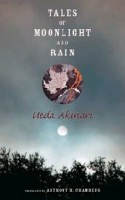
Tales of Moonlight and RainAuthor: Ueda Akinari
Translator: Anthony H. Chambers
Publisher: Columbia University Press
ISBN: 9780231139137
Released: December 2008
Original release: 1776
Awards: Japan-U.S. Friendship Commission Prize

Ueda Akinari’s Ugetsu monogatari is a collection of nine short stories of ghosts and the occult that was originally published in Japan in 1776. The classic as a whole has been translated into English several times and some of the individual tales have been translated as many as ten. The most recent of these translations is a study by Anthony H. Chambers first published in 2007 by Columbia University Press as part of its series Translation from the Asian Classics. With his translation of Ugetsu monogatari, titled Tales of Moonlight and Rain, Chambers aimed to provide th most accurate, comprehensive, and faithful English edition of the work, conveying the meaning of the text while still capturing Akinari’s tone and style of writing. His efforts were rewarded with the 2007 Japan-U.S. Friendship Commission Prize for the Translation of Japanese Literature. The particular reason that Tales of Moonlight and Rain was brought to my attention was that Akinari was noted as being one of Yukio Mishima’s favorite authors in his biography, Persona.

The nine stories in Tales of Moonlight and Rain–“Shiramine,” “The Chrysanthemum Vow,” “The Reed-Choked House,” ” The Carp of My Dreams,” “The Owl of the Three Jewels,” “The Kibitsu Cauldron,” “The Serpent’s Lust,” “The Blue Hood,” and “On Poverty and Wealth”–all deal with the mysterious and the strange. Ghosts make frequent appearances, demons cause terror and strife, spirits seek revenge, people are cursed or succumb to possession, and so on. All of the stories are set in provincial Japan which, as Chambers note in the introduction, would emphasize the strangeness and otherness of the tales for Akinari’s original audience, a group mostly made up of people who lived in Japan’s major cities. Additionally, all but one of the stories takes place before the Tokugawa shogunate was established in 1603, which also had a distancing effect. Today’s readers are even further separated from the stories in Tales of Moonlight and Rain, but the tales are no less fascinating because of it.

In addition to Akinari’s nine stories, Tales of Moonlight and Rain also includes extensive notes and analysis as well as a bibliography listing texts and commentaries, secondary resources, and previous English translations of Akinari’s work. Chambers has written a lengthy introduction to the collection as a whole, but each of the stories has its own prefatory material which notes important details regarding the titles, characters, places, and time periods, explains useful background information and the stories’ relationships and affinities to other works (both classic and contemporary), and provides additional commentary and any other observations. Chambers uses both footnotes and endnotes in Tales of Moonlight and Rain–the footnotes for points critical to the immediate understanding of the text and the endnotes for more in-depth information. In theory, this is an excellent idea, but in practice I found it rather annoying and cumbersome to have to look in two different places for the stories’ notes. But this is really my only complaint about the volume and I consider it a minor one.

One of the most interesting things for me about the stories in Tales of Moonlight and Rain were all of the references and allusions that the collection contained to other classic works of Chinese and Japanese literature such as Murasaki Shikibu’s The Tale of Genji and the collection of poetry Manyōshū. Having read translations of some of the older works being referred to, I particularly appreciated Akinari’s use of them in Tales of Moonlight and Rain. However, it is not at all necessary to be familiar with the Chinese and Japanese literary classics in order to enjoy the collection. All of the stories stand completely on their own despite the borrowing and adapting that Akinari employs. I didn’t realize it before reading Tales of Moonlight and Rain, but I was actually already familiar with some of the adaptations of Akinari’s own work; Ugetsu monogatari was more influential than I knew. Personally, I enjoyed the entirety of Tales of Moonlight and Rain a great deal, including Chambers’ commentary and analysis. The stories may be more than two centuries old, but perhaps in part because of that they remain both evocative and spellbinding.

Filed Under: REVIEWS Tagged With: Japan-U.S. Friendship Commission Prize, Ueda Akinari

Manga the Week of 12/25

December 19, 2013 by Sean Gaffney, Ash Brown, Anna N, Michelle Smith and MJ Leave a Comment

SEAN: For the most part, it’s a Merry Christmas and not a lot of manga, as most publishers take the holidays off. We do have a couple of titles trickling in, however…

sankarea4

Kodansha has the 4th volume of Sankarea, which continues to walk the line between harem romance and horror movie. As you can see from the cover art seen here, Kodansha is gunning more for the latter.

ASH: Sankarea is such a strange manga. I’m enjoying it more than I thought I would, but some of the fanservice really detracts from the series’ quirky charms.

SEAN: And Seven Seas has the 3rd and final volume of Crimson Empire. I really like the heroine and basic premise of this series, but I admit I have not really enjoyed the manga as much as I have the author’s Alice series. Perhaps the otome game plays out better, or perhaps this volume will give us a big finish.

ANNA: I actually enjoyed the first volume of Crimson Empire quite a bit, and was planning on picking up subsequent volumes but hadn’t got around to it yet. Perhaps I’m just easily amused by the idea of an assassin maid in a reverse harem series.

SEAN: That’s it. Either of these under your stocking?

MICHELLE: Not for me, this time.

MJ: Sadly, I’m with Michelle, in that neither of these titles is for me. But that doesn’t mean I’m not buying this week! So much to catch up on…

Filed Under: FEATURES, manga the week of

Sunshine Sketch, Vol. 7

December 19, 2013 by Sean Gaffney

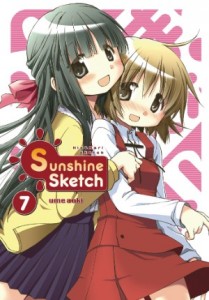
By Ume Aoki. Released in Japan as “Hidamari Sketch” by Houbunsha, serialization ongoing in the magazine Manga Time Kirara Carat. Released in North America by Yen Press.

When I last reviewed this cute 4-koma series, I noted that this volume might be the last as clearly Sae and Hiro were close to graduating. Well, by the end of this volume, they’re definitely closer, but haven’t quite gotten there yet, and it seems that it will be Volume 8 where we find out how the series can keep going without two of its big players. That said, attention is paid to all six of the main cast here, along with a few of the bit players we’ve seen sprinkled throughout, so maybe it doesn’t need to end quite yet, despite the loss of its main not-yuri couple.

sunshinesketch7

Sae and Hiro haven’t left yet, though this volume gives them a bit less attention on the grounds that they’re studying for finals and applying to art colleges. We see some nice interaction with the first-years, as Hiro tries to teach Nazuna to cook (which doesn’t go as well as she hoped) and Sae discusses the nature of nightmares and the value of a printed book vs. an online one with Nori. We also get the most character development we’re ever likely to see for Natsume, the tsundere who loves Sae but can only express her affection through harsh words. Luckily, things thaw a bit as Natsume is invited to be part of a Christmas Party thrown by the gang, and cuteness ensues rather than frustration. Still no confession, though.

There really aren’t very many jokes here that we haven’t really seen variations on before, just with fresh settings and slightly redone. Yuno is short, Miyako is eccentric, Hiro constantly binge eats and then binge diets, and Sae frets (this is especially clear when her sister comes for a visit, annoyed that Sae may make her college choice based on what others want rather than what she wants.) Aside from Sae and Hiro’s college stress, the one sense that time is actually passing comes when Yuno runs into Arisawa, the sempai she’d met a few books back who’s now in college.

If there’s a theme to this book, it’s “even though life moves on, you should always treasure your friends no matter what”. I suspect Sae and Hiro leaving hasn’t quite hit Yuno yet (that may be in Volume 8), but when it does, it’s going to be tough. It will be less tough for Sae and Hiro themselves, as they’ve managed to find colleges that not only have the program they need but are also right next to each other! Yuri continues to tease but be mostly absent – in fact, there’s not even a lot of teasing here, beyond their beaming faces when they note their colleges. They really need to find an apartment to share once they get to college. With a big pluffy bed.

The art school aspect, as always, isn’t pushed as much as it is in GA Art Design Class, the other 4-koma art student manga. But in the end, even if it doesn’t really knock it out of the park, Sunshine Sketch inspires smiles and “awww, cute” remarks, and the occasional giggle. It’s an excellent comfort manga – provided, as ever, you don’t mind the characters being squished like pancakes sometimes.

Filed Under: REVIEWS

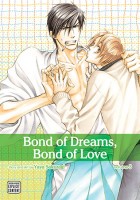
Bond of Dreams, Bond of Love, Vol. 3

December 18, 2013 by Ash Brown

Bond of Dreams, Bond of Love, Volume 3Creator: Yaya Sakuragi
U.S. publisher: Viz Media
ISBN: 9781421549781
Released: February 2013
Original release: 2010

Yaya Sakuragi has had several of her boys’ love manga released in English. Bond of Dreams, Bond of Love was the second of her series to be licensed. Bond of Dreams, Bond of Love is loosely connected to her earlier series Tea for Two. Reading Tea for Two isn’t at all necessary to understand Bond of Dreams, Bond of Love, but it does provide more details about one of the character’s back stories. Sakuragi was actually my introduction to yaoi and boys’ love manga and I continue to be very fond of her work. I like her particular sense of humor and lanky character designs. Bond of Dreams, Bond of Love isn’t my favorite of her works, but I’m still largely enjoying the manga; it’s a rather goofy series. The third volume of Bond of Dreams, Bond of Love was originally published in Japan in 2010. The English-language edition was released in 2013 by Sublime Manga, the boys’ love imprint associated with Viz Media.

There are some big changes occurring in Ao’s life. One of the biggest is that he might be moving out of his grandmother’s place and transferring schools in order to live with his mother and his twin brother Aka. Ao’s not too keen on the idea, especially since it would mean he would see Ryomei less, but more than one person has encouraged him to make the move, believing it to be in his best interest. Even though Ao’s life has been thrown into turmoil his preoccupation with Ryomei is still foremost on his mind. He somehow even manages to convince the older man to go on a date with him, though it doesn’t exactly turn out how either of them expected it would. As for Ryomei, he continues to be somewhat baffled by and conflicted over Ao’s advances. He’ trying to work out just what his feelings really are for the younger man, but it hasn’t been an easy process. And with Ao potentially moving away, Ryomei had better figure it out sooner rather than later.

Bond of Dreams, Bond of Love started with a wet dream (Ao’s, to be specific) and dreams and daydreams have continued to be a recurring element in the series. But now with the third volume, Ryomei has to deal with them, too. It’s a nice way to tie the narrative together and show the parallels between Ryomei and Ao’s feelings as the develop. Another way that Sakuragi show these parallels is through Ryomei and Ao’s not-quite-date, which is handled exceptionally well in the manga. Though the two of them are on the same outing they are experience it very differently. As a reader it’s interesting to be able to simultaneously see and compare their thoughts and reactions while they themselves are completely unaware of how the other person is interpreting the events. It’s a situation in which the lack of communication is completely believable. Both Ao and Ryomei are holding back, but for different reasons–Ao is worried about scaring Ryomei off while Ryomei is understandably concerned about his changing feelings for Ao.

For me, Bond of Dreams, Bond of Love works best as a comedy and shouldn’t be taken too seriously, which is not to say there aren’t some genuinely touching and occasionally bittersweet moments. However, the series excels in its humor and reaction shots. In general the characters’ faces are all very expressive and dynamic, but Ryomei, who tries so hard to be serious and reserved, has some of the best expressions. He has become hyper-aware of how he interacts with Ao and it shows. Despite the focus of Bond of Dreams, Bond of Love being on Ao and Ryomei, the series actually has a fairly large cast of secondary characters who all have their roles to play, too. This includes a fair number of important female characters, which can be a rarity in boys’ love manga. However, it’s Ao’s best friend Shunpei who remains one of my favorites. (Shunpei is also the character from Tea for Two; I’d love to see him get his own series at some point.) Ao’s twin brother Aka, who is constantly on edge, can be pretty entertaining, too. With its slightly ridiculous and over-the-top characters and interactions, Bond of Dreams, Bond of Love has really grown on me, and there’s still one more volume to go.

Filed Under: REVIEWS Tagged With: Bond of Dreams Bond of Love, manga, Sublime Manga, viz media, Yaya Sakuragi

Kuroko’s Basketball suspect nabbed

December 17, 2013 by Brigid Alverson

After a year of threatening letters and cancelled events, police arrested a suspect in the Kuroko’s Basketball case this week. The suspect, 36-year-old Hirofumi Watanabe, was nabbed while mailing some letters, and according to police, he has already confessed.

Yen Press has more Sword Art Online manga on the way.

The Manga Bookshelf bloggers discuss their Pick of the Week.

Lori Henderson discusses Inu x Boku SS along with her regular features on the Manga Dome podcast at Manga Xanadu.

News from Japan: The 20th anniversary edition of Bessatsu Margaret comes with a dust jacket featuring characters from popular shonen manga; RocketNews24 gives us a peek. The top-selling manga on Amazon Japan this holiday season is vol. 12 of Yotsuba&!, and the top-selling vol. 1 of a manga is Attack on Titan, according to the folks at Japanator.

Reviews: The Manga Bookshelf team files this week’s Bookshelf Briefs. Ash Brown brings us through a week’s worth of manga reading at Experiments in Manga.

Ash Brown on 12 Days (Experiments in Manga)
Harry Edmundson-Cornell on vol. 2 of 20th Century Boys (Sequart)
Ken H on vols. 8 and 9 of Attack on Titan (Comics Should Be Good)
Sean Gaffney on vol. 10 of Attack on Titan (A Case Suitable for Treatment)
AstroNerdBoy on vol. 32 of Fairy Tail (AstroNerdBoy’s Anime and Manga Reviews)
Sarah on vols. 1-4 of Cardcaptor Sakura (nagareboshi reviews)
Sean Gaffney on vols. 4 and 5 of Hetalia: Axis Powers (A Case Suitable for Treatment)
Leroy Douresseaux on vol. 10 of Itsuwaribito (The Comic Book Bin)
Johanna Draper Carlson on vol. 2 of Judge (Comics Worth Reading)
Lesley Aeschliman on vol. 1 of Limit (Lesley’s Musings… on Manga)
Alex Hoffman on Pink (Manga Widget)
Andrew T on Pink (The Beguiling)
Kristin on vol. 1 of Sweet Rein (Comic Attack)
Ken H on vols. 1 and 2 of Triton of the Sea (Comics Should Be Good)
Leroy Douresseaux on vol. 2 of Voice Over: Seiyu Academy (The Comic Book Bin)

Filed Under: MANGABLOG

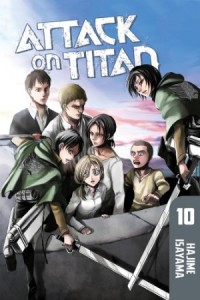
Attack on Titan, Vol. 10

December 17, 2013 by Sean Gaffney

By Hajime Isayama. Released in Japan by Kodansha, serialization ongoing in the magazine Bessatsu Shonen Magazine. Released in North America by Kodansha Comics.

(Note: this review is based on a copy provided by the publisher. Also, this review spoils this volume even more than my reviews normally do. I recommend reading it first. Also, don’t discuss post-Vol. 10 spoilers in comments.)

This is not exactly a relaxing, peaceful volume of Attack on Titan. Not that we’ve seen any of those to date, but this one in particular is pretty much wall-to-wall action, with only a few flashbacks to distract us from what’s going on. We get a few more Survey Corps deaths, as the Titans show that when they’re led by a clever bastard (the Beast Titan), they can be nastily effective. Luckily, so can our heroes, as even without gear on, they manage to take on a couple of Titans and survive, though not without injury.

titan10

This does lead to one of my favorite funny bits in the series, where Krista tears her skirt to make Reiner a sling/bandage and Ymir, watching silently from the sidelines, says “Hey, Krista, my hand got skinned.” Those of us watching Ymir from the start, however little attention has been paid to her until the previous volume, know that whenever she’s seen she’s looking at Krista, or protecting Krista, or otherwise does not have context without being next to Krista. After this volume, I think it’s pretty safe to say that Ymir is in love with Krista. (Indeed, the author’s website notes it is a romantic attraction.) Of course, this being Attack on Titan, that doesn’t mean it’s a healthy or pure love. Ymir and Krista both have issues beyond simply fighting Titans.

I must admit, I’m not really sure how well Krista’s martyr complex has actually been telegraphed in the story besides Ymir simply stating it. We do get a flashback after the fact to try to explain it, where we see more of what I’ve taken to be their usual relationship – Ymir being cutting and nasty, Krista being stubbornly nice to the point of near-death – as they try to rescue a wounded colleague in the middle of nowhere during the winter. Of course, the other characters are just as surprised by Ymir’s words as we are – they’ve never really seen much of Krista beyond “beautiful, angel, goddess”, etc.

As for Ymir’s secret, well, she’s a Titan Shifter. Not particularly a surprise given the hints and buildup we got leading up to it, though her being the Titan who destroyed Reiner and Bertolt’s hometown was a bit of a shocker. Needless to say, the reason this gets revealed is that they are at the very bring of death – or rather Krista is, I’m not sure that Ymir would really do this for any of the others, though she does show them affection. Ymir’s battle is pretty badass, even if she ends up seriously wounded – she clearly has experience doing this sort of thing. Also, given Krista’s reaction to Ymir’s fighting, I think it’s safe to say that Ymir’s feelings are not simply one-sided. Though in this series, a happy ending is almost impossible.

Speaking of Reiner and Bertolt… if Ymir’s reveal was given lots of buildup and flashbacks with Ilse’s Notebook and such, leading to a bit dramatic fight scene, then here we have the polar opposite – a conversation so casual that you turn the page before you even realize what was just said. It’s almost comedic in its own way – “Oh, by the way, Eren, we’re the Armored and Colossal Titan.” There is at least some attempt to show how so many Titan shifters managed to make it into the same squad – Annie, Reiner and Bertolt are all from around the same place, and the records were lost or damaged so it took hem this long to figure things out. Also they were damn good soldiers. Indeed, they still seem to be – Reiner and Bertolt’s motivations are somewhat murky here, and I presume future volumes will show why they feel that thanks to Eren, they can stop destroying humanity. Also, why they need Ymir, unless it’s revenge for what she apparently did to them as kids.

With more and more Titan shifters showing themselves, the question now becomes “are all the Titans transformed humans?” And if so, how innocent are they meant to be? A few of the Titans seen in the battle act much like kids would playing around their dad, and one shudders to think whether that’s really the case. There’s a nice little cliffhanger here, with the Shifter Titans on the run – some unwillingly – from the rest of the Military. Mikasa, for one, is likely to take this badly. Assuming she’s able to move – come on, some of these near-fatal wounds must slow her down, at least? In any event, despite some awkward exposition designed to move the characters around on the board to where the author needs them to be, the series remains as addicting as even. Beware, though – the speedup is almost over.

Filed Under: REVIEWS

Bookshelf Briefs 12/19/13

December 16, 2013 by Sean Gaffney and Michelle Smith Leave a Comment

This week, Sean and Michelle look at recent releases from Yen Press, Seven Seas, and Viz Media.


bloodycrossBloody Cross, Vol. 1 | By Shiwo Komeyama | Yen Press – Has there been something missing in your life ever since JinJun Park’s Raiders came to an end? Well, you’re in luck, because Bloody Cross is here to fill that void! Seriously, with its stark black and white artwork and religious themes, I was getting some major Raiders flashbacks while reading this! Tsukimiya and Hinata are mixed-race angels who have been placed under a deadly curse by God and they’re working together to break it, even if it means double-crossing each other at every opportunity. There are some elements I’m not fond of—Tsukimiya is a half-vampire angel because of course she is, not to mention the random fanservice and infantile female demon foe—but I was genuinely surprised by the way the volume ended and I think I may have to check out volume two just to see how Tsukimiya and Hinata get out of that predicament. Not quite recommended, but not bad, either. – Michelle Smith

demon5Demon Love Spell, Vol. 5 | By Mayu Shinjo | Viz Media – I am beginning to suspect, especially given the cute little omake at the end of this volume, that this will be one of Shinjo’s titles where the sex doesn’t arrive till the very end. Which is fine, particularly if the storyline remains as strong as the one we see here. Kagura and Miko move out to their own place, but that doesn’t necessarily mean they’re getting it on – her father is still wary of trusting an incubus. But Kagura is easily the least jerk-like of the Shinjo heroes we’ve seen translated over here – ironic, given he’s a demon – which makes it easier to deal with both of them getting jealous over the course of this book. All this and an interesting dovetailing of demonic possession and the entertainment industry, where people will likely not realize you’re different. This is Shinjo’s best Viz series to date. – Sean Gaffney

rin-ne13RIN-NE, Vol. 13 | By Rumiko Takahashi | Viz Media – “Pleasant but pointless” is how I would sum up this most recent volume of RIN-NE. True, one might apply that label to most of the series, but volume twelve did have the Black Cat Ranking Exam, which was a nice change of pace. Volume thirteen features one-chapter cameos by antagonists like Masato the devil and Rinne’s deadbeat dad and introduces a supremely unfunny sibling duo that specializes in scythe modifications, including one made of bonito flakes that helps cat spirits pass on. (That bit, at least, was kind of cute.) Nothing is outright bad, but I do have to wonder how Takahashi’s editor keeps from yawning when ideas for new chapters are proposed. Perhaps Takahashi is so revered—and her sitcom stylings so familiar and comforting—that no one minds when her stories go nowhere. And, really, I guess that’s why I’m still reading, too. – Michelle Smith

blacksmith3The Sacred Blacksmith, Vol. 3 | By Isao Miura and Kotaro Yamada | Seven Seas – There’s a fair bit of fanservice here, and gratuitous dressing up as maids (very common in fantasy not-quite-medieval stories). But there’s also a lot of worldbuilding, as the arrival of a young woman and her entourage proves to be far more serious than I had initially thought. The selfish ojou front quickly drops away from Charlotte, as we see the desperate young woman beneath, and the bond between her and her three guardians is very well told. There’s also some excellent action sequences here, as Cecily takes on said guardians in an indoor battle that destroys the building but saves the day. All this plus an ominous warning of a future bad guy. Of Seven Seas’ recent fantasy titles, this has been far and away my favorite. -Sean Gaffney

voiceover2Voice Over!: Seiyu Academy, Vol. 2 | By Maki Minami | Viz Media – I was pleased that the first half of this volume fleshed out Hime’s group of ‘misfits – indeed, the male love interest barely appears in this volume at all. Instead, we continue to show that despite her dreams, Hime is at her best with male roles – something underlined by her posing as a male at the end in order to satisfy her producer’s plans. On the more dramatic front, her mother proves to be the classic horrible shoujo mother as seen in so many series, and the sadness comes from seeing how Hime has grown so used to it that it doesn’t even register as sorrow anymore – just a weary determination to one day show her mother she’s not useless. Even Haruka, the aforementioned producer, is taken aback – and knows that to succeed, the first step for Hime is to get out of that house. Mission accomplished. -Sean Gaffney

Filed Under: Bookshelf Briefs

Pick of the Week: Pandora Hearts & More

December 16, 2013 by MJ, Michelle Smith, Sean Gaffney, Anna N and Ash Brown 1 Comment

potw-12-16MJ: I know there’s a lot of manga on tap this week, but I can’t help it… my heart belongs to Pandora Hearts, and I fear it always will. Volume 18 hurt me as cruelly as it could, and as it turns out, that’s just the way I like it. More, more, more, please. I gotta have my fix.

MICHELLE: Ooh, how do you like your love? o/~ (I hope I’m not the only one who instantly got that song in my head!) Anyway, I’m definitely with MJ on this. The cliffhanger ending of volume 18 was too cruel to pass up on the 19th, though, now that I think about it, it’s all too likely that only more sorrow awaits.

SEAN: My pick this week is the 2nd and final volume of Summer Wars, which was a big surprise hit for me this fall. Combining rural love comedy with technopocalypse is not something you see every day, and it has some likeable, fallible lead characters. It’s also not afraid to go into dark places when it has to. If Vol. 2 is as good as Vol. 1, we’re in for a real treat.

ANNA: I’m going to have to go with Gundam: The Origin Vol. 4. I love this series, and I love Vertical for bringing it out in a deluxe hardcover edition.

ASH: Gundam: The Origin has consistently been one of my favorite releases this year, but my pick of the week goes to the eleventh volume Q Hayashida’s delightfully weird and strange manga series Dorohedoro. With its dark humor and quirky characters, Dorohedoro somehow manages to be incredibly violent and incredibly charming all at the same time.

What looks good to you this week?

Filed Under: PICK OF THE WEEK

My Week in Manga: December 9-December 15, 2013

December 16, 2013 by Ash Brown

My News and Reviews

Last week I posted the first review in my new monthly review project, A Year of Yuri. This project will focus on comics and manga with yuri and lesbian themes. For this month’s review, I took a closer look at June Kim’s debut graphic novel 12 Days which was even better than I remembered it being. It’s a beautiful work that addresses the complexities of grief, family, love, and loss.

Also last week, I wrote a post that focused on how to find manga in libraries–Finding Manga: Library Love. The post is sort of a combination of two of my semi-regular features–Finding Manga and Library Love. (I’ve actually decided to retire Library Love, so the post was also a way for me to give the feature a nice send-off.) It’s a pretty long post; if you don’t feel like reading the whole thing, you can always just skip to the quick tips at the end.

As for interesting things found online: The Pew Research Center coincidentally posted its report on How Americans Value Public Libraries in Their Communities the same day I was expressing my own love of libraries; over at Geekscape, Kari Lane discussed yaoi with Jennifer LeBlanc, SuBLime’s editor; and Erica Friedman talked about some of the differences between the U.S. and Japanese comic book industries on Quora.

Quick Takes

Fake FurFake Fur by Satomi Yamagata. For a boys’ love manga, Fake Fur is surprisingly realistic in its portrayal of Yamashita–a young man who in high school is just starting to come to terms with his sexuality and homosexuality. The manga follows him as he becomes aware that he is in love with his close friend Kubo and how he handles the aftermath of that realization and his changing relationships. Fake Fur deals with both physical and romantic desire and how those two aspects of love can often be in conflict with each other. In some cases, sex and physical pleasure is used as a replacement for true affection. For Yamashita and several of the other characters in Fake Fur, this is something that is both comforting and heartbreaking. On the other hand, for better or for worse, physical intimacy can naturally lead to emotional intimacy. After all, a sexual relationship is still a relationship. In Fake Fur Yamashita and the others grapple with this, hoping to find love but also recognizing that there is more than one way to be close to another person.

Sankarea: Undying Love, Volume 4Sankarea: Undying Love, Volume 4 by Mitsuru Hattori. The covers for the English-language edition of the Sankarea manga tend to focus on the horror elements of the series. While that horror is certainly a part of Sankarea, I still see it as more of a romantic comedy than anything else. Granted, it is a very strange romantic comedy with even stranger characters. I like the series best when it’s focusing on the relationship between Chihiro and the recently zombified Rea, which has some interesting developments in this volume. For one, Rea continues to become more zombie-like, her cravings for flesh barely being held in check by her natural inhibitions. However, I was less impressed with the mostly unnecessary scene between Chihiro and Rea’s mother in which she drunkenly and nakedly propositions him. Apparently the volume’s fanservice quota needed to be met somehow. My favorite part of this volume was actually the side-comic “I Am Also…A Zombie…” which is told from the perspective of Chihiro’s pet cat (and zombie) Bub. Bub is the greatest.

Showa1Showa: A History of Japan, 1926-1939 by Shigeru Mizuki. Originally published in Japan as an eight-volume series, Drawn & Quarterly’s edition of Showa: A History of Japan is being released in four, two-volume omnibuses. Japan’s Showa era, corresponding to Emperor Hirohito’s reign, lasted from December 25, 1926 to January 7, 1989. In the introduction to the first volume of Showa, Frederik L Schodt describes the Showa era as one of “the most tumultuous, violent, and tragic” periods in Japan’s history. There are actually two intertwining stories contained in Mizuki’s Showa: the factual history of the country as a whole at that time and Mizuki’s personal history as someone who lived through it. Mizuki’s artwork also reflects these two different portrayals of the Showa era. The illustrations range from the highly detailed and realistic, based on news and photographs from that period, to the more free-form and cartoonish. Showa is an informative read. I’m personally more familiar with the late Showa era, so I appreciated being able to learn more about early Showa in such an engaging format.

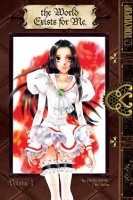
The World Exists for Me, Volume 1The World Exists for Me, Volumes 1-2 written by Be-Papas and illustrated by Chiho Saito. The literal translation of the Japanese title for The World Exists for Me would actually be The World of S and M. Though I’m sure it was intentionally chosen, it’s a rather peculiar title for a rather peculiar manga. Only two volumes were ever published, but I get the feeling that The World Exists for Me was originally conceived of as a much longer work. The ending comes very suddenly and very little, if anything, is actually resolved. The series definitely had some potential–I found its use of time travel, destiny, and historical figures and events to be interesting–but the story never quite pulls together as something particularly coherent. It’s a bit of a mess, really. While it can be enjoyable, it doesn’t really make much sense at all. The World Exists for Me was developed by the same creators involved with the Revolutionary Girl Utena manga. Some similarities can be seen between the two series, but I much prefer Utena.

Filed Under: FEATURES, My Week in Manga Tagged With: Be-Papas, Chiho Saito, manga, Mitsuru Hattori, Sankarea, Satomi Yamagata, Shigeru Mizuki, Showa: A History of Japan, World Exists for Me

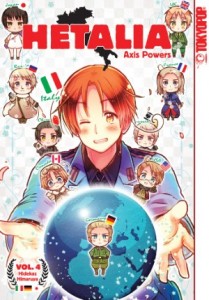
Hetalia Axis Powers, Vols. 4-5

December 15, 2013 by Sean Gaffney

By Hidekaz Himaruya. Released in Japan by Gentosha, originally serialized as an online webcomic, then in Comic Birz. Released in North America by Tokyopop in association with Right Stuf, Inc.

After a long wait, Tokyopop and Right Stuf bring us not one but two volumes of Hetalia just in time for the holidays. As you’d expect, there’s lots of historical in-jokes, wacky 4-koma humor, and stereotypes galore. You’d think that this would get tired eventually, but I’ve found myself enjoying the series even more, especially as the cast has widened from the main eight. Indeed, the back cover of Vol. 4 shows that Himaruya has done his best to add more female countries in order to balance things out – Hungary is a major player, of course, and Ukraine, Belarus, Belgium and Liechtenstein have had substantial roles. But in these two volumes we see Seychelles, Monaco, Vietnam, Taiwan, and even the Principality of Wy, though that last one may drive you to Wikipedia.

hetalia4

There seems to be a return to World War II after the previous volume, with many strips detailing the battles in Africa. These are all done with a light touch, of course, but there are historical facts sprinkled throughout – Italy’s poorly-designed tanks, Germany not realizing how hot Africa would be, and America barreling in ready to win at everything and getting his ass handed to him. There’s also examinations of prior military skirmishes, as Austria is forced to make a very dangerous decision when he’s on the verge of losing the Seven Years war and ask Russia and France to ally with him. And in the “Battle of the Ice”, a young Russia encounters Prussia and realizes that he is far too stupid to be allowed to live.

As you’d expect, there’s a lot of modern-day stuff as well. In fact, we get an alternate universe high school section in both volumes, based on the Hetalia otome game that came out in Japan a while back. Don’t worry, BL fans, Seychelles isn’t the star here. It has our three Axis Powers as the newspaper club, trying to do an article about the various school clubs and finding that almost all of them are eccentric and weird. In the 5th volume, we also get an examination of horror movies in many of the major countries, which vary greatly in mood and scare tactics.

hetalia5

There are two serious chapters in here, and strangely they both involve France, who is normally one of the most flamboyant of the Hetalia cast. In Volume 4 he runs into a young tourist visiting Paris, who is hinted to be a reincarnation of Jeanne D’Arc, France’s lost love. In the 5th, a construction worker meets France, and is somewhat taken aback by the fact that his grandfather had also met him, but France hasn’t aged a day. France has come to terms with it, but the man’s wife points out how sad it would be to never age while you watch your loved ones dying, and for a moment we understand the inner tragedy of what it must be like to be the personification of a country. (Himaruya has stated that Prussia lives on, by the way, first as ‘East Germany’ and now basically just as Prussia in modern times, living in Germany’s basement. I wonder how the nations face the death of a country.)

As long as there is history to be mined, there will still be Hetalia coming out, most likely. We get some development of Netherlands here as well, an amusing look at Southern Italy’s relationship with Spain, China dealing with a rebellious Hong Kong asking for more freedom, and Taiwan attempting to give Vietnam a makeover. There are character profiles which detail each nation’s flag, as well as the reasoning behind the design and colors of that flag. There are cute sidebars explaining weird laws in various countries, and a look at various foods. And we see Hungary forcing Austria to wear cat ears for Belgium’s festival, which satisfies the shipper in me. Those who find the premise rubs them the wrong way won’t want to pick this up, but fans of the series will find lots to love here. Definitely recommended.

Filed Under: REVIEWS

  • « Go to Previous Page
  • Page 1
  • Interim pages omitted …
  • Page 632
  • Page 633
  • Page 634
  • Page 635
  • Page 636
  • Interim pages omitted …
  • Page 1048
  • Go to Next Page »
 | Log in
Copyright © 2010 Manga Bookshelf | Powered by WordPress & the Genesis Framework