• Skip to primary navigation
  • Skip to main content
  • Skip to primary sidebar
  • Home
  • About Us
    • Privacy Policy
    • Comment Policy
    • Disclosures & Disclaimers
  • Resources
    • Links, Essays & Articles
    • Fandomology!
    • CLAMP Directory
    • BlogRoll
  • Features & Columns
    • 3 Things Thursday
    • Adventures in the Key of Shoujo
    • Bit & Blips (game reviews)
    • BL BOOKRACK
    • Bookshelf Briefs
    • Bringing the Drama
    • Comic Conversion
    • Fanservice Friday
    • Going Digital
    • It Came From the Sinosphere
    • License This!
    • Magazine no Mori
    • My Week in Manga
    • OFF THE SHELF
    • Not By Manga Alone
    • PICK OF THE WEEK
    • Subtitles & Sensibility
    • Weekly Shonen Jump Recaps
  • Manga Moveable Feast
    • MMF Full Archive
    • Yun Kouga
    • CLAMP
    • Shojo Beat
    • Osamu Tezuka
    • Sailor Moon
    • Fruits Basket
    • Takehiko Inoue
    • Wild Adapter
    • One Piece
    • After School Nightmare
    • Karakuri Odette
    • Paradise Kiss
    • The Color Trilogy
    • To Terra…
    • Sexy Voice & Robo
  • Browse by Author
    • Sean Gaffney
    • Anna Neatrour
    • Michelle Smith
    • Katherine Dacey
    • MJ
    • Brigid Alverson
    • Travis Anderson
    • Phillip Anthony
    • Derek Bown
    • Jaci Dahlvang
    • Angela Eastman
    • Erica Friedman
    • Sara K.
    • Megan Purdy
    • Emily Snodgrass
    • Nancy Thistlethwaite
    • Eva Volin
    • David Welsh
  • MB Blogs
    • A Case Suitable For Treatment
    • Experiments in Manga
    • MangaBlog
    • The Manga Critic
    • Manga Report
    • Soliloquy in Blue
    • Manga Curmudgeon (archive)

Manga Bookshelf

Discussion, Resources, Roundtables, & Reviews

Blog

Hide and Seek, Vol. 2

June 26, 2015 by Ash Brown

Hide and Seek, Volume 2Creator: Yaya Sakuragi
U.S. publisher: Viz Media
ISBN: 9781421558585
Released: March 2014
Original release: 2013

Hide and Seek is a three-volume boys’ love manga series by Yaya Sakuragi. The manga is a direct spinoff of another of Sakuragi’s boys’ love series, Bond of Dreams, Bond of Love, which is itself tangentially related to her series Tea for Two. All three series can be read and enjoyed separately from one another, but there are some shared characters and references. Both Bond of Dreams, Bond of Love and Hide and Seek were licensed and released in English by Sublime Manga, the boys’ love imprint associated with Viz Media. (Tea for Two was published by Tokyopop’s Blu Manga imprint back in the day.) Hide and Seek, Volume 2 was originally released in Japan in 2013 while the English-language edition was released in 2014. I began following Sakuragi’s work in translation after encountering her boys’ love one-shot Hey, Sensei?. I’ve continued to enjoy and read her manga, but I find Hide and Seek to be particularly good.

It was supposed to be a simple fling, an uncomplicated relationship to enjoyably pass the time with no expectations that it would develop into something more serious. Except that Shuji, who generally isn’t interested in other men, is falling more and more for the young neighborhood doctor Saji. Though he’s slow to admit that he’s in love, Shuji can’t deny the jealously he experiences when he sees another man kiss Saji. Those feelings intensify when he discovers that the man, Yuki, used to date Saji and due to various unfortunate circumstances is currently staying at the doctors’ home. Saji picks up on some of that jealousy, but he has already resigned himself to a fleeting relationship with Shuji. He would certainly be interested in a more devoted partnership, but he’s been burned so many times in the past that he’s trying no to get his hopes up. And with neither man being completely honest with the other about his feelings, any sort of relationship will be difficult to maintain.
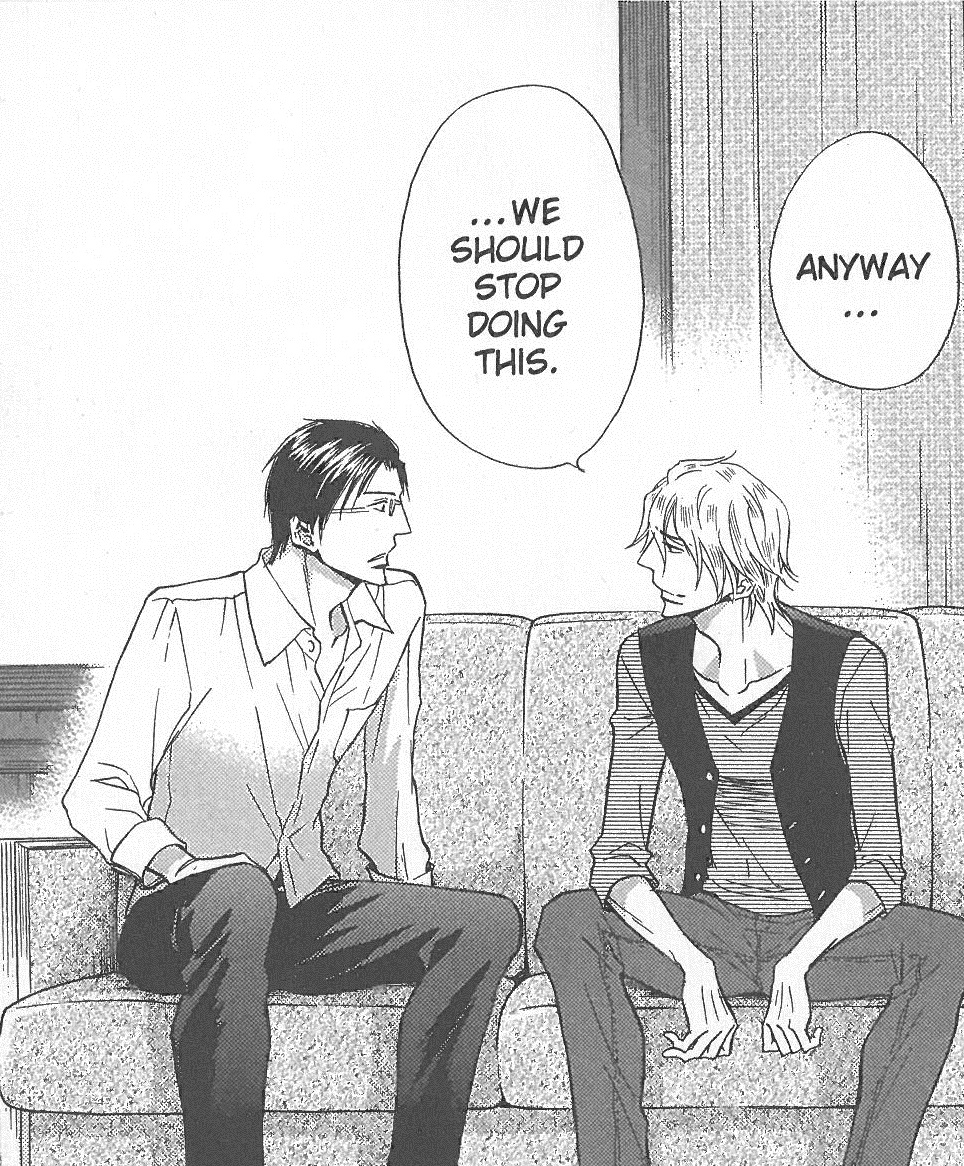
Hide and Seek, Volume 2, page 107While Hide and Seek definitely has its humorous moments, overall it tends to be a much more serious, and to some extent much more realistic, manga than its immediate predecessor Bond of Dreams, Bond of Love ever was. Likewise, Shuji, the main connecting character between the two series, is significantly more developed and complex in Hide and Seek. Although at heart he hasn’t really changed much from who he was in Bond of Dreams, Bond of Love, in part due to the tone of Hide and Seek his character has now become convincingly believable instead of being intentionally comedic and shallow. Shuji amused me greatly in Bond of Dreams, Bond of Love, but I really like Hide and Seek‘s more nuanced version of him. He is much more considerate and much less self-centered than his outward demeanor would initially lead one to assume (as well a more responsible and mature), and he’s honestly concerned for the well-being of those he cares most about, including Saji.

Overall, the characterization in Hide and Seek is excellent, particularly that of Shuji, but Saji is also a realistically complicated individual. I’ve enjoyed watching their relationship evolve and develop over the course of Hide and Seek and look forward to seeing how things turn out for them in the final volume. Shuji and Saji’s relationship isn’t in danger because they’re incompatible. In fact, the two men are surprisingly well-suited for each other. It’s actually because they care so much for each other and are trying not to force their feelings on, take advantage of, or hurt the other person that their relationship has the potential to dissolve. Although they do misinterpret the meaning and motivations behind some of each others’ words and actions, and make some inaccurate assumptions as a result, Shuji and Saji do communicate with each other, something that is absolutely critical for any relationship to succeed. Granted, they still need to learn to open up to each other a little more if they’re going to make things work in the long-term.

Filed Under: REVIEWS Tagged With: Hide and Seek, manga, Sublime Manga, viz media, Yaya Sakuragi

Manga the Week of 7/1

June 26, 2015 by Sean Gaffney, Ash Brown, Michelle Smith, Anna N and MJ Leave a Comment

SEAN: Since next week is a light week (despite being July 1st, it doesn’t count as a first week of July), I thought I’d do the manga in reverse order. And hey, coincidentally, that makes the image line up properly, too! Funny, that.

So we start with Vertical, who have the 5th volume of fanservice and ladies being awesome fantasy Witchcraft Works.

ASH: I’m a bit behind in this series, but I did enjoy the first few volumes.

SEAN: Seven Seas finally have a 7th volume of Toradora! for us (blame Japan, the series comes out very slowly over there), which resolves the horrible cliffhanger from… February 2014. Ah, the joys of monthly series that are caught up. I’ve reviewed it here.

nnb1

The Seven Seas debut this week is Non Non Biyori, a sweet city-girl meets countryside story that I’ve heard described as Higurashi without all the murder and conspiracy, and seemingly light on fanservice. I’m looking forward to this a great deal.

MICHELLE: Hmm.

ASH: I know quite a few people looking forward to this manga.

ANNA: I don’t know. I will wait and see what the early reviewers say about this one.

MJ: Also “Hmm.”

SEAN: And there can’t be a month going by without an Alice in the Country of Hearts, this one a short story collection called Junk Box.

ANNA: I really liked the first Alice series and have just resigned myself to the fact that the spin-offs are not going to be as good as the main series.

SEAN: Attack on Titan is such a big seller for Kodansha that even the non-fiction books are getting licensed (almost unheard of after a few character guides bombed over here). This one is The Science of Attack on Titan. The author apparently specializes in looking at fantasy worlds and figuring out how they would work. Also, vampi—I mean, Titans!

ASH: Attack on Titan is the only series that has been able to convince Kodansha to break its “manga only” rule.

SEAN: And we have the third and final volume of Maria the Virgin Witch. There’s a one-shot collection of side stories in Japan, but I’m not sure Kodansha has picked that up.

ASH: Kodansha has! Exhibition is currently scheduled to be released in August.

SEAN: Finally, there’s the 9th Lone Wolf & Cub omnibus from Dark Horse, who curse the fact that I’m not starting with them as always.

Did reversing this make something stand out more for you?

MICHELLE: Alas, no. Just one thing to anticipate your review of!

ASH: Reversing the order made me realize that there was an actual order…

ANNA: I’m happy that this week is so light, because maybe I can catch up on my stacks and stacks of unread manga.

MJ: I can do nothing but be miffed on Lone Wolf and Cub’s behalf.

Filed Under: FEATURES, manga the week of

Toradora!, Vol. 7

June 25, 2015 by Sean Gaffney

By Yuyuko Takemiya and Zekkyo. Released in Japan by ASCII Media Works, serialization ongoing in the magazine Dengeki Daioh. Released in North America by Seven Seas.

I’ve frequently heard companies asked why they don’t get closer to Japanese release dates, and why they think ‘caught up with Japan’ means still being one or two volumes behind. Well, Toradora! is an excellent answer in and of itself. Here is a series where we are definitively caught up. The manga came out in Japan in February, and SS has it out at the end of June. That’s an amazing turnaround. But Volume 6 came out in February 2014, and given that the 8th volume is not remotely close to being out in Japan, we could be looking at Fall 2016 to resolve the plot points this volume introduces. It’s hard to keep a fanbase with 16-month breaks between releases. Especially with the anime long done, and the light novels all fan translated – and also done.

toradora7

And this is a shame, as the manga adaptation is really excellent. We resolve the tortuous cliffhanger from last time, with Taiga’s father being the worst man ever. I was particularly happy that my critique of Minori from last volume was called out… by Minori herself, who admitted she didn’t tell Ryuuji about Taiga’s father as she was jealous that she wasn’t Taiga’s first choice for comfort. (The OT3, always strong on this title, was particularly strong here, particularly given the results of the footrace to be King of the School). As for Taiga’s dad, his end seems oddly fitting – after we realize what he’s really like, he’s simply forgotten about.

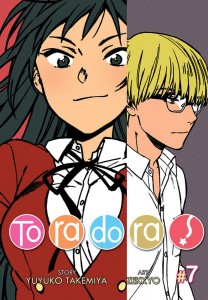
The rest of the book begins to adapt the 6th light novel, meaning we’re finally past the halfway mark of the series. The strong, confident woman on the cover would be Kanou, the queen of the school and class president, who I’m sure we’ll get to know better soon, but for the moment seems to be a bit cold and harsh. The other mysterious boy on the cover is, surprise, Kitamura, who has a complete breakdown on learning Kanou is transferring overseas in a week, and it leads him to pointlessly “rebel” by dyeing his hair blond. Kitamura has shown occasional hidden depths throughout the series, but this is the first time we’re really seeing what makes him tick – unsurprisingly, like the rest of the cast, he has a lot of internalized issues he avoids.

As for the rest of the volume, it’s exactly what you would want from Toradora!. There’s a lot of hysterical comedy, much of it involving Ami. There’s many heartwarming and tearjerking moments, such as seeing Taiga beat herself up when she realized that Kitamura is suffering and she hadn’t seen it. There’s also a reminder that our lead couple are in fact still supposed to be in love with other people – the rumor that Taiga and Kitamura are dating both angers and delights her, and Ryuuji and Minori have never felt closer. Not that anyone suspects this title will end – whenever it does end, possibly in 12 years time – with anyone but Ryuuji and Taiga. For a title that is theoretically a harem manga, it’s the sort of harem manga you could happily introduce to your parents, so to speak. Pickup this volume and remind yourself why it’s great.

Filed Under: REVIEWS

Manga Giveaway: Assassination Classroom Giveaway

June 24, 2015 by Ash Brown

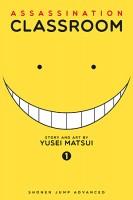
The end of June draws near, which means the end of the first half of the year is quickly approaching, too. It also means that it’s time for another giveaway at Experiments in Manga! Most schools are now out for the summer (at least in the United States), but we mustn’t forget all of those hardworking teachers. And so, this month’s giveaway is for Yusei Matsui’s Assassination Classroom, Volume 1 as published in English by Viz Media. As always, the giveaway is open worldwide!

Assassination Classroom, Volume 1

Considering the sheer number of manga translated into English that are based in a school setting, relatively few seem to grant more than a passing acknowledgement of the teachers. Sometimes they aren’t even included in the story at all or barely make an appearance beyond the background. But occasionally teachers are actually given a prominent role. Assassination Classroom is a series that stands out for that very reason (among many other reasons). Great Teacher Onizuka, the first series that I read in which a teacher was a lead character, is another manga that immediately leaps to mind. There’s S.S. Astro: Asashio Sogo Teachers’ Room, too, but I can’t think of very many other examples off the top of my head that are available in English.

(Okay, I will admit right now that there are plenty of hentai and boys’ love manga that feature teachers, but those particular stories really weren’t the ones that I had in mind…)

So, you may be wondering, how can you win a copy of Assassination Classroom, Volume 1

1) In the comments below, tell me a little about your favorite teacher from a manga. (Never noticed a teacher in your reading? Simply mention that.)
2) If you’re on Twitter, you can earn a bonus entry by tweeting, or retweeting, about the contest. Make sure to include a link to this post and @PhoenixTerran (that’s me).

There you have it! Each person can earn up to two entries for this giveaway. You have one week to submit comments. If you have trouble with the comment form, or if you prefer, entries can also be sent to me via email at phoenixterran(at)gmail(dot)com. The comments will then be posted here in your name. The giveaway winner will be randomly selected and announced on July 1, 2015. Best of luck to you all!

VERY IMPORTANT: Include some way that I can contact you. This can be an e-mail address in the comment form, a link to your website, Twitter username, or whatever. If I can’t figure out how to get a hold of you and you win, I’ll just draw another name.

Contest winner announced–Manga Giveaway: Assassination Classroom Giveaway Winner

Filed Under: FEATURES, Giveaways Tagged With: assassination classroom, manga, Yusei Matsui

Pick of the Week: Vampires, Corpses, Gundam oh my!

June 23, 2015 by Anna N, Sean Gaffney, Ash Brown and Michelle Smith 1 Comment

A manga that does not have Char Aznable in it.
SEAN: There’s so much coming out this week that I’m sure I won’t be able to easily choose what I’ll be… yeah, OK, it’s Kurosagi Corpse Delivery Service. I hate being predictable, but come on, of COURSE it is.

MICHELLE: Aya Shouoto’s He’s My Only Vampire was a pleasant surprise for me, as it’s quite a lot better than her other title currently being released (Kiss of the Rose Princess). I look forward to seeing what volume three brings.

ASH: Hmmm, there really are quite a few manga that I’m interested in that are being released this week, but I’m with Sean in picking Kurosagi Corpse Delivery Service. It’s a great series, and who knows when we’ll actually be able to pick it again?

ANNA: I feel like any appearance of Gundam: The Origin deserves a celebration, so that is my pick!

Which manga featuring Char Aznable is your favorite for the week?

Filed Under: PICK OF THE WEEK

Summer Reading and a Tokyopop Teaser

June 23, 2015 by Brigid Alverson

The next volume of Attack on Titan isn’t out till August—what do you read in the meantime? At the Barnes & Noble blog I suggest some manga that offer many of the same pleasures as Attack on Titan as well as a roundup of June releases.

Tokyopop is “evolving,” although it’s not clear what that means. In a blog post on the Tokyopop site, CEO Stu Levy writes cryptically about “rebuilding” Tokyopop in a different form; more concretely, they will have panels at Anime Expo and San Diego, so something may be afoot.

Udon has licensed the manga adaptation of the Persona4 game.

Shonen Jump will publish a short story by American creators Bikkuri and rem in this week’s issue; the story, “Folie À Deux,” was published on the Shonen Jump + app in Japan. Bikkuri and rem were the winners of the 2007 Morning International Manga Competition, and rem is the illustrator of Yen Press’s adaptation of Gail Carriger’s Soulless.

Vol. 70 of Naruto tops the New York Times manga best-seller list, with the latest volume of Deadman Wonderland coming in at number two.

The Seven Seas folks explain why it’s not a good idea to wait till the end of a series to buy all the volumes:

Due to reader attrition, sales drop off after each volume is released–this is a natural thing for almost any series. Unfortunately, due to smaller sales with each passing volume, vendors/retailers order less. When they order less, we print less. It’s a classic case of supply-and-demand.

At Contemporary Japanese Literature, Kathryn Hemmann writes about how shoujo manga has changed the American comics scene, in terms of both the comics we read and the way we read them.

Tony Yao writes about fandom and shipping in the context of Kiss Him, Not Me.

Scott Green rounds up some artists’ tributes to JoJo’s Bizarre Adventure: Stardust Memories, including a CLAMP doujinshi.

News from Japan: Kodasha’s Shonen Magazine will run a one-shot prequel to the Avengers: Age of Ultron movie in its 31st issue. Moviegoers who see Boruto: Naruto the Movie in theaters in August will get a special booklet with a new one-shot story by Masashi Kishimoto, as well as the final chapter of Naruto in full color. Inio Asano is taking a break from his current series, Dead Dead Demon’s Dededededestruction, which runs in Big Comic Spirits; it will be back at the end of August. Shueisha has posted an entire issue of Shonen Jump for free on its app: Issue #34 from 1997, which launched One Piece. Unfortunately, it seems to be only available in Japan. It looks like Hiromu Arakawa’s Silver Spoon will be coming to an end shortly.

Reviews: Ash Brown recounts a week’s worth of manga reading at Experiments in Manga.

Leroy Douresseaux on vol. 4 of Black Rose Alice (The Comic Book Bin)
A Library Girl on Cold Sleep (A Library Girl’s Familiar Diversions)
AstroNerdBoy on vol. 46 of Fairy Tail (AstroNerdBoy’s Anime and Manga Blog)
Ken H on Fragments of Horror (Sequential Ink)
Sakura Eries on vol. 18 of Goong (The Fandom Post)
Matthew Warner on vol. 7 of Inu x Boku SS (The Fandom Post)
Sakura Eries on vol. 3 of My Love Story!! (The Fandom Post)
Leroy Douresseaux on vol. 9 of Nisekoi: False Love (The Comic Book Bin)
Sean Gaffney on vol. 1 of Tokyo Ghoul (A Case Suitable for Treatment)
Kate O’Neil on vol. 9 of Until Death Do Us Part (The Fandom Post)

Filed Under: MANGABLOG

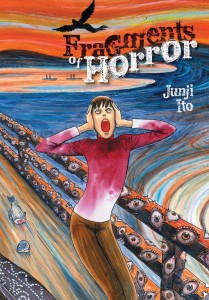
Fragments of Horror

June 23, 2015 by Sean Gaffney

By Junji Ito. Released in Japan by Asahi Shinbunsha, serialized in the magazines Nemuki+ and Shinkan. Released in North America by Viz.

I’ve never read Junji Ito before this volume, believe it or not. I used to say it’s because I don’t like horror, but I think we know that’s pretty much a lie. The truth is that I like horror if I can find an in, such as the characters and humor (Kurosagi CDS), the promise of a happy ending for these sweet kids (Higurashi), and seeing a well-crafted cast be horrible to each other (Umineko). So I never really thought about reading Uzumaki and Gyo. Reading this, though, I can see the appeal – the stories are not so much scary as unnerving, and while I didn’t feel particularly frightened as I read the book, I got more unnerved as I went along, and it sticks with you long after you put it down.

fragments

In an afterword, Ito talks about the fact that he hadn’t done a short story collection in a while, and feels the first one was rather weak. I’m inclined to agree with him, it’s the weakest in the book. In fact, the book almost succeeds in having each story be better than the previous one, though I think its peak for sheer disturbing is Blackbird, the tale of an injured hiker and the creature who helps him survive. And I will admit, there is some grotesque humor to be found here as well, from the woman who loves the house she’s boarding in – literally – to the entirely of Magami Nanakuse, which seems to combine grotesque horror and stand-up comedy in a way I can’t quite explain. Those expecting your typical American slasher story… or even Japanese titles like Ringu… are going to be startled, as this isn’t much like those.

It helps that Ito’s style of drawing faces and expressions hearkens back to a 1980s style rather than the more modern or cute manga styles we see today. Actually, a lot of his work reminded me of Makoto Kobayashi, author of What’s Michael and Club 9, who also enjoyed drawing long-faced, highly expressive men and women doing very, very silly things. I can also see fans of Furuya Usumaru liking this as well – the cover art is very reminiscent of one of his “Short Cuts” collages.

It’s hard to review a short story anthology without giving everything away, but I will note there were a few stories that went more for the melancholy than the creepy. Gentle Goodbye was sweet and sad, and makes you wonder what a world where this is possible would be like. It also has the most likeable viewpoint character of the series. And Whispering Woman was sad in a different, more sinister way, as we see someone desperately trying to deal with an abusive relationship, with tragic results. But really, the best thing to say about this collection is that I think even non-horror fans would get something out of it, though I’d certainly keep it away from young children (there’s also some nudity here, mostly in the story Wooden Spirit). Ito is a master, this book shows you why.

Filed Under: REVIEWS

My Week in Manga: June 15-June 21, 2015

June 22, 2015 by Ash Brown

 My News and Reviews

I was on vacation last week, much of which was spent in the middle of the woods in the middle of Ohio camping with my family. This meant I had very little Internet access. But even so, I did manage to post two reviews last week. My monthly horror manga review project continued with a review of After School Nightmare, Volume 4 by Setona Mizushiro. This was the first volume in the series that I hadn’t previously read before embarking on the review project. The second review was of Satoshi Wagahara’s prize-winning light novel The Devil Is a Part-Timer!, Volume 1 which is very amusing and silly. But, having watched the anime series last year, I already knew that.

As previously mentioned, I was occupied with other things last week, so I probably missed out on all sorts of interesting reading, news, and announcements. However, there were a few things that came across my radar before I left for Ohio. Kathryn Hemmann at Contemporary Japanese Literature wrote about The Cultural Cross Pollination of Shōjo Manga. And speaking of shōjo manga, Digital Manga’s most recent Tezuka Kickstarter is aiming to publish Storm Fairy. (The project also aims to reprint Unico with better image and color quality, which makes me wonder why Digital Manga didn’t do that for the first printing, but I’ve given up trying to understand Digital Manga’s decision making.) Finally, Udon Entertainment announced a new manga license: Shuji Sogabe’s adaptation of Persona 4.

Quick Takes

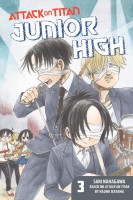
Attack on Titan: Junior High, Omnibus 3Attack on Titan: Junior High, Omnibus 3 (equivalent to Volumes 5-6) by Saki Nakagawa. Out of all the various Attack on Titan spinoffs, Junior High is the one that probably has the smallest audience overall and is the one that is the most uneven for me specifically. Sometimes the manga can be a slog to get through, but sometimes it’s absolutely hilarious. At its best, Junior High can actually make me laugh out loud; I keep reading the series for those moments because when Junior High is funny, it is very funny. The manga continues to be a very weird mix of Attack on Titan and a generic school setting with all of the standard tropes that that entails. Sometimes the combination works better than others. This particular omnibus features the school culture festival, a battle of the bands, eating contests and cooking competitions, club activities, lots of cleaning, and school rivalries among other things. I was very pleased to see that characters and storylines from other Attack on Titan spinoffs like No Regrets are now being incorporated into Junior High as well.

Lies Are a Gentleman's Manners, Volume 1Lies Are a Gentleman’s Manners by Marta Matsuo. Since for whatever reason Digital Manga often seems to be hesitant to include “Volume 1” in the title of a new manga, I didn’t initially realize that Lies Are a Gentleman’s Manners is actually an ongoing series in Japan. The first volume stands well enough on its own, but I do hope that any subsequent volumes will be licensed as well. Despite the fact that neither of the leads in this boys’ love manga are particularly likeable—Jonathan, an unscrupulous medical student selling drugs to his fellow classmates, and Paul, his equally unscrupulous (and married) college professor who uses that fact to blackmail him into a relationship—I actually do want to read more. Though some of the situations are unquestionably unsavory, the manga can also be very funny and even sexy on occasion. One of the most interesting things about Lies Are a Gentleman’s Manners is its setting. The manga takes place on America’s modern East Coast among the country’s wealthy, aristocratic upper class. While certainly a fictional representation, some of the social dynamics ring true.

TowerkindTowerkind by Kat Verhoeven. Originally self-published as a series of mini-comics, Towerkind was recently collected and released by Conundrum Press in a single volume. I was not previously familiar with Verhoeven’s work; Towerkind was a TCAF-inspired impulse buy. I’m very glad that I picked it up though because I’m loving this comic to pieces. Towerkind certainly won’t be to everyone’s liking, but there’s just something about the comic that I find oddly compelling. It’s surreal, strange, chilling, and ominous. Verhoeven effectively uses a small format to create a claustrophobic atmosphere that emphasizes the feeling of impending doom experienced by the characters. The volume opens with a foreword by Georgia Webber explaining the importance of the backdrop of Towerkind—Toronto’s first vertical neighborhood of high-rise apartments St. James Town—which helps to set the stage and tone for the comic itself. Towerkind follows a group of children gifted with unexplainable supernatural abilities who live in the towers of St. James Town while what may be the end of the world approaches.

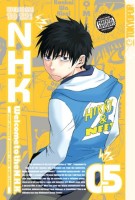
Welcome to the N.H.K., Volume 5Welcome to the N.H.K., Volumes 5-8 by Kendi Oiwa. Having already read the original Welcome to the N.H.K. novel by Tatsuhiko Takimoto and having already seen the Welcome to the N.H.K. anime series (which, it turns out, was based on both the novel and Oiwa’s manga adaptation), I am already quite familiar with the story and characters Welcome to the N.H.K., but I somehow managed to forget just how dark and hard-hitting it can be. Ostensibly Welcome to the N.H.K. is a comedy, and it can be quite funny in a painful sort of way, but it deals with some pretty heavy subject matter including (but not limited to) drug use, self-harm, suicide, and mental illness. The second half of the series, while at times outrageous, tends to fall on the more serious side of things. Although I’ve always considered Welcome to the N.H.K. to be Satou’s story, the manga also places particular emphasis on Misaki’s story. It’s been a while since I’ve read or watched them, but I believe the manga actually has a unique ending that’s different from both the novel and the anime. All three version of Welcome to the N.H.K. are very good.

Filed Under: FEATURES, My Week in Manga Tagged With: attack on titan, comics, Kat Verhoeven, Kendi Oiwa, Lies Are a Gentleman's Manners, manga, marta Matsuo, Saki Nakagawa, Welcome to the N.H.K.

Tokyo Ghoul, Vol. 1

June 21, 2015 by Sean Gaffney

By Sui Ishida. Released in Japan by Shueisha, serialized in the magazine Weekly Young Jump. Released in North America by Viz.

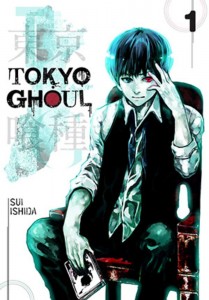
I am highly amused at the cover art for the first volume of this series, designed to draw in readers. It shows our hero, Kaneki, posing artfully on a chair, shirt untucked and collar undone, a hand to his head, a glowing red eye sdtaring at the reader, and a small fake-looking smile on his face. It is a look that says “Ladies, I am undead and hot. Please read my story.” It does not bear any resemblance whatsoever to Kaneki in this entire first volume, who from the moment he is attacked by a ghoul is in a state of panic, hunger or guilt. But then seeing him crying and creaming on the cover wouldn’t give the manga the right image. And while I think it’s a decent start, this manga does seem to be more about looking cool than plot and characters.

ghoul1

The premise is simple and easy to understand. Our hero is a bit of a nerd with a crush on a gorgeous girl who reads the same erudite horror novels he does. On their first date, however, he discovers she is a ghoul out to kill him and eat his flesh. Fortuitously, she is killed by a passing act of God – or possibly some I-beams to the head – and he survives, albeit on the brink of death. The doctor, wanting to save his life and having a convenient corpse handy, replaces some of his organs with those of the ghoul. Thus when he wakes he finds himself a hybrid, not human or ghoul… but still craving the taste of human flesh.

There is some horror here, rest assured, but I’d say it’s far more of a thriller than a horror series, like most of the current zombie genre. I will admit to one pleasant surprise in this first volume. We see a young woman with her hair draped over one eye, who was giving our hero and his love interest/ghoul the stink-eye early on. I was fairly certain he would end up being rescued by her, and that she would turn out to be a ghoul hunter or somesuch, showing him their dark organization and asking if he wants to destroy ghouls with them. Totally wrong, in fact. In fact, Touka is also a ghoul, and the dark organization she belongs to is basically a ghoul halfway house, dedicated to allowing them to live relatively safely without becoming serial killers, like Kaneki’s crush turned out to be. She also (supposedly) wants nothing to do with Kaneki. I’m sure that will change.

This is a solid first volume. The villains we do meet are nicely nasty, and it’s nice to see a damsel in distress be male for once. That said, I didn’t really find much here that would make me want to read past the first volume. If I’m going to be reading horror, I’d like a bit more humor – this is a Very Serious title – or a bit more complexity, a la Umineko. But for those who enjoy zombies – pardon me, ghouls – and action thrillers with seemingly high body counts, you’ll get a kick out of Tokyo Ghoul.

Filed Under: REVIEWS

The Devil Is a Part-Timer!, Vol. 1

June 19, 2015 by Ash Brown

The Devil Is a Part-Timer, Volume 1Author: Satoshi Wagahara
Illustrator: 029

Translator: Kevin Gifford
U.S. publisher: Yen Press
ISBN: 9780316383127
Released: April 2015
Original release: 2011
Awards: Dengeki Novel Prize

The Devil Is a Part-Timer! began in 2011 as a light novel series written by Satoshi Wagahara with illustrations by 029, but it has since expanded to include an anime adaptation and multiple manga series as well. I was actually introduced to The Devil Is a Part-Timer! through the 2013 anime series directed by Naoto Hosoda. I rather enjoyed it and so when Yen Press licensed not only the manga but the orignal light novel series of The Devil Is a Part-Timer!, it caught my attention. I was particularly interested in reading the anime’s source material, currently an ongoing series of novels at fourteen volumes in Japan. The Devil Is a Part-Timer!, Volume 1, which earned Wagahara a Silver Dengeki Novel Prize, was released in English in 2015 under Yen Press’ new light novel imprint Yen On with a translation by Kevin Gifford. The volume also includes color pages and an end-of-book bonus—character files in the form of a collection of resumes.

Satan, the Devil King, had one simple goal: to conquer Ente Isla and subjugate the humans there who manage to survive the invasion of his forces. All was going well until the Hero made her appearance on the battlefield. Emilia throws the Devil King’s plans into disarray and Satan is forced to make a hasty retreat along with Alciel, his strategist and one of the Four Great Demon Generals. Unintentionally, they end up in the parallel world of modern-day Japan with no immediate way back to Ente Isla. Emilia isn’t far behind them, which only causes another set of problems to deal with. Until they can return to their own world, Satan, now known as Maou, and Alciel, now known as Ashiya, must survive in this one as humans with very little access to their demonic powers. But then Maou secures a job as a part-timer at a fast food joint. He’s convinced that this will be the first step in conquering Japan, the world, and (assuming they can figure out how to get home) Ente Isla.

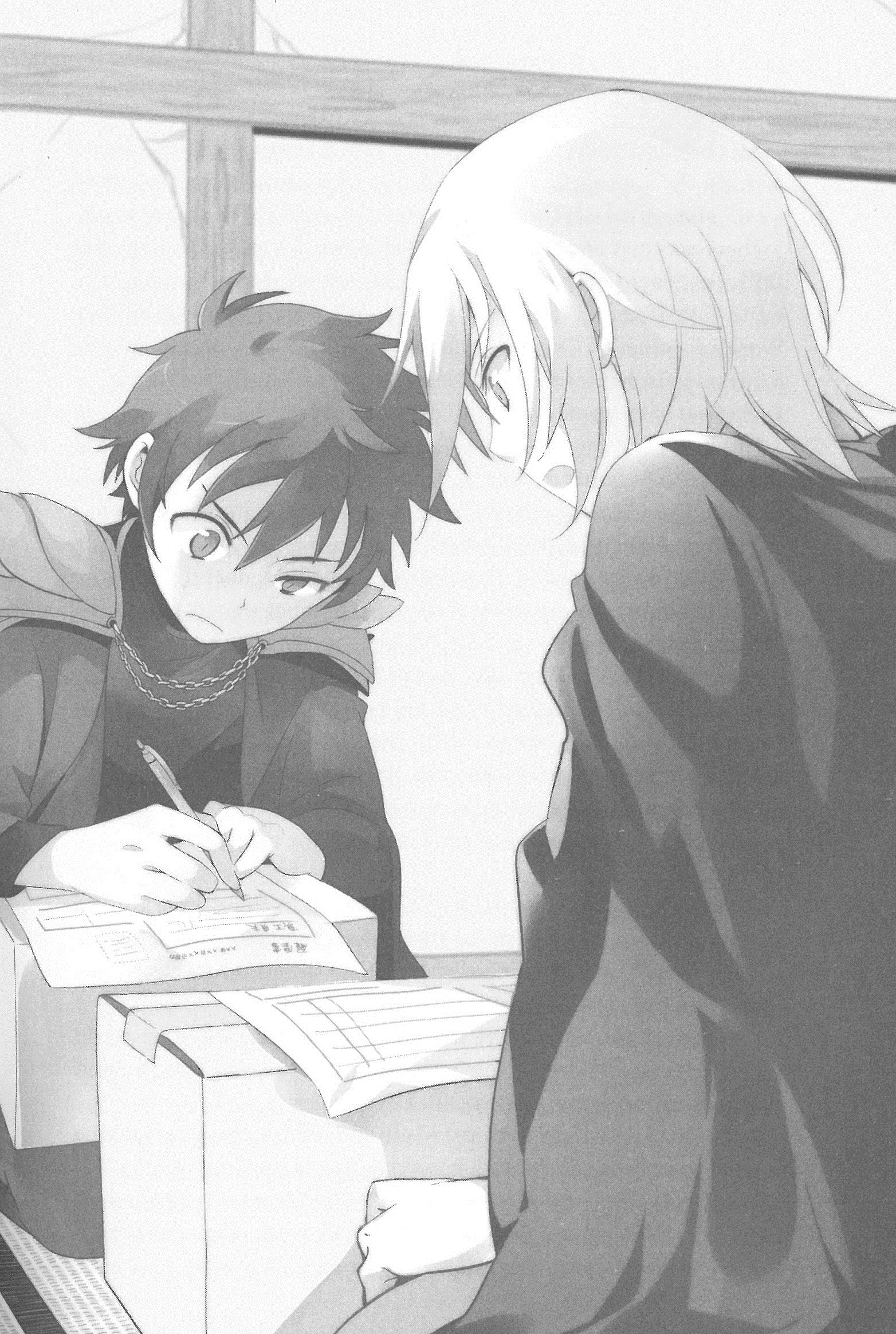
The Devil Is a Part-Timer, Volume 1, page 21The first volume of The Devil Is a Part-Timer! and at least some if not all of the second were adapted as part of the anime series, so there were no real surprises for me plot-wise reading it. The novel does include a few more worldbuilding and character details, but for the most part the anime was a very straightforward, routine interpretation of Wagahara’s orignal story. The writing in The Devil Is a Part-Timer! isn’t particularly flashy, stylish, or clever—it’s more functional than anything else—but all of the characters have their own ways of speaking and expressing themselves. It’s immediately apparent who’s responsible for any given line of dialogue because they each have a unique, individual voice. As for the plot, it’s intentionally ridiculous and absurd, which to some extent is what makes The Devil Is a Part-Timer! entertaining. Admittedly, it sometimes doesn’t make a whole lot of logical sense, and there seem to be a few potential plot holes left for Wagahara to address as well, but the novel can still be legitimately fun. High literature it certainly isn’t, though, something that both Wagahara and the characters are well-aware of; the story developments in The Devil Is a Part-Timer!, Volume 1 are repeatedly compared to those of a B movie.

Very little of The Devil Is a Part Timer!, Volume 1 has much to do with magic or mayhem. Eventually Wagahara builds up to it for the volume’s finale, but for the most part the novel is surprisingly mundane. In the end, the crises that Maou is most concerned about is the possibility of being late for work. It seems likely that Maou and Ashiya’s personalities have significantly changed along with the changes in their physical forms. But then the humor in The Devil Is a Part-Timer! is largely derived from the characters being not at all who one would assume them to be and behaving in ways that are stunningly ordinary, especially considering their epic origins. Occasionally they do recall their quests—the demons’ goal to take over Ente Isla and Emilia’s desire to destroy Satan and his cohorts—but overall Maou appears to be content in his new-found work, Ashiya has come to accept his role of househusband, and even Emi has made a nice life for herself in Japan. Ultimately that’s what makes The Devil Is a Part-Timer so amusing, the complete mismatch between the characters as they are and the expectations of who they should be.

Filed Under: REVIEWS Tagged With: 029, Dengeki Novel Prize, Devil Is a Part-Timer, Light Novels, Novels, Satoshi Wagahara, Yen On, yen press

  • « Go to Previous Page
  • Page 1
  • Interim pages omitted …
  • Page 539
  • Page 540
  • Page 541
  • Page 542
  • Page 543
  • Interim pages omitted …
  • Page 1049
  • Go to Next Page »
 | Log in
Copyright © 2010 Manga Bookshelf | Powered by WordPress & the Genesis Framework