• Skip to primary navigation
  • Skip to main content
  • Skip to primary sidebar
  • Home
  • About Us
    • Privacy Policy
    • Comment Policy
    • Disclosures & Disclaimers
  • Resources
    • Links, Essays & Articles
    • Fandomology!
    • CLAMP Directory
    • BlogRoll
  • Features & Columns
    • 3 Things Thursday
    • Adventures in the Key of Shoujo
    • Bit & Blips (game reviews)
    • BL BOOKRACK
    • Bookshelf Briefs
    • Bringing the Drama
    • Comic Conversion
    • Fanservice Friday
    • Going Digital
    • It Came From the Sinosphere
    • License This!
    • Magazine no Mori
    • My Week in Manga
    • OFF THE SHELF
    • Not By Manga Alone
    • PICK OF THE WEEK
    • Subtitles & Sensibility
    • Weekly Shonen Jump Recaps
  • Manga Moveable Feast
    • MMF Full Archive
    • Yun Kouga
    • CLAMP
    • Shojo Beat
    • Osamu Tezuka
    • Sailor Moon
    • Fruits Basket
    • Takehiko Inoue
    • Wild Adapter
    • One Piece
    • After School Nightmare
    • Karakuri Odette
    • Paradise Kiss
    • The Color Trilogy
    • To Terra…
    • Sexy Voice & Robo
  • Browse by Author
    • Sean Gaffney
    • Anna Neatrour
    • Michelle Smith
    • Katherine Dacey
    • MJ
    • Brigid Alverson
    • Travis Anderson
    • Phillip Anthony
    • Derek Bown
    • Jaci Dahlvang
    • Angela Eastman
    • Erica Friedman
    • Sara K.
    • Megan Purdy
    • Emily Snodgrass
    • Nancy Thistlethwaite
    • Eva Volin
    • David Welsh
  • MB Blogs
    • A Case Suitable For Treatment
    • Experiments in Manga
    • MangaBlog
    • The Manga Critic
    • Manga Report
    • Soliloquy in Blue
    • Manga Curmudgeon (archive)

Manga Bookshelf

Discussion, Resources, Roundtables, & Reviews

Blog

No Game No Life, Vol. 5

December 28, 2016 by Sean Gaffney

By Yuu Kamiya. Released in Japan by Media Factory. Released in North America by Yen On. Translated by Daniel Komen.

I was not quite as grumpy with this volume of No Game No Life as I was the previous one, despite the fact that it has many of the same problems. It could be that it had more interesting things happen – one fight takes up well over a third of the book – or that the denouement of the Siren thing was slightly amusing, which it was – emphasis on slightly. I suspect, however, that the main reason is that this volume was delayed and delayed and then delayed again, to the point where it now hits nine months after the last. Does absence make the heart grow fonder? More likely I was able to settle in after having forgotten literally everything about the last book, and it took a while to recall. The publisher may have figured this out as well – Vol. 6 has already been delayed a month or two as well.

I’ll start my mentioning what I didn’t care for, and then move on to what I enjoyed. As I observed in the previous volume, Sora and Shiro’s development continues to annoy me, mostly as the author has seemingly forgotten that the dichotomy between “invincible gamers” and “social incompetents” was what made them so fascinating. Here, as in Book 4, they almost never have a breakdown or completely lose it. Part of that is the nature of the game they’re playing in the first half – it requires them to be touching, basically, as they have to function as a pair of wings. But I suspect it’s more that the author just enjoys writing them as smug winners. We do get a little bit more time in their heads this volume, which is both good (Sora) and bad (Shiro’s incestuous feelings).

There’s also the resolution of the Dhampir/Siren plot, which was all right, but I wish more had been done to overcome the “Sirens are bimbos” stereotype. As it turns out the way to solve the riddle and wake the princess is simply not to do what she asks for – if you’re an unattainable love that she can never have, you win. Naturally, this is done with a lot of mental and emotional abuse, supposedly justified because she was so annoying, really. And then there’s Plum, whose surprise reveal wasn’t much of one, but whose other revelation – being a secret mastermind manipulating things – worked much better.

And then there’s Steph, who remains the main reason that I’m reading these books. I sympathize with her over the top suffering, of course, but more to the point, she’s developing more and more into a leader and keen observer every book, and people are starting to take notice – particularly Izuna, who is able to get past her verbal tic to realize that Stephanie is not as dumb as she thinks she is, or Sora and Shiro make her out to be. Of course, in the long run, I suspect this is shaping up for Stephanie to rule over everyone once Sora and Shiro win the game. I also liked the backstory with the Flugel race, and how imagination, curiosity, and the desire to create are what they desperately needed – but only Jibril had. There’s hints of some intriguing backstory, which I’d like to see more of.

So overall a mixed bag, and I think those who have been grumpy about this release won’t stop being so. But it’s still worth a read if you can tolerate twinked-out protagonists and their slangey dialogue.

Filed Under: REVIEWS

Yona of the Dawn Volume 3

December 27, 2016 by Anna N

Given my general tendency of loving fantasy shoujo series, it is no surprise that I’m thoroughly enjoying Yona of the Dawn. In the last volume Yona and her trusty guard Hak have a narrow escape from her pursuers and end up being cared for by a long-lost priest. I think pacing can be so essential for a good fantasy series. A more rushed storyline doesn’t fit in all the world building that is needed to make a series seem believable for the reader. Yona gets to know her rescuers, the priest Ik-Su, and his snarky companion Yun.

I appreciated that there was some time for flashbacks as Yun tells Yona the story of how he became Ik-Su’s helper. The unlikely combination of a street-smart orphan boy and a priest with an inability to focus on worldly concerns like the necessity of shoes is the foundation for a lifelong friendship. As Yun gets to know Yona, he begins to see that she isn’t the pampered princess he was assuming she was. Hak continues to make random flirtatious comments that don’t seem to register with Yona at all, so I’m assuming that any romance will be developing at an excruciatingly slow pace.

Yona has a new direction and quest, as she learns about the descendants of legendary dragon guardians who protected the Crimson Dragon King in the past. She sets out with Hak and Yun to search for these mystical warriors, and along the way she demands lessons in swordsmanship or archery so she can be of more use in a battle. Hak hands her a bow and she dedicates herself to practicing even though she isn’t very good at the start.

There’s something very cozy and reassuring about reading a volume of a shoujo fantasy series like this, being able to settle in and look forward to a long adventure with many volumes ahead to read. This is one of my favorite manga series of the past year.

Filed Under: REVIEWS

Bookshelf Briefs 12/27/16

December 27, 2016 by Michelle Smith and Sean Gaffney Leave a Comment

Aoharu x Machinegun, Vol. 2 | By Naoe | Yen Press – For the most part, this series has two things that it does, and it does them both well. There’s lots of talk about the survival game tournaments, and we see how even the nicest person can turn into an absolute demon in competition. We also get good advice for Tachibana, who has brilliant instincts, but this isn’t the sort of event where you can just rely on those to get you through. And what makes it worse, she’s still hiding the fact that she’s a girl, and you know it’s going to get outed at the worst possible time, especially as it’s now connected to Matsuoka’s troubled past experiences. This continues to be a surprisingly addicting action manga with a genderbend twist. – Sean Gaffney

Bungo Stray Dogs, Vol. 1 | Story by Kafka Asagiri, Art by Sango Harukawa | Yen Press – After penniless Atsushi Nakajima is cast out of an orphanage he stops a man named Osamu Dazai from committing suicide and is introduced to the “armed detective agency,” whose members all possess a supernatural skill. When it turns out that Atsushi is the “man-tiger” that they’ve been hired to capture, he ends up receiving a job offer. One of the central gimmicks of the series is that each detective is based on a real Japanese writer or poet, and although Wikipedia helped in this regard, I really wish Yen’s edition had included some explanatory notes. It was also a bit jarring that the story jumped into conflict with the main villain so quickly; I’m used to these supernatural team-up stories spending at least the first few volumes on episodic jobs. In any case, this turned out to be an intriguing story and I plan to continue. – Michelle Smith

Kiss Him, Not Me!, Vol. 8 | By Junko | Kodansha Comics – After a very funny volume, this one is a bit more dramatic, as we have the aftershock from Nanashima’s kiss, which is possibly the highlight of the volume, as Kae’s emotions and fears aren’t downplayed just because Nanashima had a cold and apologized—and he understands that. Less successful is the sequence with Shinomiya finding that his parents are moving away from Japan, and he’s being asked to go with them, which leads to both an emotional breakdown and a long iguana sequence. And while there is comedy here, the ‘overprotective to a creepy degree dad’ storyline has been done better in other shoujo works, and I’m glad he promptly leaves again. But an excellent first half. – Sean Gaffney

Magi: The Labyrinth of Magic, Vol. 21 | By Shinobu Ohtaka | VIZ Media – “A new story arc’s starting!” proclaims the first page and, indeed, after a fast-forward through the aftermath of the Magnoshutatt arc, we find our heroes on their way back to Sindria, where Sinbad is preparing for a conference with Koen Ren on the future of the world. After the latter requests an attendant, Alibaba ends up returning to Balbadd and seeing how drastically it has changed in his absence. All of this is interesting, as is Aladdin’s worry about Sinbad being dangerous, but I confess my favorite part was Alibaba and Morgiana finally making a little bit of progress on the romantic front. I particularly like that even with Alibaba’s moments of heroism and bravery, he’s also shown to be a vulnerable and occasionally angsty adolescent. Perennially recommended. – Michelle Smith

Of the Red, the Light, and the Ayakashi, Vol. 5 | By nanao and HaccaWorks* | Yen Press – Ask and you shall receive. I wanted the main plot to come back in this volume, and it does with a vengeance. The shrine denizens want Yue to “eat” someone of their choosing. Kurogitsune helps him to escape, but we find that he too wants Yue to “eat” someone, but he wants it to be one of the two he’s closest with. Yue, meanwhile, knows what the act means, and doesn’t want to eat anyone, but given who he is, is that even a choice that can be made? As for Akashi, I think he just wants to destroy things. There’s a few more volumes to go before this finishes, but it’s nice to see what we at least appear to be driving forward rather than running in place. – Sean Gaffney

Spoof on Titan, Vol. 2 | By Hounori, based on Hajime Isayama’s manga | Kodansha Comics – Two volumes seems about right for this comedic take on the Titan series to not wear out its welcome. We get a big focus on the rest of the cast this time around, with Hitch and Annie shenanigans, and Levi’s doomed squad (all alive here, of course, as this is a parody manga). We do once again get some shout outs to future events—everyone’s saying Historia rather than Krista, and there’s a cute section about the difference between the two. I also liked when it made fun of fan stereotypes—Sasha talks about a dream that isn’t food, but everyone’s bored till she gives in and acts her “role.” This was cute, and I’m glad it was brought over. Though I’m also glad it wrapped up here. – Sean Gaffney

Yowamushi Pedal, Vol. 4| By Wataru Watanabe | Yen Press – I am not a fast reader, but the pace of Yowamushi Pedal is so exhilarating that I flew through this 400-page edition. The first half depicts the tense battle for the remaining spots on the Inter-High team, with displays of determination (even from those who don’t make the cut) and friendship (cue sniffles when Naruko and Imaizumi work together to keep an exhausted Onoda upright) from all involved. Then, just before the tournament begins, we begin a lovely long flashback to what happened last year, where Captain Kinjou was in serious contention to win it all when a rival’s incredulity at being passed cost him the race. Each time I finish one of these volumes, I’m desperate for the next. – Michelle Smith

Filed Under: Bookshelf Briefs

Fruits Basket Collector’s Edition, Vol. 8

December 27, 2016 by Sean Gaffney

By Natsuki Takaya. Released in Japan by Hakusensha, serialized in the magazine Hana to Yume. Released in North America by Yen Press. Translated by Sheldon Drzka.

This volume sees the completion of the ‘Yuki and Kyo are mirrors of each other’ arc, as we finally get long flashbacks to Yuki’s childhood. We’d seen bits and pieces before, but now we truly see how wretched it was for him, and also how his own life interacted with Tohru’s as a child, and not just Kyo’s. One interesting thing is that we see, not a kinder gentler Akito per se, but an Akito who is at least less mercurial and violent. Sadly, it doesn’t last. Of course, there’s also another purpose to all of this, as the Yuki/Tohru ship is sunk here. I never shipped it, but if I had I’m not sure I would buy Yuki’s reasoning either. That said, we also start to get the setup of Yuki paying more attention to Machi, and also begin to see into her own tragic past.

In between tragic flashbacks we have what is no doubt the funniest arc in the entire series, as it’s the cultural festival and Tohru’s class is doing Cinderella. Of course, the casting is a bit… off, and so after attempting to get everyone to act against their better natures, the script is rewritten (and, my guess is, relies heavily on improvised dialogue). As a result, we have Cinderella-ish, in which Hanajima’s gloriously uncaring Cinderella goes up against her adorable and caring older stepsister Tohru and the grumpy Prince Kyo. Interestingly, this actually ties into Kyo and Tohru’s main story as well, as Cinderella accuses the Prince of being content to “lock himself away forever”, and this clearly strikes a chord with Kyo, who replies seriously, and Tohru, who breaks character to try to stop it.

The second half of the omnibus is mostly taken up with the backstory of Kyoko, Tohru’s mother. This serves several important purposes. First, it fleshes her out, shows us what Katsuya, Tohru’s father, is like (he’s sort of a kinder, gentler Shigure – don’t hurt me, Furuba fans) and how much his death devastates her, to the point where she’s considering killing herself. But more importantly, it serves to show us that Tohru has totally put her mother on a pedestal, and that Kyoko was not remotely the perfect all-loving mother she seemed – in fact, even after her recovery and desire to be a good mother to Tohru, she still seems to have the wild mood swings which have dogged her most of her life. And, once again, we see how the lack of love in a family can lead to things like this – as Katsuya tells Kyoko’s parents, parenting isn’t something that can just be abandoned when you find it too difficult. Something that most of the parents of the cast also need to hear.

There’s still a lot to resolve – the curse, Haru and Rin’s relationship, and whether or not Kureno will watch that DVD all come up in the last chapter – but I’m especially grateful that this is the last review I will have to play “hide the gender pronoun” for. Stay tuned for omnibus 9, containing the volume that broke Furuba fandom more than any other.

Filed Under: REVIEWS

Heiress and the Chauffeur 2 and Shuriken and Pleats Vol 2

December 26, 2016 by Anna N

Short manga series can be a bit troublesome at times. Sometimes they are short because they obviously weren’t all that popular, or because it seems like the premise for the series isn’t enough to stand up to multiple volumes. Sometimes two volume manga series really deliver on a a good short story, and here we have examples of one good and one not so great two volume series.

Shuriken and Pleats Volume 2 by Matsuri Hino

Matsuri Hino’s art is always gorgeous, and I enjoyed the first volume of this series mostly because I liked the concept of an overly serious ninja girl being forced to be a regular highschooler. The second volume of this series fell apart, although there were a few hints of humor along the way that I appreciated. First, I was totally confused because I remember putting down the first volume thinking that the heroine, Mikage, was an orphan. Imagine my surprise when Mikage’s mother shows up to visit her daughter, stands in the doorway and has a brief conversation with her and then promptly leaves. And it turns out that her mother has no idea that she’s a ninja, while Mikage’s father is actually running the ninja organization that Mikage used to work for.

The confusion continued as random scenes of high school life were interspersed with the conspiracy about seeds that was explored in the first volume, but the main thing that remained constant was Mikage being attracted to much older men with her feelings unreciprocated, while other much older men continue to find her adorable. The only part I found somewhat amusing about this volume was Mikage’s tendency to reach for ninja weapons and when called on her actions, proclaim that she was just holding a pen. The pretty art wasn’t enough to compensate for an incoherent storyline, and it is perplexing because Hino is capable of so much better.

The Heiress and the Chauffeur Volume 2 by Keiko Ishihara

Two volumes is probably just the right amount of length for this story about a Taisho Era heiress who is in love with her childhood companion and chauffeur. Sakaya is unusually forthright and straightforward about facing her problems, and she exhibits a great deal of resilience considering some difficult life circumstances that she’s dealing with. She has a lame foot which sometimes causes her pain, and her father is off overseas working. Her protector is Shinobu, a chauffeur who she persists in seeing as an older brother even though he is clearly in love with her.

A suitor for Sakaya shows up in this volume, and continues to meet with her even while telling her that he has business that is 10 times more important than socializing with her. Sakaya’s father is pushing for the match, so this ends up being a test for Sakaya in standing up to family pressure. This causes Sakaya and Shinobu to become a bit more honest with themselves about their feelings for each other, even going as far as stealing away with each other briefly. Like many short series that get pressured to wrap up quickly, the pacing of the story was a little bit rushed, and the authors’ notes contain some hints at stories she would have incorporated if she had more time. Still, this was a satisfying conclusion to this short series, and I enjoyed both the clarity of the art and the historical setting. I’d definitely be on the lookout for a longer series from Ishihara if Viz finds another one to put out under the Shojo Beat imprint.

Filed Under: REVIEWS Tagged With: shojo beat, shoujo, viz media

Pick of the Week: Farewell to 2016

December 26, 2016 by Sean Gaffney, Michelle Smith, Ash Brown, MJ and Anna N 2 Comments

SEAN: A bit of the post-Christmas blah, as there’s stuff I’m getting this week but nothing I’m wild about. I’ll make my pick the 2nd volume of The Ghost and the Lady from Kodansha, which features a great interpretation of Florence Nightingale.

MICHELLE: I think Cells At Work! Volume Two is the only thing I’m getting this week, so that makes picking it the obvious choice.

ASH: I’ll definitely be picking up the finale of The Ghost and the Lady, too, but my pick of the week has to go to Vinland Saga. For a time there it didn’t look like the rest of series would be translated, so I’m very happy to see more of the incredible manga finally being released.

MJ: I gotta admit there’s nothing I’m really keen to slap my money down for this week, so I’m going to go way off list. Sometime last week, Michelle convinced me that I needed to check out a digital-only series from SuBLime, The Night Beyond the Tricornered Window, and I have a feeling I’m going to be picking up all the available volumes pretty quickly this week, in my post-Christmas haze. I haven’t paid enough attention to these digital series, which is a shame, since so often the kind of BL that I love best is not the kind that is popular enough to warrant print releases. At $5.99 a volume, they’re decently affordable, too, at least for a short series! So that’s my major purchase for the week.

ANNA: I’m with Ash, I’m most excited about the next volume of Vinland Saga. I thought that we weren’t going to see another volume translated, so seeing a new volume released is a wonderful surprise.

Filed Under: PICK OF THE WEEK

My Week in Manga: December 19-December 25, 2016

December 26, 2016 by Ash Brown

My News and Reviews

Nothing other than the usual My Week in Manga feature was posted last week at Experiments in Manga. However, I still have a few things in store before the year is through. Later this week you’ll want to be on the lookout for the monthly manga giveaway for December. I’ve also been hard at work on my list of notable manga, comics, and other books that I’ve read that were released in 2016. That list should be ready to post in the very near future as well!

Quick Takes

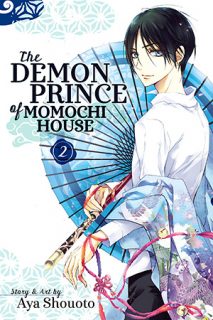
The Demon Prince of Momochi House, Volume 2The Demon Prince of Momochi House, Volumes 2-6 by Aya Shouoto. It was the beautiful artwork and yokai that first drew The Demon Prince of Momochi House to my attention and that continues to be a large part of the series’ appeal for me. I’m also enjoying the story’s melancholic atmosphere as the manga explores themes of loneliness and the desire to belong. Himari, who is an incredibly sweet and caring person, is steadily building her relationships and friendships with the locals, ayakashi and humans alike. However, more the romantic elements of the series are admittedly less convincing. Although there is an underlying story about the mysteries surrounding Aoi and Himari’s efforts to free him from his tragic fate, The Demon Prince of Momochi House frequently almost seems episodic in nature as Himari is introduced to a variety of supernatural wonders and dangers. The seemingly directionless and less-than-cohesive storytelling can be frustrating and sometimes even feels a little shallow, but overall I find the series to be alluring and provocative and look forward to reading more.

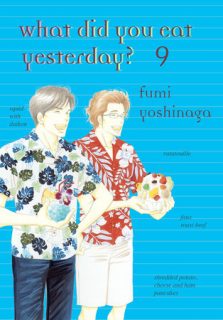
What Did You Eat Yesterday?, Volume 9What Did You Eat Yesterday?, Volumes 9-11 by Fumi Yoshinaga. I am incredibly happy that What Did You Eat Yesterday? is being released in English, so it makes me sad that the series doesn’t seem to be doing especially well in translation. It’s a shame, because it really is a wonderful manga. While I certainly appreciate the food aspects of What Did You Eat Yesterday?, I particularly love the realistic and nuanced characterizations found in the series. The food is all well and good, not to mention beautifully illustrated, but it’s the characters and their relationships that really make the series work. Shiro’s character development has probably been the most interesting and satisfying. I’m very glad to see his relationship with his parents improving even after some significant setbacks. While he’s still not out in his professional life, it is clear that he is becoming more comfortable publicly expressing his sexuality. Fortunately, Shiro and his long-term boyfriend Kenji have the love, support, and acceptance of others which makes that easier. More recently, rather than their homosexuality, what they’ve had to worry about are Shiro’s aging parents and the rising cost of living.

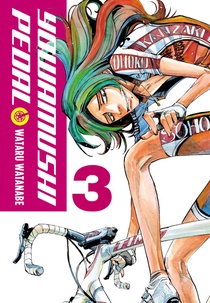
Yowamushi Pedal, Omnibus 3Yowamushi Pedal, Omnibuses 3-4 (equivalent to Volumes 5-8) by Wataru Watanabe. Out of the recent spate of new sports manga being released in North America, Yowamushi Pedal is currently one of my favorites. I have seen a fair amount of the anime adaptation so at this point I am very familiar with where the plot is heading, but even so I still find the original manga to be immensely engaging. Before Yowamushi Pedal, I actually didn’t realize how much of a team effort cycling could be; it’s interesting to learn about the various strategies that can be used to win a race. These couple of omnibuses largely focus on Sohoku’s intensive training camp and also introduce some of the major competition. The characters are fun, some of them are frankly pretty cool, too, and they all have distinctive personalities. The Sohoku team especially is made up of a group of quirky but likeable and talented young cyclists. Art-wise Yowamushi Pedal could almost be described as ugly, but I really like its highly dramatic and energetic style. Watanabe probably uses more speedlines than any other artist I’ve seen, but the effect is great.

Legend of the Galactic Heroes, Volume 2: AmbitionLegend of the Galactic Heroes, Volumes 2-3 by Yoshiki Tanaka. Despite the nearly constant war and political upheaval present in the Legend of the Galactic Heroes novels, the series isn’t really that action-oriented. I suspect some people will actually find it to be rather dry and perhaps even textbook-like. With only the occasional bout of melodrama, the series quickly moves from one event or venue to the next and the cast of characters only continues to grow. (Granted, as this is war, not all of them survive very long after being introduced.) Because the scope is so sprawling sometimes it feels as though Legend of the Galactic Heroes lacks depth of story and characters, instead opting for a wider view and summary of major events. However, Tanaka does show how the complexities of societal, political, economic, and militaristic influences can impact one another. The books frequently read like a popular history, and the series actually reminds me a bit of Romance of the Three Kingdoms, too. So far I’m really enjoying the series and find its story and characters interesting. I like the focus on tactics and strategy as well as the influence that real-life history has had on the series.

Filed Under: FEATURES, My Week in Manga Tagged With: Aya Shouoto, demon prince of momochi house, fumi yoshinaga, Legend of the Galactic Heroes, manga, Novels, Wataru Watanabe, what did you eat yesterday?, Yoshiki Tanaka, Yowamushi Pedal

Bakemonogatari: Monster Tale, Part 1

December 26, 2016 by Sean Gaffney

By NISIOISIN. Released in Japan by Kodansha. Released in North America by Vertical, Inc. Translated by Ko Ransom.

As I mentioned in my prior review of Kizumonogatari, this volume originally came first, but at the request of the agent and author they decided to do Kizumonogatari, which is first chronologically, followed by this series if Kizu sold well. Which it apparently did, as we now have not only Bakemonogatari in 3 parts coming to North America, but also its sequel Nisemonogatari (in 2 parts). This release is in three parts to match the Japanese digital re-release, and contains the first two stories in the series, Hitagi Crab and Mayoi Snail. We are reintroduced to Meme Oshino, our specialist in the supernatural; Tsubasa Hanekawa, our specialist in being the perfect class president; and Koyomi Araragi, our specialist in tsukkomi… and also finding trouble and women.

There are a few surprises in this volume. First of all, we not only get references to what happened in Kizumonogatari, but also something that happened to Hanekawa during Golden Week, which has several hints (involving a “sex cat”) but no actual explanation. More importantly, if you’d only read Kizu you may have assumed that Hanekawa was the obvious girl that Araragi was going to end up with. Thus you may be thrown off to be introduced to Hitagi Senjogahara here, who not only manages to make a much bigger impact on Araragi from the get-go, but by the end of the volumes has confessed to him and become his girlfriend. Given that the Monogatari Series uses many, many common tropes of the harem series – most deliberately – it’s somewhat startling to see the “first girl win” immediately. But then, by sheer force of personality Senjogahara is amazing. She’s seemingly rude, uncaring and vicious, but her backstory certainly explains why that would be the case, and once things turn for the better, she’s still rude, but the uncaring and vicious are replaced by a surprising sensitivity.

The other story in this volume involves Mayoi Hachikuji, a young elementary schoolgirl who seems to be beset by a spirit that keeps her from finding her way anywhere. As with most stories in Monogatari, the truth is far more complicated. I’m not sure whether Nisio wrote this series from the start intending it to become an anime, but if he did it does not surprise me that he adds a “loli” character straight off the bat. That said, the series is a lot more overt about calling attention to Hachikuji’s young age and “developing” body – both in adding fanservice and showing off how creepy it really is. Nisioisin’s series have a large amount of having their cake and eating it too, and this is no exception.

If anything throws off the casual reader besides the token loli, it may be the crushing verbiage. Due to being split into three, this is a much shorter book than Kizu, but it still feels pretty long, mostly due to the endless dialogue which meanders on and off point at will, and is filled with subtle references, kanji puns, explanation of kanji puns, and boke and tsukkomi routines. It’s a credit to the translator that this rarely feels awkward or out of place, and a surprising amount of the original is kept, using a very deft touch. (Note to suspicious Americans: yes, Araragi did mention the 90s sitcom Full House in the Japanese version.) One exception that I think many people were looking for is the ‘tore’ confession response by Araragi, which is adapted into English somewhat awkwardly but I can see why there, you don’t want to kill the most heartwarming scene with more kanji discussion. Well, unless you’re a Nisio fan.

To sum up, if you like amusing characters, fun dialogue, and endless scenes of Araragi shouting comebacks, this is a great volume to get. You can also see just how much the anime cut out to make things fit – check out all the conversations we missed! And stay tuned, as Part 2 will introduce the perverse Kanbaru and the polarizing Sengoku.

Filed Under: REVIEWS

GA: Geijutsuka Art Design Class, Vol. 7

December 25, 2016 by Sean Gaffney

By Satoko Kiyuduki. Released in Japan by Houbunsha, serialized in the magazine Manga Time Kirara Carat. Released in North America by Yen Press. Translated by Sheldon Drzka.

At last this 4-koma series devoted to both the study of art and the usual ensemble of cute girls has come to a close. You can tell it’s wrapping up by the final selection of color pages. In past volumes they’ve discussed color palettes or periods of art in history. Now we see how art can become a career, and how difficult it can be to make a living at it. Of course, our main cast are still first-years, so they won’t be graduating. But the secondary cast, including Awara and her best friend Mizubuchi, *are* graduating, and are beginning to realize that their future paths may not rely on them always being together as they have in the past. And what’s more, what’s to become of the Art Club?

There is, of course, still stuff to teach, as we learn with the girls about art patrons, and how being a designer means listening to your client as well as your muse. We get some backstory for Usami, the cute and insecure teacher, and we even manage to work in a love confession. (No, it wasn’t a yuri confession. Like manga Manga Time Kirara series, there is a level of yuri you can walk up to but not quite walk past.) Some are having trouble moving forward, like Miyabi, who has oodles of talent but whose future has been somewhat set in stone, so it’s difficult for her to fantasize. (This, naturally, leads to a dream sequence, which has been a common motif for GA volumes.) And some are wary of taking that big step, like Awara, who has an opportunity for a big art career move… but it means not going to college, something she finds rather difficult to confess, and we see why as it leads to a big fight.

Awara also has to decide what to do about the art club. She could give the club to the second years, but they’re clearly there to make up the numbers – none of them really understand WHY you would want to have an Art Club in a school that’s already devoted to art. Naturally, we do know one person whose love of art is strong enough that she would be the perfect successor. The scene where Kisaragi figures out what it is she wants to do going forward, and asks to join the art club, is one of the best in the whole series. And, because none of her friends would dream of letting her do this by herself (they all admit they’d be reluctant to join if it was any of the five of them EXCEPT her), they’re able to make up the numbers as well. We even get a look at the next generation, as the girl we saw during the last summer vacation seems to be on her way to becoming Kisaragi’s new kohai.

I know this series got a bit of flak over the years. It was too similar to Sunshine Sketch, or it prevented the artist from drawing the more critically acclaimed Shoulder-a-Coffin Kuro. But I felt its combination of art education, cuteness, and character moments was just right, and it always filled me with a warm, sunny feeling. I can’t recommend it enough.

Filed Under: REVIEWS

The Night Beyond the Tricornered Window, Vols. 1-3

December 25, 2016 by Michelle Smith

By Tomoko Yamashita | Published digitally by SuBLime

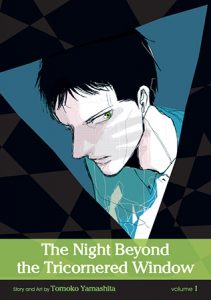
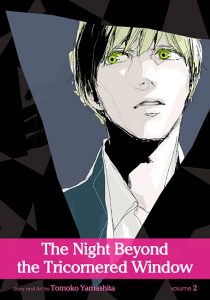
tricornered1Until Olivia mentioned it over in the comments on Manga Bookshelf, I had no idea this series existed, let alone that it was being released in English! Having loved Yamashita’s Dining Bar Akira and Black-Winged Love, I immediately purchased all extant volumes.

Kosuke Mikado has been able to see spirits since he was a child, but any time he tried to talk to his friends about it, they thought he was weird, so he has been keeping his distance from other people and has begun to doubt his own sanity. When the manager of the bookshop where Mikado works hires Rihito Hiyakawa to deal with a pesky spirit—and after Hikayawa recognizes Mikado’s powers and uses them to boost his own—Mikado finally finds someone who lives in the same world he does. Although he begins the series frightened and clinging to skepticism, through Hiyakawa’s assurances, Mikado gradually accepts the things he sees as reality and begins to combat them independently.

tricornered2I love series like this, where the leads have episodic disturbances that they investigate (via the partnership they strike up as a sort of supernatural cleaning crew and frequently assisting a non-believing cop named Hanzawa) plus an ongoing mystery (involving curses cast by someone named Erika Hiura) and yet the most important and fascinating aspect is the relationship between the leads themselves. There are the fun, suggestive moments where the guys are combining their powers for one reason or another and end up using dialogue like, “Do you want me to touch it?” or “Take me all the way in.” But where Yamashita-sensei really excels is at teasing out threads of darkness.
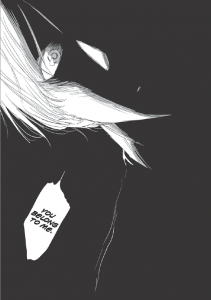
We first get an inkling that something is amiss when the guys visit a potentially fraudulent fortune-teller. Mikado is the one who physically sits for the session while Hiyakawa, bodily still in the waiting room, casually inhabits Mikado’s body to see for himself. The fortune-teller warns Mikado that the way Hiyakawa reaches into him so easily is dangerous, a warning neither Mikado nor I take seriously. And yet, after an encounter with Erika Hiura shows Mikado’s vulnerability to being accessed in this way, Hiyakawa makes Mikado enter into a contract he doesn’t remember, and we get this awesomely creepy full-page panel.

After this point, more and more potentially disturbing things about Hiyakawa are revealed. “I don’t have parents or friends,” he says at one point. Later, he seems baffled by the concepts of beauty and evil. As troubling indications mount, Mikado knows that he should be thinking seriously about what is happening between them. Other characters certainly question it, but Mikado is strangely reluctant. Is it because Hiyakawa is somehow keeping him quiescent, or is Mikado willfully maintaining his ignorance because he does not want to go back to being alone?

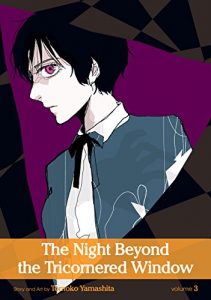
tricornered3It’s only at the end of volume three, wherein Hiyakawa nonchalantly suggests that it’d be good if they could work the other side of the business, too, that Mikado realizes he has no idea what kind of person he’s working with. As a reader, I too was lulled into believing that of course the protagonist of a series about fighting the supernatural is a good guy. Turns out, he’s more of an empty-inside opportunist. At this point, even I just want to say, “Run away, Mikado! Run away and don’t look back!” Is there any hope that he can help heal and humanize Hiyakawa, or will he only end up destroyed? How soon until volume four comes out?!

Lest my focus on the relationship suggest otherwise, the plot of The Night Beyond the Tricornered Window is also excellent. In fact, I sincerely owe Olivia a debt of gratitude. And SuBLime, too, in fact. I hope print editions are available at some point in the future, because this is a series I need to have on my shelves.

The Night Beyond the Tricornered Window is available on Kindle and at sublimemanga.com. The series is ongoing in Japan, where the fourth volume has just been released.

Filed Under: Manga, REVIEWS, Supernatural Tagged With: Tomoko Yamashita

  • « Go to Previous Page
  • Page 1
  • Interim pages omitted …
  • Page 457
  • Page 458
  • Page 459
  • Page 460
  • Page 461
  • Interim pages omitted …
  • Page 1048
  • Go to Next Page »
 | Log in
Copyright © 2010 Manga Bookshelf | Powered by WordPress & the Genesis Framework