• Skip to primary navigation
  • Skip to main content
  • Skip to primary sidebar
  • Home
  • About Us
    • Privacy Policy
    • Comment Policy
    • Disclosures & Disclaimers
  • Resources
    • Links, Essays & Articles
    • Fandomology!
    • CLAMP Directory
    • BlogRoll
  • Features & Columns
    • 3 Things Thursday
    • Adventures in the Key of Shoujo
    • Bit & Blips (game reviews)
    • BL BOOKRACK
    • Bookshelf Briefs
    • Bringing the Drama
    • Comic Conversion
    • Fanservice Friday
    • Going Digital
    • It Came From the Sinosphere
    • License This!
    • Magazine no Mori
    • My Week in Manga
    • OFF THE SHELF
    • Not By Manga Alone
    • PICK OF THE WEEK
    • Subtitles & Sensibility
    • Weekly Shonen Jump Recaps
  • Manga Moveable Feast
    • MMF Full Archive
    • Yun Kouga
    • CLAMP
    • Shojo Beat
    • Osamu Tezuka
    • Sailor Moon
    • Fruits Basket
    • Takehiko Inoue
    • Wild Adapter
    • One Piece
    • After School Nightmare
    • Karakuri Odette
    • Paradise Kiss
    • The Color Trilogy
    • To Terra…
    • Sexy Voice & Robo
  • Browse by Author
    • Sean Gaffney
    • Anna Neatrour
    • Michelle Smith
    • Katherine Dacey
    • MJ
    • Brigid Alverson
    • Travis Anderson
    • Phillip Anthony
    • Derek Bown
    • Jaci Dahlvang
    • Angela Eastman
    • Erica Friedman
    • Sara K.
    • Megan Purdy
    • Emily Snodgrass
    • Nancy Thistlethwaite
    • Eva Volin
    • David Welsh
  • MB Blogs
    • A Case Suitable For Treatment
    • Experiments in Manga
    • MangaBlog
    • The Manga Critic
    • Manga Report
    • Soliloquy in Blue
    • Manga Curmudgeon (archive)

Manga Bookshelf

Discussion, Resources, Roundtables, & Reviews

Blog

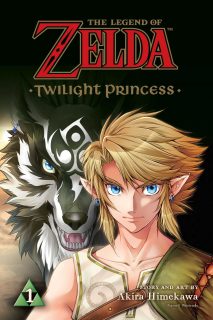
The Legend of Zelda: Twilight Princess, Vol. 1

March 23, 2017 by Ash Brown

The Legend of Zelda: Twilight Princess, Volume 1Creator: Akira Himekawa
Translator: John Werry
U.S. publisher: Viz Media
ISBN: 9781421593470
Released: March 2017
Original run: 2016

Akira Himekawa is the joint pen name of A. Honda and S. Nagano, two women who have been collaborators for over thirty years. The two-person creative team is probably best known for their work on the manga adaptations of The Legend of Zelda series of video games, although some North American readers may associate Himekawa with the Avatar: The Last Airbender comics as well. Despite being a fan of both franchises, I actually hadn’t made a point to read any of Himekawa’s work until after meeting the two women briefly at the Toronto Comic Arts Festival in 2014. Twilight Princess is the most recent entry in Himekawa’s series of The Legend of Zelda adaptations. Initially Twilight Princess was intended to be a children’s series, but when the original 2006 video game it was to be based on became the first in the franchise to be rated for teens, plans for that manga were cancelled. It wasn’t until 2016 that Himekawa would begin serializing Twilight Princess digitally, the first volume subsequently being released in Japan in print later that year. Viz Media’s English-language edition of Twilight Princess debuted in print in 2017.

Link is a young man trying to outrun his past. A year and a half ago he wandered into the border village of Ordon, hiding his personal history in hopes of establishing a new life for himself. Ordon is idyllic, seemingly a perfect place for Link to retreat. The land is said to have been blessed by the spirits and the village is well-known for its bountiful harvests. Although Link arrived as a stranger, he was warmly welcomed by the villagers and has since become an integral part of the community. Link loves Ordon and its people, but there’s always a small part of him that feels like he doesn’t quite belong. He is still plagued by guilt over the tragedies of his past, dealing with a weighty feeling of responsibility which is impossible to ignore. Having experienced disaster before, Link may be one of the few who can prevent it from happening again. Most of the other people in the sacred kingdom of Hyrule are unaware of the looming threat that the long-forgotten Twilight Realm poses. It’s a danger that grows even greater when the ambitions of one man to rule both the light and the dark begin to come to fruition. As the shadows of darkness gather around Ordon, Link will have to face his past and his fears, confronting the possibility that he will once again lose everything that he holds most dear.
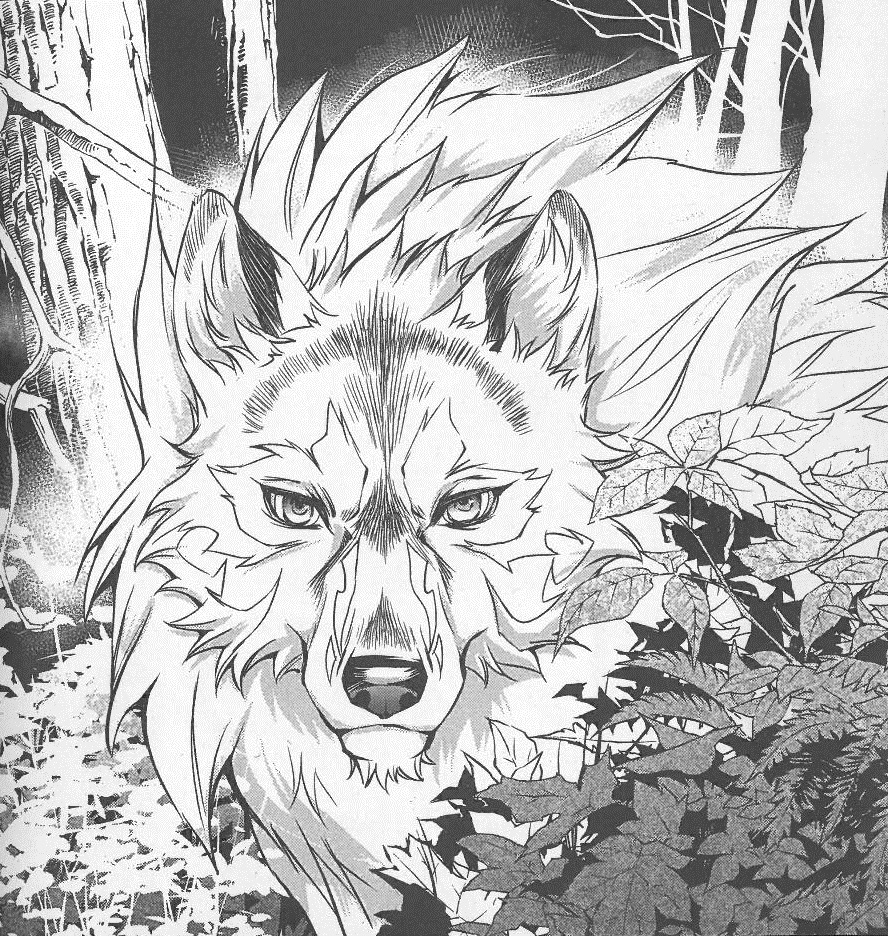
The Legend of Zelda: Twilight Princess, Volume 1, page 122Although I’ve played some of the original Twilight Princess, familiarity with the video game is not at all necessary to enjoy Himekawa’s adaptation. At least so far, the series can stand on its own as a work–the manga largely comes across as a freely-developed fantasy rather than a strict reimagining of a video game. Himekawa’s narrative in Twilight Princess is streamlined and quickly paced, incorporating elements of the original game in clever ways. Some of the wonder of having a world to leisurely explore and discover is lost as Twilight Princess is adapted into a different medium, but in exchange the manga emphasizes depth of characterization. As the protagonist, Link is generally the most fully-realized character. I really like Himkeawa’s multi-faceted interpretation of Link in Twilight Princess. While at heart Link is a troubled and brooding hero, he also exhibits happiness and joy and there are moments in the manga when his good-natured goofiness shines through. The Twilight Princess manga, much like the video game itself, is intended for a more mature audience than many of the previous incarnations of The Legend of Zelda. The story tends to be fairly dark and can be strikingly violent at times.

One of the things that I appreciate the most about Himekawa’s work on The Legend of Zelda manga is the creators’ ability to adjust their tone and style to fit the requirements of a given series. Himekawa’s skill and flexibility as artists can be seen as they move from one adaptation to the next, but can also be exhibited within a single manga. In Twilight Princess specifically there is a wonderful contrast between the serene, pastoral setting of Ordon and the ominous darkness and shadowy creatures encroaching upon it. The artwork in Twilight Princess is beautifully executed, ranging from the gorgeous to the grotesque as demanded by the story. In comparison, the storytelling itself isn’t nearly as strong. The first chapter of Twilight Princess in particular suffers from some awkward exposition and Link has a tendency to ask questions that he should already know the answers to having lived in Ordon for so long. Still, I do like the story, characters, and settings of Twilight Princess. In the past, Himekawa’s The Legend of Zelda manga have only been one or two volumes long. I would be surprised if Twilight Princess could end satisfactorily in such a short span, so I hope that the series will be longer to allow the story to unfold more naturally; I enjoyed the first volume of Twilight Princess a great deal and look forward to reading more.

Thank you to Viz Media for providing a copy of The Legend of Zelda: Twilight Princess, Volume 1 for review.
Filed Under: REVIEWS Tagged With: Akira Himekawa, Legend of Zelda, manga, viz media

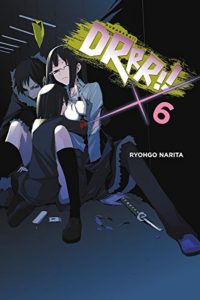
Durarara!!, Vol. 6

March 23, 2017 by Sean Gaffney

By Ryohgo Narita and Suzuhito Yasuda. Released in Japan by ASCII Mediaworks. Released in North America by Yen On. Translated by Stephen Paul.

When you write a book that creates a series of events that spiral into chaos, as Narita specialized in, particularly in this series, it can be many things to many people. For every character that’s involved in wacky hijinks, there’s another who’s undergoing a traumatic life-changing event. The skill is to keep those balls up in the air, and more importantly, to make everyone distinctive and memorable. As the books go on, we introduce more and more new cast members, and you need to be able to care about everyone without consulting the wiki to remember who they are (A Certain Magical Index suffers from this quite a bit). Luckily, Narita is quite good at this, so we can empathize not only with our heroes, but even the passing villains who get curbstomped by yakuza, and said yakuza, who are finding all of these gangs and Russian assassins simply exasperating. It’s all things to all people.

And so Durarara!! can be a comedy. There’s lots of great humor here, even if some of it is pretty twisted. Shinra’s diary of Celty fetish outfits, and her reaction to same. Chikage’s absolutely ridiculous chivalry, with equal measures of “knight in shining armor” and dumb sexism. Speaking of sexism, Erika gets to play the depraved bisexual in this one, groping Anri for no reason other than she wants to and to give the illustrator some fanservice to draw. Not OK, Erika. There’s also her and Walker namechecking Index and Shana in the middle of a pitched fight. And Mairu and Kururi’s chatroom gabbling is always worth a smile.

But Durarara!! is also ridiculously heartwarming. The fact that Shizuo has grown and changed as a person is a literal plot point here, as that very growth is what spoils Izaya’s plans. I loved the way that he bonded with Akane at the end, after saving her from Vorona and Slon. Celty might be weirded out by all the talk of Akane killing him, but it’s sweet in a Ryohgo Narita way. Anri may not be able to admit how close Mikado is to her, but her attempts to protect him are wonderful to see, as are Mikado’s absolutely pathetic attempts to protect her and also stop the Dollars gang from kidnapping Rio and her friends. For all that I like to say that Durarara!! is about terrible, twisted people, a lot of them have a good heart. Oh yes, and who doesn’t get a warm feeling in their heart when they see Izaya get what he deserved at the end of the book? I know I smiled. Well, cackled, really.

But I’m avoiding the elephant in the room, and that’s the fact that Durarara!! Book 6 is also a tragedy. We see a bit of it in miniature with Akane, a genuinely sweet little girl who is broken by events (and helped along by Izaya) to the point where both Celty and Shiki are disturbed by her but can’t quite put their finger on why. Vorona is shown that she’s nowhere near strong enough to take on Ikebukuro (don’t worry, she’ll be back). And then there’s Mikado, who is being used as a pawn by both Izaya and Aoba, and who finally makes a decision to go to a very dark place. Several times in the book we see people seemingly know Mikado better than he knows himself, and he’s given several opportunities to back off, to do the right thing, to become a good person. And he absolutely rejects all of them, agreeing to become the Blue Squares leader so that he can “fix” the Dollars. The most chilling moment in the book isn’t when he stabs Aoba in the hand with a ballpoint pen (though that is the most famous moment). As Aoba also realizes, it’s right after, when he switches back to innocent, kindhearted Mikado like flipping a switch. Mikado has chosen to embrace the darkness, and I appreciate that the narrative shows us how much of a terrible tragedy that truly is.

So we’re at the end of another arc, and that means next time we’ll see a lot of wandering around and setting up future plotlines. Still, books like that are what lead us to books like this, which is a highlight of the series.

Filed Under: durarara!!, REVIEWS

Ranma 1/2, Vols. 37-38

March 22, 2017 by Sean Gaffney

By Rumiko Takahashi. Released in Japan by Shogakukan, serialized in the magazine Shonen Sunday. Released in North America by Viz. Translated by Kaori Inoue, Adapted by Gerard Jones.

And so at last we come to the end of the great Ranma 1/2 reissue. Inu Yasha may have had a broader reach, Urusei Yatsura may have had a bigger impact on Japan itself, and Maison Ikkoku may have had more maturity and resolution, but Ranma will still be THE anime gateway for many fans, along with Sailor Moon and Bubblegum Crisis. Having read the series again, I am able to see why it was so wildly popular, as well as why revisiting it can be frustrating. Ranma does not have depth – in fact, it actively leaps out of the way of depth – which makes it perfect for creative fans who want to give it that depth. It’s no coincidence that more than AMVs or fanart, it was fanfiction that was the biggest part of the mid-90s Ranma boom. Still, this does not mean that Takahashi’s manga is not good. It’s very good indeed.

Please do not be fooled by the cover – yes, there is a wedding at the end of the book, but we don’t even get to the ceremony before everything is completely destroyed and we return to the status quo. Well, status quo except that it seems that if there had not been chaos, Ranma and Akane might have gone through with the wedding. But there is always chaos in Ranma, it’s practically the main cast member. This manga ends much the same way that many of the classic UY anime episodes ended – with more and more of the cast showing up, each trying to beat up somebody else, until everything finally turns into a giant pile of destruction. Ranma 1/2 is not a romantic comedy, or a harem manga, or even a martial arts comedy. It’s pure slapstick.

The martial arts gets a good workout in the main part of this volume, though, as we return to China to battle another major villain. You get the sense that Takahashi is trying to figure out a way to top Herb, and she doesn’t manage it, really, but A for effort. The whole main cast is there (poor Ukyou, guess you were supporting after all), and there’s lots of cool fights and dramatic kicks and Akane and Shampoo in distress a lot of the time. That said, even when captured or dehydrated down to the size of a doll, Akane is still thinking hard and trying to get herself out of her predicament. Shampoo, alas, is merely mind-controlled most of the time. (I will note that Akane not noticing Ryouga transforming several times in this beggars belief, but hey.)

And so Ranma ends with our main couple waving goodbye to the readers as they head off to school again. It’s never quite confirmed that they do have mutual feelings for each other, mostly as I think Takahashi hoped people could read between the lines and see that she’d had them show their love without saying their love several times. (UY did this too – Ataru in particular was the poster child for “show, don’t tell”.) It didn’t quite work, and fans who disliked Akane were always quick to point out the open-endedness of the ending meant that they didn’t end up together. Takahashi later did one of those “character relationship charts”, filled with one-sided arrows, except for two – Ranma and Akane, and Ryouga and Akari. So she knew they loved each other.

But we don’t read Ranma for resolution of romantic tension. We read it for genderswapping and bizarre martial arts contests and so many fights and “Ranma no baka!” and in order to flesh out our 800,000 word epic fanfic with smatterings of actual canon. And we read it because we love the characters, flat as they are. Of course, we may not always love the SAME characters, but any Ranma fan is obsessed with at least one of them (except Happosai). Ranma 1/2 was a roadmap to modern anime fandom, and the road may be less traveled these days but it’s worth walking back over.

Filed Under: ranma 1/2, REVIEWS

Accel World: The Seven-Thousand-Year Prayer

March 21, 2017 by Sean Gaffney

By Reki Kawahara and Hima. Released in Japan by ASCII Mediaworks. Released in North America by Yen On. Translated by Jocelyne Allen.

And so, at last, we come to the end of the Armor of Catastrophe arc, which was not only deliberately meant to be a long arc but also grew out of the author’s control, as he’s admitted himself in the afterword. The volume gives us a lot of what readers like about this series: good battles with some nice analysis from Haruyuki, some amusing harem comedy, some heartwarming romance with Kuroyukihime, and an examination of the nature of negative emotions and how to cope with them every day, because they don’t just magically go away merely because everyone believes in you really hard. That said, it also has some things that fans tend to not like as well: Haruyuki is not only the bestest person to ever be possessed by the evil armor, but he’s a shining magical beacon of hope for all. Oh, and he gets another girl confessing to him, and is caught with her lying on top of him, because harem comedy. It’s a balance.

The significant development here is a bit of a spoiler, but worth talking about. We learn the true identity of Ash Roller, which turns out to be somewhat confusing, meshing up a tragic tale of an introverted girl and her comatose brother with the nature of the neurolinkers that are omnipresent in this world. It’s left deliberately up in the air what’s going on here, whether Rin is literally being possessed by her brother while in the Accelerated world, or if she’s merely taking on his role to an almost absurd extent. (She genuinely seems to be unaware of what transpires without wearing her brother’s neurolinker, so odds are on the first.) That said, I admit to a bit of irritation at the fact that one of Haru’s only male friends turns out to really be a shy young girl who’s in love with him in real life. (The shyness is conveyed via an odd speech pattern – Rin talks in sentence fragments, and it’s unclear if this is a mental issue like Utai’s or if it’s meant to be natural introversion.)

That said, once again after a lot of harem tease we are reminded that at the end of the day there is only one who is top of the heap, and it’s Kuroyukihime. We get a little more insight into her real-life background – she lives alone in a very rich neighborhood, and it’s implied that the murder of the Red King in the Accelerated World had a counterpart in real life as well. That said, just as Haruyuki is a Pillar of Hope for All despite his omnipresent self-hatred, Kuroyukihime tends towards the perfect accepting girlfriend much of the time, listening calmly as Haru pours out his fears, getting the crap beaten out of her in the AW waiting for him to overcome the Disaster, and bushing cutely when he’s accidentally proposing marriage to her without actually realizing it.

So in the end Accel World has much the same strengths and weaknesses as the author’s other series, Sword Art Online. Which means fans of one will enjoy the other, and those who hate Kirito with a passion probably will find themselves getting annoyed at Haruyuki here. The next book should be standalone and lighthearted, and I fear that may mean MAXIMUM HAREM ANTICS. We shall see.

Filed Under: accel world, REVIEWS

Ne Ne Ne, Chapters 1-4

March 20, 2017 by Katherine Dacey

Ne Ne Ne sounds like E.L. James fanfic: the lead character is a virginal lass who’s forced into an arranged marriage with a sexy, mask-wearing man twenty years her senior. The actual story, however, is much less kinky than my capsule summary would suggest. Like millions of other nineteenth-century couples, sixteen-year-old Koyuki and thirty-seven-year-old Shin begin their married life as strangers, their union one of familial expediency rather than romance. Each entertains different ideas about what constitutes a proper marriage: for Koyuki, being married means homemaking and child-rearing, while for Shin, being married means mindful companionship. Most of their conflict stems from Koyuki’s immaturity, as she bursts into tears every time she burns a meal, tumbles off a ladder, or ruins one of Shin’s yukatas.

Though Koyuki’s bungled chores and teary monologues scream “moe,” Ne Ne Ne retains a core of emotional honesty that’s missing from other rom-coms about clumsy young girls and their older male admirers. The secret lies with the manga’s nuanced portrayal of Koyuki and Shin. Artist Daisuke Hagiwara does a fine job of showing us the degree to which the characters’ ages influence their expectations about married life, using small gestures — a shrug of the shoulder, a chaste kiss, a longing glance — to reveal how carefully the two are approaching their new roles. Author Shizuno Totono also raises the question of sex, hinting at the characters’ mutual attraction while acknowledging the moral and ethical dilemmas posed by Shin and Koyuki’s age gap.

Ne Ne Ne isn’t all angst and meaningful glances; Totono and Daisuke dish out plenty of jokes and sight gags, too, going to great lengths to demonstrate that Shin never takes his mask off. (Not even when he’s doing the laundry! Or snoring on a futon!) Shin’s mask serves a legitimate purpose beyond generating jokes and occasional moments of erotic tension, however: it’s a symbol of his profession — priest — and his connection to the supernatural world. In one of the story’s loveliest scenes, Shin gives Koyuki an impromptu lesson on how to spot yokai. Koyuki’s face conveys her profound sense of wonder at seeing her first dragon, and her delight at forging a small but meaningful connection with Shin — something she’s struggled to do in their more routine interactions as husband and wife.

Totono and Daisuke are less successful at wringing humor out of the couple’s interactions with supporting players. These characters are two-dimensional at best, defined by a single trait or habit that determines how they react to Koyuki and Shin’s marriage. Their brash neighbor Shouta, for example, cracks wise about the age gap between Shin and Koyuki — at one point, he implores Koyuki to marry him “when that old guy dies” — but his comments are anachronistic; it’s hard to imagine a young man in Meiji-era Japan finding an arranged marriage unusual, or speaking to his elders with such blatant disregard for etiquette. Koyuki’s father is similarly two-dimensional, a walk-on role whose main function is to defend his daughter’s chastity with comic fury. (He forbids Shin to consummate the marriage until Koyuki turns 20.) As with Shouta, these scenes don’t contribute much to our understanding of the period setting or the family dynamics that brought Shin and Koyuki together; they do, however, remind us that Shin is waaaaaaaay older than Koyuki.

If Totono and Hagiwara sometimes seem too intent on proving to the reader that Ne Ne Ne is more than just a pervy tale about an old guy in a mask and his child bride, the manga nevertheless manages to be funny, sweet, and honest about the challenges of marital life — something I didn’t expect from a story with such a ludicrous premise. Recommended.

Yen Press is simultaneously publishing the English-language edition of Ne Ne Ne as it’s released in Japan. As of March 20, 2017, four chapters are available. They can be purchased individually or as a package through Amazon, Barnes & Noble, Book Walker, ComiXology, Google Play, iBooks and Kobo.

NE NE NE, CHAPTERS 1-4 • STORY BY SHIZUKO TOTONO, ART BY DAISUKE HAGIWARA • YEN PRESS • NO RATING (APPROPRIATE FOR TEENS 13+)

Filed Under: Manga, Manga Critic, REVIEWS Tagged With: Daisuke Hagiwara, Ne Ne Ne, Romance/Romantic Comedy, Shizuku Totono, yen press

Pick of the Week: Delectable Digital

March 20, 2017 by Sean Gaffney, Ash Brown, Anna N, Katherine Dacey, Michelle Smith and MJ Leave a Comment

SEAN: As I noted i n Manga the Week of, I think this week breaks the record for most volumes in one week, helped along by Kodansha’s burgeoning digital lineup, which I’m sure the rest of the team will be talking about below. My pick of this week is Barakamon, though, which is seemingly a slow-moving, relaxed series but in reality has moved from strength to strength, and the development of its characters in this volume in particular is amazing. It’s become one of my favorite manga series.

MICHELLE: There are several debuts this week that I’m really looking forward to, but the single volume I most want to read is the fourth and final That Wolf-boy Is Mine! The series surprised me with how good it was, and I wouldn’t miss the conclusion for anything.

KATE: I’m most excited about Kodansha’s latest digital offerings. The swoon-worthy covers for Altair: A Record of Battle and Hozuki’s Coolheadness are calling out to me.

ASH: Agh! I’m so conflicted! Once again, I’m probably most interested in Kodansha’s digital releases this week, but I don’t generally read manga digitally. I really hope to see some of these like Altair: A Record of Battle and Hozuki’s Coolheadness eventually make their way into print. In the meantime, my official pick for this week goes to Goodnight Punpun which continues to be an incredibly surreal and uncomfortable but powerful and resonate work.

ANNA: I have to say, I’m finding Kodansha’s digital releases very compelling, although so much is coming out, I can see myself losing track of titles I want to read fairly easily. That being said, Altair: A Record of Battle is what looks most interesting to me, so that’s my pick.

MJ: Like Kate and Ash, I’m pretty interested in Altair: A Record of Battle, but I think I’ll put my vote in for Hozuki’s Coolheadness, which seems likely to ping a lot of my personal preferences all at once. And if I only wish these were being made available in print, I guess we take what we can get.

Filed Under: PICK OF THE WEEK

Bookshelf Briefs 3/20/17

March 20, 2017 by Katherine Dacey and Sean Gaffney Leave a Comment

Barakamon, Vol. 13 | By Satsuki Yoshino | Yen Press – For a relaxed slice-of-life series set on an out-in-the-boonies Japanese island, Barakamon has had a surprising amount of character development, mostly coming from its lead, Seishuu Handa. He and Naru go to Tokyo as promised in the last volume, and he meets his supposed arranged marriage fiancée, who turns out to have lost about 150 pounds since she had the photo taken that he saw. They get on very well, but, as is noted in the text, it’s bizarre to see two people with so little sexual tension. (I assume Barakamon‘s BL fandom in Japan is as large as it is here, which might explain why.) Meanwhile, his decision to become a calligraphy teacher is pitch-perfect and flows well with what he’s been doing. A fantastic volume. – Sean Gaffney

Everyone’s Getting Married, Vol. 4 | By Izumi Miyazono | Viz Media – This series continues to tie all of its various plots together with ease, ranging from serious events like Kamiya’s aggressive courting of Asuka and the fact that Ryu is a celebrity and being seen with him would have a backlash on both their careers to lighter fare such as Asuka being upset that Ryu paying too much attention to her belly during sex reminds her she’s gained weight. Speaking of sex, we get the dreaded “here’s a story from earlier in the author’s career to pad out the volume” extra. Fortunately, it’s good. Moreover, it’s HOT—possibly the most erotic thing Viz has published in some time, with a frankness that blows away both the reader and the heroine. An excellent adult romance series. – Sean Gaffney

Happiness, Vol. 3 | By Shuzo Oshimi | Kodansha Volume three of Happiness offers further proof that Shuzo Oshimi’s teen vampire drama may be the best manga you’re not reading. Though Oshimi has a knack for introducing surprising plot twists, he never takes short cuts to get there; as volume three demonstrates, Oshimi makes these narrative twists and turns effective through meticulous character development and world-building. By the end of the volume, we have a clearer sense of what might happen to Makoto’s family and friends if he continues to live among them as a normal teenager. Expressive, trippy artwork adds special urgency to Makoto’s story, giving us a better sense of how hard it is to be a hormonal fourteen-year-old vampire with a conscience. Edvard Munch would approve, I think. – Katherine Dacey

Haikyu!!, Vol. 9 | By Haruichi Furudate | Viz Media – The tournament is over, and our heroes lost—not uncommon in long-running sports series. So it’s back to aggressive training—provided, of course, our two young phenoms can pass their midterms, as they won’t be allowed to go to Tokyo to practice otherwise. Fortunately, the team has a new team manager who’s learning the ropes from the old one, and gives us—horrors!—a second female regular in the series. Yachi is cute and somewhat introverted, and reels a bit from dealing with overtly in your face people like Shoyo. She’s also smart, though, and has an eye for design. I like her. Meanwhile, there’s a new rival on Nekoma’s team, a Russian kid who’s just as phenom as our heroes. What will we learn in the next volume? – Sean Gaffney

Nisekoi: False Love, Vol. 20 | By Naoshi Komi | Viz Media – We’re beginning to wrap up Nisekoi, and much as the fandom may have wanted it to end with an actual harem, that ain’t happening. The first to fall is the last one in, which is to say Yui, Raku’s older sister figure and teacher. She’s required to either marry Raku in a week or return to China for an arranged marriage, which is annoying as she’d just given Chitoge the “I want my beloved to be happy” speech. The best moment in the volume belongs to Marika, who heard said speech and finds it infuriating that Yui would simply leave her feelings unexpressed and not try her hardest to win Raku. And, of course, Raku is still clueless about the fact that Chitoge is now Best Girl, though the narrative will spin that out a bit longer. Very well-written if frustrating. – Sean Gaffney

Sword Art Online: Progressive, Vol. 5 | By Kiseki Himura and Reki Kawahara | Yen Press – Last time I noted that the manga changed a few things from the end of the first novel. This new volume, adapting the second novel, goes even further, adding a whole raft of new scenes that give more added depth to the Dark Elves—particularly Kizmel’s doomed sister and her fiancé. This allows us to have more extended fight scenes, and also gives the whole thing a feeling of growing tragedy, but it also helps emphasize one of the big plot points of book two—are the NPCs really sentient? Kirito says no, and points out that Tilnel, Kizme’s late sister, may have even been ‘modeled’ on Asuna after they encountered each other. Asuna, who is far more of a dreamer than Kirito, thinks differently. This has become essential. – Sean Gaffney

Welcome to the Ballroom, Vol. 3 | By Tomo Takeuchi | Kodansha Comics – After a couple of volumes that seemed to try to balance out possible romance with dancing, this third one tilts firmly towards the ‘dancing’ side of the equation, and it’s all the better for it. Tatara is a faster learner than anyone had really given him credit for, though he needs to build up his stamina, a fact that I suspect will come back to bite him in the next book. He also learns that as the male partner in a ballroom dancing team, his job is to better bring forth the beauty of his female partner. And then there is the art, which is the series’ main strength and reason to buy. It’s brilliant, making the reader feel as if they’re right there in the room. This series has gotten very good very fast. – Sean Gaffney

Filed Under: Bookshelf Briefs

My Week in Manga: March 13-March 19, 2017

March 20, 2017 by Ash Brown

My News and Reviews

Last week at Experiments in Manga I posted an in-depth review of Ichi-F: A Worker’s Graphic Memoir of the Fukushima Nuclear Power Plant by Kazuto Tatsuta. It’s an important and fascinating manga which reveals the day-to-day lives and work of the people who are directly involved with the ongoing cleanup following the 2011 earthquake, tsunami, and nuclear disasters in Japan. On a related note, a while back I also reviewed Lucy Birmingham and David McNeill’s Strong in the Rain: Surviving Japan’s Earthquake, Tsunami, and Fukushima Nuclear Disaster which provides a fairly comprehensive and approachable overview of the disasters themselves as well as some of the initial recovery efforts. As for future in-depth reviews, I’m currently working on one for Akira Himekawa’s The Legend of Zelda: Twilight Princess, Volume 1 which I hope to post sometime later this week. (That would mean two reviews from me this month!) Initially I was planning to write a quick take on Nagabe’s The Girl from the Other Side, Volume 1 for today’s post, but I loved it so much that I want to delve into it more deeply, so expect to see a more comprehensive review for that manga in the relatively near future as well.

Quick Takes

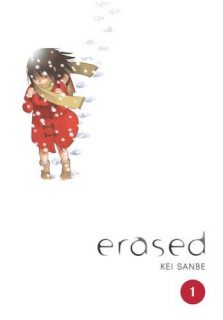
Erased, Omnibus 1Erased, Omnibus 1 (equivalent to Volumes 1-2) by Kei Sanbe. Although I haven’t actually watched it yet, Sanbe’s Erased manga was first brought to my attention due to its recent anime adaptation. I’ve heard very good things about it and so when Yen Press started releasing the original manga in a hardcover, omnibus edition it immediately caught my attention. Satoru Fujinuma has a peculiar ability which causes him to spontaneously travel back in time. Usually it happens just before some tragedy is about to occur, allowing him to try to prevent it, although doing so can sometimes cause problems for him personally. When a particularly traumatic event occurs, Satoru unexpectedly finds himself nearly two decades in his past, giving him the opportunity to try to stop a series of kidnappings and murders that haunted his childhood. While I found the story’s premise intriguing from the very start, it actually took me a little while to get into Erased. But by the end of the first volume I was hooked and by the end of the first omnibus I couldn’t wait to read more. (Also, fun fact!: Sanbe was one of Hirohiko Araki’s assistants and worked on JoJo’s Bizarre Adventure.)

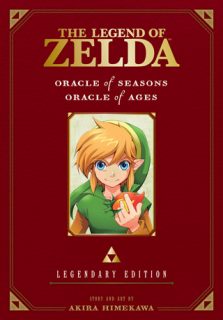
The Legend of Zelda: Oracle of Seasons/Oracle of AgesThe Legend of Zelda: Oracle of Seasons/Oracle of Ages by Akira Himekawa. Despite being a fan of The Legend of Zelda, I haven’t actually read very many of the video games’ manga adaptations. However, the Legendary Edition of Himekawa’s The Legend of Zelda manga that Viz Media has recently begun releasing may very well change that. With the handsome book designs, larger trim, color pages, and previously unreleased material, the new edition of the series is tremendously appealing. Oracle of Seasons/Oracle of Ages is the second volume in the Legendary Edition to be released, adapting the two linked video games of the same name. I haven’t actually played the Oracle games so I can’t comment on the adaptation itself, but the manga is fun and energetic. The series is aimed at younger readers which isn’t inherently a bad thing, but the story and characters can occasionally come across as somewhat simplistic as a result. The antagonists in particular seem to lack nuance and tend to be evil for evil’s sake. But as a whole the Oracle manga are enjoyable adventures, following a young Link, a warrior of destiny but still a knight-in-training, as he tries to figure out what he wants to do with his life even while he’s saving the kingdom.

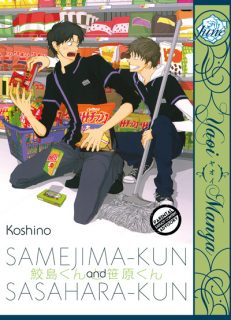
Samejima-kun and Sasahara-kunSamejima-kun and Sasahara-kun by Koshino. Currently, Samejima-kun and Sasahara-kun is the only boys’ love manga by Koshino to have been released in English in print, but I enjoyed it so much that I hope there will one day be more translated. For a while there Samejima-kun and Sasahara-kun had gone out-of-print, but it’s more-or-less available again. (Digital Manga seems to be using some sort of print-on-demand service to restock titles lately; sadly, though adequate, the production quality isn’t quite as good.) Samejima and Sasahara are both college classmates and coworkers at a convenience store. Everything seemed to be going along fine  between them until Samejima confesses that he has fallen in love with Sasahara, thereby putting their friendship in danger. At first Sasahara tries to ignore the development, wanting to just remain friends, but he comes to realize he enjoys the attention, if only he could get Samejima to believe him. Their relationship (as well as the eventual sex they have together) is endearingly awkward–Samejima obviously cares about Sasahara and vice versa, but they also annoy the hell out of each other in a way that only the closest friends can do. They’re an argumentative couple, but the manga’s humor makes it work.

Now with Kung Fu Grip!: How Bodybuilders, Soldiers and a Hairdresser Reinvented Martial Arts for AmericaNow with Kung Fu Grip!: How Bodybuilders, Soldiers and a Hairdresser Reinvented Martial Arts for America by Jared Miracle. It would be understandable, if inaccurate, to assume from its title and description that Miracle’s Now with Kung Fu Grip! is a work of popular history. I personally found the subject matter to be interesting and learned quite a bit, however the book is difficult to recommend to a casual reader. While Miracle’s style of writing isn’t overly academic, it is incredibly dense and as a whole the volume seems unfocused. Most people will do well to simply read the book’s conclusion which provides an adequate summary, foregoing the rest of the content unless more explicit detail is desired. The cover image, taken from the Chinese martial arts film Fearless, is somewhat misleading as well as the book is almost exclusively devoted to Japanese martial arts and the ways in which they’ve been incorporated into American culture. Now with Kung Fu Grip! is less about martial arts themselves and more about their social and historical contexts and the mythologies and stories that practitioners construct around them. In particular, Miracle ties the evolution of Japanese martial arts traditions in America to their commercialization and to the changing interpretations and expectations of idealized American masculinity over time.

Filed Under: FEATURES, My Week in Manga Tagged With: Akira Himekawa, Erased, Jared Miracle, Kei Sanbe, Koshino, Legend of Zelda, manga, Nonfiction

Hana & Hina After School, Vol. 1

March 20, 2017 by Sean Gaffney

By Milk Morinaga. Released in Japan as “Hana to Hina wa Houkago” by Futabasha, serialized in the magazines Comic High and Weekly Action. Released in North America by Seven Seas. Translated by Jennifer McKeon, Adapted by Shannon Fay.

This is the third of four quite similar yuri titles due out in February/March. I’ve already discussed Secret of the Princess and Kase-san And Morning Glories, and I have to save some of my energies and words for Kiss & White Lily for My Dearest Girl. Here today we have the new series from Milk Morinaga, author of many other yuri series that have been brought over to North America. It gives fans of sweet yuri exactly what they want – these are cute girls, one short and brunette and one tall and blonde, having a difficult first meeting but gradually growing closer, and the first volume ends with a lot of “but we’re both girls” angst. It doesn’t break any rules or step outside the box, but it performs its function well.

Hana is the short one, and she’s diligent and nice but tends to overthink things, and she works after school at a shop that sells what I’ve always called tchotchkes, borrowing from the Yiddish. Stuffed animals, mugs, things like that. One day she gets a new co-worker in Hina, a tall leggy blonde who appears very standoffish and cold. Of course, this is merely Hana’s read on her. As we learn more about Hina, including her love of all things cute (to the point of almost being a cute otaku), it’s clear that Hina is acting this way around Hana to avoid getting too close – which makes it all the more awkward when the new school year begins and Hina shows up at Hana’s school – yes, the tall leggy blonde is an underclassman to the petite girl. The minimal plot here involves the fact that part-time jobs are against the rules, and this is doubly bad for Hina, who’s also a model, though she’s going to give that up.

What follows is, as I indicated above, predictable, in a way that many Milk Morinaga titles are. Hana is adorable and upbeat, and every time they interact it becomes increasingly difficult for Hina to keep her hands off her. That said, Hina also has a tragic past where she’s been called out for this before, if the minimal flashback we see is any proof, and when she asks some other classmates if they’d think a confession from another girl was weird, they say no… provided it’s just the typical admiration that Japanese schoolgirls are supposed to have. If it’s real romantic feelings… yes, they think it’s weird. And so Hina’s stuck, and stressing about it as the volume comes to a close.

Actually, I’d argue this is a step forward from some other Milk Morinaga series we’ve seen that are even fluffier than this. Real life brings real problems, especially if a girl decides she likes other girls, and they can complicate a relationship even more than “but what if she doesn’t like me that way?”. I’m hoping that the remaining two volumes of the series go into that deeper. In the meantime, this is definitely recommended for fans of yuri.

Filed Under: hana & hina after school, REVIEWS

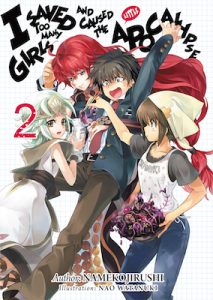
I Saved Too Many Girls and Caused the Apocalypse, Vol. 2

March 19, 2017 by Sean Gaffney

By Namekojirushi and Nao Watanuki. Released in Japan as “Ore ga Heroine o Tasukesugite Sekai ga Little Mokushiroku!?” by Hobby Japan. Released in North America digitally by J-Novel Club. Translated by Adam Lensenmayer.

This was a surprising license for J-Novel Club. Not because of the premise – honestly, the combination of harem parody along with the genre mashing of fantasy, SF, school life, and everything in between is highly appealing to North American markets. No, it’s just that this novel series is 16 volumes long in Japan, which is pretty lengthy, especially for a budding LN publisher. Thankfully, the 16th book seems to be the final one, so we don’t need to worry about it becoming a massive behemoth like A Certain Magical Index. And to be fair, judging by the lengths of these first two novels, 16 Little Apocalypses may be the equivalent of eight Devil Is a Part-Timers. The reason I bring all this up is because we not only get three heroines introduced here, but roles also for the first book’s heroines, and the introduction of (presumably) the next heroine at the end. By Book 16, what will the pileup look like? Well, probably like an apocalypse.

Of course, not all heroines are created equal. Poor Harissa doesn’t really get to do much here except fret and use the occasional spell, and Iris is sent off until the thrilling finale requires her. Satsuki plays a larger role, but that’s more due to her magical wikipedia ability than anything else. This makes sense, given that we get three new girls here, and have fun seeing Rekka try to intertwine their stories in order to solve the problem. Fortunately, two of them are already intertwined: Tetra is essentially a shrine maiden devoted to doing something about the seal that is currently holding back a powerful monster, and Leviathan (aka Lea), the monster in question who turns out to have been imprisoned there falsely. The third heroine is more down to earth: Akane Tendo (cough) pardon me, Tsumiki Nozomuno, who family owns a failing restaurant and needs her to come up with a dramatic menu item to save the day, despite the fact that anything she cooks ends up as a poisonous black sludge, and also the fact that she’s a massive tsundere.

This volume is not quite as good as the first – I suspect the author forgets that he’s writing a parody of the harem genre at times, and when he does, things get rather tedious. The villain was quite good, but the introduction reminded me a lot of Kyubey – possibly deliberately, as I think Madoka Magica was airing when this was being written. There are funny gags, although Rekka in a magical girl outfit is not as funny as the author – and indeed the rest of the cast – think. Worst of all, R’s snark is few and far between here, though when she does make a comment it’s as hilariously sarcastic and bitter as ever. She’s still easily the best part of the book.

As I said, we get a cliffhanger ending to this book, which seems to introduce the subject of the third book. Will it limit itself to just one girl this time around? If we assume 3 girls per book, that would be 48 girls, which is edging close to Negima territory, so I’m hoping that we back off a bit. I’m also hoping for a bit more making fun of the harem comedy and less conforming to it. Still, this is easy reading and fun enough for those who enjoy the genre.

Filed Under: i saved too many girls and caused the apocalypse, REVIEWS

  • « Go to Previous Page
  • Page 1
  • Interim pages omitted …
  • Page 440
  • Page 441
  • Page 442
  • Page 443
  • Page 444
  • Interim pages omitted …
  • Page 1048
  • Go to Next Page »
 | Log in
Copyright © 2010 Manga Bookshelf | Powered by WordPress & the Genesis Framework