• Skip to primary navigation
  • Skip to main content
  • Skip to primary sidebar
  • Home
  • About Us
    • Privacy Policy
    • Comment Policy
    • Disclosures & Disclaimers
  • Resources
    • Links, Essays & Articles
    • Fandomology!
    • CLAMP Directory
    • BlogRoll
  • Features & Columns
    • 3 Things Thursday
    • Adventures in the Key of Shoujo
    • Bit & Blips (game reviews)
    • BL BOOKRACK
    • Bookshelf Briefs
    • Bringing the Drama
    • Comic Conversion
    • Fanservice Friday
    • Going Digital
    • It Came From the Sinosphere
    • License This!
    • Magazine no Mori
    • My Week in Manga
    • OFF THE SHELF
    • Not By Manga Alone
    • PICK OF THE WEEK
    • Subtitles & Sensibility
    • Weekly Shonen Jump Recaps
  • Manga Moveable Feast
    • MMF Full Archive
    • Yun Kouga
    • CLAMP
    • Shojo Beat
    • Osamu Tezuka
    • Sailor Moon
    • Fruits Basket
    • Takehiko Inoue
    • Wild Adapter
    • One Piece
    • After School Nightmare
    • Karakuri Odette
    • Paradise Kiss
    • The Color Trilogy
    • To Terra…
    • Sexy Voice & Robo
  • Browse by Author
    • Sean Gaffney
    • Anna Neatrour
    • Michelle Smith
    • Katherine Dacey
    • MJ
    • Brigid Alverson
    • Travis Anderson
    • Phillip Anthony
    • Derek Bown
    • Jaci Dahlvang
    • Angela Eastman
    • Erica Friedman
    • Sara K.
    • Megan Purdy
    • Emily Snodgrass
    • Nancy Thistlethwaite
    • Eva Volin
    • David Welsh
  • MB Blogs
    • A Case Suitable For Treatment
    • Experiments in Manga
    • MangaBlog
    • The Manga Critic
    • Manga Report
    • Soliloquy in Blue
    • Manga Curmudgeon (archive)

Manga Bookshelf

Discussion, Resources, Roundtables, & Reviews

Blog

Bookshelf Briefs 5/1/17

May 1, 2017 by Michelle Smith and Sean Gaffney Leave a Comment

Anonymous Noise, Vol. 2 | By Ryoko Fukuyama | VIZ Media – Although I’m still not convinced this series is a keeper, I did like the second volume more than the first. Nino wants to improve her singing and consults Miou, the former vocalist of Yuzu’s band, who gladly points out all of her deficiencies. Apparently Nino never bothered to learn any singing fundamentals before. Meanwhile, she hears about vocal auditions for Momo Kiryu, who might be (and ultimately is) her Momo. Only, he doesn’t want to see her because he has angst about selling the songs he originally wrote for her. There is also some ridiculous angst about the reason Yuzu doesn’t sing anymore. And we still don’t have any idea what Nino’s voice actually sounds like, only that it’s unforgettable. Yet, I’m still interested in the next volume, as Nino has formally joined Yuzu’s band. I hope she develops some goals other than incessantly shouting for her childhood friend. – Michelle Smith

Kuma Miko: Girl Meets Bear, Vol. 4 | By Masume Yoshimoto | One Peace Books – Given that this volume features two detectives investigating a murder by going into a odd, remote village where everyone has strange worshiping habits, it’s not surprising that I got a bit of a Higurashi vibe off of this volume. The rest of the book is as variable as ever—I was quite amused at some of the gags, such as Natsu ending up looking as if he’s about to eat Machi by a horrible series of coincidences, or the sheer ridiculousness of the “murder” itself. But when Kuma Miko tries to do more normal manga gags, it falls flat—Hibiki’s crush being used for comedy isn’t as funny as it thinks it is, and Machi’s naivete can wear thin fast. Honestly, Kuma Miko is best read by fans of talking bears. – Sean Gaffney

Maid-sama!, Vols. 15-16 | By Hiro Fujiwara | VIZ Media – Maid-sama! keeps on trucking towards its finale. There’s rather too much repetition of the “you’re from different worlds” theme for my liking, as Misaki first encounters some weird Miyabigaoka kids who’re trying to befriend Tatsumi by throwing him an elaborate birthday party (one gift is a bronze statue of himself) and later tries to become a polished enough young lady to follow him to England, where he has gone to formally renounce his family ties. I had expected his departure to follow the shoujo trope wherein the hero goes away and there’s a time jump, but instead we actually get the story of his parentage, which was far more interesting than I expected. Still, I’m glad this is ending next time. – Michelle Smith

My Love Story!!, Vol. 12 | By Kazune Kawahara and Aruko | VIZ Media – Unlike Maid-sama!, I’m really sad this one is ending next time! Especially since a good chunk of this volume deals with compulsively lying transfer student Tanaka and how Takeo can see through his falsehoods to the loneliness within. And then Tanaka transfers schools again. It would all feel pointless if it didn’t emphasize again how good of a person Takeo is and how deep the friendship is that he and Sunakawa share. I like Yamato and all, but it’s really the depiction of this supremely meaningful friendship between guys that makes My Love Story!! unique and wonderful. Here, too, someone is poised to go overseas and we have a cliffhanger ending, but I predict happiness and warm feelings to come. – Michelle Smith

My Monster Secret, Vol. 6 | By Eiji Masuda | Seven Seas – This series is panning out to be very long, and that can be a problem when one of the main plotlines is “when will these kids who are obviously in love with each other admit their feelings” You risk frustrating your audience—especially these days, as the more modern anime fan is less tolerant of drawn-out confessions. How do you solve that, if you’re My Monster Secret? By doubling down on the comedy, as Asahi’s confession attempt is done in by Nagisa’s desperate flailing (and occasional shovels to the head), as well as Youko’s denial that he could possibly love someone like her, and the constant feeling, omnipresent in these works, that they’d ruin a great friendship . Luckily, it *is* hilarious. – Sean Gaffney

Scum’s Wish, Vol. 3 | By Mengo Yokoyari | Yen Press – The core of this third volume is the reveal about Minagawa and how she feels about Kanai—and men in general. Given that Scum’s Wish is about the sordid, seedy side of love and sexuality, she honestly fits right in, and while she’s written to come across as highly unlikable, I still sort of get a kick out of her thoughts and scheming. Meanwhile, Mugi and Hanabi have moved on to mutual masturbation, but still are avoiding the main issues, though Mugi at least it starting to see how her actions are hurting others. Not that she lets this stop her. And speaking of mutual masturbation, there’s also her friend Ecchan, who is willing to let her emotions be played with as long as she has this. Scum’s Wish: still twisted, still readable. – Sean Gaffney

Yowamushi Pedal, Vol. 5 | By Wataru Watanabe | Yen Press – There is a certain point in this omnibus, when two of our heroes are fighting against a young man stripped half naked and screaming “ABS!” like a mantra, and refusing to work together as a team in order to easily take him down, that you are thoroughly entertained by the sheer ridiculousness of what’s going on here. Less hilarious is Midousuji, whose creepy vibe is helped along by the art—it’s as if Watanabe realized how strange his faces looked on the main characters, and wondered what would happen if he took it up to eleven. The answer is: TERRIFYING THINGS. But in between that, there is bike races galore, as well as a few tragic flashbacks. Exhilarating. – Sean Gaffney

Filed Under: Bookshelf Briefs

Pick of the Week: Why Just One?

May 1, 2017 by Sean Gaffney, Ash Brown, Anna N, Michelle Smith, MJ and Katherine Dacey Leave a Comment

SEAN: I am defying the rules! I will pick two titles this week and no one can stop me! Because we’ve been waiting for My Brother’s Husband since it was announced last year, but there’s also the debut of Dreamin’ Sun from Seven Seas! I cannot choose! I must have you both!

MICHELLE: Well, if you’re doing it, then so will I! The same two titles for me, if you please!

KATE: Well, if Sean *and* Michelle are going to break the rules, then I will, too. I’m equally thrilled for My Brother’s Husband, but I’m also planning to buy the penultimate volume of My Love Story!!, one the funniest and smartest shojo comedies VIZ has published, period. It’s one of the few series that always makes me laugh — something I can’t say of many other titles that strain too hard for comic effect. If you haven’t been keeping up with My Love Story!!, now’s a great time to get reading!

MJ: I actually find myself not even remotely torn here. I am entirely on board for My Brother’s Husband this week. It’s absolutely the pick for me!

ASH: I’m definitely interested in a fair number of this week’s manga releases, including the previously mentioned debut of Dreamin’ Sun and the continuation of My Love Story!! among others, but like MJthere’s really only one pick for me this week and that is My Brother’s Husband. I couldn’t be happier that this series is being released in English.

ANNA: This is a very good week. Like everyone else I’m excited about My Brother’s Husband, but I have to admit I’m feeling so nostalgic about My Love Story!! now that the series is coming to a close, I have to go with that.

Filed Under: PICK OF THE WEEK

My Week in Manga: April 24-April 30, 2016

May 1, 2017 by Ash Brown

My News and Reviews

Last week at Experiments in Manga I posted two features in addition to the usual My Week in Manga. First up was the monthly giveaway. The winner will be announced on Wednesday, so there’s still time to enter for a chance to win the first volume of Leiji Matsumoto’s Queen Emeraldas. All you have to do is tell me a little about your favorite space manga (if you have one). Also posted last week was the long-form manga review for April. I took a look at The Girl from the Other Side: Siúil, a Rún, Volume 1 by Nagabe. The manga was one of my most anticipated debuts of 2017 and it is easily one of my favorites to be released so far this year. Last week was also the first week at my new job so I was rather preoccupied and busy with settling in there and so wasn’t online all that much. However, I did catch an interesting feature on the recent josei renaissance over at Anime Feminist. The article is written by Megan from The Manga Test Drive, one of the manga review blogs that I make a point to follow and particularly like.

Quick Takes

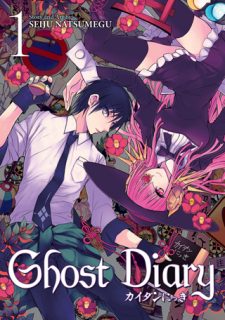
Ghost Diary, Volume 1Ghost Diary, Volume 1 by Seiju Natsumegu. My experience reading Ghost Diary was a little odd. I can’t say that I was overly impressed by the first volume while I was reading it, but by the time I reached the end I found that I actually had enjoyed myself and was interested in reading the rest of the short series. The individual elements of Ghost Diary aren’t particularly original, but as a whole it’s horrific fun. In some ways the manga feels like it’s a mashup of other existing stories which deal with the supernatural and the occult. Even the illustrations reminded me of other works, in particular some of CLAMP’s darker series. I was actually expecting Ghost Diary to be much more serious than it actually was. The manga definitely has a disturbing side to it, but to me it comes across as a dark comedy more than anything else. It’s both goofy and grotesque. The story follows Sukami Kyouichi, the youngest son in a long line of exorcists whose older sister (also an exorcist and far more powerful than he is) mysteriously disappears after he angers a god due to his inexperience, ineptitude, and ignorance. Now he’s desperately searching for her which proves to be a very dangerous venture.

Princess Jellyfish, Omnibus 4Princess Jellyfish, Omnibus 4 (equivalent to Voluems 7-8) by Akiko Higashimura. At this point the Princess Jellyfish manga has progressed much further along in the story than the content that was adapted for the anime series (which was my introduction to the work). So far, my love for the series has yet to diminish. In this omnibus the women of the Amamizukan apartments (along with Kuranosuke) somehow manage pull off a successful fashion show which is intended, in a roundabout way, to save their home from being demolished and redeveloped. However, for that to work, their success will have to extend to actually launching the Jelly Fish brand as well, and reality is much more challenging than a dream. Princess Jellyfish is intentionally outrageous and comedic in the telling of its story but the underlying heart of the manga is believable earnest. I find the manga’s style of humor to be immensely entertaining, but probably what I enjoy most about Princess Jellyfish are its characters and their relationships with one another. I especially liked how Shuu and Kuranosuke’s brotherly affections were developed and portrayed in these two volumes.

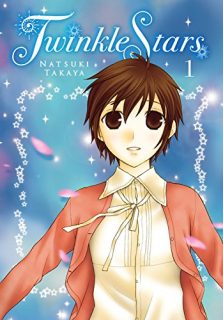
Twinkle Stars, Omnibus 1Twinkle Stars, Omnibuses 1-2 (equivalent to Volumes 1-4) by Natsuki Takaya. Probably like most people, my introduction to Takaya’s work was through the series Fruits Basket, a landmark title in the North American manga industry. It would seem, then, that Takaya’s next major series, Twinkle Stars, would be an obvious license choice, but the manga only began to be released in English relatively recently. Other than the fact that Takaya was the creator, I actually didn’t know much about Twinkle Stars before reading it. The series turns out to be an incredibly compelling and emotionally resonant work even if some of the story developments do seem a little convenient and trope-worn. The lead of Twinkle Stars is Sakyua Shiina, an endearing highschool third-year whose outward cheerfulness goes a long way to hide her inner struggle with depression and self-worth, the result of a troubled family life. Fortunately, she now has people in her life who care for her dearly. Under some rather peculiar circumstance she meets and ultimately falls in love with Chihiro, a young man who likewise is left dealing with the aftermath of past tragedies. At times Twinkle Stars can be absolutely heartbreaking but this countered by the immense kindness that is also exhibited in the series.

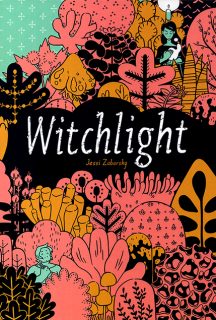
WitchlightWitchlight by Jessi Zabarsky. Before being edited and published in a collected edition with additional content, most of Witchlight had previously been released as a series of individual comic chapters. Described as a shoujo adventure, Witchlight is a delightful fantasy comic about the close bond of friendship and love which slowly develops between two young women as they travel together on a quest. They don’t start out on good terms, though. Sanja is kidnapped by Lelek, a candle witch who demands that she teach her how to use a sword. Lelek is searching for a part of herself that has been lost and magic isn’t always enough to protect her. While being abducted isn’t exactly a promising beginning to a relationship, Sanja is more curious than afraid and her good nature and openness has a positive influence on the untrusting Lelek who has kept her heart closed off from others for so long. Lelek and Sanja’s emotional journeys are the most important aspects of Witchlight, but their physical journey is also wonderful to watch unfold as they encounter other cultures and and types of magic. The characterizations, worldbuilding, artwork in Witchlight are all lovely.

RevengeRevenge: Eleven Dark Tales by Yoko Ogawa. I find the cover design and even the title selected for the English-language edition of Ogawa’s Kamoku na shigai, midara no tomurai to be somewhat misleading. Revenge, although it does make a few appearances throughout the volume, is not at all an overarching theme. And while there is death and violence, most of the gruesomeness implied by the cover occurs off-page. That being said, Revenge is a marvelously disconcerting work of subdued horror. Everything in Revenge is told from a first-person perspective, giving the collection a surprisingly quiet and contemplative atmosphere which becomes increasingly dark as the volume progresses. The individual stories can all be read and function well on their own, but what makes Revenge such a phenomenal collection is how they are all entangled with one another. Often the connections are tangential–similar turns of phrases and references are used, main characters and plot points from one story appear and reappear in the backgrounds of others, and so on–but sometimes they have a profound impact on the interpretation of the various narratives. A close, careful reading of Revenge is rewarded with the revelation of a complex, strange, and surreal web of the macabre.

Your NameYour Name directed by Makoto Shinkai. Originally I thought I would be waiting to watch a home video release of Your Name but the film actually ended up being shown at one of my local theaters and a friend invited me out to see it over the weekend. Your Name is a beautiful film, both visually and thematically, and not quite what I was expecting. (Granted, I’m not entirely sure exactly what it was that I was expecting.) To me it almost feels like three different films have been merged into one. Initially Your Name is about Mitsuha and Taki, two young people who don’t really know each other but who have started to spontaneously and erratically switch bodies when they fall asleep. But when the switching suddenly and unexpectedly stops, the film changes its focus to Taki as he tries to locate Mitsuha, keenly feeling the absence of the close intimacy that the two understandably developed over time. From there the urgency of Your Name increases even more as Taki uncovers the truth and he and Mitsuha struggle to prevent further disaster and loss. In part a romantic comedy, in part a meditation on love and spirituality, and in part (it would seem) a response to the Fukushima disasters, Your Name largely remains cohesive even while bending and shifting between genres.

Filed Under: FEATURES, My Week in Manga Tagged With: Akiko Higashimura, anime, comics, Ghost Diary, Jessi Zabarsky, makoto shinkai, manga, natsuki takaya, Princess Jellyfish, Seiju Natsumegu, twinkle stars, Yoko Ogawa

Attack on Titan, Vol. 21

May 1, 2017 by Sean Gaffney

By Hajime Isayama. Released in Japan by Kodansha, serialization ongoing in the magazine Bessatsu Shonen Magazine. Released in North America by Kodansha Comics. Translated by Ko Ransom.

(As always lately, there are major spoilers for this volume here.)

Well, we finally get the answer of who will survive. It was obviously Armin at first, but then a soldier showed up with Erwin’s dying body and the whole thing devolved into an argument about “whose life is worth more during a war?”. If I recall correctly, the Attack on Titan fandom was arguing about these chapters as well, though for a different reason – storywise, it feels like a cheat to have Armin come back from the dead after such a nice heroic sacrifice. Also, I sense the Attack on Titan audience is getting tired of the only characters dying being minor ones like Marlowe. Well, no worries here, as not only does Erwin due when Levi mercifully decides not to save him, but in order for Armin to survive, Bertolt has to be eaten. He doesn’t take it well.

Leaving aside the 80 billion counts of insubordination that Eren and Mikasa commit here, which will no doubt be gone into in the next volume, the other big dramatic moment that comes here is finding and entering the Jaeger basement. This has been the Survey Corps’ goal for who knows how long, and the “when will they get to the basement” jokes were practically a meme. Needless to say, the moment itself is given all the drama and tension it can muster, including Eren realizing that the key he’s always had isn’t for the basement door at all (Levi solves the problem by kicking the door to bits), and the cliffhanger ending showing us… a photograph! Yes, it turns out humanity may not be as completely wiped out as we suspected.

What follows is a long chapter of tragic backstory, as we have Eren’s father discussing his childhood rebellion against the authoritarian regime, the loss of his sister, his joining a resistance force, and his meeting a Historia lookalike named Dina whom he falls in love with and marries pretty quickly. Of course, we know from the very first chapters that she’s not Eren’s mother, so there’s even more drama going on here – and so yes, they’re both betrayed by Grisha’s FIRST son, named Zeke. Attack on Titan has always been fairly serious and po-faced – what little humor there is tends to come from Sasha’s antics – but even for this series, this is depressing stuff. We see a flashback to the death of the little sister, who is ripped to pieces by military dogs (no, actual dogs), and Zeke betraying his parents to the fascists is just icing on the cake.

I get the feeling that this flashback is going to take up a great deal of the next volume as well, which is good, as we still need a few more answers. For the moment, though, Attack on Titan may not be fighting too many Titans in this book, but it’s just as deadly. It’s well worth a read if you’re a fan of the series, but be warned that sometimes the mind-numbing bleakness of events can make the reader as depressed as the characters themselves.

Filed Under: attack on titan, REVIEWS

My Brother’s Husband, Vol. 1

April 30, 2017 by Katherine Dacey

The world has changed since Heather Has Two Mommies was published to controversy and acclaim in 1989. Here in the US, we’ve seen the legalization of gay marriage, first on the state and then on the federal level. We’ve also witnessed a slow but meaningful change in the way that our judicial system conceptualizes parental rights, as evidenced by a recent decision overturning Alison D. v. Virginia M., a 1991 lawsuit in which the court held that non-biological, non-adoptive parents have no legal standing in custody disputes. Writing in 2016, the New York Court of Appeals declared that “the definition of ‘parent’ established by this Court 25 years ago in Alison D. has become unworkable when applied to increasingly varied familial relationships,” recognizing the degree to which gay and lesbian partnerships had been marginalized by the original ruling.

Our recent presidential election offered a powerful reminder, however, that the initial firestorm over Heather Has Two Mommies was never fully extinguished; no matter how much the law had evolved to reflect shifting cultural attitudes, some Americans still clung tenaciously to the idea that the only legitimate families were headed by a father and a mother. In this moment of uncertainty, Gengoroh Tagame’s My Brother’s Husband is a welcome arrival in American bookstores, offering younger readers a warm, nuanced portrayal of gay life that challenges the idea that the only families that “count” are based on blood relations.

Tagame’s story focuses on Yaichi and Kana, a single father and his curious, outspoken daughter. Their cosy household is upended by the arrival of Mike Flanagan, a good-natured Canadian who was married to Yaichi’s deceased twin brother Ryoji. Yaichi is reluctant to host Mike, but seven-year-old Kana warmly embraces their visitor, insisting that Mike stay with them as an honored family member.

In the early chapters of the story, Mike represents a direct challenge to Yaichi’s unexamined beliefs about homosexuality. Tagame uses a split screen to make us privy to Yaichi’s internal monologue, contrasting Yaichi’s public actions with his private thoughts, in the process revealing the extent to which Yaichi uses stereotypes to justify his discomfort with Mike. Not surprisingly, Yaichi initially treats Mike as a nuisance, but his attitude changes as he watches Kana interact with Mike; her natural curiosity and warmth bring out the same qualities in their guest, encouraging Yaichi to view Mike as an individual, rather than a type.

In the later chapters of the story, Mike’s role in the household begins to evolve. He joins Yaichi and Kana in their daily activities — going to the store, visiting the community center — and talks openly with Kana about his marriage to Ryoji. When Yaichi’s ex-wife arrives for a visit, she marvels at Mike, Yaichi, and Kana’s closeness, recognizing the degree to which they’ve formed their own impromptu family in just a short amount of time.

My Brother’s Husband might feel like an Afterschool Special if not for the crispness of Gengoroh Tagame’s artwork, which conveys both the small-town setting and characters’ feelings with great specificity. In particular, Tagame does a fine job of suggesting just how conspicuous Mike really is in the village where Yaichi and Kana live, using the scale of Yaichi’s house — the rooms, the tatami mats, the bathtub — to drive home the point. Tagame proves equally adept at using the characters’ body language and facial expressions as a window into their feelings. In one of the story’s most poignant scenes, for example, a drunken Mike mistakes Yaichi for Ryoji, dissolving into tears as he collapses into Yaichi’s arms; it’s the only moment in which the strong, confident Mike seems vulnerable, his posture and face convulsed in grief over losing the husband he cherished. Yaichi’s grimaces, smiles, and gasps likewise reveal his vulnerability, documenting his ambivalent feelings about Mike in particular and homosexuality in general; the dialectical process by which Yaichi comes to embrace Mike as part of his family registers as much on Yaichi’s face as it does in his words and his actions.

Though some of the conflicts are resolved with sitcom tidiness, My Husband’s Brother earns points for its well-rounded characters and frank acknowledgment of Yaichi’s initial discomfort with Mike. That we believe in Yaichi’s transformation from skeptic to ally, and embrace Mike as a complex individual and not a cardboard saint, is proof of Tagame’s ability to tell a nuanced all-ages story that will resonate with readers on both sides of the Pacific. Highly recommended.

A word to parents, teachers, and librarians: My Brother’s Husband is appropriate for readers in middle and high school. Though the subject of Mike’s relationship with Ryoji is discussed at length, the story focuses on Mike’s romantic feelings for Ryoji; the sexual dimension of their relationship is not depicted.

Review copy provided by the publisher. My Brother’s Husband will be released on May 2, 2017.

MY BROTHER’S HUSBAND, VOL. 1 • BY GENGOROH TAGAME • PANTHEON BOOKS • NO RATING (SUITABLE FOR READERS 10+)

Filed Under: Manga, Manga Critic, REVIEWS Tagged With: Gengoroh Tagame, LBGTQ Manga, Pantheon

The Devil Is A Part-Timer!, Vol. 7

April 30, 2017 by Sean Gaffney

By Satoshi Wagahara and 029. Released in Japan by ASCII Mediaworks. Released in North America by Yen Press. Translated by Kevin Gifford.

Unlike the DanMachi collection released on the same date, this volume of short stories is not interconnected into a pseudo-plot – it’s just a collection of four short stories. Fortunately, the stories are all quite good, so we also lack the lows of that DanMachi collection as well. Devil Is A Part-Timer! is very strong when it’s talking about nothing in particular, so this volume plays to those strengths, showing our heroes going up against fraudulent shysters, adopting stray kittens, buying futons for their magical sword babies, and learning how to work fast-food without losing your mind. It’s also a good volume for shippers, particularly if you ship Maou and Emi, as the entire third story is basically about how great they work as a couple, and how much this seems to upset Emi.

The first story is probably the slightest – ironically, it’s the one they chose to adapt into the anime, as Maou has to deal with the fallout of Urushihara being tricked into buying a lot of useless stuff. He (and the reader) learn about how these schemes are done, and how difficult it can be to recover anything from them. The kitten story is probably the cutest, and again revolves around one of the themes of this novel series, which is explaining what seem to be obvious concepts to those completely unfamiliar with modern-day Japan. Not only does Maou not really know how to take care of cats, he’s not aware there are vets. And even worse, he’s not aware how fast he and the others can bond with a kitten. The third story, as I said earlier, is basically pure ship tease, with Maou and Emi buying a futon for Alas Ramus and everyone around them thinking they’re such a great couple. It’s amusing precisely because everyone is correct – when she’s not panicking about the very idea, they are a great couple.

The final story is easily the longest of the four, and takes place right before the series begins. It focuses on Chiho and how she came to get a job at McRonald’s and meet Maou, as well as why she fell in love with Maou. It’s nice to see Chiho interacting with her friends at school – indeed, I suspect one reason this story came out is to give greater depth to Kaori and Yoshiya in anticipation of them appearing in the main story later on. (It’s also very refreshing to see a ‘two girls, one boy’ high school friendship with no romantic tension whatsoever.) Chiho is a fairly sheltered girl whose father is a police officer, and so feels she’s lacking life experience, one reason why she applies for the McRonald’s job. There’s a lot made in this story about the ‘career survey’ all Japanese students dread, and exactly how relevant it needs to be. Mostly, though, this is a good showcase for Chiho and demonstrates how far she’s come in the six volumes since.

This isn’t essential reading, but all volumes in this series are good, and if you’re collecting it there’s no reason to pass it up. The Devil Is A Part-Timer! remains among the best Yen On releases.

Filed Under: devil is a part-timer!, REVIEWS

Giant Killing, Vol. 1

April 29, 2017 by Michelle Smith

By Masaya Tsunamoto and Tsujitomo | Published digitally by Kodansha Comics

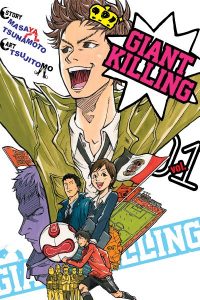
Although I genuinely, deeply love shounen sports manga, I can’t deny that most follow similar story beats. I knew going in that Giant Killing is actually seinen, but wasn’t prepared for what a breath of fresh air it would be.

Instead of some first-year joining his high-school team, the protagonist of Giant Killing is Takeshi Tatsumi, a 35-year-old former pro soccer player turned coach. The series opens with Yuri Nagata and Kosei Gotou, the PR rep and general manager of East Tokyo United (a struggling Japanese team) finally locating Tatsumi at his job in England, where has led a team of amateurs to a top-32 finish in the Football Association Cup. They have even managed to crush professional teams.

It turns out that Tatsumi specializes in leading underdog teams to victory against highly favored opponents. He sees it as a David-and-Goliath scenario, hence the title of the series. Initially, the English club president doesn’t want to let Tatsumi out of his contract, but when he learns that Tatsumi used to play for ETU and that there are desperate fans in his hometown waiting to be helped, he relents and lets him go.

Tatsumi doesn’t seem to particularly care either way and it’s this neutrality that makes him an interesting character and effective coach. For instance, at his first practice session with the ETU team, he makes them run sprints for 45 minutes. Those with the most stamina turn out to be the younger guys, but they’re also merely the alternates on the team. With his guidance, they manage to defeat the older starters in a scrimmage. The stalwart veteran of the team, Murakoshi, gets his pride wounded by this, but rather than suggest that he’s no longer useful, Tatsumi instead points out that what he needs is to find his own secret weapon to overcome these odds. Tatsumi is adept at seeing a team or an individual’s shortcomings and offering strategies to overcome them, and that’s the kind of reliable leadership that Murakoshi has done without all these years.

On the one hand, Tatsumi exemplifies the gifted protagonist that this genre is full of, but his gift is not in his own athletic prowess (or not merely that) but rather his ability to furnish others with the tools they need to succeed, to reinvigorate failing franchises, and to rekindle fan enthusiasm. And, of course, the clubs don’t mind the boost in revenue that inevitably results. Giant Killing is every bit as addictive as a shounen series, but with grown-up stakes and nuance. I can’t wait to read more!

Giant Killing is ongoing in Japan, where the 43 volumes have been released so far.

Review copy provided by the publisher.

Filed Under: Manga, REVIEWS, Seinen

Ace of the Diamond, Vols. 1-2

April 28, 2017 by Michelle Smith

By Yuji Terajima | Published digitally by Kodansha Comics

Eijun Sawamura really wanted to make some good baseball memories with his middle-school friends, but even though they practiced hard, they couldn’t win a single game. Although he shows talent as a pitcher, his unsportsmanlike behavior after a bitter defeat means most of the good baseball schools are no longer interested in him. And, because he is a hot-headed yet enthusiastic idiot, he totally forgot about the entrance exams required for other schools.

Luckily, Rei Takashima pays a visit and scouts him for Seido High, a big-name school in Tokyo that’s been to Koshien many times. He’s torn between testing his skills in this new world (the baseball club has over 100 members vying for nine positions on the roster, so competition is fierce) and loyalty to his old friends, but after they encourage him to seize the opportunity, he’s off to Tokyo. Of course, because he is such a hot-headed yet enthusiastic idiot, he clashes with the strict coach right away, flubs a chance to show off his pitching potential, and is barred from participating in practice.

After the Spring Tournament, in which Seido’s lack of a pitching ace becomes obvious, Eijun gets one more chance to show what he can do in a first-years versus upperclassmen game. The upperclassmen immediately dominate but Eijun isn’t intimidated or discouraged, and the second volume ends with the cliffhanger… will he and another first year succeed in scoring against overwhelming opponents?
So far, Ace of the Diamond is a lot of fun. I can’t claim that Eijun’s personality type is especially endearing, but he’s got his admirable qualities, too. More, though, I am having fun with the rapidly expanding cast. Beyond the upperclassmen, which include Eijun’s roommates at the dorm and a genius catcher with a troublemaking streak, we also meet Satoru Furuya, another first-year pitcher who’ll likely become Eijun’s fiercest rival; Haruno Yoshikawa, a clumsy first year manager and presumed love interest; and Haruichi Kominato, a diminutive wallflower with a talent for precision batting.

The pace is fast, the characters are fun, the protagonist has a lot of room to grow, the series is 47 volumes long with a sequel… All of that sounds spectacular for a sports manga geek like me. Thank you, Kodansha!

Side note: I keep wanting to call this series Aim for the Ace!, but that’s something completely different. (I still really want to read it, though.)

Ace of the Diamond is complete with 47 volumes. However, a sequel series—subtitled Act II—is still running. The seventh volume came out in Japan last week.

Review copies provided by the publisher.

Filed Under: Manga, REVIEWS, Shounen

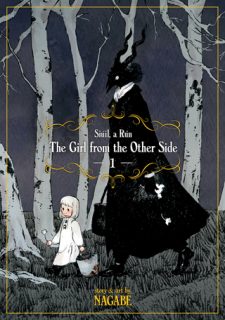
The Girl from the Other Side: Siúil, a Rún, Vol. 1

April 28, 2017 by Ash Brown

The Girl from the Other Side: Siúil, a Rún, Volume 1Creator: Nagabe
Translator: Adrienne Beck
Adapter: Ysabet Reinhardt MacFarlane
U.S. publisher: Seven Seas
ISBN: 9781626924673
Released: January 2017
Original run: 2016

The Girl from the Other Side: Siúil, a Rún by Nagabe was easily one of my most anticipated manga debuts of 2017. Nagabe is known as a creator of somewhat unusual or unorthodox manga, The Girl form the Other Side easily fitting into that category. (Nagabe’s work was actually first brought to my attention thanks to a series of beautifully drawn boys’ love doujinshi featuring birds.) The first volume of The Girl from the Other Side was originally published in Japan in 2016, while the English-language edition was released by Seven Seas early in 2017. The quality of the physical release is admittedly a little disappointing–the cover stock feels ephemeral and ink tends to smudge and transfer between pages (granted, this does at least seem to be thematically appropriate)–but I’m thrilled that The Girl from the Other Side is being translated at all. It’s also worth noting that the manga does share some obvious parallels with another unusual series, Kore Yamazaki’s The Ancient Magus’ Bride, but even considering their similarities they are quite different from each another.

Once upon a time, two kingdoms existed in a world divided into the Outside and the Inside. Humans live on the Inside behind a wall intended to keep the monstrous Outsiders and the dark curse associated with them at bay. Coming into contact with an Outsider is to be avoided at all costs; to do otherwise means risking ones’ life and humanity. But the darkness of the Outside is slowly encroaching upon the light of the Inside. Humans are succumbing to a cursed disease and are abandoning entire villages as they unsuccessfully try to flee from it. Out of fear and suspicion, people have started to turn against one another in a desperate effort to survive. In the midst of this turmoil is a young girl, Shiva. Unexpectedly left behind in an area which is now considered a part of the Outside, she is waiting to be reunited with her family. In a peculiar twist of fate, Shiva is being guarded and cared for by an inhuman Outsider who she simply calls “Teacher.” The circumstances are unusual and dangerous for them both as Shiva’s safety becoming more and more difficult to guarantee the longer she remains on the Outside, set apart from others.

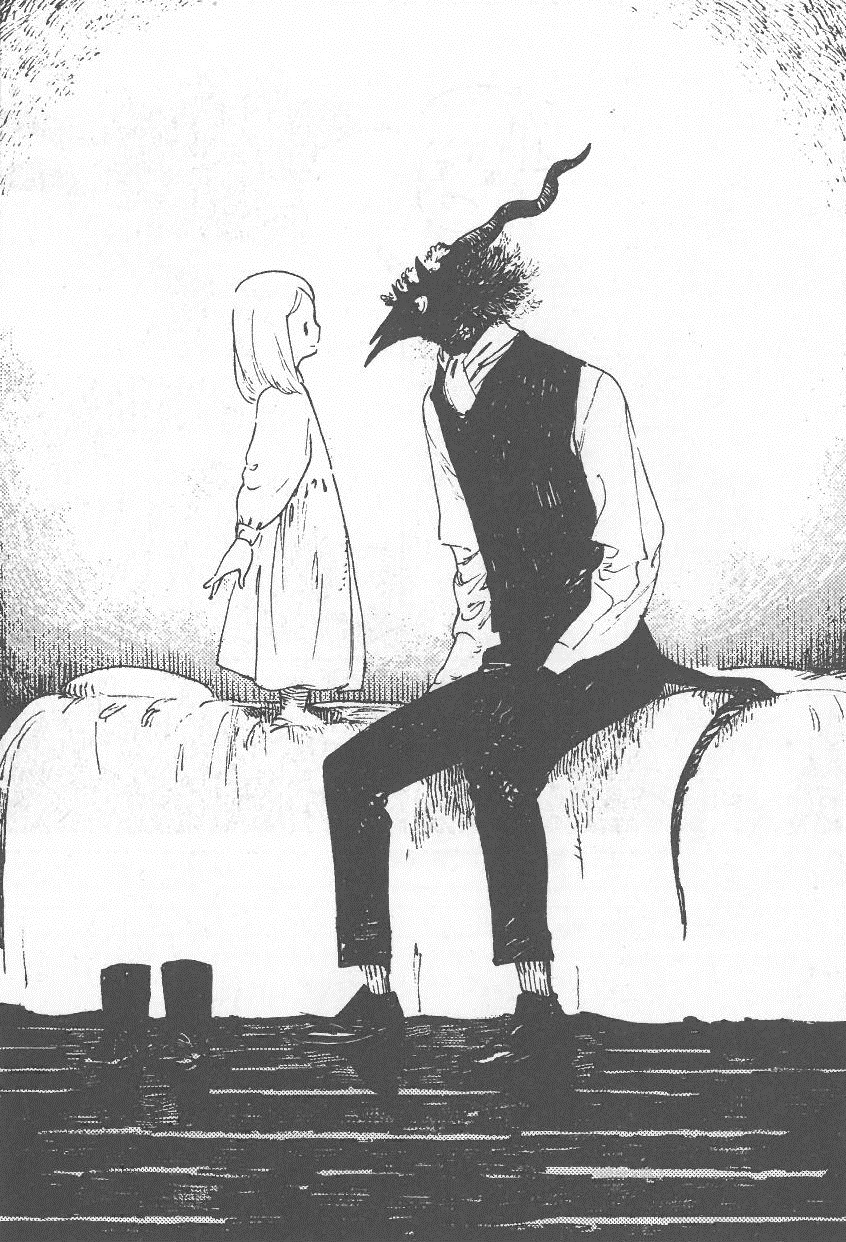
 The Girl from the Other Side: Siúil, a Rún, Volume 1, page 32The fact that Shiva’s very life is in danger is clear from the beginning of The Girl from the Other Side. As a sort of prologue, the manga opens with her being warned of the curse brought by the touch of an Outsider while the first panel of the story-proper shows her lying listless on the stump of a tree. She has only fallen asleep, but the visual cues of the scene are closely reminiscent of death. An ominous feeling of uncertainty–is Shiva actually alive or is she dead, how much of her world is real and how much of it is a fairytale–pervades The Girl from the Other Side. Shiva is young enough that she doesn’t completely understand everything that is happening to her and doesn’t know enough to be afraid. But as she experiences more her awareness grows, even when Teacher tries to shield her from life’s harsher realities. Likewise, readers gain more knowledge as the underlying truths of Shiva’s situation are slowly revealed. However, they don’t have Teacher to soften the blows for them. To some extent Shiva’s innocence protects her from the tragedy and heartbreak inherent to The Girl from the Other Side which is so obvious from an outside perspective.

The Girl from the Other Side is incredibly atmospheric, a beautiful and surprisingly gentle and charming story which simultaneously manages to be disconcerting and unsettling. The series is very dark, in both theme and illustration. There is a tremendous amount of ink on the manga’s pages–the oppressive shadow of death which haunts the story is reinforced visually, the darkness permeating the scenes. Shiva, with her light-colored hair and dressed in white, stands apart from the unwelcoming environment. She is obviously out of place, separate from what is around her. In contrast, Teacher is clothed in black and at times is barely discernible from the background. But although an Outsider and demonic in form, Teacher is Shiva’s only hope, trying to safeguard her from anyone who would seek to do her harm. Their strange yet sweet and endearing relationship is core to The Girl on the Other Side. The life that they have, no matter how impermanent, carries great weight as they face an uncertain future together. The Girl from the Other Side is a gorgeous and striking work; I can’t wait for the next volume to be released.

Filed Under: REVIEWS Tagged With: Girl from the Other Side, manga, Nagabe, Seven Seas

Is It Wrong To Try To Pick Up Girls In A Dungeon?, Vol. 8

April 28, 2017 by Sean Gaffney

By Fujino Omori and Suzuhito Yasuda. Released in Japan as “Dungeon ni Deai o Motomeru no wa Machigatte Iru Darou ka?” by Softbank Creative. Released in North America by Yen On. Translated by Andrew Gaippe.

I knew going in that this was going to be a short-story collection, but it turns out that’s not quite true. What it is is more “A day in the life” – there’s still an overarching plot going on, and stories do affect other stories, but each of the six main stories is also self-contained and stars a specific member of Hestia Familia. Omori said that he wanted to write stories about love in this volume, which may make some readers cringe, and rightly so. DanMachi works best when the harem romance is used as a spice, in my opinion, and this is definitely a heaping helping of main course romance. That said, I have an easy way to tell whether you’ll enjoy a story or not – the longer the story, the better it is.

Unfortunately, that means the book begins with its worst story. I’ve never been a fan of “we’re not blood related so it’s not really incest” stories, and so Mikoto’s crush on her adoptive God father Takemikazuchi merely aggravated me, especially as it’s surrounded by a host of other cliches. I suspect the author meant it to be the funny one of the group. Eina’s story involved Bell protecting her from a stalker, but was probably the most boring of the stories, much like its female lead (sorry, Eina). Syr’s story was all right, but it teased that it was going to finally show off how she was related to Freya – fan rumor suggested she IS Freya, but that seems unlikely – but left things a bit too vague to be satisfying.

The longer stories fare much better. Lilly and Hestia are the only characters who get to definitively talk about their love for Bell openly in the series, and we see that love being put to the test on Lilly’s end, as not only has the rest of the group been told about Bell’s special skills (and thus that his stats are literally driven by his love of Ais), but she’s feeling useless in the dungeon as well, and ends up with a huge case of self-hatred (which honestly is always sort of boiling beneath the surface of Lilly). Help comes in the form of Finn, who is not only the only other hobbit – sorry, prum – in the book, but also far more savvy about romance (well, except for the advances of the amazon with the crush on him). As for Welf, his is the least romantic story in the book, though we see his respect for Hephaistos borders on love, and she also loves seeing his growth. Welf actually drives the main plot, as his magic sword skills are now well known – and people are trying to use them for evil.

The final story stars Hestia, Bell and Ais, and I enjoyed it a great deal as well, though a brief caveat that people who dislike jealous, petty Hestia will probably dislike it a bit more. That said, Bell finally seems to be catching a clue about how Hestia feels about him, though it’s not clear whether he’ll actually do anything about that. (Finn mentions harems to him at one point, but I honestly don’t think this is going to be that kind of series.) As for Ais, she’s showing a lot more emotion in her own stoic way than she ever has before, and we see her as furious as she ever gets when seeing how a reclusive village worships an ancient dragon. I suspect this may be related to backstory we’ll get more of in Sword Oratoria.

So in the end a bit of a mixed bag, but still well worth reading for fans of the series, especially if you like Lilly, Welf, or Hestia. There’s a bit of a tease for the next book at the end, and I sense we’re about to get a more serious arc next. Perhaps with a more normal focus on action rather than romance?

Filed Under: is it wrong to try to pick up girls in a dungeon?, REVIEWS

  • « Go to Previous Page
  • Page 1
  • Interim pages omitted …
  • Page 433
  • Page 434
  • Page 435
  • Page 436
  • Page 437
  • Interim pages omitted …
  • Page 1048
  • Go to Next Page »
 | Log in
Copyright © 2010 Manga Bookshelf | Powered by WordPress & the Genesis Framework