• Skip to primary navigation
  • Skip to main content
  • Skip to primary sidebar
  • Home
  • About Us
    • Privacy Policy
    • Comment Policy
    • Disclosures & Disclaimers
  • Resources
    • Links, Essays & Articles
    • Fandomology!
    • CLAMP Directory
    • BlogRoll
  • Features & Columns
    • 3 Things Thursday
    • Adventures in the Key of Shoujo
    • Bit & Blips (game reviews)
    • BL BOOKRACK
    • Bookshelf Briefs
    • Bringing the Drama
    • Comic Conversion
    • Fanservice Friday
    • Going Digital
    • It Came From the Sinosphere
    • License This!
    • Magazine no Mori
    • My Week in Manga
    • OFF THE SHELF
    • Not By Manga Alone
    • PICK OF THE WEEK
    • Subtitles & Sensibility
    • Weekly Shonen Jump Recaps
  • Manga Moveable Feast
    • MMF Full Archive
    • Yun Kouga
    • CLAMP
    • Shojo Beat
    • Osamu Tezuka
    • Sailor Moon
    • Fruits Basket
    • Takehiko Inoue
    • Wild Adapter
    • One Piece
    • After School Nightmare
    • Karakuri Odette
    • Paradise Kiss
    • The Color Trilogy
    • To Terra…
    • Sexy Voice & Robo
  • Browse by Author
    • Sean Gaffney
    • Anna Neatrour
    • Michelle Smith
    • Katherine Dacey
    • MJ
    • Brigid Alverson
    • Travis Anderson
    • Phillip Anthony
    • Derek Bown
    • Jaci Dahlvang
    • Angela Eastman
    • Erica Friedman
    • Sara K.
    • Megan Purdy
    • Emily Snodgrass
    • Nancy Thistlethwaite
    • Eva Volin
    • David Welsh
  • MB Blogs
    • A Case Suitable For Treatment
    • Experiments in Manga
    • MangaBlog
    • The Manga Critic
    • Manga Report
    • Soliloquy in Blue
    • Manga Curmudgeon (archive)

Manga Bookshelf

Discussion, Resources, Roundtables, & Reviews

Blog

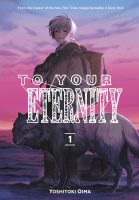
To Your Eternity, Vol. 1

November 13, 2017 by Sean Gaffney

By Yoshitoki Oima. Released in Japan as “Fumetsu no Anata e” by Kodansha, serialization ongoing in the magazine Weekly Shonen Magazine. Released in North America by Kodansha Comics. Translated by Steven LeCroy.

It’s always best when an author knows what they’re good at and continues to give us that product, and it’s even better when they can do so even while changing genres. Oima is best known as the author of A Silent Voice, and so a fantasy starring a shape-changing alien was not the most obvious follow-up, let’s be honest. But of course, what Oima is best at is gut-wrenching emotional scenes and dancing at the edge of tragedy, which we saw over and over again in A Silent Voice (which thankfully most avoided slipping into full-on tragedy), and now we see plenty of that in this new series. As always with a first volume, I’m not suite sure where this is going – the first chapter might have been a prologue and we’re now following the main cast, or it could be that this is more of an anthology series. One thing is clear, though: bring tissues.

I wasn’t actually spoiled on this series, for once, and will try to avoid spoiling any readers of this review, though it’s always hard to be elliptical about this sort of thing. Let’s just say I was entirely prepared for this series to be a heartwarming tale of a boy and his alien-turned-wolf as they march across the frozen wastes to freedom… and no, that’s not what we’re getting. The boy does not appear to have a name, and it’s a good thing that he’s so plucky and optimistic because his life to date has sucked rocks, including being abandoned by the village to look after those who can’t leave it… for some reason or another. His one companion is the wolf… who we see killed at the start of the book, and the shapeshifter takes its form. Fortunately, the shapeshifter is willing to be the boy’s pet wolf and heartwarming moments ensue… at first.

The second half of the book, and the reason I wonder if this is more of an anthology series with recurring characters, deals with a village girl who’s got big dreams of being an adult and raising a family, dreams that may have to be cut short when she’s selected as the sacrifice to the local Shardik-like God. (Honestly, it’s not clear whether the giant bear is really the local god or not, but it’s certainly a really big bear.) Fortunately, the village’s worst archer is there to try to help her. The girl’s tomboy attitude and the archer’s bad shooting are brief moments of amusement in this otherwise very serious volume. Fortunately the sacrifice is interrupted, but it’s not clear where we’re headed after this.

This series is meant to evoke a mood, and that mood is ‘tear-jerking’. If you really want to read something like that, this is absolutely your jam. I’m not sure I’ll be able to read something like this in an ongoing series, but as a first volume it packs a powerful wallop.

Filed Under: REVIEWS, to your eternity

Is It Wrong To Try To Pick Up Girls In A Dungeon? On The Side: Sword Oratoria, Vol. 4

November 12, 2017 by Sean Gaffney

By Fujino Omori and Suzuhito Yasuda. Released in Japan as “Dungeon ni Deai o Motomeru no wa Machigatte Iru Darou ka? Gaiden – Sword Oratoria” by Softbank Creative. Released in North America by Yen On. Translated by Liv Sommerlot.

I’d mentioned in my last review that the battles are what Omori writes best, and it’s still true. I’ll go even further: if you aren’t enjoying the battle sequences, there’s no real reason for you to read Sword Oratoria. That’s not to say the entire book is wall-to-wall fights – in fact, we don’t start the descent to the 59th floor till the 2nd half of the book. But I have to admit, the plot is being dripped to us in tiny amounts as the author struggles to fit this into the continuity of the main series. And, much as I like Lefiya a lot more than most DanMachi fans, it has to be said: as a jealous pseudo-lesbian, she’s rather irritating. As a female expy of Bell, she works far better, and her triumph in the dungeons towards the end is one of those “pump your fist” moments.

Yes, that’s Bell on the cover, and while he’s not in the book as much as I expected (the scene with the minotaur is kept to the bare minimum), we get a lot more context here for how Aiz feels about him. Whether those feelings are love or no, it’s pretty clear that Lefiya is not being paranoid in her jealousy – Aiz is becoming obsessed with Bell and how fast he’s growing as an adventurer. And he’s not the only one – the minotaur scene may be downplayed in the spinoff, but the impact is shown on all of Loki Familia as they descend to the 59th floor, each one using Bell as inspiration for their own growth. As I said above, when Lefiya is not chewing walls while staring at Aiz and Bell, she’s also excellent – Aiz’s hardcore “I don’t actually know how to teach” training may not help her much, but her friendship with Filvis (the Dionysus adventurer from the previous volume) proves to be far more impactful.

And then there are those fight scenes. This is Aiz’s spinoff, but in reality it’s proven to be more about Loki Familia in general, and the leaders of the family all get a chance to show off their amazing stuff here, with Gareth literally flinging a dragon like you would an Olympic hammer, Riveria’s magic providing seemingly over an hour of support allowing the rest of the family to rescue Lefiya (who has plummeted down six levels – don’t worry, it leads to better things), and Finn being the competent, sensible leader this team of hotheads needs – until the situations grows dire, when he takes off his limiters and proves to be more hotheaded than all the rest.

DanMachi is never going to be the sort of series that rewards deep analysis, and that goes doubly for its spinoff. This is fast food. But it’s very tasty fast food which leaves you satisfied and wanting to go back, which is all a franchise can really ask of its ongoing volumes. Highly recommended to DanMachi fans who can get over Lefiya’s behavior around Aiz.

Filed Under: is it wrong to try to pick up girls in a dungeon?, REVIEWS

Twinkle Stars, Vol. 4

November 11, 2017 by Sean Gaffney

By Natsuki Takaya. Released in Japan as two separate volumes by Hakusensha, serialized in the magazine Hana to Yume. Released in North America by Yen Press. Translated by Sheldon Drzka.

The decline and fall of Hijiri continues in this omnibus, as she tries her hardest to be a Hanajima but in the end is more of a Rin, complete with the angry freakouts whenever she’s embarrassed. This is not to say I don’t enjoy the entire plotline; the relationship between Hijiri and Saki may not be the healthiest in the world, but it’s cute, and leads to several laugh-out-loud moments, such as seeing how Hijiri first ‘brought Saki home’. Her own frustrations seem to spill over into her interaction with others as well, as she tries to help a girl who likes Yuuri confess to him even though she knows he’s going to reject the girl, and also tries to nag Yuuri into making his own advances on Sakuya, even as Yuuri seems content to sit back and watch Chihiro and Sakuya grow closer.

Of course, it’s entirely possible that he suspect Chihiro will simply torpedo himself before too long. Takaya’s series tend to have a common theme of seemingly “pure-hearted and good” people repressing their own emotions and traumas, and we get a lot of that here, as the art shows a large degree of depressed, resigned stares into the middle distance as characters wrestle with the fact that they might actually be forced to confront feelings that they’ve been avoiding for years. Kanade’s past is learned here, and it too manages to be a parade of parental abuse and distorted bouts of anger, another constant in Takaya’s works. I’ve tended to think that Twinkle Stars is trying to apologize to Tohru/Yuki Furuba fans by having this title be the one where they win, with Kanade as “Kyo”, but while Kanade is an awful lot like Kyo, he’s not a romantic lead, so it doesn’t quite fit.

This may make it sound as if the entire volume is nothing but depressing moping around, and it’s not. Takaya does have a certain amount of humor in this book, usually through snarky comments and reaction takes. Again, we see this most in scenes with Hijiri, whose own subplot is meant to be a lighter counterpart to the more serious relationships. This unfortunately does have the effect of diminishing Hijiri a bit, as I noted above – yes, she’s a bit more realistic and flawed, but I also feel she’s becoming almost too much of a caricatured “angry, embarrassed girl”, a trope which I think works better in shonen settings than in shoujo ones.

Twinkle Stars ran 11 volumes in Japan, and we’re up to 8 with this omnibus. I’m not certain if the final volume will be a triple of if we’ll get a single volume 6. In either event, I do still enjoy this series, especially for the emotional resonance, though I am grateful it’s going to be wrapping up soon as I’m not sure how much more teenage romantic drama I can take.

Filed Under: REVIEWS, twinkle stars

Bookshelf Overload: October 2017

November 10, 2017 by Ash Brown

Another month, another mountain of media that somehow made its way into my possession! (Actually, I know exactly how.) Thanks to some fantastic sales, I finally got around to filling in the gaps in my collection of Takehiko Inoue’s Vagabond. I also ended up buying more anime than I usually do, too. In particular, Sentai Filmworks announced back in September that it would be discontinuing DVDs and has since been working to clear out stock. Since my eyesight is poor enough that I don’t usually notice a difference in visual quality between DVD and Blu-ray releases, I took the opportunity to pick up Space Brothers and a few other things at a greatly discounted price. As for October manga debuts, I was greatly impressed by Spirit Circle, Volume 1 by Satoshi Mizukami. I was also really looking forward to the release of Yokai Rental Shop, Volume 1 by Shin Mashiba since I enjoyed the creator’s earlier series Nightmare Inspector. Notably, manga translator and yokai scholar Zack Davisson released a new work in October, too–Kaibyo: The Supernatural Cats of Japan is one of the newest titles from Chin Music Press, a publisher that takes great care with physical production and design, so in addition to being interesting, it’s also a beautiful book.

Manga!
Ajin: Demi-Human, Volume 10 by Gamon Sakurai
Akuma no Riddle, Volumes 2-4 written by Yun Kouga, illustrated by Sunao Minakata
Food Wars!: Shokugeki no Soma, Volume 20 written by Yuto Tsukuda, illustrated by Shun Saeki
Gangsta: Cursed, Volume 3 written by Kohske, illustrated by Syuhei Kamo
Imperfect Girl, Volume 1 by Mitsuru Hattori
Jackass! by Scarlet Beriko
The Key to the Kingdom, Volumes 1-6 by Kyoko Shitou
Kitaro’s Strange Adventures by Shigeru Mizuki
Prison School, Omnibus 8 by Akira Hiramoto
Spirit Circle, Volume 1 by Satoshi Mizukami
Super Dimensional Love Gun by Shintaro Kago
Vagabond, Omnibus 7-8 by Takehiko Inoue
Yokai Rental Shop, Volume 1 by Shin Mashiba

Comics!
The Academic Hour by Keren Katz
Awaken, Volume 1 by Koti Saavedra
The Big Book of Bisexual Trials and Errors by Elizabeth Beier
Can I Pet Your Werewolf? edited by Kel McDonald and Molly Muldoon
Cosmoknights: Prologue by Hannah Fisher
Flutter, Volume 3 written by Jennie Wood, illustrated by Jeff McComsey
Fujoshi Trapped in a Seme’s Perfect Body, Volume 3 written by Seru, illustrated by Joberu
Generations by Flavia Biondi
Goro, Issue 1 by Sarah Horrocks
Ladycastle written by Delilah Dawson, illustrated by Ashley A. Woods
Mis(h)adra by Iasmin Omar Ata
Oh Joy, Sex Toy, Volume 4 created by Erika Moen and Matthew Nolan
Spinning by Tillie Walden
The Tea Dragon Society by Katie O’Neill
The Witch Boy by Molly Knox Ostertag

Light Novels!
Juni Taisen: Zodiac War written by Nisiosin, illustrated by Hikaru Nakamura

Novels!
The Explosion Chronicles by Yan Lianke
Milky Way Railroad by Kenji Miyazawa
Snakelust by Kenji Kagagami

Anthologies!
Japanese Gothic Tales by Kyōka Izumi

Poetry!
Bashō’s Narrow Road: Spring and Autumn Passages by Bashō Matsuo
Night Sky with Exit Wounds by Ocean Vuong

Nonfiction!
Kaibyo: The Supernatural Cats of Japan by Zack Davisson
The Silver Spoon: Memoir of a Boyhood in Japan by Kansuke Naka

Anime!
Food Wars! directed by Yoshitomo Yonetani
Gosick, Part 2 directed by Hitoshi Nanba
Hozuki’s Coolheadedness directed by Hiro Kaburaki
Orange directed by Hiroshi Hamasaki
Pet Shop of Horrors directed by Toshio Hirata
Space Brothers directed by Ayumu Watanabe

Filed Under: Bookshelf Overload, UNSHELVED

Re: ZERO ~Starting Life in Another World~, Vol. 5

November 10, 2017 by Sean Gaffney

By Tappei Nagatsuki and Shinichirou Otsuka. Released in Japan by Media Factory. Released in North America by Yen On. Translated by Jeremiah Borque.

I admit that after four volumes of Re: Zero, and without having actually seen the anime (which, let’s remember, adapts the first NINE books), I wasn’t really sure what all the fuss was all about with Rem. I didn’t see why, aside from maybe general personality, she became basically the entire reason to watch the show for many fans. Having now read this 5th book, I think I’ve hit the point where I can say “Oh, yeah, that’s it”. Now that Emilia has broken off with Subaru and returned to the mansion, Rem gets her turn in the spotlight, showing a love and devotion to Subaru that almost goes to extremes. This can be heartwarming (as when she tries to get him to maybe stop hating himself a bit) and also disturbing (a lot of other times), but it’s hard to deny that Subaru transformed Rem’s life, and she’s never going to forget it.

It’s a good thing that someone’s in Subaru’s corner, because the reader certainly isn’t. Yes, it’s time to trawl through another book with the worst protagonist ever, as Subaru shows that after his epic beatdown from last time, he has not learned a single thing, assuring us that he will return to Emilia, save the day, and everything will be great again. Needless to say, that doesn’t happen. In fact, it doesn’t happen twice, as we’ve got another save point, meaning Subaru is free to start brutally dying again. It’s not just him or Emilia this time, though, as seemingly the entire village and mansion is slaughtered by our new enemies, the Witch Cult, led by Petelgeuse, a truly freaky nightmare who seems to revel in being insane because it’s over the top rather than any other reason. Subaru’s (feigned?) mental breakdown halfway through the book may give Rem some much needed spotlight, but it doesn’t do him much good. Even in the very end, we see his rage and fury and think: Yup, still hasn’t learned a goddamn thing.

That said, aside from Subaru I am still enjoying this series a great deal. The election continues apace, and we see once more just how hard it is for Emilia to get anywhere in it when even our grumpy abble seller and Rem show they have an instinctive fear and hatred towards her. Crusch remains an awesomely cool character, and we get some tantalizing background details of how she met Ferris that we want to hear more about. (If only there were a spinoff novel coming out in less than two weeks that would tell us that story!) There’s also a very interesting revelation about Subaru that Petelgeuse makes, which, combined with the witch miasma that pours through him whenever he resets to his save point, makes me wonder just how much of a typical “I am a normal Japanese man in another world” protagonist he is.

So my advice for this new volume of Re: Zero is the same as last time: try not to grind your teeth down to nubs as you read Subaru’s stubborn idiocy, but enjoy the rest of the worldbuilding, the scary villains, and Rem being pure and good and badass (I hope Emilia gets her turn next, but I have a feeling it may be a few more books.)

Filed Under: re: zero, REVIEWS

Manga the Week of 11/15/17

November 9, 2017 by Sean Gaffney, Michelle Smith, Ash Brown and Anna N 4 Comments

SEAN: The November from hell continues – a second week of the month is supposed to be quiet!

J-Novel has a couple of titles to start us off. The 6th Grimgar of Fantasy and Ash is one of them.

The other is a debut, and may be familiar to anime fans. Outbreak Company is another of those pesky isekai novels, about an anime and manga otaku who ends up trapped in another world.

Kodansha has a ton. The debut digital title (actually already out this week, because Kodansha) is I’m in Love and It’s the End of the World, a shoujo title from the creator of House of the Sun that’s been running in Dessert, about a quiet, negative girl who somehow attracts the attention of the school prince. Wow, we’ve never seen that before.

MICHELLE: And certainly not from Dessert specifically!

ANNA: That sounds so new!!!!!

SEAN: And for digital fans, we also have Chihayafuru 6, Drowning Love 4, House of the Sun 10, Kokkaku: Moment by Moment 2, Magical Sempai 3, and Peach Heaven 9. Phew.

MICHELLE: I’ll be picking of several of those!

ANNA: Cannot believe I need to get caught up on Chihayafuru!

SEAN: Kodansha still has print, believe it or not. We have the penultimate volume of Fairy Tail, the 62nd.

There’s also a 2nd Frau Faust, whose title I recommend singing to the Gershwin song “By Strauss”.

ASH: Frau Faust is the thing! (I greatly enjoyed the first volume and am looking forward to reading more.)

SEAN: The Seven Deadly Sins is glaring at Fairy Tail with jealousy as it releases its 23rd volume.

And UQ Holder’s 12th volume just gives in and straight up has the Negima cast on its cover.

One Peace has a 7th manga volume for The Rise of the Shield Hero.

Seven Seas has four new titles, with Generation Witch 2, Holy Corpse Rising 4, My Monster Secret 8, and Miss Kobayashi’s Dragon Maid 5.

SuBLime has the debut of A Strange and Mystifying Story, which seems to have a guy with elf ears, but otherwise sees the typical vaguely predatory BL cover art.

MICHELLE: Oh, I had no idea this series (formerly published by DMP) had been rescued! The first two volumes were pretty good (despite some problematic consent issues), but it seems to have taken a turn for the better in volume three. I’m glad to have the chance to finish the series!

ASH: Sean, those are obviously wolf ears. Like Michelle, I’m glad to see this series being rescued!

SEAN: Vertical Comics has a 3rd volume of the Mobile Suit Gundam Wing manga.

Every time we see a new volume of Requiem of the Rose King, it has a tendency to be Pick of the Week here at Manga Bookshelf. I don’t expect that to change with Vol. 7.

MICHELLE: Heh.

ASH: I do love this series so.

ANNA: It is the best.

SEAN: And we’re at 25 volumes of Rin-Ne with still no plot progression.

MICHELLE: Yep.

SEAN: Yen Press has the rest of the week, starting with the novel line. A Certain Magical Index left off last time with the heroines swapped to the wrong guy. Can they solve this problem and deal with another invasion from the Catholic… sorry, Roman Orthodox church? Find out in lucky book 13.

Durarara!! has an 8th volume, and will likely feature Izaya being smug and punchable, be warned.

And more dead girls arrive in the 2nd Magical Girl Raising Project.

Yen has one debut next week, a new spinoff from Sword Art Online. Called Sword Art Online Alternative: Gun Gale Online, it’s based on a light novel (as yet unlicensed) by the Kino’s Journey creator, and features a whole new cast, I believe.

There are only two manga based on light novels out next week, not counting SAOA. KonoSuba reaches its fifth volume, and Rokka: Braves of the Six Flowers has Vol. 4.

And there’s a large number of continuing titles, which I will list as follows: Anne Happy 7, The Case Study of Vanitas 3, Delicious in Dungeon 3, Demonizer Zilch 4, Dimension W 8, First Love Monster 8, Girls Last Tour 3, Puella Magi Tart Magica 5, The Royal Tutor 4, Today’s Cerberus 6, and Trinity Seven 11. Of that pile, Delicious in Dungeon seems the most promising to me.

MICHELLE: Same.

ASH: Delicious in Dungeon is definitely the one I’m most looking forward to, although there are a few others in there that I’ve been meaning to get around to reading.

SEAN: Are you keeping up? Or hopelessly behind? What are you getting?

MICHELLE: So totally hopelessly behind.

ANNA: Indeed.

Filed Under: FEATURES, manga the week of

In This Corner of the World

November 9, 2017 by Sean Gaffney

By Fumiyo Kouno. Released in Japan as “Kono Sekai no Katasumi ni” by Futabasha, serialized in the magazine Manga Action. Released in North America by Seven Seas. Translated by Adrienne Beck.

Sometimes history can spoil a manga a bit. You know something is going to happen going in, simply given where and when the series takes place. That’s absolutely the case with the fantastic omnibus In This Corner of the World, which focuses on a young girl named Suzu, who’s a bit airheaded but good at art, and her coming of age and awkward but loving marriage to an uncommunicative husband. The manga, particular the first two-thirds, focuses on her everyday life as she does household chores, tries to find time to do some drawings, and deals with her sister-in-law’s ire, as Suzu is regarded by the sister-in-law as a bit too ditzy to be a good wife. Which, honestly, sometimes seems to be the case. The kicker here, of course, is that Suzu was born and grew up in Hiroshima, and moves to Kure when she gets married… right before World War II.

As such, there is a certain sense as you read though Suzu’s daily struggles that you’re waiting for the bomb to go off. And there is indeed a bomb, though Suzu does not deal first-hand with the Hiroshima H-bomb. No, it’s just a simple, ordinary bomb that kills her niece and blows off her right hand, the one she draws with. The last third or so of the book has a dazed and grieving Suzu try to come to terms with what’s happening and to try to patch things up with her husband (who was with a prostitute some time ago, which caused friction between them). Suzu is kind-hearted and gentle, though, and so aside from one burst of fury when Japan surrenders (which you can understand given everything she went through) she is able to move on with her life despite the new difficulties.

This is all conveyed through some absolutely gorgeous art, which does not hesitate to try a different style in order to get across the mood or the point that it wants to make. I’d even go so far as to call the art the main reason to buy the book, though the story is good as well. We see chapters done with no dialogue, as storybook-style, as a comic strip (Suzu’s childish drawings of her older brother, which becomes a breathtakingly bittersweet callback right at the end), as karuta art, and even as blurry, out–of-focus scenery as we see Suzu struggling with the loss of her dominant hand. The story is told via the art as well as the narrative, and the result is a volume that makes you want to go back and reread it after you’ve finished.

This is not an easy read, as you might expect, and there are moments of quiet tragedy that sometimes make it hard to move on. But I absolutely recommend it, as it’s an achingly gorgeous book that deserves all the hype it might get.

Filed Under: in this corner of the world, REVIEWS

Psycome: Murder Machine and the Catastrophic Athletic Festival

November 8, 2017 by Sean Gaffney

By Mizuki Mizushiro and Namanie. Released in Japan by Enterbrain. Released in North America by Yen On. Translated by Nicole Wilder.

Given the nature of a series like this, which not only revels in its cliches but tries to top them, a volume devoted to a school athletics festival was almost as likely as one devoted to a culture festival (that should be Vol. 6). And for all I said Phycome would never be great in my last review, it comes damn close here, as the descriptions of the bloody, murderous giant melee battles in this book are so much fun I found myself grinning much of the time. Each scene tries to act as either a topper for the previous one or a showcase for the main character’s foibles. The volume is not perfect (the epilogue and ‘continuing chapter’ feel very tacked on and slightly OOC), but for those who want Psycome in its purest form, this is the one to buy.

Maina is on the cover, and gets probably about the most spotlight she’s ever going to here, as she proves once more to be a force of absolute accidental destruction. That said, she’s also grown slightly as a character, and it’s her determination that impresses here, as even the rest of the class admits. Her run during the relay race was a pump your fist moment. As for the others, Ayaka’s yandere sister side is in full force for those who like that (I do not), and there’s a third year DJ/murderer who seems to serve the role of Lee Jordan here, offering commentary and snark over the microphone. Eiri doesn’t have as much to do after getting the spotlight last time, but I will admit that Shamaya chasing her around the field with a giant vibrator may be peak Psycome. Unless it’s Kurumiya forcing herself to talk adorably in a goth loli outfit because she will do anything to win. One of those two.

The real development here, though, is with Renko. Her mother’s arrival forces her to choose between her loyalty to her and her love for Kyousuke, and it’s not as easy a decision as it sounds, given that Renko was literally bred to be an assassin. The battle with the two of them vs. her brother Renji is the action highlight of the volume, even though (as has happened before) Kyousuke’s super endurance seems utterly ludicrous. (We get more hints that his parents “trained” him, and they may show up next time.) And Kyousuke finally is able to resolve his feelings (Eiri is conveniently unconscious when this occurs, and don’t think I didn’t notice that), though the revelation about Renko and Renji’s true nature may put a kibosh on that one.

We’ve only got one more volume left, and I suspect it will be busy wrapping up all the loose ends that have collected. Therefore this may have been the last time we’ll see balls-to-the-wall comedic anarchy from Psycome, which has frequently tried to be over the top gonzo insane but has never quite hit it. It hits it several times here, and that’s why this was the most enjoyable volume to date.

Filed Under: psycome, REVIEWS

Bookshelf Briefs 11/7/17

November 7, 2017 by Michelle Smith and Sean Gaffney Leave a Comment

Cosplay Animal, Vol. 2 | By Watari Sakou | Kodansha Comics – I think I will continue to enjoy Cosplay Animal as long as the heroine remains ludicrous and the tone remains fun, both things that I can tick off with this second volume. Yes, there’s a gay guy who makes out with his employees that’s sort of a bad stereotype, but he barely stands out here next to Rika, who is dealing with not having enough stamina during sex, trying to get some with her boyfriend while being forced to work at a hot spring (she broke a vase), and, in the story that edges between the most serious and also the most ridiculous (I called “no way” a few times), trying to student-teach at Hajime’s school. Not for those easily offended, but if you like pure trash, you’ll love Cosplay Animal. – Sean Gaffney

Dreamin’ Sun, Vol. 4 | By Ichigo Takano | Seven Seas – I have resolved myself to the fact that the main romance in this series is probably going to be between Shimana and the landlord, who’s getting more tsundere by the volume. This is not good news for Zen, who always looked like the sort of overeager guy who’s destined to be romantic runner-up, but I’m not sure he expected it this soon. We wrap up the boxing plotline here and start to get into Fujiwara’s past and present, including the fact that he’s a lawyer because his family wants him to be, but not particularly happy about it. Since the point of this series seems to be “don’t throw away your dreams and accept a bad reality,” I expect that to change, especially with Shimana’s basic shininess working against it. I’m still not over the moon about this series, but it’s always a solid read. – Sean Gaffney

Idol Dreams, Vol. 4 | By Arina Tanemura | VIZ Media – When we left off, 31-year-old Chikage Deguchi had decided to date a teenager (in the guise of her 15-year-old self) whom she didn’t love in order to learn about relationships. And, judging from her reaction, she hadn’t even considered telling him the truth about herself until her friend brought it up. Compounding this folly, when she realizes that he’s exhausting himself trying to impress her (he’s in a boy band, naturally) she contrives to dramatically break his heart. Way to screw with a poor kid’s head!! Are we supposed to root for this freakin’ clueless dingbat?! I don’t know why I even keep reading this, honestly. Perhaps it’s time to officially call it quits. – Michelle Smith

RIN-NE, Vol. 25 | By Rumiko Takahashi | VIZ Media – As per usual, nothing changes in this volume of RIN-NE. It briefly looks as though Rinne might actually have a chance at obtaining a gold shinigami license after defeating his dad but.. nope. The rest of the stories are the standard episodic fare about ghosts who need to pass on or Sabato’s hijinks. I did find it odd that there were two stories in this volume that were very similar, both involving a bespectacled spirit who was about to declare his love in a roundabout way, then discovered the girl he loved was dating a coworker/classmate, and died while rushing to prevent the message from being seen. Sakura makes a remark that suggests this might have been intentional, but it’s not at all clear. That would be a whole other level of repetitiveness for this series! – Michelle Smith

Scum’s Wish, Vol. 5 | By Mengo Yokoyari | Yen Press – Cosplay Animal was gloriously fun trash. Scum’s Wish is also trash, but it’s not nearly as fun, as you continue to watch young people who are dealing with out-of-control hormones make the wrong decisions and then regret it. Moka’s date is pretty much exactly what she wanted, and yet you wince as you turn each page, as her pain and despair rip out at you (even though she’s smiling and keeping up a fairy-tale inner monologue). As for Hanabi, she finds an older guy who seems to be into her, but she’s not ready to sleep with him, and that’s exactly what he wants. The book ends with her alone, realizing she has no real friends. Two more volumes of this may be all I can take, but it’s very well written. – Sean Gaffney

Toppu GP, Vol. 2 | By Kosuke Fujishima | Kodansha Comics – It’s hard to even scrape up enough words for a brief, honestly, given that this volume is 180 pages of “motocross is cool.” But really, Fujishima is a master at what he does by now, and there’s no denying it—when you see these races, you DO think it’s really cool. Toppu suffers a loss here, and his frustration also is conveyed very well on the page —the winner is smug without being dislikable, and I like their rivalry. We also get a girl his own age who clearly likes him, and is not happy with the gorgeous, older and perfect Myne, who (at this point) can do no wrong, and has still not been killed off to advance the plot, though I wouldn’t count that out. Do you like bikes? Read this. – Sean Gaffney

Filed Under: Bookshelf Briefs

Kitaro: Kitaro’s Strange Adventures

November 7, 2017 by Sean Gaffney

By Shigeru Mizuki. Released in Japan as “Gegege no Kitaro” by Kodansha and Shogakukan, serialized in various magazines. Released in North America by Drawn & Quarterly. Translated by Zack Davisson.

As the title might suggest, there’s no really big epic in this volume of Kitaro. We get two medium sized adventures and some shorter stories, all of which are decent and show off the strengths of the Kitaro manga and characters. Kitaro not only battles against Chinese yokai who are trying to invade, but also demons from hell. And here we see that Kitaro and his world are something for children – they’re the ones who see and interact with Kitaro, and they’re the ones who are endangered. Occasionally we see an adult with issues, such as the man who has a cursed hand, but mostly in terms of yokai Kitaro is something that adults don’t believe in anymore, but kids know is real. It’s a good way to get the reader on your side, and Mizuki is a master at it.

Though we do see several recurring yokai, this is not the cozy Kitoaro of the 1990s (Neko Musume is mentioned in the accompanying history but nowhere in sight), and there’s honestly only three who are of any importance here: Kitaro, his eyeball father, and the amazingly two-faced Nezumi Otoko, who continues to show off why he became the breakout favorite character of this series. He’s such an appalling ass, showing off that he’ll do anything for money, will say anything to save his own skin, and that he gives up super easily and accepts a horrible fate – he seems to literally have no positive traits whatsover. Except, of course, that he makes the reader laugh. (Kudos to Zack Davisson’s translation here, by the way, which excels at making Nezumi Otoko funny – I lost it at “I’m just a carefree college student!”.)

I will say that it’s very clear that these are being written on the fly, and that Mizuki puts down all the ideas he has on the page, and when he runs out of them the story stops – sometimes quite abruptly. None of these are week-to-week serials with cliffhangers, they’re all self-contained. Sometimes the climaxes are epic, such as the final battle against the Chinese yokai, which is essentially two armies going after one another. And sometimes the need to wrap up a story in order to meet the page count is so obvious it becomes hilarious, and you get moments like “Kitaro fires his machine gun teeth and hits the monster in the nuts”, which is, let’s face it, something that you are highly unlikely to see in most modern manga. Though I think One Piece might give it a shot.

This is another solid volume of Kitaro, and I’m delighted to see the anthology coming out over here, containing stories approved by Mizuki before his death. And while all the stories are about yokai you never quite know what you’re going to get next – I understand the next volume crosses over with Buffy and the Beatles! OK, probably not. But it’s definitely going to be a must read. These are good editions of classic influential manga.

Filed Under: kitaro, REVIEWS

  • « Go to Previous Page
  • Page 1
  • Interim pages omitted …
  • Page 399
  • Page 400
  • Page 401
  • Page 402
  • Page 403
  • Interim pages omitted …
  • Page 1048
  • Go to Next Page »
 | Log in
Copyright © 2010 Manga Bookshelf | Powered by WordPress & the Genesis Framework