• Skip to primary navigation
  • Skip to main content
  • Skip to primary sidebar
  • Home
  • About Us
    • Privacy Policy
    • Comment Policy
    • Disclosures & Disclaimers
  • Resources
    • Links, Essays & Articles
    • Fandomology!
    • CLAMP Directory
    • BlogRoll
  • Features & Columns
    • 3 Things Thursday
    • Adventures in the Key of Shoujo
    • Bit & Blips (game reviews)
    • BL BOOKRACK
    • Bookshelf Briefs
    • Bringing the Drama
    • Comic Conversion
    • Fanservice Friday
    • Going Digital
    • It Came From the Sinosphere
    • License This!
    • Magazine no Mori
    • My Week in Manga
    • OFF THE SHELF
    • Not By Manga Alone
    • PICK OF THE WEEK
    • Subtitles & Sensibility
    • Weekly Shonen Jump Recaps
  • Manga Moveable Feast
    • MMF Full Archive
    • Yun Kouga
    • CLAMP
    • Shojo Beat
    • Osamu Tezuka
    • Sailor Moon
    • Fruits Basket
    • Takehiko Inoue
    • Wild Adapter
    • One Piece
    • After School Nightmare
    • Karakuri Odette
    • Paradise Kiss
    • The Color Trilogy
    • To Terra…
    • Sexy Voice & Robo
  • Browse by Author
    • Sean Gaffney
    • Anna Neatrour
    • Michelle Smith
    • Katherine Dacey
    • MJ
    • Brigid Alverson
    • Travis Anderson
    • Phillip Anthony
    • Derek Bown
    • Jaci Dahlvang
    • Angela Eastman
    • Erica Friedman
    • Sara K.
    • Megan Purdy
    • Emily Snodgrass
    • Nancy Thistlethwaite
    • Eva Volin
    • David Welsh
  • MB Blogs
    • A Case Suitable For Treatment
    • Experiments in Manga
    • MangaBlog
    • The Manga Critic
    • Manga Report
    • Soliloquy in Blue
    • Manga Curmudgeon (archive)

Manga Bookshelf

Discussion, Resources, Roundtables, & Reviews

Blog

Pick of the Week: Starting 2018 Off With Manga

January 1, 2018 by Sean Gaffney, Katherine Dacey, Michelle Smith, Ash Brown and Anna N Leave a Comment

SEAN: Starting off 2018, as usual for first weeks of the month, my eyes turn to Viz Media. There’s some really good shoujo out this week, what with Kimi ni Todoke, The Water Dragon’s Bride and Anonymous Noise. That said, every volume of Natsume’s Book of Friends is a treat, so that’s my pick this week.

KATE: I just checked out the preview for Drifting Dragons, and the artwork is AWESOME. The story is similar to Delicious in Dungeon in that characters spend a lot of time discussing how best to prepare monster meat, but there’s a lot more action; the first chapter has a well-staged sky battle that’s more dynamic than any equivalent scene in Dungeon. Looking forward to reading more!

MICHELLE: This week brings new installments of two sports manga I’m really enjoying—Haikyu!! and Ace of Diamond—but since that literally happens every month, I share Sean’s eagerness for a new volume of Natsume’s Book of Friends, which we haven’t had since last March.

ASH: This really is a great week for shoujo! I am terribly far behind with Natsume’s Book of Friends, but it’s an honestly lovely series. Catching up with it would seem like a wonderful way to start off the year!

ANNA: Water Dragon’s Bride is one of my favorite current series, so I’m not going to pass up the chance to make that my pick!

Filed Under: PICK OF THE WEEK

Yokai Girls, Vol. 1

January 1, 2018 by Sean Gaffney

By Kazuki Funatsu. Released in Japan as “Youkai Shoujo -Monsuga-” by Shueisha, serialized in the magazine Weekly Young Jump. Released in North America by Ghost Ship. Translated by Jennifer Ward. Adapted by Bambi Eloriaga-Amago.

I have in the past been somewhat hard on manga that are fanservice for fanservice’s sake, particularly when it’s coming from Seven Seas, who for a while had the reputation of picking up that sort of series. (They’re growing out of it, and in fact the creation of Ghost Ship may have been partly to give said titles their own forum.) That said, like almost all genres, I’m not against a particular type of manga provided it’s written well. And, much to my surprise, Yokai Girl is written well. It shouldn’t be too much of a surprise, as this is by the author of the legendary (if unlicenseable) Addicted to Curry, which ran for almost 50 volumes in Young Jump between 2001 and 2012. It’s basically a foodie manga, only it has, well, an excessive amount of fanservice, enough to make it hard to put out over here even if it weren’t incredibly long. For a followup, the author tries the same thing – this is essentially a yokai manga, only with an excessive amount of fanservice.

Yatsuki is our hero, looking somewhat sheepish on the cover. He’s a recent graduate who seems a bit of an “ordinary normal harem protagonist” sort, though there’s more to his backstory than meets the eye. He works part-time, lunches at a maid cafe with a cute girl waitress he’s attracted to, and has a younger sister (we think) back at his apartment. One day he runs into a girl stuck up a tree, and after getting her down in the classic ecchi tradition (crotch to the face, then an accidental grope of the substantial chest), she ends up passing out and he takes her back to his place. Though nothing happens, they’re clearly both attracted to each other… which is why he’s very surprised to find that she’s a yokai, a rokurokubi, or the girl with the really long neck that you’ve seen in some titles. And of course this proves to be only the beginning of his troubles, as soon more girls arrive, and more girls we thought we knew turn out to be related to supernatural origins. Fortunately, Yatsuki seems to be hella tough and also good at dealing with yokai.

As you’d expect, if you don’t like fanservice, stay away. Not only do we have a ton of panty shots, nudity, and mildly sexual situations (i.e. don’t expect any sex), but even the yokai are racier than I’d seen it titles like Nura: Rise of the Yokai Clan. The Kakiotoko is not a yokai who I want to describe in the confines of this review, except that he looks like a very buff Freddie Mercury and is hilarious. More importantly, there’s an actual serious plot behind all the not-quite-porn shenanigans, as Yatsuki has a very good reason to want to seek out and work with both yokai and yokai hunters, and the fight scenes can be bloody and vicious. So, while there are a fair share of groanworthy moments (the running gag of his offending the maid cafe waitress gets old fast), for the most part this is a very good example of what you get when an established author with a good sense of timing and character turns his hand to “let’s titillate the teenage reader”. Recommended for fanservice fans.

Filed Under: REVIEWS, yokai girls

Thank You for Reading Experiments in Manga

December 31, 2017 by Ash Brown

After a little over seven years of writing about manga, Japanese literature, and related items of interest here at Experiments in Manga, I am now largely retiring the blog. The content that’s here will remain for the foreseeable future, and I will continue to respond to any comments that are made, however I will no longer be regularly posting at the blog. It’s possible that I may very occasionally be inspired to write a long-form review or feature for Experiments in Manga, but in general my manga blogging will be moving to Manga Bookshelf proper. There I will continue participating in the Manga the Week of and Pick of the Week posts and will be contributing to the Bookshelf Briefs features as well. Another place that I will be found discussing manga and such is on Twitter, where I hope to be a little more active with my account going forward.

A huge thank you to everyone who has read and supported me and Experiments in Manga over the years! In part I started this blog as a way to connect with other people interested in manga. I am delighted that I can say I was successful in doing that. I have met so many wonderful people because of Experiments in Manga and it makes me tremendously happy to know that from time to time others found it useful, interesting, or even entertaining. To all of my friends–readers, fellow bloggers, creators, and more–thank you and thank you again. Writing at Experiments in Manga and getting to know you all has meant more to me than I can adequately express.

Filed Under: Random Musings, UNSHELVED Tagged With: Experiments in Manga

That Time I Got Reincarnated As a Slime, Vol. 1

December 31, 2017 by Sean Gaffney

By Fuse and Mitz Vah. Released in Japan as “Tensei Shitara Slime Datta Ken” by Micromagazine Publishing. Released in North America by Yen On. Translated by Kevin Gifford.

I may simply be tired of the genre. God knows a lot of fans say they are – isekai and reincarnation titles have drawn more groans than cheers lately when new licenses are announced, though sales of the popular ones still seem to be good. It could also be that this comes only a month after publication of “So I’m a Spider, So What?”, a series with which it shares a ridiculous amount of details. That said, the spider book entertained me throughout, whereas this had me constantly checking to see how many pages there were until the end. It features most of the things that are overdone in these sorts of stories – endless discussion of RPG-style attacks and level ups, goblins, elves and dwarves all present and correct, and of course an incredibly overpowered hero whose bland narration does not help the situation. It does have an interesting side story about a young girl possessed by an Ifrit, which I wish the book had been about.

Our hero is a somewhat jerk-like middle manager who is killed by a random goon one day in Japan, and ends up being (try to contained your surprise) reincarnated as a slime monster living in a cave. That said, he’s immediately given two amazing skills to start with, and those allow him to quickly become very strong even as his viewpoint tries to assure us he has no idea about his power. When you’re befriending the equivalent of Smaug within the first few pages, you may be a bit ridiculous. Leaving the cave, he runs into a race of goblins and starts powering them up as well – names have power, something he belatedly realizes after naming everyone he sees willy-nilly. He decides to civilize them, which involves getting some materials from a dwarf city, and showing off more of his awesome slimeness (he’s not like other slimes, you see).

Far more interesting are the occasional looks at humans in this world that we get. The Ifrit girl is also from Japan, transported after a WWII bombing raid that killed her mother and severely burned her. The demon who called her seems to have been looking for something else, but her sheer desire to not die is so strong that he binds an Ifrit to her anyway – which is a curse and a blessing, as she’s not dead but the Ifrit controls her – whether she likes it or not, as one of her first friends finds out. Her long struggle against this takes a lifetime until she is (hold onto your hats) saved somewhat by the titular slime. I also liked the idiot trio of adventurers who the slime meets, who provide amusing comedy whenever they’re on the page – more amusing than the “idiot goblin” assistant, who also gets a short story that seems to be about his simple yet likeable ways. I found it more the former.

There’s some interesting world building here once you get past all the attack names and level descriptions, and I’ll probably give it another volume to see if it improves. But let’s face it, when your book is titled That Time I Got Reincarnated As a Smile, and the Slime is the least interesting thing in the book, there’s a real issue here.

Filed Under: REVIEWS, that time i got reincarnated as a slime

Wake Up, Sleeping Beauty, Vol. 1

December 30, 2017 by Sean Gaffney

By Megumi Morino. Released in Japan as “Ohayou, Ibarahime” by Kodansha, serialized in the magazine Dessert. Released in North America by Kodansha Comics. Translated by Alethea and Athena Nibley.

We’ve all seen the type of story where you meet someone, start to fall in love with them, and then find out that either a) they have a terrible secret that they’ve been hiding, or b) they actually turn out to be completely different from how you thought they were. And sometimes it’s both, as is the case with Wake Up, Sleeping Beauty, which actually has the guy as the viewpoint character for once, and the girl as the one around whom the plot revolves. It’s a good plot, one that draws on the supernatural but doesn’t overly drown in it, and the story is dramatic and serious without being too angsty. I would argue that the heroine suffers from something of a lack of presence… but given that’s almost the point, it seems churlish.

Our hero is Tetsu, a bright young lad who has some tragedy in his life that is driving him to earn money, over the objections of his father, who doesn’t think he’s mature enough to move right into the workforce. (Dad is right, but Tetsu’s the hero, so he’s going to get away with it.) Tetsu ends up becoming a housekeeper at a mansion owned by a rich family. They’re under orders not to go into the small house at the back of the garden, where the family’s reclusive daughter, Shizu, lives. So, what does Tetsu do within the first few pages? Goes out to the garden and meets Shizu, who at least seems nice. Sadly, he also loses his bankbook at some point, and desperately goes to search for it. Shizu has it, and turns out to be a lot less frail and willowy than she first appeared – in fact, she’s a bit of a hyperactive terror. Is there a reason for the difference? And will Tetsu be able to keep being friends with her once he finds out the truth?

It’s sort of hard to discuss the manga without discussing its gimmick, but I will do my best. Shizu’s nature means that she is very different at different times, and for the most part we follow Tetsu as he finds out about it, falls into a state of shock, recovers, tries to be friends with her anyway, has a disastrous outing, tries to distance himself, and finally returns to the “be friends” with greater resolve. He’s a good kid, and I like his family as well – thank goodness that he’s fighting with his father but it’s not the standard evil uncaring manga dad. (I also love one of the sisters, Ryo, but I admit she barely appears – she just fits a type I really like). The book balances out mystery, romance and pathos in equal doses, and the leads are nice – you want them to overcome their problems. Also, it’s only 6 volumes, so should not wear out its welcome. If you want to try a new shoujo series with a sweet male lead who’s working hard, Wake Up, Sleeping Beauty is a good choice.

Filed Under: REVIEWS, wake up sleeping beauty

Yona of the Dawn, Vol 9

December 29, 2017 by Anna N

Yona of the Dawn Volume 9 by Mizuho Kusanagi

Excellent manga continues to be excellent isn’t the most earth shattering reaction to the latest volume of Yona of the Dawn, but it is absolutely true. This latest episode swings between pathos and humor with the ease that I expect from Kusanagi. After meeting up with the Yellow Dragon, all of Yona’s guardians are assembled. What’s going to happen next? They wander into a village that Yun had adopted in the past only to find out that their food stores are low. Yona’s group immediately starts competeting to see who can deny that they are hungry the longest as they help to fix up the village, despite plenty of evidence of rumbling stomachs. Yona wants to see how the people are living as a manifestation of the poor choices her father made when he was king. The villagers are being preyed upon by a local gang of bandits, and Yona promptly proclaims that she’s the head of a rival gang called “The Dark Dragon and the Happy Hungry Bunch” in order to banish the bandits.

This is all pretty hilarious, especially the way the new gang starts threatening the villagers by forcing them to take extra portions of supplies and candy. But the local bandits once driven off come back in force, and things get serious. Sinha ends up confronting his terrible destructive power with Yona’s help. He’s drawn in shadow, with the focus on his eyes that allow his powers to manifest, seeming almost monstrous until Yona prevents him from using his powers in a way that he might later regret. As always with this series, while Yona has been training to build her capacity to fight, it is her insight into human nature and her genuine support of her companions that allow them to get through difficult moments.

This is such a pleasure to read, and I’m happy that Viz decided to all in on a multi-volume fantasy manga series. Seeing how the characters evolve in a series where there’s time for the mangaka to do slow and deliberate character development is extremely rewarding.

Filed Under: Manga Reviews, REVIEWS Tagged With: shojo beat, shoujo, viz media, yona of the dawn

The Best Manga You’re Not Reading: Star Wars

December 29, 2017 by Katherine Dacey

I was five years old when Star Wars: A New Hope blasted its way into movie theaters. Like most members of Generation X, the film cast a long shadow over my childhood, dictating my Halloween costumes, afterschool play, Happy Meal purchases, toy collections, and clothing; I had Princess Leia action figures, Star Wars drinking glasses, Star Wars t-shirts, and a Star Wars beach towel. One of the few tie-in products I didn’t own, however, was a comic book adaptation of the movie. I’d purchased The Star Wars Storybook at a Scholastic book fair in 1978, but never knew that Marvel Comics or manga publishers were peddling something similar.

That’s a pity, because Star Wars has a long and fascinating history in print. Marvel’s six-issue adaptation of A New Hope, for example, was cooked up by a Lucasfilm executive to drum up business for the film — in essence, it was a trailer for comic geeks, arriving on newsstands a month before the movie opened. Though Marvel executives had been reluctant to license Star Wars — according to former editor Jim Shooter the “Prevailing Wisdom” at Marvel was that “science fiction doesn’t sell”  — it proved one of the company’s best business decisions of the 1970s. “The first two issues of our six issue adaptation came out in advance of the movie,” Shooter observed:

Driven by the advance marketing for the movie, sales were very good. Then about the time the third issue shipped, the movie was released. Sales made the jump to hyperspace. Star Wars the movie stayed in theaters forever, it seemed. Not since the Beatles had I seen a cultural phenomenon of such power. The comics sold and sold and sold. We reprinted the adaptation in every possible format. They all sold and sold and sold.

By contemporary standards, Roy Thomas and Howard Chaykin’s version is skillful but a little stodgy, relying on voice-overs to introduce key characters and explain plot points, rather than allowing the art to shoulder the responsibility of telling the story. Nonetheless, as Star Wars fever crossed the Pacific, Weekly Shonen Magazine republished Thomas and Chaykin’s comic, touching off a Star Wars manga blitz in Japan.

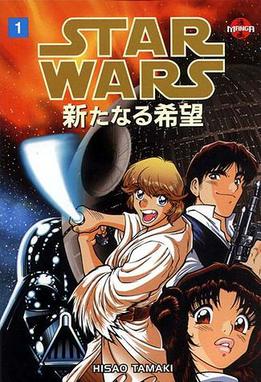
Japan caught Star Wars fever again in 1997, when the Special Edition trilogy hit theaters across the globe. Kadokowa’s MediaWorks division churned out a new set of Star Wars manga, hiring Hisao Tamaki (A New Hope), Toshiki Kudo (The Empire Strikes Back), and Shin-Ichi Hiromoto (Return of the Jedi) to handle the adaptations. And while all three are good, faithfully reproducing the main beats from each film, Tamaki’s version of A New Hope is that rarest of tie-in products: it captures the look and feel of the movie without slavishly copying it, offering both a fresh perspective on a canonical text and a point of entry for someone wholly unfamiliar with Star Wars. 

Part of what makes Tamaki’s version so fascinating is how he compensates for the absence of a soundtrack — no mean feat, given how noisy the Star Wars universe is. While Tamaki uses plenty of hand-lettered sound effects, he never uses them as a crutch, instead finding nifty ways to help us imagine the sound of a landspeeder skimming the desert floor or a Stormtrooper firing his blaster. Tamaki’s most effective tactic is careful attention to the velocity and direction of moving objects; through deft placement of speedlines and artful manipulation of the panels’ shape and size, he conveys the same information that a well engineered roar, squeak, thud, or electronic rumble might.

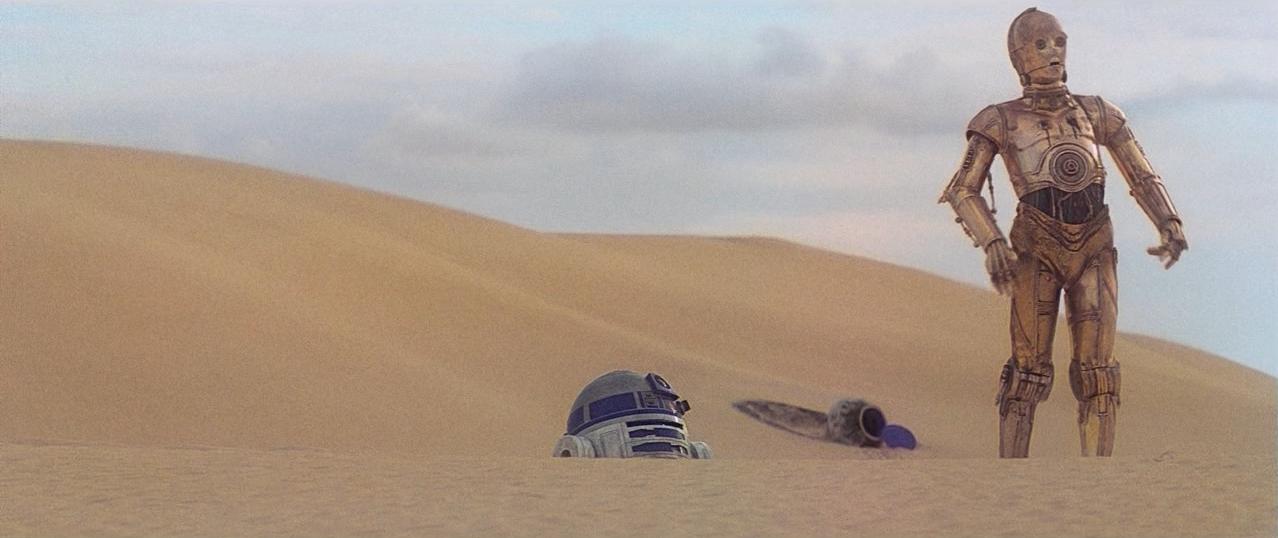
Then there’s the film’s lush, Wagnerian score, the kind of movie music that had been fashionable in the era of Ben Hur and Lawrence of Arabia but was considered unhip in the gritty, naturalistic world of early 70s cinema. The opening fanfare and dense web of leitmotifs are unquestionably part of A New Hope‘s appeal, goosing fight scenes and capturing the melancholy of a young Luke Skywalker as he gazes at a Tatooine sunset. Absent those musical prompts, however, Tamaki is forced to think about how to elicit the same emotions in words and pictures. One of the most dramatically successful attempts to bridge sound and silence occurs in volume one of Tamaki’s adaptation, right after R2D2 and C3PO land on Tatooine:

In the film, John Williams accompanies C3PO’s trek with music cribbed from The Rite of Spring — a decent choice, as Stravinsky’s dour ostinati and octatonic harmonies imbue the harsh landscape with an otherworldly quality. Tamaki, however, distills this two-minute scene to an evocative two-page spread in which a wide-angle view of the Tatooine desert unfolds beneath the individual panels, reminding us just how small and vulnerable both droids are. These images track closely with Lucas’ own vision, but the implied silence of the first and final panels in this sequence more powerfully conveys C3PO’s isolation than any musical gesture could:

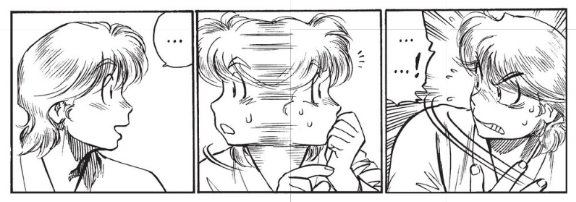
The absence of sound has another unexpected benefit: minus the actors’ desperate attempts to make George Lucas’ dialogue sound… well, like conversation, the script has more room to breathe. Tamaki plays the earnest stuff straight and ramps up the comedy whenever someone is surprised or indignant. Luke, in particular, benefits from such an approach, given his age and naivete; in Tamaki’s hands, he’s Monkey D. Luffy with a lightsaber, freaking out over chores, the Millennium Falcon’s shabby appearance, Obi-Wan Kenobi’s death, a kiss from Princess Leia… you get the idea. Tamaki’s elastic deformations of Luke’s face transform him from blandly handsome farm boy to Shonen Jump hero, equal parts brave and ridiculous:

One of the manga’s other great virtues is its ability to expand and contract time in ways that a purely temporal medium like film can’t. The ability to speed up and slow down the unfolding the plot isn’t unique to comics, of course; filmmakers can use slow motion imagery or cross-cutting to manipulate the viewer’s perception of time, but a good manga artist takes advantage of the fact the reader can, in fact, stop time by poring over an image or a scene for minutes, savoring small but telling details that would otherwise get lost in the cinematic flow. Writing for Animerica in 2004, Patrick Macias offered a thoughtful explanation of how this kind of creative expansion of time adds new layers of meaning to Tamaki’s story:

It is in Tamaki’s take on destruction of the planet Alderaan that he really shows off his stuff. A scene that took mere moments to depict on-screen is drawn out to fill half a dozen pages. He inserts images of the Alderaan populace looking up to the heavens, and you can almost hear those “millions of voices suddenly crying out in terror” with more dramatic impact in the manga than in the film.

Of course, none of this would matter if Tamaki lacked the precision to bring Lucas’ vision to life on page. Again and again, Tamaki delivers amazingly detailed drawings of space ships, aliens, and weapons that pulse with the same life as Katsuhiro Otomo’s AKIRA and Shirow Masamune’s Ghost in the Shell; if you’d never seen or heard of Star Wars, you might reasonably infer that Tamaki dreamt up this world on his own. Tamaki proves equally adept at staging deep space dogfights, too, conveying both the dizzying speed with which the ships are moving and the maze-like surface of the Death Star:


For readers coming to the manga from the films, the biggest stumbling block will be the character designs: did Tamaki get them right? The short answer is yes, if you can tolerate a little artistic license with hairdos and body types. Not surprisingly, R2D2 and C3PO look most like their big-screen counterparts — no pesky noses or mouths to draw — but the rest of the cast bear a passing-to-strong resemblance to the actors who portrayed them, though Obi-Wan Kenobi looks and moves more like Chuck Norris than Sir Alec Guiness. Tamaki does an even better job of bringing Darth Vader and his Stormtroopers to life on the page, adding an extra touch of menace in the way he draws their helmets; you can almost see the soldiers grimacing under their plastic armor from the way he draws their browlines.

If I’ve sold you on manga Star Wars, you’ll be happy to know it’s a relatively inexpensive way to relive the original trilogy. The digital versions — currently available through Amazon and ComiXology — retail for $1.99 per volume. There’s also a Phantom Menace manga for the morbidly curious; Kia Asamiya is the author, and he’s been given the truly thankless task of condensing that stinker into two volumes. At least it won’t be as interminable as the movie.

WORKS CONSULTED

Macias, Patrick. “Star Wars, The Manga.” Animerica, VIZ LLC, 7 Apr. 2004, https://web.archive.org/web/20040407180902/http://www.animerica-mag.com/features/starwars.html. Accessed 27 Dec. 2017.

Rickard, Ron. “Retro Foreign: Japanese Weekly Shōnen Magazine #18 – 23 (1978).” Star Wars Comic Collector, 20 May 2016, http://swcomiccollector.blogspot.com/2016/05/retro-foreign-japanese-weekly-shonen.html. Accessed 27 Dec. 2017.

Shooter, Jim. “Roy Thomas Saved Marvel.” Jim Shooter, 5 July 2011, https://web.archive.org/web/20150912134444/http://www.jimshooter.com/2011/07/roy-thomas-saved-marvel.html. Accessed on 28 Dec. 2017.

Spellman, Ron. “A Long Time Ago: The Strange History of Marvel’s Original Star Wars Universe.” Comics Alliance, Townsquare Media, 28 Jan. 2016, http://comicsalliance.com/original-marvel-star-wars-comics-history/. Accessed 28 Dec. 2017.

Tamaki, Hisao. Star Wars: A New Hope, adapted from an original script by George Lucas, Marvel Comics, 1998. 4 vols.

Filed Under: Manga, Manga Critic, Recommended Reading, REVIEWS Tagged With: Dark Horse, Hisao Tamaki, Kadokawa, Marvel Comics, star wars

The Devil Is a Part-Timer!, Vol. 9

December 29, 2017 by Sean Gaffney

By Satoshi Wagahara and 029. Released in Japan by ASCII Mediaworks. Released in North America by Yen Press. Translated by Kevin Gifford.

Sometimes there’s one scene or chpater of a book that has more impact than the rest of the volume. This is not uncommon, and does not mean that the rest of the book is lacking in any way. It just means that the chapter or scene in question is JUST THAT GOOD. In Vol. 9 of this series, we get that in a chapter entitled “The Hero Discovers That She Can’t Go Home Again”, which flashes back to show us Emi arriving back on Enta Isla and how she ended up in the position we saw her in at the end of Vol. 8, captured by Olba and being blackmailed. We see her being a detective, we see her learning more about her parents (indeed, possibly far more than she’d have liked), and we see that the bond she has with Alas Ramus may not be as direct as she’d though,. though to her credit she doesn’t reject Alas Ramus in any way because of this. And we see her longing for Japan, and modern times. If this light novel series ends up with the main cast back in Enta Isla, they’re going to need to modernize.

As for the rest of the cast, well, they’re back in Japan, getting ready for a rescue mission. This is not as easy as it seems – Maou has to get people to cover his shifts for a week, so that he doesn’t get fired from his McRonald’s job (the way I suspect Emi is going to be fired from her call center one). He and Suzuno need to buy supplies, which leads to them clashing over everything, as he’s a penny-pinching scrounger, and she has enough cash that “just buy the best thing” is always the first option. And they also have to deal with Rika, who after the events in Vol. 8 now knows their secrets. Do they erase her memory or let her in on the full story, which might put her in danger? The answer is not surprising, but it’s nice to see them asking the right questions. It’s also nice to see Chiho has come so far in nine books, and even though she can’t come along on the rescue mission her intelligence and calm is a great help.

Of course, Chiho is in love with Maou, and we see some jealousy flare up here, mostly as Acieth has the appearance of a clingy 14-year-old who keeps going on about being inside Maou. More seriously, though, Suzuno begins to realize that she may also be developing feelings for Maou. This is something of a surprise, as the ‘harem’ aspect of this series has really mostly been a love triangle before now, with Emi and Chiho – not that Emi will admit it, but she’s still the clear favorite. But when Suzuno hears the backstory explaining why Maou raised up a demon army to invade Enta Isla, she begins to realize that he’s not the demon she’d thought. Combine this with the ongoing revelations that the Angels may be the actual villains of this story, and she has the classic example of a maiden’s trembling heart. The sleeping bag helps take the edge off that, though.

Unsurprisingly, things end in a cliffhanger here, with every single character in Enta Isla about to get involved in something nasty. I’m not sure how long this arc will be, but I am sure that if you’ve been reading Devil Is a Part-Timer, you absolutely will not be disappointed with this book.

Filed Under: devil is a part-timer!, REVIEWS

Manga the Week of 1/3/18

December 28, 2017 by Sean Gaffney, Michelle Smith, Ash Brown and Anna N Leave a Comment

SEAN: A new year, new manga, and new series to get way behind on.

MICHELLE: Truth.

ASH: Woo!

SEAN: Ghost Ship has a debut, Yokai Girls, perhaps the most unsurprising license ever given ecchi yokai series are the new zombies. This ran in Weekly Young Jump, and is about ghosts and fanservice, not in that order.

ASH: I’ll usually give anything having to do with yokai at chance, but it may take a while for me to actually get around to trying this series.

SEAN: J-Novel Club has quite a few releases, starting with Ao Oni, a horror series that’s based on a video game, and very much in the “kill the cast off over and over” genre.

In Another World with My Smartphone has a 6th volume, this one focusing on Touya’s youngest love interest, Sue, and her attempts to not be married off.

And Invaders of the Rokujouma!? goes back to finish its side story with Vol. 8.5.

Kodansha has a lot, as you’d expect, mostly digital. Actually, entirely digital. On the Del Rey rescue end, we have a 17th Pumpkin Scissors. Newer titles include Ace of the Diamond 7, Ayanashi 2, Drifting Dragons 2, Real Girl 10, and Space Brothers 31.

MICHELLE: Ace of the Diamond is a lot of fun.

ASH: As usual, I’m glad that so much manga is being translated, but I really hope more of Kodansha’s digital-only titles turn out to be digital-first.

SEAN: Seven Seas gives us a 5th Dreamin’ Sun and a 7th Not Lives.

Their debut is a spinoff of Miss Kobayashi’s Dragon Maid, entitled Kanna’s Daily Life. Given Dragon Maid doesn’t have much of a plot, I can’t imagine how much more slice of life it can get, but…

Viz time. No debuts this time around, but Nisekoi is coming to an end with its 25th volume. Given how poorly romantic-oriented Jump titles have done over here before (looking at you, Strawberry 100%), it’s impressive to see how popular Nisekoi was… at least until fans knew which girl one, at which point the knives came out, as always. Oh well.

MICHELLE: Haikyu!! is ever a favorite.

ASH: I’ve fallen a bit behind, but I enjoy Haikyu!! immensely.

SEAN: Shonen titles include a 7th 7th Garden (No, not a typo), an 18th Blue Exorcist, Haikyu!! 19, Naruto’s 21st 3-in-1, as well as a 2nd volume of Chibi Sasuke’s Sharingan Legend, Naruto’s comedy spoof.

There’s also a 5th 3-in-1 of Rurouni Kenshin (still not cancelled, though Japan cancelled the sequel series), an 11th Twin Star Exorcists, and an 18th World Trigger, which was the last volume out before its current hiatus.

On the shoujo side, there’s a 6th Anonymous Noise, a 28th Kimi ni Todoke (which just ended in Japan, I believe), a 21st Natsume’s Book of Friends (yay!), and the 4th Water Dragon’s Bride.

MICHELLE: I will be reading all four of those, though I am also most “yay!” about Natsume’s Book of Friends.

ASH: It appears I will be echoing Michelle, again. Yay, Natsume! I need to get caught up on Water Dragon’s Bride, too.

ANNA: I’m most excited about Water Dragon’s Bride. It is such a consistently great series.

SEAN: Do you have something you want here?

Filed Under: FEATURES, manga the week of

Graineliers, Vol. 1

December 28, 2017 by Sean Gaffney

By Rihito Takarai. Released in Japan as “Grainerie” by Square Enix, serialization ongoing in the magazine GFantasy. Released in North America by Yen Press. Translated by Jocelyne Allen.

There are some series with a complex plot and deep, developing characterization, and then there are those series that want to get along just by style or mood. Graineliers definitely feels like one of the latter, and fortunately it’s very good at portraying the style and mood to keep a reader turning the pages. The author has mostly done BL series before, and in fact is well known here for the series Ten Count and Only the Flower Knows, but this is not a romance work. Instead it’s (I know, try to contain your surprise) something of a supernatural thriller (GASP!)set in a world where plant seeds can given superpowers of a sort… well, honestly, it seems more like a curse than anything else. In this world we have our handsome and tortured hero, who is seen on the cover baring his chest to show off that instead of manly, virile chest hair he has manly, virile plant roots growing there.

The cast is pretty likable. Luca is our cover boy, who actually becomes a cover man after escaping from the coma being exposed to a seed puts him in. He’s curious but sensible, and it’s actually his father’s experiments that lead to the plot going forward. His friend Abel (the traditional handsome blond to be the best friend of the hero brunet, though there’s no shoujo heroine here, and in fact GFantasy straddles the line between the two genres) rescues and hides him, and finds after he awakens that he now has some characteristics of plant life, including apparently just needing water. Unfortunately, the vaguely evil government is not likely to look kindly on this, so Luca has to hide his features. He’s also not alone, as a cute young girl trying to help her beloved grandfather turns out to share a similar fate, in what’s probably the big “startle” panel of the volume.

It’s always hard for me to review books like these, where nothing really wowed me but there are no crippling flaws either. It’s a solid, readable manga that knows what its fans want to read and gives it to them. Luca and Abel are close and slashable, but can also be read as regular old best friends. For the most part the book is fairly serious, though there was an amusing joke at the end that surprised me, mostly as I wasn’t expecting anything of the sort. There’s also a fair bit on the seeds that this world contains, and why the government might be trying to suppress knowledge of them. Basically, it’s the first fifty pages of a mystery, setting things up but hard to read on its own.

But the setup is good, and leaves you wanting to see what happens next. That said, we’re almost caught up with Japan already, and after Vol. 2 drops early next year there may be a bit of a wait. Definitely a series to grab if you like mystery with a dash of fantasy and a heaping teaspoon of pretty boys.

Filed Under: graineliers, REVIEWS

  • « Go to Previous Page
  • Page 1
  • Interim pages omitted …
  • Page 394
  • Page 395
  • Page 396
  • Page 397
  • Page 398
  • Interim pages omitted …
  • Page 1053
  • Go to Next Page »
 | Log in
Copyright © 2010 Manga Bookshelf | Powered by WordPress & the Genesis Framework