• Skip to primary navigation
  • Skip to main content
  • Skip to primary sidebar
  • Home
  • About Us
    • Privacy Policy
    • Comment Policy
    • Disclosures & Disclaimers
  • Resources
    • Links, Essays & Articles
    • Fandomology!
    • CLAMP Directory
    • BlogRoll
  • Features & Columns
    • 3 Things Thursday
    • Adventures in the Key of Shoujo
    • Bit & Blips (game reviews)
    • BL BOOKRACK
    • Bookshelf Briefs
    • Bringing the Drama
    • Comic Conversion
    • Fanservice Friday
    • Going Digital
    • It Came From the Sinosphere
    • License This!
    • Magazine no Mori
    • My Week in Manga
    • OFF THE SHELF
    • Not By Manga Alone
    • PICK OF THE WEEK
    • Subtitles & Sensibility
    • Weekly Shonen Jump Recaps
  • Manga Moveable Feast
    • MMF Full Archive
    • Yun Kouga
    • CLAMP
    • Shojo Beat
    • Osamu Tezuka
    • Sailor Moon
    • Fruits Basket
    • Takehiko Inoue
    • Wild Adapter
    • One Piece
    • After School Nightmare
    • Karakuri Odette
    • Paradise Kiss
    • The Color Trilogy
    • To Terra…
    • Sexy Voice & Robo
  • Browse by Author
    • Sean Gaffney
    • Anna Neatrour
    • Michelle Smith
    • Katherine Dacey
    • MJ
    • Brigid Alverson
    • Travis Anderson
    • Phillip Anthony
    • Derek Bown
    • Jaci Dahlvang
    • Angela Eastman
    • Erica Friedman
    • Sara K.
    • Megan Purdy
    • Emily Snodgrass
    • Nancy Thistlethwaite
    • Eva Volin
    • David Welsh
  • MB Blogs
    • A Case Suitable For Treatment
    • Experiments in Manga
    • MangaBlog
    • The Manga Critic
    • Manga Report
    • Soliloquy in Blue
    • Manga Curmudgeon (archive)

Manga Bookshelf

Discussion, Resources, Roundtables, & Reviews

Blog

No Guns Life, Vol. 1

September 9, 2019 by Katherine Dacey

No Guns Life is a textbook example of  “robo noir,” a story that borrows tropes from Double Indemnity and The Maltese Falcon and transplants them to a not-too-distant future where old and new technologies rub shoulders, and damsels in distress might, in fact, be androids. The hero is Juzo Inui, a bodyguard-for-hire who has a strong moral code and an aversion to “humidity and kids.” Like the cyborg clientele he serves, Juzo’s body has been cybernetically enhanced, his head replaced with a giant revolver. Yes—you read that right. Juzo’s head can fire a round of ammunition, a creative decision that skirts the line between funny and horrific; only Juzo’s strong moral code makes the gun-as-head concept palatable.

And speaking of that moral code, volume one focuses on Juzo’s efforts to honor a contract with a fellow cyborg. That cyborg shows up at Juzo’s office with a 12-year-old boy in tow and a request: hide the boy from the Berühen Corporation, a powerful organization that manufactures top-secret weapons. With the police and Berühen’s goons on his trail, Juzo stashes Tetsuro with his friend Mary, a back-alley surgeon, and sets out to discover why Tetsuro is such a hot commodity.

While Juzo’s exploits are entertaining, No Guns Life is a mixed bag. On the plus side, the story is briskly paced and well drawn; Tasuku Karasuma creates a strong sense of place in his establishing shots, drawing a sprawling modern city that still has hole-in-the-wall office buildings, dingy basements, and crowded tenements, all populated by characters with memorable mugs. On the minus side, the story traffics in cliches, from the beautiful assassin who carries out her duties in a skimpy costume to the villains who deliver lengthy, exposition-dense monologues before pulling the trigger. The fight scenes, too, leave something to be desired; there are too many flash-boom panels that bury the action under sound effects and speed lines, leaving the reader to guess what’s happening. None of these shortcomings are fatal, but they emphasize the fact that No Guns Life is chiefly memorable because the protagonist looks like a Second Amendment poster boy, not because the story has something new to say about the boundaries between man and machine, or the ethics of human experimentation.

The bottom line: Fans of the anime will probably enjoy No Guns Life, but readers versed in sci-fi and noir conventions may find it too pedestrian to make a lasting impression.

A review copy was provided by VIZ Media, LLC. Volume one will be released on September 17, 2019. Read a free preview here.

NO GUNS LIFE, VOL. 1 • STORY AND ART BY TASUKU KARASUMA • TRANSLATED BY JOE YAMAZAKI • VIZ MEDIA • RATED T+, FOR OLDER TEENS (VIOLENCE, SCANTILY CLAD WOMEN) • 248 pp.

Filed Under: Manga, Manga Critic, REVIEWS Tagged With: No Guns Life, Post-Apocalyptic Sci-Fi, Sci-Fi, Ultra Jump, VIZ Signature

Pick of the Week: Manga Becomes You

September 9, 2019 by Sean Gaffney, Michelle Smith, Katherine Dacey, Ash Brown, Anna N and MJ Leave a Comment

SEAN: It’s always tempting to pick Hayate the Combat Butler, if only to remind people it exists, and Become You looks promising. That said, the retro shoujo fan in me wants to read Queen Bee, the next-gen sequel to Love Attack!, which Tokyopop released back in 1839. I’ll pick that.

MICHELLE: I am very happy to see more Giant Killing at last, as its seinen take on sports manga is something different, but I am really looking forward to the debut of Become You. I loved orange very much and although Dreamin’ Sun (an earlier work) wasn’t as good, I still enjoyed it. This is Ichigo Takano’s latest series, so I am hoping for great things.

KATE: Hot guys playing the guitar–sign me up! My pick is Become You.

ASH: Eyup! I’m here for the musicians of Become You, too! Though if Queen Bee ever sees a print release, that’s another debut I’d be interested in.

ANNA: I’m going to be relentless in my love for shoujo, and pick Queen Bee as well!

MJ: Okay, I’ve gotta go with Become You. There’s a kid on the cover with a guitar. I’ve been promised childhood dreams. This is a winning combination.

Filed Under: PICK OF THE WEEK

Ascendance of a Bookworm: I’ll Do Anything to Become a Librarian!, Part 1: Daughter of a Soldier, Vol. 3

September 9, 2019 by Sean Gaffney

By Miya Kazuki and You Shiina. Released in Japan as “Honzuki no Gekokujou: Shisho ni Naru Tame ni wa Shudan wo Erandeiraremasen” by TO Books. Released in North America digitally by J-Novel Club. Translated by quof.

Tempting as it is to have the series be 20+ volumes of Myne and Lutz sitting around and making paper, it’s no surprise that we’re going in a different direction. More accurately, the moment that Myne found out there was an easier way to get at books, she was going to go after it no matter what. Of course, Myne being Myne, she chooses the one thing that will upset everyone, as the way to get to books is to become a shrine maiden at the local temple… which is composed mostly of orphan children abandoned by society who are worked to death. No wonder the family is against it. But of course, this is the thing. Myne is weak. Even after a temporary cure of the Devouring (though it’s just putting it off), she’s still really, really weak. So honestly, provided she gets some leverage, shrine maiden might be a perfect job for her. Fortunately, finding leverage is what Myne is all about.

I will admit that I wish the religion had been given a bit more emphasis in earlier volumes. As it is, it feels like the Church comes up right about when the plot requires it to. It at least gets a bit of development, with a nice story about how the Gods work, and a prayer pose that unfortunately looks like a very popular Japanese meme image, causing Myne to lose it with laughter during her own baptism. (It also provided the inside color image, because really it deserved illustration.) On the same note, Myne finds out more information about The Devouring right when the plot requires it as well – there doesn’t seem to be a taboo on discussing it, so it’s a mystery as to why Myne just now finds out that it’s due to too much mana inside her. It is clever to show that the only reason she hasn’t died yet is due to the reincarnated memories, which allow her more adult brain to control it better.

There is, believe it or not, an actual action sequence in this very inactive light novel series, as when Myne shows up with her parents to the temple, the bishop has an attitude of “we’re taking your daughter forever now, goodbye”, and gets upset when both she and her family refuse. This allows her father to kick ass and take out several priests at once, in a sequence that would be ridiculous if it lasted any longer than the two paragraphs it does. Likewise, Myne had better start learning how to control her Devouring/mana, as in her rage she ends up nearly killing the Bishop for attacking her family. It’s a startling scene. That said, it does given Myne the leverage she was seeking out, and fortunately the High Priest is a lot more sensible than the Bishop.

So Myne is off to the Temple, but can still see Lutz and her family and innovate. Oh, and she gets to be treated like a noble shrine maiden, not a slave shrine maiden. And, most importantly, BOOKS! But will it really be that easy? We’ll find out in the next arc of Bookworm, which seems to be four books long.

Filed Under: ascendance of a bookworm, REVIEWS

Star Blazers 2199: Space Battleship Yamato, Vol. 1

September 8, 2019 by Sean Gaffney

By Michio Murakawa, originally written by Yoshinobu Nishizaki. Based on the series created by Leiji Matsumoto. Released in Japan as “Uchuu Senkan Yamato 2199” by Kadokawa Shoten, serialization ongoing in the magazine Newtype Ace. Released in North America by Dark Horse Comics. Translated by Zack Davisson.

I was very much of two minds about this modern reboot of the classic 70s space opera. On the one hand, it does everything that you’d want to have done in a retelling updating Matsumoto to the 21st century. The character development gains greater depth, there’s more room for the story to breathe, there are significant female characters (and some of them aren’t even blondes!). It’s pretty good. On the other hand, it does everything you’d expect to have done in a retelling as well. The relationship between Mori and Kodai reminds me of Ranma and Akane at times, and Mori reads far more like a tsundere than I’d really want. There’s also a lot of really gratuitous fanservice, including many, many ass shots of the female cast, and one bizarre moment when they go through warp that is supposed to show it’s a mental experience as well but also mostly shows off naked breasts for the crew. So it’s pretty good, but there are issues.

The basic plot is the same as the original. The Earth is under attack from the alien Gamilans, who have basically destroyed Earth. Fortunately another alien race, the Iscander, are offering hope for the ever-popular in SF faster-than-light drive. The trouble is getting there… and that’s why we have the Yamato and its motley crew (a bit less motley in this version as it’s not being drawn by Matsumoto). We’ve got Admiral Okita, who is as good as ever as being “top Naval commander”. We’ve got crack pilot Susumu Kodai and his best friend Daisuke Shima. We’ve got Yuki Mori, who gets off to a bad start with Kodai but also has “love interest” written all over her. But there’s also a bunch of new characters, most of the notable ones women. Niimi seems like “the smart one”, the nurse Harada, who serves as a combination of comedy relief, fanservice, and romantic shipper. There’s Yamamoto, another hotshot pilot sort. And there’s also the robot, though as of yet he’s not as fun as the original.

There are lots of nice shots of space and the Yamato traveling through it, though we don’t get pages and pages of it the way the original series did. Those pages are taken up by plot and characterization, and it’s up to the reader to determine if they make the remake better or worse. I’d say “different”. Certainly I do feel like continuing the story, and I love seeing these characters all over again. It just lacks the space opera grandeur of the original – it’s not as operatic as Matsumoto at his best. But it’s also a lot longer than the original manga, so we’ll see what direction it decides to take its story in the future.

Filed Under: REVIEWS, space battleship yamato

Combatants Will Be Dispatched!, Vol. 1

September 7, 2019 by Sean Gaffney

By Natsume Akimoto and Kakao Lanthanum. Released in Japan as “Sentouin, Hakenshimasu!” by Kadokawa Sneaker Bunko. Released in North America by Yen On. Translated by Noboru Akimoto.

Sometimes you can have an isekai without all of that pesky dying and being reincarnated, or being transported to another world by a magic spell. It’s as easy as making the “fantasy world” on another planet, and having our heroes sent to it to see if it can be taken over… erm, colonized. That’s the basic premise of this series, which features the nameless Combat Agent Six and his android partner Alice Kisaragi sent via a teleport (that is totally tested and functional, honest) to a planet that is apparently dealing with a demon lord invasion. On the one side we have the kingdom of Grace, with knights, princesses, castles, etc. and the demon lords, who have golems and are your standard demonic types. On the other side we have Six, Alice, and their newly befriended band of misfits… erm, crack squad, and modern weaponry. Oh, yes, and one other thing that should be noted: Six and Alice work for an evil organization, and can only get weapons and equipment by doing evil acts.

Actually, one other thing should be noted: this is by the author of KonoSuba. Actually, it was written online before Konosuba, and picked up by Kadokawa after the latter’s success as a light novel/manga/anime franchise. This means, needless to say, that the best reason to get this is the comedy. It’s not a full-on parody like KonoSuba, but the humor tends to be along the same lines. (Actually, the humor can sometimes, like KonoSuba, cross a line or two – I was not all that pleased with the “take photos of the evil sorceress in a certain pose” moment, even if it’s a PG-rated version of same.) The cast may also ring a bell as well – Six is not that far from Kazuma, and Snow is basically what would happen if Aqua and Darkness had a kid. There’s a lot of great humor, provided you don’t mind the cast all being horrible people to one degree or another.

The best reason to get the book is the bantering relationship between Six and Alice. Like Kazuma and Aqua, there’s no real romantic tension between these two. Instead, they function as snark factories, ready and willing to tear down anything for the sake of evil and/or their own amusement. The other good reason to get this is the few moments when the protagonists are allowed to be cool. Because it’s not a parody like KonoSuba, the cool moments are allowed to exist without getting undercut, and actually impressed me a bit, even when they were also hilarious (Rose and Grimm’s “you shall not pass!” moment, the land mine trap, the chainsaw ending). There’s also some nice character development for Snow, who is arrogant and sword-obsessed but also has something of a righteousness to her, which contrasts well with Six, who is supposedly working for an evil organization but relies on petty, assholish acts to cover up the fact that he can’t be REALLY evil when it counts.

The color pages note that Snow is “this volume’s heroine”, so I expect the next book will focus on either Rose, a chimera girl who’s trying to follow in her grandfather’s footsteps, or Grimm, an archbishop of death who actually uses a wheelchair most of the book – something rarely seen in a light novel. (Yes, she can on occasion get out of it, but for the most part really does need it.) A must-read for KonoSuba fans, and those who enjoy comedy light novels and don’t mind characters whose default is “jerK” will also be happy.

Filed Under: combatants will be dispatched!, REVIEWS

Silver Spoon, Vol. 10

September 6, 2019 by Sean Gaffney

By Hiromu Arakawa. Released in Japan as “Gin no Saji” by Shogakukan, serialization ongoing in the magazine Weekly Shonen Sunday. Released in North America by Yen Press. Translated by Amanda Haley.

It has to be said, the love story in Silver Spoon can sometimes be frustrating. Not so much on the Hachiken/Mikage end, as I’m perfectly content with these two to slowly make their way into a relationship. It’s more the reaction of the rest of the students. There are not any noticeable “beta couples” in this series, which is not primarily a romantic comedy in any case, so what you end up having is a bunch of teenage farm kids watching their friends be adorable AND oblivious at the same time. They want to be happy deep down, I’m sure. But in reality… they’re pissed. And you get the sense the author is as well. So for every cute, heartwarming moment, such as Mikage’s New Year’s text, you get the inevitable crushing of it – literally, in this case, as Hachiken’s phone is destroyed via horse and via the obnoxious Ookawa. Fortunately, the rest of the book devotes itself to Ookawa’s downfall (honestly, the series as a whole also does this).

One of Silver Spoon’s general themes is that this may be shonen manga but things are not always magically going to work out. Mikage is studying now, but her grades aren’t suddenly terrific. The kids make sausage (which takes up a third of the book – again, Silver Spoon is a farming manga) but a lot of it is misshapen and weird. And then there’s Komaba, who lurks around the edges of this volume. He’s not back at school, but he is doing about eight jobs a day in order to earn money to pay back debt. As a result, he runs into Hachiken over the holidays, and then is lured into showing up at the Winter Festival. Sometimes we can’t achieve our dreams, and reality ensues. That’s certainly what happened to Komaba, and it sucks. But when you don’t achieve your dreams, that does not really mean you give up and resolve to never have fun or see your old friends again ever. This lesson he still needs to learn.

Speaking of lessons, Hachiken and Mikage might want to look over at his brother, who met a Russian girl and married her almost immediately. As always, the brothers end up being completely different. We meet said wife, Alexandra, towards the end of the book. That said, their relationship is glossed over and we get a whole bunch of Russia jokes instead. A lot of these are well-researched and amusing, but it does sort of remind me of the old 80s sitcoms where Yakov Smirnoff was the guest star. The “Silver Spoon” joke in particular is hilarious but also tremendously cliched. Still, it’s nice to see that she likes Hachiken, and I’m glad we get to see an actual functional couple, even if Hachiken’s brother still can’t cook to save his life. (Or Ookawa’s life. RIP, death by borscht.)

The next volume promises to lean a bit harder on the romance, as it’s Valentine’s day. Will we get a kiss? Don’t count on it. But do expect more of these lovable and frustrating farming goofballs.

Filed Under: REVIEWS, silver spoon

Manga the Week of 9/11/19

September 5, 2019 by Sean Gaffney, Michelle Smith, Anna N and Ash Brown Leave a Comment

SEAN: No time to talk! Manga is coming!

J-Novel Club have new volumes for Cooking with Wild Game (4) and How NOT to Summon a Demon Lord (10).

Kodansha debuts the “official” adaptation of Fate/Grand Order, called mortalis:stella. It’s one of many FGO manga out, but this is the “story” one, apparently. That said, it only ran two volumes, so I suspect the story is compressed, though there is a sequel of sorts. It ran in Ichijinsha’s Zero-Sum.

ASH: Oh, interesting! That makes it on the shoujo and josei end of things, doesn’t it?

SEAN: In print, Kodansha also has Eden’s Zero 4.

Digitally the debut is Queen Bee (Seishun Otome Banchou!), from an author familiar to readers with long memories, Shizuru Seino. She did Heaven!!, Power!!, and Love Attack!. Love Attack! never finished over here, which is a shame, as this is about the daughter of the leads from that series. She has a scary face… and disposition… but is still a girl in love. This ran in Betsufure.

MICHELLE: Oh, I actually read all of Power!! (released by TOKYOPOP as Girl Got Game) back in the day! I failed to make the connection.

ANNA: I read some of Love Attack! back in the day, and I think I have a couple volumes of Girl Got Game somewhere in my stacks of unread manga.

ASH: I rather enjoyed what I read of Love Attack!.

SEAN: We also get Giant Killing 16, The Knight Cartoonist and Her Orc Editor 2, Red Riding Hood’s Wolf Apprentice 3 (this is a final volume), The Slime Diaries 2, and Tokyo Revengers 11.

MICHELLE: Hooray for more Giant Killing! It’s been quite a while.

SEAN: Seven Seas has THREE debuts. The first is a spinoff, Arifureta Zero, adapting the spinoff light novel with the same title. It runs in Overlap’s Comic Gardo.

Become You (Kimi ni Nare) is the latest series from the author of orange. Like orange, it’s likely “shoujo in a man’s magazine”, as this runs in Futabasha’s Monthly Action. It’s got guys, and bands, and childhood dreams.

MICHELLE: I hope this is as good as orange.

ASH: Me, too! I’m also interested in it for the music aspects.

SEAN: The Brave-Tuber (Haishin Yuusha) is your standard fantasy world with adventurers, etc… except it has the Internet. Two guys try to find a way to build subscribers and defeat monsters. This runs in Mag Garden’s Comic Blade and is also a short, two-volume series.

Seven Seas also gives us Mushoku Tensei: Roxy Gets Serious 2 and There’s a Demon Lord on the Floor 7.

SuBLime has Candy Color Paradox and the 9th Deluxe Edition of Finder for its BL readers.

ASH: I finally picked up a copy of the first volume of Candy Color Paradox! (Now I just have to read it.)

SEAN: Vertical has the 5th volume of My Boy.

Viz gives us the 34th volume of Hayate the Combat Butler, still entertaining readers in the West thanks to the wonders of contractual obligation. They also have Radiant 7, Splatoon 7, and Yo-Kai Watch 12.

Lastly, Yen Press has a 5th volume of Chio’s School Road. It’s not like those OTHER roads.

ASH: Nope, not at all like those other roads.

SEAN: Thoughts? Concerns? Complaints?

Filed Under: FEATURES, manga the week of

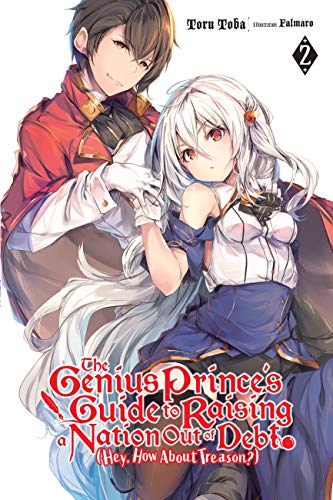
The Genius Prince’s Guide to Raising a Nation Out of Debt (Hey, How About Treason?), Vol. 1

September 5, 2019 by Sean Gaffney

By Toru Taba and Falmaro. Released in Japan as “Tensai Ouji no Akaji Kokka Saisei Jutsu ~Sou da, Baikoku Shiyou~” by GA Bunko. Released in North America by Yen On. Translated by Jessica Lange.

While the word “treason” in the title is technically accurate, I feel that it might do a disservice to the genius prince, who is not nearly as bad as that title makes him out to be. Sure, he wants to pass the leadership of the country off to someone else, and is totally fine with that someone else being another country, but this does not mean he’d do it if it meant that the people in the country would suffer. Instead this book is along the lines of a few other LNs featuring “genius” characters, who are always brilliant but not quite brilliant enough to stop misunderstandings or prevent things happening elsewhere that destroy their clever plans. Which is good, as otherwise Prince Wein might be insufferable. As it is, he’s a pretty likeable guy, though it helps that he has a beautiful childhood friend/aide who is willing to stick potatoes up his nose when he screws up.

In the mountainous and remote Kingdom of Natra, the old King is dying, and the Prince Regent, Wein, is running the country. To his subjects, court, and little sister, he’s the perfect thoughtful and intelligent King. To Ninym, his childhood friend, and only Ninym, he’s a whiny selfish brat who desperately wants to slack off and be lazy but can’t because he’s a Prince with a country to look after. He tries making overtures towards the Empire that controls half the country to take it over… then the Emperor dies and that goes south. When a neighboring country invades, he tries to have a quick little war that will end in negotiations, but that goes south in a hurry. Even holing up in a newly conquered gold mine just means finding out that it’s nearly out of gold. Fortunately, Wein really is brilliant. He’ll need that brilliance.

This ended up being a lot of fun. For one thing, we’re in a “medieval kingdom” sort of world that does NOT appear to be filled with magic and monsters. There are the Flahm, a race who seem to be regarded as slaves by some other countries but not in Natra, as Ninym is a Flahm and treating her as a slave would… not be advisable. I was expecting elf ears or similar, but it looks like “albinism” might be the only difference. I was also pleased to see that, despite Wein occasionally taking note of the large-breasted Imperial Ambassador, this does not really appear to be a harem series at all. Ninym clearly loves Wein, and worries about whether he feels the same. Given that he literally has people killed who belittle or insult her, I think that might be a clue, but hey. They make an awesome power couple even if they’re not a couple, and their back and forth is the main highlight of the book. (Future book covers also feature only the two of them, meaning we’re unlikely to have a “stack up a new heroine every volume” syndrome many LNs have.)

If you enjoy warfare and politics but are sick of isekai and gaming-style fantasy worlds, this book may be the perfect antidote. It’s fun and entertaining.

Filed Under: genius prince's guide to raising a nation out of debt, REVIEWS

Bookshelf Briefs 9/4/19

September 4, 2019 by Ash Brown, Sean Gaffney and Michelle Smith Leave a Comment

Ace of the Diamond, Vol. 23 | By Yuji Terajima | Kodansha Comics (digital only) – Seido is reeling from their surprising loss in the final round of the West Tokyo qualifiers. Promptly, the third years retire to focus on college while the rest of the team gears up for the fall tournament. Many pivotal spots have been left vacant, so the junior varsity players are fired up to finally secure a place on the varsity squad. Not fired up are Eijun, who has trouble shaking the image of his pitch hitting a batter, and Kawakami, who squandered Seido’s lead and ruined the upperclassmen’s hopes of making it to Koshien. I always appreciate anything that leads Eijun to a more humble state of being and also really liked seeing Miyuki seriously step up to a leadership role after he is made the new team captain. I’m excited to see how this iteration of the team fares. – Michelle Smith

Barakamon, Vol. 18 | By Satsuki Yoshino | Yen Press – Much of the final volume in this series involves showing us that time is slowly marching on. There’s no time skip or anything, but life keeps happening. Tama gets a manga published. Miwa’s father is leaving to work on a ship, similar to Naru’s father, and Naru and Hina move on to the next grade, though the island is so small that they don’t get any underclassman to be sempai to. As for Handa, he’s become the stable part of the group; still teaching calligraphy, still being a bit of a goofball, but not going anywhere—this is where he belongs now. The overall tome of this series was relaaxing and fun, and that’s how it ended up, with the characters undergoing mild but meaningful journeys. I’ll miss it. – Sean Gaffney

Count Fujiwara’s Suffering | By Mahito Aobe | Yen Press – I’ve talked before about how I think that omnibuses of comedy manga are a bad idea, and this 540-page volume bears that out. That said, I don’t think I’d love this even in single volumes. Count Fujiwara is a cat, whose thoughts we are privy to. He’s dealing with two sisters—one an airheaded NEET who stopped going to school after a past event we only find out about near the end; the other is a more “normal” girl who has an unfortunate crush on her sister—unfortunate in that it contains all the annoying “comedy lesbian” tropes. There’s a speck of a storyline here about what happened to make Shizuka like this, but for the most part it’s “look at the silly girls and their frustrated cat.” You can do better. – Sean Gaffney

Hatsu*Haru, Vol. 8 | By Shizuki Fujisawa | Yen Press – I have occasionally wondered as I read a manga where a character discusses the fact that they’ve never felt love like other people if said character will actually end up being asexual. It’s rarely happened, and I don’t expect it to happen here, but it’s an interesting thought. Ayumi’s thoroughly analytical personality is great for a career as a newshound, but very bad when dealing with Takaya, who we’ve known for a while has fallen for her in his quiet, hard-to-read way. Her thesis paper on why they should or shouldn’t go out doesn’t help. Fortunately, we have Kai and Riko being adorable fluffs in love to balance things out. And this time Kagura’s on the cover, but STILL gets nothing to do. Arc when? -Sean Gaffney

Komi Can’t Communicate, Vol. 2 | By Tomohito Oda | VIZ Media – Much of this volume is cute. A classmate declares herself Komi’s rival in the national health exams. Komi attempts to tell (lame) jokes in writing. The gang goes out for ramen after school. Najimi encourages Komi to go shopping for clothes and the gang all chooses different outfits for her to try on and rate. And then there’s Ren Yamai, who has a crush on Komi and promptly goes into scary, knife-wielding psycho mode. I liked that Yamai’s threats against Tadano prompted Komi to firmly state (in writing) that she decides who her friends are, as well as the fact that this whole situation prompted Komi to “talk” a lot with Tadano and allowed for some funny Najimi moments. But I really disliked that, after all Yamai’s terrible, alarming behavior, Komi consents to be friends with her after all. Yamai is the Mineta of an otherwise really fun series. Sad face. – Michelle Smith

Murcielago, Vol. 11 | By Yoshimurakana | Yen Press – The police have had a very odd relationship with Kuroko, for obvious reasons, but they find themselves more drawn into the current case than usual. The people getting eaten by sharks rapidly led to brains in jars, including the wife of Tsuru, who he’s been trying to avenge but sadly reality gets in the way. Also, his partner may be secretly evil? Fortunately, Suiren is saved, and deals with her grief. She’s not even seduced by Kuroko—yet. And so we move on to a new arc, which involves someone going around killing master swordsmen. Murcielago will never win any good taste awards, and its leads are all sociopaths (even the police, to a degree), but it’s fun, and there are some great Kuroko faces here. – Sean Gaffney

One-Punch Man, Vol. 17 | By ONE and Yusuke Murata | Viz Media – When the hell did this get so boring? Its strength remains its humor, and the best parts of the volume are showing off that humor, such as Fubuki desperately trying to rally the incredibly apathetic troops, or Saitama only getting really pissed off because the hero hunter keeps ignoring him. But for the most part, it’s serious fights between serious heroes and serious villains, and honestly I can get that much better in My Hero Academia. The world is also pretty nihilistic here—we need the heroes because the villains are not going to stop and wait for them, as a Private Merc Force finds out when they are quickly beaten and enslaved. I want more funny stuff, please. – Sean Gaffney

Sleepy Princess in the Demon Castle, Vol. 8 | By Kagiji Kumanomata | Viz Media – It’s time for new employee orientation, including a field trip and a hot springs visit. This actually means a bit more fanservice than the other seven volumes combined, as of course Syalis goes along with everyone—they have to pretend she’s working as a demon in order not to give it away. (This being a comedy manga, the author lampshades that Syalis is in a swimsuit twice within three chapters.) The jokes are the same, though—Syalsi is spoiled and a bit appalling but also too difficult to say no to, and also sort of cute and adorable. At least she’s not gleefully killing everyone anymore, so that’s a plus. It even feels a bit like an extended family now. – Sean Gaffney

Tales of Wedding Rings, Vol. 7 | By Maybe | Yen Press – We’ve hit a new harem manga record with this volume, as fully HALF THE BOOK is set up to have Satou and his fiancées get it on so that they can gain the power needed to defeat the Abyss King. Sadly, for anyone hoping for a payoff, there’s lots of skin and titillation but everyone is still a virgin by the end of the book. We also get some details of the prior hero, who was seemingly corrupted by the situation of “get to bone all these girls” and ended up getting killed by said girls, one of whom is still around thanks to the long lives of elves. Will Satou end up going down the same path? Well, not if this keeps up. This is a good series for fantasy fans but harem fans may be getting irritated. – Sean Gaffney

We Never Learn, Vol. 5 | By Taishi Tsutsui | Viz Media – As with the series’ spiritual successor, Nisekoi, We Never Learn is very good at balancing out each girl in the romantic comedy stakes so that they all get something to do. Unlike Nisekoi, the choice is not obvious from chapter one, either. It doesn’t help that Fumino seems to be honestly trying to help Naruyuki get together with someone else… even as she gets the shippiest chapter in the book, the classic “we have to share a hotel room and there is only one bed” trope. But the others get their moments as well (including the teacher, which I suppose I will have to get used to), and it’s cute, fun, and a bit sweet and romantic as long as you don’t mind it then snapping back to status quo. – Sean Gaffney

Wotakoi: Love Is Hard for Otaku, Vol. 3 | By Fujita | Kodansha Comics – Sometimes series can falter after their respective love interests get together, but so far that hasn’t been an issue with Wotakoi. There are some chapters that I find less engaging (generally the few that take place “in game”—I prefer the manga’s exploration of real life experiences), but as a whole it’s still consistently entertaining. I especially appreciate the importance placed on the series’ non-romantic friendships. The fact that Hirotaka and Narumi are dating is still being kept a secret in the workplace, so one of my favorite running gags in the third omnibus of Wotakoi is that their coworkers are all essentially rooting for them to hook up. In part this requires Fujita to introduce a few new recurring side characters who end up being a rather amusing addition to the manga. I continue to greatly enjoy Wotakoi. – Ash Brown

Yuri Life | By Kurukuruhime | Yen Press – Yuri Life is a collection of 4-koma vignettes about various cohabitating couples, the vast majority of whom are working women in their twenties. Some stories are kind of cute, but none is in the least bit funny, so it’s not that kind of 4-koma. Probably the best story in the lot is “Life with a Grim Reaper,” in which a grim reaper falls in love with a woman who’s supposed to die soon. I could see a concept like that filling at least one volume, but not so much the rest. The collection also includes “Life with a Yandere,” in which we get creepy inner monologues like, “If I snipped off those small, slim fingers, would I be the only one you touched?” Um, that is seriously fucked up! Why is that in the same collection as these other frothy tales? This is definitely a mixed bag. – Michelle Smith

Filed Under: Bookshelf Briefs

Der Werwolf: The Annals of Veight, Vol. 5

September 3, 2019 by Sean Gaffney

By Hyougetsu and Nishi(E)da. Released in Japan by Earth Star Entertainment. Released in North America by J-Novel Club. Translated by Ningen.

Honestly, I’m starting to feel that the author is spoiling me at this point. Der Werwolf 5 has Veight and Eleora going to Rolmund, which is essentially not-Russia, pretending that she defeated Meraldia in order to suss out the political situation back in her country. And thus we get an entire book filled with political machinations, double-dealing, duels, and Veight telling everyone he’s just a humble vice-commander. It’s excellent, and reminds you how good this author can be at making just two people sitting in a room discussing economics interesting. Which is a good thing, as we’re not done with this arc yet, nor does it sound like we will be next time. Rolmund still runs on a lords and serfs-style of rule, and their agricultural yield has not been all that great lately. And, honestly, no one was really expecting Eleora to win. (Which she didn’t, but let’s not split hairs.) As a result, things are… complicated. At least till Veight gets through with them.

Given that Veight is in diplomacy mode here, there’s not quite as much derring-do, especially as he and his fellow werewolves have to keep their true nature hidden during the visit. (I don’t expect THAT to last either.) He does get a duel against Count Von Evilcount, who he wipes the floor with despite the count having the sword equivalent of an Agonizer. Actually, he ends up fighting LOTS of duels, though only a few are people legitimately trying to cause him harm, and it gets to the point where by the end of the book he’s telling old war stories (edited for state secrets) to the easily impressionable son of one of the crown princes. Actually, he’s feeling out all the royals, be it eating not-so-poisonous berries from a private garden, having blunt discussions with the most ambitious of the group, and realizing that at the rate it’s going, Rolmund is going to be dealing with mass starvation and death in a generation or two.

There is a running gag here (among the many running gags in Der Werwolf) about Eleora being very repressed and precise, and everyone except Veight noting how much she’s relaxed and mellowed out since the invasion of Meraldia. She does not, thankfully, seem to be joining the group of women in love with Veight – honestly, this is still a harem with one big front-runner, and things will likely not be helped by Veight, to provide a cover story, says that Airia is his fiancee. Pretty sure that will get back to her, and also pretty sure that she won’t mind one bit, provided he doesn’t try to walk it back. But with Eleora we don’t get that dynamic, we just see that Veight has the ability to change those who come into contact with him, as we see when she manages to overcome her trust issues and reunite (sort of) with her uncle.

We’re just at the start of this arc, and I’m pretty sure things are going to go pear-shaped next time. Till then, enjoy the light novel equivalent of a John le Carré book.

Filed Under: der werwolf, REVIEWS

  • « Go to Previous Page
  • Page 1
  • Interim pages omitted …
  • Page 305
  • Page 306
  • Page 307
  • Page 308
  • Page 309
  • Interim pages omitted …
  • Page 1055
  • Go to Next Page »
 | Log in
Copyright © 2010 Manga Bookshelf | Powered by WordPress & the Genesis Framework