• Skip to primary navigation
  • Skip to main content
  • Skip to primary sidebar
  • Home
  • About Us
    • Privacy Policy
    • Comment Policy
    • Disclosures & Disclaimers
  • Resources
    • Links, Essays & Articles
    • Fandomology!
    • CLAMP Directory
    • BlogRoll
  • Features & Columns
    • 3 Things Thursday
    • Adventures in the Key of Shoujo
    • Bit & Blips (game reviews)
    • BL BOOKRACK
    • Bookshelf Briefs
    • Bringing the Drama
    • Comic Conversion
    • Fanservice Friday
    • Going Digital
    • It Came From the Sinosphere
    • License This!
    • Magazine no Mori
    • My Week in Manga
    • OFF THE SHELF
    • Not By Manga Alone
    • PICK OF THE WEEK
    • Subtitles & Sensibility
    • Weekly Shonen Jump Recaps
  • Manga Moveable Feast
    • MMF Full Archive
    • Yun Kouga
    • CLAMP
    • Shojo Beat
    • Osamu Tezuka
    • Sailor Moon
    • Fruits Basket
    • Takehiko Inoue
    • Wild Adapter
    • One Piece
    • After School Nightmare
    • Karakuri Odette
    • Paradise Kiss
    • The Color Trilogy
    • To Terra…
    • Sexy Voice & Robo
  • Browse by Author
    • Sean Gaffney
    • Anna Neatrour
    • Michelle Smith
    • Katherine Dacey
    • MJ
    • Brigid Alverson
    • Travis Anderson
    • Phillip Anthony
    • Derek Bown
    • Jaci Dahlvang
    • Angela Eastman
    • Erica Friedman
    • Sara K.
    • Megan Purdy
    • Emily Snodgrass
    • Nancy Thistlethwaite
    • Eva Volin
    • David Welsh
  • MB Blogs
    • A Case Suitable For Treatment
    • Experiments in Manga
    • MangaBlog
    • The Manga Critic
    • Manga Report
    • Soliloquy in Blue
    • Manga Curmudgeon (archive)

Manga Bookshelf

Discussion, Resources, Roundtables, & Reviews

Blog

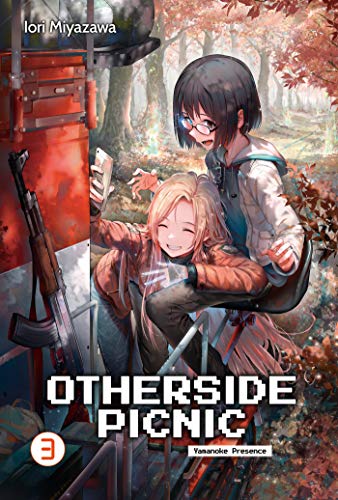
Otherside Picnic, Vol. 2

February 1, 2020 by Sean Gaffney

By Iori Miyazawa and shirakaba. Released in Japan as “Urasekai Picnic” by Hayakawa Bunko JA. Released in North America by J-Novel Club. Translated by Sean McCann.

The second volume starts up with a dangling plot form the first volume, as Sorawo and Toriko go back into the other world to rescue to US Marines who remained trapped there. It makes for a tense chapter, as moving an entire company (which has been growing smaller the longer they stayed there, admittedly) is not that easy in a space like that, especially when they come across the Japanese Urban Legend Monster of the week. After this they end up in Okinawa, and decide to stay and hit the beach… but instead end up back at the other world, beach version, which features more disturbing things and the appearance of the woman who is Toriko’s obsession and is rapidly turning into Sorawo’s nemesis, Satsuki. Both of these chapters are well told, and the characters are fun to read, but I felt they weren’t quite as terrifying as the first book could be.

The third story delves more into the characters, as we meet another student at Sorawo’s university, who has heard rumors that she can help with supernatural issues and is being stalked by ninja cats. Yes, ninja cats, and a good deal of the chapter is spent trying to deal with the seeming silliness of the proposition. The ninja cats do end up posing quite a threat, and there’s another tense sequence, but mostly what this third wheel does is show off how tight-knit Sorawo and Toriko have become, as well as the difference between them – Sorawo is distancing herself from everyone but Toriko – at least in her head – while Toriko sees it as Sorawo having opened up to other a lot more – so much that she doesn’t need Toriko anymore. This miscommunication leads to the fourth and best chapter, where the horror pops back into the pages like it was waiting for you to relax.

The final chapter shows us who Kozakura is getting the money from to pay for Toriko and Sorawo’s other world finds, and also shows us that the other world is a big business… and one that is breaking many other people. From the moment we enter the seemingly empty building that serves as the “lab” where Satsuki worked, everything becomes terrifying, with some of the most evocative descriptions of body horror I’ve read in some time. It’s clear that Toriko’s hand and Sorawo’s eye are relatively minor compared to the issues of other researchers. This reach a fever pitch when Sorawo triggers what might be a trap set by Satsuki… a literal puzzle box that starts to kill the other of them in a nasty and lingering way. Can Sorawo work together with Toriko to stop it? And stop Toriko sounding as if she’s about to run away forever and/or kill herself?

My first review mentioned this was the first license from Hayakawa’s “yuri line” that was multiple volumes, adn I’m even more relieved that there’s at least two more after this, as I’m becoming very invested in the story. The yuri, while still not explicit, is much stronger here, and the horror is a slow burn till the end when it hits a fever pitch. Recommended for fans of both genres.

Filed Under: otherside picnic, REVIEWS

Bookshelf Briefs 2/1/20

February 1, 2020 by Ash Brown, Sean Gaffney and Michelle Smith Leave a Comment

Anonymous Noise, Vol. 18 | By Ryoko Fukuyama | VIZ Media – It took a while for me to get into Anonymous Noise, and I still wouldn’t call it a favorite exactly, but it must be said that this final volume made me verklempt on a few occasions. I particularly liked that Nino and Momo getting back together is not the main focus, because that was so not what I was most invested in with this series. Instead, we get Nino telling Yuzu she wants to sing his songs forever, and him realizing that means even more than winning her heart. There are some awesome concert scenes—that full-page image of Yuzu singing!—and a sense of joyous confidence as they contemplate their musical future together. Too, I appreciated that the final appearance of Yuzu and Nino wordlessly confirmed that, yes, he did eventually grow taller than her. I think I might miss this series now that it’s over. – Michelle Smith

Giant Killing, Vol. 18 | By Masaya Tsunamoto and Tsujitomo | Kodansha Comics (digital only) – The second half of the season has begun! Tatsumi’s strategy going forward is to foster bettter communication and flexibility, so he’s been having the players swap positions, giving chances to non-regulars, etc. The best thing about this series is how Tatsumi has truly earned the players’ trust, and now the team feels more cohesive, each player secure in the knowledge that Tatsumi is looking out for them on an individual level and will help them to improve. Well, mostly everyone. Tsubaki is getting frustrated with his “terrible” playing and is pretty much useless after making a poor decision (while playing an unfamiliar defensive role) that leads to an ETU player’s injury. I really like that, even if they lose, they’re not a high school team trying to reach Nationals, so there’s still hope for the season. Have I mentioned lately how much I love Giant Killing? Verily, I do. – Michelle Smith

Haikyu!!, Vol. 36 | By Haruichi Furudate | Viz Media – I think I forgot to review the 35th volume of Haikyu!!. No doubt it was very good and also filled with volleyball. As is this 36th volume. It is a credit to the author that he has kept the games interesting, and I can easily distinguish between the major adversaries, which is more than I can say for some manga. There’s a few more flashbacks, some really killer moves… a lot of people jump high in the air… I may have to wait till the game finishes to review another volume, though, as I just can’t keep typing up “this was really cool volleyball” over and over again without stretching things out like I’m a contestant on Just a Minute. At least the series is ending in Japan in a week or two, so we’ll soon catch up. -Sean Gaffney

Jujutsu Kaisen, Vol. 1 | By Gege Akutami | Viz Media – I forget where I first heard of Jujutsu Kaisen, but the general impression I’ve garnered from others has largely been positive. Now having read the first volume myself, I can honestly say that I enjoyed the manga. However, it’s clear that the series still has some room to grow before it truly distinguishes itself. Jujutsu Kaisen is Akutami’s first long-form work which may partly explain why the series comes across as being so heavily influenced by other manga. But even while its ideas aren’t particularly new and the tropes that are used are well-worn, the specific and sometimes seemingly disparate combination of them in Jujutsu Kaisen has a sort of quirky charm—which is admittedly kind of a strange description for what is essentially a horror manga about demon hunting. There is darkness, seriousness, and drama in Jujutsu Kaisen, but many of the characters tend to be likeable goofballs. – Ash Brown

MabuSasa, Vol. 1 | By Nanase | Kodansha Comics (digital only) – With its cute cover and male lead who looks like a scary delinquent but who is actually kind, I thought MabuSasa was going to be a sweet love story akin to Honey So Sweet. I was very wrong. It’s not advertised as such anywhere that I could find, but this is actually a 4-koma manga. True, there aren’t titles for the strips, but the page layout fits, as does the sensibility. Mabuchi is indeed a sympathetic character, but he’s surrounded by one-note caricatures. Most infuriating is Akira Sasagawa (the Sasa of the title), our fujoshi heroine who absolutely refuses to listen when Mabuchi swears that he’s not in a relationship with his best friend, Sota Ando. She concocts BL scenarios at every opportunity, even when Mabuchi meets and plays with her little brother. All of this is meant to be funny, I’m assuming, but I didn’t smile once. – Michelle Smith

Yowamushi Pedal, Vol. 13 | By Wataru Watanabe | Yen Press – Sheesh, the Inter-High still isn’t over in this volume. It literally takes 300 pages to go 3.5 kilometers! In that time, there are a couple of big matchups. The first is Imaizumi versus Midousuji, where the former is bolstered by the power of friendship while the latter pulls off new and even more nightmarish contortions while scoffing at the notion that friends are anything more than useless. Imaizumi emerges victorious but a crack in his bike’s frame means that Sohoku’s hopes now rest with Onoda, who goes head to head with Manami. Probably my favorite parts were the reactions of the Sohoku third years to the announcement that Onoda is still in the running to take the whole thing. 500 meters remain at the end of the volume. Next time for sure, right? – Michelle Smith

Filed Under: Bookshelf Briefs

Invaders of the Rokujouma!?, Vol. 31

January 31, 2020 by Sean Gaffney

By Takehaya and Poco. Released in Japan as “Rokujouma no Shinryakusha!?” by HJ Bunko. Released in North America digitally by J-Novel Club. Translated by Warnis.

And so I finally finish my Rokujouma catchup. This is also where the upcoming print boxset that was Kickstartered will end, as it had to cut off somewhere, and this is as good a place as any given the series is still coming out in Japan. It’s another one of those “three short stories from the online site and one half-book original” novels, only in this case the half-book overwhelms the short stories even more than usual. The short stories aren’t bad – first there’s a Triathlon our heroes are competing in, and we focus on Clan, who is out of shape, and Yurika, who is in shape but has little motivation. It’s cute, even though they’re also both very pathetic. We then get Harumi and Maki playing board games, which if nothing else shows off how desperately these two nice introverts need someone else to bounce off of. And Shizuka and Ruth have another sentai battle, bringing back Ruth’s beetle phobia, which, let’s face it, no one wanted to bring back.

The half-novel is the first of the “what ifs” the author said he was doing, but it’s framed as also being canon – in the brief interval between when Koutarou and company bring Nalfa back to Room 106 and when she wipes everyone’s memories, the idea of alternate universes comes up. Koutarou was relieved to hear that there are universes where his mother is alive, and Nalfa offers to show him one of those in a dream. (Pointedly, we don’t see that world, possibly as I suspect it would be rather sweet but dull.) The girls all then realize they can look at a world where they won and Koutarou is their boyfriend, and after a jan-ken-pon competition, Harumi is the first to see what that life would be like. She ends up sort of providing color commentary on the dream world, which works because it’s her but I was relieved when the afterword said it would not continue after this.

The “Harumi wins” world is very similar to this one, oddly – it takes place over about the first 8-9 books, and the rest of the cast still arrive and are trying to get control of Room 106. They’re barely in the story, though, as here Koutarou is all about Harumi. Amusingly, it’s because their initial meeting went worse than in canon – when trying to pull away from the dude harassing her, she sprains her wrist and Koutarou has to give first aid. This allows two very hands-off people to touch earlier than usual, and everything springboards from there – Koutarou opens up to her faster, she realizes she’s in love faster, and they confess rapidly. That said, which that world’s Koutarou and Harumi are blissfully happy, OUR Harumi is dissatisfied. A life without the rest of the cast just isn’t the same, even if their real-life romance isn’t resolved. Another reminder that found family story beats sappy romance story.

In Vol. 33 we’ll apparently get Clan’s “what if” story next, but before that it’s back to the ongoing plot. Till then, enjoy this what if that also reminds you that the main plot is best.

Filed Under: invaders of the rokujouma!?, REVIEWS

Manga the Week of 2/5/20

January 30, 2020 by Sean Gaffney, Michelle Smith, Ash Brown, Anna N and MJ Leave a Comment

SEAN: It’s February! The worst month! And it’s a day longer this year! Why not read some really good manga, then?

ASH: Sounds like a good plan.

ANNA: Indeed.

MJ: I’m in.

SEAN: We’ll start with J-Novel Club, who have a plethora of releases, both print and digital. Full Metal Panic! gets a print omnibus of its first three volumes in a fancy hardcover edition that looks cool. Fans won’t want to miss it.

Isekai Rebuilding Project (Isekai Saiken Keikaku) is another one from Kodansha’s Legend Novels, and is about what happens after the hero arrives from another world, bringing with him smartphones, modern economics, and weaponry… and then leaves them to their own devices. Yes, it’s an isekai cleanup squad for when things don’t go according to keikaku. The cover art looks fantastic.

ASH: That really is a great cover.

SEAN: Outer Ragna (Game Jikkyou ni yoru Kouryaku to Gyakushuu no Outer Ragna) is also from Legend Novels, and doesn’t quite have an isekai, but the gamer now finds he can ‘possess’ the heroine to help save the world.

They’ve also got the 2nd Faraway Paladin manga, How NOT to Summon a Demon Lord 8 in print, If It’s For My Daughter I’d Even Defeat a Demon Lord 7 in print, In Another World with My Smartphone 8 in print, the 3rd Infinite Dendrogram manga, and The Magic in This Other World Is Too Far Behind! 7 in print.

Kodansha, in print, has Boarding school Juliet 10 and Granblue Fantasy 3.

The digital debut is Let’s Kiss in Secret Tomorrow (Ashita, Naisho no Kiss Shiyou), a Dessert manga with an unusual premise: the couple start the manga together, as childhood friends turned lovers. But they’re in high school, and now have to hide their relationship. And the guy is suddenly really hot! Can they stay together?

MICHELLE: I will at least give it a try, since I generally like things from Dessert.

MJ: It had me at “childhood friends turned lovers.”

SEAN: Also digitally: Drifting Dragons 6, Our Precious Conversations 6, Smile Down the Runway 6, The Tale of Genji: Dreams at Dawn 10, To Be Next to You 2, and To Write Your Words 3.

MICHELLE: To Be Next to You was pretty interesting, too, in that the heroine seems like the outsider (and out of her depth) in the love story the object of her affections is experiencing with another girl.

SEAN: Seven Seas has but one title: a digital release of Classroom of the Elite light novel 4.5 (yes, it’s one of those .5 novels).

TOKYOPOP has RePlay, a done in one BL manga from Comic Magazine LYNX. It’s about BL and baseball. (Insert Michelle comment here.)

MICHELLE: Crud. I may have to patronize TOKYOPOP.

ASH: I try to avoid TOKYOPOP, too, but some of the licenses are very tempting.

ANNA: I’m going to be strong and just read BL from SuBLime. You can’t trick me TOKYOPOP!

MJ: I’ll wait for Michelle to read it first.

SEAN: It’s the first week of the month, and you know what that means. No debuts for Viz this month, though!

Shonen: Blue Exorcist 23, Food Wars! 34, JoJo’s Bizarre Adventure 4-4, Jujutsu Kaisen 2, My Hero Academia 23, My Hero Academia SMASH! 3, Seraph of the End 18, Twin Star Exorcists 17, and We Never Learn 8.

Shoujo: Ao Haru Ride 9, Shortcake Cake 7, Takane & Hana 13, and Yona of the Dawn 22. Getting all of these.

MICHELLE: Yep, every single one of the shoujo, and several of the shounen, as well.

ASH: JoJo and Yona are where my priorities are but, yeah, there’s a lot of good stuff in those lists.

ANNA: My favorite week for shoujo releases.

MJ: I’ve fallen behind on most of this, but I will catch up!

SEAN: Lastly, some Yen Press stragglers, including a couple of debuts. The Hero Is Overpowered But Overly Cautious has its manga debut, and should be highly amusing.

IM: Great Priest Imhotep is getting its print debut. It runs in Shonen Gangan and is to Magi what Black Clover is to Fairy Tail.

ASH: I’ll admit I’m curious.

MJ: Well, huh.

SEAN: And there is also Hinowa Ga CRUSH! 3 and Though You May Burn to Ash 6, which has a surprising number of volumes given that you’ve already burned to ash.

ASH: I do a double-take every time I see this series mentioned. XD

SEAN: What manga is spicing up your February doldrums?

Filed Under: FEATURES, manga the week of

Wandering Witch: The Journey of Elaina, Vol. 1

January 30, 2020 by Sean Gaffney

By Jougi Shiraishi and Azure. Released in Japan as “Majo no Tabitabi” by GA Novels. Released in North America by Yen On. Translated by Nicole Wilder.

I suspected going in, judging by the blurb, that this would be less a light novel and more of a short story collection, and I was mostly correct. Elaina is our protagonist, and we do learn bits and pieces about her as the book goes on, but it’s clear the main thrust of the series is “Elaina goes to [X], events happen, Elaina leaves [X]. Which is fine, as some of the stories are quite good. The publisher did a good job not just giving in and calling it “Elaina’s Journey”, because yes, this does remind the reader of a certain motorcycle-riding protagonist we all know. Elaina’s short stories are less concerned with a moral than Kino’s, though – in fact, some of the weaker stories in this book come from when it does seem to try to awkwardly hammer home a “deep down we’re all the same” sort of lesson to be learned. Fortunately, Elaina is not really the sort to take in valuable lessons. She just wants to walk around.

As the title implies, Elaina is a young witch who is wandering around her world, which is one where witches are known and tolerated in most countries, visiting cities, towns and villages to take in what they’re like. As she does this, some of the places she goes are very entertaining and funny; some are rather creepy and horrific; and some are designed to tell us more about Elaina herself – in both flashbacks and the present day – to show us how she got to be a witch and why she’s so dedicated to wandering around and not staying longer than three days (again, does this sound familiar, Kino fans?). The supporting cast is pretty much zero; there is a recurring gag about a muscle-headed brother searching for his sister that pops up a few times, but that’s less for the character development and more for the gag.

Elaina herself is somewhat dry and frosty; at times the book can feel like a tsukkomi wandering the world of bokes. She used to be worse – one of the better stories involves us meeting her teacher when Elaina was an apprentice, and having the arrogance stripped out of her. Now she’s helpful… sometimes despite herself… but still seems removed from events, never getting too emotionally involved. Several stories here do not have happy endings, or end on a sad or scary note; we see Elaina leaving the country on her broom and never looking back. In the final story of the book, where the present-day Elaina meets her old teacher, there are hints that there’s more to Elaina than meets the eye (I’m curious about her mom as well), and I suspect we may find out she’s more important than she makes herself out to be.

As you’d expect given the format, the book is quite variable; some stories hit hard, some miss entirely. And, as I’ve hinted in the review, you do get the sense that the publisher would have been better off just license rescuing Kino’s Journey instead. But Wandering Witch is certainly an interesting journey in the end, and I enjoy Elaina’s matter-of-fact, slightly smug narrative voice. I’ll be looking for more of this.

Filed Under: REVIEWS, wandering witch

Shortcake Cake, Vol 7

January 29, 2020 by Anna N

Shortcake Cake Volume 7 by suu Morishita

As I was picking up this volume of Shortcake Cake, I started thinking about how genuinely fond of many of the current Shojo Beat titles. It is quite an accomplishment to develop a line of manga that inspires the feeling that you are seeing a friend again when you get a new volume of a series in your hands, but so many of the current Shojo Beat lineup invoke that feeling for me. Shortcake Cake continues to explore the classic romantic tradition of a love triangle (or possibly quadrangle) as Ten now realizes that she has feelings for Riku after she originally rejected him. In a great scene that takes full advantage of the iconic setting of stairs leading up to a shrine, Riku asks Ten if she likes him, and after a few beats of silence and slightly shifting facial expressions, Ten breaks the tension by balling up her fists and punching herself on either side of her face. Riku grabs her wrists to ask what she’s doing, and she blurts out “I like you.” Morishita’s cinematic approach to paneling switches from character to character, incorporating silent reaction shots coupled with blushes and awkward glances that makes this love confession iconic.

shortcake cake 7

One of the things I like about this series is the way it switches easily between emotional scenes and more comedic aspects of teenage life. Ten continues her confession by saying that she hopes she can make Riku like her back, and asks him to give her some time to win his affection. He says he’ll wait, and Ten thinks that she needs to make up for how she made Riku feel in the past. Ten decides that she’s going to actually attempt to be feminine, and what follows is a crash course in skin care and makeup application from Ageha. Ten also attempts to mirror Riku’s body language to deepen their connection in a hilarious scene. While Ten flits around trying out random advice from friends, Riku seems fairly patient and low key, except when he has to deal with an attempt to clear the air from Chiaki. In settings that recall the places where they’ve spoken in the past, Ten and Riku are open with their feelings and embark on an actual relationship.

With the way this series is developing, I’m not expecting the love confessions in this volume to be the last ones, which is a good thing because Morishita executes them so well. It is pretty adorable seeing Ten and Riku together and on the same page, but I’m very curious to see what happens when Rei figures out what is going on. Rei is largely absent from this volume, except for a single vignette after the main story, so I’m expecting him to show up soon. Shortcake Cake presents teen romance with a depth and emotional resonance that sets it apart from many other series. I’m still unsure who Ten is going to end up with, and that continues to keep me intrigued as a reader.

Filed Under: Manga Reviews, REVIEWS Tagged With: shojo beat, shortcake cake, shoujo, viz media

The Rose of Versailles, Vol. 1

January 29, 2020 by Sean Gaffney

By Riyoko Ikeda. Released in Japan as “Versailles no Bara” by Shueisha, serialized in the magazine Margaret. Released in North America by Udon Entertainment. Translated by Mari Morimoto.

At last, one of the most iconic manga ever has reached the shores of North America. It’s been a long wait since the license was first announced, and I’m sure there are some asking whether it was worth it. I am here to tell you that yes, it was. The volume of Rose of Versailles I am holding in my hands (both hands, it’s quite heavy) is gorgeous, a hardcover with high-quality paper, the first of five omnibus volumes (the “Complete Edition” from Japan). The art is breathtaking – I normally read manga fairly quickly, but it took me days to get through this book, as I kept stopping every panel to look at some fresh new detail. The characters are all compelling and drive the story well, although I admit that I like some of them more than others. The dialogue is also fantastic and will make you go back and reread when you aren’t going back to reread because of the art. It’s just… really amazing, folks.

The story frames itself as being about three people born the same year: Hans Axel von Fersen, a Swedish prince; Oscar Francois de Jarjayes, a noblewoman raised as a man; and Marie Antoinette Josephe Jeanne de Lorraine D’Autriche, better known as just Marie Antoinette, future Queen of France. The first half of the volume is very much about Marie Antoinette in its entirety; Oscar is there, but as a mere supporting player, popping up to snark at the other nobles and then getting back to her job with the Royal Guards. We see Marie as a well-meaning but naive and gullible teenager, thrust into the spotlight far too soon, and later in the book this gets even worse when Louis XV dies and she becomes Queen. Oscar is there at timees to try to guide her towards being more mature, but is not very successful at it, mostly as there are any number of hangers-on who are trying to manipulate a lonely and innocent Queen. And then there’s Fersen, who arrives at court and falls deeply in love with Marie Antoinette.

This is soap opera, of course, but of the best kind – if you’re going to go big and overdramatic, the court of Louis XV and XVI is the place to do it. Marie Antoinette is both sympathetic and frustrating, and you can see how difficult it can be to do the right thing when you have so many people who are standing besides you “giving helpful advice”. There’s also a subplot involving a pair of poor sisters, Jeanne and Rosalie; one manipulates men to move up into nobility, the other ends up attached to Oscar after her mother is killed by a mysterious noblewoman. I was, I admit, less enamored of these two; Rosalie, in particular, can grate. And then there’s the art. Rose of Versailles is most familiar for its iconic shoujo poses, and those do look beautiful and dramatic, but there’s also lots of silliness as well, and much of the humor in the volume comes from over the top comedy reactions to everyone’s antics. (Oscar, in particular, gets some magnificent funny faces.)

I hope I don’t need to tell everyone that this is worth reading immediately. If you were beginning to despair worrying it would never come out, fear not; it’s here, and it’s magnificent. Immerse yourself in it.

Filed Under: REVIEWS, rose of versailles

Jujutsu Kaisen, Vol. 1

January 28, 2020 by Anna N

Jujutsu Kaisen Volume 1 by Gege Akutami

Fending off supernatural threats is a shonen staple, so how does Jujutsu Kaisen stack up? It very much felt like an early effort from a mangaka, which it is, but the first volume has a few flashes of humor and a central premise that is both disgusting and entertaining.

jujutsu kaisen volume 1

Yuji Itadori is a teenager who enjoys hanging out with the occult club despite his superhuman strength and speed. He’s being targeted for his athletic abilities by the track coach, but manages to maintain his new supernatural hobby by winning a bet about his shot put abilities. Megumi Fushiguro, a student from another school with actual occult abilities, is investigating the presence of a cursed object when he encounters Yuji and his new friends. It turns out that the occult club has gotten their hands on an artifact that is actually quite cursed, and Yuji and Megumi have to team up to save his friends from demonic destruction. Along the way, Yuji casually eats a demonic finger in order to get cursed energy to fend off the evil spirits. This ends up giving Yuji a semi-manageable case of spirit possession, but also makes him useful to demon hunters because he’s basically a walking container for cursed objects, as long as he eats them. There’s a particular demon who is the source of the cursed digits, and Yuji is going to join a team hunting down the relics of the evil Sakuna.

The art throughout this volume is serviceable but a bit rough, there’s little mobility in the characters’ facial expressions and while the action scenes are easy to follow they’d be a lot more entertaining with some shifts in perspective or more dynamic paneling. I’m curious to see if the art improves more as the series continues to develop. The demons do look appropriately freaky and scary.

Yuji’s motivations for fighting demons are introduced with a lack of subtly. Then again, I guess one does not expect delicately and subtle plot points from a Shonen Jump manga. There were a few moments that I thought were hilarious enough to be engaging. When Yuji is figuring out how many digits he is going to have to consume, the total number is high due to a surprising reason which is tossed off in casual conversation. I also enjoyed Yuji’s low-key approach to performing dramatic physical feats. The end of the volume sets up the new occult fighting team and their sparsely populated high school that has a curriculum dedicated to fighting evil, and it’ll be interesting to see how that develops. Ultimately this first volume reminded me that sometimes one has to give a manga two volumes before deciding to follow a series or not, and that is what I’ll be doing with Jujutsu Kaisen.

Filed Under: Manga Reviews, REVIEWS Tagged With: Shonen, Shonen Jump, viz media

The Asterisk War: Resurgence of Savagery

January 28, 2020 by Sean Gaffney

By Yuu Miyazaki and okiura. Released in Japan by MF Bunko J. Released in North America by Yen On. Translated by Haydn Trowell.

Sometimes I jinx myself. Last time I was happily going on about how Asterisk War may have been cliched but hit all the right notes and was really fun to read. So it’s no surprise that here I am, reading the 12th volume, and finding things that I’m dissatisfied with. This is the last ‘setup’ volume before the next battle, the Lindvolus, and so the author is dragging the characters to where they need to be. For Ayato, who isn’t taking part in the battle (after all, it’s Julis who needs to win it), this will involve getting threatened and blackmailed. For the rest of the cast, it will involve learning about the new Big Bad and what he’s trying to do… well, actually, no one is quite sure what he is trying to do. For Orphelia, it’s starting to look like all she’ll be getting is a merciful death. And for Julis, who likely will have to administer that death, this volume is basically terrible, and it’s no surprise that she ends it distancing herself from her friends.

Firstly, Haruka is awake, and actually fulfilling a plot function, which is nice. Less nice is that the plot function she is filling is damsel in distress, though she has more agency than most of those. She’s up and telling people about the bad guy (her real father), and the scenes where she trains Ayato to realize why he’s still coming up short in controlling his powers are quite good. But the blackmail scene, where Ayato is threatened by revealing that Haruka essentially has a bomb next to her heart that will go off if Ayato doesn’t obey orders, feels like a cliche in the bad way, which Asterisk War doesn’t normally do. In addition, while I enjoyed the flashbacks to bad guy’s school years and him meeting a mysterious student with great powers (who seems very familiar), we only get one chapter of it, and it felt a bit out of place towards the start of the book.

There’s no additional confessions in the Ayatobowl sweepstakes, though his sister is happy he has so many girls after him. Instead, everyone is training for the Lindvolus, which promises to be at least the next three books, so we’d better get ready. We get a look at some of the other participants, some of whom we’ve seen before, and some of whom are new characters. Which is good, because this is a series with a tiny cast that absolutely needed more new characters. Yes, I’m joking. Actually, a lot of these little scenes were quite good, and were probably the parts of the book I enjoyed the most. But in the end the main thing this book was after was the break Julis, and also to drive her away from her friends, and it succeeded admirably. Which is fine, but a little depressing. I like Julis.

Next volume opens the tournament, so expect our heroes to be beating on a lot of supposedly strong folks who will nevertheless be sacrificed to the plot. Asterisk War continues to be a light breezy read that loves its cliches. For good and ill.

Filed Under: asterisk war, REVIEWS

Pick of the Week: Rose’s Turn

January 27, 2020 by Ash Brown, Anna N, Sean Gaffney, Michelle Smith, Katherine Dacey and MJ Leave a Comment

ASH: Back in 1983, Frederik L. Schodt introduced Riyoko Ikeda’s highly-influential manga The Rose of Versailles to English-reading audiences when he provided and except of it in his work Manga! Manga!: The World of Japanese Comics. Since then the license was a seemingly unobtainable prize. Even after Udon Entertainment announced the rights to release a English translation of The Rose of Versailles, the series languished for years. I wasn’t going to believe it until I saw it, but my faith has been restored – in 2020, I am finally holding the first glorious hardcover volume in my hands. Everyone else should be, too.

ANNA: I am so excited for The Rose of Versailles. I’m waiting for my copy, but will have a mini-celebration when I have it in my hands. There could be no other pick of the week!

SEAN: It feels like the last thirty-odd years of mainstream manga in North American has led up to this moment. The Rose of Versailles is not only long-awaited, but its presentation shows it was worth the wait. It’s magical.

MICHELLE: I find I still can’t believe it, despite credible reports of its existence. When my copy comes, I just might cry.

KATE: My copy of Rose of Versailles just arrived, and it’s gorgeous! So many epaulets! So many galaxy eyes! So many tears! I’m already swooning and I haven’t finished chapter one. (I guess it’s my pick of the week, too.)

MJ: It’s hard to believe this time has finally come! I don’t have my copy of The Rose of Versailles yet, but when it arrives, like Michelle, I think there’s a good chance I’ll cry!

Filed Under: PICK OF THE WEEK

  • « Go to Previous Page
  • Page 1
  • Interim pages omitted …
  • Page 288
  • Page 289
  • Page 290
  • Page 291
  • Page 292
  • Interim pages omitted …
  • Page 1060
  • Go to Next Page »
 | Log in
Copyright © 2010 Manga Bookshelf | Powered by WordPress & the Genesis Framework