• Skip to primary navigation
  • Skip to main content
  • Skip to primary sidebar
  • Home
  • About Us
    • Privacy Policy
    • Comment Policy
    • Disclosures & Disclaimers
  • Resources
    • Links, Essays & Articles
    • Fandomology!
    • CLAMP Directory
    • BlogRoll
  • Features & Columns
    • 3 Things Thursday
    • Adventures in the Key of Shoujo
    • Bit & Blips (game reviews)
    • BL BOOKRACK
    • Bookshelf Briefs
    • Bringing the Drama
    • Comic Conversion
    • Fanservice Friday
    • Going Digital
    • It Came From the Sinosphere
    • License This!
    • Magazine no Mori
    • My Week in Manga
    • OFF THE SHELF
    • Not By Manga Alone
    • PICK OF THE WEEK
    • Subtitles & Sensibility
    • Weekly Shonen Jump Recaps
  • Manga Moveable Feast
    • MMF Full Archive
    • Yun Kouga
    • CLAMP
    • Shojo Beat
    • Osamu Tezuka
    • Sailor Moon
    • Fruits Basket
    • Takehiko Inoue
    • Wild Adapter
    • One Piece
    • After School Nightmare
    • Karakuri Odette
    • Paradise Kiss
    • The Color Trilogy
    • To Terra…
    • Sexy Voice & Robo
  • Browse by Author
    • Sean Gaffney
    • Anna Neatrour
    • Michelle Smith
    • Katherine Dacey
    • MJ
    • Brigid Alverson
    • Travis Anderson
    • Phillip Anthony
    • Derek Bown
    • Jaci Dahlvang
    • Angela Eastman
    • Erica Friedman
    • Sara K.
    • Megan Purdy
    • Emily Snodgrass
    • Nancy Thistlethwaite
    • Eva Volin
    • David Welsh
  • MB Blogs
    • A Case Suitable For Treatment
    • Experiments in Manga
    • MangaBlog
    • The Manga Critic
    • Manga Report
    • Soliloquy in Blue
    • Manga Curmudgeon (archive)

Manga Bookshelf

Discussion, Resources, Roundtables, & Reviews

Michelle Smith

Bookshelf Briefs 10/24/11

October 24, 2011 by David Welsh, Katherine Dacey, MJ, Sean Gaffney and Michelle Smith 3 Comments

This week, David, Kate, MJ, Michelle, & Sean take a look at recent releases from NBM/Comics Lit, Viz Media, Kodansha Comics, and Vertical, Inc.


Black Jack, Vol. 16 | By Osamu Tezuka | Vertical, Inc. – One of the many great things about Black Jack is that it keeps giving me new reasons to praise it, even in its penultimate volume. The quality that really asserts itself in this volume is the tremendous variety of story types Tezuka provides. There’s sentimental romance, creepy revenge drama, potentially lethal hubris, fraternal turmoil, and, in a dazzling, extra-long piece, a blend of baffling medical mystery, religious argument, and geopolitical drama all in one. It’s hard to think of a series that provides better volume-to-volume value than Black Jack, especially when you consider Tezuka’s bodacious skills as an entertainer and his seemingly limitless ambition as an artist. Yes, his long-form pieces are breathtaking, but you get a fuller sense of his genius when you see what he can do with 20-odd pulp-infused pages. And you get a great deal of entertainment along the way. What more could you ask? – David Welsh

Blue Exorcist, Vol. 4 | By Kazue Kato | VIZ Media – Unusually for a Jump manga, the fighting is not really drawing me into Blue Exorcist – it’s straight out of the Boy’s Book of Shonen. What is interesting here is Rin’s continual struggle against revealing his powers, and the reaction of everyone else once they do get revealed. It’s clearly a long-term plot – to our surprise, his friends do not immediately say “Oh, it’s OK, you’re just Rin to us”, but seem genuinely unnerved that Rin is the son of Satan. It’s a reminder that this is not something to be taken lightly in this series, and that Satan is not just a wacky final end boss. Meanwhile, Mephisto continues to show why he’s one of the better ‘playing all sides against one another’ long planners, and Shura and Yukio have a nicely developing relationship. As always, it’s the characters that make a series likeable. – Sean Gaffney

House of Five Leaves, Vol. 4 | By Natsume Ono | VIZ Media – With a delicate web of relationships already in place, it doesn’t immediately strike me as profitable for Ono to introduce a significant newcomer to her beguilingly battered gang of kidnappers. Given the new character’s puckish youth, it’s not unreasonable to detect a bit of Cousin Oliver Syndrome in play. But while the arrival of Ginta, a self-declared negotiator, seems a bit improvisational, it ends up moving the narrative forward in some satisfying and unexpected ways. Ginta is bright and observant, but he’s also got a reservoir of bitterness and distrust, so he fits right in with the damaged goods of the Five Leaves. He also disrupts their very controlled methodology and adds to the mounting worries of their leader, Yaichi. My conclusion is that, while Ono may not have every beat and twist of this story mapped out in advance, she’s got a very sure hand on the tone that story evokes. Highly recommended. – David Welsh

Mameshiba ♥ Winter | By Traci N. Todd and Thomas Flintham | VIZ Media – Based on the original characters by Sukwon Kim, Mameshiba ♥ Winter follows the adventures of a collection of adorable creatures (some kind of cross between beans and dogs) as they attempt to build the perfect snow castle. This is a children’s picture book, short on plot (well, short in general) and geared towards activity more than reading overall. Only twelve pages long, the real focus of the book is a pop-up snow castle at the end and a selection of pop-out Mameshiba, complete with ornamental stickers. None of the Mameshiba are well-introduced here, so previous familiarity with the franchise is recommended, especially for kids on the older end of its target audience, who might otherwise wondering who all these characters are. Though the story seems unsubstantial, even for a picture book, it’s pretty difficult not to be charmed by the super-cute Mameshiba. Lighthearted activity for a snowy afternoon. – MJ

Psyren, Vol. 1 | By Toshiaki Iwashiro | VIZ Media – Gantz with training wheels — that’s how I’d describe this mediocre addition to the Shonen Jump line. Like Gantz, Psyren deposits a large and varied cast of characters in an alternate reality, forcing them to participate in a contest reminiscent of a video game. The winners live to play another day; the losers die in gruesome fashion, often after disregarding advice from the story’s youthful hero. Though Psyren isn’t nearly as slick or violent as Gantz, it does have one big advantage over its seinen big brother: Amamiya, who turns out to be one of the toughest, smartest participants in the game, showing her male peers that true grit isn’t necessarily about physical strength or speed (though she’s pretty handy with a sword). The art is serviceable, but not particularly memorable, an observation that could be extended to the script and characters as well. – Katherine Dacey

Skip Beat!, Vol. 25 | By Yoshiki Nakamura | VIZ Media – First off, thanks to Viz for not licensing Tokyo Crazy Paradise, so I can make that “from the creator of” joke for at least another few months. Now for the main event. Clearly Kyoko and Ren will be the final couple whenever Skip Beat! decides to end, but I have to admit I still find Sho the more fascinating of the two lead males. I don’t *like* him more than Ren, but there’s a fantastic cunning to him, and he’s never more at his best than when he’s burning with jealous hatred. His move here to get Kyoko to think of only him is brilliant in its godawful dickishness, and Ren’s response, whiole very sweet, doesn’t quite pack the same emotional punch. I actually preferred Ren threatening Kyoko – a nice reminder of his true feelings. All this plus some cute Moko scenes. Now that Valentine’s is over, what’s next? – Sean Gaffney

Stargazing Dog | By Takashi Murakami | NBM Comics Lit – I may be a cat person, but I am certainly not immune to the touching tale of a good-hearted and grateful dog who is faithful to his master until the very end. Christened “Happie” by the little girl who plucked him out of a cardboard box, the cheerful dog chronicles the gradual changes in his owners’ lives, culminating in a divorce and a seaward journey with “Daddy,” who gradually loses what little possessions he has left. The outcome of the story is made clear from the beginning, but that doesn’t make what transpires any less poignant. My one complaint—setting aside the various typos plaguing the volume—is that NBM chose to flip the art. Backwards signage and sound effects are distracting enough on their own, but when dialogue expressly states that they’re keeping the sea on their left and when it is subsequenly shown to be on their right, it’s downright annoying. – Michelle Smith

The Wallflower, Vol. 26 | By Tomoko Hayakawa | Kodansha Comics – In case anyone is still reading this in order to get some romantic resolution, please. Stop. You’re only hurting yourself. There is no development here, the author has admitted she has no idea how to romantically resolve anything, and all we have is comedy hijinks we’ve seen before. That said, it’s pleasant enough – there’s nothing egregiously bad about this volume, and once you place your desires in park, it can be quite fun. The best chapter is probably the final one, where some boys from class use Sunako’s creepiness as part of a plan to excuse their bad grades – it’s a nice parody of the power of parent organizations. The worst chapter is the one with Sunako’s aunt, which contains not one thing we haven’t seen before. If you buy things out of pure inertia, you’ll still enjoy this. If you don’t, you likely dropped it long ago. – Sean Gaffney

Filed Under: Bookshelf Briefs

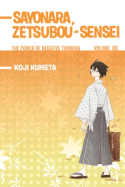
Sayonara, Zetsubou-sensei: The Power of Negative Thinking, Vols. 1-10

October 21, 2011 by Michelle Smith

By Koji Kumeta | Volumes 1-8 published by Del Rey, Volumes 9-10 published by Kodansha Comics

When I first set out to read Koji Kumeta’s Sayonara, Zetsubou-sensei, my goal was to finish the first eight volumes in time for Kodansha’s June 2011 release of volume nine.

You can see how well that worked out.

The problem was that this series simply doesn’t benefit from a marathon read. After four volumes, I burnt out and switched to reading it a chapter at a time as the mood struck me. Obviously, it took a lot longer this way, but turned out to be the ideal manga to read on breaks at work or while sitting around in the lobby of the doctor’s office. Interestingly, I found the most recent volumes to be so good that devouring them in their entirety was no problem at all!

There’s not a whole lot of plot to Zetsubou-sensei. Nozomu Itoshiki, the fourth son of a wealthy family, is a high school teacher with a penchant for nineteenth century garb. The title of the manga refers to the fact that when the characters of his name are written too closely together, they can be read as “zetsubou,” or “despair.” Which is convenient, since despairing over various things (and occasionally trying to kill himself) is Itoshiki’s specialty. His class is full of a variety of quirky students, whom we meet gradually, including a girl who sees everything positively, a methodical and precise (and possibly homicidal) girl, a girl who speaks only in text messages, a stalker, a fujoshi, an impoverished housewife, etc. We also meet a few members of his family, including his brother Mikoto, a doctor whose name can be read as “zetsumei,” or “certain death.”

Each chapter follows more or less the same pattern: the first couple of pages establish where the characters are, then something sets Itoshiki off on a rant. (For example, a hinamatsuri display inspires a diatribe about heirarchical societies.) Eventually he spews out a list of items that correspond to the topic of the day. Then the positive girl (Kafuka) will put forth a different opinion and, a couple of pages later, the chapter ends. As I’ve described it, this sounds tedious, but it’s often quite clever and absurd.

Some chapters are more Japanese-centric than others, with copious references to entertainers and public figures or topics specific to Japan, like tanabata or fukubukuro. These can be somewhat less fun to read, especially in earlier volumes when the (admittedly thorough) end notes provide so much information that one ends up reading the book with a finger permanently lodged in the back to reference the explanation as needed. With a change in translator for volume five, most of these notes disappeared.

At first, I was bothered by knowing there were all sorts of references I was missing, but in the end I think I prefer to just cope with ignorance; it helps that more recent volumes have dealt with some universal topics like dream endings, assumptions, jokes you’ve heard a million times, how we perceive the passage of time, modern conveniences leading to inconvenience (“Thanks to Amazon,com, we’ve got piles of books that we haven’t had time to read”), skewed priorities, gifts you feel obliged to accept, and getting sucked into other people’s drama. Somewhat to my surprise, it feels like we’re beginning to learn a little bit more about the characters, as well.

In addition to following the established formula in terms of chapter progression, there are also several recurring gags in Zetusbou-sensei. I’m not very fond of the poor dog with a stick in its butt who appears on occasion, but the creative ways Kumeta finds to insert a panty shot from a particular character are kind of fun, and I’m quite fond of Itoshiki’s stalker, Matoi, who suddenly pops up in the middle of scenes, surprising the characters. “You were here?” And the way in which the characters continue to fail eleventh grade and must repeat it pokes fun at those series—Ouran High School Host Club is the most notorious example to come to mind—where seasons pass but the characters inexplicably fail to graduate.

Artistically, Sayonara, Zetsubou-sensei has a very unique look. Kumeta uses very little screen tone, and all of his characters (except one) have pitch-black hair and eyes. There are many girls in the cast, but they all have distinctive hairstyles. Even if I can’t remember someone’s name, her hairstyle will clue me in. “Oh, that’s the delusional self-blaming girl!” Kumeta’s got a recurring trick for page layout too: frequently, a character will be drawn full-length to one side of the page and depicted with extremely skinny ankles and extremely large feet. In more recent volumes it seems that facial closeups are happening more often, or that characters are being viewed from some new angles, which is a welcome development.

On the whole, I enjoyed Sayonara, Zetsubou-sensei a great deal. I felt that it improved as it went along, and I look forward to remaining current with the series henceforth. It may not have made me laugh aloud continuously, but it was always amusing enough to make me smile, and it’s to its credit that it was still capable of making me giggle in its 100th chapter.

Sayonara, Zetsubou-sensei: The Power of Negative Thinking was originally published in English by Del Rey, who put out the first eight volumes, but is now being published by Kodansha Comics. The series is ongoing in Japan; volume 27 came out there earlier this week.

Review copies for volumes five, seven, eight, and ten provided by the publisher.

Filed Under: REVIEWS Tagged With: del rey

Pick of the Week: Post-NYCC

October 17, 2011 by Michelle Smith, Sean Gaffney, David Welsh, Katherine Dacey and MJ 7 Comments

In the aftermath of New York Comic Con, we have no Bookshelf Briefs to offer this week, but we did manage to pull together a quick Pick of the Week! Check out our picks from this week’s haul at Midtown Comics below.


MICHELLE: Faced with yet another tough choice this week, I ultimately decided to award my pick to the seventh volume of Jun Mochizuki’s Pandora Hearts. Volume one introduced so many story elements at once that it left me baffled, but I’m glad I gave the story another chance because it has coalesced into an affecting tale with genuinely intriguing characters. True, volume six, wherein the gang heads off to visit the little sister of protagonist Oz—who, thanks to her brother’s stint in another dimension, is now older than him—at school and meets some new characters was not my favorite, but I have faith that it will lead somewhere interesting. That’s why I will most assuredly be picking up volume seven!

SEAN: I’m at NYCC, so this will be short. New Higurashi. Start of the Rena arc. Good stuff, go get it.

DAVID: There’s so much great stuff this week, with lots of new releases from Yen Press, a few choice items from Viz’s Signature line, and an always-welcome new volume of Osamu Tezuka’s Black Jack from Vertical, but I have to go with the book that it feels like I’ve been waiting for the longest, and that would be the second volume of Kaoru Mori’s Bride’s Story from Yen. I thought the first volume was faultlessly beautiful, and I’m eager to learn more about its can-do heroine, Amir. As was the case with Mori’s Emma, the plot here is less interesting than the meticulously rendered trappings and the small but very lovely moments that reveal character. With Mori, it’s always more about the harmonic elements than a traditional, central melodic line, but the ultimate effect is always fascinating to me. I really enjoy spending time in the worlds she creates.

KATE: A Bride’s Story is at the top of my must-buy list, too, but since David has so eloquently described the series’ charms, I’ll recommend the first volume of CLAMP’s Gate 7 instead. This long-delayed project was first announced at San Diego Comic-Con in 2007, and has undergone several transformations along the way. (Remember when it was going to be simultaneously released in Japan, Korea, and North America in “mangette” form?) The story is pure CLAMP: a shy teen is transported from modern-day Tokyo to a fantasy realm that’s under siege from ferocious monsters. Naturally, he discovers that he has skillz he didn’t know he had — would it be a manga if he didn’t have a few hidden talents? — and must decide whether to save the Earth or go home for dinner. If the cover art is any indication, Gate 7 will be a feast for the eyes, even if the plot mechanics are a little creaky. Kathryn Hemann, who blogs at Contemporary Japanese Literature, has a thoughtful early review that’s worth reading if you’re on the fence about buying it.

MJ: I’m a bit of a post-con zombie this morning, but since I see that my cohorts have already covered several of my top choices (Pandora Hearts, A Bride’s Story, and Gate 7), I’ll take a moment to put the spotlight on the penultimate volume of Osamu Tezuka’s Black Jack. This series is always a winner with me, but I’m especially interested in this volume’s final chapter, which reportedly comes in at something like 70 pages. Though short, episodic storytelling served this series well, I admit I’m thrilled at the prospect of digging in to something so substantial. Definitely a must-buy!


Readers, what looks good to you?

Filed Under: PICK OF THE WEEK

Off the Shelf: Love Hina

October 12, 2011 by MJ and Michelle Smith 5 Comments

MICHELLE: We have gathered here today with special guest Kate Dacey to talk about Ken Akamatsu’s shounen romantic comedy Love Hina. In the spirit of the occasion, I feel like I should start things off by falling down a flight of stairs and ending up accidentally clutching you both upon the bosom.

MJ: Also, we should probably all be in the bath.

MICHELLE: And my pants should have fallen down somewhere along the line.

MJ: I can shriek in horror, and Kate can make pithy comments while smoking a cigarette.

KATE: That’s the perfect role for me; I’ve sounded like Bea Arthur since I was ten years old.

So what did you guys think of the book?

MICHELLE: Would you like to go first, MJ, or shall I?

MJ: Well, do you want the short version or the long one? The short version pretty much boils down to, “I guess it could have been worse,” though I’m not sure how much of a recommendation that is.

MICHELLE: How about the long version, slightly abridged?

MJ: Okay, okay. So. For those who might be unfamiliar, Love Hina tells the story of a tragically awkward and academically unremarkable young man named Keitaro who has already spent too much of his adult life trying and failing to get into the University of Tokyo (Todai) in order to fulfill a childhood promise made to a girl. Having been kicked out of his parents’ home, he heads for the safety of his grandmother’s Inn, which has (conveniently) been converted into an all-female dormitory, complete with an open bath and a cast of lively young women, each clumsier than the last. Through a series of wacky circumstances, Keitaro becomes the manager of the dormitory, allowing him the opportunity to spend yet another year studying for college entrance exams while also grasping as many bosoms as possible.

I have to admit that I nearly decided to abandon this book, when not even half a chapter in, our hero was already getting felt up in the bath by an unsuspecting girl. I looked at the three-volume omnibus in my hands and thought, “I’ll never make it through this. Never.” And I suppose it says something that I actually did.

Interestingly, I discovered what it is that I dislike about this kind of series, and it surprised me a little. While I don’t necessarily love the constant parade of nude young girls, it’s not the nudity or the sexual innuendo that really bothers me. It’s the falling. At a certain point, I just thought I would scream if I had to watch someone else fall down. Sexual situations are fine, but after a while, I could no longer tolerate their pervasively accidental nature. Really, it eventually made me angry. And I suspect that without all the falling, these three volumes could have been reduced to just one.

On the upside, the series’ primary romance has its genuinely sweet moments. They aren’t really interesting enough to make up for the book’s truly maddening qualities, but it did make it readable.

How’s that?

MICHELLE: Excellent! And interesting, because though I didn’t single out falling as the single most annoying attribute, I did get extremely annoyed at all the accidents. Any accident that can happen, will happen. Like when Keitaro attempts to fix the hole in his ceiling that communicates with Naru’s room above—and which provides much opportunity for panty-glimpsing—and an extremely unlikely series of accidents occurs that result in him glimpsing the phrase “fifteen years ago” in her diary, which makes him wonder if she could be the first love with whom he promised to make it into Tokyo University (though he fails to realize she would have been two at the time!).

MJ: For the record, I still think it will turn out to be her, through some kind of wacky circumstances. And falling.

What about you Kate?

KATE: The thing I found most grating was how inconsistent the characters were. Take Motoko: she’s fierce and principled, the sort of girl who has a very limited tolerance for foolish behavior. That she would suddenly turn into a puddle simply because she falls on top of Keitaro strained credulity, not least because Keitaro is so utterly incompetent. That the other female characters have similar moments is even more frustrating, as there’s nothing about Keitaro that ought to endear him to the Hinata dormitory residents.

I also took a pretty dim view of all the jokes about the underage girls — frankly, I found them pretty gross. There’s nothing quite like the sight of a twenty-year-old male loser ogling a young teen to really raise my feminist ire.

MICHELLE: And yet… I think I was helped by Jason’s introductory post and Sean’s review to see past all of the ridiculous fanservice and unfunny hijinks and really appreciate the sweeter moments of the series. Sure, it’s creepy that Keitaro gets turned on by a seventh grader’s undies and I can’t say that I actually like him most of the time, but get him together with Naru and let things actually go right just for a minute, and I can see the potential for them as a couple.

I guess what I’m trying to say is that I sigh as I read Love Hina (and not in a dreamy way), but I don’t despise it. In fact, I find it much more readable than Mao-chan. I couldn’t even get through the first volume of that one.

MJ: I admit I was a bit stunned by the story’s abundance of underage girls, and perhaps more so that we apparently aren’t supposed to think anything of them being constantly exposed in front of Keitaro. On one hand, it seems very natural that young girls might have a crush on an older guy (maybe not this older guy, but that’s what we’ve got) but it all comes out feeling creepy when it’s being relayed by way of the male gaze.

KATE: You’re a more patient woman than I am, Michelle! The prevailing tone reminded me too much of a Benny Hill episode for me to give a fig about Keitaro; I wanted nothing more than a big foot to descend from the sky and flatten him, Monty Python style.

MICHELLE: He’s definitely extremely pathetic and I don’t feel any sympathy for him for the ludicrous and/or perverted situations he ends up in, but I guess the calm scenes won me over at least a little, though now that I stop and think about it I wonder what exactly Naru is supposed to be gaining from associating with such a loser.

KATE: I’m so glad you mentioned Naru, Michelle! She may be the only character I actually like in Love Hina (aside from Keitaro’s sardonic, chain-smoking auntie). It’s maddening to think that Ken Akamatsu will find a way for Keitaro and Naru to be together, not least because the relationship is totally unequal: Naru is brilliant and attractive, while Keitaro can barely tie his shoes, let alone solve a quadratic equation. I don’t mean to suggest that book smarts are the only measure of a man’s worth, but when the male lead is so dumb and clueless, it’s insulting to female readers to see the series’ strongest, most appealing female character positioned to become his girlfriend.

MJ: I can relate to both of you, actually. While, like Michelle, I was able to enjoy the romantic plot with Keitaro and Naru, I found it really difficult to stomach Keitaro most of the time. I really do see him as a loser, and not because he’s having trouble getting into a super-competative university, or because he’s inexperienced with girls. I see him as a loser because he is a slave to his own desperation, and it ends up making him disgusting. I think if he had some kind of personality other than just “desperate” I could like him, but he’s really given nothing, so all we’re left with is a clumsy, groping, panty-sniffing loser.

MICHELLE: Yeah, I’m trying to think of a positive quality he possesses, but I’m coming up blank. I mean, he does try hard at certain things, it’s just that this never really works out well. He’s earnest about redeeming himself in Shinobu’s eyes for letting her believe he had already gotten into university, but then he turns around and gets all excited when he believes she’s invited him to bathe with her. One step forward, two steps back.

MJ: I think it’s probably fair to point out that we’re clearly not the audience for this manga. I’ll fully admit to an intolerance for the kind of sexually-charged antics that are the life’s blood of Love Hina. I’ve had the same issue with quite a number of BL manga with this type of sensibility, so it isn’t entirely an issue with the male gaze, either. It just really isn’t my thing. I suspect it all began with a childhood hatred of Three’s Company. Yes, Jack Tripper scarred me for life.

One of the things I particularly enjoy about the Manga Moveable Feast is the opportunity to read things I might otherwise have ignored, and in that spirit, I’m happy to have tried Love Hina. But I’m afraid it falls pretty flat with me.

MICHELLE: Oh, totally. And I hope it comes through that we all tried to like it, but that it just didn’t resound with us for various reasons.

I confess that I am a little curious to see how it ends. I guess I like it enough to care about how it wraps up. But I don’t think I like it enough to read all the volumes in between, which will undoubtedly be full of boobies and pratfalls with a small sprinkling of encouragement delivered by Naru. And there is so much other brilliant manga out there that I already don’t have time to read, I feel like I shouldn’t squander any more precious moments on Love Hina.

MJ: Well said, Michelle. I feel much the same way.

Many thanks to Kate for joining us in this special edition of Off the Shelf! Be sure to check in at PLAYBACK:stl for the complete Love Hina MMF archive!

Filed Under: OFF THE SHELF Tagged With: Love Hina, Manga Moveable Feast

Pick of the Week: Cross Game & More

October 10, 2011 by Katherine Dacey, Michelle Smith, Sean Gaffney, MJ and David Welsh 5 Comments

This week, Midtown Comics plays catch-up with several months’ worth of Kodansha Comics releases, giving the Battle Robot plenty to choose from. Check out our picks below!


KATE: Though I’m not sure why Kodansha felt it was necessary to release a third edition of Gon, I never miss an opportunity to recommend this beautifully illustrated series to new readers. Billed as “the tiny terror from the Jurassic era,” Gon is a little orange t-rex who has a talent for getting into trouble. He tangles with other predators; he eats psychedelic mushrooms; he swims with sharks; he builds a beaver dam. What makes Gon work are the illustrations: Masasahi Tanaka resists the urge to put words into his characters’ mouths, instead relying on his cartooning chops to convey what the participants are feeling and thinking. As a result, this animal-centric series is never too cute or saccharine, capturing the natural world in all its raw (and sometimes comic) glory.

MICHELLE: This week’s chart at Midtown Comics looks pretty bizarre, since they are finally getting in all those Kodansha releases they were missing before. I advocate strongly for quite a few of them—Sailor Moon, Arisa, Shugo Chara!…—but I am going to have to award my pick to the fifth volume of Cross Game, which comes out this week along with several other of VIZ’s Shonen Sunday titles. I enthused about this particular volume in a recent Off the Shelf column, where I concluded my remarks by saying, “If you like sports manga, you will like Cross Game. And if you don’t like sports manga, you will still like Cross Game.” And lo, MJsubsequently read the first volume and proved me right!

SEAN: I hate to duplicate, but I’m going with Cross Game as well. This volume introduces a new plot twist that at first seems like the most cliched thing a reader has ever seen, but Adachi is an expert, and the way things play out is fascinating. The reactions of all the characters are one of the best reasons to get it, as Adachi milks so much from his minimalistic faces. Best of all, there’s a promise of more baseball. After finishing off Eyeshield this week, I’m in the moon for some more sports, and Adachi’s baseball games are thrilling stuff.

MJ: Honestly, I’m really tempted to third Cross Game, but I guess in the interest of spreading the love, I’ll go with volume three of Kim Hyung-Min and Yang Kyung-Il’s March Story. This dark, whimsical series got off to a shaky start, but its third volume is really solid, making the most of Kim Hyung-Min’s episodic storytelling and Yang Kyung-Il’s intricate artwork. There is perhaps a little less through-story than usually suits my taste, but though this volume focuses less heavily on March and her history than either of the earlier volumes, there are enough little nuggets of new information to get me by. And the stories we do get here really work, with a level of consistency absent from the first two volumes. In the beginning, I stuck with this series for the beautiful artwork. Now I’m in for good.

DAVID: I’m going to surprise myself by not third-ing Cross Game (SECRET CODE: I’m totally actually third-ing Cross Game by claiming that I’m not) by giving a little leg-up to a new shônen series from Kodansha by Ryou Ryumon and Kouji Megumi, Bloody Monday. Now, I wasn’t wildly enthusiastic about this book in last week’s Bookshelf Briefs, but I have to say that there’s always room for another stylish mystery featuring super-smart teens, which Viz seems to realize, given the fact that they keep re-releasing Death Note over and over again. The creators do a nice job setting up their complicated story and making a persuasive case that the stakes are high, something not everyone manages in a first volume. I wasn’t precisely blown away by the series debut, but I like mysteries, and I like comics about smart kids who have unique skills, and Bloody Monday fits both bills.


Readers, what looks good to you this week?

Filed Under: PICK OF THE WEEK

Bookshelf Briefs 10/10/11

October 10, 2011 by Katherine Dacey, David Welsh, MJ, Sean Gaffney and Michelle Smith 11 Comments

This week, Kate, MJ, David, Sean, & Michelle take a look at recent releases from Digital Manga Publishing, Kodansha Comics, and Viz Media.


Blue Exorcist, Vol. 3 | By Kazue Kato | Viz Media – In the third volume of Blue Exorcist, Kazue Kato proves beyond a doubt that she’s in control of the material. She uses these chapters to properly introduce two worthy antagonists for Rin: Mephisto’s younger brother Amaimon (a dead ringer for Green Day’s Billie Joe Armstrong) and Father Fujimoto’s former protege Shura Kirigakure. But Kato also takes the time to flesh out her established cast. Rin has an opportunity to solve a crisis with reason instead of magic, while flashbacks allow us greater insight into Father Fujimoto’s relationship with Rin. Smart-looking character designs, brisk pacing, and crisp dialogue keep the story afloat, even when Kato is going through the standard shonen motions (e.g. busty big-sis types, school field trips involving camping and group chores). A worthy addition to the Shonen Jump catalog. -Katherine Dacey

Entangled Circumstances | By Kikuko Kikuya | Digital Manga Publishing – Everyone’s heard the adage “never judge a book by its cover,” but more often than not, doing so has led me to something interesting, especially where BL is concerned. Not so with Entangled Circumstances, alas. Oh, it’s okay, being the story of a handsome, popular guy (now the project manager for a magazine) and the stubborn, uptight guy (now in the magazine’s sales department) he’s been chasing for six years, but it’s not as quirky as its eye-catching cover—quite different from common BL motifs—would suggest. Pretty much the entire plot is “uptight guy refuses to admit that he loves the other guy until suddenly he does acknowledge his feelings and then they have lots of sex although he worries the popular guy will tire of him now that he’s caught him.” Yawn. Nothing new to see here. – Michelle Smith

Eyeshield 21, Vol. 37 | By Riichiro Inagaki and Yusuke Murata | Viz Media – We are finally at the end of Eyeshield 21, which is second only to Prince of Tennis for longest sports manga out in North America, I believe. And if, as I believe, it should have ended at the Christmas Bowl 3 volumes ago, I can’t really begrudge it this victory lap. We finish up the game against America, and as expected the Japanese team slowly begins to inch its way back. The highlights of the volume are probably a) the revelation of the bandaged player, who isn’t the person everyone thought; and b) seeing Agon finally give in and play like a real teammate. Much as I hate to see anything good happen to him after being a jerk for *so* long, it wouldn’t be very Shonen Jump-ey, and this is nice to see. As the series ends and we see the cast split into various colleges all playing against each other, we get a satisfying sense of closure (unless you were one of the few readers wanting romance – no hope there) and a sense that the future is bright for all of them.-Sean Gaffney

March Story, Vol. 3 | By Kim Hyung-Min and Yang Kyung-Il | Viz Media – From the beginning, March Story has had a compelling protagonist, a dark, intriguing tone, and beautiful, beautiful artwork, while other aspects of the series have waxed and waned. Things even out in volume three, as author Kim Hyung-Min finally hits his stride and then some. Though this volume conforms to the series’ episodic format almost to a fault, this seems to be a good thing, even in the eyes of an epic-loving critic like me. March’s surreally-designed mother figure, Jake, is featured in this volume, which is much more of a treat than I might have imagined. Other highlights include a story about an Ill trying to protect her human son, and an Ill who spends years devoted to a human woman. There isn’t a lot of Ill-hunting going on in these stories, but you won’t hear me complaining. This series is at its best when bittersweet. It’s nice to be able to finally recommend March Story without reservation. Hopefully this is a permanent trend. – MJ

Pretty Guardian Sailor Moon, Vol. 1 | By Naoko Takeuchi | Kodansha Comics –I end up enjoying a lot of teen-demographic manga in spite of the fact that I don’t really care for the protagonist. If the supporting cast is large and interesting enough, I can ignore the lead’s shortcomings. Sailor Moon is shaping up in that direction, as I find our titular heroine to be too much of a drippy dingbat to actively like. While her solar-system sister is having a ball over in Codename: Sailor V, Usagi is behaving in some of the most predictable ways imaginable: lazy, shallow, and easily distracted. Fortunately, she’s surrounded by people with enough verve to drag her along, and Takeuchi has barely begun assembling her array of allies. I’m particularly taken with tough, elegant, slightly spooky Sailor Mars and dreamy, sarcastic Tuxedo mask, in spite of his contractual obligation to express fascination with our heroine. And whose life wouldn’t improve under the mentorship of a talking cat? – David Welsh

Tonight’s Take-Out Night | By Akira Minazuki | Digital Manga Publishing – The title story in this collection depicts a whirlwind romance between the manager of a burger joint and a guy from the corporate office. There’s not much emotional resonance to this tale, but that’s made up for by the next set of stories about an icy inhuman being (Kirin) whose killing streak comes to an end when he meets a kind physician (Shinnosuke). Their story brings all the drama one could ever want, including Kirin becoming human through his love for Shinnosuke (and angsting that he’s just a replacement for Shinnosuke’s late wife) and Shinnosuke eventually having second thoughts about this because Kirin will now eventually die. The last pair of stories are devoted to Makimura and Fujimori, an art student and his younger mentor who feel each other up first for sculpture-making purposes and then just for fun. All in all, it’s a diverse and enjoyable collection. – Michelle Smith

X 3-in-1, Vol. 1 | By CLAMP | Viz Media – Psychic powers! Family secrets! Mysterious destinies that threaten the entire world! Good-looking boys, and girls with yards of hair! X is pretty much dead center in the Venn diagram of “things I expect from a comic by CLAMP,” which is problematic only in that I like their work best when it surprises me. Siblings Kotori and Fuma find their high-school world turned upside-down by the return of their childhood friend, Kamui. He’s changed from the gentle, outgoing boy they knew, but you would too if you were constantly being attacked by nattily dressed, willowy psychics. On one hand, the whole “earth-threatening destiny” thing is as muddy and hard to navigate as a swamp; on the other, there’s an unapologetic level of violence here that compensates for the nonsensical quality of the plot it serves. The characters may be a little drab, and the story is a head-scratcher, but the fact that there’s this much bone-crushing, body-count action in a shôjo series is undeniably awesome. – David Welsh

Filed Under: Bookshelf Briefs

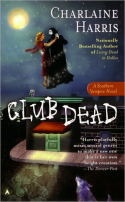
Club Dead by Charlaine Harris

October 8, 2011 by Michelle Smith

From the back cover:
There’s only one vampire Sookie Stackhouse is involved with (at least voluntarily) and that’s Bill. But recently he’s been a little distant—in another state, distant. His sinister and sexy boss Eric has an idea where to find him. Next thing Sookie knows, she is off to Jackson, Mississippi to mingle with the under-underworld at Club Dead. It’s a dangerous little haunt where the elitist vampire society can go to chill out and suck down some type O. But when Sookie finally finds Bill—caught in an act of serious betrayal—she’s not sure whether to save him… or sharpen some stakes.

Review:
It’s been more than a year since I promised “Club Dead, coming soon!” at the end of my review of Living Dead in Dallas. I didn’t forget the pledge; it just took me that long to be in the mood for another round of salacious vampire shenanigans. But what better time to revisit the series than Halloween Week? This one was such an improvement over the last, however, that I’m going to make a sincere effort to get caught up on the series.

Part of what makes Club Dead interesting is that there is so little Bill and when there is Bill, he’s wronging Sookie in ways that culminate with her disinviting him from her home. As the book begins, he is working on a top-secret assignment for “the queen of Louisiana” (there’s a lot of detail about the vampire hierarchy in this book) and tells Sookie he’s heading to Seattle to work on it. This turns out to be a lie, as she learns later that Bill is being held captive in Jackson and that he was preparing to pension her off and return to his vampire love, Lorena.

Despite the betrayal, Sookie agrees to help Eric (Bill’s superior, in a manner of speaking) find Bill and is matched up with a brawny werewolf named Alcide Herveaux, who can introduce her to the supernatural element in Jackson. Alcide’s got baggage of his own, so in addition to treading lightly around “the king of Mississippi” and the werewolves the king has hired to search for Bill’s girlfriend (thankfully, he never got her name), they’ve also got to avoid Alcide’s crazy ex, Debbie Pelt.

All of this is fairly entertaining—even if a large amount of the plot is contingent upon guys finding Sookie extremely hawt and wanting to boff her—but it did seem randomly strung-together at times. For example, after Bill is rescued the gang must next prevent the crucifixion of “Bubba” (Elvis in vamp form) and foil a convenience store robbery. I really liked the ending, though, and once again find myself hoping that Sookie will not forgive Bill’s transgressions, now weightier than ever before. Sure, it’s a little ridiculous how many guys are hot for her, but her steamy encounters with both Alcide and Eric are more fun to read than detailed sex scenes starring Bill. (The fact that Eric gets fleshed out a great deal is one of the best aspects of the book, actually.) Plus, Sookie’s reaction to these tempting guys is pretty amusing. “I was not pleased with my moral fiber!”

I find that I haven’t much to say about the book beyond this. It’s diverting and amusing and has even rekindled my curiosity about True Blood. It’s not fair to compare something like this against oh, say, Price and Prejudice, but for this particular genre, it exceeds expectations.

Filed Under: Books, Supernatural Tagged With: Charlaine Harris

Off the Shelf: Bakuman, Seiho, Geek

October 6, 2011 by MJ and Michelle Smith 5 Comments

MJ: *Brrrrr* It’s cold up here!

MICHELLE: It is extremely nice down here! Long-sleeve-shirt weather at the most.

MJ: *whimper*

MICHELLE: Don’t feel too bad; at least you’ve got takoyaki. Fat chance of ever finding that down here!

MJ: I will cling to fried octopus as the one virtue of my region. So, read any manga this week? With or without takoyaki?

MICHELLE: I read a fair bit, but it was takoyaki-free. This included volumes six and seven of Bakuman。, a series about two boys’ quest to achieve manga stardom that I seem to enjoy more and more with each installment.

In volume six, Moritaka Mashiro and Akito Takagi are working hard on their manga series when Mashiro suddenly collapses. His ailment is treatable but requires three months in the hospital, during which time their series goes on hiatus. Pretty much this entire volume is people arguing whether Mashiro should be allowed to draw while in the hospital, then whether the terms for the series coming off hiatus are fair. Mashiro eventually regains his health, but in the beginning of volume seven, they receive the bad news that the hiatus has dealt a blow to the popularity of their series and it has been canceled. Dubious about the advice they’re getting from their editor, the boys dive into the process of getting a second series serialized. This volume is mostly full of arguments about which one they want to do, what their editor wants them to do, etc.

And you know what? It’s all awesome. I love that Bakuman。 is able to achieve such dramatic tension over concepts like “What if the series that gets the go-ahead is not the one they really want to do?” or “Is Mashiro actually right to insist on a serious story? Is their editor right? Or is he incompetent?” I suppose these might not sound like riveting plots to some, but they kept me turning pages like a mad fiend and when I finished I wished there were more, which brings Bakuman。 into the elite company of series like Slam Dunk, which leave me actively pining for another volume.

The characters have also matured a great deal, both intellectually and physically, which is something this series has in common with another title with art by Takeshi Obata, the much-loved Hikaru no Go. Their attitudes toward women are much different now, for example, and I especially like how Takagi is now so candid about how much he values his girlfriend Miyoshi’s advice and includes her in everything that’s going on. Mashiro, meanwhile, is getting somewhat feistier, and if I had a nickel for every time the antics of kooky rival/friend Eiji Nizuma made me smile fondly, I could at least afford a taco.

MJ: I really enjoyed this volume as well. I wasn’t as keen on the subplot with Aoki and possible girl complications for Takagi, but in a way this is a positive sign. It’s taken me a while to care a lot about Takagi and Mashiro’s fates as artists (instead of gravitating towards supporting characters), but that’s what I was focused on here. I love the conflict with their editor, and I can’t wait to see how their final decision pans out.

MICHELLE: Y’know, one of the critiques Eiji tosses off about their work is that the characters they create lack heart, and I think that in some respects Mashiro and Takagi did, too, at first. Now I’m beginning to see them more as fully realized characters and that makes all the difference.

MJ: Well, I started off my week with the final volume of Kaneyoshi Izumi’s Seiho Boys’ High School! This was, in fact, my pick of the week, and there are a number of reasons why.

The focus of this volume is Maki’s relationship with Erika, which is on the rocks, particularly as Maki begins to suspect that she’s seeing Kamiki on the side. This kind of thing is nothing new in shoujo (or anywhere else), but what’s really refreshing is the way it all plays out. Nothing is as simple as it seems, and love can’t possibly conquer all, especially for two kids just barely figuring out who they are. Most high school romance tends to pretend like young love is forever, and those that don’t usually lean towards either intense cynicism or melodramatic angst.

Seiho goes in none of these directions. It acknowledges the inherent transience of most teen romances while really giving the characters their due. Maki and Erika are both hurting and both wrong, but they’ve got real futures in front of them, with or without each other.

This series really has been a surprise from start to finish. Originally, it was fresh, funny, and surprisingly candid about the true personalities of teen boys. It’s still those things, but also it’s become really poignant, in the manner of some of the best recent shoujo, like Sand Chronicles and We Were There. I wish it was a bit longer, so we could see what happens when Maki gets out of school, but ending here does make this a nice, relatively short series.

The extra story included at the end of the book is less my cup of tea, so I was pretty sad to realize that it would take up a full quarter of the volume. But it’s not like I would have gotten more Seiho without it, so I can handle the disappointment.

MICHELLE: I have been terribly remiss regarding Seiho, but there just came a point where six of the eight volumes were already out and I figured, “Might as well wait.” Seeing it compared to such standouts as Sand Chronicles and We Were There makes me even more eager to experience it. I really adore strong, subtle shoujo like this that manages to transcend all those shoujo clichés without ever once sacrificing its essential shoujoness.

MJ: I do too, and I didn’t really expect that in Seiho. The series was really a surprise.

So, we’ve both read the next selection, and given your opinion of the first three volumes, which I think was a bit different than mine, I’m pretty interested to see what you think of volume four of My Girlfriend’s a Geek. Wanna hit us with a quick summary?

MICHELLE: I’ll do my best!

So, college student Taiga has been dating his fujoshi girlfriend Yuiko for a while now and has gotten to know her well enough to realize that she will immerse herself in scandalous BL fantasies if he tells her he’s begun to tutor a middle-school boy who embodies the very definition of an uke. So, he keeps this quiet, and the evasions plus his distance while he works to get into his desired program at school finally prompts some genuine response from Yuiko’s part. They have a long-overdue conversation in which Taiga is able to get some things off his chest, and finally it seems like there may be some genuine hope for their relationship.

What I most wanted from the first three volumes was to see Yuiko and Taiga really engage each other, for Yuiko to seem fully present in the real world, and we finally get that here. Her attempts to get Taiga’s attention, when all she’s doing is irritating him by distracting him from her studies, were extremely sympathetic, and I felt I was finally getting a glimpse at her perspective of their relationship. I had previously read it like she was going overboard with her fujoshi tendencies, but now I realize that she’s just been teasing him half the time, hoping to get an amusing rise out of him. Okay, this still isn’t much fun for Taiga, but it helps me to understand her.

MJ: I think I enjoyed the first three volumes more than you did, or maybe just as someone who has been heavily involved in a similar type of fandom as Yuiko, I could relate to it all on some level. What was missing for me, though, was some sense of what they really meant to each other—that they were really boyfriend and girlfriend—and I finally feel like I got that here. With both of them feeling insecure in the relationship but also anxious to save it, I finally feel like I really know where they stand with each other.

I think where we may not quite see eye-to-eye here, though, is on what Taiga gets from the relationship. I appreciated that he actually *said* in this volume that he found indulging her whims “kind of fun” because, honestly, it’s felt like that to me from the start. Sure, he complains about it all, but he gets genuinely caught up in it sometimes, and I can’t help but feel that he wouldn’t keep up with it all if he didn’t enjoy being pushed into her fantasies a bit. And I’m glad to see that in him, because it’s a lot more interesting than a story about a guy who just has what we might expect to be typical straight boy reactions to everything she does. It makes the relationship feel more real to me, too.

MICHELLE: I see that in Taiga now, but I interpreted his behavior in earlier volumes as sort of… mollifying Yuiko because he wanted to have a hot older girlfriend. He wasn’t repulsed, but he was puzzled and overwhelmed by her fervor. Now, though, it seems more like he really gets Yuiko as a person. I love the scene near the end where he’s studying and she compliments him—possibly for the first time without a personal agenda—and he reveals he’s working on the BL novel for her again. How her face lights up! It’s not as if I would ever expect her to not be herself, but it seems like she’s going to take her friend’s example to heart and really appreciate having found a guy who’s willing to actively indulge her.

What it boils down to is that they just make a lot more sense to me now as a couple. I look forward to the final volume!

MJ: I agree, I’m really looking forward to the final volume, and I may even wish there were more! I’m interested in digging into the novels as well. My original expectations for this series were very low, and it has easily exceeded them.

MICHELLE: I was originally more interested in the novels, but having seen the excerpt at the end of the first manga volume, now I’m not so sure. The Taiga equivalent seems awfully spazzy.

I should note here, too, that mangaka Rize Shinba’s BL manga is also enjoyable. You and I have reviewed Intriguing Secrets and My Bad for BL Bookrack with favorable results.

MJ: Well, you know me, I’ve never had a problem with “spazzy.” And yes, I do recall that we’ve enjoyed Shinba’s BL. I guess she’s probably got some personal insight to offer to these adaptations.

MICHELLE: Seems like!

Filed Under: OFF THE SHELF

JManga Slashes Prices! (Well, Temporarily at Least)

October 4, 2011 by Michelle Smith

Even though I grumbled a little at JManga’s prices, I was mostly okay with paying the equivalent of $8.99 for a manga that would likely never get licensed for a North American print release. Still, because I wanted them to do well enough to stick around for a long time, I hoped they would reduce their prices, perhaps emulating VIZ’s $4.99-per-volume pricing strategy.

Well, happy news! JManga is having a “sale” where they’re doing exactly that. Not only that, they’re making the surprising goodwill gesture of refunding users 50% of the credits they spent under the old pricing structure. “Holy crap!” I said aloud, when I read that part.

The one drawback to this is that they haven’t been adding many new series lately. I’ve pretty much bought all the ones I wanted and am waiting for either new stuff or some second volumes to become available. I now have a hefty points balance without much to spend it on.

Anyway, if you’ve been holding back on JManga before, now’s a great time to check it out. And hopefully increased interest will show JManga that $4.99 is the way to go and this will become a permanent thing.

Filed Under: NEWS, UNSHELVED Tagged With: JManga

My Girlfriend’s a Geek, Vols. 1-3

October 4, 2011 by Michelle Smith

By Rize Shinba (manga) and Pentabu (story) | Published by Yen Press

The good news is that I liked My Girlfriend’s a Geek more than I expected to. The bad news is that I’m not sure if I should feel particularly good about that.

Taiga Mutou is a penniless college student in need of a part-time job. When he spots Yuiko Ameya—who fits his ideal of the “big sis-type”—in the office of one prospective employer, he devotes himself to getting hired and thereafter attempts to find opportunities to engage her in conversation. He’s largely unsuccessful until a bit of merchandise goes missing and she helps him look for it. They talk a bit more after that, but it’s not until she sees him in a pair of glasses that she really begins to take notice.

At first, Taiga is puzzled but pleased that certain things about him meet with Yuiko’s approval—in addition to the glasses she also appreciates his cowlick and has an unusual level of interest in his methods for marking important passages in his textbooks. When he finally asks her out and she confesses that she’s a fujoshi (“Is that okay with you?”) he’s so exuberant that he agrees without really understanding what that entails.

From that point on, My Girlfriend’s a Geek is essentially a series of situations in which Yuiko’s fujoshi ways make Taiga uncomfortable, and here is where my conflicted feelings begin. On the one hand, it’s absolutely true that Yuiko did try to warn him and that she shouldn’t have to pretend to be someone she isn’t. On the other hand, she is so caught up in her BL fantasizing that she never considers Taiga’s feelings, and even ceases to refer to him by his actual name. Taiga is always the one doing the compromising, and when it seems like Yuiko might be on the verge of doing something nice for him, it usually turns out that she has some self-serving motive.

And what if Yuiko’s character was male? How would this read then? She frequently concocts scenarios in which Taiga is getting it on with his friend Kouji and expresses the desire to take pictures of them together. If she was a male character saying such things to his girlfriend this would be the epitome of skeavy behavior! I seriously wonder whether she likes Taiga for himself at all, but that’s not to say he’s blameless here, either, because it’s hard to see what he could like about her except that she fits the bill for the cute older woman he’s always wanted to date.

All that said, there is still quite a bit to like about this series. For one thing, it’s often quite amusing, especially Taiga’s reactions to Yuiko’s flights of fangirl and the fictional shounen sports manga (with shades of Hikaru no Go and The Prince of Tennis) that Yuiko is obsessed with. For another, it does occasionally touch on what it’s like to discover that someone you fancy has this bizarre secret that you’ve got to try to cope with if you want to stay together. Taiga occasionally laments how far apart they are emotionally, and though we’ve yet to really see inside Yuiko’s head, her attempts to sustain a real-life relationship remind me some of Majima in Flower of Life, another hard-core otaku with a moe fixation.

There’s only two more volumes of this series and I plan to keep reading, but I hope that these characters will manage to achieve more of an equal relationship. Even if Yuiko could just learn to see Taiga’s exasperation and take some genuine step to engage him on a serious personal level, then I’d be happy.

My Girlfriend’s a Geek is published in English by Yen Press. The fourth volume has just come out (to be featured in this week’s Off the Shelf!) and the fifth and final volume is due in December 2011. They have also released the two-volume novel series upon which the manga is based.

Review copies provided by the publisher.

Filed Under: REVIEWS Tagged With: Rize Shinba, yen press

Pick of the Week: Festival of Viz

October 3, 2011 by David Welsh, Katherine Dacey, Sean Gaffney, Michelle Smith and MJ 9 Comments

There’s a flood of Viz titles coming in to Midtown Comics this week. Check out the Battle Robot’s picks of the bunch below!


DAVID: It’s the first week of the month, so Viz follows its customary practice of flooding the shelves with new volumes of shônen and shôjo series. While they could certainly learn to pace themselves, I won’t complain if it means I can get my hands on the fifth volume of Julietta Suzuki’s Kamisama Kiss. This series is turning into a fine example of Suzuki’s ability to balance antic comedy and nuanced emotion, which is always a good recipe for satisfying shôjo. One of the things I particularly like about Suzuki’s work is that she respects her readers’ intelligence and doesn’t need to underline every romantic beat, choosing instead to highlight unexpected moments rather than dwell on the ones we can all recite by heart. The result is a series that fluxes confidently between sweet, silly, urgent, sad, and suspenseful. I’m always happy to spend more time with these characters.

KATE: My vote goes to the fourth volume of Blue Exorcist. I’d be the first to admit that the series covers well-trod territory: it’s got combatants of the cloth, a magical academy where exorcists learn their trade, and a tortured hero who straddles the demon and human worlds. But Kazuo Kaito’s elegant art and quick wit bring this very tired premise to life, making it easy to forgive the frequent capitulations to shonen cliche: characters declaring they’ll “do their best,” sloppy but talented fighters winning the grudging respect of their more disciplined peers. I’m not convinced I want forty more volumes of Blue Exorcist, but what I’ve read so far is good, solid fun.

MICHELLE: There’s a lot on this week’s list—which includes the final volumes of both Eyeshield 21 and Seiho Boys’ High School—that I personally plan on purchasing, but the one I look forward to with the most glee is volume 25 of Yoshiki Nakamura’s Skip Beat!. Although our heroine Kyoko Mogami is still fueled largely by the desire for revenge, she gets more serious about the craft of acting every day while remaining believably oblivious to the romantic feelings of her biggest mentor, renowned actor Ren Tsuruga. Somehow, Nakamura is able to make all of this feel fresh and new, and in volume 24 revisited the well-trod shoujo territory of Valentine’s Day with truly amusing results. I look forward to seeing what happens next!

SEAN: As always with Viz blitz weeks, there’s any number of titles I could talk about, including the aforementioned final volume of Seiho (I love Eyeshield, but it should have ended 3 volumes before it did). And I really want to pick Hark! A Vagrant as well, but it manages to not be manga. So my pick this week goes to a new Weekly Shonen Jump series, the first from Viz in quite some time. PSYЯEN sounds like a standard battle manga, with the only difference being the tournament arc starts right away as opposed to 9-10 volumes in. But I’ve been pleasantly surprised by many of the more recent Jump efforts (Nura, Blue Exorcist), and the art looks good. I’m hoping for another fun, exciting series that manages to have fights without letting the manga get overwhelmed by them. And Volume 1s are the best place for that!

MJ: Well, it’s been mentioned a few times, but I’ll be the one to come down firmly on the side of volume eight of Seiho Boys’ High School. This is the final volume of the series, which has managed to remain as brash and funny as ever, while also presenting one of the most moving, realistic portrayals of teen romance I’ve seen in a while. I’ll be discussing this more in this week’s off the shelf, but it’s not that often that shoujo manga successfully balances both the all-consuming heart-burst of young love right alongside its inevitable transience, without degenerating into serious melodrama. This fun, light-hearted series has turned out to be much more poignant than I ever expected, and at just eight volumes, it’s a nice, easy-to-collect length, too. Definitely recommended.


Readers, what looks good to you this week?

Filed Under: PICK OF THE WEEK Tagged With: blue exorcist, kamisama kiss, psyren, seiho boys high school, Skip Beat!

Bookshelf Briefs, 10/3/11

October 3, 2011 by Katherine Dacey, David Welsh, MJ, Sean Gaffney and Michelle Smith 10 Comments

This week, Kate, MJ, David, Sean, & Michelle take a look at recent releases from Digital Manga Publishing, Yen Press, Kodansha Comics, Viz Media, and Vertical, Inc.


Acting on Impulse | By Natsue Ogoshi, Original Text by Vicki Lewis | Digital Manga Publishing – Opposites attract in this silly but charming romance about a farm girl from Virtue, KS who falls for a reformed playboy from Manhattan’s Upper West Side. When Trudy takes a job in New York City, her friends Meg and Peter appoint Linc to be her “bodyguard” and romance coach. Trudy wants to become a Sex-in-the-City sophisticate, having wild flings and meeting exotic men, while Linc wants to settle down. Their initial compromise — friends with benefits — proves more difficult than either anticipated, as each begins developing strong feelings for the other. (Didn’t they see When Harry Met Sally?!) I’m not giving away much by revealing that Acting on Impulse ends at the altar, but the story earns points for snappy dialogue and a heroine who’s hell-bent on preserving her independence, even if it means turning down a marriage proposal. -Katherine Dacey

Bakuman, Vol. 7 | By Tsugumi Ohba and Takeshi Obata | Viz Media – Things continue to go wrong for our heroes in this volume as their first series is canceled, and this may be the best thing that’s ever happened to Bakuman. Most of this volume focuses on the team’s power struggle with their editor, whose opinion about what direction the boys should pursue with their next series differs drastically from their own. This is one of the most interesting looks into the editorial process we’ve been shown thus far, ultimately coming to a conclusion I did not anticipate. Less interesting are Takagi’s potential girl issues, as he begins a professional but intense telephone relationship with female writer Aoki, but even this has its moments. The undeniable truth about Bakuman, is that it continues to be fascinating regardless of its shortcomings. Honestly, I can’t put it down. Still recommended.– MJ

Bamboo Blade, Vol. 10 | By Masahiro Totsuka and Aguri Igarashi | Yen Press – In the last volume, we spent most of the time on the awesome kendo battles, showing how much our team of determined girls has grown over the course of the series. Now we have to set up the next plot arc, featuring Tama matching up against her new rival. That is, if the opposing side can get the new rival onto the show. This volume may be low on kendo action (though there are some nice bouts in flashback), but it reminds you how funny this series can be when it’s on a roll. Chapter 82 and 85 are simply amazing, with Osaka-style overreaction to everything and a manga-within-a-manga parody that hits all the cliched genre conventions. We’re now about 3/4 through the series, and it’s good to see it can still make me laugh like this.-Sean Gaffney

Bloody Monday, Vol. 1 | By Ryou Ryumon and Kouji Megumi | Kodansha Comics – As a story, there’s nothing really novel about Bloody Monday, but the execution is so solid that I’m not bothered. A high-school computer hacker, Fujimaru Takagi, divides his time between the newspaper club and helping is secret-agent father decode sensitive computer files. Takagi, the senior, ends up on the wrong side of a conspiracy, leaving Fujimaru to try and clear his dad’s name, protect his sickly sister, and defend Japan against a mysterious disaster involving a virus of the organic kind. Ryumon piles on the plot twists but manages to keep things both orderly and suspenseful. Megumi’s art is very much in the crisp, Takeshi Obata vein, which always suits material of this nature. The visual fan service is certainly in evidence, but it’s pretty benign and hardly surprising considering that this is a story created for high-school boys that stars high-school boys. Overall, Bloody Monday is more than solid enough on all fronts to make me want to know what happens next. – David Welsh

Codename: Sailor V, Vol. 1 | By Naoko Takeuchi | Kodansha Comics –The thing I like best about this precursor to Sailor Moon is the fun its heroine has being a “champion of justice.” Lots of contemporary super-girls tend to mope over the necessity for secrecy and the burdensome nature of heroic duty, but Minako Aino seems to be having a ball. And why shouldn’t she? She gets to be glamorous, powerful, and popular, all while saving the day. Takeuchi also manages to tweak a lot of fan-culture mainstays along the way, from teen idols to spin-off merchandise to hunky juvenile delinquents. On the down side, the stories here tend to get a little repetitive, and it would be nice if Takeuchi relied a little less on the fact that Minako is kind of a dingbat to generate comedy. It’s fun to watch Sailor V kick ass and look fabulous doing it, but it would be more satisfying if she seemed to take more genuine pride in her work. – David Welsh

Kekkaishi, Vols. 7-9 (omnibus edition) | By Yellow Tanabe | Viz Media – There’s more classic shonen situations in these three volumes of Kekkaishi. We see the tragic backstory of Gen, whose life before joining the Shadow Organization is shown to be pretty much awful. A nasty villain is shown treating his fellow villainous colleagues as pawns, and sacrificing them just because he’s in a bad mood. A new teacher arrives to beat some sense into our heroes, and she turns out to be a hot dark-skinned girl (shades of Bleach). But it’s a sign of Yellow Tanabe’s craft that these cliches don’t feel worn, and I’m still enjoying the byplay between everyone as more of the plot is uncovered. Yoshimori gets less to do here, but this is made up for with a great sequence involving Tokine, who shows why she iss ruthless and not to be underestimated. A very good series, which I will now sadly have to get single volumes of.-Sean Gaffney

A Liar in Love | By Kiyo Ueda | Published by Digital Manga Publishing – On the surface, A Liar in Love looks like generic BL, featuring as it does a handsome playboy named Hiroki who makes a game out of seducing his brother’s timid and kind coworker, Yasuyuki. Actually, though, it’s pretty great, as Hiroki quickly finds himself out of his depth in this new relationship. It’s often difficult to sympathize with him, as he tends to treat Yasuyuki shabbily when confronted with his own shortcomings, but his journey from an inveterate player clinging to the notion that it’s all just a game to a person who can actually be genuine about his feelings is believable and compelling. Yasuyuki’s no slouch, either, especially when he’s able to stand his ground against Hiroki when the latter is at his most callous. With true-to-life characters in a realistic and difficult situation and lovely, expressive art, A Liar in Love is a gem. Highly recommended. – Michelle Smith

Psyren, Vol. 1 | By Toshiaki Iwashiro | Viz Media – Psyren is pretty much equal parts Gantz, The Drifting Classroom, and The Hunger Games, though it lacks the specific urgency of any of those entertainments. A dumb-but-decent, fight-happy boy named Ageha winds up sucked into a game-conspiracy where survival means victory and failure equals death in a dessicated, dystopian landscape. Ageha has a slight edge over his fellow competitors in the form of his desire to protect a classmate, Sakurako, who seems to have been suffering under the game’s random rules for some time. Sakurako, with her combination of ferocity and fragility, is the most interesting thing Psyren has to offer, and the prospect of getting to know her better is the most compelling reason to keep up with the series. Other than that, it’s competent enough as mayhem-survival drama goes. With so much really good survival-mayhem drama at your disposal, Psyren ends up feeling kind of inessential. Recommended for readers who like their body counts high and can withstand a lot of déjà vu. – David Welsh

Twin Spica, Vol. 9 | By Kou Yaginuma | Vertical – This volume of Twin Spica is not necessarily filled with warmth and good cheer, and certainly has many sad and wistful moments, but did not seem quite as melancholy as Volume 8 was. Our cast is now in its third year, and things get tougher as you would expect, but the praise is also coming more easily, even from their hardest instructors. Moreover, even as he’s seen less and less, Mr. Lion’s storyline continues to fascinate me. As Asumi grows older and more confident, and the actual reasons behind the fatal crash begin to slowly be revealed, we see him start to wonder if it’s finally time for him to move on. The fact that this is done with minimal dialogue is another tribute to the craft we see exhibited here. There may be trouble on the horizon for Marika, though, which is a shame as we also see her open up a bit more here. A nice peaceful ride, with lots of scenery. -Sean Gaffney

Filed Under: Bookshelf Briefs

Let’s Get Visual: Celebrating the Pretty

October 2, 2011 by Michelle Smith

MICHELLE: The long-awaited return of Sailor Moon has inspired us to devote this month’s column to classic shoujo art, focusing on a celebration of its sheer prettiness. Normally, we try to be astute in these columns—their whole purpose is to provide experience in seriously considering the artistic merits of manga—but it’s possible that this time we’ll be reduced to just sighing happily.

MJ: Yes, it’s quite possible indeed. But honestly, I think that’s valuable in its own way, and maybe we’ll end up learning a little something about why these things make us sigh happily.

MICHELLE: Perhaps so!

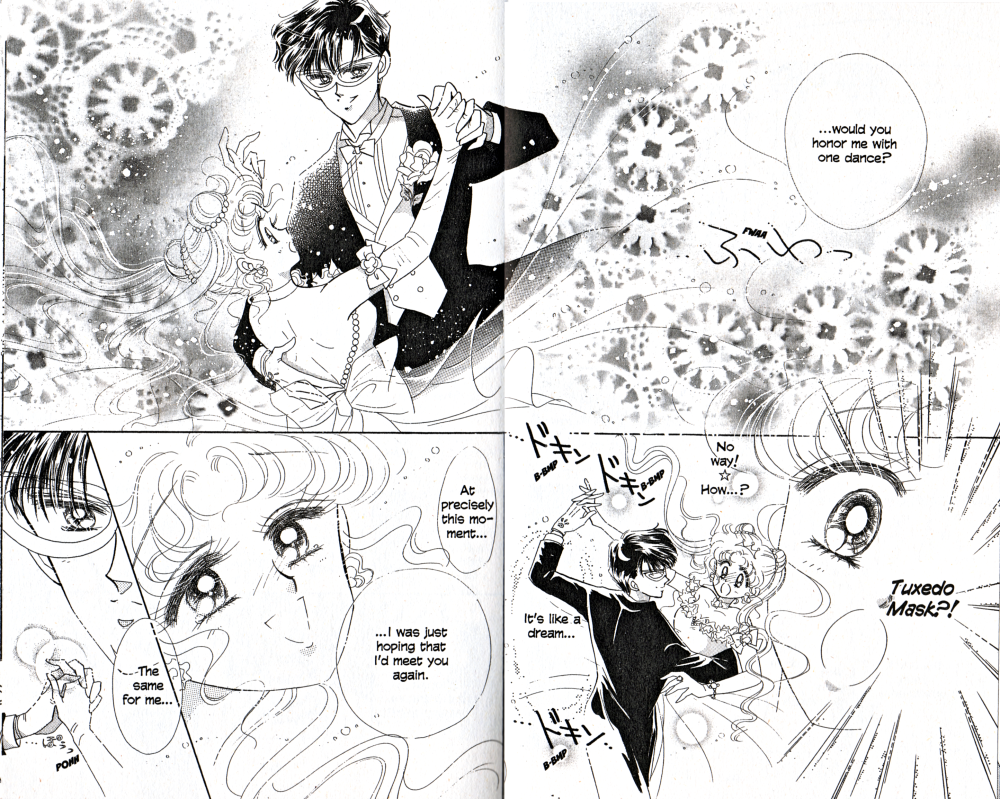
So, for my contribution I’ve chosen two memorable moments from the first volume of Naoko Takeuchi’s Pretty Guardian Sailor Moon. The first one comes from a chapter in which the protagonist, Usagi Tsukino, has infiltrated a masquerade ball in an effort to determine whether the Legendary Silver Crystal might be found there. Possible foe/possible ally Tuxedo Mask is also on the crystal’s trail, but pauses to give Usagi a twirl on the dance floor.

Pretty Guardian Sailor Moon, Volume 1, Chapter 4, Pages 142-143 (Kodansha Comics)

Takeuchi’s art perfectly captures the sheer dreaminess of this encounter for Usagi. In the top panel, the lacy screentone mimics the flare of her skirts, and the way that the smaller panels are framed focuses attention on facial expressions and reinforces the feeling that no one and nothing is capable of intruding upon this perfect moment for them.

And, of course, her dress is purty.

MJ: This sequence truly is dreamy. What particularly pulls me in here is the screentone. Its texture brings a 3D quality into this 2D world, as though the moment was preserved and wrapped up in an elaborate scrapbook that I could reach out and touch—as though it was someone’s real memories of the moment. Even just looking at something that has such a familiar texture stimulates my sense of touch, bringing me more fully into the scene. I think this kind of tangible decoration not only lends a fairy-tale dreaminess to the scene, but also makes it feel more personal for the reader.

MICHELLE: Ooh, you’re right, it does feel like a page from a scrapbook! In that sense, the screentone almost seems like it represents a snippet of the actual material of Usagi’s dress.

In addition, Usagi has used her transformation gadget for this chapter and is supposed to appear a little older than usual. I think her expression on the lower left page captures that subtle distinction nicely.

MJ: I’ll note too, that while this particular brand of big-eyed shoujo tends to get a lot of flack outside shoujo fandom, that it’s Usagi’s big, shining eyes that really let us know how she feels here, and just how dreamy this moment really is for her (and subsequently for us).

MICHELLE: You know, I think I’ve become inured to the big-eyed thing, except with extreme cases, because I don’t even notice it anymore. It just seems like such an obvious way to convey youth and wonder.

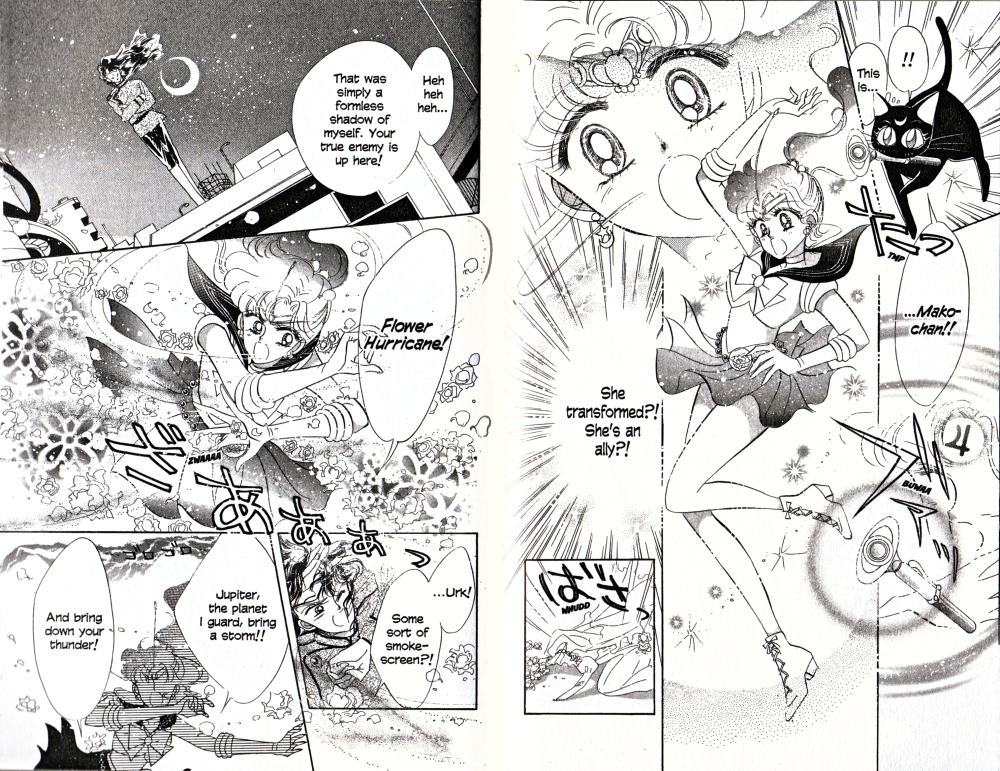
My second “memorable moment” is an example of a Sailor Moon action sequence.

Pretty Guardian Sailor Moon, Volume 1, Chapter 5, Pages 188-189 (Kodansha Comics)

In its way, this selection is just as pretty as the other one. Luna tosses Makoto her transformation pen, which glows in an appealingly magical girl fashion, transforming the girl—who is somewhat insecure about her physique—into Sailor Jupiter, someone both beautiful and powerful. Meanwhile, the enemy lurks on a nearby rooftop, and I’m impressed how this single panel so effectively establishes setting and atmosphere when one doesn’t have the preceding pages to furnish that information. Makoto’s first attack is simultaneously feminine and effective, giving her the opportunity to vanquish the enemy with her thunder bolt on the next page.

Looking back at some of the adjectives used in the paragraph above, I find that they aptly convey what it is I like about this moment: beauty and power, femininity and effectiveness. Sailor Moon shows that these things need not be mutually exclusive.

MJ: Those are great adjectives, Michelle, and actually this brings up a point I’ve been wanting to make since I listened to the podcast you participated in about Sailor Moon.

When male manga fans are trying to explain why something written for girls might be appealing to them as well, they will often attribute this to what they perceive as male or “shounen” elements in the story, like team-building or action sequences. And while I appreciate their enthusiasm for the work, I’m a bit perplexed as to why these would be considered exclusively “shounen” to begin with. Sure, certain genres of shoujo manga might share these things in common with certain genres of shounen manga, but I honestly don’t see what’s not inherently shoujo about them. Girls enjoy things like action, adventure, teamwork, and battling evil just as much as anyone, and there’s nothing odd or incongruous about these elements standing alongside things like beauty and femininity. These things naturally coexist in the minds of many girls, and when they’re all put together, they are not only exciting and inspiring, but really freaking pretty.

MICHELLE: You’re right, and though I agreed with them that there were some “shounen” elements to Sailor Moon, I didn’t mean to imply that they’re not just as easily shoujo elements, but simply story aspects that are more common to shounen manga. If that makes sense.

MJ: I guess what I’m saying is, though maybe there are more shounen action series than there are shoujo action series, it’s not as if it’s uncommon in shoujo. The entire magical girl genre pretty much exists in that realm, and those series share as much or more in common with fantasy, adventure, or sci-fi shoujo like Basara, X/1999, or They Were Eleven as they do with shounen manga—all of it very shoujo and very pretty.

I don’t mean to derail this discussion with my shoujo manifesto, though, so please forgive me. I’m just happily overwhelmed by the sparkly loveliness of this action sequence.

MICHELLE: No worries; I agree with you. But perhaps we should move on. What pretty shoujo have you chosen?

MJ: Well, it may seem like an odd choice, given the vast pool of classic pretty to choose from, but I’ve chosen an 8-page scene from volume three of Reiko Shimizu’s Moon Child, and there are a number of reasons why.

Moon Child, Volume 3, Pages 146-153 (CMX)

First, of course, there is quite a bit of objectively lovely imagery in the later panels of the scene, including rippling water, a flowing seascape, and a billowy-haired mermaid, all rendered with a perfect balance of simplicity and detail. I’m particularly fond of Shimizu’s style of character design as well, which is very much in step with most of the ’80s and early ’90s manga I’ve read. For whatever reason, this is probably my very favorite period for shoujo character design.

Most of all, though, there is an eerie, vaguely melancholy tone throughout the entire scene, particularly the first two pages, which I will admit are my favorite. I even consider them the prettiest of the whole sequence, though they have none of the flowing seascape that decorates the rest of the scene. They are, however, beautifully strange, and a perfect example of what I personally find prettiest in shoujo manga. This may seem like an odd thing to say, but I find the strangeness—this particular brand of strangeness—to be really, really beautiful. When I look at the first two pages of this sequence, I can feel the smooth surface of the water as the character brings his face near, touching the ends of his hair and the tips of his nose and chin. That smooth pool of water and the way he just falls slowly into it—it’s difficult for me to articulate exactly why I find it beautiful, but I really do.

Yes, I love these character designs, and the pretty page layouts, but sometimes what I find most beautiful about older shoujo manga is its strangeness. It brings to mind a dreamworld, I guess—one that looks like our world but somehow just isn’t in a way that engages the most obscure, most beloved corners of my imagination. These stories make themselves part of my private world, and I find them beautiful for it. If that makes any sense at all.

MICHELLE: It absolutely makes sense. And for what it’s worth, I studied the pages before I read your commentary and also felt that the exquisitely slow descent into the fountain was the loveliest part. I like, too, how Teruto slips into the fountain with such grace and barely a ripple and how this is contrasted off-panel by the little girl who has observed what happened. The inability of an everyday person to access the same magic only reinforces its strangeness.

MJ: Yes, exactly! It seems so clear that he exists in a different state of being from the regular people around him, which is part of what makes it feel so dreamlike, I think. There is a lot of that kind of thing in this series, which is really, exquisitely strange. I think the dreamlike tone makes it easier to suspend disbelief as well.

MICHELLE: From the examples we’ve both chosen, it seems that, to some extent, it’s the dreaminess of pretty scenes that is at least partly responsible for the happy sighing. Of course, we realize that real life is seldom so lovely, but it’s nice to abandon oneself for a while in a reality where that sort of thing really can happen.

MJ: I think where I often find solace in shoujo manga, is that it offers exactly what you describe—a reality that contains the stuff of dreams—but held together by real human feeling, such that even the wildest tale can often shine much-needed light on our real-life emotional turmoil. At the heart of all this strange, sparkly fantasy, there is a solid base of real emotional truth, which is sometimes easier to face when it’s presented in a pretty, dreamlike package.

MICHELLE: Well put! I think that’s one of the major strengths of genre fiction in general, actually, no matter the media.

MJ: Agreed! Of course, nothing does “pretty” quite like classic shoujo.

MICHELLE: Indeed not. That’s just icing on the cake!

Filed Under: FEATURES, Let's Get Visual Tagged With: cmx, Kodansha Comics, Naoko Takeuchi

Off the Shelf: NETCOMICS Lives!

September 28, 2011 by MJ and Michelle Smith 17 Comments

MICHELLE: Hey, MJ! What’s the best way to carve wood?

MJ: I don’t know, MIchelle. What is the best way to carve wood?

MICHELLE: Whittle by whittle!

MJ: Oooooo that one was a little painful.

MICHELLE: Sorry! I can’t help it; I love dumb jokes.

Okay, so. We should probably explain how this column is going to be a little different than most.

MJ: Yes, I suppose we should. Was it your idea? I think it might have been your idea.

MICHELLE: I can’t remember. Anyway… Before there were VIZManga.com, eManga, or JManga, there was NETCOMICS. Back when MJand I both wrote for Manga Recon, we got introduced to their site—where chapters of various series (mostly manhwa and BL) are available online for 25 cents each—and found some truly great titles just waiting to be discovered. The site remained a regular destination of mine, and I was concerned when no new releases were posted for about six months earlier this year.

Happily, NETCOMICS is now back with a vengeance and is currently actively releasing chapters from four series: Full House, Small-Minded Schoolgirls, So I Married an Anti-Fan, and Core Scramble. And it just so happened that three of those achieved a full volume’s worth of material within the past week or so, making them candidates for consideration in this week’s Off the Shelf!

MJ: Since Michelle and I are both such big fans of NETCOMICS manhwa, we decided to do mutual reads of all three of these new volumes, so while we usually each bring our own books to the table, this week, we’ve both read all of them!

MICHELLE: Indeed! So, where should we start? Perhaps with So I Married an Anti-Fan?

MJ: Excellent choice!

So I Married an Anti-Fan comes to us from the manhwa-ga Wann, author of 100% Perfect Girl, a series I liked…. really not at all. While trashy romance is certainly fine in my book, controlling love interests are not, and 100% Perfect Girl‘s Jarte was too awful for me to find romantic in the slightest. Fortunately, though I Married an Anti-Fan offers up a typically cold, arrogant male lead, our heroine is more than a match for him.

There’s a lot of plot in this first volume, but here’s the basic premise: Reporter Geunyoung Lee is drinking at a club, where she witnesses a popular male idol brutally rejecting a girl. In her stupor, she snaps a photo with her camera, but the idol, Joon Hoo, catches up to her as she flees the scene, and deletes the photo from her phone himself, at which point Geunyoung vomits on his shoes.

Thanks to the power of Joon’s agency, the incident costs Geunyoung her job and, ultimately, her apartment, which she can’t afford to keep. Enraged, she embarks on a fierce anti-fan campaign in an attempt to discredit Joon, which, through a series of wacky circumstances (in true K-drama form), results in her being chosen to basically live and work with Joon on a “reality” show called, “So I Married an Anti-Fan.”

MICHELLE: Though I never read 100% Perfect Girl myself, I definitely remembered your aversion to it, so was quite pleasantly surprised to find myself kind of loving this first volume. Part of what sold me were the modern touches—I loved seeing Geunyoung’s brawl with some Joon fangirls on YouTube, loved the sequence where she starts a blog and is immediately inundated with negative comments, and loved the whole reality series idea. How can it be that this hasn’t been the plot of a manhwa or manga before?! It’s so rife for cracktastic goodness!

I also liked that while Geunyoung is definitely fierce and a match for Joon, neither of them is exactly the archetype they may seem to be. Geunyoung, for example, is not always shrill and abrasive, but is honestly searching for what she wants to do with her life and mostly upset by the fact that she lost her job. Even though she didn’t love being a reporter, the writing was important to her. And Joon is not the arrogant celebrity, but honestly regrets what he did to Geunyoung—he had no idea she wasn’t really some ruthless paparazzi out for scandal—and finds peace in her presence because, since her opinion of him is already as low as it could get, he doesn’t have to worry about maintaining an idealistic image.

The reality show itself hasn’t started as of the first volume, but I find I am really looking forward to it! In fact, I’m tempted to read the two chapters of volume two that are now available, but figure the story will be best enjoyed in full-volume chunks.

MJ: I mentioned earlier that the plot here is in true K-drama form, and really, it reads just like a TV drama to me, which isn’t an insult in the slightest. This volume is well-paced and compelling, with a strong dose of my favorite flavor of grown-up girls’ manhwa humor. The romance is predictable, of course, but the upside of this is that I know I’m going to enjoy watching it play out. It’s a great fit for fans of something like You’re Beautiful, and actually less far-fetched. Definitely a check in the “win” column for NETCOMICS.

MICHELLE: I have yet to actually make it past the first episode of any K-drama, but if they’re like this perhaps I will have to make more of an effort. It also makes me think I should give another Wann series a chance. Perhaps not 100% Perfect Girl, but maybe Can’t Lose You, which is also available on the NETCOMICS site.

MJ: So, what’s next? Core Scramble?

MICHELLE: Sure! So, this is a boys’ love story that is actually pretty light on the romance so far. Our protagonist, Chaeun Shin, wields his magical powers in service of an organization called Clarus Orbis, which is tasked with doing away with “halls” (essentially interdimensional portals) and the “bugs” that come through them. Chaeun is devoted to his commander, Gayoon, even though Gayoon is a cold-hearted jerk who casually abandons his team mid-battle to go hang out with his girlfriend. And Chaeun’s never really tempted to leave Gayoon’s team, either, even though he’s presented with a perfectly viable alternative. Meanwhile, another group of magic users is interfering with the C.O. guys, but I never really understood what it is they’re after. In any case, their leader, Moonhoo, likes to feel Chaeun up whenever he’s presented with the opportunity.

MJ: That is a more coherent summary than I could possibly have mustered. I salute you, Michelle! That’s pretty much the story, or at least as much as we understand at this point.

Let’s face it: Core Scramble is a mess. It’s an attractive mess that has definitely caught my attention, but really, it’s a complete and utter mess. To be fair, I’m not sure this is all the author’s fault. The adaptation is sloppily executed, with some text clearly ending up in the wrong places here and there, making the story’s heavy exposition even more confusing than it has to be. Also, some of the BL elements feel a bit tacked on, as though the author was feeling pressure to get them in earlier than was natural, so that fans of the genre wouldn’t wander away before the story really got going.

There’s a lot I really want to love here. The BL market, at least here in the US, offers very little outside the standard romance genre, so I was pretty thrilled to see that Core Scramble is an all-out sci-fi/fantasy, with more plot packed into one volume than most BL series manage in their entire run. The protagonist, Chaeun, is very relatable, even when he’s inexplicably sticking by his complete ass of a boss. There’s too much going on for the volume to really gel, though, and it’s hard to say whether this will improve going forward.

What was your impression, Michelle?

MICHELLE: Much the same, I’m afraid. It seems to me that in trying to be both sci-fi and BL right out of the gate, it succeeds at neither. I really hate the “Hello, I’m Moonhoo and I’ll be your gropy seme for this book” introduction of that character, and when he randomly kisses Chaeun on their first meeting (under the guise of administering a drink or water or something) I was about ready to quit reading. And though I find Chaeun’s inexplicable loyalty to Gayoon kind of interesting, and think the C.O. organization has some potential, it’s just not defined well enough yet.

I will say, though, that I really enjoyed the kickass female soldier, Chief Song. Here’s a screenshot of her in action:

After recent internet talk this week about the so-called “sexually liberated” women of DC Comics, I thought, “Well, here’s a lady who looks simultaneously sexy and powerful. And though her clothes may be a bit skimpy, they’re really not that revealing. Her body is proportionate, and she looks absolutely confident and fearless. If you want to draw a scantily clad woman in your comic without offending female readers, this is the way to do it.

MJ: That’s a great point, Michelle! I’m completely with you on Chief Song.

And maybe this comic will recover from its early chaos, I don’t know. The introduction of Moonhoo you mention is exactly what I was thinking of when I said some of the BL felt tacked on. It’s obnoxious and doesn’t fit in with the story otherwise. On the other hand, their encounter in the last chapter of this volume was honestly intriguing and pretty sexy. If only that’s where the overt BL had started, I think it could have really worked. All the stuff earlier in the book just felt really off.

MICHELLE: I didn’t find the kiss itself at the end at all intriguing, but I like that Moonhoo is kind of amused by Chaeun’s attempts to protect him from harm (since Chaeun doesn’t know Moonhoo is affiliated with the other magic users) and I like that Chaeun interpreted the sudden smooch as a means to shock him out of his freakout mode over yet another desertion by Gayoon. It’s extra, surprising layers like that that will bring me back for volume two.

MJ: I think what I liked about it, is that in that moment, they both really just seemed like real people, enjoying a real attraction (even if their understanding of the moment doesn’t necessarily match), which is so much the opposite of the earlier groping scenes, which felt completely contrived. And yeah, despite my complaints, I’ll be back for volume two as well.

So… Full House… *happy sigh*.

MICHELLE: I have to admit I was finally and fully won over by volume five. I enjoyed it very much. It’s also worthy of note that, although Full House was previously published in English by CPM, they only got as far as volume four, so this is all-new material for us!

MJ: I am so pleased to hear that you’ve been won over! Now, I’ve discussed Full House at length before, but only the first two volumes. I hadn’t ever made it into volume three, so this was a big catch-up for me. And now having read the third and fourth volumes, I can understand better some of your complaints, as the screwball comedy bickering started to become a bit too much.

That said, volume five offers some pretty serious payoff, as Ryder’s (mistaken) anticipation of his own doom leads him to become in real life the sort of romantic hero he usually plays in films. He gives the house back to Ellie, and then when she is kidnapped, rushes in like a madman to save her. This could have been disastrous, but Sooyeon Won pulls it off so well, it really just swept me away. Ryder’s character shift feels completely real, and more importantly, Won is careful not to strip Ellie of her agency just to give Ryder his moment. Watching the two of them escape on the power of pure nerve was one of the most satisfying things I’ve seen in a while.

MICHELLE: Ryder’s shift does feel real, but I think Ellie’s does, too, since when he gives the house back to her with a minimum of fuss, she suddenly regrets having made his life so miserable up until that point. She starts to realize that, even though she’ll have the house, she may actually be losing something important. And, of course, I love that in the moment she most needs him, he is suddenly there, and reliable, and just thinking about that whole escape sequence is giving me a mild case of geekbumps because damn, they make a good team. I am really curious to see where Sooyeon Won will take the story from here.

MJ: I think I’ve always given Ellie the benefit of the doubt, mainly because I just like her, but yes, I agree that she does experience a shift here, too. And oh that moment, Michelle… I have never been a big fan of a man swooping in to save the woman, but when Ellie’s stuck, desperate and terrified, having exhausted all the options she can think of to escape her captors, and he’s just there… I admit I may have swooned.

MICHELLE: Oh, and then there’s this exchange:

Bad Guy: This rude, brash, crazy woman who doesn’t know what’s good for her. Not to mention she’s a plain-looking Asian who doesn’t stand out at all!

Ryder: You’re right!

Bad Guy: You don’t mean to say you love this girl, huh?

Ellie: What are you asking that for?

Ryder: … Probably.

I might’ve squeed (though, of course, Ryder’s comment is downplayed later). This reminds me, too, that the kidnapper’s identity completely surprised me and yet totally made sense in the context of the story. So, that made me enjoy it more than if it had just been some completely random kidnapping thrown in to manufacture some drama.

MJ: I most certainly squeed at that point. And, yes! The kidnapping made so much sense, it’s almost as if the author planned it from the beginning. If only more romantic comics really felt that way!

MICHELLE: And I don’t really want to spoil why Ryder is mistakenly anticipating his doom, but all of that makes a certain kind of sense, too. I’ve gone from being unable to comprehend there being sixteen volumes of this series (plus a sequel) to wanting all of that story to materialize right now. Happily, NETCOMICS already has the first chapter of volume six on their schedule for… today, actually, though it’s not up yet.

MJ: I expect I’ll be digging into that next chapter as soon as it’s available.

Thank you, NETCOMICS, for coming back to life. We missed you. Truly.

MICHELLE: Indeed. In just a few days, their update schedule for October will be revealed, and I hope it will be as packed as September. Of course, I’d also like to see some other series get updates (especially The Adventures of Young Det) but I am happy with the current lot, as well. And when the third volume of Small-Minded Schoolgirls is completed in a few weeks, I plan to talk about it in this space as well.

MJ: When I first realized that NETCOMICS had re-emerged, I felt some regret over having re-assimilated Manhwa Bookshelf. I hope they continue to make me regret that for a long time to come.

Filed Under: OFF THE SHELF Tagged With: Core Scramble, full house, So I Married an Anti-Fan

PotW: Insects, Dogs, & Other Stories

September 26, 2011 by MJ, David Welsh, Sean Gaffney, Michelle Smith and Katherine Dacey 8 Comments

It’s a quiet week at Midtown Comics, but the battle robot’s choices are clear!


MJ: We’ve hit a slow week again at Midtown Comics, but there’s at least one standout in the mix. This week, we’ll see the release of Osamu Tezuka’s Book of Human Insects, which was announced in Vertical’s panel at last year’s New York Comic Con. There’s no way I’d be willing to miss this, though it’s an interesting pick for me. I have a feeling it’ll be one of those books that blows me away with its artistry while simultaneously killing me with its outlook on humanity. A bleak Tezuka can be hard on us optimistic types, but it’s impossible to reject his genius, and I’d be a fool to try. This is absolutely my must-buy manga for the week.

DAVID: I should try and spread the wealth, but I just have to second MJ’s choice. This is my very favorite kind of Tezuka: crazy plotting and intense social commentary, with some indelible characters. I found Ayako disappointing, but Book of Human Insects is right up my alley.

KATE: Since David and MJhave taken up the cause of Human Insects, I’m going to plug Stargazing Dog. I don’t know if Takahashi Murakami was inspired by Vittorio DeSica’s Umberto D., but like that 1951 film, Stargazing Dog features a down-on-his-luck man whose only companion is his dog. Yes, I know, that sounds horribly mawkish, but Murakami manages to tug on the heartstrings without being sentimental. More impressive still, he pulls off that feat while allowing us to be privy to the dog’s thoughts, something DeSica didn’t have the stones to try. Highly recommended for dog-fanciers, though be warned: have tissues handy, as you will need them.

MICHELLE: Aw man, I was going to pick Stargazing Dog! I guess I will just have to second what Kate says here, and note that despite the fact that I am a bona fide cat lover, I am totally weak against endearing canines in fictional form. One interesting thing to note is that at the same time that Stargazing Dog is coming out in print, courtesy of NBM Publishing (who’ve also released some quality manhwa), it’s also available on JManga.com as Star Protector Dog.

SEAN: If I had to rely on Midtown’s lists for my PotW, I’d never mention Kodansha at all. And I already mentioned Sailor Moon and Sailor V two weeks ago. So I will once again go to the Negima well. Last volume was rather depressing, with all sorts of horrible things happening to our heroes. Naturally, that means that this volume is the one where our heroes step up and start kicking ass. I feel I should note that Volume 31 features my favorite scene in all of Negima to date. A scene so awesome that the entire cast comments later on about how awesome it was. And yes, there will be more fanservicey nudity here too. It’s Negima, that’s how it rolls.


Readers, what looks good to you this week?

Filed Under: PICK OF THE WEEK

  • « Go to Previous Page
  • Page 1
  • Interim pages omitted …
  • Page 133
  • Page 134
  • Page 135
  • Page 136
  • Page 137
  • Interim pages omitted …
  • Page 182
  • Go to Next Page »
 | Log in
Copyright © 2010 Manga Bookshelf | Powered by WordPress & the Genesis Framework