• Skip to primary navigation
  • Skip to main content
  • Skip to primary sidebar
  • Home
  • About Us
    • Privacy Policy
    • Comment Policy
    • Disclosures & Disclaimers
  • Resources
    • Links, Essays & Articles
    • Fandomology!
    • CLAMP Directory
    • BlogRoll
  • Features & Columns
    • 3 Things Thursday
    • Adventures in the Key of Shoujo
    • Bit & Blips (game reviews)
    • BL BOOKRACK
    • Bookshelf Briefs
    • Bringing the Drama
    • Comic Conversion
    • Fanservice Friday
    • Going Digital
    • It Came From the Sinosphere
    • License This!
    • Magazine no Mori
    • My Week in Manga
    • OFF THE SHELF
    • Not By Manga Alone
    • PICK OF THE WEEK
    • Subtitles & Sensibility
    • Weekly Shonen Jump Recaps
  • Manga Moveable Feast
    • MMF Full Archive
    • Yun Kouga
    • CLAMP
    • Shojo Beat
    • Osamu Tezuka
    • Sailor Moon
    • Fruits Basket
    • Takehiko Inoue
    • Wild Adapter
    • One Piece
    • After School Nightmare
    • Karakuri Odette
    • Paradise Kiss
    • The Color Trilogy
    • To Terra…
    • Sexy Voice & Robo
  • Browse by Author
    • Sean Gaffney
    • Anna Neatrour
    • Michelle Smith
    • Katherine Dacey
    • MJ
    • Brigid Alverson
    • Travis Anderson
    • Phillip Anthony
    • Derek Bown
    • Jaci Dahlvang
    • Angela Eastman
    • Erica Friedman
    • Sara K.
    • Megan Purdy
    • Emily Snodgrass
    • Nancy Thistlethwaite
    • Eva Volin
    • David Welsh
  • MB Blogs
    • A Case Suitable For Treatment
    • Experiments in Manga
    • MangaBlog
    • The Manga Critic
    • Manga Report
    • Soliloquy in Blue
    • Manga Curmudgeon (archive)

Manga Bookshelf

Discussion, Resources, Roundtables, & Reviews

Michelle Smith

Bookshelf Briefs 2/13/12

February 13, 2012 by MJ, Katherine Dacey, Sean Gaffney and Michelle Smith 3 Comments

This week, Kate, MJ, Sean, & Michelle take a look at recent releases from Kodansha Comics, Vertical, Inc., VIZ Media, Yen Press, Digital Manga Publishing, and JManga.


Bloody Monday, Vol. 3 | Story by Ryou Ryumon, Art by Kouji Megumi | Kodansha Comics – I can see why Bloody Monday appeals to teenage boys: not only do its adolescent heroes get to kick ass and match wits with evil adults, they also get to ogle beautiful villains and work alongside cute classmates. For an adult reader, however, the plot mechanics are too creaky to overlook the obvious wish-fulfillment angle. Too many scenes bog down in obvious explanation, as characters repeatedly tell each other things that one would hope world-class crime solvers would know — even if they’re only sixteen. The action scenes remain the series’ strength, as they’re the only time the exposition-dense chatter and obvious voice-overs are silenced in favor of good old-fashioned chases and shoot-outs. It’s a shame that Bloody Monday is such a mixed bag, as its paranoid, the Russians-are-out-to-get-us plot could be the basis of a terrific, globe-trotting thriller. – Katherine Dacey

Chi’s Sweet Home, Vols. 7-8 | By Konata Konami | Vertical, Inc. – Now that I own a cat, I’ve developed an even deeper appreciation for the genius of Konata Konami. So many of the details in Chi are beautifully observed, whether Chi is stalking new “prey” (a goldfish, a feather duster) or calculating the distance between two high perches. Konami also depicts new pet ownership with accuracy and warmth: like the Yamadas, I’ve spent a lot of time reading cat books in an effort to decode Francesca’s behavior, feed her the right food, and interpret symptoms of illness. I can’t speak to Chi’s relationship with Cocchi — my cat’s only animal companion is a frustrated herding dog — but even that feels right to me. A must for cat fanciers. – Katherine Dacey

Dengeki Daisy, Vol. 8 | By Kyousuke Motomi | VIZ Media – Make no mistake, this is easily the best volume of Dengeki Daisy yet. Okay, yes, part of the cliffhanger from last volume just sort of fizzles out, but it leads to Teru finally getting the full story (through flashbacks) about Kurosaki’s past as a dangerous hacker and his relationship with Soichiro and the various former coworkers with whom he still associates. Although mangaka Kyousuke Motomi can’t quite manage to write a compelling mystery plot—any attempts to hint at some vast conspiracy are generally vague and uninteresting, though we do get a little direction on who’s orchestrating the attacks on Teru—there’s still some good stuff here for fans of these characters, especially in the way Soichiro draws a young, heartbroken Kurosaki out of his shell. I do have to wonder, though, whether returning to the present day will feel like a let down after this. – Michelle Smith

Fairy Tail, Vol. 17 | By Hiro Mashima | Kodansha Comics – I have to admit, Mashima is starting to lose me here. There’s a lot going on in this volume provided you like fights – but if you’re not a big shonen fight fan, the only thing to grab a hold of is the big plot revelation, which brings back someone who I’m not really sure we all wanted to see back. Yeah, I know ‘no one dies in shonen comics’ has become somewhat of a cliche, but this just felt very underwhelming. It doesn’t help that I still have trouble holding the new characters in my head, be they heroes or villains. On the plus side, Erza being out of the action for most of the volume gives Gray a chance to shine. And the cliffhanger, involving Loke, makes me really want to know what happens next. Unfortunately, that’s not enough to save a substandard volume of this series.-Sean Gaffney

I Love You, Chief Clerk! | By Keiko Kinoshita | JManga – BL anthologies are probably my least favorite type of manga to review. With a handful of exceptions (est em, for example), BL mangaka, at least those currently published in English, seem to be especially inept at the admittedly difficult art of telling a satisfying, well-developed story in just one or two chapters. Happily, Keiko Kinoshita proves herself to be one of the exceptions. Despite its simplistic title, I Love You, Chief Clerk! is a charming collection of short romance manga that manage to get right to the heart of their stories without feeling rushed or skimpy. Kinoshita deftly introduces her characters and defines their relationships, past and present, with just a few sure strokes. She’s not concerned so much with resolution as she is with creating a few truly genuine moments, and that’s all it takes to bring her adorable short stories to life. Gratefully recommended. – MJ

Library Wars: Love & War, Vol. 7 | By Kiiro Yumi and Hiro Arikawa | VIZ Media – While readers have been reading about the not-quite-romance between Kasahara and Dojo, the plot has been slowly building up, and this is the volume where a lot of the plot cannons are fired. Following up on last volume, Tezuka gets a lot of development here, and I was also pleased to see Shibazaki’s lunch dates continue. But the real meat of this is the plot with our heroine, as a conspiracy tries to frame her and she has to lay low while her friends figure out who’s behind it. Seeing the social and normally upbeat Kasahara being so beaten down and downtrodden is quite heartbreaking, and more so when we know she’s “trying to be strong” – exactly what Dojo *doesn’t* want. For those who wanted more library wars in this manga, this is the volume to get.-Sean Gaffney

The Melancholy of Haruhi Suzumiya, Vol. 11 | Art by Haku Tsugano, Story by Nagaru Tanigawa, Characters by Noizi Ito | Yen Press – The eleventh volume of Haruhi Suzumiya irresistibly reminded me of a classic Star Trek plot line, in which a rift in time, a strange illness, or an amnesia-inducing event causes the crew to act out of character. For Harhui and her friends, the sudden rash of odd behavior begins when they’re banished to an alternate dimension; only by solving a math puzzle can they return to their normal lives. Newcomers will find this volume a difficult place to begin exploring this unique series, as the story relies too heavily on the reader’s prior knowledge of the characters. Die-hards, however, will find more of what they like: humorous interplay between characters, off-beat mysteries, and occasional bits of fanservice. -Katherine Dacey

Natsume’s Book of Friends, Vol. 11 | By Yuki Midorikawa | Viz Media – I know this is a monthly manga, but at times the author really seems to plot her arcs out to the individual volumes. The first half shows Natsume bonding even more with Tanuma and Taki (OT3!!!… sorry), and finding that he can rely on them to be there for him no matter what. Then in the 2nd half, we see that as much as he may want to open up, it’s simply not that easy given what he goes through every day… and what he went through as a child. We are our upbringing, after all. There’s also some nice yokai examination here – even the “nice” ones are still distrustful and uncomprehending about humanity. This even applies to Nyanko-sensei, who’s still saying he’s only hanging around to get the Book of Friends after all this time. Rather than admitting the deep bond he and Natsume have forged. Terrific stuff.-Sean Gaffney

No Longer Human, Vol. 3 | By Usamaru Furuya, Based on the novel by Osamu Dazai | Vertical, Inc. – In the afterword to volume three, Usamaru Furuya admits that as a teenager, he “found beauty” in the hero’s “ruinous lifestyle.” That admission is key to understanding the strengths and weaknesses of Furuya’s adaptation of No Longer Human. On the one hand, it’s immediate and visceral, depicting a young man’s fall from grace in symbolically rich imagery; Furuya has succeeded in translating an ambiguous text into a feverish nightmare of father-hate and drunken debauchery. On the other, many of the nuances of Dazai’s text have been filed away, making Yozo’s transformation seem more pedestrian than it did in the novel; it’s a Lifetime movie about addiction, minus a third-act redemption. Still, for readers new to Dazai’s work, Furuya’s adaptation provides a sturdy bridge between the original novel and the present day, showing readers that No Longer Human is as relevant now as it was in 1948. – Katherine Dacey

Only Serious About You, Vol. 2 | By Kai Asou | Digital Manga Publishing – Though I know of a few gay men who read and enjoy BL manga, the fact remains that it’s a genre written by women for women. Reading this second volume of Only Serious About You, however, made me think that here is a series I would recommend to any gay man, pre-existing manga fan or not. The evolution of the relationship between single dad Oosawa and his former customer, Yoshioka, is handled with sensitivity and realism, and the bond they share caring for Oosawa’s daughter, Chizu, is seriously touching. Yoshioka had a tough childhood, and helping to raise Chizu is like a healing experience for him, and when reserved Oosawa finally decides to accept all that Yoshioka’s willing to give, it’s sniffle time. The sense of family among these three is palpable, and a great example of the loving home two men can provide a child. A lovely, lovely story. More by Kai Asou, please! – Michelle Smith

Filed Under: Bookshelf Briefs

Pick of the Week: GTO & more

February 6, 2012 by Sean Gaffney, Michelle Smith, Katherine Dacey, MJ and Brigid Alverson 3 Comments

It’s a strong week for manga at Midtown Comics. See the Battle Robot’s picks below!


SEAN:God, I’ve missed Onizuka. My pick this week is the first volume of the ‘interquel’ GTO: 14 Days in Shonan, a 9-volume series that is supposed to fit in towards the end of GTO proper. The cast of the main series get a brief cameo, but the meat here is Onizuka arriving in a new neighborhood and having to deal with a new bunch of delinquent kids. And he is up to the job – for all his perving about getting laid (which he never does), or constantly getting into fights and winning despite severe injuries (I wince at every head blow he takes here, for reasons obvious to a seasoned GTO reader), the series in the end is about Onizuka caring about kids – the ones who used to be just like him – and showing them that the world isn’t as bad as they think it is. Whatever his motivations may be, he’s a wonderful teacher of the human spirit. Great to have him back.

KATE: With so many awesome titles arriving in stores this week — Bride of the Water God, Dawn of the Arcana, GTO: 14 Days in Shonan, Natsume’s Book of Friends, The Story of Saiunkoku — it’s difficult to limit myself to one. But if I *had* to pick one, my choice would be volume 20 of Slam Dunk. Takehiko Inoue’s deep affection for basketball is evident on every page; he immerses us in the game play to such a degree that the reader feels like she’s on the court, too, searching for an opening to the basket. Inoue’s affection for his characters is also evident on every page; even when they’re the butt of jokes, we still root for the Shohoku team to resolve their personal differences so that they can best their opponents. Slam Dunk places more emphasis on gameplay than Inoue’s other basketball manga, REAL, but is worth seeking out, even if you’re can’t cite Paul Pierce’s free-throw statistics for the 2009-10 season.

MICHELLE: I really, really love Slam Dunk, so I second Kate’s recommendation even while casting my own vote for volume one of A Devil and Her Love Song. This debut, about the attempts of an honest-to-a-fault girl to make friends in her new high school, surprised me by being far more than its comedic-seeming premise—and a couple of stereotypical-looking male characters—initially suggested. Maria is trying so hard, in her stoic way, and I found he way that she keeps desperately believing that things will work out to be very endearing. The supporting cast has some depth, as well, and I’ve heard good things about what’s to come. Definitely a very strong start to a promising series!

MJ: This week’s haul is pretty impressive (I really did love A Devil and Her Love Song), but I’m going to cast my vote for the sixth volume of The Story of Saiunkoku. Even if it wasn’t a smart, funny series with lovely period dressing and a truly awesome heroine, it would still be the series that inspired one of my favorite reviews ever. (Thank you, David!) Seriously, it’s just a charming, charming manga. And I’m a whole volume behind, so I’ve got extra shopping to do!

BRIGID: I could have gone for any one of the above, but since you all got there first, I’ll give some love to vol. 7 of Kamisama Kiss. I like Julietta Suzuki’s simple style and her sense of humor, and even if this is a story that has been told before, she puts a few new twists on it.


Readers, what looks good to you this week?

Filed Under: PICK OF THE WEEK

Bookshelf Briefs 2/6/12

February 6, 2012 by Michelle Smith, Katherine Dacey and Sean Gaffney Leave a Comment

This week, Michelle, Kate, and Sean take a look at recent releases from Kodansha Comics and Viz Media.


Arisa, Vol. 6 | By Natsumi Ando | Published by Kodansha Comics – Someone ought to invent an Arisa drinking game that involves taking a sip any time the characters are out in the woods and someone falls off a cliff. Seriously, I think that just happened a couple of volumes ago and here it is again. Despite the fact that Tsubasa stumbles (har har) upon a significant lead in the volume’s final pages, ensuring that I’ll be back for volume seven, I spent most of the volume annoyed. The good guys sure are making it easy for “the King” to undermine their efforts to learn his/her identity, to the point where it’s hard to summon any sympathy for them. It’s never a good sign when someone getting hit by a car actually makes me snicker. This series started off seeming really cool, but now it’s just kind of ridiculous. And that’s a shame. – Michelle Smith

Cage of Eden, Vol. 3 | By Yoshinobu Yamada | Kodansha Comics – You have to hand it to the author – he knows his audience. This is a story that really wouldn’t fly in Jump or Sunday, but in service-happy Magazine, it’s managed to be a success. And really, I can see why. Despite the egregious boob and panty shots, and the token loli that has been added towards the end, it’s the plot and characters that drive you onward. The teamwork/rivalry of Akira and Yarai plays out nicely, and Kohei’s breakdown is horrible yet compelling. This is very much classic boys’ literature – lots of fights with giant animals, buxom teenage girls, some small amount of romance, and plot twist after plot twist. It’d be a great manga to bring along to the beach. Just be aware that you’d finish the volumes to date very quickly, and might have trouble explaining the fanservice to anyone reading over your shoulder. – Sean Gaffney

Cross Game, Vol. 6 | By Mitsuru Adachi | Published by Viz Media – Comprising volumes twelve and thirteen of the original Japanese release, the feel of this sixth VIZ omnibus could be summed up as, “The final summer is just around the corner.” Seishu has missed their chance at the Spring Koshien, but as Ko and his friends enter their third and final year of high school, they’ve got just one more shot. Baseball is on everyone’s mind all the time, and we catch glimpses of some intense practice sessions, but just as much attention is devoted to the characters’ relationships. Much of the story revolves around Ko getting to know Akane, Wakaba’s look-alike, while Azuma and Aoba grow a little closer. It’s bittersweet, slice-of-life storytelling at its finest, and though I am really looking forward to the tournament ramping up, I’m sure the resolutions on the romantic front will be equally satisfying. Perenially recommended. – Michelle Smith

Shugo Chara-Chan!, Vol. 2 | Created by Peach-Pit, Manga by Napthalene Mizushima et al. | Kodansha Comics – If your primary complaint about Shugo Chara was that Amu’s guardians didn’t get enough time in the spotlight, this 4-koma spin-off title is for you. The stories — if they can be called that — focus on Ran, Miki, and Su as they bumble their way through a variety of stock manga situations: decorating a Christmas tree, getting dressed for a festival, baking cakes, playing with cute animals. The gags are too generic to make much of an impression, though the strips spoofing Arisa, Fairy Navigator Runa, and Hell Girl add a welcome jolt of visual and comic energy to an otherwise tepid volume. Strictly for hardcore Shugo Chara fans; newcomers won’t find enough here to sustain their interest. – Katherine Dacey

Filed Under: Bookshelf Briefs

I, Richard by Elizabeth George

February 3, 2012 by Michelle Smith

Book description:
Hailed by The New York Times as “a master of the British mystery,” award-winning author Elizabeth George is one of our most distinguished writers, cherished by readers on both sides of the Atlantic. Her first collection of short stories is an extraordinary offering that deftly explores the dark side of everyday people—and the lengths to which they will go to get what they want most…

In these five tantalizing and original tales, George plumbs the depths of human nature—and human weakness—as only she can. From the chilling tale of a marriage built on an appalling set of lies that only death can reveal, to the final, title story about a penniless schoolteacher whose ambition turns murderous, I, Richard is filled with page-turning drama, danger, and unmatched suspense.

Whether the setting is urban or suburban, affluent or middle class, no one is safe from menace. Thanks to Inspector Thomas Lynley, a squabbling group of Anglophiles discovers a killer in its midst. But little help is on hand when a picture-perfect town is shattered by an eccentric new resident’s horrifying pet project. And when a wealthy husband is haunted by suspicions about his much-younger wife, it becomes clear that a man’s imagination can be his own worst enemy…

Review:
Well. That was different! And not, I’m afraid, in a terribly good way. I’ve furnished ample avidence of my admiration for George’s mystery novels in the past (and intend to read more of them in future), but I wasn’t too enamored of these short stories, primarily because most are variations on the theme of “things go wrong for the unsympathetic protagonist.” And that is not my favorite theme upon which to dwell. But let us forge onward into specifics!

“Exposure” is a rewrite of an earlier story, “The Evidence Exposed.” It concerns a group of Americans taking a summer course in The History of British Architecture who have come to Abinger Manor, residence of Detective Inspector Thomas Lynley’s aunt, for a tour. The characters are the highlight of this one, and though the crime is rather silly and the culprit’s motive murky, I still rather liked some of the quick portraits painted of those enrolled in the class. Lynley doesn’t get much to do, though, and poor Helen is relegated to being charming without actually, if I recall rightly, having a line of dialogue.

“The Surprise of His Life” is, ironically, possessed of an utterly predictable conclusion. After a lengthy introduction, in which George reveals drawing inspiration from the alleged crimes of O. J. Simpson, we meet a wealthy businessman who has begun seeing a psychic. She warns him to expect an external shock, so he goes off into all these flights of fancy about his wife having an affair and hires a private investigator who takes pictures of her with another man and… it’s just so obvious what’s going to happen that waiting for it to actually occur is maddening.

“Good Fences Aren’t Always Enough” is a weird little tale about the residents of Napier Lane, who are striving to be designated as one of their town’s Perfect Places to Live, and the small, grey, Russian immigrant whose overgrown, rat-infested yard stands in their way. Willow McKenna, a former foster child now obsessed with the idea of a big family and cozy community, is a fairly likeable lead and this, at least, didn’t end like I thought it was going to. It was a lot more… ordinary, in the end.

“Remember I’ll Always Love You” is the second story to feature a couple’s life ruined by extreme suspicion. Charlie Lawton’s husband, Eric, has just died at the age of 42. As she seeks out his parents, Charlie begins to realize that Eric was keeping a lot of things from her. A lot of really, really major things that are so out-of-left-field that she’s left reeling. This story is sort of admirably constructed in terms of what you think you know that it turns out you didn’t really know, but it feels flat somehow.

Lastly we have the title story, “I, Richard,” which contained both the high points and low points of the collection for me. I intensely disliked Malcolm Cousins, the ambitious would-be historian who has been engaged in an affair with the wife of a friend with the express purpose of coming into possession of a prized artifact when that friend should finally succumb to a weak heart. Malcolm is a sleazy git who gets what he deserves, but George uses him as a mouthpiece for some exonerating theories in support of Richard III, and that part I liked. The challenge is, of course, writing a modern-day story concerned with Richard III and not having it be too much like Josephine Tey’s marvelous The Daughter of Time, and George succeeds in that regard, I suppose.

Ultimately, this isn’t essential reading for fans of the Lynley/Havers mystery series. Lynley appears briefly in a story, but does very little, and there’s absolutely no bearing on anything that happens in other books. I’m not sure if I’m glad I read it or not, but I know for sure that I’ll not be doing so again.

Filed Under: Books, Mystery, Short Stories Tagged With: Elizabeth George

Off the Shelf: Shoujo staples & other stories

February 2, 2012 by MJ and Michelle Smith 16 Comments

MJ: Well, hi.

MICHELLE: Howdy!

MJ: It’s been a while since we did a regular column. I’m not sure what to say.

MICHELLE: Yeah, I was looking back at those today. Our last two columns have seen us both talking about the same series, and fairly epic ones at that! Oh no! Will our regular column measure up?!

MJ: I guess we’ll just have to try it and see! So, what have you been reading this week?

MICHELLE: Some very enjoyable things! First up is the third volume of Pretty Guardian Sailor Moon, which came out a couple of weeks ago.

For those who were put off by some of the silliness in Codename: Sailor V or by Usagi’s crybaby ways earlier on in this series, volume three should quell any doubts you may possess that Takeuchi can really bring out the big dramatic guns. As I’ve mentioned elsewhere previously, the pacing of the manga is approaching breakneck speed, so here we are in volume three and the first arc is already drawing to a close. But first, this occurs, and actually I am going to frame it in such a way that it’s as Buffy-esque as possible, ‘cos that’s what I do:

Usagi’s boyfriend, Mamoru, suddenly starts acting like a different person. He’s cold and cruel and is now working with the enemy! “Is this man somebody else now?!” she wonders. “Do I have to defeat him?! Kill him?!” A terrible evil is about to be unleashed upon the world and the only way to seal it up is to defeat the man she loves! But she does it. There’s a sweet kiss, and then there’s a sword.

Some fairly significant similarities to the end of Buffy‘s second season, I think! Anyway, I don’t want to spoil too much of it, but it’s pretty great. The second arc launches very quickly with the introduction of Chibi-Usa, a young girl who literally falls from the sky and starts observing Usagi and those around her. I was pleasantly surprised by how sympathetic Chibi-Usa is in the manga. She comes across more as lonely and frightened than bratty, and certainly more intriguing than the gemstone-named band of siblings who are facing off against our heroes.

Also pleasantly surprising was the copy editing this time. Typos have been a major problem with this title, and I’m happy to say I didn’t see a single one here. So, kudos on that, Kodansha. However, my fangirl heart just about broke when I saw Jupiter’s attack, “Sparkling Wide Pressure,” interpreted as “Spark Ring Wide Pressure.” Ordinarily I wouldn’t comment on translation choices, but man. This one really hurt.

MJ: I have to say, I can’t wait to read this. Seriously. I have it on my shelf and I WANT TO READ IT NOW. And I don’t have any fangirl preconceptions, which I’m gathering might be a plus for this series.

MICHELLE: I’d say so. There are many things I love about the anime, but there are definitely areas in which the manga is superior. One is, of course, Takeuchi’s lovely artwork, which is very flexible in terms of depicting Usagi as someone goofy and as someone elegant and mature. She frequently looks graceful in the manga in a way that she does not in the anime.

Still, it makes me sad that first-time readers might’ve thought that was really Jupiter’s attack phrase. I’ll have to be vigilant about pointing out things like that for their benefit!

Anyways, what’ve you been reading this week?

MJ: My first selection for the evening is a very different brand of shoujo than Sailor Moon, though also quite enjoyable. I’m speaking of the first volume of Miyoshi Tomori’s A Devil and her Love Song, just recently released by Viz.

I know you’ve read it, Michelle, but for the uninitiated, our heroine is Maria Kawai, a transfer student recently expelled from an elite Catholic school. She’s a girl who has always had difficulty making (and keeping friends), mainly because of her inability to control her harsh (if truthful) tongue. Maria is unusually perceptive, but most of what she has to say is decidedly not what people want to hear, and she gets off on the wrong foot pretty much immediately at her new school. On some level, Maria wants to fit in, but she’s just not cut out for the spirited shoujo sunshine role, and she’s pretty well aware of it.

Thanks, perhaps, to her very good looks (and a lovely singing voice), she is sort of befriended by two boys in her class, happy-go-lucky Yusuke Kanda and surly Shin Meguro. The two boys are, on the surface, typical shoujo love interests, and it feels immediately obvious that Maria will end up with cranky guy with a heart of gold, but just as Maria does not quite fit any of the standard heroine molds, neither do these two, who each have their own ways of dealing with the pressures of classroom socialization. So who she’ll ultimately end up with (if she ends up with someone at all) is anyone’s guess.

Like another of my favorite recent shoujo series, We Were There, this volume succeeds in part by taking familiar shoujo stereotypes and making them into real people, and I appreciate that very much.

I was pretty enthralled with this debut volume, and I’m looking forward to seeing where things go. My one small fear is that all the other girls in school (who so far have only really bullied Maria) will continue to be vilified to the end. I really dislike girl-hating stories for girls. But the first volume is written with such a sure hand, I feel confident that we’re in for something better than that. It’s the kind of manga that (so far) is continuously surprising.

MICHELLE: You’ve hit upon so much of what I loved about the volume! I like the boys, but Maria herself is the most compelling at this point, as she clings to her faith that things eventually will work out, that they will someday understand her if she just keeps trying. It’s pretty moving, actually!

As for the other girls, a comment left on my review suggests you’ll be pleased with their development, saying, “all the peer enemies are eventually shown to be more than their stereotypes.”

MJ: That is very heartening to hear! Though, again, I had high hopes, given nuanced the main characters have been so far. I’m happy to hear that my faith isn’t misplaced!

So, what else do you have for us this week?

MICHELLE: Well, speaking of nuanced characters… I read volume two of Wandering Son by Shimura Takako, presented in a gorgeous hardcover edition by Fantagraphics.

This is the story of two transgendered children, Shuichi Nitori and Yoshino Takatsuki, and their struggles to express their true selves. Lately, Shuichi and Yoshino have been going out in public dressed as a girl and a boy, respectively, and have befriended an adult woman named Yuki. They also go on a class trip and decide to start an exchange diary.

Okay, plot-wise, that may not sound like much, but it’s what Takako does with it that’s so special. Where volume one largely focused on how the characters themselves perceive their differences from other kids, this volume shows some ways in which others perceive those differences. Some responses are negative, like Shuichi’s seatmate on the school trip, who accuses him of squealing like a girl and calls him a “faggot” before Shuichi actually musters the strength to tell him off.

Some responses are neutral, like when Shuichi’s sister Maho discovers his secret. She’s not horrified, but she’s puzzled. At least she’s making an honest effort to understand as best a junior-high girl can. And then some responses are overwhelmingly positive, like when Shuichi and Yoshino’s friend Chiba AWESOMELY channels Anne of Green Gables as a means to dealing with taunting. I really love her.

Because this gamut of reactions is presented, and because daily life continues to transpire, the characters’ struggles seem even more sincere and realistic. Knowing that the misunderstanding they face now will only get greater the older and more certain they become, we realize just how fabulously lucky they are to have each other, even if they have to be careful not to exclude their other friends.

My one complaint is that a volume seems to go by so quickly that I am soon left bereft, pining for the next one!

MJ: This is another volume staring at me from the shelf that I’m simply dying to read. I need to take a month’s vacation and just read, read, read! I loved the first volume, as you know, and I’m thrilled (if not remotely surprised) to hear that it continues on in an equally lovely fashion. I admit I’m made even more anxious to read it based on that Anne of Green Gables thing. OH, MY HEART.

MICHELLE: I knew that part would please you!

I do have to ding Fantagraphics for the wording of their “story so far” section, though, which contains the sentence “The two spend their days going on somewhat perverse dates.” Now, true, certain dictionary definitions of “perverse” might reasonably apply in this situation, like “disposed to go counter to what is ordinary,” but that word also comes with connotations like “wicked” and “sinful” that should best be avoided. Surely they could’ve found a suitable synonym! Grumble grumble.

MJ: I’ve been pretty unhappy with the language they’ve used while marketing this series, so that doesn’t surprise me, I guess, but it’s still regrettable.

MICHELLE: What’s your second topic of the evening?

MJ: My second read this week is the perfect example of everything Wandering Son is not. That would be Hisaya Nakajo’s Hana-Kimi, a shoujo staple now being re-released in omnibus format by Viz. It’s a popular series I’ve never read, so definitely I’m the target audience for a release like this.

Unfortunately, I’d say my reaction to it was pretty mixed. While Wandering Son tackles gender identity with tender realism, like most other manga I’ve read with themes revolving around gender-bending, Hana-Kimi plays it for laughs, making sure to keep all the confusion safely on the outside. This isn’t unexpected, by any means, but it suffers gravely in comparison to a more thoughtful work.

So, Mizuki is a teen athlete who so deeply admires a young Japanese high jump champion, Izumi Sano, that she leaves America (where she lives abroad with her family) to come back to Japan and enroll in the all-boys boarding school Sano attends. Of course she must disguise herself as a boy, and of course she ends up being Sano’s roommate, because what good would a gender-bending romp be without lots of shower and clothing snafus?

Things progress pretty much as you might expect, with many of the boys finding themselves attracted to Mizuki and and one in particular questioning his sexuality based on these feelings. Meanwhile, Sano doesn’t know what he wants, and Mizuki isn’t even quite clear on the fact that she’s got the hots for him, despite her obsessive behavior. The school doctor, Hokuto, is a breath of fresh air, genuinely funny in a wonderfully wry way. Otherwise, though, it’s all distressingly… standard, I guess would be the term.

Oh, Michelle. I think that twenty years ago, I might have eaten this series up with a spoon, but I admit I was finding all the misunderstandings and hijinks fairly wearying. On the upside, spunky Mizuki doesn’t spend too much time being a shy wallflower, and Sano figures out her secret pretty early on (unbeknownst to her), so there isn’t quite as much blushing and farce-like door-slamming as there might have been otherwise. Still, if I’m looking for cross-dressing silliness, I think I’d just rather watch You’re Beautiful.

MICHELLE: Sometimes you come up with some absolutely perfect turns of phrase. “Making sure to keep all the confusion safely on the outside” is an example, encapsulating everything Hana-Kimi is in a nutshell.

Where you are the target for this reissue, I am not, because I have actually read it all before. In fact, one of the first reviews I ever wrote was of a volume of Hana-Kimi. So believe me when I tell you… it kind of gets worse. Oh, there are certainly some terrific volumes near the end, but there’s a lot of filler before then, and then the end completely and utterly fizzles to the extent where, though I did finish it for the sake of completeness, once I’d done that I promptly sold it. “Not a keeper!” There are aspects I kind of miss—Sano sure is pretty, especially early on—but I just can’t forget how dissatisfied it left me.

All that said, I hasten to add that I applaud any slightly older shoujo title coming back into the market in a fresh way, and hope that Basara, Please Save My Earth, and Boys Over Flowers will find their way to new audiences in the near future.

MJ: Sano is pretty, indeed, though I find I keep mentally comparing him to another depressed, recovering athlete, Eiji Okamura (Banana Fish), and you realize of course he has no chance with me in that comparison.

So, do you think we’ve lived up to the glory of our last two columns? We did discuss some pretty wonderful series tonight!

MICHELLE: I think we did! And it was pretty shoujo-licious, as well, which is a nice change of pace.

MJ: Agreed! Well… I guess this is goodnight!

MICHELLE: Until next week!

Filed Under: OFF THE SHELF Tagged With: a devil and her love song, hana-kimi, sailor moon, Wandering Son

Pick of the Week: Time Warp

January 30, 2012 by Sean Gaffney, Michelle Smith, Katherine Dacey, Brigid Alverson and MJ 1 Comment

We may have stepped into a wormhole this week at Midtown Comics, whose incoming manga list is comprised mainly of not-quite-fresh releases. Fortunately, this gives the Battle Robot an excuse to recommend some well-loved titles.


MICHELLE: This week’s new manga list at Midtown Comics is comprised mostly of Vertical titles, some of which have been available elsewhere for a while now. Still, this is a good opportunity to recommend No Longer Human, Usumaru Furuya’s intriguing adaptation of the novel by Osamu Dazai. MJand I devoted our most recent Off the Shelf column to the title, which I enjoyed far more than I expected to. Yes, it’s dark and rather depressing, but there’s enough distance and self-analysis from and by the protagonist that one can enjoy it without getting bogged down. I recommend the series heartily and look forward to volume three!

SEAN: I’m not quite sure why the 6th volume of sublime baseball manga Cross Game is three weeks later than it should have been, but that’s okay. It gives me another chance to rave about this very different type of shonen we’re seeing here. Make no mistake, this series is a classic example of everything that doesn’t sell well in North America: subtle character humor, low-key art, no fights, no supernatural content (unless you think Wakaba has reincarnated as Akane), and a bunch of baseball. And that’s what makes it one to cherish. As the market continues to contract and companies keep looking for things that the kids will buy, series like these that take chances will be fewer and farther between. Never mind that Adachi is a household name in Japan: here he’s a cult, and as such, deserves love.

KATE: Since I’m a proud owner of a cat, I feel duty-bound to recommend the seventh volume of Chi’s Sweet Home. It’s totally accessible to the feline-free, of course; I was an unabashed Dog Person at the time I reviewed volume one, and I thought it was utterly charming then. Now that I can compare my cat’s behavior with Chi’s, however, I have a new appreciation of Konami Konata’s artistry. She nails the small details, whether it’s the sound of Chi’s feet on a hard floor or Chi’s tendency to misconstrue everyday objects as “prey.” (So far, I’ve had limited experience with cat barf, though years of dog ownership have prepared me for the worst.) Not much happens in a typical volume of Chi’s Sweet Home, but the scenes are artfully staged, whether the intent is humorous or heart-tugging.

BRIGID: Hmpf. Midtown seems to be well behind the rest of the world, but given the list in front of me, I would go for one of the volumes of Twin Spica. I can’t say enough about how much I like this series, and the characters, and I also like that Vertical is releasing it in double-size volumes so we get a lot of pages for the money. Go Asumi!

MJ: With all these Vertical catch-up releases coming in, it’s tough to know which to choose, but I think I’ll take the opportunity to back up Michelle on this one and recommend No Longer Human. It’s the kind of series that leaves me mulling over it for days after I’ve finished a volume, so despite the fact that it “had me craving cheese puffs” (not so good for my waistline!), I highly recommend it.


Readers, what looks good to you this week?

Filed Under: PICK OF THE WEEK Tagged With: chi's sweet home, cross game, no longer human, twin spica

Bookshelf Briefs 1/30/12

January 30, 2012 by MJ, Michelle Smith, Katherine Dacey and Sean Gaffney 4 Comments

This week, MJ, Michelle, Kate, and Sean take a look at recent releases from Kodansha Comics, Vertical, Inc., and the Digital Manga Guild.


@Full Moon, Vol. 2 | By Sanami Matoh | Kodansha Comics – Published a full ten years later than Matoh’s supernatural gender-bender Until the Full Moon, @Full Moon continues the story of pretty-boy vampire David and his werewolf husband Marlo (who turns into a woman on the night of each full moon). Though the new series features updated character designs and an internet-savvy title, it’s interesting to note how little else has changed. The series’ primary conflict still revolves around hapless romantic rivals attempting to break up the story’s main couple using revolutionary tactics like kidnapping. And though Matoh’s storytelling is more grounded than it was in 1998, there’s nothing unique enough to warrant more than a surface read. For readers like me, for whom the only draw of the original was Matoh’s gorgeous, retro artwork, I’d recommend passing on the cyber-age remake, though I must award a few points for sleeves. Not worth it for the lulz alone. – MJ

Air Gear, Vol. 21 | By Oh!Great | Kodansha Comics – After slogging through the “Full Contact” edition of Tenjo Tenge, I had a strong suspicion that Air Gear wouldn’t be my cup of tea. Reading volume 21 didn’t do much to change my opinion of Oh!Great as a storyteller — he vacillates between dopey harem comedy and ultra-violent nonsense with whiplash-inducing frequency — but it did convince me that his artistry has improved dramatically since TenTen. I was genuinely impressed by his slick, sexy character designs, elegantly choreographed fight scenes, and bad-ass monsters, even if the plot didn’t make much sense. I can’t say I enjoyed Air Gear, exactly, but I finished the volume with a grudging respect for Oh!Great’s ability to draw cool stuff. – Katherine Dacey

Cage of Eden, Vol. 3 | By Yoshinobu Yamada | Kodansha Comics – Cage of Eden is the manga equivalent of a frenemy. Sometimes it’s fun: Yoshinobu Yamada shamelessly borrows plot points from Lord of the Flies, Lost, and I Know What You Did Last Summer, creating an entertaining pastiche of chase scenes, monster fights, and teenage tribunals. Sometimes it’s a drag, however: Yamada seems to enjoy humiliating his female characters, who are groped and ogled at every turn. Only a third-act plot twist prevented me from throwing in the towel with Eden; it’s the kind of game-changing revelation that has the potential to move the story in an intriguing new direction, and make me (temporarily) forgive Yamada for his lousy treatment of Rion and Kanako. – Katherine Dacey

Full Bloom, Vol. 1 | Story by Rio, Manga by Saori Mieno | Digital Manga Guild – In this 13+ offering from the Digital Manga Guild, we meet Masaki Shiina, a princely karate expert who is holding a torch for Nagi, the girl who disappeared three years ago right after Shiina confessed his feelings for her. When she and her twin brother—who also goes by “Nagi”—transfer to Shiina’s school, he is thrilled to see her again (despite her initially frosty reception) but also confused by the appeal of her equally lovely brother. As the volume progresses, we learn a few of the twins’ secrets—with the suggestion of more to come—and that Nagi may really like Shiina after all. This might sound confusing and/or dull, but Mieno’s languid execution of the story promotes a mysterious atmosphere. True, Shiina’s not the most fascinating character around, but overall, the romantic triangle is shaping up to be more interesting than such things generally are. I’m looking forward to volume two! – Michelle Smith

Monster Hunter Orage, Vol. 3 | By Hiro Mashima | Kodansha Comics – The third volume of Monster Hunter Orage succeeds largely on the strength of Hiro Mashima’s wonderful cartooning. Watching Ailee and Sakya’s faces register amusement, irritation, bewilderment, and awe is a fine spectator sport; one could almost dispense with the dialogue in this goofy, somewhat aimless series, given how marvelously plastic the character designs are. Mashima also knows how to inject humor and suspense into the series’ rigid formula of track-fight-kill, whether he’s pitting the gang against a ferocious tundra jaguar or a herd of ‘tudinous lizards. The result is like a decent sitcom: it doesn’t push any creative boundaries, but offers a familiar and pleasing menu of laughs, conflicts, and big, toothy predators. – Katherine Dacey

The Song of Rainfall | By Nawo Inoue | Digital Manga Guild – I gotta admit, it was the cover that drew me to this one. No matter what it was about, I had to read it. As it turns out, this is a collection of stories about three couples. In “The Man Wearing One Sock,” Itou’s lousy luck begins to change when adorable Aoi moves in next door. “In First Love’s Midst” is a relatively insubstantial piece about a boy named Shin and the childhood caretaker he has come to love. The title story, about a reserved professor and the stranger he invites in from the rain on account of a resemblance to his first love, is the longest, but though it’s enjoyable, it lacks a certain emotional punch. That said, I like the way Inoue draws her characters, and would definitely read something else by her in future. – Michelle Smith

Twin Spica, Vol. 11 | By Kou Yaginuma | Vertical – Much of the first half of this volume deals with the fallout from last volume’s cliffhanger, and it’s handled perfectly, being achingly sad without quite getting overly sentimental. And it’s telling that it has a flashback to the five protagonists reiterating their dream to go to space together. This series balances those dreams with pragmatism, and while we want them all to succeed, intellectually we know by the end of the series, only Asumi’s going to be there. So we continue the ‘culling’ as it were – though I was pleased to see Marika’s story did not go the dark and downbeat way I thought it would – and come ever closer to the day when we know Mr. Lion is going to leave for good. Well-written stuff, though the end of this volume, coming so soon after the last one, does ring a bit false in terms of cliffhanger-ness. I’m not quite buying it. But this only detracts a little from a great series in its penultimate volume.-Sean Gaffney

Filed Under: Bookshelf Briefs Tagged With: @full moon, air gear, Cage of Eden, full bloom, monster hunger orage, the song of rainfall, twin spica

Dawn of the Arcana, Vols. 1-2

January 29, 2012 by Michelle Smith

By Rei Toma | Published by VIZ Media

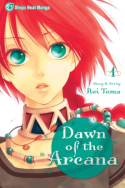
In premise, Dawn of Arcana sounds like fairly generic shoujo fantasy. Princess Nakaba of Senan is married to Prince Caesar of Belquat in an arrangement ostensibly meant to ensure peace between their warring kingdoms, but which nobody expects to do so for long. Nakaba is resigned to her fate, but not without backbone, while Caesar is arrogant and entitled and makes remarks like, “Make no mistake. You are my property.” It’s pretty obvious they will fall for each other soon.

Accompanying Nakaba is her demi-human attendant, Loki, who belongs to an enslaved race possessed of heightened strength and senses. He’s been by Nakaba’s side ever since the village in which she lived was attacked by Belquat soldiers—evidently, her mother (also a princess) eloped with a member of a race possessed of precognitive powers, which Belquat was attempting to wipe out and of which Nakaba is now the only survivor—and so she feels much love and gratitude for him.

The first volume mainly focuses on Nakaba’s attempts to fit in around the enemy castle. In Senan and Belquat, only royalty have black hair, so the fact that hers is red has always prompted sneers, curiosity, and contempt, so the reaction would be the same no matter where she resided. Gradually, she gets to know Caesar a little better, and we see that his main problems are youth and actually buying into the “it’s your right” lectures that his mother has been subjecting him to since childhood. Here’s a great sample exchange between them:

Caesar: (After planting a smooch on Nakaba.) I’m a prince, and this is my kingdom. If I want something, I take it.

Nakaba: You may be a prince, but there are some things you’ll never have. Allow me to be the first.

Nakaba actually trusts him to keep his word when he promises to help Loki get out of trouble at one point, and expresses faith in his abilities to succeed in the very endeavors which his mother discouraged him from even trying. In return, he somewhat awkwardly tries to make her happy by bestowing lavish gifts upon her, and learns that a simple thing like caring for a wounded bird does the job better than fancy dresses. It’s certainly nothing new for a surly hero to be thus tamed by a spunky heroine, but I like the development all the same.

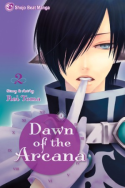
And speaking of development, volume two is a lot more interesting than the first. While someone plots to poison Caesar—and attempts to frame Nakaba for the deed—tension is brewing between Nakaba’s husband and her attendant. Loki intervenes to save Caesar from the would-be assassin, but admits that this is only to earn his trust. “I do want him dead… Have you forgotten? They are the enemy.” For too long, Loki’s people have been kept down, and he is now plotting rebellion. “You must not let him into your heart,” he warns, knowing that Caesar must eventually be his target, but though Nakaba attempts to comply, out of loyalty to Loki, she’s ultimately unable to do so.

Despite the fact that Nakaba falling for Caesar is predictable, I still like them together—how she improves him, and how he manages to make her feel safe yet simultaneously guilty—and I really like that she’s torn between these two guys, but not exactly in a romantic sense. Even while her feelings for Caesar are growing, she’s aware of the possibility that she’ll end up betraying him for Loki’s sake. Personally, I’m betting on Caesar becoming aware of the atrocities committed by his father and joining Loki’s cause—there have been some hints in this direction already—but the angst will be fun in the meantime.

Ultimately, this is a solidly good series. It’s not great yet, but it’s also far from bad.

Dawn of the Arcana is published in English by VIZ Media. Volume one is out now and volume two will officially be released on February 7, 2012. The series is ongoing in Japan, where the ninth volume has just come out.

Review copies provided by the publisher.

Filed Under: REVIEWS Tagged With: shojo beat, VIZ

Off the Shelf: No Longer Human

January 27, 2012 by MJ and Michelle Smith 10 Comments

MICHELLE: This month’s Manga Moveable Feast, currently in progress, is devoted to the works of Usamaru Furuya, prompting MJand me to devote this week’s column to the most recent of his series to see publication in English, No Longer Human.

Based on a book by Osamu Dazai that’s described as “a decadent novelist’s autobiographical masterpiece,” No Longer Human depicts the story of Yozo Oba, a young man with no comprehension of what it feels like or how to be an ordinary person. We first meet him as a high school student, where he has learned that being the class clown is the one thing that enables him to connect to his classmates.

Soon he falls in with a group of misfits plotting political rebellion, but he’s more comforted by being among outsiders than he is honestly devoted to their cause. There, he meets the first of several women who will be drawn to him and agree to feed and care for him. This becomes his pattern in life. By the middle of the second volume, he’s twenty and living with a much older woman while drawing a gag manga and helping out at the bar she owns. He realizes that he’s “a genius parasite on women,” but sees that as his only option left to survive.

MJ: As in most “decadent masterpieces,” Oba’s excesses drive him deeper and deeper into tragedy, as he drinks and sleeps his way from one safe haven to another, usually leaving the women who care for him in significantly worse condition than he found them (and in one case, even dead). The narrative lets us know that things are only going to continue to get worse, yet it’s impossible to look away.

Though there have since been at least two other graphic novel adaptations of Dazai’s original, where Furuya goes very much right, in my opinion, is in his decision to move the pre-WWII story into the present, which I think is at least partially responsible for his ability to present such a self-indulgent tragedy in a way that makes it genuinely readable. I realize the original is a classic, but I feel like the novel might suffer more from a contemporary reading than Furuya’s adaptation does.

(click images to enlarge)

Note: No Longer Human reads from left-to-right

MICHELLE: I was surprised by just how readable it was, actually. Just looking at the plot, you’d expect it to be depressing, but it’s so skillfully done that I enjoyed it very much! But yes, you’re absolutely right that updating the story was a smart choice, especially as it enabled a bit of self-insertion on Furuya’s part. Ordinarily, I’m kind of annoyed when mangaka break the fourth wall—particularly if they do so in a silly way—but here, Furuya’s interludes of discovering and being transfixed by Oba’s story are absolutely essential in setting the mood. We feel like he’s captivated right along with us.

MJ: Yes, he’s sort of sharing it with us like a guilty pleasure, and it really works as one. I think the story benefits greatly from being presented as an outrageous internet diary that’s impossible to stop reading. There’s something about this story that makes me feel like I’ve stayed up all night reading, strung out on caffeine and cheese puffs, and, frankly, that really suits it. I kind of wish I’d read it like that for real, actually.

Talking about it like this, it would be easy to gloss over Furuya’s artistry, though, which is put to pretty spectacular use in this series, wouldn’t you agree?

MICHELLE: I can imagine the back cover blurb now. “It had me craving cheese puffs.” – MJ, Manga Bookshelf

As for Furuya’s artistry, I whole-heartedly agree. His talent was on prodigious display in Genkaku Picasso, the only other series of his that I’ve read, but it really suits a darker story like this one.

I was particularly struck by the depictions of Oba as a marionette controlled by his father’s money and/or putting on a show for his peers. It’s such a vivid symbol of someone going through the motions of trying to be normal! And even though Furuya occasionally uses some symbolism that might seem overly obvious—like the surfeit of bugs lurking beneath the petals of the flowers Oba admires with his fiancée (we must return to this point)—it’s done with such finesse that it doesn’t seem trite.

MJ: My previous experience with Furuya has consisted only of Lychee Light Club, which I found visually striking on a nearly theatrical level, but juvenile and kind of emotionally empty. It’s nice to see his gifts utilized so differently here. There was a lot of sexually-charged violence in Lychee Light Club, and certainly there’s no lack of sexual themes in No Longer Human, but it’s approached so differently… it really feels like a much more mature work.

MICHELLE: I did wonder how this compared to Lychee, which I still need to read.

I wanted to ask… did you find the sexual content as supremely unsexy as I did? Beyond not being idealized at all, there are some closeups of things like twirling tongues that look downright disgusting, almost like something drawn by Junji Ito! I wonder if this is Furuya’s way of depicting the impure motives of Oba in these situations. It would be completely out of place to portray what he’s doing as titillating, let alone dreamy.

MJ: I don’t know if I’d say that I found it supremely unsexy, but it definitely does not read as something that’s supposed to be titillating. It’s interesting, too, even though the character confesses early on that his frequent, semi-anonymous sexual encounters are the only things that make him feel good (“When I’m here seems like the only time the smile on my face in genuine”), from the reader’s perspective, he seems just as detached during those trysts as he is the rest of the time. I almost feel like he’s fooling himself when he says that, and that this is reflected in Furuya’s artwork.

MICHELLE: There’s definitely a lot of emphasis on what makes Oba comfortable in a relationship. With the ladies in the “massage parlors,” it’s because he doesn’t have to use any subterfuge. With the members of the political group, it’s because everyone is a misfit in some way. And the two loving/honestly affectionate relationships he has are with women who exhibit a sort of elegant melancholy. Outsiders themselves, in a way.

But speaking of fooling himself, what on earth is going on with the abrupt change in the end of volume two?! Oba has maintained all along that he has no interest in and cannot fathom embarking upon ordinary relationships, and yet here he is, falling in love with and ultimately proposing to a virginal girl who works in a smoke shop. I’m sure he’s got an idealized version of her, but man, I just wanted to shake her and go, “Yoshino, no!” That poor girl is in for a very rude awakening. What will be her price for associating with Oba?

MJ: Yes, disaster is clearly just around the corner, in the same sure way as you’d expect in, say, a Dickens novel. Yoshino is doomed just as it seems Oba is truly doomed, and nobody’s even trying to hide it. Furuya makes the most of this, too. I’m glad you mentioned that last page in the volume, with a swarm of insects seemingly prepared to devour a flower. It’s a melodramatic image, I suppose, but so perfect for the tone of the story.

MICHELLE: Exactly! He just seems so much like a different person here from his behavior, which is emphasized by the drastic haircut Furuya has given him. It really comes out of nowhere, narratively speaking, but I have faith that Furuya is going to make it all make sense in the end. I suppose it helps knowing that, theoretically, all of this did happen to the same protagonist in the original novel (and in the life that it’s based upon?).

MJ: Well, I don’t know if I’d say he feels like a different person, but definitely a different version of a person who keeps reinventing himself over and over, in order to survive. Or perhaps I should say, “in order to survive without having to ever put himself out or curb his own desires,” because really, that’s what his survival is about. So here he is, seemingly falling in love for real for the first time ever, yet in a way, what I see is a guy who has finally figured out how to reinvent himself on the inside–enough to fool even himself. And really, that can’t go well.

MICHELLE: Maybe it’s all the drinking he’s doing that’s enabling him to fool himself to such an extent, to actually believe in one of these personas he’s crafted for himself. And I think there’s a line in there, too, about how living with Mama (do we ever learn her real name?) is so peaceful and great that he starts to believe that all the world is the same. But ultimately, he’s still pursuing the kind of parasite arrangement that’s been sustaining him the past few years, but viewing it through the illusion of love.

MJ: And in a way, maybe that’s the only direction he could really go at this point. After having finally become too disgusted even with himself in his usual arrangements, he’s gotten by with Mama (no, I don’t think we know her real name) because she lets him off the hook so completely. He’s able to be a child, a lover, an employee, whatever, but ultimately she’s just letting him play at those roles without expecting him to be any of them.

He can’t go back to what he was exactly, so what else would he do but move on to something he could play at wholeheartedly with someone who is unlikely to notice? Yoshino’s lack of experience makes her the perfect fit for this phase, because she won’t burst his bubble, at least not for a while.

MICHELLE: And I’m sure she’ll temporarily inspire him to clean up his act—stop drinking, stop blowing the income he makes from his manga—but it just can’t last long. And maybe one could look at that like a good thing, but I kind of hate him for inflicting himself on her. It’s like, what he sees as the best thing that’s ever happened to him, I see as the worst thing he’s ever done.

MJ: Yeah, I agree. Not that the other women have deserved him or anything, but to some extent they’ve enabled him by giving in to their own issues and insecurities. They’ve knowingly let him manipulate them (even if they hid it from themselves as best they could), but Yoshina isn’t worldly enough to grasp what’s happening or what kind of guy he is. And on some level, he knows that, and is taking advantage of it.

I feel almost cruel, not giving him any benefit of the doubt here, but the guy hasn’t given me anything else to work with!

MICHELLE: Whereas I don’t feel cruel at all! He’s been very frank about his own shortcomings and survival tactics throughout.

I rather wish I knew more about the source material or the other adaptations, so as to pinpoint which elements have been introduced by or presented best by Furuya, but on the other hand, I don’t want to muddy my mind with other versions of the story when I like this one so much.

MJ: I admit I suspect I wouldn’t have much patience for the novel at this point in my life. There was a time when I really loved self-indulgent tragedy, but those days are long past. I think Furuya’s wry adaptation may be exactly the thing for me now, and I feel content to leave it at that, at least for the moment. Perhaps I’ll change my mind after I’ve read the end. I’m pretty anxious to read volume three at this point.

MICHELLE: So am I! And I think I’m going to go back and read Lychee soon, too. I was unsure about it, but now I feel confident I could admire it, even if it doesn’t reach the heights of No Longer Human. Too bad CMX folded before they could release any of 51 Ways to Save Her.

MJ: I’m regretful about that now, too. Let’s hope someone else picks it up soon!

For more Furuya talk, be sure to check out this month’s Manga Moveable Feast, hosted by Ash Brown at Experiments in Manga.

All images Copyright © Usamaru Furuya 2009, Translation Copyright © 2011 Vertical, Inc.

Filed Under: OFF THE SHELF Tagged With: Manga Moveable Feast, MMF, no longer human

Unbelievable by Sara Shepard

January 26, 2012 by Michelle Smith

From the front flap:
Behind Rosewood’s grand façades, where the air smells like apples and Chanel No. 5 and infinity pools sparkle in landscaped backyards, nothing is as it seems. It was here, back in seventh grade, that five best friends shared everything—Seven jeans, MAC makeup, and their deepest, darkest secrets.

Now someone named A has turned their charmed lives into a living nightmare. Emily has been shipped off to her hyper-conservative cousins in Iowa. Aria is stuck living with her dad and his home-wrecker girlfriend. And Spencer fears she had something to do with Alison’s murder. But Hanna’s fate is worse than all of that—she’s clinging to life in the hospital because she knew too much.

With A’s threats turning dangerous and Ali’s killer still on the loose, the girls must uncover the truth—about A, about Ali, and about what happened to Hanna—before they become A’s next victims. But as they unravel Rosewood’s mysteries and secrets, will it bring an end to the horror… or is this just the beginning?

Review:
I find it hard to know where to start in reviewing Unbelievable without it becoming simply a reiteration of all the plot craziness that ensues. I’ll try to keep it to a minimum, at least.

We begin with all four girls in unfamiliar environments. Emily has been shipped off to Iowa to live with uber-strict relatives on account of continued gayness, Aria is living with her father and his girlfriend after having exhausted all other options, Spencer has been been whisked off to New Jersey by her parents in an attempt to repair her relationship with her sister, and Hanna is in a coma in the hospital, after being hit by a car. Plus, “A” is still sending them creepy messages and Ali’s killer remains on the loose.

I believe this was originally planned as the end of the series, but I’m not sure, since the last few pages suggest that a new “A” will come to town and there were also some unresolved hints about weird issues in Ali’s home life. Anyway, we do conclusively learn who A is (sadly, I had spoiled myself on this point) and are lead to believe that we learn who killed Ali, though that is not nearly as certain. Various repressed memories return in dramatic fashion. In addition, issues plaguing the various girls in their home lives get resolved—and I do appreciate how much of their drama this time is familial rather than romantic—and they sometimes even do reasonable things! (Though mostly they continue to do stupid things.)

I can’t really in good conscience recommend this series to others, but I will say that I have fun with it. This time, I checked out the unabridged audio edition narrated by Cassandra Morris. My first reaction was “This narrator sounds about nine!” but I did eventually get used to the pitch of her voice. What I never could accustom myself to, however, was her inability to pronounce the letter “t” when it appears in the middle of a word. Windows are hung with “cur-ans,” characters are suddenly “fry-end”… It’s very annoying!

In any case, I am totally going to keep reading. The fifth book in the series is called Wicked—and I have just boggled at its blurb, which mentions Emily having a boyfriend—but I am first going to read the newly released Pretty Little Secrets, which is set in the winter break between books four and five. I hope it’s not as insubstantial as the interstitial Princess Diaries books proved to be, but we shall see!

Filed Under: Books, Suspense, YA Tagged With: Sara Shepard

A Devil and Her Love Song, Vol. 1

January 24, 2012 by Michelle Smith

By Miyoshi Tomori | Published by VIZ Media

The back cover blurb of A Devil and Her Love Song contains the following lines: “Meet Maria Kawai—she’s gorgeous and whip-smart, a girl who seems to have it all. But when she unleashes her sharp tongue, it’s no wonder some consider her to be the very devil!”

And in my mind, this built up the expectation for a comedy, but that’s not what A Devil and Her Love Song is at all. It’s much more serious and sad than I had anticipated, but if I had done my research beforehand and realized that it originally ran in Margaret, I shouldn’t have been surprised.

Beautiful Maria Kawai has been expelled from her prestigious Catholic school, St. Katria’s, and must now enroll in a new school. She carries a lot of mental baggage from her experiences at St. Katria’s, most notably the fact that someone she regarded as her best friend told her “You taint everyone around you.” And, as if to lend credence to these words, Maria stirs up hostilities amongst her classmates almost immediately. The problem is that she’s so perceptive, and so blunt in her delivery, that she points out personality attributes that her classmates would rather not acknowledge, like the fact that they’ve been gossiping about her prior to her arrival, or that one boy is pushing himself to be liked by all even though he is not naturally a people person. Over the first week of school, matters escalate to the point where Maria is shoved down a flight of stairs and a truly odious teacher is telling her she’s “rotten to the core.”

And yet, there are certain lessons from her St. Katria’s days that serve Maria well in tough moments, like “those who believe will be saved,” which provides her encouragement to get through bullying encounters with a group of Mean Girls in her class. But she’s not taking solace from a religious implication of these words; instead, she seems to feel that if she believes in people’s good intentions, has faith that one day they will accept her, that this will actually come to pass. And so, even though she knows the girls have it in for her, she puts herself in the path of their harassment in the hopes that one day, she’ll win them over. As I said, it’s really rather sad and makes her far more sympathetic than I ever expected a sharp-tongued heroine to be.

I regret to admit I made another snap judgment of the series based on the chapter one title page, which depicts Maria and a couple of boys, one a cheerful blond and the other a surly-looking brunette. I assumed these would be her stereotypical shoujo love interests, but though both boys are definitely interested in her, they are far more complicated individuals than I had assumed they would be. The brunette, Shin, is grumpy, rebellious, and not really friendly with the rest of the class, but has a kind heart. It unsettles him that Maria can so clearly see through him, and he’s terrified of what would happen if she could discern what he’s feeling about her, but he still comes through with her when no one else will. There’s one especially nice scene where she’s so happy and scared by his kindness that she can’t even find the words to explain, so she sings instead.

On the other hand, you have Yusuke, who is trying so hard to be everyone’s friend that he’s actually no one’s real friend at all. His philosophy is the “lovely spin,” which is a survival mechanism he tries to impart upon Maria with little success. Turn everything into something palatable and nice, even if you’re being untrue to yourself, is the basic gist. It’s probably good for her to master this subterfuge, to avoid further confrontations and to effect the personal change she seeks, but why is he doing it? Just as he helps her master the art of diplomacy, one wonders whether she will help him drop the charade.

I mean no slight to shoujo comedies when I say that A Devil and Her Love Song is much better, richer and more deep, than I anticipated. To say that I am looking forward to reading the rest of this story would be a gross understatement.

A Devil and Her Love Song is published in English by VIZ Media. The first volume will officially be released on February 7, 2012. The series is complete in Japan with thirteen volumes.

Review copy provided by the publisher.

Filed Under: REVIEWS Tagged With: shojo beat, VIZ

Pick of the Week: Expect the Unexpected

January 23, 2012 by Katherine Dacey, Michelle Smith, Brigid Alverson, Sean Gaffney and MJ 6 Comments

There’s plenty of good manga coming in to Midtown Comics this week. Check out picks from the Battle Robot below!


KATE: I think I was the only person in the mangasphere who liked Nao Yazawa’s Moon and Blood, so I was happy to see the second volume on Midtown Comics’ shipping list this week. What charmed me the most about this jokey horror-romance was its retro vibe: Yazawa’s characters seem to have stepped out of a shojo manga from the late 1980s/early 1990s. There’s an imperious, handsome boy who’s an ace at everything (and looks like the lead in Itazura na Kiss); a ditzy but energetic heroine with long, curly hair; a dumb but kind thug who’s loved the heroine since childhood; and a child-vampire who looks like a refugee from an early Rumiko Takahashi story. The script won’t win any prizes for originality, but it’s brisk, funny, and — most importantly — never takes itself too seriously. For folks who have OD’ed on angstful horror-romances — and I count myself among that number — Moon and Blood is a great palate cleanser.

MICHELLE: There’s actually quite a bit on this list that I can see myself picking up at some point in time. Perhaps the most obvious pick is the third volume of Pretty Guardian Sailor Moon, but I think I’ll choose volume six of Arisa this time, for a little variety. Even though I’m not entirely convinced that mangaka Natsumi Ando knows where her story is going, it is nevertheless the fast-paced and suspenseful tale of a girl masquerading as her twin sister to find out what made her attempt suicide. I don’t know a lot about Nakayoshi, the magazine in which this is serialized, but it’s darker fare than I’d generally expect to find there, all while looking as stereotypically shoujo as can be. An interesting mix, to be sure!

BRIGID: I’m going to go with Michelle’s choice and pick up vol. 6 of Arisa. I find Natusme Ando’s manga strangely addictive, despite her wholesale embrace of shoujo manga cliches. I think it’s because she throws in a twist now and then to keep me guessing. I’m really enjoying Arisa, even more than Kitchen Princess, so this week’s choice is an easy one for me.

SEAN: It’s tough for me as well, as this week features volumes of two of the most essential shoujo series available in English. Tempted as I am to pick Sailor Moon – which is awesome – I’m going to make my pick the third omnibus of Cardcaptor Sakura. Back in the days when CLAMP didn’t need to confuse its audience, this is still one of their best and most heartfelt series, and Sakura is still one of the quintessential shoujo heroines. This omnibus begins the second half of the series, where the reader wonders where the manga can go now that she’s collected all the cards (answer: quite a long way), and also begins to move forward her cute romance with Syaoran. Great stuff, and Dark Horse’s package is wonderful.

MJ: It’s not too often that I choose a BL title for this column, but I admit I’m pretty psyched to see the second volume of Kai Asou’s Only Serious About You finally making its way to Midtown Comics. I enjoyed volume one immensely, and I’ve been eagerly anticipating its continuation. Good romance is so difficult to write, and in a genre where shoddy writing is so widely-tolerated, it’s no wonder few writers really make the effort. Fortunately, Asou is one of the few. She’s the kind of skilled writer who is able to make standard genre tropes feel fresh again, and perhaps even reminds us why they became”standard” to begin with. Though this was officially released in December, Midtown and I are equally behind the times, as I hadn’t realized it was already available. It’s just become this week’s must-buy manga! My only regret is that it isn’t yet available by way of DMP’s iPad app.


Readers, what looks good to you this week?

Filed Under: PICK OF THE WEEK Tagged With: arisa, cardcaptor Sakura, moon and blood, only serious about you

Bookshelf Briefs 1/23/12

January 23, 2012 by Katherine Dacey, Michelle Smith and Sean Gaffney Leave a Comment

This week, Kate, Michelle, & Sean look at new releases from Kodansha Comics, Viz Media, and Yen Press.


Animal Land, Vol. 3 | By Makoto Raiku | Kodansha Comics – What a difference a volume makes! Now that Taroza can walk, talk, and kick butt, Animal Land has taken a turn for the better. The action sequences are imaginatively staged, allowing Taroza to display a wider range of abilities and fight more formidable opponents. Volume three is also noteworthy for the introduction of the series’ second human character, a feisty blond girl who’s allied herself with a pride of hungry lions. While the interactions between her and Taroza are predictable (Capri is puzzled by her attraction to Taroza), Makoto Raiku manages to eke some fresh laughs out of their awkward courtship. A good choice for the middle-school crowd, in spite of the 13+ rating. – Katherine Dacey

Bokurano: Ours, Vol. 5 | By Mohiro Kitoh | Viz Media – I hadn’t originally planned on reading this right away, figuring it might be nice to have several volumes of this series to consume sequentially. But then I read that there’s a major revelation in this volume, and I just couldn’t resist. Actually, for a series about children who are conscripted into piloting a giant mecha with their life force, this is what passes for an upbeat volume, in that one boy successfully completes his mission then donates his heart to a very ill friend and one of the girls is able to catch a glimpse of her newborn baby brother before passing away. I thought the “major revelation” was telegraphed a bit too strongly beforehand, so it wasn’t as shocking as it could’ve been, but it’s certainly an intriguing twist. Kitoh’s sketchy, minimalist, and distinctive art style is growing on me, as well. Definitely still recommended. – Michelle Smith

Gon, Vol. 3 | By Masashi Tanaka | Kodansha Comics – If you dutifully purchased all seven volumes of Gon in late 2000s, fear not: the new Kodansha version is nearly identical to the old CMX Manga edition, save for the trade dress. If you missed out on Gon, however, now is a perfect time to explore this delightful series. As you’ve probably heard, Gon features a small orange t-rex who has a ten-year-old boy’s penchant for causing mischief. In volume three, for example, Gon floats down the Amazon, accidentally ingests some hallucinogenic mushrooms, and goes mano-a-mano with a tiger. All of Gon’s escapades are rendered in breathtaking detail; Masashi Tanaka’s linework is impeccable, capable of suggesting the texture of a reptile’s skin or a pine tree’s bark. Tanaka also has great comic chops; only Chuck Jones is his peer when it comes to drawing funny animals. Highly recommended. – Katherine Dacey

Kimi Ni Todoke, Vol. 12 | By Karuho Shiina | Viz Media. – We continue to focus on Sawako and Kazehaya’s new relationship, and how neither of them are quite sure what to do now. Sure, they’re dating and all, but how do two basically shy people go about holding hands, or even *gulp* kissing? To add to Kazehaya’s nervousness, Sawako’s parents now know they’re together. Luckily Kazehaya is a sweetie pie – indeed, her father is irritated that he can’t forbid Sawako to date him as he’s basically swell. There’s also a fantastic chapter showing how Chizu and Ayane met – Chizu, who always speaks before she thinks, makes a wonderful contrast to Ayane’s calculated speech and cognizance of the way others think. One could argue very little really happens in this volume, but who cares? Still fantastic.-Sean Gaffney

Pandora Hearts, Vol. 8 | By Jun Mochizuki | Yen Press – As we approach a volume count in the double digits, we’re starting to get plenty of information about the past, including some significant revelations about Alice. My reactions to this material can best be summed up by one of the characters, who says, “Hrm… ‘twould all seem to make sense, but not quite.” Here’s another applicable quote: “It’s been one crazy story after another, so my head’s still working on catching up.” After demonstrating some sympathy for her readers with this dialogue, Mochizuki gets back to the present, sending Oz to a local festival while suggesting that Gilbert’s about to go all crazypants. Rounding out the volume is the original one-shot concept for the series which is, I am sorry to say, both confusing and dull, but offers some entertainment in the form of familiar characters in unfamiliar situations. – Michelle Smith

Psyren, Vol. 2 | By Toshiaki Iwashiro | Viz Media. – I always find these mid-range Jump series difficult. There’s nothing inherently wrong with Psyren – the hero is fun in a Jump way, he contrasts nicely with his more competent friend, and the heroine is cute and more sensible than her other two friends. Still, there’s nothing here that demands I go out and get the next volume IMMEDIATELY, as I always feel with One Piece. It’s not a great series, it’s merely pretty good. Still, pretty good isn’t that bad. Matsuri is a fun addition to the cast, and there’s some great humor here with Ageha completely failing to use his psychic powers… then overdoing it when he finally gets it. The fighting scenes aren’t really as interesting yet, though. Given it’s a Jump manga, I hope that gets sorted out soon. Again, recommended if you like the Jump style.-Sean Gaffney

Filed Under: Bookshelf Briefs Tagged With: animal land, bokurano: ours, gon, kimi ni todoke, pandora hearts, psyren

BL Bookrack: January 2012

January 22, 2012 by MJ and Michelle Smith 3 Comments

Welcome to 2012’s first installment of BL Bookrack! This month, MJand Michelle take a look at two offerings from the Digital Manga Guild, Love & Trap and My Sempai, as well as Men of Tattoos from Digital Manga Publishing’s Juné imprint.


Love & Trap| By Kotetsuko Yamamoto | Digital Manga Guild | Young Adult (16+) – High school student Mochida Masaki will do anything to keep himself safe from bullies, even if it means using his body to “trap” someone stronger or more powerful into becoming his protector. Having only ever used sex as a tool for persuasion, it’s a tremendous shock to Masaki when he finds himself experiencing real attraction to Aihara, the class loner whose family is rumored to be connected to the Yakuza. Are Masaki’s feelings real, or is he just gravitating towards his next target?

Building a romance manga around real societal or psychological issues is tricky business, especially when one of those issues is as serious as teen prostitution, which is essentially what Yamamoto attempts to tackle with Love & Trap. Regardless of the writer’s knowledge of the subject, it’s incredibly difficult to balance complex reality with the demands of the genre, without either trivializing the issue or doling it out with an insufferably heavy hand. This balance is even more challenging to achieve if one must do so over the course of a single volume (or less).

With all that in mind, it’s not surprising to note that Love & Trap leans towards the former. Despite the manga’s dramatic setup, Yamamoto quickly resolves issues that would take most therapists years to unravel, just in time to grant Masaki his genre-approved happy ending. She fares a little better with the book’s obligatory (unrelated) side-stories, “Love Blood,” a dreamy little tale of sexual awakening that reads like a light-BL letter to Penthouse Forum, and “We’re Blooming,” a breezy workplace love-triangle romance set in a florist’s shop.

Yamamato’s artwork is a highlight throughout, clean and expressive, with an almost-classic sensibility that reflects some impressive influences, including Moto Hagio, whose character “Jeremy” (from A Cruel God Reigns) was Yamamoto’s model for the lead in “Love Blood.” On the strength of this alone, I’d be interested in seeking out her other works. Fortunately, the DMG seems to have licensed quite a few, including Blooming Darling, a two-volume sequel to the charming “We’re Blooming.” Stay tuned!

– Review by MJ


Men of Tattoos | By Yuiji Aniya | Digital Manga Publishing | Mature (18+) – I have recognized in myself a fondness for yakuza-themed BL, so when Deb Aoki named Men of Tattoos her Best New Yaoi Manga of 2011 and described it as “strange, funny, heartbreaking and surreal,” I knew I had to read it for myself.

Deb was absolutely right in her description of the series. The first four stories feature yakuza and are interconnected in various unexpected ways. “My Katagi-kun” is the story of a pair of childhood friends who reconnect and become lovers, “Dog of the Ranunculus” is about a guy who’s relatively high up in the organization falling in love with the boss’s son, “Cinderella and the Mad Shark” is about getting revenge, and “Everyone’s Song” is about dreams that don’t come true. Probably the last one packs the biggest punch, but it needs the other three stories to put it into context.

Rounding out the collection are two stories about a pair of college students who keep having dreams about each other. It’s more interesting than it sounds—and fairly steamy besides—and functions like a mental palate cleanser, as it allows the book to actually end on a happy note.

Even if you’re not a particular fan of yakuza stories or of BL in general, I’d still recommend Men of Tattoos. Aniya does some clever things with storytelling that can be appreciated by any manga fan.

– Review by Michelle Smith


My Sempai | Hebiko Habuyama | Digital Manga Guild | Young Adult (16+) – In terms of premise, My Sempai doesn’t sound terribly unique. A fresh-faced teenager, Hajime Amemiya, is being hassled by some thugs when he is rescued by cool and intimidating Saburo Ninomiya, who turns out to be an upperclassman at Hajime’s school. Immediately, a comedic tone is set when Hajime proceeds to stalk Ninomiya, pouncing on him from time to time while absurdly declaring, “I am a love vulture!!” Saburo attempts to discourage his interest at first, but when faced when Hajime’s inextinguishable belief in his being a better person than rumors suggest, he relents.

The boys start spending time together on the weekends—seeing movies, playing video games—and gradually get closer. Saburo’s not a very communicative guy, so instead of volunteering information about himself, he tells Hajime that he can ask anything he likes. It’s tough for Hajime to do this, though, so he’s pretty uncertain about how Saburo feels about him, and also feels left out when one of Saburo’s obnoxious friends (my least favorite character by far) spills the beans about a post-graduation job offer in Okinawa. They do make a cute couple, though, so I enjoyed their interactions. In addition, the chaste, fade-to-black consummation of their relationship has to be one of the happiest-looking I’ve ever seen in BL.

Habuyama’s artwork takes a bit of getting used to, as screentone (and maybe everything else, who knows?) appears to be rendered by computer. Eventually, though, I discovered that her style is particularly suited for outdoor scenes, especially at night, and there were quite a few wide-shot panels with composition worth admiring. I’m always a sucker for drawings of buildings, and there’s a particular image of a dejected Hajime standing on Saburo’s shadowy front porch that I remember as especially striking.

While some elements of My Sempai are not exactly original, I still found it a pleasant and generally humorous read. Habuyama writes in her afterword, “All that matters is that you laughed and enjoyed yourself. I draw with that intention.” I did both, so I’d call that a success.

– Review by Michelle Smith


Review copies provided by the publisher.

Disclosure: MJ is currently under contract with Digital Manga Publishing’s Digital Manga Guild, as necessitated for her ongoing report Inside the DMG. Any compensation earned by MJin her role as an editor with the DMG will be donated to the Comic Book Legal Defense Fund.

Filed Under: BL BOOKRACK Tagged With: digital manga guild, dmg, love & trap, men of tattoos, my sempai

Tidbits: A Trio of Kodansha Shoujo

January 21, 2012 by Michelle Smith

I’m catching up on three of Kodansha’s currently running shoujo series, so I thought I’d group them all together here for a Tidbits post! First up are volumes four and five of Natsumi Ando’s suspenseful Arisa, followed by the second and final volume of Naoko Takeuchi’s Codename: Sailor V, with the second volume of Pretty Guardian Sailor Moon bringing up the rear. Tidbit power, make up!

Arisa, Vols. 4-5 by Natsume Ando
Tsubasa Uehara continues to attend school in the guise of her sister, Arisa, as she endeavors to find the identity of the King who is fulfilling wishes from chosen students in dangerous ways. Her spirits flag when it seems she’s been unsuccessful in protecting the latest target, but when it turns out her efforts actually prevented the girl from sustaining permanent injury, her spirits rise. Alas, a friend’s betrayal is followed by an explanation of divided loyalties and the introduction of a pivotal new character with kind feelings towards Tsubasa but a burning hatred for Arisa.

So, there are several characters at this point who could be the King, but the strongest possibility seems to be Kudo, a transfer student who I had forgotten about entirely after reading volume three, so that tells you how memorable of a guy he is. Manabe doesn’t seem like the culprit, and neither does Arisa’s boyfriend, Midori, but it’s not out of the question. Mostly we see the King as a shadowy figure, grinning in a dastardly fashion as he does things like arrange for Tsubasa to fall off a cliff. (Side note: any time the female lead of a shoujo manga goes out into the woods at night, she is going to fall off a cliff. It’s, like, the law.) New character Shizuka seems like a potential candidate, until it’s revealed that the King is manipulating her into making wishes that will harm Arisa/Tsubasa.

All of this makes for a fast-paced and suspenseful read, but it does cause me to wonder whether Ando’s just making up all of this as she goes along. Does she really have a plan for who the King is, or is she keeping readers suspicious of everyone until inspired to take the story in a specific direction? I’m not exactly complaining—because, again, it is a fun read—but the lack of any kind of permanent gain is a little bit frustrating. I just hope there’s a satisfying and dramatic payoff in the end!

Codename: Sailor V, Vol. 2 by Naoko Takeuchi
It’s rather hard to like Minako for the majority of this volume, as several of the stories play up her shallow side. First she gets fat by eating too much evil chocolate, then she must contend with a trio of animal-themed siblings who unleash energy-sucking cats, dogs, and mosquitoes upon the populace. Minako slacks off frequently and makes various unkind comments to her long-suffering feline companion, Artemis. She also meets the latest idol sensation, handsome and mysterious Phantom Ace, and becomes one of his biggest fans.

There’s not really a whole lot to recommend these chapters except more of Sailor V’s amusing speeches, like this one, which occurs as she’s foiling the enemy’s scheme to collect energy via blood donation:

You have used clever words to abscond with a precious tribute of blood from weakened hospital patients! That is your crime!

And to add to it, you have sullied a woman’s simple joy of collecting stamps!

Worse, you forgot to give me my reward for donating blood to the tune of 800cc! And that crime is grave!

Luckily, though the premise of the final two chapters is just as silly as what’s come before—Minako is ordered to win the part of Ace’s leading lady in his latest project, filming in China, so that she can observe his potentially evil production company—it doesn’t preclude genuine dramatic impact. Though Minako entertains fantasies of marrying Ace and retiring, when he professes his to love her, she realizes that it’s not what she wants. She loves being Sailor V and, furthermore, remembers making a promise to protect an important person. Eventually, her memories fully awaken and her Sailor V costume is replaced by one matching the design of the other senshi. It’s kind of goosebump-inducing.

Though I’ve read this series before (with translations), I had completely forgotten that Ace had any connection at all to Minako’s past life, so was pleasantly surprised by that revelation as well as by this awesomely grim quote:

Your love will never be granted, for all eternity… Your love or your duty… now you can live the rest of your life never having to worry about the tortures of deciding between them. Your fate is to battle on. Because your true battle starts now.

How could I have forgotten that?! Minako is a girl who is always falling (if superficially) in love, so she can’t welcome this news, but neither does she shirk from her destiny. Ever irrepressible, she ends the series on an upbeat note, poised to show (if I recall rightly) greater maturity and determination when she joins the others in the main series.

Ultimately, Codename: Sailor V is worthwhile despite its flaws. We never learn what the enemy was hoping to achieve, nor the identity of “Boss” (though the second volume of Pretty Guardian Sailor Moon provides some insight on the matter), but we do meet a special, spunky girl as she comes to accept her unique destiny, and that can never be a bad thing.

Pretty Guardian Sailor Moon, Vol. 2 by Naoko Takeuchi
A lot happens in this volume, which I shall attempt to quickly summarize. When facing off against Zoisite, the girls are rescued by the timely arrival of Sailor Venus. Minako is now in her second year of middle school and comes across as very mature, competent, and serious about her duty. She’s been monitoring Usagi through the Sailor V game and has also been researching the enemy. She provides all sorts of information about the Dark Kingdom and also claims (well, Artemis claims) that she is Princess Serenity. Her proximity triggers some past-life memories in the others, as well.

However, Usagi starts having dreams that suggest that she was actually Serenity, and when Mamoru is injured protecting her from one of Kunzite’s attacks, one of her tears transforms into the Legendary Silver Crystal and her true identity is revealed. (The bit with Venus was evidently a ruse to direct enemy attacks onto a more experienced Guardian.) Mamoru is subsequently kidnapped by the Dark Kingdom and eventually used as Queen Beryl’s pawn, securing the crystal for her by volume’s end.

So, all of this is very dramatic and shoujo-tastic while it occurs and I honestly loved every minute of it. There are a couple of things that I found especially interesting, though. The first is how much information we get on the enemy compared to the dearth of intel provided in Codename: Sailor V. We see, for example, a flashback to the moment in which Beryl was “irresistibly drawn to” the North Pole, where she discovered the remains of the Dark Kingdom. This made me wonder… was Beryl reborn on Earth as a regular human, just like the Guardians? And did she waken to her past memories as the seal imprisoning Metalia faded?

We also learn a bit about the Four Kings of Heaven, who were generals to Endymion (Mamoru’s past identity) that were swayed into becoming Metalia’s devotees. I’m not exactly sure about this, but it seems as if their bodies had been converted into crystals and recently awakened into human form at Metalia’s whim, and that they can be revived as many times as necessary. Somehow this is sadder and more sympathetic than if they had just been some regular guys suddenly remembering their previous lives.

The second thing that struck me was how much certain elements of the story remind me of Please Save My Earth. Usagi and friends living on the moon in their past lives is the most obvious resemblance, but there’s also the fact that Usagi is troubled by questions of identity brought on by these recollections (“Am I becoming the princess? It’s like I’ve stopped being me…”) and that the residents of the Moon Kingdom were tasked with fondly watching over Earth and helping it to evolve in the best manner possible. They actually travel to the moon to listen to a computerized incarnation of Queen Serenity tell them about the tragic events of the past and how Metalia must be sealed away for good. (She was also responsible for waking Artemis and Luna from the stasis they entered after the destruction of the Moon Kingdom, which makes me suspect that she is “Boss.”)

I could probably go on for another five hundred words, which just goes to show how engaging this story is. It wouldn’t be a Kodansha review if I didn’t complain about the typos—seeing the word “it’s” used instead of “its” is even more painful when it’s part of genius Ami’s dialogue—but even their irksome presence does not detract from the enjoyment I derive from reading this series.

Filed Under: REVIEWS Tagged With: Kodansha Comics, Naoko Takeuchi

  • « Go to Previous Page
  • Page 1
  • Interim pages omitted …
  • Page 129
  • Page 130
  • Page 131
  • Page 132
  • Page 133
  • Interim pages omitted …
  • Page 182
  • Go to Next Page »
 | Log in
Copyright © 2010 Manga Bookshelf | Powered by WordPress & the Genesis Framework