• Skip to primary navigation
  • Skip to main content
  • Skip to primary sidebar
  • Home
  • About Us
    • Privacy Policy
    • Comment Policy
    • Disclosures & Disclaimers
  • Resources
    • Links, Essays & Articles
    • Fandomology!
    • CLAMP Directory
    • BlogRoll
  • Features & Columns
    • 3 Things Thursday
    • Adventures in the Key of Shoujo
    • Bit & Blips (game reviews)
    • BL BOOKRACK
    • Bookshelf Briefs
    • Bringing the Drama
    • Comic Conversion
    • Fanservice Friday
    • Going Digital
    • It Came From the Sinosphere
    • License This!
    • Magazine no Mori
    • My Week in Manga
    • OFF THE SHELF
    • Not By Manga Alone
    • PICK OF THE WEEK
    • Subtitles & Sensibility
    • Weekly Shonen Jump Recaps
  • Manga Moveable Feast
    • MMF Full Archive
    • Yun Kouga
    • CLAMP
    • Shojo Beat
    • Osamu Tezuka
    • Sailor Moon
    • Fruits Basket
    • Takehiko Inoue
    • Wild Adapter
    • One Piece
    • After School Nightmare
    • Karakuri Odette
    • Paradise Kiss
    • The Color Trilogy
    • To Terra…
    • Sexy Voice & Robo
  • Browse by Author
    • Sean Gaffney
    • Anna Neatrour
    • Michelle Smith
    • Katherine Dacey
    • MJ
    • Brigid Alverson
    • Travis Anderson
    • Phillip Anthony
    • Derek Bown
    • Jaci Dahlvang
    • Angela Eastman
    • Erica Friedman
    • Sara K.
    • Megan Purdy
    • Emily Snodgrass
    • Nancy Thistlethwaite
    • Eva Volin
    • David Welsh
  • MB Blogs
    • A Case Suitable For Treatment
    • Experiments in Manga
    • MangaBlog
    • The Manga Critic
    • Manga Report
    • Soliloquy in Blue
    • Manga Curmudgeon (archive)

Manga Bookshelf

Discussion, Resources, Roundtables, & Reviews

Michelle Smith

Pick of the Week: Dorohedoro, Durarara!!, X

April 16, 2012 by Sean Gaffney, Michelle Smith, MJ and Katherine Dacey 4 Comments

There’s quite a bit to choose from this week at Midtown Comics. What will the Battle Robot be buying this week? See below!


SEAN: There are many, many worthy titles this week, which is why I’m glad we have multiple folks picking them out. For myself, I will go with the 6th volume of Dorohedoro, Viz’s comedic fantasy action mystery manga thing. As you might guess by that description, this is an Ikki title. This volume promises to finally give us some answers regarding Nikaido and her sorcery, as well as more insight on En. And of course I’m expecting more of what I love about Dorohedoro: complicated artwork that I love to revisit; crackling dialogue with lots of Pulp Fiction-esque conversations. And Shin and Noi, who would merit a fantastic manga if it was only them, but here are merely part of a cast of great characters. Also, this volume has all new never-before-on-the-web chapters! (OK, that’s because SigIkki seems to be dead, but hey…)

KATE: I only have eyes for one title this week: X. Of all CLAMP’s early works, X has held up the best, even if the artwork is pure 1990s, with cascades of feathers and shoulder pads worthy of Crystal Carrington. One of the things I like best about X is its moral ambiguity; I’m never entirely certain who I’m supposed to be rooting for: Kamui? Fuma? The Earth? The other thing I like about X is the elegant way in which CLAMP uses the visual language of shojo manga to tell a story that could just as easily be at home in a shonen or seinen magazine. The new VIZ edition is a marked improvement over the last; the oversized trim and full-color plates give CLAMP’s elaborate battle scenes more room to breathe.

MJ: Though I’m not quite with Kate on CLAMP’s early works (I’m still a much bigger fan of Tokyo Babylon, and likely always will be), I’m completely with her on X as this week’s must-buy manga. As I mentioned back in November, though Viz’s new-and-improved omnibus release hasn’t quite yet made me *love* X, it’s definitely given me a deeper appreciation for it, in a way that suggests that true love could be on the horizon. In any case, I’m determined to find out. This week, it’s X all the way.

MICHELLE: I’m going with the second volume of Durarara!!, from Yen Press. “Weird but intriguing” was my verdict for the first volume, which managed to convey a lot of information without overwhelming the reader. I still feel like I know next to nothing about the series, and am really looking forward to seeing where it goes from here.


Readers, what looks good to you this week?

Filed Under: PICK OF THE WEEK

Bookshelf Briefs 4/16/12

April 16, 2012 by MJ, Katherine Dacey, Michelle Smith and Sean Gaffney 6 Comments

This week, MJ, Michelle, Kate, & Sean look at new releases from Viz Media, Kodansha Comics, and Seven Seas.


Bakuman, Vol. 10 | By Tsugumi Ohba & Takeshi Obata | VIZ Media – Tension is high as this volume begins, with Mashiro and Takagi’s career on the line—or at least their future with Weekly Shonen Jump. Developing their latest series for a win-or-die serialization meeting dominates the bulk of this volume, and the overwhelming intensity Ohba and Obata are able to bring to this process is a prime example of Bakuman at its best. Volume ten is irresistibly compelling, in exactly the way its protagonists are struggling to achieve with their own work, making it pretty much the perfect meta-manga. Even its personal relationships—usually the series’ weak point—hold up fairly well in this volume, especially those between the two protagonists and their rivaling editors, Miura and Hattori. I’ve had some shaky moments with this series, but even I couldn’t put this volume down. Rock on, Bakuman, rock on. – MJ

Itsuwaribito, Vol. 5 | By Yuuki Iinuma | VIZ Media – Oh, Itsuwaribito, you had such promise! Your hero travels in appealing company. He tangles with villains of every stripe, using verbal acrobatics to defeat them. And he has a compelling reason for using his unique verbal gifts. Unfortunately, Utsuho’s story has proved oddly unengaging; as the fifth volume of Itsuwaribito demonstrates, author Yuuki Iinuma has a tin ear and terrible sense of pacing. These tendencies come to the fore whenever he introduces a new character: Iinuma can’t resist giving every villain, hero, and traveling companion a Tragic Past that needs to be explained in excruciating detail. The result is a story that’s fitfully engaging, roaring to life only when Utsuho and his companions stumble into a new situation. – Katherine Dacey

Kimi ni Todoke: From Me to You, Vol. 13 | By Karuho Shiina | VIZ Media – As much as it has been truly wonderful to see Sawako and Kazehaya finally become a couple, I’ve lately become fascinated by Sawako’s friend, Ayane Yano, and wanted to know more about her. I seem to be getting my wish, as volume thirteen finds Ayane agreeing to date a boy she wasn’t even previously aware of, partly to have fun on the school trip to Okinawa and partly, perhaps, in hopes of making a connection that isn’t as easy for her to make as it is for others. Her reaction when Sawako assumes she must’ve liked the boy for a long time is priceless and highlights how different she is from her friends and many shoujo heroines. Ayane isn’t openly emotional and pure-hearted. Instead, she’s private and considers herself to be calculating, even though she acts in her friends’ best interests time and time again. You’ve got to love a series with such a complicated secondary character! – Michelle Smith

Negima! Magister Negi Magi Omnibus, Vol. 4 | By Ken Akamatsu | Kodansha Comics – These three volumes of Negima – Vols. 10-12 – are when fandom really began to explode in North America, and it’s not hard to see why. The school festival is where everything starts to come together – the tournament shows off Akamatsu’s desire for shonen fighting, there’s still plenty of cute girls being nearly naked all the time for his old-school fans, and the plot kicks into overdrive with Asuna’s past, the appearance of “Ku:nel Sanders”, and most of all the revelation of Chao as this arc’s big villain. Plus it has the return of Chisame, who is my second favorite character, doing what she does best – boggling in disbelief that everyone is accepting this. A terrific read, provided as always you don’t mind Akamatsu getting his “fanservice” chapters in every once in a while. –Sean Gaffney

Tegami Bachi: Letter Bee, Vol. 9 | By Hiroyuki Asada | VIZ Media – I stand by initial assessment of Tegami Bachi: it’s one of the best-looking titles in the Shonen Jump line, even if the story isn’t on par with, say, One Piece. The latest volume introduces a conspiracy theory that adds a badly needed element of complexity to the central narrative. As Lag is dismayed to learn, his old hero Gauche Suede has become an outlaw and adopted a new name. Lag rescues Gauche, only to discover that the government is intent on removing Gauche from Letter Bee headquarters. The battle scenes that follow are beautifully staged, striking a fine balance between action and reflection; only Niche’s aversion to underpants spoils the mood. After several ho-hum volumes, volume nine reaffirms the promise of the very first chapters — a fancy way of saying that I’m officially hooked on Tegami Bachi again. -Katherine Dacey

Toradora!, Vol. 4 | By Yuyuko Takemiya and Zekkyo | Seven Seas – I have to hand it to the authors, they really know how to take Taiga’s frustratoin and ramp it up to eleven. Everything that she’s dealing with goes wrong here – her issues with her small, undeveloped body; her growing feelings for Ryuuji (“RYUUJI IS MINE!”) and jealousy of Ami wanting to ‘take him’; and of course her ability to be angry at everything, whether deserved or not. It’s a miracle that she’s sympathetic, but of course she is, and that’s what gives this manga its heart. There’s less Minori this time around (except for a priceless final gag regarding underwear choice), but I can deal with that. The only downside continues to be Ryuuji’s mother, who is meant to be a stereotypical ‘blonde bimbo’, but is so utterly stereotypical that she gets on your nerves – and not in the good way that Taiga does. –Sean Gaffney

Toriko, Vol. 9 | By Mitsutoshi Shimabukuro | VIZ Media – In terms of plot, this is an entire volume of shonen battle. Of course, this being Toriko, half of the ‘battle’ is against thee environment – it’s rather startling how many deaths we see here just form the cold conditions. Of course, that’s not to say there’s no fighting at all. Tommyrod and Bogie are possibly the creepiest villains we’ve seen yet, and the artist is determined to make you squirm, especially if body horror is not your thing. Of course, this is still a Jump title, so there’s plenty of humor as well – the new guy, whoever he may be, is a stitch when talking to himself – and even a cute mascot of sorts as Komatsu bonds with a baby penguin. Still, overall this volume was very much ‘get closer to goal while stopping to fight people who want to stop us getting to goal’, like many well-done shonen manga. I wonder if we’ll reach the goal next time? –Sean Gaffney

Filed Under: Bookshelf Briefs

Not By Manga Alone, March 2012

April 14, 2012 by Megan Purdy, Sean Gaffney and Michelle Smith Leave a Comment

Welcome back to Not By Manga Alone! This month Megan reviews the all-woman Womanthology, Sean looks at another Kilban collection, Tiny Footprints And Other Drawings, and Michelle visits with the young Beatles in Baby’s in Black.

Womanthology | By Renae de Liz, others | IDW Press – Womanthology was a Kickstarter sensation; the most successful comics project in the crowdfunding site’s history. The over $100,000 it raised has since been surpassed by Order of the Stick’s record breaking million dollar Kickstarter. Womanthology though, remains a singular project. It’s not the first all woman US comics anthology (far from it), but it continues to be high profile, generating both excitement and controversy. Maybe the project just came at the right time, when tensions over gender in the North American comics industry and community were hot, but the project’s continued high profile has meant valuable exposure for over a hundred creators, many of them up and comers.Womanthology - Joan D'Arc

Womanthology is an anthology with a social mission. It sought to build community among women creators, raise money for various Global Giving projects, and be a kickass comic book. It needs, therefore, to be judged by those, as well as artistic criteria. Does the book fulfil the projects threefold mission statement? Yes, yes and no. The results are mixed. Certainly Womanthology’s fundraising was impressive, and the excitement with which comics fans and creators greeted the project, suggest its gone a long way to its mission of building community. Womanthology was a nonprofit book, so it’s difficult to judge its sales figures against say, AvX, but it was recently announced that the anthology has been picked up as an ongoing series by its publisher IDW, so I think we can safely term it a commercial success.

Artistically it’s a mixed bag. The editors chose to pair up established and new and upcoming creators, which is a wonderful community building measure, but the art and writing is consequently varying degrees of polished. Some stories suffer under the shortness necessary for being part of an anthology. Endings are rushed, climaxes misplaced or absent. But one, two and four page stories are hard. It’s not surprising that the stories scripted and/or drawn by experienced cartoonists tend to be strongest. Stories that leaned on fairytale or newspaper/web comic strip tropes also tended to immune to the problem the page constraints. The one-two punch of a comic strip gag is perfectly suited to a tight frame; a superhero origin story might take a bit more breathing room.

Aside from length, some stories suffer from a layout that isn’t intuitive, and doesn’t always clearly delineate where stories begin and end. Titles and credits are too often weirdly placed, tiny, or bleeding into the background. The pages of the book are divided into two parts: up top are comics and pinups, footnoted below is an ongoing comic strip that’s interspersed with creator blurbs and quotes. It’s separated from the bulk of the page by a divider of three small stars rather than a straight line, and while this may sound like a minor issue, it took me a few seconds to figure out what part of the page needed my attention first. Confusing page design can be comic book death, so it’s a good thing the content of the book drew me in quickly. The creator quotes, all of them advice on how to make or break into comics, are the book’s standout design element. Besides being good advice, they contribute to a sense of continuity, which is so important in an anthology.

For me, the big draw of Womanthology is the sheer variety of styles and voices in the book. The art runs the gamut from the traditionally superheroic, to high fantasy, to picture book and even glamor pinups. Ming Doyle’s pulpy superheroine story is a predictable standout, but there is a lot of great work in this book, and not just from the big name creators. Janet Lee’s Ladybird is lovely, unusual and textured. Nado Pena’s colours in A Stuffed Bunny in Doll-Land are stunning; a nice bit of storytelling that perfectly compliments her pencils. Everwell, script by Jody Hauser, with art by Fiona Staples and Adriana Blake is another standout, an original fairytale with two different but equally dreamy art styles. The Culper Spy, script by Amanda Deibert and art by Amy Donohoe is a particularly fun story, introducing Agent 355 of the Revolutionary War’s Culper Ring, a savvy shoutout to Brian K. Vaughn’s Y: the Last Man. But while there’s lots of fresh and impressive talent in Womanthology, many stories could have used another go-through. Several otherwise outstanding stories suffer from misplaced word bubbles that utterly disorder conversations. Some of the book’s prettiest art is at times frustratingly opaque with action scenes that make little sense, and are hard to read.

But these are minor complaints, when the book as a whole is such a satisfying read. The sheer volume of content is impressive–this is isn’t a book you’ll get through in one sitting–and kind of wonderful. The undeniable hugeness of the book, along with the thoughtful creator interviews that wrap up the book, might help you through your sticker shock. Fifty dollars US! But worth a read. – Megan Purdy

* * * * *

Tiny Footprints And Other Drawings | By B. Kliban | Workman Publishing – I had said in my review of Kliban’s last collection, Whack Your Porcupine, that his use of art and wordplay was at its zenith. In Tiny Footprints, we see him going in the opposite direction. Except for one brief section dealing with rhyming sentences, these cartoons are almost entirely wordless, requiring you to focus on the art to get the humor. Perhaps as a result, the humor is much stranger here, and his cynicism that has popped up through the prior books seems stronger than before. I note that between his last book and this one, he had published a cat calendar and cat portfolio, so perhaps this collection is a contrast to the growing celebrity his cat drawings were getting in the public eye. This is the other Kliban, who could be crude and nasty towards humanity but also judged them with one of the best artist’s eyes in the business.

Some other things I noticed in this collection: there’s a lot of transposition of humans and animals in here, with Kliban never quite allowing us to forget our roots – or indeed how thin the veneer of ‘sophistication’ we have is. This goes both ways, of course – one cartoon has a delivery man being barked at by a naked man patrolling his fenced-in yard, while another sees an unimpressed princess holding a frog sticking out its enormous tongue, clearly ready for much more than a mere peck on the lips. There’s also some analysis of the ‘professional’ and the degrees you can get for it – we see a street corner with a prostitute who apparently has a Ph. D. in her field, and another street corner noting a beggar with the same. But as always, my favorite cartoons tend to be those that make me stare and say, “…what?”, such as the bus shaped like a duck walking down Main Street. Taken as a whole, these cartoons once again make you admire both the visual eye and the twisted mind of this artist. — Sean Gaffney

* * * * *

Baby’s in Black | By Arne Bellstorf | First Second – First off, let me state up-front that I am a huge fan of The Beatles. Not only that, but I am the kind of Beatles fan who has read multiple books about them and their early days and who would certainly be capable of finding fault with a graphic novel purporting to be about them. I clarify all this so that when I tell you that I enjoyed Baby’s in Black immensely you will realize how tough I will have been to please.
Baby's In Black

It’s a familiar story for me: The Beatles are playing in a club in a seedy area of Hamburg, Germany. One day, a young German named Klaus Voormann happens to catch a performance, and is so awestruck he insists that his quasi-girlfriend Astrid Kirchherr hear them for herself. Astrid, a photographer, is instantly intrigued by the group’s enigmatic bassist, Stu Sutcliffe, and while she befriends the band as a whole, she and Stu soon fall in love. He’s only in The Beatles to please his best friend, John, but with Astrid’s encouragement enrolls in a local art school and begins to attract notice as a painter. Alas, just as things are starting to go well, he begins getting these awful headaches.

Sometimes, a phrase can be really important. In this case, the phrase in question appears on the back flap and reads, “Written with extensive input from Astrid Kirchherr herself…” If this phrase hadn’t been present, my reaction to scenes of Stu and Astrid alone together might’ve been dubious. But because of her involvement, it felt like I was getting to see little moments between them that had never been considered significant enough to make it into any other chronicle. I wish the book could’ve been longer, or had a happier ending, but it wasn’t meant to be.

I do think Bellstorf handled Stu’s death in a tasteful yet striking way, and I was particularly fond of a few pages afterwards where Astrid’s gaze alights upon various spots in her home where Stu can no longer be found. Too, Bellstorf’s artwork, complete with scribbles that occasionally exceed panel borders, nicely captures the exuberance of The Beatles’ music as well as Stu’s painting sprees. If I had any gripe, it’s that the boys in the band are sometimes distinguishable only by their eyebrows and that I occasionally got Klaus and Stu confused, especially after Astrid gave the latter the haircut that the other lads would eventually ask for themselves.

If you’re new to early Beatles history, this would be an accessible place to start. And if you’re a seasoned fan, you still might learn something new. – Michelle Smith

Filed Under: Not By Manga Alone

Off the Shelf: Generally A-squee

April 12, 2012 by MJ and Michelle Smith 3 Comments

MICHELLE: Hey, MJ! Guess what I am doing this weekend?

MJ: What are you doing this weekend, Michelle?!

MICHELLE: I am going to a pen show! Specifically, a fountain pen show!

MJ: That sounds like a lot of fun! Um. For you. :D

MICHELLE: Mean! :) I am legitimately all asquee about it!

Is there any manga you’re asquee about this week?

MJ: I am happy for your squee! And yes, actually, I’m fairly asquee about all the manga I read this week.

First, this week I finally sat down with volume one of The Drops of God, the popular wine manga that’s been a New York Times bestseller for its US publisher, Vertical, Inc. Manga bloggers have been raving about this title since it was released, and our own Kate Dacey named volume three as a recent Pick of the Week. With all that hype, I figured it was inevitable that I’d be disappointed, but I actually had a lot of fun.

If there’s anyone left who is unfamiliar with the story, it begins as young salesman Shizuku is informed of the death of his estranged father, a legendary wine critic. While Shizuku rebelled by snubbing his father’s passion to go work for a beer company, his father apparently spent his final days formalizing the adoption of a young, hot-shot wine critic, Issei. Now Shizuku must compete with Issei for his father’s legacy by embarking on a quest to identify thirteen specific wines, including one known as “Kami no Shizuku” or “The Drops of God.” Finally discovering a love of wine after all these years, Shizuku throws himself wholeheartedly into the task with the help of a gifted sommelier-in-training, Miyabi.

Two things struck me immediately as I read this volume. First, as a fairly casual (if enthusiastic) wine drinker, and certainly a novice when it comes to French wine, I was impressed by how much the Kibayashi siblings (the brother and sister team behind the pen name Tadashi Agi) were able to teach me about wine without making me feel like I was watching a documentary. Secondly, though I know that this series ran in Morning, *wow* does it read like a shounen manga. From the characters’ nearly supernatural wine-tasting abilities to the protagonist’s pure-hearted launch into his father’s quest, this manga would not feel out of place in the pages of Weekly Shonen Jump. You know, except for the wine.

I had a lot of fun with this, as I mentioned in the beginning, though I’ll admit to a slight sense of weariness while plowing through some of the particularly over-the-top wine-tasting sequences, in which a sip of wine sends our hero into scenes of flowing fields and beautiful women he can’t *quite* reach until he finds the perfect one. Fortunately, there’s enough emotional truth to be found, especially in some of the manga’s primary relationships, to keep things grounded through its flights of fancy. Overall, I enjoyed myself immensely.

MICHELLE: I have the first three volumes right next to me, just waiting to be read. It sounds like the perfect blend of two stories I enjoy—seinen food manga, like Ekiben Hitoritabi, and sports manga wherein the hero discovers a passion and talent for something he had previously spurned and then tries to get better at it, like Slam Dunk.

MJ: Yes, I think with your love for shounen sports manga, you’ll find The Drops of God pretty irresistible. Also, I should mention that there is are at least a couple of fairly wonderful female characters, which is always a big draw for me.

So, is there anything besides pens eliciting your squee this week?

MICHELLE: Yes, though I think I will save the manga that pleased me most for my second pick and instead talk about volume two of A Devil and Her Love Song.

That isn’t to say that I disliked this, of course. The series—about Maria Kawai, a sharp-tongued girl in search of acceptance at an unremarkable high school after being expelled from a prestigious one—continues to be interesting and entertaining. In this volume, we begin to see how Maria’s personality can have a positive effect on those around her, as she indirectly influences two classmates to stop hiding beside unassuming façades and express their true selves. Of course, Maria can’t forget being told that she taints people, so she attempts to distance herself in an attempt to protect them. This can sometimes be irksome in a heroine—the whole “he/she is better off without me” routine—but it works for me here, since Maria has a legitimate reason for feeling this way and isn’t just being melodramatic.

While I definitely like Maria and the two boys most interested in her, the thoroughly over-the-top mean girls in the class leave me cold. I’d much prefer a nuanced antagonist, but instead they’re just as vile as can be. I can’t retain my composure when faced with the odious homeroom teacher, though—he is really, really horrible, especially for someone who’s in a position to be a positive influence in Maria’s life, if only he weren’t such a git.

I have a feeling volume three will be pretty awesome—Maria’s been tasked with coordinating her class’s entry into a choral competition—so, despite my small complaints, I’ve no intention of dropping the series.

MJ: I think I liked this volume more than you did overall. I was especially a fan of Tomoyo, the girl whose passive allegiance to the class’ mean girls caused so much trouble for Maria in the previous volume. She’s shaping up to be one of the series’ most interesting characters, I think. But wow, can I relate to your hatred for the homeroom teacher. He’s one of those characters I just want to reach out and punch with all my strength.

MICHELLE: Really, I didn’t dislike it! And you’re absolutely right about Tomoyo. I would love to see Maria realize that good things are happening to the people she has supposedly “tainted.” And I’m sure the series will go that route and will therefore be satisfying. And if that teacher could get sacked in glorious fashion, that would be icing on the cake!

What else did you read this week?

MJ: Well, you know I’ve been on a Keiko Kinoshita kick lately—a minor addiction that’s been primarily enabled by the Digital Manga Guild, which has been licensing her works left and right. Though I’m admittedly disappointed that I won’t be able to collect these in print, there is something pretty satisfying about being able to make an impulse purchase online and find myself reading the book on my iPad seconds later, which is what I did earlier this week with The Boyfriend Next Door, localized by the DMG group Kagami Productions.

Matsuda has finally moved to Tokyo to start university (after failing his entrance exams the year before). His big city apartment life gets off to a rocky start as he takes an immediate dislike to his new neighbor, Yaotome, a distant, fairly scruffy guy who appears to be raising his young daughter, Hana, alone. Fortunately, neighborly relations improve fairly quickly, and though Yaotome is definitely a hard nut to crack, Matsuda does eventually discover a few things about him, including the fact that he’s gay and that Hana is not his daughter.

Fans of Kinoshita’s work will not be surprised to discover that this is merely the simplest version of what is actually a much more complicated situation, and much of the manga involves unraveling the real truths behind Yaotome’s emotional unavailability. This volume is textbook Kinoshita in terms of its quiet delicacy and complex, slow-building romance, and it’s very satisfying on that front. What’s a little less satisfying, is that unlike most of her work that I’ve read, it feels a bit unfinished.

After discovering just how broken Yaotome really is, Matsuda decides he’s going to break through with the sheer power of devotion, though he’s obviously in for a long haul. Frustratingly enough, that’s where the story ends. And if I hadn’t been reading this on my precious, precious iPad, there’s a decent chance I might have thrown it across the room.

Don’t get me wrong, I’m a fan of ambiguous endings, and this volume is extremely satisfying all the way through. I’d recommend it without question. It’s just that I can’t help feeling that the real story was just getting started as I reached its final pages, and I was genuinely heartbroken not to be able to continue.

MICHELLE: Despite all of your praise, I have still never managed to find the time to read anything by Kinoshita. This does sound fairly captivating, though—is it an earlier work, perhaps? That might account for its unfinished feeling.

MJ: It’s kinda midway I think, but it’s certainly possible that she was asked to wrap it up suddenly, or perhaps never even got the chance to really wrap it up at all. Fortunately, You & Tonight (which is even better) is by most accounts still running, so I’ll let later volumes of that soothe my addiction as they arrive.

So, what else have you got for us this evening? And are you feeling asquee?

MICHELLE: I am! That’s because Dawn of the Arcana is a series that gets better with every volume! This week, I read volume three of this relatively new fantasy from VIZ’s Shojo Beat imprint and loved it without reservation.

For those who might not be aware, this is the story of Nakaba, princess of a struggling land called Senan, who is the product of her mother’s relationship with a man her family did not approve of. She’s allowed to live in the castle once her mother dies, but never accepted, and is eventually married off as a pawn to one of the princes of Senan’s rival country, Belquat.

Accompanying her is Loki, the faithful servant who has guarded her since infancy. Nakaba initially despised Caesar, her new husband, but he proves to be different than most of the people of Belquat, and she can’t help feeling something for them. But she feels terribly guilty about it since Loki still blames Belquat for the massacre of the village where he and Nakaba used to live, and is plotting revenge.

Man, this series is really getting good! We haven’t had too many shoujo fantasies released here, and those that were (primarily by CMX) were episodic comedies. Dawn of the Arcana is shaping up to have a really interesting political plot that is further complicated by Nakaba’s compelling dilemma—let herself be happy and in love with Caesar, or harden her heart and allow Loki to follow through with his plans. Not to mention the fact that Nakaba has inherited the special power possessed by the villagers and that a foreign prince, Akhil, not only wants her to use it on his behalf but is possibly capable of helping her develop it.

This actually reminds me a little bit of Basara, which coming from me is a major compliment. I don’t know whether Nakaba is going to lead any full-scale rebellion against a repressive government, but it doesn’t seem out of the question. Too, I can totally imagine her swaying Caesar to fight by her side. Does such epic greatness await? I hope so!

MJ: I agree that this series really is getting good! I was so pleased to finish volume three with none of the reservations I’d had after volumes one and two. It really has hit his stride, and I’m enjoying it completely. I’ve been reminded a bit of Basara as well, though I’m not quite as intimate with that series as you are (a temporary circumstance, I promise). I’m glad you’ve been enjoying this too!

MICHELLE: It’s always nice to discover something fabulous that one didn’t know anything about before. Thanks, VIZ!

MJ: Agreed!


Some review copies provided by the publishers.

Disclosure: MJ is currently under contract with Digital Manga Publishing’s Digital Manga Guild, as necessitated for her ongoing report Inside the DMG. Any compensation earned by MJin her role as an editor with the DMG will be donated to the Comic Book Legal Defense Fund.

Filed Under: OFF THE SHELF Tagged With: a devil and her love song, dawn of the arcana, the boyfriend next door, The Drops of God

Pick of the Week: Cross Game & More

April 9, 2012 by Michelle Smith, Sean Gaffney, Katherine Dacey and MJ 4 Comments

There’s plenty to choose from at Midtown Comics this week. Check out the Battle Robot’s picks below!


MICHELLE: Decisions, decisions. I will definitely be picking up the latest volumes of Arisa and Itazura Na Kiss, and I’m tempted by the second volume of Countdown 7 Days, as well. But really, the one absolutely can’t miss release for next week is volume seven of Cross Game. This, the penultimate volume of VIZ two-in-one release, contains volumes fourteen and fifteen of the original series, and is sure to be chock full of baseball and slice-of-life relationship goodness. I shamelessly implore everyone to buy Cross Game so that we may see more Adachi released here in future!

SEAN: For those of you who might have been living in a cave for the past couple of years, I will tell you that my pick this week is Volume 23 of Rikdo Koshi’s bubble economy sentai satire Excel Saga. It only comes out once a year now (and the liner notes indicates that isn’t going to change even now that it’s done in Japan, as it says “see you in 2013”), but that just makes it an event, and in the past few volumes we’ve seen the author pull out all the stops and keep developing the actual plot he’s had going. (Yes, anime fans, the manga has a plot. I realize that may be off-putting to you.) An incredibly underrated series, buy it today and make Carl Horn smile. You want to see Carl smile, right?

KATE: I heartily second all of Michelle’s selections, but ultimately cast my vote for Rohan at the Louvre. Like Glacial Period, Sky Over the Louvre, and On the Odd Hours, this manga takes the famous museum’s immense collection as its starting point, building a story around a mysterious, 200-year-old painting. The author is Hirohiko Araki — he of JoJo’s Bizarre Adventure — and the lead character a minor character from the JoJo universe. From the summary at the NBM site, I don’t think prior knowledge of JoJo is a prerequisite for enjoying the story, which makes this a great, commitment-free way to get acquainted with Araki’s work.

MJ: I’ll admit that my top choice this week is probably the same as Kate’s, Rohan at the Louvre, and my second is Michelle’s, Cross Game (and yes, I do want to see Carl Horn smile), but since these have already been praised, I have the chance to throw my vote elsewhere. So with that in mind, I’ll name volume two of Dark Horse’s omnibus edition of Magic Knight Rayearth. Though I’m certainly a CLAMP fan, I’ll admit this is one series I’ve never actually read, and with the CLAMP MMF looming up in July, it’s time for me to study up! The fact that Kate chose this edition as a runner-up in her Best Manga of 2011 gives me a lot of confidence that catching up with Magic Knight Rayearth will be worth my while. I look forward to discussing it in July!


Readers, what looks good to you this week?

Filed Under: PICK OF THE WEEK

Bookshelf Briefs 4/9/12

April 9, 2012 by Sean Gaffney, Katherine Dacey and Michelle Smith 1 Comment

This week, Sean, Michelle, and Kate look at recent releases from JManga, Viz Media, Dark Horse, and Vertical, Inc.


Ekiben Hitoritabi, Vol. 2 | By Jun Hayase | JManga – If you read volume one of Ekiben Hitoritabi, then you know what to expect from volume two. In this volume, middle-aged bento shop proprietor Daisuke Nakahara continues to travel around Japan by rail, acquiring two new companions who are initially reserved but eventually succumb to his relentless enthusiasm for railway facts and train station bentos. It’s fairly formulaic, but the panoramic vistas and detailed food drawings are still enjoyable, and dialogue like, “This whole shrimp is pretty lavish! It’s large and filling” inspires indulgent amusement rather than mean-spirited snickering. I even got a little verklempt during the chapters where Daisuke takes a boy on the train journey promised by his now-deceased father. It may not be the most exciting manga ever published, but it’s certainly got its own unique, leisurely charm. Thank you, JManga! – Michelle Smith

GTO: 14 Days in Shonan, Vol. 2 | By Toru Fujisawa | Vertical, Inc. – After unexpectedly enjoying the first volume of GTO: 14 Days in Shonan, I was really looking forward to the second. Happily, it did not disappoint. In fact, I liked it even better than the first as, aside from a gag wherein our protagonist’s nether-regions are the target of a swarm of ants, it’s more serious, focusing on Onizuka’s attempts to not only rescue Miki Katsuragi, the rebellious teen who’s caused him so much trouble, from a kidnapper but to get her police chief dad to realize that she’s been acting out in a desperate bid for his attention. Because we are privy to Onizuka’s more bumbling moments, his clear-eyed, rule-defying pursuit seems even more impressive and heroic by comparison. Okay, maybe there’s a little blatant heartstring-pulling here, with the whole “all of us worked as one” search party, but you know what? I don’t care. It’s effective. Bring on volume three! – Michelle Smith

GTO: 14 Days in Shonan, Vol. 2 | By Toru Fujisawa | Vertical, Inc. – For all that GTO can be moralistic in its “life isn’t as bad as you think it is” ways, there’s no denying that it shows life can be pretty damn bad. These kids aren’t just cynical teenagers with no worries – they deal with abuse, gang culture, and as we see here, kidnappers drugging them into online prostitution. That said, the basic theme of “children act up as the adults have abandoned them” reappears here, and we see how “The Girl Who Cried Wolf” isn’t as much fun when taken seriously. Luckily we have Onizuka, who can be a complete idiot much of the time but has the strength to back it up, both physically and mentally. Gang culture is so omnipresent in Onizuka’s world as it’s the closest thing to family for most of these kids, and seeing that family rally to save one of their own is heartwarming. Plus, car chases! –Sean Gaffney

Kamisama Kiss, Vol. 8 | By Julietta Suzuki | Viz Media – The beauty of Karakuri Odette was twofold: it was a medium length series of six volumes, and its romantic focus was small. These end up being a weakness, unfortunately in her new series. Much of the recent volumes of Kamisama Kiss have been taken up with wondering how long we can drag out the on-again, off-again romance/servant relationship between Nanami and Tomoe. It can be frustrating. On the up side, we do see Nanami’s cleverness here in escaping the World of the Dead, and she has improved greatly as a God. The big emotional drama in this volume, though, is saved for the end, where Nanami meets Mikage once more, who shows us why Tomoe has gaps in his memory – and why he wants Nanami to fill them. If you accept this is taking forever, it’s a good fantasy romance series.-Sean Gaffney

Kurosagi Corpse Delivery Service, Vol. 12 | Story by Eiji Otsuka, Art by Housui Yamazaki | Dark Horse – In the latest volume of KCDS, the Embalming Gang — as I like to call them — enter Second Life in search of a corpse, match wits with a girl who can leave her own body, and help a dollmaker say good-bye to the sister he lost during the 1945 Tokyo Fire Raids. The first story is the weakest of the three. Though Eiji Otsuka makes a game effort to explain how the gang’s powers work in virtual reality, the material never gels; the story feels like an grab bag of plot points from The Matrix, Invasion of the Body Snatchers, and a furry snuff film. The other two, however, are more successful, offering just the right mixture of morbid jokes, spooky surprises, and poignant moments between the living and the dead. As always, Carl Horn’s exhaustive editorial notes are a boon to the curious reader, explaining cultural references, in-jokes, and sound effects in detail. –Katherine Dacey

The Story of Saiunkoku, Vol. 6 | By Kairi Yura and Sai Yukino | Viz Media – As you would expect, just because Shurei has passed the exam to become a civil servant (which she does, in a quickly elided few pages) doesn’t mean that she gets accepted by one and all. Resented for being female, she is quickly assigned to the worst tasks in the ministry go to her (we’re talking cleaning the toilets here), and those who were bullied in school may find this volume disquieting. Like most Japanese manga dealing with bullying, it rides a fine line between “she must get stronger on her own” and “why aren’t we stopping this?”. On the bright side, I like the relationship between her and the Emperor more and more, and his sneaking off to ‘be her bodyguard’ is very clever – especially since it’s becoming harder and harder to see her otherwise. With this series, the long, drawn-out romance is justified by history and events.-Sean Gaffney

Filed Under: Bookshelf Briefs

Pick of the Week: Drops, Devil, & more

April 2, 2012 by MJ, Katherine Dacey, Michelle Smith and Sean Gaffney 3 Comments

The selection of new manga is wide at Midtown Comics this week. See the Battle Robot’s picks below!


KATE: My liver and I agree: this week’s must-read manga is volume three of The Drops of God. The genius of Drops is that it reads like a shonen tournament manga but has the soul of a Food Network show. Each volume manages to impart information about the world’s finest and rarest wines while delivering plenty of drama and adventure; it’s as if someone crossed Naruto with Oishinbo, and the results are totally, utterly entertaining, even if the characters spend a lot of time waxing rhapsodic about terroir and vintage. Really, what’s not to like about a series that dares to compare a 2001 Chateau Mont-Perac with Freddie Mercury’s singing?

SEAN: My pick this time is the 2nd volume of A Devil And Her Love Song, Viz’s new shoujo series for those of us who like our heroines with bite. However, leaving Maria aside, I’m also enjoying the way that the manga is giving us the traditional shoujo cliche of the happy blond guy and his more serious brunet friend. Maria manages to deconstruct the two of them almost right out of the box, and I look forward to seeing whether they plan to develop beyond the cliche. (I do expect the cliche to stay the same in one, way – serious guy is going to win the girl.) And, as ever with series where the girl is hated by her female classmates but surrounded by hot guy friends, there’s a hope for other sympathetic females.

MICHELLE: Oh man, this is a difficult week! I am definitely eager to read both Drops of God volume three and A Devil and Her Love Song volume two, but Kate and Sean advocated for them so eloquently that I’ve nothing left to add! I think, therefore, that I’ll go for volume two of GTO: 14 Days in Shonan. I knew nothing about the series going in, yet found it easy to follow and though it does have a little too much gross-out humor for my taste, it’s also got a lot of heart. It’s nice reading about a generally goofy protagonist who is also legitimately good at something. Recommended.

MJ: I’m anxious to read both the second volume of A Devil And Her Love Song and The Drops of God (I’m behind on GTO), but since these have already been mentioned, I’ll give my nod to the third volume of Rei Toma’s Dawn of the Arcana. Though at its core, it is a pretty typical shoujo love triangle, volume three finally manages to make the heroine’s supernatural ability interesting and introduces a new, fairly intriguing character as well. Even the political angles of the story are finally taking on some real heft. Though my enthusiasm for this series is still in-progress, this is beginning to look like a series I’ll enjoy following to completion. If you haven’t already, I’d say now is the right time to pick it up!


Readers, what looks good to you this week?

Filed Under: PICK OF THE WEEK

Bookshelf Briefs 4/2/12

April 2, 2012 by MJ, Sean Gaffney and Michelle Smith 3 Comments

This week, Sean, MJ, and Michelle look at recent releases from Viz Media, Yen Press, Kodansha Comics, and SuBLime Manga.


Bamboo Blade, Vol. 12 | By Masahiro Totsuka and Aguri Igarashi | Yen Press – There’s a lot of silly fun in this volume, and most of it requires you to be familiar with the sentai genre. North American fans would best think of Power Rangers. Given that, there’s some hysterical mocking of it here, as well as some great poses. Most of the volume, though, serves two purposes: giving Usra a reason to return to kendo (which is not the “oh, wait, I love kendo all along” reason everyone thought it would be), and giving Tamaki a genuine challenge. We’ve seen TV savant Erina set up to be good at anything she does, so the cliffhanger shouldn’t be surprising, but we were all expecting Tamaki vs. Ura, so it is anyway. Everything is set up for the big finale, but will it be the finale we were expecting? Recommended to fans of sports manga and fun comedy.-Sean Gaffney

Cage of Eden, Vol. 4 | By Yoshinobu Yamada | Kodansha Comics – We have slightly less fanservice in this volume – which still means more fanservice than almost any other manga on the market, mind you – but that’s probably because things take a darker turn here, and the body count starts to pile up. There’s murder, attempted murder, rape, attempted rape, and more murder in these pages, which have more of a Lord of the Flies feeling than ever. Unlike Lord of the Flies, though, the adults on the island can be just as mercenary and villainous as the teenagers. In the end, though, it comes down to Akira – shonen hero extraordinaire, thinking on his feet and protecting the others – vs. Kohei, who panicked under pressure and is now sliding further and further into darkness in order to cover that up. It’s violent and servicey, but still a riveting thriller.-Sean Gaffney

Dawn of the Arcana, Vol. 3 | By Rei Toma | Viz Media – Visitors from a neighboring kingdom bring Princess Nakaba some new inter-palace strife, but they’re also responsible for the introduction of an enigmatic new character who so far provides more genuine intrigue than either of Nakaba’s current love interests. Furthermore, both Nakaba’s heritage and her supernatural ability are finally gaining some real dramatic traction, and even the story’s royal politics have begun to be interesting. Though the series’ romantic trajectory still remains pretty much standard, its plot and characterization have now taken the lead—never a problem for this reader. I described volume two as “tentatively recommended,” but I’m happy to report that this recommendation has now become more solid. – MJ

A Devil and Her Love Song, Vol. 2 | By Miyoshi Tomori | Viz Media – Following up on a strong first volume, A Devil and Her Love Song catapults from “good” to “great” here, as “Devil” Maria struggles with both a desire to reach out to her evolving circle of friends and her inability to gauge the impact of her own words on the brave few willing to stand with her. It’s refreshing to read a modern shoujo manga in which everyone is truly, deeply flawed, and no amount of “doing their best” can fix it. Even better, mangaka Miyoshi Tomori manages to do this while deftly avoiding both the syrup and cynicism that alternately pervade stories about high school “mean girls.” Happily, too, Tomori’s supporting characters continue to be just as interesting as her lead, including passive classmate Tomoyo, whose emerging backbone offers the promise of some awesome female friendship—one of my very favorite elements in shoujo manga. Definitely recommended. – MJ

Devil’s Honey | By Isaku Natsume | Published by SuBLime – Tasked by his superiors with reigning in a gang of punks at the school where he teaches, Toshimitsu Sugaya is surprised to learn that their leader, Yoshino, has not only been unfairly judged, but is also willing to obey his instructions without any argument. Turns out that a few years before, Sugaya inspired a runaway Yoshino to return home and stay out of trouble, and Yoshino has regarded him as a hero ever since. This being BL, these feelings become love soon enough, and after some token resistance due to the teacher-student taboo, the two get together. Honestly, there’s not a whole lot here that’s out of the ordinary, but that doesn’t stop it from being a pleasant read. It also seems to be one of the tamer offerings from VIZ’s new SuBLime imprint, if that’s more your speed. – Michelle Smith

Fairy Tail, Vol. 18 | By Hiro Mashima | Kodansha Comics – I wasn’t as enamored with Fairy Tail 17 as I have been of the series in the past, and while 18 suffers from some of the same problems – Mashima’s battles just don’t excite me as much as they should – this is still a definite improvement, mostly due to the concentration on character relationships. Natsu and Lucy get some excellent scenes together (and some ship tease too, even lampshaded), the villains get a bit more development, and even Leo and Aries get to be cute yet angsty. Best of all, though, is Erza, dealing with Jellal back before her eyes and amnesiac to boot. Her angry exhortation that it is better to live with the pain and guilt than taking the easy way out via death. Which, of course, she knows from personal experience. Still not sure where this is going, but it’s picked up again. –Sean Gaffney

The Melancholy of Suzumiya Haruhi-chan, Vol. 5 | By Puyo and Nagaru Tanigawa | Yen Press – One of the best reasons for Haruhi fans to read these gag comics is that the character suffer great humiliation in ways that really only Mikuru seems to in the original. Seeing Haruhi so flummoxed by cats and crows, to the point of tears, is fantastic. Even better is the bodyswap episode, which gives us an opportunity to see Yuki acting like Haruhi. But best of all is the sheer lunacy of seeing Koizumi, off on an enforced vacation, being replaced by Arakawa-san and getting away with it. From the start, as he quickly turns the entire SOS Brigade into his disciples, to the ending parodying uber-serious 70s anime, it’s things like this that make me come back to this series over and over. Still better than the manga adaptation it’s parodying.-Sean Gaffney

Phoenix Wright: Ace Attorney, Vol. 4 | By Kenji Kuroda and Kazuo Maekawa | Kodansha Comics – Despite being comedic, the original Phoenix Wright games all revolved around murder, and could get quite dark and depressing at times. So here we have a story of a daughter accused of killing her father, and she’s shown to have endured a life of abuse – we see her father hitting her in the head with a kendo sword, and it’s shown that she wears a head bandage constantly. That being said, there’s some real mood dissonance here, also very common in the original series – the actual way that the father was murdered is so silly it almost undercuts the entire story. The second case, which we only get half of here, has fewer high points but also fewer moral ambiguities. Fun fluff for fans of the games, but not recommended otherwise.-Sean Gaffney

Pretty Guardian Sailor Moon, Vol. 4 | By Naoko Takeuchi | Published by Kodansha Comics – You know, I think this might just be the best volume of Sailor Moon yet. Not only do we meet a new guardian in the form of Sailor Pluto, we also learn a little bit more about Sailor Jupiter’s daily life and watch as Sailor Venus gets frustrated trying to figure out the enemy and starts actively seeking answers. Various secrets and enemy motives are revealed, and though the majority are familiar to a long-time fan like me, there were some surprises, too, as I had completely forgotten that, in the manga, Tuxedo Mask has, like, actual powers! Even some awkward dialogue and a sigh-inducing “it’s” instead of “its” could not mar my enjoyment. At least they fixed “Sparkling Wide Pressure!” – Michelle Smith

Psyren, Vol. 3 | By Toshiaki Iwashiro| Viz Media – This series is probably never going to be in anyone’s list of top Jump properties, mostly due to it relying on hitting the basic shonen points. At the same time, those basic shonen points are the equivalent of eating beef stew – it’s not glamorous, but it fills you up. So we get a villain who is actually someone that Hiryu knew from before, now supposedly betraying them. We also get a volume filled with battle, as we’re back in the Psyren world for virtually the entire volume. People’s psychic powers are awakening, because that happens. And our hero and heroine get a chance to be badass and capable, which is always enjoyable. Honestly, there’s nothing here that will convince me this is great, but it’s not mediocre enough that I want to stop reading it. It’s good at what it does.-Sean Gaffney

Filed Under: Bookshelf Briefs

Off the Shelf: Moon Child

March 31, 2012 by MJ and Michelle Smith 21 Comments


MJ: “There is this fish.”

That’s the sentence that first comes to mind when trying to describe Reiko Shimzu’s Moon Child, the subject of this week’s Off the Shelf. I hear it in my head, a la the Boy from Jones & Schmidt’s The Fantasticks. “There is this fish.”

Let me see if I can do a little better. I first became acquainted with Moon Child by way of Shaenon Garrity’s Overlooked Manga Festival, which she begins with the sentence, “How insane does a manga have to be in order to be the insanest manga I’ve ever read?” She goes on to describe Moon Child, and I don’t know whether it was simply due to her delightful writing style or the truly bizarre train of thought behind Moon Child itself, but it was an article that seared itself into my brain forever. I’ve probably shared that link with more people since the first time I read it than anything else I’ve found on the internet, and that’s saying quite a lot.

Eventually, curiosity got the best of me, and I started collecting the series—if only to confirm that what Shaenon had presented to me could really, honestly exist. Result? It does, exactly as she describes it, and though it’s probably one of the most problematic manga I’ve ever read (on quite a number of levels), it’s also one of the most beautiful and one of the most intriguing.

MICHELLE: I am not exactly sure how I started collecting Moon Child. It was probably something along the lines of, “Ooh, look, here’s some more shoujo from CMX. Shoujo from CMX can’t be bad!” I bought the volumes religiously and have actually owned the whole series for a while without ever reading it… until this past week. And yes, indeed, it is quite insane!

MJ: So in the interest of helping our readers better understand all these cries of “Insanity! Insanity!” let me see if I can describe the basics of Moon Child‘s plot.

There is this fish.

No, sorry, I promised better. Okay. So. Art Gile is a former ballet prodigy whose career was abruptly stalled in his youth, thanks mainly to his inability to deal with the success of his partner, Holly, whom he’d helped along on the road to stardom. Now Art is a failed Broadway dancer with anger management issues and a tendency towards domestic violence. Driving back to his apartment after a bad audition, Art strikes a young boy with his car, sending both of them to the hospital. Though the boy appears physically uninjured, he seems to have lost his memory. Feeling responsible for the boy’s condition, Art unofficially adopts him, naming him “Jimmy.”

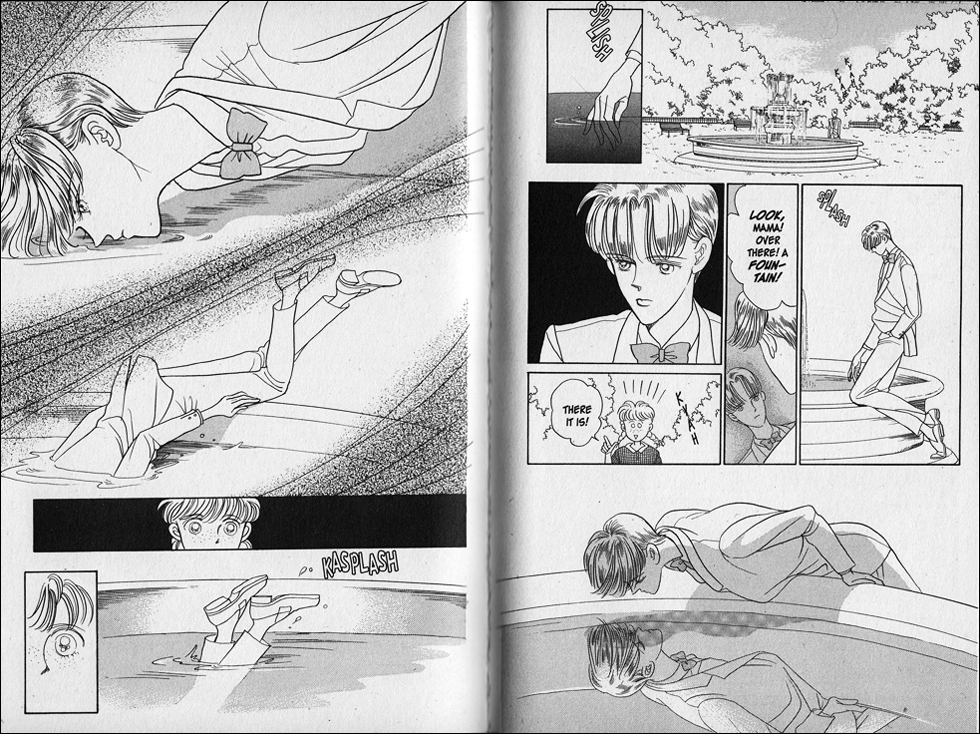
(read right-to-left | click images to enlarge)

As it turns out, “Jimmy” is actually an alien mermaid named Benjamin, still in a sort of genderless larval form. Though, by day, he looks like a pre-adolescent boy in a suit and bow tie, moonlight transforms him into a beautiful (female) mermaid with long, flowing hair and soulful eyes and the inability to speak when it counts. We soon learn that these mermaids, scattered all across the universe, return to earth every six hundred years or so to spawn a new generation. We also learn that Jimmy/Benjamin is a descendant of the actual “Little Mermaid,” and that her entire clan is dedicated to making sure that Benjamin, unlike her mother, will appropriately mate with a merman instead of falling for a human, thereby thwarting a prophesied environmental catastrophe certain to wipe out their entire population.

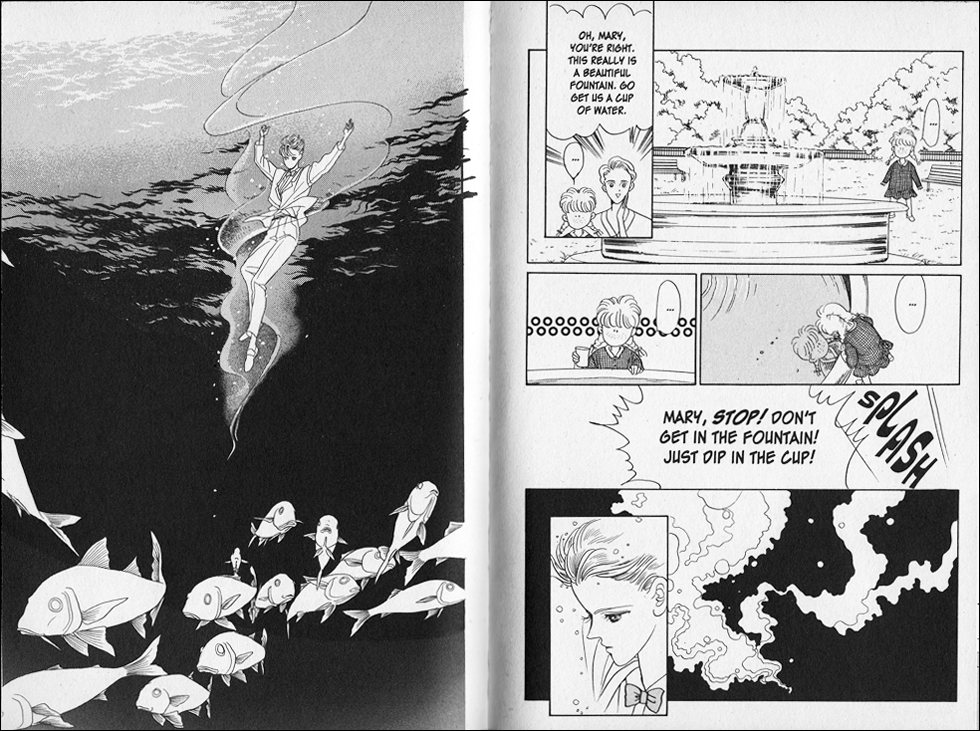
(read right-to-left | click images to enlarge)

Complicating matters further, Benjamin is left to the care of her two siblings, Teruto and Seth, who have long been instructed that their purpose in life is to see that Benjamin matures into an egg-bearing female and mates properly, at which point they will merely dissolve into foam.

Seeing that Benjamin may potentially defy her duty by falling for the human, Art, her siblings battle (not quite successfully) the desire to remove her from the picture so that one of them can properly take her place.

MICHELLE: But the siblings are unable to actually do anything to Benjamin themselves, so Teruto, the more active of the pair, strikes a deal with the same witch who brokered his mother’s bargain to become human, and ends up possessing Gil Owen, the heir to an influential investment group, which results in the story being all about Chernobyl and Gil’s exceedingly convoluted plans (I am not even sure about this) to get Art to come to Kiev and then drive him so insane with the belief that Benjamin will destroy the world that he kills her. From a story that starts off about mermaids it really is entirely, as Shaenen Garrity wrote, all about water pollution.

MJ: Though there are numerous details we’ve declined to mention so far, as you can see, the series’ plot is fairly… esoteric. Furthermore, as I mentioned in the beginning, the series is problematic on a number of levels, including the visual age gap between “Jimmy”‘s usual form and that of his romantic prospects (Art, of course, and a merman named Shonach who is captivated by Benjamin’s beauty), his cheerful acceptance of Art’s physical abuse, and the highly unfortunate depiction of the mer-people’s prophet, Grandma, as a cross between a minstrel show caricature and a woman from the Burmese Kayan Lahwi tribe. (Click if you really want to know.)

But amidst all the crazy plotting, questionable characterization, and possible racism, there is a poignance and a unique beauty to this manga that is difficult to fully convey, though we’ll certainly do our best. And I hate to jump right to the ending, but I’ll admit that the series’ final volume—which provides two different possible endings, without making it fully clear which one is real—pretty much redeemed all its faults for me in one go. How often does that happen?

MICHELLE: The ending is very interesting, indeed! I will say, though, that leading up to it is a lot of stuff that doesn’t make a lot of sense, and for me, once you’ve reached the critical mass for “wtf” it spills over into “whatever,” so there were certain aspects of the conclusion that didn’t affect me as much as they might’ve, though there were a few subplots I liked very much.

MJ: I have a feeling there will end up being a bit of a divide here between us at some points—not because I think things necessarily made sense, but because that doesn’t matter nearly as much to me as it does to you. But I expect the conversation will be lively! So, why don’t we start off with some of the things we most liked, and then move on to the rest later? Where would you like to begin?

MICHELLE: With the twins. Really, I thought they were the most interesting aspect of the story, much more so than crybaby Benjamin who beguiles men purely on the basis of being lovely. I sympathized a lot with Teruto, who was bitter at having sullied his soul to provide for his gentler siblings and was to be rewarded for all that he had done with dissolving into foam. I also really enjoyed Seth’s journey, as after Teruto embarks on his plot for revenge he is given a chance to spread his wings and become more independent. I rooted for his relationship with Shonach from the start and enjoyed just about everything involving them up until the final volume. I didn’t care about Jimmy/Benjamin and her love for Art nearly as much.

MJ: I think I’m sort of half with you and half not. I absolutely agree with you about how fascinating the twins are, and I love the fact that though Teruto is, ultimately, the villain of the story, he’s also one of the most relatable characters by far. It’s pretty much impossible not to understand his resentment over his fate, which seems tragically unjust, and his devotion to Seth is quite moving. Seth’s journey, as you say, is also one of the most interesting aspects of the series, and he ends up being the character we care most about in the end.

On the other hand, I’m not quite with you on either the Seth/Shonach relationship or your feelings about Benjamin/Jimmy. I have to admit that I kind of hate Shonach. Probably he doesn’t deserve it—I realize that—but it really bothers me that his obsession with Benjamin’s beauty (her beauty only—he doesn’t care about her as a person at all, really) keeps him from being able to appreciate the best parts of Seth, to the point that even at the end, when Seth has matured into a female, he can only see her as Benjamin. That the only expression of true affection Seth ever really gets from Shonach is when he believes she is Benjamin really breaks my heart.

(read right-to-left | click images to enlarge)

Also, I admit I really do care about Jimmy/Benjamin, and I see her as being wronged pretty much throughout the story. She’s not responsible for her pre-destined role as this super-important mermaid who holds the fate of her race in her hands any more than Teruto or Seth are responsible for their pre-determined futures as bubbles of foam. Benjamin doesn’t want to mesmerize men with her beauty. If anything, she wants to be able to live indefinitely as Jimmy, so that she can preserve the relationship she (inexplicably) treasures with Art. But with everyone tugging at her fate from every side, what she’s got is a lot of unwanted attention from Shonach (for all the wrong reasons), a deteriorating relationship with Art (who is incapable of accepting her as an adult woman), and everyone and their mom out to kill or ruin her in one way or another. If I were Benjamin, I’d cry too!

MICHELLE: You know, it never occurred to me that Shonach was to blame for his fixation on Benjamin, but you’re absolutely right in terms of the limits of his feelings and how that blinded him to Seth most of the time. And yeah, I know that Benjamin doesn’t mean to mesmerize men, but… maybe Teruto’s plight just resonated with me extra strongly for various personal reasons, and so I came to regard her much like he does. I certainly didn’t feel this way about her in the beginning!

Also, I think I could’ve liked Benjamin more if I had really seen what she saw in Art, but because I couldn’t it affected the way I perceived her feelings for him. Of course, one can have genuine feelings for shitty people, but I got so irked at various times that my capacity for being thoughtful was impacted. It didn’t help that she—incapable, as Teruto pointed out, of doing anything for herself—eventually seemed to be trying to ruin Art so that he would kill her.

MJ: I can definitely agree that it’s really difficult to understand what Benjamin sees in Art. For my own various personal reasons (heh) I can understand her desire to help him rise up out of his professional slump so that he can regain his self-esteem, and he also proves his devotion to her in many ways throughout the course of the series, and I can see why she’d desire that, especially from someone outside the mer-world where she’s valued only as a sort of angel/demon icon. But it’s so difficult for me to swallow his abusive tendencies, that my view of him is ultimately pretty negative.

On a different note, one of the characters I ended up liking most by the end was Holly, who I’d hated early on for her manipulation of Art and her cruelty towards Jimmy. I was actually pretty surprised that I could end up liking her as much as I did, given where we started. But by the end, she was one of the few likable characters left.

MICHELLE: Speaking of Art’s profession, I did wonder whether the parts where we actually see him performing were among your favorites!

I never entirely warmed to Holly, but it did seem that concern over her brother’s fate—he’s in Colombia when an earthquake strikes—tempered her bitchy tendencies in a major way, and she was actually pretty horrified by what Gil was attempting to do, and much more attuned to there being something really wrong than Art, who was basically like, “I’m responsible for my sponsor’s injury so I will do whatever he says, especially if that happens to be touring a nuclear facility.”

Another unexpectedly fun character is Gil’s personal secretary, Rita. I admit, she’s quite a favorite for me. Tall, large, and unlovely, Rita harbors a crush on Gil even before Teruto takes possession of his (secretly terminally ill) body. When Teruto realizes her psychic gifts can amplify his own powers, he makes her his right-hand woman, and quells her questions with sex. I was disappointed that she turned out to be crazy, but her bizarre actions did help ratchet up the tension.

MJ: I loved Rita! I hate that she’s easily manipulated by her interest in Gil, but I can understand it, and really it only made me feel more indignant on her behalf. I suppose I, too, was disappointed that she turned out to be crazy in the end, but she wasn’t any crazier than Teruto/Gil by that point, so I was still rooting for her on some level. I kept sort of hoping she would ultimately prevail, but I’m not even sure what that would have meant. I am sad that she never got to see how her crush on the real Gil might have played out. I suppose she would have had little chance (even if he wasn’t dying) but I really hated the way she was treated by Gil’s overprotective sister, and I would have loved for the sister to have been proven wrong for real. You know. Not just because her brother’s body got taken over by the soul of a vengeful alien mermaid.

And to answer your earlier question, yes I really did love the parts where we saw Art actually performing! I loved all the ballet stuff, actually, including the bits with Artem Zaikov, the Russian dancer who (for his own personal reasons—I guess we shouldn’t spoil everything) has it in for Art, but who ultimately won my heart by way of his charming family.

MICHELLE: Characters who look like Rita are so rare in manga that I think it’s utterly natural to root for them and hope they will prevail. Which… I suppose in a way she did, but not in a way that made her feel any better about herself.

And I was just going to ask you about Artem! When Gil was first introduced, I thought, “Wait, who is this guy?” It soon became clear what his story was, however. Shimizu duplicates this feat near the end, with Artem’s introduction providing another “Wait, who is this guy?” moment that eventually proves pivotal to the climax of the series. I really liked him, and was especially impressed by the way his dancing was drawn—I swear, Shimizu was able to perfectly capture the ways in which his style differs from Art’s.

(read right-to-left | click images to enlarge)

MJ: Yes, she really does! I feel pretty strongly that Shimizu must be a real ballet fan. Okay, I’m going to end up spoiling things after all, here, but it seems likely to me that she based Art and Artem’s mutual father, “Rimsky” on the legendary Russian dancer Vaslav Nijinsky (despite entirely glossing over his sexuality), right down to the mental illness that ultimately ended his career, and she passed down some of his defining characteristics to Artem.

Among other things, Nijinsky was known for his sensuality and androgynous appearance onstage, which is exactly how she characterizes Artem. There’s a little Nureyev in there, too (which is more appropriate to the time period), but I feel like her real interest is Nijinsky. And despite Artem’s claim that it’s Art who is “the reincarnation of Rimsky,” it’s Artem who most resembles what we know of Nijinsky, body type notwithstanding (Nijinsky was kinda stocky).

Vaslav Nijinsky in Le Spectre de la Rose E. O. Hoppé, 1911

MICHELLE: Check out MJwith the ballet knowledge!

I think Shimizu likes the idea of parental characteristics being split between siblings. Rimsky’s look and style are passed down to Artem, but his must-kill-love-interest-she-is-dangerous traits are passed to Art. Meanwhile, Seira’s love for the human prince is inherited by Benjamin, while her love for her original mer-person fiancé is embodied in Seth.

MJ: Oh, what a smart observation, Michelle! I hadn’t thought of that, but you’re absolutely right. With that in mind, it becomes even easier to understand Teruto’s tragedy. He’s the only one of Seira’s offspring to receive basically nothing from her. I think one of the most poignant moments in the series is the flashback in which Teruto overhears one of their caretakers talking about the fact that it’s really only Benjamin and Seth who are priorities, because Teruto is (essentially) barren. And since these mermaids seem to be valued only for their ability to bear eggs, they might as well be saying that Teruto has no soul. It’s that devastating.

MICHELLE: You can’t see me, but I am nodding emphatically. Teruto’s entire purpose is to protect the other two; he’s not destined to have any future of his own. Really, though, none of the mer-people are, as we learn late in the series (and I can’t tell if this was planned all along or what) that they will all die shortly after spawning. I feel like Shimizu could’ve emphasized the biological imperative a bit more—early on, there are many comparisons to fish, along with visuals of the spacefishies returning to Earth, but at the time we didn’t know that this would also be their final journey. Though, I guess if I were really up on my ichthyology, I might’ve expected it.

MJ: Mostly, I feel that revealing this late in the story was really effective. I thought it was kind of a brilliant way to suddenly change the reader’s perspective and it’s interesting, too, because it simultaneously makes things seem both more and less urgent, in terms of the relationship issues we’ve been following the entire way through. But since we’ve managed to stumble on one of the areas where you feel Shimizu fell down a little, let’s steer our way in that direction. I’m sure you’ve been bursting all along with the need to scream, “BUT IT DOESN’T MAKE SENSE!” Am I right?

MICHELLE: Not exactly bursting, and (perhaps surprisingly) not at all over the general concept itself. Once something crosses that surreal threshold, it becomes easier to accept whatever kooky setup the creator wishes to explore. But certain particulars of the plot did bug me, like “Why do these guys love Benjamin?” or, most significantly, “How does Teruto/Gil doing all this stuff accomplish his goal of having Seth turn into a female and bear eggs?”

MJ: Well, I think the first question we pretty much have to chalk up to Benjamin’s physical allure, which is made out to be pretty spectacular in a very specific, fantasy-driven way. Benjamin is drawn as a classic fairy-tale princess, all wide eyes and golden, billowing hair—a stark contrast to all the sleek, modern women in the series, like Holly. I think we’re supposed to pretty much take it as a given that all men are helpless in the face of that kind of beauty.

The only reaction that is a bit more complicated is Art’s, since he’s more attached to the (in his mind) sexually null Jimmy. By the way, am I the only one who noticed that Jimmy seems to get younger and younger as the series goes on? At first it really bothered me, but after a while I started to think that Benjamin might be achieving that by pure strength of will, in her ongoing effort to try as hard as possible to be what Art most wanted her to be— almost like some kind of automatic defense mechanism. Like a chameleon.

Regarding Teruto/Gil… well, I think it becomes pretty clear after a while that Teruto is much more driven by his need to destroy Benjamin than he is by his desire to put Seth in her place. I mean, the idea is supposed to be that if Benjamin dies, Seth will be the next in line to mature into a female. But it certainly seems like this could have been accomplished much more easily by other means. Somehow.

MICHELLE: Yeah, I don’t think Chernobyl needed to blow up in order for Benjamin to die. A suggestion to Rita would’ve done the trick, I’m sure.

I’m glad you mentioned that about Jimmy, because I definitely noticed it, too! There’s one scene in volume three (pages 86-87) where her size is extremely variable. Sometimes he looks more five than twelve! I wondered if it was intentional on Jimmy’s part, but Art doesn’t react at all, so I suspect it’s a Shimizu issue.

(click image to enlarge)

MJ: And when we first see Jimmy, she looks pretty much exactly the same as Teruto and Seth do later on, which is to say maybe mid-to-late teens. Originally, I thought maybe Shimizu changed her mind about Jimmy’s visual age to avoid dealing with any issues regarding Jimmy’s sexuality except when she appears as Benjamin, and maybe to avoid Art having to be confronted by that as well. But I was never really sure.

MICHELLE: Yeah, me neither. Probably “never really sure” is just a state of mind one has to become accustomed to with Shimizu’s works.

Alas, no others have been licensed in English and aren’t likely to be now that CMX has disappeared. (Please bow your heads for a moment of silence.) I have thirteen volumes of Princesse Kaguya in French waiting to be read, though, and her josei series Top Secret is also coming out en Français.

MJ: I really would like the opportunity to read more of her work. As weird as Moon Child is, it feels really… I don’t know… organic. And I think Shimizu’s omake sections are actually really telling, here. I don’t always read these, but I poked through a few of hers, and my immediate impression was, “Oooooh, this is what it’s like in her mind all the time.”

MICHELLE: Yeah, those are really kooky! The two robot characters who feature in the omake, Jack and Elena, star in a string of stories by Shimizu, beginning with Milky Way, so they’d be familiar to her regular readers. It makes me wonder if, in some subsequent series, there might be similar omake starring the cast of Moon Child!

MJ: So, before we wrap up, I just want to gush a little bit about Shimizu’s artwork. You know I’m a huge fan of shoujo from this era, and really, there could be no better example of why that is. I chose a scene from this series back on our Let’s Get Visual column Celebrating the Pretty, and seriously that is still one of my favorite sequences of all time.

(read right-to-left | click images to enlarge)

Yet, I’m leafing through the books now, and page after page, I’m seeing visuals that just pretty much blow me away with their haunting beauty, like the dream tidal wave in volume seven, or the creepy, creepy fish inquisition in volume eight. In many ways, it’s the series’ weirdness that makes it work so well for me, visually, because it’s so well-suited to Shimizu’s artistic mind.


MICHELLE: That wave! Here’s what I wrote about it in my notes: “A… very trippy sequence with a wave ensues.” There are many strange and lovely sequences in the book.. I was disappointed that we saw less and less of the fishy manifestations as the series went on, but I believe that’s tied in to Benjamin’s form stabilizing as she matured. I also really liked the exquisitely detailed line drawings that frequently appear in between chapters.


Another thing that impressed me was Seth’s female form, who was so very beautiful—more than Benjamin, even—and entirely feminine, and yet everything about her mannerisms still made it clear that she is Seth. She actually appears on the cover before she appears in the manga, and I blinked for a second in puzzlement and then got geekbumps when I figured out who it was.

MJ: Oh, you’re absolutely right! Honestly, I felt chills through the entire scene in which Seth finally transforms. Not only is she so completely, utterly Seth, but the way Shimizu reveals the transformation, in rapid, chaotic spurts, just as Seth must be experiencing it, is absolutely stunning.


MICHELLE: I just got geekbumps again thinking about it. Although I admit, I have to squash the logical part of my brain that’s demanding to know how she and Shonach did the deed when she was in her neither male nor female state.

MJ: I feel that adolescent mermaid sex is one of those things we’re just better off not really thinking about.

MICHELLE: I cannot help but concur.

MJ: You don’t know this yet, but I’ve been going pretty much crazy here with scanning in artwork. There’s just so much I want to share with our readers. I know that Moon Child is in many ways a great big mess, but honestly this is the kind of series I most long to see more of in English. It’s just so beautiful and so unique. There are a lot of current shoujo series that I love very much, but it’s this stuff that I really hunger for as a reader. It’s something I can’t get in any other medium. Not like this.

MICHELLE: I wish I could be hopeful that we’ll see more manga like this in the future, but taking chances in this business doesn’t seem to pay. Every series has its faults, and Moon Child is not an exception, but that doesn’t mean I’m not infinitely grateful to CMX for making it possible for us to read it.

MJ: I most certainly am. And yes, I know that historically these series have not been strong sellers. I guess all we can really do is to continue to write columns like this, in hopes of getting more readers interested in the kind of manga we wish we could see more of.


More full-series discussions with MJ & Michelle:

Fullmetal Alchemist | Paradise Kiss | The “Color of…” Trilogy | One Thousand and One Nights| Please Save My Earth
Princess Knight | Fruits Basket | Wild Adapter (with guest David Welsh)

Full-series multi-guest roundtables: Hikaru no Go | Banana Fish | Gerard & Jacques | Flower of Life

Filed Under: OFF THE SHELF Tagged With: moon child

Pick of the Week: Dororo, Kurosagi

March 26, 2012 by MJ, Michelle Smith and Sean Gaffney 4 Comments

It’s a slower week at Midtown Comics, but MJ, Michelle, and Sean have no trouble making their picks. See below!


MJ: Though I know I need to be reading Kurosagi Corpse Delivery Service (Help me out here, Dark Horse, would ya? I need some digital action on this title. ETA: My apologies to Dark Horse, I’ve been informed they do have this on their iPad app—don’t know how I missed it!) my thoughts this week are all Dororo all the time. I fell in love with this title back when I was still scared to approach Tezuka and nothing could make me happier than to see it get an omnibus release. This is a fairly creepy, action-packed title, but what really drew me in is how freaking moving it is, which was absolutely not what I expected at the time. If you missed this title when it was first released, don’t miss it again. It’s a must-read for any manga fan.

MICHELLE: I’ll chime in to second the Dororo recommendation, and probably for similar reasons: most Tezuka available prior to Dororo daunted me with its Importance, but this shounen adventure story was completely approachable, and therefore a perfect introduction to Tezuka’s oeuvre. I’m happy to see it get a new release!

SEAN: Gosh, what could my pick be? Ahem. My pick this week is the 12th volume of Dark Horse’s horror manga The Kurosagi Corpse Delivery Service. As with most horror manga I read, there’s another reason besides ‘scares’, and that’s the cast. Everyone in this cast is appealing, even the characters with less depth, and they all have a great sense of humor, something needed when you are dealing with corpses all the time. That said, there are a lot of graphically unsettling images in this series as well. It’s not a wacky horror comedy, it’s a wry horror manga with occasional funny lines. As you may have gathered by the fact that it’s been 18 months since the last volume, this is not as best-selling as Gantz or Berserk. Let’s change that, it deserves more love.


Readers, what looks good to you this week?

Filed Under: PICK OF THE WEEK Tagged With: dororo, kurosagi corpse delivery service

BL Bookrack: March 2012

March 22, 2012 by MJ and Michelle Smith 13 Comments

Welcome to the March installment of BL Bookrack! This month, MJand Michelle take a look at two debut volumes from the Digital Manga Guild, Tweeting Love Birds and You & Tonight. In Brief: About Love from Digital Manga Publishing’s Juné imprint, and volume one of My Darling Kitten Hair from JManga.


Tweeting Love Birds, Vol. 1 (Kindle) | By Kotetsuko Yamamoto | Digital Manga Guild | Rated YA (16+) – Thanks to a back cover summary that made one of the characters sound intensely annoying, I wasn’t expecting much from Tweeting Love Birds. I ended up being pleasantly surprised, but that’s not to say that the book is riveting or unique.

Daisuki Ohtaka started playing baseball because his grandfather was a fan, and even goes so far as to enroll in his grandpa’s alma mater. He doesn’t seem to have much personal love of the game, however, and once he arrives and discovers the shabby state of the team, he immediately wants to leave. After the small and cute captain, Suzume Morino (aka “Tweetie,” a nickname derived from the fact that his name means “sparrow”), blackmails Daisuke (whom he promptly christens “Taka”) into staying, he finds himself becoming more intrigued by Tweetie and experiencing jealousy when others give him attention, even while maintaining that he is straight.

Yes, this might be another “only gay for you” story, but so far it’s kind of charming. It has a slice-of-life feel that I appreciate, with any baseball action firmly in the background, and sometimes it’s even funny. I snickered out loud, for example, when a drunk Tweetie proclaims, “Taka touched my boobies.” There’s nothing much original about the plot or its execution, but neither is there anything glaringly offensive. The adaptation by DMG group Boys’ Love Bang Bang is also flawless, with no errors or awkwardness to detract from one’s reading experience.

I’m a little surprised that Yamamoto-sensei was able to squeeze enough material out of this setup for a second volume, but there is indeed one more installment to go before the series is complete. Despite first impressions, I’ll be coming back for more.

– Review by Michelle Smith


You and Tonight, Vol. 1 (Kindle) | By Keiko Kinoshita | Digital Manga Guild | Rated YA (16+) – Rikuro has spent ten long years hiding his feelings for his straight best friend, Yasutaka, only to discover that Yasutaka gave in and slept with a male coworker after he begged and cried. Though the news gives him sudden hope, it also makes him begin to panic that his time is running out. But can his friendship with Yasutaka really survive the truth?

I’ve developed a bit of a love affair with Keiko Kinoshita’s work as of late, and this series has only deepened my feelings. Written in the same vein as her earlier two-volume series Kiss Blue, You and Tonight is a thoughtful, quiet manga about the delicate balance between love and friendship, and how two lifelong friends deal with the complications that arise when that balance is disturbed. Also like Kiss Blue, You and Tonight lets its characters process this sloooowly, which is one of the things that makes Kinoshita’s romance work so well. She isn’t afraid to let her characters wallow in uncertainty, and she certainly takes her time, but there’s never a sense that the story is dragging. On the contrary, there is tension in each moment, even the quietest ones.

Kinoshita’s artwork has always been on the understated side, but her expressiveness really shines here in this volume. She makes the most of her characters’ body language and subtle facial cues, working as much emotion into them as she does into her equally understated dialogue. Both Rikuro and Yasutaka process most everything on the inside, making their moments of visible weakness even more powerful. A single panel of Rikuro breaking down, alone in an elevator, springs immediately to mind. It’s an image that’s stuck with me for days after reading this volume. Digital Manga Guild localizing group Cynical Pink does a lovely job, too, providing a clean, lyrical adaptation that suits Kinoshita’s tone perfectly.

For fans of Keiko Kinoshita, this series is a must-read. For everyone else… it’s a must-read too. Highly recommended.

– Review by MJ


In Brief:

About Love (Kindle) | By Narise Konohara | Digital Manga Publishing/Juné | Rated YA (16+) – I’m late to the party on this title, and I can only say that with the deepest regret. With its complicated characters and slow-building romance, About Love is absolutely my type of BL. Mangaka Narise Konohara weaves an unlikely love story between two seemingly unremarkable characters—a fresh-faced newlywed and the insecure young wedding planner who discovers the truth behind his smile—and she does it with the utmost subtlety and care. From its expressive, melancholy cover to the very last page, About Love is thoughtful, moody, and stunningly poignant. The only downside is that this title is not yet available digitally, but if any recent BL title is worth the shelf space, this is it. Highly recommended. – MJ

My Darling Kitten Hair, Vol. 1 | By Haruko Kumota | JManga/Libre Publishing | Rated Mature – This title came to my attention by way of JManga’s ABC of BL/yaoi and I could not be more grateful for the introduction. This adorable manga follows the romance between a slovenly young writer and his salaryman boyfriend who has just come to live with him (in a charming, Maison Ikkoku-like setting) after maintaining a rather chaste, long-distance relationship for six years. It’s not often we see a romance manga that begins in the middle of the relationship, and even less often that the main pairing is surrounded by convincingly queer characters who feel authentic as part of the story and not just as glorified set pieces. Even more encouraging, the series is still ongoing in Japan, which means there is some hope of us having a good, long time with it. Honestly surprising and highly recommended. – MJ


Some review copies provided by the publishers.

Disclosure: MJ is currently under contract with Digital Manga Publishing’s Digital Manga Guild, as necessitated for her ongoing report Inside the DMG. Any compensation earned by MJin her role as an editor with the DMG will be donated to the Comic Book Legal Defense Fund.

Other recent BL reviews at Manga Bookshelf: Ata (Digital Manga Guild)

Filed Under: BL BOOKRACK Tagged With: about love, my darling kitten hair, tweeting love birds, you & tonight

Bookshelf Briefs 3/19/12

March 19, 2012 by Katherine Dacey, Michelle Smith and Sean Gaffney Leave a Comment

This week, Kate, Michelle, & Sean take a look at recent releases from Yen Press, VIZ Media, Seven Seas, and Kodansha Comics.


13th Boy, Vol. 11 | By SangEun Lee | Yen Press – Reviewing the penultimate volume of a series is always a challenge. Divulge too little, and long-time readers might wonder if the story is building to a satisfying conclusion; divulge too much and incur the wrath of the Spoiler Police. I’ll try to find a middle ground here by saying that SangEun Lee uses volume eleven to explore the relationship between Whie-Young and Hee-So in greater depth — a relationship that may come at a price too great for Whie-Young, Hee-So, and the long-suffering Beatrice, who owes his existence to Whie-Young’s magic. The major plot developments of volume eleven are related with Lee’s customary mix of slapstick humor and sentiment; few writers can tack between the two extremes with such grace as Lee, who uses those sudden tonal shifts to underscore her characters’ emotional volatility. I have no idea if the story will turn out the way I want it to, but I’m confident that whatever happens in volume twelve will feel like the right outcome for this odd, magical manhwa. -Katherine Dacey

Ai Ore!, Vol. 4 | By Mayu Shinjo | VIZ Media – This is the point in the series where Mayu Shinjo had her big falling out with Shogakukan, and as a consequence Ai Ore! moved to Kadokawa Shoten, starting to serialize in their magazine Asuka. Asuka not being nearly as porn-oriented as Shoujo Comic can get, there’s a definite change in mood. Akira has continued his slide towards being less horrible, which is a good thing. His relationship with Mizuki has also gotten far more chaste – they’re back to hand-holding. In its defense, the humor is just as sharp as prior volumes, and the best parts show a mangaka not taking anything seriously. (Mizuki in a cage will make you boggle.) On the down side, Mizuki continues to be the weak part of this series, even needing to be rescued here. But then, by now no one is reading the series for Mizuki anyway. Still sort of recommended-ish.-Sean Gaffney

A Certain Scientific Railgun, Vol. 3 | By Kazuma Kamachi and Motoi Fuyukawa | Seven Seas – First off, we get the end of the battle between Misaki and Harumi, and it’s as brutal as you’d imagine. The backstory given is heartbreaking, especially since it involves children, and one hopes that this is not the last we see of it. Railgun is at its best doing serious and exciting action sequences – both with this and with the flashback showing a younger Kuroko in training – and given this is the majority of this volume, that makes it easily the best volume to date. Especially given the suggestion of more to Misaki’s destiny than she’s likely to be comfortable with. (Uiharu is also fantastic, lest I forget her.) I still think Kuroko is at her best when nowhere near Misaki, but that’s a minor point by now. Great action packed thriller manga.-Sean Gaffney

Mardock Scramble, Vol. 3 | Created by Tow Ubakata, Manga by Yoshitoki Oima | Kodansha Comics – If you asked me to summarize my response to volume three of Mardock Scramble, my one-word answer would be “grim.” (My two-word response: “really grim.”) Rune Balot plays cat-and-mouse with four of Boiled’s henchmen, dispatching each with gory zest. Though the plot flirts with moral complexity in later scenes — Balot seems to be enjoying her new-found powers in unexpected ways — that ambiguity feels unearned; Balot is such a flat, affectless character that her transformation feels too abrupt to be genuinely persuasive. A few startling images breathe life into the action scenes, but on the whole, volume three is so relentlessly brutal that few readers will want to continue with the series. -Katherine Dacey

Nabari No Ou, Vol. 9 | By Yuhki Kamatani | Published by Yen Press – Sometimes a volume of manga is good simply because it furnishes one with long-sought-after information. Volume nine of Nabari No Ou is just such a case, as it focuses primarily on Yukimi’s efforts to find out more about Yoite’s past. The momentum of the story is such that I was untroubled by that feeling I sometimes get with this series that it never quite manages to coalesce, and just simply enjoyed the revelations as they came. I still really don’t care about the search for five scrolls of secret ninja arts, but there are some good character moments in this volume that exemplify why I keep reading the series. The final pages are especially nice. Also, what I thought was going to be a depressing encounter with a malnourished kitten turned out to have a happy outcome. So, bonus points for that. – Michelle Smith

Rin-Ne, Vol. 8 | By Rumiko Takahashi | VIZ Media – By now readers should know that this is a manga where plot developments, if they happen at all, happen on a glacial scale. Shoujo writers, when they semi-retire, seem to gravitate to family stories in josei magazines for housewives. Takahashi seems to prefer going back to her roots, as this volume is filled with comedic one-to-two parters regarding Rinne and Sakura and their wacky soul-reaping adventures. We do get a longer arc involving Shoma, a young brat in the best Takahashi tradition (hi, Jariten), and this gets briefly serious when genuine innocent souls appear to be headed to hell. But for the most part, this manga is as calm and placid as its heroine, and is for fans who have read Takahashi for so long that they really have to keep reading her.-Sean Gaffney

Soul Eater, Vol. 8 | By Atsushi Ohkubo | Yen Press – It needs to be said right off the bat – if you hate snakes, or hate mental violation of children, do not read this volume of Soul Eater. Medusa’s takeover of Rachel is easily the most creepy and disturbing scene we have seen in the entire manga to date, and may honestly give nightmares. That said, Medusa and Arachnae’s confrontation is top-notch, and makes you want to see more of the two villains fighting for supremacy. Otherwise, it’s a fairly sedate volume of Soul Eater. Black*Star grows by tiny increments, and Crona discovers the warmth of friendship – very, very briefly. I’ve come to like this series for more than its art style, but it still leaves a weird feeling in your head as you read it – a sense that too much exposure might leave you ask insane as most of its characters. Recommended to those not easily squicked.-Sean Gaffney

Filed Under: Bookshelf Briefs Tagged With: 13th boy, a certain scientific railgun, Ai Ore!, mardock scramble, nabari no ou, rin-ne, Soul Eater

Pick of the Week: Boy, Bunny, & Bride

March 19, 2012 by MJ, Michelle Smith, Sean Gaffney and Katherine Dacey 1 Comment

There’s a wealth of new manga shipping in to Midtown Comics, including popular titles from Kodansha Comics, VIZ Media, and Seven Seas. But it’s Yen Press who manages a clean sweep of the Battle Robot’s picks this week.


MJ: This week is really brutal on the pocketbook, or at least it is on mine. I see several must-buys on the list, including the latest volumes of favorites like House of Five Leaves, Bunny Drop, Sailor Moon, and Pandora Hearts, none of which I’d be willing to miss. And A Bride’s Story, for heaven’s sake! I couldn’t possibly pass that up! But for my pick this week, I’ll continue on in my endless crusade for SangEun Lee’s supernatural romance manhwa 13th Boy. I’ve followed this series rabidly since the beginning, and now that we’ve reached its penultimate volume, I’m bursting with anticipation. Though the series’ romantic destination has been clear (to me, anyway) from the start, the journey has always been the point, and I’m dying to see how Lee plans to take us there. I wouldn’t miss it for the world.

MICHELLE: I’m in the same boat! I’ve touted both Sailor Moon and 13th Boy in the past, and love both with equal fervor. The tie-breaking factor, then, must come from how awesome the story is in each series at the present moment. Sailor Moon has just embarked on a new arc while 13th Boy is approaching its end, with all sorts of attendant drama. Put in that perspective, I think 13th Boy is the clear, “can’t miss” winner.

SEAN: I think we can all basically toss up a picture of Sailor Moon every time it comes out, and then say “in addition to this”. For me, my “in addition” is the 5th volume of Bunny Drop, the heartwarming josei manga about single parenthood. I’d noted when reviewing Volume 4 that I felt the series needed to shake things up a bit, and clearly Unita agreed with me – as the cover and back copy both note so no complaints – and so this volume timeskips ahead ten years to find Rin in high school, and Daikichi… well, just as single as he was. We’re going to have a whole new host of questions to wonder about and things to talk about. Hopefully this series can continue to keep the same high quality that has greeted us every time, even with this new development.

KATE: Tempting as those other titles are, my heart belongs to the third volume of A Bride’s Story. Kaoru Mori’s manga is awesome on many levels: it’s meticulously researched and meticulously drawn. It boasts a diverse, compelling cast of female characters who range in age from thirteen to seventy. And it has some of the funniest, weirdest omake of any series on the US market. (Seriously! Mori’s omake might be even better than Yellow Tanabe’s delightfully self-deprecating strips.) What really sold me on this title, however, is Mori’s ability to suggest the rhythm of daily life in nineteenth-century Central Asia; yes, the drama is compelling, but damned if I don’t find those chapters on weaving and bread-baking just as entertaining as the Big Confrontations.


Readers, what looks good to you this week?

Filed Under: PICK OF THE WEEK

Conspiracy 365: January – March by Gabrielle Lord

March 15, 2012 by Michelle Smith

For 2012, the three of us at Triple Take have decided to focus on YA fiction from Australia and New Zealand. First up is the first volume (January) of Gabrielle Lord’s Conspiracy 365 series, in which a teenage boy named Cal must survive attacks on his life for the next 365 days whilst investigating his father’s mysterious death. The publishing schedule was pretty nifty for this series, with the first twelve books (named after the months of the year) coming out throughout 2010 during the month reflected in their title. The thirteenth book in the series, Revenge, was published in Australia in October 2011, but hasn’t made it to the US yet.

Because I couldn’t read just one, please enjoy the first three books in the series, with more to follow!

Conspiracy 365: January
Fifteen-year-old Callum Ormond thought his father’s death six months ago was due to illness, but when a crazy-seeming figure (in requisite billowing black cloak) accosts him on New Year’s Eve and tells him his father was killed over something called “the Ormond Singularity,” he begins to wonder. Initially downplaying the warning that he himself should hide out for the next year, he is soon plagued by perils including: nearly drowning in a storm at sea, sharks, a sneaky uncle, foreclosure, fire bombs, kidnappers, criminals, and life as a fugitive. Aided by his friend Boges (no clue how to pronounce that), he tracks down some drawings his father made in his final days (which are reproduced in the book) and attempts to decipher their meaning, all while hiding out from the bad guys, the authorities, and his family.

It’s hard to really know what to say about January, since it’s almost entirely action. “Fast-paced but really kind of… empty” is a phrase from my notes that seems to sum it up best. That’s not to say I disliked it, because it was pretty entertaining. Okay, yes, already the repeated kidnappings are wearing thin, but it really does feel a bit like a 24 for teens, with Boges filling the role of Chloe to Cal’s Jack Bauer. This is aided by the way the story is written, noting the date and time for each first-person entry (though sometimes these occur during moments when one generally wouldn’t pause to describe what’s happening, like when trapped in the trunk of a car) and counting down the days until safety. The pages are numbered backwards, as well, which is a neat touch.

In addition, Cal seems like a pretty good kid. (You know you’re old when, instead of being fully swept away by the adventure, you’re thinking, “Aw, he’s thinking about how worried his mom must be. What a nice boy.”) I genuinely have no idea how he’s going to get out of the situation he finds himself in at the conclusion of this installment, but that’s okay because I have February right here!

Conspiracy 365: February
The basic plot of the February installment of Conspiracy 365 can be summed up as: Cal hides a lot, and also runs a lot. Perils faced by the teen fugitive include nearly drowning in a storm drain, nefarious people circulating recent pictures of him, and a freakin’ lion, which I thought was going to be the most eyeroll-inducing part of the book until the final pages saw him trapped on the tracks while the driver of an oncoming subway train frantically applies the brakes.

A teensy bit of progress is made toward solving the Ormond Riddle, as it appears that one of the drawings Cal’s dad made references the statue of an ancestor who died in the first World War. But that’s it. There’s no real change in Cal’s situation or his goals, unless you count the introduction of Winter Frey, ward of one of the guys out to get Cal. She proves useful, but may not be trustworthy.

Like January, this is a fast-paced and decently enjoyable read, eyerolling aside, but it’s difficult to find much of anything to say about it beyond that. I predict this will be the case for the next handful of volumes until some answers are actually forthcoming. I further predict that the answers will be rather lame, but I still intend to persevere.

Conspiracy 365: March
At first, I thought I was going to need the next batch of three installments immediately after finishing these, but now I’m ready for a break. It’s not that this series is bad, because it isn’t. But it is very repetitive, and the format enforces some implausible behavior on to the characters.

In support of the “repetitive” claim:
• In volume one, Callum has a wildlife encounter with a shark. He ends the volume in mortal peril.

• In volume two, Callum is rescued by a stranger, who becomes somewhat of an ally. Callum has a wildlife encounter with a lion. He ends the volume in mortal peril.

• In volume three, Callum is rescued by a stranger, who becomes somewhat of an ally. Callum has a wildlife encounter with a venomous snake. He ends the volume in mortal peril.

It’s probably not a good thing when your readers burst out laughing when the protagonist is bitten by a death adder! This makes me wonder what creatures will appear in later volumes. I am thinking there will be a bear. Are there bears in Australia? And there’s gotta be a dingo!

Regarding the implausible behavior… back in volume one, Callum discovered a slip of paper with two words on it, possibly the names of places in Ireland, where his dad discovered the details of this big family secret. Since that time, he’s been in internet cafés a number of times but only now, two months later, does it occur to him that he ought to look them up online. He also tries a couple of times to contact a former coworker of his father’s by calling the office, only to find the guy is out on sick leave. Why doesn’t he, say, find a phone book and try looking up the guy’s home number? Maybe we’ll have to wait until May for him to think of that.

More reviews of this series will follow eventually. In the meantime, feel free to make predictions for future wildlife encounters in the comments.

Additional reviews of Conspiracy 365: January can be found at Triple Take.

Filed Under: Books, Suspense, Triple Take, YA Tagged With: Gabrielle Lord

Pick of the Week: Twin Spica & Young Miss Holmes

March 12, 2012 by Sean Gaffney, MJ, Katherine Dacey and Michelle Smith 8 Comments

It’s an uneven week at Midtown Comics but the Battle Robot presents a nearly-united front on this week’s must-buy. See below!


SEAN: Well, there’s not quite as much going on with the list this week as there was last week. But we do get a final volume of a series I really enjoyed… and also tended to avoid. Twin Spica was very well written, emotional, and had wonderful character development, but I always kept putting off reading the volumes when I got them. Possibly as I knew they would be such an emotional wrench – the series is not depressing overall, but its lows can be quite low, and its highs always seem to be fleeting. But it has a fantastic likeable heroine in Asumi, and in the end I’m glad that Vertical took a chance on the series, even if it didn’t sell quite as well as hoped. In this final volume we’ll get to see who – if any – will be going to space. And whether Mr. Lion can finally find peace.

MJ: I’m definitely with Sean this week. Twin Spica has been a consistent high point over the past couple of years. It made my Best Of list with its debut in 2010, and has never once disappointed me over the entire course of its run. Twin Spica 12 is absolutely this week’s must-buy manga.

KATE: My votes also goes to Twin Spica, a series that hasn’t yet found the wide audience it so richly deserves. The artwork is clean and unfussy, yet very expressive; the characters are as interesting, complex, and contradictory as real people; and the science fiction elements are handled with skill and knowledge. (Anyone who’s read about the Mercury or Apollo programs will nod their head in recognition during the astronaut training sequences.) Kou Yaginuma even manages to introduce elements of magical realism into the story without compromising the serious tone. In short, Twin Spica is utterly heartfelt, speaking directly to adolescent fears and hopes, but is crafted with enough skill to sustain an adult’s interest. If you haven’t yet tried it, what are you waiting for?

MICHELLE: I concur on the Twin Spica front, though I’m lamentably behind in the series, but I am going to award my pick of the week to something that’s not on this list but which, according to Amazon, is coming out this week and that’s Young Miss Holmes, Casebook 1-2 from Seven Seas. I have a soft spot for mystery manga, and when you make it a seinen historical fiction mystery manga starring the niece of Sherlock Holmes, I surely cannot resist. I love that Seven Seas is packaging the series—now up to volume seven in Japan—in lovely two-volume chunks, as well!


Readers, what looks good to you this week?

Filed Under: PICK OF THE WEEK Tagged With: twin spica

  • « Go to Previous Page
  • Page 1
  • Interim pages omitted …
  • Page 127
  • Page 128
  • Page 129
  • Page 130
  • Page 131
  • Interim pages omitted …
  • Page 182
  • Go to Next Page »
 | Log in
Copyright © 2010 Manga Bookshelf | Powered by WordPress & the Genesis Framework