• Skip to primary navigation
  • Skip to main content
  • Skip to primary sidebar
  • Home
  • About Us
    • Privacy Policy
    • Comment Policy
    • Disclosures & Disclaimers
  • Resources
    • Links, Essays & Articles
    • Fandomology!
    • CLAMP Directory
    • BlogRoll
  • Features & Columns
    • 3 Things Thursday
    • Adventures in the Key of Shoujo
    • Bit & Blips (game reviews)
    • BL BOOKRACK
    • Bookshelf Briefs
    • Bringing the Drama
    • Comic Conversion
    • Fanservice Friday
    • Going Digital
    • It Came From the Sinosphere
    • License This!
    • Magazine no Mori
    • My Week in Manga
    • OFF THE SHELF
    • Not By Manga Alone
    • PICK OF THE WEEK
    • Subtitles & Sensibility
    • Weekly Shonen Jump Recaps
  • Manga Moveable Feast
    • MMF Full Archive
    • Yun Kouga
    • CLAMP
    • Shojo Beat
    • Osamu Tezuka
    • Sailor Moon
    • Fruits Basket
    • Takehiko Inoue
    • Wild Adapter
    • One Piece
    • After School Nightmare
    • Karakuri Odette
    • Paradise Kiss
    • The Color Trilogy
    • To Terra…
    • Sexy Voice & Robo
  • Browse by Author
    • Sean Gaffney
    • Anna Neatrour
    • Michelle Smith
    • Katherine Dacey
    • MJ
    • Brigid Alverson
    • Travis Anderson
    • Phillip Anthony
    • Derek Bown
    • Jaci Dahlvang
    • Angela Eastman
    • Erica Friedman
    • Sara K.
    • Megan Purdy
    • Emily Snodgrass
    • Nancy Thistlethwaite
    • Eva Volin
    • David Welsh
  • MB Blogs
    • A Case Suitable For Treatment
    • Experiments in Manga
    • MangaBlog
    • The Manga Critic
    • Manga Report
    • Soliloquy in Blue
    • Manga Curmudgeon (archive)

Manga Bookshelf

Discussion, Resources, Roundtables, & Reviews

Katherine Dacey

Neko Ramen, Vol. 1: Hey! Order Up!

June 2, 2010 by Katherine Dacey

If you’ve ever lived with a cat or dog, you know that no meal is complete without a pet hair garnish. Now imagine that your beloved companion actually prepared your meals instead of watching you eat them: what sort of unimaginable horrors might you encounter beyond the stray hair? That’s the starting point for Neko Ramen, a 4-koma manga about a cat whose big dream is to run a noodle shop, but author Kenji Sonishi quickly moves past hair balls and litter box jokes to mine a richer vein of humor, poking fun at his cat cook’s delusions of entrepreneurial grandeur.

Taisho is forever dreaming up ways to expand his business, ideas that seem sound in the abstract, but prove disastrous in the execution: a dessert ramen consisting of noodles and milk, a delivery service that’s thwarted by feline territoriality, a playing card promotion featuring unappetizing pictures of soup. In fact, Taisho is so completely misguided that he doesn’t grasp what’s novel about Neko Ramen; when a competitor in a cat costume opens a shop, hoping to capitalize on Taisho’s appearance on “The World’s Most Amazing Animals,” Taisho thinks he, too, needs an animal costume in order to drum up business. His sole customer, the long-suffering Tanaka-san, tries hard to offer sensible advice, but Tanaka’s counsel falls on deaf ears. (Why Tanaka sticks around for ramen that he freely admits is “awful” is one the series’ great mysteries.)

Sonishi’s artwork is crude and sketchy; each character is rendered with just enough lines to give a general impression of who or what he’s supposed to be. The primitive quality of the art actually works in the series’ favor, conveying the low-rent nature of Taisho’s business. More effective still is Sonishi’s strategy for differentiating Taisho from the other cats who regularly appear in the series: Taisho resembles a maneki neko (beckoning cat statue) in an apron, while other felines are depicted as simple, rounded shapes with ears and tails.

None of this would work if the translation were stiff or colorless, but TOKYOPOP wisely employed the husband-and-wife team of Emily Gordon and Kumail Nanjiani to adapt the script for English-speaking audiences. Both are experienced writers and performers (she wrote for Bust and Jane, he does stand-up comedy), and their ear for language is evident throughout volume one; the dialogue is idiomatic and the punchlines are snappy. The other secret to the script’s success is the care with which the adaptors distinguish Taisho’s voice from Tanaka’s, infusing the characters’ owner-customer banter the feeling of a good manzai routine, with Taisho as the boke and Tanaka as the tsukkomi.

The biggest surprise about Neko Ramen is that Sonishi manages to wring so many laughs out of what could be a one-joke premise. Sonishi’s gags remain fresh throughout the first volume, thanks, in part, to several interludes in which he abandons the 4-koma format to relate stories of Taisho’s past: his ill-fated stint as a cat model, his rivalry with a noodle shop staffed by a dog, a monkey, and a bird. These interludes nicely set the table for volume two, providing Sonishi more avenues for his absurd humor without straying too far from the series’ basic idea. Highly recommended, whether or not you fancy cats.

NEKO RAMEN, VOL. 1: HEY! ORDER UP! • BY KENJI SONISHI • TOKYOPOP • 156 pp. • RATING: TEEN (13+)

Filed Under: Manga Critic Tagged With: 4-koma, Tokyopop

Neko Ramen, Vol. 1: Hey! Order Up!

June 2, 2010 by Katherine Dacey

If you’ve ever lived with a cat or dog, you know that no meal is complete without a pet hair garnish. Now imagine that your beloved companion actually prepared your meals instead of watching you eat them: what sort of unimaginable horrors might you encounter beyond the stray hair? That’s the starting point for Neko Ramen, a 4-koma manga about a cat whose big dream is to run a noodle shop, but author Kenji Sonishi quickly moves past hair balls and litter box jokes to mine a richer vein of humor, poking fun at his cat cook’s delusions of entrepreneurial grandeur.

Taisho is forever dreaming up ways to expand his business, ideas that seem sound in the abstract, but prove disastrous in the execution: a dessert ramen consisting of noodles and milk, a delivery service that’s thwarted by feline territoriality, a playing card promotion featuring unappetizing pictures of soup. In fact, Taisho is so completely misguided that he doesn’t grasp what’s novel about Neko Ramen; when a competitor in a cat costume opens a shop, hoping to capitalize on Taisho’s appearance on “The World’s Most Amazing Animals,” Taisho thinks he, too, needs an animal costume in order to drum up business. His sole customer, the long-suffering Tanaka-san, tries hard to offer sensible advice, but Tanaka’s counsel falls on deaf ears. (Why Tanaka sticks around for ramen that he freely admits is “awful” is one the series’ great mysteries.)

Sonishi’s artwork is crude and sketchy; each character is rendered with just enough lines to give a general impression of who or what he’s supposed to be. The primitive quality of the art actually works in the series’ favor, conveying the low-rent nature of Taisho’s business. More effective still is Sonishi’s strategy for differentiating Taisho from the other cats who regularly appear in the series: Taisho resembles a maneki neko (beckoning cat statue) in an apron, while other felines are depicted as simple, rounded shapes with ears and tails.

None of this would work if the translation were stiff or colorless, but TOKYOPOP wisely employed the husband-and-wife team of Emily Gordon and Kumail Nanjiani to adapt the script for English-speaking audiences. Both are experienced writers and performers (she wrote for Bust and Jane, he does stand-up comedy), and their ear for language is evident throughout volume one; the dialogue is idiomatic and the punchlines are snappy. The other secret to the script’s success is the care with which the adaptors distinguish Taisho’s voice from Tanaka’s, infusing the characters’ owner-customer banter the feeling of a good manzai routine, with Taisho as the boke and Tanaka as the tsukkomi.

The biggest surprise about Neko Ramen is that Sonishi manages to wring so many laughs out of what could be a one-joke premise. Sonishi’s gags remain fresh throughout the first volume, thanks, in part, to several interludes in which he abandons the 4-koma format to relate stories of Taisho’s past: his ill-fated stint as a cat model, his rivalry with a noodle shop staffed by a dog, a monkey, and a bird. These interludes nicely set the table for volume two, providing Sonishi more avenues for his absurd humor without straying too far from the series’ basic idea. Highly recommended, whether or not you fancy cats.

NEKO RAMEN, VOL. 1: HEY! ORDER UP! • BY KENJI SONISHI • TOKYOPOP • 156 pp. • RATING: TEEN (13+)

Filed Under: Manga, Manga Critic, REVIEWS Tagged With: 4-koma, Cats, Comedy, Cooking and Food, Tokyopop

Library Wars: Love & War, Vol. 1

June 1, 2010 by Katherine Dacey

LibraryWars1If I were thirteen years old, Library Wars would be at the top of my Best Manga Ever list, as it reads like a catalog of the things I dug in my early teens: books about the future, books about women breaking into male professions, books with bickering leads who harbor secret feelings for each other. I can’t say that Library Wars works as well for me as an adult, but I can recommend it to younger female manga fans who are tired of stories about wallflowers, doormats, or fifteen-year-old girls whose primary objective is to nab a husband.
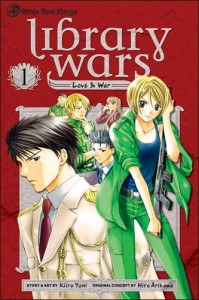
The story focuses on Iku Hasahara, a former track star and future librarian who enlists in the Library Defense Force (LDF), a paramilitary organization dedicated to combating censorship. Formed in response to the Media Betterment Act, the LDF actively challenges the national government’s efforts to remove books from stores and libraries, using weapons and strong-arm tactics when necessary. Iku is the only female recruit who can keep pace with the guys, push-up for push-up, and is the frequent target of abuse from Atsushi Dojo, a handsome drill sergeant who takes grim delight in pointing out her weaknesses. (Her mastery of the Japanese Decimal System leaves a lot to be desired.) As Iku advances through basic training, however, she begins to realize that Dojo isn’t so bad; his sometimes brusque demeanor masks genuine concern for his pupil, and a sincere desire to help her become a top-notch officer.

…

Read More

Filed Under: Manga Critic Tagged With: shojo, VIZ

Library Wars: Love & War, Vol. 1

June 1, 2010 by Katherine Dacey

If I were thirteen years old, Library Wars would be at the top of my Best Manga Ever list, as it reads like a catalog of the things I dug in my early teens: books about the future, books about women breaking into male professions, books with bickering leads who harbor secret feelings for each other. I can’t say that Library Wars works as well for me as an adult, but I can recommend it to younger female manga fans who are tired of stories about wallflowers, doormats, or fifteen-year-old girls whose primary objective is to nab a husband.

The story focuses on Iku Hasahara, a former track star and future librarian who enlists in the Library Defense Force (LDF), a paramilitary organization dedicated to combating censorship. Formed in response to the Media Betterment Act, the LDF actively challenges the national government’s efforts to remove books from stores and libraries, using weapons and strong-arm tactics when necessary. Iku is the only female recruit who can keep pace with the guys, push-up for push-up, and is the frequent target of abuse from Atsushi Dojo, a handsome drill sergeant who takes grim delight in pointing out her weaknesses. (Her mastery of the Japanese Decimal System leaves a lot to be desired.) As Iku advances through basic training, however, she begins to realize that Dojo isn’t so bad; his sometimes brusque demeanor masks genuine concern for his pupil, and a sincere desire to help her become a top-notch officer.

Library Wars‘ premise certainly invites comparisons with Fahrenheit 451. The future society depicted in Library Wars isn’t nearly as bleak or disorderly as the one Ray Bradbury imagined back in 1951, but creators Hiro Arakawa and Kiiro Yumi are just as insistent on the importance of standing up for free speech; Iku joined the Defense Forces after the Media Betterment Committee’s jack-booted thugs attempted to confiscate a book from her. (A hot guy also factored into her decision to enlist.) The MBC is as arbitrary and ruthless as the Firemen of Fahrenheit 451, working hard to restrict citizens’ access to potentially “harmful” materials, even going so far as to infiltrate libraries to weed out undesirable material.

In adapting Library Wars from novel to manga, however, Kiiro Yuki places less emphasis on the book-banning crisis and more on her characters’ relationships, preserving just enough background about the LDF’s history to justify the action sequences. That’s not necessarily a bad choice; Iku and Dojo’s banter has a pleasant, antagonistic zing to it that infuses the boot camp scenes with some playful energy. The LDF’s rationale for existing, however, often seems underdeveloped, as we don’t know what prompted the national government to pass the Betterment Act. In leaving these details vague, one could argue that Yuki is simply being true to historical fact; oppressive regimes from tsarist Russia to Maoist China have arbitrarily banned books and condemned authors in the interest of “the national welfare,” yet in the context of the Library Wars manga, that lack of specificity comes off as sloppiness. We don’t know whether censorship is having a real impact on citizens’ ability to say and think what they please; the few scenes in which we glimpse the MBC in action suggest that they’re more of a nuisance than a genuine threat to the social order.

The artwork is serviceable but not great. The character designs are about as basic as they get, with haircuts playing a pivotal role in establishing each cast member’s personality; we know Iku is a tomboy from her sensible and slightly androgynous bob, for example, while Dojo’s neat ‘do paints him as a hardcore military man. (By contrast, Sgt. Komaki, the series’ designated McDreamy character, has the kind of tousled locks that wouldn’t pass muster in the Marines.) The action scenes are hasty affairs, rendered with little respect for continuity or background detail, while the layouts often feel busy, with too many small panels and design elements hampering the visual flow.

If the censorship theme and artwork aren’t as well executed as I might have hoped, Library Wars earns high marks for having a smart, capable heroine and a smart, topical premise. Iku may not be a wonder woman, but she’s a plausible mixture of strength and uncertainty; teen girls will relate to her shifting moods, fierce temper, and high principles, even if they can’t agree whether she should end up with Dojo. And really, what’s not to like about a series that features hot guys who hate censorship but like books, libraries, and butt-kicking women? Now there’s a fantasy female readers of all ages can endorse.

LIBRARY WARS: LOVE & WAR, VOL. 1 • STORY & ART KIIRO YUMI, ORIGINAL CONCEPT BY HIRO ARAKAWA • VIZ • 200 pp. • RATING: OLDER TEEN (16+)

Filed Under: Manga, Manga Critic, REVIEWS Tagged With: Sci-Fi, shojo beat, VIZ

A, A’ and They Were Eleven

May 31, 2010 by Katherine Dacey

Though Vertical has published two series by Keiko Takemiya, the Magnificent 49ers’ work remains largely unavailable in English, with a few exceptions: Yasuko Aoike’s From Eroica With Love (which debuted in 1976 in Akita Shoten), and Moto Hagio’s short stories “A, A’ [A, A Prime],” “4/4 [Quatre/Quarts],” “X+Y,” and “They Were Eleven.”* These four stories comprise a mere 330 pages of material, but they offer readers a window into a key stage in shojo manga’s development, when women artists began pushing the medium in new directions, visually and thematically. Hagio’s work, like Takemiya’s, is unabashedly Romantic, filled with yearning characters who are struggling to uncover their true selves, even when that quest puts them at odds with societal norms. Though there is an intense, adolescent sensibility to some of her stories, that — for me, at least — is part of their beauty; Hagio clearly remembers what it feels like to be sixteen or eighteen, yet the way she frames those emotions is so exquisite and refined that the reader can appreciate her craft, even if the drama seems a little overripe from an adult perspective.

If you’ve been curious about what Takemiya’s peers were doing while she was writing To Terra and Song of the Wind and the Trees, or are wondering what to expect if you purchase Hagio’s A Drunken Dream this fall, read on.

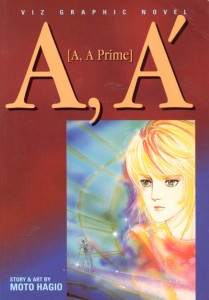
aa_coverA, A’ [A, A Prime]

This sometimes lyrical, sometimes bizarre anthology contains three interrelated stories. In the first, “A, A’, [A, A Prime],” a group of researchers struggle to accept Addy, a new team member who is, in fact, the clone of a colleague who perished several years earlier; in the second, “4/4 [Quatre/Quarts],” Mori, a telepath, becomes obsessed with Trill, a strange young woman who’s virtually mute; and in the third, “X+Y,” a now-older Mori falls in love with Tacto, an androgynous young man who resembles Trill. Addy, Trill, and Tacto are Unicorns, a humanoid species bred for deep-space travel. Though Unicorns share common physical characteristics — most notably a shock of red hair running down the center of their heads — and high IQs — their original purpose was to serve as computer technicians on long space missions — they have a hard time negotiating the human world: emotions baffle them, and the act of forming deep attachments to other people can destabilize their personalities.

Though Hagio rehearses some time-honored sci-fi tropes — especially the danger of genetic tampering — one of her most striking themes is the relationship between memory and identity. Addy, for example, is born with all of her predecessor’s memories of childhood, but none of her predecessor’s memories of Proxima, the remote ice world where the original Addy worked for three years before dying in an accident. That gap in Addy’s memory proves especially difficult for her co-worker Regg, who had been romantically involved with Addy’s predecessor. Addy has no idea who he is, and is bewildered that Regg knows about events from her “childhood” — events that Addy hasn’t discussed with anyone. More troubling still, these “memories” are deeply upsetting, even though Addy knows she isn’t reliving her own history.

Tacto, on the other hand, teeters on the verge of a breakdown because his memory is incomplete. As a young child, he stumbled across a gruesome sight, one which his father attempted to erase from Tacto’s memory. That seemingly humane gesture backfired, however, leaving Tacto with only an emotional echo of the traumatic event and no concrete information about what he’d actually seen; only by recovering those painful memories does Tacto escape his emotional paralysis and embrace Mori’s love for him.

Hagio’s artwork supports the intensely Romantic quality of all three stories, as she represents her characters’ memories with symbolically rich imagery. In “4/4,” for example, Trill is haunted by a recurring vision of corpses, each fastened to the floor with a lepidopterist’s pin — Trill’s memory of numerous, unsuccessful attempts to clone her. (Dr. Sazzan, her caretaker, is obsessed with breeding more Unicorns.) Tacto’s unformed memory of his childhood resembles the nightmare paintings of John Fuselli; Tacto sees a disembodied, demonic face emerge from the rocky surface of an asteroid, a swirling black cloud with eyes and a terrible mouth.

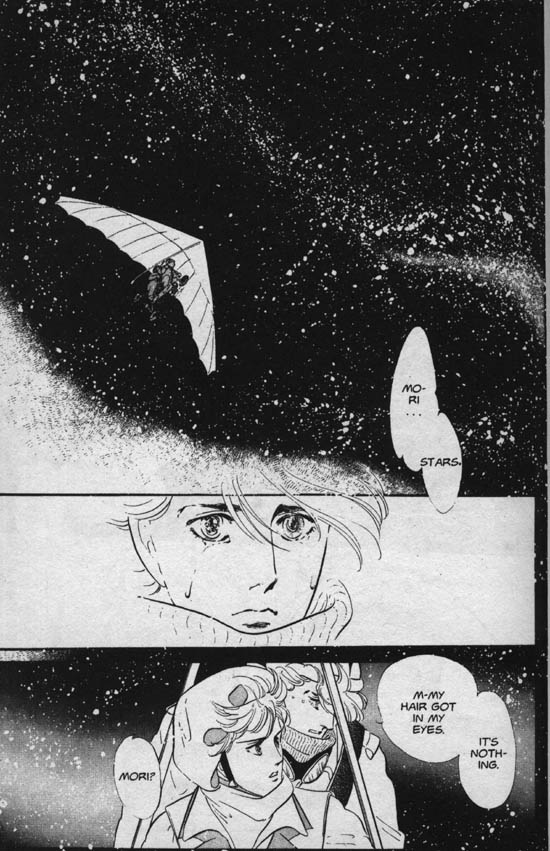
That dream-like quality extends to the settings as well, which mirror the characters’ turbulent emotional states. Trill and Mori, for example, visit a spectacular aviary aboard a space station; it’s a lush, erotically charged setting evocative of a Rousseau painting, and one that suggests the intensity of Mori’s desire for Trill. Hagio performs a similar trick in this sequence, transforming an interstellar reconnaissance mission into an intimate windsailing expedition through the stars:

aprime

Lest A, A’ sound like The Unbearable Lightness of Being in Space, let me assure you that Hagio demonstrates a unique ability to mix the sublime with the ridiculous. Her characters’ names, for example, are just about as goofy as they come: Dr. Wright Moonsault. Regg Bone. Marble. Professor Sazzan. Their costumes, too, have the same overripe quality as the names, with men sporting headbands, half capes, tall boots, and Renn Fair hats, and women clad in off-the-shoulder jumpsuits. The subplots take the cake, however, for their sheer moonbattiness: in “X+Y,” for example, Tacto’s father invents a temporary sex change drug that enables a male colleague to become pregnant, a subplot that actually holds the key to unlocking Tacto’s past.

Now out of print, VIZ originally released A, A’ in 1997. Expect to pay about $25.00 for a decent used copy if you choose to buy it online through ALibris or Amazon’s network of retailers. You might also try the library or your local comic shop’s bargain bin.

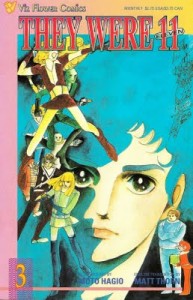
theywereeleven3THEY WERE ELEVEN

Ten cadets at an interstellar space academy are dispatched to a decommissioned ship. Their task: remain on board for 53 days without pressing the panic button; if they persevere, all ten will pass their final exam. Once aboard the ship, however, the cadets realize something is amiss. Not only do they have an extra crew member, but a series of mechanical failures and explosions threaten to send the ship hurtling into the surface of a neighboring star.

Though the premise could be spun out in the manner of, say, Event Horizon, Hagio favors a Gene Rodenberry approach, emphasizing character development and social commentary over gunplay, robots, or totally icky alien life forms. (You know the kind: they embed themselves in your chest cavity, hunt you down like a rabbit, or just spray toxic venom in your face.) Like the good astronauts of the starship Enterprise, They Were Eleven‘s cast are humanoids of various shapes and sizes. A few seem empathic; one has remarkable healing powers; another is tall and scaly; yet another looks like a distant relative of The Thing; and one pretty character has yet to decide whether it will develop into a man or woman. The dilemmas the cadets face — technical, social, and medical — also place us firmly in Star Trek territory, inspiring the characters to ruminate on issues as varied as gender roles and the ethics of sacrificing an individual for the good of the collective.

In fact, the exploration of gender is one of They Were Eleven‘s most interesting subplots; Frol, the sexually indeterminate member of the crew, is furious that her shipmates construe her as female. “I hate women!” she shouts. “Women are nothing but a waste of space!” Midway through the story, Hagio reveals the source of Frol’s misogyny: her parents want her to become the ninth wife of a prominent nobleman. If Frol passes the Galactic Academy exam, however, she will earn the right to become a man, a privilege usually reserved for a family’s eldest child. (Frol’s people are born hermaphrodites, becoming male or female only in adulthood.) Hagio’s critique of gender roles is both obvious and sly — obvious, in that Frol’s objection to being a woman stems from the division of labor on her home world (men rule the roost; women do all the work and bear lots of children) and sly, in that Hagio uses primogeniture as a metaphor for the broader sense of entitlement that comes with being born male.

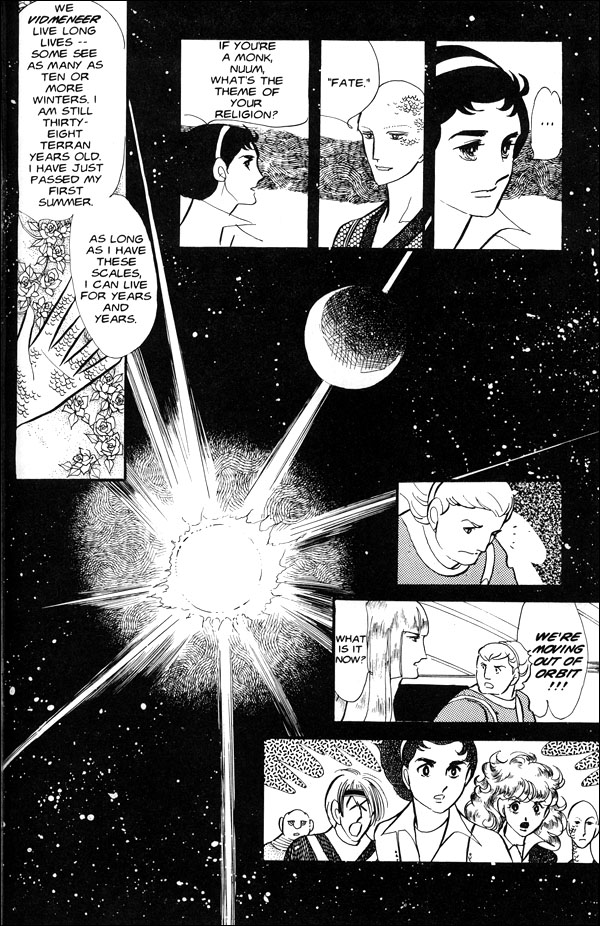
If Hagio’s aliens are strictly by the Star Trek book, all funny foreheads and funky hides, her layouts are stunning, punctuated by several arresting, full-page images: an enormous hall of cadets taking their exams (each in a groovy, womb-like isolation pod to prevent cheating), a picture of the dying star around which the test ship is orbiting, a character’s profile dissolving into a trail of stars. Hagio juxtaposes these expansive images with long, almost claustrophobically tight scenes of shipmates bickering and coping with the latest mechanical failures. It’s a neat trick, giving us a sense of how tight quarters really are aboard the White, and suggesting how that small space exacerbates tensions among the crew. And oh, those interiors! Like Takemiya, Hagio loves to draw detailed banks of computers and rows of tubes and wires and pipes, bringing the ship to vivid life. (Or, perhaps more accurately in the case of They Were Eleven, showing the ship in all its decrepitude.)

theywere11_page

Much as I would like to recommend They Were Eleven, the story is out of print in English. In the mid-1990s, VIZ issued it in two forms: as a four-issue comic (1995), and in the anthology Four Shojo Stories (1996). Used book dealers have gotten wise to the scarcity of this title; copies of Four Shojo Stories generally retail for $60 and up. Though I didn’t have too much difficulty scaring up the old VIZ Flower floppies on eBay (and I rather enjoyed the American-style presentation), it would be great to see this chestnut re-issued for a generation of readers who think that Black Bird is the first and last word in girls’ comics.

* Hagio’s story “Hanshin” was reprinted in The Comics Journal‘s shojo manga issue from 2005 (no. 269). For the purposes of this essay, I’m focusing on Hagio’s commercially available work. And speaking of work by pioneering shojo artists, Swan, which ran in Margaret from 1976 to 1981, is also available in English (CMX), and is the work of artist Kyoko Ariyoshi, who was born in 1950.

This an expanded version of a review that originally appeared at PopCultureShock on 1/20/07.

Filed Under: Manga Critic Tagged With: Classic, Magnificent 49ers, moto hagio, shojo, VIZ

Manga Artifacts: A, A’ and They Were Eleven

May 31, 2010 by Katherine Dacey

Though Vertical has published two series by Keiko Takemiya, the Magnificent 49ers’ work remains largely unavailable in English, with a few exceptions: Yasuko Aoike’s From Eroica With Love (which debuted in 1976 in Akita Shoten), and Moto Hagio’s short stories “A, A’ [A, A Prime],” “4/4 [Quatre/Quarts],” “X+Y,” and “They Were Eleven.”* These four stories comprise a mere 330 pages of material, but they offer readers a window into a key stage in shojo manga’s development, when women artists began pushing the medium in new directions, visually and thematically. Hagio’s work, like Takemiya’s, is unabashedly Romantic, filled with yearning characters who are struggling to uncover their true selves, even when that quest puts them at odds with societal norms. Though there is an intense, adolescent sensibility to some of her stories, that — for me, at least — is part of their beauty; Hagio clearly remembers what it feels like to be sixteen or eighteen, yet the way she frames those emotions is so exquisite and refined that the reader can appreciate her craft, even if the drama seems a little overripe from an adult perspective.

If you’ve been curious about what Takemiya’s peers were doing while she was writing To Terra and Song of the Wind and the Trees, or are wondering what to expect if you purchase Hagio’s A Drunken Dream this fall, read on.

aa_coverA, A’ [A, A Prime]

This sometimes lyrical, sometimes bizarre anthology contains three interrelated stories. In the first, “A, A’, [A, A Prime],” a group of researchers struggle to accept Addy, a new team member who is, in fact, the clone of a colleague who perished several years earlier; in the second, “4/4 [Quatre/Quarts],” Mori, a telepath, becomes obsessed with Trill, a strange young woman who’s virtually mute; and in the third, “X+Y,” a now-older Mori falls in love with Tacto, an androgynous young man who resembles Trill. Addy, Trill, and Tacto are Unicorns, a humanoid species bred for deep-space travel. Though Unicorns share common physical characteristics — most notably a shock of red hair running down the center of their heads — and high IQs — their original purpose was to serve as computer technicians on long space missions — they have a hard time negotiating the human world: emotions baffle them, and the act of forming deep attachments to other people can destabilize their personalities.

Though Hagio rehearses some time-honored sci-fi tropes — especially the danger of genetic tampering — one of her most striking themes is the relationship between memory and identity. Addy, for example, is born with all of her predecessor’s memories of childhood, but none of her predecessor’s memories of Proxima, the remote ice world where the original Addy worked for three years before dying in an accident. That gap in Addy’s memory proves especially difficult for her co-worker Regg, who had been romantically involved with Addy’s predecessor. Addy has no idea who he is, and is bewildered that Regg knows about events from her “childhood” — events that Addy hasn’t discussed with anyone. More troubling still, these “memories” are deeply upsetting, even though Addy knows she isn’t reliving her own history.

Tacto, on the other hand, teeters on the verge of a breakdown because his memory is incomplete. As a young child, he stumbled across a gruesome sight, one which his father attempted to erase from Tacto’s memory. That seemingly humane gesture backfired, however, leaving Tacto with only an emotional echo of the traumatic event and no concrete information about what he’d actually seen; only by recovering those painful memories does Tacto escape his emotional paralysis and embrace Mori’s love for him.

Hagio’s artwork supports the intensely Romantic quality of all three stories, as she represents her characters’ memories with symbolically rich imagery. In “4/4,” for example, Trill is haunted by a recurring vision of corpses, each fastened to the floor with a lepidopterist’s pin — Trill’s memory of numerous, unsuccessful attempts to clone her. (Dr. Sazzan, her caretaker, is obsessed with breeding more Unicorns.) Tacto’s unformed memory of his childhood resembles the nightmare paintings of John Fuselli; Tacto sees a disembodied, demonic face emerge from the rocky surface of an asteroid, a swirling black cloud with eyes and a terrible mouth.

That dream-like quality extends to the settings as well, which mirror the characters’ turbulent emotional states. Trill and Mori, for example, visit a spectacular aviary aboard a space station; it’s a lush, erotically charged setting evocative of a Rousseau painting, and one that suggests the intensity of Mori’s desire for Trill. Hagio performs a similar trick in this sequence, transforming an interstellar reconnaissance mission into an intimate windsailing expedition through the stars:

aprime

Lest A, A’ sound like The Unbearable Lightness of Being in Space, let me assure you that Hagio demonstrates a unique ability to mix the sublime with the ridiculous. Her characters’ names, for example, are just about as goofy as they come: Dr. Wright Moonsault. Regg Bone. Marble. Professor Sazzan. Their costumes, too, have the same overripe quality as the names, with men sporting headbands, half capes, tall boots, and Renn Fair hats, and women clad in off-the-shoulder jumpsuits. The subplots take the cake, however, for their sheer moonbattiness: in “X+Y,” for example, Tacto’s father invents a temporary sex change drug that enables a male colleague to become pregnant, a subplot that actually holds the key to unlocking Tacto’s past.

Now out of print, VIZ originally released A, A’ in 1997. Expect to pay about $25.00 for a decent used copy if you choose to buy it online through ALibris or Amazon’s network of retailers. You might also try the library or your local comic shop’s bargain bin.

theywereeleven3THEY WERE ELEVEN

Ten cadets at an interstellar space academy are dispatched to a decommissioned ship. Their task: remain on board for 53 days without pressing the panic button; if they persevere, all ten will pass their final exam. Once aboard the ship, however, the cadets realize something is amiss. Not only do they have an extra crew member, but a series of mechanical failures and explosions threaten to send the ship hurtling into the surface of a neighboring star.

Though the premise could be spun out in the manner of, say, Event Horizon, Hagio favors a Gene Rodenberry approach, emphasizing character development and social commentary over gunplay, robots, or totally icky alien life forms. (You know the kind: they embed themselves in your chest cavity, hunt you down like a rabbit, or just spray toxic venom in your face.) Like the good astronauts of the starship Enterprise, They Were Eleven‘s cast are humanoids of various shapes and sizes. A few seem empathic; one has remarkable healing powers; another is tall and scaly; yet another looks like a distant relative of The Thing; and one pretty character has yet to decide whether it will develop into a man or woman. The dilemmas the cadets face — technical, social, and medical — also place us firmly in Star Trek territory, inspiring the characters to ruminate on issues as varied as gender roles and the ethics of sacrificing an individual for the good of the collective.

In fact, the exploration of gender is one of They Were Eleven‘s most interesting subplots; Frol, the sexually indeterminate member of the crew, is furious that her shipmates construe her as female. “I hate women!” she shouts. “Women are nothing but a waste of space!” Midway through the story, Hagio reveals the source of Frol’s misogyny: her parents want her to become the ninth wife of a prominent nobleman. If Frol passes the Galactic Academy exam, however, she will earn the right to become a man, a privilege usually reserved for a family’s eldest child. (Frol’s people are born hermaphrodites, becoming male or female only in adulthood.) Hagio’s critique of gender roles is both obvious and sly — obvious, in that Frol’s objection to being a woman stems from the division of labor on her home world (men rule the roost; women do all the work and bear lots of children) and sly, in that Hagio uses primogeniture as a metaphor for the broader sense of entitlement that comes with being born male.

If Hagio’s aliens are strictly by the Star Trek book, all funny foreheads and funky hides, her layouts are stunning, punctuated by several arresting, full-page images: an enormous hall of cadets taking their exams (each in a groovy, womb-like isolation pod to prevent cheating), a picture of the dying star around which the test ship is orbiting, a character’s profile dissolving into a trail of stars. Hagio juxtaposes these expansive images with long, almost claustrophobically tight scenes of shipmates bickering and coping with the latest mechanical failures. It’s a neat trick, giving us a sense of how tight quarters really are aboard the White, and suggesting how that small space exacerbates tensions among the crew. And oh, those interiors! Like Takemiya, Hagio loves to draw detailed banks of computers and rows of tubes and wires and pipes, bringing the ship to vivid life. (Or, perhaps more accurately in the case of They Were Eleven, showing the ship in all its decrepitude.)

theywere11_page

Much as I would like to recommend They Were Eleven, the story is out of print in English. In the mid-1990s, VIZ issued it in two forms: as a four-issue comic (1995), and in the anthology Four Shojo Stories (1996). Used book dealers have gotten wise to the scarcity of this title; copies of Four Shojo Stories generally retail for $60 and up. Though I didn’t have too much difficulty scaring up the old VIZ Flower floppies on eBay (and I rather enjoyed the American-style presentation), it would be great to see this chestnut re-issued for a generation of readers who think that Black Bird is the first and last word in girls’ comics.

* Hagio’s story “Hanshin” was reprinted in The Comics Journal‘s shojo manga issue from 2005 (no. 269). For the purposes of this essay, I’m focusing on Hagio’s commercially available work. And speaking of work by pioneering shojo artists, Swan, which ran in Margaret from 1976 to 1981, is also available in English (CMX), and is the work of artist Kyoko Ariyoshi, who was born in 1950.

This an expanded version of a review that originally appeared at PopCultureShock on 1/20/07.

Filed Under: Manga, Manga Critic, REVIEWS Tagged With: Classic, Magnificent 49ers, moto hagio, Sci-Fi, VIZ

Andromeda Stories, Vols. 1-3

May 26, 2010 by Katherine Dacey

andromeda_stories1Ah, Keiko Takemiya, how I love your sci-fi extravaganzas! The psychic twins. The giant spiderbots. The evil, omniscient computers. The sand dragons. The fantastic hairdos. Just think how much more entertaining The Matrix might have been if you’d been at the helm instead of the dour, self-indulgent Wachowski Brothers! But wait… you did create your very own version of The Matrix: Andromeda Stories. Your version may not be as slickly presented as the Wachowski Brothers’, but you and collaborator Ryu Mitsuse engage the mind and heart with your tragic tale of doomed love, lost siblings, and machines so insidious that they’ll remake anything in their image—including the fish.
But I’m getting ahead of myself.

Mitsuse and Takemiya invert the normal order of events in a classical drama and begin Andromeda Stories with a wedding. A royal wedding, to be exact, forging an alliance between Cosmoralia and Ayoyoda, two kingdoms on the planet Astria. On the eve of the ceremony, newlyweds Prince Ithaca and Princess Lilia spot a mysterious blue star pulsating in the night sky. Shortly after the star’s appearance, a meteorite crashes through Astria’s atmosphere with a deadly cargo: an army of nanobots seeking human hosts. Only Il, a fierce female warrior, and Prince Milan, Lilia’s devoted brother, realize that these cyber-critters are rapidly transforming Cosmoralia’s population into a Borg-like race of automatons. Il and Milan set out to liberate Cosmoralia from the grips of this cyber-invasion force before the contagion of violence and fear spreads to Ayoyoda.

…

Read More

Filed Under: Manga Critic Tagged With: Classic, Keiko Takemiya, Shonen, vertical

Andromeda Stories, Vols. 1-3

May 26, 2010 by Katherine Dacey

Ah, Keiko Takemiya, how I love your sci-fi extravaganzas! The psychic twins. The giant spiderbots. The evil, omniscient computers. The sand dragons. The fantastic hairdos. Just think how much more entertaining The Matrix might have been if you’d been at the helm instead of the dour, self-indulgent Wachowski Brothers! But wait… you did create your very own version of The Matrix — Andromeda Stories. Your version may not be as slickly presented as the Wachowski Brothers’, but you and collaborator Ryu Mitsuse engage the mind and heart with your tragic tale of doomed love, lost siblings, and machines so insidious that they’ll remake anything in their image—including the fish.

But I’m getting ahead of myself.

Mitsuse and Takemiya invert the normal order of events in a classical drama and begin Andromeda Stories with a wedding — a royal wedding, to be exact, forging an alliance between Cosmoralia and Ayoyoda, two kingdoms on the planet Astria. On the eve of the ceremony, newlyweds Prince Ithaca and Princess Lilia spot a mysterious blue star pulsating in the night sky. Shortly after the star’s appearance, a meteorite crashes through Astria’s atmosphere with a deadly cargo: an army of nanobots seeking human hosts. Only Il, a fierce female warrior, and Prince Milan, Lilia’s devoted brother, realize that these cyber-critters are rapidly transforming Cosmoralia’s population into a Borg-like race of automatons. Il and Milan set out to liberate Cosmoralia from the grips of this cyber-invasion force before the contagion of violence and fear spreads to Ayoyoda.

As Il soon discovers, there’s a small resistance movement led by the Murat, an alien race who lost their homeworld to the same invading force eight generations earlier. The survivors settled on Astria and married into Ayoyoda’s royal family with the goal of preventing the Astrians from becoming technologically sophisticated enough to attract the nanobots’ attention — and if that effort failed, doing whatever they could to defeat the machines. The Murat’s secret weapon against the nanobots are Jimsa and Affle, twins born to Princess Lilia and kept apart for over twelve years to escape detection by the new regime. Jimsa and Affle both possess the power to kill with a thought, a power amplified when the two fight side by side. Of course, there’s a drawback to so much empathetic energy: if one is injured, the other feels his pain, just like the Corsican Brothers. Then, too, there’s that pesky issue of trust: will Jimsa and Affle ever see themselves as sibilings, or have their separate upbringings driven a permanent wedge between them, thus thwarting the Murats’ hope?

In other words, it’s Star Trek by way of Anne McCaffrey, with a dash of Wagner and a little Arthur C. Clarke for good measure.

One of the things I love most about Takemiya’s work is the way she freely commingles sci-fi and fantasy elements in an effort to suggest the setting: a long time ago, in a galaxy far away. Her characters carry swords and wear togas, and live in castles with turrets, yet employ the kind of gadgetry—mind-reading computers, laser guns—that wouldn’t be out of place on the Death Star. Art-wise, the spirit of Osamu Tezuka lingers over many pages in Andromeda Stories, especially in its busier scenes. The Cosmoralian marketplace, for example, comes alive thanks to Takemiya’s vivid caricatures of merchants, wrestlers, farmers, dancing girls, snakes, and sloe-eyed dinosaurs, while many of the full-page cityscapes suggest the future worlds of Phoenix and Apollo’s Song, with their abundant towers and tubular skywalks. Though Takemiya’s principal characters clearly belong to the world of 1970s shojo with their flowing manes, gypsy outfits, and sparkling eyes, some of her supporting characters — especially Balga, a Bluto-esque bodyguard — look like refugees from Buddha or Dororo. (In a sly nod to the kind of anachronistic humor that Tezuka loved, Takemiya depicts Balga playing with a Rubix’s cube while standing watch outside Princess Lilia’s chambers. 1980, you are so busted!)

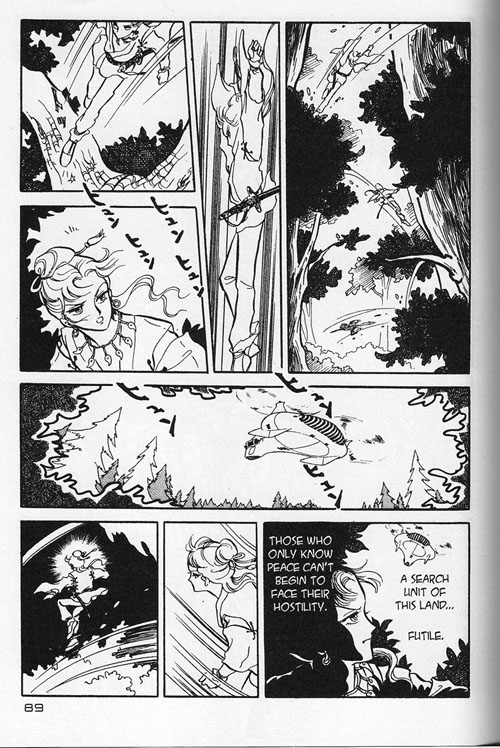
Takemiya also demonstrates a Tezukian flair for staging short, effective action sequences that make creative use of panel shapes to convey movement, speed, and distance. Midway through volume one, for example, Il leaps through the canopy of a forest in an effort to investigate a mysterious crater not far outside the Cosmoralian walls:

andromeda_page

In just four panels, we can gauge how far she’s traveled and how high off the ground she is — a point underscored by the tapered edge of the top row’s middle panel. The diagonal border amplifies the effect of the vertical speedlines, drawing the eye downwards in an rapid fashion that mimics Il’s motion. As Derik Badman observes in a concise analysis of this same page, Takemiya uses a number of tricks — drawing two iterations of the same character in one panel, using panel shape to direct the reader’s eye through the sequence, allowing sound effects to bleed outside the panels — to help us trace Il’s path through the tree tops, showing us, in compressed form, how many jumps it takes for her to reach a secure perch. It’s a technique that Tezuka perfected in works like MW, Ode to Kirihito, and Swallowing the Earth, where he gooses very basic components of the layout — especially panel shapes — to evoke the speed and energy of, say, a sword fight or a car chase.

At times, the richness of Takemiya’s visual imagination camouflages the more pedestrian aspects of the story, such as its one-dimensional principals. Lilia, in particular, is the kind of beautiful, virtuous, and long-suffering creature that seems to exist only in old-school Disney movies, while Il is a classic lone wolf, answering to no one, even when it might benefit her cause; the only real novelty here is that Mitsuse and Takemiya assign a stereotypically male role to a female character. The plot is simpler and more transparently allegorical than To Terra‘s, touching on a variety of standard science fiction themes, from the dangers of relegating too much responsibility to machines to the evils of totalitarianism. None of these themes are developed with the same level of sophistication as they are in To Terra, as the characters are generally too busy dodging death rays and mechanized piranha to wax poetic about their inner lives.

If Andromeda Stories never reaches the grand, operatic heights of To Terra, it nonetheless proves entertaining, building steady momentum over its 600+ page run, pausing occasionally to meditate on the nature of free will, creation, and individual responsibility. And c’mon… what’s not to like about a manga that looks like a 1979 cover of Heavy Metal magazine?!

This review is a synthesis of two shorter reviews that originally appeared at PopCultureShock on 10/3/07 and 1/31/08, respectively.

Filed Under: Manga, Manga Critic, REVIEWS Tagged With: Classic, Keiko Takemiya, Magnificent 49ers, Sci-Fi, Vertical Comics

Breaking Down Banana Fish, Vols. 3-4

May 25, 2010 by MJ, Connie C., Michelle Smith, Katherine Dacey, Eva Volin, Robin Brenner and Khursten Santos 24 Comments

Welcome to the second installment of the Banana Fish roundtable!

This month, we discuss volumes three and four of this classic shojo series, in which Ash gets out of jail, Eiji and Ibe overstay their visas, and everyone ends up on an ill-considered road trip to L.A., just in time to fall into the hands of a Chinese mafia family’s secret weapon. Topics this round include what makes a shojo manga, thoughts on the series’ few female characters, and everyone’s take on new bad guy, Yut-Lung.

Once again, I’m joined by Michelle Smith (Soliloquy in Blue), Khursten Santos (Otaku Champloo), Connie (Slightly Biased Manga), Eva Volin (Good Comics For Kids), Robin Brenner (No Flying, No Tights), and Katherine Dacey (The Manga Critic), all of whom graciously found time in their incredibly cramped schedules to indulge me in this discussion. …

Read More

Filed Under: FEATURES Tagged With: banana fish, breaking down banana fish, manga, roundtables

MMF: An Introduction to Keiko Takemiya’s To Terra

May 23, 2010 by Katherine Dacey

Welcome to the May Manga Movable Feast! On the menu: Keiko Takemiya’s award-winning sci-fi epic To Terra. If you’ve never dined with us before, here’s how the MMF works: every month, the manga blogging community holds a week-long virtual book club in which we discuss a particular series or one-shot. Each day, the host shares links to new blog entries focusing on that work, while building an archive for the entire week’s discussion. At the end of the week, the group then selects a new host and a new “menu” for the following month.

…

Read More

Filed Under: Manga Critic Tagged With: Classic, Keiko Takemiya, Magnificent 49ers, Sci-Fi, Shonen, vertical

An Introduction to Keiko Takemiya’s To Terra

May 23, 2010 by Katherine Dacey


Welcome to the May Manga Movable Feast! On the menu: Keiko Takemiya’s award-winning sci-fi epic To Terra. If you’ve never dined with us before, here’s how the MMF works: every month, the manga blogging community holds a week-long virtual book club in which we discuss a particular series or one-shot. Each day, the host shares links to new blog entries focusing on that work, while building an archive for the entire week’s discussion. At the end of the week, the group then selects a new host and a new “menu” for the following month.

Our “feast” has two goals. The first is to promote intelligent, in-depth analysis of manga we love (or, in some cases, hate). Previous contributions have run the gamut from straightforward reviews to an interview with Sexy Voice and Robo editor Eric Searleman, a guided tour through Kaoru Mori’s “Emmaverse,” and an essay contrasting Urushibara’s Mushishi with Lovecraft’s Cthulhu Mythos. The second goal is to foster a sense of community among avid manga readers. Everyone is invited to take part in the MMF, regardless of whether you’ve participated before. If you have your own blog, simply send me the link to your To Terra-themed post, whether it’s a brand new essay written expressly for the MMF or an older review that you’d like the share with the community, and I’ll include it in my daily round-up. If you don’t have a blog, send me your text and I’ll post your ideas here. (Click here for my email.) Discussion begins today and will run through the week until Sunday, May 30th.

Below, I’ve provided an overview of the series’ publication history, plot, and place in the manga canon. You can follow the discussion by checking the daily blog posts, clicking on the Manga Movable Feast tag, or visiting the MMF archive: http://mangacritic.com/?page_id=4766.

TO TERRA: THE PUBLICATION HISTORY

To Terra debuted in 1977 in Gekkan Manga Shonen. During its three-year run, To Terra nabbed two honors: the Shogakukan Manga Award and the Seiun Award, an annual prize for the best new science fiction published in Japan. (To Terra was the first manga to receive a Seiun Award; later winners would include Appleseed, Domu: A Child’s Dream, Urusei Yatsura, Cardcaptor Sakura, Planetes, and 20th Century Boys.)  The series was originally issued in tankubon format in 1980 by Asahi Sonorama, and reissued again in 2007 by Square Enix, around the same time Vertical, Inc. released the first English-language edition.

To Terra has enjoyed considerable popularity in Japan, thanks, in part, to several adaptations: a 1979 NHK radio drama; a 1980 movie, produced by Toei Animation; and a 2007 animated television series, produced by Aniplex.

TO TERRA: THE STORY

toterra2To Terra unfolds in a distant future characterized by environmental devastation. To salvage their dying planet, humans have evacuated Terra (Earth) and, with the aid of a supercomputer named Mother, formed a new government to restore Terra and its people to health. The most striking feature of this era of Superior Domination (S.D.) is the segregation of children from adults. Born in laboratories, raised by foster parents on Ataraxia, a planet far from Terra, children are groomed from infancy to become model citizens. At the age of 14, Mother subjects each child to a grueling battery of psychological tests euphemistically called Maturity Checks. Those who pass are sorted by intelligence, then dispatched to various corners of the galaxy for further training; those who fail are removed from society.
The real purpose of these checks is to weed out an unwanted by-product of S.D.-era genetic engineering: the Mu, a race of telepathic mutants. After decades of persecution, the Mu fled Terra, seeking refuge beneath the surface of Ataraxia. Under the leadership of Soldier Blue, they escaped detection by humans. But Soldier Blue is frail and dying (though he has chosen to project a youthful, sparkly-eyed appearance), and seeks a successor in Jomy Marcus Shin, a 14-year-old who possesses both the telepathic ability of a Mu and the hardier constitution of a human. As the series unfolds, we watch Jomy develop into a formidable leader, capable of inspiring passion, loyalty, and sacrifice among the Mu as they struggle to return to their homeworld. Running in counterpoint to Jomy’s story is that of Keith Anyan, an elite solider-in-training and future Terran leader. Keith enjoys a privileged position in human society. Yet he is plagued by doubt: why doesn’t he remember his childhood? Or his foster parents? And why does Mother refuse to eradicate the Mu when the state has deemed them a threat to mankind?

What makes this unabashedly Romantic mash-up of Star Trek, Star Wars, and 2001 both entertaining and moving is the richness of Keiko Takemiya’s universe. On the surface, To Terra is a beautifully illustrated soap opera, the kind of manga in which the heroes have terrific hair, wear smart jumpsuits, and keep psychic squirrels as pets. But To Terra can also be read a cautionary tale about mankind’s poor custodianship of the Earth; a scathing critique of eugenics and social engineering; a meditation on the relationship between memory and identity; and, most significantly, a critique of adult hypocrisy. It’s this multivalent quality that elevates To Terra from a mere allegory to an epic space opera as engaging, beautiful, and thought-provoking as Tezuka’s best work. (This review originally appeared at PopCultureShock on July 16, 2007.)

TO TERRA: ITS PLACE IN THE CANON

As anyone with a passing familiarity with the Magnificent 49ers knows, the 1970s were a watershed in the development of shojo manga. Not that shojo manga was an invention of the 1970s, of course; shojo manga traces its roots back to the 1910s, when girls’ magazines began running short, one-page gag strips, and underwent several major stages of development before evolving into the medium we know today. Until the mid-1960s, however, shojo manga was written by men for pre-teen girls; the stories were sweet, sentimental, and chaste, often revolving around family, class, and identity in the manner of a Frances Hodgson Burnett story. In an interview with manga scholar Matt Thorn, Keiko Takemiya’s former roommate Moto Hagio remembers the manga from this period:

In the girls’ comics, you would have stories in which the woman you thought was the mother turns not to be the mother, and the real mother is actually somewhere else. There was a variety of settings. For example, the poor child in the story turns out to actually come from a rich family, or the child of a rich family turns to have been adopted from a poor family. And one of the standard device was amnesia… It appeared so often, it makes me think that what with the war and the harsh social conditions, people had an unconscious desire to forget everything. So the heroine goes off in search of her real mother, but along the way she develops amnesia, and ends up being taken care of by a string of kind strangers.

Another popular motif was ballet. There was quite a boom in girls’ comics about ballet for a while. For example, the heroine would be a girl from a poor family who’s really good at ballet, but she loses the lead to an untalented girl from a rich family. In the standard story, there would be a mean girl and a kind-hearted heroine, and there would be a very clear-cut struggle between good and evil.

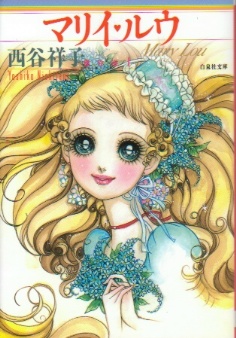
maryloubunkoIn the mid-1960s, pioneering female artist Yoshiko Nishitani began writing stories aimed at a slightly older audience. Nishitani’s Mary Lou, which made its debut in Weekly Margaret in 1965, was one of the very first shojo manga to document the romantic longings of a teenage girl. (As Thorn notes in “The Multi-Faceted World of Shoujo Manga,” the heroines of early shojo stories were too young for crushes and dates, so romance was the provenance of older, secondary characters.) Though tame by contemporary standards, Mary Lou’s emphasis on the heroine’s emotional life and relationships proved highly influential, paving the way for other artists to write stories that focused on the everyday concerns of teenagers, rather than the melodramatic travails of poor little rich girls.

Nishitani was a pioneer in another sense as well: she inspired dozens of women to enter what had been an overwhelmingly male profession. Those artists who followed Nishitani into the field in the 1970s — women like Takemiya, Hagio, and Ryoko “Rose of Versailles” Ikeda — built on her legacy, helping complete the transformation of shojo manga from staid stories about good girls to a multi-faceted storytelling medium capable of dramatizing the characters’ inner thoughts as forcefully as their physical actions. The 49ers embraced genres such as science fiction and fantasy, and developed new ones as well: the entire boys’ love industry owes a debt to Hagio and Takemiya for ground-breaking stories such as “The Heart of Thomas” and The Song of the Wind in the Trees. Whatever the subject matter, however, the 49ers used the comics medium to explore fundamental questions about identity — what constitutes family? what does it mean to be female? what distinguishes the child from the adult? — and love in all its manifestations, from maternal to carnal.

To Terra, which addresses many of the themes found in Takemiya’s other works, is significant precisely because it isn’t shojo; Takemiya was one of the first female artists to write for a boys’ magazine, bringing a distinctly shojo sensibility to her portrayal of Keith and Jomy’s emotional lives. The popular success of To Terra created opportunities for other manga-ka to cross over as well, a trend important enough for Frederick Schodt to make note of it in Manga! Manga! The World of Japanese Comics (1983). Contemporary artists such Rumiko Takahashi, CLAMP, Yellow Tanabe, and Hiromu Arakawa owe a debt to Takemiya, as she helped demonstrate what seems patently obvious to us now: that women are just as capable of writing for male audiences as men are. Oh, and we can draw a pretty bitchin’ space ship if the story calls for one.

FOR FURTHER READING

Aoki, Deb. “Interview: Keiko Takemiya, Creator of To Terra and Andromeda Stories.” About.com: Manga. January 22, 2008. (Accessed 5/23/10.)

Thorn, Matt. “The Moto Hagio Interview.” The Comics Journal 269 (July/August 2005). (Accessed 5/23/10.)

Thorn, Matt. “The Multi-Facted Universe of Shoujo Manga.” Conference paper. 2008. (Accessed 5/23/10.)

Filed Under: Classic Manga Critic, Manga, Manga Critic, REVIEWS Tagged With: Classic, Keiko Takemiya, Magnificent 49ers, Sci-Fi, Shonen, vertical

AX, Vol. 1: A Collection of Alternative Manga

May 21, 2010 by Katherine Dacey

ax coverThe next time someone dismisses manga as a “style” characterized by youthful-looking, big-eyed characters with button noses, I’m going to hand them a copy of AX, a rude, gleeful, and sometimes disturbing rebuke to the homogenized artwork and storylines found in mainstream manga publications. No one will confuse AX for Young Jump or even Big Comic Spirits; the stories in AX run the gamut from the grotesquely detailed to the playfully abstract, often flaunting their ugliness with the cheerful insistence of a ten-year-old boy waving a dead animal at squeamish classmates. Nor will anyone confuse Yoshihiro Tatsumi or Einosuke’s outlook with the humanism of Osamu Tezuka or Keiji Nakazawa; the stories in AX revel in the darker side of human nature, the part of us that’s fascinated with pain, death, sex, and bodily functions.

Founded in 1997, AX was a direct descendant of Garo (1964-2002), Katsuichi Nagai’s seminal avant garde manga magazine. As historian Paul Gravett explains in his introduction to A Collection of Alternative Manga, both publications served an essential purpose, providing artists a place to break free of the influence of commercial manga publishing — its rigid house styles, tight deadlines, strong editorial presence, and reader polls — and find more idiosyncratic forms of expression. At the same time, Gravett argues, Garo and AX gave artists a platform for speaking out against the dominant culture, to loudly question the truth that everyone can and should be “doing one’s best” while trying hard to fit in.

…

Read More

Filed Under: Manga Critic Tagged With: Top Shelf

AX, Vol. 1: A Collection of Alternative Manga

May 21, 2010 by Katherine Dacey

The next time someone dismisses manga as a “style” characterized by youthful-looking, big-eyed characters with button noses, I’m going to hand them a copy of AX, a rude, gleeful, and sometimes disturbing rebuke to the homogenized artwork and storylines found in mainstream manga publications. No one will confuse AX for Young Jump or even Big Comic Spirits; the stories in AX run the gamut from the grotesquely detailed to the playfully abstract, often flaunting their ugliness with the cheerful insistence of a ten-year-old boy waving a dead animal at squeamish classmates. Nor will anyone confuse Yoshihiro Tatsumi or Einosuke’s outlook with the humanism of Osamu Tezuka or Keiji Nakazawa; the stories in AX revel in the darker side of human nature, the part of us that’s fascinated with pain, death, sex, and bodily functions.

Founded in 1997, AX was a direct descendant of Garo (1964-2002), Katsuichi Nagai’s seminal avant garde manga magazine. As historian Paul Gravett explains in his introduction to A Collection of Alternative Manga, both publications served an essential purpose, providing artists a place to break free of the influence of commercial manga publishing — its rigid house styles, tight deadlines, strong editorial presence, and reader polls — and find more idiosyncratic forms of expression. At the same time, Gravett argues, Garo and AX gave artists a platform for speaking out against the dominant culture, to loudly question the truth that everyone can and should be “doing one’s best” while trying hard to fit in.

The thirty-three stories in A Collection of Alternative Manga nicely illustrate Gravett’s thesis, encompassing a true diversity of styles and subject-matters. At one end of the spectrum are artists such as Yuka Goto, whose work reflects a heta-uma, or “bad-good” aesthetic, with crudely-drawn figures in absurd situations (her feuding neighbors resolve their differences with a judo match), while at the other are artists such as Takato Yamato, whose intricate, naturalistic style becomes a vehicle for juxtaposing pornographically beautiful human bodies with explicit images of decay and rot. Most of the work in AX falls somewhere in between: the magical realism of Akina Kondo (“Rainy Day Blouse and The Umbrella”); the primitivist abstraction of Otoya Mitsusashi (“Sacred Light”); the horror-comedy of Kazuichi Hanawa (“Six Paths of Wealth”); the kawaii-grotesque of Mimyo Tomozawa (“300 Years”). Then there are stories which are parodies in the truest sense, borrowing the visual language of shonen manga for dark farce: Namie Fujieda’s “The Brilliant Ones,” in which an earnest group of students tries to help the class loser find a way to shine — even after his body has exploded into a thousand small parasites — and Tomohiro Koizumi’s “Stand By Me,” a story about a pair of peeping teens caught in the act.

For me, the biggest obstacle to enjoying the collection — as opposed to appreciating it — is that for every story like Ayuke Akiyama’s lovely, folkloric “In the Gourd” or Toranasuke Shimada’s historical phantasmagoria “Enrique Kobayashi’s El Dorado,” there are two that read like stunts, deliberate attempts to provoke, and maybe even disgust, the audience by rubbing its nose in taboo subjects and uncomfortable truths. Such confrontational art can be thought-provoking, to be sure, making us reconsider socially determined categories such as “parent,” “teacher,” and “child”: Yusaku Hanakuma’s “Puppy Love” is one such example, a bizarre, funny, upsetting story in which a woman gives birth to a litter of puppies and resolves to raise them as normal children. The struggles she and her “sons” face remind us of how difficult it is for anyone to raise a child whose behavior or appearance makes others uncomfortable; it’s With the Light, minus the easy sentiment (and with a dollop of David Cronenberg’s perverse sense of humor).

The need to elicit a strong, visceral response from the reader can also inspire puerile excess. Shigiheru Okada (“Me”), Saito Yunosuke (“Arizona Sizzler”), Kataoko Toyo (“The Ballad of Non-Stop Farting”), and Takashi Nemoto’s (“Black Sushi Party Piece”) repeated depictions of body parts and bodily fluids reminded me of sixth graders testing out every permutation of a new swearword to see which ones had the greatest shock value. Other stories, such as Yoshihiro Tatsumi’s “Lover’s Bride,” inspire an immediate ewwwww, and maybe a chuckle, but not much else: what deeper truths could possibly be gleaned from a sad-sack character’s decision to woo a primate instead of a human?

My other stumbling block to fully embracing AX is the way in which female characters are depicted in stories such as Yuichi Kiriyama’s “A Well-Dressed Corpse,” Hiroji Tani’s “Alraune Fatale,” and Osamu Kanna’s “The Watcher.” The female characters often seem more like receptacles for male anger, sexual aggression, or disappointment than they do actual human beings. I suppose one could argue that these artists are simply exaggerating a tendency found in manga across the spectrum, making explicit what’s normally implicit in a lot of material directed at male audiences. Yet none of these artists seem to be critiquing the male gaze in any meaningful way; they cast a pitiless, often lascivious eye on their female subjects, reducing them to a monstrous assortment of breasts and mouths and legs. It’s to editor Sean Michael Wilson’s great credit that he includes so many distinctive female voices in the anthology as well, preventing AX from becoming too dourly macho or grossly juvenile.

Yet for all my discomfort and distance from the material, I can’t look away. As a historian, AX excites me, providing a meticulously curated introduction to Japan’s underground comics scene. As a reader, AX challenges me to move beyond my notion of what constitutes manga, helping me understand what artists like Yoshihiro Tatsumi and Yoshiharu Tsuge were trying to do in the 1950s and 1960s with their “manga that isn’t manga”: to push the medium outside its comfort zone, to show us ugly truths, to make us laugh with recognition and discomfort, and to encourage artistic expression that, in Gravett’s words, is “as personalized as handwriting or a signature.” Recommended.

Review copy provided by Top Shelf. AX, Vol. 1: A Collection of Alternative Manga will be released on July 15, 2010.

AX, VOL. 1: A COLLECTION OF ALTERNATIVE MANGA • EDITED BY SEAN MICHAEL WILSON, WITH AN INTRODUCTION BY PAUL GRAVETT • TOP SHELF • NO RATING • 400 pp.

Filed Under: Manga, Manga Critic, REVIEWS Tagged With: Alt-Manga, Top Shelf

The Times of Botchan, Vols. 1-4

May 19, 2010 by Katherine Dacey

botchan_coverReading The Times of Botchan reminded me of watching Alexander Sakurov’s cryptic 2002 film Russian Ark. Both employ a similar gambit: a literary figure from the country’s past wanders through a landscape populated by real people who played pivotal roles in its modernization. In Russian Ark, the author/protagonist role is filled by the Marquis de Custine, a French aristocrat who published Empire of the Czar: Journey Through Eternal Russia in 1839, while in The Times of Botchan the role is fulfilled by Soseki Natsume (1867-1916), the defining novelist of the Meiji Restoration. Neither Ark nor Botchan employs a clear, linear narrative; both works are episodic — even, at times, picaresque — in nature as their principle characters rub shoulders with poets, composers, czars, and politicians.

When we first meet Natsume, he is writing a novel called Botchan, a short, satirical work about a energetic young man who suffers from a Holden Caufield-esque desire to expose phoniness wherever he goes. Nastume hopes Botchan will help him achieve catharsis from a vague but nagging sense of anxiety brought on by the period’s social, political, and economic upheavals, from the Freedom and People’s Rights Movement to the first murmurs of suffragism.1 Though we occasionally see Natsume in his study drafting chapters, or admiring the inky paw prints left behind by his cat, much of the manga is devoted to Natsume’s travels through Tokyo, which brings him into contact with historical figures from An Jung-Geun, an activist who assassinated the Korean governor in 1909, to Hiruko Haratsuka, a feminist active in the Seito suffrage movement of the 1910s, to Lafcadio Hearn, a Western journalist whose fascination with old Japan inspired him to write Kwaidan: Stories and Studies of Strange Things.

…

Read More

Filed Under: Manga Critic Tagged With: Fanfare/Ponent Mon, Jiro Taniguchi, Natsume Soseki, Seinen

The Times of Botchan, Vols. 1-4

May 19, 2010 by Katherine Dacey

Reading The Times of Botchan reminded me of watching Alexander Sakurov’s cryptic 2002 film Russian Ark. Both employ a similar gambit: a literary figure from the country’s past wanders through a landscape populated by real people who played pivotal roles in its modernization. In Russian Ark, the author/protagonist role is filled by the Marquis de Custine, a French aristocrat who published Empire of the Czar: Journey Through Eternal Russia in 1839, while in The Times of Botchan the role is fulfilled by Soseki Natsume (1867-1916), the defining novelist of the Meiji Restoration. Neither Ark nor Botchan employs a clear, linear narrative; both works are episodic — even, at times, picaresque — in nature as their principle characters rub shoulders with poets, composers, czars, and politicians.

When we first meet Natsume, he is writing a novel called Botchan, a short, satirical work about a energetic young man who suffers from a Holden Caufield-esque desire to expose phoniness wherever he goes. Nastume hopes Botchan will help him achieve catharsis from a vague but nagging sense of anxiety brought on by the period’s social, political, and economic upheavals, from the Freedom and People’s Rights Movement to the first murmurs of suffragism.1 Though we occasionally see Natsume in his study drafting chapters, or admiring the inky paw prints left behind by his cat, much of the manga is devoted to Natsume’s travels through Tokyo, which brings him into contact with historical figures from An Jung-Geun, an activist who assassinated the Korean governor in 1909, to Hiruko Haratsuka, a feminist active in the Seito suffrage movement of the 1910s, to Lafcadio Hearn, a Western journalist whose fascination with old Japan inspired him to write Kwaidan: Stories and Studies of Strange Things.

Some of these encounters are the jumping off point for vignettes about Westerners living in Japan, or the state of Japanese literature, while others are mere coincidence and treated in just one or two panels. The resulting manga feels like a tableau, or the Japanese equivalent of a guided tour through Colonial Williamsburg, as our unseen narrator identifies the sprawling cast of characters and mentions key events in Meiji-era history.

Despite its historical ambitions, The Times of Botchan is best read for its quieter moments. Jiro Taniguchi creates intimate scenes that require little or no dialogue to convey their nuance: two acquaintances walking silently through a snowing streetscape, Natsume working in his study. Small details capture the transitional nature of the period, and speak volumes about the characters’ ambivalent relationship with the West, with some embracing European dress, others flatly rejecting it, and most, like Natsume, striking a compromise, combining a yukata with a button-down shirt and bowler hat.

Sekikawa’s script, however, is less artful than Taniguchi’s visuals, as the omniscient narrator often supplies the reader with information that can be readily inferred from the pictures. In one scene, for example, the writer Rintaro “Ogai” Mori2 returns to his family after a prolonged stay in Europe. He intends to tell his parents that he loves — and plans to marry — a young German dancer named Elise Weigert, but cannot bring himself to do so now that he is back on Japanese soil. Taniguchi’s illustrations instill in us a powerful sense of Mori’s estrangement from his roots, using his characters’ body language and placement within the picture plane to convey the emotional distance between Mori and his parents, but Sekikawa’s narrator intrudes on the scene:

At that moment, Ogai felt, for the first time, that he was back in Japan. In this country, individualism was not regarded as a personal virtue, the ‘family’ had to be considered. Ogai was unable to speak the words he had prepared and became mute as a fish.

Such heavy-handed interjections suggest that Sekikawa doesn’t trust us to decode moments of mystery, poetry, or ambiguity on our own; at least the Marquis de Custine never bothered to explain why Nicholas II and victims of the Kursk disaster haunted the same wing of the Hermitage.

The Times of Botchan‘s other great flaw is its deadly serious tone. The two novels that Natsume wrote during the period portrayed in the manga, I Am a Cat and Botchan, are both satirical, filled with wry observations about human nature and sharp critiques of pomposity, greed, toadyism, and empty-minded embrace of Western mores.3 Though the manga is filled with visual signifiers for both works — cats, in particular, are a recurring motif throughout the first two volumes — the manga lacks the delicate touch of either novel; one might reasonably conclude from Sekikawa’s narration that Botchan was a Zola-esque expose on the evils of Westernization, rather than a comedy about a young teacher coping with the inept faculty at a podunk boys’ boarding school.

From time to time, however, the narrative snaps out of its staid, vaguely pompous tone. In one genuinely funny scene, for example, Japan’s leading literary figures gather in the home of a prominent politician for a meeting of “The Perpetual and Immutable Literary Circle.” Two are asked to compose a poem on the spot. The first, intoned by the host, is greeted with respectful, if vague praise (“It reminds one of the tranquility and beauty of Turner’s paintings,” one opines):

The great canon is heard from afar
On the left diagonal of the hands that hold the horse’s reins.

The second stuns them into uncomfortable silence:

When the cowherd makes a poem
A new air rises in the world.

A lively debate follows, with some detecting a whiff of socialism in the cowherd’s profession, and others praising it for its direct simplicity; not until the group’s acknowledged expert interprets both poems does the group reach consensus on their quality. The punchline comes in the final panel, when one member acknowledges that the first poem made no sense. In that brief scene, Sekikawa and Taniguchi capture the spirit of Botchan without slavishly recreating a scene from it; one could almost imagine the savage nicknames that a younger, less pretentious member of the circle might lavish on his elders as they debated the merits of both poems.

In another rare moment of levity, Natsume witnesses a young suffragette making out with her paramour in a restaurant, noting the length — three and a half minutes — and intensity of their kiss. Taniguichi draws that kiss in almost pornographic detail, with panel after panel of the two lovers’ mouths drenched in saliva, in essence showing us how Natsume views their contact, with a mixture of prurient fascination and revulsion. Sesikawa and Taniguchi then takes things a step further, borrowing a page from Milos Foreman’s Amadeus to suggest how this brief, everyday experience found its way into the pages of Botchan, with the suffragette morphing neatly into the Madonna, a social-climbing temptress who switches romantic allegiances when it suits her interest.

Given the didactic tone and frequent allusions to unfamiliar historical figures, I’m hesitant to give The Times of Botchan an unequivocal endorsement. Some readers will find the book long-winded, confusing, and perhaps even a little boring. But for those already enamored of Taniguchi’s superb draftsmanship or well-versed in Japanese culture, The Times of Botchan offers readers a lovely reward: a window into one of the most fascinating periods in Japanese history, and the creative process of one its most important voices.

NOTES

1. The Freedom and People’s Rights Movement in Japan began in the 1870s. Building on the reforms established in the Charter Oath of 1868 (which abolished Japan’s rigid class structure, among other provisions), urban intellectuals lobbied for the drafting of a constitution and the creation of a parliament.

2. Ogai Mori is best known to Western audiences for his novels The Wild Geese and Sansho the Bailiff, the latter being the basis of Kenji Mizoguchi’s 1954 film.

3. As translator Joel Cohn notes, Botchan (the novel) occupies a similar place in the Japanese canon as Catcher in the Rye and Huckleberry Finn, and is a standard text in most high schools. See the introduction to Natsume Soseki, Botchan, Translated by J. Cohn (New York: Kodandsha International, 2005).

Review copy of volume four provided by the publisher. This is an expanded version of a review that appeared at PopCultureShock on 6/5/2007. The original review focused on volumes 1-3 of the series.

Filed Under: Manga, Manga Critic, REVIEWS Tagged With: Fanfare/Ponent Mon, Historical Drama, Jiro Taniguchi, Natsume Soseki

  • « Go to Previous Page
  • Page 1
  • Interim pages omitted …
  • Page 78
  • Page 79
  • Page 80
  • Page 81
  • Page 82
  • Interim pages omitted …
  • Page 89
  • Go to Next Page »
 | Log in
Copyright © 2010 Manga Bookshelf | Powered by WordPress & the Genesis Framework