First published in 1956, Black Blizzard is a juicy pulp thriller that will irresistibly remind Western readers of The 39 Steps, The Defiant Ones, and The Fugitive. The hero is twenty-five-year-old Susumu Yamaji, a down-on-his-luck pianist who stands accused of murdering the ringmaster of a traveling circus. The circumstantial evidence against him is so compelling that even Susumu — who was in a drunken stupor at the time — believes he did it. After surrendering to authorities, Susumu is handcuffed to hardened criminal Shinpei Konta, a middle-aged man who’s spent most of his adult life drifting in and out of jail. (When Susumu admits to his crime, Shinpei sniffs, “Just one? Tch! That’s nothing! I’ve been convicted five times. Twice for murder.”) An avalanche provides the shackled pair an opportunity to escape into a raging snowstorm, police hot on their trail.
Written in just twenty days, Black Blizzard unfolds at a furious clip, pausing only to allow Susumu a chance to tell Shinpei about his involvement with the circus. The two principals are more archetypes than characters, drawn in bold strokes, but the interaction between them crackles with antagonistic energy — they’re as much enemies as partners, roles that they constantly renegotiate during their time on the lam. Only in the final, rushed pages does manga-ka Yoshihiro Tatsumi falter, tidily resolving the story through an all-too-convenient plot twist that hinges on coincidence.
The plot may be pilfered from Manhunt — Tatsumi claims Mickey Spillane as an influence — but the art leaves a fresh impression. Tatsumi already had a substantial amount of work under his belt at the time he wrote Blizzard — seventeen novel-length stories, as well as several volumes’ worth of short ones — but was moving in the direction of what he called “manga that isn’t manga,” stories that exploited the medium’s capacity for representing action in a more dynamic, cinematic fashion. Black Blizzard is filled with slashing diagonal lines, dramatic camera angles, and images of speeding trains; it’s as if Giacomo Balla decided to try his hand at sequential art, filling the pages with as many signifiers of motion as he could muster without lapsing into abstraction:
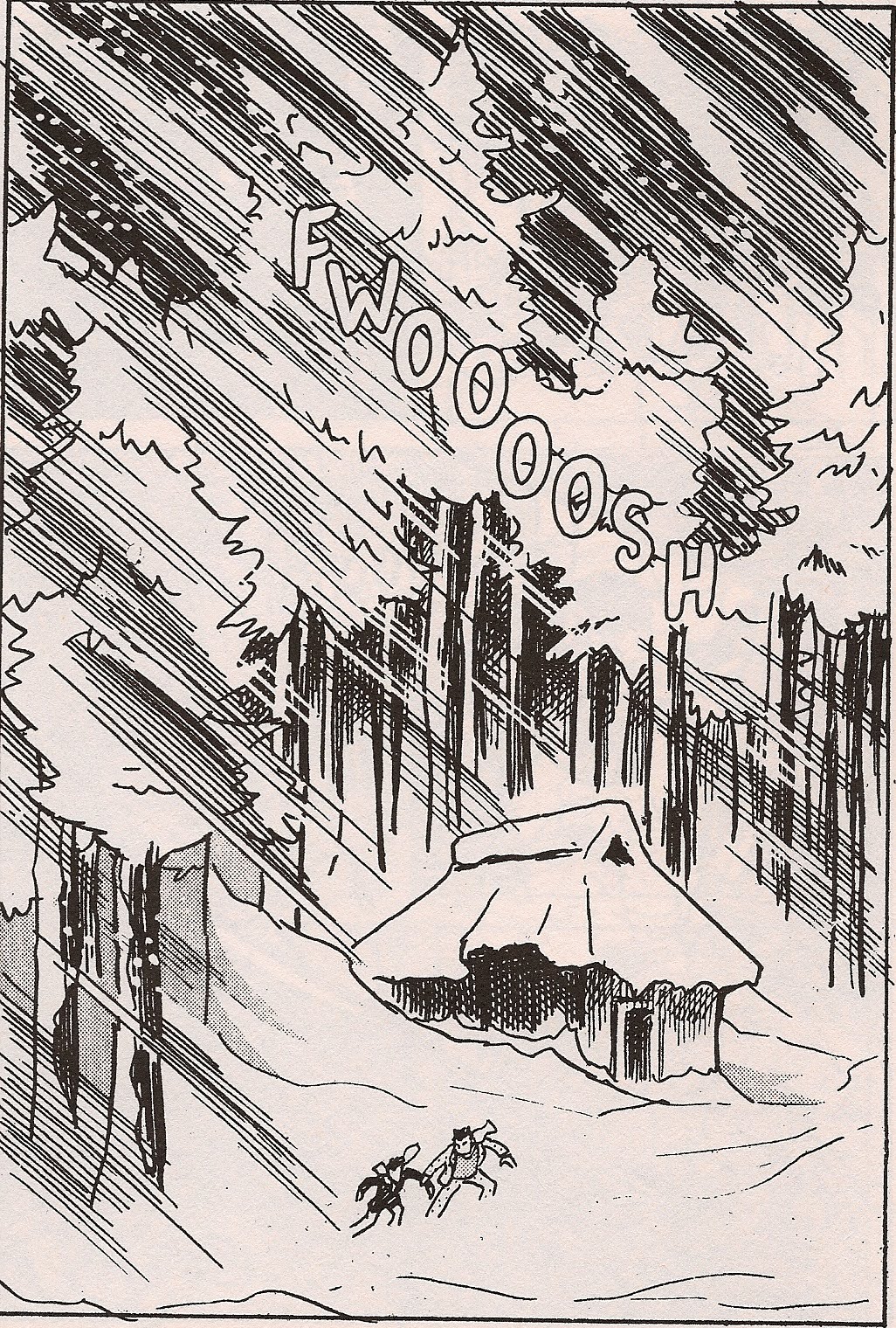
This kineticism extends to even the smallest gestures; in the very first panels, for example, we see a pair of hands banging out notes on a keyboard:
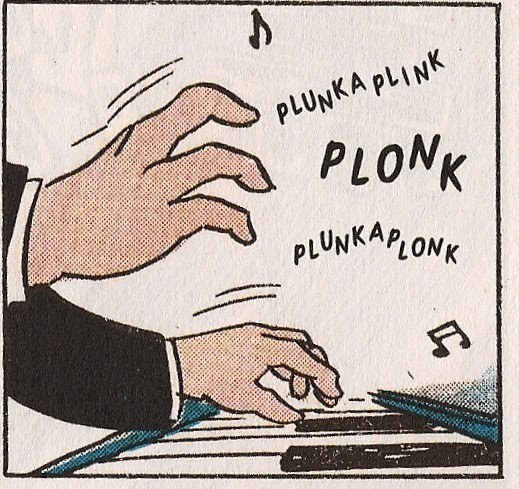
The composition couldn’t be simpler — just a few speedlines and sound effects convey the action — but these details, when coupled with the claw-like position of the hands, suggest the pianist’s extreme agitation, an impression confirmed just a few panels later when we first see Susumu’s sweat-drenched face.
Tatsumi’s regard for anatomy is, at times, careless; Susumu has Rachmaninoff-sized mitts, to judge from the awkward way in which his hands are drawn, while other cast members look stumpy, with grossly foreshortened legs. Yet for all the obvious flaws in his draftmanship, Tatsumi’s gestural approach to characterization proves well-suited to the material’s relentless pace, efficiently communicating each cast member’s personality, age, and plot function with a few artfully rendered lines and shapes. Shinpei, in particular, is a terrific creation, with a broad, sagging jaw and two thick, diagonal lines for eyebrows, making him a dead ringer for a jack-o-lantern.
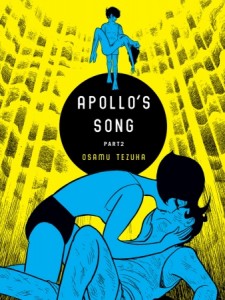
Drawn & Quarterly has done a fine job of adapting Black Blizzard for Western readers, thanks, in large part, to a crisp translation by Akemi Wegmuller that captures the unique cadences of mid-century noir; one can almost imagine Shinpei referring to an attractive woman as a “tomato.” The volume also includes an interview with Tatsumi; read in tandem with “The Joy of Creation,” one of the later chapters in A Drifting Life, the interview sheds light on Tatsumi’s creative process as well as the work’s initial reception. Editor and designer Adrian Tomine has given Black Blizzard a retro-chic makeover, dying the trim yellow and boldly announcing the book’s price in the manner of a dime-store novel. It’s an attractive design (see above), but I can’t help wishing that Drawn and Quarterly had used Masami Kuroda’s original painting:

It’s a minor complaint, to be sure, but the original cover — to my mind, at least — is a closer expression of the story’s pulpy roots and futurism-tinged artwork.
That said, Black Blizzard is a welcome addition to the growing body of mid-century manga now available in English, providing an all-too-rare glimpse into the early stages of the gekiga movement. And while it lacks the visual and narrative polish of Tatsumi’s mature work, I’ll take the sweaty hyperbole of Black Blizzard over the dour verismo of The Push Man any day; Black Blizzard has a vital, improvisatory energy missing from Tatsumi’s later period, even though his command of the medium was clearly more assured in the 1960s and 1970s.
BLACK BLIZZARD • BY YOSHIHIRO TATSUMI • DRAWN & QUARTERLY • 132 pp. • NO RATING



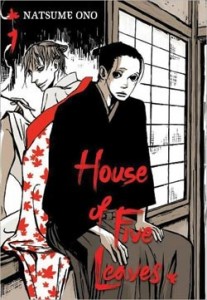 House of Five Leaves, too, focuses less on Big Events and more on everyday activity, but in Leaves, Ono’s restraint serves an important dramatic purpose: she’s showing us events through Masanosuke’s eyes, as he tries to reconcile the bandits’ seemingly ordinary lives with their extraordinary behavior. Making the reader‘s task more difficult is that Masanosuke isn’t very astute. He tends to focus on a kind gesture or a friendly conversation, missing many of the important aural and visual cues that might enable him to understand what’s happening — a trait that the group exploits. In one chapter, for example, Yaichi encourages Masanosuke to accept a job as a bodyguard for a merchant family while the group plans its next kidnapping. Masa befriends his new employer’s son, never realizing that his true assignment is to infiltrate the target’s household so that Yaichi’s minions can snatch the boy for ransom.
 Back in the 1980s and 1990s, before publishers realized that they could sell manga to teenagers through Borders and Books-A-Million, VIZ and Dark Horse actively courted the comic-store crowd with blood, bullets, and boobs. It was a golden age for manly-man manga — think Crying Freeman and Hotel Harbor View — but it was also a period in which publishers licensed some bad stuff. And when I say “bad stuff,” I mean it: I’m talking ham-fisted dialogue, eyeball-bending artwork, and kooky storylines that defy logic. Lycanthrope Leo (1997), an oddity from the VIZ catalog, is one such manga, a horror story with a plot that might best be described as Teen Wolf meets The Island of Dr. Moreau with a dash of WTF?!
 When reading historical manga, I grant the artist creative license to tell a story that evokes the spirit of an age rather than its details. What rankles my inner historian, however, are the kind of anachronisms that result from sheer laziness or paucity of imagination: modern slang, gross disregard for well-established fact. Alas, Color of Rage is filled with the kind of historical howlers that would make C. Vann Woodward or Leon Litwack gnash their teeth in despair.
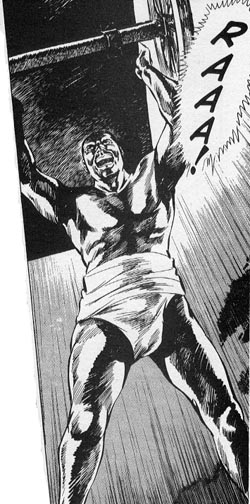 The bigger problem, however, is that King entertains notions of race, class, and gender that would have been as alien to American colonists as they were to Japanese farmers and overlords. His blind commitment to addressing inequality wherever he encounters it — on the road, at a brothel — leads him to do and say incredibly reckless things that require George’s boffo swordsmanship and insider knowledge of the culture to rectify. If anything, King’s idealism makes him seem simple-minded in comparison with George, who comes across as far more worldly, pragmatic, and clever. I’m guessing that Koike thought he’d created an honorable character in King without realizing the degree to which stereotypes, good and bad, informed the portrayal. In fairness to Koike, it’s a trap that’s ensnared plenty of American authors and screenwriters who ought to know that the saintly black character is as clichéd and potentially offensive a stereotype as the most craven fool in Uncle Tom’s Cabin. By relying on American popular entertainment for his information on slavery, however, Koike falls into the very same trap, inadvertently resurrecting some hoary racial and sexual tropes in the process.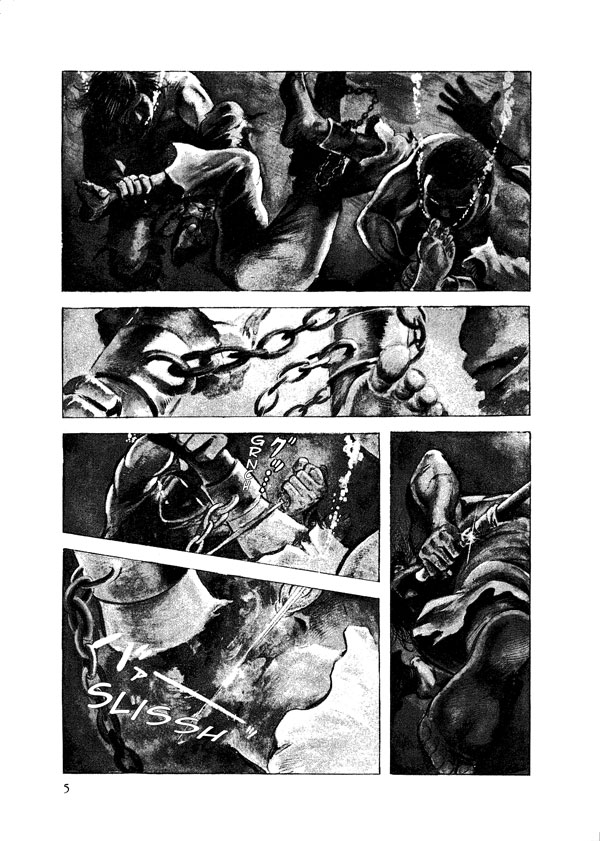
 Though I frequently grouse about fanservice , I have a grudging respect for those artists who make costume failures, panty shots, and general shirtlessness play essential roles in advancing their plots. Consider