• Skip to primary navigation
  • Skip to main content
  • Skip to primary sidebar
  • Home
  • About Us
    • Privacy Policy
    • Comment Policy
    • Disclosures & Disclaimers
  • Resources
    • Links, Essays & Articles
    • Fandomology!
    • CLAMP Directory
    • BlogRoll
  • Features & Columns
    • 3 Things Thursday
    • Adventures in the Key of Shoujo
    • Bit & Blips (game reviews)
    • BL BOOKRACK
    • Bookshelf Briefs
    • Bringing the Drama
    • Comic Conversion
    • Fanservice Friday
    • Going Digital
    • It Came From the Sinosphere
    • License This!
    • Magazine no Mori
    • My Week in Manga
    • OFF THE SHELF
    • Not By Manga Alone
    • PICK OF THE WEEK
    • Subtitles & Sensibility
    • Weekly Shonen Jump Recaps
  • Manga Moveable Feast
    • MMF Full Archive
    • Yun Kouga
    • CLAMP
    • Shojo Beat
    • Osamu Tezuka
    • Sailor Moon
    • Fruits Basket
    • Takehiko Inoue
    • Wild Adapter
    • One Piece
    • After School Nightmare
    • Karakuri Odette
    • Paradise Kiss
    • The Color Trilogy
    • To Terra…
    • Sexy Voice & Robo
  • Browse by Author
    • Sean Gaffney
    • Anna Neatrour
    • Michelle Smith
    • Katherine Dacey
    • MJ
    • Brigid Alverson
    • Travis Anderson
    • Phillip Anthony
    • Derek Bown
    • Jaci Dahlvang
    • Angela Eastman
    • Erica Friedman
    • Sara K.
    • Megan Purdy
    • Emily Snodgrass
    • Nancy Thistlethwaite
    • Eva Volin
    • David Welsh
  • MB Blogs
    • A Case Suitable For Treatment
    • Experiments in Manga
    • MangaBlog
    • The Manga Critic
    • Manga Report
    • Soliloquy in Blue
    • Manga Curmudgeon (archive)

Manga Bookshelf

Discussion, Resources, Roundtables, & Reviews

Katherine Dacey

Grand Guignol Orchestra, Vol. 3

June 9, 2011 by Katherine Dacey

In his review of TRON: Legacy, critic Andrew O’Hehir made a distinction between movies that are boring because they make the viewer keenly aware of time’s passage — what he calls “intentional and challenging boredom” — and movies that are boring because they overstimulate the viewer — what he calls the boredom of “endless distraction and wall-to-wall entertainment.” Kaori Yuki’s latest effort, Grand Guignol Orchestra, is a prime example of the latter, a relentlessly melodramatic horror story that never pauses to catch its breath. And while that kind of manga can be engrossing, Yuki’s unwillingness to vary the tone or pace robs Grand Guignol Orchestra of its power to shock, amuse, or arouse anything resembling a real human emotion.

In other words, it’s boring.

The third volume isn’t boring for lack of effort. There’s a lengthy set-piece in which Eles, Gwindel, and Lucille engage in hand-to-hand combat with an evil, cross-dressing nun who is, in fact, a castrato; there are several flashbacks to Lucille and Gwindel’s tortured pasts; and there’s a third-act auction in which noblemen bid for the privilege of watching a young woman be transformed into a zombie. And if those plot twists weren’t enough to hold the reader’s attention, Yuki throws in a few more for good measure: characters double- and triple-cross each other, former enemies unite against a common foe, and zombies swarm a castle, chomping on everyone in sight.

For all the sound and fury, volume three is dramatically inert. Every conversation is overwrought to the point of cartoonishness, draining the truly horrific and sad moments of their visceral power. Worse still, Yuki feels the need to include closed captions for the emotionally impaired, a function she’s assigned to the hapless Eles; when Eles isn’t playing the piano or being held hostage by one of Lucille’s enemies, her primary job is to think about the other characters: “Oh, so that’s why so-and-so has been depressed!” or “They don’t hate each other; they just can’t be together!” And so on.

The artwork, like the script, seems calculated to overwhelm rather than seduce. Yuki is a big proponent of the costume-as-character school of manga writing, substituting epaulets, eye patches, and lace for actual personality traits. As a result, every character, no matter how inconsequential to the story, wears a wackadoo outfit of one sort or another: a habit with a plunging neckline, a clown mask and a cock-eyed top hat. Yuki’s artwork is certainly arresting; her linework is very sensual, and her flair for drawing costumes undeniable, but her desire to populate every scene with elaborately dressed nuns, zombies, and masqueraders comes across as numbing excess in a story that lacks any form of narrative restraint.

I realize that many people will read this review and think I’m a killjoy, that I’ve lost my ability to enjoy a manga for what it is and not what I want it to be. And, to some extent, those readers are right; after five years of grinding out manga reviews, I’m no longer enthusiastic about stories that rely on spectacle to command my attention. But what I find more frustrating about Grand Guignol Orchestra is that there’s nothing real or interesting lurking beneath its busy surface; it’s hysteria masquerading as drama, and the constant stimulation of all-caps dialogue, sudden plot reversals, and Baroque murders becomes its own form of tedium to be endured, rather than something to be savored and enjoyed.

Review copy provided by VIZ Media, LLC.

GRAND GUIGNOL ORCHESTRA, VOL. 3 • BY KAORI YUKI • VIZ MEDIA • 196 pp. • RATING: OLDER TEEN (16+)

Filed Under: Manga, Manga Critic, REVIEWS Tagged With: Grand Guignol Orchestra, Kaori Yuki, shojo, shojo beat, VIZ, Zombies

A Certain Scientific Railgun, Vol. 1

June 6, 2011 by Katherine Dacey 16 Comments

Question: what do you get when you cross Sunshine Sketch with X-Men? Answer: A Certain Scientific Railgun, a story about a quartet of schoolgirl psychics who fight crime, go shopping, and eat parfaits. If that combination sounds like the manga equivalent of a peanut butter and tunafish sandwich, it is; the story see-saws between sci-fi pomposity and 4-koma cuteness, never combining these two very different flavors into an appetizing dish.

The story takes place in Academy City, a metropolis whose entire population consists of psychics and psychics-in-training. After a series of bank robberies and bombings, members of Justification, Academy City’s teen police force, make a disturbing discovery: some psychics — or “espers,” in the series’ parlance — are using an illicit drug called Level Upper to enhance their natural ability. (Level Upper is, in essence, steroids for teleporters and mind-readers.) Though the drug grants them tremendous power, that power comes with a terrible price, causing the user to slip into an irreversible coma. The girls must then track the drug to its source before it can spread through Academy City.

As promising as the plot sounds, it often feels like an afterthought, something that happens in between the principal characters’ trips to the mall, the cafe, and the gym. (There’s an entire scene devoted to one character’s efforts to find the perfect pair of pajamas. No, I’m not kidding.) The lead character, Mikoto, is the strongest and best-defined of the bunch; she’s described as a “level-five esper” capable of channeling up to one billion volts of electricity, a skill she gleefully unleashes on robbers, perverts, and her arch-nemesis, a male psychic named Toma Kamijo. Though Mikoto is an unappealing heroine, she’s the only female character who has a real personality; Mikoto is angry, unpredictable, and stubborn, but she’s also very disciplined, cultivating her skills with practice and study. Kuroko, Ruiko, and Kazari, the remaining members of the quartet, are less developed: each girl has one psychic ability that she uses in combat and one adorable tic that she exhibits while hanging out with friends. (Actually, “adorable” is up for debate; grabbing another girl’s breasts seems more predatory than cute.)

Thin as the characterizations may be, A Certain Scientific Railgun faces an even bigger problem: many important plot elements are poorly explained. Not that the series wants for exposition-dense conversation; the opening ten pages are filled with characters narrating Mikoto’s rise from level-zero nobody to level-five bad-ass. But many other details remain unexplored: who is Toma and why does Mikoto detest him? why do so many characters have supernatural abilities? why has the government created an entire city just for young psychics? Perhaps the most egregious example is Mikoto herself; though we learn a lot about her education, the fact that she’s been cloned is glossed over, as if having six genetic doppelgangers was entirely unremarkable.

Given Railgun‘s origins — it’s a side story within A Certain Magical Index, a long-running light novel series — it’s not surprising that so many of these crucial details remain unexamined; the author might reasonably expect Japanese fans to know the Magical Index universe well enough to jump into Railgun with a minimum of exposition. For a newcomer, however, the experience is frustrating; uninteresting plot points are explored in excruciating detail, while many of the things that seem more fundamental to the story (e.g. the characters’ psychic abilities) are barely addressed at all.

The final chapter suggests that future installments may feature more scenes of crime-solving and fewer scenes of tweenage girls showering, eating desserts, and horsing around. An honest-to-goodness mystery would go a long way towards giving the story some dramatic shape; right now, A Certain Scientific Railgun feels as aimless and airy as a volume of Sunshine Sketch, even if Mikoto and friends have cooler talents than the Sunshine girls.

Review copy provided by Seven Seas. Volume one will be released on June 30, 2011.

A CERTAIN SCIENTIFIC RAILGUN, VOL. 1 • STORY BY KAZUMA KAMACHI, ART BY MOTIO FUYUKAWA • SEVEN SEAS • 192 pp. • RATING: TEEN (13+)

Filed Under: Manga Critic Tagged With: Certain Magical Index, Seven Seas

A Certain Scientific Railgun, Vol. 1

June 6, 2011 by Katherine Dacey

Question: what do you get when you cross Sunshine Sketch with X-Men? Answer: A Certain Scientific Railgun, a story about a quartet of schoolgirl psychics who fight crime, go shopping, and eat parfaits. If that combination sounds like the manga equivalent of a peanut butter and tunafish sandwich, it is; the story see-saws between sci-fi pomposity and 4-koma cuteness, never combining these two very different flavors into an appetizing dish.

The story takes place in Academy City, a metropolis whose entire population consists of psychics and psychics-in-training. After a series of bank robberies and bombings, members of Justification, Academy City’s teen police force, make a disturbing discovery: some psychics — or “espers,” in the series’ parlance — are using an illicit drug called Level Upper to enhance their natural ability. (Level Upper is, in essence, steroids for teleporters and mind-readers.) Though the drug grants them tremendous power, that power comes with a terrible price, causing the user to slip into an irreversible coma. The girls must then track the drug to its source before it can spread through Academy City.

As promising as the plot sounds, it often feels like an afterthought, something that happens in between the principal characters’ trips to the mall, the cafe, and the gym. (There’s an entire scene devoted to one character’s efforts to find the perfect pair of pajamas. No, I’m not kidding.) The lead character, Mikoto, is the strongest and best-defined of the bunch; she’s described as a “level-five esper” capable of channeling up to one billion volts of electricity, a skill she gleefully unleashes on robbers, perverts, and her arch-nemesis, a male psychic named Toma Kamijo. Though Mikoto is an unappealing heroine, she’s the only female character who has a real personality; Mikoto is angry, unpredictable, and stubborn, but she’s also very disciplined, cultivating her skills with practice and study. Kuroko, Ruiko, and Kazari, the remaining members of the quartet, are less developed: each girl has one psychic ability that she uses in combat and one adorable tic that she exhibits while hanging out with friends. (Actually, “adorable” is up for debate; grabbing another girl’s breasts seems more predatory than cute.)

Thin as the characterizations may be, A Certain Scientific Railgun faces an even bigger problem: many important plot elements are poorly explained. Not that the series wants for exposition-dense conversation; the opening ten pages are filled with characters narrating Mikoto’s rise from level-zero nobody to level-five bad-ass. But many other details remain unexplored: who is Toma and why does Mikoto detest him? why do so many characters have supernatural abilities? why has the government created an entire city just for young psychics? Perhaps the most egregious example is Mikoto herself; though we learn a lot about her education, the fact that she’s been cloned is glossed over, as if having six genetic doppelgangers was entirely unremarkable.

Given Railgun‘s origins — it’s a side story within A Certain Magical Index, a long-running light novel series — it’s not surprising that so many of these crucial details remain unexamined; the author might reasonably expect Japanese fans to know the Magical Index universe well enough to jump into Railgun with a minimum of exposition. For a newcomer, however, the experience is frustrating; uninteresting plot points are explored in excruciating detail, while many of the things that seem more fundamental to the story (e.g. the characters’ psychic abilities) are barely addressed at all.

The final chapter suggests that future installments may feature more scenes of crime-solving and fewer scenes of tweenage girls showering, eating desserts, and horsing around. An honest-to-goodness mystery would go a long way towards giving the story some dramatic shape; right now, A Certain Scientific Railgun feels as aimless and airy as a volume of Sunshine Sketch, even if Mikoto and friends have cooler talents than the Sunshine girls.

Review copy provided by Seven Seas. Volume one will be released on June 30, 2011.

A CERTAIN SCIENTIFIC RAILGUN, VOL. 1 • STORY BY KAZUMA KAMACHI, ART BY MOTIO FUYUKAWA • SEVEN SEAS • 192 pp. • RATING: TEEN (13+)

Filed Under: Manga, Manga Critic, REVIEWS Tagged With: Certain Magical Index, Seven Seas

Pick of the Week: Spring Bounty

June 6, 2011 by Michelle Smith, MJ, David Welsh and Katherine Dacey 10 Comments

The arrivals list at Midtown Comics overflows with manga, making this week’s Pick a tough one for all. Take a look below to see what made the cut!


MICHELLE: It’s a bountiful week at Midtown Comics, with many Shonen Jump and Shojo Beat offerings from VIZ making their way onto the shelves. There’s an awful lot on this list that I am personally planning to buy, and singling out just one is pretty tough. New volumes of One Piece and Slam Dunk are serious contenders, but in the end, the fifth volume of Bakuman。 walks away with the honors. I’ve been catching up on the series this weekend, and it’s just utterly charming. The behind-the-scenes glimpses into manga production at Shueisha are fascinating, Mashiro and Takagi are finally achieving some success, and an interesting crop of friendly rivals has developed, including the endearingly weird Eiji Nizuma, who has been waiting for Mashiro and Takagi to come challenge him. Now, gee, what other Shonen Jump manga illustrated by Takeshi Obata does that remind me of?

MJ: We’re offered a wealth of choices this week, indeed. New volumes of Black Jack, Claymore, and Rasetsu call out to me in particular, but if I could only buy one volume of manga from this list, I’d have to choose the 25th installment of Fullmetal Alchemist. I doubt anybody needs me to go on and on again about why I love this series, but just in case you’ve missed it somehow, feel free to browse this tag. And for those who’ve never gotten around to starting this admittedly long series, now is the perfect time to start, with the first of Viz’s new 3-in-1 editions arriving in stores this week as well. If you’ve only watched the anime series, you don’t know what you’re missing. Time to pick up a volume and find out!

DAVID: Viz really could learn to pace itself. I’m quite eager to read the third volume of Kamisama Kiss and curious to see which way the pendulum will swing on Grand Guignol Orchestra, not to mention the previously mentioned books, but I’m going to have to cast my vote for the 14th volume of Osamu Tezuka’s Black Jack from Vertical. Much as I love Tezuka’s crazed gekiga stories, I have such a weakness for this series and its totally reliable, often absurd servings of genre fiction. I have high hopes that this volume will offer a nice side dish of creepy, creepy Pinoko.

KATE: Tempted as I am by the second volume of Blue Exorcist, I’m also going old-school with my pick and choosing the fourteenth volume of Black Jack as this week’s must-buy manga. I’d be the first to admit that the series can be repetitive, especially when read in large chunks. But if you ration yourself to just one or two stories at a time, it’s easier to appreciate Tezuka’s storytelling gift; he manages to fit a whole volume’s worth of drama into twenty pages without sacrificing clarity or emotional intensity. The hero’s dark, brooding personality is another plus; Black Jack may share Dr. Gregory House’s ability to diagnose a rare illness from looking at a character’s fingernails or smelling his breath, but Jack isn’t nearly as smug and insufferable as his TV counterpart. I’m not sure how Tezuka will ever top the story in which Black Jack operates on himself in the Australian outback while fending off wild dingoes, but I’m happy to keep reading until Tezuka does.


Readers, what looks good to you this week?

Filed Under: PICK OF THE WEEK Tagged With: bakuman, black jack, fullmetal alchemist

Bookshelf Briefs 6/6/11

June 6, 2011 by MJ, Katherine Dacey, David Welsh and Michelle Smith 4 Comments

This week, MJ, Kate, David, & Michelle take a look at a variety of manga from Viz Media, Vertical Inc., Digital Manga Publishing, and Yen Press.


Bakuman, Vol. 5 | By Tsugumi Ohba & Takeshi Obata | Viz Media – The theme for this volume may as well be “Everyone makes progress toward making their dreams come true!” Not that everything is smooth sailing. Mashiro and Takagi finally have a series in Shonen Jump, but along with that comes new editor, Miura, who is rather inexperienced. It takes him some time to gain the confidence to steer the boys in a direction that will keep their series popular with readers. Meanwhile, other friends and rivals aim for the same goal and even Miho experiences a rejuvenation in her dedication to become a voice actress. It’s a thoroughly shounen setup, which is only fitting for a story about making shounen manga. I wish we actually got to see some of this manga they’re creating, though! Maybe in due time… -Michelle Smith

Black Bird, Vol. 8 | By Kanoko Sakurakoji | Viz Media – If there’s one thing that can be said for Kanoko Sakurakoji’s Black Bird, it’s that it stays unflinchingly on message, volume after volume. “Girls, always obey what the menfolk tell you,” it says over and over, in a thousand different ways. “They’re smarter and stronger than you are, so they always know what’s best.” That’s the overwhelming message of this series, though there’s an equally consistent side note attached, “Be grateful and understanding when your man punishes you for your mistakes. After all, it’s for your own good.” Volume eight personifies these messages without fail, as always, with the added bonus of the much-anticipated consummation of Misao and Kyo’s sexual relationship, which is of course preceded by extra gratitude, humility, and expressions of flushed desperation from our heroine. Yay? -MJ

Bleach, Vol. 35 | By Tite Kubo | Viz Media – Despite its status as a hit battle manga, for a reader like me, the best of Bleach exists between battles, when Tite Kubo is able to utilize his (not insignificant) talent for writing quirky, compelling characters. Unfortunately Kubo tends to excess in this area, creating a never-ending stream of brand new characters, leaving less room and page time for those we already love. With that in mind, volume 35 reveals both the best and worst of Kubo’s habits, providing some genuinely satisfying moments with some of our favorite characters while leading us into another series of battles with an array of new foes. If I could deliver one message to Kubo, it would be that when it comes to supporting characters, sometimes less is more. 35 stacks up in the “win” column, but the future looks far less bright. – MJ

Blue Exorcist, Vol. 2 | By Kazue Kato | Viz Media – In discussion of this series’ first volume, I said, ” I’d like to see more … with Rin actually learning the craft under Yukio’s tutelage, because watching the two of them together is the most compelling aspect of the story so far.” The good news here is that we do see more of this, and it indeed remains the series’ greatest strength. The less good news is that the bulk of this volume is spent introducing the class’ other students, including hotheaded Suguro and by-the-book tsundere Izumo. Though there’s obviously a self-formed family of young exorcists being nurtured here, it’s a shame to have so much of the volume’s focus stolen away by it, when we’ve only just begun with the series’ two main characters. Still, this remains the most compelling new shounen series to travel westward this year. I look forward to seeing where it goes from here. – MJ

A Bride’s Story, Vol. 1 | By Kaoru Mori | Yen Press – This is one of those books where I’m convinced I could pass off random page scans as a review, possibly followed up with, “See? See?!” I can’t quite decide if it’s more gorgeous than Mori’s Emma (CMX), but I can say without question that it’s one of the loveliest manga you’re likely to find in current release. It’s also as quietly moving and packed with absorbing details as Emma was, so you really can’t lose. In this tale set in central Asia in the 19th century, a 20-year-old woman enters into an arranged marriage with a 12-year-old boy. We see quietly forceful Amir adapt from her nomadic lifestyle to the more settled state of affairs with her young bridegroom. There’s the whispered promise of an actual plot, but I could read dozens of volumes of nothing but Mori’s meticulously researched, breathtakingly drawn slice of life. Really, what more do you need? -David Welsh

Chi’s Sweet Home, Vol. 6 | By Konami Kanata | Vertical, Inc. – After five volumes of cute kitten antics — including Chi’s first visit to the vet, Chi’s first bath, and Chi’s first excursion beyond the safe confines of home — I thought Kanata Konami would have run out of material. I’m pleased to report that volume six of Chi’s Sweet Home is just as appealing and fresh as the previous installments, offering plenty of awwww-inducing moments as well as some genuinely funny scenes. (Don’t miss the chapter in which Chi stalks a parakeet; Chi’s reaction to the parakeet is priceless.) Konami continues to expand the scope of the story to include more animals, more people, and more settings, neatly mimicking Chi’s growing awareness of her surroundings while preventing the story from becoming too cutely claustrophobic. As in previous volumes, the illustrations are simple but effective, capturing Chi’s surprise and delight in discovering new things: vacuum cleaners, Kleenex, birthday cake. Recommended. -Katherine Dacey

Chi’s Sweet Home, Vol. 6 | By Konami Kanata | Vertical, Inc. – Whenever a new volume of Chi’s Sweet Home comes into my possession it automatically vaults to the top of the to-read pile. The first five volumes all offered colorful, cute, and (mostly) cheerful stores about Chi, an adorable tabby kitten, and the sixth is no exception. Kanata has a knack for depicting scenarios familiar to any cat owner, like massacred houseplants and the species-wide fascination with climbing into boxes, while imagining what the world must look like to a cat. Chi’s nocturnal journey to the local park is a particular standout. My one complaint is that Chi’s owners, the Yamadas, continually do frustrating things like leave cakes unattended and store breakable objects at the top of a flight of stairs, then proceed to freak out when Chi messes with them. You’ve got a cat now, folks. You either put things away or get used to the gnaw marks. -Michelle Smith

Itsuwaribito, Vol. 2 | By Yuuki Iinuma | Viz Media – In this volume, Utsuho proves himself trustworthy to the implausibly youthful Dr. Yakuma by rescuing him from the clutches of a bizarre fellow whom I shall christen “Freaky Dude.” Not only that, he correctly deduces the cause of Freaky Dude’s killing spree and helps him to see the error of his ways. The display convinces Yakuma to invite Utsuho on a journey to Nadeshiko Island, where he suspects a treasure of life-extending medicine awaits. It also happens to be the location of many exiled criminals. I’m still not enraptured by Itsuwaribito, but I found this volume a lot more entertaining than the first. For reasons I cannot quite pinpoint, it reminds me of Black Cat, in a simple shounen adventure kind of way. Plus, there’s an adorable twitchy-eared talking tanuki! I’ll definitely be checking out volume three. -Michelle Smith

Twin Spica, Vol. 7 | By Kou Yaginuma | Vertical, Inc. – In the seventh volume of Twin Spica, Kou Yaginuma explores Marika’s childhood, as well as Marika’s struggle to create her own destiny, rather than the one for which she was created. Though Marika’s story is emotionally compelling, Yaginuma strains too hard to show us that Marika, Asumi, and Fuchuya have a shared history; there’s a tidiness to the connection that feels a little false, as if the characters’ shared memory of the Lion disaster wasn’t grounds enough for bonding. The volume’s final chapters are more dramatically persuasive, giving the three female leads a chance to demonstrate just how smart, resourceful, and tough they can be under duress. N.B. Beginning with volume seven, Vertical will be releasing Twin Spica in a longer omnibus format of 300-400 pages (roughly 1.5 volumes). -Katherine Dacey

Your Story I’ve Known | By Tsuta Suzuki | Juné Manga – It’s rare that I find the sex scenes in a boys’-love title to be the most interesting, but that’s definitely the case in the title story of this book. Suzuki laces the physically intimate moments with intriguing, revealing observations. Unfortunately, those kinds of notes are largely absent in the rest of this tale of a gangster who takes up with the son of one of his ex-girlfriends. It’s drawn well, but the characters and their dynamic aren’t very engaging. The back-up stories compensate for the centerpiece, though. One’s about a young man dealing with his lover’s irritating reticence. Another is a love story between a kid and a goofy, centuries-old ghost. The last describes the awkward early courtship between two salarymen. Each has a distinct, quirky charm, making the book a worthwhile investment overall. -David Welsh

Filed Under: Bookshelf Briefs Tagged With: a bride's story, bakuman, black bird, bleach, blue exorcist, chi's sweet home, itsuwaribito, twin spica, your story I've known

Tenjo Tenge: Full Contact Edition, Vol. 1

June 3, 2011 by Katherine Dacey 26 Comments

When I tell people that I review manga, they often ask me, “Isn’t it all porn and ninjas?” No, I assure them, there are manga about cooking, gambling, dating, teaching, crime solving, alien fighting, computer programming, ghost busting, mind reading, wine tasting, dog training, and just about any other topic you can imagine; if there’s an audience to be served, Japanese publishers will find a way to reach them through comics.

“But it seems like every manga I’ve seen has a girl in a short skirt waving a sword,” they reply. I usually offer a counter-example — say, Ouran High School Host Club or What’s Michael? — but I know the kind of manga they have in mind. It’s filled with female characters who have women’s bodies and girls’ faces; schoolgirls who wear their uniforms twenty-four hours a day; fighters who use swords, even though the story is set in the present; and supporting characters who dress like Edo-era refugees, even though their cohorts are wearing sneakers and hoodies. In short, what they’re seeing in their mind’s eye looks a lot like Tenjo Tenge.

Plot-wise, Tenjo Tenge isn’t much more complicated than “girls in skirts waving katanas.” The story takes place at Todo Academy, one of those only-in-manga institutions where students study martial arts technique to the exclusion of anything else. (If anyone attends a math class in Tenjo Tenge, I missed it.) First-year students Soichiro Nagi and Bob Makihara fully expect to rule the roost with their awesome fighting skills, but are quickly disabused of the notion when they run afoul of Todo’s Executive Council. Mindful of their greenhorn status, the boys join the Juken Club, an organization lead by Maya Natsume, a third-year student who’s handy with a sword. In so doing, however, Soichiro and Bob become targets for the Executive Council, which carries on an energetic, bloody feud with Maya and her younger sister.

Flipping through the first volume of VIZ’s “Full Contact” edition, it’s easy to see why DC Comics censored the original English print run. The story abounds in the kind of gratuitous nudity and sexual encounters that make an unadulterated version a tough sell at big chain stores like Wal-Mart and Barnes & Noble. DC Comics’ solution was an inelegant one: they re-wrote the script, drew bras and panties on naked girls, and cut some of the most offensive passages. As an advocate of free speech, I can’t condone the bowdlerization of any text, especially in the interest of a more commercially viable age-rating , but as a woman, it’s hard to celebrate the restoration of a graphic rape scene or images of naked girls throwing themselves at the heroes.

Whether those scenes are really necessary to advancing the plot is another issue. The rape, in particular, is an ugly exercise in exploitation, pitting a grown man against a teenager who has a twelve-year-old’s face and a porn star’s body. Though Oh!Great shows us the victim’s terrified expression in several panels, he lavishes far more attention on her anatomy, twisting her body into the kind of grotesque, provocative poses that were a stock-in-trade of Hustler. What makes this passage especially nasty is its underlying intent; we’re not being asked to identify with the victim, or burn with outrage over her violation, but to be aroused by her naked body. In a word: yuck.

From time to time, Oh!Great gives the Natsume sisters a chance to strut their martial arts stuff, suggesting that both girls are as tough and cunning as their male counterparts, but he can’t resist tearing off their clothes, or showing us their panties, especially when they’re in the middle of intense, hand-to-hand combat. And if the characters’ complete objectification wasn’t bad enough, Oh!Great draws such grossly misshapen bodies that it’s hard to imagine who would find them sexy; say what you will about Ryoichi Ikeda and Kazuo Koike’s Wounded Man — and yes, there’s plenty to say about the exploitation of its female characters — but Ikeda knew how to draw beautiful women. Oh!Great’s female characters, on the other hand, look like blow-up dolls, incapable of standing on their own two feet, let alone brandishing a sword or high-kicking an opponent.

Tenjo Tenge fans who were angered by the first English-language edition will be pleased with VIZ’s new translation. Many of the elements that had been eliminated or camouflaged in the first version have been restored; characters drop f-bombs and drop trou without editorial intervention. As an added enticement, VIZ has formatted the story as a series of two-in-one omnibuses, complete with glossy color plates and oversized trim. Given the care with which the new Tenjo Tenge was prepared, I wish I could say that the uncensored version convinced me that I’d unfairly dismissed the genius of Oh!Great the first time around. Alas, the answer is no; the story comes is too perilously close to the porn-and-ninjas stereotype for my taste.

Review copy provided by VIZ Media, LLC. Volume one of Tenjo Tenge will be released on June 7, 2011.

TENJO TENGE: FULL CONTACT EDITION, VOL. 1 • BY OH!GREAT • VIZ MEDIA • 386 pp. • RATING: MATURE (18+)

Filed Under: Manga Critic Tagged With: Martial Arts, Oh!Great, Tenjo Tenge Full Contact Edition, VIZ

Tenjo Tenge: Full Contact Edition, Vol. 1

June 3, 2011 by Katherine Dacey

When I tell people that I review manga, they often ask me, “Isn’t it all porn and ninjas?” No, I assure them, there are manga about cooking, gambling, dating, teaching, crime solving, alien fighting, computer programming, ghost busting, mind reading, wine tasting, dog training, and just about any other topic you can imagine; if there’s an audience to be served, Japanese publishers will find a way to reach them through comics. “But it seems like every manga I’ve seen has a girl in a short skirt waving a sword,” they reply. I usually offer a counter-example — say, Ouran High School Host Club or What’s Michael? — but I know the kind of manga they have in mind. It’s filled with female characters who have women’s bodies and girls’ faces; schoolgirls who wear their uniforms twenty-four hours a day; fighters who use swords, even though the story is set in the present; and supporting characters who dress like Edo-era refugees, even though their cohorts are wearing sneakers and hoodies. In short, what they’re seeing in their mind’s eye looks a lot like Tenjo Tenge.

Plot-wise, Tenjo Tenge isn’t much more complicated than “girls in skirts waving katanas.” The story takes place at Todo Academy, one of those only-in-manga institutions where students study martial arts technique to the exclusion of anything else. (If anyone attends a math class in Tenjo Tenge, I missed it.) First-year students Soichiro Nagi and Bob Makihara fully expect to rule the roost with their awesome fighting skills, but are quickly disabused of the notion when they run afoul of Todo’s Executive Council. Mindful of their greenhorn status, the boys join the Juken Club, an organization lead by Maya Natsume, a third-year student who’s handy with a sword. In so doing, however, Soichiro and Bob become targets for the Executive Council, which carries on an energetic, bloody feud with Maya and her younger sister.

Flipping through the first volume of VIZ’s “Full Contact” edition, it’s easy to see why DC Comics censored the original English print run. The story abounds in the kind of gratuitous nudity and sexual encounters that make an unadulterated version a tough sell at big chain stores like Wal-Mart and Barnes & Noble. DC Comics’ solution was an inelegant one: they re-wrote the script, drew bras and panties on naked girls, and cut some of the most offensive passages. As an advocate of free speech, I can’t condone the bowdlerization of any text, especially in the interest of a more commercially viable age-rating , but as a woman, it’s hard to celebrate the restoration of a graphic rape scene or images of naked girls throwing themselves at the heroes.

Whether those scenes are really necessary to advancing the plot is another issue. The rape, in particular, is an ugly exercise in exploitation, pitting a grown man against a teenager who has a twelve-year-old’s face and a porn star’s body. Though Oh!Great shows us the victim’s terrified expression in several panels, he lavishes far more attention on her anatomy, twisting her body into the kind of grotesque, provocative poses that were a stock-in-trade of Hustler. What makes this passage especially nasty is its underlying intent; we’re not being asked to identify with the victim, or burn with outrage over her violation, but to be aroused by her naked body. In a word: yuck.

From time to time, Oh!Great gives the Natsume sisters a chance to strut their martial arts stuff, suggesting that both girls are as tough and cunning as their male counterparts, but he can’t resist tearing off their clothes, or showing us their panties, especially when they’re in the middle of intense, hand-to-hand combat. And if the characters’ complete objectification wasn’t bad enough, Oh!Great draws such grossly misshapen bodies that it’s hard to imagine who would find them sexy; say what you will about Ryoichi Ikeda and Kazuo Koike’s Wounded Man — and yes, there’s plenty to say about the exploitation of its female characters — but Ikeda knew how to draw beautiful women. Oh!Great’s female characters, on the other hand, look like blow-up dolls, incapable of standing on their own two feet, let alone brandishing a sword or high-kicking an opponent.

Tenjo Tenge fans who were angered by the first English-language edition will be pleased with VIZ’s new translation. Many of the elements that had been eliminated or camouflaged in the first version have been restored; characters drop f-bombs and drop trou without editorial intervention. As an added enticement, VIZ has formatted the story as a series of two-in-one omnibuses, complete with glossy color plates and oversized trim. Given the care with which the new Tenjo Tenge was prepared, I wish I could say that the uncensored version convinced me that I’d unfairly dismissed the genius of Oh!Great the first time around. Alas, the answer is no; the story comes is too perilously close to the porn-and-ninjas stereotype for my taste.

Review copy provided by VIZ Media, LLC. Volume one of Tenjo Tenge will be released on June 7, 2011.

TENJO TENGE: FULL CONTACT EDITION, VOL. 1 • BY OH!GREAT • VIZ MEDIA • 386 pp. • RATING: MATURE (18+)

Filed Under: Manga, Manga Critic, REVIEWS Tagged With: Martial Arts, Oh!Great, Tenjo Tenge Full Contact Edition, VIZ

Off the Shelf: Anniversary Edition

June 1, 2011 by Michelle Smith, MJ, Katherine Dacey and David Welsh 13 Comments

MICHELLE: Gee, they told me that we’d be holding Off the Shelf here this week, but it’s dark and doesn’t look like anyone’s here yet…

MJ: Surprise!!

Er. Sort of?

MICHELLE: OMG, no way! You guys~!

KATE: It’s OK, Michelle–we figured you might be on to us. But you do an excellent job of feigning surprise, if that’s any consolation.

DAVID: I made punch! It’s vivid pink and thick with booze!

MJ: I’ll take a glass of that punch!

MICHELLE: Well, I did kind of invite all of you here to celebrate not only my official induction into the Manga Bookshelf family, but also the one-year anniversary of Off the Shelf!

DAVID: And we’re thrilled to be here!

MJ: That’s right, we’ve actually been doing this column for a full year as of today. How wonderful that this coincides with Michelle’s official entry into our ranks!

KATE: Call me a skeptic, but that seems planned!

MICHELLE: I can vouch for it being a happy accident! Once we realized the coincidence, we knew we had to have a partay!

MJ: So, we’ve never tried to do this with more than two people before. I guess I should ask someone… So, David, read any good books this week?

DAVID: Ah! I have the perfect tonic for skepticism! And it comes in an omnibus-sized dose!

MICHELLE: Lay it on us!

DAVID: Indeed I did! When not hiking the canyons of southern Utah or trying to figure out how the lights worked in a Las Vegas hotel, I was paying a visit to CLAMP Land.

Now, based on what I’ve read of their work, I’m not a huge CLAMP fan. I think they can be pretty self-indulgent, and coherent narrative is not their highest priority. So I was totally delighted to see how focused Cardcaptor Sakura is. I read Book 1 of Dark Horse’s re-release while I was on vacation, and it was a complete treat. (I also suspect I was the only 40-something gay man in Utah who happened to be reading Book 1 of Cardcaptor Sakura at that point in time, which was gravy in a strange way that I can’t fully explain.)

Everyone probably already knows this, but it’s in the magical girl genre. Our heroine, Sakura, finds a dusty old book that used to contain the powerful Clow Cards, which grant the user various abilities. The guardian of the book, an adorable little whatsit called Kero, informs Sakura that she has magical abilities and can collect the missing cards, thus preventing unspecified disaster. It’s your basic gather-stuff-and-get-stronger structure, but it isn’t bogged down in the details of that ongoing quest. The CLAMP quartet doesn’t neglect Sakura’s card-capturing adventures, but they aren’t encyclopedically obsessed, either.

Their primary interest seems to be to give you reasons to like Sakura and her friends and family, and they knock that out of the park. Sakura is spunky and funny. She knows she’s a novice at the whole magic thing, but she’s not insecure about it. She has good instincts and trusts them, and she has reliable helpers. There’s the previously mentioned Kero, and there’s her rich classmate Tomoyo who, in addition to being unfailingly supportive, provides fabulous costumes for Sakura and chronicles her adventures on video. She’s like Edna Mode with a camcorder.

I like Sakura’s brother, Toya, and his twin impulses to tease and protect Sakura seem entirely credible. I like Sakura’s rival in card collection, Syaoran, mostly for the fact that Sakura seems generally unfazed by his criticisms and finds him a useful indicator that she’s on the right track. And while I don’t have much of an opinion on Yukito, Toya’s best friend, I find the fact that Sakura and Syaoran both have huge crushes on him to be totally adorable and ceaselessly amusing. In fact, the undercurrents of homo-romanticism (I can’t really call it homo-eroticism) in the book give it such an interesting flavor, because they’re such non-issues. They’re just believable side notes that make things livelier.

I’ve already used the word “adorable” twice in this review, and you should gird yourself for me using it again, because this book is adorable in all of the best ways a thing can be adorable. The character designs? Adorable. The jokes and romance? Adorable. The sparkly, easy-to-read art? Adorable. It’s cheerful, heartwarming stuff that still manages to be thoughtful and exciting, and I can’t wait to read more of it, because, beyond being very endearing magical-girl manga, it seems like it might be heading interesting, even daring places. I’m not ready to excuse CLAMP School Detectives or the song lyrics and angel drag in Clover or anything that drastic, but this definitely gives CLAMP one for the win column.

MJ: David, the way you describe this, I feel like I need to rush out and buy the Dark Horse editions RIGHT NOW.

DAVID: You totally do. It is the best kind of cute manga. Of course, you’re the real CLAMP devotee of the group, Kate. What did you pull off the shelf?

KATE: Not CLAMP, I’m afraid! I think I’m beginning to outgrow them, honestly; when I want melodramatic, inter-dimensional craziness, I’m more inclined to reach for Keiko Takemiya or Saki Hiwatari these days. I still plan to buy Magic Knight Rayearth, X/1999, and Gate 7 as they’re released, but I don’t feel that same sense of giddy anticipation about a new CLAMP title that I might have back in the day. (Mind you, by “back in the day,” I mean, “about four years ago, when David interviewed me about my CLAMP habit.”)

No, I just finished the fourth volume of Neko Ramen. As the title suggests, Neko Ramen features a cat who likes noodles — or, to be more precise, a cat who runs a small ramen joint. The joke, of course, is that he’s a cat; the restaurant’s bathroom is a back-room letterbox, the dishes frequently come with cat-hair garnishes, and the food is all but inedible from a human perspective.

What makes Neko Ramen such an unexpected joy is that Kenji Sonishi goes a step further with the jokes; yes, there are scratching post gags in later volumes, but most of the series’ humor is rooted in Taisho’s crazy business schemes. Taisho is always cooking up new strategies for improving business, strategies that, on their face, make good sense: discount cards, buyer reward programs, giveaways. In practice, however, Taisho has a knack for undermining himself, developing ill-advised dishes — boomeramen, anyone? — and promotions that repel more diners than they attract.

At the beginning of volume four, for example, Taisho decides to “go green” and substitute hand-made clay bowls for plastic ones. The problem? His paw prints and fur are embedded in the new serving dishes. (“I feel kind of dirty eating this,” a customer mutters as Taisho serves him his meal.) An attempt to make 3-D noodles similarly goes awry: though the dish looks cool when viewed through 3-D glasses, Taisho used real paint to color the noodles red and blue, making them unsafe to eat.

The series’ best running joke is that Taisho hasn’t grasped his true market value. Taisho has figured out that animals are a potential draw for customers, however, and is endlessly experimenting with mascots and costumes. In volume one, for example, he himself dons a crab suit, while in volume four, he hires someone to greet customers dressed as a polar bear. (In a weird touch, the guy in the suit is actually an anteater.) The irony is that Taisho resists any attempt to make himself the star attraction; he vehemently refuses to act cute and cat-like for one of his animal-loving customers, viewing it as an affront to his dignity.

Better still, Neko Ramen reads like a good newspaper strip. The jokes and stories are self-contained, so readers can jump into Neko Ramen without knowing anything about the characters. But if you do choose to spend time with Taisho and his friends, you’ll find the humor has more layers than meet the eye.

MJ: Kate, I haven’t read any of this series, but you’re making it sound cuter to me than it has in the past.

KATE: I think Neko Ramen succeeds precisely because it isn’t cute. There’s a gleeful, absurd quality to many of Neko Ramen’s jokes. I mean — boomeramen, the dish that comes back to you? That’s both groan-worthy and totally inspired.

DAVID: It sounds great, but I’m confused. I thought all four-panel manga had to feature four to six high-school girls of different but complementary temperaments.

KATE: Me, too–that’s why I’m not usually a 4-koma kinda girl. Neko Ramen is the anti-Sunshine Sketch.

MICHELLE: I think I need another hit of punch after being reminded of Sunshine Sketch.

MJ: Pass some of that punch over here.

MICHELLE: Here you go. I also brought you one of those swirly bits of ham with a toothpick. So, what’d you read this week, MJ?

MJ: This week, I finally caught up with volume seven of Kou Yaginuma’s charming series, Twin Spica. This is a double-sized volume with a lot going on, especially for this type of manga, which I tend to think of as sort of sweetly lazy in terms of pace. It’s a warm, gentle manga, with just enough darkness to make it incredibly compelling, and this volume is a perfect example of that. We find out more about Marika’s unusual origins in this volume, and we get a bit more backstory for Asumi’s father, too.

Something I’ve really enjoyed about this series in its most recent volumes is the hint of teen romance, I think particularly because it is presented much more subtly than what I’m accustomed to in school-based romances, most of which are shoujo. This actually reminds me more of the YA novels I loved most as a teen and pre-teen, which were character-driven, certainly, and always contained some small nugget of romance, but were much less romance-focused than most of the shoujo I (gleefully) read. Yeah, Anne Shirley was *totally* going to get together with Gilbert Blythe someday, but most of the story was about Anne herself, only leaning heavily to romance in later installments of the series.

Despite its seinen roots, Twin Spica, to me, feels like one of these stories. It’s like Lucy Maud Montgomery, Maud Hart Lovelace, and Margaret Sutton all wrapped up together… IN SPACE. Okay, not really in space, but you get my point. It’s got all the best qualities of my favorite old YA novels, along with all the best qualities of my favorite younger-aimed sci-fi novels, with a small helping of whimsy on the side. Mr. Lion is a particular favorite of mine, and I think even Anne would have had difficulty dreaming him up.

I also really love that fact that though all the boys in this story seem vaguely (or not so vaguely) fascinated with Asumi, it’s because she’s genuinely awesome. Their interest in her is not remotely inexplicable. Also, all three of the series’ main female characters are really fantastic and richly written. Late in this volume, when the three of them are teamed up for a seemingly impossible mission, one of the boys observes that their team “has the toughest members.” And it’s wonderfully, actually true.

I know we’ve all praised this series in our blogs at least once, so none of this is news. But I continue to be bowled over by the loveliness of this series.

DAVID: Twin Spica is one of those series that just get better as you consume more of it. Not unlike this punch.

MICHELLE: I don’t know how I ended up so far behind on Twin Spica, but the Anne Shirley comparison makes me regret this terribly. It’s nice to think this series may be as meaningful to some tween girl as Anne of Green Gables was to me.

MJ: You know, I think it could have been that for me, easily. I dreamed so often of flying into space in those days. This really would have been a meaningful series for me. It’s a meaningful series to me now.

So what about you, Michelle? What do you have to share on this super-celebratory occasion?

MICHELLE: I have lately been loving the heck out of SangEun Lee’s manhwa series, 13th Boy, and its seventh volume (due later this month from Yen Press) is no exception.

One of the most endearing quirks about 13th Boy has always been Beatrice, the talking cactus who serves as confidante and advisor to Hee-So Eun, the series’ slightly spazzy protagonist. Beatrice watched over his master as she attempted to land the guy of her dreams, Won-Jun Kang, and now that she’s finally succeeded, he’s feeling lonely and jealous. More to the point, he has realized that he has feelings for her.

It’s these feelings that allow Beatrice to change into his human form (usually only possible on a full moon) and stay that way, but unfortunately, all this does is result in inconvenience for Hee-So. She has to hide him from her family, so they spend several days of her precious summer vacation hiding away in her room, eating noodles on a hot plate. She makes excuses to her friends, and bails on a couple of dates with Won-Jun. Poor Beatrice has gotten what he wished for, but he just feels like a burden, and eventually decides to relieve Hee-So of his presence.

Hee-So, in turn, realizes that the one who was truly dependent was her, and immediately launches out into the rain to search for Beatrice with little regard for her personal safety. One of the best things about this series is the dialogue that you’d never find anywhere else. Like this line, for example:

Once I find you, I’ll punch you in the face first, and then I’ll—I’ll get you some chicken.

Of course, there’s a little bit of romantic strife thrown in for good measure, as Hee-So is jealous of Won-Jun’s relationship with his friend Sae-Bom and Won-Jun is jealous of Hee-So’s interactions with magically inclined hottie, Whie-Young, but for the most part, this volume’s about a girl and her cactus.

MJ: You know I love this series, and I have to admit I totally ‘ship Hee-So with the cactus.

MICHELLE: I don’t think I actually ship Hee-So with anyone in particular, because each contender has his own unique baggage. I do love that she loves Beatrice so much that when he’s in peril or in pain, it drives any thought of dreamy romance right out of her head. And there’s a great panel, too, when she returns to her bedroom after having been unable to find him and realizes that, for the first time in eight years, she is all alone there.

KATE: We may be the only three women in North America who are eagerly anticipating volume 8! I smell a roundtable discussion here…

MJ: Yes, yes, we must convince them all! If a roundtable is what it takes, I’m up for it.

DAVID: Now I have to track down early volumes. If it makes the three of you this giddy, I feel positively foolish for waiting this long.

MJ: I think any series in which a talking cactus is a viable romantic option is a winner no matter how you look at it.

MICHELLE: Forsooth.

DAVID: And on that note, I’m letting the punch run its course. Welcome to the battle robot, Michelle, and thanks for the invitation to this week’s Off the Shelf!

KATE: Thanks for having us — y’all know how to host a great party!

MICHELLE: Thanks for coming! Can I be the green lion?

MJ: Today, Michelle, you can be anything you want. :)

And that’s a wrap!

Filed Under: OFF THE SHELF Tagged With: 13th boy, cardcaptor Sakura, neko ramen, twin spica

The Best Manga You’re Not Reading: Rica ‘tte Kanji!?

June 1, 2011 by Katherine Dacey 17 Comments

The most basic yuri plotline — what publisher Erica Friedman calls “Story A” — traces its roots back to the pioneering Class S fiction of Nobuko Yoshiya (1896-1973). In works such as Hana monogatari (1916-24) and Yaneura no nishojo (1919), schoolgirls developed intense, often romantic, feelings for other schoolgirls. Given the period in which Yoshiya wrote, it’s not surprising that her characters’ relationships were never consummated; the girls might exchange passionate letters or meaningful glances, but marriage, graduation, or death prevented them from being together as a couple. Fifty years later, when manga artists such as Ryoko Yamagishi and Riyoko Ikeda began writing girls’ love stories, they, too, favored tragic endings; Yamagishi’s Shiroi Heya no Futari (1971), for example, culminates in a melodramatic death (suicide by ex-boyfriend, to be exact), as do Ikeda’s Oniisama e… (1975) and Claudine…! (1978).

Small wonder, then, that manga-ka Rica Takashima saw a vacuum that needed filling. “There were very few manga with lesbian stories,” Takashima explains in the afterword to Rica ‘tte Kanji!? “Only depressing, sad stories about ‘forbidden love’ and with a break-up in the end. For example, ‘If I were a man, I could marry you.’ That kind of thing, but I wanted to read a HAPPY story.”

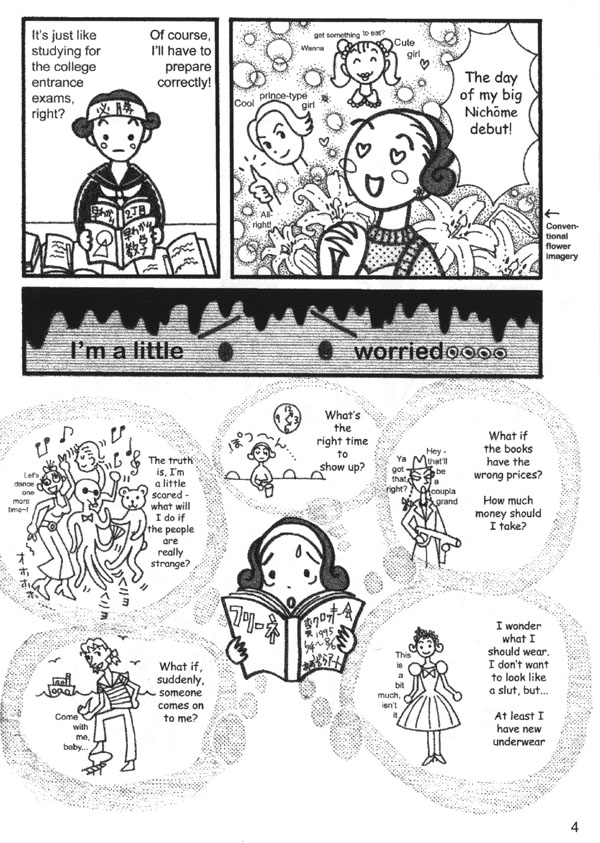
And “happy” is the perfect adjective to describe Rica ‘tte Kanji!? Rica, the heroine, is a cheerful optimist who moves to Tokyo to attend junior college (she plans to major in early childhood development) and explore the Nichome district, home to the city’s gay community. At the beginning of the series, Rica is nervous about visiting Nichome for the first time, worrying about what to wear and how to handle pick-up lines:

Rica’s fears are quickly allayed when she’s introduced to Miho, a sardonic art student a few years Rica’s senior. The two meet cute on Rica’s first trip to Nichome’s Lily Bar, where Rica confesses that she’s never met “an actual lesbian.” “I grew up out in the country,” she explains to Miho. “It’s the same for everyone in the beginning,” Miho assures her, prompting Rica to declare Miho her first gay friend. Though Miho falls for Rica right away, Rica’s lack of experience and general ditziness makes her oblivious to Miho’s advances. Their relationship has another hurdle to clear as well: Rica is just as nervous about the idea of having sex as she was about making a good impression at the Lily Bar, and keeps Miho at arm’s length — figuratively and literally — as she tries to decide what she’s comfortable doing.

What Takashima does better than most is to find the comedy in these situations, not by creating artificial misunderstandings between the characters, or manufacturing romantic rivals, but by making us privy to Rica and Miho’s thoughts. The two women’s internal monologues are funny, peppered with cute and weird observations, but they’re also very truthful; who among us hasn’t worried about putting the moves on a friend or being naked with a new partner?

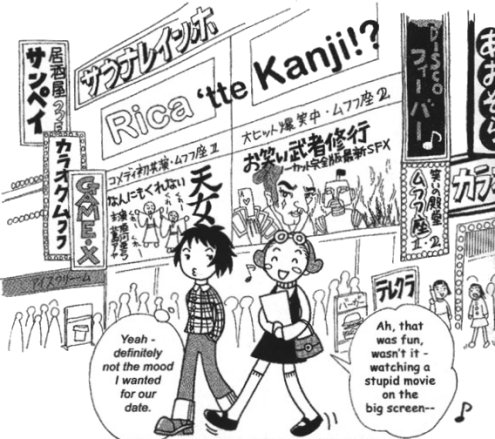
Though Takashima’s script is charming, what really makes Rica ‘tte Kanji!? work is the art. That may seem like a funny thing to say about a story in which the characters are little more than well-dressed stick figures with cute, round faces, but Takashima’s illustrations have a warm, handmade quality. Better still, the artwork never panders to male yuri fans; by rendering the characters as cute, paper-doll figures, Takashima directs the eye away from Rica and Miho’s bodies towards their faces, compelling the reader to see the women as two people fumbling through a relationship, not fantasy objects.

And speaking of fantasy, a few reviewers have pointed out the absence of real conflict in Rica ‘tte Kanji!?. Though Miho and Rica’s relationship hits a few minor snags, their romance takes place in a bubble untouched by homophobia or workaday concerns. It’s a fair criticism, I suppose, but one that misses the point; Rica ‘tte Kanji!? is a cheeky, cheerful rebuke to the Tragic Gay Story, substituting a happily-ever-after ending for death and separation.

Impatient readers can find copies of Rica ‘tte Kanji on Amazon for about $24.00. If you’re willing to wait a few months, however, ALC Publishing will be releasing a new omnibus edition that will include the original Rica ‘tte Kanji stories, as well as material written for ALC’s Yuri Monogatari anthologies.

RICA ‘TTE KANJI!? • BY RICA TAKASHIMA • ALC PUBLISHING • 96 pp.

Filed Under: Manga Critic Tagged With: ALC Publishing, Rica 'tte Kanji Review, Rica Takashima, yuri

The Best Manga You’re Not Reading: Rica ‘tte Kanji!?

June 1, 2011 by Katherine Dacey

The most basic yuri plotline — what publisher Erica Friedman calls “Story A” — traces its roots back to the pioneering Class S fiction of Nobuko Yoshiya (1896-1973). In works such as Hana monogatari (1916-24) and Yaneura no nishojo (1919), schoolgirls developed intense, often romantic, feelings for other schoolgirls. Given the period in which Yoshiya wrote, it’s not surprising that her characters’ relationships were never consummated; the girls might exchange passionate letters or meaningful glances, but marriage, graduation, or death prevented them from being together as a couple. Fifty years later, when manga artists such as Ryoko Yamagishi and Riyoko Ikeda began writing girls’ love stories, they, too, favored tragic endings; Yamagishi’s Shiroi Heya no Futari (1971), for example, culminates in a melodramatic death (suicide by ex-boyfriend, to be exact), as do Ikeda’s Oniisama e… (1975) and Claudine…! (1978).

Small wonder, then, that manga-ka Rica Takashima saw a vacuum that needed filling. “There were very few manga with lesbian stories,” Takashima explains in the afterword to Rica ‘tte Kanji!? “Only depressing, sad stories about ‘forbidden love’ and with a break-up in the end. For example, ‘If I were a man, I could marry you.’ That kind of thing, but I wanted to read a HAPPY story.”

And “happy” is the perfect adjective to describe Rica ‘tte Kanji!? Rica, the heroine, is a cheerful optimist who moves to Tokyo to attend junior college (she plans to major in early childhood development) and explore the Nichome district, home to the city’s gay community. At the beginning of the series, Rica is nervous about visiting Nichome for the first time, worrying about what to wear and how to handle pick-up lines:

Rica’s fears are quickly allayed when she’s introduced to Miho, a sardonic art student a few years Rica’s senior. The two meet cute on Rica’s first trip to Nichome’s Lily Bar, where Rica confesses that she’s never met “an actual lesbian.” “I grew up out in the country,” she explains to Miho. “It’s the same for everyone in the beginning,” Miho assures her, prompting Rica to declare Miho her first gay friend. Though Miho falls for Rica right away, Rica’s lack of experience and general ditziness makes her oblivious to Miho’s advances. Their relationship has another hurdle to clear as well: Rica is just as nervous about the idea of having sex as she was about making a good impression at the Lily Bar, and keeps Miho at arm’s length — figuratively and literally — as she tries to decide what she’s comfortable doing.

What Takashima does better than most is to find the comedy in these situations, not by creating artificial misunderstandings between the characters, or manufacturing romantic rivals, but by making us privy to Rica and Miho’s thoughts. The two women’s internal monologues are funny, peppered with cute and weird observations, but they’re also very truthful; who among us hasn’t worried about putting the moves on a friend or being naked with a new partner?

Though Takashima’s script is charming, what really makes Rica ‘tte Kanji!? work is the art. That may seem like a funny thing to say about a story in which the characters are little more than well-dressed stick figures with cute, round faces, but Takashima’s illustrations have a warm, handmade quality. Better still, the artwork never panders to male yuri fans; by rendering the characters as cute, paper-doll figures, Takashima directs the eye away from Rica and Miho’s bodies towards their faces, compelling the reader to see the women as two people fumbling through a relationship, not fantasy objects.

And speaking of fantasy, a few reviewers have pointed out the absence of real conflict in Rica ‘tte Kanji!?. Though Miho and Rica’s relationship hits a few minor snags, their romance takes place in a bubble untouched by homophobia or workaday concerns. It’s a fair criticism, I suppose, but one that misses the point; Rica ‘tte Kanji!? is a cheeky, cheerful rebuke to the Tragic Gay Story, substituting a happily-ever-after ending for death and separation.

Impatient readers can find copies of Rica ‘tte Kanji on Amazon for about $24.00. If you’re willing to wait a few months, however, ALC Publishing will be releasing a new omnibus edition that will include the original Rica ‘tte Kanji stories, as well as material written for ALC’s Yuri Monogatari anthologies.

RICA ‘TTE KANJI!? • BY RICA TAKASHIMA • ALC PUBLISHING • 96 pp.

Filed Under: Manga, Manga Critic, Recommended Reading, REVIEWS Tagged With: ALC Publishing, Rica 'tte Kanji Review, Rica Takashima, yuri

A Zoo in Winter

May 28, 2011 by Katherine Dacey 19 Comments

One of the best-selling manga in the US right now is Bakuman, a drama about two teens trying to break into the Japanese comics industry. Flipping through the first two volumes, it’s easy to see why the series has such an ardent following: Tsugumi Ohba and Takeshi Obata have portrayed the characters’ journey not as an aesthetic or introspective process, but as an adventure story in which the boys battle progressively more talented opponents while they work toward their ultimate goal of creating a hit series.

For all its lip service to perseverance and craft, Bakuman is, at heart, a fantasy that trumpets youth, native ability, and confidence as the keys to artistic success. To be sure, Ohba and Obata make a concerted effort to show their characters engaged in the less dramatic aspects of manga-making: brainstorming story ideas, working with an editor, experimenting with unfamiliar tools. These scenes aren’t really meant to chart the boys’ growth as artists, however, but to reinforce the idea that Mashiro and Takagi are naturals.

Jiro Taniguchi’s forthcoming A Zoo in Winter offers a very different perspective on breaking into the manga industry, one in which the principle character engages in a long, complicated, and frequently humbling process of refining his skills. When we first meet seventeen-year-old Mitsuo Hamaguchi, he’s working at a manufacturing company, contemplating a future designing textiles while harboring dreams of becoming an artist. Hamaguchi spends his free time sketching animals at the local zoo, and chaperoning his boss’ wayward daughter on excursions around town.

At loose ends, Hamaguchi visits Tokyo on a whim, landing a position as an assistant to popular manga-ka Shiro Kondo. The work is anything but glamorous: Hamaguchi frequently pulls all-nighters, erasing pencil marks, blacking in objects, drawing speedlines, and copying backgrounds from other assistants’ drawings. Working on Kondo’s manga rekindles Hamaguchi’s own childhood ambition to become an artist, inspiring Hamaguchi to take live drawing classes and start work on his own story — a goal that proves more elusive than Hamaguchi imagined.

Hamaguchi’s emotional development is as fitful as his artistic. Though he’s savoring his independence, he frequently reverts to adolescent behavior whenever he hits a roadblock, wallowing in self-pity when another assistant seems poised to get his big break, for example, or drinking himself into a stupor when his girlfriend moves away. Hamaguchi’s relationship with his older brother is particularly telling: separated by ten years, Hamaguchi continues to view him as a father figure, squirming in embarrassment when his brother visits Kondo’s studio. (“Please, brother, try to mind your own business,” Hamaguchi pleads.) As their visit progresses, however, Hamaguchi marvels at his brother’s ability to chat up Kondo and mix with the bohemian element at the assistants’ favorite dive-bar, gradually realizing that his older brother isn’t as judgmental or rigid as Hamaguchi assumed, just deeply concerned with the family’s welfare.

In another artist’s hands, Hamaguchi’s brother might have been a sterner figure, one who dismissed an artistic career as a frivolous or irresponsible choice. Yet Jiro Taniguchi resists the temptation to make Hamaguchi’s brother into a straw man, instead allowing Hamaguchi to discover his brother’s relaxed decency for himself; Hamaguchi’s epiphany is a small one, but one that brings him a few steps closer to adulthood. Taniguchi manages the difficult feat of honoring the sincerity of Hamaguchi’s feelings while creating emotional distance between Hamaguchi and the reader; we’re not invited to experience Hamaguchi’s embarrassment so much as remember what it was like to learn that our parents were, in fact, just like all the other adults we knew and liked.

What makes these passages even more effective is Taniguchi’s draftsmanship. Though he has always been a superb illustrator, capable of evoking the bustling sprawl of a Japanese city or the craggy face of a mountain, his characters’ faces often had an impassive, Noh-mask quality. In Zoo in Winter, however, the characters’ facial expressions are rendered with the same precision he usually reserves for landscapes and interiors, capturing subtle shifts in their attitudes and emotions. Not that Taniguchi neglects the urban environment; one of the manga’s loveliest sequences unfolds in a zoo on a snowy day. Anyone who’s had the experience of running in Central Park on a rainy November afternoon, or walking a winter beach will immediately recognize Hamaguchi’s elation at having the zoo to himself, and of seeing the landscape transformed by the weather.

It’s the subtlety of the characterizations, however, that will remain with readers long after they’ve finished A Zoo in Winter. The story does more than just dramatize Hamaguchi’s journey from adolescence to adulthood; it shows us how his emotional maturation informs every aspect of his artistry — something that’s missing from many other portrait-of-an-artist-as-a-young-man sagas, which place much greater emphasis on the pleasure of professional recognition than on the satisfaction of mastering one’s craft. To be fair, Ohba and Obata address the issue of craft in Bakuman, but I’ll take the quiet honesty of A Zoo in Winter over the sound and fury of a Shonen Jump title any day. Highly recommended.

Review copy provided by Fanfare/Ponent Mon. A Zoo in Winter will be released on June 23, 2011.

A ZOO IN WINTER • BY JIRO TANIGUCHI • FANFARE/PONENT MON • 232 pp.

Filed Under: Manga Critic Tagged With: Fanfare/Ponent Mon, Jiro Taniguchi, Seinen

A Zoo in Winter

May 28, 2011 by Katherine Dacey

One of the best-selling manga in the US right now is Bakuman, a drama about two teens trying to break into the Japanese comics industry. Flipping through the first two volumes, it’s easy to see why the series has such an ardent following: Tsugumi Ohba and Takeshi Obata have portrayed the characters’ journey not as an aesthetic or introspective process, but as an adventure story in which the boys battle progressively more talented opponents while they work toward their ultimate goal of creating a hit series.

For all its lip service to perseverance and craft, Bakuman is, at heart, a fantasy that trumpets youth, native ability, and confidence as the keys to artistic success. To be sure, Ohba and Obata make a concerted effort to show their characters engaged in the less dramatic aspects of manga-making: brainstorming story ideas, working with an editor, experimenting with unfamiliar tools. These scenes aren’t really meant to chart the boys’ growth as artists, however, but to reinforce the idea that Mashiro and Takagi are naturals.

Jiro Taniguchi’s forthcoming A Zoo in Winter offers a very different perspective on breaking into the manga industry, one in which the principle character engages in a long, complicated, and frequently humbling process of refining his skills. When we first meet seventeen-year-old Mitsuo Hamaguchi, he’s working at a manufacturing company, contemplating a future designing textiles while harboring dreams of becoming an artist. Hamaguchi spends his free time sketching animals at the local zoo, and chaperoning his boss’ wayward daughter on excursions around town.

At loose ends, Hamaguchi visits Tokyo on a whim, landing a position as an assistant to popular manga-ka Shiro Kondo. The work is anything but glamorous: Hamaguchi frequently pulls all-nighters, erasing pencil marks, blacking in objects, drawing speedlines, and copying backgrounds from other assistants’ drawings. Working on Kondo’s manga rekindles Hamaguchi’s own childhood ambition to become an artist, inspiring Hamaguchi to take live drawing classes and start work on his own story — a goal that proves more elusive than Hamaguchi imagined.

Hamaguchi’s emotional development is as fitful as his artistic. Though he’s savoring his independence, he frequently reverts to adolescent behavior whenever he hits a roadblock, wallowing in self-pity when another assistant seems poised to get his big break, for example, or drinking himself into a stupor when his girlfriend moves away. Hamaguchi’s relationship with his older brother is particularly telling: separated by ten years, Hamaguchi continues to view him as a father figure, squirming in embarrassment when his brother visits Kondo’s studio. (“Please, brother, try to mind your own business,” Hamaguchi pleads.) As their visit progresses, however, Hamaguchi marvels at his brother’s ability to chat up Kondo and mix with the bohemian element at the assistants’ favorite dive-bar, gradually realizing that his older brother isn’t as judgmental or rigid as Hamaguchi assumed, just deeply concerned with the family’s welfare.

In another artist’s hands, Hamaguchi’s brother might have been a sterner figure, one who dismissed an artistic career as a frivolous or irresponsible choice. Yet Jiro Taniguchi resists the temptation to make Hamaguchi’s brother into a straw man, instead allowing Hamaguchi to discover his brother’s relaxed decency for himself; Hamaguchi’s epiphany is a small one, but one that brings him a few steps closer to adulthood. Taniguchi manages the difficult feat of honoring the sincerity of Hamaguchi’s feelings while creating emotional distance between Hamaguchi and the reader; we’re not invited to experience Hamaguchi’s embarrassment so much as remember what it was like to learn that our parents were, in fact, just like all the other adults we knew and liked.

What makes these passages even more effective is Taniguchi’s draftsmanship. Though he has always been a superb illustrator, capable of evoking the bustling sprawl of a Japanese city or the craggy face of a mountain, his characters’ faces often had an impassive, Noh-mask quality. In Zoo in Winter, however, the characters’ facial expressions are rendered with the same precision he usually reserves for landscapes and interiors, capturing subtle shifts in their attitudes and emotions. Not that Taniguchi neglects the urban environment; one of the manga’s loveliest sequences unfolds in a zoo on a snowy day. Anyone who’s had the experience of running in Central Park on a rainy November afternoon, or walking a winter beach will immediately recognize Hamaguchi’s elation at having the zoo to himself, and of seeing the landscape transformed by the weather.

It’s the subtlety of the characterizations, however, that will remain with readers long after they’ve finished A Zoo in Winter. The story does more than just dramatize Hamaguchi’s journey from adolescence to adulthood; it shows us how his emotional maturation informs every aspect of his artistry — something that’s missing from many other portrait-of-an-artist-as-a-young-man sagas, which place much greater emphasis on the pleasure of professional recognition than on the satisfaction of mastering one’s craft. To be fair, Ohba and Obata address the issue of craft in Bakuman, but I’ll take the quiet honesty of A Zoo in Winter over the sound and fury of a Shonen Jump title any day. Highly recommended.

Review copy provided by Fanfare/Ponent Mon. A Zoo in Winter will be released on June 23, 2011.

A ZOO IN WINTER • BY JIRO TANIGUCHI • FANFARE/PONENT MON • 232 pp.

Filed Under: Manga, Manga Critic, REVIEWS Tagged With: Fanfare/Ponent Mon, Jiro Taniguchi, Seinen

A Bride’s Story, Vol. 1

May 24, 2011 by Katherine Dacey 29 Comments

For nearly 3,000 years, the Silk Road connected Asia with Africa and the Middle East, providing a conduit for the ancient world’s most precious commodities: silk, spices, glassware, medicine, perfume, livestock. By the nineteenth century, when A Bride’s Story takes place, the overland trade routes had been eclipsed in importance by maritime ones that linked China directly with India, Somalia, and the Mediterranean. Yet the Silk Road continued to play a vital role in bridging smaller geographical divides, as the main plot in A Bride’s Story demonstrates.

Set in Central Asia, A Bride’s Story focuses on two clans: the Halgal, a nomadic tribe whose livelihood depends on a mixture of hunting and herding, and the Eihon, farmers with a permanent homestead near the Caspian Sea. The families arrange a marriage between twenty-year-old Amir, the oldest Halgal daughter, and twelve-year-old Karluk, the future Eihon patriarch. As that age gap implies, Amir and Karluk’s union is one of political and economic expedience, designed to help the Eihon clan preserve its territory. Each family has reservations about the match: the Eihon believe that Amir is too old to bear Karluk a good-sized family, while the Halgal want to dissolve the union and betroth Amir to the leader of a neighboring tribe.

Amir and Karluk, however, seem more content with the arrangement than their elders. Given their age gap, Amir is more mother than wife to Karluk. There’s a note of urgency and purpose in Amir’s ministrations — she’s keen to prove her worth to the Eihons, especially when Karluk falls ill — but there’s also a genuine warmth and kindness in her gestures. Karluk, for his part, seems very much like a young teenager, intrigued by Amir’s beauty and charisma, but still too uncomfortable in his own skin to be physically demonstrative with her; Amir seems much keener to consummate their marriage, lest she lose her standing with the Eihon clan.

One of the great pleasures of A Bride’s Story is its strong cast of female characters. Balkirsh, the Eihon matriarch, proves Amir’s staunchest ally, fiercely rebuffing the Halgal’s efforts to reclaim Amir with a well-placed arrow. Though Balkirsh never explicitly states why she identifies with her daughter-in-law, the bow-and-arrow scene is telling, hinting at a shared cultural heritage that binds the two women. Amir, too, is a memorable character; she’s a terrific physical specimen, agile and fearless on horseback, but her true strength is her keen emotional intelligence. She accepts her new marriage without complaint, rapidly insinuating herself into the Eihon clan while preserving her own sense of self by introducing Karluk to her family’s customs.

The artwork, too, is another compelling reason to read A Bride’s Story. As she did in Emma and Shirley, Kaoru Mori pours her energy into period detail: clothing, furnishings, architecture. By far her most striking designs are the tribal costumes worn by the Eihon and the Halgal. Mori painstakingly draws embroidery, ornaments, and layers of fabric; watching Amir mount her horse, one can almost hear the swish of her skirts and the jingle of her earrings. Mori is similarly meticulous when rendering the surfaces of common household objects; she etches an intricate floral design into a silver tea set and weaves elegant, delicate patterns into the rugs that grace the walls and floors of the Eihon compound, luxuriating in the artistry with which these items were made.

At the same time, however, the Central Asian setting grants Mori greater license to make her characters move — something she rarely did in the overstuffed parlors  and crowded London streets in Emma and Shirley. To be sure, Mori’s flair for staging dynamic scenes was evident in Emma, when Hakim Atawari made a show-stopping entrance astride an elephant. In A Bride’s Story, however, Mori’s active sequences are less flashy and more fluid; they feel less like dramatic stunts than an organic part of the story, helping the reader understand how physically taxing Amir and Karluk’s labors are while helping us appreciate the scale and severity of the landscape.

Perhaps the most striking aspect of volume one is just how uneventful it is. Kaoru Mori is content to let her narrative follow the rhythms of everyday life, pausing to show us a master carver in his wood shop, or a group of women cooking a meal, or a young boy tending chickens. Yet A Bride’s Story is never dull, thanks to Mori’s smart, engaging dialogue; as she demonstrated in Emma and Shirley, Mori can make even the simplest moments revealing, whether her characters are preparing a manor house for the master’s return or discussing the merits of rabbit stew. By allowing her story to unfold in such a naturalistic fashion, A Bride’s Story manages to be both intimate and expansive, giving us a taste of what it might have been like to live along the Silk Road in the nineteenth century. Highly recommended.

A BRIDE’S STORY, VOL. 1 • BY KAORU MORI • YEN PRESS • 192 pp. • RATING: OLDER TEEN (16+)

Filed Under: Manga Critic Tagged With: A Bride's Story Review, Kaoru Mori, Silk Road, yen press

A Bride’s Story, Vol. 1

May 24, 2011 by Katherine Dacey

For nearly 3,000 years, the Silk Road connected Asia with Africa and the Middle East, providing a conduit for the ancient world’s most precious commodities: silk, spices, glassware, medicine, perfume, livestock. By the nineteenth century, when A Bride’s Story takes place, the overland trade routes had been eclipsed in importance by maritime ones that linked China directly with India, Somalia, and the Mediterranean. Yet the Silk Road continued to play a vital role in bridging smaller geographical divides, as the main plot in A Bride’s Story demonstrates.

Set in Central Asia, A Bride’s Story focuses on two clans: the Halgal, a nomadic tribe whose livelihood depends on a mixture of hunting and herding, and the Eihon, farmers with a permanent homestead near the Caspian Sea. The families arrange a marriage between twenty-year-old Amir, the oldest Halgal daughter, and twelve-year-old Karluk, the future Eihon patriarch. As that age gap implies, Amir and Karluk’s union is one of political and economic expedience, designed to help the Eihon clan preserve its territory. Each family has reservations about the match: the Eihon believe that Amir is too old to bear Karluk a good-sized family, while the Halgal want to dissolve the union and betroth Amir to the leader of a neighboring tribe.

Amir and Karluk, however, seem more content with the arrangement than their elders. Given their age gap, Amir is more mother than wife to Karluk. There’s a note of urgency and purpose in Amir’s ministrations — she’s keen to prove her worth to the Eihons, especially when Karluk falls ill — but there’s also a genuine warmth and kindness in her gestures. Karluk, for his part, seems very much like a young teenager, intrigued by Amir’s beauty and charisma, but still too uncomfortable in his own skin to be physically demonstrative with her; Amir seems much keener to consummate their marriage, lest she lose her standing with the Eihon clan.

One of the great pleasures of A Bride’s Story is its strong cast of female characters. Balkirsh, the Eihon matriarch, proves Amir’s staunchest ally, fiercely rebuffing the Halgal’s efforts to reclaim Amir with a well-placed arrow. Though Balkirsh never explicitly states why she identifies with her daughter-in-law, the bow-and-arrow scene is telling, hinting at a shared cultural heritage that binds the two women. Amir, too, is a memorable character; she’s a terrific physical specimen, agile and fearless on horseback, but her true strength is her keen emotional intelligence. She accepts her new marriage without complaint, rapidly insinuating herself into the Eihon clan while preserving her own sense of self by introducing Karluk to her family’s customs.

The artwork, too, is another compelling reason to read A Bride’s Story. As she did in Emma and Shirley, Kaoru Mori pours her energy into period detail: clothing, furnishings, architecture. By far her most striking designs are the tribal costumes worn by the Eihon and the Halgal. Mori painstakingly draws embroidery, ornaments, and layers of fabric; watching Amir mount her horse, one can almost hear the swish of her skirts and the jingle of her earrings. Mori is similarly meticulous when rendering the surfaces of common household objects; she etches an intricate floral design into a silver tea set and weaves elegant, delicate patterns into the rugs that grace the walls and floors of the Eihon compound, luxuriating in the artistry with which these items were made.

At the same time, however, the Central Asian setting grants Mori greater license to make her characters move — something she rarely did in the overstuffed parlors  and crowded London streets in Emma and Shirley. To be sure, Mori’s flair for staging dynamic scenes was evident in Emma, when Hakim Atawari made a show-stopping entrance astride an elephant. In A Bride’s Story, however, Mori’s active sequences are less flashy and more fluid; they feel less like dramatic stunts than an organic part of the story, helping the reader understand how physically taxing Amir and Karluk’s labors are while helping us appreciate the scale and severity of the landscape.

Perhaps the most striking aspect of volume one is just how uneventful it is. Kaoru Mori is content to let her narrative follow the rhythms of everyday life, pausing to show us a master carver in his wood shop, or a group of women cooking a meal, or a young boy tending chickens. Yet A Bride’s Story is never dull, thanks to Mori’s smart, engaging dialogue; as she demonstrated in Emma and Shirley, Mori can make even the simplest moments revealing, whether her characters are preparing a manor house for the master’s return or discussing the merits of rabbit stew. By allowing her story to unfold in such a naturalistic fashion, A Bride’s Story manages to be both intimate and expansive, giving us a taste of what it might have been like to live along the Silk Road in the nineteenth century. Highly recommended.

A BRIDE’S STORY, VOL. 1 • BY KAORU MORI • YEN PRESS • 192 pp. • RATING: OLDER TEEN (16+)

Filed Under: Manga, Manga Critic, REVIEWS Tagged With: A Bride's Story Review, Kaoru Mori, Silk Road, yen press

Pick of the Week: A Bride’s Story & Others

May 23, 2011 by Katherine Dacey, Michelle Smith, David Welsh and MJ 8 Comments

New manga from Kaoru Mori (unsurprisingly) steals the show at Midtown Comics this week, but check out our recommendations for additional picks as well!


KATE: A new Kaoru Mori manga is always cause for celebration, so I’m getting this week’s party started by recommending A Bride’s Story, which debuts on Wednesday. Like Emma and Shirley,A Bride’s Story is as much about the historical period — its customs, its social hierarchies, its clothing — as it about the characters. In this case, the setting is the Silk Road in the nineteenth century, and the characters are Amir, a twenty-year-oldwoman, and Karluk, her twelve-year-old husband. Their union is one of political expedience, but their growing respect for one another suggests that their marriage has the potential to evolve. Not a whole lot happens in the first volume, but the artwork is lovely, and the gently meandering storylines allow us to see just how capable and complex Amir really is. I’m already pining for volume two!

MICHELLE: I’m keen to read A Bride’s Story myself, but my pick this week goes to the second volume of Natsume Ando’s Arisa, back from a long hiatus as publishing rights shifted from Del Rey to Kodansha Comics. Volume one served up delicious shoujo creepiness as a tough girl named Tsubasa disguised herself as her more refined twin to figure out what in her school life caused her to attempt suicide, and ended just as she was on the verge of discovering the identity of “the King,” a mysterious person with the ability to grant any wish. Not only is the series back, it’s also on a bimonthly schedule from this point on.

DAVID: I’m going to have to second Kate’s pick of A Bride’s Story. I’m such a fan of Mori’s Emma that it would seem treasonous to do otherwise. (Though I’m also very much looking forward to Arisa.)

MJ: You can add me to the list of Manga Bookshelf-ers eagerly anticipating A Bride’s Story, but I’ll also take this opportunity to give a shout-out to one of my favorite shoujo series, Peach Pit’s Shugo Chara!. Kodansha Comics brings out volume 10 this week, following its long run with Del Rey Manga, and I can’t wait to pick it up! I’ve written a lot about this series (including a heartfelt plea for lowering its age rating) much of which can be accessed via my Shugo Chara! Evangelism post. After all that, can I pass up the chance to recommend it one more time? I think not!


Amazon.com Widgets


Readers, what looks good to you this week?

Filed Under: PICK OF THE WEEK Tagged With: a bride's story, arisa, shugo chara!

  • « Go to Previous Page
  • Page 1
  • Interim pages omitted …
  • Page 65
  • Page 66
  • Page 67
  • Page 68
  • Page 69
  • Interim pages omitted …
  • Page 89
  • Go to Next Page »
 | Log in
Copyright © 2010 Manga Bookshelf | Powered by WordPress & the Genesis Framework