• Skip to primary navigation
  • Skip to main content
  • Skip to primary sidebar
  • Home
  • About Us
    • Privacy Policy
    • Comment Policy
    • Disclosures & Disclaimers
  • Resources
    • Links, Essays & Articles
    • Fandomology!
    • CLAMP Directory
    • BlogRoll
  • Features & Columns
    • 3 Things Thursday
    • Adventures in the Key of Shoujo
    • Bit & Blips (game reviews)
    • BL BOOKRACK
    • Bookshelf Briefs
    • Bringing the Drama
    • Comic Conversion
    • Fanservice Friday
    • Going Digital
    • It Came From the Sinosphere
    • License This!
    • Magazine no Mori
    • My Week in Manga
    • OFF THE SHELF
    • Not By Manga Alone
    • PICK OF THE WEEK
    • Subtitles & Sensibility
    • Weekly Shonen Jump Recaps
  • Manga Moveable Feast
    • MMF Full Archive
    • Yun Kouga
    • CLAMP
    • Shojo Beat
    • Osamu Tezuka
    • Sailor Moon
    • Fruits Basket
    • Takehiko Inoue
    • Wild Adapter
    • One Piece
    • After School Nightmare
    • Karakuri Odette
    • Paradise Kiss
    • The Color Trilogy
    • To Terra…
    • Sexy Voice & Robo
  • Browse by Author
    • Sean Gaffney
    • Anna Neatrour
    • Michelle Smith
    • Katherine Dacey
    • MJ
    • Brigid Alverson
    • Travis Anderson
    • Phillip Anthony
    • Derek Bown
    • Jaci Dahlvang
    • Angela Eastman
    • Erica Friedman
    • Sara K.
    • Megan Purdy
    • Emily Snodgrass
    • Nancy Thistlethwaite
    • Eva Volin
    • David Welsh
  • MB Blogs
    • A Case Suitable For Treatment
    • Experiments in Manga
    • MangaBlog
    • The Manga Critic
    • Manga Report
    • Soliloquy in Blue
    • Manga Curmudgeon (archive)

Manga Bookshelf

Discussion, Resources, Roundtables, & Reviews

Katherine Dacey

H.P. Lovecraft’s The Hound and Other Stories

October 11, 2017 by Katherine Dacey

If you admire the fecundity of H.P. Lovecraft’s imagination but not the turgidity of his prose, you might find Gou Tanabe’s manga adaptations of The Hound and Other Stories an agreeable alternative to the originals. Tanabe sticks close to the source material while pruning away the florid language characteristic of Lovecraft’s writing, offering more polished — and, frankly, unnerving — versions of three early works: “The Temple,” first published in 1925, “The Hound,” from 1922, and “The Nameless City,” from 1921.

Tanabe is no stranger to literary adaptations; he’s also tackled works by Maxim Gorky (“Twenty-Six Men and a Girl”), Franz Kafka (“A Hunger Artist”), and folklorist Lafcadio Hearn (“The Story of O-Tei”). Lovecraft’s writing, however, occupies a unique place in Tanabe’s oeuvre, as he’s published adaptations of other Lovecraft stories — “The Color Out of Space” (1927) and “The Haunter of the Dark” (1935)” — and expanded Lovecraft’s novella “At the Mountains of Madness” into an ongoing, multi-volume series. Reflecting on his fascination with Lovecraft, Tanabe reverentially describes him as a “priest of his own Mythos,” capable of summoning “unknowable darkness” on the page. “By illustrating his stories,” Tanabe declares, “I intend to become an apostle of the gods he made” (172).

And while Tanabe’s sentiments are a little purple, his affinities with Lovecraft are evident in his artful translation of words into images. Consider “The Temple,” a tense drama set aboard a German U-boat in the waning days of World War II. While Lovecraft’s narrator baldly ascribes the crew’s irrational behavior to “peasant ignorance” and “soft, womanish” dispositions, Tanabe focuses instead on the extraordinary claustrophobia of their environment, cramming every panel with ducts, pipes, valves, levers, and gauges; the walls of the ship seem to press in on the characters as their disabled submarine plunges to its doom. That sense of entombment is heightened by Tanabe’s stark use of tone in the story’s final act, when the light emanating from the ship barely pierces the jet-black depths of the ocean. A fleeting glimpse of a dolphin — normally a symbol of innocent playfulness — becomes a sinister omen when lit from below, its smiling visage transformed into a sneer.

Tanabe also demonstrates a flair for drawing lost cities, evoking the grandeur and mystery of ancient civilizations through sheer scale: his temples and monuments are so large that they spill off the page, while their interiors are cramped and dark, more cave than castle. In “The Nameless City,” for example, we follow the narrator through a labyrinth of dark tunnels, his torch briefly illuminating objects and surfaces that hint at the true nature of the city’s inhabitants. These panels culminate in an extraordinary two-page spread revealing a Romanesque fresco that, on closer inspection, is populated not with demons, angels, and men, but reptilian monsters arranged in concentric circles around a Christ-like figure.

The revelation of who lived there — and how they treated their human subjects — provides a moment of thematic continuity with the other two stories in the anthology. As writer Robert M. Price explains in his forward to The New Lovecraft Circle, Lovecraft’s heroes seek forbidden knowledge, “gradual[ly] piecing together… clues whose eventual destination one does not know.” Price elaborates:

The knowledge, once gained, is too great for the mind of man. It is Promethean, Faustian knowledge. Knowledge that destroys in the moment of enlightenment, a Gnosis of damnation, not of salvation. One would never have contracted with Mephistopheles to gain it. One rather wishes it were not too late to forget it. (xviii–xix)

At the same time, however, the narrator’s terrible discovery exemplifies another important strand in Lovecraft’s writing: a sense of cosmic indifferentism, the idea that the universe is, in Lovecraft’s words, “only a furtive arrangement of elementary particles” that “presage of transition to chaos.” As Lovecraft observed,

The human race will disappear. Other races will appear and disappear in turn. The sky will become icy and void, pierced by the feeble light of half-dead stars. Which will also disappear. Everything will disappear. And what human beings do is just as free of sense as the free motion of elementary particles. (Riemer)

Viewed in this light, the rendering of the fresco seems less like a simple artistic choice by Tanabe than an expression of Lovecraft’s own cosmic indifferentism. By parodying the Christian iconography enshrined on Medieval cathedral walls, ceilings, and portals, Tanabe points both the futility of belief — it didn’t save the monsters, after all — and the inevitability that mankind will repeat the cycle of birth, life, and death that the monstrous fresco depicts.

And if all of this sounds like the ruminations of a freshman philosophy major, fear not; The Hound and Other Stories can still be enjoyed on its own merits. All three stories are well paced and vividly rendered, each embodying the Romantic definition of the sublime — “all that stuns the soul, all that imprints a feeling of terror”— while offering the kind of satisfying twists that pulp fiction readers craved in the 1920s. And for those more invested in the Lovecraft mythos, The Hound provides an opportunity to revisit these stories afresh, seeing them through the eyes of an artist who has dedicated his career to finding the poetry, the mystery, and the weirdness in Lovecraft’s words. Recommended. 

References

Price, Robert M. “Introduction.” The New Lovecraft Circle. Del Rey, 2004, xiii-xxvi.

Riemer, Andrew. “A Nihilist’s Hope Against Hope.” Sydney Morning Herald, 28 June 2003, http://www.smh.com.au/articles/2003/06/27/1056683892274.html. Accessed on 11 Oct. 2017.

Tanabe, Gou. H.P. Lovecraft’s The Hound and Other Stories. Translated by Zack Davisson, Dark Horse, 2017.

Filed Under: Manga, Manga Critic, REVIEWS Tagged With: Dark Horse, Gou Tanabe, H.P. Lovecraft, Horror/Supernatural

Pick of the Week: Zodiac Killers

October 9, 2017 by Sean Gaffney, MJ, Anna N, Katherine Dacey, Ash Brown and Michelle Smith Leave a Comment

SEAN: I must admit there’s not a whole lot that’s inspiring me in this week’s list. I’m interested in Spirit Circle for sure. That said, I think my pick this week will be for Juni Taisen: Zodiac War. It’s rare that I choose what is essentially a ‘kill the cast one by one’ genre, but the creators are luring me in, so I am intrigued.

MICHELLE: Ch-ch-ch-Chihaya! I love Chihayafuru so much, and I’m dying to see what happens with Arata, now that he’s begun to think he can best honor his grandfather by continuing to show the world his style of play. I literally have geekbumps thinking about it.

ASH: I’m with Sean this week, and largely for the same reasons. I’m certainly interested in Spirit Circle having found Satoshi Mizukami’s Lucifer and the Biscuit Hammer to be enjoyably quirky and even powerful at times despite its uneveness. But the release that I’m most curious about is Juni Taisen: Zodiac War simply because of the creators involved.

KATE: Add me to the “meh” column again. Instead, I’ll point budget-conscious manga readers to VIZ’s big JoJo sale. The first three story arcs — Phantom Blood, Battle Tendencies, and Stardust Crusaders — are on sale at the VIZ website. If you’re looking for a wallet-friendly way to catch up on the first eleven volumes of the JoJo saga, this is a great way to do it. Word to the wise: this is a digital-only initiative.

ANNA: And I’m going to join Michelle in picking Chihayafuru! This is one of those series I thought would never be translated so I’m delighted to celebrate each volume being released here.

MJ: The pickings are slim for me this week, but I am fairly interested in Juni Taisen: Zodiac War, based mainly on its artist, so that’s what I’ll go with.

Filed Under: PICK OF THE WEEK

Pick of the Week: Goodbye Kiss

October 2, 2017 by Sean Gaffney, Michelle Smith, Katherine Dacey, Ash Brown and Anna N Leave a Comment

MICHELLE: There’s a healthy dose of sports manga due out this week—Ace of the Diamond, Haikyu!!, and Kuroko’s Basketball—as well as other favorites like Food Wars and Honey So Sweet, but I really have no choice but to avail myself of the final opportunity to pick Kamisama Kiss. This series has been consistently good across 25 volumes, and though a happy ending has been earned, I’ll be sorry to see it so. Sayounara, Kamisama.

SEAN: A lot of old favorites, and the shipper in me wants to pick Assassination Classroom, but I agree, Kamisama Kiss is absolutely the pick this week. I can never resist a wedding pic on the final volume of a shoujo manga!

KATE: At the risk of sounding like Manga Bookshelf’s resident picky eater, this week’s list doesn’t have any stand-out titles for me. There are plenty of decent continuing series — Assassination Classroom, Kurokuro’s Basketball — but nothing that I’m actively following. If I had to choose a title, though, my vote would go to Rave Master, since I missed it the first time around.

ASH: Although there are several manga that I’m looking forward to next week, such as the next installments of Haikyu!! and Yona of the Dawn, the release that I’m most curious about is the first volume of House of Brutes. In particular, I’m interested to see if it’s actually released at all considering the publisher’s current financial troubles. But I’ll be glad to see more of Gengoroh Tagame’s work released in English. (This is definitely different fare than My Brother’s Husband, though!)

ANNA: I’m a little torn, because there’s a ton of great manga coming out this week, with Yona of the Dawn always a highlight. But I’m also going to pick the final volume of Kamisama Kiss. It is such a jewel of a series, and even though all things must come to an end, I’m glad it is getting an appropriate send off with a special limited edition.

Filed Under: PICK OF THE WEEK

Hergé à Québec

September 29, 2017 by Katherine Dacey

One of the highlights of my August visit to Québec City was the Hergé à Québec exhibition at the Musée de la civilisation. The show, which has already made stops in Paris, Geneva, and London, offers a retrospective on the life and work of Georges Prosper Remi (1907 – 1983), better known to children around the world as Hergé, creator of Tintin, intrepid boy reporter, and Snowy, his sardonic canine companion.

Hergé à Québec spans Remi’s entire career, from his first childhood drawings to his late-in-life brush with contemporary art. As a means of introducing Hergé to visitors, the show begins with a gallery of items culled from his formative years, including a comic drawn when he was a sixteen-year-old Boy Scout. This room is followed by a sequence of exhibits exploring three seminal Tintin stories, Tintin in the Land of the Soviets (1930), The Blue Lotus (1932) and Cigars of the Pharoah (1934). Through a series of well-chosen projections, photographs, and pages, the curators define Hergé’s ligne claire (clear line) style, and state the main thesis of the show: that Tintin teaches young readers about the world through his adventures — in which Tintin is subject to the slings and arrows of fortune as he travels through foreign lands — and missions — in which he pursues a specific objective, such as finding a lost object. This idea is further developed in later galleries, culminating in a charming display of pages from and items associated with Tintin’s two lunar adventures: Destination Moon (1953) and Explorers on the Moon (1954).

The show also includes a gallery featuring commercial posters designed by his production company l’Atelier Hergé-Publicité. These advertisements, rendered in a bold, colorful style reminiscent of Cassandre’s, urge consumers to fly Sabena Airlines, read Le Vingtième Siècle, and buy Parein biscuits. As playful and striking as many of these images are, the inclusion of one toy company’s poster — an image of a thick-lipped African child holding an umbrella — points to one of the exhibition’s main flaws: it misses the opportunity to address Hergé’s racist depictions of colonized people in a historically responsible fashion.

A selection of posters produced by l’Atelier Hergé-Publicité.

In tracing the development of Hergé’s storytelling from Tintin in the Land of the Soviets to The Blue Lotus, the show only tacitly acknowledges the two works that fell between them: Tintin in the Congo (1931) and Tintin in America (1932). Instead, the curators focus on Hergé’s relationship with Chinese artist Zhang Chongren, whom Hergé befriended shortly before writing The Blue Lotus. Through his interactions with Zhang, they argue, Hergé learned the importance of researching the places Tintin visited, rather than defaulting to popular stereotypes about their peoples. And while the discussion of Hergé and Zhang’s friendship offers evidence that Hergé was capable of taking a more nuanced view of other cultures, the show never examines Hergé’s paternalistic view of Belgium’s African subjects, an issue that’s explicitly addressed in both Benoit Peeters’ Hergé: Son of Tintin and Pierre Assouline’s Hergé, The Man Who Created Tintin.

The exhibition does a better job of addressing Hergé’s stint at Le Soir (1939-1944), the official newspaper of occupied Belgium. After the war, Hergé was arrested four times on suspicion of collaborating with the Nazi regime — charges that almost cost him his citizenship. To the curators’ credit, the show includes a brief video interview with Hergé about this episode in his life. By acknowledging his involvement with Le Soir in such a neutral fashion, however, the show misses another opportunity to present a more nuanced picture of Hergé’s political beliefs, warts and all.

Where the show excels is in its ability to immerse the visitor in Hergé’s creative process, from crude storyboards — with cross-outs, arrows, and editorial notes — to published work. Throughout the exhibition, there are numerous pairings of early drafts with finished products, allowing the viewer to trace the development of characters and scenes from concept to completion. The galleries also include several side-by-side comparisons of objects with the images they inspired, most notably in Tintin and the Broken Ear (1937). Although some of these pages are presented in their final form, with word balloons and dialogue, many are not. This decision allows the visitor to more fully appreciate the role of Hergé’s line work and colorful palette in creating Tintin’s world — without the mediating influence of text.

The exhibition also makes a strong case that Hergé deserves serious consideration as both an art collector and painter. The final gallery juxtaposes Hergé’s acquisitions — including Roy Lichtenstein’s Rouen Cathedral (1967) — with his own original canvases. And as fascinating as it was to contemplate Hergé’s taste in art, I found the modernist work that he produced under the tutelage of Belgian painter Louis Van Lint (1909-1986) more striking than the work he’d collected. His own paintings demonstrate strong affinities with Joan Miró and Marc Chagall, but also demonstrate strong affinities with his cartooning, as evidenced by his careful delineation of space and strong sense of color.

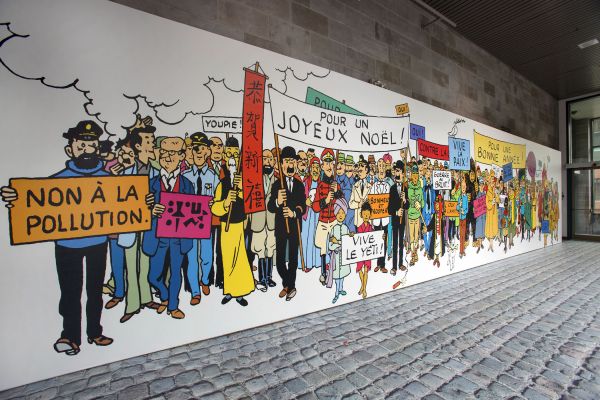
This 1973 mural greets visitors to the Musée de la civilisation.

It’s a shame that the curators didn’t explore Hergé’s life with the same zeal; doing so would have provided valuable context for understanding him as a product of a specific place and time, immersed in ideas that shaped the characters he created and the stories he told. Yet for all the show’s limitations, Hergé à Québec gave me new insight into Hergé’s evolution as an artist and storyteller, and a deeper appreciation of his craft. For an artist’s perspective on Hergé à Québec, see Ben Towle’s thoughtful evaluation of the exhibit.

Hergé à Québec is on display at the Musée de la civilisation in Quebec City through October 22nd. For information and tickets, click here. Note that the show is not included in the general admission price to the museum.

Filed Under: Comics, Manga Critic Tagged With: Exhibitions, Herge, Musée de la civilisation, Tintin

A First Look at Shojo FIGHT!

September 26, 2017 by Katherine Dacey

We’re in the middle of a sports-manga renaissance in the US, with publishers offering an unprecedented range of titles from Kurokuro’s Basketball and Haikyu!! to Yowamushi Pedal and Welcome to the Ballroom. Leading the pack is Kodansha Comics, which is making an astonishing range of titles available through their digital-only and digital-first initiatives. And astonishing it is: alongside obvious choices like the baseball-centric Ace of the Diamond, you’ll also find soccer manga (Days, Giant Killing, Sayanora, Football), rugby manga (All Out!!), mixed-martial arts manga (All-Rounder Meguru), and card game manga (Chihayafuru). Kodansha’s latest acquisition is Shojo FIGHT!, a volleyball series that reads like Dynasty with knee pads.

I mean that as a compliment.

The first chapter briskly introduces us to the three principle members of the Hakuumzan Private Academy Middle School volleyball team: Neri, a talented but difficult personality who has trouble playing well with others (literally and figuratively); Koyuki, a telegenic setter who moonlights on the Junior National team; and Chiyo, a jealous teammate who slots into the Joan Collins role of Queen Bitch. As we learn in the opening pages, Neri’s temper frequently relegates her to the bench, even though her teammates firmly believe that she’s in a league of her own as both a setter and a hitter — a point that Chiyo lords over the emotionally vulnerable Koyuki. Koyuki, for her part, feels isolated from her teammates who say nice things to her face but trash her playing when she’s not around. Though Chiyo bluntly dismisses Neri as “a wolf in sheep’s clothing,” Koyuki makes a concerted effort to befriend Neri, whom she views as a peer on the court.

The dynamic between these three players would be enough for an entire series, but Yoko Nihonbashi surrounds them with a boisterous cast of supporting characters who run the gamut from Odagiri, a shy Neri fangirl, to the Shikisama brothers, two gifted volleyball players who are, of course, handsome, sharp-witted, and fiercely loyal to their childhood friend… well, I’ll let you figure out that particular triangle on your own, though it’s not hard to guess who she is. While these figures are sketched more hastily than the principle trio, Nihonbashi offers tantalizing clues about how they will figure into the conflict between Neri and her teammates.

What will make or break this series for most readers is the art. As numerous folks have observed, Nihonbashi’s thick lines, wide-eyed characters, and computer-generated fills more closely conform to Americans’ perception of what OEL manga looks like — think Peach Fuzz or Van Von Hunter — than a licensed seinen or shojo title. I think that’s a valid observation, though it’s worth noting that Nihonbashi is a Japanese artist writing for Evening magazine, not a Tokyopop Rising Star of Manga. The boldness of Nihonbashi’s linework, and her dense but well structured layouts, aren’t the least bit amateurish or unpolished. If anything, they demonstrate a good understanding of game mechanics and a flair for drawing expressive, animated faces that telegraph the characters’ emotional states; the malicious twinkle in Chiyo’s eye speaks more loudly than her poisonous words — and that’s saying something.

My suggestion: try before you buy! The first 50 pages of Shojo FIGHT! can be viewed for free at the Kodansha Comics website. There’s enough drama packed into that opening chapter to hook any soap opera fan or sports enthusiast, and if the sudsy plotting isn’t enough to pique your interest, Neri will be: she’s prickly and complicated but appealing, not least because she seems like a real teenage athlete struggling to reconcile her desire to dominate the court with her desire to be part of the team.

The entire first volume goes on sale today (September 26th) via Amazon, B&N, ComiXology, and other digital book platforms.

Filed Under: Manga, Manga Critic, REVIEWS Tagged With: Kodansha Comics, Seinen, Shojo Fight!, Sports Manga, Volleyball, Yoko Nihonbashi

Pick of the Week: Girl Fight Tonight!

September 25, 2017 by Sean Gaffney, Katherine Dacey, Michelle Smith, Anna N and Ash Brown Leave a Comment

SEAN: Until a couple of days ago, this was an easy pick, as Frau Faust was greatly enjoyable. But a rival appears, and I’m afraid that it’s won me over… or should, I haven’t read it yet. Yes, my pick of the week is Shojo Fight!, which I’ve wanted licensed here for a while now. It’s digital only, but we can’t have everything. Also, potential Haikyu!! crossover fics?

KATE: I second Sean’s pick: more volleyball manga is a good thing, especially since Crimson Hero is out of print. I’m also curious about All Out!!, another digital-only sports title from Kodansha. I can’t claim to be a rugby fan, but my younger sister played on the Stanford women’s team and has fond memories of — and a few scars from — the experience. So as an act of sisterly loyalty, I’m also casting a vote for All-Out!!.

MICHELLE: Yep, it’s gotta be Shojo Fight! for me, too, though I am definitely looking forward to All-Out!! as well.

ANNA: Shojo Fight! is also my pick. Have we had an all sports manga pick of the week recently? It certainly sounds like an excuse to celebrate!

ASH: Well, were I a digital reader, I’m sure I would be joining you all in picking Shojo Fight!. Alas, I am still devoted to my print volumes. Happily, though this week is relatively light on physical releases, there is one manga in particular that has caught my eye–the debut of Frau Faust.

Filed Under: PICK OF THE WEEK

After Hours and My Lesbian Experience with Loneliness

September 22, 2017 by Katherine Dacey

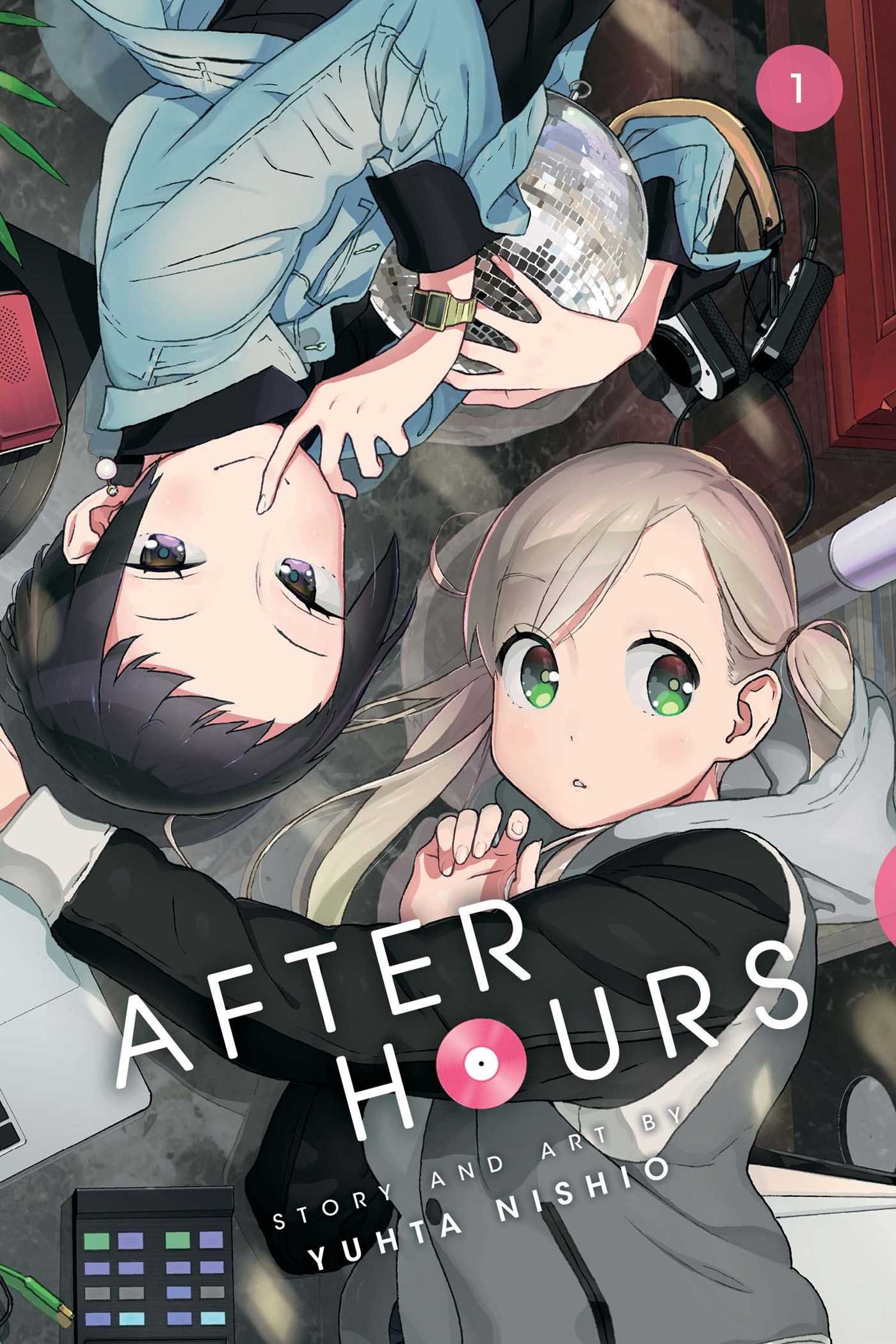
After Hours and My Lesbian Experience with Loneliness epitomize a small but growing trend in yuri manga licensing: both focus on women in their twenties exploring their sexuality, rather than depicting middle- or high-school aged girls crushing on each other.

After Hours is the more upbeat of the two, a sympathetic portrait of twenty-three-year-old Emi, a recent college graduate who’s just quit her job and is struggling to figure out what comes next. A chance encounter with Kei, a twenty-nine-year-old deejay, is a turning point in Emi’s young adult life: not only is she drawn to Kei’s confidence, she’s also intrigued by Kei’s passion for spinning records. As their connection deepens, Emi takes a more active role in supporting Kei’s career, joining Kei’s circle of friends and trying her hand at “veejaying,” selecting videos to complement Kei’s set lists.

One of the most striking aspects of After Hours is Yuhta Nishio’s sensitive depiction of Emi and Kei’s sexual encounters. He uses a handful of discrete signifiers — a pile of clothing on the floor, a tender embrace, a flirtatious post-coital chat — rather than explicit or provocative imagery. That’s a wise choice, I think, as it allows Nishio to portray Emi and Kei as grown women with healthy sexual urges without reducing them to sexualized objects. Nishio’s restrained approach also emphasizes the aspects of Emi and Kei’s bodily intimacy that foster a mutual sense of trust, familiarity, and affection — a dimension of sexual experience that’s often missing from straight romance manga.

Though the first chapters are largely uneventful, future volumes promise dramatic complications. Emi has yet to disclose her relationship to her friends or her not-quite-ex-boyfriend, with whom she’s still sharing an apartment. More interestingly, Emi hasn’t really thought about what it means to be in a relationship with another woman; she’s initially surprised by her attraction to Kei, but resists labeling those feelings as lesbian, bisexual, or queer, choosing instead to savor the sense of purpose and joy that being with Kei brings to her life. The ease with which Emi embraces her new love is a refreshing development, a quiet rebuttal of the idea that sexual orientation is absolute or easily defined.

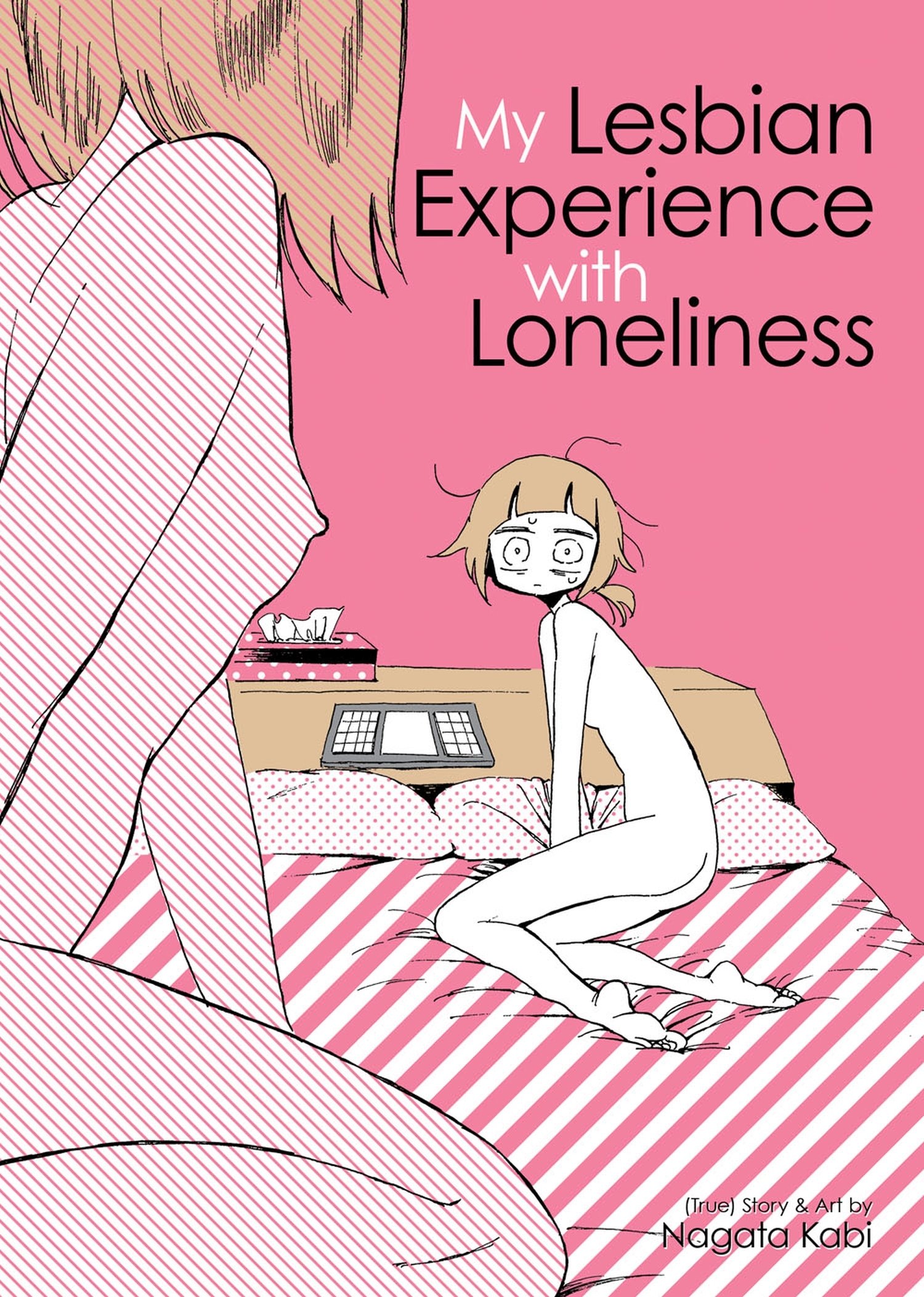
By contrast, Nagata Kabi’s My Lesbian Experience with Loneliness is a more complex story, a confessional comic documenting the author’s sexual awakening in her late twenties. Nagata narrates her odyssey with candor, acknowledging the degree to which mental illness dictated her adult life. She describes the bodily ravages of disordered eating — she vacillated between anoxeria and bulimia — and the emotional toll of disordered thinking, noting the degree to which both depression and body dysmorphia prevented her from holding down a job, maintaining friendships, or thinking about herself as a sexual person. She also ruminates on her chilly relationship with her parents, and her profound sense of shame in disappointing them by not becoming a “real” adult with a conventional office job.

After hitting rock bottom, Nagata realizes the degree to which she’s suppressed her sexuality. In an effort to reassert control over her life, Nagata decides to hire a female escort for her first sexual experience. Nagata documents this encounter in an almost clinical fashion, contrasting her feverish anticipation with her stiff, detached response to being touched. For all of her progress towards mental health and self-acceptance, she realizes that she cannot yet surrender to the bodily sensations of desire — a tension that remains unresolved at the end of her narrative, even though Nagata’s final panels suggest her sense of relief and pride for taking such a bold step.

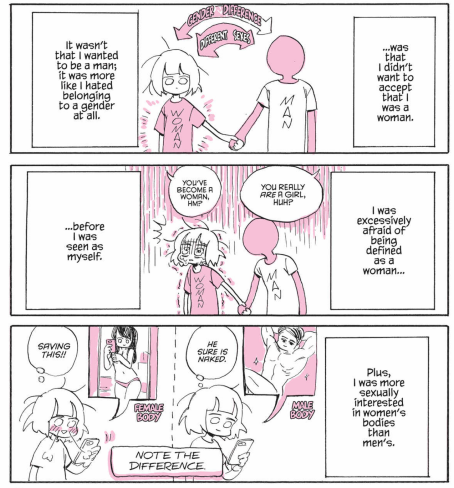
That Nagata’s journey is more inspiring than depressing is a testament to her writing skills (and, I might add, Jocelyne Allen’s artfully wry translation). Though Nagata never shies away from describing uncomfortable thoughts or self-destructive behavior, she finds moments of grace and humor in even the darkest situations, especially as she begins to contemplate what it means to be a sexual person. In three sharp, economical panels, for example, she explores her profound discomfort with binary gender labels, even as she begins to recognize her sexual attraction to women:

It feels churlish to criticize such a personal work, and yet I found myself wishing that Nagata’s art felt more essential to the story she was telling. Writing for The Comics Journal, critic Katie Skelly voiced similar concerns, arguing that Nagata’s tendency to mix big blocks of text with cute drawings keeps the reader at arm’s length when Nagata discloses intimate, sometimes disturbing, details of her eating disorders and self-mutilation. “Nagata can’t find a suitable bridge to mend the gap between the story of her experience and aesthetic,” Skelly notes. “[H]er style can read as generic and her tone never quite finds its mark.” I admit to feeling the same way about Nagata’s work: I admired her raw honesty, but felt that My Lesbian Experience with Loneliness could have been a book, a movie, or a Moth Radio Hour segment just as easily as a comic; nothing about the way Nagata related her experiences felt like it was uniquely suited to manga, as her drawings were more illustrative of what she felt than genuinely revelatory about why she felt such profound self-loathing.

For all the things that go unsaid in My Lesbian Experience with Loneliness, however, there’s much wisdom in Nagata’s story, especially for people struggling with what it means to be healthy, whole, and sexual. Nagata’s recovery is a testament to the human capacity for resilience, and her willingness to share her most vulnerable moments with strangers an act of genuine courage. Here’s hoping that she continues to document her journey of self-discovery.

VIZ Media provided a complimentary review copy of After Hours.

AFTER HOURS • STORY AND ART BY YUHTA NISHIO • TRANSLATION BY ABBY LEHRKE • 160 pp. • RATED TEEN+ (for older teens)

MY LESBIAN EXPERIENCE WITH LONELINESS • STORY AND ART BY NAGATA KABI • TRANSLATED BY JOCELYNE ALLEN • SEVEN SEAS • 152 pp. • RATED OT (for older teens)

Filed Under: Manga, Manga Critic, REVIEWS Tagged With: LGBTQ, My Lesbian Experience With Loneliness, Nagata Kabi, Seven Seas, VIZ, yuri

Elegant Yokai Apartment Life, Vol. 1

September 18, 2017 by Katherine Dacey

Elegant Yokai Apartment Life suffers from multiple personality disorder, lurching awkwardly from one situation to the next without comfortably settling into one storytelling mode long enough for the reader to decide if it’s a sitcom, a soap opera, or a horror show.

In fairness to creators Hinowa Kouzuki and Waka Miyama, few stories purely embody a single genre; the labels that the publishing and entertainment industries have coined — rom-com, dramedy — give ample proof that hybridization is a common strategy for enlivening familar plots. For such hybrid forms to work, however, the tonal shifts must be intrinsic to the story, arising naturally from the interactions between the characters and their environment. Elegant Yokai‘s narrative swerves, however, feel more like a desperate attempt to appeal to as many different constituencies as possible: there’s fanservice for guys (a female ghost who wears only panties and a well-placed towel) and girls (a hot onmyoji with a ponytail and a silver fox with an eye patch), yokai drawn from folklore and urban myth, a potential love interest for the hero, a raft of comic-relief characters who get brief turns in the spotlight, a subplot borrowed from a 1983 Afterschool Special, and tragic backstories for several characters just in case the idea of a “ghostly boarding house” doesn’t tickle your funny bone.

The most frustrating part of this narrative abundance is that so much of it feels… extra. Any one of these elements could be excised from the story without fundamentally changing the premise, making room for more character development. That point is crucial: Elegant Yokai‘s lead is less a person than a reader surrogate, walking from one situation to another in a state of mild befuddlement about his supernatural neighbors. Author Hinowa Kouzuki has saddled Inaba with motivations that explain how he ended up rooming with yokai, but hasn’t actually given him any discernible personality traits. Kouzuki and Miyama’s few attempts to flesh out Inaba’s character are clumsy and, frankly, illogical: what well-adjusted person marks his middle school graduation by fighting his BFF in an abandoned lot because he’s “always wanted to do that”? (Shouldn’t Inaba quote one of the rules of Fight Club or something?)

The artwork suffers from a similarly overdetermined quality. The human characters are less drawn than assembled from bits and pieces of other artists’ work — a dash of CLAMP here, a bit of Yuu Watase there — while the yokai have been shamelessly copied from Rumiko Takahashi and Hayao Miyazaki’s oeuvre. Making deliberate allusions to other artists’ work is, of course, a time-honored tradition, but here, these nods feel less like tribute and more like theft; readers tempted to compare Miyama’s art with Miyazaki’s are bound to find hers a poor substitute.

It’s only in the final chapter of volume one that we get a glimpse of what Elegant Yokai might have been. The story trains the spotlight on Inaba’s fellow apartment dwellers Kuga and Shiro, a boy and his dog who were murdered by Kuga’s mother. Once a month, Kuga’s mother — also a ghost — shows up at the apartment building to reclaim her son. Over time, however, her human form has deteriorated and memories have faded, reducing her to a pitiful demonic state, more scribble monster than angry wraith. The frankness with which Kouzuki and Miyama depict her crime prevents these scenes from descending into bathos; these moments are the only ones that elicit an authentic emotional response from the reader, not least because Kuga and Shiro’s predicament has a demonstrable effect on the other characters. Too bad the rest of volume one is such a frantic, disjointed mess.

ELEGANT YOKAI APARTMENT LIFE, VOL. 1 • STORY BY HINOWA KOUZUKI, ART BY WAKA MIYAMA • TRANSLATED BY ADAM HIRSCH • 206 pp. • RATED T (13+)

Filed Under: Manga, Manga Critic, REVIEWS Tagged With: Comedy, Horror/Supernatural, Kodansha Comics, Yokai

Pick of the Week: Flower Girls

September 18, 2017 by Sean Gaffney, Katherine Dacey, Michelle Smith, Ash Brown, Anna N and MJ Leave a Comment

KATE: This week’s manga haul has something for everyone: new installments of digital-only releases like Tokyo Tarareba Girls, new volumes of perennial favorites like Nichijou and Master Keaton, and a handful of debuts like Kiss Me at the Stroke of Midnight and Sweet Blue Flowers. And while I’m intrigued by Sweet Blue Flowers, my vote goes to volume nine of A Bride’s Story, Kaoru Mori’s gorgeously illustrated chronicle of life on the Silk Road. What say the rest of the MB gang?

MICHELLE: Despite the handful of Seven Seas titles that I’m genuinely looking forward to, I really can only choose Sweet Blue Flowers. I’ve been looking forced to reading this series in English for years! (I even bought the Japanese volumes for a while!) Thanks, VIZ!

SEAN: It’s light novel week, so you know I want to say Baccano!. And there’s a bunch of other titles I want in this monster week. But as with Michelle, my choice goes to Sweet Blue Flowers finally getting the treatment it deserves. Can’t wait.

ASH: Like Kate, I’m certainly looking forward to the next installment of A Bride’s Story, and there are plenty of other manga being released this week that I’ll definitely be picking up (such as Descending Stories), but I’ll be joining Michelle and Sean in choosing Sweet Blue Flowers as my official pick. Shimura’s Wandering Son was an incredibly important series for me personally, so I am thrilled that more of her work is be released in print.

ANNA: There are quite a few great series coming out this this week! I’m going to have to go with the last volume of Master Keaton. Urasawa is always at the top of his game, and I’m going to miss all the insurance investigation shenanigans.

MJ: I find myself echoing what others have said so far regarding Takako Shimura’s Sweet Blue Flowers. A real release of this series has been a long time coming, and I’m thrilled to see it finally hitting the shelves. I can’t wait to read it.

Filed Under: PICK OF THE WEEK

Pick of the Week: Butlers, Cosplayers, and Sunspots

September 11, 2017 by Sean Gaffney, Katherine Dacey, Michelle Smith, Ash Brown, Anna N and MJ Leave a Comment

SEAN: It’s a light week with no first volumes. A few books I’m looking forward to, but I’ll be Don Quixote again and give my pick to Hayate the Combat Butler. All my other lost causes have either ended or been dropped, but Hayate is still there, trickling out.

KATE: Whoa… I reviewed the first volume of Hayate back in 2006, when I was writing for PopCultureShock. I remember enjoying it, reading a few more volumes, and then… well, I think I lost track of it. Sean’s comments, however, reminded me that VIZ has been good about continuing series that never quite found the audience they deserved. (See Kaze Hikaru.) So my vote goes to Hayate the Combat Butler as well.

MICHELLE: My pick this week goes to the final volume of Complex Age. It’s been riveting and it’s been truly upsetting, but my hope is that it’ll end on an empowering note, too. I’m looking forward to it!

ASH: I’ve never actually read any of Hayate the Combat Butler (although perhaps I should). However, I have read the first part of Complex Age and found it to be surprisingly relatable and personally meaningful. I’m a few volumes behind in reading the series, but I join Michelle in choosing the final installment as my pick this week. I’m very glad that Kodansha Comics brought the series to my attention.

ANNA: It is such a light week! Of the titles that are coming out, Complex Age is the series that I’m most likely to finish, although like Ash I need to catch up. That’s my pick as well.

MJ: I’m still in catch-up mode from the summer when I was directing an opera, and since there’s nothing on this week’s pack that really grabs me, I’m going to dig back into the stuff I missed and finally take a look at One Peace Books’ I Hear the Sunspot. It sounds like exactly my kind of BL (if it is, in fact, BL). So let the catching up begin!

Filed Under: PICK OF THE WEEK

The Legend of Zelda: Twilight Princess, Vols. 1-2

September 6, 2017 by Katherine Dacey

Can someone who’s never played a Legend of Zelda video game still enjoy the manga adaptations? That’s the question I set out to answer by reading the first two volumes of the Twilight Princess saga.

The short answer to the question is a qualified yes — if by “enjoy” you mean, “get a handle on what’s happening.” Akira Himekawa, a pseudonym for the two-woman team of A. Honda and S. Nagano, pack a considerable amount of exposition into the first two chapters, making it easy for the uninitiated to grasp the premise. Honda and Nagano also use these introductory pages to introduce us to the residents of Ordon Village — the hero’s home — treating us to idyllic scenes of farmers tending their crops, shepherds minding their flocks, and barefoot children cavorting. Though these tableaux are as cornpone as anything John Ford ever committed to screen, they’re rendered in a crisp, readable style that helps the reader understand what’s at stake if Link fails in his quest to restore the balance between light and darkness.

But if you equate “enjoyment” with “feeling a spark of pleasure or surprise while reading,” then the answer to my initial question is a resounding no. There’s a labored quality to the storytelling that prevents Twilight Princess from coming alive on the page; Honda and Nagano try too hard to nail down every narrative detail, producing a story that often reads more like an overly scripted PowerPoint presentation on Twilight Princess than an organic work of fiction. In the first volume, for example, we’re introduced to the obviously pregnant wife of an important supporting character. Just a few pages later, however, another villager helpfully mentions that Uli’s wife is… pregnant. A similar round of no-shit statements accompany Link’s volume two transformation into a wolf, a development that prompts Link — and other characters — to repeatedly observe that he’s no longer human; you could play a decent drinking game by taking a swig of whiskey whenever someone registered surprise at Link’s lupine form. At least he looks cool.

The plot developments are equally obvious. As soon as Honda and Nagano introduced a tremulous teenage girl and her snot-faced little brother, for example, I knew it was only a matter of 30-40 pages before they’d be snatched, giving Link a compelling reason to enter the Twilight Realm. This predictable turn of events wouldn’t be frustrating if we cared about Ilia and Colin’s fate, but they’re such generic characters that they never transcend their function as plot devices. Even the combat feels more like a sprinkling of “adult spice” than a real attempt to tell a darker or more complex story; Twilight Princess is so devoid of ambiguity or suspense that even the most intense, violent sequences seem largely inconsequential.

The blandness of the manga’s execution prompts me to ask a second question: who is Twilight Princess for? Book sales indicate that there’s a large audience of Zelda fanatics who are enjoying this series, so my guess is that the manga appeals to players’ nostalgia for the original games. For the rest of us, however, Twilight Princess is neither interesting nor imaginative enough to compete with One Piece, Naruto, Fairy Tail, or Fullmetal Alchemist on its own terms, nor does it offer any clues why the Zelda games have been a global, thirty-year phenomenon that’s captivated two generations of gamers.

VIZ provided a review copy of volume two.

THE LEGEND OF ZELDA: TWILIGHT PRINCESS, VOLS. 1-2 • BY AKIRA HIMEKAWA • TRANSLATED BY JOHN WERRY • RATED T, FOR TEEN

Filed Under: Manga, Manga Critic, REVIEWS Tagged With: Akira Himekawa, Legend of Zelda, Twilight Princess, Video Game Manga, VIZ

Pick of the Week: One Last Love Story

September 5, 2017 by Sean Gaffney, Michelle Smith, Katherine Dacey, Ash Brown and Anna N Leave a Comment

MICHELLE: Last time I had the option to pick Skip Beat!, I said that it’d likely always be my pick when it comes out, due to its biannual release schedule. Well, not this time. As much as I deeply love it, this is my final chance to choose My Love Story!!, so I’m gonna do it. It’s brain balm of the best kind—warm and sweet but never sappy or boring. I will miss it very much.

SEAN: So much to love this week, and I want to pick Queen’s Quality, as I do love me some Motomi, but I agree with Michelle: there’s no question that the final volume of My Love Story!! is going to be my pick. Some have accused it of being too sweet and sappy, and they’re absolutely correct, but that’s what I want from this series. Mainline the sugar into my veins, please!

KATE: I’m torn between the final volume of My Love Story!! and the latest installment of One-Punch Man, which deserves to be a Naruto-sized hit in America.

ANNA: This is a great week for manga for me. Like everyone else, I feel compelled to pick the final volume of My Love Story!!, it is such a uniquely quirky series that is heartwarming without being cloying.

ASH: I’m in agreement with everyone else here. While there are quite a few things that I have my eyes on this week–Captain Harlock, Haikyu!!, Sweetness & Lightning–it’s My Love Story!! that has my heart.

Filed Under: PICK OF THE WEEK

That Time I Got Reincarnated As a Slime, Vol. 1

August 28, 2017 by Katherine Dacey

I’m a sucker for a great title, a tendency that’s yielded a bumper crop of disappointments through the years; I still haven’t purged the memory of a Screaming Broccoli album I purchased in 1988, or the 90 minutes I spent watching So I Married an Axe Murderer. I’m pleased to report That Time I Got Reincarnated As a Slime proved a better gamble than punk-rock vegetables, offering enough solid jokes and weird plot developments to sustain this reader’s interest. What surprised me the most about Reincarnated, however, wasn’t the premise — that’s clearly advertised in the title — nor the hero’s appearance — again, see title — but the story’s fundamentally optimistic message: there are always second chances in life.

The first chapter introduces us to Mikami, a 37-year-old virgin trapped in a lousy job. On a fateful afternoon, he impulsively saves a junior colleague from a knife-wielding attacker, an act of heroism that costs Mikami his life — as a human being, at least — and leads to his reincarnation in a fantasy realm that looks remarkably like World of Warcraft, Game of Thrones, and a hundred MMORPGs. Guided by an unseen dungeon master, Mikami reinvents himself as Rimuru, a slime monster who absorbs his enemies’ powers by eating them — a trick that quickly enables Rimuru to do remarkable things from healing the wounded to spinning thread.

What’s more remarkable about Rimuru is that he immediately puts his powers to work — for other people. (Well, monsters, really.) In chapter two, for example, he teaches a community of goblins how to defend themselves against a numerically superior opponent, helping them build sophisticated fortifications that repel a snarling pack of direwolves. (Paging George R.R. Martin!) Rimuru also bestows names on each member of the tribe, an act that transforms the once small and homely goblins into strapping specimens. That would be a good joke in and of itself, but it lands with greater impact because Rimuru’s act of generosity is consistent with what we saw of his human self, both in the prologue and in a brief flashback to his interactions with colleagues.

And speaking of jokes, Stephen Paul’s crisp translation plays an instrumental role in bridging the gap between the original novels and their manga adaptation by creating a distinctive, sardonic voice for Rimuru that situates him somewhere between audience surrogate and hero. The tone of Rimuru’s monologues captures the mixture of enthusiasm, wonder, and bewilderment with which he approaches new situations, great and small. After bestowing the names Gobta, Gobchi, Gobstu, Gobte, and Gobto on a family of goblins, for example, Rimuru heads off criticism from the reader by declaring, “I didn’t claim I was some kind of naming virtuoso!”, while a fortune teller’s romantic predictions prompt him to ask the same questions we’re thinking: “Do slimes even have genders? How do they multiply? Cell division?”

What Paul’s translation can’t do is goose the pacing. Manga-kaTaiki Kawakami makes a game effort to handle the first volume’s exposition as efficiently as possible, which results in many static panels of Rimuru learning the rules of play from the unseen dungeon master. Though the dialogue is punchy, the story unfolds in fits and starts, seesawing between short, intense bursts of action and leisurely scenes of Rimuru chatting with other characters, pondering one of his new-found abilities, or describing something that happened off camera. These info-dump passages are all the more tedious because Rimuru lacks the limbs, eyes, or mouth to adequately register surprise or awe at what he learns; what features he has — two pencil-line eyebrows — are frozen in a perma-scowl.

The other disappointing element of the manga adaptation is the paucity of female characters in volume one, a problem that series creator Fuse cheerfully acknowledges. “It’s quite possible not to have a heroine in a traditional sense,” he opines in the manga’s epilogue, “but not having any female characters whatsoever is a problem. There’s no beauty in the manga.” Kawakami’s strategy for addressing this issue is not to introduce an important character a little sooner than she appeared in the novels, or expand one of the minor female characters into a more essential figure, but to pile on the fan service by turning any gathering of female characters into a harem scene; I’m still scrubbing my eyeballs after reading a chapter in which an attractive elfling uses Rimuru as a boob shelf. (Worse still: someone cracks wise about E.I.L.F.s, a quip that wouldn’t have been funny in 2003, let alone 2017.)

For all its flaws, however, Reincarnated has its heart in the right place, using Rimuru’s adventures to demonstrate that it’s possible to make the most of any situation, no matter how improbable or unpromising it may seem at the outset. Better still, Reincarnated imparts its moral with tongue firmly in cheek, never lapsing into sappy earnestness about doing one’s best, or sacrificing yourself for the greater good. Of course, we haven’t seen what will happen if and when Rimuru stumbles into a second chance at romance, though volume one offers a few tantalizing clues about a future love interest. Here’s hoping that Rimuru begins his second — and potentially more terrifying — journey of romantic self-discovery without losing his wit or his wits.

THAT TIME I GOT REINCARNATED AS A SLIME, VOL. 1 • CREATED BY FUSE • MANGA BY TAIKI KAWAKAMI • CHARACTER DESIGNS BY MITZ VAH • TRANSLATED BY STEPHEN PAUL • KODANSHA COMICS • RATED: TEEN (13+) • 240 pp.

Filed Under: Manga, Manga Critic Tagged With: Fantasy, Gaming Manga, Kodansha Comics, That Time I Got Reincarnated As a Slime

Pick of the Week: Scrounging for Choices

August 28, 2017 by Sean Gaffney, Michelle Smith, Katherine Dacey, Ash Brown and Anna N Leave a Comment

SEAN: Despite the large number of manga available this week, my pick is the latest book in the Monogatari Series, the 2nd Nisemonogatari. I enjoy this series despite its fanservice, but this one may be challenging even with that. Toothbrushes out!

MICHELLE: As Sean predicted, the new releases that appeal to me the most are Kodansha’s digital sports manga. Days is shounen fun, but Giant Killing offers a seinen slant that makes it unique and my pick for this week.

KATE: I’m backing Michelle’s play by picking Giant Killing and Days, too. I’d love to see even more sports manga available in English, and supporting Kodansha’s digital publishing efforts seems like the best way to encourage them to be bolder in their licensing choices. We need manga about golfing, running, synchronized swimming, mountain biking, kayaking, sailing, speed skating, agility training, sled dog racing… the possibilities are endless!

MICHELLE: I’m still holding out hope for Mitsuru Adachi’s Rough, too. (Though not from Kodansha, obviously.)

ASH: Were I a digital reader this would be a great week of releases for me with new volumes of Giant Killing, Saki, and Space Brothers coming out. Limiting myself to print releases though there’s not much that I’m super-excited about, but I am very curious about the debut of Kigurumi Guardians.

ANNA: There’s not a ton out there that I’m reading this week, although I’m very happy that more sports manga is being released. I’m picking Altair: A Record of Battles volume 3, because that’s what I’m most likely to read… someday!

Filed Under: PICK OF THE WEEK

Pick of the Week: Food, Glorious Food!

August 21, 2017 by Sean Gaffney, Michelle Smith, Anna N, Katherine Dacey and Ash Brown Leave a Comment

MICHELLE: It is happy cruelty that this week I am forced to choose between Chihayafuru and What Did You Eat Yesterday?, both of which I love intensely. I think we will probably see another volume of Chihayafuru before volume thirteen of WDYEY, as it won’t even come out in Japan until next month, so that gives Yoshinaga the slight edge this time. But really, get them both.

SEAN: My pick this week is the final volume of Blood Lad, which I’ve definitely enjoyed more than I expected to. It feels like it’s just about the right time to end it, too. Also, Fuyumi cover!

ANNA: Chihayafuru is an easy pick for me. I am so happy this series is being translated!

KATE: There’s only one manga on my plate this week: volume two of Delicious in Dungeon. It reads like an episode of Martha Stewart Living crossed with a MMPORG, mixing action scenes with tips on how to get the most of giant scorpion meat. (Who knew it was good for tempura?)

MICHELLE: Oh, I didn’t even mention that or Yowamushi Pedal! So much great stuff this week.

ASH: There really are so many great manga being released this week, making it extremely difficult to choose just one! So, I’ll cheat a little and pick a subgenre instead–give me all the food manga you’ve got! Both What Did You Eat Yesterday? and Delicious in Dungeon are very high on my list and I’m definitely looking forward to sinking my teeth into them. (Not literally, of course.)

Filed Under: PICK OF THE WEEK

  • « Go to Previous Page
  • Page 1
  • Interim pages omitted …
  • Page 36
  • Page 37
  • Page 38
  • Page 39
  • Page 40
  • Interim pages omitted …
  • Page 89
  • Go to Next Page »
 | Log in
Copyright © 2010 Manga Bookshelf | Powered by WordPress & the Genesis Framework