• Skip to primary navigation
  • Skip to main content
  • Skip to primary sidebar
  • Home
  • About Us
    • Privacy Policy
    • Comment Policy
    • Disclosures & Disclaimers
  • Resources
    • Links, Essays & Articles
    • Fandomology!
    • CLAMP Directory
    • BlogRoll
  • Features & Columns
    • 3 Things Thursday
    • Adventures in the Key of Shoujo
    • Bit & Blips (game reviews)
    • BL BOOKRACK
    • Bookshelf Briefs
    • Bringing the Drama
    • Comic Conversion
    • Fanservice Friday
    • Going Digital
    • It Came From the Sinosphere
    • License This!
    • Magazine no Mori
    • My Week in Manga
    • OFF THE SHELF
    • Not By Manga Alone
    • PICK OF THE WEEK
    • Subtitles & Sensibility
    • Weekly Shonen Jump Recaps
  • Manga Moveable Feast
    • MMF Full Archive
    • Yun Kouga
    • CLAMP
    • Shojo Beat
    • Osamu Tezuka
    • Sailor Moon
    • Fruits Basket
    • Takehiko Inoue
    • Wild Adapter
    • One Piece
    • After School Nightmare
    • Karakuri Odette
    • Paradise Kiss
    • The Color Trilogy
    • To Terra…
    • Sexy Voice & Robo
  • Browse by Author
    • Sean Gaffney
    • Anna Neatrour
    • Michelle Smith
    • Katherine Dacey
    • MJ
    • Brigid Alverson
    • Travis Anderson
    • Phillip Anthony
    • Derek Bown
    • Jaci Dahlvang
    • Angela Eastman
    • Erica Friedman
    • Sara K.
    • Megan Purdy
    • Emily Snodgrass
    • Nancy Thistlethwaite
    • Eva Volin
    • David Welsh
  • MB Blogs
    • A Case Suitable For Treatment
    • Experiments in Manga
    • MangaBlog
    • The Manga Critic
    • Manga Report
    • Soliloquy in Blue
    • Manga Curmudgeon (archive)

Manga Bookshelf

Discussion, Resources, Roundtables, & Reviews

Katherine Dacey

Pick of the Week: The Calm Before the Storm

December 11, 2017 by Sean Gaffney, Michelle Smith, Katherine Dacey, Anna N and Ash Brown Leave a Comment

MICHELLE: Ordinarily, I would be all about picking Chihayafuru at this juncture, but Princess Jellyfish is in a really dramatic spot right now and I think it has the slight edge. But really, you should read both.

SEAN: I’ve fallen behind on both Chihayafuru and Princess Jellyfish, so will turn to light novels for my pick. The premise for Walking My Second Path in Life sounds great, and does not appear, fingers crossed, to be an isekai. I’m a sucker for princesses who resolve to become knights, really.

KATE: I’m hoarding my change for next week.

ASH: I will definitely need all the change that I can get for next week but, like Michelle, I simply can’t resist picking up the latest volume of Princess Jellyfish!

ANNA: I have to admit, I’m behind on both Chihayafuru and Princess Jellyfish, but I’m still very excited that they are both coming out. I’m a little more attached to Chihayafuru though, so that is my pick!

Filed Under: PICK OF THE WEEK

A Polar Bear in Love, Vol. 1

December 5, 2017 by Katherine Dacey

Don’t be fooled by the cute cover: A Polar Bear in Love is neither gag strip nor conventional rom-com about an improbable couple overcoming their differences. It’s a fitfully amusing, sometimes melancholy reflection on what it’s like to fall in love for the first time, filled with the awkward moments and misunderstandings that all dating newbies experience.

The set-up is simple: Polar Bear falls head-over-paws for Lil’ Seal. Lil’ Seal, for his part, is understandably terrified by Polar Bear’s declaration of love and suffers violent tremors and visions of his imminent demise. Author Koromo complicates this one-joke premise, however, by revealing that both Polar Bear and Lil’ Seal are male, and that neither of them are old enough to understand what it means to be in an adult relationship. Polar Bear, for example, labors under the impression that it’s normal for people to eat their loved ones. While that sounds like a cutesy, kids-believe-the-darndest-things punchline, Polar Bear’s belief is rooted in a fundamental law of the Arctic: the strong eat the weak. His own experiences with love, loss, and scavenging tug — OK, yank — on the heartstrings in an unexpected way, revealing the extent to which his carnivorous instincts are complicated by his desire for friendship.

The art, too, is deceptively minimalist. Both Polar Bear and Lil’ Seal are rendered as thick outlines against a wintery landscape, an artistic decision that allows Koromo to deform her characters for maximum humorous effect, but also underscores the fact that their white fur coats are intended to camouflage them from one another. Though the characters’ conversations are distinctively human, their physical movements are not; even when Polar Bear clasps Lil’ Seal to his chest in a tender embrace — a seemingly anthropomorphic moment — Koromo poses Polar Bear firmly on his haunches, capturing the muscular weight of his enormous hind quarters, and emphasizing the disparity between his size and Lil’ Seal’s.

But is it good, you ask? I’m not sure. There’s a brisk efficiency in Koromo’s artwork and a few delightfully absurd moments that illustrate the major gap between what Polar Bear says and what Lil’ Seal hears — an apt metaphor for what happens when two people try sorting out their feelings for one another. The story never finds a consistent rhythm or tone, however, lurching between somber reflections on arctic survival and antic scenes of Polar Bear glomping Lil’ Seal. The same is true of the characters; in some scenes, their chatter pegs them as worldly seven- or eight-year-olds, while other conversations make them seem like jejune high schoolers.

What I can say, however, is that I was genuinely surprised by A Polar Bear in Love. The manga didn’t follow any obvious formula, and wasn’t afraid to explore dark or weird emotional terrain in the service of character development. I wish I’d laughed more, or found the narrative less circular, but I won’t lie: a few scenes made me sniffle and feel protective of Polar Bear, despite his penchant for over-the-top pronouncements and bone-crushing hugs. His sincerity carried me past volume one’s weaker moments, and made me curious about what’s next for him and his harp seal pal.

A POLAR BEAR IN LOVE, VOL. 1 • STORY AND ART BY KOROMO • TRANSLATED BY TAYLOR ENGEL • YEN PRESS • 160 pp. • RATED A, FOR ALL AGES

Filed Under: Manga, Manga Critic, REVIEWS Tagged With: Comedy, Koromo, Polar Bear, yen press

Pick of the Week: Neverland

December 4, 2017 by Sean Gaffney, Katherine Dacey, Michelle Smith, Anna N and Ash Brown Leave a Comment

SEAN: There are a few intriguing volumes out this week, and I’d argue Wake Up, Sleeping Beauty is my clear runner-up, but there has been SO much good buzz about The Promised Neverland that I simply can’t resist making it my pick of the week. I want to see what the fuss is about.

KATE: This week, I’m all in for The Promised Neverland. After seeing so many people praising it, I decided to check it out for myself and boy howdy — it’s a nail-biter! If you need more persuading, I’ve offered a more thoughtful explanation of why you should be reading Neverland here.

MICHELLE: This wasn’t on my radar until Ash posted the link to Kate’s review, and now I’m going to be picking it like everyone else! Wake Up, Sleeping Beauty and Drifting Dragons are debuts I plan to check out, as well.

ASH: Perhaps unsurprisingly, I’m in agreement with everyone else here! While there are a few things that I’m interested in this week, my pick absolutely goes to The Promised Neverland.

ANNA: I’m not going to break this pattern! The Promised Neverland looks very interesting, that’s my pick too!

Filed Under: PICK OF THE WEEK

Pick of the Week: Take A Chance On ACCA

November 27, 2017 by Sean Gaffney, Michelle Smith, Katherine Dacey, Ash Brown and Anna N 1 Comment

MICHELLE: I am very happy about new volumes of All Out!! and Giant Killing, and looking forward to Kodansha Digital’s new shoujo offerings, especially Lovesick Ellie, but I absolutely MUST have ACCA. I’ve missed Natsume Ono’s work and this one has an interesting premise regarding intrigue in some fictional country. Sign me up!

KATE: I second Michelle’s recommendation: it’s been waaaaaaaaaay too long since there was a new Natsume Ono title available in English.

SEAN: Yup, I have to agree, though I’m also drawn to SP Baby. But the Pick of the Week just has to be ACCA, the failed band that Agnetha and Anni-Frid put together with Christopher Cross… I mean, the newest offering from Natsume Ono.

ASH: No question about it, like everyone else, the debut of ACCA is absolutely my pick this week! House of Five Leaves was a particularly meaningful series for me, and I’ve greatly enjoyed many of the creator’s other manga, so I’m always interested in seeing what Ono is up to.

ANNA: I agree, a new Natsume Ono series is something that appears very rarely, and is definitely something to celebrate. ACCA is my pick as well!

Filed Under: PICK OF THE WEEK

A First Look at The Promised Neverland

November 27, 2017 by Katherine Dacey

Crack pacing, crisp artwork, and a shocking plot twist in chapter one — those are just three reasons to pick up The Promised Neverland when it arrives in comic shops on December 5th. The first volume is a masterful exercise in world-building, introducing the principal characters and the main conflict in a few economic strokes, avoiding the trap that ensnares so many fantasy authors: the info-dump introduction. Instead, the writer-artist team of Kaiu Shirai and Posuka Demizu allow the reader to figure out what’s happening by revealing important plot details as the characters uncover them, and letting the artwork establish the setting. That makes the very earliest pages of the story flow more like a rollercoaster than a Star Wars screen crawl, making every page turn feel like an urgent necessity.

The story begins at Grace Field House, an orphanage plucked from a Victorian novel: the main building is a homey Tudor villa that’s surrounded by open meadows and lush forest, perfect for a game of tag. Our first hint that something is amiss comes just six pages into the story, as Emma, the narrator, makes a mental note of all the things she’s grateful for: “a warm bed, delicious food” and “an all-white uniform.” Before we can ponder the significance of the uniform, however, Demizu inserts a panel revealing that every resident of Grace Field House has a number tattooed on her neck, a sure sign that the orphans are more prisoners than temporary wards:

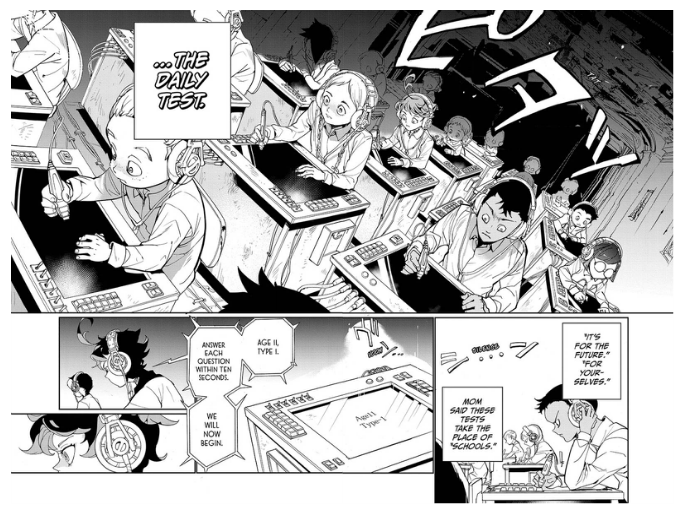
A smattering of other clues — including a series of daily IQ tests and a fence encircling the property — reinforce our perception that Emma and her friends Roy and Norman are in grave danger. And while the earliest chapters occasionally bow to Shonen Jump convention with on-the-nose narration, it’s the artwork, not Emma’s voice-over, that makes each new revelation feel so sinister. Consider the panel that introduces the testing ritual:

In the first ten pages of the story, Demizu uses little to no shading to create volume or contrast, instead depicting the setting and characters through clean, graceful linework. The image above, which appears on pages 12-13, is the first time that we see such a dramatic use of tone; the students at the back of the frame look like they’re being swallowed by a black hole, while the students at the front sit under a klieg light’s glare. Demizu’s subsequent drawings are more restrained than this particular sequence, but her artwork becomes more detailed and complex than what we saw in the story’s first pages — it’s as if the setting is coming into focus for the first time, complicating our initial impressions of Grace Field House as a place of refuge.

I’m reluctant to say more about the plot, since the first chapter’s spell loses some of its potency if you know the Big Terrible Secret beforehand. (If you absolutely, positively must know what happens, Wikipedia has a decent, one-paragraph summary of the premise.) By the time Emma, Roy, and Norman realize the real purpose of their incarceration, however, the basic “rules” of the Promised Neverland universe have been firmly established, and the characters fleshed out enough for us to care whether they succeed in escaping. More importantly, the lead trio are smart and capable without seeming like miniature adults, making their likelihood of success seem uncertain, rather than preordained. That element of suspense may be difficult to sustain for 10 or 20 volumes, but hot damn — volume one is a nail-biter. Count me in for more!

Volume one debuts on December 5th in print and ebook form. Chapters 1-3 are available for free on the VIZ website; the story is currently being serialized in the English edition of Weekly Shonen Jump.

Filed Under: Manga, Manga Critic, REVIEWS Tagged With: Fantasy, Shonen, Shonen Jump, The Promised Neverland, VIZ

Pick of the Week: Hard To Decide

November 20, 2017 by Sean Gaffney, Michelle Smith, Anna N, Ash Brown, Katherine Dacey and MJ Leave a Comment

SEAN: There’s a good number of titles I’m getting, but my mind is torn between the ridiculous manga Arakawa Under the Bridge and the ridiculous light novel So I’m a Spider, So What?, Given this is technically Manga Bookshelf and not Light Novel Bookshelf, I’ll lean on the side of the manga, so Arakawa is my pick.

KATE: So many choices… I’m partial to VIZ’s Children of the Whales, as I’m always interested in good fantasy/sci-fi, but I can’t deny the appeal of A Polar Bear in Love, which just looks cute. Cute is good.

ASH: There are so many terrific titles being released this week! Sean and Kate have already mentioned Arakawa Under the Bridge and Children of the Whales, both of which I’m looking forward to reading, so I’ll use my pick on the Neo Parasyte M shounen anthology–I’m a fan of Hitoshi Iwaaki’s original Parasyte manga and greatly enjoyed the shoujo collection Neo Parasyte F and I certainly can’t pass up the opportunity read more of Moto Hagio’s work!

MICHELLE: Since the intriguing debuts have been covered, I’ll vote for a continued favorite: Ooku. It has gone a bit beyond the point where I thought it would end, and I’m intrigued to see what other stories Yoshinaga has to tell.

ANNA: This week has a bunch of interesting manga. I have to say out of all of them I’m most interested in Children of the Whales. I’m in the mood for some good sci-fi!

MJ: This is a tough week for me. One thing you can generally count on with me is that Fumi Yoshinaga always wins. And yet… this week, I find my curiosity leaning soooo heavily towards getting a real taste of Hikaru Nakamura’s work in English that I think I’m unable to resist. It’s Arakawa Under the Bridge for me. I’m so sorry, Ooku. You know I still love you. Right??

Filed Under: PICK OF THE WEEK

Manga in Theory and Practice: The Craft of Creating Manga

November 19, 2017 by Katherine Dacey

Part manifesto, part how-to manual, Hirohiko Araki’s Manga in Theory and Practice: The Craft of Creating Manga is as idiosyncratic as the series that made him a household name in Japan. Araki characterizes his book as both a map, guiding the aspiring artist along the “golden way” of manga, and a tool kit for developing one’s storytelling chops. “If you were to go hiking on an unfamiliar mountain, you’d bring a map, right?” he states. “If you also have with you a foundation of mountaineering skill, you could wander onto side paths and discover unexpected scenery, and if you were to come across any dangers, you could find your way around them and still reach the summit” (12-13).

Araki’s own map to the summit was Hitchcock/Truffaut. First published in 1967, the book traced Hitchcock’s journey from title boy at Paramount’s Famous Players to director of Rear Window, analyzed Hitchcock’s signature techniques, and considered Hitchcock’s contributions to the development of film. It’s not hard to imagine why Truffaut and Hitchcock’s words beguiled Araki; they provided Araki practical tips for creating memorable characters and surprising plot twists while reassuring him that a popular medium like film or comics could, in fact, be a high art form.

That fancy pedigree helps explain what differentiates Manga in Theory and Practice from hundreds of other books aimed at the manga novice. Instead of tutorials on choosing pen nibs or drawing “manga” eyes, Araki offers a chatty, first-person treatise on writing a hit series, explaining the techniques he uses to sustain to a long-form story with examples from his favorite movies, manga, and novels. Araki also uses his own manga to illustrate how his ideas work in practice, narrating scenes from JoJo’s Bizarre Adventure, Poker Under Arms, and Cool Shock B.T. By choosing material from every stage of his career, he allows the reader to appreciate just how much his own style has evolved through years of study, practice, and editorial critique — a valuable example for any aspiring manga artist.

The book’s core chapters — “Designing Characters,” “How to Write a Story,” “Art Expresses Everything,” “What Setting Is to Manga,” and “All Elements Connect to the Theme” — outline Araki’s process for creating characters and settings, offering sound advice about which genres are best suited to serialization. Though Araki’s techniques are highly individual, the thoroughness with which he approaches world building is a useful model for less experienced writers. Araki even includes a detailed chart for capturing “sixty facts for fleshing out your characters,” from the obvious — age, gender, size — to the mundane — handedness, favorite brands.

Another recurring theme of Manga in Theory and Practice is that art is a means to an end, not an end in itself. “What your readers will see is the artwork,” Araki observes, “but behind those drawings exist the interconnected elements of character, story, setting, and theme” (41). To illustrate this point, Araki devotes several pages to explaining the difference between signification and realism, suggesting when one technique is more effective than the other. Using Jiro Taniguchi’s Solitary Gourmet (Kodoku no Gourmet) as an example, Araki notes that the hero “is drawn as an everyday salaryman, but the food is drawn with complete realism.” By drawing Goro in less detail than the food, Araki argues, Taniguchi directs the reader’s eye to the presentation, texture, and ingredients of every dish, rather than Goro’s reaction to the meal — a subtle but effective way to highlight the uniqueness of each restaurant Goro visits (45).

Araki returns to this idea later in the book, noting that the artist’s credibility lies, in part, with his ability to convince the reader that the story is taking place in a real world where characters walk, drive, text, cook, shop, and go to school. Under the provocative heading “How to Draw Guns,” Araki explains that hands-on experience with “machinery and tools” is essential to creating a realistic setting. “If you are drawing a motorcycle or bicycle, and you don’t understand how the wheels are attached or where the handlebars are placed, the result will be unsuitable for riding upon, and your setting will become incoherent,” he notes (131-32).

As pragmatic as Araki’s advice is, the book sometimes sags under the weight of Araki’s pedantic tone; it’s a little like reading a how-to book written by Polonius or your pompous Uncle Frank. In a section titled “The Difference Between Drawing Men and Women,” for example, Araki counsels the aspiring manga-ka that “nowadays, both men and women can become heroes.” And if that advice seems self-evident, what follows is even less useful. “If anything sets apart male and female characters, it’s only visual,” he elaborates. The decision to include female characters “is purely a matter of your own taste,” he continues, “as long as your characters are appealing, you could get away with a world of all men” (58-59). Small wonder so many male comic artists have no idea how to write female characters.

More amusing is a passage in which Araki castigates Francis Ford Coppola for extending the storyline of The Godfather beyond Michael Corleone’s promotion to family don. As Araki sees it, the plot developments that follow Michael’s ascent — Fredo’s betrayal, his divorce from Kay — violate Araki’s dictum that “protagonists are always rising.” “In the sequels,” Araki opines, “Michael is beset by troubles and family betrayals in a series of realistic scenes that are brilliantly rendered, but from the point of view of the audience, are unwanted and depressing” (100). Araki does praise Coppola’s commitment to this dreary vision of mob life, but it’s hard to escape the idea that Araki is dissing Coppola for the The Godfather II‘s downbeat ending.

And while I’m tickled by Araki’s assessment of The Godfather II, these odd digressions are part of Manga in Theory and Practice‘s charm. It’s one of the few how-to manuals that seems to have been written by a flesh-and-blood person working in the industry, rather than a manga illustration bot. More importantly, Manga in Theory and Practice is a valuable reference work, filling a niche that most manga manuals ignore: how to unify images and words into a dynamic story. Recommended.

VIZ Media provided a review copy.

Works Cited

Araki, Hirohito. Manga in Theory and Practice: The Craft of Creating Manga, translated by Nathan A. Collins, VIZ Media, 2017.

Filed Under: Books, Manga Critic, REVIEWS Tagged With: Hirohiko Araki, How-To, JoJo's Bizarre Adventure, VIZ

Astra Lost in Space, Vol. 1

November 14, 2017 by Katherine Dacey

While the US manga market has plenty to offer teen readers, there’s a dearth of titles for kids who have aged out of Yokai Watch but aren’t quite ready for Bleach or Soul Eater. Astra Lost in Space, a new addition to the VIZ catalog, is a perfect transitional title for ten, eleven, and twelve-year-olds who want to read “real” manga: its slick illustrations and adventure-driven plot feel just edgy enough for this group, while the content falls safely within the boundaries of what’s appropriate for the middle school crowd.

The plot of Astra Lost in Space may remind older fans of Moto Hagio’s sci-fi classic “They Were Eleven”: nine high school students find themselves stranded aboard a spaceship whose communication system has been disabled. With only a few days’ supply of water and food on board, the group is forced to improvise a plan for making the five-month journey home. Their solution: hopscotching between planets — let’s call them “Class M” for the sake of convenience — where an abundant supply of water, plants, and animals await harvesting.

As you might guess, the planet-of-the-week formula provides artist Kenta Shinohara (Sket Dance) ample opportunity to draw menacing fauna and flora, and stage imaginative action sequences. In the volume’s best scene, for example, team captain Kanata Hoshijima leap-frogs across a field of sky-high lily pads to rescue the group’s youngest member from a flying, six-legged monster. Shinohara lavishes more attention to detail on Kanata’s long jump technique than on the turgon itself, breaking down each of Kanata’s jumps into discrete steps recognizable to any track-and-field fan: the approach, the takeoff, the hang, and the landing. In a further nod to realism, Shinohara shows us the physical toll that each jump exacts from Kanata; we can practically hear Kanata’s heaving breaths as he readies himself for the next one, an effective gambit for casting doubt on Kanata’s ability to reach Funicia.

For all the skill with which this rescue is staged, Shinohara can’t disguise the fact his characters feel like they’re the products of a Shonen Jump reader’s poll, rather than original creations. Kanata, for example, is a walking, talking checklist of shonen hero traits: he’s strong, friendly, over-confident, and burdened with a tragic backstory that gives him the will to persevere in any situation, no matter how dire. He also happens to be a decathlete, a fact that’s revealed as he rescues Funicia from the turgon’s grip. (At least that explains his javelin-throwing skills.) The other characters are less developed than Kanata, but will seem familiar to anyone who’s read three or four Shonen Jump titles: there’s Quittierre, a pretty rich girl whose tantrums conceal a good heart; Aries, a cute spaz who makes Edith Bunker look like a genius; Zack, a calm, smart boy who speaks in complete paragraphs; Charce, a boy who’s so handsome he sparkles; and a handful of less-defined characters who — according to the Third Law of Manga Plot Dynamics — will either be monster fodder or directly responsible for their classmates’ terrible predicament.

Manga novitiates, however, will be less troubled by these nods to convention, thanks to the story’s brisk pacing, smart-looking layouts, and game attempts at humor. Though there’s a mild bit of fanservice and “fantasy violence” (VIZ’s term, not mine), parents, teachers, and librarians should feel comfortable allowing middle school students to read Astra.

N.B. The first 45 chapters are currently available through the VIZ website for anyone wishing to screen the story for younger readers. Volume one of Astra is also available in a Kindle edition, and will be available in a print edition that’s slated for a December 5th release.

ASTRA LOST IN SPACE, VOL. 1 • STORY AND ART BY KENTO SHINOHARA • TRANSLATED BY ADRIENNE BECK • VIZ • 204 pp. • RATED T for TEEN

Filed Under: Manga, Manga Critic, REVIEWS Tagged With: Kenta Shinohara, Sci-Fi, Shonen, Shonen Jump, VIZ

Pick of the Week: King Me

November 13, 2017 by Sean Gaffney, Michelle Smith, MJ, Ash Brown, Anna N and Katherine Dacey Leave a Comment

MICHELLE: I would pretend to moan and groan here about having to decide between Requiem of the Rose King and Chihayafuru, but although I really and sincerely do love Requiem of the Rose King, for me and my sports manga fixation, there’s really no contest. Chihayafuru forever!!!

SEAN: I like Chihayafuru as well, though I’m falling behind. My pick is Requiem of the Rose King, though, as it remains one of the most compulsively readable shoujo out there, even if Shakespeare might be spinning in his grave a bit.

KATE: This week, I only have eyes for one title: volume three of Delicious in Dungeon, one of 2017’s best new manga. It’s funny, breezy, and surprisingly well plotted, despite its monster-of-the-week formula. As I noted in my review of volume one, Dungeon reads like a mash-up of a workplace sitcom and a cooking show (albeit one with seriously unappetizing recipes).

ASH: There are so many things that I’m interested in this week, it’s difficult for me to choose just one! There’s Frau Faust and Requiem of the Rose King for classically-inspired tales with interesting twists and Delicious in Dungeon with its brilliant mix of food and fantasy. For official picks I often lean towards debuts, though, and I’m very glad that A Strange and Mystifying Story was rescued–I’m curious to see if I like the series as well as I did the first time it was translated.

ANNA: There’s so much great manga coming out this week! For me though, any time Requiem of the Rose King comes out, that’s an automatic pick for me. This unique adaptation of Richard the III is always mesmerizing.

MJ: I’ve been pretty swamped this week, and haven’t had a chance to really look things over, but did somebody say Requiem of the Rose King? You can always count me in for that.

Filed Under: PICK OF THE WEEK

Pick of the Week: A Lot To Choose From

November 6, 2017 by Sean Gaffney, Michelle Smith, Katherine Dacey, Anna N and Ash Brown Leave a Comment

SEAN: As always for the first week of the month, there’s a lot I’m interested in, mostly from Viz. My pick is the new volume of My Hero Academia, which has risen up this year to become one of Jump’s hottest new titles, not quite on a Naruto level but at least near Bleach. And it’s also really fun.

MICHELLE: There’s a ton of stuff I’m interested in, too, with shoutouts to Ace of the Diamond, The Full-Time Wife Escapist, and Dreamin’ Sun in particular. Still, I am feeling in a distinctly Natsuki Takaya mood at present, so the fourth 2-in-1 omnibus of Twinkle Stars seems like just the thing.

KATE: This week, I’m all about Descending Stories. The last two volumes have done a better job of showing the reader why rakugo remains popular with Japanese audiences today, and has brought the drama. Count me in for the next installment!

ANNA: I’m going to go with The Full-Time Wife Escapist, I find the protagonist of the series different than what I expect from most josei series, and the dynamics between the characters are so interesting given the odd situations they find themselves in.

ASH: There are quite a few things that I’m interested in this week, too. However, the release I’m probably most curious about is the third omnibus of Erased. (Since the series is in part a mystery, this would seem to be an appropriate response.)

Filed Under: PICK OF THE WEEK

Yokai Rental Shop, Vol. 1

October 31, 2017 by Katherine Dacey

Yokai Rental Shop is a classic example of Monkey Paw Theater, in which a foolish person comes into possession of a magical object, uses said object to grant an ill-advised wish, then pays a terrible price for his rash decision. Author Shin Mashiba puts a Japanese spin on W.W. Jacob’s famous story, substituting a nekomata and an okuri-inu for a cursed paw, but otherwise conforms the tenets of the genre. The clientele of Pet Shop Crow seek quick or unwise solutions to everyday problems: one mourns the untimely demise of her favorite idol, another dreads his daily encounter with bullies, and a third worries that her younger sister is trying to steal her boyfriend. To help each client “solve” her problem, shop owner Karasu rents them an exotic pet with special abilities. That pet comes with specific instructions — defy them and the deal goes sideways, resulting in bodily harm or emotional trauma.

I liked this story better when it was called Pet Shop of Horrors.

Part of the problem is that Karasu’s clientele is an unsympathetic lot, especially when contrasted with the characters in “The Monkey’s Paw” or Pet Shop of Horrors. The bullying victim, for example, is so enraptured by his yokai companion’s powers that he explicitly ignores Karasu’s instructions, fantasizing about how he will utilize his new-found strength. Within two pages, however, he realizes the folly of his arrogance, as the okuri-inu metamorphoses into a canid Godzilla with a taste for human flesh. Only a quick intervention from Karasu prevents the chapter from devolving into a gruesome spectacle, though you may wish that Karasu had adopted a more laissez-faire attitude towards his foolish client.

The other major issue plaguing Yokai Rental Shop is that Mashiba doesn’t stick with the monster-of-the-week formula for long. A subplot involving Karasu and his half-brother Hiiragi, a fussy civil servant, takes a detour into InuYasha territory when Karasu makes an important discovery about their father. Mashiba tries milking the brothers’ temperamental differences for laughs, but the jokes don’t land with much force; if you’ve seen one episode of The Odd Couple or read a chapter of xxxHolic, you’ve seen this dynamic executed with more gusto and imagination, two qualities that Yokai Rental Shop sorely lacks.

Neither of these deficiencies would be so glaring if the artwork was less perfunctory, but Mashiba’s serviceable character designs and settings do little to imbue the story with its own identity. The shop’s clientele, in particular, are blandly interchangeable; they look like they belong in a government-issue manga about tax returns or recycling, lacking the kind of individuality that might highlight the poignancy of their dilemmas or underscore just how determined they are to get what they want. Even the “turn” in each story — in which the yokai reveal their true natures — is executed in get-the-job-done manner, relying too much on dialogue, smudgy screentone, and slashing lines to suggest what’s happening.

By skimping on these moments, Mashiba misses a crucial opportunity to make the reader feel pity, revulsion, satisfaction, or fear at the outcome of each story; the strongest reaction that any of these scenarios elicits is a shrug of the shoulders. The reader is left wondering why the author even bothered with the horror angle when her true objective seems to be writing a dramedy about a Mutt-and-Jeff pair of brothers—albeit eccentric ones.

YOKAI RENTAL SHOP, VOL. 1 • BY SHIN MASHIBA • TRANSLATED BY AMANDA HALEY, ADAPTED BY JULIA KINSMAN • SEVEN SEAS ENTERTAINMENT • RATED TEEN

Filed Under: Manga, Manga Critic, REVIEWS Tagged With: Horror/Supernatural, Seven Seas, Shin Mashiba, Yokai

Pick of the Week: Break on Through to the Other Side

October 30, 2017 by Sean Gaffney, Michelle Smith, Anna N, Katherine Dacey and Ash Brown Leave a Comment

MICHELLE: There’s a lot of potentially interesting stuff here, but I have to go with the title that I have been eagerly anticipating for months, which is the third volume of Nagabe’s The Girl from the Other Side, published by Seven Seas. With its unique, dark artwork and fairy-tale story, it’s one-of-a-kind and absolutely something every manga fan should read. Especially you, MJ.

ANNA: I agree! The Girl from the Other Side is different from so much other manga out there, and the foreboding feeling that permeates this series make it a great spooky choice to read around Halloween.

SEAN: There is an embarrassment of stuff I want to get this week. My pick is for the final volume of The Disappearance of Nagato Yuki-chan, though. A series somewhat unloved by original Haruhi fans (at least here), I think it has its own charm, and its Asakura Ryouko is my favorite Asakura Ryouko.

KATE: Man, next week looks like it might bankrupt me! I can’t decide between the AKIRA box set and the next installment of The Girl From the Other Side, both of which look pretty damn amazing. I’m also excited about In This Corner of the World — rescued from license oblivion by Seven Seas — and the print debut of To Your Eternity, which is gorgeously illustrated and incredibly sad. Like, have-a-stiff-drink-before-you-read-it sad. (You’ve been warned!)

ASH: My wallet is in trouble, too. There’s so much being released that I’m interested in! I’ll definitely be picking up the next volumes of Kitaro and The Girl from the Other Side and the release of In This Corner of the World is certainly notable, too. But in the end, I think I’ll be joining Kate in naming the debut of To Your Eternity as my official pick this week. I’ve really enjoyed seeing Yoshitoki Oima’s growth as a creator.

Filed Under: PICK OF THE WEEK

Pick of the Week: Sports vs. Supernatural

October 23, 2017 by Sean Gaffney, Michelle Smith, Ash Brown, Anna N and Katherine Dacey 1 Comment

SEAN: As regular readers know, I’m a sucker for NISIOISIN titles, and therefore my pick of the week is Vertical’s release of Imperfect Girl, which will no doubt be twisted yet fun.

MICHELLE: And I am a sucker for sports manga, so it’s the second volume of Shojo FIGHT! for me.

KATE: I’m torn between the second volume of Toppu GP and the second volume of Shojo FIGHT!, both of which I enjoyed immensely. I’m also looking forward to Yokai Rental Shop, if only because it seems like a seasonally appropriate debut.

ANNA: The first volume of Shojo FIGHT! had a unique art style and managed to pack an entire season’s soap opera plots into just one volume. It also served as more of a prequel, setting up the characters and plot areas as everyone moves on to high school at the end. I’m looking forward to the second volume.

ASH: The debut of Yokai Rental Shop is where it’s at for me! Although the basic premise of the manga isn’t especially novel, my love of yokai knows no bounds and I was rather fond Nightmare Inspector, one of the creator’s earlier series.

Filed Under: PICK OF THE WEEK

Until Your Bones Rot, Vol. 1

October 20, 2017 by Katherine Dacey

When Lois Duncan passed away in 2016, fans and critics alike fondly remembered her as the author of I Know What You Did Last Summer, the first great psychological thriller for teens. Duncan’s story took a tried-and-true plot and retooled it for younger readers, focusing on a quartet of teens who commit and conceal a crime, only to be stalked by an anonymous avenger. While the plot was pure potboiler, Duncan’s characterizations were remarkably realistic, convincingly depicting the confusion, uncertainty, and rashness of the teenage mind under extreme duress.

Until Your Bones Rot explores similar terrain as I Know What You Did Last Summer. Bones’ teen protagonists — Shintaro, Akira, Haruko, Ryu, and Tsubaki — are bound by a gruesome crime they committed when they were eleven years old. Artist Yae Utsumi doesn’t immediately reveal what, exactly, they did, though he plants tantalizing clues throughout volume one: a fleeting glimpse of a nighttime ritual, a nightmarish vision of a bloodied face. The plot is set in motion by an anonymous phone call threatening to expose the group unless they meet the caller’s demands. Though the five initially work together to protect their secret, fault lines soon develop within the group, particularly between Akira — the group’s alpha male — and Shintaro, the odd man out.

Utsumi handles the set-up with finesse, but his tone is less assured. Some passages feel like they’ve been ripped from Love Hina, with bikini-clad girls fawning over the nebbishy Shintaro; other passages read more like MPD Psycho, with characters doing disgusting things to dead bodies; and still other passages play out like a Very Special Episode of The OC in which one character silently copes with an abusive boyfriend. None of these scenes feel like they belong to the same story; about the only common thread that binds them is Utsumi’s fanservice, which gratuitously eroticizes a scene of sexual assault.

It’s a pity that the first volume is so uneven, as Utsumi makes a game attempt to create believable characters. Tsubaki and Shintaro, in particular, behave like real teenagers whose emotional and sexual attraction to one another is so overwhelming that they don’t know how to have a normal conversation or behave like friends; their one-on-one interactions suggest that both were deeply scarred by their participation in the murder, but lack the words — or the maturity — to say how it effected them, instead turning to each other for physical comfort. That’s a level of psychological nuance that Lois Duncan herself might have appreciated, even if Utsumi takes a few narrative shortcuts to establish the dynamic between Tsubaki and Shintaro.

And that, in a nutshell, is what makes Until Your Bones Rot so frustrating: Utsumi clearly understands the teenage mind, but can’t decide if he’s writing a finely observed psychological thriller or a junior-league Saw. The push-pull of these two different storytelling modes robs the most gory scenes of their horror and the most dramatic scenes of their poignancy, yielding a muddled stew of blood, boobs, and tears. Someone should make him read I Know What You Did Last Summer for a few pointers on how to walk the line between Grand Guignol and Afterschool Special more convincingly.

UNTIL YOUR BONES ROT, VOL. 1 • STORY AND ART BY YAE UTSUMI • TRANSLATION BY URSULA KU • KODANSHA COMICS • RATED 16+ (SEX, PARTIAL NUDITY, GRAPHIC VIOLENCE)

Filed Under: Manga, Manga Critic, REVIEWS Tagged With: Horror/Supernatural, Kodansha Comics

Pick of the Week: Autumn Manga

October 16, 2017 by Sean Gaffney, Michelle Smith, Katherine Dacey, Anna N and Ash Brown Leave a Comment

MICHELLE: Although it technically came out last week, it wasn’t really on my radar ’til this week, so I’m going to go with Kokkoku: Moment by Moment. I don’t read a lot of seinen thrillers, and this one sounds interesting!

SEAN: I’ve always been a big fan of Nichijou, so my pick this week will be the Bold volume of Helvetica Standard. Will it be strange? I hope it’s strange.

KATE: With Halloween right around the corner, my vote goes to Until Your Bones Rot (Hone ga Kusaru Made); it sounds a little like I Know What You Did Last Summer, only nastier. I’m not sure if Kodansha will be releasing it on Tuesday, though, since Amazon and ComiXology seem to have scrubbed all references to the series from their pages.

ASH: There’s not a lot coming out this week that I’m actively following, but I did enjoy the first half of Assassin’s Creed: Awakening and am curious to see how it ends. (I was initially drawn to the manga due to the involvement of Kenji Oiwa who was also the artist of the manga adaptation of Otsuichi’s Goth, which may be even more seasonally appropriate.)

ANNA: It is my known tendency to go for whatever happens to be light and fluffy shoujo and I’m not going to stray from tradition. My pick is the second volume of Beasts of Abigaile, because I feel it is important to celebrate the month of October with reverse harem werewolf manga.

Filed Under: PICK OF THE WEEK

  • « Go to Previous Page
  • Page 1
  • Interim pages omitted …
  • Page 35
  • Page 36
  • Page 37
  • Page 38
  • Page 39
  • Interim pages omitted …
  • Page 89
  • Go to Next Page »
 | Log in
Copyright © 2010 Manga Bookshelf | Powered by WordPress & the Genesis Framework