• Skip to primary navigation
  • Skip to main content
  • Skip to primary sidebar
  • Home
  • About Us
    • Privacy Policy
    • Comment Policy
    • Disclosures & Disclaimers
  • Resources
    • Links, Essays & Articles
    • Fandomology!
    • CLAMP Directory
    • BlogRoll
  • Features & Columns
    • 3 Things Thursday
    • Adventures in the Key of Shoujo
    • Bit & Blips (game reviews)
    • BL BOOKRACK
    • Bookshelf Briefs
    • Bringing the Drama
    • Comic Conversion
    • Fanservice Friday
    • Going Digital
    • It Came From the Sinosphere
    • License This!
    • Magazine no Mori
    • My Week in Manga
    • OFF THE SHELF
    • Not By Manga Alone
    • PICK OF THE WEEK
    • Subtitles & Sensibility
    • Weekly Shonen Jump Recaps
  • Manga Moveable Feast
    • MMF Full Archive
    • Yun Kouga
    • CLAMP
    • Shojo Beat
    • Osamu Tezuka
    • Sailor Moon
    • Fruits Basket
    • Takehiko Inoue
    • Wild Adapter
    • One Piece
    • After School Nightmare
    • Karakuri Odette
    • Paradise Kiss
    • The Color Trilogy
    • To Terra…
    • Sexy Voice & Robo
  • Browse by Author
    • Sean Gaffney
    • Anna Neatrour
    • Michelle Smith
    • Katherine Dacey
    • MJ
    • Brigid Alverson
    • Travis Anderson
    • Phillip Anthony
    • Derek Bown
    • Jaci Dahlvang
    • Angela Eastman
    • Erica Friedman
    • Sara K.
    • Megan Purdy
    • Emily Snodgrass
    • Nancy Thistlethwaite
    • Eva Volin
    • David Welsh
  • MB Blogs
    • A Case Suitable For Treatment
    • Experiments in Manga
    • MangaBlog
    • The Manga Critic
    • Manga Report
    • Soliloquy in Blue
    • Manga Curmudgeon (archive)

Manga Bookshelf

Discussion, Resources, Roundtables, & Reviews

Katherine Dacey

Go With the Clouds: North by Northwest, Vols. 1-2

August 30, 2019 by Katherine Dacey

I’ve never used the word “shambolic” in a review before, but that was the first adjective that came to mind as I read Go With the Clouds: North by Northwest, a handsomely illustrated series that can’t decide if it’s a murder mystery, a coming-of-age story, an Icelandic travel brochure, or a Knight Rider episode. Go With the Clouds’ abrupt tonal shifts and plot twists left me scratching my head, but I was never bored or disappointed by Aki Irie’s narrative choices; if anything, the messy weirdness of the first volume was ingratiating, a reminder that sometimes the most interesting storytellers aren’t particularly disciplined.

The first volume is a bumpy ride, lurching from one idea to the next without warning. In the first five chapters alone, we learn that seventeen-year-old protagonist Kei Miyama is a detective-for-hire; has a younger sibling named Michitaka who’s the chief suspect in a double homicide; and can hear his car’s thoughts. (As befits a story set in Iceland, Kei’s car is very moody.) Though volume one ends with a dramatic confrontation over Michitaka, volume two barely acknowledges the murder investigation, focusing instead on a visit from Kei’s childhood friend Kiyoshi. The two spend an agreeable week touring the Icelandic countryside by car, visiting geysers, gawking at cliffs and waterfalls, and taking pictures. Michitaka makes the briefest of cameos, but is otherwise absent from volume two—a strange choice, given how urgent his storyline seemed in volume one.

Normally, this kind of narrative sloppiness if a turn-off for me, but Irie rewards the patient reader with complex characters, interesting bits of Icelandic lore, and—best of all—breathtaking artwork that captures the starkly beautiful landscape of the Golden Circle. Her linework is crisp and her use of tone sparing; in her most striking panels, we have a sense of how empty the Icelandic countryside really is thanks to her judicious use of white space. At the same time, however, she excels at detail work, giving the reader an intimate look at houses, cafes, churches, and—yes—car interiors. That same attention to detail extends to her character designs, which are an elegant blend of naturalism and stylization; you’d be forgiven for thinking that Kei looks more like a movie star than a moody teenager.
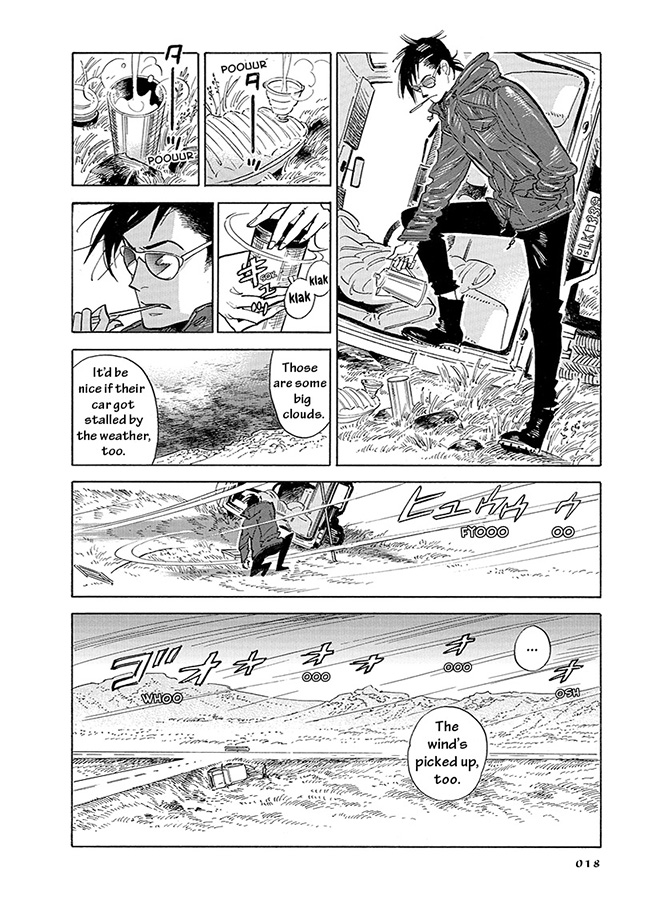
Her characterizations are likewise thoughtful. Kei, for example, isn’t defined solely by his gift; instead, it’s just a small facet of his personality that helps shed light on how attuned he is to his surroundings. The same is true for Kei’s grandfather, who’s initially portrayed as a stubborn curmudgeon but turns out to be more perceptive than his blustery persona might suggest, especially after Michitaka enters the picture. While several seemingly important characters are still in an embryonic stage of development—most notably Kei’s imperious neighbor Lilja—Irie’s ability to depict people in all their idiosyncrasies makes me confident that the supporting cast will be more fleshed out in future volumes.

I’d be the first to admit that the series’ pacing and narrative detours won’t be everyone’s cup of tea; I was initially put off by Kei’s one-sided conversations with his trusty jalopy, and frustrated by the sudden appearance—and equally sudden disappearance—of a Japanese investigator who is convinced of Michitaka’s guilt. By the end of volume one, however, I didn’t care; I felt that Go With the Clouds had transported me somewhere I hadn’t been before—in real life or my imagination—and was eager for another installment of Kei’s saga. Recommended.

GO WITH THE CLOUDS, NORTH BY NORTHWEST, VOLS. 1-2 • ART AND STORY BY AKI IRIE • VERTICAL COMICS • NO RATING

Filed Under: Manga, Manga Critic, REVIEWS Tagged With: Aki Irie, Iceland, Mystery/Suspense, Seinen, Vertical Comics

The Right Way to Make Jump

August 23, 2019 by Katherine Dacey

Most books about the manga industry fall into one of two categories: the how-to book, which offers advice on how to draw proportionate characters, plan a storyboard, and buy the right pens; and the how-I-became-an-artist story, which charts the emotional ups and downs of breaking into the manga biz. The Right Way to Make Jump takes a different approach, pulling back the curtain on the production process.

Our guide to the manga-making process is Takeshi Sakurai, an anxiety-ridden thirty-year-old who traded his dreams of becoming a professional manga-ka for a more predictable, less demanding life as an onigiri chef. Out of the blue, Sakurai receives a call from his former editor Momiyaxx-san about a once-in-a-lifetime opportunity to “create a non-fiction manga” that explains “how Jump is made.” After much hand-wringing and angst—and a friendly nudge from his cheerful, patient wife—Sakurai accepts the assignment, embarking on a series of factory tours and interviews to learn the nuts-and-bolts of publishing an issue of Weekly Jump. His odyssey takes him to a paper mill at the foot of Mt. Fuji, the editors’ bullpen at Shueisha headquarters, and VIZ’s corporate office in San Francisco, where Sakurai gets a first-hand look at how Jump is localized for different markets.

The book is cheekily divided into ten “arcs,” each of which focuses on a specific production step. The most interesting sections focus on the manufacturing process, explaining why Jump uses colored paper and how the magazines are cut, assembled, and bound. For readers who love the Discovery Channel—and I count myself among them—these early chapters are a blast, as they are studded with weird, wonderful facts about paper and machinery. (Among the most interesting: Jump paper dust plays an important role in Tokyo’s sewage treatment program.) The later chapters, by contrast, are less effective, as the editorial staff’s answers to potentially interesting questions are couched in polite, vague language that offers little insight into what they do; you’d be forgiven for rolling your eyes when a Jump staffer offers an essentialist justification for not hiring female editors, or chalks up the order of each issue to ‘intuition.’

Where The Right Way really shines is in Sakurai’s use of clever visual analogies to help the reader grasp the most  intricate parts of the manufacturing process. In “Platemaking,” for example, Sakurai creates a muscle-bound figure who represents the resin plate, a key element in the printing process:

The figure’s transformation neatly embodies the basic principles of creating a positive from a negative by comparing the process to suntanning—something that readers of all ages can relate to from personal experience.

As informative as such passages are, The Right Way can be a frustrating reading experience. Some chapters are briskly executed, achieving a good balance between education and entertainment, while others focus too much on slapstick humor, unfunny exchanges between Sakurai and Momiyaxx-san, and shameless plugs for Weekly Jump. Sakurai’s sardonic tone—expertly captured by translator Emily Taylor—helps mitigate some of these issues, but can’t always goose the tempo when Sakurai frets and fumes about meeting his deadlines; joking about your own shortcomings can be an effective strategy for ingratiating yourself to the reader, but not when you’re using those jokes to pad your weekly page count.

The overall structure of the book, too, leaves something to be desired. Though the first chapters focus on how the magazine is printed, the later chapters tackle a seemingly random selection of topics—Jump Festa, recycled paper stock, cover design, reader contests—suggesting that no one anticipated how long The Right Way would run in Weekly Jump. A topic-of-the-week approach is fine when readers wait for each new installment, but it makes for a chaotic, sometimes repetitive reading experience when collected in a single volume. The most logical strategy for organizing the tankubon edition would have been to start with the editorial process and end with the printing; not only does sequential presentation have obvious explanatory value, it also lends the material a compelling narrative arc, something that The Right Way to Make Jump sorely lacks.

Despite these shortcomings, I’d still recommend The Right Way to Make Jump, as it offers an all-too-rare glimpse of manga publishing’s less glamorous aspects, highlighting the contributions of professionals whose efficiency, creativity, and diligence have made Weekly Jump into a global phenomenon.

THE RIGHT WAY TO MAKE JUMP • ART AND STORY BY TAKESHI SAKURAI • TRANSLATED BY EMILY TAYLOR • VIZ MEDIA • 208 pp. • RATED T, FOR TEENS

Filed Under: Manga, Manga Critic, REVIEWS Tagged With: How-To, Shonen Jump, Takeshi Sakurai, VIZ

Pick of the Week: The Poe Clan

August 19, 2019 by Michelle Smith, Anna N, Katherine Dacey, Sean Gaffney, Ash Brown and MJ Leave a Comment

MICHELLE: I mean, it has to be The Poe Clan, right? If you’re in doubt, check out Kate’s terrific review!

ANNA: I am going to pick The Poe Clan as well, I am excited to read it.

KATE: Thanks for the plug, Michelle! I can’t stress enough how lucky we are to have this ground-breaking series in English, and with a great translation and gorgeous packaging to boot. Go, buy, and be prepared to swoon at all the roses and galaxy eyes!

Since we’re unanimous in our praise of The Poe Clan, I also wanted to highlight a series that would otherwise be my pick of the week: Kenji Tsurata’s Emanon, a beautiful fantasy/sci-fi story about a young woman who lives with the collective memories of all of her ancestors, stretching back to the beginning of life on Earth. The idea sounds kinda hokey (or pretentious), but Tsurata has done a fine job of adapting the source material–it’s based on a story by Shinji Kajio–into a thoughtful rumination on what it means to be alive. If you liked Wandering Island, Emanon is a no-brainer.

SEAN: The Poe Clan, absolutely.

ASH: I’m certainly looking forward to reading more of Emanon this week, and Golden Kamuy, too. But, yeah, there can really be no other pick than The Poe Clan.

MJ: It’s obviously The Poe Clan!

Filed Under: PICK OF THE WEEK

The Poe Clan, Vol. 1

August 15, 2019 by Katherine Dacey

Since its debut in Bessatsu Shōjo Comic, Moto Hagio’s The Poe Clan has proven almost as enduring as its vampire protagonists, living on in the form of radio plays, CD dramas, a television series, a Takarazuka production, and a sequel that appeared in Flowers forty years after the series finished its initial run. The Poe Clan’s success is even more remarkable considering that Hagio was in the formative stages of her career, having made her professional debut just three years earlier with the short story “Lulu to Mimi.” Yet it’s easy to see why this work captivated female readers in 1972, as Hagio’s fluid layouts, beautiful characters, and feverish pace brought something new to shojo manga: a story that luxuriated in the characters’ interior lives, using a rich mixture of symbolism and facial close-ups to convey their ineffable sorrow.

The Poe Clan‘s principal characters are Edgar and Marybelle Portsnell, the secret, illegitimate children of a powerful aristocrat. When their father’s new wife discovers their existence, Edgar and Marybelle’s nursemaid leads them into a forest and abandons them. The pair are rescued by Hannah Poe, a seemingly benevolent old woman who plans to induct them into her clan when they come of age. The local villagers’ discovery that the Poes are, in fact, vampirnellas (Hagio’s term for vampires) irrevocably alters Hannah’s plans, however, setting in motion a chain of events that lead to Edgar and Marybelle’s premature transformation into vampirnellas.

Though my plot summary implies a chronological narrative, The Poe Clan is more Moebius strip than straight line, beginning midway through Edgar and Marybelle’s saga, then shuttling back and forth in time to reveal their father’s true identity and introduce a third important character: Alan Twilight, the scion of a wealthy industrialist whose confidence and beauty beguile the Portsnell siblings. In less capable hands, Hagio’s narrative structure might feel self-consciously literary, but the story’s fervid tone and dreamy imagery are better served by a non-linear approach that allows the reader to immerse themselves in Edgar’s memories, experiencing them as he does: a torrent of feelings. Furthermore, Hagio’s time-shifting serves a vital dramatic purpose, helping the reader appreciate just how meaningless time is for The Poe Clan’s immortal characters; they cannot age or bear children, nor can they remain in any school or village for more than a few months since their unchanging appearance might arouse suspicion.

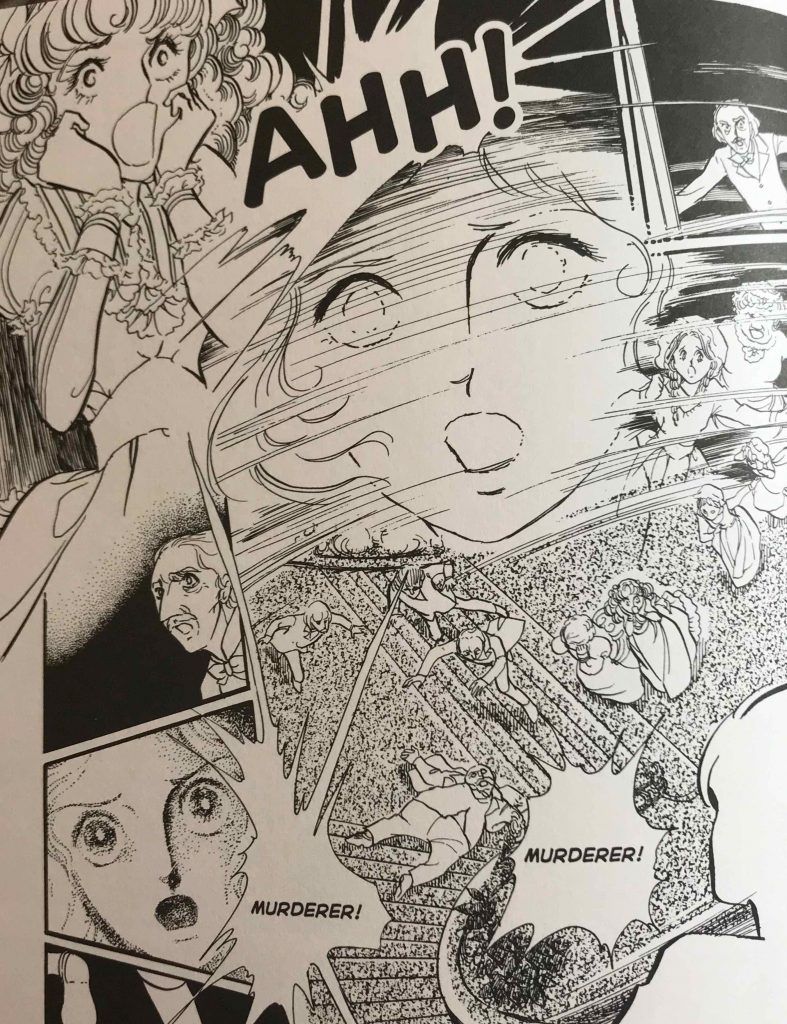
Hagio’s artwork further reinforces the dreamlike atmosphere through inventive use of panel shapes and placement, with characters bursting out of frames and tumbling across the page, freeing them from the sequential logic of the grid. In this scene, for example, Hagio uses these techniques to depict an act of impulsive violence—Alan pushes his uncle down a flight of stairs—as well as the reaction of the servants and relatives who bear witness to it:

While the influence of manga pioneers like Osamu Tezuka and Shotaro Ishinomori is evident in the dynamism of this layout, what Hagio achieves on this page is something arguably more radical: she uses this approach not simply to suggest the speed or force of bodies in motion, or the simultaneous reactions of the bystanders, but to convey the intensity of her characters’ feelings, a point reinforced by the facial closeups and word balloons that frame the uncle’s crumpled body.

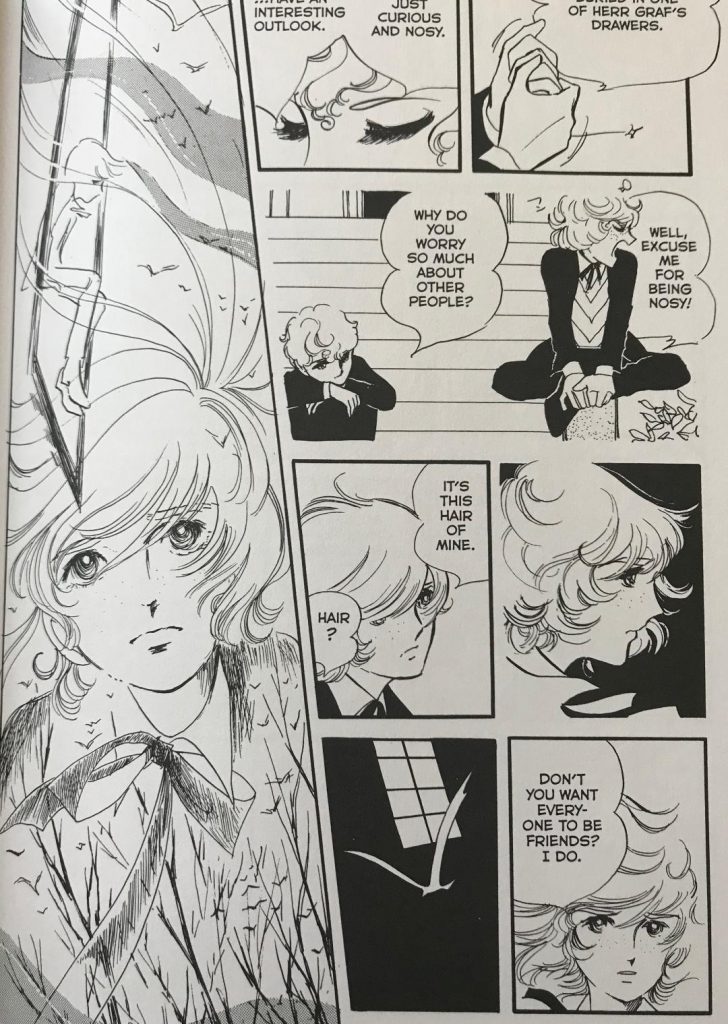
Her method for representing memories is likewise artful. Through layering seemingly arbitrary images, she creates a powerful analogue for how we remember events—not as a complete, chronological sequence but a vivid collage of individual moments and details. In this passage, Hagio reveals why one of Edgar’s schoolmates has confessed to a theft he didn’t commit:

The final frame of this passage reveals the source of Killian’s pain: he witnessed another boy’s suicide. But Killian isn’t remembering how the event unfolded; he’s remembering the things that caught his eye—birds and branches, feet dangling from a window—and his own feelings of helplessness as he realized what his classmate was about to do.

As ravishing as the artwork is, what stayed with me after reading The Poe Clan is how effectively it depicts the exquisite awfulness of being thirteen. Alan, Edgar, and Marybelle feel and say things with the utmost sincerity, so caught up in the intensity of their emotions that nothing else matters. Through the metaphor of vampirism, Hagio validates the realness of their tweenage mindset by depicting their existence as an endless cycle of all-consuming crushes, sudden betrayals, and confrontations with hypocritical, dangerous, or bumbling adults. At the same time, however, Hagio invites the reader to see the tragedy in the Portsnells’ dilemma; they are prisoners of their own immaturity, unable to achieve the emotional equilibrium that comes with growing up.

One final note: Fantagraphics deserves special praise for their elegant presentation of this shojo classic. Rachel Thorn’s graceful translation is a perfect match for the imagery, conveying the characters’ fervor in all its adolescent intensity, while the large trim size and substantial paper stock are an ideal canvas for Hagio’s detailed, vivid artwork. Recommended. 

This post was updated on August 23rd with more accurate information about the current status of The Poe Family‘s serialization in Flowers. Special thanks to Eric Henwood-Greer for the correction!

THE POE CLAN, VOL. 1 • ART AND STORY BY MOTO HAGIO • TRANSLATED BY RACHEL THORN • FANTAGRAPHICS • 512 pp. • NO RATING

Filed Under: Manga, Manga Critic, REVIEWS Tagged With: Classic Manga, fantagraphics, moto hagio, The Poe Clan, Vampires

Pick of the Week: Princesses, Classmates and Magi

August 12, 2019 by Katherine Dacey, Sean Gaffney, Michelle Smith, Ash Brown and Anna N Leave a Comment

KATE: There’s a surprising amount of good stuff in this week’s new manga haul! I’m intrigued by Star Blazers 2199 and The Night Is Short, Walk On Girl, but I’m also excited to see Yen Press licensing more queer-friendly manga; Yuri Life looks like a winner. If I had to recommend just one title, though, my choice would be Sleepy Princess in the Demon Castle, a gag manga that finds a surprising number of ways to make chronic insomnia look funny.

SEAN: Given it’s the last time I can pick it, I feel obliged to make my pick of the week Magi. Shonen Sunday series always have a much harder time here in North America, so I’m pleased that this long-runner seemed to do well and wasn’t consigned to 2-volumes-per-year hell. I’ll miss it.

MICHELLE: I’m intrigued by Star Blazers 2199 and am grateful to have more Ace of the Diamond and Classmates, but I must join Sean in one final pick for Magi. This story has come a long way and become more complicated than I ever would’ve guessed from that first volume and I look forward to seeing how it all ties up in the end.

ASH: I am very much intrigued by The Night Is Short, Walk On Girl, but my pick this week goes to the second volume of Classmates. I really loved the first volume and am always happy for the chance to read more of Asumiko Nakamura’s work in English.

ANNA: I enjoyed the first volume of Komi Can’t Communicate, and I always like to read two volumes of a series before deciding to be in for the duration or not. I’m looking forward to the second volume of this shonen comedy.

Filed Under: PICK OF THE WEEK

Ryuko, Vol. 1

August 8, 2019 by Katherine Dacey

If you’ve been jonesing for a stylish thriller that doesn’t take itself too seriously, Eldo Yoshimizu’s Ryuko might just fit the bill: it has the pulpy soul of a Kazuo Koike manga and the brash attitude of a James Bond flick. And while Ryuko never quite achieves the simmering intensity or cohesion of Lady Snowblood and Crying Freeman, it does hold its own against Koike’s best work thanks to its audacious action sequences and cool-as-ice heroine who’ll stop at nothing to avenge her mother’s kidnapping.

Running in tandem with the kidnapping storyline are four —maybe five — other subplots, all connected to the Soviet-Afghanistan war. There’s gun-running and opium harvesting, Soviet malfeasance and CIA chicanery, and some other elements that, frankly, don’t make a lot of sense, though they provide sufficient justification for the imaginatively staged combat. Anyone hoping for a few helpful lines of expository dialogue will be frustrated, as the characters are so laconic they seldom utter more than a few words before throwing a punch or brandishing a gun.

The real star of Ryuko is Eldo Yoshimizu’s artwork, which deftly synthesizes Japanese and European influences without slavishly copying them. His female characters, in particular, have the undulating hips, flowing locks, and determined scowls of Leiji Matsumoto’s most lethal heroines, while the male characters’ appearances owe a debt to the rugged manly-men that stalked the pages of Hugo Pratt, Takao Sato, and Goseki Kojima’s adventure stories. Not surprisingly, Yoshimizu lavishes his greatest attention on Ryuko, swathing her in barely-there dresses and leopard-print catsuits–an artistic decision that makes her look cool, but seems impractical for dodging bullets and karate-chopping enemies.

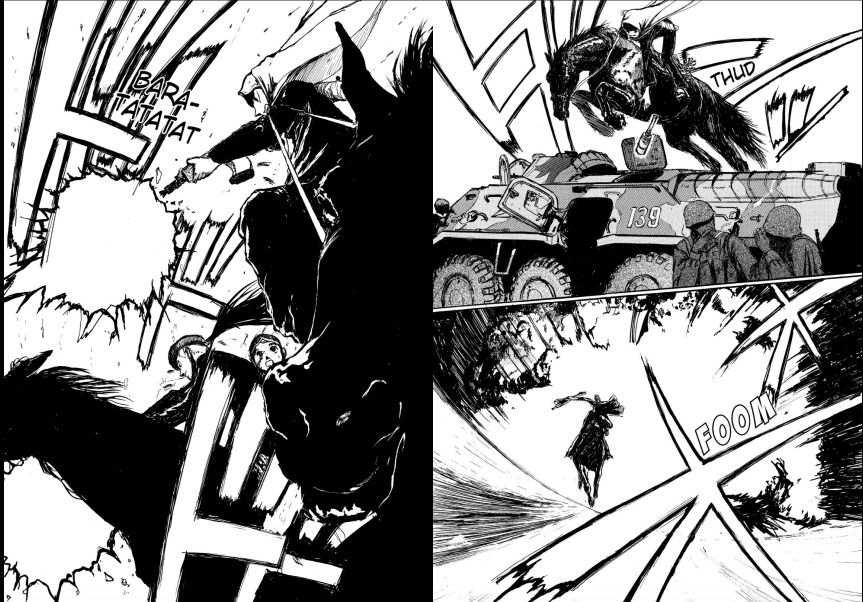
But oh, Ryuko’s fight scenes! They’re worth the price of admission, as they showcase the full range of Yoshimizu’s talents as a draftsman, veering sharply between naturalism, suggestion, and pure abstraction. In this sequence, for example, we see the young Ryuko ambushing a group of Soviet soldiers:

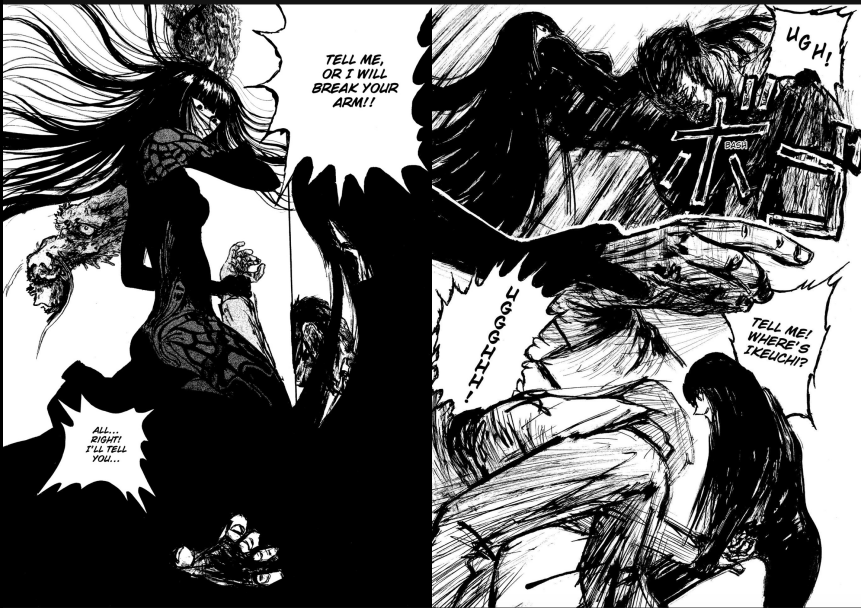
In the first panel, the tank is drawn with utmost specificity, allowing us to appreciate its sheer mass and its weaponry. The subsequent panels, however, are more gestural than the first, as we glimpse Ryuko silhouetted against the explosion, her age and gender completely obscured by the brilliant flash of light behind her. In the final panel of the sequence, Yoshimizu uses two horses to frame the action, rendering them as bold patches of black, with just a suggestion of a nostril and an eye, their demonic appearance echoing Ryuko’s own fierce resolve. Other sequences, such as this one, are even more abstract, dispensing with a grid in favor of fluid, overlapping images; in a particularly effective gambit, Ryuko’s arm forms a kind of panel boundary between the first stage of the attack — a knee to the stomach — and the second, in which she flips and pins her opponent:

Even Ryuko’s hair plays an important role in helping us understand what’s happening in this confrontation. In the first sequence, her hair swings around her face and shoulders in a naturalistic fashion, but in the final panel, her hair looks like a furious nest of snakes, each poised to strike her victim. That shift is subtle but important, a nifty metaphor for just how quick and lethal Ryuko can be.

For all the verve with which these scenes are drawn, Ryuko‘s characters never quite register as flesh-and-blood people. Yoshimizu has provided them with backstories, but the characters’ behavior is so steeped in action-movie cliche that their motivations for shooting and punching are almost immaterial. The story’s breakneck pacing doesn’t allow anyone much time for introspection, either; the few flashbacks to Ryuko’s childhood separation from her mother are the only genuinely emotional moments in the story. Still, no one reads trashy thrillers for a deep exploration of the human psyche; they’re looking for an over-the-top story that serves up generous helpings of car chases, gun battles, and fist-fights, the more outlandish, the better. On that front, Ryuko performs admirably, infusing a shopworn revenge plot with the sensual swagger of old-school classics like Lady Snowblood and Lupin III. Recommended.

RYUKO, VOL. 1 • ART AND STORY BY ELDO YOSHIMIZU • TRANSLATION BY MOTOKO TAMAMURO AND JONATHAN CLEMENTS • TITAN COMICS • NO RATING (PARTIAL NUDITY, VIOLENCE) • 256 pp.

Filed Under: Manga, Manga Critic, REVIEWS Tagged With: Eldo Yoshimizu, Ryuko, Titan Comics, Yakuza

Pick of the Week: Crime and Superheroes

August 5, 2019 by Sean Gaffney, Michelle Smith, Katherine Dacey, Anna N and Ash Brown Leave a Comment

SEAN: My Hero Academia’s 19th and 20th volumes have what may be my favorite “light” arc of the series. As such, the 20th volume, like the 19th, is my pick. If only for those two faces. You know the ones I mean.

MICHELLE: Courtesy of the awesome Shonen Jump vault, I’m all caught up on My Hero Academia now, so volume 20 is actually a reread for me, but it’s a testament to the greatness of this series that I’m still looking forward to it. The light arc concludes, and is definitely great, but I also really enjoyed finally getting to meet a mysterious hero who’s been hinted at and finally makes his debut in this volume.

KATE: After being publicly shamed for my tendency to plug the same manga over and over — notice I resisted the temptation to type “again” — I had to bring my Recommendation A-Game this week. My pick is Ryuko, Titan Comic’s first foray into serialized manga. It looks like the sleazy, brutal, fast-paced stuff that Kazuo Koike used to pump out by the truckload, and I can’t wait to read it. The cover alone is swoon-worthy!

ANNA: There’s so much great shoujo coming out this week, it is hard for me to single out just one title. But I have to admit when looking over everything coming out that I’m always most enthusiastic about Yona of the Dawn, so volume 19 of that series is my pick!

ASH: So many series that I’m following have new volumes this week, making it very difficult to choose where to start. So, thanks for the reminder about Ryuko, Kate! I’ve been very curious about that series, enough to make it my pick, too.

Filed Under: PICK OF THE WEEK

Pick of the Week: We Love Honda-san

July 29, 2019 by Ash Brown, Sean Gaffney, Anna N, Michelle Smith, Katherine Dacey and MJ Leave a Comment

ASH: Along with the usual variety of releases, this week also seems to have a fair number of series making their English-language debut. This includes the first volume of one of my most anticipated manga of the year, Skull-Faced Bookseller Honda-san. The series has already gained some recognition from its anime adaptation, but I’m thrilled to have a chance to read the original.

SEAN: Honda-san is definitely my manga of the week, but my pick this week is the first volume of new light novel Bottom-Tier Character Tomozaki. In a marketplace where it seems the only things that can be licensed are those with some sort of supernatural/fantasy content, I want to champion the rare series that has none of those things. (It does talk about gaming a lot, though.)

ANNA: Skull-Faced Bookseller Honda-san is my pick, no question. It looks delightfully quirky.

MICHELLE: Yep, it’s bony booksellers for me, as well!

KATE: C’mon, guys, no love for The Alchemist Who Survived Now Dreams of a Quiet City Life or Precarious Woman Executive Miss Black General? You’re breaking my heart! I jest, I jest… I’m on team Skull-Faced Book Seller Honda-san 100% this week.

MJ: Okay, the truth is, I’m headed into production week of my teen opera today, so if Handel didn’t write it, it’s not really in my universe this week. But if I was in the same universe as my colleagues and any of this manga right now, I’d be Skull-Faced Book Seller Honda-san all the way. Do with that what you will.

Filed Under: PICK OF THE WEEK

Pick of the Week: Present and Future Manga

July 22, 2019 by Sean Gaffney, Michelle Smith, Katherine Dacey, Anna N and Ash Brown Leave a Comment

SEAN: Most of the debuts I was looking forward to picking this week got schedule shifted away, and I’m left with a lot of “Hrm”. So I’ll go with Teasing Master Takagi-san 5, always a favorite and with two fantastic chapters bookending the volume.

MICHELLE: I’ll go with the third and final volume of Love in Focus . This is the second short series from Yoko Nogiri that I’ve liked more than anticipated. I hope she writes something longer someday!

KATE: Our Dreams at Dusk is just about perfect with beautiful art, great characters, and a compelling story that allows readers across the spectrum to appreciate just how difficult it can be to come to terms with your own sexuality.

ANNA: Honestly the main thing I’ve been thinking of this week is the fact that we had a Rose of Versailles cover reveal! So I’ll pick Rose of Versailles even though it isn’t coming out for a long time, and also reserve the right to pick it again.

ASH: I am in complete agreement with Kate. Our Dreams at Dusk is such an incredible series, I’m making it my pick even when this week’s other releases include another of my favorites, To Your Eternity.

Filed Under: PICK OF THE WEEK

Pick of the Week: Beasts and Demons

July 15, 2019 by Michelle Smith, Katherine Dacey, Ash Brown, Anna N and Sean Gaffney Leave a Comment

MICHELLE: I am very happy that Haikasoru has kept up with printing the Legends of Galactic Heroes novels. One day, I really will read them! For my official pick, though, I’ll go with Beastars. I’m not entirely sold on the premise, but since the next shounen “big thing” I was initially meh about turned out to be My Hero Academia, I will be more receptive this time!

KATE: I’m also curious about Beastars, but I never miss an opportunity to plug Inio Asano’s Dead Dead Demon’s Dededede Destruction, a book that walks the tightrope between mordant and morbid with ease. You’ll laugh, you’ll grimace, and you’ll get a lump in your throat at least once or twice in each volume. Oh, and the art’s pretty nifty, too.

ASH: Dead Dead Demon’s Dededede Destruction is always a good choice, and Legend of the Galactic Heroes has been a great read so far, but for my pick I’ll allow my curiosity to get the best of me and go with Beastars. I’ve heard nothing but good things about the series.

ANNA: Like many, I’m curious about Beastars. I’m going to go with Dead Dead Demon’s Dededede Destruction though, it really is something special.

SEAN: My pick is the new My Next Life As a Villainess, as it always makes me laugh.

Filed Under: PICK OF THE WEEK

Pick of the Week: Dreaming of Shoujo

July 1, 2019 by Sean Gaffney, Michelle Smith, Katherine Dacey, Ash Brown and Anna N Leave a Comment

MICHELLE: Despite the Pretty Little Liars vibes of its concept, the mere fact that Daytime Shooting Star ran in Margaret is sufficient for me to award it my pick of the week. I deeply hope I’m not skeeved.

SEAN: I want that too, and will always welcome Oresama Teacher and Kaguya-sama: Love Is War, but my pick this week is Side-by-Side Dreamers, because yuri science fiction novels are something I’d like to see more of.

KATE: I’m still reeling from last week’s enormous bounty, so I’m going to pass on recommending anything new. Ask me when I’m climbed out from underneath the big stack of books next to my bed…

ASH: I’m likewise behind in my manga reading, however many of the shoujo releases from Viz will still be added to my ever-growing stack this week. I’m easily furthest behind with Oresama Teacher, but it’s such a delightful series that I have no qualms with making it my official pick.

ANNA: I’m always excited for shoujo debuts like Daytime Shooting Star, but when looking over the week I’m most interested in reading the second volume of Snow White with the Red Hair, which seemed endearingly quirky based on the first volume. I want to see how the series develops.

Filed Under: PICK OF THE WEEK

Pick of the Week: Welcome Returns

June 24, 2019 by Sean Gaffney, Michelle Smith, Anna N, Katherine Dacey and Ash Brown Leave a Comment

SEAN: Something for everyone this week. I enjoyed Little Miss P, and have been waiting for more Satoko and Nada for some time. I have to go with one of my “comfort manga” titles, though, so this week I’m picking the 2nd Today’s Menu for the Emiya Family. So many mythical heroes not killing each other and eating yummy food!

MICHELLE: I hope VIZ does more in the digital-only vein, so I will support their inroads into that arena by picking The Right Way to Make Jump. Plus, Kohei Horikoshi is in it, apparently.

ANNA: I’m going to go with Satoko and Nada for my pick.

KATE: I’m torn between the second installment of Satoko and Nada and the first installment of At the Mountains of Madness. How’s that for tonal whiplash?

ASH: Likewise! The first volume of Satoko and Nada was terrific, but then so was Gou Tanabe’s previous Lovecraft adaptation. And so I’ll continue the tonal whiplash by picking something different still, The Monster and the Beast.

Filed Under: PICK OF THE WEEK

Pick of the Week: So Much To Pick From

June 17, 2019 by Sean Gaffney, Michelle Smith, Katherine Dacey, Ash Brown, Anna N and MJ Leave a Comment

MICHELLE: In an unprecedented move for me, I’m picking a light novel this week! Restaurant to Another World has spawned various adaptations but I’ve experienced none of them. Still, it seems rather low-key and charming, which sounds lovely.

SEAN: So much I want to talk about… new Silver Spoon, new Hatsu*Haru, another silly isekai debut… for my pick, I’ll go with Animeta!. I’m a sucker for “manga/anime about breaking into the manga/anime industry”.

KATE: I’d be remiss if I didn’t plug Again!! and Silver Spoon, two of my favorite series, but this week, my heart belongs to Saint Young Men. Show some love for Kodansha and read it, since no one ever thought this one would be available in the US.

ASH: Hoo, boy, there’s so much coming out this week that I’m actively reading! Again!!, Gangsta, Golden Kamuy, and Silver Spoon are definite priorities for me, but I’ll be joining Michelle with the print debut of Restaurant to Another World as my official pick.

ANNA: I’m so far behind, but I’m gonna go with Gangsta as my pick!

MJ: Okay, I’ll go ahead and be the one to throw my whole heart at Silver Spoon. SILVER SPOON. SIIIIILVER SPOOOOOOOOON. What I’m saying is Silver Spoon.

Filed Under: PICK OF THE WEEK

Pick of the Week: Ill Communication

June 10, 2019 by Sean Gaffney, Ash Brown, Michelle Smith, Katherine Dacey, Anna N and MJ Leave a Comment

SEAN: My pick this week, as I may have hinted in Manga the Week of, is Komi Can’t Communicate, which takes the standard ‘aloof beauty is just an introvert’ and takes it to eleven, as Komi seems to have an actual communication disorder. The manga is lighthearted but apparently really sweet. I want to read it.

ASH: I’ll admit, the manga I’m most curious about this week is actually I Married My Best Friend to Shut My Parents Up. Though it’s a story of a completely different type, the title and underlying premise immediately reminded me of Kaori Ekuni’s novel Twinkle Twinkle, which is a favorite of mine.

MICHELLE: Even though I’ve somehow already managed to get several volumes behind, it’s Ran the Peerless Beauty for me!

KATE: I’m also curious about Komi Can’t Communicate, but am otherwise underwhelmed by this week’s bounty!

ANNA: I’m going to check out Komi Can’t Communicate, but this week also represents a chance for me to get a little caught up on my stack of unread manga.

MJ: So, I’m going to go in a different direction this week and check out Crest of the Stars. I missed it the first time around, when Tokyopop was publishing it, and I’m in the mood for some great science fiction. That’s my pick this week!

Filed Under: PICK OF THE WEEK

Pick of the Week: Sweetness, Classmates, and Viz

June 3, 2019 by Sean Gaffney, Michelle Smith, Katherine Dacey, Ash Brown, Anna N and MJ Leave a Comment

MICHELLE: Last week it was hard to choose because of scarcity and this week it’s hard to choose because of abundance. I am very excited about new volumes of many shounen and shoujo favorites from VIZ, and am very tempted in particular to choose volume nineteen of My Hero Academia, but it’s my last chance ever to recommend the charming food manga Sweetness & Lightning, so I think that’ll have to be the one this time.

SEAN: I will therefore leap in and choose My Hero Academia 19 in your place. After the heavy drama and death of the previous arc, it’s nice to step back a bit and have fun, and this volume’s culture festival does just that. That said, you an bet Promised Neverland and Yona of the Dawn are right up there as well.

KATE: My Captain Obvious recommendation is volume 10 of The Promised Neverland, which remains gripping and suspenseful despite the author’s over-reliance on interior monologues to clue the reader into what’s happening. (Seriously, WE GET IT. Emma and Ray are wicked smart and can out-think their enemies.)

ASH: Lots of great manga are being released this week. One that hasn’t been mentioned yet, and one for which I am particularly excited, is the print debut of Classmates: Dou Kyu Sei. I honestly love Asumiko Nakamura’s work, so I’m thrilled to be able to add more of it to my shelves.

ANNA: If Yona of the Dawn is coming out, I can’t bring myself to pick anything else, so Yona for me!

MJ: Well, I have to join Ash this week in picking Classmates: Dou Kyu Sei. I read and reviewed this charming volume back in the days of JManga, and I’m thrilled that it’s back and finally getting a print release. Thanks, Seven Seas!

Filed Under: PICK OF THE WEEK

  • « Go to Previous Page
  • Page 1
  • Interim pages omitted …
  • Page 27
  • Page 28
  • Page 29
  • Page 30
  • Page 31
  • Interim pages omitted …
  • Page 89
  • Go to Next Page »
 | Log in
Copyright © 2010 Manga Bookshelf | Powered by WordPress & the Genesis Framework