• Skip to primary navigation
  • Skip to main content
  • Skip to primary sidebar
  • Home
  • About Us
    • Privacy Policy
    • Comment Policy
    • Disclosures & Disclaimers
  • Resources
    • Links, Essays & Articles
    • Fandomology!
    • CLAMP Directory
    • BlogRoll
  • Features & Columns
    • 3 Things Thursday
    • Adventures in the Key of Shoujo
    • Bit & Blips (game reviews)
    • BL BOOKRACK
    • Bookshelf Briefs
    • Bringing the Drama
    • Comic Conversion
    • Fanservice Friday
    • Going Digital
    • It Came From the Sinosphere
    • License This!
    • Magazine no Mori
    • My Week in Manga
    • OFF THE SHELF
    • Not By Manga Alone
    • PICK OF THE WEEK
    • Subtitles & Sensibility
    • Weekly Shonen Jump Recaps
  • Manga Moveable Feast
    • MMF Full Archive
    • Yun Kouga
    • CLAMP
    • Shojo Beat
    • Osamu Tezuka
    • Sailor Moon
    • Fruits Basket
    • Takehiko Inoue
    • Wild Adapter
    • One Piece
    • After School Nightmare
    • Karakuri Odette
    • Paradise Kiss
    • The Color Trilogy
    • To Terra…
    • Sexy Voice & Robo
  • Browse by Author
    • Sean Gaffney
    • Anna Neatrour
    • Michelle Smith
    • Katherine Dacey
    • MJ
    • Brigid Alverson
    • Travis Anderson
    • Phillip Anthony
    • Derek Bown
    • Jaci Dahlvang
    • Angela Eastman
    • Erica Friedman
    • Sara K.
    • Megan Purdy
    • Emily Snodgrass
    • Nancy Thistlethwaite
    • Eva Volin
    • David Welsh
  • MB Blogs
    • A Case Suitable For Treatment
    • Experiments in Manga
    • MangaBlog
    • The Manga Critic
    • Manga Report
    • Soliloquy in Blue
    • Manga Curmudgeon (archive)

Manga Bookshelf

Discussion, Resources, Roundtables, & Reviews

Archives for January 2012

Durarara!!, Vol. 1

January 28, 2012 by Sean Gaffney

By Ryohgo Narita, Suzuhito Yasuda, and Akiyo Satorigi. Released in Japan by Square Enix, serialization ongoing in the magazine GFantasy. Released in North America by Yen Press.

Unlike my fellow reviewers on Manga Bookshelf, who have already come at this volume from the perspective of one who is unfamiliar with the franchise, this is my third go-round with this material. I had seen the anime based on the light novels, and following that I had read a translation of the first book. It’s quite similar to the trajectory I followed with the Suzumiya Haruhi series, and I must admit that my primary worry was that the manga version of DRRR!! would be as uninspiring as the Haruhi manga has (mostly) turned out to be. Fortunately, my fears were quelled – this is a quite decent adaptation, and I think folks coming at it for the first time will have a lot of fun, even if they may get a bit confused as well.

As you may have noticed from the cover, the DRRR!! series is known for its impressive cast size. The wraparound cover is actually impressively designed, and catches the eye quite nicely. It’s an ensemble piece overall, with no cast member supposedly standing out as the “star”, but if I had to pick the lead characters, they would indeed be the five people on the front cover and the leather-clad figure on the spine. Other successful parts of the adaptation include the chatroom conversations, which are a large part of the original novels. It can be hard to make such things interesting in a manga medium, but showing the hands typing manages to keep us guessing while still giving clues as to the actual identity of the participants.

The manga rearranges some plot beats to make it flow better, particularly the scenes with Seiji and his stalker. You actually manage to feel a little sympathy for him, however brief that is, before his ill-thought-out actions. Though honestly, in this manga it can be hard to find sympathetic characters. Minako certainly qualifies as one, at least in these first few books. Most of the cast, however, just have that “off” feel to them, and you come to realize that you’re dealing with a bunch of weirdos and freaks here – many by design. The best example of this is the chapter dealing with Izaya, who is the closest the series gets to a villain. Certainly he’s absolutely horrible in Chapter 4, but notably he doesn’t actually go through what what is implied – there’s a certain sense that he’s acting the villain for fun, rather than out of malice. Which is why, even if he drops those suitcases off the highrise, they are invariably empty.

As you would guess with a spinoff manga, while this is written with the neophyte in mind, a lot of the book gains extra depth after you’ve read it through once, or if you already know the source material. Erika’s line about “just a few books for us to use tonight” goes from confusing to chilling, a morbid punchline to the typical otaku (buy three copies of everything) habit. Instead of trying to guess the plot, you end up surprised by how much of the plot is woven seamlessly into the early sections – Masaomi’s reaction to the color gangs, for example, or Celty’s horrible flashback to Shingen and a young Shinra. The sign of a good tie-in is that it can pander to its base without sacrificing new fans, and I think DRRR!! does that here.

It’s not necessarily perfect – the art seems to be a lot more “moe” and cutesy than the original character designs for the novels were. Mikado and Shinra especially suffer because of this. It also meanders a lot, but then so did the original. I think a series like this will benefit from having a few more volumes out to better digest everything. Looking forward to April, when we’ll get Vol. 2. Will it have a special guest artist to raw in the fans the way this volume does with Black Butler’s Yana Toboso?

And yeah, I have no idea why the chapters are variations on Wa. But then the title Durarara!! is itself meant to be based on nonsense syllables.

Filed Under: REVIEWS

Genkaku Picasso, Volume 1

January 27, 2012 by Ash Brown

Creator: Usamaru Furuya
U.S. publisher: Viz Media
ISBN: 9781421536750
Released: November 2010
Original release: 2009

After a seven year drought, Genkaku Picasso became the first in a (very small) flood of new titles by Usamaru Furuya to be translated into English. The first volume of Genkaku Picasso was released in Japan in 2009; the entire series was originally serialized in the manga magazine Jump SQ between 2008 and 2010. The English edition of Genkaku Picasso started publication in 2010. Once again, it was Viz Media that brought Furuya’s work to English-reading audiences, having previously published Short Cuts and excerpts from his debut manga, Palepoli. I’ve had Genkaku Picasso sitting on my shelf for quite some time, but it’s only now for the Usamaru Furuya Manga Moveable Feast that I’ve finally gotten around to reading it. Furuya is well known for his work in underground and alternative manga, but Genkaku Picasso is one of his more mainstream series.

Hikari Hamura, nicknamed Picasso by his classmates (much to his frustration), would much prefer that everyone would just leave him alone to his drawing. However, after a strange accident leaves him with the even stranger ability to visualize the contents of another person’s heart, Picasso must learn to use his artistic talents to help others or else he’ll rot away. Drawing what he sees, he can dive into the artwork and their subconscious. The problem is that the visions aren’t particularly straightforward. That and Picasso doesn’t really feel like reaching out to others and is much more comfortable keeping to himself. It’s not easy, and there tends to be quite a few misunderstandings, but Picasso doesn’t seem to have much of a choice. He might not want to, but he has to get to know his classmates better even if he does find them and the prospect terribly annoying.

One of the things that impresses me the most about Furuya’s work as whole is that he deliberately creates a particular aesthetic to fit an individual manga and story. In the case of Genkaku Picasso, Furuya primarily uses two different art styles. The first, representing reality, is a more mainstream, slightly stylized manga style which utilizes screentone and such. The other is based on the approach of pencil sketches and includes hand shading techniques and crosshatching. Used for Picasso’s artwork and the characters’ subconsciouses, it is also a reflection of Furuya’s own fine arts background. I find it interesting that the more realistic style is used to capture the unreal in Genkaku Picasso while the comic style is used to show the ordinary. Granted, even Picasso’s “ordinary” is slightly off-balance and surreal, which the artwork helps to show.

I wouldn’t exactly say that I was disappointed with the first volume of Genkaku Picasso, but I didn’t find it nearly as captivating or compelling as the other works of his that I have read. I really like the premise of the series, but after one volume I haven’t been convinced by the manga itself, yet. I feel like it wants to be deep and profound, but the first volume somehow comes across as superficial, even when Picasso is delving into the supposed darkness of other people’s hearts. The problems are resolved too quickly and easily. Still, there are plenty of elements in Genkaku Picasso that I enjoy. Although there hasn’t been much real development yet, I do like the characters. Picasso and his classmates Sugiura and Akane make an amusing trio (quartet if you count Chiaki). Genkaku Picasso also has a quirky sense of humor that shows up frequently. Picasso’s social awkwardness (mostly self-imposed) and bluntness is delightfully endearing. So while I may not have been overwhelmed by the first volume of Genkaku Picasso, it does intrigue me and I do want to continue on with the series.

Filed Under: REVIEWS Tagged With: genkaku picasso, manga, Manga Moveable Feast, Shonen Jump, Usamaru Furuya, viz media

Off the Shelf: No Longer Human

January 27, 2012 by MJ and Michelle Smith 10 Comments

MICHELLE: This month’s Manga Moveable Feast, currently in progress, is devoted to the works of Usamaru Furuya, prompting MJand me to devote this week’s column to the most recent of his series to see publication in English, No Longer Human.

Based on a book by Osamu Dazai that’s described as “a decadent novelist’s autobiographical masterpiece,” No Longer Human depicts the story of Yozo Oba, a young man with no comprehension of what it feels like or how to be an ordinary person. We first meet him as a high school student, where he has learned that being the class clown is the one thing that enables him to connect to his classmates.

Soon he falls in with a group of misfits plotting political rebellion, but he’s more comforted by being among outsiders than he is honestly devoted to their cause. There, he meets the first of several women who will be drawn to him and agree to feed and care for him. This becomes his pattern in life. By the middle of the second volume, he’s twenty and living with a much older woman while drawing a gag manga and helping out at the bar she owns. He realizes that he’s “a genius parasite on women,” but sees that as his only option left to survive.

MJ: As in most “decadent masterpieces,” Oba’s excesses drive him deeper and deeper into tragedy, as he drinks and sleeps his way from one safe haven to another, usually leaving the women who care for him in significantly worse condition than he found them (and in one case, even dead). The narrative lets us know that things are only going to continue to get worse, yet it’s impossible to look away.

Though there have since been at least two other graphic novel adaptations of Dazai’s original, where Furuya goes very much right, in my opinion, is in his decision to move the pre-WWII story into the present, which I think is at least partially responsible for his ability to present such a self-indulgent tragedy in a way that makes it genuinely readable. I realize the original is a classic, but I feel like the novel might suffer more from a contemporary reading than Furuya’s adaptation does.

(click images to enlarge)

Note: No Longer Human reads from left-to-right

MICHELLE: I was surprised by just how readable it was, actually. Just looking at the plot, you’d expect it to be depressing, but it’s so skillfully done that I enjoyed it very much! But yes, you’re absolutely right that updating the story was a smart choice, especially as it enabled a bit of self-insertion on Furuya’s part. Ordinarily, I’m kind of annoyed when mangaka break the fourth wall—particularly if they do so in a silly way—but here, Furuya’s interludes of discovering and being transfixed by Oba’s story are absolutely essential in setting the mood. We feel like he’s captivated right along with us.

MJ: Yes, he’s sort of sharing it with us like a guilty pleasure, and it really works as one. I think the story benefits greatly from being presented as an outrageous internet diary that’s impossible to stop reading. There’s something about this story that makes me feel like I’ve stayed up all night reading, strung out on caffeine and cheese puffs, and, frankly, that really suits it. I kind of wish I’d read it like that for real, actually.

Talking about it like this, it would be easy to gloss over Furuya’s artistry, though, which is put to pretty spectacular use in this series, wouldn’t you agree?

MICHELLE: I can imagine the back cover blurb now. “It had me craving cheese puffs.” – MJ, Manga Bookshelf

As for Furuya’s artistry, I whole-heartedly agree. His talent was on prodigious display in Genkaku Picasso, the only other series of his that I’ve read, but it really suits a darker story like this one.

I was particularly struck by the depictions of Oba as a marionette controlled by his father’s money and/or putting on a show for his peers. It’s such a vivid symbol of someone going through the motions of trying to be normal! And even though Furuya occasionally uses some symbolism that might seem overly obvious—like the surfeit of bugs lurking beneath the petals of the flowers Oba admires with his fiancée (we must return to this point)—it’s done with such finesse that it doesn’t seem trite.

MJ: My previous experience with Furuya has consisted only of Lychee Light Club, which I found visually striking on a nearly theatrical level, but juvenile and kind of emotionally empty. It’s nice to see his gifts utilized so differently here. There was a lot of sexually-charged violence in Lychee Light Club, and certainly there’s no lack of sexual themes in No Longer Human, but it’s approached so differently… it really feels like a much more mature work.

MICHELLE: I did wonder how this compared to Lychee, which I still need to read.

I wanted to ask… did you find the sexual content as supremely unsexy as I did? Beyond not being idealized at all, there are some closeups of things like twirling tongues that look downright disgusting, almost like something drawn by Junji Ito! I wonder if this is Furuya’s way of depicting the impure motives of Oba in these situations. It would be completely out of place to portray what he’s doing as titillating, let alone dreamy.

MJ: I don’t know if I’d say that I found it supremely unsexy, but it definitely does not read as something that’s supposed to be titillating. It’s interesting, too, even though the character confesses early on that his frequent, semi-anonymous sexual encounters are the only things that make him feel good (“When I’m here seems like the only time the smile on my face in genuine”), from the reader’s perspective, he seems just as detached during those trysts as he is the rest of the time. I almost feel like he’s fooling himself when he says that, and that this is reflected in Furuya’s artwork.

MICHELLE: There’s definitely a lot of emphasis on what makes Oba comfortable in a relationship. With the ladies in the “massage parlors,” it’s because he doesn’t have to use any subterfuge. With the members of the political group, it’s because everyone is a misfit in some way. And the two loving/honestly affectionate relationships he has are with women who exhibit a sort of elegant melancholy. Outsiders themselves, in a way.

But speaking of fooling himself, what on earth is going on with the abrupt change in the end of volume two?! Oba has maintained all along that he has no interest in and cannot fathom embarking upon ordinary relationships, and yet here he is, falling in love with and ultimately proposing to a virginal girl who works in a smoke shop. I’m sure he’s got an idealized version of her, but man, I just wanted to shake her and go, “Yoshino, no!” That poor girl is in for a very rude awakening. What will be her price for associating with Oba?

MJ: Yes, disaster is clearly just around the corner, in the same sure way as you’d expect in, say, a Dickens novel. Yoshino is doomed just as it seems Oba is truly doomed, and nobody’s even trying to hide it. Furuya makes the most of this, too. I’m glad you mentioned that last page in the volume, with a swarm of insects seemingly prepared to devour a flower. It’s a melodramatic image, I suppose, but so perfect for the tone of the story.

MICHELLE: Exactly! He just seems so much like a different person here from his behavior, which is emphasized by the drastic haircut Furuya has given him. It really comes out of nowhere, narratively speaking, but I have faith that Furuya is going to make it all make sense in the end. I suppose it helps knowing that, theoretically, all of this did happen to the same protagonist in the original novel (and in the life that it’s based upon?).

MJ: Well, I don’t know if I’d say he feels like a different person, but definitely a different version of a person who keeps reinventing himself over and over, in order to survive. Or perhaps I should say, “in order to survive without having to ever put himself out or curb his own desires,” because really, that’s what his survival is about. So here he is, seemingly falling in love for real for the first time ever, yet in a way, what I see is a guy who has finally figured out how to reinvent himself on the inside–enough to fool even himself. And really, that can’t go well.

MICHELLE: Maybe it’s all the drinking he’s doing that’s enabling him to fool himself to such an extent, to actually believe in one of these personas he’s crafted for himself. And I think there’s a line in there, too, about how living with Mama (do we ever learn her real name?) is so peaceful and great that he starts to believe that all the world is the same. But ultimately, he’s still pursuing the kind of parasite arrangement that’s been sustaining him the past few years, but viewing it through the illusion of love.

MJ: And in a way, maybe that’s the only direction he could really go at this point. After having finally become too disgusted even with himself in his usual arrangements, he’s gotten by with Mama (no, I don’t think we know her real name) because she lets him off the hook so completely. He’s able to be a child, a lover, an employee, whatever, but ultimately she’s just letting him play at those roles without expecting him to be any of them.

He can’t go back to what he was exactly, so what else would he do but move on to something he could play at wholeheartedly with someone who is unlikely to notice? Yoshino’s lack of experience makes her the perfect fit for this phase, because she won’t burst his bubble, at least not for a while.

MICHELLE: And I’m sure she’ll temporarily inspire him to clean up his act—stop drinking, stop blowing the income he makes from his manga—but it just can’t last long. And maybe one could look at that like a good thing, but I kind of hate him for inflicting himself on her. It’s like, what he sees as the best thing that’s ever happened to him, I see as the worst thing he’s ever done.

MJ: Yeah, I agree. Not that the other women have deserved him or anything, but to some extent they’ve enabled him by giving in to their own issues and insecurities. They’ve knowingly let him manipulate them (even if they hid it from themselves as best they could), but Yoshina isn’t worldly enough to grasp what’s happening or what kind of guy he is. And on some level, he knows that, and is taking advantage of it.

I feel almost cruel, not giving him any benefit of the doubt here, but the guy hasn’t given me anything else to work with!

MICHELLE: Whereas I don’t feel cruel at all! He’s been very frank about his own shortcomings and survival tactics throughout.

I rather wish I knew more about the source material or the other adaptations, so as to pinpoint which elements have been introduced by or presented best by Furuya, but on the other hand, I don’t want to muddy my mind with other versions of the story when I like this one so much.

MJ: I admit I suspect I wouldn’t have much patience for the novel at this point in my life. There was a time when I really loved self-indulgent tragedy, but those days are long past. I think Furuya’s wry adaptation may be exactly the thing for me now, and I feel content to leave it at that, at least for the moment. Perhaps I’ll change my mind after I’ve read the end. I’m pretty anxious to read volume three at this point.

MICHELLE: So am I! And I think I’m going to go back and read Lychee soon, too. I was unsure about it, but now I feel confident I could admire it, even if it doesn’t reach the heights of No Longer Human. Too bad CMX folded before they could release any of 51 Ways to Save Her.

MJ: I’m regretful about that now, too. Let’s hope someone else picks it up soon!

For more Furuya talk, be sure to check out this month’s Manga Moveable Feast, hosted by Ash Brown at Experiments in Manga.

All images Copyright © Usamaru Furuya 2009, Translation Copyright © 2011 Vertical, Inc.

Filed Under: OFF THE SHELF Tagged With: Manga Moveable Feast, MMF, no longer human

Show Us Your Stuff: Hamster428’s Shojolicious Library

January 26, 2012 by Katherine Dacey 13 Comments

Another week, another awesome manga fan shares pictures of her stuff! Today’s featured collector goes by the handle Hamster428, and traces the beginning of her manga obsession to Doraemon. These days, her tastes run the gamut from Skip Beat! to Phoenix, and while she doesn’t actively collect rare titles, her library includes a unique edition of Mermaid Saga. (No word on whether that volume of Mermaid Saga is valuable…) So without further ado, I turn the floor over to Hamster428 so that she can introduce herself and her manga. – Katherine Dacey

Hi, this is Hamster428.  I majored in engineering and make a living doing design work now. But aside from my job and my manga, I’m generally a non-geek, I swear.

How long have you been collecting manga?
If you count my Doraemon days, it’d be since I was six. No, really, I saved lunch money to buy my own volumes of Doraemon and Chibi Maruko-chan. But those days didn’t last long because we moved to the US when I was in the third grade. And it wasn’t until Fruits Basket came out over here that I bought my next manga volume.

What was the first manga you bought?
Doraemon. I must have been six, or something like that, because I couldn’t read a word. And I really, really wanted to learn, because I really, really wanted to know what the book says. Yes, parents, comics can be beneficial to your child’s education!

Doraemon and Snoopy... together again for the first time!

How big is your collection?
700 volumes, give or take.

What is the rarest item in your collection?
To be honest, if they’re that rare, I probably don’t own them. (See the gaps in my Phoenix collection…)

What is the weirdest item in your collection?
I didn’t think I owned anything weird — that is, until I bought an upside-down and backward copy of Mermaid Saga volume 2. (VIZ somehow flipped the cover in production.)

How has your taste in manga evolved since you started your collection?
I used to to read anything and everything that was available, which means shonen like Ore wa Teppei and very young shojo like Chibi Maruko. Now I tend to favor older shojo/josei and little of everything else. I guess you could say I’m a sucker for all things romantic.

Who are your favorite comic artists?
I may have a CLAMP “shrine” and everything, but that’s only for organization purposes. I practically worship Fujiko F. Fujio and Yumi Tamura, the former for writing my favorite series ever, and the latter for consistently writing quality series.

What series are you actively collecting right now?
Skip Beat!, 13th Boy

Spotlight on shojo!

Do you have any tips for fellow collectors (e.g. how to organize a collection, where to find rare books, where to score the best deals on new manga)?
I’m always pressed for shelf space so I’ve had to double stack for a while now. For those who want to double-stack but don’t want to hide one series behind another, you could do what I do and hide half of one series behind its other half. I’m not exactly anal about seeing every volume of a series so this works out for me (although I am generally more anal about my stuff being in alphabetical orders). And I suspect most of us are already using these, but I really recommend IKEA’s Billy cases. They’re the best for manga because of the adjustable shelves. They’re not fancy but they’re highly functional.

Show Us Your Stuff is a regular column in which readers share pictures of their manga collections and discuss their favorite series. If you’d like to see your manga library featured here, please send me an email.

Filed Under: Manga Critic Tagged With: Awesome Manga Collections

The Art of The Secret World of Arrietty

January 26, 2012 by Katherine Dacey

Among the many books I read as a child, few left as indelible an impression as Mary Norton’s The Borrowers (1952). The book featured the Clocks, a family of mouse-sized people who lived unseen in the floorboards and walls of an old English house, stealing small objects and transforming them into furniture, cookware, and decorations. Norton’s rapturous descriptions of the Borrowers’ home so enchanted me that I still view thimbles and buttons not as human tools, but as tea-cozies and dinner plates for tiny folk.

The Borrowers made a similarly powerful impression on legendary animator Hayao Miyazaki, who saw in the Clocks’ resourceful gathering a metaphor for the way ordinary people were living through “chaotic, unsure times.” In 2007, he teamed up with Keiko Niwa to adapt Norton’s story into a screenplay. He then hired Hiromasa Yonebayashi to direct the film version, The Borrower Arrietty, which took nearly three years to complete. (N.B. For the North American release, the film has been re-titled The Secret World of Arrietty.)

Through concept sketches, movie stills, and interviews with Yonebayashi, The Art of The Secret World of Arrietty walks readers through the three-year process of making the movie. We see numerous sketches of Arrietty — sometimes as fierce warrior figure, other times as a round, soft-faced girl — as well as Miyazaki’s first sketches of the Clocks’ tiny home. In every chapter, these rough sketches are juxtaposed with finished images, allowing the reader to appreciate the important role that art directors Noboru Yoshida and Yoji Takeshige played in translating Miyazaki’s ideas into animated sequences. No where is this more evident than in their rendering of the Borrowers’ habitat: the rich color saturation, palpable textures, and intricate patterns make the Borrowers’ world seem utterly real.

Readers should note that the book covers the entire movie, revealing several important plot points. The book also reproduces the complete script — again, something that spoiler-phobes should consider in timing their purchase of The Art of The Secret World of Arrietty. (The film arrives in North American theaters on February 17.) For anyone who’s been impatient to see the film since it was first announced in 2009, or who read and loved Mary Norton’s novel, however, the lush, lovely images in Arrietty are the perfect “trailer” for this much-anticipated film. Recommended.

Review copy provided by VIZ Media LLC. The Art of The Secret World of Arrietty will be released on February 7, 2012.

THE ART OF THE SECRET WORLD OF ARRIETTY • BY HIROMASA YONEBAYASHI • VIZ MEDIA • 200 pp.

Filed Under: Books, Manga Critic, REVIEWS Tagged With: anime, Hayao Miyazaki, Secret World of Arrietty, Studio Ghibli, The Borrowers, VIZ

The Art of The Secret World of Arrietty

January 26, 2012 by Katherine Dacey 2 Comments

Among the many books I read and loved as a child, few left as indelible an impression as Mary Norton’s The Borrowers (1952). The book featured the Clocks, a family of mouse-sized people who lived, unseen, in the floorboards and walls of an old English house, stealing small objects and transforming them into furniture, cookware, and decorations. Norton’s rapturous descriptions of the Borrowers’ home so enchanted me that I still view thimbles and buttons not as human tools, but as tea-cozies and dinner plates for tiny folk.

The Borrowers made a similarly powerful impression on legendary animator Hayao Miyazaki, who saw in the Clocks’ resourceful gathering a metaphor for the way ordinary people were living through “chaotic, unsure times.” In 2007, he teamed up with Keiko Niwa to adapt Norton’s story into a screenplay. He then hired Hiromasa Yonebayashi to direct the film version, The Borrower Arrietty, which took nearly three years to complete. (N.B. For the North American release, the film has been re-titled The Secret World of Arrietty.)

Through concept sketches, movie stills, and interviews with Yonebayashi, The Art of The Secret World of Arrietty walks readers through the three-year process of making the movie. We see numerous sketches of Arrietty — sometimes as fierce warrior figure, other times as a round, soft-faced girl — as well as Miyazaki’s first sketches of the Clocks’ tiny home. In every chapter, these rough sketches are juxtaposed with finished images, allowing the reader to appreciate the important role that art directors Noboru Yoshida and Yoji Takeshige played in translating Miyazaki’s ideas into animated sequences. No where is this more evident than in their rendering of the Borrowers’ habitat: the rich color saturation, palpable textures, and intricate patterns make the Borrowers’ world seem utterly real.

Readers should note that the book covers the entire movie, revealing several important plot points. The book also reproduces the complete script — again, something that spoiler-phobes should consider in timing their purchase of The Art of The Secret World of Arrietty. (The film arrives in North American theaters on February 17.) For anyone who’s been impatient to see the film since it was first announced in 2009, or who read and loved Mary Norton’s novel, however, the lush, lovely images in Arrietty are the perfect “trailer” for this much-anticipated film. Recommended.

Review copy provided by VIZ Media LLC. The Art of The Secret World of Arrietty will be released on February 7, 2012.

THE ART OF THE SECRET WORLD OF ARRIETTY • BY HIROMASA YONEBAYASHI • VIZ MEDIA • 200 pp.

Filed Under: Manga Critic Tagged With: anime, Hayao Miyazaki, Secret World of Arrietty, Studio Ghibli, The Borrowers, VIZ

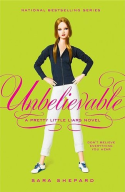
Unbelievable by Sara Shepard

January 26, 2012 by Michelle Smith

From the front flap:
Behind Rosewood’s grand façades, where the air smells like apples and Chanel No. 5 and infinity pools sparkle in landscaped backyards, nothing is as it seems. It was here, back in seventh grade, that five best friends shared everything—Seven jeans, MAC makeup, and their deepest, darkest secrets.

Now someone named A has turned their charmed lives into a living nightmare. Emily has been shipped off to her hyper-conservative cousins in Iowa. Aria is stuck living with her dad and his home-wrecker girlfriend. And Spencer fears she had something to do with Alison’s murder. But Hanna’s fate is worse than all of that—she’s clinging to life in the hospital because she knew too much.

With A’s threats turning dangerous and Ali’s killer still on the loose, the girls must uncover the truth—about A, about Ali, and about what happened to Hanna—before they become A’s next victims. But as they unravel Rosewood’s mysteries and secrets, will it bring an end to the horror… or is this just the beginning?

Review:
I find it hard to know where to start in reviewing Unbelievable without it becoming simply a reiteration of all the plot craziness that ensues. I’ll try to keep it to a minimum, at least.

We begin with all four girls in unfamiliar environments. Emily has been shipped off to Iowa to live with uber-strict relatives on account of continued gayness, Aria is living with her father and his girlfriend after having exhausted all other options, Spencer has been been whisked off to New Jersey by her parents in an attempt to repair her relationship with her sister, and Hanna is in a coma in the hospital, after being hit by a car. Plus, “A” is still sending them creepy messages and Ali’s killer remains on the loose.

I believe this was originally planned as the end of the series, but I’m not sure, since the last few pages suggest that a new “A” will come to town and there were also some unresolved hints about weird issues in Ali’s home life. Anyway, we do conclusively learn who A is (sadly, I had spoiled myself on this point) and are lead to believe that we learn who killed Ali, though that is not nearly as certain. Various repressed memories return in dramatic fashion. In addition, issues plaguing the various girls in their home lives get resolved—and I do appreciate how much of their drama this time is familial rather than romantic—and they sometimes even do reasonable things! (Though mostly they continue to do stupid things.)

I can’t really in good conscience recommend this series to others, but I will say that I have fun with it. This time, I checked out the unabridged audio edition narrated by Cassandra Morris. My first reaction was “This narrator sounds about nine!” but I did eventually get used to the pitch of her voice. What I never could accustom myself to, however, was her inability to pronounce the letter “t” when it appears in the middle of a word. Windows are hung with “cur-ans,” characters are suddenly “fry-end”… It’s very annoying!

In any case, I am totally going to keep reading. The fifth book in the series is called Wicked—and I have just boggled at its blurb, which mentions Emily having a boyfriend—but I am first going to read the newly released Pretty Little Secrets, which is set in the winter break between books four and five. I hope it’s not as insubstantial as the interstitial Princess Diaries books proved to be, but we shall see!

Filed Under: Books, Suspense, YA Tagged With: Sara Shepard

Usamaru Furuya Manga Moveable Feast: Roundup Two

January 26, 2012 by Ash Brown

© Usamaru Furuya

We’re about halfway through the Usamaru Furuya Manga Moveable Feast, so it’s time for the second roundup!

Here at Experiments in Manga I posted a review for Secret Comics Japan, a manga anthology that includes excerpts from Furuya’s debut manga Palepoli. The review is for the volume as a whole, but I do briefly mention Palepoli in it. The last Wednesday of every month I run a manga giveaway. In order to coordinate with the Feast, January’s giveaway is for Genkaku Picasso, Volume 1. All you have to do to enter is tell me how you were introduced to Usamaru Furuya and his work. My giveaways are always open world-wide, so I hope you’ll enter! I also made a (shocking!) confession: I volunteered to host the Usamaru Furuya Manga Moveable Feast before I had even read any of his manga.

Jim Hemmingfield was kind enough to contribute a guest post for the Feast at Experiments in Manga. (This is a first for the site, so I was particularly excited about it.) Jim provides a terrific overview of Furuya’s manga, including works that have yet to be licensed in English. Furuya is one of Jim’s favorite mangaka. It’s a long post, but worth reading. To quote briefly the end of the article:

Usamaru Furuya is a unique and visionary artist; probably one of the finest artists you will find working in comics today and I hope this feast helps to spread the word.

Over at Manga Xanadu, Lori Henderson reviews the first two volumes of No Longer Human. Lori didn’t originally plan to read the series, but found it to be a manga worthy of recommendation:

I wasn’t going to read No Longer Human. I’m one of those people who hears “literary classic”, and my brain shuts down. I’ve never been big on the drama and tragedy that usually permeates these kinds of books, but I’m making an effort to “expand my horizons”, so I decided to at least give the first volume a chance. What I found was a compelling human drama that didn’t feel like homework at all.

Linda of Animemiz’s Scribblings takes time to reflect on having a limited exposure to Usamaru Furuya and his works. Linda briefly looks at Lychee Light Club and Sion Sono’s film Love Exposure, in which Furuya plays the role of the leader of the Zero Church cult. In the post, Linda makes the following comment, which I couldn’t agree with more:

If there were any live action movies adaption that would reflect the vision from my limited exposure to Furuya works, then Shion Sono should be the right candidate.

At Completely Futile, Adam Stephanides reviews the first two volumes of Furuya’s The Children’s Crusade which just recently finished serialization in Japan. It hasn’t been licensed in English yet, but I sincerely hope that it will be!

The characters’ lively, expressive faces as drawn by Furuya contribute substantially to the characterizations. And the art in general is excellent, both in visual storytelling and page design, and is frequently cinematic in scope and detail. Furuya isn’t particularly well known for his action scenes, but the ones here are dynamic.

The Feast is well under way and there have been some wonderful contributions. If you can’t wait for the next roundup, be sure to keep an eye on the archive page—I update it as soon as I learn about a new article or review. And if I’ve missed something, please let me know!

Filed Under: UNSHELVED Tagged With: manga, Manga Moveable Feast, Usamaru Furuya

New manga, Usamaru Furuya giveaway

January 26, 2012 by Brigid Alverson

I posted my take on this week’s new manga releases at MTV Geek, and Sean Gaffney takes a look at next week’s list.

The Manga Moveable Feast continues at Experiments in Manga with a guest post by Jim Hemmingfield about this month’s creator, Usamaru Furuya, and a Genkaku Picasso giveaway.

Ed Sizemore guests on the latest Eeper’s Choice podcast, which features a discussion of Kingyo Used Books.

Reviews

Shannon Fay on vol. 2 of The Betrayal Knows My Name (Kuriousity)
Kate O’Neil on vol. 2 of The Betrayal Knows My Name (The Fandom Post)
Connie on vol. 11 of Black Bird (Slightly Biased Manga)
Connie on vol. 2 of Boys With Tomorrow to Conquer (Slightly Biased Manga)
Adam Stephanides on The Children’s Crusade (Completely Futile)
Leroy Douresseaux on vol. 2 of Dawn of the Arcana (The Comic Book Bin)
Chris Kirby on vol. 21 of D.Gray-Man (The Fandom Post)
Kristin on vol. 21 of D.Gray-Man and vol. 53 of Naruto (Comic Attack)
Danica Davidson on vol. 1 of Gente (Graphic Novel Reporter)
Tom Gill on The Incident at Nishibeta Village (The Hooded Utilitarian)
Sesho on vol. 1 of Sailor Moon (Sesho’s Anime and Manga Reviews)
Sean Gaffney on vols. 1 and 2 of Short Cuts (A Case Suitable for Treatment)
Connie on vol. 1 of Step (Slightly Biased Manga)
Chris Kirby on vol. 7 of Tegami Bachi (The Fandom Post)
Connie on vol. 5 of Wild Adapter (Slightly Biased Manga)
Erica Friedman on Yurikan Feuille (Okazu)
Connie on vol. 4 of Ze (Slightly Biased Manga)

Filed Under: MANGABLOG

Short Cuts, Vols. 1 & 2

January 26, 2012 by Sean Gaffney

By Usamaru Furuya. Released in Japan by Shogakukan, serialized in the magazine Young Sunday. Released in North America by Viz.

Short Cuts was my first exposure to this month’s MMF topic, Usamaru Furuya. I picked it up because the girls in it looked cute and the manga itself looked funny. Both turned out to be correct, yet there ended up being much more, something that made me want to seek out more work from this talented artist whose point of view seemed a little different than everyone else’s.

Genkaku Picasso has its comedic moments, but it really has to be said: Short Cuts is easily the most light-hearted and comedic title that North America has ever released from Furuya. The reason for this might have something to do with the manga’s chosen topic: kogals. The phenomenon is now over, but at the time that Short Cuts was serialized, kogals were at the height of their popularity. The fashion-conscious, uniform-altering girl who didn’t care about Japanese standards and wanted to do her own thing… provided it was the thing the others were doing. Short Cuts also refers to the format: it’s basically a 4-koma style without being limited to 4 panels. Most of the pages are one-page gag panels, with a few exceptions for serious stories or ‘arty’ bits.

Speaking of those arty bits, another reason that Furuya’s art really stood out for me are those times when he would jokingly ‘get possessed’ and draw these huge two-page surreal spreads… which also made it into the magazine, which says something about the trust the editors had in him. His art tends to fit the gag during most of the book – cute girls have cute faces, while older folks or non kogals tend to look much more realistic and frumpy. (One comic even has Mai lampshade this, finding a magazine of her dumpy parents as fashion models years ago.) The two-page art panels give an impression of someone who is given creative freedom in his series, but it’s STILL NOT ENOUGH – he must create even more bizarre and outre things.

There is no continuity in this series as such, though a couple of characters recur. The most obvious one is Mai-chan, who is Furuya’s default kogal. She’s more of an ‘everyday girl’ than the other kogals depicted here, and probably closest to the reader identification figure. Well, that is, when she’s not being conscripted into the JSDF or breaking the fourth wall to rebel against the author himself. Mai is a great example of the fun side of Short Cuts. At the same time, Furuya is not afraid to do the occasional serious strip either – Cut 54 here, where a man desperate for money sells his wife and daughter as ‘conveniences’ is both appalling and somewhat sad.

The strips appeared in the seinen magazine geared towards early 20-somethings Young Sunday, which, like all other magazines in Japan with ‘Young’ in their title, has a certain amount of adult content. Short Cuts is no different, and I would definitely classify it for mature readers. Be it the computers that have to be given blowjobs in order to boot up, or the Little Lolita Storage Safe, or the girl who loses her virginity at the beach after using her father as a swimsuit (it makes sense in context… well, no, it really doesn’t), Short Cuts is not something you should let impressionable children read, at least not without long talks about sexuality in Japan.

Short Cuts even gets an ending os sorts, as Furuya shows himself as a dying old man, finally passing away and being taken to heaven by Mai-chan and the rest of the Short Cuts cast. This is, I think, the main reason why Short Cuts succeeds. It takes on a lot of funny subjects, especially the kogal movement in Japan, but it’s never mean about them. You get the feeling that Furuya likes these girls, and is rooting for them. And we do as well. In a world where they constantly have to battle parents, perverts, and each other, you take the little victories where you can. Short Cuts is a string of those little victories, showing Kogals at a time when they were on top of the world. It’s also a fantastic example of Usamaru Furuya’s art. Both volumes are out of print, I believe, but should be fairly easy to track down.

Filed Under: REVIEWS

Manga the Week of 2/1

January 25, 2012 by Sean Gaffney

Remember, kids, when the month starts on Wednesday, Viz ignores it. (Mostly). So even though this is the first week of February, don’t expect a Viz blitz just yet. What we do have is a lot of stuff that has been out elsewhere for a while, but is finally hitting Midtown now…

Digital Manga Publishing has a couple of titles left that didn’t come out last week. Vol. 4 of school comedy Great Place High School Student Council (still a very awkward title), and Vol. 2 of Mr. Tiger and Mr. Bunny… sorry, Mr. Wolf. Still not a Tiger & Bunny crossover, sad to say.

Kodansha has the 2nd volume of @ Full Moon, which has gay subtext, vampires *and* werewolves, yet still somehow has not been licensed for a major motion picture starring Justin Timberlake. I wonder why? There’s also Vol. 17 of Fairy Tail, which is about due for the return of Fairy Tail fandom’s least favorite character.

There is a large pile of Vertical releases, almost all of which everyone else has had for months, but which Midtown is getting now. So if you haven’t gotten Chi’s Sweet Home 7, No Longer Human 2, Princess Knight 1 *and* 2, or Twin Spica 9 *and* 10 (but not 11, oddly enough), now would be the time. They’re all recommended.

Lastly, arriving two weeks late for no discernible reason whatsoever, we have Vol. 6 of Cross Game, containing the Japanese Vol. 12 and 13. Akane arrived last volume, and was a somewhat polarizing character among the blogger reviews that I read. Will she get a chance to win people’s hearts? Or will it be 2 more volumes of all baseball again?

Any ideas?

Filed Under: FEATURES

Guest Post: An Examination and Appreciation of the Works of Usamaru Furuya

January 25, 2012 by Ash Brown

As the host of the Usamaru Furuya Manga Moveable Feast, I am delighted to welcome Jim Hemmingfield to Experiments in Manga as a guest writer. I am absolutely thrilled that Jim agreed to contribute to the Feast!

Jim Hemmingfield is a manga fan who lives in London. He’s been collecting manga since the early 90s and is mainly interested in the more alternative artists. He would like to blog more but hardly has any time. Occasionally he posts to the Same Hat Tumblr. You can also find him on Twitter @jimhemmingfield.

* * *


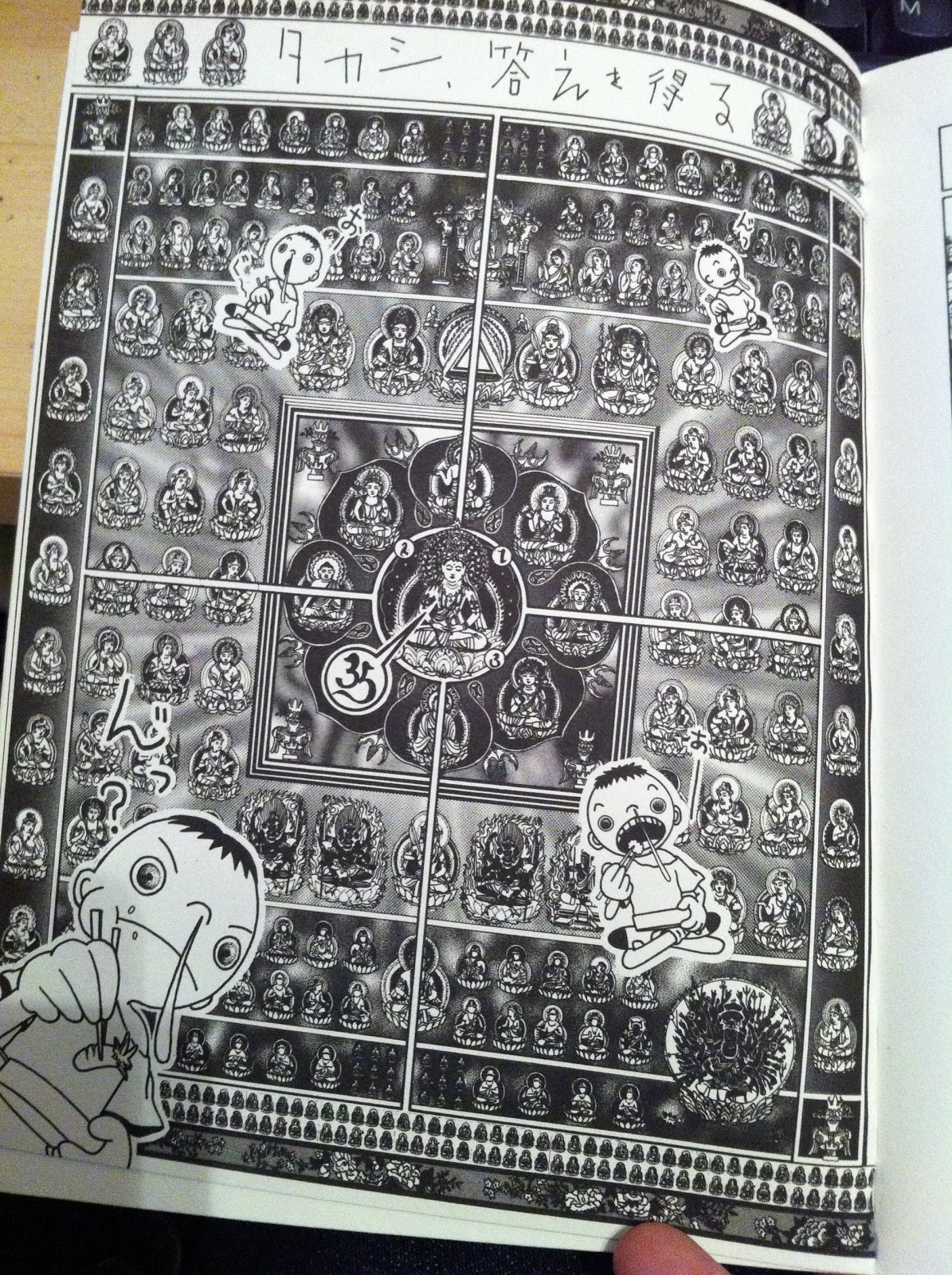
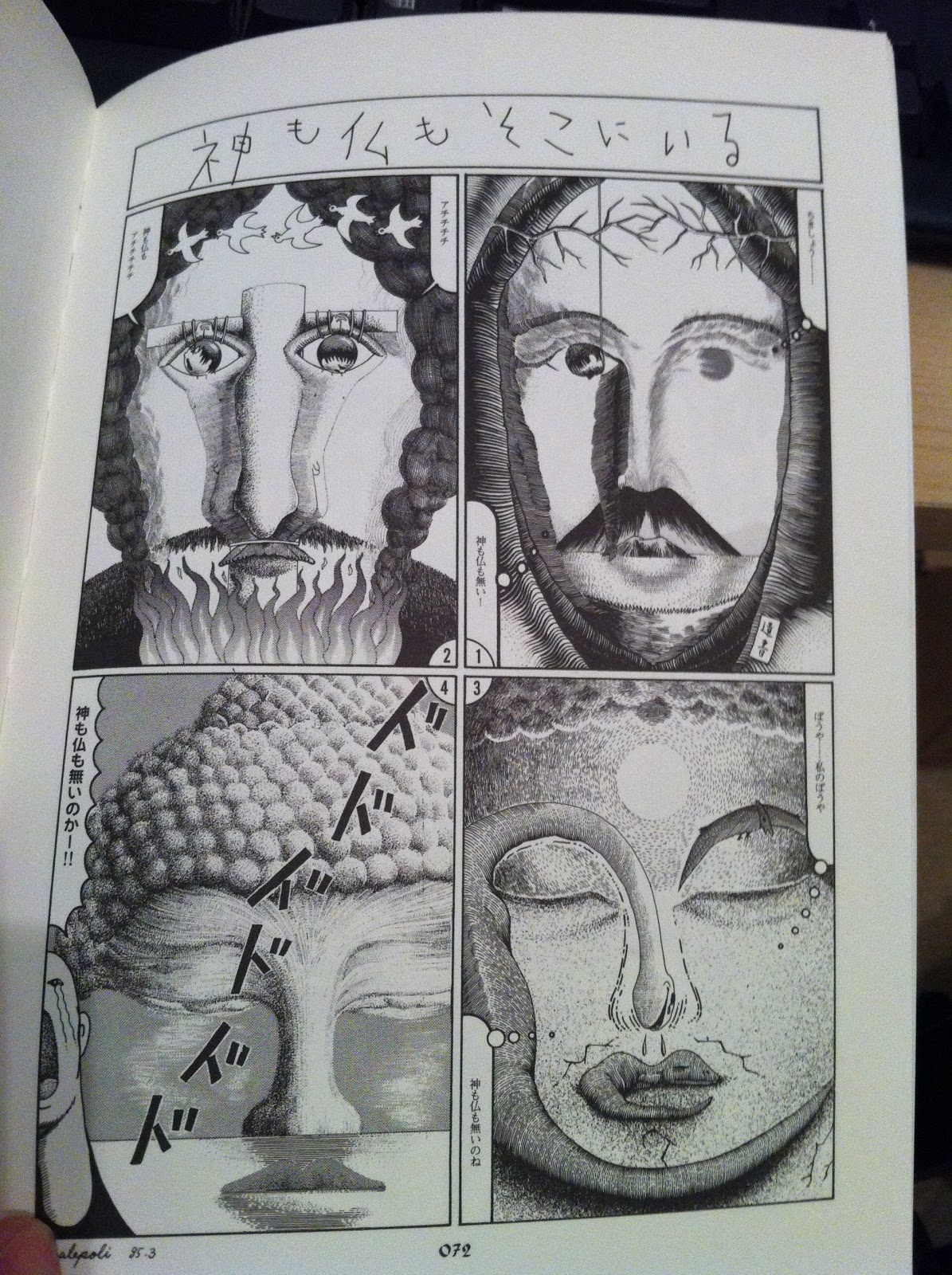
A page from Palepoli

Out of all the manga-ka to see the light of day in the US, Usamaru Furuya is certainly the most idiosyncratic; or, at least, the most versatile in his idiosyncrasies. He also seems to be one of the more successful of the alt-manga crowd in the US due to a recent resurgence of titles being released. It would, however, be an injustice to simply tag Furuya as an alt-manga artist. Instead, Usamaru Furuya is a unique creator, as happy to work in the mainstream as he is in the underground. It’s fairly common for manga-ka to produce works for different demographics (Shonen, Shojo, Seinen etc.) but I’m not sure that many have pushed the boundaries like Furuya; and, if they have, they haven’t made it to our shores. I’d go so far as to say, without learning Japanese (or possibly French?) you would be hard pressed to find such a versatile and individual manga-ka as Furuya. The only travesty is that we still haven’t had a chance to witness some of his finest moments.

A bit of background on Furuya is necessary to understand how he managed to achieve this standing. In the book Manga (published by Taschen, edited by Julius Wiedemann and Masanao Amano) there is a DVD which includes an interview with Furuya, detailing both his background and career. Whilst at Elementary School and Junior High, Furuya enjoyed drawing manga and began to submit illustrations to magazines. Unlike so many manga-ka’s stories who begin cartooning early and never stop, Furuya’s interest in manga dwindled throughout High School and College. Furuya states at this stage became less interested in manga and had little exposure to it.

Instead, he developed an interest in fine arts and theatre. He majored in oil painting at College and began to act in theatre at the same time. From here he became interested in dance, taking his inspiration from Saburo Teshigawara. His interests at this point, he says, were using his body to express. He also became interested in mono-ka, an art movement that I can find no information about online, which Furuya says is similar to the Italian Arte Povera. This is a type of 3D art, such as installations, and that was the type of art Furuya was most interested in creating around that time.

These interests continued after College. Furuya would continue to perform experimental dances which would incorporate less and less movement, to the point that they could hardly be described as dance. He would also display 1 or 2 3D pieces per year in galleries. As creating these pieces took such a long time, Furuya began to take on additional work, doing illustrations for text books, such as drawings of insects and plant photosynthesis. When he started doing this Furuya’s love of drawing was reignited. He believes that when he went to college drawing is what he really wanted to do but he was distracted by the new ways of expression he discovered and was possibly influenced by peers and tutors to pursue them leading him away from illustration. Whatever the cause, if not for the uncommon path Furuya travelled, his manga would probably not be as unique and interesting as they are.

Furuya was 24 when he began producing his first manga, Palepoli, which was serialised in the seminal underground manga anthology Garo. Palepoli was my second exposure to Furuya’s work, in the sadly now out of print Secret Comics Japan (published in 2000 by Viz). Palepoli is a Yonkoma style manga, generally a gag strip, always consisting of four panels. Furuya started with this format as he was only starting out and was nervous about creating a longer narrative. He says that he also tried to take the fundamentals of art to create a manga and that he would take an entire day to draw one frame, meaning each page would take four days to complete. Unlike traditional Yonkoma, which consist of four horizontal panels that read top to bottom, Furuya had Palepoli set out like a four panel grid. Furuya’s art background, coupled with the amount of time he spent on each page, meant that, although some strips would ape traditional manga styles, most of the strips had a unique, highly detailed and stylised look. The gags, although funny, dealt with a variety of dark, disturbing and occasionally grotesque subject matter. Also, some of the formalism on display, such as the trick drawings which look like one thing close up but another from further away, makes for some breathtaking artistry. I’m surprised one of these strips didn’t make it into Secret Comics Japan. A lot of Palepoli has a very unique Japanese-ness to it but the surreal-ness and artistry of the work overall makes me think it would be accepted and appreciated by both mature manga readers and the art comix crowd. Out of all of Furuya’s unpublished works Palepoli is the one I would like to see the most. I’m lucky enough to own a Japanese copy which, although I don’t understand, gives me tremendous enjoyment to look through but the idea of owning a fully translated copy would really make my day.

Another of Furuya’s earlier experimental pieces was Plastic Girl, which is also high on my list of Furuya titles I would love to see licensed. Plastic Girl is unlike any other manga I’ve seen and, like Palepoli, would go down well with the alternative, art comix crowd. Unlike most manga, Plastic Girl is a full colour book, published in a large size and clocking in at a slender 46 pages. Again, Furuya employs his art background to craft an amazingly beautiful book, using a variety of different styles and utilising different materials for each section including painting on wood, cloth and canvas. The book has 23 different chapters, each spread over two pages and Furuya employs different styles for most (occasionally some are repeated). My personal favourite is one that is painted to look like 2 stained glass windows. All of it is gorgeous and, from what I can gather, the narrative is symbolic, surreal and occasionally disturbing, like many of Furuya’s works. (There is a review from someone who can read Japanese at Completely Futile). Unfortunately, though the imagery is fairly tame for the most part, I can see this being a hard sell in the west as it differs so much from the general perception of manga. I definitely can’t see it being picked up by any of the major manga publishers.

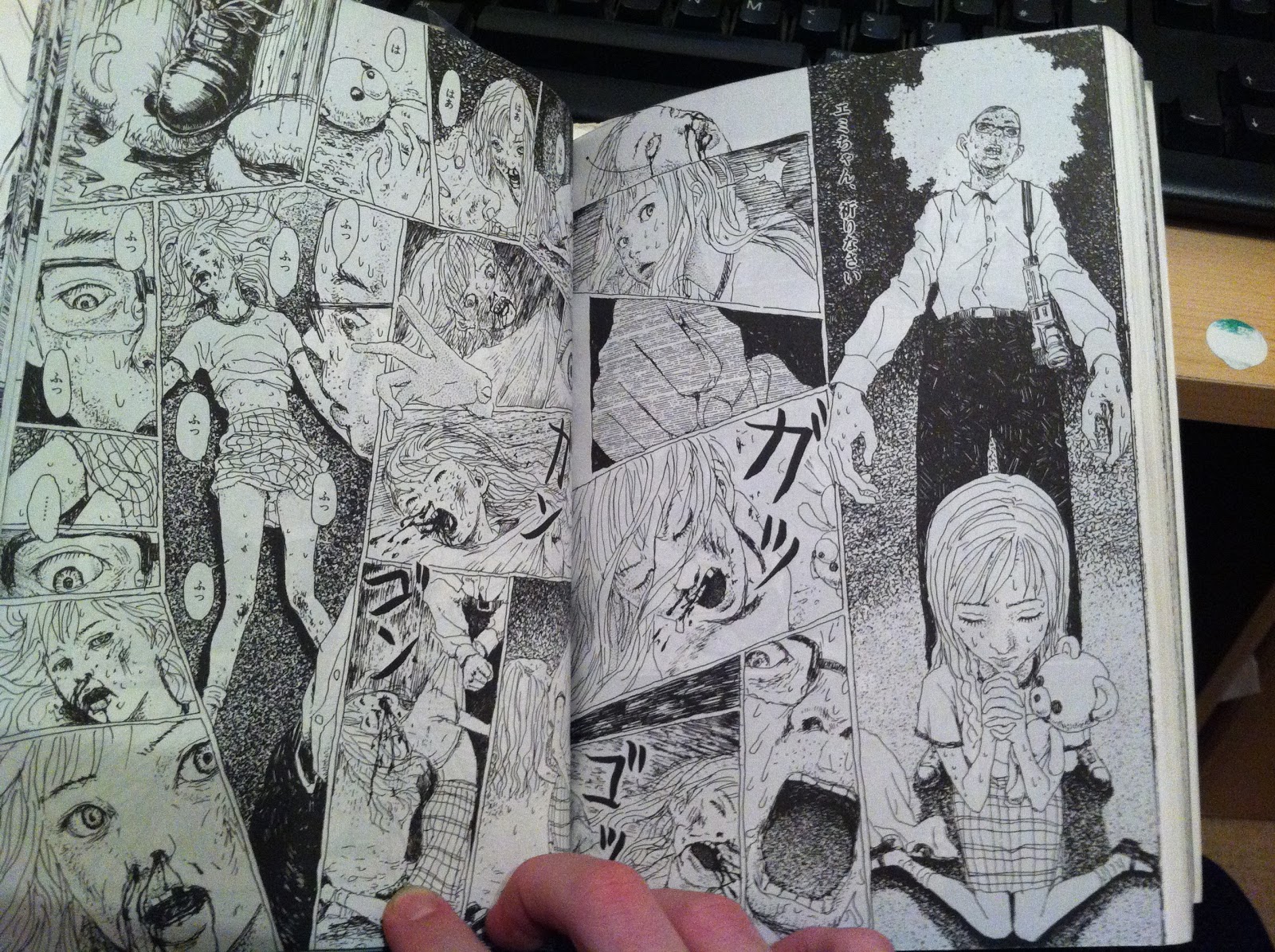
“Emi-chan” from Garden

Palepoli and Plastic Girl are probably Furuya’s most artistic and experimental books, but that’s not to say his other works aren’t also worth exploring. There are several unlicensed works that look like they would be far more interesting than the majority of manga licensed in the US. His short story collection Garden, which contains several stories of differing length, collected from alternative publications Comic Cue and Manga Erotics, is possibly more conventional in terms of the art and layout overall, although Furuya continues to switch up his style for each story. He also continues to explore the darker side of the human psyche as well as inserting comical stories and ones that look as though they are more fantasy orientated. The last story in particular, although I have only seen it in its original Japanese, plumbs some of the darkest depths of Furuya’s mind. It makes for a disturbing read (even without being able to understand the dialogue) but the shaky line Furuya uses fits the mood perfectly. The story is so extreme that in the original tankobon the pages are sealed together. The reader has the choice as to whether or not they wish to cut open the pages in order to read it. It is broke up into several sections so if it gets to extreme you do not need to continue. I’m unsure if this was Furuya’s choice or the publishers but it is an interesting choice. I have actually seen this in one other book, King Terry’s Heta-Uma Dictionary, although the sealed pages are no more shocking than the rest of the book (i.e. not really shocking at all) unlike the work in Garden. All in all, there are at least three stories in Garden that make it un-publishable in English which is a real travesty. A review of Garden can also be found at Completely Futile.

After Garden (and another short story collection called Wsamarus 2001 that I have no information on) Furuya began to work on slightly longer form narratives and began to work for more varied magazines. Saying this, Short Cuts, one of Furuya’s series that has been published in English (out of print but fairly cheap to get hold of) was serialized in Young Sunday not long after Palepoli and around the same time the stories in Garden were appearing in much more underground/niche publications. In the DVD interview, Furuya gives his reasons for working for a variety of publishers. He states that he wants to create a wide variety of works and that each one is dependent on certain rules and regulations. In other words, Furuya likes the restrictions that will be placed on him by some publishers, allowing him to create something within those set boundaries. This is why he is happy to work for a broad spectrum of magazines. Two of his more recent works, Genkaku Picasso and Lychee Light Club were published in Jump SQ (part of Shuiesha’s Jump line of Shonen magazines) and Manga Erotics F respectively, two distinctly different publications (both titles are available in English from Viz and Vertical), showing Furuya is still happy to take his work to wherever it is best suited.

Out of all of Furuya’s works I believe his longest is called Pi. At nine volumes long it could still be seen as a fairly short series in comparison to many manga. Pi was published in Shogakukan’s Big Comic Spirits, a fairly popular Seinen anthology. I know little about this title except that it revolves around a man obsessed with finding the perfect breasts. Along with Genkaku Picasso (I’m not a big Shonen reader), this is the Furuya title that appeals the least but, artistically, it is up to Furuya’s high artist standard.

Along with the titles mentioned earlier, the Furuya works I would most like to see are his darker ones like the recently released Lychee Light Club (published in US by Vertical). This is Furuya’s adaption of the Tokyo Grand Guignol play so it combines two of Furuya’s interests. In style and content it is similar to another one of my favourite manga artists Suehiro Maruo. Furuya has acknowledged by dedicating the book to Maruo as well as the TGG troupe leader Norimizu Ameya. I would say that Furuya incorporates more black humour in Lychee Light Club than I have seen in Maruo’s work. Still it is treads fairly dark territory and has several gory moments. Furuya is currently working on a prequel to Lychee Light Club which he is serialising online.

Trick drawing from Palepoli

Another title I would be eager to read, that does not seem to mine the darker side of Furuya’s psyche, is The Music of Marie. This title is described as a fantasy epic that revolves around a world where men are watched over by a mechanical goddess in the sky called Marie who brings them contentment with her music. It sounds like an enchanting story that seems to evoke early Hayao Miyazaki works, especially Nausicaa. At only 2 volumes long I would see it being an ideal choice for Vertical if they wish to publish more Furuya after they have finished No Longer Human, which I would highly recommend. I have also heard many people say that Furuya’s art in The Music of Marie is arguably his best. For those of you lucky enough to be able to read French, the series has been published by Casterman.

These are only a short selection of Furuya works that deserve some more attention. There are many more fascinating titles by Usamaru Furuya, all of which I feel would easily find an audience in the west and this is without mentioning those already available, all of which are worth your time and money. As I said to begin, Usamaru Furuya is a unique and visionary artist; probably one of the finest artists you will find working in comics today and I hope this feast helps to spread the word.

Filed Under: UNSHELVED Tagged With: manga, Manga Moveable Feast, Usamaru Furuya

Great Graphic Novels list is out!

January 25, 2012 by Brigid Alverson

Dark Horse has been adding manga and manhwa to their digital site pretty aggressively; Deb Aoki notes the newest additions.

YALSA has released its Great Graphic Novels for Teens list, and it includes a number of manga; vol. 1 of Wandering Son and vol. 1 of A Bride’s Story made the top ten.

Ash Brown presents the first roundup for the Usamaru Furuya Manga Moveable Feast at Experiments in Manga.

Derek Bown introduces a new column at Manga Bookshelf, Combat Commentary, that will analyze and critique combat scenes in manga. He kicks it off with a corker from Bleach.

Kate Dacey points us toward a preview of Shigeru Mizuki’s NonNonBa.

Matt Alt explains why you need a copy of his new book Yurei Attack! The Japanese Ghost Survival Guide, which is due out in a few months.

Reviews

Justin on vol. 1 of Dawn of the Arcana (Organization Anti-Social Geniuses)
Michelle Smith on vol. 1 of A Devil and Her Love Song (Soliloquy in Blue)
Lori Henderson on vols. 1 and 2 of No Longer Human (Manga Xanadu)
Sean Gaffney on vol. 60 of One Piece (A Case Suitable for Treatment)
Anna on vol. 6 of Sakura Hime: The Legend of Princess Sakura (Manga Report)
Ash Brown on Secret Comics Japan: Underground Comics Now (Experiments in Manga)

Filed Under: MANGABLOG

One Piece, Vol. 60

January 25, 2012 by Sean Gaffney

By Eiichiro Oda. Released in Japan by Shueisha, serialization ongoing in the magazine Weekly Shonen Jump. Released in North America by Viz.

I am still a little mindboggled that I get to review a sixtieth volume of a manga that’s been released in North America. Yes, it’s true that without Naruto’s success, I likely wouldn’t be reading this, but honestly without Naruto’s success I wouldn’t be reading ANY Viz manga. This volume wraps up Luffy’s flashback sequence, and then takes us back to dealing with the aftermath of the Marineford debacle.

As with most volumes of One Piece, there’s so much going on that you simply have to stop and focus on a few things that jump out at you. Sabo is an interesting character to add here, especially gives he has an explicit connection to Luffy’s past – *and* he’s the son of noblemen, who once again are shown to be thoroughly corrupt and evil. Sabo is the exception, of course, and his “death” halfway through the volume, unlike Ace’s, feels more like the deaths of One Piece past – i.e., you get the sense we’ll be seeing Sabo again at some point. This does not diminish any of the heartbreak, of course, especially following the disastrous fire which destroys the city.

The flashback now finished, we move back to the fates of those affected by the previous 7-8 volumes. It’s great to see Makino again, who seems to be the closest thing we’re ever going to get to a mother figure for Luffy, and she points out that just because someone is not sobbing on the ground in despair does not mean that they are suffering. And Luffy, who has been feeling that he has lost everything, is reminded of the one thing he still has and that he can still take heart in – the other Straw Hat Pirates. Who we finally *see*, after so many volumes missing. They aren’t reunited yet, no, but we get some nice ‘epilogues’ to their cover page stories, showing them getting Luffy’s mysterious ‘message’ and understanding it.

There is then what amounts to a montage of characters we have known, as Luffy, Jimbei and Rayleigh decide to GO BACK TO THE BATTLEFIELD (a sequence, I note, we are told about but don’t see – very smart, considering how long this arc has gone on) and everyone reacts to this. Highlights include Coby discovering that his screaming at everyone to stop fighting wasn’t just being really loud – he has haki now! Well, he has to keep up with Luffy somehow. Various pirates are off to the New World, including some of the Supernovas and Crocodile. Even Buggy is reunited with his crew. And it’s always wonderful seeing Vivi again.

The back half of this manga is filled with nostalgia, but it’s also pointing the way forward. The next volume will finally wrap things up and get our crew back on their way to adventure – OK, maybe the volume AFTER that – but Oda has built a world so strong that we are content to follow his plots wherever they may meander. Especially if it means we see Ace and Luffy as kids fighting giant bears.

Filed Under: REVIEWS

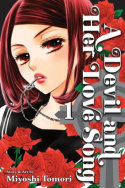
A Devil and Her Love Song, Vol. 1

January 24, 2012 by Michelle Smith

By Miyoshi Tomori | Published by VIZ Media

The back cover blurb of A Devil and Her Love Song contains the following lines: “Meet Maria Kawai—she’s gorgeous and whip-smart, a girl who seems to have it all. But when she unleashes her sharp tongue, it’s no wonder some consider her to be the very devil!”

And in my mind, this built up the expectation for a comedy, but that’s not what A Devil and Her Love Song is at all. It’s much more serious and sad than I had anticipated, but if I had done my research beforehand and realized that it originally ran in Margaret, I shouldn’t have been surprised.

Beautiful Maria Kawai has been expelled from her prestigious Catholic school, St. Katria’s, and must now enroll in a new school. She carries a lot of mental baggage from her experiences at St. Katria’s, most notably the fact that someone she regarded as her best friend told her “You taint everyone around you.” And, as if to lend credence to these words, Maria stirs up hostilities amongst her classmates almost immediately. The problem is that she’s so perceptive, and so blunt in her delivery, that she points out personality attributes that her classmates would rather not acknowledge, like the fact that they’ve been gossiping about her prior to her arrival, or that one boy is pushing himself to be liked by all even though he is not naturally a people person. Over the first week of school, matters escalate to the point where Maria is shoved down a flight of stairs and a truly odious teacher is telling her she’s “rotten to the core.”

And yet, there are certain lessons from her St. Katria’s days that serve Maria well in tough moments, like “those who believe will be saved,” which provides her encouragement to get through bullying encounters with a group of Mean Girls in her class. But she’s not taking solace from a religious implication of these words; instead, she seems to feel that if she believes in people’s good intentions, has faith that one day they will accept her, that this will actually come to pass. And so, even though she knows the girls have it in for her, she puts herself in the path of their harassment in the hopes that one day, she’ll win them over. As I said, it’s really rather sad and makes her far more sympathetic than I ever expected a sharp-tongued heroine to be.

I regret to admit I made another snap judgment of the series based on the chapter one title page, which depicts Maria and a couple of boys, one a cheerful blond and the other a surly-looking brunette. I assumed these would be her stereotypical shoujo love interests, but though both boys are definitely interested in her, they are far more complicated individuals than I had assumed they would be. The brunette, Shin, is grumpy, rebellious, and not really friendly with the rest of the class, but has a kind heart. It unsettles him that Maria can so clearly see through him, and he’s terrified of what would happen if she could discern what he’s feeling about her, but he still comes through with her when no one else will. There’s one especially nice scene where she’s so happy and scared by his kindness that she can’t even find the words to explain, so she sings instead.

On the other hand, you have Yusuke, who is trying so hard to be everyone’s friend that he’s actually no one’s real friend at all. His philosophy is the “lovely spin,” which is a survival mechanism he tries to impart upon Maria with little success. Turn everything into something palatable and nice, even if you’re being untrue to yourself, is the basic gist. It’s probably good for her to master this subterfuge, to avoid further confrontations and to effect the personal change she seeks, but why is he doing it? Just as he helps her master the art of diplomacy, one wonders whether she will help him drop the charade.

I mean no slight to shoujo comedies when I say that A Devil and Her Love Song is much better, richer and more deep, than I anticipated. To say that I am looking forward to reading the rest of this story would be a gross understatement.

A Devil and Her Love Song is published in English by VIZ Media. The first volume will officially be released on February 7, 2012. The series is complete in Japan with thirteen volumes.

Review copy provided by the publisher.

Filed Under: REVIEWS Tagged With: shojo beat, VIZ

  • « Go to Previous Page
  • Page 1
  • Page 2
  • Page 3
  • Page 4
  • Interim pages omitted …
  • Page 7
  • Go to Next Page »
 | Log in
Copyright © 2010 Manga Bookshelf | Powered by WordPress & the Genesis Framework