• Skip to primary navigation
  • Skip to main content
  • Skip to primary sidebar
  • Home
  • About Us
    • Privacy Policy
    • Comment Policy
    • Disclosures & Disclaimers
  • Resources
    • Links, Essays & Articles
    • Fandomology!
    • CLAMP Directory
    • BlogRoll
  • Features & Columns
    • 3 Things Thursday
    • Adventures in the Key of Shoujo
    • Bit & Blips (game reviews)
    • BL BOOKRACK
    • Bookshelf Briefs
    • Bringing the Drama
    • Comic Conversion
    • Fanservice Friday
    • Going Digital
    • It Came From the Sinosphere
    • License This!
    • Magazine no Mori
    • My Week in Manga
    • OFF THE SHELF
    • Not By Manga Alone
    • PICK OF THE WEEK
    • Subtitles & Sensibility
    • Weekly Shonen Jump Recaps
  • Manga Moveable Feast
    • MMF Full Archive
    • Yun Kouga
    • CLAMP
    • Shojo Beat
    • Osamu Tezuka
    • Sailor Moon
    • Fruits Basket
    • Takehiko Inoue
    • Wild Adapter
    • One Piece
    • After School Nightmare
    • Karakuri Odette
    • Paradise Kiss
    • The Color Trilogy
    • To Terra…
    • Sexy Voice & Robo
  • Browse by Author
    • Sean Gaffney
    • Anna Neatrour
    • Michelle Smith
    • Katherine Dacey
    • MJ
    • Brigid Alverson
    • Travis Anderson
    • Phillip Anthony
    • Derek Bown
    • Jaci Dahlvang
    • Angela Eastman
    • Erica Friedman
    • Sara K.
    • Megan Purdy
    • Emily Snodgrass
    • Nancy Thistlethwaite
    • Eva Volin
    • David Welsh
  • MB Blogs
    • A Case Suitable For Treatment
    • Experiments in Manga
    • MangaBlog
    • The Manga Critic
    • Manga Report
    • Soliloquy in Blue
    • Manga Curmudgeon (archive)

Manga Bookshelf

Discussion, Resources, Roundtables, & Reviews

Archives for April 2011

Bookshelf Briefs 4/11/11

April 11, 2011 by David Welsh, Katherine Dacey, MJ and Michelle Smith 6 Comments

This week, MJ, Kate, David, & Michelle take a look at several ongoing series from Viz Media, Digital Manga Publishing, TOKYOPOP, and Yen Press.


Bunny Drop, vol. 3 | By Yumi Unita | Yen Press – I think this column is a perfect venue for new volumes of series like Bunny Drop where all I basically have to say is that it’s still excellent. This time around, Daikichi deals with the milestone of Rin starting primary school, carries on traditions that his parents observed for him, and adds to the ever-growing list of responsibilities people face when they’re guardian for a child. For her part, Rin adapts to her new school and helps a friend do the same. Unita is such a smart and warm observer of the small moments that make up everyday life and the subtle connections that represent family at its best. I seriously can’t speak highly enough about this book and hope you’re all reading it. I’m thrilled that it received an Eisner nomination. – David Welsh

Countdown 7 Days | By Kemuri Karakara | Digital Manga Publishing – Kemuri Karakara’s latest series, Countdown 7 Days, focuses on the students at the Sheol Soul School — or should that be Schul? — an academy that prepares the recently deceased for the afterlife. Though I’m temperamentally predisposed to like manga with a supernatural theme, I’d be the first to admit that Karakara doesn’t seem to be in control of the material; the characters have no chemistry with each other, and the basic rules of the afterlife are so poorly explained that much of the action in volume one doesn’t make much sense. It’s a shame the plot is more muddle than linear narrative, as Karakara has a flair for drawing the kind of nattily attired men, fancy weapons, and evocative settings that inspire fan fiction and cosplay. -Katherine Dacey

High School of the Dead, vol. 2 | Story by Daisuke Sato, Art by Shouji Sato| Yen Press – The zombie action continues in volume two, but though the apocalyptic intrigue is beginning to ramp up as police and other authorities begin treating even living citizens as acceptable losses, the series’ fanservice has officially lost all touch with reality. While the volume begins promisingly, it later degenerates into unbelievable sexual fantasy, as we’re asked to believe that not only do average young women spend baths together playfully groping at each other’s (amazingly large) breasts, but that they are also keen to prance about in their thong underwear while all the menfolk remain fully clothed. Meanwhile, the avocados of doom have definitely grown. Suitable as wank-fodder only.– MJ

K-ON!, vol. 2 | By Kakifly | Yen Press – So, I have to wonder… am I really supposed to find any of this funny? When Yui, the ditzy lead guitarist of the band formed by the members of the pop music club, suddenly forgets a simple chord, am I supposed to laugh? How about when she acts superior to the new girl, Azusa, whose talent eclipses her own? Worst of all, how about when their faculty advisor, who is fixated on her students’ bust sizes, actually grabs one girl’s breasts? None of this is in the least bit amusing to me. The only reason I liked this volume a little more than the first is the introduction of Azusa, who motivates the girls to actually practice once in a while. Scintillating stuff, that. – Michelle Smith

Neko Ramen, vol. 3 | By Kenji Sonishi | TOKYOPOP – The third volume of Neko Ramen finds Taisho experimenting with “Boomeramen” (it comes back when the customer throws it), dressing as a panda (“They’re trendy,” he explains), and opening a high-end restaurant called Neko Ramen Hills. Though it’s clear to the reader – and to the shop’s only regular customer – that Taisho’s ideas are terribly misguided, the cat cook remains a fierce optimist, undeterred by failure and impervious to suggestion or criticism. That kind of character isn’t always the easiest to like, but Taisho is oddly winning in his dedication to building a successful business; it’s hard not to root for him, even though he never seems to learn from ill-advised promotions or impulsive hiring practices. Highly recommended. – Katherine Dacey

Otomen, vol. 9 | By Aya Kanno | Viz Media – Just days after rashly claiming my disillusionment with Otomen as a multi-volume series, I decided to give it another chance, with somewhat mixed results. Though a sub-plot in which Juta is nearly (but then not) outed as shoujo mangaka Jewel Sachihana only feeds my frustration with the series’ situation comedy setup, this volume’s ramped-up gender commentary has almost won me back over. Whether it’s enough to keep me hooked for more than another volume remains to be seen, but I can’t deny that things look more promising than they have in a while. Of course it doesn’t hurt that Kanno’s sense of humor and artwork are both just as stunning as ever. Cautiously re-recommended.– MJ

Filed Under: Bookshelf Briefs Tagged With: bunny drop, countdown 7 days, high school of the dead, k-on!, neko ramen, otomen

From the stack: Korea as Viewed by 12 Creators

April 11, 2011 by David Welsh

I don’t know if it was editorially composed to be this way, but Korea as Viewed by 12 Creators (Fanfare/Ponent Mon) puts its least successful pieces first, allowing the stories to build in ambition and interest as the anthology progresses. The order leaves the reader with the strongest possible impression of the collection and only a scant memory of the introductory blandness. It’s a smart choice.

Choi Kyu-Sok opens the collection with “The Fake Dove,” a reminder that pretense is an international language. In it, a manhwa artist tries to live among the homeless for an assignment. It’s exactly what you’d expect – halfhearted, privileged guilt tempered by winking cynicism. “Feel bad about their plight, but you can still complain about the way they smell.”

Catel’s “Dul Lucie” has a promising idea – the creator’s attempts to show South Korea through her trademark character’s eyes. Unfortunately, it ends up being a shapeless blend of travelogue and authorial excuse-making. It’s not without charm, though, and I’d like to read some of Catel’s other work. (This chapter is among those that suffer from sometimes awkward, seemingly rushed translation; happily, none of the really good pieces fall victim to that fate.)

Things start to perk up with “Solego’s Tree,” by Lee Doo-hoo. A gifted artist finds that masterworks can have unintended consequences in a simply structured, beautifully drawn little parable.

Alas, it’s back to the bland with Vanyda’s “Oh Pilsung Korea!” A French brother and sister (whose father is Korean) bemoan the fact that they aren’t seeing “the real Korea” during their visit. Putting aside the fact that they haven’t made any specific efforts in that direction, I always find the notion of finding the “real” anywhere kind of presumptive. If the story had been about the impracticality of expectations or the travelers’ accountability, there might have been something here.

I liked “Cinderella” by Park Heong-yong, a tale of boyhood mischief that morphs into something stranger but still welcoming. I found Mathieu Sapin’s “Beondegi” twee in the way I generally react to “normal person gets dragged into wacky misadventures by a free spirit” fiction. Byun Ki-hyun makes a conscientious effort to illustrate the ways women are underestimated and overlooked in “The Rabbit,” blending elements of fantasy into a realistic urban landscape. The results aren’t especially memorable or persuasive, though.

The anthology really takes off with Igort’s “Letters from Korea.” It displays the sharpest point of view of any of the stories up to this point, and the creator clearly filtered his experiences into a coherent, thematically resonant narrative. He recounts his experiences with artisans of various levels and types, from someone who crafts handmade notebooks to a legendary animator to the people who merely leave notes to loved ones on the border with North Korea. It’s a story with interesting things on its mind, representing a meaty kind of travel experience that’s well worth sharing.

Utterly different and even more glorious is “The Pine Tree,” by Lee Hee-jae. A large family gathers in their rural hometown for the funeral of their patriarch. It speaks clearly and eloquently of the power of tradition and the enduring bonds of home as it articulates, moment by moment, the experience of the wake, the funeral, and the landscape where they’re set. I’d love for someone to publish more of Lee’s comics if they’re even remotely close to the quality of this piece.

We’re back to travelogue with Hervé Tanquerelle’s “A Rat in the Country of Yong,” but what a travelogue it is. Tanquerelle forgoes conventional detail for wordless, anthropomorphous charm. It’s such a treat to see Tanquerelle visually frame the experience of going someplace utterly new in classic, children’s-book fashion. The experiences aren’t exactly novel, but their rendering has such endearing freshness and such a warm point of view that I doubt most readers will care.

Chaemin snaps us back into the real world with “The Rain that Goes Away Comes Back,” a glimpse at what the Korean equivalent of josei must look like. As with “The Rabbit,” Chaemin shows the challenges and choices working women face. Unlike “The Rabbit,” Chaemin doesn’t need to rely on obvious metaphor. Her protagonist, an unmarried woman working at a social service agency, makes eloquent points about the pros and cons of solitude and makes anxiety about the future palpable, while keeping it at a recognizable, human scale.

Things close out on a totally whimsical note with Guillame Bouzard’s “Operation Captain Zidane.” Bouzard, in a hilariously self-parodying frame of mind, paints his trip to Korea as a ridiculous bit of subterfuge tied to the World Cup. Bouzard neatly and winningly satirizes politics, nationalism, and manic sports fandom in this smart and frisky closer to the book.

While Korea isn’t as consistently successful as its predecessor, Japan as Viewed by 17 Creators, there’s more than enough excellent material here to make it worth your time. Its high points are extremely high, and they’re varied in tone and approach. It’s about two-thirds of a good-to-great anthology, which is a totally acceptable rate of return.


Filed Under: REVIEWS

Ill-Fated Relationship

April 10, 2011 by MJ 12 Comments

Originally hosted at Manhwa Bookshelf.

Ill-Fated Relationship | By Hwang Joon-Ho | Published by iSeeToon | Platform: iOS (iPhone only) – A man and woman meet in the big city, brought together by chance and undefinable desire. While this is not an uncommon premise in any kind of fiction, what distinguishes their story from others is what the two have in common. They’re both serial killers.

There are so many ways in which a story like this could go wrong. It could try too hard to be funny or sympathetic, trivializing both the characters’ mental illness and the suffering of their victims, all in the name of entertainment. It could also lean to the other extreme, reveling in a level of “realism” that ultimately borders on sick voyeurism. Or, more unfortunately, it could simply be dull, wrapped up in clinical analysis that engages no one, save a few idle academics. Thankfully, Ill-Fated Relationship avoids all of these traps, studying its characters with interest that steers safely clear of both fetishization and cold objectivity.

Hwang introduces his characters simply, avoiding coy humor or cheap surprises. A serial killer boards a public bus, looking for his next victim. He observes his surroundings quietly, even dispassionately, a sense enhanced by the comic’s drab color palette of blues, blacks, and grays (with the occasional red for emphasis). After leaving the bus, he’s confronted by a lost boy looking for his mother. “Should I feel pity for this child?” the killer asks himself. “Maybe not,” he finally determines, walking away from the scene. The boy turns then to a woman in the crowd, who takes him home to kill him. This brief chain of events, beginning with the first killer’s decision not to help the boy, serves as the catalyst for bringing the two killers together, ultimately leading them to their fate as described in the story’s title.

Though the plot of the story revolves around the two “helping” each other in various ways, the real point of the series has little to do with plot at all. All in all, there’s nothing new here, and certainly nothing unexpected. After all, the title alone pretty much gives away the ending, if in somewhat vague terms. And likewise, though the story’s philosophical and psychological trajectory is well-trodden ground (How does childhood trauma contribute to antisocial behavior? Are people essentially cruel and amoral beings?), again that’s hardly the point. For, despite its starkly unsentimental tone and ambivalent POV, Ill-Fated Relationship is, at its core, an intensely personal story.

The real heart of this manhwa lies in the personal journeys of its characters, how they became what they are, and how their experience with each other influences the way they view themselves and what they do. And though it is their differences that, in many ways, cause them to seek each other out (he’s drawn to her care-free worldview, while she’s drawn to his emotional vulnerability), it is the way in which they most closely connect that ultimately seals their fate, and perhaps even gives them meaning, something that Hwang manages to explore with surprising subtlety.

Hwang’s style is sparse, both visually and narratively, creating an environment that feels both intimate and detached at the same time. While the limited use of color suggests a similarly subdued emotional palette, the lack of detail (both background and foreground) brings each emotional beat into sharp focus. With just the sparest detail gracing the page, every small shift becomes significant, both in movement and expression. And with narration and dialogue used even more sparingly, it is these carefully-executed visual cues that do most of the heavy lifting.

With its clear, simple art style and minimal dialogue, this series is unusually well-suited to the iPhone’s small screen, but to limit its reach that way really does seem a shame. I’d love to see this manhwa on the iPad as well, and even more so on the web, which would substantially increase its potential for an English-speaking audience. In the English-language manhwa market, currently dominated by conventional romance and action series, Ill-Fated Relationship provides a welcome alternative for fans of indie comics and manga who are interested in exploring the largely untapped wealth of Korean webcomics.

Complete in twenty chapters (with a short parody comic as an extra), Ill-Fated Relationship‘s compelling characters and well-crafted narrative provide an exceptionally satisfying, compact read. Recommended.

Advance copy provided by the publisher. Editing not yet final. Short previews from the publisher available here.

Filed Under: Manhwa Bookshelf, MANHWA REVIEWS Tagged With: ill-fated relationship, iseetoon

Decisions, decisions

April 9, 2011 by David Welsh

Thanks to everyone for their input on my Previews order for the month. Here’s what most of you voted for in terms of potentially dubious manga:

Animal ears and a bell around her neck… this one isn’t going to be easy, I can feel it.

As for the boys’ love candidates, I really did take all of your feedback into account, though I didn’t go with the title that received the majority of votes:

I just adore that cover. And I figured if I had to order a book with a cover that makes me deeply uneasy, I could at least indulge myself with one that looks really nice.

Here are some other highlights from the current catalog.


Filed Under: DAILY CHATTER

Fanservice Friday: The sleeve’s the thing

April 8, 2011 by MJ 39 Comments

Earlier this week in our Off the Shelf column, Michelle and I reviewed Kazue Kato’s Blue Exorcist, at which time the following exchange occurred:

MICHELLE: … While I do like the art style, particularly the looks of Rin and Yukio, I must say that the quirky-just-to-be-quirky garb of the academy’s president puts me off quite a bit. Usually I take characters with a bizarre sense of fashion in stride, but this guy’s outfit just seems extra pointless to me.

MJ: I’m on the fence regarding the president’s odd outfit. It’s definitely “quirky-just-to-be-quirky,” just as you say, but it contains a particular element that tends to be bullet-proof costuming for me (giant cuffs on sleeves), which is almost enough to win me over all by itself. There’s a reason I’m obsessed with the artwork in Pandora Hearts.

MICHELLE: That is an oddly specific costuming kink! I haven’t paused to consider whether I have anything similar. Maybe I like long coats, because I really like the outfit Yukio wears while teaching his class.

MJ: Long coats are delicious. I can completely get behind that!

With this in mind, I’d like to dedicate this month’s Fanservice Friday to my bullet-proof costuming kink, CUFFED SLEEVES. Oh, the beauty of it all!

Since I mentioned Pandora Hearts specifically in the conversation with Michelle, I’ll use that manga as my prime example here. Clearly, Jun Mochizuki understands the power of the cuffed sleeve, as she’s filled up her manga with it. Furthermore, most of these sleeves occur on long coats, combining the deliciousness of both to substantial effect.

Raven does particularly well in the coat department, as you can see from the illustrations below. This is a long, flowing coat with a kind of bad-ass vibe, enhanced by the boots and hat. Note how Mochizuki accents the length and fullness of the cuffed sleeves with her choice of camera angle and poses. These illustrations are absolutely gorgeous, and they’re exactly the thing to satisfy my personal costuming desires. For the life of me, I can’t understand why anyone wants to see attractive manga characters nude or scantily clad, when they could be seeing them in a scrumptious coat. Everyone looks beautiful in a coat like this.

Break is also a winner in Mochizuki’s cuffed sleeve department, with a special feature that seems to belong only to him. In the scene below, you’ll see that Break’s overcoat is designed to sit perpetually off his shoulders (I’m not even sure it’s a separate piece of clothing). This has the effect of giving him over-long sleeves (another personal kink of mine), but it also actually creates the illusion of his sleeves being cuffed at the top as well as the bottom, for extra cuff-a-licious goodness.

Though this is an action scene with plenty of important stuff going on, I can’t help it, I’m looking at the sleeves.

On the left below, you’ll see a particularly nice example of Break’s behavior as concerns his over-long sleeves (Mochizuki obviously has a thing for this, and so do I), but it’s not just the men who get good sleeve action in this manga. Sharon’s lacy cuff reveals another just below it, an interestingly dainty look for a character who’s really only dainty on the outside. Echo gets cuffs on the top of her sleeves (similar to Break’s), and even on her boots, attractively framing the thigh area for those who are into that. But the best cuffs really belong to Alice, based on sheer size alone, gracefully matching in scale the large bow at the front of her coat.

Not that Mochizuki is alone in her appreciation of the cuffed sleeve.

Though the look is most common in manga set in the west or in heavy fantasy settings like Blue Exorcist, mangaka like CLAMP, for instance, have demonstrated some love for large, lovely cuffs. In xxxHolic, Watanuki and Doumeki’s winter uniform includes a long, slim coat (nicely matched to CLAMP’s long, slim character designs) with elegant buttons and a substantial cuffed sleeve. And in Tokyo Babylon, doting sister Hokuto is seen dressing up twin brother Subaru in some beautifully cuffed outfits, including this flowing shirt from volume three. Here again we have a large cuff that extends slightly past the wrist, which is a favorite look for me.

The allure of the cuffed sleeve is not limited to fantasy manga, either, nor to manga set in any particular period. Even modern gag series can be found sporting substantial cuffs, as seen here in Kōji Kumeta’s Sayonara, Zetsubou-Sensei. While Nozomu’s no-nonsense shirtsleeves provide a humorous contrast, peeking out from under his otherwise traditional garb (though of course, I wish they were wider!), student Kafuka’s coat is simply pretty and timeless. And no, those aren’t cuffs, of course, but they create a similar look that I’m very fond of, accenting the end of the sleeve by making it wider just before the wrist.

Why do I like this effect so much? I simply have no idea. I only know that it pleases my eye immediately, improving my impression of the outfit as a whole.

And though large, wide cuffs can often be used to accentuate the delicacy of smaller hands, they aren’t any less attractive when paired with large hands. Nor do I associate over-long sleeves with infantilizing characters, though I suspect they may sometimes be used specifically for this effect.

Looking for magical girl manga featuring cuffed sleeves? Look no further than Shugo Chara!‘s Amu Hinamori, cool and spicy, and sporting fantastic cuffs!


So, readers, do you have your own bullet-proof costuming elements? What piece of clothing makes you feel serviced as a fan?


All illustrations from English-language releases of Pandora Hearts (Yen Press), xxxHolic (Del Rey Manga), Tokyo Babylon (TOKYOPOP), Sayonara, Zetsubou-Sensei (Del Rey Manga), & Shugo Chara! (Del Rey Manga). Buy these books for more beautiful cuff action!

Filed Under: Fanservice Friday, UNSHELVED Tagged With: costuming, pandora hearts

License request day: Fore!

April 8, 2011 by David Welsh

I heard this lovely story on NPR about a professional golfer, 19-year-old Ryo Ishikawa, who’s planning on donating his 2011 earnings to disaster relief in Japan. Okay, it’s kind of annoying when the sports correspondent feigns shock that a 19-year-old could adopt a charitable world view, since some of the most generous people I know are kids. But all the same, it actually made me care a tiny bit about the outcome of professional golf matches. I don’t play golf myself because, while I like taking long walks outside followed by gin and tonics, I don’t like paying to do so or inconveniencing people with my incompetence. Still…

Ishikawa’s nickname (“Bashful Prince”) is just so manga, isn’t it? And he looks so manga in that photo on Wikipedia. It made me wonder if there hasn’t been a surge in golf manga debuting during his ascendance in the sport, which then made me wonder about existing titles about golf. So while it’s entirely possible I have room in my heart for only one sports manga, I thought it might be interesting to hit the links.

Before we move forward, the answer to the question you’re probably asking yourself is, “Yes, there is a shôjo title about golf.” It’s called Super Shot, written and illustrated by Kouko Itamoto. It ran for two volumes and was originally published by Kodansha. I don’t really know much about it, but I assume it’s about a young woman who likes to golf. That seems safe, doesn’t it? Of course, it could also be about a young woman who hates to golf but is really good at it. One never knows.

Speaking of young people who come to golf by accident, there’s the protagonist of Nakaba Suzuki’s Rising Impact, which ran for 17 volumes in Shueisha’s Shônen Jump. It tells the tale of a young baseball fan whose life is changed when he meets a traveler who converts him to the good walk spoiled. Then, it’s off to Tokyo to become the very best golfer he can be! (You have to use exclamation points when talking about sports shônen.)

Doesn’t anyone go into golf for the fabulous prizes? Thanks be to Dan Doh! for exploring this motive in a 29-volume series, written by Nobuhiro Sakata and illustrated by Daichi Banjo for Shogakukan’s Shônen Sunday. Like his Rising Impact peer, our hero here switches from baseball to golf when he learns he can earn millions a year on the pro circuit. He’s not as mercenary as he sounds; the money will help him reunite with his mother. I’m not sure why that is, and it sounds like a plan fraught with potential pitfalls, but the cover is cute, and the anime has been licensed and released.

But where’s the love? Surely there are few places as romantic as the rolling hills of a golf course, right? Sakata and Eiji Kazama have you covered with Kaze no Daichi, which is over 50 volumes long and still running in Shogakukan’s Big Comic Original. It’s about a promising golfer, Okita, and his talented caddie, Lily, who work their way to the top and fall in love in the process. It won the Shogakukan Manga Award in 1994.

But… but… ridiculous outfits, you cry! What’s golf without at least one person in a ridiculous outfit? Oh, faithful readers, manga provides, as always. In Suu Minazuki’s He-nshin!! – Sonata Birdie Rush, a young woman golfer faces a challenging issue: she finds a sponsor who’ll only bankroll her if she does cosplay during her matches. Honestly, how much more ridiculous can she look than some high-profile players? This five-volume series originally ran in Shueisha’s Young Jump.

So there’s a sampler of titles from this surprisingly robust genre. I’m a bit disappointed that I didn’t find any josei, yaoi or yuri to add to the mix, but I suspect they’re out there somewhere, or will be soon.

Filed Under: LICENSE REQUESTS

Three Harlequin Manga about Revenge

April 7, 2011 by Anna N

I love the way there sometimes seem to be themes with the Harlequin manga that’s added to the emanga site. Sometimes it is all about billionaires, sheiks, or pregnant mistresses. I noticed today that there were three titles that incorporated the word “revenge” so I of course decided to read all of them. I’ve listed them here ranking from least to most favorite.

The Millionaire’s Revenge by Cathy Williams and Hiromi Kobayashi

This was the first revenge title that I sampled, and it was the least entertaining. I was hoping for some more vengeance but instead we got a simple story about a pair of star-crossed lovers. Rich girl Laura has an affair with stable boy Gabriel, but refuses to marry him. Years later, he returns having made millions of dollars while her father has gambled the family fortune away. Gabriel is determined to have his revenge by buying the estate of his former employer and enacting a scandalous plan to make Laura fall in love with him yet again, only to reject her. Of course, they find love after all. I generally tend to prefer my Harlequin titles to be a bit loonier than The Millionaire’s Revenge. There was no murder, kidnapping, or any other shenanigans, so this title didn’t really inspire much enthusiasm from me while reading it. The art is the fairly standard rushed adaptation, and some of the dialogue felt a bit on the stilted side. You can safely give this Revenge title a pass, because the next two are much better.

The Italian’s Passionate Revenge by Lucy Gordon and Junko Okada

Passionate Revenge! I was hoping for more excitement in this title, and it did amp up the drama a little bit. Elise was forced into a loveless marriage by her father, leaving behind her Italian boyfriend Angelo. Years later, her husband’s employer shows up at the funeral and whisks her away to Italy. Elise is mesmerized by Vincente’s “fiery eyes” and they start an affair. But what is Vincente’s true motivation?! It turns out that he’s been employing a private detective to assemble a profile on Elise. He’s the cousin of the long-lost Angelo and he has decided to avenge the death by suicide of his broken hearted cousin. But the past may not be what it seems! This title was a little more exciting than The Millionaire’s Revenge, since it featured past suicides, seductive Italians, and a private detective who walked around wearing an inexplicable eyepatch. The art was as good as you can expect from a Harlequin adaptation, but sometimes the characters were drawn with odd facial angles that were not very attractive. There were plenty of tearful inner monologues about revenge, and overall I found this much more entertaining than The Millionaire’s Revenge.

Purchased for Revenge by Julia James and Masako Ogimaru

This was by far my favorite of the three revenge titles, as it features a cracktastic plot and better than usual art. I knew that I was in for a treat when I read the first page of the manga and saw that it featured a cute guy in a tuxedo being thrown out of a casino into a dirty alleyway. In the South of France, Eve is being forced to endure the odious company of her father’s business associates. When she steps out for some fresh air she meets a handsome stranger. They share a kiss in the moonlight, and they part. She never expects to see him again, but she finds out that the man she was mesmerized by is her father’s most hated business enemy Alexi. Oh, the humanity! Ogimaru’s art is fluid, with more interesting panel layouts than I tend to see in most Harlequin manga adaptations. The higher quality art combined with the crazy plot elements made this manga very enjoyable for the lunacy factor alone. Alexi assumes that Eve is a prostitute because there are rumors circling that her father has a habit of pimping her out to his business partners. When Eve is roofied by her father who then invites Alexi to sample her unconscious body, Alexi’s fears are confirmed. So in just a few pages, Purchased for Revenge has inadvertant attraction, a hostile business takeover, mistaken prostitution, and a destitute heroine. It gets even crazier as it goes on, although the consummation of Eve and Alexi’s romance features the rather tortured gender dynamics that you might expect from a Harlequin manga circa 1985. I haven’t even touched on the alcoholic mother, charitable foundations, and past murder that come into play later in the story. Purchased for Revenge was the best by far of this bunch of Harlequin manga.

Access to electronic copies provided by the publisher

Filed Under: UNSHELVED

The Best Manga You’re Not Reading: Kekkaishi

April 7, 2011 by Katherine Dacey

I have a challenge for all you Shonen Jump readers: pick up a copy of Kekkaishi. It may not be as sexy as Death Note, or as goofy as One Piece, or as battle-focused as Bleach, but what it lacks in flash, it makes up in heart, humor, and good old-fashioned storytelling.

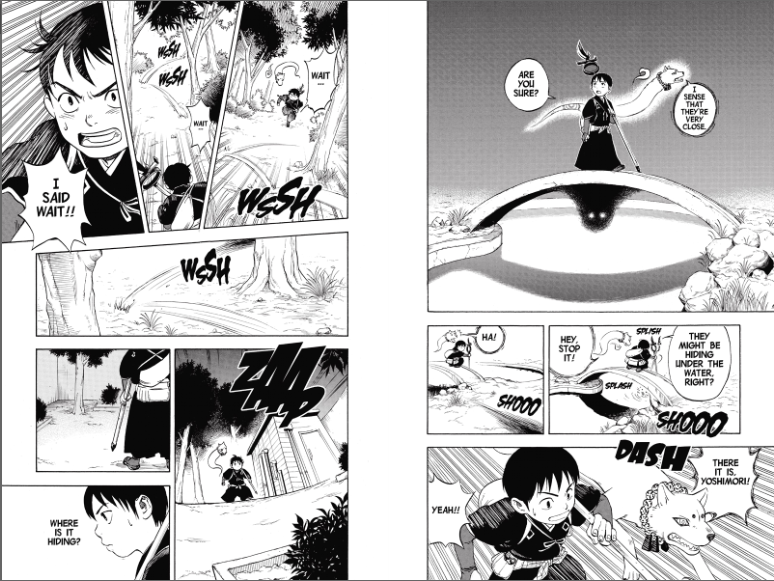
The premise of Kekkaishi is simple: Yoshimori Sumimura, a seemingly unremarkable fourteen-year-old boy, is a kekkaishi, or barrier-master. When he isn’t consuming unhealthy amounts of coffee-flavored milk, dozing off in class, or baking architecturally magnificent cakes (one of his pet obsessions), he’s patrolling the grounds of his school, which sits atop the Karasumori, a locus of magical energy that proves irresistible to ayakashi (demons) looking to augment their power. Yoshimori traps unwanted visitors within cube-shaped barriers, then vaporizes them, barrier and all.

Joining him on patrol are his sixteen-year-old neighbor Tokine Yukimura—a more disciplined kekkaishi whom Yoshimori secretly adores—and a small complement of demons that includes two dog spirits, Madarao and Hakubi, and a half-human, half-ayakashi, Gen Shishio. Further complicating matters are the families themselves: the Sumimuras and Yukimuras detest one another. Though their clans have been tasked with protecting the Karasumori for nearly 500 years, the oldest generation carries on an energetic feud, making it difficult for Yoshimori and Tokine to work together harmoniously. In short, Kekkaishi reads like an entertaining mash-up of Bleach, InuYasha, and Romeo and Juliet. (Or maybe Romeo Must Die. Take your pick.)

Each volume unfurls at a brisk clip, in part because Tanabe doesn’t feel the need to explain the entire mythology of the Karasumori site all at once. Nor does she resort to the kind of lazy, expository dialogue found in many shonen series with complicated backstories. (You know the kind: “As you know, Tokine, we’ve been combating ayakashi together for almost a year, and our faithful demon dog sidekicks have played an indispensable role in helping us rid the site of ayakashi. Don’t you think, childhood friend and neighbor of mine?”) Instead, Tanabe reveals details about the Karasumori site’s past gradually as she introduces new characters and confronts her principal cast members with new demonic challenges. In fact, the kekkaishis’ greatest adversaries—the Kokuburo, a group of powerful demons whose plan for world domination involves taking over the Karasumori site—don’t even appear in the first volume of the series.

What makes Kekkaishi such a joy to read is Yellow Tanabe’s consummate skill as both an illustrator and storyteller. Her artwork is clean and attractive, with bold lines and nicely composed pictures. Though her character designs are immensely appealing—and seem ready-made for the inevitable assortment of lunchboxes, t-shirts, shijikis, and coffee milk drinks that the series inspired—it’s her action sequences that really shine. Kekkaishi is one of the few shonen series where the fight scenes are (a) dynamic (b) thrilling (c) easy to follow (d) essential to the plot and (e) just the right length. There’s also a wonderful sense of play in Tanabe’s combat. Yoshimori and Tokine use kekkaishi not only as traps, but also as aerial stepping-stones that allow them to pursue demons mid-air.

There’s another appealing—and slyly didactic—aspect to these fight scenes as well. Though Yoshimori possesses greater spiritual powers than Tokine, it’s Tokine who frequently saves the day. Why? Because she practices creating barriers with the same diligence as she does her homework. Yoshimori, on the other hand, struggles to master his powers, sometimes embarking on marathon training sessions and other times neglecting to practice at all.

Kekkaishi offers readers more modest pleasures as well. Tanabe creates a colorful cast of supporting characters that include Yoshimori and Tokine’s sparring grandparents, who prove surprisingly spry for a couple of sexagenarians; Yoshimori’s father, who reminds me of James Dean’s apron-clad dad in Rebel Without a Cause; Masahiko Tsukijigaoka, a genial ghost who was a baker in life; Heisuke Matsudo, a nattily-dressed friend of Yoshimori’s grandfather with a specialty in weird science; and Mamezo, the grouchy guardian spirit of the Karasumori site who looks a bit like Kermit the Frog on a bender. Tanabe’s villains are a less colorful and distinctive bunch than, say, Naraku’s various incarnations, but I find that refreshing. For once the hero—and pals—are as vivid and appealing as the bad guys without having sordid or unnecessarily complicated backstories.

Like all shonen series, Kekkaishi suffers from an occasional dry spell. In volumes seven and eight, for example, the series seemed to have lost its mojo; I found the fight scenes tedious and felt Tanabe had fumbled in her depiction of Tokine, who went from being an appealing, competent character to a mere tag-along. But Tanabe quickly righted the ship in volume nine, introducing new characters, fleshing out the Kokoburo’s motives for capturing the Karasumori, staging some ecological intrigue at the Colorless Marsh, and revealing that Yoshimori’s dad has some demon-busting skills of his own. Though volume nine features two dramatic fight scenes, it’s the quieter, character-building moments that really shine, raising the emotional stakes by revealing unexpected facets of the heroes’ personalities; what happens in volume ten is all the more devastating because Tanabe makes us care deeply about her characters’ welfare.

If I still haven’t persuaded you that Kekkaishi is more fun than a barrel of demon monkeys, let me sing the praises of Yellow Tanabe’s omake. I don’t usually read sidebars or gag strips for reasons that David Welsh so aptly summarized in a memorable blog entry:

The content is generally pretty repetitive. They’re working really hard, and they’re sorry they’re behind on their fan mail. This volume isn’t as good as they’d have liked, but they’re trying, and reader support keeps them going. They wish they had a kitty. That sort of thing.

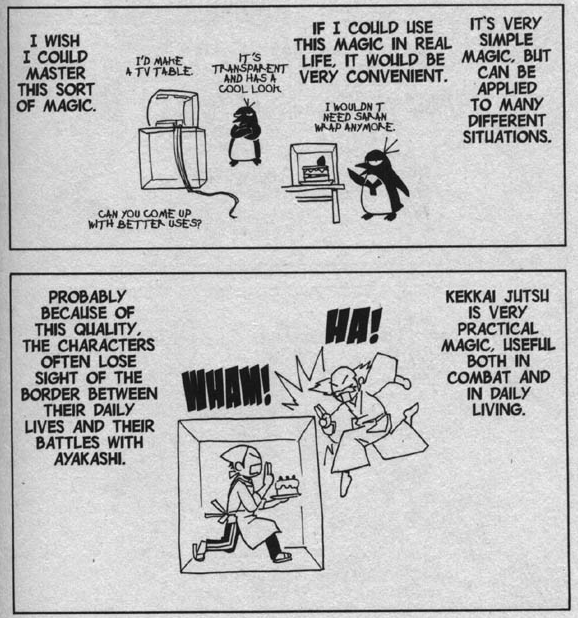
Tanabe’s omake steer clear of the usual bowing and scraping before the fandom. Instead, she depicts herself as a slightly tubby penguin with a perpetual scowl and an implacable panda for an editor. Not much happens in a typical strip, but the back-and-forth between penguin and panda is amusing and, for anyone who’s ever been on the receiving end of editorial criticism, all too true. She also has a lot of fun explaining her creative decisions:

And if you’re still on the fence, let me pull out my trump card: Kekkaishi is complete. Done. Finished. Finito.

After a successful eight-year run in Weekly Shonen Sunday, the series wrapped on April 6th with the publication of its 334th chapter. And by successful, I mean successful in Japan, where the series inspired a 52-episode television series and a robust assortment of video games, and nabbed nabbed the 2007 Shogakukan Award for Best Shonen Series. Here in the US, however, Kekkaishi has barely made a ripple. VIZ has been making a concerted effort to promote the series, featuring sample chapters on its Shonen Sunday website, licensing broadcasting rights to Cartoon Network, and releasing two budget editions: one digital (for the iPad), and one print. (Look for the first three-in-one edition on May 3, 2011.) I’m not sure why Kekkaishi hasn’t caught on with American audiences yet, but now is a great time to jump into this addictive series. I dare you not to like it!

This is a revised version of an essay that originally appeared at PopCultureShock on 5/14/07.

Filed Under: Manga, Manga Critic, Recommended Reading, REVIEWS Tagged With: Horror/Supernatural, Shonen, shonen sunday, VIZ, Yellow Tanabe, Yokai

The Best Manga You’re Not Reading: Kekkaishi

April 7, 2011 by Katherine Dacey 33 Comments

I have a challenge for all you Shonen Jump readers: pick up a copy of Kekkaishi. It may not be as sexy as Death Note, or as goofy as One Piece, or as battle-focused as Bleach, but what it lacks in flash, it makes up in heart, humor, and good old-fashioned storytelling.

The premise of Kekkaishi is simple: Yoshimori Sumimura, a seemingly unremarkable fourteen-year-old boy, is a kekkaishi, or barrier-master. When he isn’t consuming unhealthy amounts of coffee-flavored milk, dozing off in class, or baking architecturally magnificent cakes (one of his pet obsessions), he’s patrolling the grounds of his school, which sits atop the Karasumori, a locus of magical energy that proves irresistible to ayakashi (demons) looking to augment their power. Yoshimori traps unwanted visitors within cube-shaped barriers, then vaporizes them, barrier and all.

Joining him on patrol are his sixteen-year-old neighbor Tokine Yukimura—a more disciplined kekkaishi whom Yoshimori secretly adores—and a small complement of demons that includes two dog spirits, Madarao and Hakubi, and a half-human, half-ayakashi, Gen Shishio. Further complicating matters are the families themselves: the Sumimuras and Yukimuras detest one another. Though their clans have been tasked with protecting the Karasumori for nearly 500 years, the oldest generation carries on an energetic feud, making it difficult for Yoshimori and Tokine to work together harmoniously. In short, Kekkaishi reads like an entertaining mash-up of Bleach, InuYasha, and Romeo and Juliet. (Or maybe Romeo Must Die. Take your pick.)

Each volume unfurls at a brisk clip, in part because Tanabe doesn’t feel the need to explain the entire mythology of the Karasumori site all at once. Nor does she resort to the kind of lazy, expository dialogue found in many shonen series with complicated backstories. (You know the kind: “As you know, Tokine, we’ve been combating ayakashi together for almost a year, and our faithful demon dog sidekicks have played an indispensable role in helping us rid the site of ayakashi. Don’t you think, childhood friend and neighbor of mine?”) Instead, Tanabe reveals details about the Karasumori site’s past gradually as she introduces new characters and confronts her principal cast members with new demonic challenges. In fact, the kekkaishis’ greatest adversaries—the Kokuburo, a group of powerful demons whose plan for world domination involves taking over the Karasumori site—don’t even appear in the first volume of the series.

What makes Kekkaishi such a joy to read is Yellow Tanabe’s consummate skill as both an illustrator and storyteller. Her artwork is clean and attractive, with bold lines and nicely composed pictures. Though her character designs are immensely appealing—and seem ready-made for the inevitable assortment of lunchboxes, t-shirts, shijikis, and coffee milk drinks that the series inspired—it’s her action sequences that really shine. Kekkaishi is one of the few shonen series where the fight scenes are (a) dynamic (b) thrilling (c) easy to follow (d) essential to the plot and (e) just the right length. There’s also a wonderful sense of play in Tanabe’s combat. Yoshimori and Tokine use kekkaishi not only as traps, but also as aerial stepping-stones that allow them to pursue demons mid-air.

There’s another appealing—and slyly didactic—aspect to these fight scenes as well. Though Yoshimori possesses greater spiritual powers than Tokine, it’s Tokine who frequently saves the day. Why? Because she practices creating barriers with the same diligence as she does her homework. Yoshimori, on the other hand, struggles to master his powers, sometimes embarking on marathon training sessions and other times neglecting to practice at all.

Kekkaishi offers readers more modest pleasures as well. Tanabe creates a colorful cast of supporting characters that include Yoshimori and Tokine’s sparring grandparents, who prove surprisingly spry for a couple of sexagenarians; Yoshimori’s father, who reminds me of James Dean’s apron-clad dad in Rebel Without a Cause; Masahiko Tsukijigaoka, a genial ghost who was a baker in life; Heisuke Matsudo, a nattily-dressed friend of Yoshimori’s grandfather with a specialty in weird science; and Mamezo, the grouchy guardian spirit of the Karasumori site who looks a bit like Kermit the Frog on a bender. Tanabe’s villains are a less colorful and distinctive bunch than, say, Naraku’s various incarnations, but I find that refreshing. For once the hero—and pals—are as vivid and appealing as the bad guys without having sordid or unnecessarily complicated backstories.

Like all shonen series, Kekkaishi suffers from an occasional dry spell. In volumes seven and eight, for example, the series seemed to have lost its mojo; I found the fight scenes tedious and felt Tanabe had fumbled in her depiction of Tokine, who went from being an appealing, competent character to a mere tag-along. But Tanabe quickly righted the ship in volume nine, introducing new characters, fleshing out the Kokoburo’s motives for capturing the Karasumori, staging some ecological intrigue at the Colorless Marsh, and revealing that Yoshimori’s dad has some demon-busting skills of his own. Though volume nine features two dramatic fight scenes, it’s the quieter, character-building moments that really shine, raising the emotional stakes by revealing unexpected facets of the heroes’ personalities; what happens in volume ten is all the more devastating because Tanabe makes us care deeply about her characters’ welfare.

If I still haven’t persuaded you that Kekkaishi is more fun than a barrel of demon monkeys, let me sing the praises of Yellow Tanabe’s omake. I don’t usually read sidebars or gag strips for reasons that David Welsh so aptly summarized in a memorable blog entry:

The content is generally pretty repetitive. They’re working really hard, and they’re sorry they’re behind on their fan mail. This volume isn’t as good as they’d have liked, but they’re trying, and reader support keeps them going. They wish they had a kitty. That sort of thing.

Tanabe’s omake steer clear of the usual bowing and scraping before the fandom. Instead, she depicts herself as a slightly tubby penguin with a perpetual scowl and an implacable panda for an editor. Not much happens in a typical strip, but the back-and-forth between penguin and panda is amusing and, for anyone who’s ever been on the receiving end of editorial criticism, all too true. She also has a lot of fun explaining her creative decisions:

And if you’re still on the fence, let me pull out my trump card: Kekkaishi is complete. Done. Finished. Finito.

After a successful eight-year run in Weekly Shonen Sunday, the series wrapped on April 6th with the publication of its 334th chapter. And by successful, I mean successful in Japan, where the series inspired a 52-episode television series and a robust assortment of video games, and nabbed nabbed the 2007 Shogakukan Award for Best Shonen Series. Here in the US, however, Kekkaishi has barely made a ripple. VIZ has been making a concerted effort to promote the series, featuring sample chapters on its Shonen Sunday website, licensing broadcasting rights to Cartoon Network, and releasing two budget editions: one digital (for the iPad), and one print. (Look for the first three-in-one edition on May 3, 2011.) I’m not sure why Kekkaishi hasn’t caught on with American audiences yet, but now is a great time to jump into this addictive series. I dare you not to like it!

This is a revised version of an essay that originally appeared at PopCultureShock on 5/14/07.

Filed Under: Manga Critic Tagged With: Horror/Supernatural, Shonen, shonen sunday, VIZ, Yellow Tanabe, Yokai

3 Things Thursday: tl;dr

April 7, 2011 by MJ 28 Comments

It happens to everyone at some point or another, for some reason or another. Sooner or later, every manga fan will drop a series they previously liked–maybe even loved–out of boredom, disappointment, or just plain oversight. And though a significant part of what draws me particularly to manga is its tendency towards long-form storytelling, it’s happened to me too.

Though as Kate Dacey recently stated, breaking up is hard to do, sometimes making up is even harder. Once you’ve let a few volumes pass for this reason or that, even if your intention is to pick a series back up, the catch-up can be daunting. So on this 3 Things Thursday, I’ve decided to take a look at 3 series I’ve dropped, intentionally or not, why I dropped them, and what my chances are of returning to the fold.

3 series MJhas failed to continue:

1. Bleach | Tite Kubo | Viz Media – At this point, I suppose I know more fans who have stopped reading Tite Kubo’s shounen battle epic than those who have kept on, but for my part, I’m actually a little surprised. While it’s absolutely true that I tend to find its long battle sequences tragically uninteresting, the point at which I dropped the series (after volume 28) feels a bit sad. Yes, the series was headed into a (likely) long stretch of battles, none of which I was keen on sitting through, but it had also just produced two of my favorite volumes of the entire series. With such riches so recently offered up, why did I stop reading?

I think it’s possible that $9.99 a volume just felt like too much to spend to wade through another swath of battles, waiting for the next bit of juicy characterization to finally materialize. Now I’m more than five volumes behind. Return? Unlikely.

2. Otomen | Aya Kanno | Viz Media – Otomen is a series that has left me tormented. On one hand, it’s absolutely brilliant. I mean really, truly, a gorgeous piece of work. But much like one of Kate’s drop-ees, Detroit Metal City, a person could die waiting for something to actually happen. These series are like old-school television sitcoms. Though at any moment it might seem like something significant could happen, changing its characters’ lives in truly dramatic ways, everything is back to normal by the end of the episode, with everyone safely returned to exactly where they started. As brilliant as the series’ premise is, it’s failed for me as long-form storytelling, and unless there’s going to be some genuine forward motion in plot or characterization, I’m loathe to give it more of my time.

I stopped reading this series after volume five, though on some level, it broke my heart to do so. It’s such a smart, funny series. But what’s an epic-loving girl to do?

3. Pluto | Naoki Urasawa/Osamu Tezuka | Viz Media – This dropped series is the saddest of them all, because I had no intention of dropping it at all. And though I understand how it happened, I’m not sure how to get back on track. Back in July of 2009, I wrote an entry called Tears and Manga, inspired by my experience with volume four of Pluto, which had so affected me with the death of a mechanical dog in its first chapter, that I was unable to continue reading at the time. Now, any regular reader of this blog will know that I love to be hurt by fiction. Really I do. I love to feel deeply about what I’m reading, even if those feelings are difficult to handle. I fully expected to jump right back into Pluto, one of my very favorite series at the time, once I’d recovered from the hurt, and I expected to read it eagerly to the end. But the truth is, I haven’t. In fact, I don’t even own past volume five.

How do I return, now that I’ve failed to buy the rest of the series? Can my heart or my pocketbook ever manage it? I sincerely hope so.


Readers, what beloved series have you dropped and why?

Filed Under: 3 Things Thursday Tagged With: bleach, otomen, pluto

From the stack: Tokyo Is My Garden

April 7, 2011 by David Welsh

Let me start by saying that Tokyo Is My Garden (Fanfare/Ponent Mon) has clearly been created with talent and professionalism. It’s attractive to look at, thanks to Frédéric Boilet, and it’s got a readable script by Boilet and Benoît Peeters. It paints a vivid picture of urban life in Tokyo. It’s even got “gray tones” by Jiro Taniguchi, whatever that means.

On the down side, it’s got one of those male protagonists I find grating: the lazy schlub who dates way out of his league. This isn’t always an implausible proposition, but you have to work a lot harder than Boilet and Peeters have to sell it. Maybe that’s my problem rather than a serious flaw in the comic, but we can’t help how we engage a work, and as I’ve tried to draft this review in my head, I keep constructing, not an assessment of the work’s value, but a conversation with a theoretical straight woman friend (TSWF).

So here we go:

TSWF: Who’s that?

ME: (Looking. Grimacing.) Oh, that’s David. He’s from France.

TSWF: Really? That’s kind of… interesting.

ME: (After a moment.) Oh, honey, no.

TSWF: What? It’s just an observation.

ME: It’s a fraught observation.

TSWF: Well, what’s wrong with him?

ME: He’s one of those types that assume things will work out without any effort on his part.

TSWF: What, romantically? Professionally?

ME: In every way. And the worst part is that things do work out for him.

TSWF: Is he dating anyone?

ME: Of course he is. He’s dating this hot fashion publicist named Kimie, who he started dating about five minutes after he got dumped by a hot model.

TSWF: What’s next? Techno enka cabaret singer?

ME: Probably.

TSWF: What does he do for a living?

ME: He claims he’s really a novelist.

TSWF: Has he written anything?

ME: Probably title pages and future reviews of his works.

TSWF: (Snorts.) Ow. Gin burns when it comes out through your nose. What does he really do?

ME: A cognac company is paying him to open up the Japanese market for their brand.

TSWF: That sounds fabulous.

ME: Doesn’t it? But he doesn’t do anything related to that. He dates, and he works at a fish market.

TSWF: Seriously? Like a shop, or one of those warehouse things?

ME: Warehouse things. I’m sure it’s all part of some literary scheme to inform his future prose with the working person’s perspective.

TSWF: So he could be hanging out in clubs and giving people free booze for a living, but he’d rather haul dead fish?

ME: Isn’t that deep?

TSWF: Until you think about it for eight seconds. Can I have his real job?

ME: Me first. Apparently, his boss is coming to Tokyo, and he’s all worried that his Bérnaise train is about to go off the rails.

TSWF: All because he’s never done a lick of the work he’s supposed to be doing. That’s so unfair.

ME: I know! And then he’ll have to go back to France. Can you imagine?

TSWF: God. This economy is cruel.

ME: Don’t worry too much. He got dumped by a beautiful woman only to wind up with a beautiful, smart woman. I’m sure he’ll end up accidentally getting a promotion before his boss goes back to France.

TSWF: Okay, so the down side is he’s a big pile of slack, but at least he’s an extremely lucky pile of slack. A woman could do worse.

ME: Or better. Much, much better.

The end.


Filed Under: REVIEWS

Sakura Hime: The Legend of Princess Sakura

April 7, 2011 by Anna N

Sakura Hime: The Legend of Princess Sakura Volume 1 by Arina Tanemura

Arina Tanemura can be a somewhat polarizing manga creator. Some people love her detailed art and others might find overly cluttered. Some people may enjoy her plotting and characters which are girly to an extreme. Others might find her manga a bit hard to relate to. The main series of Tanemura’s that I’ve read in its entirety is Kamekaze Kaito Jeanne, about an art thief named Maron who is the reincarnation of Joan of Arc. I have a lot of lingering affection for Tanemura due to Kamekaze Kaito Jeanne sheer craziness (Maron goes to talk to God in the final volume), and I’ve been slowly collecting volumes of her other series Full Moon and Gentlemen’s Alliance Cross. So to people who say “Artwork too busy!” I say “Galaxy Eyes!” If somebody says “Too many shoujo cliches!” I say “Look at the ribbons! LOOK AT ALL THE BILLOWING RIBBONS!”

Sakura Hime is set in the Heian period, which gives plenty of room for Tanemura to display her love of detail with all the flowing costumes the nobles wear. Sakura is a princess who has grown up in isolation, promised in marriage at a young age to Prince Oura. The introduction page of the manga encapsulates the whole story, as it has a picture of our cheerful heroine and a potentially tortured young man with the text “Always I watch you. I hate you. I hate you. Always I’ve hated you. Always….I watch you.” This might be getting a little dark, despite all the magical girl trappings of Tanemura’s story. Sakura is visited by an arrogant emissary named Aoba who claims to be a representative of the prince. Sakura wants to make her own decisions and isn’t happy about being sold into marriage. Aoba (who is of course the prince in disguise) and Sakura naturally fall in to the type of bickering relationship that usually signals a romance drawn out over at least four volumes. But there are complications, as it turns out that Sakura is a descendant of one of the legendary Moon Princesses and thus her fate is to transform into a fighting sailor outfit and armed with a sword that she can’t exactly control, fight demons!

The rest of the volume shows Sakura gradually starting to stand up for herself. Romance isn’t working out for her, and she has to flee, accompanied only by her tiny sidekick. She soon makes new friends but dealing with Aoba and her own mystical nature ensure that she’s still going to experience rough times ahead. If you have a low tolerance for silly magical girl manga, Sakura Hime isn’t for you. If you have a tendency to be distracted by billowing ribbons and always appreciate it when characters yell things like “Sakura Descends! There is no escaping the moon’s divine retribution!” Sakura Hime seems like an amusing way to pass the time while you’re waiting for the new Kodansha editions of Sailor Moon. Tanemura’s billowing ribbons really are the best.

Review copy provided by the publisher.

Filed Under: UNSHELVED

Off the Shelf: Ranting & Hoping

April 6, 2011 by MJ and Michelle Smith 11 Comments

MICHELLE: Hey, MJ! What’s brown and sticky?

MJ: Um.

MICHELLE: A stick!

MJ: Ba-dum-dum *chick*

MICHELLE: That is seriously my favorite joke. Anyways! Want to get us started this week?

MJ: I will do that, though I warn you, it won’t be pretty.

MICHELLE: I’m a big girl; I can take it.

MJ: So here’s the thing. For a number of reasons (notably the “I get the message” incident) I haven’t read any of Kanoko Sakurakoji’s Black Bird since its second volume. But somehow last night, in a moment of true madness, I found myself picking up volumes six and seven from my review shelf, determined to give the series another chance. I’d genuinely liked the first volume, after all. Was not that alone reason enough to grant a second chance?

This was a mistake.

“I wanted to see this look on your face,” says super-Tengu Kyo to Misao, his helpless bride. Well, apparently that’s all anyone wants to see because she looks like that pretty much the entire time. It would not be an exaggeration to say that throughout the whole of these two volumes, there are maybe ten pages total in which she is not visibly flushed, either from terror, humiliation, or sexual arousal.

Furthermore, any hopes that Misao might have reclaimed even some small amount of the agency she appeared to possess in the series’ first volume have been utterly dashed by this point. She’s completely submissive to her demon lover, and though volume six opens with her going out on her own to try to stop Kyo’s brutal brother Sho from claiming leadership of the Tengu clan, practically the first thing she says to Kyo when she’s returned from the ordeal is, “I know you’re going to scold me. I’ll accept any punishment you give me,” at which point Kyo admits that what she did probably helped his cause but then adds, “All you had to do was stay in my arms and be protected. You’ve sure turned into a troublesome bride.”

Volume seven revolves around Misao and Kyo’s desperate struggle not to have sexual intercourse (featuring flushed, aroused Misao in an array of flustered poses), which is more tedious than it is genuinely offensive, but man, it was rough to get through.

I realize that I’m basically ranting here, but really, Michelle, I just don’t get it. And I mean that with all sincerity. I can accept that many girls and women enjoy fantasizing about being subservient to a stern, controlling lover. It’s obvious that they do, based on the popularity of this series alone. But it’s just so not my fantasy, to the point of making me feel alternately angry and ill as I attempt to read this series. I just can’t enjoy it, even when I try.

MICHELLE: I haven’t read beyond volume two, either, but I also have later volumes sitting around, waiting for their turn at a second chance. I guess it’s the sales figures and the feeling that popularity must somehow reflect quality that makes us feel compelled to try it again, even if it isn’t our cup of tea. If only it weren’t so skeevy, it could really be trashy fun! It’s not as if Kyo is hard on the eyes or anything.

MJ: I can often appreciate a trashy romance! I have done so many times! But there’s something about this one, Michelle… oh, it just makes me furious on pretty much every other page. And though I’m really quite fond of the adorable little Tengu, Taro, he doesn’t appear often enough in these volumes to sufficiently quell my rage.

So how about you? Anything less maddening to share with us this week?

MICHELLE: Well, though it does have its own shades of “average girl in love with a stern guy,” Itazura Na Kiss still continues to generally delight me.

The fifth volume is no exception. Brilliant Naoki Irie, who rivals Ash Lynx in the ability to do anything and do it awesomely, has finally decided that he wants to be a doctor. Even though he claims to be disinterested in Kotoko Aihara, the girl who has devotedly loved him for five years now, she is the only one he tells about his decision, knowing that it will upset his father to learn that Naoki won’t be taking over for him at his company.

Naoki’s right, but no one expected the father to have chest pains that require hospitalization. Putting his own plans on hold, Naoki steps in to lead his father’s company in his absence, realizes they’re in a pretty dire financial situation, and appears poised to go along with an arranged marriage that would make an in-law of a wealthy potential investor.

Of course, this brings much drama for our poor heroine, as well as many nice moments between the lead couple. While everyone else has their own vision of what Naoki should be, for example, Kotoko’s the only one who grieves the loss of his dream when he decides to put it aside for the sake of the family.

It’s too bad, though, that many other moments in the volume repeatedly drive home the point that Kotoko is thoroughly incompetent at anything she attempts. She’s worthless helping at the office, she can’t knit a decent scarf, she can’t cook… It’s frustrating, because I want to see her find that thing she is really good at. Happily, it seems that she might be poised to figure that out, since she’s realized everyone else has a dream and that all she’s been doing is revolving around Naoki.

Despite the occasional frustration, every time I finish a volume of this series I really wish I had the next. I’d say that’s pretty high praise!

MJ: That’s certainly high praise, maybe even more so since you can recognize the things that frustrate you about the series, yet still feel that way. Of course I’m famous for loving flawed books, but I really think it often comes down to the very *personal* needs we have as readers, and whether a book fulfills them. Yeah, I’d be frustrated, too, with the heroine who is terrible at everything. That trope is really unpleasant for me, and obviously it is for you too. But the series still fulfills your basic needs as a reader and leaves you wanting more.

I suspect my problem with Black Bird is that it simply doesn’t fulfill my needs, so there’s nothing to balance the things that frustrate me about it. Based on your assessment here, I have greater hopes for Itazura Na Kiss!

MICHELLE: I certainly hope you’d find it more to your liking. One major difference is that Naoki’s not trying to quell Kotoko’s personal ambition; in fact, he’d probably like her more if she found something else to do with her life than just moon about over him. I admit that he’s frequently dismissive of her, but there are also things about her that he obviously values, as well.

Now, our final pick of the night is one that we both read. Care to do the summarizing honors this time?

MJ: Ouch! The summarizing! Me? Why?????? (insert dramatic weeping)

Okay, I’ll try. So, the manga we’ve both brought to the table tonight is volume one of Kazue Kato’s Blue Exorcist, out just this week from Viz Media. It’s the story of Rin, a rowdy teen who just happens to be the son of Satan, born to a human woman and raised (along with his frail twin brother) by local priest and well-known exorcist Father Fujimoto. As the series opens, Rin is just becoming aware of his demonic ancestry, the shock of which sends him into a teenaged temper tantrum capable of (accidentally) causing the death of his beloved father figure. Bereft and fueled by vengeance, Rin vows to become an exorcist himself, only to discover that his supposedly innocent brother must be the one to teach him!

How’d I do?

MICHELLE: You did quite well! Now, I will go out on a limb here and guess that you didn’t care much about exorcisms or Satan or demonic powers sealed by a sword, but that you did enjoy the relationship between the brothers once we discover that Yukio, Rin’s brother, is actually a fairly badass exorcist in his own right!

MJ: You are very smart indeed! Yes, that was definitely my reaction, and I suspect it was yours too! I’m actually really glad that David made a point of repeating, when he named Blue Exorcist his Pick of the Week, that the first chapter is exceptionally weak, because if I hadn’t known that it was going to get better, I might not have soldiered on. There really was nothing there to draw me in, aside from a vague fondness for the art style. How about you?

MICHELLE: David’s words definitely were in my mind as I read. At first, I was wondering what was really so awful. Boring, yes, but awful? But then came the thoroughly cheesy scene in which Father Fujimoto is possessed by Satan and I went, “Oh.” Things improve very much when Rin gets to True Cross Academy, however. While I do like the art style, particularly the looks of Rin and Yukio, I must say that the quirky-just-to-be-quirky garb of the academy’s president puts me off quite a bit. Usually I take characters with a bizarre sense of fashion in stride, but this guy’s outfit just seems extra pointless to me.

MJ: I’m on the fence regarding the president’s odd outfit. It’s definitely “quirky-just-to-be-quirky,” just as you say, but it contains a particular element that tends to be bullet-proof costuming for me (giant cuffs on sleeves), which is almost enough to win me over all by itself. There’s a reason I’m obsessed with the artwork in Pandora Hearts.

MICHELLE: That is an oddly specific costuming kink! I haven’t paused to consider whether I have anything similar. Maybe I like long coats, because I really like the outfit Yukio wears while teaching his class.

Which leads us back ’round full circle to the brothers and their relationship. I have to wonder where the story is going to go from here, because while I like the boys and find their interaction interesting—Yukio initially blames Rin for Father Fujimoto’s death but comes around to deciding to protect his brother in Fujimoto’s place—if the whole series is going to be them tackling cases like the girl whose legs were affected by a garden spirit, I can’t say my interest is going to stay put for long.

MJ: Long coats are delicious. I can completely get behind that!

I enjoyed the episode with the girl in the garden, but yes, I agree that format would not be compelling for long. I’d like to see more of the two of them in the classroom, with Rin actually learning the craft under Yukio’s tutelage, because watching the two of them together is the most compelling aspect of the story so far. I’d like to get to know both of them more, both as their present selves and the little boys they once were. I feel like there could be a lot there.

MICHELLE: I think that’s unquestionably the area in which the series shows the most potential, particularly in the character of Yukio, whose perspective of events we haven’t been privy to. I definitely plan to continue reading it; I just hope I don’t wind up disappointed.

MJ: Given how dramatically the series improved between its first two chapters, at least things have already shifted in a positive direction. I have high hopes!

MICHELLE: I have… modest hopes.

MJ: Always the smart one. ;)

Filed Under: OFF THE SHELF Tagged With: black bird, blue exorcist, itazura na kiss

A Kid’s View: Yotsuba&!, Vol. 1

April 6, 2011 by Jia Li 6 Comments

Yotsuba&!, Vol. 1 | By Kiyohiko Azuma | Published by Yen Press – This book is about a little girl and her dad. They have just moved to a new place in Japan. The little girl meets her neighbors, loves to shop, and gets into a lot of trouble.

I liked Yotsuba&!. My favorite part about this book is when Yotsuba, one of her neighbors and Jumbo go cicada-catching. I didn’t like when Yotsuba lets all the bugs go and they get all over her neighbor’s house. One of the neighbors sprays the bugs and the bugs aren’t strong anymore. The bugs were very sad and weak and did not like it.

My favorite characters were Yotsuba and Ena. Both characters were really fun. Yotsuba and I are both little girls and we both like shopping. Ena reminds me of my older sister so I could relate to both characters.

The book was pretty funny. The funniest part was when the bathroom lock gets broken and the people who climb out the window get stuck.

There was nothing I did not understand except for the “&!” at the end of the title. What is that? I did not like it when the people in the book were excited and the illustration made them look really mad and yelling loudly. If I was just looking at the pictures and not reading the story I would think the people in the book were really mean.

I liked the book a lot so I would recommend this book to little girls like me!

Filed Under: A Kid's View Tagged With: yotsuba!

The Josei Alphabet: J

April 6, 2011 by David Welsh

“J” is for…

Jazz-Tango, written and illustrated by Wakuni Akisato, originally serialized in Shogakukan’s Petit Flower, one volume. This yaoi-themed tale features a surfer whose life takes a dark turn when a virtual double shows up in his world.

Jinsei Jojo na no da, written and illustrated by Ai Ueno, originally published by Shueisha, one volume. A young couple elopes and plans to live on love, until the harsh realities of life smack them around a bit. Will their relationship endure?


Jotei Ecatherina, written and illustrated by Riyoko (The Rose of Versailles) Ikeda, five volumes. This series uses the life story of Russian-born author and historian Henri Troyat to examine the biography of Catherine the Great. The notion of Ikeda examining czarist Russia makes me drool, as do the page samples on Amazon.

Jounetsu no Game, based on a novel by Helen Brooks, written and illustrated by Keiko Ishimoto, originally published by Ohzora Shuppan, one volume. This one sounds like Two Weeks Notice, featuring a hard-working young woman slaving away for a selfish jerk. Of course, this jerk’s name is “Matt de Capistrano,” so it certainly gets points for that.

Juunji no Kane ga Naru made, based on a novel by Elizabeth Harbison, written and illustrated by Junko Sasaki, originally published by Harlequinsha, one volume. The most striking thing about this book, aside from the heroine’s apparently disastrous home perm, is her career: she’s a hotel concierge, which would make a great subject for an episodic seinen or josei series. Career concerns aside, our concierge must deal with the advances of the Prince of Beloria. Ah, Beloria… how I tread your soil someday.

What starts with “J” in you josei alphabet?


Filed Under: FEATURES

  • « Go to Previous Page
  • Page 1
  • Interim pages omitted …
  • Page 3
  • Page 4
  • Page 5
  • Page 6
  • Go to Next Page »
 | Log in
Copyright © 2010 Manga Bookshelf | Powered by WordPress & the Genesis Framework