• Skip to primary navigation
  • Skip to main content
  • Skip to primary sidebar
  • Home
  • About Us
    • Privacy Policy
    • Comment Policy
    • Disclosures & Disclaimers
  • Resources
    • Links, Essays & Articles
    • Fandomology!
    • CLAMP Directory
    • BlogRoll
  • Features & Columns
    • 3 Things Thursday
    • Adventures in the Key of Shoujo
    • Bit & Blips (game reviews)
    • BL BOOKRACK
    • Bookshelf Briefs
    • Bringing the Drama
    • Comic Conversion
    • Fanservice Friday
    • Going Digital
    • It Came From the Sinosphere
    • License This!
    • Magazine no Mori
    • My Week in Manga
    • OFF THE SHELF
    • Not By Manga Alone
    • PICK OF THE WEEK
    • Subtitles & Sensibility
    • Weekly Shonen Jump Recaps
  • Manga Moveable Feast
    • MMF Full Archive
    • Yun Kouga
    • CLAMP
    • Shojo Beat
    • Osamu Tezuka
    • Sailor Moon
    • Fruits Basket
    • Takehiko Inoue
    • Wild Adapter
    • One Piece
    • After School Nightmare
    • Karakuri Odette
    • Paradise Kiss
    • The Color Trilogy
    • To Terra…
    • Sexy Voice & Robo
  • Browse by Author
    • Sean Gaffney
    • Anna Neatrour
    • Michelle Smith
    • Katherine Dacey
    • MJ
    • Brigid Alverson
    • Travis Anderson
    • Phillip Anthony
    • Derek Bown
    • Jaci Dahlvang
    • Angela Eastman
    • Erica Friedman
    • Sara K.
    • Megan Purdy
    • Emily Snodgrass
    • Nancy Thistlethwaite
    • Eva Volin
    • David Welsh
  • MB Blogs
    • A Case Suitable For Treatment
    • Experiments in Manga
    • MangaBlog
    • The Manga Critic
    • Manga Report
    • Soliloquy in Blue
    • Manga Curmudgeon (archive)

Manga Bookshelf

Discussion, Resources, Roundtables, & Reviews

Archives for April 2011

New Let’s Get Visual: Funny Pages

April 30, 2011 by MJ Leave a Comment

After taking March off, Michelle and I are back with a new installment of Let’s Get Visual, our monthly discussion of manga artwork.

For this month’s theme, to quote Michelle, “We examined intensely emotional moments in our last column, so this time we’re going in the opposite direction by highlighting pages that make us laugh.” Michelle begins first, bringing us a charming scene featuring Koh, the talking snake from Shiho Sugiura’s quasi-BL series, Silver Diamond (TOKYOPOP). I take my own selection from Kiyohiko Azuma’s Yotsuba&!.

As always, the point of the column is to help us develop our ability as manga critics, so please join the discussion, especially if you have something new to teach us!

Find the column here at Michelle’s blog, Soliloquy in Blue.

Filed Under: UNSHELVED Tagged With: let's get visual

Previews review May 2011

April 30, 2011 by David Welsh

After a couple of months of fairly jam-packed Previews catalogs, I suppose it could seem petty to complain that the current listings seem a little slender. There aren’t even enough debuts to manage a dubious manga poll for the month. Fortunately, there are some highlights worth noting.

Book of Human Insects, written and illustrated by Osamu Tezuka, Vertical, item code MAY 11 1268: How can one complain about a month that offers the English-language debut of crazy Tezuka seinen? This one originally ran in Akita Shoten’s Play Comic and has been published in French by Casterman as La femme insecte. It’s a mystery about an unscrupulous and manipulative woman. Vertical promises “more twists and turns than MW,” which hardly seems possible.

Veronica #208: Veronica Presents Kevin Keller #2: written and illustrated by Dan Parent, colored by Rich Koslowski, Archie Comics, item code MAY 11 0836: Okay, I missed mentioning the first issue of this, but Kevin (Robot 6) Melrose’s preview of part two of the mini-series about Riverdale’s newest resident, who happens to be gay, reminded me to be excited. (And just as a side note, who would have predicted that Archie would have proven to be the nimblest and most risk-friendly of pamphlet publishers? Not me, that’s for sure.)

Until the Full Moon, written and illustrated by Sanami Matoh, Kodansha Comics, item code MAY 11 1129: This isn’t a debut, per se, as the series was previously published by Broccoli Books. I thought the first volume was kind of dull back then, but I’m among the many who hold a special place in my heart for Matoh’s Fake (Tokyopop), so I thought this book’s return was worth mentioning.

That’s pretty much it as far as debuts go. Here are some particularly enticing new volumes of ongoing series.

Little Nothings volume 4: My Shadow in the Distance, written and illustrated by Lewis Trondheim, NBM, item code MAY 11 1142: These are smart, charming, observational-autobiographical comics from an incredibly talented creator, and they’re incredibly easy on the eye. You can check out a bunch of them at Trondheim’s blog for NBM.

And here’s a by-no-means complete list of new volumes of ongoing series that I’m looking forward to reading:

  • 20th Century Boys vol. 16, written and illustrated by Naoki Urasawa, Viz Media, item code MAY 11 1241
  • Arisa vol. 3, written and illustrated by Natsumi (Kitchen Princess) Ando, Kodansha Comics, item code MAY 11 1122
  • Black Jack vol. 17, written and illustrated by Osamu Tezuka, Vertical, item code MAY 11 1269
  • Book Girl and the Captive Fool, written by Mizuki Nomura, Yen Press, item code MAY 11 1281

I’ll post another blind date experiment with the current batch of boys’-love candidates tomorrow.


Filed Under: DAILY CHATTER

5 Reasons to Read InuYasha

April 29, 2011 by Katherine Dacey

InuYasha was the first comic that I actively collected, the manga that introduced me to the Wednesday comic-buying ritual and the very notion of self-identifying as a fan. Though I followed it religiously for years, trading in my older editions for new ones, watching the anime, and speculating about the finale, my interest in the series gradually waned as I was exposed to new artists and new genres. Still, InuYasha held a special place in my heart; reading it was one of my seminal experiences as a comic fan, making me reluctant to re-visit InuYasha for fear of sullying those precious first-manga memories. VIZ’s recent decision to re-issue InuYasha in an omnibus edition, however, inspired me to pick it up again. I made a shocking discovery in the process of re-reading the first chapters: InuYasha is good. Really good, in fact, and deserving of more respect than it gets from many critics.

What makes InuYasha work? I can think of five reasons:

1. The story arcs are long enough to be complex and engaging, but not so long as to test the patience.

There’s a Zen quality to Rumiko Takahashi’s storytelling that might not be obvious at first glance; after all, she loves a pratfall or a sword fight as much as the next shonen manga-ka. Don’t let that surface activity fool you, however: Takahashi has a terrific sense of balance, staging a romantic interlude between a demon-of-the-week episode and a longer storyline involving Naraku’s minions, thus preventing the series from devolving into a punishing string of battle arcs. The other great advantage of this approach is that Takashi carves out more space for her characters to interact as people, not just combatants; as a result, InuYasha is one of the few shonen manga in which the characters’ relationships evolve over time.

2. Takahashi knows how to stage a fight scene that’s dramatic, tense, and mercifully short.

‘Nuff said.

3. InuYasha‘s villains are powerful and strange, not strawmen.

Though we know our heroes will prevail — it’s shonen, for Pete’s sake — Takahashi throws creative obstacles in their way that makes their eventual triumph more satisfying. Consider Naraku. In many respects, he’s a standard-issue bad guy: he’s omnipotent, charismatic, and manipulative, capable of finding the darkness and vulnerability in the purest soul. (He also has fabulous hair, another reliable indication of his villainy.) Yet the way in which Naraku wields power is genuinely unsettling, as he fashions warriors from pieces of himself, then reabsorbs them into his body when they outlive their usefulness. Naraku’s manifestations are peculiar, too. Some are female, some are children, some have monstrous bodies, and some have the power to create their own demonic offspring, but few look like the sort of golem I’d create if I wanted to wreak havoc. And therein lies Naraku’s true power: his opponents never know what form he’ll take next, or whether he’s already among them.

Sesshomaru, too, is another villain who proves more interesting than he first appears. In the very earliest chapters of the manga, he’s a bored sociopath who has no qualms about using InuYasha’s mama trauma to trick his younger brother into revealing the Tetsusaiga’s location. As the story progresses, however, Sesshomaru begins tolerating the company of a cheerful eight-year-old girl who, in a neat inversion of the usual human-canine relationship, is dependent on her dog-demon master for protection, food, and companionship. Takahashi resists the urge to fully “humanize” Sesshomaru, however; he remains InuYasha’s scornful adversary for most of the series, largely unchanged by his peculiar fixation with Rin.

And did I mention that Sesshomaru has awesome hair? Oh, to be a villain in a Takahashi manga!

4. InuYasha‘s female characters kick ass.

Back in 2008, Shaenon Garrity wrote a devastatingly funny article about the seven types of female characters in shonen manga, from The Tomboy to The Little Girl to The Experienced Older Woman. I’m pleased to report that none of these types appear in InuYasha; in fact, InuYasha boasts one of the smartest, toughest, and most appealing set of female characters in shonen manga. And by “tough,” I don’t mean that Kagome, Kikyo, and Sango brandish weapons while wearing provocative outfits; I mean they persist in the face of adversity, even if their own lives are at stake. They’re strong enough to hold their own against demons, ghosts, and heavily armed bandits, and wise enough to know when words are more effective than weapons. They’re not adverse to the idea of romance, but recovering the Shikon Jewel takes precedence over dating. And they’re woman enough to cry if something awful happens, though they’d rather shed their tears in private than show their pain to others.

5. The horror! The horror!

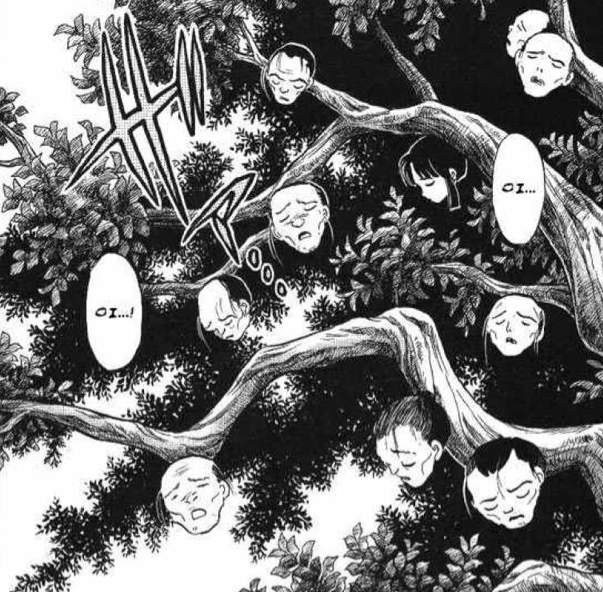
Takahashi may have the coolest resume of anyone working in manga today; not only did she study script writing with Kazuo Koike, she also worked as an assistant to Kazuo Umezu — an apprenticeship that’s evident in the early chapters of InuYasha. In between Kagome and InuYasha’s first encounters with Naraku are a handful of short but spooky stories in which seemingly benign objects — a noh mask, a peach tree — are transformed by Shikon Jewel shards into instruments of torture and killing. Takahashi’s horror stories are less florid than Umezu’s, with fewer detours into WTF? territory, but like Umezu, Takahashi has a vivid imagination that yields some decidedly scary images. Here, for example, is the demonic peach tree from chapter 79, “The Fruits of Evil”:

Takahashi doesn’t just use these images to shock; she uses them to illustrate the consequences of ugly emotions, impulsive actions, and violent behavior, to show us how these choices slowly corrode the soul and transform us into the most monstrous version of ourselves. (Also to show us the consequences of substituting human bones and blood for Miracle Gro. Kids, don’t try this at home.)

What Takahashi does better than almost anyone is walk the fine line between terror and horror. Gothic novelist Ann Radcliffe, author of The Mysteries of Udolpho (1794) and The Italian (1797), was one of the first writers to argue that terror and horror were different states of arousal. “Terror and Horror are so far opposite, that the first expands the soul and awakens the faculties to a high degree of life; the other contracts, freezes and nearly annihilates them,” she wrote in an 1826 essay, “On the Supernatural in Poetry.” Critiquing Radcliffe’s work in 1966, Devendra P. Varma explained that difference more concretely: “The difference between Terror and Horror is the difference between awful apprehension and sickening realization: between the smell of death and stumbling against a corpse.” And that’s exactly where Takahashi operates: she gives us tantalizing, suggestive glimpses of scary things, then keeps them obscured until the denouement of the story, allowing our imaginations to supply most of the grisly details. We read her work in a heightened state of awareness, which only intensifies our pleasure — and revulsion — when the true nature of Kagome and InuYasha’s foes are revealed.

* * * * *

If you haven’t looked at InuYasha in a while, or missed it during the height of its popularity, now is a great time to give it a try. Each volume of the VIZBIG edition collects three issues, allowing readers to more fully immerse themselves in the story. And if you’re a purist about packaging, you’ll be happy to know that VIZ is finally issuing InuYasha in an unflipped format — a first in the series’ US history.

Filed Under: Manga, Manga Critic, Recommended Reading, REVIEWS Tagged With: Horror/Supernatural, inuyasha, Rumiko Takahashi, Shonen, shonen sunday, VIZ, Yokai

5 Reasons to Read InuYasha

April 29, 2011 by Katherine Dacey 26 Comments

InuYasha was the first comic that I actively collected, the manga that introduced me to the Wednesday comic-buying ritual and the very notion of self-identifying as a fan. Though I followed it religiously for years, trading in my older editions for new ones, watching the anime, and speculating about the finale, my interest in the series gradually waned as I was exposed to new artists and new genres. Still, InuYasha held a special place in my heart; reading it was one of my seminal experiences as a comic fan, making me reluctant to re-visit InuYasha for fear of sullying those precious first-manga memories. VIZ’s recent decision to re-issue InuYasha in an omnibus edition, however, inspired me to pick it up again. I made a shocking discovery in the process of re-reading the first chapters: InuYasha is good. Really good, in fact, and deserving of more respect than it gets from many critics.

What makes InuYasha work? I can think of five reasons:

1. The story arcs are long enough to be complex and engaging, but not so long as to test the patience.

There’s a Zen quality to Rumiko Takahashi’s storytelling that might not be obvious at first glance; after all, she loves a pratfall or a sword fight as much as the next shonen manga-ka. Don’t let that surface activity fool you, however: Takahashi has a terrific sense of balance, staging a romantic interlude between a demon-of-the-week episode and a longer storyline involving Naraku’s minions, thus preventing the series from devolving into a punishing string of battle arcs. The other great advantage of this approach is that Takashi carves out more space for her characters to interact as people, not just combatants; as a result, InuYasha is one of the few shonen manga in which the characters’ relationships evolve over time.

2. Takahashi knows how to stage a fight scene that’s dramatic, tense, and mercifully short.

‘Nuff said.

3. InuYasha‘s villains are powerful and strange, not strawmen.

Though we know our heroes will prevail — it’s shonen, for Pete’s sake — Takahashi throws creative obstacles in their way that makes their eventual triumph more satisfying. Consider Naraku. In many respects, he’s a standard-issue bad guy: he’s omnipotent, charismatic, and manipulative, capable of finding the darkness and vulnerability in the purest soul. (He also has fabulous hair, another reliable indication of his villainy.) Yet the way in which Naraku wields power is genuinely unsettling, as he fashions warriors from pieces of himself, then reabsorbs them into his body when they outlive their usefulness. Naraku’s manifestations are peculiar, too. Some are female, some are children, some have monstrous bodies, and some have the power to create their own demonic offspring, but few look like the sort of golem I’d create if I wanted to wreak havoc. And therein lies Naraku’s true power: his opponents never know what form he’ll take next, or whether he’s already among them.

Sesshomaru, too, is another villain who proves more interesting than he first appears. In the very earliest chapters of the manga, he’s a bored sociopath who has no qualms about using InuYasha’s mama trauma to trick his younger brother into revealing the Tetsusaiga’s location. As the story progresses, however, Sesshomaru begins tolerating the company of a cheerful eight-year-old girl who, in a neat inversion of the usual human-canine relationship, is dependent on her dog-demon master for protection, food, and companionship. Takahashi resists the urge to fully “humanize” Sesshomaru, however; he remains InuYasha’s scornful adversary for most of the series, largely unchanged by his peculiar fixation with Rin.

And did I mention that Sesshomaru has awesome hair? Oh, to be a villain in a Takahashi manga!

4. InuYasha‘s female characters kick ass.

Back in 2008, Shaenon Garrity wrote a devastatingly funny article about the seven types of female characters in shonen manga, from The Tomboy to The Little Girl to The Experienced Older Woman. I’m pleased to report that none of these types appear in InuYasha; in fact, InuYasha boasts one of the smartest, toughest, and most appealing set of female characters in shonen manga. And by “tough,” I don’t mean that Kagome, Kikyo, and Sango brandish weapons while wearing provocative outfits; I mean they persist in the face of adversity, even if their own lives are at stake. They’re strong enough to hold their own against demons, ghosts, and heavily armed bandits, and wise enough to know when words are more effective than weapons. They’re not adverse to the idea of romance, but recovering the Shikon Jewel takes precedence over dating. And they’re woman enough to cry if something awful happens, though they’d rather shed their tears in private than show their pain to others.

5. The horror! The horror!

Takahashi may have the coolest resume of anyone working in manga today; not only did she study script writing with Kazuo Koike, she also worked as an assistant to Kazuo Umezu — an apprenticeship that’s evident in the early chapters of InuYasha. In between Kagome and InuYasha’s first encounters with Naraku are a handful of short but spooky stories in which seemingly benign objects — a noh mask, a peach tree — are transformed by Shikon Jewel shards into instruments of torture and killing. Takahashi’s horror stories are less florid than Umezu’s, with fewer detours into WTF? territory, but like Umezu, Takahashi has a vivid imagination that yields some decidedly scary images. Here, for example, is the demonic peach tree from chapter 79, “The Fruits of Evil”:

Takahashi doesn’t just use these images to shock; she uses them to illustrate the consequences of ugly emotions, impulsive actions, and violent behavior, to show us how these choices slowly corrode the soul and transform us into the most monstrous version of ourselves. (Also to show us the consequences of substituting human bones and blood for Miracle Gro. Kids, don’t try this at home.)

What Takahashi does better than almost anyone is walk the fine line between terror and horror. Gothic novelist Ann Radcliffe, author of The Mysteries of Udolpho (1794) and The Italian (1797), was one of the first writers to argue that terror and horror were different states of arousal. “Terror and Horror are so far opposite, that the first expands the soul and awakens the faculties to a high degree of life; the other contracts, freezes and nearly annihilates them,” she wrote in an 1826 essay, “On the Supernatural in Poetry.” Critiquing Radcliffe’s work in 1966, Devendra P. Varma explained that difference more concretely: “The difference between Terror and Horror is the difference between awful apprehension and sickening realization: between the smell of death and stumbling against a corpse.” And that’s exactly where Takahashi operates: she gives us tantalizing, suggestive glimpses of scary things, then keeps them obscured until the denouement of the story, allowing our imaginations to supply most of the grisly details. We read her work in a heightened state of awareness, which only intensifies our pleasure — and revulsion — when the true nature of Kagome and InuYasha’s foes are revealed.

* * * * *

If you haven’t looked at InuYasha in a while, or missed it during the height of its popularity, now is a great time to give it a try. Each volume of the VIZBIG edition collects three issues, allowing readers to more fully immerse themselves in the story. And if you’re a purist about packaging, you’ll be happy to know that VIZ is finally issuing InuYasha in an unflipped format — a first in the series’ US history.

Filed Under: Manga Critic Tagged With: Horror/Supernatural, inuyasha, Rumiko Takahashi, Shonen, shonen sunday, VIZ, Yokai

Manga Moveable Feast: Rumic World Trilogy Volumes 2 and 3

April 29, 2011 by Anna N

Rumiko Takahashi is one of those manga artists whose influence it is impossible to overstate, but the prolific nature of her manga series might make her works seem a bit daunting to the average reader who might not feel like picking up 56 volumes of Inuyasha or 36 volumes of Ranma 1/2. Many manga bloggers are choosing to focus on shorter series and her short stories this week, and I’m no exception as I decided to finally read a couple volumes of the Rumic World Trilogy that I’ve been hoarding for just such an occasion. Somewhere in a closet I have stashed a few single issues of Uresei Yatsura and one of my favorite Takahashi stories, Firetripper, which appears in collected format in the Rumic World Trilogy Volume 1. Firetripper is probably a contributing factor to why I like Shinobi Life so much, as it features a time traveling romance about a girl from modern times who ends up meeting a warrior from the past.

The second volume of the Rumic World Trilogy is almost a self-contained volume, as it features five stories with the same characters bookended by two short stories, “The Golden Gods of Poverty” about an unfortunate boy who is used by his rapacious parents to summon the lucky gods who don’t seem to be very lucky anymore, and “The Entrepreneurial Spirit” about fundraising seances in high school.

“Wasted Minds” are the five linked stories in this volume, which are a comedic adventure story about two spies with special powers. Yura Enjoji functions as the team’s strongman, and she is fiercely protective of her long hair. Tamuro Gomi’s last name (trash in Japanese) is a reflection of his skills because he is a teleporter who can only teleport from trash heap to trash heap. They start investigating a rival spy agency along with their hapless handler. They run into pigs that transform machines into trash, sea monsters, and a school for teen juvenile delinquents. As they flit from garbage dump to trashcan, there’s plenty of adventures and a little bit of romance. Whenever I pick up a Takahashi title, I’m struck by the simplicity of her illustrations and clear action sequences of her art. It seems like many manga titles today rely on an abundance of screen tone and occasionally confusing panel composition, so it is a relief to my eyes to pick up a title like this that is so easy to read.

The third volume of this series features a nice selection of short stories. I enjoyed the first one, “Wedded Bliss” about a new couple who happily fights all the time to the detriment of their neighbors. “War Council” was an amusing take on the “evil student council” type story that so often pops up in manga, as an ordinary boy who agrees to serve as student council president because he has a crush on the vice president is caught between the warring factions of the jock student organization and the nerd student organization. “When my Eyes Got Wings” shows more of a horror influence as a sick boy with a scary pet bird develops a crush on a high school girl, and strange things begin happening around her boyfriend. “Sleep and Forget” is a dramatic romance that resembled “Firetripper” in plot and tone. A girl and boy with a connection to dogs relive and reenact events from their past lives, as they struggle with the vicious spirits of a dog and the old woman that was its master. “The Face Pack” is a goofy story about a group of students dedicated to the art of disguise. Also included is an autobiographical sketch of what happened to Takahashi when she suddenly found herself cat-sitting. Out of all of the stories in this volume, I found “Sleep and Forget” the most memorable, just because tend to enjoy Takahashi when she turns her hand to more serious stories that blend action and romance.

If you’re a little intimidated by the thought of tackling Takahashi, I think that these Rumic World Trilogy volumes are a worthwhile investment. While they might be out of print, they are still easy to acquire. Sometimes when reading anthology manga volumes, I put them down thinking that most of the stories were auditions for longer series that didn’t quite make the grade. I didn’t get that feeling when reading the Rumic World stories, as everything seemed nicely resolved and self-contained.


Check out the Manga Moveable Feast for more bloggers talking about Rumiko Takahashi
.

Filed Under: UNSHELVED

Alanna: The First Adventure by Tamora Pierce

April 29, 2011 by Michelle Smith

From the back cover:
“From now on I’m Alan of Trebond, the younger twin. I’ll be a knight.”

And so young Alanna of Trebond begins the journey to knighthood. Though a girl, Alanna has always craved the adventure and daring allowed only for boys; her twin brother, Thom, yearns to learn the art of magic. So one day they decide to switch places: disguised as a girl, Thom heads for the convent to learn magic; Alanna, pretending to be a boy, is on her way to the castle of King Roald to begin her training as a page.

But the road to knighthood is not an easy one. As Alanna masters the skills necessary for battle, she must also learn to control her heart and to discern her enemies from her allies.

Filled with swords and sorcery, adventure and intrigue, good and evil, Alanna’s first adventure begins—one that will lead to the fulfillment of her dreams and the magical destiny that will make her a legend in her land.

Review:
For a period of several years, I was an administrator on an online roleplaying game based on a popular series of children’s fantasy books starring a protagonist with a peculiarly shaped scar. New players to this game would frequently submit applications for characters that read very similar to this:

“Ten-year-old Alanna has red hair, purple eyes, and a twin brother. She is very smart, determined, and brave. Plus, she has a great magical gift, so great that she will one day be able to succeed in curing a deadly sickness where all other healers have failed. She also excels at becoming the best at unarmed combat and swordsmanship (albeit with quite a lot of practice), distrusting bad guys instantly, and conveniently finding ancient, powerful swords with sparkly crystals on them.”

Okay, perhaps that’s a bit better than your average newbie attempt, but there are still some striking similarities. This resulted in me snickering out loud the first time Alanna’s looks—for, yes, that paragraph is describing the protagonist of this book—were mentioned, and in rolling my eyes every time her awesomeness was further established. The action in the book covers several years, and Alanna’s plan is to divulge her secret on her eighteenth birthday, after she is made a knight. It’s certainly welcome to see a female proving herself in that environment so adeptly. I don’t mean to suggest that awesome women cannot exist, but after a while I started asking myself, “What next?”

Perhaps such a heroine appeals more to young adults, the intended audience for this book. There are some good messages here about applying oneself when the things you want to do prove challenging and not letting anyone’s idea of your limitations get in your way. It’s just that everything kind of happens too easily. Even though we know Alanna is spending hours and hours practicing, her evolution from fumbling beginner to “a matchless swordsman” doesn’t seem to take very long. The climactic battle at the end against an immortal race of evil beings living in “the black city” also seems too simple.

In the end, I liked Alanna: The First Adventure enough to continue with the rest of the quartet. It appears to be the first book Pierce published, so it’s no wonder it doesn’t match up to my favorites amongst her works.

Filed Under: Books Tagged With: Tamora Pierce

License request day: Global Garden

April 29, 2011 by David Welsh

MJ and Michelle Smith took their Off the Shelf column on the road this week, discussing Saki Hiwatari’s Please Save My Earth (Viz) over at The Hooded Utilitarian. I enjoyed the discussion so much that I took a look at other works by Hiwatari. One of them features the ghost of Albert Einstein.

If you’re anything like me, this is all you need to know to want to read at least one volume of the series, because legendary theoretical physicists just don’t show up in shôjo manga as often as they should.

The series, Global Garden, ran for eight volumes in Hakusensha’s Hana to Yume in the early 2000s. In it, two young men share a precognitive dream that the world tree is dying because of the bombings of Hiroshima and Nagasaki. They foresee a young girl being able to heal the tree and save the world, so Einstein branches out into theoretical pharmacology and gives them something to slow their aging. Einstein dies, and his disembodied spirit offers these eternally youthful do-gooders guidance as they wait about 50 years for the girl who can save the world. Along the way, someone manages to make a clone that’s half psychic slow-aging guy, half Einstein. So, one of the protagonists has a baby with Einstein, basically.

Global Garden also promises several items off of the classic-sounding-shôjo menu: gender fluidity, a seriously magical girl, and complex blended-family dynamics, and mixes them in with an environmental message. Plus psychic powers. And Einstein’s ghost. Hakusensha offers some preview pages of the first volume.

It’s been published in French by Delcourt as Global Garden: Einstein’s Last Dream. I suspect this is because the French are better at marketing manga and know that, when you’ve got the shôjo Einstein card in your hand, you play it.

This isn’t Einstein’s only appearance in manga. Most obviously, there’s Edu-Manga: Albert Einstein (Digital Manga), written by Isao Himuro and illustrated by Kotaro Iwasaki. A teen Einstein clone is part of the student body of Kumiko Suekane’s Afterschool Charisma (Viz). It seems odd that he’s not a cast member of Kouta Hirano’s Drifters (Dark Horse), but perhaps the available information on that series is incomplete.

Since we’re on the subject, what are some of your favorite examples of actual people from history showing up in manga under unlikely circumstances?


Filed Under: LICENSE REQUESTS, Link Blogging

Ai Ore Volume 1

April 28, 2011 by Anna N

Ai Ore Volume 1 by Mayu Shinjo

I don’t think I’ve ever blogged much about Mayu Shinjo’s series Sensual Phrase, mostly because I wrote about it for Library Journal’s Xpress Reviews online a long long time ago. If you scroll down this page you can see my review of the final volume. Sensual Phrase was pure trashy soapy fun, as you might expect from a series about a virginal (but not for long) girl who inexplicably becomes recruited to be the lyricist of a popular rock band. Shinju’s series fill a niche that isn’t often explored here for translated manga – more mature shoujo. We’ve got some other examples like Butterflies, Flowers (which I consider to be josei masquerading as shoujo) but not much else.

Ai Ore deals with superficially swapping traditional gender roles and romance in a teen rock band saga format. An androgynous band named Blaue Rosen is faced with the loss of their lead singer. All the pretty boys in the band are actually girls who attend the same all female high school. A cute girl named Akira asks to audition for the part, but the stoic lead guitarist Mizuki doesn’t want anyone else singing her songs. Of course Akira turns out to be a boy, and a romance between the tall and rangy Mizuki and the short and cute Akira begins. Mizuki’s handsomeness cause her to be treated as a major crush object by all the girls at her school, and Akira’s feminine charms have given him the title of his school’s “princess”. When Mizuki and Akira are together, misunderstandings abound as Mizuki’s classmates don’t understand why she is favoring a single girl with her attention and the boys at Akira’s school are disappointed that a handsome boy is monopolizing the attention of their princess. Shenanigans!

Unfortunately the switch in outward appearances doesn’t mean that Shinjo’s characters personalities are switched as well. For all his girlish features, Akira is a fairly typical alpha male, relentlessly pursuing his goal of dating Mizuki and joining her band despite her not very convincing protestations. While Mizuki professes to hate men, and is committed to maintaining her princely outward appearance, her inexplicable feelings for Akira turn her timorous. She doesn’t project the self-confidence and cool that she’s able to maintain as part of her stage performance. Shinjo’s romantic plot devices have a striking similarity to many of the tropes that pop up in old school romance novels. Threats of rape and sexual assault are common, and I was a little bummed out yet unsurprised that the end of this volume focused on several scenarios of this type. I am generally a big fan of cross dressing manga but Ai Ore didn’t totally win me over, despite plenty of over the top pronouncements like Akira saying “Instead of singing about love, drown yourself in me!” It was a little hard for me to believe that Akira is more physically dominating than Mizuki when he’s drawn to be around a foot shorter than her.

Existing Mayu Shinjo fans will find a lot to like about Ai Ore. It is an oversized edition of 300 pages, with color pages in the front and a character gallery in the back. Even though I’m not finding this manga as immediately addicting as Sensual Phrase, I’ll want to check out the second volume.

Review copy provided by the publisher

Filed Under: UNSHELVED

3 Things Thursday: Please Save My Earth

April 28, 2011 by MJ 10 Comments

Given that I spent the past week pretty much fully immersed in a re-read of all 21 volumes of Saki Hiwatari’s Please Save My Earth (followed by a full three days’ discussion and editing of same), it should be no surprise that I’ve got PSME on the brain.

And so, for this week’s 3 things Thursday, I give you…

3 reasons to re-read Please Save My Earth:

1. Alice Sakaguchi – Considering the way I felt about her the first time I read the series, I can’t believe I’m saying this, but I am. Alice Sakaguchi kicks ass. No, seriously, she does. Is she restless & feisty, making her mark everywhere she goes? No. Does she have a quick temper? No. Does she confront her enemies with anger, telling them where to shove it? Definitely not. But she’s far from passive and definitely not dumb, accusations I might have hastily hurled at her when I first read the series. What she actually is, is thoughtful, compassionate, careful, and mature, and the only one of the kids in the series who will not let herself be controlled by the person she used to be. If you’re like me, and you originally read Alice as passive, I urge you to read the series again. I was stunned by my experience, and perhaps you will be too!

2. Humor – Though it’s easy to remember the series’ most dramatic moments, the biggest surprise waiting for me as I began my re-read was just how damn funny the Hiwatari can be. It’s a rare author who can genuinely pull off occasional remarks made to the audience (even some of the asides in Paradise Kiss make me cringe), and Hiwatari does this beautifully. I laughed out loud numerous times during the first volume, and that’s not even counting my delight over the artwork depicting Rin Kobayashi’s prowess with rhythmic gymnastics. Priceless, truly.

3. Art, art, and more art – Saki Hiwatari is a gorgeous artist, obviously influenced by the 49ers (among others), but very talented in her own right. Every panel in this series is wonderfully crafted, clear and expressive, regardless of tone. Drama, humor, romance, she draws it all, and she draws it well. This isn’t just pretty artwork, it’s powerful visual storytelling that gets better and better with each volume. It was difficult to stop scanning pages for our HU piece, because I found myself wanting to display everything, that’s how well the art in the series works for me. I found this a lot easier to appreciate on a more leisurely second read.


Yeah, I’ve got PSME on the brain, and I’m definitely proselytizing at this point, but that’s kinda what I love about manga, my friends. It makes me want to share.

So, readers… why would you re-read Please Save My Earth? Or why might you read it for the first time?

Filed Under: 3 Things Thursday Tagged With: please save my earth

Off the Shelf: PSME on the road!

April 28, 2011 by MJ 10 Comments

Calling “classic” shoujo fans (yes, I have difficulty with the concept of stuff from the 80s being “classic”): This week, we’ve taken Off the Shelf on the road to The Hooded Utilitarian, where we discuss Saki Hiwatari’s Please Save My Earth in its epic entirety. The series is not only a favorite for both of us, but also one of the series you picked in our super-scientific 3 Things Thursday poll not too long ago.

At over 6500 words, our piece is epic in its own way, with lots of pretty, pretty pictures as well. Read it here. With a series like this, it’s impossible to discuss everything, and we’re certain we’ve left out a lot, so please pipe up in comments to continue the discussion!

As many of you know, Please Save My Earth is increasingly difficult to buy, with several volumes clearly out of print and definitely out of stock. It’s painful to recommend a series that’s so hard to obtain legally, but our greatest wish would be that increased interest might inspire re-release, perhaps in omnibus form. So if you want to read Please Save My Earth, come on and make some noise! We did!

Filed Under: OFF THE SHELF Tagged With: please save my earth, the hooded utilitarian

Please Save My Earth at The Hooded Utilitarian

April 28, 2011 by Michelle Smith

For our second joint venture at The Hooded Utilitarian, MJ and I take a look at the sci-fi shoujo classic, Please Save My Earth.

Summarizing a series this long is a daunting undertaking, but MJdoes an admirable job:

“Please Save My Earth is a 21-volume soft sci-fi epic about seven Japanese children (six teenagers and one elementary school student) who discover that they are the reincarnations of a group of alien scientists who once studied the Earth from a remote base on the Moon. Their discovery is made through a series of shared dreams, in which the children re-experience their past lives, including the destruction of their home planet and their eventual deaths from an unknown illness that spread rapidly through the group during their final days. Now reborn on earth, the children seek each other out, burdened with unfinished business from their past lives while simultaneously struggling with the present.”

To check out the rest of our conversation, which touches upon the series’ themes, characters, humor, and artwork, please visit The Hooded Utilitarian.

Filed Under: FEATURES Tagged With: Saki Hiwatari, VIZ

The dreary skies of Hou Ou High

April 28, 2011 by David Welsh

When I do my “pick a dubious manga” polls, I have two preferred outcomes in mind. The first is that I’ll be pleasantly surprised by a manga that sounds questionable, finding a nugget of gold in an unexpected place. The second is that the book will be even worse than it sounds and that I’ll be able to unleash a bitter diatribe on something that’s offended one of my core values. The worst potential outcome is that I’ll merely be bored.

Unfortunately, the first choice in this series of reader-generated selections achieves that last result. Arata Aki’s The Beautiful Skies of Hou Ou High (Digital Manga) is garden-variety bad. Oh, it’s very bad, I assure you, but it’s not memorably bad.

It’s about a young lesbian whose mother contrives admission to an elite, all-boys’ school in the hopes that the complete immersion in a sea of wealthy dreamboats will burn the gay out of her daughter. (“The students are all fat-cats!” Mom crows. “If she gets pregnant, then we win!”) Aki doesn’t stage a train-wreck of skin-crawling sexual politics like Jun Yuzuki did with Gakuen Prince, mostly because I suspect Aki isn’t writer enough to conceive of a plot outlandish (or consistent) enough to be that awful.

Instead, we get a lot of quirky classmates out of central casting who harbor an inexplicable fascination with our heroine, Kei, whose defining characteristic is her stupidity. (“She really is an idiot,” Kei’s younger sister notes. In a moment of what’s later revealed to be understatement, her mother calls her “dimwitted.” “Man, everything about you is weak,” her first friend at school concludes.) Manga has a rich history of endearingly dumb protagonists. Kei Saeba is not among their number. She’s frantic and grating and dull, and her stupidity is so generic that it’s hard to invest any interest in it.

What passes for an ongoing subplot isn’t especially promising. The school’s administration has been blackmailed into admitting Kei, and they basically want her gone. (Sympathies, gentlemen!) The director is terrified of potential scandal involving a girl secretly attending the prestigious school, but he’s equally concerned with concealing his own secrets. I could go on, but I don’t care. Even a little.

I don’t care about stupid Kei. I don’t care about the blurry boy harem that Aki is assembling for her. I don’t care if the headmaster arranges for her to be tossed into a deep, icy well.

I do care about the fact that Digital Manga couldn’t be bothered to include translation notes for the volume, as at least knowing what some references were would have given me something to think about besides the manga I was trying to read. But no, all I had to work with were dull characters, inane plot developments, and a tone that couldn’t even work up the energy to offend me.

Blue Exorcist, I’m sorry I ever doubted you.


Filed Under: REVIEWS

Tokyopop Giveaway Winner

April 27, 2011 by Anna N

According to random.org, the winner of the Tokyopop Trio Giveaway is comment #9 from Alex Hoffman of Manga Widget. He wrote that he would miss the josei series Suppli the most, which is also one of the series that I’m going to miss.

Other unfinished series that are causing manga fans to mourn are listed below. I am starting to feel a little depressed again, but am taking comfort in the fact I am sharing the manga love by sending a package to Alex!

Maid Sama
Shinobi Life (me too!)
Your and My Secret (me too!)
Pet Shop of Horrors
Genju no Seiza
tactics (I have a few stray volumes of this, haven’t read it yet)
Aria (I think this is a candidate for a license rescue, as it does seem to have a devoted fanbase)
Demon Sacred (me too)
Trinity Blood
Wild Adapter
Saiyuki
Vassalord
Togainu no Chi
Zone-00
Dot Hacks
Gundam
Fake
Cyborg 009

Filed Under: UNSHELVED

The Josei Alphabet: M

April 27, 2011 by David Welsh

“M” is for…

Marginal, written and illustrated by Moto Hagio, originally serialized in Shogakukan’s Petit Flower, five volumes. In what sounds like Hagio in her classic speculative-fiction mode, she tells the tale of an Earth that’s faced a cataclysm that left only one woman and an average lifespan of 30 for the men. If Hagio’s name is listed after “By,” I want it.

Mesh, written and illustrated by Moto Hagio, originally serialized in Shogakukan’s Petit Flower, seven volumes. Nobody ever said I couldn’t mention two titles by the same creator in one letter, especially when that creator is Hagio. This story focuses on a teen’s decision to kill his drug-dealer father.

Midnight Secretary, written and illustrated by Tomu Ohmi, originally serialized in Shogakukan’s Petit Comic, seven volumes, published in French by Soleil. In spite of her old-school fashion sense, Kaya proves to be a remarkably adaptable administrative assistant when she learns her boss is a vampire.

Mizu ni Sumi Oni, written and illustrated by Akiko Hatsu, originally serialized in Asahi Sonorama’s Mystery, one volume. This collection of horror shorts was apparently published in English by ComicsOne, though I can find no evidence of this. I include it here mostly for the gorgeous cover.

Momokan, written and illustrated by Kikuno Shirakawa, currently serialized in Kodansha’s Be Love. Cute puppy manga! Cute puppy manga! Cute puppy manga!

Josei magazines:

  • Mystery, published by Asahi Sonorama.

Licensed josei:

  • Maddie’s Love-Child, based on a novel by Miranda Lee, adapted by Yukako Nidori, eManga, one volume.
  • Make Love and Peace, written and illustrated by Takane Yonetani, LuvLuv Press, one volume.
  • Make More Love and Peace, written and illustrated by Takane Yonetani, LuvLuve Press, one volume.
  • The Millionaire’s Revenge, based on a novel by Cathy Williams, adapted by Hiromi Kobayashi, eManga, one volume.
  • Mistress Bought and Paid for, based on a novel by Lynn Graham, adapted by Junko Okada, eManga, one volume.

What starts with “M” in your josei alphabet?


Filed Under: FEATURES

Manga Artifacts: Rumiko Takahashi’s Rumic Theater

April 26, 2011 by Katherine Dacey

Most American readers know Rumiko Takahashi through her work in Shonen Sunday, but Takahashi has a foot in the seinen world as well. Maison Ikkoku ran in Big Comic Spirits from 1980-87, alongside Area 88 and Wounded Man, while short stories such as “To Grandmother’s House We Go” and “One Hundred Years of Love” appeared in Big Comic Spirits‘ sister publication Big Comic Original. In Japan, Takahashi’s seinen shorts have been collected into four volumes: 1 or W, The Tragedy of P, The Executive’s Dog, and Red Bouquet. Here in the US, however, only two have been translated into English: The Tragedy of P, which was re-titled Rumic Theater (1996), and 1 or W, which was published as Rumic Theater: One or Double (1998). (N.B. One or Double includes a handful of shonen and josei stories that appeared in Shonen Sunday and Petit Flower, respectively.)

These two translated volumes showcase Takahashi’s ability to work in almost genre. There are sports comedies (“The Grandfather of All Baseball Games”), domestic dramas (“Hidden in the Pottery,” “House of Garbage,” “The Tragedy of P”), rom-coms (“The Merchant of Romance,” “The Diet Goddess”), pop-culture spoofs (“Shake Your Buddha”), and ghost stories (“To Grandmother’s House We Go,” “One or Double”). As with Takahashi’s work in Shonen Sunday, many of these stories fold supernatural elements into everyday situations. In “Extra-Large Size Happiness,” for example, a woman’s relationship with her mother-in-law is strained by the sudden and frequent appearance of a household spirit that only she can see, while in “Reserved Seat,” a ghostly grandma takes possession of her grandson’s body so that she can honor her season tickets at the Takarazuka Revue.

Takahashi is a master at establishing her premise in just a few pages, allowing plenty of room for character development and broad comedy without compromising narrative momentum. One of the reasons Takahashi can be so economical is that she invests even the smallest moments with telling detail, making sure that every aspect of a character’s behavior is consistent with the story’s premise. In “Excuse Me for Being a Dog,” for example, the hero — who turns into a shiba inu whenever he suffers a nosebleed — acts like a canine even in his human form: he investigates an abandoned book bag with his nose, curls his lip at strangers, and recoils in the presence of pungent odors. Takahashi doesn’t make a big deal of these behavioral tics, but their inclusion in the story elevates Shiro’s condition from a wacky plot contrivance to a fundamental aspect of his existence. (OK, it’s also a wacky plot contrivance.)

Takahashi’s deep affection for her characters also contributes to the stories’ success. Though they bicker and tease and goad one another, the characters’ good will and mutual affection is seldom in question, even when their judgment is. Takahashi is as generous with her least sympathetic characters as she is with her leads, allowing them moments of wisdom and decency that often challenge the other characters’ perception of them. In “The Story of P,” for example, a man agrees to care for his eccentric client’s pet penguin, despite the fact the Hagas’ apartment complex doesn’t allow pets. For most of the story, Mrs. Haga plays cat-and-mouse with her neighbor Mrs. Kakei, the head of tenants’ association and a reputed animal hater. (Mrs. Kakei keeps tabs on the other tenants, notifying the management of any pet violations.) Yet in the last pages of the story, we learn that Mrs. Kakei has complicated, emotional reasons for ratting out her neighbors that stem, in part, from a genuine concern for animal welfare and not a humorless love of rules.

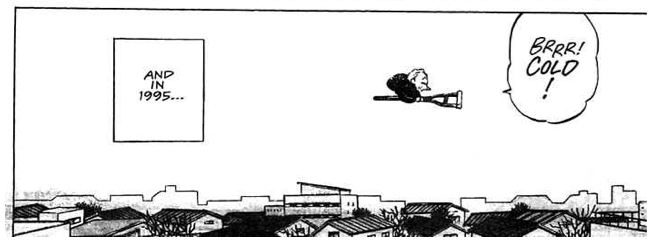
Art-wise, Takahashi produces some of the cleanest, most accessible layouts in manga. Her characters’ faces are easy to read, and her scenes are staged for maximum clarity and emotional impact; no one times a scare or a punch line better than Takahashi. Even more striking is the sense of mischief and play that informs her artwork. The elderly heroine of “One Hundred Years of Love,” for example, gains the ability to fly after surviving a near-death experience. Takahashi draws the old woman astride an enormous crutch, soaring over an urban landscape. At first, Mrs. Hoshino mutters about the weather, but soon she embraces the possibilities of flight, buzzing an unsuspecting eight-year-old apartment dweller:


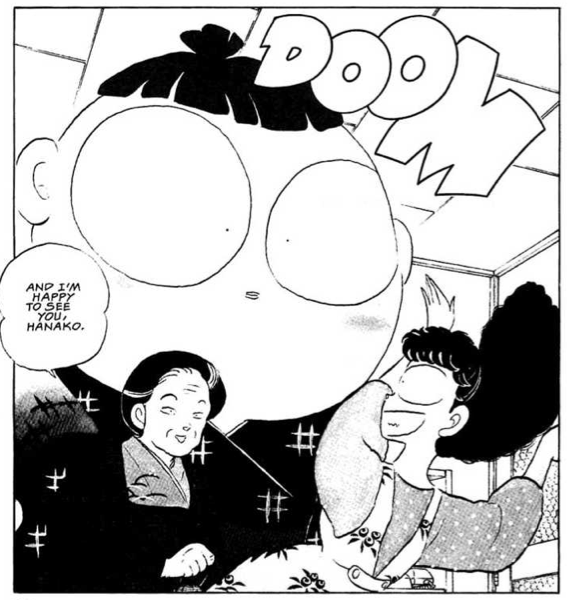
That same sense of mischief is evident in “Extra-Large Size Happiness,” in which a giant yokai pops into the frame — directly behind the frazzled heroine’s mother-in-law. Readers familiar with InuYasha‘s Shippo and Myogi will immediately recognize this round, genial figure:

The similarities between this nameless yokai and Myoga could be construed as a flaw or weakness of Takahashi’s style, but there’s an argument to be made that Takahashi employs a “star system” of her own. Granted, Takahashi never constructed a neat theoretical framework to explain the recurrence of certain characters in her stories, as Osamu Tezuka famously did for his. Flipping through the pages of Rumic Theater, however, it’s easy to imagine these characters as actors who specialize in certain types of roles, retaining something of their own “off-screen” personality and appearance in every story; as David Welsh observed in his recent essay on Ranma 1/2, “The fun is in seeing the specialists find variations on their distinctive themes.” And here, in Rumic Theater, the fun comes from seeing Takahashi’s regulars tackle more grown-up themes — marital discord, neighborhood politics, growing old — than might otherwise be permissible in the context of a long-form adventure such as InuYasha or Ranma 1/2 .

Filed Under: Manga, Manga Critic, Recommended Reading, REVIEWS Tagged With: Manga Movable Feast, Rumic Theater, Rumiko Takahashi, Seinen, VIZ

  • Page 1
  • Page 2
  • Page 3
  • Interim pages omitted …
  • Page 6
  • Go to Next Page »
 | Log in
Copyright © 2010 Manga Bookshelf | Powered by WordPress & the Genesis Framework