• Skip to primary navigation
  • Skip to main content
  • Skip to primary sidebar
  • Home
  • About Us
    • Privacy Policy
    • Comment Policy
    • Disclosures & Disclaimers
  • Resources
    • Links, Essays & Articles
    • Fandomology!
    • CLAMP Directory
    • BlogRoll
  • Features & Columns
    • 3 Things Thursday
    • Adventures in the Key of Shoujo
    • Bit & Blips (game reviews)
    • BL BOOKRACK
    • Bookshelf Briefs
    • Bringing the Drama
    • Comic Conversion
    • Fanservice Friday
    • Going Digital
    • It Came From the Sinosphere
    • License This!
    • Magazine no Mori
    • My Week in Manga
    • OFF THE SHELF
    • Not By Manga Alone
    • PICK OF THE WEEK
    • Subtitles & Sensibility
    • Weekly Shonen Jump Recaps
  • Manga Moveable Feast
    • MMF Full Archive
    • Yun Kouga
    • CLAMP
    • Shojo Beat
    • Osamu Tezuka
    • Sailor Moon
    • Fruits Basket
    • Takehiko Inoue
    • Wild Adapter
    • One Piece
    • After School Nightmare
    • Karakuri Odette
    • Paradise Kiss
    • The Color Trilogy
    • To Terra…
    • Sexy Voice & Robo
  • Browse by Author
    • Sean Gaffney
    • Anna Neatrour
    • Michelle Smith
    • Katherine Dacey
    • MJ
    • Brigid Alverson
    • Travis Anderson
    • Phillip Anthony
    • Derek Bown
    • Jaci Dahlvang
    • Angela Eastman
    • Erica Friedman
    • Sara K.
    • Megan Purdy
    • Emily Snodgrass
    • Nancy Thistlethwaite
    • Eva Volin
    • David Welsh
  • MB Blogs
    • A Case Suitable For Treatment
    • Experiments in Manga
    • MangaBlog
    • The Manga Critic
    • Manga Report
    • Soliloquy in Blue
    • Manga Curmudgeon (archive)

Manga Bookshelf

Discussion, Resources, Roundtables, & Reviews

Archives for January 2010

5 Female Voices in Manga Criticism

January 13, 2010 by MJ 34 Comments

Recently, a group of critics at The Hooded Utilitarian posted part one of an article naming their picks for Best Online Comics Criticism in 2009. It’s a great read with some fantastic links to follow. Johanna Draper Carlson linked to this at Comics Worth Reading, mentioning that she hoped the next installment would include more manga and more women, because “some of the most insightful critics currently are women talking about manga.”

I agree with Johanna, of course, and it got me thinking about how many manga blogs by women I read every day and how much these women have shaped my own experience with manga. Certainly one of the things I value most about the online manga community is that so many of its prominent voices are women, and it feels like a great privilege to be able to interact with all of them so easily. …

Read More

Filed Under: FEATURES Tagged With: manga, women in manga

Sinfest, Vol. 1

January 12, 2010 by Katherine Dacey

The very first Sinfest strips tell you everything you need to know about Tatsuya Ishida’s cheeky yet surprisingly reverential comic. In them, we see a young man seated at a table across from the Devil, negotiating a contract that would enable him to enjoy — among other perks — a “supermodel sandwich” in exchange for his soul. The transaction isn’t taking place in an office or the gates of Hell, however, but, in a hat tip to Charles Schulz, at a jerry-rigged booth that’s a shoo-in for the one Lucy van Pelt used to dispense nickel-sized bits of wisdom to the Peanuts gang.

It’s this mixture of the fresh and the familiar that makes Sinfest such a treat to read. Though Ishida examines such ubiquitous comic strip subjects as the temperamental differences between cats and dogs, the eternal miscommunication between men and women, and the general absurdity of popular culture, Ishida puts a unique spin on the material. His Pooch and Percival cartoons provide an instructive example. Like many artists, Ishida portrays Percival as the smarter of the pair, a sly, cynical cat who tolerates the presence of his fellow pet Pooch, while Pooch is portrayed as an unabashed enthusiast who lives completely in the moment, frequently breaking into Snoopy-esque dance to express his joy. From time to time, however, Ishida neatly upends this relationship: in one strip, for example, Percival snidely denounces their master, telling Pooch, “They don’t care about you. They’re just lonely and they use you to fill their stupid void.” Without missing a beat, Pooch replies, “Well, that’s what I do with them.” This kind of carnivalesque reversal is key to Sinfest‘s success, challenging our preconceived notions of catness and dogness as well as our deeply ingrained belief that happiness, however desirable, is antithetical to introspection.

Some of Ishida’s bluntest, funniest strips take aim at popular culture, laying bare the subtexts that inform television, movies, and music. Ishida satirizes the diamond industry’s “Tell her you’d marry her all over again” ad, for example, with a neat, shot-by-shot reconstruction accompanied by a rude gloss on what’s really being sold: “This holiday season,” the narrator intones, “Give the gift that says, ‘Girl, I wanna do ya like it ain’t no thing!’ The gift that will make her fake it like she’s never faked it before!” The entertainment industry’s marginalization of women, blacks, and Asians also comes in for a blistering critique, with Ishida proposing television programs to address the “absence of ethnic/oppressed people in the new fall line-up” such as Geisha Warrior Hoochie, a story about the world’s deadliest masseuse;  Just Shank Me, a comedy documenting “the madcap hijinks of two pimps in a crackhouse”; and The Mex-Files, a Latino riff on Fox’s popular scare-fest. As his savage titles suggest, Ishida isn’t shy about pointing out the industry’s over-reliance on offensive stereotypes to pander to under-served demographics; if anything, these parodies ring with the same kind of uncomfortable truth as Dave Chappelle’s sharpest sketches.

As rude as Ishida can be, he also has a deep affection for the comic strip. He frequently pays homage to favorite cartoonists — albeit in ways that they might not embrace — by placing beloved characters in new and ridiculous contexts. Some of these send-ups are played strictly for laughs: the B.C. crew stoned out of their minds, Garfield on the cover of Pethouse magazine. Some are more pointed — It’s the Apocalypse, Charlies Brown! — gently poking creators for allowing their properties to be milked dry. (If you’ve ever seen You’re Not Elected, Charlie Brown, you’ll appreciate Ishida’s take on these C-list specials all the more.) All of these parodies are executed with painstaking care, as Ishida demonstrates an uncanny ability to mimic Scott Adams, Bill Waterson, Berke Breathed, Gary Larson, and, of course, Charles Schulz.

Given how raunchy and controversial Ishida can be, it’s no wonder that Sinfest began its life as a webcomic rather than a staple of the funny pages. Volume one of the Dark Horse edition collects the first 500+ installments of Sinfest, including twelve prototype strips that Ishida drew for The Daily Bruin (UCLA’s newspaper) in the early 1990s. Looking at these formative cartoons, we can see Ishida experimenting with voice and pushing the boundaries of good taste with crude jabs at campus feminism. These early strips have a more strident quality to them, as Ishida hadn’t yet mastered the difficult task of using boorish characters to critique sexism; instead, his characters just seem loud and not very funny. By the time the first Sinfest strips appeared in 2001, however, Ishida had gotten the hang of it, inviting us to recognize and laugh at his characters’ stupidity, rather than inviting us to laugh with them — and it’s this distinction that allows Ishida to be so in-your-face about issues that make all of us uncomfortable. Imagine Ricky Gervais or Dave Chappelle using comic strips as their preferred mode of expression, and you have a pretty good idea of what Tatsuya Ishida’s Sinfest is all about. Recommended.

Review copy provided by Dark Horse.

SINFEST, VOL. 1 • BY TATSUYA ISHIDA • DARK HORSE • RATING: OLDER TEEN (16+)  208 pp.

Filed Under: Comics, Manga Critic, REVIEWS Tagged With: Comedy, Dark Horse

Sinfest, Vol. 1

January 12, 2010 by Katherine Dacey

sinfest_coverThe very first Sinfest strips tell you everything you need to know about Tatsuya Ishida’s cheeky yet surprisingly reverential comic. In them, we see a young man seated at a table across from the Devil, negotiating a contract that would enable him to enjoy — among other perks — a “supermodel sandwich” in exchange for his soul. The transaction isn’t taking place in an office or the gates of Hell, however, but, in a hat tip to Charles Schulz, at a jerry-rigged booth that’s a shoo-in for the one Lucy van Pelt used to dispense nickel-sized bits of wisdom to the Peanuts gang.

It’s this mixture of the fresh and the familiar that makes Sinfest such a treat to read. Though Ishida examines such ubiquitous comic strip subjects as the temperamental differences between cats and dogs, the eternal miscommunication between men and women, and the general absurdity of popular culture, Ishida puts a unique spin on the material. His Pooch and Percival cartoons provide an instructive example. Like many artists, Ishida portrays Percival as the smarter of the pair, a sly, cynical cat who tolerates the presence of his fellow pet Pooch, while Pooch is portrayed as an unabashed enthusiast who lives completely in the moment, frequently breaking into Snoopy-esque dance to express his joy. From time to time, however, Ishida neatly upends this relationship: in one strip, for example, Percival snidely denounces their master, telling Pooch, “They don’t care about you. They’re just lonely and they use you to fill their stupid void.” Without missing a beat, Pooch replies, “Well, that’s what I do with them.” This kind of carnivalesque reversal is key to Sinfest‘s success, challenging our preconceived notions of catness and dogness as well as our deeply ingrained belief that happiness, however desirable, is antithetical to introspection.

…

Read More

Filed Under: Manga Critic Tagged With: Comedy, Dark Horse

Monday Morning Links

January 11, 2010 by MJ 2 Comments

Good morning! First of all, a reminder not to miss today’s installment of Manhwa Monday! Secondly, since Google Reader greeted me this morning with several wonderful gems, I thought it would be a crime not to pass them along to you!

Reverse Thieves offer up an interview with Ed Chavez, head of marketing for Vertical, Inc. and all-around manga expert. Ed discusses his background, his thoughts on manga, and goes into quite a bit of detail regarding Vertical’s highly anticipated (at least by me) 2010 manga releases, including Twin Spica, Peepo Choo, 7 Billion Needles, and the endlessly adorable Chi’s Sweet Home (insert happy sigh). The interview is long, but it’s a great read, so I recommend going in for the long haul.

Over at the newly-renamed Manga Curmudgeon, David Welsh writes the most delightful review of Yen Press’ Time and Again ever, in which he compares …

Read More

Filed Under: DAILY CHATTER, NEWS Tagged With: links, manga, manhwa, yaoi/boys' love

Fullmetal Alchemist, Vol. 22

January 11, 2010 by MJ Leave a Comment

By Hiromu Arakawa
Viz, 192 pp.
Rating: T (Teen)

Having been finally released from Pride’s control, Al feels responsible for the damage done. In order to rectify the situation, he devises a plan to trap Pride that he must put into action with his father’s help (and without his brother’s knowledge). Anxious to get on with his own plans for world domination, Greed breaks off from the rest of the group, against the wishes of his body’s cohabitant, Lin.

Meanwhile, Mustang’s group continues their resistance, finding allies among Briggs’ Northern troops as well as a few unexpected quarters, and Hohenheim comes face-to-face with an old acquaintance once again. With the story’s major players all converging on Central City, the series’ final battle seems to truly have begun.

The time has come for each of the Elric men to show their true strength and artist Hiromu Arakawa has certainly ramped up the tension to get them there. Her real brilliance is best displayed, however, in the volume’s smallest moments—brief encounters and bits of characterization that make her characters shine in the din. Both Hohenheim’s quiet acts of compassion and Kimblee’s stubborn emotional detachment say more about each of them than their public actions ever could. As always, Arakawa’s artwork provides impressive clarity, even through the messiest action sequences, without ever sacrificing pace or expression.

This volume is a thrill from start to finish, certain to leave fans anxious for more.

Filed Under: MANGA REVIEWS Tagged With: fullmetal alchemist

The Princes in the Tower by Alison Weir: B+

January 11, 2010 by Michelle Smith

princesintowerFrom the front flap:
Despite five centuries of investigation by historians, the sinister deaths of the boy king Edward V and his younger brother Richard, Duke of York, remain one of the most fascinating murder mysteries in English history. Did Richard III really kill “the Princes in the Tower,” as is commonly believed, or was the murderer someone else entirely? In this utterly absorbing and meticulously researched book, English writer Alison Weir, an authority on the history of the British royal family, at last provides a conclusive solution to this age-old puzzle.

Review:
There are two schools of thought on Richard III. One group, dubbed “revisionists,” believes that Richard’s unsavory reputation is undeserved and that he did not do the awful things attributed to him. The second, “traditionalists,” hold that Richard was tyrannical and ambitious and certainly did commit many terrible acts. Alison Weir is firmly in the traditionalist camp and, after reading her work, I must (reluctantly) conclude that Richard probably was behind the deaths of his nephews.

The way Weir organizes her information is interesting. After devoting the entire first chapter to an introduction and evaluation of her sources, especially contemporary ones, she proceeds to tell the story by citing many of the sources in turn. These do not always agree, and when they don’t, she points it out and explains which, in her opinion, is likely the most accurate account. The result is a narrative that feels thorough and yet not unnecessarily bogged down by detours into conjecture. While I lament the passing of my romanticized view of Richard III, Weir ultimately did compile enough irrefutable evidence to convince me of his villainy.

Some things about the way the information is presented rankle a bit, however. It’s clear from pretty early on that Weir, despite claiming that she approached the question of Richard’s guilt with an open mind, is completely dismissive of the revisionist view, saying “the majority of serious historians have rejected it.” Too, she often seems to base her arguments on behavioral assumptions like (paraphrased) “Surely a man of such integrity would verify his facts” or “This was published during a time when many people who knew Richard III were still alive and would spot inaccuracies.” Okay, sure, but in a political climate where beheadings occur frequently—and when the monarch (Henry VII) in power wants to avoid attention being called to the House of York, as Weir points out herself—are these people really going to feel free to defend him? It’s not that I dispute her conclusions based on the evidence, and I’m by no means a historian myself, but I do have to wonder whether this is how research is normally conducted and presented.

In any case, Weir’s account of Richard’s life, deeds, and legacy is a fascinating and, ultimately, convincing read, even to someone like me who has enjoyed (and likely will continue to enjoy) reading historical fiction in which Richard is presented in a positive light.

Filed Under: Books Tagged With: Alison Weir

Manhwa Monday: January 11th, 2010

January 11, 2010 by MJ 16 Comments

First things first! The winner of last week’s giveaway is commenter Eva D., who will receive volume one of Yen Press’ Goong: The Royal Palace! Eva, drop me an e-mail with your address and I’ll send it right out!

This week’s featured review is Noah Berlatsky’s thoughtful look at the first six volumes of Dokebi Bride (NETCOMICS) over at Comixology. Though he spends a surprising amount of time trying to reconcile the series within Japanese demographic categories which seems, at best, a pointless exercise, it is a beautiful review of a gorgeous series that remains, to this date, sadly unfinished. “The book, like many ghost stories, is about grief and dislocation and how the two circle around each other like black, exhausted smudges,” he says early on in the review–an observation indicative of the its eloquence as a whole. The review is honestly a great read and I’d recommend it whether you’ve read the series or not. …

Read More

Filed Under: Manhwa Bookshelf Tagged With: manhwa, Manhwa Bookshelf

Blue Sheep Reverie 1-2 by Makoto Tateno: B-

January 11, 2010 by Michelle Smith

bluesheep2When Kai’s lover, Maria, is murdered, he sets out to find her killer. His one clue is that the ring Maria always wore—a man-made blue jewel resembling the eye of a sheep—is missing, and he thinks he’s found it on the hand of Lahti Bara, a bigwig in Sarte, one of the gangs ruling the gritty city of Akatsuki. To get close to Lahti and check out his ring, Kai makes a bid to be his bodyguard and later consents to be his lover. It turns out that Lahti isn’t Maria’s murderer, but Kai has already grown fascinated by the powerful and enigmatic leader and gets embroiled in a bunch of gang politics involving a rival gang, an elite group within Sarte called the Four Kings, a renegade Sarte member attempting to bring them down, and a power struggle over gang leadership.

While I very heartily applaud any BL series for having as much plot as this one does, I must regretfully admit that I found most of the gang-related action dull and repetitive. Nearly every time something bad happens, the aforementioned renegade is the culprit but never seems to get caught. Kai isn’t a very strong character, either, but I do think his relationship with Lahti is an interesting one. It definitely isn’t love, as Lahti occasionally keeps Kai on door guard duty while he’s bedding other men, but Kai realizes that it’s not love and kindness he craves, but rather the strength to be worthy to stand at Lahti’s side, to be necessary to him.

So, is this good? Well, almost. It’s one of those cases where I like it despite its faults. I actually struggled a lot with whether to give it a B, since Tateno-sensei bothered to create such an intricate plot, but I just couldn’t do it.

Review copy for volume two provided by the publisher. Review originally published at Manga Recon.

Filed Under: REVIEWS Tagged With: digital manga publishing, Juné, Makoto Tateno

Fullmetal Alchemist, Vol. 21

January 10, 2010 by MJ 2 Comments

Fullmetal Alchemist, Vol. 21
By Hiromu Arakawa
Published by Viz Media


Buy This Book

Winry makes her way safely back to Resembool only to discover that Ed has beaten her to it. Though she’s grateful to find him all in one piece, she’s less thrilled with his insistence that she flee the country. Meanwhile, Al has encountered newly-uncovered homunculus Pride (aka Selim Bradley), whose terrifying power is enough to take control of him and set him against his own brother. Only the the surprise appearance of an old ally can turn this fight around! Now with President Bradley and his dangerous son out of Central City, Mustang’s group of rebels finally makes their move, taking the President’s wife hostage. Can they be prepared for the result?

After the last volume’s calm before the storm, Arakawa ramps up the tension by revealing the true horror of Pride’s power, wrapped up in the package of a cute little boy–one so ruthless he’ll consume his own allies if it will help him to win. Even so, Arakawa manages to balance this kind of pure evil with just the smallest drop of pathos, keeping the story from ever settling into comfortable black and white. This is one of her most impressive (and consistent) balancing acts and part of what makes her story so powerful. The series somehow maintains both pure-hearted shonen morality and multiple shades of gray, side by side, even in its primary characters. It is dark, but never pessimistic–moralistic, but never self-righteous. It follows established conventions of its genre without ever losing its persistent freshness.

Though the story’s increasingly serious bent has (understandably) overwhelmed its early humor, especially now as the climax draws near, there is still quite a bit to be found, particularly in the wonderfully dry humor of Major General Olivier Armstrong and pretty much anyone associated with Colonel Mustang. As the series reaches further into darkness and anxiety, these characters help keep the atmosphere from becoming too heavy, something I expect we’ll all be grateful for by series’ end.

“Tension” is the keyword in this harrowing volume of one of my favorite series in current publication. Keep a look out for tomorrow’s installment of Manga Recon‘s Manga Minis to see how things explode in the series’ next volume!

Review copy provided by the publisher.

Filed Under: MANGA REVIEWS Tagged With: fullmetal alchemist, manga

Oh, What a Year Can Bring

January 9, 2010 by MJ 13 Comments

As some on Twitter may recall, December marked my official one-year anniversary as a manga reviewer. I’ve been blogging about manga since late 2007, but it was December of 2008 when Kate Dacey e-mailed me to ask if I’d be interested in joining the crew at Manga Recon. Having declared several times before then that “I don’t write reviews!” I was not especially confident, but I plowed in anyway and it’s been a fantastic year. My first review subject was volume thirteen of Claymore for the December 8th Manga Minis column. I’d like to think I’ve come a ways since then.

An old entry that springs to mind is one called Life of Me, posted on January 1st of last year, in which I included a photo of the desk where I write. I think you’ll notice the most significant change over the course of the year: …

Read More

Filed Under: DAILY CHATTER, FEATURES Tagged With: home, photos

20th Century Boys, Vols. 1-6

January 9, 2010 by Katherine Dacey

Do you remember those first, glorious seasons of Heroes and Lost? Both shows promised to reinvigorate the sci-fi thriller with complex, flawed characters and plots that moved freely between past, present, and future. By the middle of their second seasons, however, it was clear that neither shows’ writers knew how to successfully resolve the conflicts and mysteries introduced in the first, as the writers resorted to cheap tricks — the out-of-left-field personality reversal, the all-too-convenient coincidence, and the arbitrary let’s-kill-off-a-character plot twist — to keep the myriad plot lines afloat, alienating thousands of viewers in the process. Heroes and Lost seemed proof that even the scariest doomsday scenario would fall flat if saddled with too many subplots and secondary characters.

Reading Naoki Urasawa’s 20th Century Boys, however, convinced me that it is possible to tell a twisty, layered story about ordinary people saving the world from annihilation without succumbing to cliche or unduly testing the audience’s patience. The key to Urasawa’s success? A strong script with vivid characters and a clear sense of purpose, reassuring the reader that all the plot strands are just that: strands, not loose threads.

In 20th Century Boys, humanity’s future rests in the hands of an unpromising lot. There’s Kenji, a college dropout who runs a convenience store; Maruo, a cheerful, plump soul who owns a shop down the street from Kenji; Yoshitune, a shy, bespectacled office man; Otcho, a scruffy renegade who’s been living off the grid in Thailand; and Yukiji, a K-9 officer who can’t control her drug-sniffing dog. All five were childhood friends, members of a secret club that wrote The Book of Prophecy, an elaborate doomsday scenario involving superheroes and giant robots. Now in their thirties, the gang has disbanded — that is, until their pal Donkey, a high-school science teacher, leaps to his death off a building.

Or did he? As Kenji begins pushing for answers, he discovers that Donkey was investigating a mysterious cult, known only as The Friends, that had appropriated the club’s “official” symbol. The more Kenji probes, the more parallels he discovers between The Friends’ clandestine activities and the Book of Prophecy, parallels that suggest the cult is headed by one of Kenji’s old schoolmates. Terrified that The Friends will attempt to recreate the story’s climatic battle, Kenji tracks down his clubmates one by one, assembling a small army to oppose the cult.

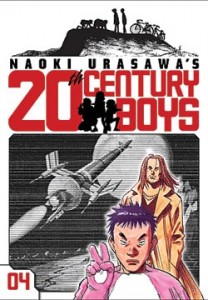
20thcentury4From the very first pages of volume one, Urasawa demonstrates an uncommon ability to move back and forth in time, juxtaposing scenes from Kenji’s past with brief glimpses of the future. The success of these scenes is attributable, in part, to Urasawa’s superb draftsmanship, as he does a fine job of aging his characters from their long-limbed, baby-faced, ten-year-old selves into thirty-somethings weighed down by adult responsibilities.
The integrity of Urasawa’s characterizations also contribute to the success of these temporal leaps; his characters’ adult behavior jives with what we know about them from childhood flashbacks. Otcho, for example, was the club’s most worldly member, the kid who introduced his pals to rock-n-roll and gave them the lowdown on Woodstock; it’s not surprising to see him reincarnated as a long-haired thug-for-hire who despises authority. Ditto for Yanbo and Mabo, twins who terrorized Kenji and friends back in the day. When Yanbo and Mabo resurface in volume five, Urasawa gives them a more pleasing appearance and demeanor than we might have expected, luring us into a false sense that they’ve outgrown their bullying ways. Urasawa then slaps us on the wrist for not trusting our original assessment of the twins, uncorking a fiendish plot twist that’s in keeping with what we already knew about them.

Urasawa uses these flashbacks and flash-forwards to build a dense network of connections among his characters, gradually revealing how and why Kenji’s childhood fantasies are providing the blueprint for a real-life apocalyptic scenario. Heroes and Lost attempted to do the same thing, but neither show succeeded in convincing us that those connections were lying just below the surface waiting for us to discover them; those connections had an arbitrary, bolt-from-the-blue quality. With 20th Century Boys, however, Urasawa makes us feel that we might have unearthed these links without any editorial guidance, as even the most surprising developments still make sense within the story’s elaborate framework.

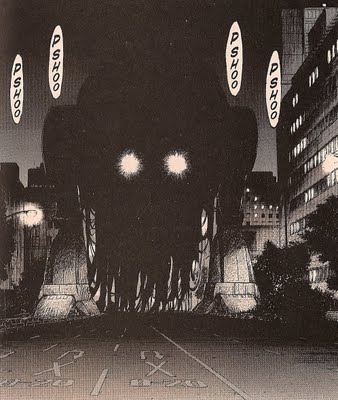
What gives the story its sense of urgency is Urasawa’s ability to create and sustain a strong sense of fear and anticipation. Six volumes into 20th Century Boys, we’ve had a few tantalizing glimpses of the robot that menaces Tokyo on the eve of the millennium, but we still don’t know what it looks like or what it can do. Urasawa has only shown us the enemy in silhouette:

20thcentury_robot

It’s a point I’ve raised in other reviews: an unseen menace is much scarier than one that’s routinely trotted out of the shadows to spook us. Consider the difference between Jaws and its sequels. In the original, Steven Spielberg hinted at the shark’s presence, showing us a dorsal fin or a dark outline moving rapidly beneath the water’s surface, but withholding the “money” shot (“tooth” shot, perhaps?) until the third reel. The few times that we see Jaws attack are genuinely scary because they finally put us face-to-face with those terrible teeth and dead eyes, confirming just how deadly the shark really is. In the sequels, however, the shark is featured prominently; we see it dine on boaters and swimmers in lurid detail. We may marvel at the stupidity of the shark’s victims, or feel disgusted by the gallons of fake blood, but we never feel scared, as we know what we’re up against from the very first scenes.

Urasawa takes a page from Spielberg’s book, showing us just enough of the robot’s form to engage our imagination. The robot’s silhouette hints at its size and strength; if anything, it looks like an enormous man-o-war lumbering through Tokyo. But what stays with us are those fierce, penetrating headlights, so evocative of a prison searchlight or a pair of eyes. As David Ford observes at Are You a Serious Comic Book Reader?, we feel a palpable sense of despair when we see the robot: how can Kenji hope to escape its all-seeing gaze? (By the way, I highly encourage you to read Ford’s essay, though spoiler-phobes should stay away until they’ve finished volume five.)

With more than ten volumes left in 20th Century Boys, I have no idea how Urasawa plans to tie all of the stories’ threads together. I’m confident, however, that he’ll do so with the skill of a master weaver, seamlessly incorporating all of the relationships, plot twists, and motives into an intricate, beautiful tapestry.

Review copies provided by VIZ Media, LLC. Volume seven will be released on February 10, 2010.

20TH CENTURY BOYS, VOLS. 1-6 • BY NAOKI URASAWA • VIZ • RATING: OLDER TEEN (16+)

Filed Under: Manga, Manga Critic, REVIEWS Tagged With: Naoki Urasawa, Sci-Fi, Thriller, VIZ, VIZ Signature

20th Century Boys, Vols. 1-6

January 9, 2010 by Katherine Dacey

20thcentury1Do you remember those first, glorious seasons of Heroes and Lost? Both shows promised to reinvigorate the sci-fi thriller with complex, flawed characters and plots that moved freely between past, present, and future. By the middle of their second seasons, however, it was clear that neither shows’ writers knew how to successfully resolve the conflicts and mysteries introduced in the first, as the writers resorted to cheap tricks — the out-of-left-field personality reversal, the all-too-convenient coincidence, and the arbitrary let’s-kill-off-a-character plot twist — to keep the myriad plot lines afloat, alienating thousands of viewers in the process. Heroes and Lost seemed proof that even the scariest doomsday scenario would fall flat if saddled with too many subplots and secondary characters.

Reading Naoki Urasawa’s 20th Century Boys, however, convinced me that it is possible to tell a twisty, layered story about ordinary people saving the world from annihilation without succumbing to cliche or unduly testing the audience’s patience. The key to Urasawa’s success? A strong script with vivid characters and a clear sense of purpose, reassuring the reader that all the plot strands are just that: strands, not loose threads.

…

Read More

Filed Under: Manga Critic Tagged With: Naoki Urasawa, Seinen, VIZ

Gaudy Night by Dorothy L. Sayers: A+

January 9, 2010 by Michelle Smith

gaudynightFrom the back cover:
When Harriet Vane attends her Oxford reunion, known as the “Gaudy,” the prim academic setting is haunted by a rash of bizarre pranks: scrawled obscenities, burnt effigies, and poison-pen letters—including one that says, “Ask your boyfriend with the title if he likes arsenic in his soup.” Some of the notes threaten murder; all are perfectly ghastly; yet in spite of their scurrilous nature, all are perfectly worded. And Harriet finds herself ensnared in a nightmare of romance and terror, with only the tiniest shreds of clues to challenge her powers of detection, and those of her paramour, Lord Peter Wimsey.

Review:
I’m trying to recall precisely when I first heard of Gaudy Night. It must’ve been somewhere around 2001 or 2002, because my first attempt to read the Wimsey series (I couldn’t just jump straight to the penultimate novel, after all!) occurred early in 2002. In any case, here is a book I’ve been waiting to read for at least eight years and, unlike so much else in life, it completely lived up to (and even exceeded) my expectations.

Because I blindly accepted the accounts of this book’s excellence, I didn’t read much about it before its time came. Therefore, it was an exceedingly pleasant surprise that the narrative is told from the point of view of Harriet Vane, a mystery novelist and long-time object of Wimsey’s affections. After discovering a couple of disturbing messages when attending her Oxford reunion, Harriet is later called back to the college to conduct a discreet investigation. While investigating the origins of poison-pen letters, foiling pranks, and settling into the academic life once more, Harriet also engages in many conversations with the members of the Senior Common Room on the virtues of a life devoted to scholarship as opposed to the traditional womanly duties, and uses the experience of her former schoolmates to help form conclusions about whether marriage is worth it. The overall message is an unapologetically feminist one, though some characters do persist in advocating for stereotypical gender roles.

Of course, this isn’t the first book to present Harriet’s point of view. Have His Carcase is similar, but it’s more breezy and amusing. This time, it feels like we really get to know Harriet inside and out and understand exactly what it is that keeps her from accepting Peter’s marriage proposals: her belief that she has so thoroughly messed up attempts at love (Peter first meets her in Strong Poison when she is on trial for killing her lover) that she had better give up, and, most strongly, the pesky feelings of gratitude toward Peter that would forever keep them on unequal footing. As fond as she is of Peter, she can’t really believe he would be happy with her or treat her as an equal, and it’s in this novel that he finally, finally manages to convince her that both are true.

Eventually, Harriet reaches a point in the case where it’s necessary to call for Peter’s assistance and it’s here that she begins to compare the kind of marriage he would offer as opposed to the variety more normally encountered. For example, Peter doesn’t want a sweet, uncritical, and dependent spouse: he wants an honest and independent one. “Anybody can have the harmony,” he says, giving voice to a lovely musical metaphor, “if they will leave us the counterpoint.” It takes a little bit for this to sink in, however. Instead of trying to dissuade Harriet from continuing the investigation when her life is in jeopardy, for example, Peter teaches her self-defense moves. He basically encourages all the independence she could ask for and more, giving her the freedom to risk the life she still believes she owes to him. Lastly, he reveals more of his own weaknesses, showing that he’s flawed and human, too. At last she realizes that he truly means to accept her as she is and when Peter proposes one last time, she accepts.

While the disturbances on campus and Harriet’s investigation are truly fascinating—I’m thinking particularly of the fabulous scene where the culprit is dashing about removing fuses from all of the buildings and casting everyone into darkness—it really is the relationship between these two that shines most brightly. In terms of intelligence and independence, Harriet and Peter perhaps the closest thing 20th century literature has to a couple like Elizabeth Bennet and Fitzwilliam Darcy. Without them, Gaudy Night would’ve earned a solid A, which is nothing to sneer at.

Reiterating that Gaudy Night is highly recommended is unnecessary at this point, but I do advise reading at least the Wimsey novels that have been linked to here before tackling it so as to have a better idea as to the origins of Harriet and Peter’s relationship and how they’ve circled around one another for the last five years. That’ll make the novel’s conclusion all the more satisfying.

Filed Under: Books, Mystery Tagged With: Dorothy L. Sayers

Resources at Manga Bookshelf!

January 8, 2010 by MJ 1 Comment

nana-4Though I’ve long maintained a review index here at Manga Bookshelf, something that’s always seemed clunky to me is the process readers must go through just to find discussion on the their topics of interest. In hopes of making this just a bit easier, I’ve created a new page, Resources, Features, & Essays with links to the most informative (or at least most wordy) features from the archives, to be updated regularly from here on out. At least one section (Yaoi/Boys’ Love) I created simply for the fact that these are two of the most popular search terms readers follow to this site. Other sections include my collection of “Persuasion Posts,” Recommendations & Buying Guides, and a catch-all section for posts and essays ranging from why I like Twitter to how to avoid feeling intimidated by Tezuka. Check the page out here!

Filed Under: NEWS Tagged With: manga, resources

New Manhwa Readers Poll at About.com!

January 7, 2010 by MJ 3 Comments

mijeongOver at About.com, Deb Aoki has been posting a series of “Best of” readers polls, where anyone can vote for their favorite new manga (in quite a number of categories) released in 2009. The latest of these has special interest for me: Best New Korean Manhwa.

I had a really rough time choosing my favorite from that group (I ended up going with Byun Byung-Jun’s collection of moody short manhwa, Mijeong, though now 13th Boy, Time and Again, and even U Don’t Know Me are looking at me as a traitor), though I’m anxious now to get my hands on a copy of Udon’s Reading Club–the only one of the bunch I don’t have in my possession. I was a bit disappointed not to see any of NETCOMICS’ new ladies’ titles on the list, such as Small-Minded Schoolgirls and Please, Please Me, though perhaps …

Read More

Filed Under: NEWS Tagged With: manhwa

  • « Go to Previous Page
  • Page 1
  • Page 2
  • Page 3
  • Page 4
  • Go to Next Page »
 | Log in
Copyright © 2010 Manga Bookshelf | Powered by WordPress & the Genesis Framework