• Skip to primary navigation
  • Skip to main content
  • Skip to primary sidebar
  • Home
  • About Us
    • Privacy Policy
    • Comment Policy
    • Disclosures & Disclaimers
  • Resources
    • Links, Essays & Articles
    • Fandomology!
    • CLAMP Directory
    • BlogRoll
  • Features & Columns
    • 3 Things Thursday
    • Adventures in the Key of Shoujo
    • Bit & Blips (game reviews)
    • BL BOOKRACK
    • Bookshelf Briefs
    • Bringing the Drama
    • Comic Conversion
    • Fanservice Friday
    • Going Digital
    • It Came From the Sinosphere
    • License This!
    • Magazine no Mori
    • My Week in Manga
    • OFF THE SHELF
    • Not By Manga Alone
    • PICK OF THE WEEK
    • Subtitles & Sensibility
    • Weekly Shonen Jump Recaps
  • Manga Moveable Feast
    • MMF Full Archive
    • Yun Kouga
    • CLAMP
    • Shojo Beat
    • Osamu Tezuka
    • Sailor Moon
    • Fruits Basket
    • Takehiko Inoue
    • Wild Adapter
    • One Piece
    • After School Nightmare
    • Karakuri Odette
    • Paradise Kiss
    • The Color Trilogy
    • To Terra…
    • Sexy Voice & Robo
  • Browse by Author
    • Sean Gaffney
    • Anna Neatrour
    • Michelle Smith
    • Katherine Dacey
    • MJ
    • Brigid Alverson
    • Travis Anderson
    • Phillip Anthony
    • Derek Bown
    • Jaci Dahlvang
    • Angela Eastman
    • Erica Friedman
    • Sara K.
    • Megan Purdy
    • Emily Snodgrass
    • Nancy Thistlethwaite
    • Eva Volin
    • David Welsh
  • MB Blogs
    • A Case Suitable For Treatment
    • Experiments in Manga
    • MangaBlog
    • The Manga Critic
    • Manga Report
    • Soliloquy in Blue
    • Manga Curmudgeon (archive)

Manga Bookshelf

Discussion, Resources, Roundtables, & Reviews

Shonen

The Flowers of Evil, Vol. 2

July 10, 2012 by Katherine Dacey 12 Comments

Do you remember the first time you tried to impress someone on a date? I do: I was fifteen, and thrilled that an older boy had invited me to dinner. (He drove a Mazda two-seater and quoted lines from Wim Wenders’ Wings of Desire, which, in 1988, made him a god.) My strategy for wooing him was to describe, in excruciating detail, the nuances of Igor Stravinsky’s Petrushka, from the opening tableau to the final notes. I was convinced that if he could see my passion for something as dark and powerful as that ballet, he’d understand who I really was, and fall in love with that person. (Needless to say, we didn’t go on a second date.)

Kasuga, the earnest hero of The Flowers of Evil, finds himself in a similar situation at the beginning of volume two: Saeki, the classmate whom he’s loved from afar, has finally consented to go on a date with him. As they wander the aisles of his favorite bookstore, Kasuga confesses to Saeki that Baudelaire’s Fleurs du Mal “changed how I see the world. I felt as though I’d been an ignorant fool my whole life.”  It’s a cringe-inducing moment — not because Saeki mocks Kasuga, or recoils from him, but because Kasuga has exposed himself in such a clumsy, sincere, and godawful manner.

That sincerity is nearly his undoing. Throughout the volume, Nakamura goads Kasuga about Saeki, reacting with fury when Kasuga asks Saeki to enter into a “pure, platonic relationship” with him: how dare he pretend to be normal? Nakamura then redoubles her efforts to reveal Kasuga’s “perversion,” currying favor with Saeki while pouring poison in Kasuga’s ear. But to what end? The final scene of the manga offers some interesting, and surprising, hints at Nakamura’s true agenda while suggesting that Kasuga might, in fact, have more in common with her than he’d care to admit. I won’t reveal what happens, but will venture to say that “orgiastic” is an apt description of those last glorious, frenzied pages.

Review copy provided by Vertical, Inc.

THE FLOWERS OF EVIL, VOL. 2 | BY SHUZO OSHIMI | VERTICAL, INC. | 168 pp.

Filed Under: Manga Critic Tagged With: Flowers of Evil, Shonen, Shuzo Oshimi, vertical

The Flowers of Evil, Vol. 1

May 9, 2012 by Katherine Dacey

If you grew up in a small town, you probably knew someone like Takao Kasuga, the nebbish-hero of The Flowers of Evil. Kasuga is a precocious middle-schooler who copes with provincial life by burying his nose in a book. His peers tolerate him, but find him a little too smug and strange to be one of the guys. Kasuga, for his part, takes pride in his sophisticated reading habits, stashing poems in his desk and telling his classmates that they’re too stupid to appreciate his favorite writer, Charles Baudelaire.

In a moment of impulse, Kasuga steals the gym outfit of beautiful classmate Nanako Saeki — an act witnessed by Sawa Nakamura, the class outcast. Nakamura confronts Kasuga after school, threatening to expose him as the thief unless he complies with her requests. Her motives for blackmailing Kasuga are complex, a mixture of prurient interest in Kasuga’s sexual fantasies and sadistic delight in wielding power over a boy. At times Nakamura  physically dominates him — she punches and tackles him — and at times she manipulates him with humiliating tasks and questions.

I’d be the first to admit that the similarities between Flowers of Evil and Sundome — however superficial — predisposed me to dislike the book. I didn’t think I had the stomach for another story in which a ball-busting girl sexually and psychologically tortured a sad-sack boy. Yet Flowers of Evil proved a far more compelling and honest look at adolescent sexuality than Sundome, thanks, in large part, to Shuzo Oshimi’s sympathetic portrayal of Kasuga.

Throughout the book, author Shuzo Oshimi hints that Kasuga’s character was inspired by his own experiences as a book-toting misfit. “I read Baudelaire’s Flowers of Evil for the first time in middle school,” he explains at the end of chapter one. “I didn’t understand much of it, but the book’s feel — suspicious, indecent, yet nastily noble — made me think, I’m so cool for reading it.” Kasuga, too, clearly feels a sense of superiority for having discovered Baudelaire at a young age; in a fit of self-pity, he muses, “How many people in this town understand Baudelaire?” At the same time, however, he’s keenly aware that his peers think he’s weird. Kasuga may be mature enough to appreciate Baudelaire — or perhaps, more accurately, to think he understands Baudelaire — but he isn’t quite old enough to shake off his classmates’ teasing.

Oshimi also does an exceptional job of dramatizing Kasuga’s inner sexual turmoil. Early in the book, for example, Kasuga catches sight of Saeki. In a flash, he pictures her clad in gym clothes, blushing and telling him, “I love you.” His acute embarrassment at being discovered mid-reverie is all the more palpable for the way in which he’s drawn: Kasuga sinks into his chair, his shoulders slumped, brows furrowed, and body foreshortened, making him look like a moist ragdoll. In later chapters, Oshimi uses surreal imagery — a wall of eyes, a fun-house mirror, a giant sink hole — to suggest that Kasuga’s normal teenage discomfort with sexual feelings has become something more powerful and destructive: shame.

If Kasuga is a sympathetic character, Nakamura poses greater difficulties for the reader. She claims her true agenda is to expose him as a pervert, but nothing about Kasuga’s behavior indicates that he is; if anything, Kasuga is naive, torn between romantic and sexual ideas about love. (That he calls Saeki “my muse, my femme fatale, my Venus” suggests the extent of his confusion.) Nakamura, too, appears to wrestling with complicated sexual feelings; in several scenes, she hints at her own predilections, only to accuse Kasuga of harboring even nastier ones. In short, Nakamura seems intent on finding someone more self-loathing and sexually confused than she is, yet her behavior is so violent and manipulative it sometimes feels as if Oshimi is trying too hard to suggest her disaffection; Nakamura’s character veers dangerously close to being a symbol of castration anxiety, rather than an emotionally damaged teenage girl.

That said, The Flowers of Evil is a shockingly readable story that vividly — one might even say queasily — evokes the fear and confusion of discovering one’s own sexuality. Recommended.

THE FLOWERS OF EVIL, VOL. 1 • BY SHUZO OSHIMI • VERTICAL, INC. • 202 pp. • NO RATING (BEST FOR OLDER TEENS)

Filed Under: Manga, Manga Critic, REVIEWS Tagged With: Flowers of Evil, Shonen, Shuzo Oshimi, vertical

The Flowers of Evil, Vol. 1

May 9, 2012 by Katherine Dacey 11 Comments

If you grew up in a small town, you probably knew someone like Takao Kasuga, the nebbish-hero of The Flowers of Evil. Kasuga is a precocious middle-schooler who copes with provincial life by burying his nose in a book. His peers tolerate him, but find him a little too smug and strange to be one of the guys. Kasuga, for his part, takes pride in his sophisticated reading habits, stashing poems in his desk and telling his classmates that they’re too stupid to appreciate his favorite writer, Charles Baudelaire.

In a moment of impulse, Kasuga steals the gym outfit of beautiful classmate Nanako Saeki — an act witnessed by Sawa Nakamura, the class outcast. Nakamura confronts Kasuga after school, threatening to expose him as the thief unless he complies with her requests. Her motives for blackmailing Kasuga are complex, a mixture of prurient interest in Kasuga’s sexual fantasies and sadistic delight in wielding power over a boy. At times Nakamura  physically dominates him — she punches and tackles him — and at times she manipulates him with humiliating tasks and questions.

I’d be the first to admit that the similarities between Flowers of Evil and Sundome — however superficial — predisposed me to dislike the book. I didn’t think I had the stomach for another story in which a ball-busting girl sexually and psychologically tortured a sad-sack boy. Yet Flowers of Evil proved a far more compelling and honest look at adolescent sexuality than Sundome, thanks, in large part, to Shuzo Oshimi’s sympathetic portrayal of Kasuga.

Throughout the book, author Shuzo Oshimi hints that Kasuga’s character was inspired by his own experiences as a book-toting misfit. “I read Baudelaire’s Flowers of Evil for the first time in middle school,” he explains at the end of chapter one. “I didn’t understand much of it, but the book’s feel — suspicious, indecent, yet nastily noble — made me think, I’m so cool for reading it.” Kasuga, too, clearly feels a sense of superiority for having discovered Baudelaire at a young age; in a fit of self-pity, he muses, “How many people in this town understand Baudelaire?” At the same time, however, he’s keenly aware that his peers think he’s weird. Kasuga may be mature enough to appreciate Baudelaire — or perhaps, more accurately, to think he understands Baudelaire — but he isn’t quite old enough to shake off his classmates’ teasing.

Oshimi also does an exceptional job of dramatizing Kasuga’s inner sexual turmoil. Early in the book, for example, Kasuga catches sight of Saeki. In a flash, he pictures her clad in gym clothes, blushing and telling him, “I love you.” His acute embarrassment at being discovered mid-reverie is all the more palpable for the way in which he’s drawn: Kasuga sinks into his chair, his shoulders slumped, brows furrowed, and body foreshortened, making him look like a moist ragdoll. In later chapters, Oshimi uses surreal imagery — a wall of eyes, a fun-house mirror, a giant sink hole — to suggest that Kasuga’s normal teenage discomfort with sexual feelings has become something more powerful and destructive: shame.

If Kasuga is a sympathetic character, Nakamura poses greater difficulties for the reader. She claims her true agenda is to expose him as a pervert, but nothing about Kasuga’s behavior indicates that he is; if anything, Kasuga is naive, torn between romantic and sexual ideas about love. (That he calls Saeki “my muse, my femme fatale, my Venus” suggests the extent of his confusion.) Nakamura, too, appears to wrestling with complicated sexual feelings; in several scenes, she hints at her own predilections, only to accuse Kasuga of harboring even nastier ones. In short, Nakamura seems intent on finding someone more self-loathing and sexually confused than she is, yet her behavior is so violent and manipulative it sometimes feels as if Oshimi is trying too hard to suggest her disaffection; Nakamura’s character veers dangerously close to being a symbol of castration anxiety, rather than an emotionally damaged teenage girl.

That said, The Flowers of Evil is a shockingly readable story that vividly — one might even say queasily — evokes the fear and confusion of discovering one’s own sexuality. Recommended.

THE FLOWERS OF EVIL, VOL. 1 • BY SHUZO OSHIMI • VERTICAL, INC. • 202 pp. • NO RATING (BEST FOR OLDER TEENS)

Filed Under: Manga Critic Tagged With: Flowers of Evil, Shonen, vertical

GTO: 14 Days in Shonan, Vol. 1

February 6, 2012 by Katherine Dacey 2 Comments

GTO: 14 Days in Shonan is loud and silly, the kind of manga in which the slightest misunderstanding between characters escalates into shouting matches, bone-crunching violence, or incarceration (or all three). It’s the kind of manga in which the hero is over-confident to the point of being dumb. And it’s the kind of manga in which the author trots out the same gags two or three times per volume, repeating them with the insistence of a ten-year-old who thinks no one heard him the first time he said, “Orange you glad I didn’t say banana?”

I loved it.

14 Days in Shonan — a sequel to the wildly popular GTO: Great Teacher Onizuka — follows the same basic template as the original stories, pitting the hellraiser-cum-homeroom teacher against a posse of troubled teens. This time, however, the action unfolds in Onizuka’s hometown, where he takes up residence at a group foster home after disgracing himself on national television. (“I just tried to tell a fun little story, and see what happened,” he fumes.) Hijinks and beatdowns ensue when one of the residents wages a vicious campaign to send Onizuka back to Tokyo — a campaign that repeatedly backfires, thanks to Onizuka’s cheerful determination and  strong constitution. (No one takes a baseball bat to the head quite like Onizuka.)

Though the hijinks are amusing, what makes 14 Days in Shonan work is its sincerity. In many stories told from the teacher’s point of view, the teacher is a sardonic observer of student behavior, bemoaning his charges’ lack of knowledge, manners, or interest in the subject. 14 Days in Shonan, however, offers a rosier picture of teaching, one in which a good educator plays a decisive role in improving his students’ lives, whether they be victims of bullying or survivors of parental abuse. At the same time, however, author Toru Fujisawa pokes fun at the conventions of the To Sir With Love genre, gleefully mocking Eikichi Onizuka’s unorthodox methodology, gullibility, and exaggerated sense of importance; Onizuka may get results, but they almost always come at the expense of his dignity.

And oh! those affronts to his dignity are hilarious. Onizuka is teased by teenagers and cops alike: they insult him, remind him that he’s a virgin, and Photoshop his image, placing him in suggestive situations. Though he tries to maintain a suave facade, Onizuka can barely contain his embarrassment at the way he’s treated; not since Mr. Bean has a character been able to contort his face into so many distinctive states of disgust, arousal, or surprise.

But the most surprising thing about 14 Days in Shonan is its ability to address serious social problems without devolving into an Afterschool Special. The hand-to-hand combat and barrage of condom jokes helps mitigate against didacticism, to be sure, but Fujisawa is skillful enough to make the students’ personal troubles a meaningful — and sometimes moving — part of the story, inspiring Onizuka to new heights of creativity (and silliness) in his efforts to reach them. It’s never entirely clear when Onizuka is deliberately playing the fool, and when he’s genuinely out of his depth, but Fujisawa is always generous in giving his brash hero credit for helping students, even when Onizuka looks ridiculous.

Highly recommended.

Review copy provided by Vertical, Inc.

GTO: 14 DAYS IN SHONAN, VOL. 1 • BY TORU FUJISAWA • VERTICAL, INC. • 200 pp. • NO RATING (SUGGESTIVE SITUATIONS, LANGUAGE, VIOLENCE)

Filed Under: Manga Critic Tagged With: GTO: Great Teacher Onizuka, Shonen, vertical

GTO: 14 Days in Shonan, Vol. 1

February 6, 2012 by Katherine Dacey

GTO: 14 Days in Shonan is loud and silly, the kind of manga in which the slightest misunderstanding between characters escalates into shouting matches, bone-crunching violence, or incarceration (or all three). It’s the kind of manga in which the hero is over-confident to the point of being dumb. And it’s the kind of manga in which the author trots out the same gags two or three times per volume, repeating them with the insistence of a ten-year-old who thinks no one heard him the first time he said, “Orange you glad I didn’t say banana?”

I loved it.

14 Days in Shonan — a sequel to the wildly popular GTO: Great Teacher Onizuka — follows the same basic template as the original stories, pitting the hellraiser-cum-homeroom teacher against a posse of troubled teens. This time, however, the action unfolds in Onizuka’s hometown, where he takes up residence at a group foster home after disgracing himself on national television. (“I just tried to tell a fun little story, and see what happened,” he fumes.) Hijinks and beatdowns ensue when one of the residents wages a vicious campaign to send Onizuka back to Tokyo — a campaign that repeatedly backfires, thanks to Onizuka’s cheerful determination and  strong constitution. (No one takes a baseball bat to the head quite like Onizuka.)

Though the hijinks are amusing, what makes 14 Days in Shonan work is its sincerity. In many stories told from the teacher’s point of view, the teacher is a sardonic observer of student behavior, bemoaning his charges’ lack of knowledge, manners, or interest in the subject. 14 Days in Shonan, however, offers a rosier picture of teaching, one in which a good educator plays a decisive role in improving his students’ lives, whether they be victims of bullying or survivors of parental abuse. At the same time, however, author Toru Fujisawa pokes fun at the conventions of the To Sir With Love genre, gleefully mocking Eikichi Onizuka’s unorthodox methodology, gullibility, and exaggerated sense of importance; Onizuka may get results, but they almost always come at the expense of his dignity.

And oh! those affronts to his dignity are hilarious. Onizuka is teased by teenagers and cops alike: they insult him, remind him that he’s a virgin, and Photoshop his image, placing him in suggestive situations. Though he tries to maintain a suave facade, Onizuka can barely contain his embarrassment at the way he’s treated; not since Mr. Bean has a character been able to contort his face into so many distinctive states of disgust, arousal, or surprise.

But the most surprising thing about 14 Days in Shonan is its ability to address serious social problems without devolving into an Afterschool Special. The hand-to-hand combat and barrage of condom jokes helps mitigate against didacticism, to be sure, but Fujisawa is skillful enough to make the students’ personal troubles a meaningful — and sometimes moving — part of the story, inspiring Onizuka to new heights of creativity (and silliness) in his efforts to reach them. It’s never entirely clear when Onizuka is deliberately playing the fool, and when he’s genuinely out of his depth, but Fujisawa is always generous in giving his brash hero credit for helping students, even when Onizuka looks ridiculous.

Highly recommended.

Review copy provided by Vertical, Inc.

GTO: 14 DAYS IN SHONAN, VOL. 1 • BY TORU FUJISAWA • VERTICAL, INC. • 200 pp. • NO RATING (SUGGESTIVE SITUATIONS, LANGUAGE, VIOLENCE)

Filed Under: Manga, Manga Critic, REVIEWS Tagged With: GTO: Great Teacher Onizuka, Shonen, vertical

Combat Commentary: Naruto Vol. 2, Ch. 12–15

January 17, 2012 by Derek Bown 5 Comments

Fight scenes are practically synonymous with manga and anime. Few people can think of anime without thinking of two over-muscled men throwing energy beams and punches at each other while screaming for minutes on end.

These people are wrong, and most likely stopped paying attention to anime and manga back when Dragonball Z first came out in the west. Not only is there obviously much more to manga than fighting, but even shounen manga, the posterboys for fighting series, go beyond two muscled mastodons beating the crap out of each other.

Fight scenes in manga can range from straightforward, brutal beatings to calculated strategic encounters between two opponents. The purpose of this column is to explore the many flavors of fight scenes found in shounen manga, as well as some shoujo and seinen manga.

For many manga fans, Naruto was one of the first series they ever read. And while the series’ value is hotly debated among the various camps of manga fans, it cannot be denied that in its early run, Naruto was very different from the typical shounen battle manga. Fights were developed and executed in a much more cerebral way, making them far more interesting to read.

(click images to enlarge)

The most indicative of this style is in volume two, chapters twelve to fifteen—the first fight against Zabuza. The fight begins with Zabuza being set up as a serious threat, both through his actions and the words of others. He is shown as being on par with (and momentarily superior to) Kakashi, who until this point has been the strongest ninja in the series. With Kakashi (a ninja who has already bested Naruto and his team) incapacitated, the protagonists find themselves facing an opponent they cannot best physically.

So they do what they did not do when fighting Kakashi; they use teamwork and tactics. The climax of the fight involves Naruto using a complex strategy involving turning into a throwing star to get get behind Zabuza and free Kakashi.

Some might say that Naruto and Sasuke failed, as Zabuza was taken down by Kakashi in the end. And they would be correct, if not for the fact that the purpose of the fight was not to defeat Zabuza, but instead to free Kakashi so that he could defeat Zabuza. With this goal accomplished, the fight was a success for Naruto and Sasuke. And since two twelve year olds taking out an adult is ludicrous, this is essentially one of the only ways to have resolved the fight while remaining believable, or as believable as any shounen manga ever gets. Masaki Kishimoto understood his characters’ limitations, and set up a battle in which they could be victorious while still remaining true to those limitations.

The fight focuses on intelligence over brute force, and if one thinks of fight scenes as a mystery plot in which the mystery to be solved is how the opponent can be defeated, then it becomes easier to determine what makes a good fight scene. No one would ever consider a mystery story where the protagonist stumbles upon the answer rather than working it out for themselves to be a good example of the genre.

Likewise, sudden powerups only work to a fight’s detriment. What sets Naruto apart in the early chapters is that most of the fight scenes progress like the fight against Zabuza did, with focus being given to fighting tactics rather than power levels. The way opponents are defeated involves intelligent solutions more often than not, which makes the fights more intellectually stimulating than their cousins.

Derek Bown writes anime and manga reviews at Burning Lizard Studios. If you have any fight scenes from manga you want him to look at, mention them in the comments. 

Filed Under: Combat Commentary, FEATURES Tagged With: Combat Commentary, manga, naruto, Shonen, Shonen Jump, VIZ

MMF: GeGeGe no Kitaro

November 7, 2011 by Katherine Dacey 5 Comments

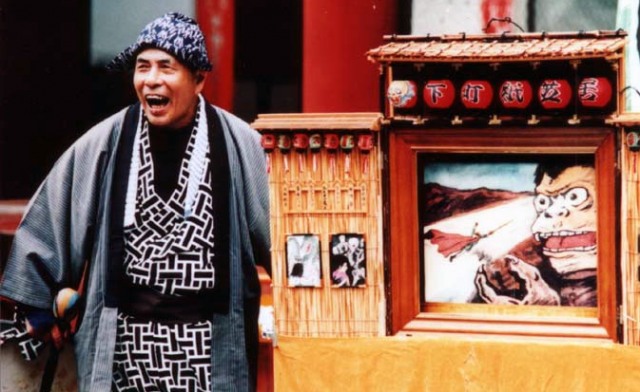
From the early 1920s through the late 1950s, before television became a fixture in Japanese homes, audiences flocked to kamishibai performances on street corners and parks around the country. A kamishibaiya (storyteller) would pedal from village to village with a butai (small wooden stage) perched on the back of his bicycle. When he arrived in a new community, he would click two sticks together to announce his presence, selling candy to the growing assembly of children. He would then show the audience a series of colorfully painted panels that told a story in much the same fashion as a comic book, narrating as he removed them one at a time from the butai.

At the height of its popularity in the 1930s, nearly five million people attended kamishibai performances every day. There were kamishibai for every demographic: sentimental tales about kittens and orphans for girls, adventure stories about masked heroes and mountaineers for boys, and pulpy mysteries and historical dramas for adults. A small army of artists and writers cranked out new installments of popular stories such as Golden Bat, Tiger Boy, Prince Gamma, and Cry of the Andes, providing an important training ground for such postwar manga-ka as Kazuo Koike, Sanpei Shirato, and Shigeru Mizuki.

A contemporary kamishibaiya performs in front of a butai.

Mizuki’s best-known comic, GeGeGe no Kitaro, traces its roots to the 1930s, when kamishibaiya around Japan performed Hakaba no Kitaro, a supernatural tale about a yokai boy who lived in a graveyard. Though Mizuki didn’t create Kitaro, he was responsible for adapting Hakaba no Kitaro into manga form, publishing his first Kitaro stories for the akabon (rental comics) market in 1959. Kitaro eventually found a home at Weekly Shonen Magazine in 1966, where the editors renamed it GeGeGe no Kitaro. Kitaro proved immensely popular, spawning animated television shows, feature-length movies, and video games, not to mention numerous manga sequels in Shonen Sunday, Shonen Action, and Shukan Jitsuwa.

Despite its immense popularity in Japan, none of the GeGeGe no Kitaro manga have been licensed for the North American market. In 2002, Kodansha International hired Ralph McCarthy to translate a handful of the Weekly Shonen Magazine stories, collecting them in three bilingual editions. Those volumes are scarce — at least on this side of the Pacific — although I was able to snag the first on eBay for less than $20. (Caveat emptor: Some Amazon retailers are asking as much as $345.00 for a single volume of the Kodansha Bilingual Comics edition.)

Looking through the pages of volume one, the story’s roots in kamishibai are apparent. The first chapter, “Ghost Train,” is a classic example of comeuppance theater: after two Tokyo businessmen abuse Kitaro and his sidekick Ratman, the men find themselves aboard a mysterious train whose final destination is Tama-reien (Tama Cemetery). The pacing suggests a story told at a campfire, allowing the audience to savor the word play (all the stops on the Tama-reien line have eerie names), the description of the passengers, and the two businessmen’s growing sense of terror. Though the pictures carry the weight of the storytelling, Mizuki uses an omniscient narrator to heighten the reader’s awareness of sound. “The skeleton-thin attendant blew his flute, and a tram came screeching into the station like a rickety hearse,” the narrator informs us. “The door rattled open like the door to a crematorium.”

The narrator serves another important purpose as well, filling in the gap between images, just as a kamishibayai would have done in the 1930s. Towards the end of the story, for example, the two men decide to leap from the train, rather than ride it to its final destination. Mizuki draws their awkward jump, then cuts to an image of the ghost train speeding along a dark track, barely distinguishable from the night sky and grassy wasteland it traverses. “Their heads cracked against something hard — rocks, perhaps,” the narrator explains. “A wail of agony splits the air, then all was silence once again.” This statement proves essential to setting up the story’s punchline, bringing the men’s ordeal to a dramatically suggestive end that is deftly clarified in the last four panels.

The second chapter, “The Leviathing,” owes a debt to such kamishibai mainstays as Golden Bat and Prince Gamma, serial adventures that freely mixed elements of science fiction, mystery, and fantasy. In “Leviathing,” Kitaro joins a scientific expedition to New Guinea, where an unscrupulous scientist injects Kitaro with a prehistoric animal’s blood, transforming Kitaro into a hairy, seven-story beast with the head of a whale and the body of a yeti.

As in “Ghost Train,” an omniscent narrator plays an important role in advancing the story, describing the changes in setting, and revealing the limitations of Kitaro’s new form. “Kitaro tried to yell, ‘Father!’, but all that came out was the Leviathing’s roar,” the narrator intones. “He put down his frightened father and walked away.”

Vital as the narration may be, it’s the artwork that underscores the poignancy of Kitaro’s situation. Mizuki draws the Leviathing in a dramatically different fashion when viewed from below than when viewed close-up: from the perspective of a human bystander, the Leviathing is monstrous, with an enormous, gaping mouth and short, grasping arms. Up close, however, he’s a gentle creature, capable of frowning, sighing, and shedding tears. These close-ups help remind us that it’s Kitaro trapped inside this destructive body, unable to communicate with humans or yokai; there’s simply no place for a giant prehistoric creature in such a thoroughly urbanized landscape, a point underscored by the military’s brutal efforts to eradicate Kitaro by driving him out to sea.

Although “The Leviathing” may strike readers as a sci-fi romp and not a ghost story, it illustrates one of the series’ most important themes: displacement. In many of the Kitaro stories, he struggles to find a place for himself — and his yokai friends — in an increasingly modernized world. As Jonathan Clements observes,

Mizuki was one of the first manga creators to deal with the rush of modernity, depicting Japanese ghosts largely as peaceful, gentle creatures forced into action by the encroachment of human civilisation on their remote, secluded places of haunting. In particular, he cited electric light as the main nemesis of spirits from the otherworld, giving his stories an elegiac quality that celebrates Japanese folktale traditions, even as he laments their passing.

Readers familiar with GeGeGe no Kitaro from its numerous film and television adaptations may find the bilingual edition a frustrating introduction to the manga, as many of the series’ colorful supporting players — Daddy Eyeball, Catchick, and The Sand Witch — play minor-to-nonexistent roles in the first volume. Readers interested in manga’s history, however, will find the first volume of the bilingual edition a fascinating window into the pre-war Japanese entertainment industry, offering English-speakers a hint of the stories and storytelling practices that once enchanted Japanese audiences on street corners around the country. Below, you’ll find a short bibliography of articles and books about Kitaro and kamishibai, should you wish to learn more about this famous character’s roots.

For Further Reading

Clements, Jonathan. “Spooky Ooky.” Schoolgirl Milky Crisis. 13 September 2010. <http://schoolgirlmilkycrisis.com/blog/?p=1710>. Accessed 11/6/11.

Kobayashi, Kenji and Kelly Yamamoto. “Kamishibai Theater.” Japanese American National Museum. <http://www.janm.org/janmkids/kamishibai.php>. Accessed 11/7/11.

Kyogoku, Natsuhiko. “Afterword.” GeGeGe no Kitaro, Vol. 1. Trans. Ralph F. McCarthy. New York: Kodansha International, 2002. 123-25.

McCarthy, Helen. “Spooky Kitaro’s Sixth Generation.” Suite 101. 6 May 2008. <http://helen-mccarthy.suite101.com/spooky-kitaros-sixth-generation-a52997>. Accessed 11/6/11.

Nash, Eric. Manga Kamishibai: The Art of Japanese Paper Theater. New York: Harry N. Abrams, 2009.

Filed Under: Manga Critic Tagged With: GeGeGe no Kitaro, Manga Movable Feast, Shigeru Mizuki, Shonen, Yokai

Manga Artifacts: GeGeGe no Kitaro

November 7, 2011 by Katherine Dacey

From the early 1920s through the late 1950s, before television became a fixture in Japanese homes, audiences flocked to kamishibai performances on street corners and parks around the country. A kamishibaiya (storyteller) would pedal from village to village with a butai (small wooden stage) perched on the back of his bicycle. When he arrived in a new community, he would click two sticks together to announce his presence, selling candy to the growing assembly of children. He would then show the audience a series of colorfully painted panels that told a story in much the same fashion as a comic book, narrating as he removed them one at a time from the butai.

At the height of its popularity in the 1930s, nearly five million people attended kamishibai performances every day. There were kamishibai for every demographic: sentimental tales about kittens and orphans for girls, adventure stories about masked heroes and mountaineers for boys, and pulpy mysteries and historical dramas for adults. A small army of artists and writers cranked out new installments of popular stories such as Golden Bat, Tiger Boy, Prince Gamma, and Cry of the Andes, providing an important training ground for such postwar manga-ka as Kazuo Koike, Sanpei Shirato, and Shigeru Mizuki.

A contemporary kamishibaiya performs in front of a butai.

Mizuki’s best-known comic, GeGeGe no Kitaro, traces its roots to the 1930s, when kamishibaiya around Japan performed Hakaba no Kitaro, a supernatural tale about a yokai boy who lived in a graveyard. Though Mizuki didn’t create Kitaro, he was responsible for adapting Hakaba no Kitaro into manga form, publishing his first Kitaro stories for the akabon (rental comics) market in 1959. Kitaro eventually found a home at Weekly Shonen Magazine in 1966, where the editors renamed it GeGeGe no Kitaro. Kitaro proved immensely popular, spawning animated television shows, feature-length movies, and video games, not to mention numerous manga sequels in Shonen Sunday, Shonen Action, and Shukan Jitsuwa.

Despite its immense popularity in Japan, none of the GeGeGe no Kitaro manga have been licensed for the North American market. In 2002, Kodansha International hired Ralph McCarthy to translate a handful of the Weekly Shonen Magazine stories, collecting them in three bilingual editions. Those volumes are scarce — at least on this side of the Pacific — although I was able to snag the first on eBay for less than $20. (Caveat emptor: Some Amazon retailers are asking as much as $345.00 for a single volume of the Kodansha Bilingual Comics edition.)

Looking through the pages of volume one, the story’s roots in kamishibai are apparent. The first chapter, “Ghost Train,” is a classic example of comeuppance theater: after two Tokyo businessmen abuse Kitaro and his sidekick Ratman, the men find themselves aboard a mysterious train whose final destination is Tama-reien (Tama Cemetery). The pacing suggests a story told at a campfire, allowing the audience to savor the word play (all the stops on the Tama-reien line have eerie names), the description of the passengers, and the two businessmen’s growing sense of terror. Though the pictures carry the weight of the storytelling, Mizuki uses an omniscient narrator to heighten the reader’s awareness of sound. “The skeleton-thin attendant blew his flute, and a tram came screeching into the station like a rickety hearse,” the narrator informs us. “The door rattled open like the door to a crematorium.”

The narrator serves another important purpose as well, filling in the gap between images, just as a kamishibayai would have done in the 1930s. Towards the end of the story, for example, the two men decide to leap from the train, rather than ride it to its final destination. Mizuki draws their awkward jump, then cuts to an image of the ghost train speeding along a dark track, barely distinguishable from the night sky and grassy wasteland it traverses. “Their heads cracked against something hard — rocks, perhaps,” the narrator explains. “A wail of agony splits the air, then all was silence once again.” This statement proves essential to setting up the story’s punchline, bringing the men’s ordeal to a dramatically suggestive end that is deftly clarified in the last four panels.

The second chapter, “The Leviathing,” owes a debt to such kamishibai mainstays as Golden Bat and Prince Gamma, serial adventures that freely mixed elements of science fiction, mystery, and fantasy. In “Leviathing,” Kitaro joins a scientific expedition to New Guinea, where an unscrupulous scientist injects Kitaro with a prehistoric animal’s blood, transforming Kitaro into a hairy, seven-story beast with the head of a whale and the body of a yeti.

As in “Ghost Train,” an omniscent narrator plays an important role in advancing the story, describing the changes in setting, and revealing the limitations of Kitaro’s new form. “Kitaro tried to yell, ‘Father!’, but all that came out was the Leviathing’s roar,” the narrator intones. “He put down his frightened father and walked away.”

Vital as the narration may be, it’s the artwork that underscores the poignancy of Kitaro’s situation. Mizuki draws the Leviathing in a dramatically different fashion when viewed from below than when viewed close-up: from the perspective of a human bystander, the Leviathing is monstrous, with an enormous, gaping mouth and short, grasping arms. Up close, however, he’s a gentle creature, capable of frowning, sighing, and shedding tears. These close-ups help remind us that it’s Kitaro trapped inside this destructive body, unable to communicate with humans or yokai; there’s simply no place for a giant prehistoric creature in such a thoroughly urbanized landscape, a point underscored by the military’s brutal efforts to eradicate Kitaro by driving him out to sea.

Although “The Leviathing” may strike readers as a sci-fi romp and not a ghost story, it illustrates one of the series’ most important themes: displacement. In many of the Kitaro stories, he struggles to find a place for himself — and his yokai friends — in an increasingly modernized world. As Jonathan Clements observes,

Mizuki was one of the first manga creators to deal with the rush of modernity, depicting Japanese ghosts largely as peaceful, gentle creatures forced into action by the encroachment of human civilisation on their remote, secluded places of haunting. In particular, he cited electric light as the main nemesis of spirits from the otherworld, giving his stories an elegiac quality that celebrates Japanese folktale traditions, even as he laments their passing.

Readers familiar with GeGeGe no Kitaro from its numerous film and television adaptations may find the bilingual edition a frustrating introduction to the manga, as many of the series’ colorful supporting players — Daddy Eyeball, Catchick, and The Sand Witch — play minor-to-nonexistent roles in the first volume. Readers interested in manga’s history, however, will find the first volume of the bilingual edition a fascinating window into the pre-war Japanese entertainment industry, offering English-speakers a hint of the stories and storytelling practices that once enchanted Japanese audiences on street corners around the country. Below, you’ll find a short bibliography of articles and books about Kitaro and kamishibai, should you wish to learn more about this famous character’s roots.

For Further Reading

Clements, Jonathan. “Spooky Ooky.” Schoolgirl Milky Crisis. 13 September 2010. <http://schoolgirlmilkycrisis.com/blog/?p=1710>. Accessed 11/6/11.

Kobayashi, Kenji and Kelly Yamamoto. “Kamishibai Theater.” Japanese American National Museum. <http://www.janm.org/janmkids/kamishibai.php>. Accessed 11/7/11.

Kyogoku, Natsuhiko. “Afterword.” GeGeGe no Kitaro, Vol. 1. Trans. Ralph F. McCarthy. New York: Kodansha International, 2002. 123-25.

McCarthy, Helen. “Spooky Kitaro’s Sixth Generation.” Suite 101. 6 May 2008. <http://helen-mccarthy.suite101.com/spooky-kitaros-sixth-generation-a52997>. Accessed 11/6/11.

Nash, Eric. Manga Kamishibai: The Art of Japanese Paper Theater. New York: Harry N. Abrams, 2009.

Filed Under: Manga Critic, REVIEWS Tagged With: GeGeGe no Kitaro, Shigeru Mizuki, Shonen, Yokai

Show Us Your Stuff: Burning Lizard’s Collection

October 4, 2011 by Katherine Dacey 5 Comments

Welcome to the third installment of Show Us Your Stuff, now back at The Manga Critic! If you missed Daniella Orihuela-Griber’s contribution, click here. I’ve also created an archive for this feature here at The Manga Critic, which you can access from the “Features” menu or by clicking here. Today’s contributor is Derek Bown, a writer, student, and shonen manga enthusiast who runs the review site Burning Lizard Studios. Without further ado, here’s Derek in his own words.

Hey, I’m Derek, sometimes known as Burning Lizard. I run an anime, manga, and anything-that-catches-my-fancy review blog. I’m an avid reader and collector of manga, and in the past few years my manga collection has doubled several times. (Especially since the Borders liquidation.) I figured that since I’m like every collector out there: I’m just not satisfied unless I show my collection off to someone. So here you go internet, here is my manga collection.

What was your first manga?
Either One Piece or Ranma 1/2. Both were series that I originally experienced as anime. After my local TV stations started airing only reruns, I turned to the manga to get the rest of the story — which turned out to be crucial for One Piece, since there was an actual story to continue. Ranma 1/2 just managed to both entertain and piss me off towards the later volumes….

Read More

Filed Under: Manga Critic Tagged With: Awesome Manga Collections, One Piece, Shonen

Bloody Monday, Vol. 1

August 30, 2011 by Katherine Dacey 10 Comments

To judge from all the shonen manga I’ve read, the fate of the world rests in teenage boys’ hands: not only do they have the power to kill demons and thwart alien invasions, they’re also blessed with the kind of superior intelligence that makes them natural partners with law enforcement.

Bloody Monday is a textbook example of the teen-genius genre: high school student Fujimaru Takagi dabbles in crime-solving, hacking into secure networks and decoding encrypted files on behalf of the Public Security Intelligence Agency. (Naturally, he works for the PSIA’s super-secret “Third-I” division, which is “comprised solely of elites.”) Fujimaru’s deductive skills are put to the ultimate test when his father is falsely implicated in a murder. To find the real killer, Fujimaru must uncover the connection between his father and the “Christmas Massacre,” a terrorist attack that left thousands of Russian civilians dead, their bodies covered in boils.

In the right hands, Bloody Monday might have been good, silly fun, 24 for the under-twenty-four crowd. The script, however, is pointed and obvious, explaining hacker culture and internet technology to an audience that has grown up on the world-wide web: are there any fifteen-year-olds who don’t grasp the basics of computer viruses? The characters, too, seem impossibly dim, thinking out loud, missing obvious connections, and reminding each other how they’re related, whether they’re fellow reporters for the school newspaper or siblings. Small wonder they don’t realize that their school has been infiltrated by an enemy agent.

The art is more skillful than the script, with polished character designs and detailed backgrounds. The adults actually look like adults, not teenagers with unfortunate laugh lines, while the scenes aboard the Transsiberian Railroad convey the harshness of the Russian landscape. Though artist Kouji Megumi nevers misses an opportunity to show us an attractive woman in her underwear — and really, what well-trained assassin doesn’t snuff a target or two while wearing only a matching bra-and-panty set? — the fanservice never overwhelms the plot. The action sequences, too, are well-staged, using swift cross-cuts and imaginative camera angles to heighten the suspense.

In the end, however, the slick visuals aren’t enough to compensate for the flat-footed storytelling. A plot as potentially interesting and complex as Bloody Monday‘s should challenge the reader to arrive the solution independently, not spoon-feed it; too often, the story seems to have been written in boldface, depriving the reader of an opportunity to guess the outcome of the story for herself.

BLOODY MONDAY, VOL. 1 • STORY BY RYOU RYUMON, ART BY KOUJI MEGUMI • KODANSHA COMICS USA • 200 pp. • RATING: TEEN (13+)

Filed Under: Manga Critic Tagged With: Bloody Monday, kodansha, Shonen

Cage of Eden, Vol. 1

August 25, 2011 by Katherine Dacey 10 Comments

Stop me if you’ve heard this one before: a trans-Pacific flight encounters turbulence, and before any of the passengers can shout “J.J. Abrams!” — or “William Golding!” for that matter — the plane crash-lands an uninhabited tropical island, far from civilization’s reach. In some variations of the story, the island itself poses the greatest danger to survivors, harboring monsters or malevolent spirits. In other versions, the survivors’ own fear and narcissism proves more deadly than any jungle-dwelling creatures, as the rude wilderness strips away the survivors’ veneer of humanity.

In Cage of Eden, Yoshinobu Yamada combines these two survival narratives to tell the story of a high school holiday gone horribly wrong. Cage’s teen heroes crash-land in a prehistoric forest populated by long-extinct animals: saber-toothed tigers, horse-sized birds. These big, hungry predators aren’t the only threat to the students’ safety, however. Yarai, the class delinquent, seizes the opportunity to act on his darkest impulses, terrorizing his peers and the doomed flight’s captain. Only Akira, a small, self-described loser, and Mariya, a bespectacled, anti-social genius, have the skills and the smarts to outwit both enemies.

Though the story unfurls at a good clip, the execution is a little creaky. The opening chapter is a choppy information dump, as Yamada introduces the principal characters, delineates their relationships, and reveals the purpose of their plane trip. Once on the island, Mariya’s computer proves shockingly durable — it boots up without protest, despite plunging 35,000 feet — and helpfully equipped with a searchable database of extinct animals. (“Even without internet, I can still access program files,” Mariya solemnly informs an incredulous Akira.) The characters speak fluent exposition, frequently explaining things to one another that are readily obvious from Yamada’s crisply executed drawings. Worse still, the intelligent dialogue is reserved for the male characters; the few female characters’ primary role is to be menaced, rescued, and ogled, though not necessarily in that order.

However obvious the script or ubiquitous the cheesecake — and yes, the fanservice is executed with all the subtlety of a tap-dancing hippopotamus — Cage of Eden has a cheerful, B-movie vibe that’s hard to resist. The monsters are rendered in loving detail, down to their sinews and feathers and claws; as they tear across the page, it’s not hard to imagine how terrified the characters must be, or how fast they need to run in order to escape. The setting, too, is a boon, offering Yamada numerous places to conceal a dangerous animal or booby trap. Even the characters are effective. Though drawn in broad strokes, Akira is a sympathetic lead; he’s prone to self-doubt after years of being a bench warmer, an academic failure, a mama’s boy, and a second banana to the most popular student in his class. That the island provides him a chance to prove his worth isn’t surprising — that’s de rigeur for the genre — but Akira’s mixture of humility and bravery is refreshing, helping distract the reader from the absurdity of his action-movie heroics.

I won’t make any grand claims for Cage of Eden: on many levels, it’s dumber than a peroxide blonde, with characters doing and saying things that defy common sense. Yet Yoshinobu Yamada demonstrates a genuine flair for writing popcorn-movie manga, populating the island with scary-looking monsters and staging thrilling action sequences that temporarily erase the memory of the clumsy dialogue and panty shots. Cage of Eden is the perfect beach read for the final days of August: it’s fun and fast-paced, placing few demands on the sun-addled reader.

CAGE OF EDEN, VOL. 1 • BY YOSHINOBU YAMADA • KODANSHA COMICS USA • 200 pp. • RATING: OLDER TEEN (16+)

Filed Under: Manga Critic Tagged With: Cage of Eden, kodansha, Shonen

The Best Manga You’re Not Reading: Samurai Crusader

July 9, 2011 by Katherine Dacey

Whenever I see Ryoichi Ikegami’s name attached to a project, I know two things: first, that the manga will be beautifully illustrated, and second, that the plot will be completely nuts. Samurai Crusader, a globe-trotting, name-dropping adventure from the early 1990s, provides an instructive example. The story revolves around a young martial artist who teams up with struggling novelist Ernest Hemingway — yes, that Ernest Hemingway — to prevent an unscrupulous Japanese general from invading Shanghai with Nazi assistance. And if the thought of Hemingway as a butt-kicking action hero isn’t crazy enough, Ikeda and writer Hiroi Oji populate the story with such colorful bit players as a sadistic female military general, a bare-breasted priestess, an axe-wielding Aryan warrior, a demon whisperer, and a ninja with razor-sharp teeth. Ikeda and Oji don’t skimp on the cameos, either; Pablo Picasso, Joseph Goebbels, and Hermann Goering all have brief but memorable walk-on roles, as do Hitler and Emperor Akihito.

This motley assortment of characters are all chasing Kusanagi, a Japanese sword so expertly crafted that it can sever a canon in two. But Kusanagi isn’t just an elegant weapon; it’s a mystical object, capable of bestowing great power on its owner. The Nazis and the Japanese military alike believe that Kusanagi is the key to world domination, and double-cross each other in hopes of stealing it from the Oritsuin clan, a noble Japanese family. Kumomaru, the youngest member of the Oritsuins, is determined to stop both parties from abusing Kusanagi’s power, racing from Paris to Shanghai in a valiant effort to foil Japanese imperial ambitions in China. Along the way Kumomaru befriends Hemingway, beds a sexy French cat burglar, and falls in with a gang of Chinese warriors who disguise themselves as cooks. (As a sign of just how badass these cook-warriors are, each high-ranking solider in the organization has a dragon tattoo… on his tongue.)

As awesomely silly as the plot may be, the real attraction of Samurai Crusader is the art. The period settings provide Ikegami a swell excuse to draw zeppelins and biplanes, Nazi uniforms and samurai formal wear, French ballrooms and Chinese dives. No detail goes overlooked; even the most inconsequential characters’ clothing is meticulously rendered, and the street lamps in every city are drawn with such care as to distinguish a Parisian boulevard from a Shanghai corner.

The character designs, too, are arresting in their specificity; Ikegami’s great strength as an artist is his ability to convey character through odd facial features and posture, whether he’s drawing a crooked industrialist or a street urchin. Though his lead characters are impossibly attractive, Ikegami’s best creation, by far, is Juzo, a stealthy martial artist with the most distinctive set of choppers since James Bond crossed paths with Jaws. Juzo’s shark-like teeth, wild hair, and demonic squint make him an excellent foil for the handsome Kumomaru; Juzo moves with the lethal precision of a cobra, twisting his body into extraordinary positions to better deploy his arsenal of knives, wires, words, and pistols. Oh, and those teeth? They make swell weapons, too.

The only downside to Samurai Crusader is the dialogue. Though the story unfurls at a furious pace, the story grinds to a halt whenever Kumomaru crosses paths with his arch-nemesis, the deluded General Kamishima. Their all-caps exchanges feel more like policy discussions than real arguments, despite Ikegami’s best efforts to stage the scenes as dramatically as possible. Sweat drops bead, veins pulse and pop, but Ikegami can’t disguise the fact that these speeches are kind of a drag. (Sample: “Independence for all of Asia should be the way of Japan! We need national self-determination!”) What redeems these windy passages are the shoot-outs, tank fights, and sword play that proceed and follow them; aside from John Woo and Andrew Lau, few people can make bloodletting look as elegant as Ikegami does.

Perhaps the best way to summarize Samurai Crusader‘s appeal is to say that it has all the virtues of Crying Freeman and Wounded Man — crazy action scenes, sexy leads, mustache-twirling villains — without the copious nudity and sexual violence that can give even the most committed manga fan pause. Readers interested in tracking down copies should note that all three volumes of Samurai Crusader are out of print, though reasonably priced copies are readily available on Amazon and eBay. Highly recommended.

SAMURAI CRUSADER: THE KUMOMARU CHRONICLES, VOLS. 1-3 • STORY BY HIROI OJI, ART BY RYOICHI IKEGAMI • VIZ COMMUNICATIONS, INC. • NO RATING

Filed Under: Manga, Manga Critic, REVIEWS Tagged With: Hiroi Oji, Ryoichi Ikegami, Shonen, VIZ

The Best Manga You’re Not Reading: Samurai Crusader

July 9, 2011 by Katherine Dacey 19 Comments

Whenever I see Ryoichi Ikegami’s name attached to a project, I know two things: first, that the manga will be beautifully illustrated, and second, that the plot will be completely nuts.

Samurai Crusader, a globe-trotting, name-dropping adventure from the early 1990s, provides an instructive example. The story revolves around a young martial artist who teams up with struggling novelist Ernest Hemingway — yes, that Ernest Hemingway — to prevent an unscrupulous Japanese general from invading Shanghai with Nazi assistance. And if the thought of Hemingway as a butt-kicking action hero isn’t crazy enough, Ikeda and writer Hiroi Oji populate the story with such colorful bit players as a sadistic female military general, a bare-breasted priestess, an axe-wielding Aryan warrior, a demon whisperer, and a ninja with razor-sharp teeth. Ikeda and Oji don’t skimp on the cameos, either; Pablo Picasso, Joseph Goebbels, and Hermann Goering all have brief but memorable walk-on roles, as do Hitler and Emperor Akihito.

This motley assortment of characters are all chasing Kusanagi, a Japanese sword so expertly crafted that it can sever a canon in two. But Kusanagi isn’t just an elegant weapon; it’s a mystical object, capable of bestowing great power on its owner. The Nazis and the Japanese military alike believe that Kusanagi is the key to world domination, and double-cross each other in hopes of stealing it from the Oritsuin clan, a noble Japanese family. Kumomaru, the youngest member of the Oritsuins, is determined to stop both parties from abusing Kusanagi’s power, racing from Paris to Shanghai in a valiant effort to foil Japanese imperial ambitions in China. Along the way Kumomaru befriends Hemingway, beds a sexy French cat burglar, and falls in with a gang of Chinese warriors who disguise themselves as cooks. (As a sign of just how badass these cook-warriors are, each high-ranking solider in the organization has a dragon tattoo… on his tongue.)

As awesomely silly as the plot may be, the real attraction of Samurai Crusader is the art. The period settings provide Ikegami a swell excuse to draw zeppelins and biplanes, Nazi uniforms and samurai formal wear, French ballrooms and Chinese dives. No detail goes overlooked; even the most inconsequential characters’ clothing is meticulously rendered, and the street lamps in every city are drawn with such care as to distinguish a Parisian boulevard from a Shanghai corner.

The character designs, too, are arresting in their specificity; Ikegami’s great strength as an artist is his ability to convey character through odd facial features and posture, whether he’s drawing a crooked industrialist or a street urchin. Though his lead characters are impossibly attractive, Ikegami’s best creation, by far, is Juzo, a stealthy martial artist with the most distinctive set of choppers since James Bond crossed paths with Jaws. Juzo’s shark-like teeth, wild hair, and demonic squint make him an excellent foil for the handsome Kumomaru; Juzo moves with the lethal precision of a cobra, twisting his body into extraordinary positions to better deploy his arsenal of knives, wires, words, and pistols. Oh, and those teeth? They make swell weapons, too.

The only downside to Samurai Crusader is the dialogue. Though the story unfurls at a furious pace, the story grinds to a halt whenever Kumomaru crosses paths with his arch-nemesis, the deluded General Kamishima. Their all-caps exchanges feel more like policy discussions than real arguments, despite Ikegami’s best efforts to stage the scenes as dramatically as possible. Sweat drops bead, veins pulse and pop, but Ikegami can’t disguise the fact that these speeches are kind of a drag. (Sample: “Independence for all of Asia should be the way of Japan! We need national self-determination!”) What redeems these windy passages are the shoot-outs, tank fights, and sword play that proceed and follow them; aside from John Woo and Andrew Lau, few people can make bloodletting look as elegant as Ikegami does.

Perhaps the best way to summarize Samurai Crusader‘s appeal is to say that it has all the virtues of Crying Freeman and Wounded Man — crazy action scenes, sexy leads, mustache-twirling villains — without the copious nudity and sexual violence that can give even the most committed manga fan pause. Readers interested in tracking down copies should note that all three volumes of Samurai Crusader are out of print, though reasonably priced copies are readily available on Amazon and eBay. Highly recommended.

SAMURAI CRUSADER: THE KUMOMARU CHRONICLES, VOLS. 1-3 • STORY BY HIROI OJI, ART BY RYOICHI IKEGAMI • VIZ COMMUNICATIONS, INC. • NO RATING

Filed Under: Manga Critic Tagged With: Hiroi Oji, Ryoichi Ikegami, Shonen, VIZ

Monster Hunter Orage, Vol. 1

July 4, 2011 by Katherine Dacey

As a critic, few words fill me with more trepidation than “inspired by the popular video game.” I’ve read my share of video game manga, most of which were thin on plot and characterization but heavy on explanation. Every so often, however, I run across a series like Monster Hunter Orage, which manages to stay true to its roots while offering something to readers who’ve never played the game.

What makes Monster Hunter work is Hiro Mashima’s script, which does a solid job of translating game play into genuine plot. In the original game, players answered to a town guild, accepting orders to hunt or capture a variety of monsters. Players could fly solo or team up with one, two, or three other gamers to bring down bigger monsters and boost their skill rating. (The ultimate object of the game was to attain the highest skill level, rather than accumulate the greatest number of points.)

In the manga, Mashima builds a story around Shiki, a hunter on a quest to find Myo Galuna, a.k.a. the Thunder Dragon. Shiki is a Seal Hunter, a special category of monster-slayer who’s free to pursue game without interference from town guilds. Though he’s strong and skilled, his brash behavior and social cluelessness prove serious barriers to finding comrades — that is, until he meets Ailee, a fiercely independent hunter who shares Shiki’s desire to find the Thunder Dragon, and Sakya, a gunner who wants to avenge her father’s death.

Shiki and Ailee’s peppery rapport provides a welcome jolt of comic energy, whether they’re arguing about how to kill a monster or how to catch dinner. Like many of Mashima’s heroines, Ailee has little tolerance for teenage male foolishness, and frequently dismisses Shiki with a withering comment. (When they first meet, for example, Shiki blurts out, “Say, haven’t we met before?”, to which Ailee replies, “It’s been forever since I heard that stale pick-up line. Wait. Don’t respond. Just go somewhere else.”) Other supporting characters play a similar role in keeping the tone breezy: the Prince, a preening, foolish hunter, is font of malapropisms, while Maru, the Prince’s sidekick, provides an energetic stream of patter whenever the two appear together.

The art is as nimble as the script, relying heavily on Mashima’s crisp linework to give definition to his characters, monsters, and landscapes; he’s as sparing with screentone as Arina Tanemura is with white space. Though the characters have marvelous, elastic faces, capable of registering fifteen degrees of surprise and indignation, the monsters are unimpressive; they look a lot like dinosaurs with extra feathers and appendages. Put the men and the monsters together, however, and the results are terrific: the fights are graceful and swift, allowing the main characters to demonstrate their martial arts acumen without dragging out the conflict over three or four chapters.

If I had any complaint about Monster Hunter Orage, it’s that the story quickly falls into a predictable pattern. The outcome of the fights is never in question, nor is Shiki’s role as the hunter who will ultimately be the one to outsmart the monster. Even efforts to introduce subplots only go so far; by the end of volume one, it’s clear that the Prince will do anything to destroy Shiki, but his buffoonish behavior and general incompetence make him a less-than-credible threat to the heroes.

But if Monster Hunter isn’t as deep as it could be, it’s still a lot of fun, propelled by a goofy, anything-for-a-laugh script, appealing characters, and plenty of man-on-monster action. And at four volumes, the series won’t overstay its welcome. A good beach read.

MONSTER HUNTER ORAGE, VOL. 1 • BY HIRO MASHIMA • KODANSHA COMICS USA • 192 pp. • RATING: TEEN (13+)

Filed Under: Manga, Manga Critic, REVIEWS Tagged With: Capcom, Hiro Mashima, kodansha, monster hunter orage, Shonen

Monster Hunter Orage, Vol. 1

July 4, 2011 by Katherine Dacey 11 Comments

As a critic, few words fill me with more trepidation than “inspired by the popular video game.” I’ve read my share of video game manga, most of which were thin on plot and characterization but heavy on explanation. Every so often, however, I run across a series like Monster Hunter Orage, which manages to stay true to its roots while offering something to readers who’ve never played the game.

What makes Monster Hunter work is Hiro Mashima’s script, which does a solid job of translating game play into genuine plot. In the original game, players answered to a town guild, accepting orders to hunt or capture a variety of monsters. Players could fly solo or team up with one, two, or three other gamers to bring down bigger monsters and boost their skill rating. (The ultimate object of the game was to attain the highest skill level, rather than accumulate the greatest number of points.)

In the manga, Mashima builds a story around Shiki, a hunter on a quest to find Myo Galuna, a.k.a. the Thunder Dragon. Shiki is a Seal Hunter, a special category of monster-slayer who’s free to pursue game without interference from town guilds. Though he’s strong and skilled, his brash behavior and social cluelessness prove serious barriers to finding comrades — that is, until he meets Ailee, a fiercely independent hunter who shares Shiki’s desire to find the Thunder Dragon, and Sakya, a gunner who wants to avenge her father’s death.

Shiki and Ailee’s peppery rapport provides a welcome jolt of comic energy, whether they’re arguing about how to kill a monster or how to catch dinner. Like many of Mashima’s heroines, Ailee has little tolerance for teenage male foolishness, and frequently dismisses Shiki with a withering comment. (When they first meet, for example, Shiki blurts out, “Say, haven’t we met before?”, to which Ailee replies, “It’s been forever since I heard that stale pick-up line. Wait. Don’t respond. Just go somewhere else.”) Other supporting characters play a similar role in keeping the tone breezy: the Prince, a preening, foolish hunter, is font of malapropisms, while Maru, the Prince’s sidekick, provides an energetic stream of patter whenever the two appear together.

The art is as nimble as the script, relying heavily on Mashima’s crisp linework to give definition to his characters, monsters, and landscapes; he’s as sparing with screentone as Arina Tanemura is with white space. Though the characters have marvelous, elastic faces, capable of registering fifteen degrees of surprise and indignation, the monsters are unimpressive; they look a lot like dinosaurs with extra feathers and appendages. Put the men and the monsters together, however, and the results are terrific: the fights are graceful and swift, allowing the main characters to demonstrate their martial arts acumen without dragging out the conflict over three or four chapters.

If I had any complaint about Monster Hunter Orage, it’s that the story quickly falls into a predictable pattern. The outcome of the fights is never in question, nor is Shiki’s role as the hunter who will ultimately be the one to outsmart the monster. Even efforts to introduce subplots only go so far; by the end of volume one, it’s clear that the Prince will do anything to destroy Shiki, but his buffoonish behavior and general incompetence make him a less-than-credible threat to the heroes.

But if Monster Hunter isn’t as deep as it could be, it’s still a lot of fun, propelled by a goofy, anything-for-a-laugh script, appealing characters, and plenty of man-on-monster action. And at four volumes, the series won’t overstay its welcome. A good beach read.

MONSTER HUNTER ORAGE, VOL. 1 • BY HIRO MASHIMA • KODANSHA COMICS USA • 192 pp. • RATING: TEEN (13+)

Filed Under: Manga Critic Tagged With: Capcom, Hiro Mashima, kodansha, monster hunter orage, Shonen

  • « Go to Previous Page
  • Page 1
  • Page 2
  • Page 3
  • Page 4
  • Page 5
  • Page 6
  • Page 7
  • Go to Next Page »
 | Log in
Copyright © 2010 Manga Bookshelf | Powered by WordPress & the Genesis Framework