• Skip to primary navigation
  • Skip to main content
  • Skip to primary sidebar
  • Home
  • About Us
    • Privacy Policy
    • Comment Policy
    • Disclosures & Disclaimers
  • Resources
    • Links, Essays & Articles
    • Fandomology!
    • CLAMP Directory
    • BlogRoll
  • Features & Columns
    • 3 Things Thursday
    • Adventures in the Key of Shoujo
    • Bit & Blips (game reviews)
    • BL BOOKRACK
    • Bookshelf Briefs
    • Bringing the Drama
    • Comic Conversion
    • Fanservice Friday
    • Going Digital
    • It Came From the Sinosphere
    • License This!
    • Magazine no Mori
    • My Week in Manga
    • OFF THE SHELF
    • Not By Manga Alone
    • PICK OF THE WEEK
    • Subtitles & Sensibility
    • Weekly Shonen Jump Recaps
  • Manga Moveable Feast
    • MMF Full Archive
    • Yun Kouga
    • CLAMP
    • Shojo Beat
    • Osamu Tezuka
    • Sailor Moon
    • Fruits Basket
    • Takehiko Inoue
    • Wild Adapter
    • One Piece
    • After School Nightmare
    • Karakuri Odette
    • Paradise Kiss
    • The Color Trilogy
    • To Terra…
    • Sexy Voice & Robo
  • Browse by Author
    • Sean Gaffney
    • Anna Neatrour
    • Michelle Smith
    • Katherine Dacey
    • MJ
    • Brigid Alverson
    • Travis Anderson
    • Phillip Anthony
    • Derek Bown
    • Jaci Dahlvang
    • Angela Eastman
    • Erica Friedman
    • Sara K.
    • Megan Purdy
    • Emily Snodgrass
    • Nancy Thistlethwaite
    • Eva Volin
    • David Welsh
  • MB Blogs
    • A Case Suitable For Treatment
    • Experiments in Manga
    • MangaBlog
    • The Manga Critic
    • Manga Report
    • Soliloquy in Blue
    • Manga Curmudgeon (archive)

Manga Bookshelf

Discussion, Resources, Roundtables, & Reviews

Seinen

No Longer Human, Vol. 1

November 24, 2011 by Katherine Dacey 4 Comments

First published in 1948, Osamu Dazai’s No Longer Human became one of the most widely read books in post-war Japan. The story, modeled on Dazai’s own life, chronicles a dissolute young man’s profound estrangement from his family and peers. The protagonist’s life follows a trajectory similar to Dazai’s: convinced that his life is an empty charade, Yozo drops out of school; joins the Communist Party; enters into a suicide pact with a virtual stranger; and woos lonely women, using them for shelter, emotional comfort, and financial support after his father, a prominent politician, disowns him.

The novel is divided into three sections, or “notebooks,” each corresponding to a period in the protagonist’s life. In the first, Yozo describes his childhood: his uneasy relationship with his father, his clownish behavior at school, and his abuse at the hands of a female servant. In the second and third sections, Yozo documents his troubled adulthood, as he abandons school for a life of drinking and illicit relationships, bouncing from one woman to the next with little regard for the harm he causes them — or himself. Framing Yozo’s story is a second narrative delivered by an unnamed author who has found three photographs of Yozo: as a child of ten, “a small boy surrounded by a great many women”; as a college student, handsome but “strangely unpleasant”; and as man in his later twenties, his hair “streaked with gray,” and his face “devoid of expression.”*

Given the novel’s enduring popularity, it’s no surprise that several manga artists have adapted Dazai’s text as a graphic novel. Their approaches have ranged from reverential — the East Press edition (2007) hews closely to the original novel — to provocative — Yasunori Ninose’s version (2010) uses tentacle-porn imagery to represent the character’s extreme emotional distress. Usamaru Furuya’s 2009 adaptation falls somewhere in between, taking liberties with the setting and structure of Dazai’s work, while preserving the original tone and events of the novel.

As these myriad approaches suggest, one of the biggest challenges of translating No Longer Human into a pictorial form is its interiority: though eventful, Yozo’s story is as much about his state of mind as his behavior. Early in the novel, for example, Yozo describes his inability to understand how other people feel and think. “I have not the remotest clue what the nature or extent of my neighbor’s woes can be,” he tells the reader. “It is almost impossible for me to converse with other people.” In a desperate attempt to camouflage his bewilderment, Yozo constructs a jovial mask, winning approval from his family members and classmates with impish behavior and remarks. “I kept my melancholy and my agitation hidden, careful lest any trace should be left exposed,” he explains. “I feigned an innocent optimism; I gradually perfected myself in the role of the farcical eccentric.”

Furuya makes a game effort to find visual analogues for Yozo’s interior states. Whenever Yozo feels emotionally disoriented, for example, Furuya obscures the other characters’ expressions, rendering their faces as blurs. Furuya extends this symbolic approach to Yozo’s social paralysis as well. “I was congenitally unable to refuse anything offered to me by another person, no matter how little it might suit my tastes,” Yozo confesses. “In other words, I hadn’t the strength even to choose between two alternatives.” In these passages, Furuya draws Yozo as a marionette, violently manipulated by an unseen puppeteer; as a drowning victim, disappearing under the water’s surface; and as a man engulfed in flames, so consumed by his fear of disappointing others that he surrenders his own agency.

Though Furuya follows the basic outline of Dazai’s novel, he makes two significant changes to the text. First, he moves the story from pre-war Japan to the present day, replacing the unnamed narrator with a character named Usamaru Furuya, a manga artist who discovers Yozo’s pictures on the internet. Second, Furuya streamlines the script, all but eliminating the first notebook; instead, he depicts Yozo’s childhood through a few brief, suggestive flashbacks.

The first decision makes good sense. By moving the setting from Taisho-era Japan to the present, Furuya sheds the novel’s period trappings in favor of a milieu that readers can intuitively appreciate — a world of blogs, cell-phones, high-rise apartment buildings, and other technologies that promote social isolation.

Less successful is Furuya’s decision to focus on Yozo’s adult life to the exclusion of his childhood. In the original novel, ten-year-old Yozo crosses paths with another outsider, a young boy who immediately detects the effort and strain behind Yozo’s clowning.  Fearful that Takeichi will expose his deceit to the other students, Yozo dons “the gentle beguiling smile of the false Christian,” befriending the odd, unlikeable Takeichi in an effort to buy his silence. The episode is among the most potent and revealing in the book, an early example of Yozo’s ability to manipulate others, and a rare example of him acknowledging his own agency — something he never does in the manga.

Furuya also trims another brief but important scene from the early pages of No Longer Human, in which Yozo implies that he was molested by his wealthy family’s servants. “Already by that time I had been taught a lamentable thing by the maids and menservants; I was being corrupted,” Yozo declares. “I now think that that to perpetrate such a thing on a small child is the ugliest, vilest, cruelest crime a human being can commit.” Yozo’s indifference to others’ suffering, inability to experience romantic love, and passive-aggressive behavior, suggest a pathology rooted in this formative experience. Perhaps Furuya found this passage too neatly Freudian for his purposes, but in choosing to omit it, he makes Yozo seem like just another cad who beds and discards women, rather than a wounded soul incapable of sexual intimacy.

Yet for all its shortcomings — the omissions, the obvious symbolism — Furuya’s adaptation still captures the raw power of Dazai’s original novel. In its best passages, Furuya makes us feel as dazed and lonely as Yozo himself; we appreciate how helpless he feels, though we can see how seductive — and dangerous — he can be. Furuya also manages to document the full extent of Yozo’s debauchery without eroticizing it; we are keenly aware of the emotional distance between Yozo and his sexual conquests, making these scenes feel joyless and awkward, rather than titillating in their explicitness.

In short, Furuya has found a way to transform Dazai’s sharp critique of pre-war Japanese society into a more universal text, one that raises the question, What does it mean to be human right now?

* All quotations taken from Donald Keene’s translation (New York: Penguin Books, 1958).

Review copy provided by Vertical, Inc.

NO LONGER HUMAN, VOL. 1 • NOVEL BY OSAMU DAZAI, ADAPTATION BY USAMARU FURUYA • VERTICAL, INC. • RATING: OLDER TEEN (16+)

Filed Under: Manga Critic Tagged With: Osamu Dazai, Seinen, Usamaru Furuya, vertical

The Edge of Darkness, Comic @Bunch

September 29, 2011 by Erica Friedman Leave a Comment

If you’ve read anything I’ve written about manga magazines, you know I love the obscure and unique. Not AX unique, “look at me, I’m so experimental! Penises!” unique. I like unique when it comes by it honestly. Authentic oddballity, if you will.  Fortuitous circumstance lead me, therefore, to Monthly Comic @Bunch.

Monthly Comic @Bunch is a relative newcomer to the comic scene. Replacing Weekly Comic Bunch, along with Monthly Comic Zenon, Monthly Comic @Bunch began publication in January 2011. There are no circulation numbers available yet, and Weekly Comic Bunch last posted data in 2008, with a monthly circulation of 182,672. At 650 yen ( $8.50 at time of writing) for about 670 pages, you’re getting a page per yen of action, adventure and a fair measure of screaming, for one reason or another.

Compared with other Seinen magazines, Monthly Comic @Bunch  feels very much as if the editorial staff’s main requirement is that the artists draw something they want to draw, as opposed to something that will sell. As a result, there’s no one cohesive thread in Bunch’s choices.  Explosion- and violence-filled “BTOOOM!” by Inoue Junya sits side by side with Mizu Asato’s children-and-animals story “Meina no Fukurou.”

What will probably strike a Western audience first is that few, if any, of the creators or stories’ names are known here. With the exception of some of the “Hokuto no Ken” (Fist of the North Star) stories, and Usamaru Furuya’s manga adaptation of Dazai Osamu’s No Longer Human, both of which ran in Weekly Comic Bunch,  Monthly Comic @Bunch is filled with talented artists and skilled storytelling that we’ll probably never see here in English.

Monthly Comic @Bunch does have a website, Web@Bunch, with samples of manga, both running currently, and website-only. The site includes messages from the creators, a blog, links to published collected volumes and the usual sort of functions on magazine websites.

The standout Monthly Comic @Bunch series for me are Nakajima Michitsune’s fantasy war story, “Gunka no Baltzar” set in a Napoleonic War-style setting, about a young man moving up through the ranks; police action/adventure story “Ouroboros” by Kanzaki Hiroya, and the story that dragged me here in the first place, “Avare Senki” by Nakamura Ching. Let me talk a little bit about this story, because in a world where Bakuman is being talked about so often, there needs to be an “Avare Senki.”

Bakuman is a fictionalized story about two young men trying to make it in the manga world, written and drawn by two men who have made it in the manga world. “Avare Senki” (which translates to something like “Stingy Wars” or maybe the “Battle of Cheeseparing,” or “Miserly Combat,”) is a story about the bone-crushing poverty and exhaustion endured by a manga artist and her assistants when she’s working steadily, but has not “made” it. Wrapped in a plot of working on a fantasy series called Avare Senki, Nakamura-sensei draws a sobering, but not entirely depressing, tale of deadlines, ramen, smoking and recycling materials. For people who want to really see behind the curtain of a manga artist’s life, forget Bakuman, and turn to “Avare Senki.” It will open your eyes, I assure you.

When compared with many Seinen magazines, there’s a refreshing lack of creepy fanservice here. The magazine feels quite manly overall, and there is a sense of edginess to it that pervades most of the pages, even if it eschews the most banal tropes of fanservice. This isn’t to say there is none – but when compared with many of the top Shounen magazines, this magazine is significantly more mature.

For fans of the obscure, the authentically edgy, Monthly Comic @Bunch, is a don’t-miss magazine.

Monthly Comic @Bunch from Shinchosha Publishing: http://www.comicbunch.com/

Filed Under: Magazine no Mori Tagged With: Manga Magazine, Seinen, Shinchosha

Taking a Close Look at Ultra Jump

June 16, 2011 by Erica Friedman 11 Comments

This article was originally published at Mangacast.net.

As sure as boys become men, some boys who read manga become men who read manga. And, at some point, battles for ninja clan supremacy fail to fully meet the emotional needs of that audience. No, that audience wants more violence, less focus on teamwork and strangely uncomfortable series that resolve without ending or end without resolving. For these readers, Ultra Jump is the magazine of choice.

Running 16 series currently, Ultra Jump is heavy on the sci-fi/fantasy and action, with some martial arts and a soupçon of magic. Ultra Jump got it’s start in 1999, some 30 years after it’s younger brother Shounen Jump. UJ is a monthly magazine, retailing in Japan for ¥560 ($6.65USD at time of writing) for just over 500 pages and like Shounen Jump, it’s available pretty much anywhere manga magazines are sold in Japan and in most Japanese bookstores in America. The 2010 circulation for Ultra Jump is reported to be 73,20 which is slightly up from 2009’s 70,834 and close to the 2008 circulation.  Ultra Jump has a digital magazine called Ultra Jump Egg, which provides sample chapters of manga series that have just begun to run in the magazine or, are perhaps being considered for it.

Of the series running currently in Ultra Jump, several have had a checkered experience on US shores. Infamously, Tenjou Tenge, which recently finished, was originally licensed by CMX, who had the nerve to deprive the readership of a glimpse of girl’s underwear and was therefore censured strongly by the folks least likely to actually buy the thing anyway. Viz has rescued this audience from that hell of not being able to see girl’s underwear, and new omnibus volumes are starting to hit the shelves.  Hayate x Blade (the actual reason that I get Ultra Jump) has been licensed and published through volume 6 by Seven Seas. Because Sevens Seas licensed the title from the original publisher, Mediaworks (who ran it in Dengeki Daioh magazine through Volume 8, when it moved to Shuiesha and Ultra Jump,) there is some confusion among fans whether Seven Seas will be able to continue it at least through that point or whether Volume 6 will be as far as the series makes it in English.

Because Ultra Jump is a Shueisha book, it’s no surprise that Viz has a strong presence in the UJ license game. Hyperviolent dystopian Gumn, known here as Battle Angel Alita, has undergone only slightly fewer iterations on these shores as it has in Japan and has managed to successfully reach Volume 14 of the Final Order series. Volume 15 is slated to be released in autumn 2011 Bastard!!, which made it to Volume 19 in English, is known for going on hiatus with some regularity (and has reached that stage of “venerable old series, which means it is serialized on the order of twice a year, perhaps.) Bastard!! is now on hiatus in English, as well. Also currently published by Viz is the hyperviolent dystopian Dogs, Bullets and Carnage.

Ultra Jump series have a tendency to be very long-running as manga series, (Ninku, Tenjou Tenge, Gunm, Steel Ball Run) but if they are turned into an anime at all, the anime tend to be OVAs or short series without second seasons. The overwhelming feeling as a reader is that this is a magazine for readers of manga, as opposed to anime/manga fans. And not just readers, but readers who are in for the long haul, who are content to see the plot develop through long fight arcs and the small spaces in between them. Of the remaining unlicensed titles, I can see Jumbor being ported here, fueled by any success with Takei Hiroyuki’s collaboration with Stan Lee, Ultimo – Jumbor has very similar character designs, but a slightly more classic sci-fi feel. And I wonder if America would be ready for a Wild West manga like Minagawa Ryouji’s Peace Maker. Viz is still slowly popping out Jojo’s Bizarre Adventure, so there’s at least a chance that, when that finishes, Steel Ball Run, a hyperviolent dystopian tale of the meanest polo game you ever did see, might make it over here. That, or when they hit the lottery and want to throw some of that money away on something people want, but will never buy.

The hyperviolent dystopian magical series Anima Chal Lives (one of my personal faves in the magazine), Grandeek Reel, Heaven’s Prison and Hatsukoi Magical Blitz all have about the same chance of being licensed as Needless, which is to say little, for any number of reasons, from constant, uneditable nudity, to constant, uneditable semi-nudity. (The Needless anime was licensed, I’m still not sure why. never was there a better-named series.)

I’ve seen UJ alternately labeled shounen (for boys, say 12-15) and seinen (for young men, say 16-25.) I’d weigh in on the side of seinen. It’s not that young boys can’t or won’t read and stick with long series – One Piece proves the lie on that pretty quickly – but that the sensibility of the stories, and the crises of identities are more “adult,” if you will. When I began this article, I was surprised, pleasantly, at how many of the series for this magazine have made it over here.  Viz has already resurrected Tenjou Tenge and, damn I’d love to hear that Hayate x Blade will be continued.

Ultra Jump, published monthly by Shueisha. http://ultra.shueisha.co.jp/


Erica Friedman write reviews of Yuri Manga, Anime and related media at her blog Okazu .

Filed Under: Magazine no Mori Tagged With: Manga Magazine, Seinen, Shounen, Shueisha

A Zoo in Winter

May 28, 2011 by Katherine Dacey 19 Comments

One of the best-selling manga in the US right now is Bakuman, a drama about two teens trying to break into the Japanese comics industry. Flipping through the first two volumes, it’s easy to see why the series has such an ardent following: Tsugumi Ohba and Takeshi Obata have portrayed the characters’ journey not as an aesthetic or introspective process, but as an adventure story in which the boys battle progressively more talented opponents while they work toward their ultimate goal of creating a hit series.

For all its lip service to perseverance and craft, Bakuman is, at heart, a fantasy that trumpets youth, native ability, and confidence as the keys to artistic success. To be sure, Ohba and Obata make a concerted effort to show their characters engaged in the less dramatic aspects of manga-making: brainstorming story ideas, working with an editor, experimenting with unfamiliar tools. These scenes aren’t really meant to chart the boys’ growth as artists, however, but to reinforce the idea that Mashiro and Takagi are naturals.

Jiro Taniguchi’s forthcoming A Zoo in Winter offers a very different perspective on breaking into the manga industry, one in which the principle character engages in a long, complicated, and frequently humbling process of refining his skills. When we first meet seventeen-year-old Mitsuo Hamaguchi, he’s working at a manufacturing company, contemplating a future designing textiles while harboring dreams of becoming an artist. Hamaguchi spends his free time sketching animals at the local zoo, and chaperoning his boss’ wayward daughter on excursions around town.

At loose ends, Hamaguchi visits Tokyo on a whim, landing a position as an assistant to popular manga-ka Shiro Kondo. The work is anything but glamorous: Hamaguchi frequently pulls all-nighters, erasing pencil marks, blacking in objects, drawing speedlines, and copying backgrounds from other assistants’ drawings. Working on Kondo’s manga rekindles Hamaguchi’s own childhood ambition to become an artist, inspiring Hamaguchi to take live drawing classes and start work on his own story — a goal that proves more elusive than Hamaguchi imagined.

Hamaguchi’s emotional development is as fitful as his artistic. Though he’s savoring his independence, he frequently reverts to adolescent behavior whenever he hits a roadblock, wallowing in self-pity when another assistant seems poised to get his big break, for example, or drinking himself into a stupor when his girlfriend moves away. Hamaguchi’s relationship with his older brother is particularly telling: separated by ten years, Hamaguchi continues to view him as a father figure, squirming in embarrassment when his brother visits Kondo’s studio. (“Please, brother, try to mind your own business,” Hamaguchi pleads.) As their visit progresses, however, Hamaguchi marvels at his brother’s ability to chat up Kondo and mix with the bohemian element at the assistants’ favorite dive-bar, gradually realizing that his older brother isn’t as judgmental or rigid as Hamaguchi assumed, just deeply concerned with the family’s welfare.

In another artist’s hands, Hamaguchi’s brother might have been a sterner figure, one who dismissed an artistic career as a frivolous or irresponsible choice. Yet Jiro Taniguchi resists the temptation to make Hamaguchi’s brother into a straw man, instead allowing Hamaguchi to discover his brother’s relaxed decency for himself; Hamaguchi’s epiphany is a small one, but one that brings him a few steps closer to adulthood. Taniguchi manages the difficult feat of honoring the sincerity of Hamaguchi’s feelings while creating emotional distance between Hamaguchi and the reader; we’re not invited to experience Hamaguchi’s embarrassment so much as remember what it was like to learn that our parents were, in fact, just like all the other adults we knew and liked.

What makes these passages even more effective is Taniguchi’s draftsmanship. Though he has always been a superb illustrator, capable of evoking the bustling sprawl of a Japanese city or the craggy face of a mountain, his characters’ faces often had an impassive, Noh-mask quality. In Zoo in Winter, however, the characters’ facial expressions are rendered with the same precision he usually reserves for landscapes and interiors, capturing subtle shifts in their attitudes and emotions. Not that Taniguchi neglects the urban environment; one of the manga’s loveliest sequences unfolds in a zoo on a snowy day. Anyone who’s had the experience of running in Central Park on a rainy November afternoon, or walking a winter beach will immediately recognize Hamaguchi’s elation at having the zoo to himself, and of seeing the landscape transformed by the weather.

It’s the subtlety of the characterizations, however, that will remain with readers long after they’ve finished A Zoo in Winter. The story does more than just dramatize Hamaguchi’s journey from adolescence to adulthood; it shows us how his emotional maturation informs every aspect of his artistry — something that’s missing from many other portrait-of-an-artist-as-a-young-man sagas, which place much greater emphasis on the pleasure of professional recognition than on the satisfaction of mastering one’s craft. To be fair, Ohba and Obata address the issue of craft in Bakuman, but I’ll take the quiet honesty of A Zoo in Winter over the sound and fury of a Shonen Jump title any day. Highly recommended.

Review copy provided by Fanfare/Ponent Mon. A Zoo in Winter will be released on June 23, 2011.

A ZOO IN WINTER • BY JIRO TANIGUCHI • FANFARE/PONENT MON • 232 pp.

Filed Under: Manga Critic Tagged With: Fanfare/Ponent Mon, Jiro Taniguchi, Seinen

A Zoo in Winter

May 28, 2011 by Katherine Dacey

One of the best-selling manga in the US right now is Bakuman, a drama about two teens trying to break into the Japanese comics industry. Flipping through the first two volumes, it’s easy to see why the series has such an ardent following: Tsugumi Ohba and Takeshi Obata have portrayed the characters’ journey not as an aesthetic or introspective process, but as an adventure story in which the boys battle progressively more talented opponents while they work toward their ultimate goal of creating a hit series.

For all its lip service to perseverance and craft, Bakuman is, at heart, a fantasy that trumpets youth, native ability, and confidence as the keys to artistic success. To be sure, Ohba and Obata make a concerted effort to show their characters engaged in the less dramatic aspects of manga-making: brainstorming story ideas, working with an editor, experimenting with unfamiliar tools. These scenes aren’t really meant to chart the boys’ growth as artists, however, but to reinforce the idea that Mashiro and Takagi are naturals.

Jiro Taniguchi’s forthcoming A Zoo in Winter offers a very different perspective on breaking into the manga industry, one in which the principle character engages in a long, complicated, and frequently humbling process of refining his skills. When we first meet seventeen-year-old Mitsuo Hamaguchi, he’s working at a manufacturing company, contemplating a future designing textiles while harboring dreams of becoming an artist. Hamaguchi spends his free time sketching animals at the local zoo, and chaperoning his boss’ wayward daughter on excursions around town.

At loose ends, Hamaguchi visits Tokyo on a whim, landing a position as an assistant to popular manga-ka Shiro Kondo. The work is anything but glamorous: Hamaguchi frequently pulls all-nighters, erasing pencil marks, blacking in objects, drawing speedlines, and copying backgrounds from other assistants’ drawings. Working on Kondo’s manga rekindles Hamaguchi’s own childhood ambition to become an artist, inspiring Hamaguchi to take live drawing classes and start work on his own story — a goal that proves more elusive than Hamaguchi imagined.

Hamaguchi’s emotional development is as fitful as his artistic. Though he’s savoring his independence, he frequently reverts to adolescent behavior whenever he hits a roadblock, wallowing in self-pity when another assistant seems poised to get his big break, for example, or drinking himself into a stupor when his girlfriend moves away. Hamaguchi’s relationship with his older brother is particularly telling: separated by ten years, Hamaguchi continues to view him as a father figure, squirming in embarrassment when his brother visits Kondo’s studio. (“Please, brother, try to mind your own business,” Hamaguchi pleads.) As their visit progresses, however, Hamaguchi marvels at his brother’s ability to chat up Kondo and mix with the bohemian element at the assistants’ favorite dive-bar, gradually realizing that his older brother isn’t as judgmental or rigid as Hamaguchi assumed, just deeply concerned with the family’s welfare.

In another artist’s hands, Hamaguchi’s brother might have been a sterner figure, one who dismissed an artistic career as a frivolous or irresponsible choice. Yet Jiro Taniguchi resists the temptation to make Hamaguchi’s brother into a straw man, instead allowing Hamaguchi to discover his brother’s relaxed decency for himself; Hamaguchi’s epiphany is a small one, but one that brings him a few steps closer to adulthood. Taniguchi manages the difficult feat of honoring the sincerity of Hamaguchi’s feelings while creating emotional distance between Hamaguchi and the reader; we’re not invited to experience Hamaguchi’s embarrassment so much as remember what it was like to learn that our parents were, in fact, just like all the other adults we knew and liked.

What makes these passages even more effective is Taniguchi’s draftsmanship. Though he has always been a superb illustrator, capable of evoking the bustling sprawl of a Japanese city or the craggy face of a mountain, his characters’ faces often had an impassive, Noh-mask quality. In Zoo in Winter, however, the characters’ facial expressions are rendered with the same precision he usually reserves for landscapes and interiors, capturing subtle shifts in their attitudes and emotions. Not that Taniguchi neglects the urban environment; one of the manga’s loveliest sequences unfolds in a zoo on a snowy day. Anyone who’s had the experience of running in Central Park on a rainy November afternoon, or walking a winter beach will immediately recognize Hamaguchi’s elation at having the zoo to himself, and of seeing the landscape transformed by the weather.

It’s the subtlety of the characterizations, however, that will remain with readers long after they’ve finished A Zoo in Winter. The story does more than just dramatize Hamaguchi’s journey from adolescence to adulthood; it shows us how his emotional maturation informs every aspect of his artistry — something that’s missing from many other portrait-of-an-artist-as-a-young-man sagas, which place much greater emphasis on the pleasure of professional recognition than on the satisfaction of mastering one’s craft. To be fair, Ohba and Obata address the issue of craft in Bakuman, but I’ll take the quiet honesty of A Zoo in Winter over the sound and fury of a Shonen Jump title any day. Highly recommended.

Review copy provided by Fanfare/Ponent Mon. A Zoo in Winter will be released on June 23, 2011.

A ZOO IN WINTER • BY JIRO TANIGUCHI • FANFARE/PONENT MON • 232 pp.

Filed Under: Manga, Manga Critic, REVIEWS Tagged With: Fanfare/Ponent Mon, Jiro Taniguchi, Seinen

License request day: Karechi

May 13, 2011 by David Welsh

Have I mentioned how much I prefer rail travel to the indignities of air travel? Have I mentioned how annoyed I get that there are so few rail options in my region of the country?

I’m certain I’ve mentioned how much I like comics about travel. I know there’s ample evidence that I like episodic, slice-of-life manga and would like to read more of it.

So it should come as no surprise that I’m very interested in a series called Karechi, written and illustrated by Kunihiko Ikeda and currently running in Kodansha’s Weekly Morning.

It’s set in the late 1960s and stars a conductor on the then-new high-speed rail line between Osaka and Tokyo. It’s about how Kenji Ogino helps individual passengers, and it’s also about how high-speed rail changed Japan. All evidence indicates that it’s nostalgic in tone, which is another plus for me. And you can even buy a reproduction of the lead character’s uniform.

Isn’t that dapper? I probably couldn’t walk through the club car on a moving train without it ending up looking like tie-dye, but that doesn’t diminish the uniform’s old-school elegance.

Now, I live in a country where governors actually turn down huge amounts of money to develop rail systems for reasons too baffling to credit. (My personal theory is that these governors’ oil-company overlords are petrified that people might actually use these rail systems instead of filling up their cars with gasoline.) But that doesn’t mean we can’t have a few volumes of comics about rail systems, does it?

It probably means exactly that, doesn’t it?


Filed Under: LICENSE REQUESTS Tagged With: kodansha, Seinen, Weekly Morning

Upcoming 5/11/2011

May 10, 2011 by David Welsh

After last week’s bonanza and Free Comic Book Day over the weekend, it’s tumbleweed time on the Comic List. This drove the Manga Bookshelf crew to an alternative approach to our Pick of the Week, but there are tons of relatively recent books under the microscope in the current Bookshelf Briefs.

Of course, if you depend on Diamond for your manga needs, there is a piece of good news: the seventh volume of Kou Yaginuma’s Twin Spica arrives from Vertical. This series gets better and deeper as it goes along, and it was pretty darn good to start. As a bonus, this volume is about a hundred pages longer than average, and it’s fairly packed with character development and event. Highlights include a summer visit to heroine Asumi’s home town, a training exercise set in a prison, and lots of little revelations about our quintet of would-be astronauts. If forced to identify a failing in this series, I would have to say that Kei (the gung-ho, “energetic” girl of the group) is overdue for some serious examination. She’s still functioning as bossy, easily flustered comic relief, and she needs some nuance.

Oh, and I’ve been meaning to tell you the results of my latest boys’-love blind date: like so many of us sometimes do, I’ve cast aside my usual standards in favor of looks. Yes, in spite of my aversion to BL where the “boys” is literal, I’ve cast my lot with Puku Okuyama’s Warning! Whispers of Love (DMP) based almost entirely on its lively, attractive cover. Thanks to everyone who put in their two cents!


Filed Under: DAILY CHATTER, Link Blogging Tagged With: Comic Flapper, Craft, Media Factory, Seinen, Taiyo Tasho, Yaoi

Lychee Light Club

May 9, 2011 by David Welsh

David: Kate and I were both planning on writing about Usamaru Furuya’s Lychee Light Club, which arrives courtesy of Vertical this week, and we decided to pool our critical resources. It’s… quite a reading experience, and I think Kate and I have different overall responses to the book. First, though, Kate, would you like to take a stab at summarizing the plot?

Kate: If I were at a cocktail party, and someone I didn’t know very well asked me to describe Lychee Light Club, I might say that it’s about a group of teenage boys who are just beginning to go through puberty. They’ve formed their own secret organization with elaborate rules and rituals, and go to extreme lengths to conceal their activities from outsiders. Among those activities: building Lychee, a robot who’s programmed to find beautiful girls and bring them back to the clubhouse. Not long after his activation, however, Lychee develops a conscience, forming a bond with one of his kidnapping victims and turning against his creators.

Of course, that summary makes Lychee Light Cub sound more coherent and less violent than it is; the boys deal with threatening figures by raping, torturing, and dismembering them, acts that Usamaru Furuya draws in exquisite detail. There’s also a great deal of internal conflict within the Lychee Light Club, as several charismatic boys vie for control of the group. And in true Lord of the Flies fashion, the boys begin turning on each other with a savagery that’s genuinely disturbing.

How’d I do?

David: I think you did very well. It’s a fever dream of adolescent power fantasies manifesting themselves as abominable realities. I think there’s always an element of that in Furuya’s storytelling, and I don’t always have a lot of patience for it. I tend to find that his work is characterized more by flashes of brilliance than sustained craftsmanship.

In this case, though, and in spite of the really strenuous efforts to be shocking, I found this to be the most coherent work of Furuya’s that I read. It’s packed with undeniably revolting moments, but it holds together in ways that something like Genkaku Picasso didn’t. Whether that coherence compensates for the unsavory content is an entirely different question, obviously.

Kate: I wonder if the story’s coherence can be attributed to the fact that Furuya adapted Lychee Light Club from a pre-existing work. (For folks who haven’t read the English edition, Furuya based the story on an experimental play called Tokyo Grand Guignol.) Perhaps working from someone else’s storyline helped Furuya concentrate more on plot mechanics, something he definitely had difficulty doing in Genkaku Picasso. It certainly makes me curious to see what he’ll do with Osamu Dazai’s No Longer Human.

As for the unsavory content… I don’t even know where to start. I understand that the story is intended to be dark satire, to reveal just how hysterical and silly young adolescent boys can be, especially before they know how to approach and interact with girls. But I have a hard time getting on board with that kind of satire when it requires the characters to grossly abuse girls and women. And I have an even harder time embracing that kind of plot device when the author eroticizes the violence against female characters. I’m thinking, in particular, of an early scene in which the boys capture one of their teachers. Though we’re meant to see that the boys’ behavior is a symptom of their depravity, the scene in which they kill her is charged with a thoroughly unpleasant, sexual energy: they fondle her, they strip her, and then they vivisect her, inspecting her internal organs with prurient interest. As a female reader, my own revulsion was so strong that it was hard to push past that scene.

David: That scene definitely constructs a high barrier to the work. I almost wonder if it got so gruesome so early to inform the audience that this was what they were likely to get, and that they might choose to flip past those chapters as they appeared in Manga Erotics F. An issue that may compound the problem of the frankly repulsive acts these kids perpetrate is that, while Lychee Light Club is more structurally coherent than some of Furuya’s other works, that doesn’t mean that it has a sound and consistent philosophy. On one hand, I’m not a fan of entertainments that try and paint aberrant depravity as generational malaise, and this book certainly doesn’t attempt that. But it doesn’t really present any other explanation aside from the malignant influence of a charismatic psychopath. And that’s a problematic starting point for other reasons.

But I’m glad you mentioned the work’s theatrical origins side by side with its offensive content, because the theatricality was key to my appreciation of what I feel like Furuya is doing here. One of the striking things about the book was the very specific theatricality that I took away from it.

By that, I don’t mean that it was melodramatic or extravagant, but that it seemed wedded to certain theatrical conventions. Furuya kept using compositions that suggested proscenium staging to me, a sort of one-set gore opera not unlike Sondheim and Prince’s Sweeney Todd or the sewer scenes in Phantom of the Opera. Even the strange flatness of character and event, no matter how horrible, seemed like a conscious aesthetic choice that a theatrical troupe might assume as their distinguishing shtick. I’m not saying it justifies the gratuitous violence, particularly when it was sexualized, but it did add a layer of distance for me, and it added a certain degree of fascination.

Kate: I agree; the characters’ interactions with one another — especially the boys’ group dynamic — feel like pure stage business, which makes it easier to interpret their behavior as ritual or schtick. I also agree with you that there’s something aesthetically appealing about the way Furuya emphasizes the story’s theatrical roots, both in the way he frames the action and in the way he moves his characters around the “stage”; the boys’ ceremonies reminded me of something out of Young Sherlock Holmes — well, if that movie had been made by Leni Riefenstahl, and not Steven Spielberg.

And yet…

I’m still struggling with my reaction to the way the female characters are treated. Kanon endures less sexual and physical humiliation than the other female characters, yet she’s so saintly that it’s hard to see her as anything more than an adolescent fantasy figure. Maybe that’s the point, but Furuya’s treatment of the other female characters is so despicable that it’s hard to know whether he’s condemning the boys’ behavior or just shrugging his shoulders and saying, “Gosh, that’s just how young teenagers are.”

David: I’m glad you mentioned that shrug, because I view it as a consistent problem in this sub-genre of fiction. When I was in college, it seemed like there was a minor flood of independent films about how awful and amoral teen-agers are, and my consistent reaction to them was always, “Yes? And?” I’ve never thought that merely identifying the depths to which any group of people can sink isn’t sufficient purpose for fiction, no matter how well it’s crafted. When it resorts to a vérité approach to that material, whether it’s a movie like River’s Edge or a graphic novel like Ayako, I feel like there’s nothing to respond to but the bleak appraisal, and that’s always unsatisfying. Lychee at least has the absurd theatricality to elevate it.

But, as you say, that’s not going to be enough to mitigate the effect of violence, particularly the violence against women. And Kanon is a problematic female lead in the sense that she’s very much in that gray area between ambiguous and under-developed. I kept hoping that there was more to her behavior, as I would occasionally detect some suggestion of a larger pattern to her actions, but that never really cohered into anything meaningful. She influenced the outcome of the story, but that was less through agency than it was a result of an incongruous female presence, which is hardly the same thing as an active female character. Does that make sense?

Kate: Absolutely — I think you’ve put your finger on why I struggled so much with the story, even though Kanon is intended to be a sympathetic figure.

Switching gears, I wanted to ask you what you thought of the artwork.

David: I’ve always been taken with Furuya’s art, even when it’s in service of this kind of material. He strikes a really impressive balance between realism and stylization, I think, and that was definitely my impression here.

One thing I have to mention, which is minor but struck me repeatedly in this book: the odd blush that he applies to boys’ lips. It’s such a strange little detail, but I always notice it, and I always find it unsettling in a productive way, at least in this book. I can’t quite put my finger on why, but it landed in this place where it suggested both innocence and horror.

Kate: That small detail with the boys’ lips harkens back to what you said about Lychee Light Club‘s theatricality; it’s as if the characters are wearing stage make-up to make them look even younger and more androgynous.

And speaking of the boys’ appearance, one of the things I found most interesting about Lychee Light Club is the way in which Furuya channels the spirit of Suehiro Maruo. When I first flipped through the book, I was struck by how many of the characters reminded me of an image that appears in Frederick Schodt’s Dreamland Japan. It’s a picture of three schoolboys — one holding a sword, one playing a flute, and one cocking a baseball bat — from Maruo’s Itoshi no Showa (My Beloved Showa Era). Each of the boys represents a different period in modern Japanese history (the Meiji, Taisho, and Showa eras, respectively), and at the end of the story, when a new “sibling” is born into their family, “they take off their masks and reveal themselves as monsters.” Schodt goes on to quote critic Inuhiko Yomota, who characterizes Maruo’s style as “a museum of 20th-century kitsch art” for the way in which Maruo synthesizes Nazi symbolism, traditional Japanese woodblock prints, and Taisho and Showa-era graphic design into a coherent visual language.

I think that “museum” metaphor is an apt way to describe Furuya’s style as well. In Short Cuts, for example, he proved that he could mimic just about any manga-ka’s style in service of a good joke; he pokes fun at Leiji Matsumoto and Osamu Tezuka with beautifully drawn panels that not only reproduce the characters from Galaxy 999 and Astro Boy, but also the sensibility of those comics — the linework, the density of images, the application of screentone. In Lychee Light Club, Furuya does something similar with Maruo’s work, though the prevailing spirit is different: the character designs, extreme violence, and “unmasking” of the boys in the final act of the story seem like explicit homage to Maruo, rather than a playful jab at established masters.

David: That’s so interesting, and it helps some things click for me. I think I noticed a similar kind of curatorial bent in Furuya’s Palepoli strips in Secret Comics Japan. I always find creators more interesting when they have a wider frame of reference, so to see Furuya fusing theatrical conventions and Maruo homage with his own sensibility is very satisfying, in a way. I just feel like artists are almost always automatically better when they have interests beyond their specific creative spheres and when they can drawn on these interests to inform their work while still maintaining their specific point of view. The ability to synthesize a range of elements from all over high and low culture while still creating something unique is quite impressive to me.

Of course, if it’s in service of fairly repulsive material, that may not be enough to salvage the reading experience. It did for me, but I certainly understand that it probably won’t for many, many people. Which brings me to a tricky question: to whom would you recommend this book, if you would recommend it at all? It’s interesting to me that Vertical would publish a book like this. There’s certainly been no shortage of aggressively shocking material in their other releases (Felipe Smith’s Peepo Choo and Tezuka’s MW and Ayako come to mind), but Lychee Light Club seems to be on a different taste plane altogether.

Kate: Good question — and one I feel unqualified to answer, since a formulation as glib as “fans of Suehiro Maruo’s work!” only addresses a tiny fraction of Lychee Light Club‘s potential audience. But if I had to take a stab at recommending it, I’d say it would be of interest to anyone who was intrigued by the darker stories in AX: An Alternative Manga Anthology (e.g. Kaizuichi Hanawa’s “Six Paths of Wealth”).

David: I think that’s an excellent answer. I like it even better because I don’t have an answer of my own.

On the subject of marketing, I noticed an intriguing tag line in Vertical’s house ad for Jiro Matsumoto’s Velveteen and Mandala, which asserted that “the manga renaissance continues.” I quite liked that sentiment, particularly as it relates to Vertical’s catalog. It’s ambitious, and not every book is right for every reader, but Vertical does make very ambitious choices, and their selection does have something for many different demographics, from kids who like funny cats to hardcore otaku.


Filed Under: REVIEWS Tagged With: Manga Erotics F, Ohta Shuppan, Seinen, Usumaru Furua

Six to grow on

May 6, 2011 by David Welsh

Viz has certainly delivered some beloved manga to English-reading audiences in their almost-25-year history, haven’t they? Yesterday’s discussion has certainly reinforced that belief. So, by all means, let us extend warm and gracious thanks for the seinen, the shônen, the shôjo, the josei, the fifth genre, and so on!

And yet…

It would not be Friday if I didn’t at least obliquely express a little dissatisfaction with what’s on our shelves, and Viz co-owners Shueisha and Shogakukan certainly aren’t exempt in terms of onus for rectifying perceived shortcomings. So, instead of adding a new, unlicensed title to the pile, I’ll offer a polite but firm reminder of some of the titles these two publishing giants might consider sending through the Viz pipeline.

Bartender, written by Akari Joh and Illustrated by Kenji Nagatomo, currently serialized in Shueisha’s Super Jump. While I hope Vertical’s release of wine epic Drops of God succeeds for its own sake, I hope one of the side effects is that it helps create a market for intoxicant-driven manga like this one. Sure, it’s great to enjoy a cocktail while reading manga, but it would be even better to enjoy a cocktail while reading manga that’s about cocktails.

The Cornered Mouse Dreams of Cheese, written and illustrated by Setona Mizushiro, originally serialized in Shogakukan’s Judy. If you’re looking for someone who can explain to you why there isn’t more Mizushiro manga available in English, you can just keep on looking, because I am not even remotely equipped to do so. It’s honestly hard to pick just one of Mizushiro’s yet-to-be-licensed works, but I settled on this one to add a little boys’-love spice to the mix.

Gokusen, written and illustrated by Kozueko Morimoto, originally serialized in Shueisha’s You. If assembling The Josei Alphabet has led me to no other conclusion, it’s further convinced me that we need more josei in English. By all accounts, this tale of a math teacher trying to get the delinquents at her all-boys’ school on the right path, is funny and sprightly and could certainly reach a fairly diverse audience.

Hime-Chan’s Ribbon, written and illustrated by Megumi Mizusawa, originally serialized in Shueisha’s Ribon. There are almost certainly more important shôjo titles in both Shogakukan and Shueisha’s catalogs that are crying out for licensing, but this one sounds really adorable, and its accessory-driven storytelling might both catch and support the wave that I hope is created by the re-release of Sailor Moon.

Otherworld Barbara, written and illustrated by Moto Hagio, originally serialized in Shogakukan’s Flowers. I give Viz all the credit in the world for being the first stateside publisher to introduce Hagio’s work to readers, but what have they done for us lately? It’s been a long time since Fantagraphics released A Drunken Dream and Other Stories, and I need a new Hagio fix. This award-winning, four-volume series would do the trick.

Witches, written and illustrated by Daisuke Igarashi, originally serialized in Shogakukan’s IKKI. I love Viz’s SigIKKI initiative, but they desperately need to add another substantial, ongoing series to their roster, and I would love it if that series was Witches, because I can star at Igarashi’s illustrations for hours.

So there are my top six Viz-friendly license requests of the moment. What about you? What Shueisha or Shogakukan titles top your wish lists?


Filed Under: LICENSE REQUESTS Tagged With: Daisuke Igarashi, Flowers, IKKI, Josei, Judy, moto hagio, Ribon, Seinen, Shogakukan, shojo, Shueisha, Super Jump, You

Spice and Wolf, Vol. 4

May 4, 2011 by Katherine Dacey 22 Comments

At some point in your childhood, a well-meaning adult — a parent, a teacher, Mr. Rodgers — exhorted you “not to judge a book by its cover.” I’m not as diligent about following that advice as I should be, though I have enough experience as a consumer to correctly guess a book’s contents and intended audience from the packaging. Every now and then, however, I completely misjudge a title, as I did with volume four of Spice and Wolf. The cover suggested a fantasy-adventure in a medieval setting — perhaps something along the lines of Claymore — but the story read more like an economics textbook with sexy illustrations.

Ostensibly, Spice and Wolf focuses on the relationship between Holo, a six-hundred-year-old wolf god, and Lawrence, a twenty-five-year-old human. The two meet cute when Holo stows away in Lawrence’s wagon, looking for a ride to her homeland of Yoitsu. Though they’re temperamental opposites — Holo is crafty and impulsive, Lawrence is deliberate and careful — the two discover that they make good business partners; Holo’s ability to manipulate trading partners complements Lawrence’s financial acumen and risk assessment skills.

That’s not a bad premise for a manga; in the right hands, Holo and Lawrence’s travels could be the basis for a smart social satire or an engaging comedy. Unfortunately, the script frequently requires Lawrence to explain the finer points of loans, currency, and inventory control to Holo, expositions that are about as much fun to read as a chapter from Modern Management: Concepts and Skills. Holo’s responses are equally stultifying; in one scene, she cheerfully tells Lawrence, “It’s my intention to pay you back with interest. That means the more I borrow, the more you profit.” Ace student, that Holo.

These tedious exchanges about interest rates and guild politics are occasionally interrupted by comic interludes, usually prompted by Holo’s discovery of a stash of booze or Holo’s decision to groom her tail, an elaborate procedure that requires her to assume a number of fetching poses as she preens. If there was any chemistry between Holo and Lawrence, these scenes might not feel so completely perfunctory, but they serve little purpose beyond catering to the male reader’s gaze. Worse still, the story lacks any sense of urgency or purpose; the dramatic climax of volume four involves Lawrence discovering that he bought a wagon’s worth of worthless armor. There’s more at stake in a typical episode of The Apprentice, and they’re hawking salad dressing and mattresses.

Yet for all my criticisms of Spice and Wolf, I can see why the series has a devoted following. The artwork is immaculate, with clean lines, appealing character designs, and meticulously rendered landscapes, buildings, and urban markets; Keito Koume’s crowd scenes bustle with activity, as characters negotiate deals and flirt with each other, bringing the walled medieval towns to vivid life. The supporting cast, too, boasts some memorable characters. In volume four, for example, Lawrence and Holo cross paths with Norah, a shepherdess whose pleasant demeanor masks a complicated personal history. The volume closes with a bonus story showing us Norah’s visit to a local town, followed by a difficult night when she and her dog Ennek hide from Church authorities. It’s a simple mood piece, but it’s tense and effectively staged, hinting at the broad — even overreaching — power invested in religious authorities.

That the Church’s power and history remain mysterious four volumes into the manga points to the series’ biggest problem: most of the interesting conflicts in Spice and Wolf are so deeply buried beneath the commercial shop-talk that they barely register at all. As a result, Spice and Wolf reads more like Project X: Cup Medieval Noodle than a proper drama; what it desperately needs is a high-speed wagon chase, sword fight, or — dare I say it? — a love scene to goose the proceedings.

Review copy provided by Yen Press. Volume four of Spice & Wolf arrives in stores on May 31, 2011.

SPICE AND WOLF, VOL. 4 • STORY BY ISUNA HASEKURA, ART BY KEITO KOUME • YEN PRESS • 192 pp. • RATING: MATURE

Filed Under: Manga Critic Tagged With: Seinen, Spice and Wolf, yen press

Spice and Wolf, Vol. 4

May 4, 2011 by Katherine Dacey

At some point in your childhood, a well-meaning adult — a parent, a teacher, Mr. Rodgers — exhorted you “not to judge a book by its cover.” I’m not as diligent about following that advice as I should be, though I have enough experience as a consumer to correctly guess a book’s contents and intended audience from the packaging. Every now and then, however, I completely misjudge a title, as I did with volume four of Spice and Wolf. The cover suggested a fantasy-adventure in a medieval setting — perhaps something along the lines of Claymore — but the story read more like an economics textbook with sexy illustrations.

Ostensibly, Spice and Wolf focuses on the relationship between Holo, a six-hundred-year-old wolf god, and Lawrence, a twenty-five-year-old human. The two meet cute when Holo stows away in Lawrence’s wagon, looking for a ride to her homeland of Yoitsu. Though they’re temperamental opposites — Holo is crafty and impulsive, Lawrence is deliberate and careful — the two discover that they make good business partners; Holo’s ability to manipulate trading partners complements Lawrence’s financial acumen and risk assessment skills.

That’s not a bad premise for a manga; in the right hands, Holo and Lawrence’s travels could be the basis for a smart social satire or an engaging comedy. Unfortunately, the script frequently requires Lawrence to explain the finer points of loans, currency, and inventory control to Holo, expositions that are about as much fun to read as a chapter from Modern Management: Concepts and Skills. Holo’s responses are equally stultifying; in one scene, she cheerfully tells Lawrence, “It’s my intention to pay you back with interest. That means the more I borrow, the more you profit.” Ace student, that Holo.

These tedious exchanges about interest rates and guild politics are occasionally interrupted by comic interludes, usually prompted by Holo’s discovery of a stash of booze or Holo’s decision to groom her tail, an elaborate procedure that requires her to assume a number of fetching poses as she preens. If there was any chemistry between Holo and Lawrence, these scenes might not feel so completely perfunctory, but they serve little purpose beyond catering to the male reader’s gaze. Worse still, the story lacks any sense of urgency or purpose; the dramatic climax of volume four involves Lawrence discovering that he bought a wagon’s worth of worthless armor. There’s more at stake in a typical episode of The Apprentice, and they’re hawking salad dressing and mattresses.

Yet for all my criticisms of Spice and Wolf, I can see why the series has a devoted following. The artwork is immaculate, with clean lines, appealing character designs, and meticulously rendered landscapes, buildings, and urban markets; Keito Koume’s crowd scenes bustle with activity, as characters negotiate deals and flirt with each other, bringing the walled medieval towns to vivid life. The supporting cast, too, boasts some memorable characters. In volume four, for example, Lawrence and Holo cross paths with Norah, a shepherdess whose pleasant demeanor masks a complicated personal history. The volume closes with a bonus story showing us Norah’s visit to a local town, followed by a difficult night when she and her dog Ennek hide from Church authorities. It’s a simple mood piece, but it’s tense and effectively staged, hinting at the broad — even overreaching — power invested in religious authorities.

That the Church’s power and history remain mysterious four volumes into the manga points to the series’ biggest problem: most of the interesting conflicts in Spice and Wolf are so deeply buried beneath the commercial shop-talk that they barely register at all. As a result, Spice and Wolf reads more like Project X: Cup Medieval Noodle than a proper drama; what it desperately needs is a high-speed wagon chase, sword fight, or — dare I say it? — a love scene to goose the proceedings.

Review copy provided by Yen Press. Volume four of Spice & Wolf arrives in stores on May 31, 2011.

SPICE AND WOLF, VOL. 4 • STORY BY ISUNA HASEKURA, ART BY KEITO KOUME • YEN PRESS • 192 pp. • RATING: MATURE

Filed Under: Manga, Manga Critic, REVIEWS Tagged With: Seinen, Spice and Wolf, yen press

Manga Artifacts: Rumiko Takahashi’s Rumic Theater

April 26, 2011 by Katherine Dacey

Most American readers know Rumiko Takahashi through her work in Shonen Sunday, but Takahashi has a foot in the seinen world as well. Maison Ikkoku ran in Big Comic Spirits from 1980-87, alongside Area 88 and Wounded Man, while short stories such as “To Grandmother’s House We Go” and “One Hundred Years of Love” appeared in Big Comic Spirits‘ sister publication Big Comic Original. In Japan, Takahashi’s seinen shorts have been collected into four volumes: 1 or W, The Tragedy of P, The Executive’s Dog, and Red Bouquet. Here in the US, however, only two have been translated into English: The Tragedy of P, which was re-titled Rumic Theater (1996), and 1 or W, which was published as Rumic Theater: One or Double (1998). (N.B. One or Double includes a handful of shonen and josei stories that appeared in Shonen Sunday and Petit Flower, respectively.)

These two translated volumes showcase Takahashi’s ability to work in almost genre. There are sports comedies (“The Grandfather of All Baseball Games”), domestic dramas (“Hidden in the Pottery,” “House of Garbage,” “The Tragedy of P”), rom-coms (“The Merchant of Romance,” “The Diet Goddess”), pop-culture spoofs (“Shake Your Buddha”), and ghost stories (“To Grandmother’s House We Go,” “One or Double”). As with Takahashi’s work in Shonen Sunday, many of these stories fold supernatural elements into everyday situations. In “Extra-Large Size Happiness,” for example, a woman’s relationship with her mother-in-law is strained by the sudden and frequent appearance of a household spirit that only she can see, while in “Reserved Seat,” a ghostly grandma takes possession of her grandson’s body so that she can honor her season tickets at the Takarazuka Revue.

Takahashi is a master at establishing her premise in just a few pages, allowing plenty of room for character development and broad comedy without compromising narrative momentum. One of the reasons Takahashi can be so economical is that she invests even the smallest moments with telling detail, making sure that every aspect of a character’s behavior is consistent with the story’s premise. In “Excuse Me for Being a Dog,” for example, the hero — who turns into a shiba inu whenever he suffers a nosebleed — acts like a canine even in his human form: he investigates an abandoned book bag with his nose, curls his lip at strangers, and recoils in the presence of pungent odors. Takahashi doesn’t make a big deal of these behavioral tics, but their inclusion in the story elevates Shiro’s condition from a wacky plot contrivance to a fundamental aspect of his existence. (OK, it’s also a wacky plot contrivance.)

Takahashi’s deep affection for her characters also contributes to the stories’ success. Though they bicker and tease and goad one another, the characters’ good will and mutual affection is seldom in question, even when their judgment is. Takahashi is as generous with her least sympathetic characters as she is with her leads, allowing them moments of wisdom and decency that often challenge the other characters’ perception of them. In “The Story of P,” for example, a man agrees to care for his eccentric client’s pet penguin, despite the fact the Hagas’ apartment complex doesn’t allow pets. For most of the story, Mrs. Haga plays cat-and-mouse with her neighbor Mrs. Kakei, the head of tenants’ association and a reputed animal hater. (Mrs. Kakei keeps tabs on the other tenants, notifying the management of any pet violations.) Yet in the last pages of the story, we learn that Mrs. Kakei has complicated, emotional reasons for ratting out her neighbors that stem, in part, from a genuine concern for animal welfare and not a humorless love of rules.

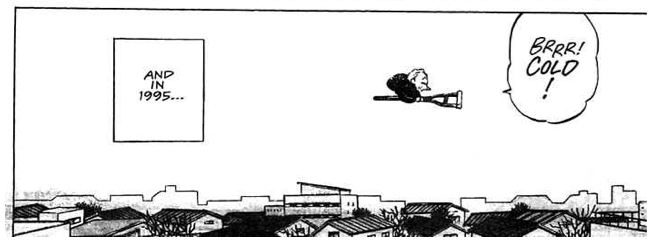
Art-wise, Takahashi produces some of the cleanest, most accessible layouts in manga. Her characters’ faces are easy to read, and her scenes are staged for maximum clarity and emotional impact; no one times a scare or a punch line better than Takahashi. Even more striking is the sense of mischief and play that informs her artwork. The elderly heroine of “One Hundred Years of Love,” for example, gains the ability to fly after surviving a near-death experience. Takahashi draws the old woman astride an enormous crutch, soaring over an urban landscape. At first, Mrs. Hoshino mutters about the weather, but soon she embraces the possibilities of flight, buzzing an unsuspecting eight-year-old apartment dweller:


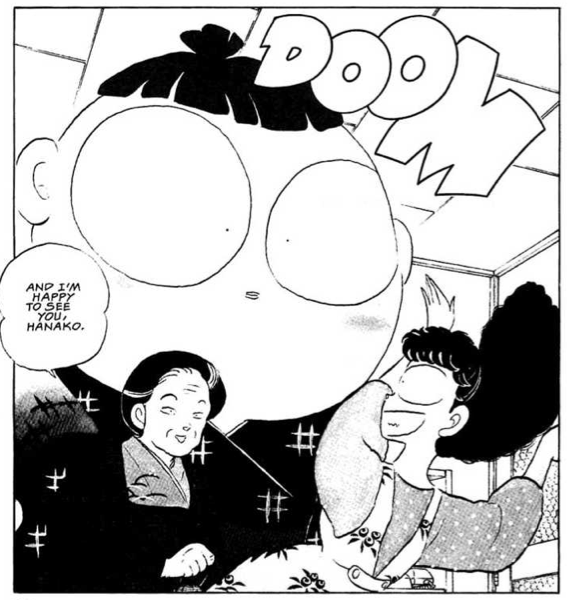
That same sense of mischief is evident in “Extra-Large Size Happiness,” in which a giant yokai pops into the frame — directly behind the frazzled heroine’s mother-in-law. Readers familiar with InuYasha‘s Shippo and Myogi will immediately recognize this round, genial figure:

The similarities between this nameless yokai and Myoga could be construed as a flaw or weakness of Takahashi’s style, but there’s an argument to be made that Takahashi employs a “star system” of her own. Granted, Takahashi never constructed a neat theoretical framework to explain the recurrence of certain characters in her stories, as Osamu Tezuka famously did for his. Flipping through the pages of Rumic Theater, however, it’s easy to imagine these characters as actors who specialize in certain types of roles, retaining something of their own “off-screen” personality and appearance in every story; as David Welsh observed in his recent essay on Ranma 1/2, “The fun is in seeing the specialists find variations on their distinctive themes.” And here, in Rumic Theater, the fun comes from seeing Takahashi’s regulars tackle more grown-up themes — marital discord, neighborhood politics, growing old — than might otherwise be permissible in the context of a long-form adventure such as InuYasha or Ranma 1/2 .

Filed Under: Manga, Manga Critic, Recommended Reading, REVIEWS Tagged With: Manga Movable Feast, Rumic Theater, Rumiko Takahashi, Seinen, VIZ

Rumiko Takahashi’s Rumic Theater

April 26, 2011 by Katherine Dacey 11 Comments

Most American readers know Rumiko Takahashi through her work in Shonen Sunday, but Takahashi has a foot in the seinen world as well. Maison Ikkoku ran in Big Comic Spirits from 1980-87, alongside Area 88 and Wounded Man, while short stories such as “To Grandmother’s House We Go” and “One Hundred Years of Love” appeared in Big Comic Spirits‘ sister publication Big Comic Original. In Japan, Takahashi’s seinen shorts have been collected into four volumes: 1 or W, The Tragedy of P, The Executive’s Dog, and Red Bouquet. Here in the US, however, only two have been translated into English: The Tragedy of P, which was re-titled Rumic Theater (1996), and 1 or W, which was published as Rumic Theater: One or Double (1998). (N.B. One or Double includes a handful of shonen and josei stories that appeared in Shonen Sunday and Petit Flower, respectively.)

These two translated volumes showcase Takahashi’s ability to work in almost genre. There are sports comedies (“The Grandfather of All Baseball Games”), domestic dramas (“Hidden in the Pottery,” “House of Garbage,” “The Tragedy of P”), rom-coms (“The Merchant of Romance,” “The Diet Goddess”), pop-culture spoofs (“Shake Your Buddha”), and ghost stories (“To Grandmother’s House We Go,” “One or Double”). As with Takahashi’s work in Shonen Sunday, many of these stories fold supernatural elements into everyday situations. In “Extra-Large Size Happiness,” for example, a woman’s relationship with her mother-in-law is strained by the sudden and frequent appearance of a household spirit that only she can see, while in “Reserved Seat,” a ghostly grandma takes possession of her grandson’s body so that she can honor her season tickets at the Takarazuka Revue.

Takahashi is a master at establishing her premise in just a few pages, allowing plenty of room for character development and broad comedy without compromising narrative momentum. One of the reasons Takahashi can be so economical is that she invests even the smallest moments with telling detail, making sure that every aspect of a character’s behavior is consistent with the story’s premise. In “Excuse Me for Being a Dog,” for example, the hero — who turns into a shiba inu whenever he suffers a nosebleed — acts like a canine even in his human form: he investigates an abandoned book bag with his nose, curls his lip at strangers, and recoils in the presence of pungent odors. Takahashi doesn’t make a big deal of these behavioral tics, but their inclusion in the story elevates Shiro’s condition from a wacky plot contrivance to a fundamental aspect of his existence. (OK, it’s also a wacky plot contrivance.)

Takahashi’s deep affection for her characters also contributes to the stories’ success. Though they bicker and tease and goad one another, the characters’ good will and mutual affection is seldom in question, even when their judgment is. Takahashi is as generous with her least sympathetic characters as she is with her leads, allowing them moments of wisdom and decency that often challenge the other characters’ perception of them. In “The Story of P,” for example, a man agrees to care for his eccentric client’s pet penguin, despite the fact the Hagas’ apartment complex doesn’t allow pets. For most of the story, Mrs. Haga plays cat-and-mouse with her neighbor Mrs. Kakei, the head of tenants’ association and a reputed animal hater. (Mrs. Kakei keeps tabs on the other tenants, notifying the management of any pet violations.) Yet in the last pages of the story, we learn that Mrs. Kakei has complicated, emotional reasons for ratting out her neighbors that stem, in part, from a genuine concern for animal welfare and not a humorless love of rules.

Art-wise, Takahashi produces some of the cleanest, most accessible layouts in manga. Her characters’ faces are easy to read, and her scenes are staged for maximum clarity and emotional impact; no one times a scare or a punch line better than Takahashi. Even more striking is the sense of mischief and play that informs her artwork. The elderly heroine of “One Hundred Years of Love,” for example, gains the ability to fly after surviving a near-death experience. Takahashi draws the old woman astride an enormous crutch, soaring over an urban landscape. At first, Mrs. Hoshino mutters about the weather, but soon she embraces the possibilities of flight, buzzing an unsuspecting eight-year-old apartment dweller:


That same sense of mischief is evident in “Extra-Large Size Happiness,” in which a giant yokai pops into the frame — directly behind the frazzled heroine’s mother-in-law. Readers familiar with InuYasha‘s Shippo and Myogi will immediately recognize this round, genial figure:

The similarities between this nameless yokai and Myoga could be construed as a flaw or weakness of Takahashi’s style, but there’s an argument to be made that Takahashi employs a “star system” of her own. Granted, Takahashi never constructed a neat theoretical framework to explain the recurrence of certain characters in her stories, as Osamu Tezuka famously did for his. Flipping through the pages of Rumic Theater, however, it’s easy to imagine these characters as actors who specialize in certain types of roles, retaining something of their own “off-screen” personality and appearance in every story; as David Welsh observed in his recent essay on Ranma 1/2, “The fun is in seeing the specialists find variations on their distinctive themes.” And here, in Rumic Theater, the fun comes from seeing Takahashi’s regulars tackle more grown-up themes — marital discord, neighborhood politics, growing old — than might otherwise be permissible in the context of a long-form adventure such as InuYasha or Ranma 1/2 .

Filed Under: Manga Critic Tagged With: Manga Movable Feast, Rumic Theater, Rumiko Takahashi, Seinen, VIZ

Butterfly, Vol. 1

April 11, 2011 by Katherine Dacey

Reading Butterfly won’t change your life, make you a better person, or cause subtle but significant changes to South American weather patterns, but it may just restore your faith in Tokyopop’s ability to suss out smart, entertaining series that quietly subvert genre conventions.

The genre in question is what I call “seeing dead people,” in which a teenager struggles to cope with the unwanted ability to interact with ghosts. Normally, these long-suffering teens see spirits everywhere, but Genji Ishikawa, Butterfly‘s protagonist, sees only one ghost: his older brother, who committed suicide after pushing a girl into the path of an oncoming train. Though Genji would like nothing better than to have a girlfriend, his tragic past and rumored ability to speak to the dead proves irresistible to classmates with an interest in the paranormal.

Genji has another problem: he’s ¥600,000 in debt, more than he could hope to earn through an after-school job. When a peculiar girl approaches him with a money-making proposition, he reluctantly accepts, only to renege on their agreement when he realizes what he’s being asked to do: tangle with ghosts. Or, more accurately, tangle with what Ageha’s clients believe are ghosts; she has the ability to make people’s fears take corporeal form, and expects Genji to “kill” these projections for her clients’ benefit.

Though Ageha is a type we’ve seen before — manipulative, preternaturally calm, faintly androgynous — her abilities put an interesting twist on the “seeing dead people” premise. She clearly profits from her deceptions, but her fraud is, at bottom, a useful public service, one that allows shopkeepers, frightened swimmers, and hotel chambermaids to resume their normal routines after a catastrophic event, even if these “exorcisms” don’t actually help the dead cross over to the afterlife. As mercenary as Genji finds Ageha, her success forces him to to consider the possibility that his own spiritual powers are less a bane than a blessing, that he has an obligation to develop and use them, rather than deny their value.

The only downside to such an ambitious premise is that Yu Aikawa needs almost every page of volume one to establish the basic parameters of her story. Some of the exposition is handled gracefully; the details of the brother’s death, for example, are revealed slowly and casually, forcing the reader to piece together what happened to him with little authorial guidance. Some of the exposition is handled clumsily, however; Ageha and Genji’s first few encounters seem more like job interviews than spontaneous exchanges of information, an impression that isn’t thoroughly dispelled until one of their ghostbusting gigs goes awry.

Narrative hiccups aside, the story that’s beginning to emerge in the later chapters of volume one is compelling, a supernatural mystery that explores its characters troubled emotional lives with the same thoroughness as it dispenses with pesky spooks. Recommended.

BUTTERFLY, VOL. 1 • BY YU AIKAWA • TOKYOPOP • 208 pp. • RATING: TEEN (13+)

Filed Under: Manga, Manga Critic, REVIEWS Tagged With: butterfly, Seinen, Tokyopop, Yu Aikawa

Butterfly, Vol. 1

April 11, 2011 by Katherine Dacey 6 Comments

Reading Butterfly won’t change your life, make you a better person, or cause subtle but significant changes to South American weather patterns, but it may just restore your faith in Tokyopop’s ability to suss out smart, entertaining series that quietly subvert genre conventions.

The genre in question is what I call “seeing dead people,” in which a teenager struggles to cope with the unwanted ability to interact with ghosts. Normally, these long-suffering teens see spirits everywhere, but Genji Ishikawa, Butterfly‘s protagonist, sees only one ghost: his older brother, who committed suicide after pushing a girl into the path of an oncoming train. Though Genji would like nothing better than to have a girlfriend, his tragic past and rumored ability to speak to the dead proves irresistible to classmates with an interest in the paranormal.

Genji has another problem: he’s ¥600,000 in debt, more than he could hope to earn through an after-school job. When a peculiar girl approaches him with a money-making proposition, he reluctantly accepts, only to renege on their agreement when he realizes what he’s being asked to do: tangle with ghosts. Or, more accurately, tangle with what Ageha’s clients believe are ghosts; she has the ability to make people’s fears take corporeal form, and expects Genji to “kill” these projections for her clients’ benefit.

Though Ageha is a type we’ve seen before — manipulative, preternaturally calm, faintly androgynous — her abilities put an interesting twist on the “seeing dead people” premise. She clearly profits from her deceptions, but her fraud is, at bottom, a useful public service, one that allows shopkeepers, frightened swimmers, and hotel chambermaids to resume their normal routines after a catastrophic event, even if these “exorcisms” don’t actually help the dead cross over to the afterlife. As mercenary as Genji finds Ageha, her success forces him to to consider the possibility that his own spiritual powers are less a bane than a blessing, that he has an obligation to develop and use them, rather than deny their value.

The only downside to such an ambitious premise is that Yu Aikawa needs almost every page of volume one to establish the basic parameters of her story. Some of the exposition is handled gracefully; the details of the brother’s death, for example, are revealed slowly and casually, forcing the reader to piece together what happened to him with little authorial guidance. Some of the exposition is handled clumsily, however; Ageha and Genji’s first few encounters seem more like job interviews than spontaneous exchanges of information, an impression that isn’t thoroughly dispelled until one of their ghostbusting gigs goes awry.

Narrative hiccups aside, the story that’s beginning to emerge in the later chapters of volume one is compelling, a supernatural mystery that explores its characters troubled emotional lives with the same thoroughness as it dispenses with pesky spooks. Recommended.

BUTTERFLY, VOL. 1 • BY YU AIKAWA • TOKYOPOP • 208 pp. • RATING: TEEN (13+)

Filed Under: Manga Critic Tagged With: butterfly, Seinen, Tokyopop, Yu Aikawa

  • « Go to Previous Page
  • Page 1
  • Page 2
  • Page 3
  • Page 4
  • Page 5
  • Interim pages omitted …
  • Page 7
  • Go to Next Page »
 | Log in
Copyright © 2010 Manga Bookshelf | Powered by WordPress & the Genesis Framework