• Skip to primary navigation
  • Skip to main content
  • Skip to primary sidebar
  • Home
  • About Us
    • Privacy Policy
    • Comment Policy
    • Disclosures & Disclaimers
  • Resources
    • Links, Essays & Articles
    • Fandomology!
    • CLAMP Directory
    • BlogRoll
  • Features & Columns
    • 3 Things Thursday
    • Adventures in the Key of Shoujo
    • Bit & Blips (game reviews)
    • BL BOOKRACK
    • Bookshelf Briefs
    • Bringing the Drama
    • Comic Conversion
    • Fanservice Friday
    • Going Digital
    • It Came From the Sinosphere
    • License This!
    • Magazine no Mori
    • My Week in Manga
    • OFF THE SHELF
    • Not By Manga Alone
    • PICK OF THE WEEK
    • Subtitles & Sensibility
    • Weekly Shonen Jump Recaps
  • Manga Moveable Feast
    • MMF Full Archive
    • Yun Kouga
    • CLAMP
    • Shojo Beat
    • Osamu Tezuka
    • Sailor Moon
    • Fruits Basket
    • Takehiko Inoue
    • Wild Adapter
    • One Piece
    • After School Nightmare
    • Karakuri Odette
    • Paradise Kiss
    • The Color Trilogy
    • To Terra…
    • Sexy Voice & Robo
  • Browse by Author
    • Sean Gaffney
    • Anna Neatrour
    • Michelle Smith
    • Katherine Dacey
    • MJ
    • Brigid Alverson
    • Travis Anderson
    • Phillip Anthony
    • Derek Bown
    • Jaci Dahlvang
    • Angela Eastman
    • Erica Friedman
    • Sara K.
    • Megan Purdy
    • Emily Snodgrass
    • Nancy Thistlethwaite
    • Eva Volin
    • David Welsh
  • MB Blogs
    • A Case Suitable For Treatment
    • Experiments in Manga
    • MangaBlog
    • The Manga Critic
    • Manga Report
    • Soliloquy in Blue
    • Manga Curmudgeon (archive)

Manga Bookshelf

Discussion, Resources, Roundtables, & Reviews

manga

Manga Giveaway: Ema Toyama Twosome Winner

June 3, 2015 by Ash Brown

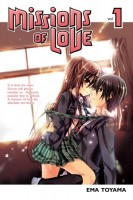
Manga Dogs, Volume 1Missions of Love, Volume 1And the winner of the Ema Toyama Twosome is… Coco!

As the winner, Coco will be receiving two manga by Ema Toyama: Manga Dogs, Volume 1 and Missions of Love, Volume 1. Both of those series feature protagonists who are professional storytellers, a mangaka and cell phone novelist respectively. So, for the manga giveaway, I asked participants to tell me a little about their favorite characters in manga who are writers. Check out the Ema Toyama Twosome comments for all of the characters mentioned, and check out the list below for all of the manga mentioned and then some!

Manga available in English featuring writers of various types:
Author’s Pet by Deathco Cotorino
Awaken Forest by Yuna Aoi
Bakuman written by Tsugumi Ohba, illustrated by Takeshi Obata
Barefoot Waltz by Romuko Miike
Blood Alone by Masayuki Takano
Fairy Tail by Hiro Mashima
Fruits Basket by Natsuki Takaya
Gerard & Jacques by Fumi Yoshinaga
Gravitation by Maki Murakami
Honey Blood by Miko Mitsuki
Junjo Romantica by Shungiku Nakamura
Kiss All the Boys by Shiuko Kano
Kinoko Inu: Mushroom Pup by Kimama Aoboshi
Kodocha: Sana’s Stage by Miho Obana
Liberty Liberty! by Hinako Takanaga
Love Machine by Amayo Tsuge
Manga Dogs by Ema Toyama
Me & My Brothers by Hari Tokeino
Missions of Love by Ema Toyama
Monthly Girls’ Nozaki-kun by Izumi Tsubaki
No One Loves Me by Yugi Yamada
Not Love But Delicious Foods Make Me So Happy! by Fumi Yoshinaga
Otomen by Aya Kanno
R.O.D.: Read or Die written by Hideyuki Kurata, illustrated by Shutaro Yamada
R.O.D.: Read or Dream written by Hideyuki Kurata, illustrated by Ran Ayanaga
The Times of Botchan written by Natsuo Sekikawa, illustrated by Jiro Taniguchi
The Strange Tale of Panorama Island by Suehiro Maruo
Two of Hearts by Kano Miyamoto
Utsubora: The Story of a Novelist by Asumiko Nakamura
La Vie en Rose by Sakurako Yamada
Welcome to the N.H.K. by Kendi Oiwa
Yukarism by Chika Shiomi

The above list isn’t quite comprehensive, but it does include most of the manga available in print that I know of that have characters who are writers. While compiling the list I was struck by how many boys’ love titles feature authors. I’m not entirely sure why that profession seems to be particularly popular in that genre, but there you have it. Thank you to everyone who shared your personal favorites with me; I hope to see you again for the next giveaway!
Filed Under: Giveaways, UNSHELVED Tagged With: Ema Toyama, manga, Manga Dogs, missions of love

My Week in Manga: May 25-May 31, 2015

June 1, 2015 by Ash Brown

My News and Reviews

Last week was the last week of May, which means the most recent giveaway at Experiments in Manga is currently underway. There are still a couple of days left to enter for a chance to win an Ema Toyama Twosome, i.e. the first volume of both Missions of Love and Manga Dogs. I also posted a couple of in-depth reviews last week. The first review was of Yoshikazu Yasuhiko’s Mobile Suit Gundam: The Origin, Volume 8: Operation Odessa, which is the first volume to take place after the series’ extended flashback arc. It’s not my favorite volume in the series, but Kai gets his moment in the spotlight which I was happy to see. The second review was of Kazuki Sakuraba’s award-winning novel Red Girls: The Legend of the Akakuchibas, which I enjoyed immensely. Sakuraba is probably better known as the creator of Gosick, but Red Girls is a fantastic multi-generational epic.

I was actually at a conference for work most of last week, so I wasn’t able to keep up with news and announcements to quite the same extent that I’m usually able to. However, I still did come across some interesting reading. Aya Kanno, for example, has recently had some interviews posted. Over at Barnes & Noble’s Sci-Fi & Fantasy Blog, Brigid Alverson talked with Kanno about defying expectations and Rebecca Silverman’s interview of Kanno was posted at Anime News Network. A couple of weeks ago I reviewed the first volume of Wayward which I quite enjoyed, so I found Katriel Page’s essay about how Rori embodies liminality to be particularly interesting. And over at Organization Anti-Social Geniuses, Justin wants you all to Meet the Man Who’s Translated a Thousand Manga Chapters—Dan Luffey.

Quick Takes

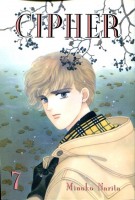
Cipher, Volume 7Cipher, Volumes 7-11 by Minako Narita. Despite being twelve volumes in Japan, for some reason the English-language edition of Cipher was collected in eleven. (It is the complete series, though.) I thoroughly enjoyed the first part of the series, and the sixth volume ends with a fairly dramatic twist, so I was anxious to read the manga’s conclusion. Cipher and Siva, being nearly inseparable growing up and at one point even sharing an identity, are now living apart with the entire country between them. Wracked with guilt, Cipher has moved from New York to Los Angeles, leaving his girlfriend Anise behind along with his twin brother. In general, this second half of Cipher tends to be somewhat more believable than the first, though there are still plenty of parts that aren’t especially realistic. However, Narita does an excellent job of exploring the emotional fallout and the changes in the characters’ relationships with one another that come about as a result of both Cipher and Siva learning to live their lives as individuals and each becoming his own person. New characters are introduced who play a very important role in this evolution, including Cipher’s Los Angeles roommate Hal and Siva’s fellow model Alex. In the end, Anise’s story ends up being secondary to that of the brothers, but she shows growth and development as well.

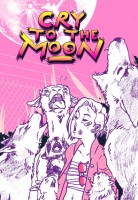
Cry to the MoonCry to the Moon by Various. I discovered Love Love Hill relatively recently, but the collective releases some great comics, so I’ve been making a point to pick up its anthologies. Cry to the Moon, based on the theme of delinquents and animals, is the most recent Love Love Hill comics anthology. The volume includes contributions from eight different creators. I was especially looking forward to Saicoink’s “To My Dear White Dove: A Quiet Love,” a sort of alternate universe side story to her series Open Spaces and Closed Places (which I absolutely love), but I enjoyed the other works that were collected as well. Cry to the Moon has a nice variety of comics that range from the comedic to the bittersweet to the tragic. Many of the stories are based in reality while a few of them incorporate more fantastical elements. Some are only a few pages while others are more lengthy and involved. But no matter the length or the tone of the story, each of the comics collected in Cry to the Moon exhibits heart. What I love about anthologies is the opportunity to experience the different art styles and storytelling techniques of the creators involved. I also appreciate that the individual creators are given space in Cry to the Moon to write about their influences and inspirations for their stories and how they decided to interpret the anthology’s theme.

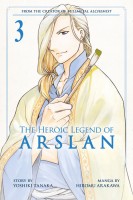
The Heroic Legend of Arslan, Volume 3The Heroic Legend of Arslan, Volume 3 by Hiromu Arakawa. I am largely enjoying The Heroic Legend of Arslan, it’s a great fantasy story with exciting battles and interesting worldbuilding, but I do wish that the characters and plot had a little more complexity and nuance to them. By the end of the third volume, I have some hope that this will eventually happen as the series continues to develop, but right now it’s just not quite there. Characterization in the manga tends to be painted with a fairly broad stroke and heavy hand. Some of the humor, while amusing, doesn’t always mesh well with the overall tone of the series, either. However, there are other things that The Heroic Legend of Arslan is doing well. I particularly like the series’ approach to action scenes and battles. There are plenty of examples of extraordinarily strong fighters showing off their incredibly powerful skills, but strategy and tactics are also incredibly important to how a battle plays out in the end. In the third volume, Arslan and his small contingent of supporters face off against more than a thousand soldiers, but thanks to careful planning, psychological manipulation, and effective use of the geographical terrain, for the most part they are able to come through unscathed.

Showa3Showa: A History of Japan, 1944-1953 by Shigeru Mizuki. This third and penultimate volume of Showa: A History of Japan addresses the time period of that era that I already knew the most about—the end of the Pacific War and the following occupation of Japan by Western forces. Even so, there were things that I learned reading the manga that I never knew before. Showa: A History of Japan continues to be told using two closely intertwined narratives. Mizuki outlines the larger developments of the war and Japan’s reconstruction, but he also incorporates the story of his own experiences and the experiences of his family. It’s this personal touch that makes Showa: A History of Japan especially compelling and hard-hitting as it drives home the tragedy of war and the dire circumstances faced by the soldiers and civilians on both sides of the conflict. Part of the third volume deals with some of the same events found in Mizuki’s Onward Towards Our Noble Deaths, so I was already familiar with some of the story, but that didn’t make its impact any less effective. This volume reveals how Mizuki survived during war against all odds as well as how he survived after the war (another difficult feat), including his beginnings as a kamishibai and manga artist.

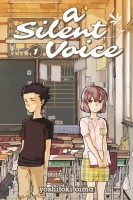
A Silent Voice, Volume 1A Silent Voice, Volume 1 by Yoshitoki Oima. If the volumes that follow the first are anywhere near as strong, A Silent Voice is likely one of the best series to be released this year. (At least in print; technically, the manga started being officially released digitally on Crunchyroll last year.) The first volume of A Silent Voice is both powerful and heartbreaking. The story follows Shoya, a somewhat unlikeable young man and a terrible bully. He learns that his actions have consequences not only for others but for himself as well when he decides to make Shoko, a deaf transfer student, his next target. A Silent Voice doesn’t sugarcoat school bullying, showing just how vicious and cruel kids can be and how quickly they can turn on one another. Perhaps even more tragic is that some of the teachers do very little to put an end to it or to discourage the behavior. In some cases, they seem to even encourage it, or at least allow the bullying to flourish. There is a stunning lack of empathy from almost every character in the series. The majority of A Silent Voice, Volume 1 takes place during Shoya and Shoko’s middle school years. This actually occurs six years before the start of the manga, establishing the complicated nature of Shoya’s feelings toward Shoko and the exploring developments that led him to become the person he now is.

Filed Under: FEATURES, My Week in Manga Tagged With: Cipher, comics, Heroic Legend of Arslan, Hiromu Arakawa, manga, Minako Narita, Showa: A History of Japan, Silent Voice, Yoshitoki Oima

Mobile Suit Gundam: The Origin, Vol. 8: Operation Odessa

May 29, 2015 by Ash Brown

Mobile Suit Gundam: The Origin, Volume 8: Operation OdessaCreator: Yoshikazu Yasuhiko
Original story: Yoshiyuki Tomino and Hajime Yatate

U.S. publisher: Vertical
ISBN: 9781939130686
Released: December 2014
Original release: 2011

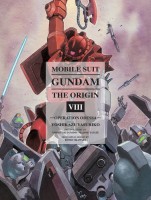
Although I was vaguely familiar with Gundam before reading Yoshikazu Yasuhiko’s Mobile Suit Gundam: The Origin, the manga series was my first real introduction to the ever-expanding franchise. I was actually more interested in The Origin because it was created by Yasuhiko than for its Gundam connection, but I’ve been enjoying the series so much that I’ve started to look for other manga, novels, and anime set in the universe. Operation Odessa is the eighth volume in Vertical’s English-language release of The Origin. Published in 2015, the volume is based on the Japanese collectors’ edition released in 2011 and includes an essay by Makoto Yukimura in addition to a gallery of some of Yasuhiko’s color artwork for the series. The Origin is a reimagining of the original Mobile Suit Gundam anime from 1979. The last several volumes of The Origin have been an extended flashback not found in the original anime series, but with Operation Odessa the manga returns to the story’s current timeline.

After successfully defending itself from Zeon forces at Jaburo—though not without significant casualties—the Earth Federation has set out to reclaim more of the planet and its aligned space colonies. The key to its plans is the newly developed and highly advanced Gundam mobile suit which the ragtag crew of the White Base was somehow able to deliver to the Federation’s headquarters mostly intact. The Gundam prototype will serve as the basis for a mass-produced mobile suit that will hopefully be able to rival those developed by Zeon. Up until this point in the devastating conflict between the two factions, Zeon’s impressive technological achievements have given it a distinct advantage over the Federation. But now the tide of war seems to be changing. However, neither side will remain unscathed. The battles are still incredibly destructive and the loss of life continues to be immense. Even so, the end of the war may still not be coming anytime soon.

Mobile Suit Gundam: The Origin, Volume 8: Operation Odessa, page 146The Origin began in space and has since moved Earthward, the space battles giving way to air and land battles. And now with Operation Odessa, sea battles have an important role to play in the conflict as well. With new arenas of warfare come new weapons, mobile suits, technology, equipment, and vehicles. It can actually be a little overwhelming at times, this sudden introduction of very specialized tools that don’t have much more explanation given beyond a name and a visual design. Inundated, readers are mostly left to glean the details of the differences in the capabilities and purposes of the individual units from their context within the manga. Much of Operation Odessa seems to be devoted to showing off these new toys of war in a way that is probably more meaningful to someone who is already well-versed in Gundam lore. Especially in the last half of the volume, the narrative tends to be jarring as it jumps from battle to battle, or from different points in the same battle, without much connecting material to smooth the transitions.

While Operation Odessa could arguably be considered overly focused on equipment and technology, it is important to note that the manga still has a prominent human element to it, which is what makes The Origin such a compelling series. In particular, Kai, one of the young pilots connected to White Base, is heavily featured in Operation Odessa and develops significantly as a character. For the most part he has largely been a secondary character who provides a fair amount of comedic relief in the series. Except now he’s quite seriously fed up with all of the fighting and even tries to leave, only to find himself drawn back into battle and the tragedy of war. As Yasuhiko has shown repeatedly throughout The Origin, those who are directly involved in the conflict aren’t the only ones who are impacted by it. Civilians and non-combatants must also take action out of necessity, doing whatever they can to survive and protect those they love. It’s a lesson that Kai must learn the hard way in Operation Odessa if he is to understand his own role as a soldier.

Filed Under: REVIEWS Tagged With: Gundam, Hajime Yatate, manga, vertical, Yoshikazu Yasuhiko, Yoshiyuki Tomino

Manga Giveaway: Ema Toyama Twosome

May 26, 2015 by Ash Brown

June is almost here, and May is almost through, so it’s once again time to hold a manga giveaway at Experiments in Manga! This month you will all have the opportunity to win not one, but two manga created by Ema Toyama and released in English by Kodansha Comics: Manga Dogs, Volume 1 and Missions of Love, Volume 1. As always, the giveaway is open worldwide!

Manga Dogs, Volume 1Missions of Love, Volume 1

So far, mangaka Ema Toyama has had three of her original series released in English: I Am Here!, Manga Dogs, and Missions of Love. She was also one of several contributors involved with Shugo Chara Chan!. My introduction to Toyama’s work was through Missions of Love (which I find to be incredibly addictive with all of its over-the-top melodrama and twisted relationships). The only other manga of hers that I’ve read is the three-volume series Manga Dogs. The two series are very different from each other, but I find it interesting that they both feature young women as protagonists who are creative types. In the case of Missions of Love, Yukina Himuro is a cell phone novelist while in Manga Dogs, Kanna Tezuka is a shoujo mangaka. Though both Yukina and Kanna have other things to deal with in their lives, at least part of each manga series deals with their careers as professional storytellers.

So, you may be wondering, how can you win two volumes of Ema Toyama’s manga?

1) In the comments below, tell me a little about your favorite character in a manga who is an author, novelist, or some other type of writer. (If you’ve never come across one in your reading, simply mention that.)
2) If you’re on Twitter, you can earn a bonus entry by tweeting, or retweeting, about the contest. Make sure to include a link to this post and @PhoenixTerran (that’s me).

It’s as easy as that! Each person participating in the giveaway can earn up to two entries and has one week to submit comments. If you prefer, or have trouble leaving comments, entries can also be sent via email to phoenixterran(at)gmail(dot)com. I will then post the entry here in your name. The giveaway winner will be randomly selected and announced on June 3, 2015.

VERY IMPORTANT: Include some way that I can contact you. This can be an e-mail address in the comment form, a link to your website, Twitter username, or whatever. If I can’t figure out how to get a hold of you and you win, I’ll just draw another name.

Contest winner announced–Manga Giveaway: Ema Toyama Twosome Winner

Filed Under: FEATURES, Giveaways Tagged With: Ema Toyama, manga, Manga Dogs, missions of love

My Week in Manga: May 18-May 24, 2015

May 25, 2015 by Ash Brown

My News and Reviews

Well, it was a little later than I initially intended, but I finally finished writing and posted my random musings on TCAF 2015 last week! It’s a long post which includes some of my general thoughts as well as write-ups of the panels that attended while at the festival. Even considering its length, people still seem to like it or at least find parts of it interesting, which makes me happy. Tangentially related to TCAF, I also posted and in-depth review of Wayward, Volume 1: String Theory, the first collection in an ongoing comic series created by Jim Zub and Steve Cummings. (Zub was one of the exhibitors at TCAF, though I picked up Wayward long before that.) The comic is heavily influenced by stories about yokai, but it definitely has its own modern twist on Japan’s myths and legends. String Theory is a great start to the series and I’m looking forward to reading the next volume.

Last week seemed to be oddly quiet on the news and licensing front. I’m sure there must have been some interesting things posted, but at least I didn’t come across very many. However, speaking of yokai, The New York Times recently published the article “Reviving Japan’s Dreaded and Beloved Ghosts” (or, “Pokémon’s Spooky Ancestors” if you try to look it up in the print edition) about some of the recent and forthcoming books being released in North America about the creatures. Vaguely related, Seven Seas announced that it has licensed Yoshihiko Inui’s Tomodachi x Monster, a dark parody manga series about kids and their pet monsters. Otherwise, if I’ve missed some particularly good reading, please do let me know!

Quick Takes

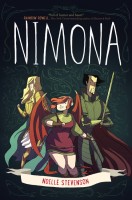
NimonaNimona by Noelle Stevenson. Originally an award-winning webcomic, Nimona was recently released as Stevenson’s debut graphic novel. The comic has been slightly revised for the print edition and additional content, including a new epilogue, has been collected in the volume as well. Nimona is one of my favorite comic releases so far this year. In the beginning it’s silly and very funny. But, while it never loses its humor, the comic does become more serious and even heart-wrenching as it progresses after some of the characters’ personal struggles and backgrounds are fully revealed. Nimona is a young shapeshifter who has decided that she will become the sidekick of Lord Ballister Blackheart, a supervillain whose plans are always being foiled by his arch-nemesis Sir Ambrosius Goldenloin. (The two men share a history together and deeply care about each other.) Nimona does manage to convince Blackheart to allow her to join his team, but finds his strict code of ethics frustrating to deal with. Likewise, he often frowns upon her excessively wild nature and propensity towards violence. Despite their differences, over time the two of them grow very close to each other. Nimona is an incredibly delightful and charming comic. I look forward to reading more of Stevenson’s work in the future.

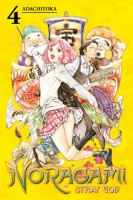
Noragami: Stray God, Volume 4Noragami: Stray God, Volume 4 by Adachitoka. Even though Noragami seems to have been doing fairly well for Kodansha Comics, I haven’t really heard many people talking about the series. Initially I thought that Noragami was primarily going to be a comedy but the last few volumes, though they have their moments of levity, have actually been pretty serious. The fourth volume largely focuses on the plight of Bishamonten, a warrior god (technically goddess in Noragami). Though outwardly very strong and aggressive, she is having difficulty controlling and supporting the numerous shinki under her care. This does strike me as a little strange since Tenjin also has a large number of shinki without there seeming to be any negative consequences, but perhaps Bishamonten’s group is significantly bigger. It is interesting to see the differences in the relationships between the shinki and their respective gods in Noragami. After some strife in the last couple of volumes, Yato and Yuki have managed to forge an impressive partnership. Probably most importantly, they are at a point in their relationship where they can be honest with each other, airing their grievances and sharing their pain. The same cannot be said of Bishamonten and her shinki, which may be the source of their problems. Even though it is out of concern, hiding their true feelings is actually more damaging in the long run.

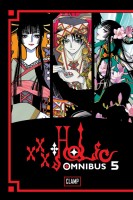
xxxHolic, Omnibus 5xxxHolic, Omnibus 5 (equivalent to Volumes 13-15) by CLAMP. I’ve come to the realization that I much prefer xxxHolic when it isn’t being tied down with its association toTsubasa: Reservoir Chronicles. Fortunately, even though its connection to the other series continues to solidify in this omnibus, for the most part this portion of xxxHolic remains its own story without too much interference. Oddly enough, it even becomes a food manga of sorts, which I really wasn’t anticipating. Perhaps it’s not so surprising, though. Throughout xxHOlic Watanuki has always been shown to be cooking, making bento and snacks for the people who are important to him. But in the fifth omnibus of xxxHolic the cooking becomes critical to the story itself rather than just being a part of his character. (CLAMP also has a way of making the most mundane thing extraordinarily melodramatic to such an extent that a character’s very life seems to hang by a thread from it.) Watanuki teaches Kohane to cook because he wants to, but then he is hired out to fulfill the wish of one of the shop’s clients by providing instruction to her, too. Though at first he halfheartedly puts up a fight, he takes this task very seriously, eventually uncovering the woman’s true fears and desires. (All through the power of food!) There is also a sense of ominous foreboding in this volume as the series prepares for its finale.

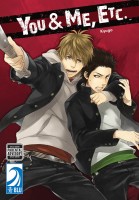
You & Me, Etc.You & Me, Etc. by Kyugo. After I finished reading You & Me, Etc., I was extremely surprised to note that the boys’ love manga had been rated mature by the publisher. Honestly, nothing more than a few kisses and perhaps a little bit of cuddling happen in the manga. (The fact that it’s between men shouldn’t make a difference.) I believe You & Me, Etc. is the only manga by Kyugo to have been released in English. You & Me, Etc. is not an especially memorable collection of short boys’ love manga—none of the selections really have any sort of “hook” per se—but the stories are executed very well and it’s a very enjoyable volume. The stories included are quieter with a strong focus on the characters’ relationships and interactions. Some of those relationships aren’t even particularly romantic in nature (which will likely disappoint readers expecting or hoping for something a little steamier from a manga with an “M” rating), but nonetheless they are still very important and most often deal with some sort of love or affection. The volume features three couples (broadly defined) who must navigate and develop their relationships in the face of difficult circumstances, whether it be a life-changing accident, a shared secret, or a death in the family. Based on the volume’s strengths, I would certainly be interested in reading more of Kyugo’s work.

Filed Under: FEATURES, My Week in Manga Tagged With: Adachitoka, clamp, comics, Kyugo, manga, Noelle Stevenson, Noragami, xxxholic

Random Musings: Toronto Comic Arts Festival 2015

May 20, 2015 by Ash Brown

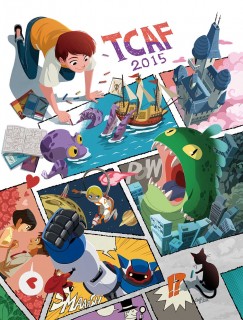
TCAF 2015 Poster

©Gurihiru

2015 marks the third time that I’ve been able to attend the Toronto Comic Arts Festival (TCAF). I generally don’t go to very many conferences, festivals, or conventions unless it’s for work, but I had such a phenomenal experience at TCAF 2013 that it’s become an annual event for me. TCAF is totally worth me pushing through all of my social anxieties and general awkwardness. This year was great, too, and for the most part I handled it pretty well. I don’t know if it’s just that I’m getting used to the trip and generally know what to expect from the event or what, but TCAF’s expansion into more areas of the Toronto Reference Library made the crowds feel less, well, crowded which probably also helped.

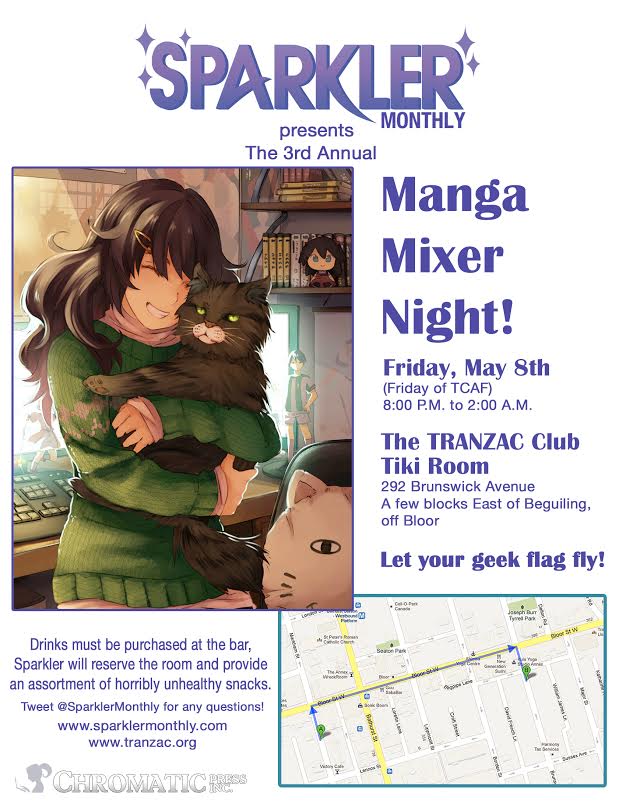
I’ve actually been trying to make TCAF a family trip since 2013 and this year it finally happened. Everyone, including the nine-month old, was able to make it to Toronto. We set out from Michigan on Friday and arrived in Toronto in time for me to go to Sparkler Monthly‘s Manga Mixer. I went last year, too, and enjoyed myself, so I was looking forward to it even though I’m not much of a party person. I enjoyed the mixer this year as well and had the opportunity to talk about manga, comics, and all sorts of things with all sorts of people. I was particularly happy to chat with Lissa Pattillo and the rest of the folk at Chromatic Press again. And I met several of my fellow manga and comics enthusiasts in person for the first time, like Linda/animemiz, Ysabet MacFarlane, and Alex Hoffman, which was great. Later on in the evening Jason Thompson showed up and we talked for a bit, which was pretty exciting for me since he played a large role in introducing me to manga. He seemed to know who I was, too, even though we’d never met before.

Actually, people recognizing me or Experiments in Manga after I introduced myself was something that happened several times over the course of TCAF, which was an odd but kind of thrilling experience. (I guess “Ash Brown” is a name that tends to stick with people?) Another odd thing to happen was that a lot of people assumed I was one of the exhibitors or an artist myself. Granted, considering how many creators visit TCAF as exhibitors or attendees, it’s a pretty safe guess for someone to make and still end up being correct much of the time. Anyway. Some of my personal social highlights over the course of TCAF in addition the Manga Mixer: I had a nice conversation with Ryan Sands, said hello to the MASSIVE crew, ran into fellow Manga Bookshelf blogger Sean Gaffney, had the chance to meet Amanda Cosmos, briefly chatted with Jocelyne Allen, and talked with Ken Niimura and Aya Kanno at their respective signings. And there were plenty of other smaller interactions throughout the festival, too.

Manga Mixer presented by Sparkler

TCAF 2015 Manga Mixer presented by
Sparkler Monthly

I like to start off TCAF proper bright and early on Saturday morning by visiting the exhibitor areas. This has a few advantages: the crowds are relatively small and manageable, exhibitors haven’t sold out of anything yet (although, not everything is available for sale right away), and most of the festival programming for the day hasn’t started. I generally have a few tables that I know I want to stop by and a few things that I know I want to check out, but I also wander around to see everything that’s there. For me, part of TCAF is learning about and discovering new things; I always make a point to come home with some comics and artwork by artists whose work I’m completely unfamiliar with. If I could I’d bring home everything that caught my interest. I have to give myself a strict budget for TCAF to keep things from getting out of hand. I focus my purchases on independent creators and small publishers while at TCAF, but I also end up making a very lengthy list of comics and other books to obtain at a later date. Even after it’s over, TCAF continues to influence what I buy. This year I got my hands on almost everything that I really wanted, but there were a few things I’m still kicking myself for missing out on, like Gengoroh Tagame’s new artbook. Hopefully I’ll have the chance to pick some of those things up in the near future, though.

On Saturday, I attended a total of six (six!) panels. I basically found a seat in the Marriott’s High Park Ballroom and didn’t move for the rest of the day. (Should you ever attempt this yourself, I highly recommend bringing your own water and snacks with you.) One of the most challenging parts of TCAF is deciding which programs to go to because it is literally impossible to do everything. There are so many fantastic panels and creators that there are always going to be conflicts. But, rest assured, whatever you choose, it will be great. I have yet to leave a TCAF event disappointed or dissatisfied.

My first panel of the day was “Subscription Comics.” Moderated by Brigid Alverson, the discussion featured Box Brown of Retrofit Comics, Ryan Sands of Youth in Decline, Jordan Shiveley of Uncivilized Books, and Lianne Sentar of Chromatic Press. Although the models are different from one publisher to another, each of them features a subscription service of some sort. (I’m currently a Chromatic Press and Youth in Decline subscriber; next year I’ll probably be a Retrofit subscriber, too, considering the number of comics I buy from the publisher anyway.) The panel’s conversation focused on the benefits provided and challenges presented by subscriptions not just for publishers, but for creators and readers as well. Subscriptions get money to the publisher quickly and can help pay for upfront costs. It can be incredibly useful for publishers to know that there will be definite revenue when planning the year’s finances, too. For creators, publishers’ subscriptions can provide an appealing outlet for experimentation, a way to do something for fun on the side, and not have to worry about marketing and other aspects of promotion. The panelists tended to agree that an ideal subscription service would feature both big and small names. The more well-known artists provide the initial draw for readers and help support the publication of the rest of the comics. Subscriptions can provide the curatorial guidance needed in the astoundingly large world of comics which can frequently be overwhelming, especially for newer readers.

TCAF 2015 Poster - Pascal Blanchet

©Pascal Blanchet

Brigid Alverson was also involved with the next event, serving as the interviewer for Aya Kanno’s Spotlight with Jocelyne Allen interpreting. The discussion largely focused on Kanno’s two most recent series to have been released in English, Otomen and Requiem of the Rose King. She got the idea for Otomen when she realized that a lot of the men around her were otomen, but that in Japan a boy liking girlish things is still looked down upon, more so than a girl liking boyish things. Her editor at the time was a little uneasy about the series because Kanno had never done a comedy manga before; it took about a year to convince him. Being true to oneself is a theme that is particularly important in Otomen, and one that deeply resonates with Kanno. As for Requiem of the Rose King, there is an exaggerated element in Shakespeare’s plays that she doesn’t often see in modern works that she finds very appealing. Kanno described her version of Richard as a mix of all of the good parts of Shakespeare’s Richard, characteristics of the historical Richard III, and some of her own fantasy. Kanno did read a fair number of history books when conducting research for the series, but not much on the time period is available in Japanese, so the visuals of the manga tend to be heavily influenced by Shakespearian stage productions and much of the story comes from within Kanno herself as she creates her own personal interpretations of history. Kanno has always been interested in sex, gender, and sexuality, so it isn’t too surprising that those subjects play an important role in her work; both Otomen and Requiem of the Rose King deal with those subjects in different ways.

Next up was “Gay Comics Art Japan with Gengoroh Tagame,” featuring Gengoroh Tagame, the first commercially successful creator of gay manga, Anne Ishii and Graham Kolbeins of MASSIVE, and Leyla Aker, one of the editors at Viz Media and SuBLime Manga. Tagame was one of the featured guests at TCAF in 2013 and he is an extremely knowledgeable and charming individual, so I was very happy to see him return again this year. The panelists discussed queer comics, gay manga, and BL, the fluidity of the boundaries between the genres, and the usefulness and limitations of labels. It’s becoming more and more difficult to definitively draw a line between gay manga and BL. Many complicated factors influence how a person approaches a particular work: the style of the art, the gender and sexuality of the creator (which in and of itself is very complicated), the emphasis placed on romance or sex, and the intended audience, among many other things. Generally, fifteen to twenty percent of SuBLime’s readership, and up to fifty percent for some titles (usually the romance-oriented manga), are men and Tagame has a large number of fans who are women, so even the boundaries between expected audiences are blurring. Complicating matters even further is the fact that the different categories and genres applied to manga in Japan do not necessarily have exact equivalents to those used in other countries and vice versa. Categorization can be useful for marketing purposes, publishers, and readers, but it can also create situations in which the content or creators are being marginalized or pigeonholed simply because of the label that is being used. Aker mentioned that there were two major BL mangaka whose work is often requested by fans who ultimately did not want to be published by SuBLime specifically for those reasons.

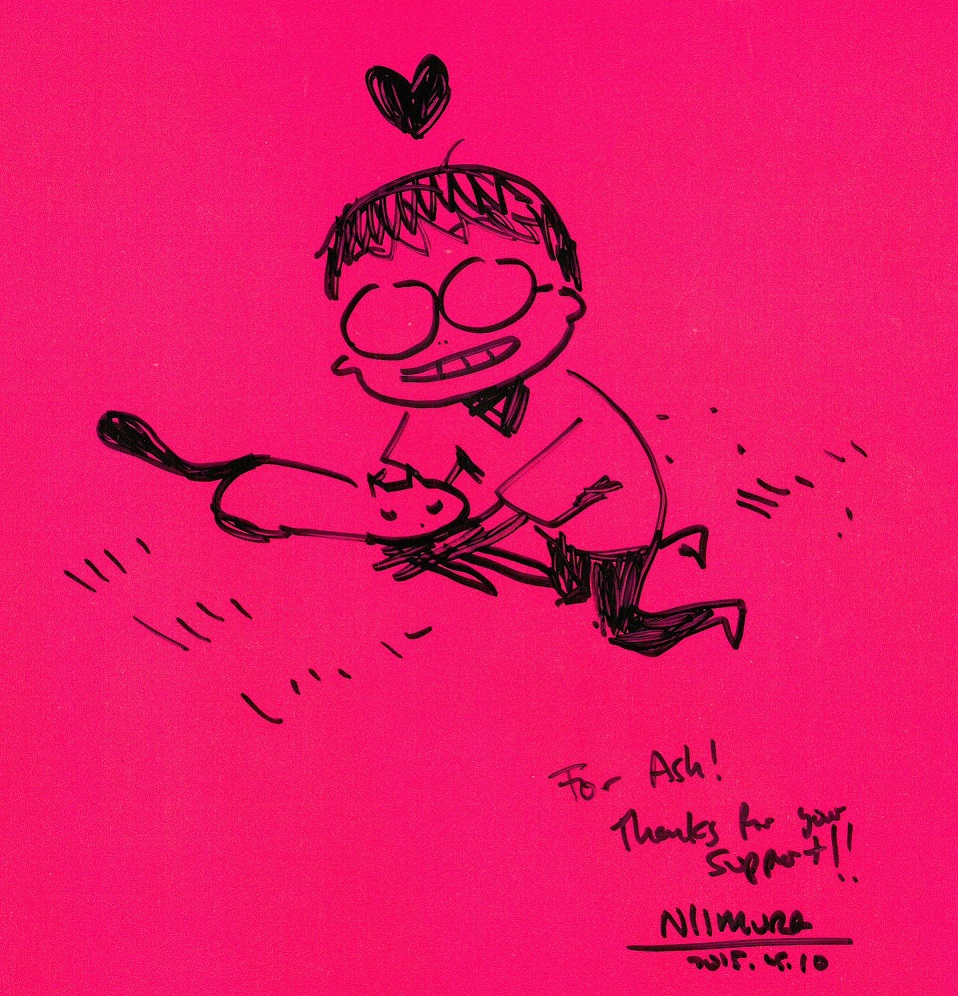
Ken Niimura Sketch

Ken Niimura likes cats

Despite being a huge fan of Avatar: The Last Airbender, I’ve never actually read any of the comics. And so before attending Gurihiru’s Spotlight, I wasn’t particularly familiar with the work of the two Japanese artists who make up the illustration team: Chifuyu Sasaki, who focuses on design, pencils, and inks, and Naoko Kawano, who focuses on design and colors. Along with their agent Akihide Yanagi, who helped to interpret, the two women were interviewed by Deb Aoki. Sasaki and Kawano became friends in college and soon after began collaborating on artwork together. Although they each have their specialty, their creative process has always been a team effort. Previously, they both worked as office ladies and did some local illustration work on the side; it wasn’t until they responded to Marvel’s search for Japanese creators that their career as artists really took off. They still haven’t been published much in Japan—their style is considered “too Western” by some—however, they have found success in other parts of the world. One of the reasons they submitted their work to Marvel was to try to reach an audience that would better appreciate their style. Marvel has never asked them to change how they draw and they have been given a lot of freedom with the series that they have been involved with. In addition to Marvel and Dark Horse Comics, Gurihiru has also worked with Scholastic and Pearson Education as illustrators and colorists. Their two biggest influences when it comes to how they approach their art? Disney animation and Todd McFarlane’s Spawn. One day Gurihiru would like to try creating their own stories, but in the meantime they’re so busy as artists that they haven’t had a good opportunity to develop those skills.

Noelle Stevenson’s Spotlight conflicted with Ed Luce’s Spotlight, which I was also very interested in. But, because Gurihiru’s session went over its time, I was already in the room, and I wanted to be there for the next panel as well, I decided to continue my siege of the High Park Ballroom. Stevenson was on a panel that I attended last year at TCAF and I was looking forward to reading her debut graphic novel Nimona which debuted at TCAF this year, so I was glad to have the chance to hear her interviewed by Robin Brenner (another manga-savvy librarian that I look up to a great deal). Stevenson is an engaging, intelligent, and well-spoken young creator. Topics of the casual conversation included Nimona, working as part of a team as a writer for Lumberjanes, and the importance of diversity in comics. Before being picked up by HarperCollins, Nimona started as a webcomic that was a part of Stevenson’s senior thesis. The first thing she knew about the story was its ending, but she actually began posting the comic online before the script had been finalized. As a result, the comic changed some as it progressed, and additional revisions needed to be made for the print edition. Stevenson first became widely known for her fanart, which is how her agent, who approached her directly, discovered her. Her work on Nimona and as a writer for Lumbarjanes has allowed her to create something of her own which subsequently led to other projects. As Stevenson describes it, “the writing was an accident,” but she is now being hired for her own unique voice rather than as someone to mimic an existing tone or story. She finds it very satisfying to be in the position to create something that isn’t just more of the same, feeling that diversity in comics makes for better stories in addition to challenging readers to expand both their worldviews and their capacities for empathy.

Aya Kanno Chibis

Chibi Richard and Asuka by Aya Kanno

One of the most popular events at TCAF in 2014 was “What Do Women Want? Writing Comics For A Female Audience” and so this year Lianne Sentar facilitated a reprise of the panel. Joining her this time around was Sam Maggs, Sandra Bell-Lundy, Brenden Fletcher, Svetlana Chmakova, and Sydney Padua. The group provided a nice range of perspectives on the subject as the panelists are all involved in different parts of the comics industry: publishing, journalism, syndicated comics, mainstream comics, manga-influenced comics, and webcomics. The panelists argue, and I agree with them, that by expanding the range of stories being told about and for women in addition to increasing the diversity of their representation in comics, men’s stories and representation are inherently expanded and increased as well. Stories aimed at straight, white men are often the default in mainstream media, but if allowed, women-oriented stories can be just as universal. Last year the panel included a lot of angry ranting, but this year tended to be much more positive in tone, a good indication that the state of the comics industry is already beginning to change for the better. The group hypothesized that the Internet has a played a critical role in allowing this to happen. Social media and webcomics in particular have provided platforms for creators to freely express themselves, reach a widespread audience, and form communities and support networks even when working on a comic that is especially niche. The big publishers are paying attention to these developments and taking note of what readers want, but the inertia of a well-entrenched industry used to telling a particular kind of story can be difficult to overcome and there will continue to be missteps. The road may be bumpy, but it is improving, and there are now other viable options for creators and readers outside of mainstream publication, as well.

I thought about going to the Queer Mixer again this year but ultimately ended up hanging out in the city with the family, finding plenty of good food to eat and beer to drink, enjoying the pleasant weather outside, and visiting Toronto’s public parks. Because TCAF starts a couple of hours later on Sunday than it does on Saturday, we were able to sleep in a bit on Sunday morning before heading out for brunch. Afterwards I made my way back to the Marriott and the Reference Library while the rest of the family explored the Royal Ontario Museum. Compared to Saturday, at first it seems like I hardly did anything at all on Sunday since I only attended three panels. But, I also made it to Ken Niimura and Aya Kanno’s signings, and spent some more time in the exhibitor areas talking to and collecting signatures from some of the other creators. The other three-fourths of family wandered around the library for a bit as well, tracking down some of their favorite artists and adding to the pile of comics that were coming back to the United States with us.

My first panel of the day was “Get Published In Japan!,” moderated by Deb Aoki and featuring Yuri Yamamoto (an editor at Akita Shoten for Princess magazine who is working with Aya Kanno on Requiem of the Rose King among other series), Ken Niimura, Abby Denson and independent manga artist Yuuko Koyama (who self-published some work together in Japan), and Gurihiru’s agent Akihide Yanagi. While the panel addressed some of the more technical issues and challenges that confront non-Japanese creators when trying to break into the manga industry in Japan—such as language barriers and the lack of support for submitting materials digitally—much of the discussion actually focused on the importance of the relationship between an editor and creator. In Japan, editors tend to play a much more prominent role in the creation of comics than they do in most other countries; editors are often considered a part of the creative team, and some even act as the writers for the artists they work with. It’s a relationship dynamic which may take some foreign creators, many of whom are used to working more independently, time to adjust to. As Niimura puts it, “Finding the right editor is like finding the right girlfriend or boyfriend,” a good match is required to really make the relationship work. The panelists agreed that one of the most important traits for creators to have is the ability to positively take critique and criticism in stride, always working to improve based on those comments with the knowledge that even if they are severe they are intended to help them better themselves and their work. Of course, the advice that creators receive, even for the same comic, will differ depending on the editor they are working with. Some editor’s in Japan intentionally seek out foreign talent, while others still show some discrimination towards non-Japanese creators. But, as long as a submission to a manga magazine is in Japanese, it will always be reviewed for consideration.

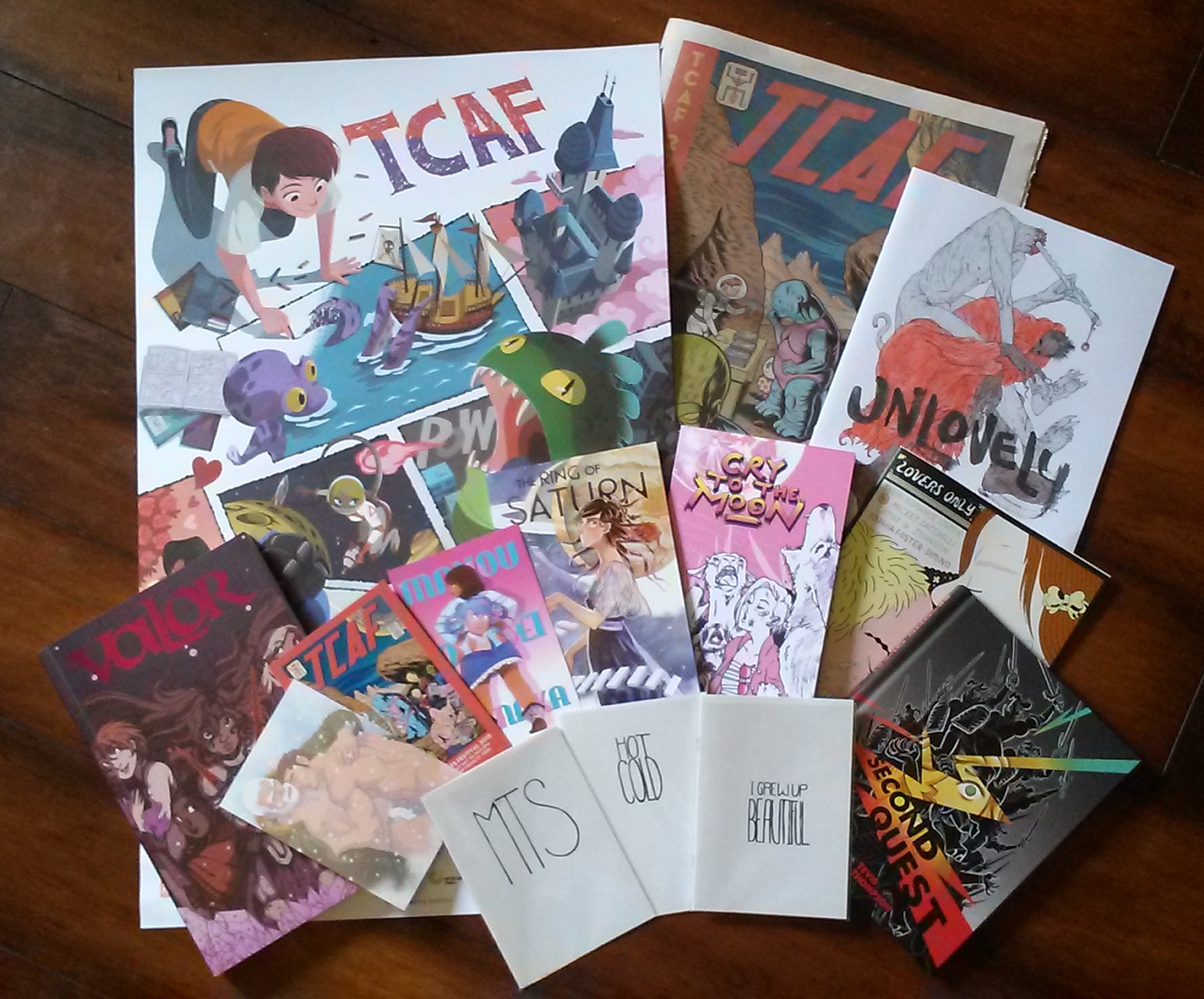
TCAF 2015 Haul

Most, but not quite all, of my TCAF haul

It was then back to the Reference Library for the “Manga Translation” panel facilitated by Robin Brenner and featuring translators Kumar Sivasubramanian (who has done manga translation for Dark Horse and Vertical) and Jocelyne Allen (who has worked with Drawn & Quarterly, Digital Manga, Viz Media, and others) as well as Deb Aoki (who has served as one of the judges for the Manga Translation Battle sponsored by Japan’s Agency for Cultural Affairs). Over the course of the discussion, the panelists identified some of the things that make manga translation particularly challenging, such as sound effects, the size and shape of word balloons and the limited space for text, choosing appropriate gendered pronouns, puns and wordplay, culturally specific concepts and jokes, and so on. Both accuracy and readability are important for any translation; the audience must always be kept in mind since translation choices and tone will change depending on what the publishers and readers want or need. Some series, like Blade of the Immortal, demand a “rawer” translation with much of the Japanese terminology left intact because that is what the audience has come to expect. Different publishers have different policies and requirements for their translations, too. For example, some allow translation notes while others do not. Many manga fans may not realize that the translators ultimately aren’t the only ones responsible for a manga’s translation—adapters and editors, as well as the original publishers and creators, are also involved in the decisions that are made. More than one translator may work on the same series, too, so additional effort is needed in order to maintain a consistent translation over multiple volumes. It’s also worth noting that it’s very rare that a translator has the opportunity to work directly with creators or to ask them questions about their manga. Generally translators don’t know anything more than any other reader and they can be taken by surprise by the manga’s developments, which can present problems for translation.

Although the Comics vs Games showcase has been a part of TCAF for four years now, 2015 was the first time that I had the chance to attend any of its programming, largely because much of it was actually located in the Reference Library this year. At one point in time, my love of games rivaled my love of comics, so I was particularly looking forward to it. “Comics vs Games: Microtalks!” featured eleven speakers: David Calvo, Alfe Clemencio, Amanda Cosmos, David Hellman, Andrew Hlynka, Kim Hoang, Rachel Kahn, Xin Ran Liu, Matthew Ritter, Jason Shiga, and Miguel Sternber. The group included game developers, artists, and aficionados, as well as comics creators, each of whom gave a very short presentation discussing various aspects of comics and games, generally touching upon the similarities and differences between the mediums and what creators working in one could learn from the other. Both comics and games can be a form of storytelling that requires a reader or player to actively engage in the creation of a narrative from disparate images and moments. Of the two, generally games are considered to be more interactive, which greatly impacts the experience of the story, even if it’s a linear one. But the incredibly innovative work being done by Jason Shiga proves that comics can be interactive as well. Art obviously serves a function in comics where it is a critical part of the narrative, but it’s also important in games where the artwork is responsible for creating and establishing a setting and environment. Traditional illustration techniques can be used to inform game art and design, and even three-dimensional games can successfully incorporate two-dimensional artwork and animation.

Believe it or not, the above is just a small fraction of what I could have written about TCAF. Each of the individual panels and spotlights could have easily had an entire essay devoted solely to them; I merely expressed some of my own thoughts and experiences, and touched upon a few and not by any means all of the major themes and topics addressed at the various programs at the festival. TCAF is an absolutely fantastic comics event. If you ever have the opportunity to attend, I highly recommend it. I know that I certainly plan on returning every year that I possibly can.

Filed Under: FEATURES Tagged With: Aya Kanno, comics, Gengoroh Tagame, Gurihiru, J. M. Ken Niimura, manga, Noelle Stevenson, TCAF, Video Games

My Week in Manga: May 11-May 17, 2015

May 18, 2015 by Ash Brown

My News and Reviews

Well, I was hoping to post the recap of my recent visit to the Toronto Comic Arts Festival last week, but I haven’t actually managed to finish writing it yet. (Things have been very busy at work and home, and the taiko performance season is ramping up, too.) So, the plan is to post it sometime later this week instead. Fortunately, I did have a couple of in-depth manga reviews in reserve for last week just in case the TCAF post fell through. The first review, Yuki Urushibara’s Mushishi, Volume 3, is a part of my ongoing monthly horror manga review project. Mushishi continues to be one of my favorite series. This particular volume is notable as it reveals some of Ginko’s backstory. Last week I also reviewed the most recent installment of Bruno Gmünder’s Gay Manga line, Mentaiko Itto’s Priapus, which is a highly entertaining collection of gay erotic manga. The volume marks Itto’s official English-language debut and contains some pretty ridiculous stories and characters.

While I haven’t managed to fully report back on TCAF 2015, other TCAF posts are already being made. The Comics Reporter is making an effort to create an index of stories and references, but I specifically wanted to point out the recordings of some of the panels at The Comics Beat. Other items of interest from elsewhere online include Ryan Holmberg’s most recent What Was Alternative Manga? column at The Comics Journal—Blood Plants: Mizuki Shigeru, Kitaro, and the Japanese Blood Industry—and the 2015 edition of Advice on Manga Translation from Manga Translators over at Organization Anti-Social Geniuses. As for licensing news, Kodansha Comics announced a deluxe omnibus edition of Fairy Tail and Dark Horse will be adding a few new titles: Kentaro Miura’s Giganto Maxia, Spike Chunsoft and Takashi Tsukimi’s Danganronpa, and Kengo Hanazawa’s I Am a Hero, in addition to rescuing CLAMP’s RG Veda.

Quick Takes

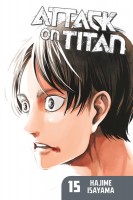
Attack on Titan, Volume 15Attack on Titan, Volume 15 by Hajime Isayama. Although it certainly has its moments and its own peculiar charm, Isayama’s artwork has never really been one of the strengths of Attack on Titan. There has certainly been improvement over the course of the series, and some of the individual panels and sequences are fantastic, but the artwork in this particular volume is terribly inconsistent and sometimes doesn’t even make sense to the point of distraction. But what Attack on Titan lacks in artistic finesse, the series makes up for with its large, engaging cast of characters and its constantly evolving story. Granted, with plot twist after plot twist after plot twist, the story is frequently on the verge of getting out of hand. Fortunately, Isayama reins it in a bit with this volume, allowing several of the story threads to play out and come to some sort of resolution before throwing something completely new into the mix, once again ending with a cliffhanger. Sometimes I miss the days when Attack on Titan was closer to being straight up horror, but all of the recent political intrigue can be interesting, too.

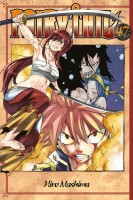
Fairy Tail, Volume 47Fairy Tail, Volumes 47-48 by Hiro Mashima. Thanks to Mashima’s afterword in the forty-seventh volume, I think I’ve finally figured out why Fairy Tail has been frustrating me recently—it’s his admitted lack of foreshadowing. The sudden plot developments that seem to come out of nowhere, although some of them are admittedly pretty great, make the series feel very disjointed and to some extent even directionless. Instead of inspiring feelings of excitement in how the story is progressing, Fairy Tail often inspires bafflement over its twists and revelations. In the same afterword Mashima indicates that he hopes to improve the foreshadowing, but he also says that he’ll be including plenty of red herrings as well, so I’m not sure how much that’s going to help. But even considering the unevenness of the series’ narrative, there’s still some good fun to be had in these two volumes. There are dragons, epic battles, and plenty of opportunities for the characters to demonstrate just how powerful they have become and just how badass they can be. Mashima is even able to work in some additional backstory for some of the characters amidst all the chaos.

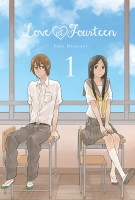
Love at Fourteen, Volume 1Love at Fourteen, Volumes 1-2 by Fuka Mizutani. I was actually taken by surprise by how much I ended up enjoying the first two volumes of Love at Fourteen. I had heard good things about the series, but I didn’t really expect that I would be so taken with a series about the romantic turmoils of middle school students. Tanaka and Yoshikawa have been close friends for some time and that friendship has started to blossom into something greater. They are becoming more aware of themselves and of each other. But their school doesn’t allow dating at such a young age, so they do what they can to keep their relationship a secret. So far the series is a chaste, slowly developing romance, but realistically that’s how it should be. Love at Fourteen is charming and somewhat nostalgic without being syrupy sweet. There’s even some queer representation—a girl who has fallen in love with another girl—which I’m always happy to see. However, I will admit that I am a little concerned about how the relationship between the music teacher and one of the other students may develop since some of her behavior towards him has been has been borderline if not blatantly inappropriate.

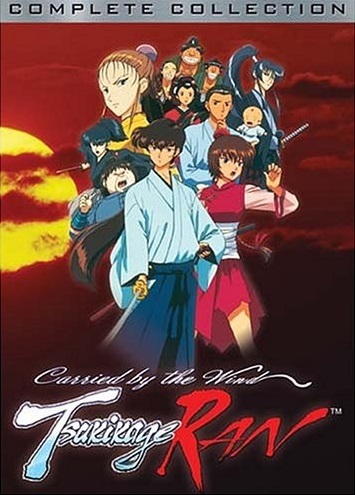
Carried by the Wind: Tsukikage RanCarried by the Wind: Tsukikage Ran directed by Akitaro Daichi. I am just now discovering Carried by the Wind; I completely missed when it was first released and happened across the thirteen-episode series more by accident than anything else. I’m glad that I did, though, because it is a tremendous amount of fun. Carried by the Wind is a comedic homage, without quite being a parody, of samurai films and television series. Tsukikage Ran, a skilled swordswoman, is a wandering ronin who would much rather drink a good bottle of sake and take a nap than get into a fight. Meow is a talented Chinese martial artist who means well but tends to get herself into trouble with her meddling. Although their attitudes and personalities are almost complete opposites—Ran is cool and collected while Meow is brash and prone to outbursts—the two end up becoming traveling companions of sorts. Each episode of Carried by the Wind stands completely on its own and generally follows a somewhat predictable story arc with Ran and Meow righting some sort of wrongdoing. But with its humor, marvelous lead characters, and great fight scenes, Carried by the Wind is a highly entertaining series.

Filed Under: FEATURES, My Week in Manga Tagged With: anime, attack on titan, Carried by the Wind, Fairy Tail, Fuka Mizutani, Hajime Isayama, Hiro Mashima, Love at Fourteen, manga

Priapus

May 15, 2015 by Ash Brown

PriapusCreator: Mentaiko Itto
Publisher: Bruno Gmünder
ISBN: 9783867877947
Released: April 2015

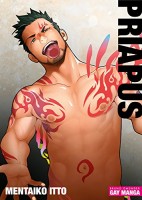
Mentaiko Itto’s Priapus is the fifth volume to be released by Bruno Gmünder as part of its relatively new Gay Manga line. Although the publisher is based in Germany, so far all of the manga have been translated into English. With the publication of Priapus in 2015, Itto joined Gengoroh Tagame and Takeshi Matsu as one of the few creators of gay erotic manga to have had an entire collection of their work released in English. However, unlike Tagame and Matsu, who both had examples of their work translated before being published by Bruno Gmünder, Priapus is Itto’s official English-language debut. Although the release of Priapus provided my first opportunity to read any of Itto’s manga, the creator does have a fairly strong presence online and so I was already somewhat familiar with his artwork and illustrations. But, I don’t actually know much about Itto beyond the fact that he seems to have garnered a global following; Bruno Gmünder describes him as “one of the most exciting young voices in gay manga today.”

Priapus collects several of Itto’s short manga and doujinshi. The volume opens with the first three episodes of “Priapus,” an ongoing series of stories featuring a contemporary erotic reimagining of the titular Greek god of fertility. Zeus, fed up with humans and their pointless wars, has decided to eliminate the entire race. Believing more violence will do nothing to solve the problem or teach humanity a lesson, he orders Priapus to bring about their demise bloodlessly in a way that only he can—by turning all of the men gay in a great Homopocalypse. “Gachinko Battle” is a spinoff of sorts from “Priapus.” The Gachinko Budokai is an epic mixed martial arts tournament, the winner of which is granted a wish by the gods. However, the rules of the competitions change according to the gods’ whims, and with Priapus in charge that means the champion will be whoever makes his opponents orgasm first during a fight. The gods have their fun in “1/4” as well, shrinking a young man to less than a quarter of his size and cursing him to stay that way until he successfully has sex with someone he likes. Priapus concludes with the completely unrelated “1000 Meters Deep” which is about the intimate relationship between the two last remaining members of a swim club.

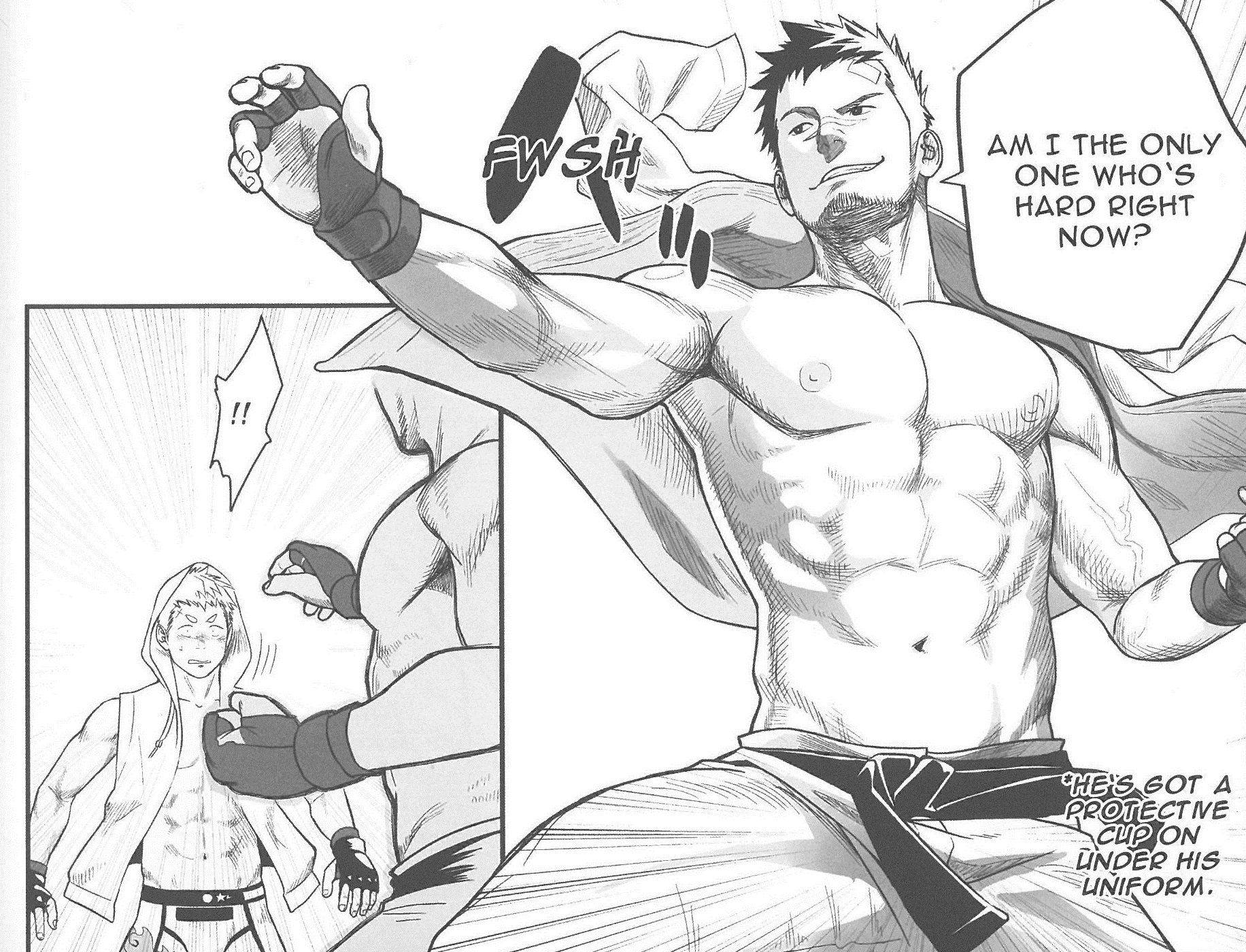
Priapus, page 106In general, there isn’t a lot of depth to the stories and characters of Priapus. The setups mostly serve as an excuse for a copious amount of sex, and there is plenty of vigorous, uninhibited sex included in the manga. But so much of Priapus is intentionally ridiculous that, for the most part, it’s not intended to be taken too seriously to begin with. Ultimately, the result is highly entertaining. At times the volume is even surprisingly cute and sweet. As expected, Priapus is a stunningly virile god who takes great delight in being given free rein to have as much sex as he wants with as many men as he would like using wide a variety of divine tools and techniques to achieve his goals. But it soon becomes clear that he actually and honestly cares for the men he seduces. He even takes the time to set them up with other guys when he needs to move on to his next target. The men in the other stories, too, make emotional and romantic connections with each other, not just physical ones. The erotic content of Priapus tends to be the focus of the manga, but there are some rather charming character moments as well.

Although in part some of the characters in Priapus are inspired by Greek mythology, Itto’s stories and interpretations are entirely his own. Humor pervades Priapus, everything from the basic premises of the stories, to the references to anime and adult videos, the breaking of the fourth wall, the interactions between the characters, and even the imaginative sex itself. (By necessity, the sex in “1/4” has to be particularly creative.) Initially it would seem that “1000 Meters Deep” would be the exception to this trend. Overall, the story has a much more melancholy and introspective feel to it. Even the artwork is more delicate, setting it further apart from the rest of the manga collected in Priapus. But it also ends with a bit of levity. Itto mentions in the afterword that he’s very happy that his work has now been published uncensored; his lean, trim, muscular, and well-built men are on full display in all of their frequently naked glory. The artwork in Priapus is attractive and the stories and characters are amusing and even heartwarming on occasion, making for a very appealing collection of erotic gay manga. I certainly wouldn’t mind seeing more of Itto’s work translated.

Filed Under: REVIEWS Tagged With: Bruno Gmünder, Gay Manga, manga, Mentaiko Itto

Mushishi, Vol. 3

May 13, 2015 by Ash Brown

Mushishi, Volume 3Creator: Yuki Urushibara
U.S. publisher: Del Rey
ISBN: 9780345496454
Released: February 2008
Original release: 2002
Awards: Japan Media Arts Award, Kodansha Manga Award

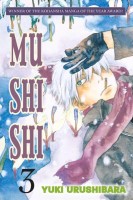
Mushishi, Volume 3 by Yuki Urushibara was originally published in Japan in 2002. The volume was initially released in English in print by Del Rey Manga in 2008. Although that particular edition is no longer available, Kodansha Comics did re-release Mushishi, Volume 3 digitally in 2014. I count myself lucky to own the entirety of Mushishi in print. I fell in love with the series after reading the first volume and so made a point to begin collecting it. Fortunately, Mushishi was being released in English around the same time I first started to really get into comics and manga and I didn’t have a difficult time finding the series. To this day, Mushishi remains one of my favorite manga. I like its quiet yet often creepy atmosphere and its folktale-like nature. I’m not the only one who appreciates Mushishi. The series was a recipient of a Kodansha Manga Award and has also been the basis for a live-action movie as well as multiple anime adaptations and other media.

Unseen to most people but found throughout nature are mushi—creatures that are still very close to the original form of life. They can be benign forces but often their presence is a source of trouble when it encroaches upon the human world. Illness and disease and even seemingly natural phenomena can all be attributed to mushi. Some people with the ability to see mushi make their living as mushishi by traveling across the country, studying the creatures, and trying to return balance where disturbances have occurred. But there are also those who can see mushi who are not mushishi. Frequently they are unaware of what the creatures truly are, and many times the people around them don’t believe them when they try to describe their experiences with mushi. This lack of understanding can cause significant strife, even within tightly knit communities. People who can see and are aware of mushi, whether they be mushishi or not, are treated differently, sometimes out of concern and sometimes out of fear.

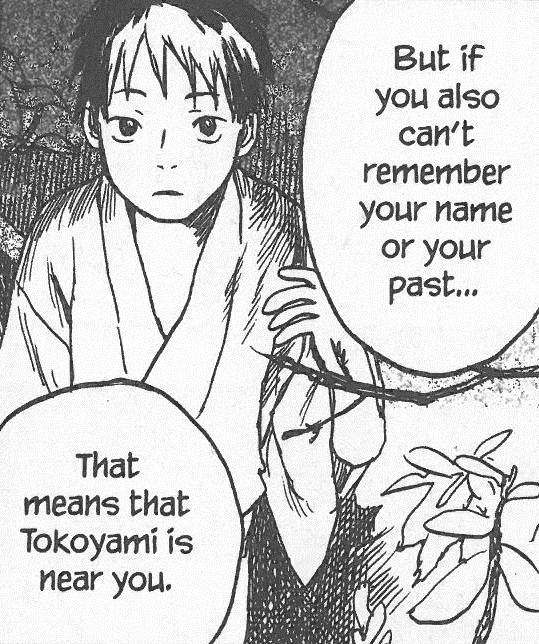
Mushishi, Volume 3, page 202While the previous volume of Mushishi seemed to place a particular emphasis on mushishi, the fourth volume mostly features stories in which Ginko—a mushishi and the series’ protagonist—is dealing with incidents where people who can see mushi but who are not formally trained as mushishi are somehow involved. In “The Cry of Rust,” the unique quality of a young woman’s voice attracts mushi, bringing calamity to her village. “From the Ocean’s Edge” follows a man whose wife has been missing at sea for three years after they both saw peculiar creatures in the water. “The Heavy Seed” tells the story of a village that has strangely bountiful harvests during times of famine. Children fall deathly ill in “White Living in the Inkstone” when they accidentally release dormant mushi while playing in Doctor Adashino’s storehouse without permission. (Adashino is one of the very few recurring characters in Mushishi; his slightly antagonistic relationship with Ginko is absolutely delightful.)

Although during serialization it followed “The Cry of Rust,” the final chapter collected in Mushishi, Volume 3 is “The Fish Gaze.” The episode is particularly notable because it reveals some of Ginko’s backstory. Even though it’s a past that he himself is unable to remember—a rare example of a time when the reader is more knowledgeable than he is—this specific part of Ginko’s life story plays a very important role in who he later becomes. Mushishi tends to be episodic, but elements of Ginko’s character and personality have been revealed throughout the series. However, “The Fish Gazee” is the first chapter to really delve into his history. Like many of the other stories in Mushishi, Ginko’s tale has elements of darkness and tragedy, but the emphasis placed on the ultimate perseverance of life in the face of death and sorrow remains. Mushishi frequently incorporates sadness, but the manga is not without hope; Urushibara seems to be able to navigate a fine balance between melancholy and wonder with ease.

Filed Under: REVIEWS Tagged With: del rey, Japan Media Arts Award, Kodansha Manga Award, manga, mushishi, Yuki Urushibara

My Week in Manga: May 4-May 10, 2015

May 11, 2015 by Ash Brown

My News and Reviews

Despite spending a long weekend in Canada for the Toronto Comic Arts Festival and generally being very busy, I still managed to post a few things here at Experiments in Manga last week. To begin with, the winner of the Yamada-kun and the Seven Witches manga giveaway was announced. The post also includes a list of some of the manga available in English that feature witches. As for reviews, two were posted. The first was for Blade of the Immortal, Volume 31: Final Curtain, the last volume of Hiroaki Samura’s epic manga series. With that post, I have now written a review for every Blade of the Immortal trade collection in English. (At some point, I do hope to work on an Adaptation Adventures feature for the Blade of the Immortal anime, as well.) Last week’s other review is only very tangentially related to manga. I finally read Lewis Carroll’s Alice’s Adventures in Wonderland and Through the Looking-Glass, which is simply marvelous and I highly recommend the novels. I specifically read (and reviewed) Seven Seas’ recent omnibus edition which includes hundreds of delightful illustrations by International Manga Award-winning artist Kriss Sison.

As previously mentioned, I spent a portion of last week at TCAF and so was rather preoccupied. (I hope to post some random musings about the event later this week, most likely on Friday if I can’t manage to get the feature together that quickly. Otherwise, I’ll aim for next week.) Still, I did catch some interesting things online. For example, a recent episode of the Inkstuds podcast features Anne Ishii and Graham Kolbeins, the editors of the Massive anthology, talking about gay manga, its creators, and other related topics. Tofugu posted a couple of manga-related articles recently: an interview with Araki Joh and Exploring Shueisha. A few licenses were announced last week as well. Coinciding with the news that Masashi Kishimoto will be a guest at this year’s New York Comic-Con, Viz also announced new Naruto light novels, an artbook, and a box set. Seven Seas slipped in another license announcement, too: Tsukasa Saimura’s manga series Hour of the Zombie. And not to be left behind, Yen Press also made two license announcements on Twitter: Of the Red, the Light and the Ayakashi by HaccaWorks* and Nanao, and School-Live! by Sadoru Chiba and Norimitsu Kaihou.

Quick Takes

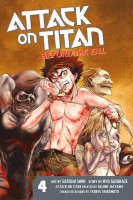
Attack on Titan: Before the Fall, Volume 4Attack on Titan: Before the Fall, Volume 4 written by Ryo Suzukaze, illustrated by Satoshi Shiki. Although Before the Fall has kept my attention since the beginning of the series, the fourth volume is the first volume that really excited and engaged me. Part of that is likely due to the introduction of a new character, Cardina Baumeister, who is much more capable than he initially appears. (Although, maybe it’s a bad thing that I find him more interesting than the series’ protagonist…) He and Kuklo are both prisoners who will soon be quietly and secretly sent to their deaths. The method of their planned execution? Abandonment outside of the walls, left to be consumed by the Titans. Fortunately for Kuklo, there are people who are invested in keeping him alive. But even considering that, surviving still won’t be an easy feat. At this point in the series, Before the Fall is beginning to tie in a little more closely with the established history and worldbuilding of Attack on Titan as a whole, which I like to see. The fourth volume reveals a bit more about the political and social settings of Attack on Titan in addition to having some exciting action sequences. I don’t really care much for how the Titans are drawn in Before the Fall, though. Or Sharle’s character design, for that matter.

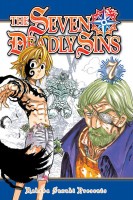
Seven Deadly Sins, Volume 7The Seven Deadly Sins, Volumes 7-8 by Nakaba Suzuki. Happily, by the beginning of the seventh volume, the largely pointless tournament arc of Seven Deadly Sins is done and over with and the series is getting back on track with an actual plot. More of Meliodas’ personal history is revealed as are the motivations of the Holy Knights who are trying to incite a massive war. Another of the legendary Seven Deadly Sins is introduced in these volumes as well: Gowther, a rather peculiar young man known as the Goat Sin of Lust. I still haven’t been able to figure out the significance of the animals or even the sins as the relate to the warriors, which seems like a lost opportunity for Suzuki’s worldbuilding. Perhaps there really is no greater meaning, and the names are just supposed to sound cool. It’s also rather curious that, despite having been comrades who fought closely together in the past, the Seven Deadly Sins don’t seem to actually know who each other are. They don’t seem to pay attention to each other either; for example, Meliodas seems very surprised to discover a demon he is fighting used to be a Holy Knight when Gowther stated that very fact at the end of the previous chapter. But, while Seven Deadly Sins can be frustrating, there are very entertaining parts as well, like when Diane simply chucks her teammates forty miles when they need to cover distance quickly.

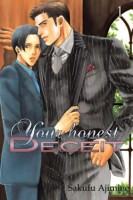
Your Honest Deceit, Volume 1Your Honest Deceit, Volumes 1-2 by Sakufu Ajimine. I believe that the short boys’ love series Your Honest Deceit is the only work by Ajimine to have been released in English. It’s a largely enjoyable manga, but for me it wasn’t a particularly spectacular one. However, I did appreciate that for the most part the story revolves around grown, adult men with well-established careers. In this particular case, Your Honest Deceit is about lawyers and their professional assistants. (Granted, if I’m in the mood to read about gay lawyers, I would generally prefer Fumi Yoshinaga’s Ichigenme… The First Class Is Civil Law. Or What Did You Eat Yesterday?, for that matter.) Kuze is the younger of the two men of the series’ primary couple. He went to law school and did exceptionally well in his classes, but he seems to not be interested in becoming a lawyer and is content working as a secretary for the older Kitahara, the lawyer and object of his affections and one of the school’s lecturers. Your Honest Deceit has its serious moments and misunderstandings, but Ajimine incorporates a fair amount of humor in the manga. At the same time, I’m not really sure that I would call it a comedy; Kuze and Kitahara’s burgeoning relationship is threatened by their own jealousies as well as by interference from other people, so it can be rather dramatic at time.

Filed Under: FEATURES, My Week in Manga Tagged With: attack on titan, manga, Nakaba Suzuki, Ryo Suzukaze, Sakufu Ajimine, Satoshi Shiki, Seven Deadly Sins, Your Honest Deceit

Blade of the Immortal, Vol. 31: Final Curtain

May 8, 2015 by Ash Brown

Blade of the Immortal, Volume 31: Final CurtainCreator: Hiroaki Samura
U.S. publisher: Dark Horse
ISBN: 9781616556266
Released: April 2015
Original release: 2013
Awards: Eisner Award, Japan Media Arts Award

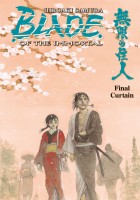
So, this is it. The Final Curtain of Blade of the Immortal, both literally and figuratively. Released by Dark Horse Comics in 2015, the volume is the thirty-first and final installment in the English-language edition of Hiroaki Samura’s epic manga series. After nearly two decades of publication, the entirety Blade of the Immortal has now been translated. Due to slight differences between the early English trade collections and the Japanese releases, Final Curtain is actually equivalent to the thirtieth volume of the original Japanese edition of Blade of the Immortal published in 2013. The manga has been well-received by both critics and fans alike, winning Samura many awards and honors including a Japan Media Arts Award and an Eisner Award. Blade of the Immortal was one of the very first manga that I began reading and collecting and the series has remained a personal favorite of mine ever since I discovered it. Because of that, Blade of the Immortal and its ending hold particular meaning for me. I have been looking forward to reading its conclusion for a very long time.

At its height, the Ittō-ryū was poised to become the official sword school of the shogunate, bringing the goal of the group’s leader Anotsu Kagehisa—the restoration of the way of the sword to Japan—tantalizingly close. But in the end they were betrayed and massacred by the very people who invited them to join the banshū. Since then the Ittō-ryū’s numbers have continued to dwindle as the survivors of that initial attack have been hunted down by the Mugai-ryū and Rokki-dan, forces largely made up of death row criminals commanded by Habaki Kagimura. The fighting has been fierce and casualties have been immense on both sides. Now only a few members of each group remain and they are locked in their final battles against one another. Though it appears as though Anotsu may have the upper hand, the outcome of the conflict is far from certain, especially as there are others interested in controlling the fate of the Ittō-ryū, including the young woman Rin and her near-immortal bodyguard Manji.

Blade of the Immortal, Volume 31: Final Curtain, page 238Final Curtain serves two main purposes: providing a resolution to the intense and bloody confrontations begun in the previous volume, Vigilance, and granting a conclusion to Blade of the Immortal as a whole. I feel the final volume is successful on both counts. Even though they aren’t as over-the-top or as brutal as some of the other fight sequences in the series, there are still plenty of surprises to be had in the final battles of Blade of the Immortal. They require incredible physical, mental, and even emotional fortitude from those involved, making the scenes very engaging to read. It’s not just fighting for fighting’s sake; there is deliberate purpose and reason behind the struggles. Lately, the series seems to have turned its attention to the dramatic demise of the Ittō-ryū and its leader, but Final Curtain manages to bring the manga full circle again by allowing Rin and Manji to once again become directly involved in how events unfold.

Blade of the Immortal has always had a large cast of characters as well as several intertwining plot threads. All of the survivors and the families and friends of those who have died have at least one moment in Final Curtain, even if it’s only a few panels, in which they become the focus of the manga, creating something akin to an epilogue. Loose ends are tied up and, while some ambiguity remains, the aftermath of the long struggle is revealed. Blade of the Immortal covered a lot of ground in its thirty-one volumes, the story twisting and turning and the characters and their relationships continually growing and evolving. The series can be read and enjoyed simply for its impressive action and fight sequences, but the manga also explores deeper, thought-provoking ideas. The characters are morally complex—very few can be said to be entirely in the right or in the wrong—and Blade of the Immortal questions what their or any person’s ultimate legacy will be. As for the last volume itself, I found Final Curtain to be a very satisfying conclusion to the series.

Filed Under: REVIEWS Tagged With: Blade of the Immortal, Dark Horse, Eisner Award, Hiroaki Samura, Japan Media Arts Award, manga

Manga Giveaway: Yamada-kun and the Seven Witches Giveaway Winner

May 6, 2015 by Ash Brown

Yamada-kun and the Seven Witches, Volume 1And the winner of the Yamada-kun and the Seven Witches manga giveaway is… Anna!

As the winner, Anna will be receiving a copy of Yamada-kun and the Seven Witches, Volume 1 by Miki Yoshikawa as published by Kodansha Comics. There seem to have been quite a few manga released recently that feature witches, so for this giveaway I asked participants to tell me a little about their favorite witches in manga. Check out the giveaway comments for all of the detailed responses, and check out below for a list of additional witchy manga!

Some manga featuring witches that have been licensed in English:
The Ancient Magus’ Bride by Kore Yamazaki
Berserk by Kentaro Miura
The Big Adventures of Majoko by Tomomi Mizuna
Cowa! by Akira Toriyama
Dragon Knights by Mineko Ohkami
The Good Witch of the West written by Noriko Ogiwara, illustrated by Haruhiko Momokawa
Himeyuka & Rozione’s Story by Sumomo Yumeka
Innocent W by Kei Kusunoki
Knights by Minoru Murao
Kurohime by Masanori Katakura
MÄR by Nobuyuki Anzai
Maria the Virgin Witch by Masayuki Ishikawa
Princess Knight by Osamu Tezuka
Puella Magi Kazumi Magica: The Innocent Malice by Magica Quartet
Puella Magi Madoka Magica by Magica Quartet
Record Of Lodoss War: The Grey Witch written by Ryo Mizuno, illustrated by Yoshihiko Ochi
Rosario+Vampire by Akihisa Ikeda
Rosario+Vampire: Season II by Akihisa Ikeda
Shoulder-a-Coffin Kuro by Sato Kiyuzuki
Soul Eater by Atsushi Ohkubo
Soul Eater Not! by Atsushi Ohkubo
Spell of Desire by Tomu Ohmi
Sugar Sugar Rune by Moyoco Anno
Tsubasa: Reservoir Chronicle by CLAMP
Ultra Maniac by Wataru Yoshizumi
Umineko: When They Cry written by Ryukishi07
Witchcraft Works by Ryu Mizunagi
xxxHolic by CLAMP
xxxHOlic: Rei by CLAMP
Yamada-kun and the Seven Witches by Miki Yoshikawa
Zone-00 by Kiyo Kyujyo

Thank you to everyone who participated in the giveaway and shared your favorite witches with me. I hope to see you again for the next one!

Filed Under: UNSHELVED Tagged With: manga, Miki Yoshikawa, Yamada-kun and the Seven Witches

My Week in Manga: April 27-May 3, 2015

May 4, 2015 by Ash Brown

My News and Reviews

Last week was the end of one month and the beginning of another, which means the most recent manga giveaway at Experiments in Manga is currently underway. The winner will be announced on Wednesday, so there’s still a little time to enter for a chance to win Miki Yoshikawa’s Yamada-kun and the Seven Witches, Volume 1. An in-depth manga review was posted last week as well. I took a look at Aki’s The Angel of Elhamburg, a bittersweet tragedy which, although it can be difficult to follow in places, is a lovely single-volume manga. And finally, over the weekend, April’s Bookshelf Overload was posted for those who are curious about the manga that made its way into my home last month.

On to other interesting reading and news found elsewhere online! Sparkler Monthly has started a monthly blog and the first post Why do we need “comics for women”? Why not “comics for everyone”? is excellent. Seven Seas announced three new manga licenses last week: Katsuhisa Kigitsu’s Fraken Fran, Wataru Karasuma’s Not Lives, and Ichigo Takano’s Orange (which is also being released digitally by Crunchyroll.) Franken Fran in particular has been a oft-requested title by fans. Organization Anti-Social Geniuses talked with Lissa Pattillo from Seven Seas about the Franken Fran license. Also at OASG is an interview with Hope Donovan, a managing editor at Viz Media. And Mangabrog has posted a translation of a conversation between mangaka Nobuyuki Fukumoto and musician and author Kenji Ohtsuki.

Quick Takes

Cipher, Volume 1Cipher, Volumes 1-6 by Minako Narita. During its time, CMX published some really great manga, including several old-school shoujo series. Cipher is one of those, and probably one of the most eighties manga that I’ve read. The series, set in New York, began serialization in 1984 and includes many references to American pop culture of the time. Anise is trying to make friends with Siva, an up-and-coming actor as well as one of her classmates, when she discovers his secret. He has a twin, Cipher, and they’ve been taking turns pretending to be “Siva.” And so they make a bet: if after two weeks she can tell the two twins apart, they will tell her why they have been sharing an identity. Cipher doesn’t always have the most believable story—for one, I don’t know of any parents who would ever let their child move in with someone they’ve never met even temporarily—but the characters and interpersonal drama are consistently engaging and at times even compelling. So far, I’m loving it. Cipher is often slow-moving, generally focusing on the everyday lives of American teenagers, but a plot twist towards the end of the sixth volume hastens and sets up important character and story developments for the second half of the series.

Junk!Junk! Shushushu Sakurai. If I’m not mistaken, Junk! was the very last manga to be released by DramaQueen before the publisher disappeared. Like Sakurai’s other DramaQueen release, Missing Road, Junk! is a boys’ love manga that incorporates elements of science fiction and action. Also like Missing Road, Junk! is a manga that could have benefited from additional volumes in order to explore some of the complexities of the plot and setting. Reading these manga, Sakurai seems to be overly ambitious when it comes to her stories. However, I think Junk! is the more cohesive, coherent, and successful of the two overall. Even though it’s only a single volume, Junk! has a lot going on in it. A religious cult focused on breeding people together—whether they are male or female—in order to foster the evolution of even stronger humans. A man who holds the key to a closely kept government secret that ensures a person’s survival even in the face a nuclear apocalypse. And, because it is a mature boys’ love title after all, there’s plenty of sex, too, even at inopportune moments. (Seriously, taking time to bang your lover in the middle of a dangerous infiltration mission doesn’t seem to be the wisest decision.)

My Little Monster, Volume 7My Little Monster, Volume 7 by Robico. The last few volumes of My Little Monster left me a little frustrated with the lack of progress in the development of the series’ story and in the relationships of its characters. Fortunately, the seventh volume seems to get things back on track and the manga continues to be a fairly amusing and even endearing series from time to time. Also, I love that after everything that has happened, Nagoya, the pet chicken, continues to make repeated appearances. The cast of My Little Monster is made up of a bunch of oddballs who tend to be socially awkward, but I do like them quite a bit. Part of that social awkwardness means they can be completely oblivious to other people’s feelings, even when those feelings have been clearly and repeatedly stated. To be fair, they’re sometimes oblivious to their own feelings as well. The result is one heck of a mess of tangled and conflicting relationships. The seventh volume of My Little Monster sees some but certainly not all of those relationships sorted out after several confessions of love are made and replies to them eventually given. At this point the series is more than halfway over, so I hope Robico is able to maintain its forward momentum.

Sankarea: Undying Love, Volume 11Sankarea: Undying Love, Volume 11 by Mitsuru Hattori. I was very curious to see how Sankarea would end since I honestly had no idea which direction Hattori was going to take things. And now that I’ve read the final volume, I’m not entirely convinced that Hattori actually knew, either. From the very beginning Sankarea has been a strange mix of horror and romantic comedy, an offbeat story with offbeat characters. Sometimes the ideal balance between the two genres was there, and sometimes it wasn’t. The finale of Sankarea would seem to demand that Hattori choose one over the other, but instead he attempts to satisfy the requirements of both by employing a series of false endings. I think that ultimately the conclusion of Sankarea would have been more satisfying if Hattori had simply picked one ending and ran with it. Like the rest of the series, the eleventh volume of Sankarea had its cute and sweet moments as well its moments of blood and gore. It also has the return of Rea’s abusive father (legitimately one of the most disturbing elements of the series), trying to put him in a slightly more sympathetic light.  In the end, little Bub the undead cat is probably still my favorite part of the entire series.

Filed Under: FEATURES, My Week in Manga Tagged With: Cipher, manga, Minako Narita, Mitsuru Hattori, My Little Monster, Robico, Sankarea, Shushushu Sakurai

The Angel of Elhamburg

May 1, 2015 by Ash Brown

The Angel of ElhamburgCreator: Aki
U.S. publisher: Yen Press
ISBN: 9780316340465
Released: March 2015
Original release: 2013

So far, three of Aki’s manga have been released in English. First was her debut, Utahime, published by Digital Manga. Second was her short series Olympos, released by Yen Press as a single omnibus volume. Most recently published in English is Aki’s The Angel of Elhamburg, initially conceived of as a short, one-shot manga, but expanded to fill an entire volume. Also released by Yen Press, The Angel of Elhamburg is presented in an attractive hardcover edition with a dust jacket with foil accents. The manga was released in Japan in 2013 and in English in 2015. Aki’s manga tend to be historical fantasies with prominent European influences and a fair amount of melancholy and sadness. The Angel of Elhamburg falls into that category as well. Although I sometimes find aspects of Aki’s storytelling frustrating, I largely enjoy her manga and her artwork is consistently beautiful. I was very happy to see The Angel of Elhamburg licensed.

After successfully overthrowing the previous lord, Madeth has become the High King, something that would not have been possible had it not been for the support and efforts of his close friend and knight Lalvan. Madeth has extraordinary charisma—people easily love and willingly follow him—but he is uneducated and of low birth. He lacks the ambition and confidence that one would expect from a ruler. Lalvan, on the other hand, is exceptionally clever and capable. But despite his talents, and his peculiar ability to see spirits invisible to others, Lalvan has always been overshadowed by his friend and most often finds himself in an auxiliary role. Now that Madeth has become king, their relationship has started to fracture as long-hidden and suppressed insecurities, jealousies, and issues of trust threaten to destroy their friendship and perhaps even throw the kingdom into turmoil once more.

The Angel of Elhamburg, page 6Although the title is The Angel of Elhamburg, the role of the angel in the manga—a spirit that watches over Elhamburg Castle, the kingdom’s seat of power—is actually a relatively minor one. The fact that Lalvan can see the angel significantly impacts some of the story and character developments, but the angel itself is not an active character, merely a notable presence. The real focus of The Angel of Elhamburg is on the changing relationship between Lalvan and Madeth, with a particular emphasis given to Lalvan and his perspective of events. This highlighting of the characters is present in Aki’s storytelling as well as in her artwork. Although overall quite lovely, the backgrounds and settings tend to be somewhat limited; more attention is devoted to the characters’ facial expressions and body language, and to the details of their clothing and design. Because the manga’s focus is so much on people as individuals, The Angel of Elhamburg often feels very intimate and personal.

The Angel of Elhamburg is told in five scenes, or chapters. I particularly liked the structure of the first which is further divided into three acts following Lalvan, Madeth, and the angel respectively. However, once Aki decided to expand the manga, the narrative deviates from this initial structure and becomes more linear until the last scene. The final chapter is a little confusing at first since its use of flashbacks and flash-forwards obscures the story’s chronology. The Angel of Elhamburg is a bittersweet tragedy. With the manga’s classical feel and theatric nature, I could easily see it being adapted as a stage production. The rise and fall of a kingdom serves as the backdrop for the interpersonal drama and conflict, which is the true heart of the manga. There is a story, but The Angel of Elhamburg is probably best described as a character study. The Angel of Elhamburg excels in conveying the depth of Lalvan and Madeth’s individual personalities and fears, ultimately showing an established and evolving relationship that is believably complicated.

Filed Under: REVIEWS Tagged With: Aki, manga, yen press

Manga Giveaway: Yamada-kun and the Seven Witches Giveaway

April 29, 2015 by Ash Brown

The end of April is almost here, which means it’s time for another manga giveaway! With thanks to Kodansha Comics, this month you will all have a chance to win a copy of Miki Yoshikawa’s Yamada-kun and the Seven Witches, Volume 1. (I unintentionally ended up with two copies, so my gain is also your gain!) As always, the giveaway is open worldwide.
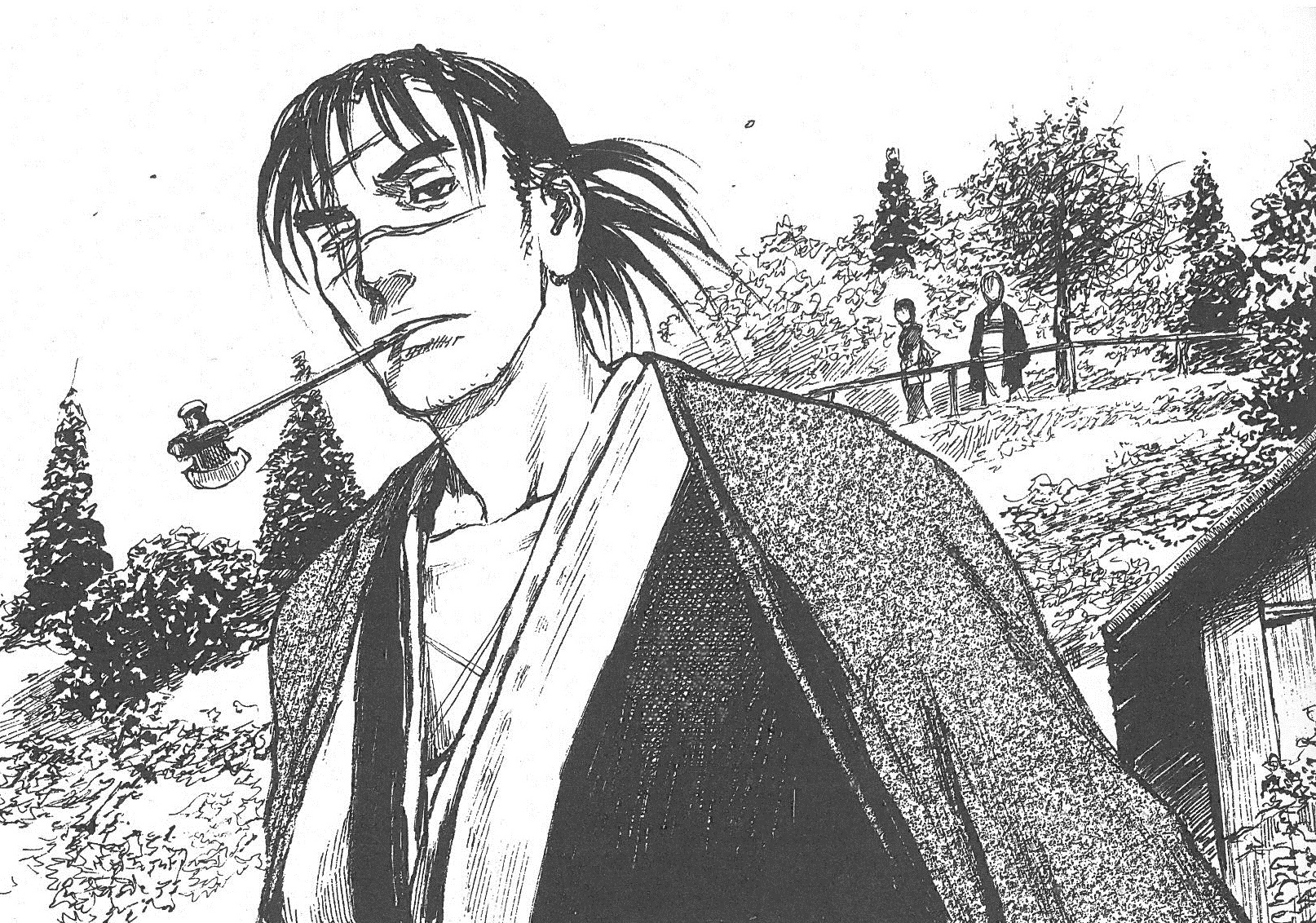
Yamada-kun and the Seven Witches, Volume 1

What with the recent releases of Yamada-kun and the Seven Witches, Maria the Virgin Witch, and Witchcraft Works, it seems as though manga featuring witches are becoming increasingly prevalent in English. And that’s not even to mention all of the series that don’t actually have the word “witch” in the title. Now, despite it’s cover and title, after only one volume Yamada-kun doesn’t seem to necessarily have anything to do with witches, but I’ve been assured by others that they are indeed a part of the series.

As with vampires, I don’t have a particular interest in witches, though that’s certainly not going to stop me from reading a manga. (Interestingly, but perhaps unsurprisingly, vampires appear to be more prevalent in manga intended for women while witches appear to be more prevalent in manga intended for men.) I have no idea why witches seem to have become so popular recently, but they’ve actually been around in manga for a while.

One of my favorite witch manga is the sadly out-of-print Sugar Sugar Rune. Berserk, another favorite series of mine, also features a young witch as a main character in its recent story arc. The two series are drastically different from each other, though; just because a manga has a witch in it doesn’t mean it will be like any of the others!

So, you may be wondering, how can you win the first volume of Yamada-kun and the Seven Witches, Volume 1?

1) In the comments below, tell me about your favorite witch from manga. (If you don’t have one, or have never read a manga about a witch, you can simply mention that instead.)
2) If you’re on Twitter, you can earn a bonus entry by tweeting, or retweeting, about the contest. Make sure to include a link to this post and @PhoenixTerran (that’s me).

And there you have it! Each person can earn up to two entries for this giveaway and has one week to submit comments. If you have trouble with the form, or if you would prefer, entries can also be sent to me via email at phoenixterran(at)gmail(dot)com. I will then post the comments here in your name. The giveaway winner will be randomly selected and announced on May 6, 2015. Good luck!

VERY IMPORTANT: Include some way that I can contact you. This can be an e-mail address in the comment form, a link to your website, Twitter username, or whatever. If I can’t figure out how to get a hold of you and you win, I’ll just draw another name.

Contest winner announced–Manga Giveaway: Yamada-kun and the Seven Witches Giveaway Winner

Filed Under: FEATURES, Giveaways Tagged With: manga, Miki Yoshikawa, Yamada-kun and the Seven Witches

  • « Go to Previous Page
  • Page 1
  • Interim pages omitted …
  • Page 16
  • Page 17
  • Page 18
  • Page 19
  • Page 20
  • Interim pages omitted …
  • Page 60
  • Go to Next Page »
 | Log in
Copyright © 2010 Manga Bookshelf | Powered by WordPress & the Genesis Framework