• Skip to primary navigation
  • Skip to main content
  • Skip to primary sidebar
  • Home
  • About Us
    • Privacy Policy
    • Comment Policy
    • Disclosures & Disclaimers
  • Resources
    • Links, Essays & Articles
    • Fandomology!
    • CLAMP Directory
    • BlogRoll
  • Features & Columns
    • 3 Things Thursday
    • Adventures in the Key of Shoujo
    • Bit & Blips (game reviews)
    • BL BOOKRACK
    • Bookshelf Briefs
    • Bringing the Drama
    • Comic Conversion
    • Fanservice Friday
    • Going Digital
    • It Came From the Sinosphere
    • License This!
    • Magazine no Mori
    • My Week in Manga
    • OFF THE SHELF
    • Not By Manga Alone
    • PICK OF THE WEEK
    • Subtitles & Sensibility
    • Weekly Shonen Jump Recaps
  • Manga Moveable Feast
    • MMF Full Archive
    • Yun Kouga
    • CLAMP
    • Shojo Beat
    • Osamu Tezuka
    • Sailor Moon
    • Fruits Basket
    • Takehiko Inoue
    • Wild Adapter
    • One Piece
    • After School Nightmare
    • Karakuri Odette
    • Paradise Kiss
    • The Color Trilogy
    • To Terra…
    • Sexy Voice & Robo
  • Browse by Author
    • Sean Gaffney
    • Anna Neatrour
    • Michelle Smith
    • Katherine Dacey
    • MJ
    • Brigid Alverson
    • Travis Anderson
    • Phillip Anthony
    • Derek Bown
    • Jaci Dahlvang
    • Angela Eastman
    • Erica Friedman
    • Sara K.
    • Megan Purdy
    • Emily Snodgrass
    • Nancy Thistlethwaite
    • Eva Volin
    • David Welsh
  • MB Blogs
    • A Case Suitable For Treatment
    • Experiments in Manga
    • MangaBlog
    • The Manga Critic
    • Manga Report
    • Soliloquy in Blue
    • Manga Curmudgeon (archive)

Manga Bookshelf

Discussion, Resources, Roundtables, & Reviews

comics

Random Musings: Toronto Comic Arts Festival 2017

May 28, 2017 by Ash Brown

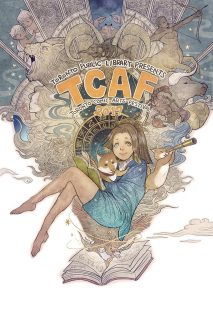
TCAF 2017 Poster - Sana Takeda

©Sana Takeda

I didn’t actually realize it until I started writing up my random musings for the 2017 Toronto Comic Arts Festival (TCAF), but this year was actually my five-year TCAF anniversary! For the first two years I coordinated the trip with a friend (a different one each year), but for the last three years my TCAF adventures have been combined with a Toronto family vacation. 2017’s TCAF trip leaned a little more heavily towards family activities than in years past, but I still found the opportunity to enjoy what the festival had to offer. And seriously, TCAF has a tremendous amount to offer. It’s the only comics-related event that I currently attend, and it’s absolutely worth challenging my social anxiety and general awkwardness.

Although there are TCAF-related events throughout May, the festival-proper usually takes place on Mother’s Day weekend which was May 13th and 14th this year. As mentioned, much of the emphasis of my trip this year was on family vacationing. We made a long weekend of it, leaving on Thursday and returning on Sunday. On Thursday, after treating ourselves to breakfast at a favorite local restaurant and taking the young one to a weekly language development play group (which I hadn’t actually had the opportunity to visit before since I’m usually working when the class is held), the four of us (three adults and a toddler) piled into the car on headed out.

If we were to drive straight through from where we live in Michigan to Toronto, it would take about four and a half hours but we arrived a little over six hours after we left. Things always seem to take a bit longer when kids are involved, not to mention the fact that we also happened to stop for a leisurely picnic lunch once we were in Canada and well on our way. I don’t remember exactly what time we finally pulled into Toronto, but it was late enough that I missed the book launch party for Jane Mai and An Nguyen’s newest collaboration So Pretty / Very Rotten: Comics and Essays on Lolita Fashion and Culture which I had hoped to attend. Instead, we all took our time settling into the room for our stay and then ordered tasty takeout from a place that was a surprising combination of pizzeria and Asian fusion.

On Friday, the whole family spent most of the day at the Ontario Science Centre, which was fantastic. We mainly focused on the interactive areas geared towards younger ages and so certainly didn’t see everything there was to see; I would like to go back sometime and explore even more of the centre because we all had a great time. After resting up in our room for a bit, we eventually made our way down to The Distillery Historic District for dinner, drinks, and other diversions. In the past, Friday night would have been the night that I would take off for the Sparkler Monthly mixer, but this year that party was held on Saturday evening instead. (Sadly, this also meant Sparkler’s party conflicted with the annual queer mixer.)

After spending most of Thursday and Friday with the family, I was mostly off on my own on Saturday enjoying the first day of TCAF. As in years past, I started my morning off wandering the exhibitor areas before they got super crowded. I mostly explored the Toronto Reference Library,  which had three floors of exhibitors this year, but eventually made my way to the exhibitors situated in the Masonic Temple as well. I wasn’t quite as social as I have been at previous festivals, but I did make a point to at least say hello to the creator’s that I recently supported through Kickstarter who were at the festival. I spent a fair amount of time going through all of the exhibitor’s online portfolios before arriving in Toronto, making notes to myself of the tables that I wanted to be sure to stop by, but in the end I really did try to see everything there was to see. One of the things I love about TCAF is the wide variety of comics at the event, but I especially appreciate the number of queer creators and the amount of queer content present.
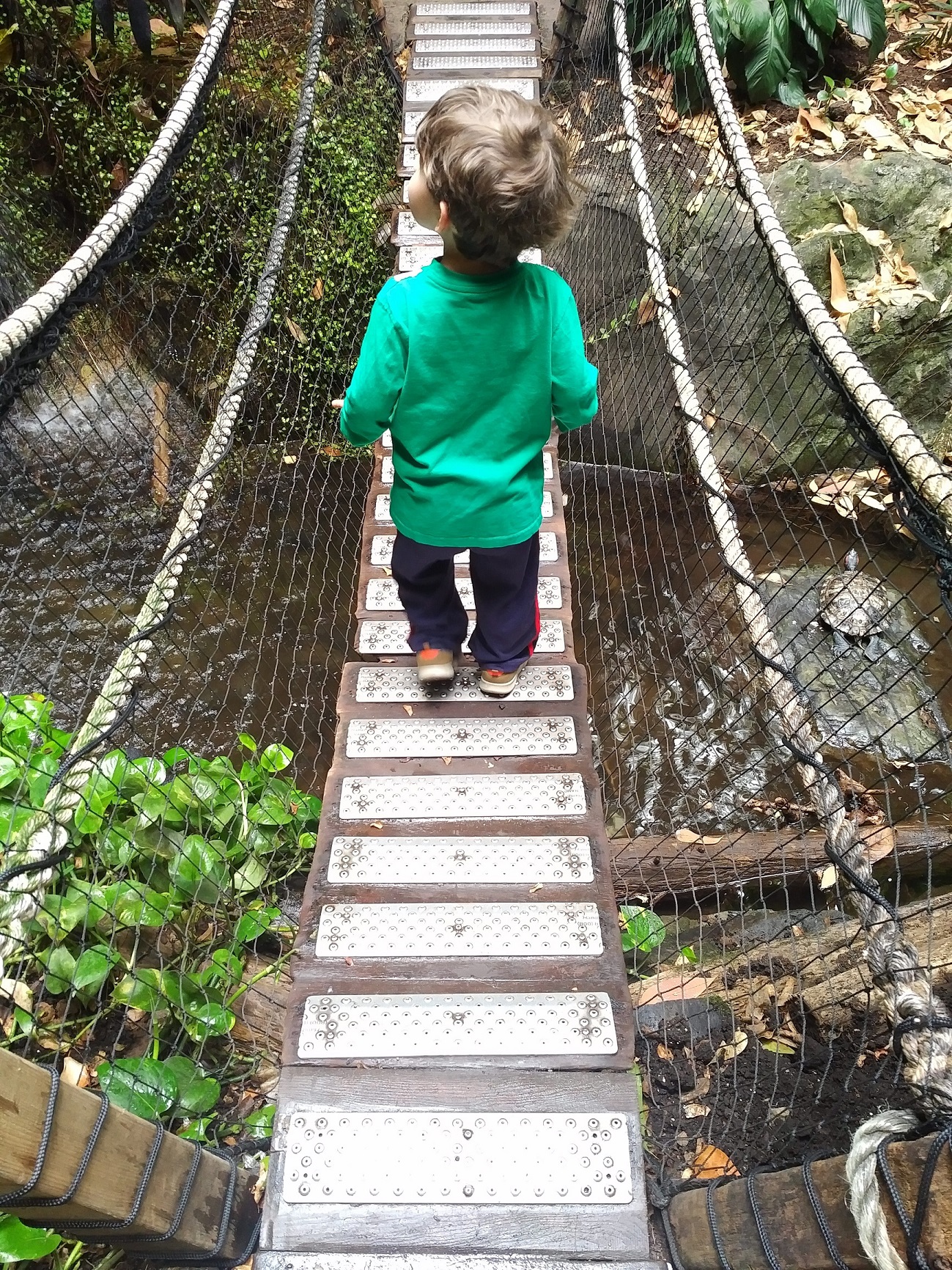
Ontario Science Centre Rainforest

Exploring the rainforest at the Ontario Science Centre

In addition to all of the phenomenal exhibitors, TCAF also has a strong lineup of panels, workshops, and creator spotlights. As usual, it was a tremendous challenge deciding which events I wanted to go to, especially as so many of the conflict with one another. In the end I settled on six, all but one of which were held on Saturday. There were definitely others that I wanted to attend, too, but for one reason or another (such as waking up with a migraine on Sunday morning or a cranky toddler) I wasn’t ultimately able to fit them all into my schedule.

Since I’m a musician on top of being a huge fan of comics, one of the panels that immediately caught my interest was “Sounds and Vision: Music in Comics,” moderated by Phillipe Leblanc, which explored how artists portray and convey music and sound in a visual medium. Although I haven’t actually read any of their comics (yet), I did recognize the panelists by name–Dave Chisholm, Nick Craine, Anya Davidson, Sandrine Revel, and Eric Kostiuk Williams. All of the creators on the panel had at least some musical background, formal or otherwise (Chisholm even has a doctorate in jazz trumpet), and consider music to be one of their passions. In some ways the two artforms, music and comics, are incompatible since each one requires so much time to master as an artist, but they can still be brought together. If nothing else, creators’ experiences as musicians can inform and influence the stories they want to tell. Effectively incorporating music into a comic requires more than just putting music notes on a page. As Chisholm pointed out, musical notation isn’t really music either–it’s simply ink on paper, a visual shorthand (much like comics themselves). In order to convey the intended feeling of the music, comic creators must instead rely on page and panel design to capture a sense of tempo, movement, and flow. Creative use of typography can also be effective, especially when lyrics are involved, and imaginative onomatopoeiae can serve as a device to form a visual soundscape. Often a literal representation of music isn’t what is demanded by a narrative, it’s the emotional resonance and impact of that music that needs to be seen, whether it’s the focus of a comic or simply being used as a background element to help set a scene.

After spending a little more time browsing the exhibitor areas, the next panel that I attended was simply titled “Sports!” which included Michael Nybrandt, Ngozi Ukazu, Sonam Wangyal, and Jarrett Williams as panelists and RJ Casey as a moderator. While in Japan sports comics have been immensely successful, the subgenre hasn’t thrived in the same way in the North American comics industry. Although there have been some independent sports comics with impressive followings, such as Ukazu’s Check, Please!, in general sports comics continue to be a hard sell for many major publishers. In the 1990s there were some unsuccessful mainstream attempts that basically tried to turn sports comics into superhero narratives rather than focusing on the underlying human story, something that didn’t work well at the time. There’s also the question of audience since there is a lingering and inaccurate stereotype that “nerds don’t like sports.” (Ukazu commented that it might actually be more difficult to sell sports comics to sports fans than to comics fans.) Sports stories provide ready-made and easily understood narratives which allow the incorporation and exploration of other subjects such as politics, religion, and performance of gender, making those issues more acceptable or palatable for readers. Emotional highs and lows are inherent to the stories, often directly tied to the athletes’ successes and failures in competition. Sports comics can risk becoming repetitive since the most basic story arc is the often same–someone will win and someone will lose–but while the ending may be already be determined, how the comic arrives at that ending is not. Changing the implications of winning and losing can introduce new dynamics and not all the conflict and drama has to happen within the context of the sport itself.
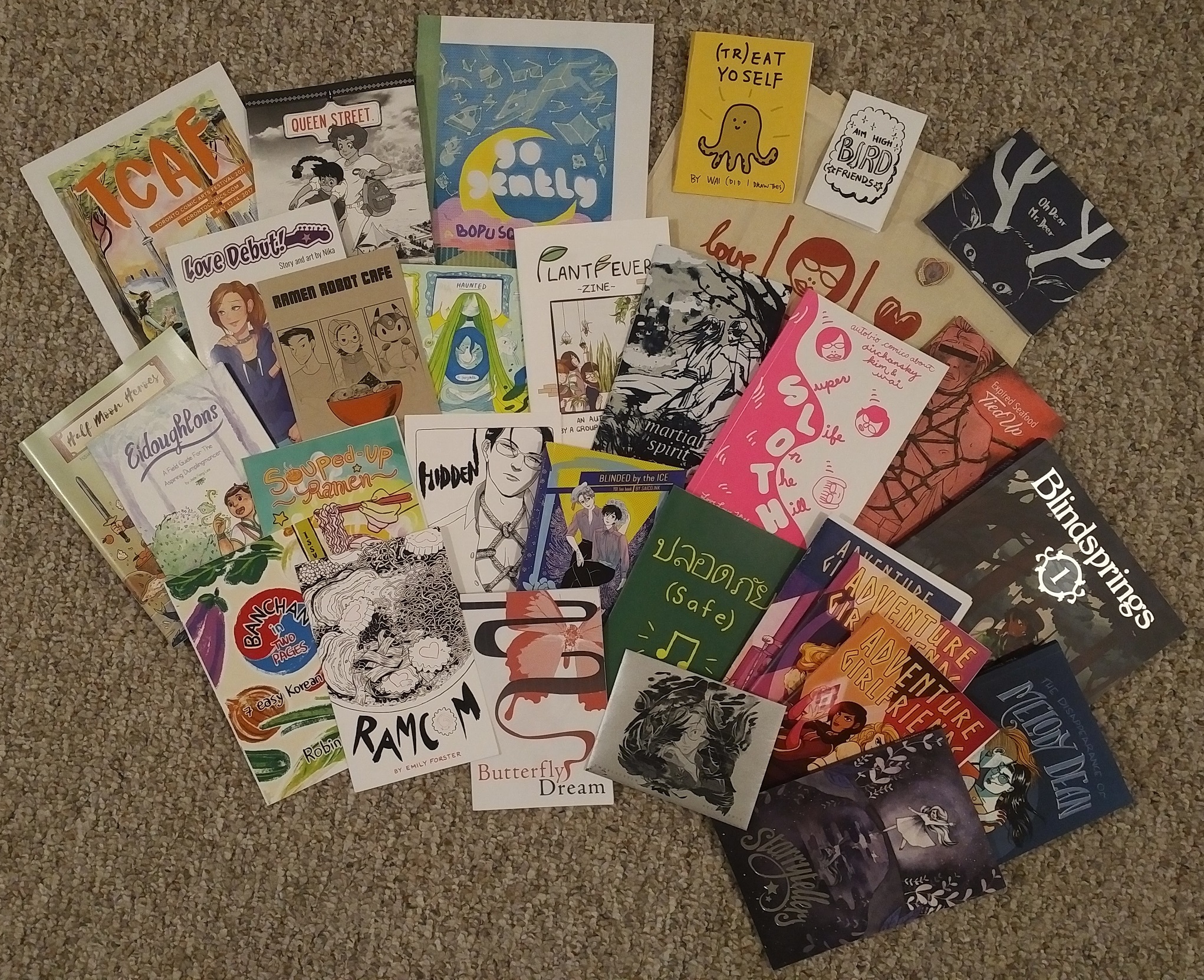
TCAF 2017 Haul

TCAF Haul 2017!
(minus a t-shirt and poster)

While the first two panels I went to were both held at the Stealth Lounge at The Pilot, my next three panels were located at another of TCAF’s primary event locations, the Toronto Marriott Bloor Yorkville Hotel which allows for larger gatherings. It’s a good thing, too. Glen Downey, who was moderating “Creating While Depressed,” noted that it was one of the most well-attended TCAF panels with which he has been involved. The subject matter being discussed appeared to strike a very personal chord with many of the people in the audience, myself included. The panelists–Meredith Gran, Tara Ogaick, Meredith Park, and Shivana Sookdeo–were all very candid and open, sharing their own experiences as creators who have to carefully balance their mental health with their creative work. They talked about how damaging the idealized stereotype of the “tortured artist” is and how the romanticized portrayal of depression found in popular culture is often vastly different from actual experience. In reality, people with depression are creating despite depression rather than because of it. For them, comics can be an outlet for expression and a way to alleviate some of the symptoms of depression, but at their lowest points it may be impossible for them to produce any work at all. It is at those times when communication and honesty are particularly crucial in order to clearly delineate limitations and establish realistic expectations not only for themselves but for the people with whom they might be working. The panelists also emphasized the importance of finding a supportive, close-knit community. Although they were specifically speaking as artistic creators with depression, I found that their experiences strongly resonated with my own and could be more broadly relatable.

My fourth panel of the day was “21st Century Webcomics,” featuring Michael DeForge, Blue Delliquanti, Priya Huq, Matt Lubchansky, and moderated by Tom Spurgeon. I don’t actually follow as many comics online as I used to–I find reading digital content difficult and/or frustrating for a wide variety of reasons–but I am still a huge supporter of webcomics, frequently buying print editions if they exist. As with any medium, webcomics have evolved over time especially as advances in the creation of digital artwork have also been made. Likewise, the relationship between webcomics and print comics have changed and there is less of a sense that they are at war these days. Instead, webcomics are often used to support their print equivalents. Because they are online, webcomics are inherently more discoverable and more widely accessible which helps to build an audience and further promote a creator’s work. Webcomics can also give a creator the opportunity to experiment with new methods and formats of expression that simply aren’t realistically feasible or even possible in print, such as the use of infinite canvass, animation techniques, or interactive elements. Creators have a tremendous amount of freedom when it comes to webcomics, allowing personal or experimental works to be produced and distributed that more traditional or mainstream comic publishers might initially be reluctant to take a risk on. However, while it was hoped that the Internet would allow creators to more directly deliver their content to readers and flatten out publishing hierarchies (which to some extent has occurred), the reality is that there has been a rise in intermediaries. More and more, creators find they frequently have to rely on multiple external systems and platforms like Kickstarter, Patreon, and social media to sustain their work.

“LGBTQ Comics Abroad,” moderated by Justin Hall, was the one panel that I wanted to be sure to make it to above all others not just because the subject matter had to do with queer comics but because Gengoroh Tagame was participating. (Even if someone isn’t a fan of Tagame’s works, his immense historical knowledge and experience as a gay comics creator makes his panels well-worth seeking out.) The other panelists included A.C. Esguerra, Molly Ostertag, Tommi Parrish, and Martina Schradi. Anne Ishii was also there, technically to assist with interpretation for Tagame, but she also had her own thoughts and experiences to bring to the discussion. The panelists talked about their work and the state of queer comics within their own countries (Japan, United States, Australia, and Germany) but also the challenges presented when considering international audiences. Queer identities are formed differently from culture to culture, and some of the nuances of those differences can be difficult to convey or translate, however there are still some shared and common experiences that are not limited by borders; social mores and contexts will often vary, but universal themes can still be found. The online environment has presented an opportunity for queer comics to be successful in ways that are currently difficult through traditional publishing, although the mainstream comics industry has been slowly making progress. The Internet allows for an unprecedented ease of global access to and distribution of queer content; it has been possible for numerous communities and support networks to be established which aren’t limited by geographic boundaries. But along with the good, there is also the bad–the piracy, scanlations, and extreme levels of fan entitlement present online can be hugely damaging.
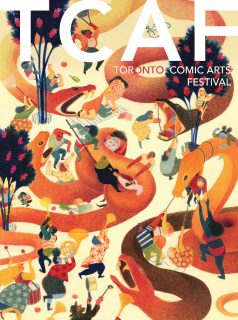
TCAF 2017 Poster - Eleanor Davis

©Eleanor Davis

As mentioned, Saturday night I went to the Sparkler TCAF Mixer. I brought the little one along with me to allow the family’s other two adults to have a child-free dinner date. A good time was had by all and I had the chance to catch up with not only the Chromatic Press/Sparkler Monthly folks but some of Seven Seas’ people as well. There’s a bit of an overlap between the two groups even though the demographics of each company’s audience are currently the inverse of each other. (Interesting tidbit: According to a recent Sparkler Monthly survey, while women form the core readership, at present Chromatic Press has more nonbinary readers than male readers.) Expect some really great things and exciting announcements to come from both publishers in the near future.

Sunday ended up being a much shorter day than was originally planned (I was really hoping to attend the So Pretty / Very Rotten discussion on Lolita culture at the Japan Foundation, for one). However, I and one of my partners were able to at least make it to The Pilot for the panel “Looks Good Enough to Eat: Comics and Food” before we all headed back to Michigan. We sadly missed out 2016’s food comics panel, so we were particularly happy to be there this year. Perhaps unsurprisingly considering my well-known love of food comics, I was already familiar with the work of most of the panelists: Sarah Becan, Emily Forster, Robin Ha, Jade Feng Lee, and Kat Verhoeven. Along with moderator Lauren Jorden, the group discussed what appealed to them about creating and reading comics that prominently feature or incorporate food. The subgenre of food comics is actually quite diverse, including comics explicitly about food (recipe comics, autobiographical works, or journalistic reviews) as well as comics that use food as a theme or aesthetic. Everyone has to eat, which can make food comics particularly accessible; it’s a shared experience that can serve as a gateway into comics. Food is a multisensory experience, so it can be challenging when working in a medium that primarily relies on one. However, an important part of eating is the visual experience, so to that extent comics are a natural fit. Comics can evoke a feeling or mood that can’t be captured in the same way with photography or other visual artforms. Often there is a strong emotional component to food comics. Even when the subject matter is specifically about food, food itself isn’t just food–it’s history, community, culture, relationships, and personal expression. And comics can be all of those things, too.

And with that,  and after one last tour through the exhibitor areas, the whole family prepared to depart for home. Though I didn’t end up doing everything that I had originally planned or hoped to do,  but I still had a fantastic trip. Toronto is a terrific city and TCAF is a phenomenal festival. However inadequately, I’ve tried to convey some of that greatness here by highlighting a little of what I learned and experienced. However, there’s so much more that I could have (and perhaps should have) written about because there’s so much more to the festival. I definitely plan on attending TCAF for the foreseeable future.
Filed Under: FEATURES, Random Musings Tagged With: comics, Gengoroh Tagame, manga, TCAF

My Week in Manga: May 15-May 21, 2017

May 22, 2017 by Ash Brown

My News and Reviews

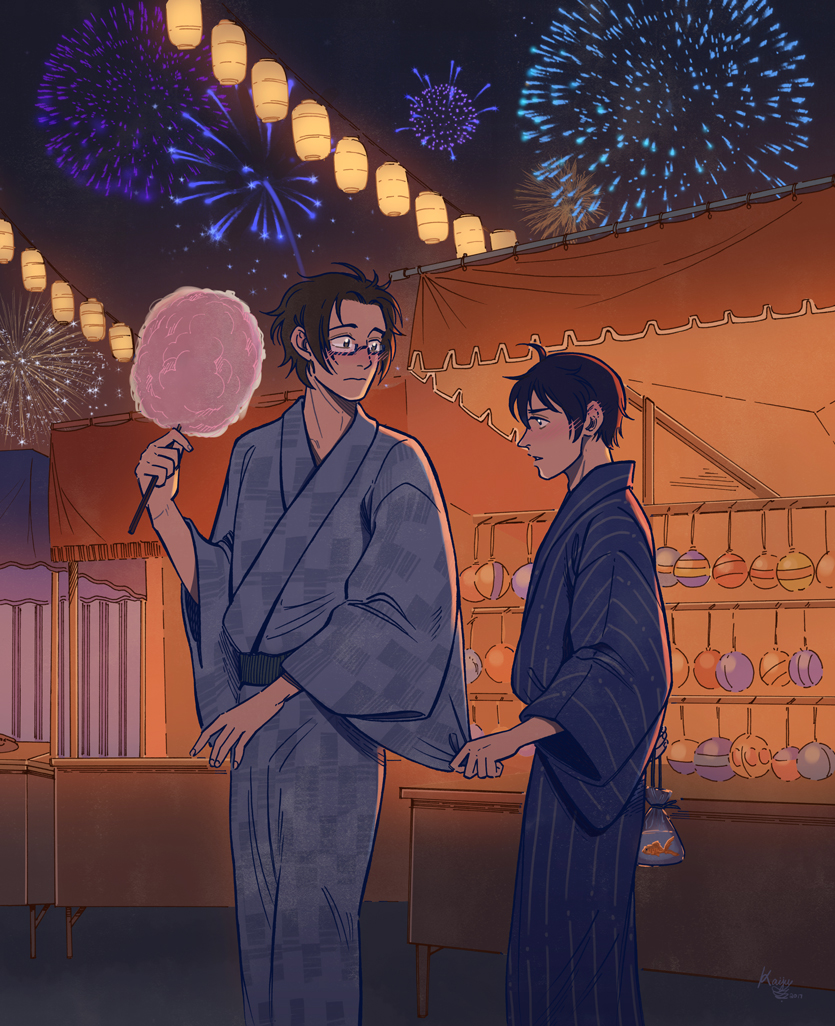
Other than the usual My Week in Manga, I didn’t manage to post any other features at Experiments in Manga last week. This was largely expected since I’m still catching up from my trip to the Toronto Comic Arts Festival. I have, however, been working on writing up some of my random musings about this year’s festival and hope to have those ready to post within the next few days. There is one thing that happened last week that I’d definitely like to share with everyone, though: the artwork that I commissioned from KaiJu was finished!

KaiJu Tokyo Demons Commission

The illustration is of the characters Sachi and Kadoyuki from Lianne Sentar’s Tokyo Demons, a series which I love very, very much. I’m also quite fond of KaiJu’s original work as well, some of which I’ve previously reviewed here at Experiments in Manga. The creative team’s current comic is Novae which is absolutely wonderful and well-worth checking out.

Elsewhere online: Lilian Min talks to Jane Mai and An Nguyen about their new book So Pretty / Very Rotten in the article The Complex Femininity of Japanese Lolita Fashion. One of Tofugu’s most recent podcasts, Interpreting for Osamu Tezuka, features Frederick L. Schodt. Also at Tofugu, manga translator Zack Davisson has some advice for learning Japanese. Speaking of Davisson, he’ll be translating two of Seven Sea’s recently announced acquisitions: Go Nagai’s original Devilman manga series (this is huge!) as well as Go Nagai and Team Moon’s Devilman vs. Hades manga. In other licensing news, Viz Media will be releasing Hinodeya Sankichi’s Splatoon manga.

Quick Takes

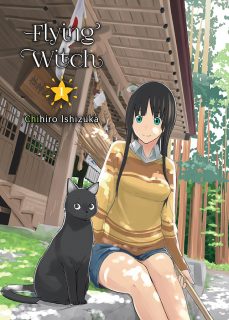
Flying Witch, Volume 1Flying Witch, Volume 1 by Chihiro Ishizuka. I was only vaguely aware of Flying Witch before Vertical Comics licensed the manga; although I haven’t actually watched it, a twelve-episode anime adaptation of the series first aired a little over a year ago. Flying Witch is a manga about Makoto, a fifteen-year-old witch who has moved to the country to stay with her relatives while she completes her magic training. She’s a bit of an airhead and has a terrible sense of direction, but she’s earnest and kind and quick to make friends with the locals. The focus of Flying Witch is on the everyday lives of Makoto, her relatives, and friends. It’s a gentle and harmless manga that much of the time isn’t even about magic though it can still occasionally be charming. The manga’s artwork, much like the story itself, is functional but not particularly distinctive and even the worldbuilding is somewhat lacking. Flying Witch isn’t a bad series, but it didn’t really grab me, either. Granted, I don’t have a particular interest in witches. However, I did really like the series’ countryside setting. Additionally, The Harbinger of Spring, a nature spirit introduced in one of the final chapters of the first volume, was a fascinating addition and easily my favorite part of the manga.

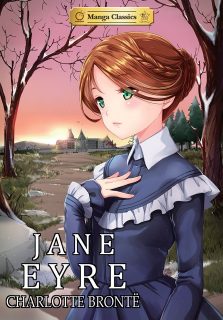
Jane EyreJane Eyre adapted by Crystal Silvermoon Chan and illustrated by SunNeko Lee. Charlotte Brontë’s Jane Eyre holds a very special place in my heart; I first read it in high school and it remains one of my favorite novels. To varying degrees, I’ve enjoyed the numerous films, novels, comics, and other works inspired by Jane Eyre that I’ve encountered as well. And so I was very curious to read one of the most recent adaptations, Chan and Lee’s Jane Eyre comic from Udon Entertainment’s Manga Classics line. (This is the same creative team which worked on the adaptation of Victor Hugo’s Les Misérables, one of Manga Classics debut titles.) Though overall Lee’s artwork is attractive, I wasn’t entirely satisfied by the character designs of the leads–Jane as a young woman doesn’t look much older than when she was a child, and Mr. Rochester comes across as too traditionally handsome. Other than that relatively minor complaint, Chan and Lee’s Jane Eyre remains true to Brontë’s original and is an enjoyable and very accessible rendition. Some small changes have been made, as Chan describes in the essay about the adaptation process, but all the major characterization and plot points remain. The volume also includes additional historical background information. Now I really want to reread the novel again.

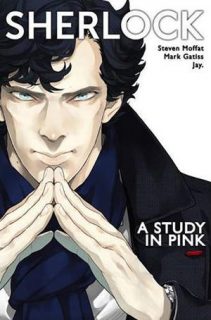
Sherlock, Volume 1: A Study in PinkSherlock, Volume 1: A Study in Pink by Jay. I believe Sherlock is the very first manga to be released by Titan Comics, recently followed by Yano Takashi and Kenji Oiwa’s Assassin’s Creed: Awakening. The fact that Titan isn’t a typical manga publisher and hasn’t released many manga may partly explain why Jay’s adaptation of the BBC’s television series Sherlock was first released in English as six individual comic issues before being collected into a single volume. Titan’s catalog largely consists of comic adaptations of Western television and video game franchises, so Jay’s Sherlock fits in nicely with the rest. Sherlock is a modern reimagining of Sir Arthur Conan Doyle’s Sherlock Holmes stories, A Study in Pink influenced heavily by Doyle’s novel A Study in Scarlet. It’s been a while since I’ve actually watched A Study in Pink, but Jay’s interpretation does seem to be a very faithful one, including character designs that are based on the show’s actors, most notably Benedict Cumberbatch (Sherlock) and Martin Freeman (Watson). Some of the action can be a little difficult to follow, but otherwise I largely enjoyed Jay’s version of A Study in Pink. However, because it is such a close adaptation and nothing much is added or taken away I’m not entirely sure who the best or intended audience for the Sherlock manga would be; most people would likely be satisfied with the original episode.

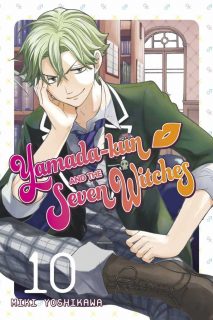
Yamada-kun and the Seven Witches, Volume 10Yamada-kun and the Seven Witches, Volumes 10-12 by Miki Yoshikawa. From the beginning Yamada-kun and the Seven Witches wasn’t without its problems, but I thoroughly enjoyed the first part of the manga. However, I’m now starting to find the series somewhat wearisome even though there are some things that are quite well done and that I still like about it. With these three volumes, Yoshikawa brings the second major story arc of Yamada-kun and the Seven Witches to a close and begins yet another one. To the Yoshikawa’s credit, each time the story is more or less restarted it makes logical sense, but at this point it feels like the series is being stretched out far longer than it was originally intended. (I suspect that Yamada-kun and the Seven Witches may be a victim of its own popularity and success.) The first story arc was highly entertaining, but I wasn’t as impressed with the second and the third hasn’t instilled much confidence in me that it will greatly improve. On top of that, the manga’s fanservice has become more and more forced as the series has progressed. Where at one point it was incorporated well into the story, more recently the fanservice is haphazard at best. Because at first I did greatly enjoy Yamada-kun and the Seven Witches and appreciated its gender play and themes of friendship, it saddens me to see the series’ decline.

Filed Under: FEATURES, My Week in Manga Tagged With: Chihiro Ishizuka, comics, Crystal Silvermoon, Flying Witch, Jay, manga, Manga Classics, Miki Yoshikawa, Sherlock, SunNeko Lee, Yamada-kun and the Seven Witches

My Week in Manga: May 8-May 15, 2017

May 15, 2017 by Ash Brown

My News and Reviews

The Bookshelf Overload for April was posted at Experiments in Manga last week; otherwise, things were pretty quiet. Initially I had an in-depth feature scheduled for this week, but I’ll probably end up pushing that back to next week instead. I spent last Thursday through Sunday in Canada with the family for vacation and the Toronto Comic Arts Festival (TCAF) which I’ll be writing up like I have in years past. We had a great time, although not everything went exactly as planned.

Speaking of TCAF, Heidi MacDonald, Brigid Alverson, Deb Aoki, and Erica Friedman were apparently all sharing a hotel room for the event. I haven’t had a chance to listen to it yet, but they took advantage of that fact by recording a podcast in which they (and eventually Robin Brenner and Eva Volin as well) discuss a wide variety of topics including manga, queer comics, food, libraries, and more: Episode 1, Episode 2, Episode 3, Episode 4. I only found out about the details after I got back home, but once again some people had trouble crossing the border between the United States and Canada in order to attend TCAF. In one notable case, Anne Ishii, one of the folks behind Massive and Gengoroh Tagame’s interpreter and translator, was detained for over two hours before eventually being allowed to enter the country.

A few things from elsewhere online last week: Anyone who picked up the Attack on Titan choose-your-own-path book from Kodansha Comics will want know about the corrections and errata that were recently released online. Kodansha also confirmed it would be releasing the Neo Parasyte M manga anthology (a sort of companion volume to Neo Parasyte F which I greatly enjoyed). In other licensing news, although an official public announcement hasn’t been made, The OASG received some confirmation that Udon Entertainment is currently “deep into the localization” of Rose of Versailles and Sugar Sugar Rune. No release dates have been set yet, though. Seven Seas hasn’t mentioned any release dates for its most recent set of licensing announcements, either, though I wouldn’t be surprised to see Okayado’s MaMaMa: Magical Director Mako-chan’s Magical Guidance, Mintarou’s DNA Doesn’t Tell Us, Tekka Yaguraba’s Sorry For My Familiar, Hiroaki Yoshikawa’s Crisis Girls, Tsuina Miura and Takahiro Oba’s High-Rise Invasion, and Coolkyoushinja’s Mononoke Sharing all released first.

A couple of Kickstarters that have recently caught my attention, too. Chromatic Press’ latest campaign is raising funds to print the first volume of Magical How? by Eurika Yusin Gho (aka Eyugho). Though on occasion I’ve mentioned Magical How? on Twitter, I haven’t really wrote much about the comic here at Experiments in Manga. (Or at least not yet.) It’s a pretty fun series though, a sort of magical girl/boys’ love mashup with energetic, full-color artwork and lots of humor. The other project I specifically want to mention is for the second volume of Beyond, a queer speculative fiction comics anthology. If successful, the project will also allow the award-winning first volume (which is great) to be reprinted.

Quick Takes

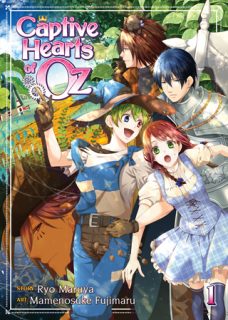
Captive Hearts of Oz, Volume 1Captive Hearts of Oz, Volume 1 written by Ryo Maruya, illustrated by Mamenosuke Fujimaru. One of the most interesting things about Captive Hearts of Oz is that the English-language release is actually the first time the manga has been published; rather than licensing existing content, the series is a direct collaboration between Seven Seas and the creators. Captive Hearts of Oz is Maruya’s debut work in English, but Fujimaru already has a notable presence due to the numerous Alice in the Country of… manga that have been translated. I suspect that it’s intentional then that Captive Hearts of Oz has a similar vibe to those series. Interestingly, there’s no explicit romance in the series yet although the manga is reminiscent of an otome game. Dorothy has simply been swept into an unfamiliar world where she meets a number of unusual people, many of whom just happen to be attractive young men. Captive Hearts of Oz is a somewhat unusual reimagining of a Western classic which may (or may not) have more depth to it than initially appears. At the very least there’s something dark and mysterious going on, although after only one volume it’s not entirely clear exactly what that is. The narrative is frustratingly disjointed in places, but I am curious to see how Captive Hearts of Oz continues to develop.

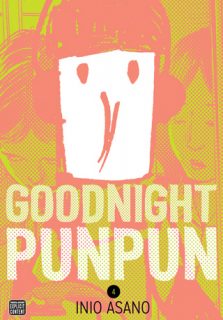
Goodnight Punpun, Omnibus 4Goodnight Punpun, Omnibuses 4-5 by Inio Asano. At this point in Goodnight Punpun, the series’ titular protagonist has entered early adulthood and his life largely remains a directionless disaster not entirely of his own making. He’s not completely blameless, though. I find that I have to time my reading of Goodnight Punpun very carefully. The manga has a very pessimistic worldview with which I can very easily identify, so if I’m already feeling mentally or emotionally exhausted, it’s usually a good idea for me to wait to tackle the series. On the other hand, it can sometimes be extremely cathartic to completely acknowledge the unfairness and darkness of the story and its real-life parallels. Either way, Goodnight Punpun is an incredible and powerful work, but it’s also very hard-hitting. Asano seems to be very aware of this and very aware of some of the related criticisms that have been leveled at the series. I, for one, have at times questioned whether or not all of the pain and suffering in Goodnight Punpun ultimately serves a purpose or if the manga is simply reveling in gloom and despair. I’ll admit that I’m still not sure and probably won’t be convinced one way or another until the manga’s conclusion, but Asano does directly recognize those concerns by having the creative work of some of the series’ characters similarly criticized.

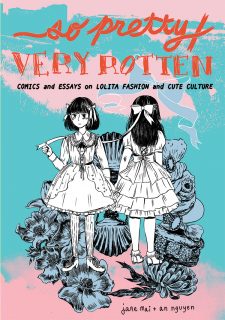
So Pretty / Very RottenSo Pretty / Very Rotten: Comics and Essays on Lolita Fashion and Cute Culture by Jane Mai and An Nguyen. I don’t have a particular interest in fashion, so if it wasn’t for the fact that I make a point to follow the work of Nguyen (aka Saicoink) I might not have gotten around to reading So Pretty / Very Rotten for quite some time. That would have been a shame because So Pretty / Very Rotten is both a terrific and fascinating work. I was certainly aware of Lolita culture previously, but I can confidently say that I have a much better understanding of it and even appreciation for it after reading So Pretty / Very Rotten. The volume examines numerous topics related to Lolitas–history, culture, fashion, identity, gender, expression, community and more–through approachable and accessible essays, both personal and academic (the Lolita lifestyle is one of the areas of Nguyen’s research), as well as through comics and illustrations. It’s a mix that works quite well. The essays are informative and the comics are cute and engaging, effectively demonstrating the concepts addressed through visual narratives. So Pretty / Very Rotten also includes an interview with and essay by Novala Takemoto, a prominent figure in Lolita culture who is probably best known in North America as the creator of Kamikaze Girls.

The Whipping Girl by Nuria Tamarit. I’m not entirely certain, but I believe that The Whipping Girl is the first published solo comic by Tamarit, an illustrator from Valencia, Spain. Even if it’s not, I certainly hope that there will be more in the future if for no other reason than Tamarit’s striking artwork is gorgeous. Color pencils are prominently used to illustrate The Whipping Girl and the effect is lovely. Writing-wise, the work isn’t quite as strong; The Whipping Girl feels like it ends rather abruptly, even considering that it’s a short comic to begin with, but it’s still an enjoyable tale. The story largely follows Agape, the whipping girl of Prince Dalibor. He’s a bit of a jerk, intentionally behaving improperly in order to get back at Agape who is generally much more capable than he is. She finally gets so fed up with the whole situation that she decides to make a run for it. Neither she nor Dal are able to anticipate the complete extent of the repercussions of her actions, and both are surprised to discover how close their bond really is. Overall, The Whipping Girl is a very satisfying comic with beautiful artwork, expressive characters, and a great sense of humor. Agape in particular is a delight, an intelligent, strong-willed young woman with an attitude.

Filed Under: FEATURES, My Week in Manga Tagged With: Captive Hearts of Oz, comics, Goodnight Punpun, Inio Asano, Jane Mai, Mamenosuke Fujimaru, manga, Nonfiction, Nuria Tamarit, Ryo Maruya, Saicoink

My Week in Manga: April 24-April 30, 2016

May 1, 2017 by Ash Brown

My News and Reviews

Last week at Experiments in Manga I posted two features in addition to the usual My Week in Manga. First up was the monthly giveaway. The winner will be announced on Wednesday, so there’s still time to enter for a chance to win the first volume of Leiji Matsumoto’s Queen Emeraldas. All you have to do is tell me a little about your favorite space manga (if you have one). Also posted last week was the long-form manga review for April. I took a look at The Girl from the Other Side: Siúil, a Rún, Volume 1 by Nagabe. The manga was one of my most anticipated debuts of 2017 and it is easily one of my favorites to be released so far this year. Last week was also the first week at my new job so I was rather preoccupied and busy with settling in there and so wasn’t online all that much. However, I did catch an interesting feature on the recent josei renaissance over at Anime Feminist. The article is written by Megan from The Manga Test Drive, one of the manga review blogs that I make a point to follow and particularly like.

Quick Takes

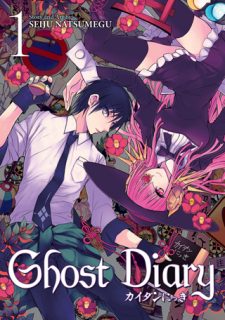
Ghost Diary, Volume 1Ghost Diary, Volume 1 by Seiju Natsumegu. My experience reading Ghost Diary was a little odd. I can’t say that I was overly impressed by the first volume while I was reading it, but by the time I reached the end I found that I actually had enjoyed myself and was interested in reading the rest of the short series. The individual elements of Ghost Diary aren’t particularly original, but as a whole it’s horrific fun. In some ways the manga feels like it’s a mashup of other existing stories which deal with the supernatural and the occult. Even the illustrations reminded me of other works, in particular some of CLAMP’s darker series. I was actually expecting Ghost Diary to be much more serious than it actually was. The manga definitely has a disturbing side to it, but to me it comes across as a dark comedy more than anything else. It’s both goofy and grotesque. The story follows Sukami Kyouichi, the youngest son in a long line of exorcists whose older sister (also an exorcist and far more powerful than he is) mysteriously disappears after he angers a god due to his inexperience, ineptitude, and ignorance. Now he’s desperately searching for her which proves to be a very dangerous venture.

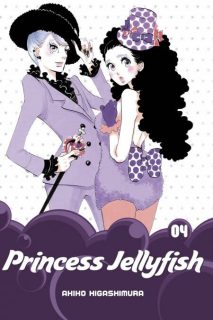
Princess Jellyfish, Omnibus 4Princess Jellyfish, Omnibus 4 (equivalent to Voluems 7-8) by Akiko Higashimura. At this point the Princess Jellyfish manga has progressed much further along in the story than the content that was adapted for the anime series (which was my introduction to the work). So far, my love for the series has yet to diminish. In this omnibus the women of the Amamizukan apartments (along with Kuranosuke) somehow manage pull off a successful fashion show which is intended, in a roundabout way, to save their home from being demolished and redeveloped. However, for that to work, their success will have to extend to actually launching the Jelly Fish brand as well, and reality is much more challenging than a dream. Princess Jellyfish is intentionally outrageous and comedic in the telling of its story but the underlying heart of the manga is believable earnest. I find the manga’s style of humor to be immensely entertaining, but probably what I enjoy most about Princess Jellyfish are its characters and their relationships with one another. I especially liked how Shuu and Kuranosuke’s brotherly affections were developed and portrayed in these two volumes.

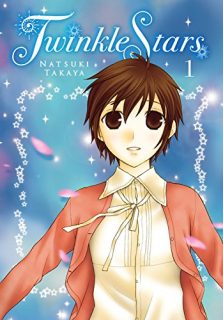
Twinkle Stars, Omnibus 1Twinkle Stars, Omnibuses 1-2 (equivalent to Volumes 1-4) by Natsuki Takaya. Probably like most people, my introduction to Takaya’s work was through the series Fruits Basket, a landmark title in the North American manga industry. It would seem, then, that Takaya’s next major series, Twinkle Stars, would be an obvious license choice, but the manga only began to be released in English relatively recently. Other than the fact that Takaya was the creator, I actually didn’t know much about Twinkle Stars before reading it. The series turns out to be an incredibly compelling and emotionally resonant work even if some of the story developments do seem a little convenient and trope-worn. The lead of Twinkle Stars is Sakyua Shiina, an endearing highschool third-year whose outward cheerfulness goes a long way to hide her inner struggle with depression and self-worth, the result of a troubled family life. Fortunately, she now has people in her life who care for her dearly. Under some rather peculiar circumstance she meets and ultimately falls in love with Chihiro, a young man who likewise is left dealing with the aftermath of past tragedies. At times Twinkle Stars can be absolutely heartbreaking but this countered by the immense kindness that is also exhibited in the series.

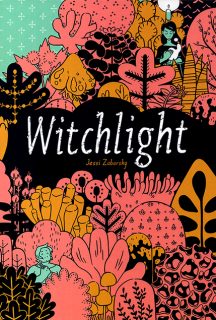
WitchlightWitchlight by Jessi Zabarsky. Before being edited and published in a collected edition with additional content, most of Witchlight had previously been released as a series of individual comic chapters. Described as a shoujo adventure, Witchlight is a delightful fantasy comic about the close bond of friendship and love which slowly develops between two young women as they travel together on a quest. They don’t start out on good terms, though. Sanja is kidnapped by Lelek, a candle witch who demands that she teach her how to use a sword. Lelek is searching for a part of herself that has been lost and magic isn’t always enough to protect her. While being abducted isn’t exactly a promising beginning to a relationship, Sanja is more curious than afraid and her good nature and openness has a positive influence on the untrusting Lelek who has kept her heart closed off from others for so long. Lelek and Sanja’s emotional journeys are the most important aspects of Witchlight, but their physical journey is also wonderful to watch unfold as they encounter other cultures and and types of magic. The characterizations, worldbuilding, artwork in Witchlight are all lovely.

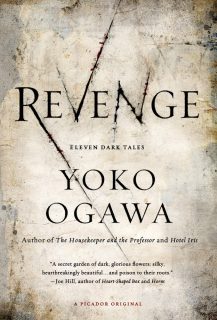
RevengeRevenge: Eleven Dark Tales by Yoko Ogawa. I find the cover design and even the title selected for the English-language edition of Ogawa’s Kamoku na shigai, midara no tomurai to be somewhat misleading. Revenge, although it does make a few appearances throughout the volume, is not at all an overarching theme. And while there is death and violence, most of the gruesomeness implied by the cover occurs off-page. That being said, Revenge is a marvelously disconcerting work of subdued horror. Everything in Revenge is told from a first-person perspective, giving the collection a surprisingly quiet and contemplative atmosphere which becomes increasingly dark as the volume progresses. The individual stories can all be read and function well on their own, but what makes Revenge such a phenomenal collection is how they are all entangled with one another. Often the connections are tangential–similar turns of phrases and references are used, main characters and plot points from one story appear and reappear in the backgrounds of others, and so on–but sometimes they have a profound impact on the interpretation of the various narratives. A close, careful reading of Revenge is rewarded with the revelation of a complex, strange, and surreal web of the macabre.

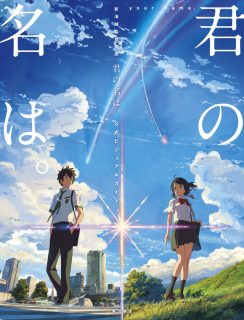
Your NameYour Name directed by Makoto Shinkai. Originally I thought I would be waiting to watch a home video release of Your Name but the film actually ended up being shown at one of my local theaters and a friend invited me out to see it over the weekend. Your Name is a beautiful film, both visually and thematically, and not quite what I was expecting. (Granted, I’m not entirely sure exactly what it was that I was expecting.) To me it almost feels like three different films have been merged into one. Initially Your Name is about Mitsuha and Taki, two young people who don’t really know each other but who have started to spontaneously and erratically switch bodies when they fall asleep. But when the switching suddenly and unexpectedly stops, the film changes its focus to Taki as he tries to locate Mitsuha, keenly feeling the absence of the close intimacy that the two understandably developed over time. From there the urgency of Your Name increases even more as Taki uncovers the truth and he and Mitsuha struggle to prevent further disaster and loss. In part a romantic comedy, in part a meditation on love and spirituality, and in part (it would seem) a response to the Fukushima disasters, Your Name largely remains cohesive even while bending and shifting between genres.

Filed Under: FEATURES, My Week in Manga Tagged With: Akiko Higashimura, anime, comics, Ghost Diary, Jessi Zabarsky, makoto shinkai, manga, natsuki takaya, Princess Jellyfish, Seiju Natsumegu, twinkle stars, Yoko Ogawa

My Week in Manga: April 3-April 9, 2017

April 10, 2017 by Ash Brown

My News and Reviews

Last week at Experiments in Manga the winner of the Miss Kobayashi’s Dragon Maid manga giveaway was announced. The post also includes a list of some of the manga available in print in English which feature dragons. Also posted last week was a guest review by my friend Jocilyn. She was inspired to write about Canno’s Kiss & White Lily for My Dearest Girl, Volume 1, the most recent yuri manga to be released by Yen Press. As mentioned previously, I’m currently working on my own in-depth review of the first volume of The Girl from the Other Side: Siúil, A Rún by Nagabe. It looks like I should be on track to post it sometime next week.

Elsewhere online, Seven Seas has completely revamped its website, adding new features like browsing by genre, launching a newsletter, and so on. It looks great and what’s more, there will be a regular survey which provides readers an opportunity to give feedback and submit license requests. As part of the launch of the new website, Seven Seas also announced a few new licenses: Touki Yanagimi and Youhei Yasumura’s Anti-Magic Academy: The 35th Test Platoon, Shin Mashiba’s Yokai Rental Shop (I loved Mashiba’s Nightmare Inspector, so I’m really looking forward this one), and an omnibus of Fumiyo Kouno’s In This Corner of the World (Kouno is the creator of Town of Evening Calm, Country of Cherry Blossoms which is also excellent).

In other publishing news, some of Kodansha Comics digital-only titles were recently called digital-first, so there may yet be hope for print editions of some of the manga. I missed (or maybe forgot about) the initial announcement, but Titan Comics will be releasing Ravina the Witch? by Junko Mizuno in English later this year. (Ravina the Witch? was originally released in French in 2014.) In sadder news, Bruno Gmünder recently announced its bankruptcy (again). I’m not entirely sure what this will mean for the publisher’s past and future comics releases, including the Gay Manga line, but they might not stay in print long. (I’ve featured some of Bruno Gmünder’s releases here before; I’ll be sad to see them go if the publisher folds.)

As for a few of the interesting Kickstarters that I’ve discovered lately: Emily Cheeseman is raising funds to release the print edition of Gawain and the Green Knight, a beautiful webcomic that she’s been working on since 2015. I wasn’t previously familiar with the work of Elise Schuenke, but Living Space looks like it should be another great queer-themed comic. And speaking of queer-themed comics, the initial campaign for the Tabula Idem tarot anthology wasn’t successful but the creative team has revised and relaunched the project. Finally, anyone interested in Weird Al may be curious about Kelly Phillips’ comic memoir Weird Me about her experiences as the webmaster of a Weird Al fan site in her teens. (Weird Al’s music was a major touchstone for me growing up.)

Quick Takes

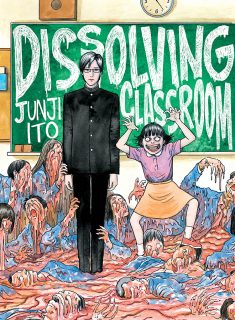
Dissolving ClassroomDissolving Classroom by Junji Ito. Lately there has been a resurgence in manga by Ito being released in English. In many cases they’ve actually been re-releases, but there have been a few newly-translated manga being published as well, Dissolving Classroom from Vertical Comics being the most recent example. I love Ito’s brand of horror manga and Dissolving Classroom was originally serialized in a josei magazine, so the volume was an obvious candidate for one of my most anticipated releases of the year. As expected, I thoroughly enjoyed the manga, but Dissolving Classroom didn’t end up leaving as strong of an impression on me as some of Ito’s earlier works. The loosely connected stories in Dissolving Classroom follow the demise of the people who meet Yuuma, a young man whose constant apologizing will literally make a person’s brain melt, and his incredibly creepy little sister Chizumi. Neither of the siblings are quite what they initially seem. Yuuma in particular comes across as a troubled but largely benign individual; very few people actually realize what’s going wrong before it’s too late. Dissolving Classroom is bizarre but certainly not the strangest manga that Ito has created. The visuals aren’t as shockingly memorable as some of Ito’s other series either, but they are still successfully disconcerting.

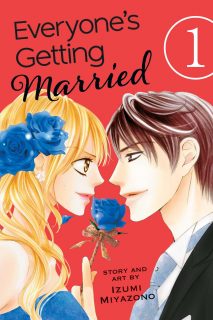
Everyone's Getting Married, Volume 1Everyone’s Getting Married, Volume 1 by Izumi Miyazono. While josei manga have recently become more common in translation (a trend that I would love to see continue), there still aren’t all that many to be found. I’ve generally enjoyed the josei manga that I’ve read in the past and I like to show my support for new releases, so I made a point to try Everyone’s Getting Married. Asuka is well-admired for her successful career, but what she really wants in life is to get married and become a housewife. When her boyfriend of five years unexpectedly dumps her, she suddenly finds herself looking for a new long-term relationship. That proves to be more difficult than she expected and unfortunately for her most likely candidate is Ryu, a man who has made it very clear that he has no interest in marriage. I’ve growing a little weary of high school romances, so I found Everyone’s Getting Married to be a wonderfully refreshing change of pace; I enjoyed reading about adults and their lives and relationships for once. I also like Asuka a great deal. She’s independent, knows what she wants out of life, and is willing to work hard for what is important to her. I’m looking forward to reading more about her and reading more of Everyone’s Getting Married.

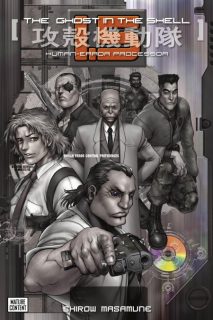
Ghost in the Shell, Volume 1.5: Human-Error ProcessorGhost in the Shell, Volume 1.5: Human-Error Processor by Masamune Shirow. While I had previously read the first and second volumes of Ghost in the Shell, I had never actually read the manga’s third volume, something that I didn’t realize until Kodansha Comics recently re-released the entire series in a deluxe, hardcover edition. Even though it was the third volume of Ghost in the Shell to be collected and released, the events of Human-Error Processor take place between the first and second volumes (thus being numbered 1.5). The episodic chapters focus almost entirely Section 9 and the cases that group is investigating. A few intriguing new characters are introduced, but sadly the Major only makes the occasional guest appearance. Out of the three Ghost in the Shell volumes, Human-Error Processor is the most straightforward and easy to follow. While that’s something that I would generally welcome, the volume was somehow less interesting as a result even if it was more readable. As with the previous volumes in the series, some of the most interesting parts of the world-building in Human-Error Processor are actually only found in the footnotes instead of being directly incorporated into the manga.

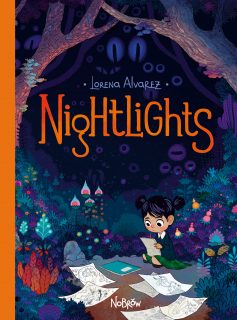
NightlightsNightlights by Lorena Alvarez. It was the bold, vibrant colors and gorgeous illustrations of Nightlights that initially caught my attention. Alvarez is a Columbian illustrator; Nightlights is her first comic and my introduction to her work. Nightlights is about a little girl, Sandy, whose imagination takes flight at night. She gathers together small, mysterious, glowing lights and uses them to create anything that she can dream of. Come the day, she spends her time alone drawing what she has seen. It’s an innocent enough premise, but Nightlights can actually be pretty dark and some of the comic’s themes are fairly heavy. Nightlights could be described as an all-ages comic, but some younger readers might find it scary in places. There is also a depth and nuance to the comic and its narrative that only more mature readers will likely pick up on. Although the stories are notably different, Nightlights actually reminded me a little bit of the animated film The Secret of Kells which I likewise greatly enjoyed. Each in their own way the works are fairytale-like, telling stories about imagination, creation, and the unknown. Nightlights was a beautiful comic and I sincerely hope to see more work from Alvarez in the future.
Gone: A Girl, a Violin, a Life UnstrungGone: A Girl, a Violin, a Life Unstrung by Min Kym. In 2010, Kym’s Stradivarius was stolen from her in a London cafe. The violin was an integral part of her identity, not just as a musician but as a person, and its loss was devastating. Her burgeoning career as a soloist came to a sudden halt. The violin was recovered three years later, but circumstances didn’t allow Kym to reclaim the instrument as her own. Ultimately she had to put it up for auction, losing it once again. In part, Kym’s memoir Gone was written in an attempt to process these traumatic events, rediscover who she is, and move forward with her life. Telling her side of the story she recounts growing up as a child prodigy–as the youngest daughter, her family’s devotion to her talent as a violinist was at odds with their South Korean heritage–her development as a musician, and her relationships with the Stradivarius and the people around her. Gone is an incredibly heartfelt and personal memoir but it can be somewhat discursive; Kym’s style of writing is very informal and at times even chaotic. Her voice as an author isn’t as clear as her voice as a violinist, but her passion and pain resonates throughout Gone. Complementing the release of Kym’s memoir is a companion album available from Warner Classics.

Filed Under: FEATURES, My Week in Manga Tagged With: comics, everyone's getting married, Ghost in the Shell, Izumi Miyazono, Junji Ito, Lorena Alvarez, manga, Masamune Shirow, Min Kym, Nonfiction

My Week in Manga: March 20-March 26, 2017

March 27, 2017 by Ash Brown

My News and Reviews

I actually managed to post another review at Experiments in Manga last week! That makes two weeks in a row, which hasn’t happened in a very long time. My goal of writing one review every month still remains, but when a month with five Wednesdays (like March this year) comes along, I’m going to try to do a second in-depth review or feature. That way, every week will have at least two posts, the usual My Week in Manga along with another feature of some sort. Anyway, as for the review that was posted last week, I took a look at Akira Himekawa’s The Legend of Zelda: Twilight Princess, Volume 1 which I enjoyed a great deal. The manga stands well on its own so someone doesn’t have to be familiar with the original video game it’s based on to enjoy it. The manga series is also notably darker than Himekawa’s previous all-ages adaptations of The Legend of Zelda video games.

Elsewhere online, I came across a few interesting interviews to read. Over at Viz Media’s blog, speculative fiction author Taiyo Fujii talks a little about Orbital Cloud, his most recent novel to be translated into English. (I previously read and reviewed Gene Mapper, Fujii’s debut work of fiction which I rather enjoyed, so I’m looking forward to reading the award-winning Orbital Cloud.) Through the Painting is in the process of translating a 2013 Tokyo Manga Lab interview with Haruko Kumota, creator of the manga series Descending Stories: Showa Genroku Rakugo Shinju. (Kodansha Comics is releasing the series in English; it’s one of my most anticipated debuts of the year.) Finally, on the occasion of Yen Press’ recent release of Canno’s Kiss and White Lily for My Dearest Girl, Brigid Alverson interviewed Erica Friedman about yuri manga for Barnes & Noble. And speaking of Yen Press, the publisher announced a few manga licenses last week: Re:ZERO -Starting Life in Another World, Chapter 3: Truth of Zero by Tappei Nagatsuki, Shinichirou Otsuka, Daichi Matsuse; Is It Wrong to Try to Pick Up Girls in a Dungeon?: Sword Oratoria by Fujino Omori, Takashi Yagi; Hybrid x Heart by Masamune Kuji, Riku Ayakawa; and Gabriel Dropout by Ukami.

Quick Takes

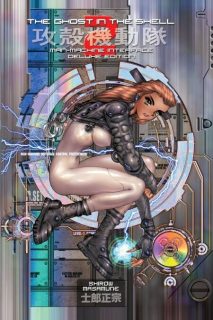
The Ghost in the Shell, Volume 2: Man-Machine InterfaceThe Ghost in the Shell, Volume 2: Man-Machine Interface by Masamune Shirow. It’s been well over a decade since I first read Masamune’s The Ghost in the Shell manga. While I had vague memories of the first volume, I remembered virtually nothing about the second. Kodansha Comics’ recent re-release of the series in a deluxe, hardcover edition provided an ideal opportunity for me to revisit the manga. (The deluxe edition presents the manga in right-to-left format with the original Japanese sound effects for the first time; it’s also supposed to have bonus content, but I’m not exactly sure what that additional material is supposed to be in second volume.) Upon rereading the second volume of The Ghost in the Shell, I think I know why I had trouble recalling anything about it–the manga seems to be more show than substance. At times I would find that I had stopped reading the seemingly nonsensical text entirely and was just turning pages and looking the artwork, much of which is in color. There is a story in there somewhere, as well as some interesting worldbuilding and philosophizing, but most of that seems to be happening in the copious footnotes rather than in the manga proper.

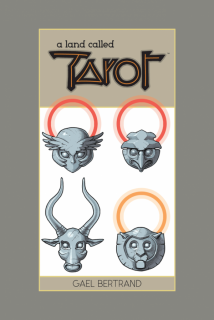
A Land Called TarotA Land Called Tarot by Gael Bertrand. Originally serialized in the Island comics anthology, A Land Called Tarot was recently released in a standalone hardcover collection with additional content. Except for a few sound effects, A Land Called Tarot is actually a wordless comic. There is no dialogue or narration, so readers must rely entirely on Bertrand’s artwork to interpret the characters, story, and setting. Fortunately, Bertrand is more than up to the task. The artwork in A Land Called Tarot is absolutely gorgeous. The cover design is actually somewhat misleading–the interior illustrations are marvelously detailed and beautifully colorful. The lack of words in the comic invites readers to pay even more attention to the artwork and to explore the nuances of the fantastic world that Bertrand has created. The comic follows an adventurous hero, the Knight of Swords, as he travels across the land and meeting its people, his journey taking him through both time and space. There are moments of action and battle, but there are also moments that are peaceful and serene and sometimes even little lonely. A Land Called Tarot is a wondrous delight. I unequivocally loved the comic hope to see more work by Bertrand in the future.
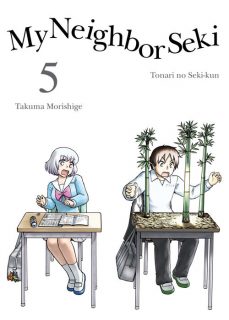
My Neighbor Seki, Volume 5My Neighbor Seki, Volumes 5-7 by Takuma Morishige. I’m not really sure why I’ve fallen behind reading of My Neighbor Seki because I enjoy the series a great deal. The manga remains consistently delightful and is wonderfully charming. My introduction to the series was through its anime adaptation; the chapters in these three volumes happen to be released or serialized around the same time that the anime was being produced. The author’s notes seem to imply that the manga wasn’t initially anticipated to become as long as it now has (the series is actually still ongoing, as far as I can tell) but the anime understandably revitalized interest in My Neighbor Seki. I like both versions of My Neighbor Seki, but there’s more in the manga that was never adapted. I continue to be impressed by Morishige’s inventiveness and imagination in creating new and clever scenarios for the series’ characters. Not much has changed from the beginning of My Neighbor Seki, although occasionally Seki isn’t the only one actively participating in the games he plays instead of paying attention in class. His mother has been introduced, too. I hope to see her again as one of the recurring characters.

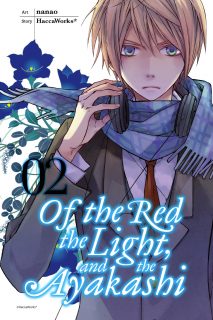
Of the Red, the Light, and the Ayakashi, Volume 2Of the Red, the Light, and the Ayakashi, Volumes 2-3 by Nanao. While I enjoyed the first volume of Of the Red, the Light, and the Ayakashi, especially its ominous atmosphere and the sense of foreboding it inspired, it’s taken me quite a while to finally get around to reading more of the series. Now I’m regretting my delay, because the next two volumes are just as enticing as the first, if not more so, and if anything the series is getting stronger as a whole. Granted, there’s still some annoying awkwardness surrounding some of the characters’ conversations in which they seem to talk around important topics and information simply because the reader isn’t supposed to know the details about them yet. But even with this fault, Of the Red, the Light, and the Ayakashi manages to remain engaging. Part of this is due to the series’ air of mystery and the way in which Nanao is able to stretch out the story without being manipulative. For example, an important reveal in the second volume which in many other stories would have been the major plot twist is simply one in a longer string of steady developments. Several more questions are raised for every one that is answered in the series; I am incredibly curious to learn more.

Filed Under: FEATURES, My Week in Manga Tagged With: comics, Gael Bertrand, Ghost in the Shell, manga, Masamune Shirow, My Neighbor Seki, Nanao, Of the Red the Light and the Ayakashi, Takuma Morishige

My Week in Manga: February 27-March 5, 2017

March 6, 2017 by Ash Brown

My News and Reviews

Last week at Experiments in Manga the winner of the Tokyo ESP manga giveaway was announced. The post also includes a list of some of the manga available in English about psychics and/or espers. That was it for the blog, but as I previously mentioned, I had an all-day job interview last week which took up a fair amount of my time and attentions. Well, it turns out that they liked me, and I liked them, so it looks like I’ll be starting in a new position at a different library in May. It’s both very exciting and very nerve-wracking, but I think (hope!) it’s a good move for me. My day job will still have absolutely nothing to do with manga, though.

Elsewhere online last week there was ICv2’s annual Manga Week. A number of interesting manga-focused articles and interviews were posted, including a mention of some of Vertical Comics’ most recent licensing announcements: Arakawa Under the Bridge by Hikari Nakamura (the one I’m most excited for), Gundam Wing: The Glory of Losers by Tomofumi Ogasawara, Helvetica Standard by Keiichi Arawi, and Voices of a Distant Star by Makoto Shinkai and Mizu Sahara (technically a rescue as the manga was originally published in English by TokyoPop back in the day). Kodansha Comics recently made some announcements at ECCC. In addition to adding even more fantastic series to its digital initiative, Kodansha Comics is working on a Ghost in the Shell anthology similar to the Attack on Titan Anthology released last year. Should be interesting!

Quick Takes

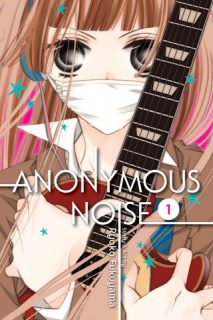
Anonymous Noise, Volume 1Anonymous Noise, Volume 1 by Ryoko Fukuyama. I will pretty much give any manga a try if it’s even tangentially related to music, so it shouldn’t be too much of a surprise that I would be interested in Anonymous Noise. The series follows Nino Arisugawa (called Alice, by some) who loves to sing. Expressing herself through music is an important part of who she is, but perhaps more importantly it’s how she connects to the people who mean the most to her. First there was Momo, Nino’s close childhood friend with a proclivity for making bad puns, and then there was Yuzu, who helped soothe Nino’s heartbreak with his own music when Momo’s family unexpectedly moves away. But after developing feelings for Nino, Yuzu suddenly disappears from her life, too. Fast forward a few years and the three of them are attending the same high school, although initially they don’t realize it. Most of the first volume feels like a prologue more than anything else, so I’m curious to see the direction the story proper will take from here. In addition to music, it seems that unrequited love will also be a major theme of Anonymous Noise. Complicated feelings of love, longing, loss, and loneliness set the tone for the series.

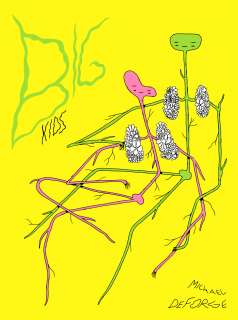
Big KidsBig Kids by Michael DeForge. Due to my interest in alternative and independent comics, I’ve been aware of DeForge’s work for quite some time. However, I’ve never actually read any of DeForge’s comics until picking up Big Kids. To be honest, I think I was probably a little intimidated since DeForge is such a highly acclaimed and well-regarded artist. I recently came across Big Kids on display at my local comic book shop where flipped through a few pages before putting it back. But I couldn’t stop thinking about it and so ultimately brought a copy home with me. The small volume’s bright yellow cover burned itself onto my retinas, and it’s content has burned itself onto my soul. I’ve read through the comic several times now and I still can’t stop thinking about it. I don’t know that I completely understand everything about it, but Big Kids is a work that is both surreal, verging on abstract, and powerful. In part, the comic about growing up. After being dumped by his boyfriend, Adam wakes up one day to discover that he has become a tree. The world itself is still the same, it’s just that Adam now views it from a vastly different perspective. But while being a tree has its benefits, there’s also a sense of sadness and loss associated with it.

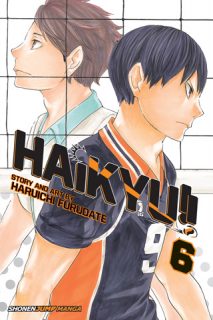
Haikyu!!, Volume 6Haikyu!!, Volumes 6-9 by Haruichi Furudate. Out of all of the sports manga currently being released in print in English, Haikyu!! is definitely one of my favorites. Admittedly, I was a little worried that as the series entered its first tournament arc and became more focused on the games themselves I would lose some of my enthusiasm (I’m not especially interested in volleyball), but my fears appear to have been mostly unfounded. Occasionally Haikyu!! will get a little bogged down in the particulars of volleyball, but this is usually completely offset by the series’ incredibly engaging characters. I’m immensely enjoying seeing them grow and evolve not just as players, but as people. I absolutely love the manga’s approach to and emphasis on teamwork. Some of the characters are prodigies, but it is made very clear that a single person cannot win on their own. Often it’s the unassuming, “ordinary” players who dramatically shift the course and tone of a game. Everyone has their own talents and abilities and everyone has an important role to play. Haikyu!! may be a series about volleyball, but its themes and message are much more universal than that. The manga has great positivity and energy which makes it fun to read, too.

Filed Under: FEATURES, My Week in Manga Tagged With: Anonymous Noise, comics, Haikyu!!, Haruichi Furudate, manga, Michael DeForge, Ryoko Fukuyama

My Week in Manga: February 20-February 26, 2017

February 27, 2017 by Ash Brown

My News and Reviews

In a few more days and March will be here and in a few more days the winner of the Tokyo ESP manga giveaway will be announced. Never fear though, there’s still a little time left to enter for a chance to win the first omnibus in the series! Simply tell me a little about a favorite psychic/esper from a manga. (A quick note: Normally I announce giveaway winners on Wednesday mornings but, because I have an all-day job interview on the 1st, this time the announcement will likely be made sometime on Wednesday evening instead.)

As for some interesting things I came across last week: The National Museum of Modern Art in Tokyo has created an online archive of early Japanese animation. An English-language version of the site is currently in the works, but even if you can’t read Japanese if you click around enough you’ll find the some of the videos available for viewing. The University of Michigan’s Center for Japanese Studies recently hosted two master rakugo artists–Yanagiya Sankyo and Yanagiya Kyonosuke–and has posted a video of one of their events. The video includes a brief introduction to rakugo, a demonstration and performance, and a question and answer session.

There are also a few podcasts worth mentioning (though I haven’t actually had the opportunity to listen to most of them yet): The most recent episode of Comic Books Are Burning in Hell is devoted to the late Jiro Taniguchi. Tofugu started a podcast not too long ago and recently talked with Alexander O. Smith about What Makes a Good Japanese Translator? (Smith does a fair amount of video game translation but translates novels and manga as well. He’s also one of the founders of Bento Books.) Vertical Comics recently started a podcast, too, and the first episode of the Mangocast is now available for listening.

As for crowdfunding efforts for queer comics, the end of February has seen quite a few Kickstarter projects launch: The Husband & Husband campaign is hoping to publish the first volume of the cute and funny webcomic in print. The Dates anthology, which focuses on queer historical fiction, is back for a second volume. (Though I haven’t written a quick take for it yet, I have the first volume and it’s great.) The Go Get a Roomie! project is raising funds to print the second volume and reprint the first volume of the webcomic. And finally, Digital Manga’s most recent Kickstarter has launched–Juné Manga is working with Velvet Toucher, a Japanese artist living in the United States, to release Eden’s Mercy.

Quick Takes

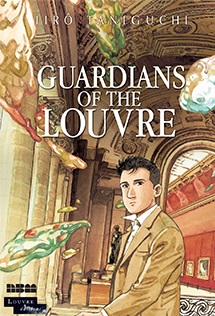
Guardians of the LouvreGuardians of the Louvre by Jiro Taniguchi. I’ve read most but not quite all of Taniguchi’s manga that has been released in English, but his recent passing reminded me that I hadn’t yet read Guardians of the Louvre, the latest one to have been released. One of the most remarkable things about Guardians of the Louvre is its full-color artwork. The volume is actually part of the “Louvre Collection,” a series of comics commissioned by the Louvre that feature the museum and its collections. (Hirohiko Araki’s Rohan at the Louvre is part of the same series.) Taniguchi is an extremely versatile creator; while some of his manga are action-packed, others are more introspective. Guardians of the Louvre is definitely one of the latter. The story is a quiet and contemplative exploration of art and inspiration, following a manga creator who is visiting Paris on his own for a few days. He falls ill soon after he arrives but pushes through in order to visit the Louvre. And so when he seems to start slipping through time, meeting artists and historical figures associated with the museum, not to mention the embodiments of some of the works housed there, he’s never quite sure how much of his visit is based in reality and how much is a fever dream.

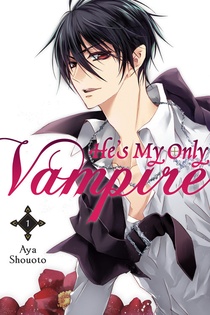
He's My Only Vampire, Volume 1He’s My Only Vampire, Volumes 1-3 by Aya Shouoto. While I don’t actively avoid vampire manga, I also don’t actively seek it out. Usually there has to be something a little “extra” to catch my attention. In the case of He’s My Only Vampire, I had decided to seek out more of Shouoto’s work available in English while waiting for more of The Demon Prince of Momochi House to be released. He’s My Only Vampire is kind of an odd series and at this point the manga doesn’t seem to have a clear direction. It’s as if Shouoto is either trying to do too much at once with the story or hasn’t quite decided where it should go yet. It can still be pretty entertaining from time to time, though. Shouoto’s artwork, even though anatomy seems to occasionally go out the window, can be lovely and sensual, too. So far the best part of the manga is the three main characters–Kana, the strong and spunky heroine, Aki, the titular vampire and Kana’s long-lost childhood friend, and Jin, a high-school delinquent who has recently discovered that he is at least part werewolf. Personality-wise and the relationship-wise they’re all sort of goofy and their interactions can be quite amusing. The story is taking some darker turns, but I think I prefer its humor.

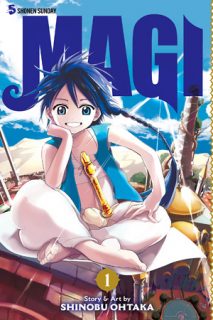
Magi: The Labyrinth of Magic, Volume 1Magi: The Labyrinth of Magic, Volumes 1-4 by Shinobu Ohtaka. I know quite a few people who love Magi and have heard plenty of great things about the series but despite those facts it’s still taken me this long to finally get around to reading the manga. Magi more or less starts out as a dungeon crawl which, while highly entertaining, isn’t exactly the most compelling narrative for a series that’s already over thirty volumes and still ongoing. But after the first dungeon crawl (and I suspect that there will likely be more of those in the future) Ohtaka begins delving into the characters and their motivations while exploring the vast world in which the live. In part Magi is inspired by One Thousand and One Nights but Ohtaka does not strictly adhere to those stories and characters, instead creating a complex world that is reminiscent of but distinct from that work. Magi really is a great series, with plenty of magic, mystery, and adventure; I can easily understand why it’s so well-loved. The artwork is clear and attractive, the settings and characters are interesting and well-realized, and the story, worldbuilding, and action are engaging. I also particularly appreciate that the women can be just as badass as the men in the series and in some cases are even more so.

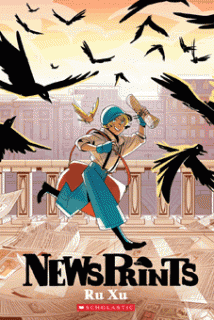
NewsPrintsNewsPrints by Ru Xu. My introduction to Xu’s work was through the beautifully illustrated webcomic Saint for Rent. However, NewsPrints is her debut graphic novel. Published by Scholastic the comic is aimed towards middle grade readers but it can be appreciated by older readers, too. NewsPrints, while still being very approachable, actually tackles some pretty weighty subject matter–war, propaganda, identity, and so on. The comic is about Blue, an orphan who is hiding the fact that she is a girl so that she can work as a newsboy for the Bugle, one of the only newspapers that actually reports the truth. The Bugle has taken in and cares for other orphans as well, but Blue is afraid that she won’t be able to hide her secret much longer and may lose her newfound family because of it. The city she lives in has very firmly entrenched ideas about what is and is not appropriate for girls to do. Blue is embroiled in an extremely dangerous situation when she meets and becomes friends with Crow who is also hiding a secret, one that could greatly influence the course of the war. Though NewsPrints tells a complete story the ending is left fairly open. Apparently a sequel is currently in the works; I’m very curious to see where Xu takes the comic next.

Filed Under: FEATURES, My Week in Manga Tagged With: Aya Shouoto, comics, He's My Only Vampire, Jiro Taniguchi, magi, manga, Ru Xu, Shinobu Ohtaka

My Week in Manga: February 13-February 19, 2017

February 20, 2017 by Ash Brown

My News and Reviews

Hooray! I managed to write and post another in-depth review at Experiments in Manga. Even if I’m not writing as much as I once was, it still feels pretty good to get back into the (slow) swing of things. Anyway, last week I took a look at Jen Lee Quick’s dark fantasy Western Gatesmith, Volume 1. The comic is off to an intriguing start though it can also be a little frustrating. The series is currently on break, but I hope that there will be more soon.

As many people are probably aware, the prolific and versatile mangaka Jiro Taniguchi passed away earlier this month. Despite not being particularly well known in English, a fair number of his manga have been released in translation. Kate Dacey of The Manga Critic has a nice guide to Taniguchi’s work for those interested in what is currently available. At The Comics Journal, Taniguchi was the subject of a recent article by Joe McCulloch and an obituary written by Zack Davisson. Other comic sites like The Beat have recently honored Taniguchi as well. I’ve read most but not quite all of Taniguchi’s work in English, my personal favorites being A Distant Neighborhood and his collaboration with Baku Yumemakura The Summit of the Gods. Way back when there was a Manga Moveable Feast devoted to Taniguchi, too. Some of the links are no longer work, but many of the features can still be tracked down.

In happier news, SuBLime announced three new licenses last week: Akane Abe’s Am I In Love or Just Hungry? (digital-only), Scarlet Beriko’s Jackass!, and Tsuta Suzuki’s A Strange and Mystifying Story. (I’m very curious about Jackass! and I’m very happy about A Strange and Mystifying Story which is actually a license rescue. The first three of seven volumes were originally published in English by Digital Manga; I remember quite liking them.) The Toronto Comic Arts Festival has started announcing its featured guests for the year which will include Gengoroh Tagame among other fantastic creators. The OASG talked to Kodansha Comics about the licensing of Chihayafuru. While still probably unlikely, a print edition of the series isn’t completely off the table. As for Kickstarter campaigns for queer comics that have recently caught my attention, Megan Lavey-Heaton has launched a project to print the third volume of Namesake.

Quick Takes

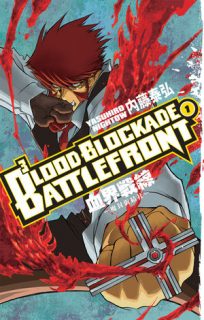
Blood Blockade Battlefront, Volume 1Blood Blockade Battlefront, Volumes 1-7 by Yasuhiro Nightow. I wasn’t initially planning on reading Blood Blockade Battlefront–I wasn’t a huge fan Nightow’s Trigun–but I kept hearing great things about the anime adaptation and then I came across a “complete” set of the manga on super sale, so I picked it up. The series is actually ten volumes long; supposedly Dark Horse has plans to release the final three at some point. In general the manga tends to be fairly episodic, so even if the rest of the series isn’t translated at least readers aren’t left with an unresolved story. It wasn’t until partway through the second volume of Blood Blockade Battlefront that the series started to click with me, but once it did I found myself really enjoying the manga. Its mix of goofy everyday life and action-heavy sequences actually reminded me a bit of Cowboy Bebop. The manga is essentially about a semi-secret group of monster hunters working in what used to be New York before it was destroyed by the sudden appearance of an interdimensional portal. The character designs of the main cast are sadly simple and plain compared to the series’ fantastic setting and creatures, but their distinctive personalities mostly make up for that.

The Box ManThe Box Man by Imiri Sakabashira. The North American manga industry is primarily focused on publishing more popular, mainstream works, but occasionally an alternative or independent work is released as well. The Box Man was originally serialized in Ax, an alternative manga magazine in Japan which was the basis for the Ax: Alternative Manga English-language anthology. Examples of Sakabashira’s work can be found in that anthology and in the earlier collection Sake Jock, but The Box Man is his first long-form work to be translated. Granted, there’s very little dialogue that actually needs to be translated–for the most part the manga is an entirely visual experience. Even the story is fairly limited in scope. The narrative follows a kappa-like cat accompanying a man on a scooter who is transporting a box which turns out to contain something rather peculiar. The strangeness of The Box Man doesn’t end there, but the point of the manga seems to be less about telling a story and more about creating a visual spectacle. The artwork incorporates popular culture references (some of which I’m sure I completely missed) and at times can be rather bizarre, violent, or erotically-charged.

Giganto MaxiaGiganto Maxia by Kentaro Miura. Though it certainly has its problems, Miura’s Berserk is one of my favorite series. I have been significantly less enamored with the other manga by Miura that have been released in English–specifically his collaborations with Buronson Japan and King of Wolves–but I was still very curious about Giganto Maxia. Whether it’s intentional or not, the dark fantasy manga shares some similarities with Attack on Titan and Terra Formars and also appears to be heavily influenced by professional wrestling. Miura’s artwork in Giganto Maxia is tremendous but the story, while it isn’t awful, struggles to match the caliber of the illustrations. I almost wonder if Giganto Maxia was originally intended to be longer than a single volume since so much about the manga’s world and characters are left unexplained in the end. Giganto Maxia does more or less tell a complete story, but it feels like a single episode taken from the middle of a larger narrative. At one time a slave forced to battle to the death in a gladiatorial arena, Delos is now fighting against the empire itself. Joining forces with Prome, a powerful spirit who takes the form of a young girl (and who is constantly trying to get him to drink her “nectar” ), Delos can transform into the mythic titan Gohra in order to do battle.

Lake JehovahLake Jehovah by Jillian Fleck. Lake Jehovah, Fleck’s debut graphic novel, first came to my attention due to the fact that Jay, the comic’s protagonist, is genderqueer. While themes of identity, gender, and sexuality are integral to the comic’s story they aren’t the primary focus of Lake Jehovah. Instead, the comic is about the end of the world, both literally and figuratively. Human civilization has already succumbed to multiple apocalypses but Jay unexpectedly becomes the prophet for the next impending disaster while dealing with even more personal and existential crises. Jay struggles with intense depression and anxiety which slowly destroys xis relationship with xis fiance. Eventually she leaves, no longer able to cope with Jay’s instability, and Jay is left recover and come to terms with everything alone. Lake Jehovah actually handles the topic of mental illness better than many other comics I’ve read. It’s an emotionally tumultuous work, tempering despair with humor as the characters search for meaning in their lives even while everything is falling apart around them. Some turn to sex or drugs while others find comfort in poetry or art. Lake Jehovah is a somewhat strange but undeniably compelling comic.

Filed Under: FEATURES, My Week in Manga Tagged With: Blood Blockade Battlefront, comics, Imiri Sakabashira, Jillian Fleck, Kentaro Miura, manga, Yasuhiro Nightow

Gatesmith, Vol. 1

February 16, 2017 by Ash Brown

Gatesmith, Volume 1Creator: Jen Lee Quick
Publisher: Chromatic Press
ISBN: 9781987988079
Released: July 2016
Original run: 2014-2015

My introduction to the work of Jen Lee Quick was through her comic Off*Beat. The first two volumes of the series were originally published by Tokyopop after which the comic sadly languished unresolved until it was rescued by Chromatic Press, becoming one of the publisher’s flagship titles. After completing Off*Beat with Chromatic Press, Quick began working on a second comic series with the publisher called Gatesmith. The origins of Gatesmith actually date back to Quick’s Tokyopop days as well, but the ideas for comic have significantly changed since then. At least one thing has remained the same though–Gatesmith is a dark fantasy Western drastically different from Off*Beat. Gatesmith began serialization in Chromatic Press’ digital magazine Sparkler Monthly in 2014. The first volume concluded in 2015 and the serialized content was subsequently collected as an ebook along with an exclusive epilogue comic and the short prequel comic “Hungry.” A small print run of Gatesmith, Volume 1 was released in 2016. As a fan of Quick’s work, I was very happy to snag a copy.

Edgeward is a western frontier town undergoing a transformation as its residents slowly build it into a successful mining city. But Edgeward is also the home to numerous strange happenings, phenomena which some people attribute to the area’s large deposits of mythrilite, a promising but potentially dangerous new energy source which hasn’t yet been thoroughly studied. Modernization can carry along with it tremendous risks, but there seems to be something even more primal, ancient, and bizarre at work in Edgeward. On the outskirts of town, strange lights can be seen in the middle of the desert. Peculiar trees spontaneously emerge where no tree has any right growing. Rumors circulate about monsters and creatures of legend roaming about. Ranchers are losing livestock and are uncertain whether or not to blame humans or something much more diabolical. Whatever it is that is going on in Edgeward may very well have a greater meaning and far-reaching impact than anyone realizes.

Gatesmith, Volume 1, page 72The setting of Gatesmith, while beautiful, is also a harsh and frequently brutal one. Survival is certainly not guaranteed in such an unforgiving environment. The comic opens with an attack on a covered wagon that leaves everyone directly involved in the incident dead and the violence in the story doesn’t end there. At this point virtually everything is unknown in Gatesmith, and the unknown is very apt to get someone killed. Gatesmith, Volume 1 offers very few answers as Quick layers mystery upon mystery. In the series, myth, folklore, and the supernatural are closely intertwined with scientific, social, and technological progress. The anxieties surrounding the changing times are very real and sometimes manifest in unexpected ways. When humans are attempting to deal with things that they don’t completely comprehend or understand trouble naturally follows, but it’s not always the inhuman that people have to worry about–unintentionally or not, civilization can be just as destructive and isn’t necessarily always a positive force. Tremendous resilience and adaptability will be required of any of the characters who hope to reach the end of Gatesmith alive.

Gatesmith is off to an incredibly intriguing start with its first volume; I am intensely curious to see how the comic continues to develop from here. However, part of what makes Gatesmith so appealing and engrossing is also what makes the comic somewhat frustrating. Quick is working with several storylines and a marvelously diverse cast of characters, but this early on in the series the connections between them all are not immediately clear. With the many strange occurrences and often stranger characters involved in Gatesmith, the ultimate direction and drive of the story is somewhat obscured at the moment and the worldbuilding hasn’t yet been established in its entirety. What has been revealed so far is enticing and tantalizing, though. Gatesmith is an interesting blend of genres. Quick draws on traditions of Westerns, folklore, horror, and other speculative fiction without relying heavily on preexisting elements or well-worn tropes, combining them together in striking ways. Currently Gatesmith is on a break as Quick concentrates on a few other creative projects, but I hope to see more of the weirdly wonderful and wonderfully weird Western soon.

Filed Under: REVIEWS Tagged With: Chromatic Press, comics, Gatesmith, Jen Lee Quick

My Week in Manga: January 23-January 29, 2017

January 30, 2017 by Ash Brown

My News and Reviews

The end of the month is approaching which means it’s time for Experiments in Manga’s monthly giveaway. The winner of the most recent giveaway will be announced on Wednesday, so there’s still a little time left to enter for a chance to win the first volume of Kenya Suzuki’s delightful full-color manga series Please Tell Me! Galko-chan. Speaking of manga giveaways, there’s also an opportunity to win a copy of the first omnibus in Kei Sanbe’s Erased over at The OASG.

Elsewhere online, I came the Young Adult Library Services Association’s 2017 Great Graphic Novels for Teens. As usual, the list includes a fair number of manga along with all of the other excellent comics. Ichigo Takano’s Orange (which was also one of my notable manga from 2016) even made the top ten list. Out of the many other manga included as part of YALSA’s larger list, I have in-depth reviews of Junji Ito’s Cat Diary: Yon & Mu and Akiko Higashimura’s Princess Jellyfish, Omnibus 1, both of which I loved.

Another list I came across recently was BookRiot’s feature on Japanese speculative fiction in translation. Overall, I think it’s a great list–I’ve previously reviewed three of the books included (Miyuki Miyabe’s The Book of Heroes, Yusuke Kishi’s The Crimson Labyrinth, and Taiyo Fujii’s Gene Mapper) and most of the others I’ve been meaning to read for quite some time or were already high on my list of books to read in the near future.
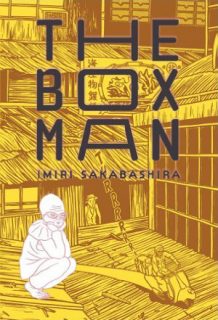
It’s been a while since I’ve mentioned Kickstarter projects here, but there are a few campaigns for print comics that have caught my eye lately: Maya Kern is looking to print the second volume of the adorable webcomic Monster Pop; Amanda Lafrenais is campaigning to release the second Titty-Time print collection of erotic comics; and Deandra Tan is hoping to release a print edition of her graphic novel Love Debut!.

Quick Takes

Aoharu X Machinegun, Volume 1Aoharu X Machinegun, Volume 1 by Naoe. I picked up the first volume of Aoharu X Machinegun more on a whim than anything else but I ended up enjoying it much more than I expected. On the surface there are a few things about the beginning of Aoharu X Machinegun that are oddly reminiscent of Ouran High School Host Club–Masamune works in a host club and Hotaru, who is often mistaken for a boy, gets wrapped up in his schemes after she needs to earn some money for damaging the club’s property–but the similarities mostly end there. Hotaru has an overly-strong sense of of justice and has a tendency to get into fights because of it. Masamune is the leader of a competitive survival/war game team and has decided the Hotaru should become its third member after her aggressiveness leaves a distinct impression on him. Initially, the team’s second member Tooru, who also happens to be well-known hentai mangaka, is less than thrilled about this. They’re both completely unaware that Hotaru is a girl, too, which could cause some trouble later on. Aoharu X Machinegun is kind of ridiculous but fun. I enjoyed its action and sense of humor and this point would be interested in reading more.

Bakune Young, Volume 1Bakune Young, Volumes 1-3 by Toyokazu Matsunaga. I’ve been meaning to read Bakune Young for quite a while now but the short series is long out-of-print and can be somewhat difficult to find. (Fortunately, it turned out that my library actually owns a complete set.) Reading Bakune Young is quite an experience to say the least. Matsunaga’s artwork, while it’s frequently and deliberately grotesque and at times could even be described as ugly, is tremendous. The story itself is nearly nonsensical, but it does manage to have a bizarre sort of logic to it. The series opens with the titular Bakune Young in a pachinko parlor before he begins targeting yakuza in a killing spree. His rampage quickly escalates and eventually not only the yakuza, but Japanese police, a ninja assassin from the French Foreign Legion, psychics, and even the American military all become involved as the death count increases exponentially. Bakune Young is certainly not for the faint of heart. It’s incredibly violent, viciously dark, and legitimately absurd, but assuming one isn’t bothered by all that, it can also be extraordinarily funny. I suspect Bakune Young is a manga that readers either love or hate without there being much middle ground.

The Encyclopedia of Early EarthThe Encyclopedia of Early Earth by Isabel Greenberg. I recently read and absolutely loved Greenberg’s The One Hundred Nights of Hero and so immediately made a point to seek out more of her work. The Encyclopedia of Early Earth was Greenberg’s first graphic novel and received great acclaim when it was published. The comic’s premise is simple: a nameless storyteller as travels the world in search of a missing piece of his soul. The graphic novel shares some obvious similarities to The One  Hundred Nights of Hero in its structure, themes, artwork, and setting. Both comics take place in the pre-prehistoric Early Earth and utilize the same mythologies, cosmologies, and pantheons. Both comics, in addition to love, are also about the importance of stories and storytellers; they find inspiration in and retell existing folktales while intertwining them with those of Greenberg’s own making. Otherwise, the two comics aren’t directly related. The Encyclopedia of Early Earth feels less politically-charged than The One Hundred Nights of Hero which may make it more palatable to some audiences but as a result it isn’t nearly as powerful a work overall in comparison. Even so, The Encyclopedia of Early Earth is wonderful.

Wolf MagicWolf Magic by Natsuki Zippo. So far, Wolf Magic is the only manga by Zippo to have been released in English. As far as I can tell, Wolf Magic is also Zippo’s first professional work. Especially considering that, it’s a very strong collection of boys’ love manga, and I’d certainly be interested in seeing more from Zippo translated. Wolf Magic opens with “The Water of Love for the Withered Flower” which is about Hanasaki, a florist whose severe appearance is at complete odds with what most people would associate with his profession. However, he still manages to unintentionally catch the eye of Hata. The manga then turns to the various “Wolf Magic” stories which follow Nagase, a young gay man, as he falls in and out of love during high school and then continues to look for “the one” in college. In the process, he develops a surprising relationship with Higuchi. While the two story arcs are unrelated and are quite different from each other, thematically they are very similar. Both Hanasaki and Nagase are searching for love and acceptance and both ultimately find it in unexpected places and ways. Overall, with its attractive artwork and excellent characterizations, Wolf Magic is quite well done.

United States of JapanUnited States of Japan by Peter Tieryas. I’ve often heard United States of Japan described as a spiritual sequel or successor to Philip K. Dick’s The Man in the High Castle. In some ways that is certainly true–Tieryas’ novel probably would not have existed were it not for Dick’s and makes multiple references to The Man in the High Castle–but the two novels are drastically different from each other in tone and style. The underlying premise, however, is the same. Emerging victorious from World War II, Japan now controls a significant portion of what was once the United States of America. The grim cyberpunk alternate history presented in United States of Japan (complete with mecha battles and graphic torture) can be extraordinarily brutal and gruesome. The lead characters aren’t exactly the most likeable or sympathetic people, either, though they become slightly more so as the novel progresses. Captain Ben Ishimura, whose only talent seems to be hacking and programming, is a censor who comes to the attention of Agent Akiko Tsukino when an illegal video game which imagines America winning the Second World War threatens to embolden resistance against the rule of Japan.

Filed Under: FEATURES, My Week in Manga Tagged With: Aoharu X Machinegun, Bakune Young, comics, Isabel Greenberg, manga, Naoe, Natsuki Zippo, Novels, Peter Tieryas, Toyokazu Matsunaga

My Week in Manga: January 9-January 15, 2017

January 16, 2017 by Ash Brown

My News and Reviews

Last week at Experiments in Manga I posted the Bookshelf Overload for December. It includes a pretty big list of things, in part due to massive holiday sales, so hopefully future months won’t be quite as ridiculous. Another thing that happened last week that was kind of cool was related to a post that I wrote back in 2014. My Spotlight on Masaichi Mukaide is probably one of the most noteworthy things that I’ve ever written and it actually got quite a bit of attention when I posted it. Well, Masaichi Mukaide himself apparently came across it recently and even left a comment.

Probably the biggest manga news from last week was the slew of licenses and other announcements made by Seven Seas. Here’s the list of manga:

Absolute Duo by Takumi Hiiragiboshi and Shinichirou Nariie
Alice & Zouroku by Tetsuya Imai
Captain Harlock: Dimensional Voyage by Leiji Matsumoto and Kouichi Shimahoshi
The Count of Monte Cristo by Moriyama Ena
Cutie Honey a Go Go! by Hideaki Anno and Shinpei Itou
Devilman G by Go Nagai and Rui Takatou
Dragon Half by Ryusuke Mita
Hatsune Miku: Bad End Night by Hitoshizuku-P x Yama and Tsubata Nozaki
Hatsune Miku Presents: Hachune Miku’s Everyday Vocaloid Paradise by Ontama
Magical Girl Special Ops Asuka by Makoto Fukami and Seigo Tokiya
Sleeping Beauty by Yumi Unita
Spirit Circle by Satoshi Mizukami
The Testament of Sister New Devil Storm by Tetsuto Uesu and Fumihiro Kiso
Unmagical Girl by Ryuichi Yokoyama and Manmaru Kamitsuki
Wadanohara and the Great Blue Sea by Mogeko

Seven Seas is getting back into translating novels and has a deluxe edition of Ryo Mizuno’s Record of the Lodoss War: The Grey Witch with illustrations by illustrations by Yutaka Izubuchi in the works, too. Also announced was a full-color edition of Madeleine Rosca’s Hollow Fields and five more illustrated literary classics. (I found Seven Seas release of Lewis Carroll’s Alice’s Adventures in Wonderland and Through the Looking-Glass to be quite enjoyable.)

It’s a pretty interesting group of announcements with a fairly wide range of titles to choose from. There’s even a manga from the late ’80s (Dragon Half), and not many of those are licensed any more. I’m particularly curious about Moriyama Ena’s adaptation of The Count of Monte Cristo (the cover art is gorgeous), the josei manga Sleeping Beauty by Yumi Unita (whose Bunny Drop left me with extremely conflicted feelings), as well as the number of titles which are part of classic franchises.

Quick Takes

Devils' Line, Volume 1Devils’ Line, Volumes 1-2 by Ryo Hanada. I actually didn’t realize it at first, but Devils’ Line is the second work by Hanada to be released in English. The first was the doujinshi Good-bye Geist which overall I enjoyed. However, Devils’ Line is Hanada’s first professional series. In general, I’m liking it, too, except that the artwork is terribly inconsistent. At times it’s absolutely spectacular (the cover illustrations are especially great) but within a few panels it may have lost all sense of scale an anatomy. I can’t quite tell if this is mean to be deliberate or not; if so, the execution is unconvincing. The story isn’t as tight as it could be, but it does have a nice blend of genres, including romance, horror, action, crime, and thriller. And, like Good-bye Geist, the series has a marvelously ominous atmosphere. The plot centers around Tsukasa, who unfortunately seems to be a magnet for both vampires (or “devils”) and sexual assault, and Anzai, a half-vampire working for the police in a unit specializing in devil-related incidents. Vampirism in Devils’ Line has an intensely sexual component to it; the eroticism often associated with vampires in other stories is in this case incredibly dark and violent.

The Ghost and the Lady, Volume 2The Ghost and the Lady, Volume 2 by Kazuhiro Fujita. Admittedly, The Ghost and the Lady is kind of a strange manga series. In part historical fiction and in part supernatural drama, the manga’s disparate elements don’t always perfectly mesh, but I still enjoyed the series a great deal. In The Ghost and the Lady, Fujita mixes together historical facts and legends, reimagining the life of Florence Nightingale and her accomplishments during the Crimean War with a distinctly supernatural flair. It’s clear that Fujita has done a tremendous amount of research for the series; and as the afterword by the series’ translator Zack Davisson points out, more or less every named character in the manga has a historical counterpart. There’s Nightingale herself as well as the people she knew, Grey is based on a famous ghost of the Drury Lane theater, and even historical figures like the Chevalier d’Éon have prominent roles to play. (Speaking of whom, I really need to find a good biography of d’Éon to read.) Despite the presence of the ghosts, the supernatural aspects of The Ghost and the Lady seem to come and go; I do wish that the eidolons had been utilized a little more in the series’ second half because it’s great when they are.

Holy Corpse Rising, Volume 1Holy Corpse Rising, Volume 1 by Hosana Tanaka. As can be safely assumed by provocative cover art, Holy Corpse Rising is a manga series that includes a fair amount of nudity and scantily clad women. However, despite the occasional ridiculousness, the fanservice is largely keeping with the style and tone of the series as a whole, so it doesn’t feel out-of-place; a significant portion of Holy Corpse Rising is intended to be titillating. In general, Tanaka’s artwork is quite attractive, though the women in the series are the most beautiful. They’re also by far the most powerful characters, both in ability and status. The first volume of Holy Corpse Rising serves as an introduction to the war between the Credic Church and the witches. Nikola, a monk who is a specialist in witch lore, is charged with securing the aid of the coven of first witches in the Church’s fight against their descendants. But first Nikola must resurrect them and in the process manages to put himself in some rather compromising situations. So far the first witches each seem to gain their power from a different bodily fluid (tears, blood). And since there are twelve of them, Holy Corpse Rising has the potential to enter some pretty kinky territory.

The One Hundred Nights of HeroThe One Hundred Nights of Hero by Isabel Greenberg. I don’t recall exactly what it was that brought The One Hundred Nights of Hero to my attention, but I’m so glad that I read it because it is marvelous; I loved the comic. Greenberg takes inspiration from existing stories and even provides retelling of folktales over the course of the graphic novel. The framework is deliberately similar to that of One Thousand and One Nights and there are stories within stories within stories. In fact, The One Hundred Nights of Hero is about the power of stories and storytellers. It’s also about love and “brave women who don’t take shit from anyone.” At the center of the comic is Cherry and her maid Hero, two women who love each other dearly. Night after night, Hero spins tale after tale in an effort to save their lives. The world of The One Hundred Nights of Hero is an incredibly misogynistic one. While different from our own, in some ways it is also tragically reminiscent. The One Hundred Nights of Hero isn’t always particularly subtle and can at times feel somewhat heavy-handed, but it’s a wonderfully powerful and unabashedly feminist work. I definitely plan on seeking out more of Greenberg’s comics.

Moshi MoshiMoshi Moshi by Banana Yoshimoto. Despite being an extremely prolific author and one of the most well-known Japanese novelists translated in English, I haven’t actually read any of Yoshimoto’s works until now. The story of Moshi Moshi is told from the first-person perspective of Yoshie, a young woman whose father has recently died. A successful musician, the circumstances surrounding his death are somewhat unclear, but it’s believed that he committed double suicide with a woman who neither she or her mother knows. The novel follows Yoshie as she tries to come to terms with the unexpected loss of her father by reinventing her life in the chic neighborhood of Shimokitazawa. Her mother joins her there, feeling that the ghost of her husband is haunting the family home, and Yoshie herself is plagued with recurring dreams in which her father appears, searching for his phone. Though Moshi Moshi does tend to drag a little in places, I really liked how Yoshimoto handles the themes of love, loss, and the inevitability of change in the novel. I suspect that Moshi Moshi likely isn’t the best introduction to Yoshimoto’s work, but for the most part I did appreciate it.

Filed Under: FEATURES, My Week in Manga Tagged With: Banana Yoshimoto, comics, Devils' Line, Ghost and the Lady, Holy Corpse Rising, Hosana Tanaka, Isabel Greenberg, Kazuhiro Fujita, manga, Novels, Ryo Hanada

My Week in Manga: December 26, 2016-January 1, 2017

January 2, 2017 by Ash Brown

My News and Reviews

Happy New Year, everyone! 2016 may now be over, but there’s still a little time left to enter Experiments in Manga’s December giveaway. Tell me a little about your favorite tournament manga or tournament story arc by Wednesday for a chance to win the first omnibus of Tadatoshi Fujimaki’s Kuroko’s Basketball. Also posted at Experiments in Manga last week were my random musings about some of the notable manga, comics, and other books that debuted in 2016. Despite there being three posts last week (which hasn’t happened in a very long time!) I actually wasn’t online much at all. As a result, I probably missed out on some interesting reading and announcements, so do let me know if there was anything particularly cool. One thing that I did see though was an interview with Kabi Nagata, creator of My Lesbian Experience with Loneliness which is scheduled to be released in English by Seven Seas later this year (and which I’m really looking forward to).

Quick Takes
Bungo Stray Dogs, Volume 1Bungo Stray Dogs, Volume 1 written by Kafka Asagiri and illustrated by Sango Harukawa. The Armed Detective Agency specializes in the dangerous cases that the Japanese police and military either won’t or can’t handle. It’s a team of uniquely skilled individuals who have abilities that seem to come right out of fiction, but the “good guys” aren’t the only ones with formidable powers. While there are names that a more casual reader might recognize—Osamu Dazai, Edogawa Rampo, Junichiro Tanazaki, Ryunosuke Akutagawa, and so on—others, like the lead Atsushi Nakajima, are less well-known in English. (I actually happen to be a pretty big fan of Nakajima’s work.) Their supernatural talents and personality quirks are all based on their namesakes. For example, Dazai’s power is named No Longer Human and he has a penchant for attempting suicide. It’s off to an intriguing start, but I’m not sure if Bungo Stray Dogs will appeal quite as much to someone not as familiar with the literary references being made. It’s not necessary to understand them to enjoy the manga, though. So far, I am getting a kick out of the series and look forward to seeing how it develops.

Hunter x Hunter, Volume 1Hunter x Hunter, Volumes 1-8 by Yoshihiro Togashi. I’ve been somewhat reluctant to start reading Hunter x Hunter (it might have something to do with the manga already being over thirty volumes long), but I’ve seen so much excitement and fan art for the series recently that I finally gave in. And I’ll admit, there’s a tremendous amount that I found appealing about the beginning of Hunter x Hunter. The setting is interesting, too, especially the concept of Hunters. These are people who, after putting their lives at risk to pass a grueling series of tests, are granted access to resources and information that others can only dream of. The manga largely follows Gon, a boy who wants to become a Hunter in order to find his father Ging, himself a hunter of great renown, as well as the friends and enemies Gon makes along the way. I really enjoyed the first story arc in which the candidates are trying to pass the Hunter exam. The second arc, while it serves an important purpose, I found to be a bit tedious as some of the world’s metaphysics are overexplained. However, the series quickly recovers its momentum again with clever action, intriguing characters, and drama.

Miss Kobayashi's Dragon Maid, Volume 1Miss Kobayashi’s Dragon Maid, Volume 1 by Coolkyousinnjya. Out of Seven Seas more recent monster girl manga, Miss Kobayashi’s Dragon Maid is the one that I was most interested in. For one, I happen to really like dragons. It also doesn’t hurt that the series is yuri-esque and that the titular Miss Kobayashi is an adult woman working as a systems engineer. Miss Kobayashi’s Dragon Maid features some nudity and bawdiness but for the most part it doesn’t tend to be overly-sexualized which is also refreshing. The manga can actually be surprisingly cute,  charming, and sweet. Hotaru is a dragon who has taken it upon herself to act as Kobayashi’s maid after Kobayashi saves her life. For her part, Kobayashi thought it was all an alcohol-induced dream and so is very surprised to discover that a dragon girl has made herself at home in her apartment. Why a maid specifically? It turns out that Kobayashi is a bit of a maid otaku (which becomes very clear when she goes off on drunken rants on the subject). Hotaru, who loves Kobayashi dearly, wants to do anything to make Kobayashi happy even if her efforts are somewhat awkward and frequently miss the mark.

Reindeer BoyReindeer Boy by Cassandra Jean. I am a fan of Jean’s illustration work, and so I was very excited to learn that an original graphic novel was in the making. Reindeer Boy is based on a series of character drawings that Jean has been creating (and that I’ve been following) since 2013. The comic follows Quincy, a young woman whose life takes an unexpected turn when a group of students, all of whom have antlers, transfer into her high school. They seem to take particular interest in her, especially the flirtatious Cupid who claims they are Santa’s reindeer. Quincy’s not sure what to make of it all, but the more she gets to know them the more she likes them. Admittedly, the story of Reindeer Boy does feel like it was made to fit the characters rather than the other way around. It’s kind of a strange comic, but it’s fun, goofy fluff with a bit of romance, delightful characters, and beautiful, sensual artwork. Reindeer Boy, while telling a complete story, does seem to end rather abruptly. I’m not sure if there are plans to release any additional reindeer comics, but I’d love the opportunity to spend more time with the characters and learn more about the mythology that Jean has created.

Yuri!!! on IceYuri!!! on Ice directed by Sayo Yamamoto. It’s been a long while since I’ve had the time and opportunity to marathon an entire anime series, but I knew that once I started Yuri!!! on Ice that I wouldn’t want to stop. And I was right; I love this series so much and hope that there will be a nice physical release that I can purchase in the future. The underlying story is fairly straightforward and simple: After a miserable performance at the Grand Prix, the career of Japanese figure skater Yuri Katsuki is falling apart when his idol Victor Nikiforov unexpectedly quits competing to become his coach. Yuri!!! on Ice is a series about love, passion, and inspiration in many forms. It’s also about people struggling against their selves, fighting through failure and realizing their self-worth. Yuri!!! on Ice is a tightly written and immensely satisfying show, but I do think it would have been even better if there were just a few more episodes to allow the characters and story more room to breathe. That being said, there is still some impressive character development with the series’ short span and the psychological elements are handled particularly well. Understandably, the leads receive the most attention, but I’d really like to know more about the supporting cast, too.
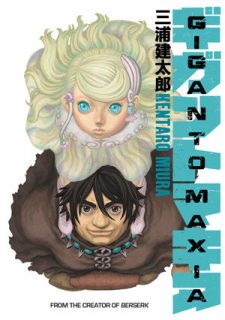
Filed Under: FEATURES, My Week in Manga Tagged With: anime, Bungo Stray Dogs, Cassandra Jean, comics, Coolkyousinnjya, Hunter X Hunter, Kafka Asagiri, manga, Miss Kobayashi's Dragon Maid, Sango Harukawa, Yoshihiro Togashi, Yuri on Ice

Random Musings: Notable in 2016

December 30, 2016 by Ash Brown

The end of 2016 has come and, as promised, I have compiled my annual list of notable releases of some of the works published within the last twelve months. All of the caveats from previous years still apply–to qualify a book must have been released in 2016 and I must have read it in 2016. (And I certainly haven’t read everything that’s been published this year.) Additionally, this year I’ve specifically decided to focus on debuts rather than continuing series (with one exception) and am limiting the list to one book per publisher in order to make it more manageable for myself. This is not a “best of” list or a list of favorites (that would be a much longer feature). It’s not even a list of all of the noteworthy releases from the past year, otherwise I’d probably never finish writing (2016 was an excellent year for manga in particular). What this list is is a subset of releases from the last year that, for one reason or another, left the most significant impressions on me.

Orange, Omnibus 1The first manga published in English in 2016 which really made me take note was Ichigo Takano’s Orange. It’s a heartwarming but bittersweet story which deals with some very heavy topics including crippling guilt, regret, depression, and suicide. Orange resonated very strongly with my own personal experiences as someone who is both challenged by and knows others who struggle with similar issues. The manga can be heartbreaking, but Takano’s approach is immensely compassionate and life-affirming.

Goodnight Punpun, Omnibus 1Inio Asano’s Goodnight Punpun is likewise a heartwrenching manga that deals with very serious and troubling subject matter. However, in the case of Goodnight Punpun, that exploration ends up being incredibly dark and surreal. I find the series to be remarkably compelling and the artwork is spectacular, but it’s certainly not what I would call light reading. The tragic coming-of-age story that Asano presents is deliberately uncomfortable and even the humor tends to be extremely bleak.

The Gods LieDevastating coming-of-age stories were apparently a theme for me in 2016 because The Gods Lie by Kaori Ozaki fits into that category as well. The Gods Lie was actually one of my most anticipated releases of the year and I was not disappointed. The manga is a beautiful, emotionally resonate work with a story that is both skillfully told and drawn. Ozaki addresses themes of abandonment, desperation, and death, recognizing that solutions to bad situations aren’t always easy or clear.

What Is Obscenity?Although the subject matter of Rokudenashiko’s autobiographical manga What Is Obscenity?: The Story of a Good for Nothing Artist and Her Pussy is also quite serious—a portrayal of the circumstances surrounding her multiple arrests on obscenity charges—the volume itself is charmingly funny, sweet, and surprisingly upbeat. Rokudenashiko’s work as an artist and activist is both inspiring and empowering. I personally feel that What Is Obscenity? was one of the most important releases from 2016.

Kitaro, Volume 1: The Birth of KitaroA few years ago, Drawn & Quarterly released a collection of Shigeru Mizuki’s Kitaro manga which I loved, so I was thrilled when a multi-volume Kitaro series was announced. Beginning with The Birth of Kitaro, the series has been specifically curated to appeal to younger readers although the manga is still a tremendous amount of fun regardless of age. Not very many classic manga are licensed in English these days, but with my particular interest in yokai, I’m glad that the influential Kitaro is one of them.

Attack on Titan AnthologyKodansha Comics was the manga publisher that impressed me most overall in 2016 with the expansion of the range of its offerings. One of the most interesting releases actually wasn’t a manga but an original collection of Western comics inspired by Hajime Isayama’s Attack on Titan. Like any anthology, some of the contributions to Attack on Titan Anthology are stronger than others, but some are incredible. As a whole, the volume is a fantastic collection compiling a wide variety of styles and genres.

Are You an Echo?: The Lost Poetry of Misuzu KanekoAnother remarkable multinational effort from 2016 was Are You an Echo?: The Lost Poetry of Misuzu Kaneko from Chin Music Press. The children’s book, beautifully illustrated by Toshikado Hajiri, combines a biography written by David Jacobson with a selection of Kaneko’s poetry translated by Sally Ito and Michiko Tsuboi. Kaneko is relatively unknown in English but her work is utterly delightful, charming, and compassionate. Are You an Echo? is a lovely book and a treasure.

Human ActsTechnically, Han Kang’s Human Acts won’t be released in North America until 2017, but the English translation was first published in 2016. The novel was honestly one of the best books that I read all year. It was also one of the most devastating and haunting. Beautifully written by Kang and elegantly translated by Deborah Smith, Human Acts shows how past tragedies have long-lasting and far-reaching effects on the present and future. The novel is intensely personal, political, and powerful.
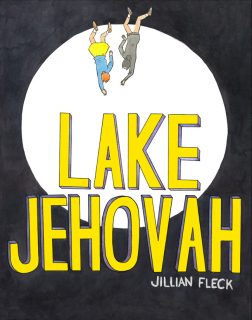
The Paper Menagerie and Other StoriesThe Paper Menagerie and Other Stories is the second book by Ken Liu to have been published. (Liu’s first book, The Grace of Kings, was actually on last year’s list of notable releases.) The collection brings together fifteen of Liu’s short stories and novellas, a combination of award-winning works and the author’s personal favorites. The volume is consistently compelling and thought-provoking—as good speculative fiction should be—each story providing a distinctive and meaningful perspective.

Tokyo Demons: Know What You WantAs many people know, Lianne Sentar’s Tokyo Demons is one of my obsessions, so I would be remiss to not mention it here. 2016 was a great year for fans of the series: Know What You Want, a provocative collection of mature side stories, was released in print, the third book finished its serialization online with an extremely satisfying conclusion, and the beginnings of the sequel series Tokyo Ghosts began to make its appearance. I’m very glad for the opportunity to see the story and characters continue to change and evolve.

Filed Under: FEATURES Tagged With: comics, manga, Novels

My Week in Manga: December 12-December 18, 2016

December 19, 2016 by Ash Brown

My News and Reviews

After a slight delay, November’s Bookshelf Overload was posted last week at Experiments in Manga. Last week I also came to the sad conclusion that my feature on Ichigo Takano’s Orange simply isn’t going to happen despite the progress that I’ve made on it and all of my best efforts. I’d like to extend an apology to everyone who was looking forward to that post, myself included. Orange deeply resonated with me and my own experiences and I wanted to share that with others. Specifically, I wanted to write an essay exploring its sensitive, honest, and compassionate portrayal of the very personal challenges surrounding issues of guilt, depression, and suicide. Ironically, it’s partly due to my own mess of anxieties, et al. that I’m having so much trouble lately. Even when I have the inspiration and desire, I’m still having a terribly difficult time actually writing. So, I’m not sure when my long-form features will return–even though I miss writing and sharing them, I’m trying to be kind to myself by giving myself a bit of a break–but I hope that it is sooner rather than later. However, I can at least still commit to regularly posting My Week in Manga, Giveaways, and Bookshelf Overload features! It’s not much compared to my past output, but at least it is something. Oh, and I’ll definitely be posting my list of notable 2016 releases at the end of the month!

Quick Takes

The Boy Who Cried WolfThe Boy Who Cried Wolf by Mentaiko Itto. Bruno Gmünder’s Gay Manga line began in 2013 and the publisher has been slowly but steadily releasing gay erotic manga in English translation ever since. The Boy Who Cried Wolf is the second collection of Mentaiko Itto’s erotic doujinshi to be published by Bruno Gmünder. The volume collects three of Itto’s short manga: “Hamu and the Boy Who Cried Wolf,” “Holy Night,” and “As Swift as Lightning.” As I’ve come to expect from Itto’s work, in addition to uninhibited sex scenes there is also a fair amount of humor to be found in The Boy Who Cried Wolf as well as a great deal of heart. Unlike Priapus, Itto’s previous collection in translation, The Boy Who Cried Wolf is generally more realistic and less fantastic in nature. Granted, as a historical comedy of sorts, “As Swift as the Lightning” deliberately includes its fair share of anachronisms. But Itto actually incorporates some autobiographical elements in “Hamu and the Boy Who Cried Wolf,” a manga about a young man who is initially so deeply closeted that he unintentionally hurts the person he cares most about. However, because this is Itto, the story isn’t nearly as gloomy as that description sounds. The Boy Who Cried Wolf is a great collection of highly entertaining erotic manga. I truly hope that more of Itto’s work will be translated in the future.
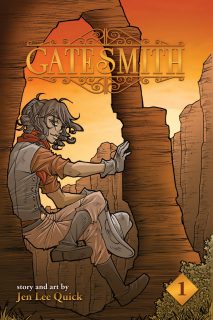
In/Spectre, Volume 1In/Spectre, Volume 1 by Chasiba Katase. Although In/Spectre is based on the novel Invented Inference: Steel Lady Nanase by Kyo Shirodaira, Katase seems to have been given plenty of freedom in adapting the story as a manga series. If the note from the original author is to be believed, the currently ongoing In/Spectre manga is actually the more popular of the two renditions. Unsurprisingly, I was primarily drawn to the manga because yokai play a prominent role in the series. Considering the title I thought it might also be a mystery manga which, as it turns out, in some ways it is and in some ways it isn’t. I didn’t find the first volume of In/Spectre to be as engaging as I hoped it would be–at times the pacing can be agonizingly slow–but I am still greatly intrigued by the series. Now that the setting has been established and the rather peculiar characters have been introduced, I’m hoping that future volumes have more energy to them because I really do like the basic premise of the series. In/Spectre largely follows a young woman named Kotoko Iwanaga who has become a god of wisdom to Japan’s yokai. This has its benefits, but it also cost her an eye and a leg. She is responsible for helping to mediate disputes between yokai, but also for keeping the more unruly ones in check when humans are in danger.
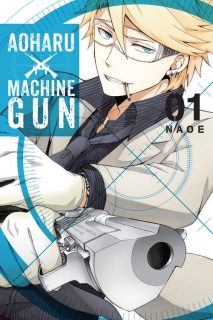
Persona 4, Volume 2Persona 4, Volumes 2-5 by Shuji Sogabe. Though I suspect that I would enjoy it, I still haven’t actually played the original Persona 4 video game, so it’s difficult for me to directly compare Sogabe’s manga adaptation. However, I can say that for the most part the manga can stand alone as its own work. However occasionally it does feel as though the characters are being railroaded and the story has only one possible path to take, probably a remnant from the manga’s RPG origins. While overall the artwork is attractive and stylish, the action-oriented scenes and fight sequences can be somewhat lacking in their execution. But I love the themes that Persona 4 deals with, especially those of personal identity and self-acceptance. As the series progresses, concepts of gender and sexuality come into greater play as well which (as always) I find particularly interesting. In general like all of the characters, too. Yosuke can unfortunately be a homophobic ass from time to time, but I absolutely adore Kanji, a tough guy with a good heart who has traditionally feminine interests and hobbies. Much of the character and story development in Persona 4 is ambiguous enough that multiple and sometimes opposing readings and interpretations are possible, some of which are frankly unflattering. Personally, I prefer and am more comfortable with the more positive interpretations.

Stand Still, Stay Silent, Volume 1Stand Still, Stay Silent, Book 1 by Minna Sundberg. The first book of Sundberg’s ongoing Stand Still, Stay Silent collects the award-winning webcomic’s prologue, first five chapters, and additional bonus content. It’s available in both digital and physical editions, but the hardcover print volume is absolutely gorgeous. Much like Sundberg’s earlier epic A Redtail’s Dream, Nordic influences are a major part of Stand Still, Stay Silent. The comic is stunningly illustrated with beautiful, full-color artwork. Stand Still, Stay Silent is a post-apocalyptic tale of adventure and exploration with an ominous touch of horror and the unknown. At the same time, the comic manages to be lighthearted and humorous. The prologue establishes the comic’s fascinating setting–a seemingly harmless disease which turns out to be fatal quickly spreads across the globe. Ninety years later, Iceland, which was able to completely close itself off from the rest of the world, has become the center of known civilization, but a team has been assembled to see what can be found beyond the relative safety of the Nordic countries. Despite scenes of intense terror and action, the plot of Stand Still, Stay Silent is actually on the slower side; the focus is almost entirely on the characters and their interpersonal dynamics. The character writing, worldbuilding, and humor in Stand Still, Stay Silent is simply fantastic.

Filed Under: FEATURES, My Week in Manga Tagged With: Chasiba Katase, comics, In/Spectre, manga, Mentaiko Itto, Minna Sundberg, Persona, Shin Megami Tensei, Shuji Sogabe, Stand Still Stay Silent

  • « Go to Previous Page
  • Page 1
  • Page 2
  • Page 3
  • Page 4
  • Interim pages omitted …
  • Page 8
  • Go to Next Page »
 | Log in
Copyright © 2010 Manga Bookshelf | Powered by WordPress & the Genesis Framework