• Skip to primary navigation
  • Skip to main content
  • Skip to primary sidebar
  • Home
  • About Us
    • Privacy Policy
    • Comment Policy
    • Disclosures & Disclaimers
  • Resources
    • Links, Essays & Articles
    • Fandomology!
    • CLAMP Directory
    • BlogRoll
  • Features & Columns
    • 3 Things Thursday
    • Adventures in the Key of Shoujo
    • Bit & Blips (game reviews)
    • BL BOOKRACK
    • Bookshelf Briefs
    • Bringing the Drama
    • Comic Conversion
    • Fanservice Friday
    • Going Digital
    • It Came From the Sinosphere
    • License This!
    • Magazine no Mori
    • My Week in Manga
    • OFF THE SHELF
    • Not By Manga Alone
    • PICK OF THE WEEK
    • Subtitles & Sensibility
    • Weekly Shonen Jump Recaps
  • Manga Moveable Feast
    • MMF Full Archive
    • Yun Kouga
    • CLAMP
    • Shojo Beat
    • Osamu Tezuka
    • Sailor Moon
    • Fruits Basket
    • Takehiko Inoue
    • Wild Adapter
    • One Piece
    • After School Nightmare
    • Karakuri Odette
    • Paradise Kiss
    • The Color Trilogy
    • To Terra…
    • Sexy Voice & Robo
  • Browse by Author
    • Sean Gaffney
    • Anna Neatrour
    • Michelle Smith
    • Katherine Dacey
    • MJ
    • Brigid Alverson
    • Travis Anderson
    • Phillip Anthony
    • Derek Bown
    • Jaci Dahlvang
    • Angela Eastman
    • Erica Friedman
    • Sara K.
    • Megan Purdy
    • Emily Snodgrass
    • Nancy Thistlethwaite
    • Eva Volin
    • David Welsh
  • MB Blogs
    • A Case Suitable For Treatment
    • Experiments in Manga
    • MangaBlog
    • The Manga Critic
    • Manga Report
    • Soliloquy in Blue
    • Manga Curmudgeon (archive)

Manga Bookshelf

Discussion, Resources, Roundtables, & Reviews

attack on titan

My Week in Manga: May 4-May 10, 2015

May 11, 2015 by Ash Brown

My News and Reviews

Despite spending a long weekend in Canada for the Toronto Comic Arts Festival and generally being very busy, I still managed to post a few things here at Experiments in Manga last week. To begin with, the winner of the Yamada-kun and the Seven Witches manga giveaway was announced. The post also includes a list of some of the manga available in English that feature witches. As for reviews, two were posted. The first was for Blade of the Immortal, Volume 31: Final Curtain, the last volume of Hiroaki Samura’s epic manga series. With that post, I have now written a review for every Blade of the Immortal trade collection in English. (At some point, I do hope to work on an Adaptation Adventures feature for the Blade of the Immortal anime, as well.) Last week’s other review is only very tangentially related to manga. I finally read Lewis Carroll’s Alice’s Adventures in Wonderland and Through the Looking-Glass, which is simply marvelous and I highly recommend the novels. I specifically read (and reviewed) Seven Seas’ recent omnibus edition which includes hundreds of delightful illustrations by International Manga Award-winning artist Kriss Sison.

As previously mentioned, I spent a portion of last week at TCAF and so was rather preoccupied. (I hope to post some random musings about the event later this week, most likely on Friday if I can’t manage to get the feature together that quickly. Otherwise, I’ll aim for next week.) Still, I did catch some interesting things online. For example, a recent episode of the Inkstuds podcast features Anne Ishii and Graham Kolbeins, the editors of the Massive anthology, talking about gay manga, its creators, and other related topics. Tofugu posted a couple of manga-related articles recently: an interview with Araki Joh and Exploring Shueisha. A few licenses were announced last week as well. Coinciding with the news that Masashi Kishimoto will be a guest at this year’s New York Comic-Con, Viz also announced new Naruto light novels, an artbook, and a box set. Seven Seas slipped in another license announcement, too: Tsukasa Saimura’s manga series Hour of the Zombie. And not to be left behind, Yen Press also made two license announcements on Twitter: Of the Red, the Light and the Ayakashi by HaccaWorks* and Nanao, and School-Live! by Sadoru Chiba and Norimitsu Kaihou.

Quick Takes
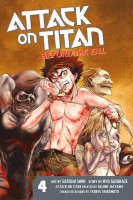
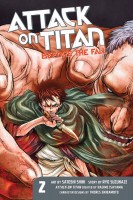
Attack on Titan: Before the Fall, Volume 4Attack on Titan: Before the Fall, Volume 4 written by Ryo Suzukaze, illustrated by Satoshi Shiki. Although Before the Fall has kept my attention since the beginning of the series, the fourth volume is the first volume that really excited and engaged me. Part of that is likely due to the introduction of a new character, Cardina Baumeister, who is much more capable than he initially appears. (Although, maybe it’s a bad thing that I find him more interesting than the series’ protagonist…) He and Kuklo are both prisoners who will soon be quietly and secretly sent to their deaths. The method of their planned execution? Abandonment outside of the walls, left to be consumed by the Titans. Fortunately for Kuklo, there are people who are invested in keeping him alive. But even considering that, surviving still won’t be an easy feat. At this point in the series, Before the Fall is beginning to tie in a little more closely with the established history and worldbuilding of Attack on Titan as a whole, which I like to see. The fourth volume reveals a bit more about the political and social settings of Attack on Titan in addition to having some exciting action sequences. I don’t really care much for how the Titans are drawn in Before the Fall, though. Or Sharle’s character design, for that matter.
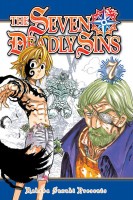
Seven Deadly Sins, Volume 7The Seven Deadly Sins, Volumes 7-8 by Nakaba Suzuki. Happily, by the beginning of the seventh volume, the largely pointless tournament arc of Seven Deadly Sins is done and over with and the series is getting back on track with an actual plot. More of Meliodas’ personal history is revealed as are the motivations of the Holy Knights who are trying to incite a massive war. Another of the legendary Seven Deadly Sins is introduced in these volumes as well: Gowther, a rather peculiar young man known as the Goat Sin of Lust. I still haven’t been able to figure out the significance of the animals or even the sins as the relate to the warriors, which seems like a lost opportunity for Suzuki’s worldbuilding. Perhaps there really is no greater meaning, and the names are just supposed to sound cool. It’s also rather curious that, despite having been comrades who fought closely together in the past, the Seven Deadly Sins don’t seem to actually know who each other are. They don’t seem to pay attention to each other either; for example, Meliodas seems very surprised to discover a demon he is fighting used to be a Holy Knight when Gowther stated that very fact at the end of the previous chapter. But, while Seven Deadly Sins can be frustrating, there are very entertaining parts as well, like when Diane simply chucks her teammates forty miles when they need to cover distance quickly.
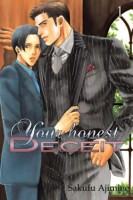
Your Honest Deceit, Volume 1Your Honest Deceit, Volumes 1-2 by Sakufu Ajimine. I believe that the short boys’ love series Your Honest Deceit is the only work by Ajimine to have been released in English. It’s a largely enjoyable manga, but for me it wasn’t a particularly spectacular one. However, I did appreciate that for the most part the story revolves around grown, adult men with well-established careers. In this particular case, Your Honest Deceit is about lawyers and their professional assistants. (Granted, if I’m in the mood to read about gay lawyers, I would generally prefer Fumi Yoshinaga’s Ichigenme… The First Class Is Civil Law. Or What Did You Eat Yesterday?, for that matter.) Kuze is the younger of the two men of the series’ primary couple. He went to law school and did exceptionally well in his classes, but he seems to not be interested in becoming a lawyer and is content working as a secretary for the older Kitahara, the lawyer and object of his affections and one of the school’s lecturers. Your Honest Deceit has its serious moments and misunderstandings, but Ajimine incorporates a fair amount of humor in the manga. At the same time, I’m not really sure that I would call it a comedy; Kuze and Kitahara’s burgeoning relationship is threatened by their own jealousies as well as by interference from other people, so it can be rather dramatic at time.
Filed Under: FEATURES, My Week in Manga Tagged With: attack on titan, manga, Nakaba Suzuki, Ryo Suzukaze, Sakufu Ajimine, Satoshi Shiki, Seven Deadly Sins, Your Honest Deceit

My Week in Manga: March 16-March 22, 2015

March 23, 2015 by Ash Brown

My News and Reviews

Two more reviews were posted at Experiments in Manga last week. Only one was of a manga, but the other book does include illustrations! I’m a little behind in reviewing the series, but I finally wrote up my impressions of Fumi Yoshinaga’s What Did You Eat Yesterday?, Volume 6. (Just in time for the seventh volume to be released later this week!) There’s some really nice character development for Shiro and, as always, delicious-looking food. The second review posted last week was for Haikasoru’s anthology of short fiction Phantasm Japan: Fantasies Light and Dark from and about Japan which collects twenty-one horror-tinged stories. It has a great range of contributions and authors and is an excellent followup to the The Future Is Japanese anthology.

I’ve been busy at work and the taiko performance season is ramping up, so I’ve not had much time to pay attention to the manga news over the last week or so. (Let me know if I missed something good!) However, I did see that Manga Brog posted a translation of interviews of Inio Asano and Daisuke Igarashi from the magazine Manga Erotics F in 2012. And speaking of Asano, Vertical Comics apparently made a license announcement a couple of weekends ago—an omnibus edition of Asano’s A Girl on the Shore. Asano’s Nijigahara Holograph left a huge impression on me last year, so I’m really looking forward to reading more of his work in English.

Quick Takes

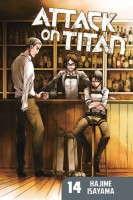
Attack on Titan, Volume 14Attack on Titan, Volume 14 by Hajime Isayama. The cover of the fourteenth volume of Attack on Titan has a Western flair to it (“Western” as in the genre) and, surprisingly enough, so do the contents. I found the introduction of the trappings of the American Old West to be a little bizarre in a setting that has largely been European-influenced, but it is what it is. I never expected there to be a guns-blazing saloon shootout in Attack on Titan, but it is an admittedly exciting scene even if it does feel a little out-of-place. Also somewhat surprising, not a single Titan makes an appearance in the volume except for flashbacks. The series’ focus has shifted from the fight against the Titans to the conflict inside of the walls as humans are pitted against each other. The Survey Corps is in the process of trying to reveal some major conspiracies to the general public, schemes that the Military Police and government would rather not come to light, so things get pretty violent. All in all, even considering the odd Western elements, it’s an excellent volume of Attack on Titan with some great action sequences, character development, and plot progression.

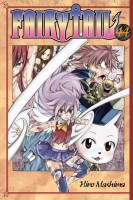
Fairy Tail, Volume 44Fairy Tail, Volumes 44-46 by Hiro Mashima. The Tartaros arc of Fairy Tail continues with these three volumes of the series. Fairy Tail is facing off with a guild of demons which is attempting to eliminate all magic except for its own curses. For the most part, it’s battle after battle without too much story development. Major sacrifices are made by Fairy Tail (sadly, some of them lose their significance and impact when Mashima doesn’t completely follow through with them), and a new antagonist is introduced, the extremely powerful King of the Underworld, Mard Geer. Reading Mashima’s afterwords at the end of each volume, it seems as though he has tried to carefully plan out the important events and battles of Fairy Tail. Even so, it feels as though the series meanders getting from one major plot point to the next, almost as if Mashima is making the story up as he goes instead of having a definite endpoint in mind. However, the fights can be exciting and the characters continue to evolve, or at least power up. I was pleased to see the forty-sixth volume turn the manga’s focus back onto Gray, though, bringing his most recent story arc to a satisfying conclusion.

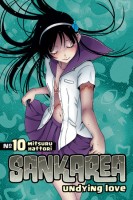
Sankarea: Undying Love, Volume 10Sankarea: Undying Love, Volume 10 by Mitsuru Hattori. There have been parts of Sankarea that I’ve really enjoyed, and parts of the series that I really have not, but overall the tenth volume frustrates me more than anything else. Mostly it’s because of the narrative structure and the fact that several important backstories are crammed into the volume. I almost wonder if Hattori realized that he was running out of time to bring the series to a proper conclusion. (There is only one more volume after this one.) It is good to finally find out more about Chihiro’s grandfather and all of his research into bringing the living back to life. And there are some great horror elements to that particular story, as well. I just really wish the revelation hadn’t taken the form of a huge infodump given by a conveniently revived zombie. However, I did like the different art styles that Hattori used to distinguish Chihiro’s memories of his mother and the story about Chihiro’s grandfather from the rest of the manga. And I am curious to see how Sankarea will end. It’s been a strange if somewhat uneven series about zombies and love, part horror manga and part romantic comedy.

Filed Under: FEATURES, My Week in Manga Tagged With: attack on titan, Fairy Tail, Hajime Isayama, Hiro Mashima, manga, Mitsuru Hattori, Sankarea

My Week in Manga: March 9-March 13, 2015

March 16, 2015 by Ash Brown

My News and Reviews

Two reviews at Experiments in Manga last week! First up, I finally got around to reading Kouhei Kadono’s Boogiepop at Dawn. Technically the sixth Boogiepop novel, and the fourth to be released in English, it actually serves as a prequel to the entire series. I’ve really enjoyed what I’ve read of the Boogiepop series and found Boogiepop at Dawn to be particularly satisfying. I’m hoping to do a Boogiepop Adaptation Adventures post once I have a chance to read the manga and watch the anime and live-action adaptations. The second review posted last week was of Yuki Urushibara’s Mushishi, Volume 2. Mushishi is one of my favorite manga, and the second volume includes some of my favorite stories in the series. The review is part of my monthly manga review project focusing on horror manga. Next month will feature Setona Mizushiro’s After School Nightmare again.

Sparkler Monthly has been getting some good press recently, which I’m happy to see. Jason Thompson delves into the comics side of the magazine in the most recent House of 1000 Manga. Lianne Sentar was interviewed by Brigid Alverson at Robot 6 about Marketing to the Female Gaze. Sparkler has been adding a bunch of new comics lately. The most recent is actually a rescue from the closure of Inkblazers, Heldrad’s Orange Junk. More comics and more print releases will be announced in the very near future (I’m particularly looking forward to the Tokyo Demons Cherry Bomb collection), so now is a better time than ever to consider becoming a member to support the creators and the rest of the Sparkler team.

Last week was apparently “manga week” at ICv2, which included interviews with Dark Horse’s Mike Richardson (Part 1 and Part 2) and Viz Media’s Kevin Hamric (Part 1 and Part 2). The Comics Journal has been collecting and posting tributes to the late Yoshihiro Tatsumi, and Ryan Holmberg has written an in-depth article on Tatsumi for the site as well. Elsewhere online, Comics Forum posted Masafumi Monden’s article Shōjo Manga Research: The Legacy of Women Critics and Their Gender-Based Approach and Reflecting Lights has a nice publisher spotlight on Vertical Comics. Finally, Sean has a roundup of all the manga and light novel licenses that have recently been announced.

Quick Takes

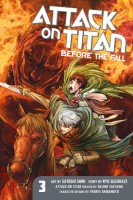
Attack on Titan: Before the Fall, Volume 3Attack on Titan: Before the Fall, Volume 3 written by Ryo Suzukaze and illustrated by Satoshi Shiki. An adaptation of a series of light novels, Before the Fall is a prequel to Hajime Isayama’s immensely popular and successful manga Attack on Titan. It takes place well before the original series, during a time in which humanity is facing the Titans, but has yet to really find a way to effectively deal with them. At this point, the Survey Corps at least knows how to destroy the Titans, but it is lacking the resources—specifically the three-dimensional maneuvering gear—that greatly aids in actually accomplishing the feat. Apparently, as the extra manga at the end of the third volume implies, Kuklo will somehow be involved in reclaiming that crucial bit of technology. However, most of the volume is devoted to the intense battle and tragic outcomes of the Survey Corps and Kuklo’s unfortunate confrontation with a Titan outside of the walls. There’s some plot and story development as well, but the action takes precedence this time around. In general, I don’t find Before the Fall to be quite as compelling as the original Attack on Titan, but it is interesting to see more of the overall worldbuilding and backstory that has been created for the franchise as a whole.

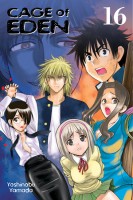
Cage of Eden, Volume 16Cage of Eden, Volume 16 by Yoshinobu Yamada. It’s been a while since I’ve read any of Cage of Eden, though the sixteenth volume seems to be pretty par for the course. I enjoy a good survival story, but the manga is just not as enthralling as I want it to be. It doesn’t help that the fanservice tends to be narratively awkward; the sixteenth volume includes not one but two naked bath scenes of buxom middle school girls that interrupt the flow of the story. As for the story itself, there have been a few interesting developments. Having split into separate groups to investigate the spire and the pyramid on the island, the survivors have been able to begin piecing together exactly where they are as they uncover more and more secrets. Considering the number of deaths in Cage of Eden so far, it’s probably a safe bet that not everyone is going to survive to the end of the series. Especially taking into account the fact that the dinosaurs and other beasts aren’t the only dangerous creatures on the island. Humans can also be extremely deadly. And manipulative, too. It’s this menacing human element that the sixteenth volume of Cage of Eden focuses on. Trying to survive on the island has definitely taken its toll on the characters both mentally and physically.

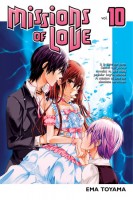
Missions of Love, Volume 10Missions of Love, Volume 10 by Ema Toyama. To be completely honest, I wasn’t expecting to enjoy Missions of Love nearly as much as I do, but here I am, ten volumes later, still completely hooked on the series’ melodrama and exceptionally twisted train wrecks of relationships. And there are some pretty momentous developments in those relationships in this volume, specifically a confession of love that can’t be mistaken or ignored. It seems as thought the time is drawing very near in which Yukina will have to choose either Shigure or Akira, but she’s only now realizing that might mean losing one of them completely. Partially in an attempt to avoid having to make an immediate decision, she challenges them both with a mission: to take her on a date as boyfriend and girlfriend. Missions of Love has always been suggestive, often skirting the edge of what would be deemed appropriate behavior and occasionally crossing over the line, and the tenth volume is no different. The relationships in the series aren’t healthy ones and never have been. Seeing as how many of them were initially based on manipulation and blackmail that probably isn’t too surprising, but it is interesting to see the characters develop legitimate feelings of affection for one another. They just don’t always go about expressing it in the best fashion.

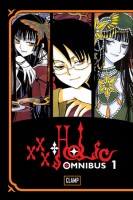
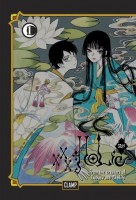
xxxHolic, Omnibus 1xxxHolic, Omnibuses 1-2 (equivalent to Volumes 1-6) by CLAMP. I read the first few volumes of xxxHolic when the manga was originally being published by Del Rey Manga but never got around to finishing the series before it went out of print, so I’m happy that Kodansha Comics is releasing the omnibuses. xxxHolic is a manga of extremes. One moment it’s ridiculously comedic and the next it’s deadly serious. The manga can be a strange mix of humor and horror; sometimes the balance between those two aspects of the series works better than others. I like the incorporation of yokai in xxxHolic since I have a particular interest in yokai. Generally, CLAMP’s renditions of the traditional stories are much more contemporary and free-form in nature. Yokai and folk tales serve more as a source of loose inspiration rather than a rigid structure for the manga to build upon. xxxHolic and Tsubasa: Reservoir Chronicle are directly related to each other, although they can be read separately without to much of a problem. So far, I find the Tsubasa references to be some of the least interesting in xxxHolic, but I do get a kick out of some of the throwaway nods to other CLAMP manga. For example, the leads from Legal Drug make a brief appearance with a minor (yet arguably crucial) role selling a hangover cure.

Filed Under: FEATURES, My Week in Manga Tagged With: attack on titan, Cage of Eden, clamp, Ema Toyama, manga, missions of love, Ryo Suzukaze, Satoshi Shiki, xxxholic, Yoshinobu Yamada

Attack on Titan: Junior High, Vol. 2

February 6, 2015 by Ash Brown

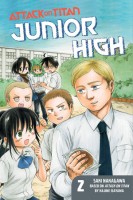
Attack on Titan: Junior High, Omnibus 2Creator: Saki Nakagawa
U.S. publisher: Kodansha
ISBN: 9781612629186
Released: November 2014
Original release: 2013-2014

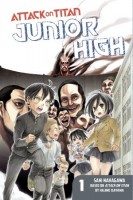
I was actually a little surprised by how much I ended up liking the first omnibus of Attack on Titan: Junior High. Created by Saki Nakagawa with input from Hajime Isayama (both of whom actually attended the same design school, though that fact is more of a coincidence than anything else), Attack on Titan: Junior High is specifically a parody spinoff of Isayama’s immensely popular manga series Attack on Titan. More generally, the series is also a parody of just about any manga with a school setting. Attack on Titan: Junior High is an odd mix of Attack on Titan and contemporary school life that actually manages to work much of the time. The second Attack on Titan: Junior High omnibus, released by Kodansha Comics in 2014, collects the third and fourth volumes of the series’ original Japanese edition, published in 2013 and 2014 respectively. Kodansha was kind enough to send me a review copy of Attack on Titan: Junior high, Omnibus 2 which, because I enjoyed the first omnibus, I was particularly happy to see.

Life isn’t easy for the human students of Attack Junior High. Not only do they have to worry about the normal sorts of challenges encountered at school–getting a passing grade in class, surviving the ire of upperclassmen, daring to ask another student on a date, ensuring their clubs aren’t suspended, and so on–they also have to worry about the rest of the student body, the Titans. It doesn’t help that Attack Junior High’s principal just so happens to be a Titan as well, meaning most of the administration looks the other way as the Titans terrorize the much smaller students, the victims of bullying and stolen lunches. But then there’s the beloved teacher Mr. Erwin Smith who on the surface seems to favor the Titans when in actuality he harbors a deep-seated hatred so intense that it rivals Eren’s. Considering Eren’s single-minded commitment to taking on and taking out all of the Titans, this is rather impressive.

There is no denying that Attack on Titan: Junior High is an utterly ridiculous manga series. In general, I think that overall I probably enjoyed the first omnibus slightly more. The novelty of the spinoff has worn off some, but the second omnibus still managed to make me laugh on multiple occasions. I do find that the series works best for me when it is directly riffing on the original Attack on Titan manga and its fandom rather than playing around with more generic story tropes. Granted, from time to time those parodies can be entertaining, as well. But ultimately Attack on Titan: Junior High tends to be rather uneven with its humor. Sometimes the manga can be absolutely hilarious, but just as often the attempts at comedy just aren’t very funny. Unsurprisingly, many of the jokes in the series require readers to already be very familiar with Attack on Titan to really appreciate them, but it’s those readers for whom the series is intended to begin with.

Attack on Titan: Junior High and its style of humor certainly will not appeal to everyone. It’s not particularly clever and much of the manga can only be enjoyed by readers who are already predisposed towards random, absurd, and frequently nonsensical comedy. The English translation and localization of Attack on Titan: Junior High is fairly loose in sections, adding a few jokes here and there and freely changing pop culture references to ones that will likely be more recognizable to Western audiences. I’m not sure how funny or effective some of the changes will be in a few years’ time since they often refer to recent events, but for now they are amusing. The best gags are those where Nakagawa takes the characters of Attack on Titan and emphasizes and distorts their personality quirks to extremes. One of the most appealing things about the original Attack on Titan is its ensemble cast, and that is true of Attack on Titan: Junior High as well. Fortunately, that’s something that doesn’t rely on timeliness.

Thank you to Kodansha for providing a copy of Attack on Titan: Junior High, Omnibus 1 for review.

Filed Under: REVIEWS Tagged With: attack on titan, kodansha, Kodansha Comics, manga, Saki Nakagawa

Attack on Titan: No Regrets, Vol. 2

December 12, 2014 by Ash Brown

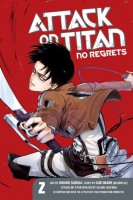
Attack on Titan: No Regrets, Volume 2Creator: Hikaru Suruga
Original story: Gun Snark

U.S. publisher: Kodansha
ISBN: 9781612629438
Released: October 2014
Original release: 2014

Attack on Titan: No Regrets, Volume 2 is the final volume of Hikaru Suruga’s manga adaptation of the A Choice with No Regrets visual novel written by Gun Snark. No Regrets is one of the many spinoffs and adaptations of Hajime Isayama’s immensely popular Attack on Titan manga series. It focuses on the backstory of one of Attack on Titan‘s most beloved characters, Levi, and how he became an exceptionally skilled and valued member of the Survey Corps. The second volume of the No Regrets manga was originally released in Japan in 2014, as was Kodansha Comics’ English-language edition. The volume also includes two short, largely comedic, No Regrets side stories as well as a special interview between Isayama and Suruga discussing the story and characters of the Attack on Titan franchise. I rather enjoyed the first volume of No Regrets and so was looking forward to reading the conclusion of the series.

At one point they were considered to be some of the most notorious criminals in the Underground, but now Levi, Isabel, and Furlan have been coerced into joining the Survey Corps, which may very well be a death sentence. Initially they weren’t well-liked by their fellow soldiers, and the three of them weren’t particularly happy with their situation, either. But during their first expedition outside of the walls, Levi and his crew leave quite an impression by handily dispatching an abnormal Titan with seeming ease. Levi and the others still don’t fit in with the rest of the Survey Corps members, but at least their remarkable skills, especially Levi’s, are recognized and admired. The extra attention they receive after defeating the Titan isn’t exactly welcome, though–Furlan is trying to coordinate a covert mission that will either lead to the three criminals’ ultimate freedom or to their deaths. They have been hired by a high-ranking political figure to steal back incriminating documents from Erwin, one of the Survey Corps’ most promising young leaders, and to end his life in the process.

What I particularly liked about the first volume of No Regrets was that it expanded the setting of Attack on Titan in addition to providing valuable background information about Levi, Erwin, and their relationship to each other. Sadly, the second volume doesn’t add much more that is new; I felt like I had already seen many of the scenes play out before and it was very clear how some of the events were going to end. The second volume of No Regrets spends a fair amount of time explaining the long-distance scouting formation, for example. While it’s noteworthy that No Regrets shows the first time that the maneuver is ever attempted, anyone familiar with Attack on Titan should already be quite aware of how the formation functions and its importance. Likewise, as is to be expected, encounters with Titans never tend to go well. Because in many ways No Regrets serves as a prequel to Attack on Titan, the deaths of major characters in the series are not at all surprising and lose some of their impact as a result.

More than anyone else’s, No Regrets is Levi’s story, but Erwin plays a pivotal role in it as well. Both of the men are exceptionally charismatic leaders, although Erwin is the only one of the two who actually seeks that role. Levi doesn’t want to be responsible for the lives of others while Erwin is willing to shoulder the weight of the sacrifices made in the fight against the Titans. He is extremely intelligent and talented and able to make tough decision. Even at the cost of individual lives, Erwin voluntarily employs dubious methods if he believes that the results will increase the odds of humanity’s survival. His almost fanatical drive and obsession contrasts sharply with Levi’s more reserved and internally focused nature. As is known will happen, eventually Erwin wins Levi over to his cause and gives him a firm direction and purpose, but this foregone conclusion does seem to occur rather abruptly. Still, the exploration of Levi and Erwin’s respective personalities and motivations in No Regrets is probably what the series does best and is what the manga brings to Attack on Titan as a whole.

Filed Under: REVIEWS Tagged With: attack on titan, Gun Snark, Hikaru Suruga, kodansha, Kodansha Comics, manga

Tatsumi on Film; Anno on Instagram

November 14, 2014 by Katherine Dacey

tatsumiGekiga pioneer Yoshihiro Tatsumi’s work is now accessible to viewers on the big screen, thanks to Singaporean director Eric Khoo. Khoo adapted such classic stories as “Hell,” “Goodbye,” and “Beloved Monkey,” interleaving them with vignettes from Tatsumi’s autobiography A Drifting Life. 

This just in: Moyocco Anno‘s new Instagram account is pretty awesome.

Marvel’s C.B. Cebulski shares a few more details about the Avengers/Attack on Titan crossover series. Over at TCJ, Joe McCulloch looks at an earlier Marvel/manga crossover, Kazuo Koike’s Wolverine one-shot.

Lori Henderson dishes the dirt on two new licenses: Aquarion-Evol and Flowers for Chronous, both of which will be published by One Peace Books.

The Manga Bookshelf gang share their picks for this week’s best new arrivals.

What kind of manga appeals to 9-to-12 year old readers? MJ weighs the pros and cons of three series that are frequently recommended for tweens.

News from Japan: The forthcoming Doraemon movie–Doraemon: Nobita no Space Heroes–will be adapted for the pages of Coro Coro; look for the first chapter in January 2015. Also arriving in theaters next year will be a big-screen treatment of Io Sakisaka’s Strobe Edge.

Reviews: Over at Anime News Network, Jason Thompson completes his 56-hour Naruto review marathon, tackling volumes 28-72. Closer to home, MJ sings the praises of an oldie but goodie: Setona Mizushiro’s Afterschool Nightmare.

Matthew Warner on vol. 13 of 07-Ghost (The Fandom Post)
Ash Brown on vol. 1 of Ajin: Demi-Human (Experiments in Manga)
Sean Gaffney on vol. 14 of Attack on Titan (A Case Suitable for Treatment)
Anna Call on vol. 1 of Deadman Wonderland (No Flying No Tights)
Ken H. on vols. 2-3 of Kimagure Orange Road (Sequential Ink)
Megan R. on Le Chevalier D’Eon (Manga Test Drive)
Rebecca Silverman on vols. 1-2 of Lucifer and the Biscuit Hammer (Anime News Network)
L.B. Bryant on vol. 5 of No Matter How I Look at It, It’s You Guys’ Fault I’m Not Popular (ICv2)
Richie Graham on vol. 1 of Ranma 1/2: 2-in-1 Edition (No Flying No Tights)
Sakura Eries on vol. 9 of Spice and Wolf (The Fandom Post)
Kate O’Neil on vol. 22 of Soul Eater (The Fandom Post)
Leroy Douresseaux on vol. 10 of Ultimo (Comic Book Bin)
Jenny Ertel on vols. 1-3 of What Did You Eat Yesterday? (No Flying No Tights)
Matthew Warner on vol. 1 of World Trigger (The Fandom Post)

Filed Under: MANGABLOG Tagged With: attack on titan, Marvel, Moyocco Anno, One Peace Books, Yoshihiro Tatsumi

My Week in Manga: October 13-October 19, 2014

October 20, 2014 by Ash Brown

My News and Reviews

Only somewhat unintentionally, last week ended up being a yuri-filled week here at Experiments in Manga. My friend Jocilyn was inspired to write a guest review of Takako Shimura’s Sweet Blue Flowers, Volume 1 by Takako Shimura, which is currently only available digitally. (I’m hoping that one day the series will be available in print, but as Jocilyn points out, a few fixes may be needed for that to happen.) As for the manga review that I posted last week, I took a look at Chiho Saito’s Revolutionary Girl Utena: The Adolescence of Utena for my Year of Yuri monthly review project. Revolutionary Girl Utena is one of my absolute favorite anime series and I was quite pleased with Saito’s The Adolescence of Utena, finding it to be an incredibly compelling work in its own right. And speaking of my Year of Yuri project, I only have one more review to go! I haven’t quite decided which manga (or comic) my final review will tackle, so if you have any requests or would like to see something in particular, let me know! I also posted one other (non-yuri) review last week: Monkey Business: New Writing from Japan, Volume 4. Monkey Business is a literary journal featuring a mix of fiction, nonfiction, poetry, and even a bit of manga. The stories tend to be a little strange, but that also tends to be something that I enjoy.

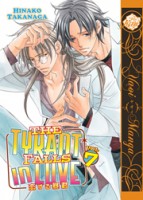
Elsewhere online, New York Comic Con articles are still being posted. At Publishers Weekly, Deb Aoki has a general roundup of the manga industry’s presence at NYCC. Justin of Organization Anti-Social Geniuses has a few interesting things from his time at NYCC, including why publishers and fans think it’s worth it to buy manga and an interview with Gen Manga’s Robert McGuire. Vertical also posted a bit more information about the Vertical Comics imprint. Unrelated to NYCC but still interesting reading, at Contemporary Japanese Literature Kathryn Hemmann has an excellent critique of Helen McCarthy’s A Brief History of Manga, specifically addressing the male-centric focus of the work. (I’ve had the volume on my “to be read” pile since its release; I should really get around to actually reading it one of these days) Also, Frederick L. Schodt wrote a bit about the history of his groundbreaking work Manga! Manga!. (Exceptionally good timing, as I am just about to start reading it.) And last but not least, Digital Manga has licensed ninth and final volume of Hinako Takanaga’s The Tyrant Falls in Love! (I mistakenly thought the eighth volume was the series’ end, so I’m doubly happy for this license.)

Quick Takes

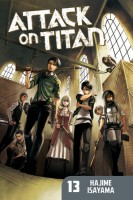
Attack on Titan, Volume 13Attack on Titan, Volume 13 by Hajime Isayama. Although I have largely been enjoying Attack on Titan since the beginning of the series, the thirteenth volume is a particularly good installment of the manga. As the series has progressed, mystery on top of mystery and twist on top of twist has been added, which is something that can only be sustained for so long. But with the thirteenth volume it feels as though some progress has actually been made with the plot and some answers are finally being given–or at least some convincing and appropriately disconcerting theories are being offered. The thirteenth volume begins with the aftermath of the Survey Corps’ rescue of Eren. The number of deaths and casualties incurred by the group is severe. Eren must come to terms with just how much ensuring his safety costs and just how much depends on him in the battles to come. The focus of Attack on Titan has shifted from confronting the Titans themselves to confronting the corruption within the government while trying to discover who or what is even behind the existence of the Titans. It’s a particularly effective development–the prospect of fighting Titans has a significantly different psychological impact than that of fighting, and even killing, humans.

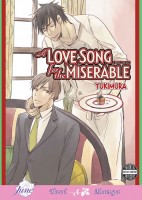
A Love Song for the MiserableA Love Song for the Miserable by Yukimura. Many of the boys’ love manga released in English are about high school or middle school students, so it’s always a refreshing to encounter a story about adults. A Love Song for the Miserable is one of those stories. Asada is hoping to work in events planning while Nao is studying to become a patissier. After a chance meeting, the two of them become friends and Asada ends up acting as Nao’s taste tester, developing feelings for the other man in the process. Sadly, Asada would much rather completely ruin any chance of a relationship with Nao than risk the possibility of being rejected after opening up. Their friendship ends badly which puts them both in an awkward position three years later when Asada meets Nao again while on the job. A Love Song for the Miserable captures Asada’s personality and insecurities extremely well and the complexities of his feelings are very realistic. It’s understandable that Asada’s lack of confidence in himself and his jealousy over Nao’s success when his own career is going nowhere would interfere with him developing a stable relationship. Asada has very good reasons for being miserable, and Nao has very good reasons for being upset with him, but they might just be able to make something work.

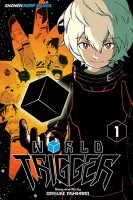
World Trigger, Volume 1World Trigger, Volumes 1-2 by Daisuke Ashihara. In an interesting move, Viz decided to simultaneously release two volumes of World Trigger. It certainly caught my attention, so I guess the gambit was a successful one. There were several things that I liked about World Trigger. For example, I particularly appreciate that strategy and tactics come into play in the fights and that the battles aren’t all about who happens to have the greatest brute strength or power. I also liked Yuma–since he is a Neighbor his perspective is very different from that of the other characters and it shows–although I can easily see how he might get on some readers’ nerves. Other aspects of the manga didn’t work quite as well for me. Right off the bat Border is described as a mysterious organization; the general population seems oddly accepting of its presence and seems to require no further explanation as long as Border continues to fight against the Neighbors, which I found a little difficult to believe. I assume this is probably something the series will explore in the future, but as it is the lack of information is frustrating, especially when other things are over-explained. For the most part I did enjoy the first volume, but the second didn’t do much to retain my attention. Though it has its good points, World Trigger hasn’t quite managed to set itself apart from other series yet and seems a little generic so far.

Filed Under: FEATURES, My Week in Manga Tagged With: attack on titan, Daisuke Ashihara, Hajime Isayama, manga, world trigger, Yukimura

My Week in Manga: October 6-October 12, 2014

October 13, 2014 by Ash Brown

My News and Reviews

Last week Experiments in Manga saw the introduction of a new feature–Adaptation Adventures. Basically, the feature is intended to explore and compare different versions of the same story, which I think should be an interesting approach. I specifically had things in mind like the Parasyte anime adaptation that recently began airing  (readers of Experiments in Manga have expressed interest in some sort of Parasyte comparison in the past), but I quickly realized that the feature provides nearly endless options. For the first Adaptation Adventures column, I took a look at Udon Entertainment’s Manga Classics, a line of manga-style graphic novel adaptations of classic literature. I was pleasantly surprised by the Manga Classics editions of Pride & Prejudice and Les Misérables and look forward to seeing future releases. I also posted an in-depth manga review last week of Yaya Sakuragi’s Bond of Dreams, Bond of Love, Volume 4, the last volume in the series. Sakuragi was my introduction to boys’ love manga and I’m always happy to see more of her work available in English. Bond of Dreams, Bond of Love isn’t my favorite Sakuragi manga, but I did enjoy its goofiness.

Elsewhere online, I was extremely happy to see that the one and only Manga Critic (Katherine Dacey) has come out of “retirement” and joined forces with Brigid Alverson at MangaBlog. Kate was one of my major inspirations for starting Experiments in Manga, so I’m very happy to see her return and look forward to reading her commentary. This also means that MangaBlog will be updated more regularly again, which will be great. In other news: Sean Gaffney at A Case Suitable for Treatment has a roundup of Seven Seas recent license announcements. Over at Comics Forum, the most recent Manga Studies column has been posted–Takeuchi Osamu and Manga Expression pt. 1: Tezuka Osamu as Manga Locus by Nicholas Theisen. Also, October’s issue of Sparkler Monthly is now available. It includes the launch of the third and final volume of Tokyo Demons as well as some additional bonus stories for the series. (Since I love Tokyo Demons, I’m particularly excited for and dreading the beginning of the end.)

The New York Comic Con took place over the weekend, and there was plenty of excitement to come out of that. Sean was there this year and has written up some notes on the panels he was able to attend. Vertical is spinning off Vertical Comics as a separate imprint to focus on manga and related material while Vertical continues to release prose and nonfiction. Vertical also licensed more Attack on Titan light novels, which will probably do pretty well. Viz Media also had a few new licenses to announce, as did Kodansha Comics. In addition to several other licenses, Yen Press has rescued Kaoru Mori’s Emma for a deluxe hardcover omnibus release! I only discovered Emma after CMX’s edition went out of print (and became extremely expensive), so I’m thrilled that I’ll finally be able to own the series in such a lovely format. (If you’re curious about Emma, I recommend checking out the archives for the Emma Manga Moveable Feast.)

Quick Takes

Attack on Titan: Before the Fall, Volume 2Attack on Titan: Before the Fall, Volume 2 written by Ryo Suzukaze and illustrated by Satoshi Shiki. I have largely been enjoying Attack on Titan‘s prequel manga Before the Fall, but I think I like it even more now that I have read the first Before the Fall novel that was recently released by Vertical. (My review of that volume can be found here.) Other than both being prequels to Attack on Titan, the stories of the novel and the manga aren’t directly related, but small references are made to the novel’s plot and characters in the manga. Which makes a fair amount of sense since the Before the Fall manga series is based on the second and third Attack on Titan light novels written by Suzukaze. In the second volume of the Before the Fall manga, Kuklo and Sharle have made their escape–Kuklo from the dungeons and Sharle from her overbearing father–but they are now faced with surviving among the common people. They actually make a pretty good life for themselves at first, but then Kuklo becomes obsessed with wanting to see a Titan for himself which, as anyone who is familiar with Attack on Titan will know, is an absolutely terrible idea that probably won’t end well for anyone involved.

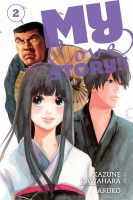
My Love Story!!, Volume 2My Love Story!!, Volume 2 written by Kazune Kawahara and illustrated by Aruko. I absolutely adored the first volume of My Love Story!!, so much so that I was actually a little afraid to read the second volume since my expectations had been set so high. However, I am very pleased to report that I also loved My Love Story!!, Volume 2. The entire series just makes me so extremely happy to read. Takeo and Yamato’s love is incredibly pure and sweet and the two of them are utterly endearing and charming together. Misunderstandings do happen on occasion, but forgiveness is quick in coming and no harm is done. My Love Story!! has the potential to be sickeningly sweet, but the romance and characters are handled with such humor and lightheartedness that, at least for me, the manga hasn’t reached that point. There isn’t much nuance or subtlety to the characters–Takeo is a manly many with a sensitive heart, Yamato is adorable and earnest, Suna is cool and aloof–but I like them all so much that I don’t mind. My Love Story!! is ridiculous and over-the-top and I love it. I’m still not sure how the story will be able to be sustained for an entire series now that the basic conceit has been so well-established, but I look forward to finding out.

A New Season of Young LeavesA New Season of Young Leaves written by Venio Tachibana and illustrated by Akeno Kitahata. Ever since reading the two-volume boys’ love manga series Seven Days (which I loved) I have made a point to seek out more of Tachibana’s work available in English. And so I was very excited when A New Season of Young Leaves was licensed. I’ll admit, at first I was actually a little disappointed with A New Season for Young Leaves. I simply didn’t understand the relationship and odd power dynamics between the super popular Mariya and the socially awkward Nachi. But then about halfway through the volume, during an extensive flashback that explores the evolution of their strange friendship, the manga finally clicked for me. I found it to be incredibly compelling and I immediately wanted to read it again, which I take as a very good sign. I didn’t realize it when I initially began reading A New Season for Young Leaves, but it’s actually the first manga in a series that is at least three volumes long. While there were definitely a few plot lines introduced that were left unresolved, for the most part A New Season of Young Leaves does tell a complete story. But I really do hope more of the series is licensed; I am very curious to see how things continue to develop between Mariya and Nachi and the rest of their classmates.

Filed Under: FEATURES, My Week in Manga Tagged With: Akeno Kitahata, Aruko, attack on titan, Kazune Kawahara, manga, My Love Story, Ryo Suzukaze, Satoshi Shiki, Venio Tachibana

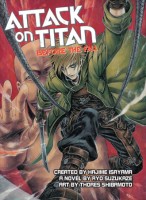
Attack on Titan: Before the Fall

October 3, 2014 by Ash Brown

Attack on Titan: Before the FallAuthor: Ryo Suzukaze
Illustrator: Thores Shibamoto

Translator: Ko Ransom
U.S. publisher: Vertical
ISBN: 9781939130860
Released: September 2014
Original release: 2011

Hajime Isayama’s manga series Attack on Titan has become extraordinarily successful not only in Japan but worldwide as well. The series has inspired numerous manga spinoffs, anime, games, and more. Attack on Titan: Before the Fall is the first of three light novels written by Ryo Suzukaze and illustrated by Thores Shibamoto which serve as a prequel to Isayama’s original series. The second and third novels have been adapted as the manga series Attack on Titan: Before the Fall, illustrated by Satoshi Shiki, which is being released in English by Kodansha Comics. The first Before the Fall novel, however, was licensed and released by Vertical in 2014 with an English translation by Ko Ransom. Currently the novel, which was originally published in Japan in 2011, is chronologically the earliest story set in the Attack on Titan universe. I’m fascinated by the Attack on Titan phenomena and the large fanbase that it has developed, not to mention the series itself, so I was very interested in reading the Before the Fall prequel.

Angel Aaltonen may be young, but his ingenuity is impressive. A master craftsman, he and the others at the workshop he is a part of strive to design, create, and improve the weapons used in humanity’s fight for survival against the Titans. Except that Angel has never actually seen a Titan. Neither has most of the human population which seeks safety within a series of enormous walls. But while for a time they may be safe, they are also trapped by their own defenses. Only the members of the Survey Corps and Garrison forces have directly confronted the Titans, gigantic monstrosities that devour humans and bring destruction and terror. Even more dire is the fact no one knows how to stop or defeat the Titans. Angel and many others fear that one day the unthinkable will happen and the walls will fail. They are determined to discover the Titan’s weaknesses before that can happen, but the existing political and religious situation will make that prospect even more difficult than it already is to accomplish.

Most of the stories in Attack on Titan as a whole follow those characters who serve in the military–the people who are on the front lines directly fighting the Titans. Before the Fall, however, focuses on those who work behind the scenes to make those battles possible–the scientists, craftsmen, and engineers. (Granted, by the end of Before the Fall, Angel has become fairly hands-on himself.) It’s an interesting approach, giving a slight spin to an already familiar story, and one that I particularly liked and appreciated. Among other things, Before the Fall shows the development of some of the most iconic technology in Attack on Titan, the three-dimensional maneuvering gear. But as intriguing as the story is in Before the Fall, sadly the writing itself isn’t particularly engaging and the novel ends up being fairly slow going despite several intense action sequences. There were also a few frustratingly obvious oversights made by the characters; I found it difficult to believe that their logic would have been so flawed. Ultimately, I liked the premise of Before the Fall much more than its execution.

Although the writing might not be the best, where Before the Fall excels is in providing Attack on Titan with more thoroughly grounded worldbuilding, backstory, and lore. Suzukaze not only explores the development and creation of the equipment and weapons that will be used to fight the Titans, he also shows the beginning of the unrest between the general population, the military and government, and the religious cults and factions. There is enough of a basic introduction to the world that even readers who aren’t familiar with Attack on Titan should be able to easily follow Before the Fall, but the novel will appeal most to those who already know and enjoy the franchise. Before the Fall doesn’t tend to have the overwhelmingly bleak atmosphere of the original manga series, but it is still definitely a part of Attack on Titan, meaning that there are many casualties and several gruesome and horrifying turns of events. The air of dark mystery generally found in Attack on Titan remains in Before the Fall, as do the desperate punctuations of human hope and determination in the face of annihilation.

Filed Under: REVIEWS Tagged With: attack on titan, Light Novels, Novels, Ryo Suzukaze, Thores Shibamoto, vertical

Attack on Titan: No Regrets, Vol. 1

June 18, 2014 by Ash Brown

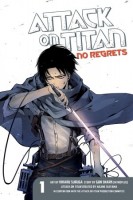
Attack on Titan: No Regrets, Volume 1Creator: Hikaru Suruga
Original story: Gun Snark

U.S. publisher: Kodansha
ISBN: 9781612629414
Released: June 2014
Original release: 2014

I think it’s probably safe at this point to call Hajime Isayama’s manga series Attack on Titan a worldwide phenomenon. It has spawned successful anime adaptations as well as multiple manga spinoffs, a series of novels, and games, among other media. Most of those have been, or soon will be, released in English, too. When it comes to the side manga, I was especially curious about Attack on Titan: No Regrets because so far it has been the only explicitly shoujo offering to be included as part of the franchise. (I was therefore very happy to receive a review copy.) The short manga series in an adaptation by Hikaru Suruga of a Nitroplus visual novel written by Gun Snark and supervised by Isayama himself. The first volume of No Regrets was released in Japan, and then soon after in English by Kodansha Comics, in 2014. Kodansha’s English-language release also collects the story’s prologue chapter, which was included as part of Japan’s special edition of Attack on Titan: No Regrets, Volume 1.

Behind Wall Sheena lies the royal capital and the surrounding city where those who are lucky enough are able to live in luxury. But below it all is the Underground, where outcasts and criminals live in slum-like conditions. It’s there that Levi and his two comrades Isabel and Furlan call home, but they swear to one another that one day they will leave their criminal pasts and the Underground behind and live up above. Their chance comes in the form of Erwin, a young, talented, and devoted Survey Corps squad leader. Levi’s exceptional vertical maneuvering skills have caught Erwin’s attention and after some effort he has caught Levi as well. Erwin offers Levi and his crew a choice: join the Survey Corps themselves, lending their natural strengths to humanity’s fight against the Titans, or submit to the Military Police to answer for their many crimes. The decision isn’t a difficult one to make, but being forced to join the Survey Corps against their will doesn’t sit at all well with Levi; he plans to have his revenge against Erwin.

Arguably, Erwin and Levi are two of Attack on Titan‘s most beloved characters. (Not to mention one of the pairings that I’ve most frequently seen shipped.) There’s a certain intensity to their relationship in the original series–it’s obvious that they share a history and a past with each other–which means exploring their origins and how that bond developed in No Regrets makes a good deal of sense. Personally, I’ve always found Levi and Erwin to be particularly interesting characters, making No Regrets a welcome addition to the Attack on Titan canon. In the first volume of No Regrets their relationship is a volatile and antagonistic one. It’s an extremely important element of the series, but the manga also explores who they are as individuals, which is just as crucial. Each in their own way, both Levi and Erwin are intimidating and formidable men. Erwin may actually be the more terrifying of the two–he’s cool, calm, collected, and incredibly calculating–but Levi’s more obvious aggressiveness and propensity towards violence also leaves an impression.

In addition to focusing on Erwin and Levi, No Regrets features cameos from a few of the other key players from the original Attack on Titan and also introduces new characters, most notably Furlan and Isabel. Granted, seeing as this is still Attack on Titan and that No Regrets already has a considerable death count, there’s certainly no guarantee of their survival. All of the main characters in No Regrets, and to some extent the series’ side and background characters as well, have very distinct personalities which are exhibited through their facial expressions, body language, and individual manners of speech. Suruga’s artwork in No Regrets takes its cues from Isayama’s original series but in general is much cleaner and consistent. Story-wise, the series exhibits an excellent balance between political intrigue and action, including fantastically dynamic vertical maneuvering sequences. For the most part No Regrets stands fairly well on its own, although those familiar with Attack on Titan will get the most out of it. I quite enjoyed the first volume of No Regrets and look forward to reading the rest of the series.

Thank you to Kodansha for providing a copy of Attack on Titan: No Regrets, Volume 1 for review.

Filed Under: REVIEWS Tagged With: attack on titan, Gun Snark, Hikaru Suruga, kodansha, Kodansha Comics, manga

My Week in Manga: April 21-April 27, 2014

April 28, 2014 by Ash Brown

My News and Reviews

Last week was another week with two reviews here at Experiments in Manga. The first review was of Fumi Yoshinaga’s What Did You Eat Yesterday?, Volume 1, one of the manga I was most looking forward to being released this year. I really enjoyed the debut of the series and look forward to reading more. The second review posted last week was of Jen Lee Quick’s Off*Beat, Volume 2. The third volume in the series will be released soon, so I decided to revisit the previous volume in preparation. Off*Beat is a comic that simply makes me happy and I think I enjoy it more with each rereading.

And now for some interesting found online: Jason Stroman wraps up his manga advice series at Organization Anti-Social Geniuses with 20 Things I Learned from the Manga Advice Series. Joe McCulloch takes a close look at some of the pre-Tezuka manga available in English at The Comics Journal. No Flying No Tights has updated its list of must have manga for teens. A recent poll of Japanese parents asked “Which manga do you want your kids to read?” RocketNews24 lists the top ten, eight of which are currently available in English either digitally or in print.

Quick Takes

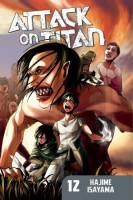
Attack on Titan, Volume 12Attack on Titan, Volume 12 by Hajime Isayama. The English-language release of Attack on Titan has now more or less caught up with the Japanese release of the series, which means the time between volumes has increased. Granted, those who are impatient have option of reading the most recent chapters on Crunchyroll, but I’ve personally been waiting since January to see what happens next. I am still impressed by just how many twists and turns Isayama is able to incorporate into the plot of Attack on Titan. Even though the twelfth volume is more about the action than it is about the story, there are still some surprises in store. Granted, each revelation in Attack on Titan only seems to raise more questions. In this volume the Survey Corp is tasked with rescuing Eren, who is in bad shape and being held captive along with Ymir by Reiner and Bertolt. Facing off against Titans is one thing, but having to attack those who at one point seemed to be allies is another thing entirely. Attack on Titan has always been intense and the twelfth volume is no different.

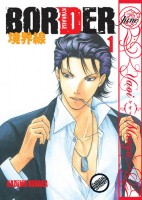
Border, Volume 1Border, Volumes 1-3 by Kazuma Kodaka. Although Border is an ongoing series at five volumes and counting, only three of those volumes have so far been released in English. I’m not sure if Digital Manga plans on licensing more at this point or not. Border is the most recent of Kodaka’s boys’ love manga to be translated. Though calling it boys’ love might be a bit misleading. The manga’s lead, Yamato, is gay and all of the characters seem to be in love with him to one extent or another, but so far the series seems to be more about detective agency he runs with his two foster brothers and his cousin than it is about romance. The first volume, which focuses on ex-soldier Yamato and his tragic past, is the most boys’ love-like (including explicit sex scenes), but subsequent volumes turn to the other characters–his brothers Kippei, a computer genius, and Tamaki, a hair designer whose skills are handy when disguises are needed. Their backstories are likewise tragic. I like this narrative structure of Border. And if the pattern continues, the next volume in the series should focus on Yamato’s cousin Sogo, which I would be very interested in reading.

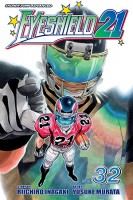
Eyeshield 21, Volume 32Eyeshield 21, Volumes 32-34 written by Riichiro Inagaki and illustrated by Yusuke Murata. Often I find that reading sports manga makes me at least temporarily more interested in the games which they’re about, but for whatever reason that hasn’t been the case for Eyeshield 21. I probably have developed more of an appreciation for American football, but it still isn’t a sport I care very much about. Eyeshield 21 on the other hand, I’ve come to love. The artwork is phenomenal and the characters are engaging and distinctive. At this point, much of the humor and many of the running gags from the start of the series have faded into the background; Eyeshield 21 has become much more serious and dramatic, but it’s still a tremendous amount of fun. The series has been building up to the Christmas Bowl where the Deimon Devil Bats are playing against the Teikoku Alexanders, an all-star team which has never lost the tournament. The games in Eyeshield 21 have always been exciting but the Christmas Bowl match is fantastic. I fully anticipated Eyeshield 21 to end with the Christmas Bowl, but no, there are still three more volumes to go!

xxxHolic: Rei, Volume 1xxxHolic: Rei, Volume 1 by CLAMP. It’s been a while since I’ve read any of the original xxxHolic manga, and I never did finish reading the series before it went out of print (happily, Kodansha will be re-releasing the series in an omnibus edition), but I was still happy to see Rei licensed. As indicated in the translation notes, rei in this instance means return, “signaling a return to the series and to its roots.” It’s not really clear yet exactly how, or if, Rei will tie into the main series. I do have a few ideas how it might, though. Those who have read at least some of xxxHolic will be at a slight advantage over those who haven’t since the characters aren’t thoroughly introduced, but even new readers should be able to make sense of most of Rei. I love Clamp’s artwork in this series. The high-contrast and relatively simple illustration style is very evocative and elegant, and creepy and disconcerting when required. The supernatural elements in the manga tend to be dark in tone, but at the same time the main characters and their interactions tend towards the more comedic. It’s an interesting mix that somehow works; even the humorous scenes have something menacing lurking underneath.

Filed Under: FEATURES, My Week in Manga Tagged With: attack on titan, border, clamp, Eyeshield 21, Hajime Isayama, Kazuma Kodaka, manga, Riichiro Inagaki, xxxholic, Yusuke Murata

Attack on Titan: Junior High, Vol. 1

March 19, 2014 by Ash Brown

Attack on Titan: Junior High, Omnibus 1Creator: Saki Nakagawa
U.S. publisher: Kodansha
ISBN: 9781612629162
Released: March 2014
Original release: 2013

Attack on Titan: Junior High is one of several spin-off series inspired by Hajime Isayama’s hit manga Attack on Titan. Saki Nakagawa was selected to work on an Attack on Titan series after entering a manga contest. (Coincidentally, both Nakagawa and Isayama attended the same design school.) Although Nakagawa is the writer and artist for Attack on Titan: Junior High, Isayama has had some input into the series’ development. In fact, he was the one who suggested creating a manga along the lines of Tsutomu Nihei’s parody series Blame! Academy. And so Attack on Titan: Junior High was born–a comedy manga that somehow manages to combine Attack on Titan with contemporary Japanese school life. The manga began serialization in 2012 in Japan and the first two volumes were collected in 2013. Kodansha Comics is releasing Attack on Titan: Junior High in an omnibus edition. The first omnibus, collecting the first two Japanese volumes, was published in 2014 and Kodansha was kind enough to send me a review copy.

It has been five years since Eren was traumatized from an encounter with a Titan. Now that he’s in junior high he finally has the opportunity to seek revenge–both humans and titans are counted among the students and teachers of Attack Junior High. Of course Eren has other pressing matters to attend to even while his hatred of Titans remains at the forefront of his mind: making allies out of his classmates (which he’s not particularly good at), surviving epic games of dodgeball and choosing the perfect after-school club (which are both more dangerous than they might first appear), not to mention trying to stay on the upperclassmen’s good sides (which can actually be rather difficult). On top of all of that, Eren is a member of class four, a group of first years who all have their own quirks and issues to deal with. All together they’re a bunch of weirdos, but none of the other classes at Attack Junior High are much better. It’s really saying something when the Titans are the most normal ones at the school.

To really appreciate Attack on Titan: Junior High requires familiarity with the original Attack on Titan series and to some extent familiarity with Attack on Titan fandom as well. Some of Attack on Titan: Junior High will be funny, or at least amusing, even to those who haven’t read Attack on Titan, but the manga works best when it is directly parodying the original series and using it as its framework. All of Attack on Titan‘s most well-loved and reviled characters make an appearance in Attack on Titan: Junior High with some of their personality traits taken to a comedic extreme (although some were fairly over-the-top to begin with): Eren is a single-minded fanatic; Mikasa is overprotective of him to a fault; Sasha thinks about nothing but food; Jean is an arrogant ass; Hange succumbs to fits of ecstasy at the mere thought of Titans; Levi is obsessed with cleanliness, and so on. These characteristics were true of the original cast, too, but Nakagawa has stretched them to their limits in Attack on Titan: Junior High.

Nakagawa is clearly a fan of the original Attack on Titan series and is having a lot of fun with Attack on Titan: Junior High. In addition to using Isayama’s characters and taking them to their ludicrous yet logical conclusions, Nakagawa also uses pivotal and memorable scenes from Attack on Titan, giving them utterly ridiculous and absurd twists to emphasize their more comedic possibilities. The darkness, death, and destruction found in Attack on Titan is almost completely missing from Attack on Titan: Junior High. It can be just as frantic and frenetic, but as a parody the manga is much more lighthearted in tone. Even characters who have long been dead in the original series have an active role to play in Attack on Titan: Junior High; it seems as though no one really has to worry about dying in Nakagawa’s series. The worst thing that really happens in the first omnibus of Attack on Titan: Junior High is some stolen lunches. Granted, for students that can be an extremely tragic event, indeed.

Thank you to Kodansha for providing a copy of Attack on Titan: Junior High, Omnibus 1 for review.

Filed Under: REVIEWS Tagged With: attack on titan, kodansha, Kodansha Comics, manga, Saki Nakagawa

My Week in Manga: February 24-March 2, 2014

March 3, 2014 by Ash Brown

My News and Reviews

Last week ended up being surprisingly busy here at Experiments in Manga. The most recent manga giveaway was posted, and there’s still some time left to enter for a chance to win a copy of the new edition of Shohei Manabe’s Smuggler. All you have to do is tell about your favorite assassin in manga. Last week I also posted my review of Hinoki Kino’s manga No. 6, Volume 5. I already knew going into the series that I liked the characters and story, having seen the No. 6 anime, but each volume of the manga is progressively stronger than the last. Over the weekend, I posted February’s Bookshelf Overload for those of you who are interested in that sort of thing. Also over the weekend, I reviewed Real, Volume 1 by Takehiko Inoue. I honestly believe Real to be one of the best manga currently being released in English. The review is part of what I’m calling “Manga March Madness.” Each weekend in March I will be posting a review for another volume of Real. At least that’s the plan. We’ll see if I can pull it off or not.

On to other interesting thing online! The Guys with Pencils podcast posted the second part of their interview with TCAF-founder Chris Butcher. Organization Anti-Social Geniuses has some Advice on Manga Lettering, From Manga Letterers. Khursten Santos wrote about The Silence on Josei Manga on Otaku Champloo, and had some feedback and followup to the post show up on Tumblr. Finally, the Comics Book Legal Defense Fund has an interesting article about the impact government regulations can have on creative freedom–History Repeats Itself: How Korean Manwha Met the Same Fate as American Comics

Quick Takes

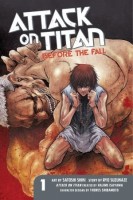
Attack on Titan: Before the Fall, Volume 1Attack on Titan: Before the Fall, Volume 1 written by Ryo Suzukaze and illustrated by Satoshi Shiki. Set some seventy years before the main events of Hajime Isayama’s original Attack on Titan manga, Before the Fall is based on a series of light novels by Ryo Suzukaze (which Vertical will begin releasing later this year). Despite having a different author than the original manga, Before the Fall fits right in with Isayama’s worldbuilding and the tone set by Attack on Titan–there is still plenty of fear and darkness. The most striking difference, which didn’t come at all as a surprise, is that the artwork in Before the Fall is much stronger overall. The story follows Kuklo, a young man who, due to the unusual circumstances of his birth, is feared, abused, and reviled by those around him. It’s not pretty. People who have read the original Attack on Titan will have a slightly better understanding of the world than those who haven’t, but so far Before the Fall seems to stand quite well on its own. Before the Fall has a lot of potential; I look forward to seeing how it develops.

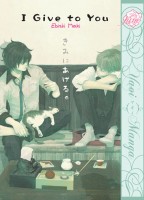
I Give to YouI Give to You by Ebishi Maki. As far as I can tell, I Give to You is Maki’s first and currently only boys’ love manga. It’s not a typical boys’ love story, either. The focus is very much on the characters themselves and their personal struggles and less on romance. The manga addresses what it means to be normal and lead a normal life, which isn’t an option for either of the leads. Ryoichi is being pursued by debt collectors after his ex-boyfriend defaults on a loan they co-signed together. He takes shelter from a storm in a teahouse run by Ren, another young man with a past he’d like to put behind him. The two are very different–despite his financial worries, Ryoichi tends to be fairly warm and happy-go-lucky while Ren is cooler and much more reserved. In the beginning, it’s Ryoichi who needs help and acceptance from Ren, but by the end of I Give to You their roles have almost completely reversed. The evolution of their relationship happens so slowly and naturally over the course of the manga that I was quite impressed with how it was handled. I would definitely be interested in reading more of Maki’s manga.

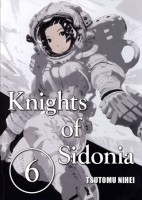
Knights of Sidonia, Volume 6Knights of Sidonia, Volumes 6-7 by Tsutomu Nihei. For most of Knights of Sidonia, it has been the Gauna who have been adapting and evolving by adopting human strategies, techniques, and even form. In these volumes, it’s the humans who have begun to apply the abilities and characteristics of the Gauna to their own technologies, creating terrifying and powerful human-Guana hybrids in the process. Understandably, not everyone is comfortable with these developments, but humanity is running out of options if it wants to survive. Knights of Sidonia has this odd mix of comedy and creepiness that somehow works. Although by this point in the series he has largely been accepted by the rest of the population of Sidonia and even has a few romantic interests, Nagate continues to be incredibly awkward socially. Because of this he still has a tendency to unintentionally create quite a commotion, often with humorous results. At the same time, Knights of Sidonia is also a horror manga. The Gauna, and now the hybrids as well, have very disconcerting designs that can be both grotesque and beautiful.

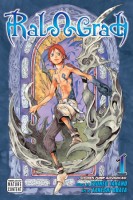
Ral Ω Grad, Volume 1Ral Ω Grad, Volumes 1-4 written by Tsuneo Takano and illustrated by Takeshi Obata. The primary reason I decided to read Ral Ω Grad was because I’m a fan of Obata’s artwork. Ral Ω Grad is a loose adaptation of the 2006 video game Blue Dragon. The manga definitely has a fantasy RPG feel to it–a young hero with special abilities fights against the destruction of the world by gathering together a party of other gifted individuals around him–but familiarity with Blue Dragon isn’t at all necessary to understand what’s going on. Generally, Ral Ω Grad manages to be vaguely entertaining even though it’s breaking no new ground. I found that I enjoyed the series more when I approached it as a parody rather taking it too seriously. (I’m pretty sure it wasn’t intended to be a parody, though…) Ral’s motivation for saving the world? Because he loves women. And boobs. Consequently, there’s fanservice and groping aplenty, but Ral spends quite a bit of his time running around mostly naked, too. In the end, the series’ highlight really is Obata’s artwork, which is consistently excellent. The story, sadly, is less engaging.

Filed Under: FEATURES, My Week in Manga Tagged With: attack on titan, Ebishi Maki, knights of sidonia, manga, Ral Ω Grad, Ryo Suzukaze, Satoshi Shiki, Takeshi Obata, Tsuneo Takano, Tsutomu Nihei

My Week in Manga: January 27-February 2, 2014

February 3, 2014 by Ash Brown

My News and Reviews

I only posted one review last week, but there were a couple of other posts as well. As for the review, I took a look at Haruki Murakami’s award-winning Kafka on the Shore. Of the two Murakami novels that I have so far read, this is my favorite. Still, at times I found it to be a rather frustrating reading experience, although there were parts of the novel that I absolutely loved. For the few people who are actually interested, I also posted January’s Bookshelf Overload last week. But, perhaps most importantly, my first manga giveaway of the year is currently in progress! I accidentally ended up with two copies of the second Vinland Saga omnibus, so now you have a chance to win one for your very own! The winner will be announced on Wednesday, so there’s still some time to enter the giveaway.

On to other things online! Matt Thorn has tracked down the interview with Inio Asano that sparked the whole discussion about his gender identity among fandom and offers some of his own comments. Over at All About Manga, Daniella Orihuela-Gruber writes about Hetalia’s Version of History: What Does It Offer Readers?. The fourth episode of Fujojocast has been posted, which takes a look at some award-winning and award-nominated manga. And speaking of honor-worthy manga, Wandering Son made the Rainbow List again this year and quite a few manga appear on YALSA’s 2014 list of Great Graphic Novels for Teens (which is actually a great list of graphic novels for anyone, not just teens). Finally, Seven Seas has had a week full of license announcements, including Vampire Bund doujinshi, Kokoro Connect, and it’s newest yuri acquisition Citurs.

Quick Takes

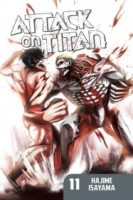
Attack on Titan, Volume 11Attack on Titan, Volume 11 by Hajime Isayama. To be honest, I’ve recently been a little worried reading Attack on Titan due to the sheer number of plot twists that seem to be included in every volume. While this does make for some exciting (and occasionally confusing) storytelling, it also makes the series feel like Isayama barely has it under his control. Fortunately, the eleventh volume of Attack on Titan is relatively the free of any “big reveals.” (At least in comparison to previous volumes.) Instead, the characters must deal with the fallout from some of the most recent developments–there are a surprising number of Titans who have come out of the 104th Corps. So, while there aren’t many dramatic plot twists in the eleventh volume, there is a major Titan battle between Eren and some of the people he once considered to be his comrades. Some nice character development comes out of it, too, as well as some more hints regarding what the Titans really are and who is behind it all. I’m still sticking with the series at this point.

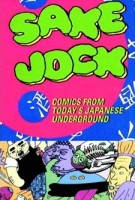
Sake JockSake Jock: Comics from Today’s Japanese Underground edited by Adam Glickman. Published in 1995, Sake Jock is described as being “the first collection of Japanese alternative artists to appear in English.” Sadly, this slim volume from Fantagraphics can be rather difficult to find nowadays. Sake Jock collects seven short manga, most if not all of which were originally published in the influential alternative manga magazine Garo. Some of the creators I was already familiar with from other underground comics anthologies while others I was encountering for the first time. I was particularly happy to see a work by Kiriko Nananan included since I love her style. Overall, I appreciated and enjoyed the manga collected in Sake Jock. I’m not sure that the collection will hold much general appeal except to those who already have an established interest in alternative manga; there have since been other anthologies published that would make a better introduction. It’s kind of a cool artifact, though, and I am glad to have it as part of my collection.

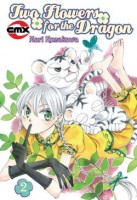
Two Flowers for the Dragon, Volume 2Two Flowers for the Dragon, Volumes 2-4 by Nari Kusakawa. It’s actually been a few years since I read the first volume of Two Flowers for the Dragon, but I remember being quite taken with it so I figured it was about time to get around to reading more of the series. I’ve rediscovered that I really enjoy the manga. It’s a wonderful mix of fantasy and romance with great character dynamics. There’s also a bit of court intrigue and some assassination plots for good measure.(And some unexpected gender-bending, too, for that matter.) Shakuya, the princess and heir of the Dragon Clan, has two fiancés vying for her affections. Kuwan is a capable but somewhat arrogant captain of the guard while Lucien is a kind-hearted young man who has lost many of his memories. The two of them obviously care for her dearly and are understandably a little antagonistic towards one another. Much to her dismay, Shakuya has developed feelings for both of them to varying degrees. But trying to figure out the workings of her own heart is only one of her many concerns.

The Tyrant Falls in Love, Volume 7The Tyrant Falls in Love, Volume 7-8 by Hinako Takanaga. Volumes seven and eight of The Tyrant Falls in Love form the last story arc in the series although Takanaga does promise that she hasn’t completely abandoned the story and characters. She plans on creating more manga–side stories, epilogues, and so on–but The Tyrant Falls in Love forms a complete story on its own, even considering the fact that it was a sort of follow-up to her debut series Challengers. Throughout The Tyrant Falls in Love, Morinaga and Souchi’s communication has been absolutely terrible. Their relationship is an extraordinarily rocky and volatile one; I honestly wasn’t sure what sort of ending Takanaga was going to go for. Overall, I was very satisfied with the series’ conclusion and I think it works. The only thing I wasn’t entirely convinced by is the direction that Masaki’s relationship with Morinaga’s older brother seems to be taking. Granted, that particular development did set in motion a pretty critical realization on Morinaga’s part.

Filed Under: FEATURES, My Week in Manga Tagged With: attack on titan, Hajime Isayama, Hinako Takanaga, manga, Nari Kusakawa, Two Flowers for the Dragon, Tyrant Falls in Love

Attack on Titan, Vol 1

January 28, 2014 by Anna N


Attack on Titan Vol 1 by Hajime Isayama

At this point, given the ubiquity of Attack on Titan on manga best seller lists, reviewing it is a bit like reviewing the air, but I decided to finally get around to reading this series when Mangablog alerted me to the crazy deal for the kindle edition of the first volume that was running recently. Sometimes I have no trouble reading manga on my Kindle Paperwhite, but I had more difficulty figuring out what was going on with the art with the reduced size, and quickly switched over to reading this manga on my iPad instead.

I’ve been reading a bunch of post-apocalyptic fiction recently, just because there are so many YA dystopian novels out there, and I’m also in the middle of reading Justin Cronin’s The Twelve. Attack on Titan is an interesting twist on the dystopian genre as many years into the future humanity has retreated into walled cities in order to protect themselves from the Titian, giant zombie-like humanoid creatures who enjoy eating human flesh. Eren is in many ways a fairly typical brash and opinionated shonen hero, whose close companion is a quieter and seemingly more pragmatic girl named Mikasa. Eren is worried about the complacency his town seems to be developing, as Titans haven’t attacked it for a long time.

Sure enough, a devastating attack on the town follows, as a Titan bigger than anyone has seen before easily breaches the wall, causing panic and confusion in the town where few humans are equipped to deal with a direct attack. Years later, Eren and Mikasa are ready to take their work assignments in the town, and they have to choose the safer duty of directly protecting the townspeople or joining up with the riskier survey corps. Eren wants to avenge his family, and Mikasa is quietly determined to follow him in order to protect him.

By far the weakest element of Attack on Titan is the art. The characters are drawn stiffly and not in proportion. For much of the time Eren and his comrades are yelling at each other, with facial expressions that don’t have very much variation. At the same time, the more detailed renderings of the Titans are plenty creepy, with their musculature visible on their bodies due to lack of skin, wide jaws, and shark-like rows of teeth. In contrast to the art, the worldbuilding in Attack on Titan is excellent, and it is clear that Isayama has spent plenty of time plotting out the events in his future history, thinking through the weapon systems and defenses the humans have constructed, and setting up the relationships between the characters in an interesting way. The first volume ended on a cliffhanger that was both shocking and weirdly refreshing from a manga plotting perspective, making me wonder a bit if Attack on Titan is going to be serving up a bit of metacommentary about manga plot cliches. Even though the art was fairly awkward, I was still able to follow along with the action sequences, and the Titans were genuinely unsettling, with their grimacing silence and habits of eating people in one gulp. I’m a little leery of taking on such a long series, but I can certainly see why Attack on Titan is so popular.

Filed Under: REVIEWS Tagged With: attack on titan, kodansha

  • « Go to Previous Page
  • Page 1
  • Page 2
  • Page 3
  • Go to Next Page »
 | Log in
Copyright © 2010 Manga Bookshelf | Powered by WordPress & the Genesis Framework