• Skip to primary navigation
  • Skip to main content
  • Skip to primary sidebar
  • Home
  • About Us
    • Privacy Policy
    • Comment Policy
    • Disclosures & Disclaimers
  • Resources
    • Links, Essays & Articles
    • Fandomology!
    • CLAMP Directory
    • BlogRoll
  • Features & Columns
    • 3 Things Thursday
    • Adventures in the Key of Shoujo
    • Bit & Blips (game reviews)
    • BL BOOKRACK
    • Bookshelf Briefs
    • Bringing the Drama
    • Comic Conversion
    • Fanservice Friday
    • Going Digital
    • It Came From the Sinosphere
    • License This!
    • Magazine no Mori
    • My Week in Manga
    • OFF THE SHELF
    • Not By Manga Alone
    • PICK OF THE WEEK
    • Subtitles & Sensibility
    • Weekly Shonen Jump Recaps
  • Manga Moveable Feast
    • MMF Full Archive
    • Yun Kouga
    • CLAMP
    • Shojo Beat
    • Osamu Tezuka
    • Sailor Moon
    • Fruits Basket
    • Takehiko Inoue
    • Wild Adapter
    • One Piece
    • After School Nightmare
    • Karakuri Odette
    • Paradise Kiss
    • The Color Trilogy
    • To Terra…
    • Sexy Voice & Robo
  • Browse by Author
    • Sean Gaffney
    • Anna Neatrour
    • Michelle Smith
    • Katherine Dacey
    • MJ
    • Brigid Alverson
    • Travis Anderson
    • Phillip Anthony
    • Derek Bown
    • Jaci Dahlvang
    • Angela Eastman
    • Erica Friedman
    • Sara K.
    • Megan Purdy
    • Emily Snodgrass
    • Nancy Thistlethwaite
    • Eva Volin
    • David Welsh
  • MB Blogs
    • A Case Suitable For Treatment
    • Experiments in Manga
    • MangaBlog
    • The Manga Critic
    • Manga Report
    • Soliloquy in Blue
    • Manga Curmudgeon (archive)

Manga Bookshelf

Discussion, Resources, Roundtables, & Reviews

Reviews

Banished from the Hero’s Party, I Decided to Live a Quiet Life in the Countryside, Vol. 5

February 23, 2022 by Sean Gaffney

By Zappon and Yasumo. Released in Japan as “Shin no Nakama ja Nai to Yuusha no Party wo Oidasaretanode, Henkyou de Slow Life Surukoto ni Shimashita” by Kadokawa Sneaker Bunko. Released in North America by Yen On. Translated by Dale DeLucia.

Sometimes you just can’t balance a book so that the coolest, most exciting stuff happens at the climax. Oh sure, you do your best. There’s an insurmountable monster that has never been killed before, that can easily take on the magic of your two strongest characters. Good stuff, everyone has to work together to achieve victory, lots of near death experiences, etc. But then the readers get to the book and no one is talking about that. They’re all saying “Did you see the part where the tiny spider rides to the rescue on a horse? Because that is a thing that happened.” I’m not even sure how you could top that in future books. The victim being saved is even a former bad guy, and so there’s a “we’re friends now, bond between brothers” scene. Again, one of the characters in that scene is a small spider. Mr. Crawly Wawly is the real hero here.

As you can see by the cover, this book reunited Red and Rit with Yarandrala, the high elf who helped the hero’s party for a time and also had some romantic ship tease, though she is quite accepting of their relationship. In fact, she’s there to invite both of them, as well as Ruti, to come live with her in the elf kingdom… because humans will betray your trust. Yeah, she’s still not over the whole “banished from the hero’s party” thing. As for Red, he wants to get the perfect gem for Rit’s engagement ring, but that involves a long journey to the land of giants, which may not even work out. Still, it’ll be fine. Rit is with him. And Ruti. Oh, and his dwarf friend. And the former mayor of the city, who happens to be a mage. And then Yarandrala shows up with Tisse, Godwin, and Mr. Crawly Wawly. This party is even bigger than the Hero’s Party!

Despite the action sequences, this book is trying its best to be a bit more slow life than the previous one. Ruti is still trying to search for a purpose in life (yay!) and also wants to become lovers with her brother (boo). Fortunately, Red has enough common sense that I’m sure this will go nowhere. Red and Rit are by now sickening everyone they come across with their flirting, even if they’re unaware of it. There’s even time for a visit to a natural hot spring, and the whole book ends with a citywide festival. That said, there are hints that we’re starting to set up for a second arc, as the epilogue has assassins in town, and we also get a long prologue reminding us of the large number of other kingdoms that are also trying to defeat the demon lord. Ruti may be adventuring only when she wants to for now, but can she keep that up?

Overall, good book, and those who watched the anime can start here. Long live Mr. Crawly Wawly.
Filed Under: banished from the hero's party, REVIEWS

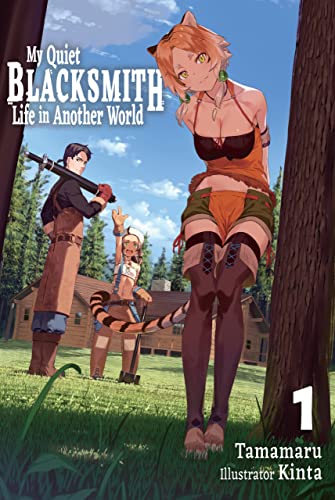
My Quiet Blacksmith Life in Another World, Vol. 1

February 22, 2022 by Sean Gaffney

By Tamamaru and Kinta. Released in Japan as “Kajiya de Hajimeru Isekai Slow Life” by Kadokawa Books. Released in North America by J-Novel Club. Translated by Linda Liu.

Obviously one should not read too much into the life of the author from the work they are writing. But sometimes it can be pretty easy to see that the creator is a little bit older than most light novel creators. Especially these days, where Truck-kun has been going after beleaguered office workers rather than shut-in high school NEETs. There’s a lack of gaming terminology and dungeon crawling. The harem, if there is one (there usually is) tends to be more familial than horny, at least on the part of the lead. And, of course, despite having super amazing powers and the ability to save the world, our protagonist wants to do nothing but relax and putter around the house doing what they love best. This is all very well and good. In this book, it turns out what the protagonist (and the author) love best is DIY. You will be reading about making swords and knives. You will be reading about building additions to houses. You will be reading this a LOT.

The setup is cookie-cutter. Our hero, Eizo, dies after saving a cat (but not himself) from a truck while on his way home from his crippling IT job. Turns out the cat was a goddess, and that it was not Eizo’s time to die. To try to salvage this, the goddess sends Eizo to a fantasy world, 10 years or so younger than he was (so about thirty). Eizo wants to be able to create things, so he gets knowledge of blacksmithing and the like, as well as some self-defense skills and magic. And then he’s dumped by a cabin in a forest. He wastes no time setting up shop, and quickly gains two companions: Samya, a beastgirl that he saves after she was savaged by a bear, and Rike, a dwarf who sees his handiwork and demands that she become his disciple. Because yeah, turns out he’s not just a normal blacksmith, he’s The Best There Is.

The edges of this book are interesting. There’s a prologue and an epilogue taking place many years after the main events that play this as “the creation of legends”, complete with a hero vs. demon lord scenario, that I found worked really well. We get two side-stories at the end that show the POV of other characters, and it’s interesting, particularly Helen, who is introduced to us (from Eizo’s POV) as something of a meathead swordswoman, but who turns out to be far more serious and practical when we get inside her own head. Unfortunately (and this is a common problem with slow life books) most of the book is from Eizo’s POV, and Christ, he’s dull. Show, don’t tell is left to die at the side of a ditch here, as we get page after page of him making swords, making knives, doing woodworking, chopping trees, all of which goes on forever. Even the fight near the end, where he takes on a massive bear, is fairly tedious as fights go.

As I said, there’s the hint of a good story around the edges of the book. I may read the second volume. But I think the author would be better off getting into woodworking and metallurgy themselves rather than have their creation tell us about it in excruciating detail.

Filed Under: my quiet blacksmith life in another world, REVIEWS

Ascendance of a Bookworm: I’ll Do Anything to Become a Librarian!, Part 4: Founder of the Royal Academy’s So-Called Library Committee, Vol. 5

February 21, 2022 by Sean Gaffney

By Miya Kazuki and You Shiina. Released in Japan as “Honzuki no Gekokujou: Shisho ni Naru Tame ni wa Shudan wo Erandeiraremasen” by TO Books. Released in North America by J-Novel Club. Translated by quof.

I feel this volume is almost deceptively relaxing. On the one hand, everything goes pretty well. Rozemyne does not make social faux-pas that can’t be glossed over somehow. There is an ambush to try to kill her… but she’s nowhere near it and it’s thwarted immediately. There’s a wedding to a woman from an enemy duchy… but she turns out to be a big sweetie pie who just has a case of resting “I look just like my ancestor who nearly destroyed you all” face. That last one, though, hints at the undercurrents we see in this book that I suspect are going to pay off in big explosions down the line. We’ve talked before about how the class system in this series is not going away anytime soon, but that also means that the nobility are going to be what nobility tend to do, which is find ways to quietly murder each other. Time to pick a side. Meanwhile, Rozemyne wants fish.

The author admits in the afterword that this cover (and indeed most of the covers in the series) is theme related rather than specifying actual events. In this case it’s the dyeing competition that Rozemyne is holding in order to introduce the new techniques (and bring back the old, forgotten techniques), and it turns out that Myne’s mother Effa is one of the contestants. Elsewhere, they’re setting up the printing business in the Groschel area, but the way that the nobility treats the commoners who live there turns out to not only be arrogant but also have legitimate negative effects on the printing. And then there’s the aforementioned marriage, as Lamprecht is marrying a woman from the far, far higher in status Ahrensbach district. It’s a political move, yes, but fortunately there seems to be actual love there as well. Finally, Rozemyne heads back to school to start Year 2 at the Academy, where she will face even more problems… not least of which is that the young prince of the realm has confused her for her younger sister.

As I noted above, Rozemyne is getting better at this. She still screws up enough to make Ferdinand (who is in this book far less than usual) smack his forehead, but that’s mostly just when she’s fantasizing about her ideal library, which would require more magic than there is in the world. She can do the meet and greets and keep up with the nobility, and has learned to translate when they’re being condescending, rude or threatening. The best example of this is her discussion with Aurelia, the bride I mentioned before. She screws up in that she’s not supposed to speak directly to the bride in her position… but she doesn’t bat an eyelid as she immediately says she was just talking to herself out loud, and she AND Aurelia then proceed to have an entire conversation like that. (I hope we see more of Aurelia, she seems sweet.)

So yes, an excellent Bookworm volume, and almost calm and peaceful. Ominous. Waiting for the other shoe to drop. Also, when Rozemyne finally does grow up (signs point to Book 28), she will be absolutely terrifying.

Filed Under: ascendance of a bookworm, REVIEWS

There’s No Way a Side Character Like Me Could Be Popular, Right?, Vol. 3

February 19, 2022 by Sean Gaffney

By Sekaiichi and Tomari. Released in Japan as “Yujinchara no Ore ga Motemakuru Wakenaidaro?” by Overlap. Released in North America by Tentai Books. Translated by Alejandro de Vicente Suárez.

When the first novel in this series first got translated into English, the romcom was still very much a rarity in the market. When the second one was published, the genre was starting to be licensed here, if not yet seen. But it’s been a good 15 months since the 2nd volume came out over here, and since then we’ve had absolutely PILES of cute high school romantic comedies. Indeed, My Friend’s Little Sister Has It In For Me! manages to hit a lot of the exact same plot points as There’s No Way a Side Character Like Me Could Be Popular, Right?, down to the character types. Unfortunately, that also means that I’m a lot less forgiving of said types when they hit on things I don’t like. And this one absolutely does that, as it adds a third romantic love interest to our “side character”, his teacher Makiri-sensei. Should be fine, should be fine, we know how well teacher-student romances go over here. Buckle up, folks.

After the events of the second book, Yuuji now has a fake girlfriend, Touka (who is genuinely in love with him but he doesn’t get it) and a rejected childhood friend Kana (whose love he DOES get, but he rejects her because of what’s going on with Touka). The two of them unfortunately spend the majority of the book sniping at each other in a classic romantic comedy “jealous girls fighting over their boy” way that irritates Yuuji’s friends almost as much as it does the reader. While this is going on, though, he makes a discovery about his teacher, Makiri-sensei. We already know that she’s much kinder than her seeming cold exterior – now we find that she’s an awful drunk, thjat’s she’s very upset about still being a virgin, and that her father is setting her up for an arranged marriage. It feels like a pulled a slot machine and got three lemons. But I really don’t want to make this lemonade.

The book does have some interesting moments, usually when it tries to push against its romcom cliches. Yuuji’s got the face of a thug, but also has had violent incidents in his past, and in this book we get to see his relationship with his father, which is… really, really uncomfortable and also far more interesting than anything else with his teacher. He and his dad are alike in far more ways than either of them are willing to admit, and seeing Yuuji snap and finally air his grievances – so to speak – in that flashback was chilling. It’s then followed up wtih his father also being a secret manga otaku who reads We Never Learn adn is therefore OK with his son banging his teacher, and I’m ready to hit my head against the table again.

I like the dynamic between the two leads in this series. Touka is fine here, and I can feel her frustration. But it was going to take a miracle to get me to like this plot, and the book didn’t even turn water into Sprite, much less wine. Skip this and see if the fourth book gets back to entertaining romcom stuff.

Filed Under: REVIEWS, there's no way a side character like me could be popular right?

A Late-Start Tamer’s Laid-Back Life, Vol. 2

February 18, 2022 by Sean Gaffney

By Yuu Tanaka and Nardack. Released in Japan as “Deokure Tamer no Sono Higurashi” by GC Novels. Released in North America by J-Novel Club. Translated by Yuko C. Shimomoto.

It can often be very tempting to say “please see previous review” rather than trying to find 500+ new words about a series. Oh, there’s nothing particularly bad about this second volume. It continues to manage to make me want to keep reading it despite the fact that it is really just a gaming log of this guy building up his stats and choosing his bonuses. For 350 pages. The fact that I enjoy it is a big point in the author’s favor. And yet… there’s not really a lot to delve into here. Yuto is never really going to have major character development, as this is not that sort of book. He’s in an actual game, rather than trapped in a game or in a fantasy world that looks like a game, so there’s never any worry of bad things happening to him. Heck, it’s a G-rated game, so his two tamed monsters have a child by their magic intermingling, rather than for any more sordid reason. It’s not boring per se, but boring surrounds it like a cloud.

Yuto continues to chug along. He’s now hatched his monster egg, which produces a bear. No, not a normal, realistic bear – a teddy bear. Who Yuto promptly names Bear Bear, because that’s the kind of guy he is. He also meets a few other people, mostly young women (aside from his friendship with elf boy Sawyer, who is attractive and thus forces us to trot out the loathed “I’m straight, though” rejoinder) who assist him in running his farm, not dying from fighting ghosts, or just building him woodworking projects because his tamed animals are so KYUTE! Admittedly, he does still have a bit of negative attention. Not as bad as the first book – permabanning can send a message – but they’re not happy he always seems to be getting cool new things and has some hot babes hanging out with him. That said, he’s more concerned with tea and cookies.

It really does feel as you read this volume that the author is someone who wants to play a very specific kind of game, the one we are seeing in this book, but can’t quite find the one that has all the bells and whistles they want so has decided to just write it as a light novel. It is an ode to the sort of player who actually tries to do the useless quests everyone else avoids, or experiments with combining two completely disparate things into a recipe because why not? It also shows how rewarding this kind of thinking is – though only if you’re original about it, as people who are trying to do the exact same things that Yuto did are finding the game does not crank out the same cool rewards. I will admit I do also like the fact that Yuto is the opposite of a fighter. He’s saved by badass women from certain death twice in this book, and the book ends with a special event literally being created for him because he’s clearly not interested in the martial arts tournament. The devs have their eye on him. (Possibly in a disturbing way.)

Again, if you like Bofuri, you should give this a try. It really does make ‘a +3 boost to strength for 30 minutes’ come alive. (OK, no, it does not do that. But it tries.)

Filed Under: late start tamer's laid back life, REVIEWS

When Supernatural Battles Became Commonplace, Vol. 1

February 17, 2022 by Sean Gaffney

By Kota Nozomi and 029. Released in Japan as “Inou Battle wa Nichijoukei no Nakade” by GA Bunko. Released in North America by J-Novel Club. Translated by Tristan K. Hill.

So, Andou is awful. I feel the need to get that out of the way straight off, because I’ve already been told that folks thought I would drop this book because of him. I get it, they’re not wrong. He’s cringeworthy. Yes, by the end of the book you realize he has an empathetic core and is thinking more than he lets on, but that does not stop you from having to read about him making speeches or creating nicknames or drawing dragon tattoos on his right arm. This is a series about how embarrassing you were as a teenager, and it is going to rub your face in it. (If you were not like this as a teen… let’s face it, you probably never finished the book, did you?) Throw in the fact that this is one of those “you’re licensing it NOW?!?!” series (the anime came out seven and a half years ago) and you have a really high bar to clear. That said, I did finish it.

The literature club consists of chuunibyou Andou (pardon me for avoiding his first name), wannabe writer Tomoyo, childhood friend and “normal girl” Hatoko, literal 10-year-old Chifuyu, and club president and BL fan Sayumi. Six months ago they all suddenly acquired incredibly cool superpowers… well, incredibly cool except for Andou, who can create black fire in his hand that doesn’t do anything. Andou is sure this means that they’ve been chosen to fight in an amazing series of light novel-style battles. But… six months later, all they do is go to club and use their powers for mild, meaningless things. Why on earth did they get them in the first place? Does it have anything to do with Tomoyo’s brother, a man who can actually out-chuuni Andou? And can they save the literature club from being shut down?

Not gonna lie, this series is mostly known for one scene from the anime, and I read it wanting to read that in prose form. Unfortunately, it’s not in this first volume. The weak parts of the book, apart from Andou, are the parts where it reminds you that it has a real plot it’s going to try to do. The real plot is boring and you don’t want it to happen. Not a good sign. That said, when the kids are sitting in the club shooting the shit, discussing tropes and cliches and baffling poor Hatoko, that’s when the books become fun. This is one of those “have your cake and eat it too” parodies that also tries to be the thing it’s parodying, but I like it more when it’s making fun of shonen manga, or Index, or any one of a dozen other series namechecked in this volume. I do also really like all the club members apart from Andou, though it never is explained why a 10-year-old is hanging around a high school club room.

If you watched the anime, like “chuuni” novels, or enjoy mocking cliches, you will enjoy this book. For others, can you put up with a man who has a good heart but who also makes you wish you were reading anything else?

Filed Under: REVIEWS, when supernatural battles became commonplace

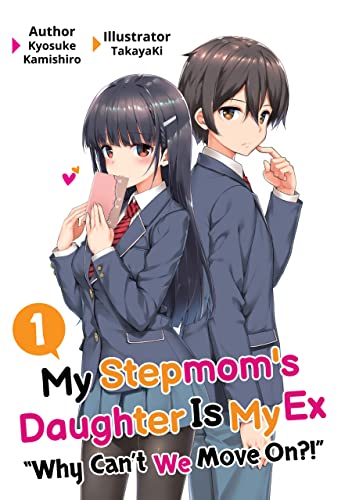
My Stepmom’s Daughter Is My Ex: “Why Can’t We Move On?”

February 15, 2022 by Sean Gaffney

By Kyosuke Kamishiro and TakayaKi. Released in Japan as “Mamahaha no Tsurego ga Motokano datta” by Kadokawa Sneaker Bunko. Released in North America by J-Novel Club. Translated by Gierrlon Dunn.

This may come as a shocking surprise to regular readers of this blog, but I am no longer a teenager. This can sometimes be difficult when you are reviewing books whose primary audience is either teens or those who were just teens a year or two ago. Things that make total sense to you when you are the same age as the main character tend to make you scratch your head or yell at the main character later in life. Fortunately, I think this series is designed so that even those the same age as the characters will be yelling at them. Two awkward teens who break up due to poor communication skills are forced to realize that they’re perfect for each other, but are too stubborn to admit it. What that means in practice is that, under a veneer of caustic sniping and bitter inner monologues, this is one of those “cute kids flirt” romance titles.

Mizuto, a bookish young man, and Yume, a nerdy and shy girl, become a couple and start to date in middle school. Sadly, due to the aforementioned lack of good communication, they also break up about a year later. They managed to keep the relationship a secret from their parents… which might be a bad thing, as now his dad has married her mom, and they’re family! For the sake of the parents (who are barely in this book, to be honest), the two try to put on a public face of getting along, but when alone they’re sarcastic, bitter and constantly sniping at each other. He has a tendency to default to “jerk”. She’s a bit of a mess. Despite this, both of them still do have the characteristics that made them attractive to each other. He’s really caring and kind of hot when he bothers to try. She’s grown up to be gorgeous and is making a big effort to be more outgoing. Dammit… this is terrible!

I will note that I was super relieved when I saw the POV switch to Yume after the first chapter, because this is the sort of story that absolutely would not work if it was told from only one side. The chapters alternate between Mizuto’s grumpy loner guy and Yume’s freaking out internally girl, and it helps to make it more understandable why things went south, and also how easy it would be to fix if they weren’t both really stubborn. Which they are, this is like seven volumes in Japan and has just had an anime announced, so resolution is not forthcoming. There was a rather annoying plot point about 3/4 of the way into the book, where Yume’s new friend in high school is implied to be a dangerous stalker sort, and wants to marry Mizuto so she can be around Yume. I was fine with the plot when reading it as I assumed this was total bullshit that said friend cooked up as a plan to get our leads closer together… then it turned out to be true. Bleah.

That said, overall this was pretty cute. If you like cute teenage romance with a side order of bitching at each other, this is probably one you should pick up.

Filed Under: my stepmom's daughter is my ex, REVIEWS

High School DxD: Holy Behind the Gymnasium

February 14, 2022 by Sean Gaffney

By Ichiei Ishibumi and Miyama-Zero. Released in Japan by Fujimi Fantasia Bunko. Released in North America by Yen On. Translated by Haydn Trowell.

I think the author just enjoys suckering people in. For most of the sixth volume of High School DxD, the series is at its default level of horny, which is to say: high, but not beyond all human reason. Sure, there are cosplay battles to see who can turn Issei on the most. Sure, there’s the endless amounts of breast comparison shopping he seems to do as easily as breathing. And yes, I probably should have guessed what was going to happen when we got to the television interview and it didn’t show Issei at all. Still, no amount of preparation could have prepared me for: the theme song. As with the previous volume’s “I can talk to enemy breasts and get them to divulge secrets”, it goes above and beyond in making you wonder what the hell the author is thinking. I have to assume that the author thinks that all this is necessary as otherwise it’s a generic shonen battle manga. Which is a shame as the battles are absolutely fine.

The start of this novel is sparked by two things: Irina returns and transfers into the school, now a full-blown angel but seemingly exactly the same as she’s always been. The other is the upcoming sports festival, where Issei and Asia have to run the three-legged race together. This is difficult, as they’re overly conscious of each other’s bodies, and also because the demon who Asia healed at the start of the series is back, and he wants Asia for himself. The answer is a Rating Game, which is a bit of a surprise so soon after the last one. Unfortunately, that’s far from the only surprise, and our heroes end up fighting against a horde of demon mooks in order to save Asia from a hideous fate at the hands of a demon who turns out to be even worse than we thought – and we already hated him.

I will admit, much as this is Asia’s book, she is mostly a straight up damsel in distress here, though I did like her slapping Diodora for insulting Issei. Unfortunately, she’s still in ‘meek healer’ mode, so her role in this book is to get kidnapped and threatened with rape. This made me grumpy. Other than that, it’s a perfectly good book in regards to the standards of High School DxD, which bear no resemblance to other light novel standards. Issei gets to be cool a few times, and has started to think on his feet much better. The solution for getting Akeno to one-shot kill all the bad guys was hilarious. The theme song, jaw-dropping though it was, was also pretty funny, I will grant you. I have to hand it to High School DxD, it does not do anything in half measures. It is here to talk about tits and it will talk about them until it is blue in the face.

This is apparently the end of the second “arc” of the series, and does include several tantalizing setups for later events. Overall, it was decent. For a value of decent that is a High School DxD book.

Filed Under: high school dxd, REVIEWS

The Genius Prince’s Guide to Raising a Nation Out of Debt (Hey, How About Treason?), Vol. 8

February 13, 2022 by Sean Gaffney

By Toru Taba and Falmaro. Released in Japan as “Tensai Ouji no Akaji Kokka Saisei Jutsu ~Sou da, Baikoku Shiyou~” by GA Bunko. Released in North America by Yen On. Translated by Jessica Lange.

You get the sense that towards the end of this series, whenever it does end (the 11th volume is out in Japan), it’s going to involve a Big East vs. West battle, with Natra in the middle of it. In a way, that’s what we’ve been getting for a while in a political way – both the Empire (and particularly Lowellmina) and the West’s religious Alliance (with Caldmellia trying to use Wein for her own amusement and to make him suffer). And, fair to Caldmellia, we almost get that here as well. We get Wein accused of murder – again – and needing to clear his name, we get one of the West’s nations invading the merchant city on the border, which comes as quite a surprise to its own leader; and we get introduced to the Holy King Silverio, who at first looks to just be a propr being held up so that the real villain can work behind the scenes, but in reality is… well, terrifying. Can Wein think his way out of this?

We also, though it’s more of a teaser for later books, get a better look at the Flahm. They’ve always been an odd combination of albinos, black slaves and Japanese burakumin, but here we see that they’re not a united front, as several in their faction feel they need as many positions of power as they can get to prevent the tide turning against them again. The other viewpoint, which includes Ninym, is that they should fill positions with their best people more than just warm bodies, and in any case she has no interest in regaining their old kingdom but wants to do what’s best for Natra. There’s also a really sweet moment when, after seeing wein asleep in their carriage on the way to the conference, she kneels down and snuggles up against him. This is also pretty bittersweet as well – Ninym does not feel she can ever explicitly show her love as it can’t ever happen. I hope we can find a way to fix that.

We also get to have my other favorite character, Falanya, come along to the conference this time around, mostly to continue to make valuable connections. I suspect the biggest will be her meeting Felite – it does get a color page, after all – but it’s also interesting to see the back and forth between her and her adviser, the “formerly evil” Sirgis. He’s being genuinely helpful and showing her how to be more politically savvy (yes, memorizing all those faces and names really is important), but he also wants revenge on Wein, and a throne war is the way that he’s going to try to get it. Falanya says that if he tries to turn her against her brother she’ll cut him loose, but I have a suspicion she’s going to find that a lot harder to do than she thinks. We’ve been setting up brother vs. sister since Book 4, and I can’t wait.

So another solid book in the series, which currently has an anime racing through its first books at a very rapid pace. It won’t get to this one this season, but perhaps if it gets another…

Filed Under: genius prince's guide to raising a nation out of debt, REVIEWS

The Thursday Murder Club, Books 1-2 by Richard Osman

February 13, 2022 by Michelle Smith

Can I resist a mystery series about a quartet of septuagenarians at a peaceful retirement village solving crimes? No, I cannot.

The Thursday Murder Club
Coopers Chase is a posh retirement community nestled amidst the rolling hills of Kent. It’s a bustling place with many activities for the residents to engage in, including the Thursday Murder Club, established by two ladies with a background in law enforcement (one as a detective and the other seemingly as some sort of top-secret government agent). When Penny (the detective) becomes seriously ill and is transferred to the on-site nursing home, Elizabeth (the government agent) approaches new resident and former nurse Joyce with a question about one of Penny’s cold cases and thus, Joyce becomes the newest member of the Thursday Murder Club. As the book progresses and the Thursday Murder Club offers their assistance in a murder investigation connected to Coopers Chase, Joyce’s diary entries are regularly interspersed throughout the narrative.

One reviewer described The Thursday Murder Club as “utterly charming and very, very clever,” and on the whole I must agree. The four members of the Thursday Murder Club—which also includes fastidious Ibrahim and impassioned Ron—are very endearingly drawn, each with their own set of strengths and foibles. I didn’t anticipate that the police characters would also be endearing, but they are! Donna is ambitious and funny and Chris, overweight and extremely self-critical, was a particular favorite. I loved a certain twist about their relationship that comes at the end of the book; with a 25-year age difference I was a little concerned how I’d feel if they got paired off romantically, but happily I needn’t have worried on that score.

The book also doesn’t shy away from acknowledging the inescapable fact of mortality, as Elizabeth tries to cope with her husband’s gradual decline and grief-stricken widowers or soon-to-be widowers figure prominently. You also get passages like, “Many years ago, everybody here would wake early because there was much to do and only so many hours in the day. Now they wake early because there is much to do and only so many days left.” So yes, this book is amusing, but it is also sometimes bleak. At the same time, however, it’s not without hope. These characters are capable and useful and there are some things they can do and get away with precisely because of their age.

The actual mystery itself is rather unnecessarily convoluted, and there were a couple of minor characters whose actions in the past didn’t exactly correlate with their actions in the present. One was simply, “If Joyce’s daughter thought her mother moving into Coopers Chase was a bad idea, then why did she purchase her flat for her?” but the other tied into the murder itself. Also, I didn’t really get why the Thursday Murder Club was going to notify the police about one person but were content to not notify the police about another person. However, I didn’t guess the final solution and was successfully lulled into forgetting about something introduced early on, so kudos there.

In the end, I enjoyed The Thursday Murder Club very much and look forward to not only the sequel but the movie in the works.

The Man Who Died Twice
When Elizabeth’s ex-husband Douglas arrives at Coopers Chase seeking protection from the money launderer from whom he has stolen diamonds worth 20 million pounds, the Thursday Murder Club is thrust into a case that’s equal parts murder (Douglas promptly turns up dead), mafia, inexpertly knitted friendship bracelets, and scavenger hunt.

Until nearly the end, I felt that The Man Who Died Twice was actually a stronger book than its predecessor. Early on, Ibrahim is mugged by some teenagers in Fairhaven, and I appreciated both his subsequent psychological state and that his friends were determined to exact revenge on his behalf. There were some pairings or groups of characters we hadn’t seen before—I quite liked Donna going to talk to Ibrahim about her loneliness—and though the mystery was largely solved by Elizabeth, Joyce had a not insignificant part to play. We learn more about Elizabeth’s background in MI-5, and I was glad this was addressed now rather than continuing to drop hints about it indefinitely. And of course there was the blend of amusing writing and poignant reminders about death and dementia.

But things unraveled just a bit towards the end. The Thursday Murder Club executes their plan to deal with the money launderer, the mafia, the teenager, and the local drug queenpin that Chris and Donna have been trying to nab, and I was surprised by who the killer ultimately turned out to be. But there were also some things that bothered me. One moment, Ibrahim is insistant that he will never leave Coopers Chase again. The next, he’s driving Joyce to go adopt a rescue dog. What did she say to him to change his mind? It had seemed like this was a world without a pandemic, a choice I’d wholly support, but then COVID is mentioned in a joking aside. If you introduce COVID and your protagonists are septuagenarian residents of a retirement community, then that opens up a lot of questions that were totally ignored. Lastly, while the diamonds’ ultimate fate was satisfying, I did wonder why they were not seized as evidence.

On the whole, though, I enjoyed this sequel as much as the first book and eagerly anticipate book three, which looks like it might be out in the fall.

Filed Under: Books, Mystery, REVIEWS Tagged With: Richard Osman

Saint? No! I’m Just a Passing Beast Tamer!: The Invincible Saint and the Quest for Fluff, Vol. 1

February 12, 2022 by Sean Gaffney

By Inumajin and Falmaro. Released in Japan as “Seijo-sama? Iie, Toorisugari no Mamono Tsukai desu! – Zettai Muteki no Seijo wa Mofumofu to Tabi wo suru” by Kadokawa Books. Released in North America by J-Novel Club. Translated by Meteora.

I had this on my list of new J-Novel Club releases to try out, but I didn’t really have too many high hopes. The author had written a very similar series, Woof Woof Story: I Told You to Turn Me Into a Pampered Pooch, Not Fenrir!, but that one really didn’t grab me at all. So I started to read this book, and I began to laugh. And then I kept reading, and I started laughing a lot. This is a funny book. It has a ridiculous lead character (no, she’s literally described by her brother as ridiculous), her own ridiculous goals in life (and a backstory that might seem familiar to Leadale fans), and a lot of good ridiculous dialogue, though the reader will need to be willing to go along with the standard “I did a ridiculous thing.” “YOU DID A RIDICULOUS THING?!?!?!” style comedy. Basically, this book is hella fun. And, of course, hella fluffy.

Yoshino Kanata spent her entire life in Japan in a hospital bed on life support. She regarded herself as happy because she had the internet, but those in charge of the afterlife think she had SUPER bad karma. As a result, they’re reincarnating her with all the good karma they possibly can. She’s reborn as Kanata Aldezia. Her father is the finest swordsman in the land. Her mother a great sage. She herself has won every award imaginable. And now, it’s time for the ceremony that determines the calling she will have going forward, because isekai worlds only run on RPG logic. Everyone thinks she will be a Saint. She has a different calling in mind. See, in Japan she never got to pet a cuddly animal. And here, she’s so terrifyingly powerful that animals fear her. Therefore, she’s going to be a Beast Tamer and got fluffy animals all around her! One slight problem – Beast Tamer is the biggest loser profession of them all.

So yes, Kanata is a trip, one of those heroines who does not have one ounce of common sense in her head but makes up for it with more power and determination than God. Indeed, as the final scene of the book shows, this is literally true. All she wants to do is leave the city and find fluffy monsters to pet. So far, she mostly has Zagg’iel, aka Zaggy. The former King of Demons, he’s under a curse that has essentially made him into a tubby little cat creature. The interaction between these two is both funny and heartwarming, as she loves him and roots for him even when he’s weak and has no powers. Of course, she never quite manages to leave the city. She beats up on bird creatures, tames dragons, cleans the sewers, restarts magical furnaces, and finally faces off against the new demon king and his army of mind-controlled minions Through all of this, her mindset is set on one thing: Is this fluff? Can I pet it? If not… she’s unimpressed.

So yes, this is better than Woof Woof Story and also deeply silly. I’ll be reading more. recommended for those who love OP ditzes and snuggling small creatures.

Filed Under: REVIEWS, saint? no! i'm just a passing beast tamer

Baccano!: 1935-A Deep Marble

February 11, 2022 by Sean Gaffney

By Ryohgo Narita and Katsumi Enami. Released in Japan by Dengeki Bunko. Released in North America by Yen On. Translated by Taylor Engel.

It’s been a long time since we’ve been here. Oh, don’t get me wrong, we continue to have about three Baccano! novels translated every year. However, the plot in the 1930s, with Firo, Ladd, Jacuzzi, et al can be generally considered the “main” plotline. And since Peter Pan in Chains, the 1934 novel, we’ve seen three books set in the 1700s, two set in the 21st century, and two set in the 1930s but as “side stories” taking place in between events we previously read about. And we still have one more of those to go, I warn you. But for the moment, we’re in the home stretch. The author has stated that the 1935 arc will be the last one set in this time period, with an “epilogue” taking place in 2003. This is the big one. But, as I said, it’s been a while. For English speakers, about three years. For the Japanese readers, over five years. As such, it’s no surprise that this volume, while not exactly a recap, is certainly a reintroduction to most of the main cast.

Several things happen at the start of this book. Isaac and Miria, still trying to not be thieves but also broke, go looking for a job. Jacuzzi’s gang is also broke (I mean, it is 1935), and so he too is looking for work. Ricardo and Christopher are in New York, and are ALSO looking for work. Ladd gets out of Alcatraz prison and reunited with Lua, Graham and Shaft. Another character from a long, long time ago is also released from captivity, and unfortunately ends up right in the middle of things. And of course Huey Laforet is out of prison and therefore back to his usual tricks… which include Chane, who is very happy to be reunited with him but also conflicted due to her love for Claire/Felix. Through all of this, Firo is just trying to run his casino. Unfortunately for Firo, Narita books tend to be “slow burn leading to an explosive climax”, and that explosion is in that very same casino.

This is a fun book to read, despite the fact that it feels like everyone is showing up to do their “bit”. Isaac and Miria are flakey. Jacuzzi cries a lot but also shows gumption. Ladd, Graham and Christopher are incredibly violent, etc. That said, there is an ACTUAL plot going on here as well, involving the Runorata family building their own secret casino and inviting representatives of all the local gangs, including the Martillo and the Gandor ones. They’ve got some heavy hitters in charge, including people you would not normally think would be associated with the dark underbelly of society. And also a new character, named Melvi, who is very interesting to a heck of a lot of people for reasons that only come out at the end of the book… and even then, there’s more of a “how on Earth could THAT happen?” than anything else. Then again, we have seen something like it before with our favorite Big Bad, who is also in this book, albeit in only one scene.

So yeah, it’s all setup, but it’s fun setup. And you’ll be delighted to know that the next book is in fact Part 2 of this arc. So perhaps we can actually keep track of things a little better.

Filed Under: baccano!, REVIEWS

The Applause of Marielle Clarac

February 10, 2022 by Sean Gaffney

By Haruka Momo and Maro. Released in Japan as “Marielle Clarac no Kassai” by Ichijinsha Bunko Iris NEO. Released in North America by J-Novel Club. Translated by Philip Reuben.

This is another one of those volumes where all I want to talk about is the last quarter of the book, but I will try to restrain myself. This is not to see the main storyline is not good or interesting, as it’s very good. As you can imagine with that title, the story revolves around the theater, as an acting troupe that Marielle and her husband go to see is suddenly interrupted by a threatening message… from Lutin! Or is it? This doesn’t seem like his style. We know Lutin is around because his master, Prince Liberto, is there to meet his fiancee Henrietta, one of the princesses of the kingdom. Everything seems great there… till Henrietta notices that Liberto always has a mask of “charming smile” going on, and begins to worry that she has no clue how he really things. Marielle needs to solve both these problems, and she does so with her usual talent of getting involved, accidentally stealing evidence, getting captured, and flirting with her husband.

Marielle is growing up in some ways, and I can’t really call her a scatterbrain anymore. Indeed, as we see near the end of the book, her ability to analyze and lay bare the emotional turmoil around romance is second to none. That said, to Simeon’s frustration, she’s always going to get involved in potentially lethal situations, because that’s just the sort of series that the two of them are in. It was amusing to see that, after going undercover, escaping, getting caught and interrogated by Lutin, and falling asleep in a cold room, she finally comes down with a bad cold, something she was proud of never having had before. (I thought at first it might be signs that she’s pregnant, but if that happens it’s not in this book.) She’s the very model of an amateur detective, and everyone has basically stopped trying to discourage her from this and instead they use her as sort of a guided missile of “trouble follows her” to get to the bottom of things.

The mystery is solved way before the end of the book, and we’re left with the last quarter, where everything is taken to another level. Henrietta is having a nervous breakdown over the fact that she can’t tell what her fiancee is thinking, and the solution is apparently to have her (and her allies, including Marielle and Julianne) locked in a tower with only one high window, which Liberto must scale to prove his love for her (and also to show that he can make faces other than “pleasant smile”). This works even better than planned, as Marielle’s plan is essentially to humiliate him until he snaps, and it works beautifully. This is topped by his true feelings towards his fiancee, which are entirely political and not romantic in nature… something she promptly accepts. It wasn’t that she worried he didn’t love her, it was that she worried she had no idea what he thought AT ALL. Now that he’s said what he thinks, a steady foundation can be built.

So all in all an excellent volume, and I don’t even mind that these books tend towards the lengthy. It’s worth it to spend more time in Marielle’s head.

Filed Under: marielle clarac, REVIEWS

Duncan Kincaid and Gemma James, Books 9-12 by Deborah Crombie

February 9, 2022 by Michelle Smith

now_may_weepNow May You Weep
Gemma is invited by her friend and former landlord Hazel Cavendish to a “cookery weekend” in the Scottish Highlands at a bed and breakfast managed by one of Hazel’s old school friends and her husband. Little does Gemma know, however, that the whole event has been arranged to bring Hazel back to the area where she grew up so that she might reconnect and explore her connection with her first love, Donald Brodie. Meanwhile, back in London, Hazel’s husband Tim figures out what’s going on and resolves to do something about it.

The book begins slowly, introducing us to larger-than-life Scottish stereotype Donald and the other guests and lingering quite a while on the history of a pair of local distilleries. (Nothing will ever convince me that whiskey tastes good, and consequently I couldn’t get too interested in this aspect of the book.) Eventually, Donald is shot and killed at point-blank range and Gemma must watch from the outside as a local Detective Chief Inspector takes charge of the case and doesn’t avail himself of her assistance. Of course, she gets involved anyway.

Now May You Weep is a decent book. I didn’t guess the culprit, but I thought some aspects of the conclusion were a bit far-fetched. Revelations that might’ve had impact somehow did not. Too, I was saddened that an element of the supernatural has crept back into this series in the form of Hazel having dreams about her great-grandmother that lead her to uncover the truth behind the feud that kept Donald’s father from approving of their long-ago engagement.

Still, it was sufficiently enjoyable that my enthusiasm for the series remains undimmed.

in_dark_houseIn a Dark House
These columns sometimes take a long time to complete, as exemplified by the fact that over 2.5 years have passed since I finished Now May You Weep. In the interim, I got obsessed with podcasts, but my book fervor has returned and, man, was I ever in the mood for some Deborah Crombie. Thankfully, In a Dark House is very good.

When a body is found in a burned warehouse owned by a prominent politician, Duncan is assigned to investigate. Meanwhile Gemma, traumatized by recently having failed to find a missing child, learns about a missing woman who lived nearby. Could she be the unidentified victim of the fire? But wait, here are two more missing women and a kid, to boot. Of course, everything ends up being related, and past a certain point, some of it was kind of predictable, but it was also satisfying.

I enjoyed spending more time with Duncan’s new Sergeant, Doug Cullen, as well as the introduction of Maura Bell, the local inspector who should’ve had the case before Duncan turned up. I hope to see more of them both in future installments. I continue to love Gemma, and loved that she was able to regain some confidence with this case. I loved that we saw Duncan being kind of an ass a few times, and how there are some unresolved things between them at the end of the book. I also loved that one suspect’s desperate actions due to custody arrangements eventually prompted Duncan to realize there wasn’t anything he wouldn’t do to keep his son, Kit, with him.

I didn’t love that it was super obvious that the case was going to prevent Duncan from making it to Kit’s custody hearing on time. It’s one of those things where you wish you could shake a fictional character. Gemma yelled at him, but not enough, I thought, and then started feeling she’d said too much. It was all very frustrating. I also thought Crombie tipped her hand with one specific character, who gave me suspicious feels the moment they were first introduced. Still, on the whole, I enjoyed this book quite a lot and vow to not let so much time elapse before the next one.

water_like_stoneWater Like a Stone
It was only 1.5 years between books this time. Progress!

It’s Christmas, and Duncan, Gemma, the boys, and the dogs have all made the trip to the cozy town of Nantwich to stay with Duncan’s family for the holidays. On the night of their arrival, however, Duncan’s sister Juliet discovers the entombed body of an infant while working on renovating an old barn for some clients. Meanwhile, she’s contending with her atrocious husband who believes what his slimy business partner has been telling him about Juliet, namely that she’s been unfaithful. Actually, until about the 75% mark, most of Duncan and Gemma’s part of the story is just accessory to family drama, as Juliet’s troubled teen daughter Lally also figures prominently.

That makes sense, of course, since Scotland Yard has not officially been called in to assist with the case. And, happily, the investigative team from Cheshire CID (and here I also include the pathologist) are extremely well drawn and enjoyable characters. I liked them so much, in fact, that if I learned Deborah Crombie was going to start a spinoff series focusing on them, I’d be ecstatic. Before long, another person is murdered, and then we wait for the detectives to put everything together.

I want to emphasize the “we wait” part, because my one major complaint about this book is that the solution to the mystery is pretty easy to guess. Granted, it took me longer than it should have to realize what had happened with the infant in the barn, but the identity of the character whose anonymous and deranged (cruelty to animals warning!) point-of-view we occasionally access was quickly obvious, and I knew that the sporadic mentions of a teenager’s death by drowning one month prior were going to pay off eventually. I still enjoyed the book very much despite this, though!

where_memoriesWhere Memories Lie
Erika Rosenthal, Gemma’s friend, came to England fleeing Nazi Germany. Her father, a jeweler, stayed behind but gifted her his latest creation, an exquisite diamond brooch, though this was stolen before Erika even made it out of Germany. Now it has turned up for auction in London and Erika has asked Gemma to investigate the matter. The day after Gemma makes her inquiries at the auction house, the employee she spoke to is intentionally run down by a Land Rover while crossing the street on her way home. Convinced this has something to do with the brooch, Gemma prevails upon Kincaid to take the case.

As Gemma and Kincaid work the case in the present—assisted by Doug Cullen and Melody Talbot, whose points-of-view I was glad to see, even though Doug is bitter and abrasive—a parallel investigation unfolds in 1952 involving the murder of David Rosenthal, Erika’s husband. I don’t know whether I’ve read too many mysteries in general or too much Crombie in particular, but I found the solution in both cases even easier to guess than in Water Like a Stone. The three chief suspects in the present each appear so thoroughly innocent that one starts to look at background characters. Who could it be that we’ve seen enough for it to be a satisfying solution? Really, there was only one person and from there the whole motive unfurled.

That said, I still really like the characters in this series, particularly Gemma. I’m also glad we got to know so much more about Erika. As the novel begins, Erika’s daily struggle is described as “the balancing of each day’s small, luminous joys against the ever-threatening beast of despair” but Gemma’s efforts afford her not only closure regarding what happened to David but also another lost romantic opportunity, initially “too painful to contemplate even now.” By the end of the novel, Erika seems to be opening herself up to the possibility of love again, and I hope she’s able to find some happiness. The great thing about Crombie is that she’ll be sure to keep us updated—I’m still super grateful she’s never forgotten the cat Duncan adopted in, like, book two.

Filed Under: Books, Mystery, REVIEWS Tagged With: Deborah Crombie

The Ideal Sponger Life, Vol. 6

February 9, 2022 by Sean Gaffney

By Tsunehiko Watanabe and Jyuu Ayakura. Released in Japan as “Risou no Himo Seikatsu” by Hero Bunko. Released in North America by J-Novel Club. Translated by MPT.

The idea of “You have to take a concubine for political reasons” has been around since the start of the series, but Zenjirou and Aura have been deftly avoiding it by essentially being in the “honeymoon” stage of their relationship. Now, however, she’s had a son and they’re trying for another child (trying an awful lot in this book, though as always there’s nothing explicit) and the murmurs are getting louder. Lots of factions are arranging to have their daughters be what is essentially Wife #2. That said, it is still something of a surprise when Princess Freya does the equivalent of a public proposal to him at her introductory event. Indeed, it’s a surprise to Freya’s group as well, particularly her bodyguard Skaji. They’d have been less surprised if they looked at future cover art for this series: The Ideal Sponger Life has 14 volumes out in Japan so far, and Freya features on more covers than Aura. She’s absolutely here to stay. That said, politics…

Negotiating Zenjirou’s emotional state is also an important part of this volume. We’ve seen how he is mostly a very kind, accepting person (indeed, the main reason Freya moves so quickly is that she realizes that if she becomes his concubine she’ll still have some power, as he’s not a sexist like most of this society) but that doesn’t mean that he’s happy with everything that’s happening. Taking another woman into his bed seriously bothers him (it doesn’t happen here, and it’s implied won’t for several books – negotiations, etc.) but he sees why it’s very politically advantageous for their nation. It’s a matter of sucking it up and dealing with it, unfortunately. Which is possibly why Aura basically decides the best way to pacify him for the moment is “lots of sex”. Still, at least he now has his goats, which means he can make CHEESE! And chocolate, more importantly.

The maids are also here at the end of the book, of course. Indeed, their presence is slowly starting to intersect with the main plot, as one of the older maids is married off to the middle management noble we saw in the previous book, and her two fellow maids are also called back home by their families to marry, meaning there’s a need for new trainees. Naturally, our three “wacky” maids are not being called home to marry just yet (and we are forcibly reminded that they are from noble families, something fairly easy to forget), but they do now have to act as teachers to the new girls – and it can be especially difficult given that Zenjirou is nothing like other guys that might need maids. There’s less comedy schtick here than usual, and it’s implied that the three maids are – slowly – growing up. I wonder how long they’ll be in the cast.

So with Freya added to the mix, I assume that we need to head back to fantasy Scandinavia soon, but Zenjirou has to learn more magic to do that without it taking years. And what of Bona, the other really obvious concubinal candidate? If nothing else, you know the next volume will have lots of extended discussion about it.

Also, the cover art is hilarious to me. “Sure, Aura’s got big tits, but check out THIS!” (twerks)

Filed Under: ideal sponger life, REVIEWS

  • « Go to Previous Page
  • Page 1
  • Interim pages omitted …
  • Page 84
  • Page 85
  • Page 86
  • Page 87
  • Page 88
  • Interim pages omitted …
  • Page 346
  • Go to Next Page »
 | Log in
Copyright © 2010 Manga Bookshelf | Powered by WordPress & the Genesis Framework