• Skip to primary navigation
  • Skip to main content
  • Skip to primary sidebar
  • Home
  • About Us
    • Privacy Policy
    • Comment Policy
    • Disclosures & Disclaimers
  • Resources
    • Links, Essays & Articles
    • Fandomology!
    • CLAMP Directory
    • BlogRoll
  • Features & Columns
    • 3 Things Thursday
    • Adventures in the Key of Shoujo
    • Bit & Blips (game reviews)
    • BL BOOKRACK
    • Bookshelf Briefs
    • Bringing the Drama
    • Comic Conversion
    • Fanservice Friday
    • Going Digital
    • It Came From the Sinosphere
    • License This!
    • Magazine no Mori
    • My Week in Manga
    • OFF THE SHELF
    • Not By Manga Alone
    • PICK OF THE WEEK
    • Subtitles & Sensibility
    • Weekly Shonen Jump Recaps
  • Manga Moveable Feast
    • MMF Full Archive
    • Yun Kouga
    • CLAMP
    • Shojo Beat
    • Osamu Tezuka
    • Sailor Moon
    • Fruits Basket
    • Takehiko Inoue
    • Wild Adapter
    • One Piece
    • After School Nightmare
    • Karakuri Odette
    • Paradise Kiss
    • The Color Trilogy
    • To Terra…
    • Sexy Voice & Robo
  • Browse by Author
    • Sean Gaffney
    • Anna Neatrour
    • Michelle Smith
    • Katherine Dacey
    • MJ
    • Brigid Alverson
    • Travis Anderson
    • Phillip Anthony
    • Derek Bown
    • Jaci Dahlvang
    • Angela Eastman
    • Erica Friedman
    • Sara K.
    • Megan Purdy
    • Emily Snodgrass
    • Nancy Thistlethwaite
    • Eva Volin
    • David Welsh
  • MB Blogs
    • A Case Suitable For Treatment
    • Experiments in Manga
    • MangaBlog
    • The Manga Critic
    • Manga Report
    • Soliloquy in Blue
    • Manga Curmudgeon (archive)

Manga Bookshelf

Discussion, Resources, Roundtables, & Reviews

Reviews

Modern Villainess: It’s Not Easy Building a Corporate Empire Before the Crash, Vol. 1

May 13, 2022 by Sean Gaffney

By Tofuro Futsukaichi and Kei. Released in Japan as “Gendai Shakai de Otome Game no Akuyaku Reijou wo Suru no wa Chotto Taihen” by Overlap Novels. Released in North America by Seven Seas. Translated by Alexandra Owen-Burns.

One of the most common afterwords in light novels, particularly when a book was originally published on the web, is the author talking about how they were only writing this book to amuse themselves and they had no idea it would get fans, or get published, or get an anime, etc. Usually I take this with a grain of salt, particularly when the book ends up having all the most popular cliches that are currently selling. With Modern Villainess, though, I 100% believe the author was not writing this for anyone but themselves, because it really does not seem to care about the common cliches. Our reincarnated-as-a-child heroine does not bother to act childish except to occasionally say “yay, pudding!”. About the only cliche that remains in place is the heroine believing that, no matter what changes she makes, she is doomed. But the answer in this case is not to learn magic and swordplay (non-existent), or make friends (though she does do that). It’s to become a tycoon.
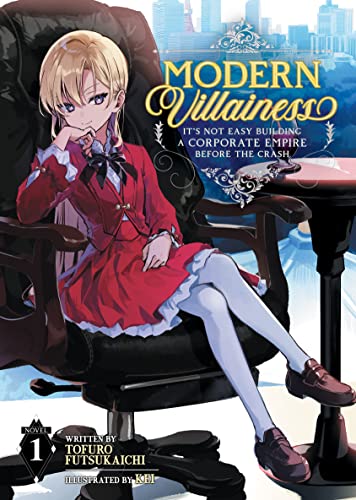
As you’d expect by now, our heroine has been reborn into the life of a villainess from an otome game. Only this otome game is set in an alternate-world modern Japan, and she ends up ruined by the bubble bursting in 2008. In order to avoid that, she’ll need to invest wisely. Shame that she’s just a little kid. Also, both her parents are dead. And she’s sort of exiled from the family due to various scandals. Oh, and she might be descended from Russian royalty. And, yes, her family’s finances are in danger. Fortunately, she has a savvy butler who simply accepts that this girl is a genius, and so she sets out to fix her life via mergers, investments, buying up debt, and making herself a Very Important Person to the government of Japan. Unfortunately, that also attracts the attention of other countries.

The goal here was to write a villainess book that was not like others, which this mostly manages to do. She still has a mini-harem of young, brilliant boys, all of whom are set to “betray her” at the end of the otome game. But for the most part, this book is about economics. So much economics. The glossary at the end of each chapter, when added up, runs to about 25-30 pages. It can be difficult to keep track of the bankers, lenders, oil barons, and politicians who come into Runa’s life, but it’s also a lot of fun seeing her managing to outflummox everyone with the power of her Swiss bank account. (Those who don’t like capitalism will want to skip this, trust me.) Despite essentially being the star of Monopoly, Runa is surprisingly likeable, and we do occasionally see her making mistakes, which is refreshing. It’s a lot of fun if you can get through the pages and pages of money, power, and the combination therein.

Our heroine is still in elementary school at the end of this volume, so we’ve got a ways to go before we get to the ominous prologue (where we also see the heroine, who otherwise doesn’t show up). If you want something different in your villainess books, give this a shot.

(Also, kudos to her friend Hotaru, who actually does seem to have magic powers in an otherwise magicless book. And also looks exactly like Hotaru from Sailor Moon.)
Filed Under: modern villainess, REVIEWS

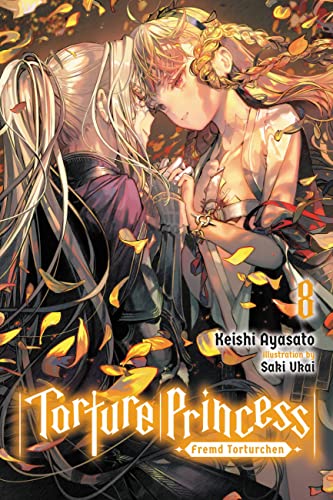
Torture Princess: Fremd Torturchen, Vol. 8

May 12, 2022 by Sean Gaffney

By Keishi Ayasato and Saki Ukai. Released in Japan as “Isekai Goumon Hime” by MF Bunko J. Released in North America Yen On. Translated by Nathaniel Hiroshi Thrasher.

As you might expect, there’s a lot of serious stuff going on in this volume of Torture Princess. We’re going to war, and one side does not really have a goal that is not “kill everyone in the most appalling way imaginable”. We get to see this world’s equivalent of last resort weapons, only for the enemy to respond with their own. Characters that we have seen since Book 1, who have died before but always seem to come back, finally die. And, of course, the entire book is asking the question: why are we even bothering to save a world like THIS? As a result, you might guess that the humor we’ve seen in previous volumes is pretty much absent, and you’re right – mostly. There is one scene near the end, though, which also begins in death, which ends up being the funniest scene not only in this book but possibly in the entire series. I don’t want to spoil it, but it features Jeanne and Izabella. It’s magical.

The mixed-race people, with Lewis and Alice behind them, are continuing to wage revenge against the humans and beastmen, with the help of some demi-humans. There are a few suggestions to stop the war. One is offered by the enemy, which is to give them Elisabeth, Kaito and Hina. But that would pretty much make the previous seven books pointless, so that’s off the table – at least privately. No, let’s face it, there’s really only one solution left, and it’s to go to war. On one side we have the humans and beastmen, aided by two Torture Princesses and some near gods. On the other side we have Alice, Lewis, and a dead giant sandworm which proves to be far more useful than anyone else might have imagined. Can one side win? What is “winning” in a battle that’s just about revenge? And is this world simply doomed regardless?

Kaito and Hina get a bit more to do in this book, despite spending almost all of it trapped in the big ol’ crystal. Their dreamscape not only shows off what’s happening in the world as a game of brutal chess, but also has a few uninvited guests. That said, for the most part we’re still putting focus squarely on Elisabeth. She’s trying to do her best here, but as everyone is fond of pointing out to her, she’s changed a bit TOO much fro being around Kaito, and actually, y’know, likes and cares about people now. That, plus the fact that she’s trying to save Kaito and the world he himself saved, means she’s less effective in many ways. Thankfully, she has daddy dearest, Vlad, on her side. The battle between Vlad and Lewis is probably the second best scene in the book. Also not without humor, it has a far darker finish.

The afterword notes that the next volume will be the final one in the series. Which is good, as frankly we’re running out of population. Will we go full end-of-world? Can our heroes manage to pull a happy ending out of a hat? Does a happy ending even fit this series? We’ll find out soon. Till then, this was an excellent volume.

Filed Under: REVIEWS, torture princess

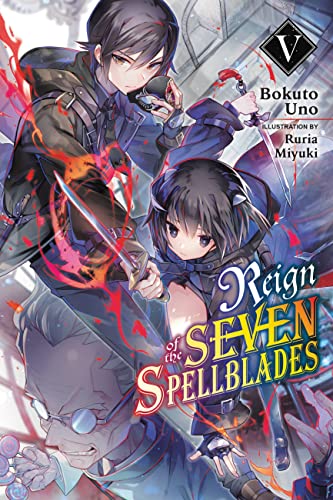
Reign of the Seven Spellblades, Vol. 5

May 11, 2022 by Sean Gaffney

By Bokuto Uno and Miyuki Ruria. Released in Japan as “Nanatsu no Maken ga Shihai suru” by Dengeki Bunko. Released in North America by Yen On. Translated by Andrew Cunningham.

It’s been several books since we’ve had to deal with the revelation that we got at the end of Book One, which is to say it’s been a while since Oliver and his allies have tried to murder a teacher. Good news! We get that here, as the academy’s resident mad scientist is next on the chopping block. More good news is that we also get a lot more explanations and backstory for exactly what is going on. Being Seven Spellblades, of course, it’s complex, and its discussion of Gnostics and Gnostic Hunters is very reminiscent of the battle for the “true face” of Christianity around the time of the Apostle Paul. There’s more suggestions that by the time this series is over Oliver will be dead or evil, but honestly, that’s not really a surprise anymore. Revenge is sometimes more important than… well, everything else. That said, boy, this revenge was costly. If the body count goes up with each dead teacher, the academy may be empty by the final book.

The book opens to a flashback showing us Chloe Two-Blade, the legendary Gnostic Hunter, and her fight against the Lovecraftian wyrms that have devastated her comrades. Hold that thought, because we then move back to the present, as our heroes try to tame griffins the hard way, learn about astronomy (which honestly seems more like history than anything else), and worry about Nanao, who has unfortunately Been Noticed – not only by Chela’s father but also by the headmistress of the academy, and you really don’t want to get noticed by her. Also, Professor Forggieri takes Pete on a tour of his mad scientist lab, with Oliver and Nanao tagging along. Still, there’s a sense of unease and tension throughout the book… which lets out in the second half, which is one big battle to kill said mad scientist.

Our main cast are probably safe, at least until the second to last book where one of them will tragically sacrifice themselves (my money’s on Chela), but the book is here to remind you that anyone else can die, as we’re introduced to more students who seem fun, powerful, and who are in the end sacrifices to help Oliver get his revenge. Even aside from Oliver, Guy and Katie meet a student who cheerfully says he’ll die soon due to experimentation, and try not to be like him. this is a super dangerous place, and even after graduation there’s no guarantee you won’t die fighting monsters from beyond our ken… or end up being brutally tortured and murdered by your allies. I really enjoy the religious subtext at the back of this series, and how it’s trying to show you that kindness is not a virtue here – something that may prove Oliver’s undoing, as little hints here and there suggest that we’re building up to a final battle between him and Nanao.

Fans of this series should be quite happy, as long as they don’t get too attached to anyone, and are familiar with 2nd-century religious persecution.

Filed Under: reign of the seven spellblades, REVIEWS

Rascal Does Not Dream of His First Love

May 10, 2022 by Sean Gaffney

By Hajime Kamoshida and Keji Mizoguchi. Released in Japan as “Seishun Buta Yarou wa Hatsukoi Shoujo no Yume wo Minai” by Dengeki Bunko. Released in North America by Yen On. Translated by Andrew Cunningham.

One of the things I like best about this series, which sets it apart from many of its contemporaries, is its use of short, quick sentences. The book reads fast, with dense paragraphs kept to a bare minimum and most of its page count being dialogue or inner monologue of some sort. However, this does not mean that it sacrifices any emotional impact – in fact, in many ways it’s heightened. The start of this book was always going to be a killer, and the prose makes it even more so. The sheer despair that Sakuta is feeling, the grief and rage that Mai’s mother and Nodoka have as they blame him for her death and cry out as to why it happened, it’s absolutely visceral and raw. Even knowing that this is not going to be permanent, that Mai will not remain dead (a series does not kill off its main draw), this is still a painful read. It gets better. But at some cost.

When we last left our heroes, Mai had just been hit by a truck. Sadly, she is not reincarnated in a fantasy world, but is simply dead. This shatters Sakuta, and things are not helped by the fact that a superstar actress died in order to save the life of her ordinary boyfriend – most of Japanese media is out to get him. refusing to accept Mai’s death, he returns once more to the beachfront we’ve seen in most other books in this series, and finds the older Shouko there once more. She reminds him of what almost everyone has experienced so far – Adolescence Syndrome – and that this might actually be a future we don’t want to see, rather than the present. But can Sakuta return to his “present” even though he’s already there? Will anyone notice him? And even if he can stop Mai from getting killed, who’s to stop HIM from dying?

I do wonder if there’s a fanfic out there showing what happened in that bad future if Sakuta couldn’t fix it, because the implication is there is no way the media would allow him to survive. Sakuta’s grief infuses over half of this volume, making it by far the least funny of the books to date, but that’s fine, you don’t want laughs here. When they come later, they’re as much a relief for Sakuta as they are for the reader. It’s also nice to see Mai reminding us that she is quite a sweet and loving partner, to the point where Sakuta has to actually find ways to upset her in order to have her be cool and menacing towards him (his professed fetish). And then there’s Shouko, whose life and death also rides on this book. The ending may be a bit sappy and unrealistic, but given the nature of the series, realism is not what I want. That said, it’s VERY abrupt – you’re waiting for another epilogue.

It’ll be interesting to see where we go from here, with the main backstory plotlines pretty much resolved. The next volume promises a return to Kaede’s attempts to go to school. Till then, please enjoy this cry of grief from the heart, and be thankful it all ended well.

Filed Under: rascal does not dream, REVIEWS

The Executioner and Her Way of Life: Crimson Nightmare

May 9, 2022 by Sean Gaffney

By Mato Sato and nilitsu. Released in Japan as “Shokei Shoujo no Virgin Road” by GA Bunko. Released in North America by Yen On. Translated by Jenny McKeon.

For the most part this fourth volume of The Executioner and Her Way of Life is a bit of a breather volume. There’s pretty much zero gore, which is nice. Akari and Momo prove to be highly amusing together as they pettily snipe at each other, and both are more interesting away from Menou. And the running gag of various enemy agents being forced to admit they’re sex pests to avoid giving away their cover runs long enough to be funny and just that long. Plus we get the addition of several old villains, and they’re almost pleasant. All this and hot springs. The whole thing would be lovely if it were not for the fact that Akari is still a ticky ticky timebomb… or is she? As Menou slowly figures out… or is straight up told… various parts of the plot, she rapidly realizes that killing Akari to save the world might not be what’s actually going on. Unfortunately for her, her Master has come to take over.

Akari and Momo, reluctant allies – very reluctant – take a train to a nearby hot spring town in the mountains. Neither one wants to be around the other, but they both have one thing in common, which is that they want to save Menou’s life. Unfortunately for them, Menou managed to go after them much faster than expected due to the obvious solution of “ask Ashuna for money and a ride”. Good news for Ashuna (and the reader), this involves Menou dressing in a butler uniform. And, as it turns out, EVERYONE is arriving at this little mountain town, including Pandaemonium, who lacks power but is still dangerous, Manon, who is resurrected with a new body, and one other surprise guest. Things do not build to a furious climax, alas, but peter out, as Akari ends up spirited away by the one person whose presence has suffused this whole series.

The best parts of this book were the parts with Akari and Momo. Their constant insults and angry bitching is funny, yes, but as the book goes on we get to see how both of them are generally a lot kinder than they’d like to let on, and Akari in particular feels less upset by Momo’s attitude after she realizes that Menou is pretty much all Momo has. We also get a lot of stuff explained to us here, such as the nature of Conjurations, why Akari has to be killed, and what really happened in the past. This even ties in with Japoan, not only because the hot springs mountain town is the closest we’ve seen to Japanese culture in this world, but also because there may be a way to get Akari back after all. If she wants to go. And if she can put up with mass murder. And of course Flare, near the end of the book, shows us, unsurprisingly, that she’s not going to arrive to save the day.

This series has a cast that are interesting and fun to read about but are all, except maybe for Menou, various shades of unpleasant. It makes for an intriguing read.

Filed Under: executioner and her way of life, REVIEWS

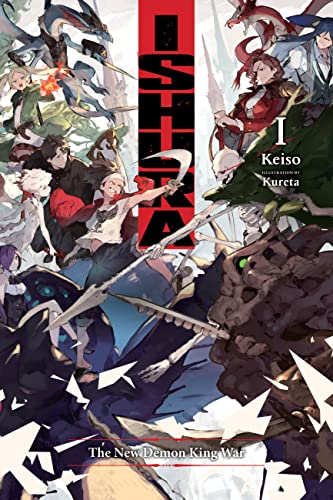
Ishura: The New Demon King War

May 8, 2022 by Sean Gaffney

By Keiso and Kureta. Released in Japan by Dengeki no Shin Bungei. Released in North America by Yen On. Translated by David Musto.

I almost didn’t get this. It ticked off quite a few boxes in terms of “things I’m not interested in”, was very long, and looked like it would consist of one big fight. Most of those things are true, but I will admit that the book definitely picks up as it goes along, especially in the second half. It suffers from having a sprawling cast, each of which have to get their own introductory chapter to show off why they’re here and why they’re really pretty strong. Unfortunately, this means that it feels like we’re reading 16 prologues at times. In the back half things get much better, the fights are indeed very cool, and there are some surprisingly touching moments. I enjoyed reading it, in the end. That said, I’m pretty sure that this will be the only volume I read because, no matter how well it tries to hide it, this series is going to come down to two genres that I really cannot stand. It’s both a tournament arc AND a survival game.

This world we’re introduced to seems to have everything. There’s wyverns AND dragons. There’s various kinds of magic. There’s walking skeletons and walking mandrakes, both super powerful. And there’s isekai’d Japanese folks, though for once they’re just part of the cast pile – we learn nothing about who they were or why they ended up here. The first half of the book sets up for a war between the main city Aureatia, which is run pretty much by humans – called “mitia” here – and Lithia, a city that has split off, with its ruler declaring herself the new Demon Lord. That title is a bit taboo these days, especially after the appearance of the True Demon Lord. In the second half of the book, the war begins and we see who lives, who dies, and who gets tragic backstory and THEN dies.

As you’d expect with a book like this, some character arcs work better than others. My favorite was Kia, a young, seemingly blase elf girl with the power to control absolutely anything with her words. At first she almost comes across as a bargain-basement tsundere, but as the book goes on and she learns about how the world works – and what her powers can do – she suddenly gains morals and ethics, much to the horror of her teacher, an assassin named Elea who is trying to murder anyone who discovers Kia’s secret. I also enjoyed the touching relationship between Regnejee, a battle-hardened wyvern who is a little battle-hungry, and Curte, a blind woman who lives in a tower and marvels at everything Regnejee says… or at least that’s how it looks at first.

I could go on, I’m sure. There’s something for everyone here, and I liked the use of names and titles, which reminded me quite a bit of Katanagatari. As a fantasy series with a high body count, it’s a real winner. It’s just not my thing.

Filed Under: ishura, REVIEWS

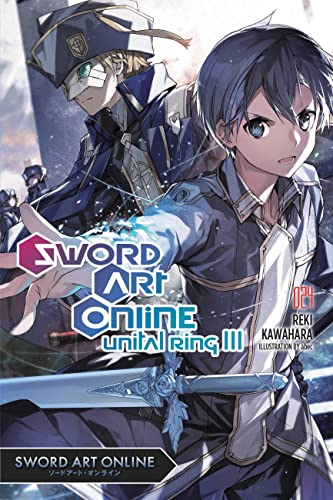
Sword Art Online, Vol. 24: Unital Ring III

May 7, 2022 by Sean Gaffney

By Reki Kawahara and abec. Released in Japan by Dengeki Bunko. Released in North America by Yen On. Translated by Stephen Paul.

Given that this series has now been running for twenty-four volumes, it’s no surprise that the current arc is seeing a lot more discussion of what has come before. This is especially true now that Kawahara has caught up with himself and no longer has to quietly edit the crappy things he wrote when he was 20 years younger. There’s a lot of interesting stuff that never really got developed in the past that can now be looked into at more leisure. This is the concept behind the Progressive series – which these books pretty much make clear have sort of usurped the original first volume as being canonical – as well as the movie, which also gets referenced here. The line between canon versions of Sword Art Online is blurring. And given that, it’s no surprise that, despite the current death game-esque plot of Unital Ring, complete with a Death Collar of sorts for Kirito, we’re still heading back to the Underworld, which may be 200 or so years into the future but still manages to ask the important question: is *he* REALLY dead?

(Man, covers always spoil, huh? So much for my trying to be ambiguous…)

Kirito is having a bit of a rough time at the moment, though honestly compared to “I am in a coma” it’s going pretty well. In Unital Ring everyone seems to be trying to kill his party. Someone has apparently dived into the Underworld without authorization, which means there needs to be an investigation. And, most importantly, it’s Asuna’s birthday and he has to get just the right present. Frankly, he’s pretty much a dumbass about that, and it’s a good thing that Argo is back in his life to give him enough hints that he can do the right thing. Argo and Alice get to spend time with Kirito in Unital Ring this volume, as Argo has finally given in and ported her character in. Good thing too, as it turns out that it’s not just SAO, or ALO, or GGO, it’s lots of other virtual reality games. Meaning we also get GIANT INSECT BATTLES!

I suspect there may be some fans who are a bit grumpy about the supposed reveal towards the end of this book. That said, “Nobody dies in Bleach” is the phrase, not “nobody dies in SAO”. There have been important characters killed off. So I think we’re allowed to give the author a bit of rope here, especially as there’s no confirmation that it *is* who Kirito thinks it is. That said, I cannot help but be reminded of the separation of Alice Zuberg and Alice Synthesis Thirty and go “Hrrrm”. Aside from that, I continue to be amused, given his reputation as the all-powerful light novel hero, how much of this book shows Kirito being mocked or screwing up. I mean, yes, he does some cool things, but that’s mostly because his human strategy guide is back. Of course, he fares better than Asuna, who has an incredibly cool battle… recapped for us as it’s offscreen. Bleah.

This arc is settling in to be another long one, but at least it has the entire cast this time, so fans should be a bit more happy than Underworld. Till next time: d’awwww. sugar maple tree.

Filed Under: REVIEWS, sword art online

When Supernatural Battles Became Commonplace, Vol. 2

May 6, 2022 by Sean Gaffney

By Kota Nozomi and 029. Released in Japan as “Inou Battle wa Nichijoukei no Nakade” by GA Bunko. Released in North America by J-Novel Club. Translated by Tristan K. Hill.

So this was a nice improvement on the first volume, though I will continue to say that I hate it whenever this book has a real plot that it wants is to care about. It’s at its best when it’s just shooting the shit and riffing on Japanese media cliches. Unfortunately, when we run into Chuuni and the Chuutones towards the end, I groaned and wished that Hatoko would simply vanish and reappear back at school. Fortunately, this is precisely what happened. I suppose I’ll have to deal with them more later, but I seriously do not care, whereas I do care about the main cast. Even Andou – I can’t tell if he was far less annoying in this book or if I just got used to his antics, but he worked far better in this book, especially when we get to the relationship between him and Hatoko. Because yes, THIS is the book with “that scene”, and it’s pretty damn epic. Worth the read, definitely, especially given the stress buildup we see all book.

Stop me if you’ve heard this one before, but this is a book of two halves. In the front half we feature once again Kudou, the student council president and vague antagonist from the previous book, who has taken a letter of challenge as a love letter thanks to Andou’s over the top verbiage. Needless to say, she’s the sort to immediately go over the top herself, and Andou has to struggle to find a way to break things to her gently before he breaks her. That said, the confession comes as a shock to the rest of the club, especially two girls who we know have feelings for him. Given her presence on the cover, and the fact that most of the chapters begin with her narration before switching to Andou’s, you can assume Hatoko is especially confused by all this. But, whatever. She wouldn’t understand it anyway.

The book threatens to be drowned out by Hatoko’s rant, which is beautiful, but it also highlights the gulf between them. That said, we see in the flashbacks that this is not for want of trying from Andou – he was attempting for years to get her to understand his way of thinking. But sometimes people just don’t vibe the same way, and the best part of the book is when both of them are told that, in fact, they don’t HAVE to understand each other deeply – they can just be friends because they are friends. The other highlight of the book is the short story competition, which is absolutely hilarious – Hatoko’s grimdark romance, Chifuyu’s incoherent foreign mess, Andou’s summary and character descriptions with no actual text, and Sayumi simply dragging Andou out behind the shed and shooting him in the head. Glorious.

Again, there’s a plot here somewhere, but I plan to ignore it, just as I ignore Andou’s friend Sagami, who is the absolute worst in a way that is clearly deliberate but also I don’t care that it is. Recommended if you use the word “weeb” as a term of honor.

Filed Under: REVIEWS, when supernatural battles became commonplace

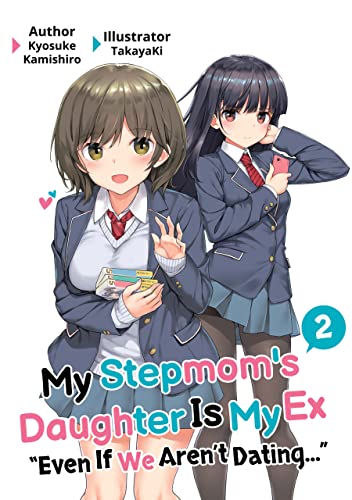
My Stepmom’s Daughter Is My Ex: “Even If We Aren’t Dating…”

May 5, 2022 by Sean Gaffney

By Kyosuke Kamishiro and TakayaKi. Released in Japan as “Mamahaha no Tsurego ga Motokano datta” by Kadokawa Sneaker Bunko. Released in North America by J-Novel Club. Translated by Gierrlon Dunn.

This is very much a book of two halves. The first half is essentially more of the same stuff that we saw in the initial volume, with our two leads bitterly grousing at each other while also showing that eventually, when they get their heads out of their asses, they will once more be a terrific couple. The second half introduces a new girl to the mix, set up to be a rival love interest. That said, the author knows what the genre is. This is not the old school genre of “guy and the 100 girls who really, really etc. love him”, it’s part of the more recent “we are cute couples who flirt adorably” genre, with the twist that they aren’t a couple anymore and their flirting is bickering. As such, sympathy in the book stays solely with Yume, though the new girl is very nice and sweet, which is a plus, and possibly makes up for the fact that Akatsuki is still in this.

Mizuto and Yume continue to stubbornly not get along, despite the fact that their entire life is a series of light novel romcom moments (as is literally pointed out later). There’s seat changes in class, which brings back awkward memories; a Mother’s Day event which brings back sad awkward memories; a sleepover with their mutual friends which turns hideously awkward when it turns out that said friends live next door to each other; and a battle over best grades in the school that goes beyond awkward and into painful. We are then introduced to Isana Hagashira, who hangs out in the library, loves light novels, is socially inept, and has really large breasts (something she will point out, as she regards it as one of her few interesting features). She and Mizuto bond immediately, leaving Yume forced to confront her own repressed feelings.

Isana reminded me not a little of Kotomi Ichinose from Clannad, and the smile she gives on the cover art doesn’t really match her in this book, where she’s mostly rather expressionless, as part of her social difficulties. She’s really sweet, and I enjoyed seeing Akatsuki and Yume slowly force her to realize that she’s fallen in love with Mizuto. Unfortunately, framing her character as having crippling self-esteem issues and then having to have her forcibly rejected due to… well, due to the plot of the series… seems a bit mean. That said, it’s not nearly as mean as forcing us to spend time around Kagure and Akatsuki, who are there to remind us what a really toxic couple are like. Not that they’re dating, but this certainly is not the “if we just admitted we still love each other everything would be solved” of our two leads, there’s some real hatred here. I fear we will learn more about it later.

So yeah, this series still works best when it’s about the main couple. Fortunately, they’re the stars of the book. Recommended with reservations.

Filed Under: my stepmom's daughter is my ex, REVIEWS

Kuma Kuma Kuma Bear, Vol. 10

May 4, 2022 by Sean Gaffney

By Kumanano and 029. Released in Japan by PASH! Books. Released in North America by Seven Seas. Translated by Jan Cash & Vincent Castaneda. Adapted by M.B. Hare.

This is a lighter volume of Kuma Bear, despite the threat of the destruction of an ancient sacred tree. You know Yuna’s got this, though the fight is difficult enough that she has to switch from black bear onesie to white bear onesie, and she ends up fairly exhausted. Speaking of that switch… Kuma Bear is, I think, mostly written for a male audience, but I also think we’re supposed to go “aww” at the antics more than “Cor!”. Yuna has to strip to change her costume, and there’s a shot of her in her underwear. But it’s not particularly sexy, and the narrative is far more concerned with Yuna’s childish bear panties and her reaction to anyone who finds out about them. Yuna has an image that she wants to keep up of her as a cool lone wolf (or rather lone bear) sort, but it’s constantly undone by the reality of her being the big sister to 11 million kids and also having older than she looks issues. Is embarrassment fanservice?

Arriving at the elf village allows the author to bring out a whole mess of fantasy novel elf tropes to make fun of, from their supposed perfect hidden tracking skills (which Yuna spots immediately) to the fact that even “grandfather” looks, at most, about 40 years old. The barrier nis weakening, however, and it turns out the problem is that the elves’ sacred tree has been infested by a parasite, who is slowly killing it and weakening said barrier. So it’s up to the elves to fix things… along with Yuna, who can enter the protective ward that no one but elves can, because, you know, OP bear. There’s also other dangerous monsters to fight, some of which might actually kill off an elf or two… but probably not, as this is not one of the dark Kuma Bear books. The worst we’ll see is Yuna worrying about her secrets.

Yuna has, for the most part, remained quiet on her origins and the basis of her awesome powers, not even telling Fina, the one person she’s closest to. I had wondered briefly if she might open up a bit to the elves here, given that they sign a contract that tortures them with unstoppable laughter if they reveal her secret, but no, it turns out she’s just telling them about her bear gates so she can set one up here, and her bear phone so that the village can communicate with Sanya and Yuna when they want to. It doesn’t feel like she’s revealing much here, but I get it. Yuna hates making ties with other people, but does it anyway, and she also hates it when people praise her because she doesn’t think of any of it as HER. The Bear Suit is the OP heroine. She’s just the girl inside it. Which is an interesting psychological trauma to dig into, but I doubt we’re going there soon.

If you read Kuma Bear, you’ll enjoy this. If you don’t, we;ll, cute but OP bear girl slice-of-life again.

Filed Under: kuma kuma kuma bear, REVIEWS

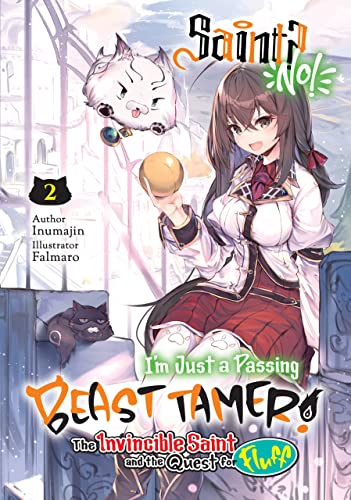
Saint? No! I’m Just a Passing Beast Tamer!: The Invincible Saint and the Quest for Fluff, Vol. 2

May 3, 2022 by Sean Gaffney

By Inumajin and Falmaro. Released in Japan as “Seijo-sama? Iie, Toorisugari no Mamono Tsukai desu! – Zettai Muteki no Seijo wa Mofumofu to Tabi wo suru” by Kadokawa Books. Released in North America by J-Novel Club. Translated by Meteora.

As with the last volume, the main thing you notice about this book is that it’s a comedy. That said,, things are actually pretty dark when Kanata’s not on the scene. The church is evil and is taking the money for themselves. The church is also brainwashing local ogres into having their minions attack small villages. Bitter blacksmiths are tricking their rival’s daughter into paying fake debt. And yet… when Kanata IS on the page, everyone turns into the broadest comedy. The hypercompetent adventurer Melissa turns into the ultimate whiny office lady. The evil Saint causing all this is far more annoyed that Kanata doesn’t even bother to see her as an enemy. And the massive wolf-spirit imprisoned by the Church finds that he can get far more laughs if he’s a cute puffball. The key to Kanata saving the world is not her ludicrous power to do anything, or her vague kindness that mostly revolves around fluff. It’s that she’s funny.

We pick up where we left off, with Kanata and her demon lord turned pussycat companion Zaggy trying to track down more fluff for Kanata to pet. They run into a small dog puffball, who Kanata nicknames Fen-Fen, who is of course the aforementioned Wolf Spirit. He’s spent decades waiting for the Saint that he’s supposed to dedicate himself to, only to be locked up by Marianne, the girl who actually does have the Saint title but has none of the Saint morality. She’s actually being led by the goddess we saw last time, who has one piece of advice for her: if you see Kanata, run away. Sadly, Marianne does not take this advice, and now has to deal with a girl who will get more fluff By Any Means Necessary, even if it means doing endless amounts of tiny, cheap good deeds.

The joke about Kanata, of course, is that she *is* the Saint, but accidentally. She’s not particularly saving lives, helping find lost pets, or taking down the evil church that’s controlling everything because it’s the right thing to do. Indeed, you could argue that she doesn’t notice what she’s doing at all. She does it because it will get her fluff. Hell, the evil Saint, Marianne, is seemingly killed by her patron goddess, only for Kanata to resurrect her… because her hair is a 10 points on the fluffy scale. No other reason. We do occasionally see flashes of her actually comprehending what’s going on… in the side story she clearly sees the cheating going on and decides to help by having Zaggy cheat on the other side… But for the most part, she’s not good or bad. She’s fluff. And since no one in this world knows what that means, it becomes an all-purpose thing to strive for, be it strength, good deeds, whatever. Fluff is what you want it to be.

Of course, Kanata wants it to be fluff she can snuggle. She may have to wait a bit, the third volume is not out in Japan yet. Till then, this is silly but… no, it’s just silly.

Filed Under: REVIEWS, saint? no! i'm just a passing beast tamer

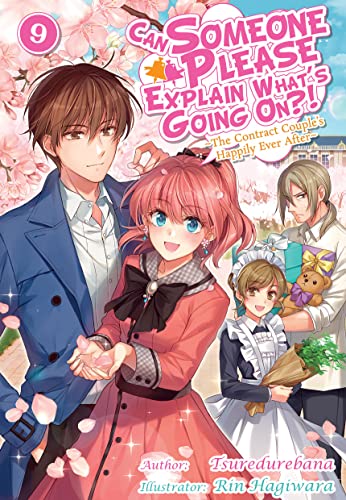
Can Someone Please Explain What’s Going On?! ~The Contract Couple’s Happily Ever After~, Vol. 9

May 2, 2022 by Sean Gaffney

By Tsuredurebana and Rin Hagiwara. Released in Japan as “Dareka Kono Joukyou wo Setsumei Shite Kudasai! ~Keiyaku Kara Hajimaru Wedding~” by ArianRose. Released in North America by J-Novel Club. Translated by Tara Quinn.

And so we finally get to the end of this series, with six main volumes and three After Story volumes. This is the last of the After Stories and has the least amount happening, as there’s not even a crisis to solve this time, like the mystery from the previous book. This volume has two main plotlines: 1) finish telling Lettie the story of how she was born, which this time does actually involve her birth, and 2) celebrate the kingdom’s founding day, which sounds remarkably like Christmas but is done at the height of cherry blossom season. Mostly what this volume shows off is how comfortable and happy everyone is now, and that all of the conflict and drama from earlier books has been dealt with. The only remaining issue is Viola’s constant self-image issues, which I know the author thinks of as a cute running gag but never fails to irritate me – and everyone else in the household too, judging by their reaction to her worry that Lettie will inherit her looks.

As noted, the first half of the book shows the days leading up to Viola giving birth and the weeks after it. This includes some false labor brought on by insisting on weeding while nearly due to give birth, and also a relatively quick and easy labor – much to Viola’s surprise, as from her perspective she thought it took forever. Lettie is surrounded by adoring family and servants, so the question is how is she not going to grow up spoiled, really. Viola will help there, I expect. The second chunk of the book has the mansion preparing for Flur Day, the aforementioned Christmas equivalent. A strong windstorm may put paid to some of the festivities, but otherwise there’s a relative lack of anything going on here – the main drama stems from everyone trying to get out of hearing the King’s speech again so that they can get to the truly important thing a week later – Lettie’s first birthday.

There is still the occasional reminder that there is ever present danger in this world – Viola is given a number of mazes to memorize and complete, and only after she’s done so does she realize that they’re a layout of the mansion and the royal palace, complete with secret passages and hidey-holes, if she ever needs to escape like she has in previous books. But for the most part this is a victory lap, and it even ends the way a lot of these books do – with Viola discovering she is pregnant with her second child. As I’ve noted before, this continues to be a surprise to me as Viola has not, through all nine volumes, ever really shown any sexual desire towards her husband. Even when given an obvious opportunity, such as coming in to “get warm” after a nighttime cherry blossom viewing, all they do is have cocoa. It’s very pure.

So yes, this book is also a bit boring, but I’ll take that over the classist nonsense some of the main series did. In the end, this was a flawed but fun series, and I really hope one day it hits Viola that she’s gorgeous.

Filed Under: can someone please explain what's going on?!, REVIEWS

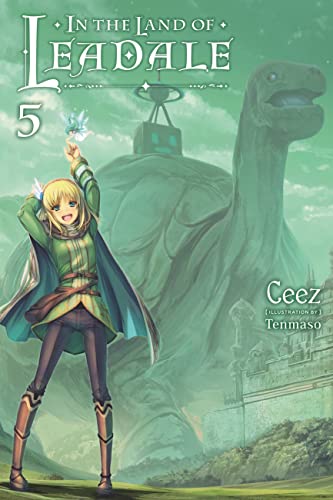
In the Land of Leadale, Vol. 5

May 1, 2022 by Sean Gaffney

By Ceez and Tenmaso. Released in Japan as “Leadale no Daichi nite” by Famitsu Bunko. Released in North America by Yen On. Translated by Jessica Lange.

We’ve introduced most of the main cast at this point, but there’s one other major player (and indeed Major Player) whose absence from this has felt like a plot point: Opus, Cayna’s rival and partner in crime. She knows he’s there, as the presence of L’il Fairy has demonstrated, but he has not really shown up in front of her and we haven’t gotten a good sense of his character. Well, despite the fact that he only appears in the last few pages of this volume, we have a much better idea now. He’s a troll. A massive troll. And while Cayna, who is also incredibly eccentric in her own right, proved to be OK with that when she was helping him do the trolling, being on the receiving end of it for once pushes her to a righteous fury we haven’t really seen from her that much. For all that Cayna tends to use fists to solve arguments, she’s a relatively mellow person. Well, OK, she’s not. But her own “persona” pretends she is.

Cayna is still going around being a force of nature, but she can’t be everywhere, particularly if something needs to be solved the hard way rather than the Cayna way. So Exis and Quolkeh team up with another ex-player to take on a massive Guardian Tower that is a mobile turtle… heading for the royal palace. (This is solved by a typical Japanese quiz game.) As for Cayna, she suddenly finds that L’il Fairy needs a name, So she goes with Kuu, because it sounds like Kee, because Cayna is still pretty childish most of the time. She then goes on to do what she does best: There Is No Kill Like Overkill, as she takes on a huge pile of monsters led by a goblin master who is somewhat stunned to see how easily she carves them up. She then takes Cloffe and Clofia (remember them? The anime cut them?) on a dungeon crawl to find Opus. A very annoying dungeon crawl.

Since our last review the anime ran, and it seems to be a case where fans of the light novels enjoyed it (despite the cuts) but those who had not read the books were deeply turned off by Cayna’s temper and the series’ lack of a plot. To be honest, they’re good points. The author really enjoys showing Cayna lose it and hit people with her fists or big-ass weapons, usually whether they deserve it or not. Fortunately, in this case, Opus definitely does deserve it. As for the lack of anything happening… that’s true as well. This is at heart a slow life series, it’s just Cayna doesn’t run a drugstore or a library, she goes around trying to discover the secrets of this post-game world. It’s a hard vibe to get into, and I don’t think the anime got far along enough to show it off.

Still, this volume is pleasant enough, and thankfully had less of the body horror of Book 4. Now that Opus is here, will he help shed some light on things? Or will he just be a dick? We’ll find out soon.

Filed Under: in the land of leadale, REVIEWS

Ascendance of a Bookworm: I’ll Do Anything to Become a Librarian!, Part 4: Founder of the Royal Academy’s So-Called Library Committee, Vol. 6

April 29, 2022 by Sean Gaffney

By Miya Kazuki and You Shiina. Released in Japan as “Honzuki no Gekokujou: Shisho ni Naru Tame ni wa Shudan wo Erandeiraremasen” by TO Books. Released in North America by J-Novel Club. Translated by quof.

I must admit, she’s started to mesmerize me, that’s the only explanation. Towards the end of this book, I recall thinking that it was another quiet book with not much happening and with Rozemyne not really doing anything wrong. While the latter is… partly true, the hilarious epilogue reminded me how earth-shaking all of this was to the folks back home, and how Sylvester and Ferdinand desperately need the invention of Tylenol. Rozemyne is getting better at the social niceties, but she’s still a huge chasm away from everyone else, and things are not helped by having someone who is basically the same as her come along, and be royalty at that. The two of them join forces in this volume, and I am grateful that they have Hannelore there to try to keep things from exploding, but I also feel very bad for her. It’s tough to be a minder to a cataclysmic event like Rozemyne.

We’re back at school for Rozemyne’s 2nd year, and she’s a little bit calmer about things this time around, though of course that’s only by degree. Her main concern is starting her library committee and being a good big sister to Charlotte (which is not helped by Charlotte being both taller and more mature than her big sister). Then things… start to happen. Lessons are for the most part fine, though Rozemyne is starting to discover how much of the entire 7-year curriculum Ferdinand has already drilled into her. And she almost kills a teacher. Whoops. Things escalate a bit when she runs into Hildebrand, the 3rd prince, at the library. Hildebrand is supposed to be hiding from the rest of the students, but he quickly gets attached to Rozemyne (who he has finally figured out is not Charlotte) and ends up part of Rozemyne’s library committee. Which… complicates things.

I haven’t even mentioned the most interesting part of the book, which is when Roderick, the former Veronica Faction boy who wants to pledge his name to Rozemyne, goes out hunting feystones with others and runs into a magical beast that absolutely should not be there, forcing everyone – including Rozemyne – to rally round and try to stop it. This has moments of humor, as Rozemyne, who was chiding Wilfried for trying to look cool earlier in the book, is upset that everyone was able to be cool except her, but it’s also a scary moment, and a bit ominous, as it becomes clear that this monster was directed directly at the area their duchy occupies. Bookworm loves to drop little hints of things to come and then leave them alone for a few books, so I’m not sure when we’ll get back to this, but let’s just say the political war that is inevitably coming simmers in the background.

We leave off with Rozemyne heading back home for a series of lectures about how she is appalling, but again, only about 1/3 of this was her fault this time. Still an essential light novel series.

Filed Under: ascendance of a bookworm, REVIEWS

Konosuba: God’s Blessing on This Wonderful World!: Runaway Goddess, Come Home!

April 28, 2022 by Sean Gaffney

By Natsume Akatsuki and Kurone Mishima. Released in Japan as “Kono Subarashii Sekai ni Shukufuku o!” by Kadokawa Sneaker Bunko. Released in North America by Yen On. Translated by Kevin Steinbach.

Last time I suggested the entire book had been written around one 40-50 page scene. This one’s even worse, as the entire book is entirely setup for one 3-4 page scene. The author even admits in the afterword that they had the ending to this book in mind right from the start of the series. It’s pretty spectacular, frankly, and fans of Megumin will be over the moon. That said, there is also the rest of this book to deal with. Good news, it’s also good, though it does not quite hit the highs that the end gives us. It’s the second to last in the series, so we’re setting up for the final battle here, but we’re also showing off how well everyone has integrated into Axel, and how much Kazuma, Megumin and Darkness have mellowed out and become boon companions. And in some cases more than that, as Kazuma and Megumin try once more to try to lose their virginity. (Take a wild guess how well that goes.)

As we saw at the end of the last volume, Aqua has run away to go defeat the Demon Lord, though it’s pretty clear she wants the rest of her friends to catch up ASAP. Instead she gets Handsome Sword Guy (whose name she forgets, and so do I), Cecily, and Yunyun… which is actually a far more balanced party than her normal one, so she mostly ends up very bored on the journey when she’s not accidentally tempting monsters to eat her. Kazuma is, alas, very reluctant to come after her as he’s back to Level 1 after recent events. That said, his level is back to baseline but he still has his skills… which gives him an idea. An idea involving Vanir, Wiz, and a very difficult dungeon…

If there’s a runner-up in terms of best bit in the book after the Rise and Rise of Megumin, it’s the adventures of Vanir and Wiz in the dungeon, keeping the useless Kazuma safe while also letting him get in the last hit to raise his level again (and then lower it, as he’s cheating as per usual). Vanir is just the same as always, but it’s an absolute delight to see Wiz getting obsessed with clearing the dungeon and just as over the top. They make a very good team. As for others in the book, the award for “worst person in the world” has to go to Zesta, who not only pervs hard on Kazuma, Megumin and Darkness, but is such a lustful pervert that even high-level monsters run away as they are worried he’ll try to screw them. (He will, indeed, try that.) He’s also the one who gets a horrible idea regarding Serena’s powers to return the pain she receives back on the giver, which relies on her being a virgin. KonoSuba is not about to forget its roots of being terrible in the best ways.

So all the main players have finally arrived at the final battle. Will our heroes triumph? Will the demon lord prevail? Will Kazuma die again? And what’s up with the link between this world and Japan? That will wait till the final volume next time. Till then, this was a lot of fun. Also, I find it hilarious that it took till Book 16 for Megumin and Darkness to learn Kazuma is from another world.

Filed Under: konosuba, REVIEWS

  • « Go to Previous Page
  • Page 1
  • Interim pages omitted …
  • Page 80
  • Page 81
  • Page 82
  • Page 83
  • Page 84
  • Interim pages omitted …
  • Page 346
  • Go to Next Page »
 | Log in
Copyright © 2010 Manga Bookshelf | Powered by WordPress & the Genesis Framework