• Skip to primary navigation
  • Skip to main content
  • Skip to primary sidebar
  • Home
  • About Us
    • Privacy Policy
    • Comment Policy
    • Disclosures & Disclaimers
  • Resources
    • Links, Essays & Articles
    • Fandomology!
    • CLAMP Directory
    • BlogRoll
  • Features & Columns
    • 3 Things Thursday
    • Adventures in the Key of Shoujo
    • Bit & Blips (game reviews)
    • BL BOOKRACK
    • Bookshelf Briefs
    • Bringing the Drama
    • Comic Conversion
    • Fanservice Friday
    • Going Digital
    • It Came From the Sinosphere
    • License This!
    • Magazine no Mori
    • My Week in Manga
    • OFF THE SHELF
    • Not By Manga Alone
    • PICK OF THE WEEK
    • Subtitles & Sensibility
    • Weekly Shonen Jump Recaps
  • Manga Moveable Feast
    • MMF Full Archive
    • Yun Kouga
    • CLAMP
    • Shojo Beat
    • Osamu Tezuka
    • Sailor Moon
    • Fruits Basket
    • Takehiko Inoue
    • Wild Adapter
    • One Piece
    • After School Nightmare
    • Karakuri Odette
    • Paradise Kiss
    • The Color Trilogy
    • To Terra…
    • Sexy Voice & Robo
  • Browse by Author
    • Sean Gaffney
    • Anna Neatrour
    • Michelle Smith
    • Katherine Dacey
    • MJ
    • Brigid Alverson
    • Travis Anderson
    • Phillip Anthony
    • Derek Bown
    • Jaci Dahlvang
    • Angela Eastman
    • Erica Friedman
    • Sara K.
    • Megan Purdy
    • Emily Snodgrass
    • Nancy Thistlethwaite
    • Eva Volin
    • David Welsh
  • MB Blogs
    • A Case Suitable For Treatment
    • Experiments in Manga
    • MangaBlog
    • The Manga Critic
    • Manga Report
    • Soliloquy in Blue
    • Manga Curmudgeon (archive)

Manga Bookshelf

Discussion, Resources, Roundtables, & Reviews

Reviews

Sayonara, Zetsubou-sensei, Vol. 11

February 4, 2012 by Sean Gaffney

By Koji Kumeta. Released in Japan by Kodansha, serialization ongoing in the magazine Weekly Shonen Magazine. Released in North America by Kodansha Comics.

So, now that I spent several months researching all the niggly bits of Vol. 10 (something I will never do again), I’m a couple of volumes behind. Not only that, but Zetsubou-sensei, much as I love it, doesn’t exactly allow me to talk about developing plot and characterizations. It’s a gag manga. What’s a reviewer to do?

Well, there are a few things I can talk about. For one, just because I’m not doing long lists of references doesn’t mean I can never mention them again. I noted in my review of Vol. 10 that ‘pregnant heroines’ were mentioned as one of the manga that Kumeta had on his list of things to do – in fact, he’d done every one of them except that. No, we shouldn’t expect Zetsubou-sensei to end this way. But it gets brought up again in Chapter 101, where it’s noted as one of the ‘three taboo’s o shonen manga’. (The other, tone on male nipples, is casually broken by Kumeta here for a gag.

The real gag is that, at the time that this chapter was running, another author in Shonen Magazine was breaking the first, far more major taboo. Sei Kouji was wrapping up his series Suzuka, a harem manga about two high school track-and-field stars and their tsundere love. As Joshua Weeks noted in the endnotes (talking about it for a different gag), it was quite ecchi. It also ended with Suzuka pregnant, and giving up her star carer to have the child. This was quite controversial at the time, both for the actual suggestion of teenage sex (though if sex is going to happen, it’ll be in Magazine, rather than Jump and Sunday), and because many felt this was an ‘unhappy ending’, with the couple giving up their dreams in order to raise the child.

(Suzuka ended here in North America 3 volumes away from the end, so I apologize if I spoiled you. I can’t see Kodansha finishing it up if they haven’t already.)

Then we have the chapters featuring Nozomu’s body double. While mostly amusing for the fact that none of the cast seem to be able to tell him from the real thing, including Matoi, it does lend itself to another long-term character change for the sake of better gags. In general, the cast of Zetsubou, in regards to being “in love” with him, falls into two types: a) Kiri, Matoi and Chiri, and b) all the rest. (Kafuka, as ever, is outside the box entirely.) When he needs a chaotic ending, he’ll go with the whole cast, but in general, you tend to think that, of the major cast members (sorry, Mayo), those are the three with actual feelings. Now we have Abiru added to that lineup here, and though it’ll be hit and miss for a while, she does continue to show major affection for him in future volumes. Given that the series is not about to have him hook up with any of his students, this is entirely done for fun, but it’s still worth noting.

This volume also has one of my favorite chapters in the series, which talks about “off-air battles”. It’s something that makes sense in both Japanese and English, so works well here. It gives Matoi a larger role (she’s finally becoming an actual productive cast member, as opposed to a simple visual gag) and highlights her jealous feud with Kiri. It shows off Nozomu’s stunning hypocrisy in regards to his “suicide attempts” (and yes, by the way, Chiri used the English phrase “techno-maestros” in Japanese as well). And it has a great metatextual end gag, offsetting Chiri’s increasingly bloody violence (witness her horrifying butchering of a corpse with a blunt knife a few chapters earlier) with the need to remind oneself that this is a comic for young boys. (Well, no it isn’t, but let Shonen Magazine have its delusions. Jump they aren’t.)

Sayonara, Zetsubou-sensei is a series that benefits from multiple re-readings, and so I higly recommend that you go out and buy it. Also, for Kodansha-haters, they kept in Kiri’s “Don’t open it!” this time around, possibly as she’s simply zipping up the back of her dress.

Filed Under: REVIEWS

Wandering Son, Vol. 2

February 2, 2012 by Sean Gaffney

By Shimura Takako. Released in Japan by Enterbrain, serialization ongoing in the magazine Comic Beam. Released in North America by Fantagraphics.

In Volume 2 of Wandering Son, as you would expect, we begin to discover that just because you have someone to share your dreams does not necessarily mean that they become easier to achieve. Shuichi gets more of the focus here, and he’s starting to realize just what he’s getting into with his desire to be a girl. His sister is angry and suspicious of him… while at the same time being fascinated about dressing him up. Classmates are being cruel as only children can. But it’s actually a simple classroom assignment to write down what you want to be when you grow up that almost breaks him this volume. The future is scary.

In volume 1 it was Saori that drew my attention, but in this volume it seems to be Maho, Shuichi’s sister. She’s clearly presented unsympathetically at times, and I get the feeling that things will only get worse in that regard. But I love how things are never as cut and dried as “good guy” and “bad guy” in this series, especially with the children. After all, Shuichi may be the hero, but Maho is having to deal with being a young girl as well, not to mention her brother is dressing up as a girl, to the point where one of her classmates starts to fall for Shuichi. The characters develop from their situations, which is all you can ask for in this sort of work.

Meanwhile, the young woman we met in Volume One, Yuki, gets her own secret revealed. It’s not particularly surprising to me – I was more surprised that she was unaware of Shuichi and Yoshino’s identities. Yuki’s boyfriend, though, does lead to one of the funniest (and most cringe-inducing) scenes in the entire volume, where he looks at Yoshino suspiciously and then decides to verify her gender. Yoshino’s reaction made me laugh, but at the same time, I’m amazed she didn’t slug him… or run off. Yuki notes that it’s very rare to have two friends like Shuichi and Yoshino are. In addition to the transgender issues, the core of each volume is, of course, the friendship they have, and I hope that it continues to develop.

The second half of the volume is a class trip, and shows us that Shuichi is having difficulties with the other kids in his class. He’s so softspoken that he tends to get picked on, and one boy in particular is pressing him to see just how far he can take it, calling him “faggot” and mocking him on the bus. You don’t have to be familiar with transgender issues to understand what’s going on here (though this being manga, I would not particularly be surprised were that bully redeemed a ways down the road). Then there’s Saori, who, unlike Shuichi and Yoshino, can’t just sit back and let injustice go. She’s reminded of Anne of Green Gables, a book which most Western readers will know, and it leads to a truly wonderful scene. I like Saori, but given her high-strung nature I worry that she’s going to have even more trouble growing up than our two leads.

As with the first volume, the second one ends with an essay by translator Matt Thorn, this one dealing with transgender and homosexuality in the united States and Japan. (Neither Shuichi nor Yoshino’s sexuality has come up in the manga yet, but I’m fairly certain it will at some point.) Matt’s essay is excellent, noting the similarities and differences in the prejudices among cultures. Wandering Son, of course, will be dealing with family, and friends, and classmates. It’s not really going to have the option of viewing transgender issues from a distance the way a lot of Japanese folks can. Let’s hope Shuichi and Yoshino can weather the storm.

Filed Under: REVIEWS

Pretty Guardian Sailor Moon, Vol. 3

January 31, 2012 by Sean Gaffney

By Naoko Takeuchi. Released in Japan as “Bishoujo Senshi Sailor Moon” by Kodansha, serialized in the magazine Nakayoshi. Released in North America by Kodansha Comics.

I had forgotten how much compressing the 18 original volumes into 12 (and 2 side-story books) would speed things up. That’s right, we’re already at the end of the first arc and starting the second! Indeed, you can definitely tell that, had Sailor Moon not been a huge success, Nakayoshi would have likely ended it here, right before Chibi-Usa arrives. But then, had that happened, we wouldn’t be discussing it now.

For fans of the anime, that’s Sailor Mars on the cover. You might not recognize her as she’s looking cool, calm and collected. :) In the actual manga, though, things really aren’t going so well. Mamoru has been possessed by Metallia, and even if Jupiter and Venus manage to kill off Beryl, things aren’t going to end quite that easily. (Speaking of which, a couple of things to note: a) there’s an ongoing gag about Venus’ sword being too heavy to use. Done for comedy in Vol. 2, it’s now quite serious, as Venus has a lot of trouble actually wielding it. That said, even if Jupiter (who is much stronger) gets in the first blow, it’s Venus who actually kills Beryl. b) Wasn’t there a shot of archaeologist Beryl being possessed by Metallia in a previous volume? I guess we’re assuming, like the Four Generals, that once they were converted to evil, they couldn’t be saved. Keep an eye out for villains killed in Sailor Moon going forward, and see how many were once human…)

Unfortunately, Mamoru is still evil, and so it’s up to Sailor Moon to kill him for the good of the world. Which she actually does, even using Venus’ huge sword. And then, very startlingly, she proceeds to reverse the sword and kill herself. Or at least, so it seems. I dunno, maybe it’s because of the anime episode 45 and 46, but I find the ending to the first arc in the manga somewhat confusing. It would appear that both Sailor Moon and Mamoru were ‘saved’ from a deadly blow from the sword; Mamoru by a crystal containing the essence of his four Generals, and Sailor Moon by Mamoru’s watch. This… seems a bit too pat. On the good side, Moon is just as awkward with a heavy sword as you’d expect. Honestly, none of them look comfortable with it.

The action then moves to the North Pole, where, in order to wake Sailor Moon and Mamoru, the senshi decide to sacrifice their lives. This involves using their transformation pens to somehow use all their power to wake Sailor Moon, and again kind of pales in comparison with the anime. But that’s not the manga’s fault. But now Sailor Moon is alive, and can use the power of love, the power of prayer and the power of basic light over darkness to defeat Metallia. Now she’s finally reunited with an unpossessed Mamoru, and they kiss. And then she… finds out her friends are all dead. Oopsie. (Note we see them in pools of blood, which are all drawn as ‘clear fluid’ rather than the typical ‘black blood’ you see in monochrome. I suspect this may be to make it less horrifying – they’re drenched in it.) Luckily, Sailor Moon can resurrect the dead with her new powerup, which she proceeds to do. (If you’re rolling your eyes at this, get used to it – it’s not the last time we’ll be seeing it.)

Yay! Happy ending, everyone’s alive and going back to school, Usagi has a boyfriend, and all is well… wait, who’s this kid? Yes, Chibi-Usa drops in, and sets the stage for the second major arc in the manga, which is generally called Sailor Moon R in deference to its anime counterpart. Chibi-Usa… is a brat at times, even in the manga. But at least in the manga it’s very clear that she is, at heart, a very scared child, and that much of her behavior is due to panic and stress as much as anything else. She arrives out of the sky with her mind-controlling ball that looks like Luna and immediately proceeds to ingratiate herself with Mamoru, get accepted into Usagi’s family, and get on Usagi’s nerves. And she’s also after the Silver Crystal… which the villains are also after. Is she a villain?

Yes, we get a new set of villains here as well, with the Black Moon Family. More on Prince Demande later, as he’s a truly horrible ass, but here we just get to see bits of the main villains. Instead, they send out disposable minions, each with the powersets to match up against a specific senshi, to capture them. And it actually works quite well, as first Mars, then Mercury are captured by the enemy and… well, not killed, but moved off the board for a while. This, by the way, results in the deaths of the minions. This is not the anime, no redemption for you! There are also, by the way, some lovely scenes of Ami, Rei, Makoto and Mamoru interacting with their friends in daily life. The friends don’t get big roles, but it helps to show that the cast are (mostly) quite popular and well-liked.

I’m not sure if there were any extras in this volume in Japan; there aren’t any here, I can tell you. But regardless of that, this was a solid volume of Sailor Moon. More battle-oriented than most, which means I like it a bit less than the others, as Takeuchi’s battle scenes can get confusing. But as we leave our heroes, the Senshi are now down to three. And somehow, I have a feeling that the start of Vol. 4 will end with Jupiter getting abducted as well, as that’s how these things go. Is this what happens when you find yourself on the cover?!?!

Filed Under: REVIEWS

Yakuza Cafe

January 30, 2012 by Katherine Dacey

Yakuza Cafe is a pleasant surprise, a cheerful, smutty send-up of gangster manga that playfully mocks maid cafes, foodie manga, and yakuza culture.

The titular gangsters are the Fujimaki Clan, a once-feared crime syndicate who’ve launched a legitimate business: a yakuza-themed cafe, staffed by the clan’s former foot soldiers. Though the food is tasty, and the waitstaff comely, the cafe is all but deserted — that is, until Shinri, the clan leader’s only son, discovers the root of the problem: no one can brew a decent cup of tea! Not to worry: Shinri just happens to be an expert on the subject, thanks to his grandmother, a tea connoisseur so dedicated that she grew her own leaves.

Of course, Yakuza Cafe is yaoi, so there’s also a romantic subplot running in tandem with the shop’s rehabilitation. That storyline involves Shinri and a brooding, muscle-bound thug named Mikado, who’s famous for his fiery temper. Though others warn Shinri not to become emotionally or physically involved with Mikado, Shinri finds himself irresistibly drawn to Mikado and his elaborate dragon tattoo. (The tattoo, it should be noted, is almost a character in its own right.)

Yakuza Cafe has three things working in its favor: a cast of handsome men, a clever premise, and a deep affection for the genres it parodies. Shinano Oumi draws elegant, if generic, characters in a variety of pleasing shapes and sizes: broad-shouldered types for readers who prefer rugged men and slender, snappy dressers for those who favor metrosexuals. Oumi doesn’t just populate her story with attractive characters, she inserts them into a situation that’s ripe with comic potential: what could possibly go wrong when former hit men serve tea and pastries to teenage girls? Of course, none of these scenarios would be funny if Oumi overplayed them, but she uses a light touch throughout the story, whether she’s borrowing ideas from The Drops of God — grandma’s tea expertise could easily spawn a manga of its own — or putting a BL spin on a gangster manga cliche. (Mikado tries to slice off his own pinky in order to atone for his relationship with Shinri.)

The main drawback to Yakuza Cafe is the romance. Shinri and Mikado’s attraction is explained by means of a very tired shojo trope — The Handsome Senpai From My Childhood — and never properly developed. That’s a pity, because the other lengthy story in Yakuza Cafe, “The Crimson Seal,” achieves a much better balance between the main story and the budding relationship between a college grifter and a Fujimaki foot soldier. “Seal” also offers the manga’s only really emotional moment, culminating in a Tragic Death as sincere and silly as anything in Crying Freeman. (I say this with love.)

Whether you’ll enjoy Yakuza Cafe boils down to a simple test: do you read yaoi for the stories or the pictures? If the former, you’ll find it entertaining, with passably exciting bedroom scenes; if the latter, you may not find enough visual stimulation to hold your interest through all the maid cafe and yakuza jokes.

Digital review copy provided by Digital Manga Publishing.

YAKUZA CAFE • BY SHINANO OUMI • DMP • 168 pp. • RATING: MATURE (18+)

Filed Under: Manga, Manga Critic, REVIEWS Tagged With: DMP, Yakuza, Yaoi

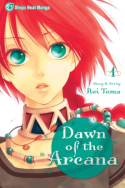
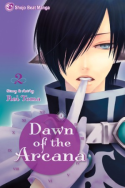
Dawn of the Arcana, Vols. 1-2

January 29, 2012 by Michelle Smith

By Rei Toma | Published by VIZ Media

In premise, Dawn of Arcana sounds like fairly generic shoujo fantasy. Princess Nakaba of Senan is married to Prince Caesar of Belquat in an arrangement ostensibly meant to ensure peace between their warring kingdoms, but which nobody expects to do so for long. Nakaba is resigned to her fate, but not without backbone, while Caesar is arrogant and entitled and makes remarks like, “Make no mistake. You are my property.” It’s pretty obvious they will fall for each other soon.

Accompanying Nakaba is her demi-human attendant, Loki, who belongs to an enslaved race possessed of heightened strength and senses. He’s been by Nakaba’s side ever since the village in which she lived was attacked by Belquat soldiers—evidently, her mother (also a princess) eloped with a member of a race possessed of precognitive powers, which Belquat was attempting to wipe out and of which Nakaba is now the only survivor—and so she feels much love and gratitude for him.

The first volume mainly focuses on Nakaba’s attempts to fit in around the enemy castle. In Senan and Belquat, only royalty have black hair, so the fact that hers is red has always prompted sneers, curiosity, and contempt, so the reaction would be the same no matter where she resided. Gradually, she gets to know Caesar a little better, and we see that his main problems are youth and actually buying into the “it’s your right” lectures that his mother has been subjecting him to since childhood. Here’s a great sample exchange between them:

Caesar: (After planting a smooch on Nakaba.) I’m a prince, and this is my kingdom. If I want something, I take it.

Nakaba: You may be a prince, but there are some things you’ll never have. Allow me to be the first.

Nakaba actually trusts him to keep his word when he promises to help Loki get out of trouble at one point, and expresses faith in his abilities to succeed in the very endeavors which his mother discouraged him from even trying. In return, he somewhat awkwardly tries to make her happy by bestowing lavish gifts upon her, and learns that a simple thing like caring for a wounded bird does the job better than fancy dresses. It’s certainly nothing new for a surly hero to be thus tamed by a spunky heroine, but I like the development all the same.

And speaking of development, volume two is a lot more interesting than the first. While someone plots to poison Caesar—and attempts to frame Nakaba for the deed—tension is brewing between Nakaba’s husband and her attendant. Loki intervenes to save Caesar from the would-be assassin, but admits that this is only to earn his trust. “I do want him dead… Have you forgotten? They are the enemy.” For too long, Loki’s people have been kept down, and he is now plotting rebellion. “You must not let him into your heart,” he warns, knowing that Caesar must eventually be his target, but though Nakaba attempts to comply, out of loyalty to Loki, she’s ultimately unable to do so.

Despite the fact that Nakaba falling for Caesar is predictable, I still like them together—how she improves him, and how he manages to make her feel safe yet simultaneously guilty—and I really like that she’s torn between these two guys, but not exactly in a romantic sense. Even while her feelings for Caesar are growing, she’s aware of the possibility that she’ll end up betraying him for Loki’s sake. Personally, I’m betting on Caesar becoming aware of the atrocities committed by his father and joining Loki’s cause—there have been some hints in this direction already—but the angst will be fun in the meantime.

Ultimately, this is a solidly good series. It’s not great yet, but it’s also far from bad.

Dawn of the Arcana is published in English by VIZ Media. Volume one is out now and volume two will officially be released on February 7, 2012. The series is ongoing in Japan, where the ninth volume has just come out.

Review copies provided by the publisher.

Filed Under: REVIEWS Tagged With: shojo beat, VIZ

Book Girl and the Corrupted Angel

January 29, 2012 by Sean Gaffney

By Mizuki Nomura. Released in Japan by Enterbrain. Released in North America by Yen Press.

As I noted in my previous review of Book Girl, the plots and mysteries in these novels all seem to take the same turns. So rather than focus on how Konoha finds once again how his life mirrors that of the guest star this week, I have some thoughts that occurred to me as I read it, which will contain spoilers for both this book and the previous three.

First of all, as the author notes in her afterword, the cliffhanger from Book Three is not touched on here at all, except for the fact that Konoha reveals that yes, he did actually know about it and this is not a “secret” being kept from him. The reasoning for this is because Nomura-san felt that if she moved on to the ‘finale’ right now, it would do Nanase a disservice. Which is true, I suppose, except that for a book that is meant to be her focus book, Nanase gets startlingly little to do here. I’ve had issues with her in the past three books – I felt she was the flattest of the characters, and looked forward to seeing what happened with her here – but so much of the action in this book revolves around her being a touchstone to the other characters, an ideal, rather than interacting with her as a person.

That said, her scene with Konoha in the abandoned house of Mito’s family is brilliant, and a good thing too, as it’s likely to be the last decent interaction she’ll get with Konoha. Nanase may be a tsundere, but she’s never been able to repress her emotions at all. Whereas Konoha is *all* repressed emotions – except they keep slipping out of him with every panic attack he has. Their confessions and commiserations are done over cell phones, even though they’re sitting next to each other – which is both heartwarming and also quite sad. And then, finally, Nanase confesses. And Konoha, neither as the narrator nor in dialogue, ever acknowledges that she has for the rest of the novel. Not even when people confront him on it point-blank, or refer to it obliquely. Indeed, his narration can be quite aggravating as he tries to think of things to do to cheer Nanase up – you can hear your teeth grind as you read it.

For all that Konoha has been supposedly growing with each novel, he still shows signs here of being nowhere close to a functional human being. Which is absolutely fine. I mean, Konoha essentially has post-traumatic stress disorder, among other problems. As he learned in the previous Book Girl, these aren’t the sorts of things that can be resolved in a nice, pat 30-minute TV show. His joy at talking with Mariya-san earlier is based around the fact that he constantly seeks others that he can emulate, and thinks that the quiet, chai-loving joys of this music teacher give him hope. Of course, this is then stomped to bits over the rest of the book. Honestly, the real ways that Konoha grows in this book is in relation to his writing. Slowly he is coming to realize the joy that reading Miu Inoue has given to others, and that it’s not just because they’re shallow or are seeking escape in a happy fantasy world. He is accepting his own work, which will (we hope) eventually lead him to accept his own self.

Tohko, of course, is the primary reason this is happening at all. Despite having a vague harem-atmosphere in the broadest sense, the meat of this series has absolutely nothing to do with “who will Konoha end up with?” Which is good, as it’s unlikely to be Tohko, the titular Book Girl. She’s absent from a lot of the investigation for once, as she’s preparing for college exams. Of course, she blows off her practice exams in order to solve the mystery. She’s fulfilling several functions in Konoha’s life, but perhaps the most important is keeping him writing – even if he refuses to admit that what he writes for Tohko is the same thing as what he wrote as Miu Inoue. His writing is a gift, a real talent, and by Tohko not allowing that to die, even under a purportedly selfish guise of “wanting snacks”, she can help to heal his heart. Tohko is not really a love interest here – more of a muse, with a bit of therapist thrown in.

The book examined here, by the way, is The Phantom of the Opera, as stated on the back cover. With a bit of Dumas’s Camille thrown in. It’s a book that has most people nowadays thinking of the adaptations instead, as Tohko acknowledges, but it also prepares us for a lot of high emotion. Konoha’s fits and panic attacks seem even higher-strung than the prior books, and the denouement of the mystery consists of a lot of people screaming at each other. There’s a lot of sordid things happening here, as with previous Book Girl novels. Enjo Kosai, or “compensated dating”, comes up as a main plot point, and it’s not glamorized at all – it’s sordid and disempowering. The actual finale of the book, on the other hand, is quite quiet and beautiful – and leaves a little bit of hope, which is all you ask for a series like this.

As I said, the cliffhanger from Book Three is not resolved here, but Miu Asakura, the girl from Konoha’s past, does pop up here and there in Nanase’s backstory and narration – and doesn’t sound at all pleasant. Well, we couldn’t expect all happy smiles and forgiveness, now could we? Even though we don’t meet her here, she is enough of a force that Nanase’s final statement manages to be a cliffhanger on its own. After being faked out last time, I’m not sure if Book Five will resolve it either – there are eight books in the series, after all. But certainly I want to read more, and July, which sees Book Girl and the Wayfarer’s Lamentation (these titles always sound so sad) seems very far away. Recommended.

Filed Under: REVIEWS

Game Review: Motto Tanto Cuore

January 28, 2012 by Paul Beasi 4 Comments

A party in the park with our favorite maids!
Bits & Blips: Manga Bookshelf Edition

The maids are back, and this time they’re getting ready for a party! If you’ve read my review of Tanto Cuore (and if not, I suggest you do so now if you aren’t familiar with the game) then you know that I was pleasantly surprised by it. Motto Tanto Cuore by Arclight Games brings back some familiar faces along with some new ones, and introduces a mechanic that once again brings a new twist to the deck building genre. I won’t go into too much detail with what hasn’t changed and will instead focus on the changes and additions.

Celina Lavaux—High Class Maid in charge of decorations.

Setup and Gameplay:

Motto Tanto Cuore has a new group of maids called the High Class Maids and a new type of card called Preparation Cards which come in three types: Decorations, Food, and Cleaning. The Preparation cards are strictly victory point (VP) cards that players are trying to acquire during the game. There is also a “first master” card which will be given to the start player (chosen randomly) at the beginning of the game. These cards, along with ten of the thirteen general maids and the 1, 2, and 3 love cards make up the “park.” The general maids and the love cards are all considered “staff.”

The general maids have a new “skills” section on them with varying amounts of Concentration (Con), Effort (Eff), and Ingenuity (Dev). Why is ingenuity “Dev”? I used some online tools to translate the Japanese characters in that box and while Google Translate comes up with “Device,” other Japanese-to-English specific sites came up with different things such as imagination and ingenuity. Thematically, “ingenuity” made more sense to me than “device” so that’s the translation I used, while I suspect the publisher chose “device”. It doesn’t really matter much since you will mostly be concerned about matching the skills on the maids with the requirements on the Preparation cards.

In turn order, starting with the player who has the “first master” card, each player will select one of the nine High Class Maids. These maids each have a special ability that will take effect at the start of a player’s turn. Three of these maids are linked to obtaining Preparation cards, and one of them allows the holder to take the “first master” card from the player who is currently holding it. The remaining maids offer special abilities such as gaining additional servings, employs, callings, or love. One of them lets you return a “1 love” card to the park, useful for thinning out your deck.

A Cleaning Preparation card.

Once everyone has selected a High Class Maid, the players begin their turns again starting with the player who holds the “first master” card. First, the High Class Maid’s special ability (if she has one) takes effect. Next is the “Serving phase” where the player will use “servings” (actions) to play cards from her “side” (hand). The next step is a new phase called the “Work phase.” In this phase, players will gain Preparation cards. In order to gain a Preparation card, the following requirements must be met:

  1. The player must have the equivalent High Class Maid.
  2. The player must have played cards during the Serving phase with the correct amounts of skills required: Effort, Concentration, and/or Ingenuity.

If the conditions are met, then the player takes the top Preparation card from the pile that she qualified for and places it in her house (not in the deck). There is no limit to how many Preparation cards may be gained on a turn provided the player can meet the skill requirements for the next card. The Preparation cards get more valuable as the pile is depleted, but the costs get steeper.

Players now have an opportunity to “employ” (buy) new staff. Any new staff is placed in the “kitchen” (discard pile). Finally, the High Class Maid is returned to the park and the “Cleanup” phase is executed. Play now passes to the next player. At the end of the round, whoever is now in control of “first master” card will be the new start player.

Play continues until two of the general maid piles or one of the Preparation card piles have been depleted. When this happens, the current round is finished. Once all High Class Maids have been returned to the park in this final round, the game is over.

Artwork:

Once again, an incredible number of Japanese artists were brought in to design the cards. There isn’t much new to say here about the art that I didn’t already mention in my review of Tanto Cuore. Some people will like the art, some will hate it, and some will probably just ignore it. I like most of the new cards, although like before there are one or two that push up against my own personal taste boundaries, but none that outright offend me.

No one messes with the Hitmaid!

Is it different enough?

While some of the mechanics are the same, the introduction of the High Class Maids and Preparations gives the game a very different feel from the original. You have just five cards in your hand when you have to choose your High Class Maid. Do you have all the servings and skills you need to get a Preparation card? If so, then take the corresponding High Class Maid—unless someone else already did! If not, is it possible for you to draw the cards you need this turn? Is it worth the risk of taking a High Class Maid you might not ultimately get to use if you don’t draw the right cards? Or maybe you think you’ll have the right cards next turn, and you should get that “first master” card so you don’t miss out.

Points are a lot more scarce in Motto Tanto Cuore. You need to get those Preparation cards. Sure, there are other ways to get points, either from high cost general maids or with chamber maids as in Tanto Cuore, but not as easily. In this game, building a deck that will get you the right skills at the right time is critical. That’s not to say a deck that generates a lot of love (enabling you to buy those high cost maids) couldn’t be a winning strategy, but I have yet to see that play out.

Can I use cards from Tanto Cuore and its two expansions?

Yes! You can add any combination of 10 Private maids, the Illness and Bad Habit cards, and/or a single pile of 10 random maids from any Tanto Cuore set to create an 11th pile of general maids. The old games can expand the new one; I think that’s pretty slick.

Downsides:

Although there are instructions for two and three player games which involve removing some cards, this game will play the best with four players. With two players, there’s rarely any competition for the High Class Maids. I played it this way and enjoyed it, but games with more players were far more interesting. If you’re looking for a good two player game, I would stick with the original.

Also, we did notice that if one player manages to snatch up most of the Chiffon Loudenne general maids, that player’s ability to generate Effort became really powerful, making it pretty easy to grab the cleaning Preparation cards and run away with the win. My current thought is “don’t let that happen”, but that means one pile is going to get depleted rapidly in almost every game, since she’s an inexpensive card and you need three of her to really see her full potential.

Conclusions:

Overall, I’m very happy with this new take on Tanto Cuore. The role selection mechanic and new VP cards make for some different choices and strategies that I enjoy a lot. However, it probably won’t hit the table as often as Tanto Cuore, simply because it’s easier for me to find one or two players who are willing to play than it is to find four, and this game really shines with four.

An important note: Currently, this game does not have an English publisher, so it is only available in Japanese. Cardhaus games specializes in Japanese boardgame imports and you can get this one as well as many other Japanese-only titles there. You can find translated rules and cards on BoardGameGeek. All translations were provided by the magnificent Simon Lundström to whom I owe a great deal of thanks for his tremendous work.

Age: 12+
Length: 30-60 mins
# of players: 2 to 4

Designer: Masayuki Kudou
Pubisher: Arclight Games
Artists:

Tohru Adumi
COMTA
F.S
Akira Hayase
Kinoshita Ichi
Natsuki Koko
Souji Kusaka
Misa Matoki
Rin Minase
Nana
Aoi Nanase
Nishida
Fujii Rino
Poyoyon Rock
Ruchie
Sanba-sou
Ofuu Yamadori
Kazuno Yuikawa

Filed Under: Bits & Blips, Game reviews, REVIEWS Tagged With: motto tanto cuore, tanto cuore

Durarara!!, Vol. 1

January 28, 2012 by Sean Gaffney

By Ryohgo Narita, Suzuhito Yasuda, and Akiyo Satorigi. Released in Japan by Square Enix, serialization ongoing in the magazine GFantasy. Released in North America by Yen Press.

Unlike my fellow reviewers on Manga Bookshelf, who have already come at this volume from the perspective of one who is unfamiliar with the franchise, this is my third go-round with this material. I had seen the anime based on the light novels, and following that I had read a translation of the first book. It’s quite similar to the trajectory I followed with the Suzumiya Haruhi series, and I must admit that my primary worry was that the manga version of DRRR!! would be as uninspiring as the Haruhi manga has (mostly) turned out to be. Fortunately, my fears were quelled – this is a quite decent adaptation, and I think folks coming at it for the first time will have a lot of fun, even if they may get a bit confused as well.

As you may have noticed from the cover, the DRRR!! series is known for its impressive cast size. The wraparound cover is actually impressively designed, and catches the eye quite nicely. It’s an ensemble piece overall, with no cast member supposedly standing out as the “star”, but if I had to pick the lead characters, they would indeed be the five people on the front cover and the leather-clad figure on the spine. Other successful parts of the adaptation include the chatroom conversations, which are a large part of the original novels. It can be hard to make such things interesting in a manga medium, but showing the hands typing manages to keep us guessing while still giving clues as to the actual identity of the participants.

The manga rearranges some plot beats to make it flow better, particularly the scenes with Seiji and his stalker. You actually manage to feel a little sympathy for him, however brief that is, before his ill-thought-out actions. Though honestly, in this manga it can be hard to find sympathetic characters. Minako certainly qualifies as one, at least in these first few books. Most of the cast, however, just have that “off” feel to them, and you come to realize that you’re dealing with a bunch of weirdos and freaks here – many by design. The best example of this is the chapter dealing with Izaya, who is the closest the series gets to a villain. Certainly he’s absolutely horrible in Chapter 4, but notably he doesn’t actually go through what what is implied – there’s a certain sense that he’s acting the villain for fun, rather than out of malice. Which is why, even if he drops those suitcases off the highrise, they are invariably empty.

As you would guess with a spinoff manga, while this is written with the neophyte in mind, a lot of the book gains extra depth after you’ve read it through once, or if you already know the source material. Erika’s line about “just a few books for us to use tonight” goes from confusing to chilling, a morbid punchline to the typical otaku (buy three copies of everything) habit. Instead of trying to guess the plot, you end up surprised by how much of the plot is woven seamlessly into the early sections – Masaomi’s reaction to the color gangs, for example, or Celty’s horrible flashback to Shingen and a young Shinra. The sign of a good tie-in is that it can pander to its base without sacrificing new fans, and I think DRRR!! does that here.

It’s not necessarily perfect – the art seems to be a lot more “moe” and cutesy than the original character designs for the novels were. Mikado and Shinra especially suffer because of this. It also meanders a lot, but then so did the original. I think a series like this will benefit from having a few more volumes out to better digest everything. Looking forward to April, when we’ll get Vol. 2. Will it have a special guest artist to raw in the fans the way this volume does with Black Butler’s Yana Toboso?

And yeah, I have no idea why the chapters are variations on Wa. But then the title Durarara!! is itself meant to be based on nonsense syllables.

Filed Under: REVIEWS

Genkaku Picasso, Volume 1

January 27, 2012 by Ash Brown

Creator: Usamaru Furuya
U.S. publisher: Viz Media
ISBN: 9781421536750
Released: November 2010
Original release: 2009

After a seven year drought, Genkaku Picasso became the first in a (very small) flood of new titles by Usamaru Furuya to be translated into English. The first volume of Genkaku Picasso was released in Japan in 2009; the entire series was originally serialized in the manga magazine Jump SQ between 2008 and 2010. The English edition of Genkaku Picasso started publication in 2010. Once again, it was Viz Media that brought Furuya’s work to English-reading audiences, having previously published Short Cuts and excerpts from his debut manga, Palepoli. I’ve had Genkaku Picasso sitting on my shelf for quite some time, but it’s only now for the Usamaru Furuya Manga Moveable Feast that I’ve finally gotten around to reading it. Furuya is well known for his work in underground and alternative manga, but Genkaku Picasso is one of his more mainstream series.

Hikari Hamura, nicknamed Picasso by his classmates (much to his frustration), would much prefer that everyone would just leave him alone to his drawing. However, after a strange accident leaves him with the even stranger ability to visualize the contents of another person’s heart, Picasso must learn to use his artistic talents to help others or else he’ll rot away. Drawing what he sees, he can dive into the artwork and their subconscious. The problem is that the visions aren’t particularly straightforward. That and Picasso doesn’t really feel like reaching out to others and is much more comfortable keeping to himself. It’s not easy, and there tends to be quite a few misunderstandings, but Picasso doesn’t seem to have much of a choice. He might not want to, but he has to get to know his classmates better even if he does find them and the prospect terribly annoying.

One of the things that impresses me the most about Furuya’s work as whole is that he deliberately creates a particular aesthetic to fit an individual manga and story. In the case of Genkaku Picasso, Furuya primarily uses two different art styles. The first, representing reality, is a more mainstream, slightly stylized manga style which utilizes screentone and such. The other is based on the approach of pencil sketches and includes hand shading techniques and crosshatching. Used for Picasso’s artwork and the characters’ subconsciouses, it is also a reflection of Furuya’s own fine arts background. I find it interesting that the more realistic style is used to capture the unreal in Genkaku Picasso while the comic style is used to show the ordinary. Granted, even Picasso’s “ordinary” is slightly off-balance and surreal, which the artwork helps to show.

I wouldn’t exactly say that I was disappointed with the first volume of Genkaku Picasso, but I didn’t find it nearly as captivating or compelling as the other works of his that I have read. I really like the premise of the series, but after one volume I haven’t been convinced by the manga itself, yet. I feel like it wants to be deep and profound, but the first volume somehow comes across as superficial, even when Picasso is delving into the supposed darkness of other people’s hearts. The problems are resolved too quickly and easily. Still, there are plenty of elements in Genkaku Picasso that I enjoy. Although there hasn’t been much real development yet, I do like the characters. Picasso and his classmates Sugiura and Akane make an amusing trio (quartet if you count Chiaki). Genkaku Picasso also has a quirky sense of humor that shows up frequently. Picasso’s social awkwardness (mostly self-imposed) and bluntness is delightfully endearing. So while I may not have been overwhelmed by the first volume of Genkaku Picasso, it does intrigue me and I do want to continue on with the series.

Filed Under: REVIEWS Tagged With: genkaku picasso, manga, Manga Moveable Feast, Shonen Jump, Usamaru Furuya, viz media

The Art of The Secret World of Arrietty

January 26, 2012 by Katherine Dacey

Among the many books I read as a child, few left as indelible an impression as Mary Norton’s The Borrowers (1952). The book featured the Clocks, a family of mouse-sized people who lived unseen in the floorboards and walls of an old English house, stealing small objects and transforming them into furniture, cookware, and decorations. Norton’s rapturous descriptions of the Borrowers’ home so enchanted me that I still view thimbles and buttons not as human tools, but as tea-cozies and dinner plates for tiny folk.

The Borrowers made a similarly powerful impression on legendary animator Hayao Miyazaki, who saw in the Clocks’ resourceful gathering a metaphor for the way ordinary people were living through “chaotic, unsure times.” In 2007, he teamed up with Keiko Niwa to adapt Norton’s story into a screenplay. He then hired Hiromasa Yonebayashi to direct the film version, The Borrower Arrietty, which took nearly three years to complete. (N.B. For the North American release, the film has been re-titled The Secret World of Arrietty.)

Through concept sketches, movie stills, and interviews with Yonebayashi, The Art of The Secret World of Arrietty walks readers through the three-year process of making the movie. We see numerous sketches of Arrietty — sometimes as fierce warrior figure, other times as a round, soft-faced girl — as well as Miyazaki’s first sketches of the Clocks’ tiny home. In every chapter, these rough sketches are juxtaposed with finished images, allowing the reader to appreciate the important role that art directors Noboru Yoshida and Yoji Takeshige played in translating Miyazaki’s ideas into animated sequences. No where is this more evident than in their rendering of the Borrowers’ habitat: the rich color saturation, palpable textures, and intricate patterns make the Borrowers’ world seem utterly real.

Readers should note that the book covers the entire movie, revealing several important plot points. The book also reproduces the complete script — again, something that spoiler-phobes should consider in timing their purchase of The Art of The Secret World of Arrietty. (The film arrives in North American theaters on February 17.) For anyone who’s been impatient to see the film since it was first announced in 2009, or who read and loved Mary Norton’s novel, however, the lush, lovely images in Arrietty are the perfect “trailer” for this much-anticipated film. Recommended.

Review copy provided by VIZ Media LLC. The Art of The Secret World of Arrietty will be released on February 7, 2012.

THE ART OF THE SECRET WORLD OF ARRIETTY • BY HIROMASA YONEBAYASHI • VIZ MEDIA • 200 pp.

Filed Under: Books, Manga Critic, REVIEWS Tagged With: anime, Hayao Miyazaki, Secret World of Arrietty, Studio Ghibli, The Borrowers, VIZ

Short Cuts, Vols. 1 & 2

January 26, 2012 by Sean Gaffney

By Usamaru Furuya. Released in Japan by Shogakukan, serialized in the magazine Young Sunday. Released in North America by Viz.

Short Cuts was my first exposure to this month’s MMF topic, Usamaru Furuya. I picked it up because the girls in it looked cute and the manga itself looked funny. Both turned out to be correct, yet there ended up being much more, something that made me want to seek out more work from this talented artist whose point of view seemed a little different than everyone else’s.

Genkaku Picasso has its comedic moments, but it really has to be said: Short Cuts is easily the most light-hearted and comedic title that North America has ever released from Furuya. The reason for this might have something to do with the manga’s chosen topic: kogals. The phenomenon is now over, but at the time that Short Cuts was serialized, kogals were at the height of their popularity. The fashion-conscious, uniform-altering girl who didn’t care about Japanese standards and wanted to do her own thing… provided it was the thing the others were doing. Short Cuts also refers to the format: it’s basically a 4-koma style without being limited to 4 panels. Most of the pages are one-page gag panels, with a few exceptions for serious stories or ‘arty’ bits.

Speaking of those arty bits, another reason that Furuya’s art really stood out for me are those times when he would jokingly ‘get possessed’ and draw these huge two-page surreal spreads… which also made it into the magazine, which says something about the trust the editors had in him. His art tends to fit the gag during most of the book – cute girls have cute faces, while older folks or non kogals tend to look much more realistic and frumpy. (One comic even has Mai lampshade this, finding a magazine of her dumpy parents as fashion models years ago.) The two-page art panels give an impression of someone who is given creative freedom in his series, but it’s STILL NOT ENOUGH – he must create even more bizarre and outre things.

There is no continuity in this series as such, though a couple of characters recur. The most obvious one is Mai-chan, who is Furuya’s default kogal. She’s more of an ‘everyday girl’ than the other kogals depicted here, and probably closest to the reader identification figure. Well, that is, when she’s not being conscripted into the JSDF or breaking the fourth wall to rebel against the author himself. Mai is a great example of the fun side of Short Cuts. At the same time, Furuya is not afraid to do the occasional serious strip either – Cut 54 here, where a man desperate for money sells his wife and daughter as ‘conveniences’ is both appalling and somewhat sad.

The strips appeared in the seinen magazine geared towards early 20-somethings Young Sunday, which, like all other magazines in Japan with ‘Young’ in their title, has a certain amount of adult content. Short Cuts is no different, and I would definitely classify it for mature readers. Be it the computers that have to be given blowjobs in order to boot up, or the Little Lolita Storage Safe, or the girl who loses her virginity at the beach after using her father as a swimsuit (it makes sense in context… well, no, it really doesn’t), Short Cuts is not something you should let impressionable children read, at least not without long talks about sexuality in Japan.

Short Cuts even gets an ending os sorts, as Furuya shows himself as a dying old man, finally passing away and being taken to heaven by Mai-chan and the rest of the Short Cuts cast. This is, I think, the main reason why Short Cuts succeeds. It takes on a lot of funny subjects, especially the kogal movement in Japan, but it’s never mean about them. You get the feeling that Furuya likes these girls, and is rooting for them. And we do as well. In a world where they constantly have to battle parents, perverts, and each other, you take the little victories where you can. Short Cuts is a string of those little victories, showing Kogals at a time when they were on top of the world. It’s also a fantastic example of Usamaru Furuya’s art. Both volumes are out of print, I believe, but should be fairly easy to track down.

Filed Under: REVIEWS

One Piece, Vol. 60

January 25, 2012 by Sean Gaffney

By Eiichiro Oda. Released in Japan by Shueisha, serialization ongoing in the magazine Weekly Shonen Jump. Released in North America by Viz.

I am still a little mindboggled that I get to review a sixtieth volume of a manga that’s been released in North America. Yes, it’s true that without Naruto’s success, I likely wouldn’t be reading this, but honestly without Naruto’s success I wouldn’t be reading ANY Viz manga. This volume wraps up Luffy’s flashback sequence, and then takes us back to dealing with the aftermath of the Marineford debacle.

As with most volumes of One Piece, there’s so much going on that you simply have to stop and focus on a few things that jump out at you. Sabo is an interesting character to add here, especially gives he has an explicit connection to Luffy’s past – *and* he’s the son of noblemen, who once again are shown to be thoroughly corrupt and evil. Sabo is the exception, of course, and his “death” halfway through the volume, unlike Ace’s, feels more like the deaths of One Piece past – i.e., you get the sense we’ll be seeing Sabo again at some point. This does not diminish any of the heartbreak, of course, especially following the disastrous fire which destroys the city.

The flashback now finished, we move back to the fates of those affected by the previous 7-8 volumes. It’s great to see Makino again, who seems to be the closest thing we’re ever going to get to a mother figure for Luffy, and she points out that just because someone is not sobbing on the ground in despair does not mean that they are suffering. And Luffy, who has been feeling that he has lost everything, is reminded of the one thing he still has and that he can still take heart in – the other Straw Hat Pirates. Who we finally *see*, after so many volumes missing. They aren’t reunited yet, no, but we get some nice ‘epilogues’ to their cover page stories, showing them getting Luffy’s mysterious ‘message’ and understanding it.

There is then what amounts to a montage of characters we have known, as Luffy, Jimbei and Rayleigh decide to GO BACK TO THE BATTLEFIELD (a sequence, I note, we are told about but don’t see – very smart, considering how long this arc has gone on) and everyone reacts to this. Highlights include Coby discovering that his screaming at everyone to stop fighting wasn’t just being really loud – he has haki now! Well, he has to keep up with Luffy somehow. Various pirates are off to the New World, including some of the Supernovas and Crocodile. Even Buggy is reunited with his crew. And it’s always wonderful seeing Vivi again.

The back half of this manga is filled with nostalgia, but it’s also pointing the way forward. The next volume will finally wrap things up and get our crew back on their way to adventure – OK, maybe the volume AFTER that – but Oda has built a world so strong that we are content to follow his plots wherever they may meander. Especially if it means we see Ace and Luffy as kids fighting giant bears.

Filed Under: REVIEWS

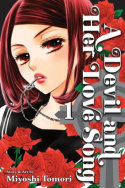
A Devil and Her Love Song, Vol. 1

January 24, 2012 by Michelle Smith

By Miyoshi Tomori | Published by VIZ Media

The back cover blurb of A Devil and Her Love Song contains the following lines: “Meet Maria Kawai—she’s gorgeous and whip-smart, a girl who seems to have it all. But when she unleashes her sharp tongue, it’s no wonder some consider her to be the very devil!”

And in my mind, this built up the expectation for a comedy, but that’s not what A Devil and Her Love Song is at all. It’s much more serious and sad than I had anticipated, but if I had done my research beforehand and realized that it originally ran in Margaret, I shouldn’t have been surprised.

Beautiful Maria Kawai has been expelled from her prestigious Catholic school, St. Katria’s, and must now enroll in a new school. She carries a lot of mental baggage from her experiences at St. Katria’s, most notably the fact that someone she regarded as her best friend told her “You taint everyone around you.” And, as if to lend credence to these words, Maria stirs up hostilities amongst her classmates almost immediately. The problem is that she’s so perceptive, and so blunt in her delivery, that she points out personality attributes that her classmates would rather not acknowledge, like the fact that they’ve been gossiping about her prior to her arrival, or that one boy is pushing himself to be liked by all even though he is not naturally a people person. Over the first week of school, matters escalate to the point where Maria is shoved down a flight of stairs and a truly odious teacher is telling her she’s “rotten to the core.”

And yet, there are certain lessons from her St. Katria’s days that serve Maria well in tough moments, like “those who believe will be saved,” which provides her encouragement to get through bullying encounters with a group of Mean Girls in her class. But she’s not taking solace from a religious implication of these words; instead, she seems to feel that if she believes in people’s good intentions, has faith that one day they will accept her, that this will actually come to pass. And so, even though she knows the girls have it in for her, she puts herself in the path of their harassment in the hopes that one day, she’ll win them over. As I said, it’s really rather sad and makes her far more sympathetic than I ever expected a sharp-tongued heroine to be.

I regret to admit I made another snap judgment of the series based on the chapter one title page, which depicts Maria and a couple of boys, one a cheerful blond and the other a surly-looking brunette. I assumed these would be her stereotypical shoujo love interests, but though both boys are definitely interested in her, they are far more complicated individuals than I had assumed they would be. The brunette, Shin, is grumpy, rebellious, and not really friendly with the rest of the class, but has a kind heart. It unsettles him that Maria can so clearly see through him, and he’s terrified of what would happen if she could discern what he’s feeling about her, but he still comes through with her when no one else will. There’s one especially nice scene where she’s so happy and scared by his kindness that she can’t even find the words to explain, so she sings instead.

On the other hand, you have Yusuke, who is trying so hard to be everyone’s friend that he’s actually no one’s real friend at all. His philosophy is the “lovely spin,” which is a survival mechanism he tries to impart upon Maria with little success. Turn everything into something palatable and nice, even if you’re being untrue to yourself, is the basic gist. It’s probably good for her to master this subterfuge, to avoid further confrontations and to effect the personal change she seeks, but why is he doing it? Just as he helps her master the art of diplomacy, one wonders whether she will help him drop the charade.

I mean no slight to shoujo comedies when I say that A Devil and Her Love Song is much better, richer and more deep, than I anticipated. To say that I am looking forward to reading the rest of this story would be a gross understatement.

A Devil and Her Love Song is published in English by VIZ Media. The first volume will officially be released on February 7, 2012. The series is complete in Japan with thirteen volumes.

Review copy provided by the publisher.

Filed Under: REVIEWS Tagged With: shojo beat, VIZ

Hyakusho Kizoku, Vol. 1

January 23, 2012 by Katherine Dacey

Drawn in a loose, improvisational style, Hiromu Arakawa’s Hyakusho Kizuko may remind readers of the gag strips that round out every volume of her wildly successful Fullmetal Alchemist. That’s not a knock on Hyakusho, by the way; like her fellow sister-in-shonen Yellow Tanabe, Arakawa’s omake are every bit as entertaining as her more polished stories, offering her a chance to riff on favorite characters, complain about her job, and reflect on her previous career as a dairy farmer.

In Hyakusho Kizuko, however, the focus is squarely on the joys and hardships of farm life, rather than the pressures of bringing a popular comic to press. Arakawa shares humorous anecdotes about her ongoing war with the Hokkaido squirrel, a skilled crop thief, as well as her family’s penchant for using animal medicines to cure their own ailments. She also waxes poetic about the temperament of cows — apparently, they make great pets — and celebrates Hokkaido’s important role in feeding the rest of Japan. (As she notes in chapter seven, Japan’s dependence on imported food would rise from 50% to 80% if Hokkaido stopped supplying the other islands with its agricultural products.)

Arakawa doesn’t neglect her life as an artist; throughout the stories, we see her interact with her editor, who’s decidedly skeptical about the marketability of agricultural manga. “How come you’ve written about poop two chapters in a row?” her exasperated editor asks. “In a farmer’s story, poop is your friend,” Arakawa cheerfully counters. Besides, Arakawa notes, her manga explores other topics: “I also mention cow teats,” she declares.

As these matter-of-fact exchanges suggest, Arakawa is eager to educate Japanese readers about where their food comes from. She drops facts about food consumption, discusses cow bloodlines, decries government interference in dairy production, and describes what happens to animals that don’t contribute to a farm’s bottom line. She does so with a light hand, however, interspersing the more serious discussions about sustainability with sight gags involving wild bears, foolish tourists, and barn cats.

None of these passages would be entertaining (or edifying) were it not for a solid adaptation. I’ve complained in the past about other JManga titles, which sometimes suffered from overly literal translations; witness Otaku-Type Delusional Girl, better known in English as Fujoshi Rumi. Hyakusho Kizuko, however, is a pleasant surprise; the translator has done an excellent job of rendering the text in fluid, conversational English that’s a genuine pleasure to read. In fact, the best compliment I could pay the translator is to note that I actually laughed out loud reading several passages.

I’d be the first to admit that Hyakusho Kizuko won’t be every FMA fan’s idea of a good read; folks who like Arakawa best when she’s staging magical combat may find the information-dense passages too didactic for their tastes. For curious city dwellers, however, Hyakusho Kizuko will be a revelation, offering them an entertaining look at the day-to-day operations of a working farm. Highly recommended.

HYAKUSHO KIZOKU, VOL. 1 • BY HIROMU ARAKAWA • SHINSOKAN PUBLISHING CO., LTD. • 139 pp. • NO RATING

Filed Under: Manga, Manga Critic, REVIEWS Tagged With: Agricultural Manga, Comedy, Hiromu Arakawa, JManga

Skip Beat!, Vol. 26

January 23, 2012 by Sean Gaffney

By Yoshiki Nakamura. Released in Japan by Hakusensha, serialization ongoing in the magazine Hana to Yume. Released in North America by Viz.

It’s been a while since I reviewed Skip Beat! in depth – the last two volumes were Briefs for the Manga bookshelf team. Since then, the Natsu arc has basically wrapped up, although Kyoko is still doing that show. In the meantime, Chaiki has now joined the Love Me team. And, as with Kyoko and Kanae, her cynicism and inability to “love” is her undoing, at least as far as Lory is concerned.

Lory may be an eccentric (the python is quite typical of him, complete with the pun), but you can’t say that he’s not trying his best for these girls. Not only is his “punishment” acting assignments most young people would kill for, but they’re tailored perfectly for each of the victims. Chiaki in particular is trying hard to rediscover her love of acting, and swallows her pride a little here as she is well aware of what she needs to do in order to open up. Sadly, we only hear a bit of what Kanae is going to be doing. But Kyoko is the star, and as always the focus is on her.

Kyoko is ordered to go meet a “scary person”, and I was amused at the reminder of how out of place she is in normal society, especially in the Love Me uniforms (which are given a nice cover image here). Kyoko just stands out, and given that the crowd are already creeped out by Cain Heel, it makes sense that the combination of his aura with that of Kyoko’s leads to fireworks. Speaking of Cain Heel, Cain is, of course, Ren, something that we and Kyoko recognize right away, though Kyoko immediately doubts herself. I do sometimes wonder if Ren is an ex-Love Me member, and if Lory still gives him assignments in the same manner that he does for Kyoko. Certainly Cain Heel is designed to hit several of Ren’s buttons.

Naturally, Kyoko is now paired with Ren again, and we get to see her take on another role – this one outside of the TV camera, as she’s playing Cain Heel’s spoiled sister, Setsu. Seeing Kyoko get into the role is probably the high point of this volume. Each time she’s had to play someone “different” from herself it’s caused problems, and this time is no different. Yet she seems to get a hold of Setsu’s basic nature much faster, and has become adept at looking into the character’s motivations. Of course, this can be very problematic when they’re forced to live together in the same motel room…

Though obviously not explicit, there’s an incestual subtext here. The Heel siblings are close to the point of obsession, and Kyoko accurately notes that Setsu’s love of her brother is a bit disturbing. And it goes the other way as well, of course, showing us Cain’s love of his sister intermingling with Ren’s feelings for Kyoko. Ren has always been about repression and masks, so seeing him losing it and cracking is a treat. He really desires Kyoko here, and we start to see the real reason that Lory paired Ren and Kyoko together. Of course, he regards his desires as deeply wrong, so we’re still not actually going anywhere, but…

This new arc promises to be a lot of fun, and is already mixing together humor, romance and drama in equal measures. It’s still running in Japan, so we’ll be seeing a lot of the Heel siblings in future volumes. For now, though, we’ll enjoy the comedy, be amused at the pseudo-romance, pretend not to notice Ren’s obsession merging with “Cain Heel”, and try to forget that terrifying panel of Ren’s huge hand reaching out to grab Kyoko and drag her into an alleyway, which would be genuinely horrible if we didn’t know it was him.

Filed Under: REVIEWS

  • « Go to Previous Page
  • Page 1
  • Interim pages omitted …
  • Page 286
  • Page 287
  • Page 288
  • Page 289
  • Page 290
  • Interim pages omitted …
  • Page 346
  • Go to Next Page »
 | Log in
Copyright © 2010 Manga Bookshelf | Powered by WordPress & the Genesis Framework