• Skip to primary navigation
  • Skip to main content
  • Skip to primary sidebar
  • Home
  • About Us
    • Privacy Policy
    • Comment Policy
    • Disclosures & Disclaimers
  • Resources
    • Links, Essays & Articles
    • Fandomology!
    • CLAMP Directory
    • BlogRoll
  • Features & Columns
    • 3 Things Thursday
    • Adventures in the Key of Shoujo
    • Bit & Blips (game reviews)
    • BL BOOKRACK
    • Bookshelf Briefs
    • Bringing the Drama
    • Comic Conversion
    • Fanservice Friday
    • Going Digital
    • It Came From the Sinosphere
    • License This!
    • Magazine no Mori
    • My Week in Manga
    • OFF THE SHELF
    • Not By Manga Alone
    • PICK OF THE WEEK
    • Subtitles & Sensibility
    • Weekly Shonen Jump Recaps
  • Manga Moveable Feast
    • MMF Full Archive
    • Yun Kouga
    • CLAMP
    • Shojo Beat
    • Osamu Tezuka
    • Sailor Moon
    • Fruits Basket
    • Takehiko Inoue
    • Wild Adapter
    • One Piece
    • After School Nightmare
    • Karakuri Odette
    • Paradise Kiss
    • The Color Trilogy
    • To Terra…
    • Sexy Voice & Robo
  • Browse by Author
    • Sean Gaffney
    • Anna Neatrour
    • Michelle Smith
    • Katherine Dacey
    • MJ
    • Brigid Alverson
    • Travis Anderson
    • Phillip Anthony
    • Derek Bown
    • Jaci Dahlvang
    • Angela Eastman
    • Erica Friedman
    • Sara K.
    • Megan Purdy
    • Emily Snodgrass
    • Nancy Thistlethwaite
    • Eva Volin
    • David Welsh
  • MB Blogs
    • A Case Suitable For Treatment
    • Experiments in Manga
    • MangaBlog
    • The Manga Critic
    • Manga Report
    • Soliloquy in Blue
    • Manga Curmudgeon (archive)

Manga Bookshelf

Discussion, Resources, Roundtables, & Reviews

Reviews

Hetalia Axis Powers, Vol. 3

July 9, 2012 by Sean Gaffney

By Hidekaz Himaruya. Released in Japan by Gentosha, originally serialized as an online webcomic. Released in North America by Tokyopop in association with Right Stuf, Inc.

For the first time in over a year, I get to review a new Tokyopop book. And naturally, it’s the third volume of Hetalia Axis Powers. It was a runaway bestseller, so it makes sense that it should come back. The translation for it had already been done, given it was scheduled to ship a mere month after TP initially went under. And, being one of the company’s few Gentosha books, I imagine the renegotiations were easier than with a company like Kadokawa or Akita, who might inquire about the 7-8 other abandoned titles that there is little interest in reviving.

The quality of the book itself is a huge improvement over the first two, at least production-wise. The paper is thicker and more durable, there are color pages, and it simply feels more ‘quality’ than the almost xeroxed feel of the first two volumes. As for Himaruya’s art, it’s always going to look a bit dashed off, as that’s just what he does, but it does look a bit clearer here than in prior books.

The series is less about World War II than ever before, but that’s absolutely fine. History buffs may like Hetalia, but in the end it’s not particularly written for them. It’s a goofy comedy starring a bunch of (mostly) guys who do dumb things around each other, and happen to be nations of the world. There’s a bit less reliance on stereotype here (though still a lot – don’t think it vanishes) as we have grown to know the characters and therefore the author can rely on simple character-based gags, such as tomboy Hungary not realizing that she’s a girl, or Japan’s crushing disappointment that Switzerland does not look like Heidi at all.

This is not to say that there aren’t plenty of historical strips, they’re just used as setup for the most part. Probably the best in the book is the analysis of the alliance between Poland and Lithuania in the 15th and 16th century, which also gives us a chance to see some actual action in the series, however brief, as the two nations battle against Prussia and Sweden (what an odd pairing. Are their fanfics? … yes, of course there are.) At times the history/gag comic balance can be upset a bit, but it’s mostly unintentional. When Prussia comes across an older Hungary lying beaten against a tree with clothes torn open, the unpleasant implication is that she was just raped by Turkey. While this is not entirely out of place given the actual history that happened between the two, it jars in a comic that mostly has a light touch with catastrophic world events.

There are a few new nations introduced here (including another rare female, Belgium), and some get a bit more development, such as the Nordics. But for the most part the main cast of 3 Axis and 5 Allies remain the focus, and they have lots of goofy times. Several of the gags fall flat, but the book reads quickly, and in the end you read it with a smile on your face more often than not. That said, this is only recommended to those very familiar with the series, and would be a wretched starting point for newbies. Let’s hope it sells well enough to get a Vol. 4… and perhaps inspire some other license rescues?

Filed Under: REVIEWS

The Future Is Japanese: Science Fiction Futures and Brand New Fantasies from and about Japan

July 8, 2012 by Ash Brown

Editor: Nick Mamatas and Masumi Washington
Publisher: Viz Media
ISBN: 9781421542232
Released: May 2012

I have been impatiently waiting for The Future Is Japanese: Science Fiction Futures and Brand New Fantasies from and about Japan, edited by Nick Mamatas and Masumi Washington, ever since the anthology was first announced. I already adore Viz Media’s Japanese speculative fiction imprint Haikasoru and will buy and read anything it publishes. However, I was particularly excited about The Future Is Japanese because it is Haikasoru’s first original publication. (I also hope that it isn’t the last.) I was thrilled when the book was finally released in 2012. The anthology collects thirteen stories from creators both East and West (primarily Japanese and American). All but two of the stories were being published for the first time. Just looking at the table of contents I was very pleased with what I saw. Most of the contributors to The Future Is Japanese are already award-winners in their own rights; those whose works with which I wasn’t already familiar I at least recognized by name. As an added bonus, the book’s cover illustration is by Yuko Shimizu, one of my favorite artists. The Future Is Japanese had a lot going for it from the very start.

After a foreword by Masumi Washington and an introduction by Nick Mamatas, The Future Is Japanese begins strongly with Ken Liu’s short story “Mono no Aware,” a meditation on impermanence wrapped in a science fiction tale of humanity’s survival at the edge of space. The next two stories were probably my least favorite in the collection although there were moments in each that I enjoyed tremendously. “The Sound of Breaking Up” by Felicity Savage starts as one story and ends up being an entirely different one. This frustrated me because I was more interested in the first. David Mole’s mecha tale “Chitai Heiki Koronbīn” ends too abruptly for my taste and seemed like it should be the introduction to a longer work. (Granted, one that I would like to read.) These are followed by “The Indifference Engine” by Project Itoh which explores war, hatred, and prejudice. Originally published in 2007, the story confirmed the fact that I want to read everything written by Itoh. The next story was one of my personal favorites in the anthology, “The Sea of Trees” by Rachel Swirsky, a haunting tale about death, ghosts, and letting go. Toh EnJoe’s story “Endoastronomy,” which follows next, has a philosophical and intellectual bent to it, something I enjoy about and have come to expect from his work.

The next selection, “In Plain Sight” by Pat Cadigan deals with the complications caused by artificial and augmented realities. The Future Is Japanese continues with “Golden Bread” by Issui Ogawa. I happen to be fond of Ogawa’s longer works and was not disappointed with his short story. Next is Catherynne M. Valente’s contribution, “One Breath, One Stroke” which is about yokai that live close to the human world. Written in a delightful but fragmented style, the work creates more of a mood rather than a cohesive story. Ekaterina Sedia’s near future and slightly melancholic tale “Whale Meat” follows. Next in the anthology is a selection from the extremely prolific Hideyuki Kikuchi. I actually preferred “Mountain People, Ocean People” over many of the other works of his that I have read. Following next is “Goddess of Mercy” by Bruce Sterling, one of the longer stories in the collection it is about the pirates and darkness that settle on Tsushima island after Japan is destroyed. The Future Is Japanese concludes with “Autogenic Dreaming: Interview with the Columns of Clouds” by TOBI Hirotaka. Originally published in 2009, the story won a Seiun Award in 2010. A complex story featuring a digitization project that has unexpected consequences, “Autogenic Dreaming” particularly appealed to my information science background.

As with most short story collections, how much a reader will enjoy each individual work in The Future Is Japanese will depend on personal preferences. Although I wasn’t blown away by the anthology, personally I found The Future Is Japanese to be a very satisfying read. The short story can be a difficult form to master, but even the works that I found problematic had their strong points. The stories do all tend to be serious in tone, but the collection covers a nice range of speculative fiction from fantasy to science fiction to horror. The Future Is Japanese also has a good balance between Western and Japanese authors. Appropriately enough for the anthology’s theme, even the Western works show Japanese influence, whether stemming from the writers’ personal interests or from the creators having lived in or visited Japan. Overall, The Future Is Japanese is a solid anthology that was well worth the wait.

Filed Under: REVIEWS Tagged With: Haikasoru, Ken Liu, Masumi Washington, Nick Mamatas, Project Itoh, viz media

Attack on Titan, Vol. 1

July 6, 2012 by Sean Gaffney

By Hajime Isayama. Released in Japan by Kodansha, serialization ongoing in the magazine Bessatsu Shonen Magazine. Released in North America by Kodansha Comics.

When the buzz for this series first started coming out, right about when it got the Kodansha manga award last year, I recall many people mocking Shueisha for turning it down. The author had shown the series to the editors of Weekly Shonen Jump, and was promptly told that the series was not Jump enough. So he turned around and sold it to Kodansha, and now it’s a bestseller. But they were absolutely right. This isn’t a Jump series at all. Leaving aside the basic horror of the premise, modern Jump simply isn’t this grim. Even Kodansha thought it was more suited to their monthly magazine than the flagship.

The series immediately knows that its strength are the titans themselves. They are huge, grotesque, and unknowable, even as the humans in the city desperately try to discover their weak points and flaws. Seeing likeable characters literally getting eaten by these things not only gives a feeling of desperation to the series, but helps you to side even more with our band of heroes who have vowed to destroy them – particularly the brother-sister team who keep the viewpoint.

Speaking of that, and this is a bit of a spoiler, apologies. I’m not at all sure, at the end of Vol. 1, how I feel about Eren. So-called decoy protagonists are nothing new in manga, and we’ve certainly seen folks we thought would be the hero getting mercilessly killed off right away before. But he doesn’t quite have the right *feel* of one of these, and I’m not sure the manga is ready to follow Mikasa and Armin for the rest of the series. I came out of the closing moments of the cliffhanger thinking along the lines of “…really? How are they going to walk back from that one?” Of course, if I prove to be wrong, it’s quite an impressive step to take. Especially given that the seemingly emotionless Mikasa seems more likely the sort to launch a roaring rampage of revenge after this.

If the series does have a downside, it’s the art when titans are *not* on the screen. There’s a fairly large cast filled with military types here, many of whom I presume will form our core cast. It’s a shame I had so much trouble telling them apart, then, and kept flicking to the montage introduction in the middle of the book to try to get them straight. There’s also some basic siege cliches in here – Eren’s fight with Jean is right out of the big book of war movies.

More to the point, I’d like a few more signs that there’s light at the end of the tunnel. This series is still ongoing, at 7+ volumes in Japan, and I really hope that we get a few more bright spots ahead. As if it ends up being the story of how a ragtag bunch of misfits go up against the enemy and slowly die one by one, the story will be fascinating, but far too downbeat for my taste. I hope the 2nd book can show a bit more optimism.

Filed Under: REVIEWS

Genshiken: Second Season, Vol. 1

July 4, 2012 by Sean Gaffney

By Shimoku Kio. Released in Japan by Kodansha, serialization ongoing in the magazine Afternoon. Released in North America by Kodansha Comics.

This review is based on an advance uncorrected proof provided by the publisher, and does not reflect a review of a finished product.

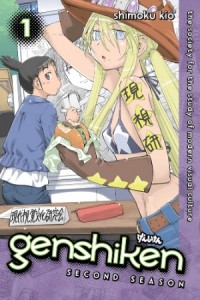
It’s not all that much of a surprise that the Genshiken series has returned for more adventures of everyone’s favorite otaku club. The original series also slowly evolved over its nine volumes, seeing the club shed members and switch club presidents, even though the basic cast stayed the same. But now almost all that cast has graduated, so this sequel also has the challenge of introducing a whole bunch of new people and hoping that the reader will appreciate them in the same way they did when Ogiue joined.

Speaking of Ogiue, as the series starts she’s the new club president, not that there’s much of a club. It only has three people, partly as it seemingly duplicates other club’s interests, but mostly as it still has Kukichi. I have to say that while I appreciate his value as a comic foil, Kukichi’s utter creeptasticness still rubs me the wrong way, even in this new series. Luckily, as in the original series, he is used sparingly. This is partly because Kio-san also has another comic relief character to balance things out, Suzanna. Who is also creeptastic, particularly in her inability to speak in anything but old anime phrases, but at least doesn’t make me want to wash afterwards.

As for the new folks, there are two characters who get the bulk of the screen time, and I suspect they will start to force out Ogiue and Ohno just as those two slowly took over from Sasahara and company. Yajima is a poor artist but wants to be better at it, and seems to be filling the ‘we need at least one normal person in the club’ function that used to be Kasukabe’s, though Yajima at least is also an otaku. More interesting is Kenjiro Hata (I thought this might be a Hayate the Combat Butler joke, but it seems to be a coincidence), a character who I can’t really discuss without spoiling the first volume. It’s Hata I expect most Japanese fans will be glomming onto, though I’m not sure about Western fans.

For those wondering if this will resolve anything from the prior series, such as Madarame’s unrequited love… well, Madarame does show up throughout, despite having graduated, and he still seems to be hung up on Kasukabe. Whether that goes anywhere I suspect depends on how fast the new group of characters catches on. I am reminded of the K-On! series, which tried to have its came and eat it too by introducing some new girls for Asuka’s high school band while also following the four others to college. In the end, neither one caught on with readers. Genshiken has been doing this from the start, but we now have a bit more of a tonal shift. As the cast has gotten more and more female, the otaku obsessions have grown more and more BL. The series still runs in Afternoon, a magazine for young men, but I do suspect that the sequel over here may find a larger crossover BL-audience than the original did. (Though the original also had its female fans, of course.)

In the end, I enjoyed getting back to this series. It’s like visiting an old hangout and seeing what’s changed. Thankfully, there’s little melancholic ‘good old days’ here: things are the same as ever, just with a new cast. I look forward to seeing their awkward fits and starts of growing up. Which is, of course, the real plot of Genshiken: Awkwardness Is Magic.

Filed Under: REVIEWS

Vagabond, Vols. 1-3

July 1, 2012 by Michelle Smith

By Takehiko Inoue | Published by VIZ Media (first VIZBIG edition)

One of my goals for this Manga Moveable Feast was to finally read some of Vagabond. I’ve been collecting the VIZBIG editions since they started coming out, which means there were ten of these on my shelf (with their spines forming a group portrait) unread. Now that I finally have read some of Vagabond, I’ve found it so different from the Inoue I’m familiar with—and yet containing some of the same themes—that I’m rather at a loss for words.

Shinmen Takezo is the son of a legendary swordsman, though we don’t really find that out until volume three. Since the age of thirteen, when he killed a man who came to Miyamoto village looking to challenge its strongest occupant, he’s been ostracized by all save a couple of childhood friends and he’s recently been off to battle with one of them, Hon’iden Matahachi. They both survive a bloody battle, but Matahachi takes up with a thieving widow, leaving Takezo to return to Miyamoto with tidings of Matahachi’s survival.

To make a long story very short: Takezo meets with an unfriendly welcome and is manipulated by a clever monk named Takuan into reevaluating his life. Four years later, now going by the name Miyamoto Musashi, he shows up in Kyoto looking to challenge the head of the Yoshioka sword school, and though he defeats many of their members, he learns there are still those stronger than him. A drunken Matahachi accidentally sets the blaze that allows Musashi to escape, and the VIZBIG ends with him realizing that the old friend he left for dead might actually have survived.

Even though I knew this was about swordsmen, I somehow didn’t expect it to be as gory as it is. There are a lot of death blows being dealt here, as Musashi is obsessed with measuring/proving his strength against others and willing to sacrifice his life to this aim. That said, at times the art is absolutely gorgeous, and there are a few color pages that look like bona fide paintings. The scope, layout, and pacing of the story all lend it a cinematic feel that is genuinely impressive. There’s one scene early on, when Musashi turns around to face the one opponent left standing and it’s genuinely terrifying.

But yet, I mostly found it unaffecting. I expect there will be more insight into the main character as time progresses, but for now he’s so closed off, so proud of his strength and being hailed a demon that I can’t grow fond of him or endorse his goals. I have a feeling I’m not supposed to. I did identify with Matahachi a lot, though, especially his inferiority complex in regards to his friend and his inability to follow through with the heroic deeds he imagines himself performing. I like Otsu, the fiancée Matahachi left behind, and I’m intrigued by Takuan, the monk. I’ll keep reading for them, if nothing else.

One thing about Musashi reminds me a lot of Hisanobu Takahashi in Real. As a child, Hisanobu was attempting to master a particular basketball move that his father showed him. He worked very hard on it, but was never able to show his father because the latter abandoned the family. Musashi has also been abandoned by his mother and shunned by his father, and part of his drive to test himself seems due to the desire to show them his strength, show them that he doesn’t need to depend on anyone else. Musashi is a real historical figure, not a character Inoue created, but it seems like he’s drawn to these confident yet wounded types.

Ultimately, I can see why Vagabond is hailed as a masterpiece, and I will certainly keep reading it, but my heart will always belong to Inoue’s sports manga, Slam Dunk in particular. The heart wants what the heart wants!

Vagabond is published in English by VIZ Media. Single volumes up through 33 have been published, as well as ten “VIZBIG” editions comprised of three volumes each. An eleventh VIZBIG edition is scheduled to be released in December. Inoue has recently resumed the series in Japan, so the upcoming release of volume 34 (October) will be the first new Vagabond released in English in two years.

Filed Under: REVIEWS Tagged With: Takehiko Inoue, VIZ

Alice In The Country Of Hearts Omnibus, Vol. 3

June 28, 2012 by Sean Gaffney

By Quin Rose and Soumei Hoshino, based on the game by Quin Rose. Released in Japan as “Heart no Kuni no Alice ~Wonderful Wonder World~” by Mag Garden, serialized in the magazine Comic Blade Avarus. Released in North America by Yen Press.

I have a sad confession to make. You see… I forgot to spoil myself for the end of this manga. I know, it sounds unusual. After all, you are my faithful readers, and know me well. You know that I traditionally spoil myself rotten. And indeed, later on in this review I will be discussing ‘the big spoiler’, be warned. But when Tokyopop released Vol. 5 of this series, they hadn’t yet gone under, and there wasn’t as big a need to find out what was going on. Afterwards, well, I just forgot to. What this means, though, is that for once I came at an ending with no idea what would happen, and thus managed to be both surprised and pleased. Which is especially surprising given the ending’s hardly happy…

In a previous review of this series, I had noted that what I enjoyed most about it was that all of Alice’s choices for her ‘reverse harem’ were so broken. And even though there was a good deal of ‘and she changes them with her pure heart and friendship’ to it – this is still an adaptation of an otome game, after all – many of them stayed pleasantly psychotic and bloodthirsty anyway. Indeed, Ace was probably my favorite character, as he recognizes and is actively fighting against what Alice represents. There’s also some good backstory given throughout, especially regarding Blood Dupre, Vivaldi, and Eliot March. You get the sense that life actually happened before Alice arrived, which is hard to achieve in a setting like this.

I understand, having spoiled myself NOW, that fans of the games were a little annoyed at the opaqueness of the manga, especially towards the end. There’s apparently a whole lot left out about the nature of Peter White, etc. (Which doesn’t seem to bother me as much, mostly as I loathe Peter White. The manga apparently turned up the ‘jerk’ level on several characters, and he was the worst of them.) This is the nature of such adaptation, though, and I recall Higurashi fans being similarly annoyed with the anime. The question is whether one can get a gleaning of what actually happened from what the manga writer givens us. And I think the answer is yes, though it’s only a gleaning. (Apparently the manga writer didn’t understand the game’s ending.)

Here’s where I talk spoilers, by the way.

We’ve had Alice in Wonderland for most of the manga series, but occasionally she gets these pangs of conscience that she really should “wake up” and return to the real world, as her big sister is waiting for her. And as she interacts with the others, the vial she was given at the start fills up with liquid. When it’s full, she can return. And so she does, despite some misgivings, and others telling her not to, and those strange headaches she gets sometimes. And when she returns, she finds… well, actually, she doesn’t. Blood Dupre goes screaming off grumpily into the ‘real world’ after her and forces her to return. Having gotten approval to do this by Nightmare, who can now ‘Seal Off’ Alice’s memories again. And then we see her older sister in a coffin.

And suddenly the entire premise is thrown on its ear. Suddenly instead of ‘a teenage girl lands in a magical fantasy land where she must decide which hot guy she likes best’, it would seem that the land itself is attempting to prevent Alice from sinking into what is presumably hopeless despair in the real world, and that her sitting with her sister having tea and talking books is actually the dream. And that the vial which fills up as Alice interacts with the others is likely to be filling with ALICE’S feelings, not the guys falling for her. And we see why she gets so upset when all the others in Wonderland keep trying to murder each other (well, besides the usual reason anyone would).

So what we have here is a bunch of sociopathic clockwork people attempting to rise above their station and change themselves, even though that is completely impossible, and also help to heal the heart of a broken and damaged young woman devastated at a death in the family by sealing off her memory and keeping her in a fantasy world filled with blood and chaos. And that’s fantastic. Discomfiting, but fantastic. In short, this manga is more for Higurashi fans than for, say, Ouran fans. Highly recommended, and re-reading all 3 omnibuses in one stroke definitely helps as well.

Filed Under: REVIEWS

Sunshine Sketch, Vol. 6

June 25, 2012 by Sean Gaffney

By Ume Aoki. Released in Japan as “Hidamari Sketch” by Houbunsha, serialization ongoing in the magazine Manga Time Kirara Carat. Released in North America by Yen Press.

As I have noted many times before, there are certain manga that I like *because* I can go into them and not be surprised. Most 4-koma style manga fall into that category, mostly as plot development, if any, is glacial. In the case of Ume Aoki’s Sunshine Sketch, I have a limited pallette I want to see. Will Sae and Hiro have not-quite-yuri moments? Will Miyako be extremely silly and weird? Will Yuno be adorable? And indeed I got all of these things while reading the 6th volume of this series. But I was pleasantly surprised to see that I did also get some character development, as well as a sense that Vol. 7 may be the final one (at least for our favorite third-years).

First off, it has to be said that Yoshinoya-sensei, the girls’ teacher, has never particularly been a favorite of mine. She’s there purely as comic relief, and the exhibitionist and boob jokes have always seemed vaguely out of place in a moe blob series like this. And indeed, we still get both of those here. But I was also pleased to see signs that she is a good teacher at heart, as well as a few strips showing her bonding with her own generation of friends. And her advice to Hiro at the end is spot on, seeing through all of Hiro’s stress right to what’s really going on, and soothing her while letting Hiro understand the solution has to come from her. It’s a nice thing to see.

Speaking of Hiro, I was rather surprised by the final collection of strips here, as I figured that if anyone was going to freak out about graduation and losing her best friend, it would be Sae. Hiro has always seemed to be the more mature and together one in our favorite pair. That said, the desire to have a beloved situation stay exactly the same is a well-known one. Hiro’s choice of career, as Sae notes, is an excellent one, and has been quietly signposted through the previous volumes. But most of all, there’s Sae’s reassurance that things will be OK, even if the two are separated that finally soothes Hiro and gives her resolve. They are a wonderful couple (except they aren’t a couple), and everyone around them knows it.

As for the rest, Nazuna has the cover with Yuno this time around, and I’m slowly getting used to her and Nori. She seems to be funniest when horrible things are happening to her, sad to say. As for the art style, well, it’s Volume 6. If readers disliked the art I’m sure they would have dropped it by now. I have noticed a lot less ‘squashed SD’ style in these latter panels, as the girls seem to be drawn more ‘normally’, presumably as Aoki has gained confidence in her work.

Sunshine Sketch 6 gives readers exactly what they want from this sort of series: more of what they like about it. And, as an added bonus, there’s some additional depth as well. An excellent quick read.

Filed Under: REVIEWS

Love Hina Omnibus, Vol. 3

June 21, 2012 by Sean Gaffney

By Ken Akamatsu. Released in Japan by Kodansha, serialized in the magazine Weekly Shonen Magazine. Released in North America by Kodansha Comics.

Things are beginning to pick up a bit in this third volume of Love Hina. Yes, there is still a lot of Keitaro seeing people naked and Keitaro getting hit, but it’s far less than in the first few volumes. Akamatsu is finding he can indeed do things other than ecchi comedy, and is also starting to realize something important: he has no idea where to go with this once his heroes achieve their goal.

Yes, surprise, Keitaro, Naru and Mutsumi all make it into Todai in this collection. Admittedly, it takes 2/3 of the omnibus for this to happen, including a visit to another turtle-infested South Sea island. The reason for this being that Keitaro, convinced he failed, has run away. Except… he didn’t fail. He’s in… provided he submits his paperwork on time. This is what drives most of the comedy here, a fast-paced race against time chase with increasingly ludicrous situations. Something that should be very familiar to Negima readers. Yes, Ken can still bring the ecchi comedy, but the difference between this and the start of the series is the *pacing*. The first volume is glacial, and you only realize how much after seeing these volumes.

Speaking of realization, as I noted, Akamatsu has realized he does not really want Keitaro in college stories. This is what leads to the broken leg that keeps him sidelined most of the last third of the book. And kudos to Akamatsu for lampshading this heavily, given the amount of abuse he’s taken from Naru. Everyone jokes that they had thought he was immortal. Admittedly, making him physically vulnerable does undercut the ‘comedic sociopathy doesn’t hurt’ rules of this universe… I suppose I should be lucky he didn’t get the broken leg via a Naru punch. Anyway, getting back to my point, Keitaro as a hapless college student, worrying he and Naru are growing further apart is kinda boring. But Keitaro the competent archaeologist, using his bad luck for good rather than for evil? That works. Keitaro on the island is the most likeable we’ve ever seen him. (Akamatsu will go too far with this, but we aren’t quite there yet.)

On the romance front, Keitaro has at last confessed to Naru. Who takes her own sweet time in answering him, mostly as she’s just as bad as he is in most respects. This gets contrasted with Seta and Haruka, who not only turn out to have dated when they were students, but also have many similarities to the current Keitaro and Naru. In fact, Haruka’s enraged beating of Seta after embarrassing her one too many times could easily have been a typical Keitaro/Naru farce. It’s a really sweet chapter, though, and one hopes that they can resolve things soon… especially as our heroes seem to realize the parallels with their own situation.

Motoko and Shinobu also get some short arcs towards the end. Shinobu proves to be a fairly mediocre student, and most of her story is spent trying to teach her to study properly while showing off her crush on Keitaro. (Naru doesn’t help by still being in the ‘who likes that idiot?’ phase of her life.) And Motoko’s sister, Tsuruko shows up, supposedly to test Motoko’s allegiance to her sword art, but in reality to try to make her mature more and get over some of her worst hangups. Of course, this being Love Hina, Tsuruko goes about this via some tough love. This gives us an iconic image of Motoko dressed as a maid, determined to become the perfect feminine woman since she can’t please her sister by her sword mastery. The anime would take this and run with it, I seem to recall.

So things look almost ready to wrap up here. Keitaro and Naru aren’t together, but both know their feelings for each other. And they got into Todai. Looks as if this series is ready to wrap up. Of course, it’s not. There’s 2 more omnibuses to go. Join us next time when we introduce the second most controversial character in all of Love Hina (Naru being first, of course.)

Filed Under: REVIEWS

Drifting Net Cafe, Vol. 1

June 19, 2012 by Katherine Dacey

It takes nerve — nay, stones — to update Kazuo Umezu’s bat-shit classic The Drifting Classroom. That’s exactly what Shuzo Oshimi (The Flowers of Evil) has done in Drifting Net Cafe, however, substituting a nebbishy salaryman for Sho, the original series’ twelve-year-old protagonist, and an Internet cafe for Sho’s school. The results are a decidedly mixed bag, suggesting that some texts lend themselves to revision, while others are too much the product of particular author’s imagination to warrant re-telling.

As in the original series, the story begins with a snapshot of the hero’s daily life: 29-year-old Toki has an argument with his pregnant wife, Yukie, then goes to an office job he dislikes. On impulse, he stops in an Internet cafe on his way home from work, where he bumps into Tohno, a girl he loved in middle school. The two begin comparing notes on their current lives when an earthquake plunges the building into darkness. When no one arrives to lead Toki, Tohno, and their fellow customers to safety, the group makes a terrifying discovery: the cafe has been transported from Tokyo to a wasteland from which all evidence of human civilization — roads, buildings, people — has been expunged.

To his credit, Oshimi takes enough time to establish Toki’s routine and personality for the reader to appreciate what’s at stake if Toki doesn’t find a way to return to his old life. None of the other characters, however, are fleshed out to the same degree. Yukie is portrayed as a howling grotesque, at the mercy of her hormones; Tohno is saintly and brave; and the other cafe customers are assigned one or two defining traits, depending on their gender and age. Thin characterizations are a common problem in disaster stories; authors are often reluctant to bestow too much humanity on characters who are destined to become monster food or cannon fodder, lest the audience find the story too dispiriting. Oshimi, however, takes that indifference to an extreme, creating a supporting cast of repellant, one-note characters whose comeuppance elicit cheers, not tears.

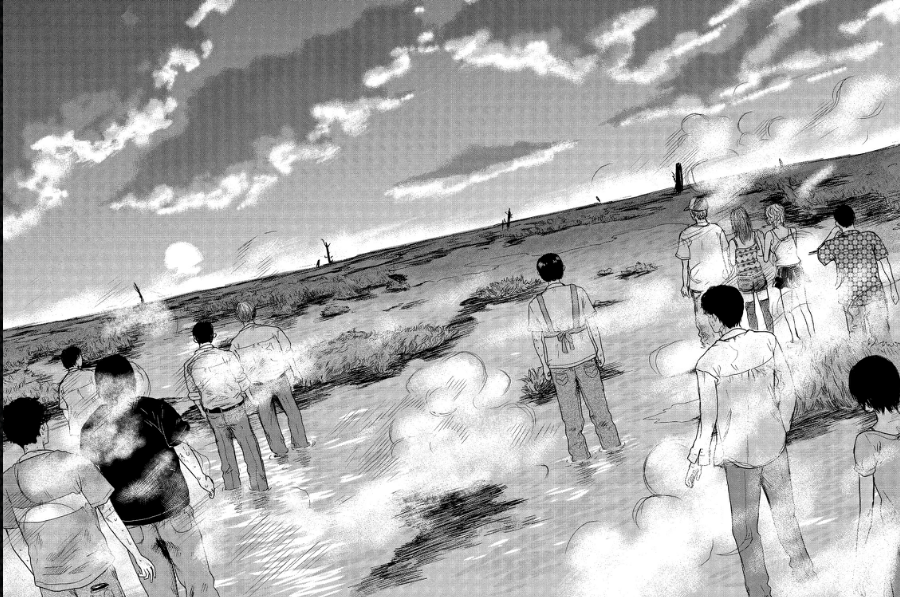
The other great drawback to Drifting Net Cafe is Oshimi’s lack of imagination. Though Oshimi is a competent draftsman, he shows little of Umezu’s flair for nightmarish imagery. Consider the way Oshimi renders the cafe’s final destination:

The wasteland, as imagined by Shuzo Oshimi in Drifting Net Cafe.

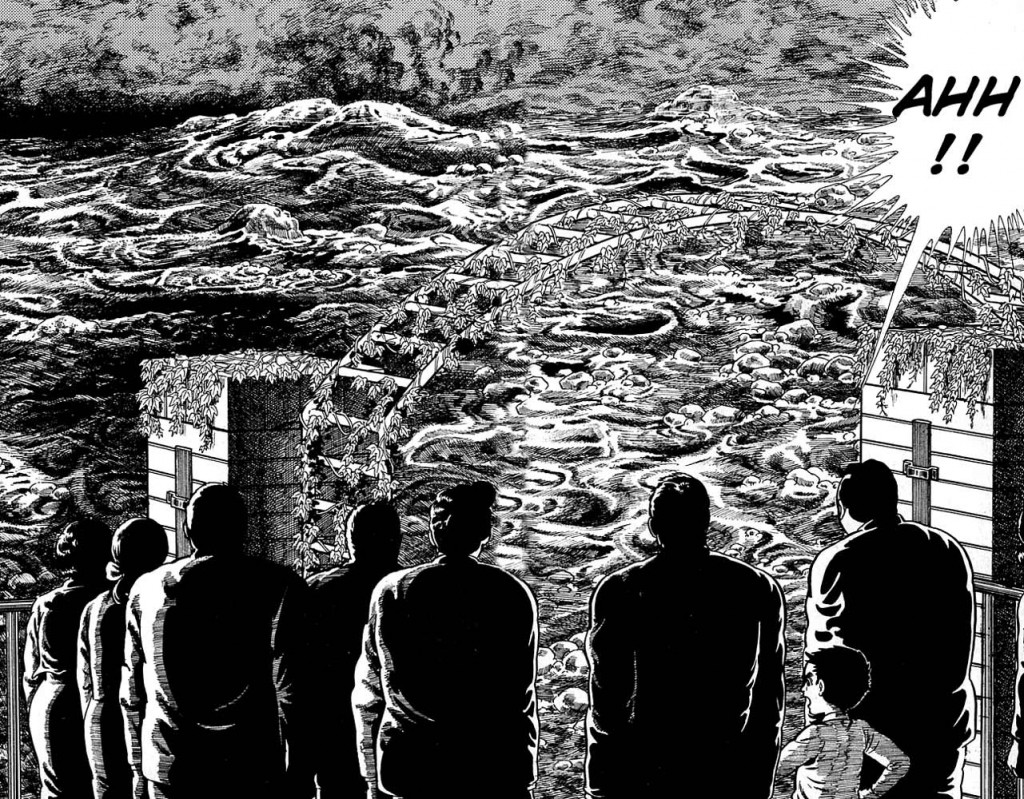
It’s not a badly composed image; Oshimi makes effective use of the tilted camera angle to convey the characters’ disorientation, and uses a few charred trees to suggest that something powerful scoured the landscape clean. When contrasted with the original version, however, it’s clear that Oshimi’s image elicits a much tidier, less emotional response than the repulsive, molten moonscape that Sho and his teachers discover just beyond the school gates:

Umezu’s vision of the wasteland, from The Drifting Classroom.

Oshimi’s monsters, too, betray his tendency to favor blandly polished imagery over inspired, if crudely rendered, boogeymen. Late in volume one of Drifting Net Cafe, for example, a creature resembling a typical Star Trek parasite attacks a female character, latching onto her thigh. It’s a memorable scene, tapping a similar vein of body-violation horror as Alien and Prometheus, but the monster’s quick defeat makes it seem more like a pretext for fanservice than a genuine menace. Umezu’s monsters, by contrast, take a variety of forms — giant insects and lizards, creepy aliens with bulbous foreheads, giant metallic serpents with grasping hands — all of which seem like the products of a feverish child’s imagination, rather than something copied from a TV show or straight-to-DVD movie.

The characters’ conflicts, too, seem smaller and less compelling than they did in Umezu’s original, which pitted Sho and his classmates against their teachers. The Drifting Classroom‘s adults quickly become deranged with grief and fear, leaving the children to fend for themselves in a hostile environment. Sho and his classmates spend several agonizing chapters struggling to accept the fact that none of the adults are in charge anymore; the students’ first attempts to defend themselves against crazed teachers and giant bugs end in catastrophe, a gruesome reminder of their misplaced trust in the adults.

In Oshimi’s version, however, all the characters are adults. They challenge one another’s leadership, squabble over resources, and indulge their worst impulses, sexual and otherwise. Though some of these scenes pack a visceral punch, most simply reinforce the idea that Toki and Tohno are the only decent folk among a group of unpleasant, self-interested urbanites — not exactly the stuff of high-stakes drama, even if one character finds himself on the business end of a pocket knife.

Where Drifting Net Cafe improves on the source material is pacing. The Drifting Classroom unfolds at a furious clip; characters are maimed or menaced in every chapter, and speak at decibel levels better suited for the Bonnaroo Music Festival than everyday conversation. Oshimi, on the other hand, varies the narrative tempo of Drifting Net Cafe: some chapters are packed with important revelations and dramatic confrontations, while others are more leisurely. These quieter chapters are among the most unnerving, however, as we watch the characters size up each others’ weaknesses, like sharks circling a wounded seal.

Though conceived as a tribute to The Drifting Classroom, Oshimi’s work is more likely to appeal to readers who haven’t read the original, or who find Umezu’s distinctive artwork dated and ugly. Long-time fans of Classroom are likely to find Oshimi’s update slick but soulless, as it relies more heavily on low-budget disaster movies than the original source material for its characters and conflicts.

DRIFTING NET CAFE, VOL. 1 • BY SHUZO OSHIMI • JMANGA • 251 pp. • RATING: MATURE (18+)

Filed Under: Manga, Manga Critic, REVIEWS Tagged With: Drifting Classroom, JManga, Kazuo Umezu, Seinen, Shuzo Oshimi

Puella Magi Madoka Magica, Vol. 1

June 18, 2012 by Sean Gaffney

By Magica Quartet and Hanokage. Released in Japan by Houbunsha, serialized in the magazine Manga Time Kirara Forward. Released in North America by Yen Press.

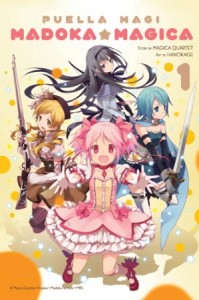
This is another in a series of media tie-in manga where I have not actually seen the original medium. With Haruhi Suzumiya’s manga I can at least tell you how the manga falls down when compared to the anime and light novels. And Higurashi is the interesting case where most fans agree the manga *is* better than the anime. Madoka Magica, though, is a big phenomenon, one I know through cultural osmosis more than anything else. And while this manga adaptation was perfectly pleasant and didn’t have anything hideously wrong with it (except maybe the usual art style problems), I came away from it with the desire to see the anime and see how it improved on the story. Which, admittedly, may be the reason for many media tie-in adaptations – to get you to seek out the anime/game/novel/toy.

The manga adaptation of this series ran in a seinen magazine for young men, Manga Time Kirara Forward (one of Houbunsha’s many ‘Manga Time’ variations, though unlike most other series that run there Madoka Magica is not a 4-koma). And indeed, despite the cute magical girl plot, young men seems to very much be its target audience. Not that there’s a huge amount of fanservice or adult situations – there isn’t, really. But a lot of this reads like how a male anime fan would want magical girl shows to work. Darker, more weaponized, with a lot less shining optimism. As for me, a person who loves his shining optimism, I’m not sure how I feel about it. Forming a contract to become a magical girl is presented as something you can’t turn back from, and the cliffhanger for this volume fills you with dread rather than inspiring you.

And then there’s Kyubey. As I said, cultural osmosis has led me to know several things about this work without actually seeing it, and Number One With A Bullet was that everyone hates Kyubey. Kyubey looks cute and adorable, like many mascots in similar shows, but his lack of real expression and determination to make magical girls give the whole thing an ominous undertone. Even if I didn’t know about him, I suspect I’d find him creepy.

Our heroine is a bright and shiny optimist in the Usagi mode, and she’s contrasted here with Homura, who is cynical, grumpy, and clearly has a horrific past we don’t know about yet. There’s a yuri fandom associated with this series, and it’s no surprise that these two are a big part of it. Homura is a girl with a mission, and that mission seems to be to stop Madoka becoming a magical girl. Well, so far so good… but with her best friend giving in, I’m not sure how long that’s going to hold up. As for Mami, well, she fills her function. And she does have one of the better lines in the book when she notes that “magical girls don’t always have to be allies”. That line more than anything else shows this is not a shoujo magical girl manga.

As I said at the start, this is pretty solid for the most part. The art is a bit generic (I really couldn’t tell they were designed by Ume Aoki of Sunshine Sketch fame, which I could when I saw the odd anime screencap), but the beats all seem to be there. If you are like me, and can deal with emotional wreckage better on the printed page than on the screen, then this may be the Madoka Magica for you. Anime fans, though, I suspect won’t find much here that’s new.

Filed Under: REVIEWS

Alice in the Country of Clover: Bloody Twins

June 14, 2012 by Sean Gaffney

By Quin Rose and Mamenosuke Fujimaru, based on the game by Quin Rose. Released in Japan as “Clover no Kuni no Alice – Bloody Twins” by Ichijinsha, serialized in the magazine Comic Zero-Sum. Released in North America by Seven Seas.

I never did finish Alice in the Country of Hearts, for obvious reasons. Hopefully that will be remedied later this month by Yen Press. That said, it sold pretty well, so I was not surprised that various spinoffs were licensed. There’s certainly twenty million or so of them coming out in Japan right now. This first volume is complete in one, and focuses on the two cute twins, Tweedledee and Tweedledum. The manga (based on the game once more) posits that Alice did not choose a boyfriend in the “Hearts” game, so instead of a love via “passion” it goes for a love via “friendship.”

Unfortunately, there are a few problems with this approach. First of all, the Dee & Dum story takes up barely half the book, so it’s padded out with a few other short stories based on ‘what if Alice chose xxxxx?’ plotlines. Some of these could be interesting (the Vivaldi plotline in particular), but they’re too short to go anywhere. And since most Western readers will have only read the manga rather than played the game, some seem completely out of left field. Gowland? Really? He was barely in the original manga! The purpose of this is straight up ‘give a nice bone to fans of the game who won’t get to see their path animated’.

As for the main plotline, I was never really a big fan of the twins to begin with, but the main reason to read Alice and enjoy it, at least for me, was that this was a twisted, disturbing variation on an otome game. The reason Alice hadn’t chosen a boyfriend is that they all seemed to be psychotic. You can tell that they’re attempting the same thing here (the twins certainly butcher a lot of people), but whether it’s the different artist or something else the fact is it all comes off as too cute and light-hearted. And Alice falters as well, as requiring her to be in love reduces her to the usual shoujo cliches “he cannot love me the way I love him”, “how can I possibly choose between them”, etc. You know it’s bad when the ancillary character bio describes Ace as ‘more unstable’ in Clover World, but he actually seems genteel by comparison.

This ran in a magazine with a slightly older demographic than the original Hearts manga, and the situations are slightly more adult in nature, though mostly in the way of implication. Throughout the Dee & Dum story, everyone is joking about Alice loving both twins being “tough on a girl’s body”, and the Blood Dupre story has similar implications. It’s not actually too bad, but worth noting given that I think the original manga when released by Tokyopop may have had a younger audience.

There are a large number of sequels/side-stories still to go, but this wasn’t exactly a great place to start. At least it’s only one volume. Hopefully better things will come with Cheshire Cat Waltz, a 3-volume sequel featuring Boris.

Filed Under: REVIEWS

Ouran High School Host Club, Vol. 18

June 11, 2012 by Sean Gaffney

By Bisco Hatori. Released in Japan as “Ouran Koukou Host Club” by Hakusensha, serialized in the magazine LaLa. Released in North America by Viz.

At long last, one of Viz’s most beloved shoujo series is coming to an end. We’ve had all the drama, we’ve had the love confession, so all that’s left is wrapping things up. Luckily, for the most part that means a return to the comedy that was one of the main reasons that fans loved this series. From Tamaki’s over-the-top reactions, to Haruhi’s deadpan remarks, to Kyoya’s smiling nastiness, there’s something for everyone here. And it’s all topped with a layer of sweetness that will give you cavities – but in a good way.

I should probably mention right now, though, that some BL fans of the series may end up being annoyed. Ouran has a huge BL fandom, as many reverse harem series tend to, and the artist enjoyed playing up to it – though always in a silly way. However, now that it’s the end of the series, she does little panels devoted to what happens to the cast when they grow up. A note to authors of books or manga with romantic entanglements – fans HATE this. Telling folks who love to write fanfiction that all of their romantic avenues are blocked by canon just grates. So when Ouran fans started off Vol. 18 by having Hunny married off to Reiko, I suspect the reaction was less “awww, so cute!” and more “Noooooo, he’s Mori’s!”. Be prepared for this throughout the book.

As for the book itself, I had wondered what Tamaki’s reaction to Haruhi’s confession would be like. It’s pretty much exactly as I predicted – which is what makes it fun, of course. Tamaki’s tendency to overdo everything, his naivete at basic day-to-day living and yet his mastery of reading other people are all on display here, and I think after 18 volumes we no longer worry about how he’ll function as an actual responsible adult. The same goes for Haruhi – the change in her over the course of the series has been astounding, and here we see her actually being openly affectionate with Tamaki.

The series proper ends about 2/3 through the volume, so we get two ‘side stories’ taking place after the series. The second is just 6 pages of our main couple being adorable, but the first is full-length, and focuses on Kyoya and his family issues. The author notes in comments that she wanted to leave Kyoya’s story open-ended as it would be very difficult to realistically wrap it up that fast – it will take years. So instead we have Kyoya being clever, but still not quite clever enough to think ahead of his father, which is his main goal. He also clashes with a woman from another family who’s being engaged to one of his brothers. Seeing their sharp, nasty barbs towards each other – all delivered, of course, with bright and happy smiles – made me happy. And of course the rest of the Host Club is there as well, making this probably the funniest chapter of the volume.

As with all harem series that deliver an actual ending, this is going to upset a few people. But I suspect the majority will be delighted. Ouran has been an over-the-top romantic comedy which, even if it got a bit melodramatic towards the end, never stopped delivering entertainment. It’s been worth the wait to have it fully come out here. v(I do wonder if Viz will license Hatori’s new work, The Bullshit Delusional Opera, when it comes out in Japan. It may need a title change.) Congratulations to Haruhi, Tamaki and the cast!

Filed Under: REVIEWS

Until Death Do Us Part, Vol. 1

June 8, 2012 by Sean Gaffney

By Hiroshi Takashige and DOUBLE-S. Released in Japan as “Shi ga Futari wo Wakatsu made” in 2 separate volumes by Square Enix, serialization ongoing in the magazine Young Gangan. Released in North America by Yen Press.

It feels rather refreshing, after reading this first omnibus, to know that I will not have to be thinking of ways to praise the author’s fresh, original ideas. There’s nothing like that here. Not that this is a bad manga – it’s quite good – but it is an action-packed thriller with spectacle and excitement, not a densely plotted opaque mystery. Well, unless it surprises me later. That said, as I indicated, it’s startling how well this works anyway. This manga is a compulsive page-turner, with likeable, cool characters and lots of good action scenes that are (for once) relatively easy to follow.

The premise reads like the author stared surfing TV Tropes and writing stuff down. Our hero, Mamoru, a blind swordsman who is testing new technology that lets him a) see folks as wire frame-type contours, and b) cut them with a monofilament sword, is interrupted one day by a girl, Haruka, who can predict the future under the right conditions and has a lot of bad guys hoping to catch and dissect her to figure out why. He reluctantly helps her, and along the way they meet the organization he belongs to, a special task force composed of victims of terrorism who are not getting revenge. Together they will bring down an insane global conspiracy!

Again, if I read that synopsis of fanfiction.net, I’d be moving on without a second thought. But the creators make it work, mostly by not really giving anyone time to think about anything. This is an action manga, and things rarely stop for more than 5-10 pages without another firefight or sword battle breaking out. The lead is cool, handsome, morally ambiguous, and has a tortured past – winning qualities, every one. (I am unsurprised that this manga has a large female following.) His colleague Ryotaro is refreshingly normal, aside from his amazing tech savvy, and seems to handle the dual role of Mr. Exposition and Straight Man fairly well.

As for Haruka, well, so far she is the typical waif. I have the most misgivings about her, mostly due to the way this role has been handled in the past. I hope that she gets stronger and starts taking her own initiative (although props to her for escaping and seeking out Mamoru at the start). There’s also the whole “one day I’ll marry him” thing, which gets wrapped up in the actual title of the manga. Given she seems to be about 12, let’s hope that it continues to stay hypothetical. The artist doesn’t seem to draw in a very ‘moe’ style, which is a plus. On the other hand, he avoids panty shots and then points out in the afterword how he avoided panty shots, which is a minus. Sort of a ‘Don’t show, don’t tell’.

So despite being a collection of action cliches, this is a lot of fun. There’s a fair amount of violence, as you’d expect from a manga about terrorists who fight other terrorists, but it’s not overwhelming. It also has a good head on its shoulders, and even an occasional sense of humor. I think the word I’m looking for is solid. Yen has found good, solid entertainment here. Check it out.

Filed Under: REVIEWS

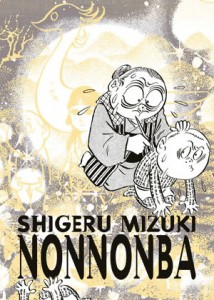
Nonnonba

June 6, 2012 by Sean Gaffney

By Shigeru Mizuki. Released in Japan as “Nonnonba to Ore” by Chikuma Shobo. Released in North America by Drawn & Quarterly.

It feels somewhat odd that after reading Nonnonba, a semi-autobiographic epic by the creator of Gegege no Kitaro, the man who is known worldwide for his amazing yokai tales and characterizations, that I found the yokai in it the least engaging part. Oh, don’t get me wrong, there are some spectacular spooks here. My favorite was probably Azuki-Haraki, who looks as if he had been drawn by guest artist Robert Crumb. But though there are yokai and supernatural elements throughout, the reason this is such a famous title – it’s gotten many accolades ever since its first publication in 1977 – has been its human characters, in particular Shigeru himself.

There are several main plotlines that flit through Shigeru’s life as he grows older in this volume. His flighty father’s continued schemes to chase his dream – and unemployment that inevitably follows. The young child gangs that roam the streets, which seem to be undecided as to how serious they are – especially after their new leader has Shigeru ostracized. His grandmother – the titular Nonnonba – moves back in with them after the death of her husband and is very much what you’d expect, dispensing good advice, acting as a nanny/doctor, and occasionally dealing out exposition on yokai.

One of the main things I noticed, though, was the series of girls approximately Shigeru’s age who arrive, seeming to be potential love interests, and then move on. At first this is sudden – “Oh, she died of the measles a week ago”, and you accept it as part of what being a child in 1930s Japan was like. Then we meet a sickly girl who enjoys Shigeru’s drawings, and given she has ‘doomed’ written all over her (if this were a Western comic she’d be dying of consumption), one can briefly raise an eyebrow. Then, in the last third of the book, we meet Miu, a young girl who is part of a ‘family’ moving into a haunted house – and can also sense nature and the supernatural in an almost psychic way. I was fairly sure she would die as well – the color pages at the start made me think they were all going to the land of the dead – but her fate is far more realistic, fitting in with the darker tone of the 2nd half of the book.

Still, the book itself is not depressing. Life is something that has to be accepted, in all its facets. Mizuki is an expert at capturing his childhood in a way unfettered by preciousness or overanalysis. There’s also a bit of eerie prescience here – Shigeru reforming the teen gangs to ‘pacifism’ is all very well and good, but I kept being reminded that this group of kids would be going off to war in a scant few years. This is probably why Shigeru the child has an emphasis on pacifism – and why the ostracized gang eventually joins him over the dictatorial leadership of the stronger Kappa (Kappa being a nickname, he’s not a yokai).

I wasn’t as blown away by this as I thought I would be – Gegege no Kitaro remains the title I want to see here the most – but it was a nice, solid autobiography, mixing reality and fantasy in such a way that each complements the other. There’s a lot of extremely flawed human beings here, including Shigeru, but the overall mood is one of nostalgia and remembrance.

Filed Under: REVIEWS

GTO: 14 Days in Shonan, Vol. 3

June 4, 2012 by Sean Gaffney

By Toru Fujisawa. Released in Japan by Kodansha, serialized in the magazine Weekly Shonen Magazine. Released in North America by Vertical.

After an action-packed 2nd volume of GTO, it’s time to take a breather and get back to some lighter stuff before we gear up for the next broken teen who Onizuka has to save. And hey, didn’t Shiratori-san say that there was someone else who worked at the White Swan? Who was even prettier than her? Could this possibly be the overture to… some romance?

Well, no. This is Eikichi Onizuka, so whenever romance rears its ugly head, he turns into the immature idiot that he is. (Yes, he’s also a heartwarming badass, but hey, facets.) First he tries his hand at seducing Shiratori-san via some red wine, which is a little creepy but it becomes clear that he’s not really going to follow through on it unless she’s awake and willing… okay, no, it’s creepy no matter what. Then when she falls asleep, he falls back on peeping on the other caretaker in the house, who we haven’t met before… or so we think. Much to his surprise and ours, the other caretaker turns out to be his old not-girlfriend Shinomi Fujisaki, who is, as you might imagine, displeased at Onizuka ogling her nude.

It’s great seeing Shinomi back in the storyline, as she makes a good love-interest contrast to Azusa Fuyutsuki from the GTO series proper. Whereas Azusa tends to be ‘he’s sort of a weirdo, but I can see the good heart inside of him’, Shinomi is very much in the ‘I’ve always seen the good heart, but WHY IS HE SUCH A FREAK’ school of lovers. As you might expect, Onizuka walking back into her life after disappearing years ago confuses the hell out of her, and she responds via violence in the best tsundere way. (Onizuka, who is very similar to her, responds by changing the subject and being over the top goofy, which we’ve already seen tends to be his way of avoiding serious issues.) I don’t expect much to be resolved here – this takes place during GTO proper, which didn’t resolve any romances – but it’s sweet to see them reunite.

As for the rest of the manga, we’ve resolved the parental problems that Miki had, and now that we know that she was merely the easiest ‘villain’ to take down, we know it’s only going to get worse. So we get a flashback to another resident of the White Swan, Ikuko, and her abusive mother, who was so bad social services had to step in. This is probably one of the best written parts of the entire volume, as it really gets into the ambiguous feelings kids have when their loved ones abuse them – and the stoic acceptance that it’s their fault for not being “good enough”. I’m not sure we’ll see more of Ikuko’s life later on, but I do hope that she manages to come to terms with her upbringing.

Then there’s Seiya, who would appear to be the next ‘project’ for Onizuka to fix. And once again, we see how Onizuka works – forcing the kids to ‘go too far’ in order to show them that deep down they really don’t want to take the final steps towards darkness. All of these manga – GTO, Shonan Jun’ai Gumi, and this spinoff – stem from the same genre of Japanese manga, which are about teenagers and family, and how much they feel abandoned and helpless. If Onizuka can help these kids reconnect emotionally, on any level, he’s going to do it. And it would appear that the fourth volume will be another action-filled one.

Filed Under: REVIEWS

  • « Go to Previous Page
  • Page 1
  • Interim pages omitted …
  • Page 281
  • Page 282
  • Page 283
  • Page 284
  • Page 285
  • Interim pages omitted …
  • Page 346
  • Go to Next Page »
 | Log in
Copyright © 2010 Manga Bookshelf | Powered by WordPress & the Genesis Framework