In the opening pages of Descending Stories, we’re introduced to Yotaro, an amiable ex-con with an unusual plan for going straight: he wants to become a rakugoka, or rakugo artist. To learn the ropes of this venerable performing tradition, Yotaro cajoles Yakumo, a rakugo master, into accepting him as an apprentice — something that Yakumo has resisted doing in the past, even when more suitable candidates have presented themselves. Descending Stories then follows Yotaro’s first clumsy efforts at telling stories, making people laugh, and resisting the temptations of his old life.
Rakugo, for the uninitiated, is Japan’s answer to continuous vaudeville. In lieu of acrobats and jugglers, however, yose (venues) offer customers a steady flow of rakugokas who regale the audience with humorous stories, each adhering to a clearly defined format that begins with the makura (prelude), moves to the hondai (main story), and concludes with the ochi (punchline). Unlike a vaudeville artist — or a manzai duo, for that matter — the rakugoka remains seated while delivering his material, using only two simple props — a fan and a cloth — to convey what’s happening.
In theory, rakugo sounds like an ideal topic for a manga: it’s a storytelling genre that relies almost exclusively on facial expressions and physical gestures to bring the story to life, actions that translate well to a silent, static medium like comics. The audible dimension of a rakugo performance also lends itself to graphic depiction, as a well-chosen typeface can suggest the register, volume, gender, and age of the person speaking. Yet the rakugo performances in Descending Stories capture little of the magic that would explain the genre’s enduring appeal in Japan. Too often, Haruko Kumota cross-cuts between a snippet of performance and a snippet of conversation in which audience members praise the rakugoka‘s technique, or comment on how much everyone else seems to be enjoying themselves. The net result feels more like watching a football game on television than attending a theatrical performance; we can see what’s happening, but the relentless stream of chatter and clumsy framing of the action keep us at arm’s length.
The flatness of these performances stand in sharp contrast to the vibrant story that surrounds them. Though the principal cast is small — Yotaro, Yakumo, and Konatsu, Yakumo’s adopted daughter — Kumota squeezes plenty of dramatic juice out of their interactions. In chapter three, for example, Konatsu accuses Yakumo of murdering her biological father, Sukeroku, who was also an accomplished performer. She vows to exact revenge by taking up rakugo herself, a gesture designed to provoke the staunchly traditionalist Yakumo. “Women can’t perform rakugo,” he tells her:
That’s just the way it is. They can’t enjoy stupidity, for one thing. Even if they can, their art doesn’t deepen as they age. And should they somehow master the art… well, there’s nothing more unpleasant than a woman who can do a good impression of a man. There’s just too much to overcome.
Yet Yakumo is no soap opera villain, intent on crushing the spirit of a plucky heroine; he’s a realist who bears deep — and as yet unrevealed — wounds from collaborating with Konatsu’s dad. He recognizes the depth of Konatsu’s pain, and her sincere desire to preserve her father’s legacy by memorizing and performing his material. As a conciliatory gesture, Yakumo begins reciting “The Naughty Three,” one of Sukeroku’s stories. This eight-panel sequence offers a fleeting glimpse of Yakumo’s true artistry, showing us how he twists his face and bends his torso to portray the story’s main characters. Only a solitary panel of Konatsu sobbing, “My father… He’s alive,” undercuts the effectiveness of the scene, baldly stating what’s apparent from the illustrations.
And that, in a nutshell, is what makes Descending Stories simultaneously frustrating and compelling. On the one hand, Kumota tries so hard to persuade us that rakugo is a funny, spellbinding, and vital tradition that the performances never take flight on the page; even the best scenes are marred by comments that feel like a poke in the ribs: “Didja get it?” On the other hand, Kumota creates such passionate, complex characters that it’s fundamentally impossible to dislike Descending Stories; I want to know whether Yotaro becomes a rakugoka, or if Konatsu finds an outlet for her own storytelling gift. My suggestion: read the omake for insights into rakugo, and read the main chapters for the drama.
DESCENDING STORIES: SHOWA GENROKU RAKUGO SHINJO, VOL. 1 • BY HARUKA KUMOTA • KODANSHA COMICS • RATING: YOUNG ADULT (13+)


 Mikuri Moriyama is a 25-year-old licensed clinical psychologist who hasn’t been able to find a job after grad school. She’s been living with her parents and working for a temp agency, and when she’s laid off her father arranges for her to assume housekeeping duties for a guy he used to work with. Hiramasa Tsuzaki is 36 and single. He seems humorless and particular at first, but Mikuri finds that working for a hard-to-please guy makes it easier to know when she’s been successful. She performs her duties well, even managing to nurse Tsuzaki through an illness in such a business-like way that it’s not awkward for him. Things go well for a few months, then Mikuri’s father prepares to retire and move to the countryside. Rather than lose their mutually beneficial arrangement, Mikuri and Tsuzaki decide that she’ll move in with him and, for the sake of propriety, become his common-law wife. They proceed to perpetuate the ruse that they’re actually a real couple.
 As Tsuzaki’s coworkers learn that he’s gotten married, his social calendar suddenly fills up in a way it never did before, while Mikuri notices that her aunt Yuri, with whom she’s very close, has been hesitant to invite her out as much as she used to before Mikuri got married. Spending time with Numata and Kazami is enjoyable for the couple, but it’s also risky, because nosy Numata snoops and learns there’s only a twin bed in the bedroom, and by volume two, Kazami is convinced that they’re faking it. Kazami is perhaps as equally developed as Tsuzaki himself, as we hear a great deal about his reservations about marriage, which all leads up to the big cliffhanger ending of volume two (which I shan’t spoil). Tsuzaki, meanwhile, is attempting in vain to keep from developing feelings for Mikuri. She persists in being business-like, and he 100% believes there’s no chance she’d ever reciprocate, so he often looks emotionless in front of her, only revealing his feelings when he’s alone. I love that neither one of them is spazzy; they’re in a somewhat trope-y arrangement, but they’re handling it like adults.

 Even without knowing much about Dreamin’ Sun, I was sold by the fact that it’s an earlier series from Ichigo Takano, creator of orange, which I loved dearly. Dreamin’ Sun is more of a straightforward and comedic shoujo story in which characters do not contend with letters from their future selves or how to save a suicidal friend, but it still has a few poignant moments.

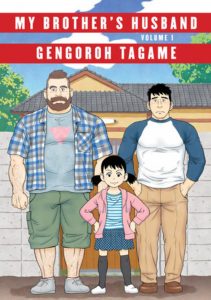 Yaichi is a single dad who works from home managing the rental property his parents left to him and his brother, Ryoji, after being killed in a car accident when the boys were teenagers. He considers his real job to be providing the best home he can to his daughter, Kana. On the day the story begins, Yaichi is expecting a guest—Mike Flanagan, the burly Canadian whom Ryoji married after leaving Japan ten years ago. Ryoji passed away the previous month and Mike has come to Japan to try to connect with Ryoji’s past and see for himself the many things he’d heard stories about from his husband.
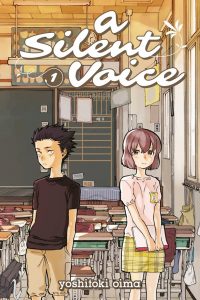 In elementary school, Shoya Ishida often engaged in foolhardy stunts to stave off boredom. When hearing impaired transfer student Shoko Nishimiya joins his class and causes disruption within the class, she becomes Shoya’s target. Initially, the other kids laugh at Shoya’s antics but when he goes too far and destroys several hearing aids to the tune of $14,000, they swiftly condemn him. Now he’s the one who’s ostracized and this status continues into high school, long after Shoko transferred out again. Full of self-loathing, he’s preparing to commit suicide, but a chance reunion with Shoko inspires him to try to change.
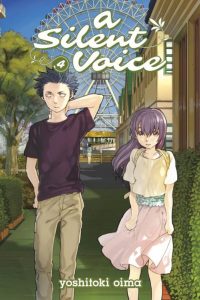 Back and forth things go, with this group continuing to try to establish themselves as friends without seeming to genuinely like each other much. Eventually, they decide to film a movie together. For one scene, they need to acquire permission to film at their old elementary school. Shoya is the unwilling emissary, and an encounter with his odious former teacher leaves him feeling so awful about himself that he ends up lashing out at all his friends, seemingly trying to drive them away as he feels he deserves. This has the unintended side effect of causing Shoko to feel like she’s the cause of his unhappiness, prompting a desperate act.
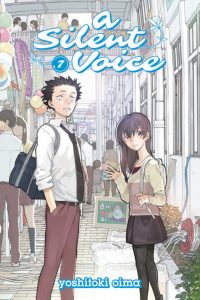 Less clear is what Oima was aiming for with their group of friends. Even though Naoka was far more outwardly nasty to Shoko, at least she was open about it and expressed a great deal of self-loathing because of her behavior. With the help of another friend, Miyoko, she is encouraged to have a bit more optimism, and will probably end up doing okay. Even though she could’ve been fleshed out further, I do like Naoka as a character. But man oh man, do I hate Miki. She makes everything about herself—at one point revising the bullying narrative so that she and Shoko were co-victims—and doesn’t seem to grow at all. Everything she does seems fake, because most of it is, and I was baffled when the boy she fancies declared her to be “kind” after some weepy episode. Miki should get hit by a bus.