• Skip to primary navigation
  • Skip to main content
  • Skip to primary sidebar
  • Home
  • About Us
    • Privacy Policy
    • Comment Policy
    • Disclosures & Disclaimers
  • Resources
    • Links, Essays & Articles
    • Fandomology!
    • CLAMP Directory
    • BlogRoll
  • Features & Columns
    • 3 Things Thursday
    • Adventures in the Key of Shoujo
    • Bit & Blips (game reviews)
    • BL BOOKRACK
    • Bookshelf Briefs
    • Bringing the Drama
    • Comic Conversion
    • Fanservice Friday
    • Going Digital
    • It Came From the Sinosphere
    • License This!
    • Magazine no Mori
    • My Week in Manga
    • OFF THE SHELF
    • Not By Manga Alone
    • PICK OF THE WEEK
    • Subtitles & Sensibility
    • Weekly Shonen Jump Recaps
  • Manga Moveable Feast
    • MMF Full Archive
    • Yun Kouga
    • CLAMP
    • Shojo Beat
    • Osamu Tezuka
    • Sailor Moon
    • Fruits Basket
    • Takehiko Inoue
    • Wild Adapter
    • One Piece
    • After School Nightmare
    • Karakuri Odette
    • Paradise Kiss
    • The Color Trilogy
    • To Terra…
    • Sexy Voice & Robo
  • Browse by Author
    • Sean Gaffney
    • Anna Neatrour
    • Michelle Smith
    • Katherine Dacey
    • MJ
    • Brigid Alverson
    • Travis Anderson
    • Phillip Anthony
    • Derek Bown
    • Jaci Dahlvang
    • Angela Eastman
    • Erica Friedman
    • Sara K.
    • Megan Purdy
    • Emily Snodgrass
    • Nancy Thistlethwaite
    • Eva Volin
    • David Welsh
  • MB Blogs
    • A Case Suitable For Treatment
    • Experiments in Manga
    • MangaBlog
    • The Manga Critic
    • Manga Report
    • Soliloquy in Blue
    • Manga Curmudgeon (archive)

Manga Bookshelf

Discussion, Resources, Roundtables, & Reviews

Reviews

Hayate the Combat Butler, Vol. 33

January 17, 2019 by Sean Gaffney

By Kenjiro Hata. Released in Japan as “Hayate no Gotoku!” by Shogakukan, serialized in the magazine Shonen Sunday. Released in North America by Viz. Translated by John Werry.

The manga had taken a six-week break in Shonen Sunday towards the beginning of this book, and so Hata amusingly tries to do a “let me remind you of the plot and cast” for those who have not been reading this for 32 previous volumes. Mostly what it does is remind us of Hayate’s near-inhuman stamina, which vies with his legitimately inhuman bad luck for dominance. Hata knows the value of setting up an obvious joke and letting it play out as far as he possibly can. We start with all the residents of the getting colds, except Hayate, who has to take care of all of them (despite such minor setbacks as being hit by a truck). Then, of course, he gets a cold right as he has to take a “fail this and you’re expelled” test at school, and runs into infinite obstacles on the way, not least of which is Fumi at her most annoying… well, OK, that’s Fumi all the time. The punchline, which involves Yukiji’s PSP, is the perfectly timed icing on the cake.

Last time I mentioned the debut of new character Kayura, but like most of the cast she made her big debut and then faded into the ‘brought out as needed’ category. On the bright side, she does not appear to be in love with Hayate, which puts her into a relatively rare category. (Though to be fair to the author, it’s not as rare as other harem manga. There are a good 6-7 girls we see in this title who are not in love with anyone, and of course there’s Miki, who loves Hinagiku.) Those who do love Hayate get a few spotlights here. Izumi’s birthday leads to a lovely cake and a desperate attempt by her to eat it alone with Hayate. Ruka also shows up again, needing bike lessons from Hayate, which gets very amusing when he asks her if she wants a gentle or strict teacher and she says “strict”. Hayate’s sadistic aspects don’t come out very often, but when they do they’re hilarious, especially combined with the low-simmering romance we see here.

And then there’s Ayumu, whose love for Hayate is the most explicit but also likely the most doomed. She’s getting the old high school career survey, and “Hayate’s bride” isn’t going to cut it, especially as she has these visions of what life will be like as said bride, involving a series of “Hayate’s bad luck means we lose everything” disasters. She talks with Nagi about becoming a musician, but lacks the drive and the talent for it. Actually, given how we’ve seen her handling Nagi and Hinagiku throughout the series, a counseling job might not be a bad idea, though she needs to restrain her more head in the clouds moments. Hopefully she’ll fare better than Hinagiku, who was once the ensemble darkhorse of the series that everyone loved, even getting an ED theme in the anime devoted to her, but now is entirely used for fanservice. Poor Hina.

This is the 33rd volume of Hayate the Combat Butler, and I applaud all of you still buying it every time it comes out. Its humor is consistently funny to me, which helps to get through plot-absent volumes such as this one. It is currently projected to end in North America in the fall of 2028. Thought I’d put that out there.

Filed Under: hayate the combat butler, REVIEWS

An Archdemon’s Dilemma: How to Love Your Elf Bride, Vol. 3

January 16, 2019 by Sean Gaffney

By Fuminori Teshima and COMTA. Released in Japan by Hobby Japan. Released in North America digitally by J-Novel Club. Translated by Hikoki.

This volume does a much better job than the previous two books at actually having tension during the fights – Zagan actually has to work hard once or twice, which shows you how dangerous things are. Of course, he brought things on himself by walking into what was clearly a trap – something he knew, and which everyone else in his party pointed out, and yet they did it anyway. Our heroes are invited to a luxury boat for a party – something that everyone except Chastille knows does not mean a REAL party – and while there run afoul of another archdemon and his dark elf, who is a carbon copy of Nephy except she’s dark-skinned and supposedly evil. In amongst this we have Zagan and Nephy continuing to be utterly adorable together, and they are getting a little better at reading each other’s feelings. And for those of you who like “an elf’s ears are an arousal point”, you’ll love this one too.

I will admit to surprise that most of the book takes place on the fantasy equivalent of a luxury liner, but why not? Zagan and party go there to see if he can get more knowledge, something that he says is obviously what all sorcerers and archdemons should be doing. Alas, things go south almost immediately and he is forced, along with the rest of the boat, to do battle with a toxic back sludge that is the dregs of a former demon lord who was killed near the lake they’re on. I had wondered if this was going to lead to a demon lord revival, but we aren’t quite there yet. There is quite a bit of interesting worldbuilding in this book, as we get more insight into the different types of fantasy races we have here, and why Nephy was so mistreated by her home village.

There’s also a fair bit of humor, some of which works and some of which I was less thrilled by. Chastille works best when she can balance out the lovesick young girl with the kickass swordswoman, and it’s unfortunately mostly all lovesick this time round, with much narrative mocking of her being a crybaby. This mostly annoyed me, though it did set up a very amusing gag later on with Nephteros. Speaking of Nephteros, I expect to see her again. The ‘dark mirror’ character has been done before, and I was relatively pleased that this wasn’t a clone or duplicate of Nephy but merely someone who looks almost exactly alike. She also carries the ‘I love my master but am horrified to realize he only sees me as a tool’ subplot extremely well. And she also gets the funniest moment in the book, in the final pages, where Zagan not only gets his revenge but weaponizes his revenge and gives it to Nephteros to use as she sees fit.

Basically, this is still a fun and sweet series, and the backstory is getting more intriguing. Less whining from Chastille next time, please? Also, liked the siren chanteuse who also turned out to be a cheerleader.

Filed Under: archdemon's dilemma, REVIEWS

Kakuriyo: Bed & Breakfast for Spirits, Vol. 1

January 15, 2019 by Sean Gaffney

By Midori Yuma and Waco Ioka. Released in Japan as “Kakuriyo no Yadomeshi: Ayakashi Oyado ni Yomeiri Shimasu” by Enterbrain, serialization ongoing in the magazine B’S LOG COMIC. Released in North America by Viz Media. Translated by Tomo Kimura.

There are times when you simply have to trust in the good taste of a publisher. I admit, reading the first volume of Kakuriyo, I wasn’t all that drawn in. It’s apparently based on a series of novels, and sometimes reads like it: there’s a ton of exposition laid out by characters to the heroine (who also gets to exposit on her own past) in an effort to get the story to where the author wants it to be and have the reader understand things. Which is fine, but works better in prose than it does in a shoujo manga. As with a lot of series featuring a young human woman meeting up with a bunch of yokai, most of the cast start off as jerks, with one or two exceptions, including her dead grandfather who got her into this mess. That said, there’s a lot here that I can see should translate into a fun series down the road, so I will assume this just starts slowly (like many other series I follow).

Our human heroine is Aoi, a young woman in college (college? In a shoujo manga? Well, it’s is B’s Log…) whose grandfather recently passed away. He had a reputation as a lothario, fathering a lot of children and then skedaddling. To Aoi, however, he’s the precious grandfather who took her in and raised her, so she’s a bit conflicted when she thinks about his past. Also like her grandfather, she can see yokai, and does her best to be nice to when when she does, despite the fact that she gives then so much food it feels like she’s starving herself to death. One day she runs into an ogre yokai at the steps of a shrine, and gives him her lunch. But when she gets her lunchbox back, she’s transported to a yokai inn! Turns out that her grandfather was also a troublemaker in the yokai world, and offered up his granddaughter in marriage to get out of a debt. Now she either has to marry him… or work off her debt in the inn. But will anyone hire her?

As I said, most of the first volume is dedicated to the setup, as it’s only in the final chapter that we get the sense we know how Aoi will survive in this world (if you guessed tasty food, give yourself a pat on the back – there’s even a ‘let me describe how I make the food’ section). Genji, a young man who can change his appearance from boy to man to woman – and does so frequently – is the one yokai who seems to be nice to Aoi, and he helpfully explains the ways of the inn to her. The Odanna, the ogre wh0o brought her there in the first place, seems like the sort that’s outwardly standoffish but warms up when you know him better – the funniest scene in the book involves Aoi being “tortured” by getting a nice warm bath and dressed in a lovely kimono. Aoi herself is in a long line of “plucky young women” we’ve seen in this sort of book, and seems to have her head on straight.

So overall I would say that while I was merely mildly entertained by this first book, it shows promise and makes me want to read more. I trust it will improve by the volume.

Filed Under: kakuriyo, REVIEWS

Legend of the Galactic Heroes: Desolation

January 14, 2019 by Sean Gaffney

By Yoshiki Tanaka. Released in Japan as “Ginga Eiyū Densetsu” by Tokuma Shoten. Released in North America by Haikasoru. Translated by Matt Treyvaud.

Before we discuss the events of the second half of the book (which I will spoil out of necessity), let’s talk about the fairly normal first half. Reinhard is headed with his entire fleet towards Iserlohn, and Yang and company are doing their level best to try to at least slow them down. There are a few more times when we see Yang being the master tactician and manipulator that he is, and a lot of the Empire’s finest being hotheads when they shouldn’t be. The stage is set for Reinhard and Yang to negotiate terms. We even get one last debate, in Yang’s head, about the need for democracy vs. a dictatorship. Yang is well aware that Reinhard is a kinder, gentler dictator, and that forcing democracy is likely to make people far more unhappy than they would be under the Emperor’s hand. But it’s notable that the Empire only seems the better option because of these circumstances, and we’ve also seen Reinhard’s petulant side as well. Plus he’s STILL not married. What of the future?

But in amongst this, you’re getting the foreshadowing. LOGH is many things, but subtle it ain’t, so we get several scenes showing us the Church setting Yang up to be assassinated (using a character I had honestly forgotten about – this cast is too damn big) and setting the audience up to expect another near escape like Yang had a couple of books ago. But then we get things like “this was the last time the two would ever speak”, and you start to realize what’s going to happen. And then it does. Yang is killed on his way to the peace talks. Not even in a pitched gun battle or anything, but shot in the leg and slowly bleeding to death. Given that it’s a series about the horrors of war, among other things, it seems fitting, but everyone agrees this was not the way that Yang should have died (Frederica’s dream of the death of Yang as an 85-year-old grandfather is possibly the most heartbreaking thing in a heartbreaking book.)

As you can imagine, the rest of the book deals with the fallout from this. Iserlohn is devastated, of course, and many of their allies flee. The cause is kept alive, with Frederica on the political side and Julian on the military side, but both agree they’re only doing this because they know it’s what Yang would do; Frederica’s saying that she’d be happy to let democracy go hang if it meant getting her husband back is chilling. And the ominous foreshadowing is not done yet. Mittermeier and von Reuentahl also get a “they would never speak again” foreshadowing, and I suspect the latter is going to turn on Reinhard soon, or at least be made to seem like he is. And Reinhard spends much of the book in bed with a high fever… not the first time this has happened. He’s been ill QUITE a bit, which is another reason he’s being pressured to marry. With the Republic in tatters, is the Empire far behind?

There’s two more books in the main series, and lots more to resolve. It’s hard not to leave this book feeling depressed, though, and I will admit that most of the reason I read this was to read about Yang Wen-Li. Like his family and allies, I’ll continue to read the books, but also like them, I’m not looking forward to it nearly as much. A well-written equivalent of a drive-by gangland killing.

Filed Under: legend of the galactic heroes, REVIEWS

Water Dragon’s Bride, Vol. 8

January 13, 2019 by Anna N

The Water Dragon’s Bride Volume 8 by Rei Toma

One of the central questions I had as a reader of The Water Dragon’s Bride was what would happen if Asahi managed to find her way home? With her return to modern day Japan and her decision to rejoin her friends in the world of the Water Dragon God, I was curious to see where Toma would take the plot next in terms of a main conflict. She introduces a new antagonist for the Water Dragon God and Asahi, and I’m genuinely curious to see where the story goes next because I’m not sure what to expect.

Water Dragon God 8

The idea of other castaway people has been touched on a little bit before in this series, but this volume takes a turn when it thoroughly explores the backstory of Kurose, the companion to Tokoyami the God of Darkness, who rules an Underworld where it is impossible for the Water Dragon God to enter. The Water Dragon God enlists Subaru for help, but it ends up being Asahi’s unpredictable reactions to danger and the strength of her caring for others that opens up a possibility for her to escape.

Asahi and the Water Dragon God end up creating some deadly supernatural enemies, and one of the things that I appreciate about Toma is that her antagonists are fully drawn, with motivations and reasons for their actions that cause the reader to ponder the nature of humanity. Kurose is bullied in school, and when he’s rescued by Tokoyami and taken to a world of darkness, we see what happens when a less resilient human gets exposed to supernatural influences without the benefit of Asahi’s strong inner will. Kurose has his own traumatic adventures in the world of the Water Dragon God, where bad things happen to good people, and the gods seem indifferent to the suffering that they refuse to intervene in. As always, Toma’s capable illustrations serve to heighten the impact of the symbolic world that the gods inhabit, contrasted to the lives of ordinary villagers and teenagers in the modern world. There’s a confrontation between the two gods and their companions which will surely happen in the volumes ahead, and I’m very curious to see if Asahi’s unique outlook and faith manages to get herself and the Water Dragon God out of yet another complex situation.

Filed Under: Manga Reviews, REVIEWS Tagged With: shojo beat, shoujo, the water dragon's bride, viz media

Katanagatari: Sword Tale, Vol. 1

January 13, 2019 by Sean Gaffney

By Nisioisin and take. Released in Japan in three separate volumes by Kodansha BOX. Released in North America by Vertical, Inc. Translated by Sam Bett.

This is the third major series of Nisioisin’s to come out over here as a novel, after the popular Monogatari Series and the cult classic but poor selling Zaregoto Series. These books reunite Nisio with the artist for the Zaregoto books, and the art is sufficiently stylistically awesome. As for fans of Nisioisin’s wordplay, not only do they get tons of that in these volumes, but we get footnotes from the translator (which he indicates are totally optional) explaining many of the original lines and why they’re puns, as well as his own translation choices. It’s the sort of thing I wish that we could have seen with the Monogatari books, as it might have made several readers less dagnabbit mad. The book is also very metatextual, a common thread in Nisio’s work, with suggestions that certain elements will be followed up with in future books, or announcing the tragic backstory of one of the characters is coming. That said, it’s a very Nisio series, but how does it hold up as an actual book?

Our hero is Shichika, who lives on a little-known island with his older sister Nanami. He’s the heir to a school of swordsmanship, the Kyotoryu, that does not use swords – but aside from not using swords, it’s handled exactly like a classic sword school. As a result, Shichika is essentially a blade himself, which makes sense given that sometimes he tends to have the emotional depth of an inanimate object. Into this island steps Togame, who is there to hire Shichika to help her locate twelve Mutant Blades, katanas that rightfully should belong to the Shogun but are instead being used by twelve other people. After the events of the first book, which involve the first of those swords, Shichika agrees to accompany her, leaving the island and his sister and going to get each sword one by one – though that always means a battle.

As I hinted before, Shichika is almost a parody of the “simple country bumpkin’ type who isn’t so simple, and much is made of the fact that he has never really had to think before now, so isn’t used to it. This makes him a pleasing contrast at least to super-genius Ii-chan and overly florid Araragi. He’s fine with leaving the thinking to Togame, who is a self-titled “schemer” but whose schemes haven’t really been able to do much but postpone the inevitable fights so far, and whose fragility makes her easy to use as a hostage or a distraction. She’s also less clever than she thinks, as the best gag in the book, a misuse of a British greeting she has, attests to. Together they make each other more interesting, which is all one can ask. As for the sword wielders, by the end of the first omnibus three are dead, though you are only meant to feel sympathy for the last one – indeed, the ninja clan that start the book as the main antagonists have become, at the author’s own insistence, the comic foils of the story.

It’s clear who this book is meant for: fans of the anime, as well as fans of Nisioisin’s eclectic narrative style. Both should find this series very entertaining, though even I found Shichika somewhat wearing by the end. I’ll definitely be getting the next set of three this spring.

Filed Under: katanagatari, REVIEWS

The Irregular at Magic High School: Visitor Arc, Part II

January 12, 2019 by Sean Gaffney

By Tsutomu Sato and Kana Ishida. Released in Japan as “Mahouka Koukou no Rettousei” by ASCII Mediaworks. Released in North America by Yen On. Translated by Andrew Prowse.

This is very much a book of two halves, and I must admit that I preferred the first half to the second, though they both had issues. The first half is a continuation of the plot from the first book in this arc, as Tatsuya and Lina separately and together try to figure out what’s “possessing” these people and how to stop them, but are almost undone by a traitor in Lina’s midst. The traitor is… a character we met once before in the last book, but I must admit “minor character X’ does not really make it very dramatic – I was expecting it to be Lina’s aide Sylvia, which would have been more tragic. There’s also a pretty nice fight with said minor character traitor at the climax of the first half of the book, which actually gives Mizuki something to do. And we get a great way to present boring exposition and still make me laugh – Shizuku calls from California to give intel to Tatsuya, but she’s shitfaced drunk when she does so, and he’s trying to explain things to her as she slurs her words more and more. It’s pretty funny.

I was less impressed with the second half of the book, as it’s Valentine’s Day at the school, and you know what that means: wacky hijinks. I’ve talked before about how I’m not fond of Honoka being defined just by her love of Tatsuya, and I realize that the author is trying to let her and Shizuku get developed by the Honor Student manga author in that regard, but man, here her love for Tatsuya is literally weaponized by the runaway parasite, who possessed a robot named Pixie that’s part of the school’s robotics experiment. As you can imagine, instead of being driven by self-preservation and killing witnesses like the other possessed folks, she’s driven by the intense and disturbingly submissive love for Honoka that Honoka accidentally activated her with. That said, most of the valentine stuff was merely okay, and not actually irritating. And Mayumi’s revenge chocolates made me smile.

The irritating, as so frequently happens in this series, was saved for our two leads. I realize that Miyuki gets jealous sometimes, but what she did with Tatsuya’s chocolates was so petty and immature my jaw dropped. This is not helped by Tatsuya basically saying “welp” and just going along with it. (Tatsuya is not at his most likeable throughout the book – there’s a sequence where he lets Miyuki answer a difficult conundrum they have as he wants her to be “more than a pretty doll” that made me want to punch him.) And, of course, Miyuki is also dealing with her incestuous feelings for her brother, which are sometimes used as the usual gag (Lina’s reaction to Miyuki saying she and Tatsuya are just siblings) but in Miyuki’s inner thoughts are very much taken seriously. She feels guilty about these feelings, but honestly the whole thing makes me feel deeply uncomfortable.

When you add in some “Japan is good, everyone else is less good” speeches, and Lina getting chewed out for daring to fall in love with Tatsuya (a fact that she denies, but no one believes her, least of all the reader), and you have a typically easy to read but frustrating volume of Mahouka. Next volume should wrap up this arc, at least.

Filed Under: irregular at magic high school, REVIEWS

An Invitation from a Crab

January 11, 2019 by Sean Gaffney

By panpanya. Released in Japan as “Kani ni Sasowarete” by Hakusensha, serialized in the magazine Rakuen Le Paradis. Released in North America by Denpa Books. Translated by Ko Ransom.

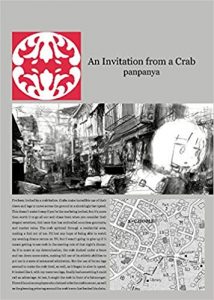
Iev always been a fan of those sketchy, semi-slice of life (except they’re too weird) manga that you see towards the back of a lot of seinen and josei manga magazines. It used to be that the chances of such works getting licensed over here was nil, but Denpa has quite a few eclectic titles coming out now, and An Invitation from a Crab is one of the first. It’s more of a collection of interconnected short stories, along with the occasional essay discussing the importance of paying attention to things. Our unnamed heroine is theoretically a high school student, and occasionally we do see her in class. But the world she’s in is not quite the same as ours, featuring normal humans but also animal-headed people, as well as the bizarre lemon with an eye that seems to be a ‘boss’ sort of type. Essentially, An Invitation from a Crab is a “what kind of stories will the author spin next?’ sort of book. And they’re good stories.

The stories here range from a few pages long to larger chunky narratives. The title comes from the first story, where our heroine follows a crab that is lying in the road and seems to know where it’s going. That said, the “punchline”, as it were, amounts to not much, and that’s also the case with most of the rest of these stories. You’re reading this for mood, not for jokes or characterization, and so frequently the stories feel like “shaggy dog” stories, where the ending does not justify the effort expended. Which is absolutely fine given much of this is about enjoying the journey. We see our heroine wearing a Chinese communist outfit in a factory breaking coconuts so they can be used to create electricity. That is a sentence I can’t believe I just typed, and it’s probably the weirdest of the stories in here, but there’s other dreamlike sequences as well, including one that literally is a dream, where our heroine’s spirit gets off a train but her body doesn’t.

There is quite a bit of humor here, despite my saying earlier that there weren’t punchlines per se. Sometimes simply seeing the situation makes me laugh, such as our heroine and her dog/roommate/whatever searching to try to find anyone who knows where pineapples come from, or the heroine gleefully preparing for her Sunday day off by doing piles of things (this reminded me of the Zetsubou-sensei chapter where the class had a “preview” of their field trip). And sometimes the mood can be disturbing – there’s a lot of dark shadows in this world, and while the coconut and lost body stories are not dark in any way, they’re unsettling and have a sense of unreality to them. Even some of the shorter stories in the volume, such as when our heroine is sold a giant salamander and tries to return him to the Amazon (a plot that lifts directly from an old Bugs Bunny cartoon), has an ominous feel to its humorous ending.

If you’re interested in a skewed look at life in a world that’s not quite this one, or wonder what it would be like if you did follow that crab into the side alley, you should definitely pick this up.

Filed Under: an invitation from a crab, REVIEWS

Accel World: Snow White’s Slumber

January 10, 2019 by Sean Gaffney

By Reki Kawahara and Hima. Released in Japan by ASCII Mediaworks. Released in North America by Yen On. Translated by Jocelyne Allen.

I was a little grumpy with the last volume of Accel World. After feeling that the Armor of Catastrophe arc went on far too long (a fact the author also agreed with me on), seeing it return as a Mark II made me slap my hand to my forehead. Fortunately, we were near the end of this arc when it appeared, and so it’s taken care of in one volume, though not without considerable sacrifice. More importantly, there’s a lot of really interesting discussion about the nature of Accel World in general, as well as its forbears. Striving for a meaning and purpose in life is something we see a lot of in the real world, but in the Accel World, the meaning and purpose of life may actually be a tangible thing, given that it was created. What’s more, the nature of Metatron reminds me very much of the nature of Kizmel in Sword Art Online; a sense of “these supposed NPCs have gone way beyond what everyone thought they would do’.

A lot of this volume, given that Haruyuki is separated from Kuroyukihime, focuses on the relationship between him and Metatron, who would likely have risen up fairly high on the list of ‘harem candidates’ were it not for the events later in the book, and even so the epilogue shows there may be hope. I admit I could have done without the “I speak like a tsundere princess” thing, but I really did like the discussion they had, which also shows how clever Haruyuki is, piecing together stuff that’s been bubbling around inside his head for the last 15 volumes or so. She also gives him the strength to finish off the bad guys before they get even more powerful, and (hopefully) get ris of the ISS kits making everyone lose it in the real world as well, though that last part remains to be seen. Everyone else got a lot of good stuff to do as well, and there was some nice development of Nico, who gets her armor back… mostly. There’s even a heartwarming festival to end things!

Except that what most everyone will be talking about is the arrival of White Cosmos, the White King who we’d never seen before, the power behind the Accelerated Research Society, and Kuroyukihime’s real-life sister. Given this is a Kawahara villain, it’s no real surprise that her goal appears to be to drive everyone in the game to total despair. Subtlety is not why you read this author. I suspect that she’s mostly going to be used to drive character development for Kuroyukihime, who wisely (and with Haruyuki’s help) chooses not to fight her just now. And of course to contrast the ‘girl shrouded in black who’s really kind vs. girl who looks white and kind but is secretly manipulative and awful’. Again, subtlety is not on display here. But it makes for a nice, dramatic scene, and would look pretty cool animated.

Given that we’ve wrapped up a long arc here, I would not be surprised if the next volume is lighter in tone. In the meantime, fans of the series shold enjoy this new volume, especially the talk between Haruyuki and Metatron.

Filed Under: accel world, REVIEWS

Kakuriyo: Bed & Breakfast for Spirits, Vol. 1

January 9, 2019 by Katherine Dacey

One occupational hazard of reviewing manga is the powerful sense of déjà vu that a middle-of-the-road series can induce. I experienced just such a flash while reading Kakuriyo: Bed & Breakfast for Spirits, a pleasant, decently executed shojo series that hit so many familiar beats I was tempted to pull out a bingo card and tick off the stock characters and situations as I plowed through volume one.

As in other supernatural romances — think InuYasha and The Water Dragon’s Bride — the plot is set in motion by the heroine’s abduction to the kakuriyo, or spirit realm. There, Aoi learns that her late grandfather was capable of traveling between the kakuriyo and utsushiyo (human world), a skill that gramps exploited to run up a tab at a supernatural B&B. Gramps pledged Aoi as collateral, promising her hand in marriage to Odanna, the inn’s proprietor. Odanna is — wait for it — a handsome jerk with an attitude so condescending that Aoi can barely stand to be in the same room with him. He’s also an ogre. (A real ogre, not a metaphorical one.)

Indignant at the prospect of marrying a monster, Aoi instead vows to settle her grandfather’s accounts by working at the inn, a vow made more complicated by the other demons’ refusal to hire human staff for even the most menial tasks. The creators have used Aoi’s predicament as an opportunity to graft elements of a cooking manga onto the main plot by furnishing Aoi with culinary skills so impressive that even denizens of the kakuriyo are wowed by her omelet rice and chicken stew. The inclusion of these scenes feels perfunctory, however, as they add little to our understanding of who Aoi is; if anything, these interludes serve mostly to foreshadow the inevitable moment in volume two or five when Aoi finally persuades the inn’s chef to update his menu with Japanese comfort food.

The real pleasure in reading Kakuriyo: Bed & Breakfast for Spirits is the parade of ayakashi (spirits). The supporting cast seem to have stepped out of a Hyakki Yagyō scroll: there are kappas and tengus and oni, no-faced women and nine-tailed foxes, all drawn in a style that explicitly references the work of Utagawa Yoshiiku and Kawanabe Kyosai. When interacting with Aoi, these spirits morph into preternaturally elegant humans swathed in Edo-era couture. It’s an effective gambit, allowing illustrator Waco Ioka to emphasize her strengths — fabrics, textures, masks — while offering a plausible explanation for the demons’ uncanny appearance. (Looking through one of gramps’ photo albums, Aoi notes that the ayakashi‘s “faces look fake, like they’re pasted on.”)

Yet for all the joys of seeing the Night Parade of 100 Demons come to life in such a stylish fashion, I was so aware of the plot mechanics that I could never fully embrace Kakuriyo as a story. Someone less steeped in the conventions and cliches of shojo manga, however, might well find Kakuriyo a charming introduction to one of the medium’s most ubiquitous and appealing genres: the supernatural romance.

The verdict: Librarians working with middle school readers might find Kakuriyo a good addition to their graphic novel collection, as it’s largely free of provocative content (e.g. strong language, sexuality) but will feel more “adult” to readers in grades 6-8 than other T-rated romances.

A review copy was supplied by VIZ Media.

KAKURIYO: BED & BREAKFAST FOR SPIRITS, VOL. 1 • ART BY WACO IOKA, ORIGINAL STORY BY MIDORI YUMA, CHARACTER DESIGN BY LARUHA • TRANSLATED BY TOMO KIMURA • RATED T, FOR TEENS (FANTASY VIOLENCE) • 196 pp.

Filed Under: Manga, Manga Critic, REVIEWS Tagged With: Ayakashi, shojo, shojo beat, Supernatural Romance, VIZ, Waco Ioka

After the Rain, Vol. 2

January 9, 2019 by Sean Gaffney

By Jun Mayuzuki. Released in Japan as “Koi wa Ameagari no You ni” in two separate volumes by Shogakukan, serialized in the magazine Big Comic Spirits. Released in North America by Vertical Comics. Translated by Jocelyne Allen.

As you might imagine given the title of the series is After the Rain, it rains an awful lot in this manga. This not only creates an appropriate atmosphere, but allows both of its protagonists to come down with bad colds. This causes both Akira and Kondo to lose control of their emotions a bit, allowing suppressed feelings to boil over – nothing going beyond hugging, mind you. No one is quite ready for this relationship to advance that far yet. (Well, Akira may want it to – her fantasies when she’s in bed with a cold verge close to a masturbatory scene.) Plus both Akira and Kondo have things in their life they need to work out first. Akira is still trying to untie herself from her previous track team life, despite her friend Haruka insisting they can still be friends. And Kondo has a hidden side – he writes. But doesn’t want anyone to find out about it.

It’s no coincidence that both of these plotlines resemble each other – our leads are very much alike despite the age difference. Akira is determined to move on from her injury, but feels like the only way she can do that is by completely cutting out that part of her life. This naturally upsets Haruka, who is reduced to tears hearing Akira essentially deny everything they had. As for Kondo, seeing Akira recommend a book by his college friend Chihiro brings up old memories, and causes him to reunite with said friend and discuss their old literature club, which also apparently had his ex-wife in it. The reunion allows him to give advice to Akira on her fight, which is, essentially, “even if you do never speak again, this will not change the precious moments you once had with each other”. Which is good, if non-confrontational, advice – I’m sort of rooting for Haruka here.

We also meet Akira’s father in this volume (complete with a great “stop telling people I’m dead!” joke), which is good, because it shows us that her dad really isn’t much like Kondo at all. (So he’s not a replacement father figure, which I was fearing.) She’s also a lot more outgoing with her dad, sort of like the flashbacks of her and Haruka that we see before the accident. Like most high school kids, she’s ready to grow up and be taken seriously as an adult, and is frustrated by people who still want to treat her as a kid – not realizing that the reason they’re doing it so much is they know they don’t have much time left to pamper her. She’s almost an adult, but you want to stop time just so that you can still have her need you in the same way. It amounted to my favorite chapter in the book.

This story continues to be a sweet, slow burn, and my misgivings about the May-December romance have faded a bit. More to the point, I just like the writing of the characters. Even if the romance doesn’t happen, I want to see what happens next in their life anyway.

Filed Under: after the rain, REVIEWS

Reborn as a Vending Machine, I Now Wander the Dungeon, Vol. 3

January 8, 2019 by Sean Gaffney

By Hirukuma and Ituwa Kato. Released in Japan as “Jidou Hanbaiki ni Umare Kawatta Ore wa Meikyuu wo Samayou” by Kadokawa Shoten. Released in North America by Yen On. Translated by Andrew Prowse.

This third volume of Reborn as a Vending Machine tries to expand the world that we’re in and give our hero a bit more insight into goals for the future. As we’ve seen, a lot of his “what should I do next” thoughts involve collecting points to level up, get new products, etc. Here, after a very amusing eating contest, Shui from the mercenary group wins the right to have Boxxo for the entire day, and takes him to the first floor of the dungeon, home to (try to contain your surprise) a group of poor yet plucky orphan children. The dungeon, it turns out, needs to have someone reach a certain level in order to get to the second floor. So for the unwanted kids, or whose whose parents have died, they have this. It reminds Boxxo to, if you’ll pardon me, think outside the box and realize this is a real life world he’s now in, not just a game RPG.

There’s also his relationship with Lammis, which continues to be chaste (he’s a vending machine) but still have that “I am a harem manga protagonist” feel to it. Lammis is clearly deeply in love with Boxxo, and as such will try to overcome her limits in order to stay by his side (she’s terrified of the supernatural, and the last half of the book involves nothing but that) and also gets easily embarrassed around him (she tries to hide her heavy period, which doesn’t work but does allow Boxxo to show off that he can also dispense sanitary pads). As for Boxxo, his emotions are still a bit flat, but it’s pretty clear he likes Lammis quite a bit. I’m not entirely sure where the series’ endgame is here, but am content with it simply being cute and chaste – it really does get pretty adorable.

Less adorable is the climax to the third book, where our heroes defeat a skeleton lord and then discover the demon behind the skeleton lord, who is vastly more powerful. For a moment I wondered if the book was actually going to kill off a few regulars – the villain actually stops Hulemy and Shui’s hearts, and you briefly think the book might be going in a dark direction. But no, it’s just an excuse for Boxxo to recall that AED stations can also be part of a vending machine, and that he can use that to save their lives. Also, he has telekinesis now, though we don’t get too much of a sense of how he’ll use that. Honestly, you don’t want this series getting too dark – it’s about a guy reincarnated as a vending machine – so I’m fine with his breaking out vaguely deus ex vending machina powers so that everyone is fine again.

While the series has a number of volumes after this in its webnovel version, Kadokawa hasn’t published a new volume in about two years, so this may be all the vending machine we see. (The author has been writing KonoSuba side story volumes, which may explain it.) Which is a shame, as despite its truly ridiculous premise I found myself drawn into each book, trying to see what would be happening next. I’ll miss you, Boxxo.

Filed Under: reborn as a vending machine, REVIEWS

I Saved Too Many Girls and Caused the Apocalypse, Vol. 11

January 6, 2019 by Sean Gaffney

By Namekojirushi and Nao Watanuki. Released in Japan as “Ore ga Heroine o Tasukesugite Sekai ga Little Mokushiroku!?” by Hobby Japan. Released in North America digitally by J-Novel Club. Translated by Mana Z.

By the end of this volume, we have five left to go before the series ends. It’s started to make me wonder what the endgame is actually going to be. Oh, I’m still convinced it will end with him not choosing anyone. But it has to be said, if he is going to choose one of the girls, it has to be someone the reader has a strong attachment to as well. And, well, First Girl Wins is not just a trope for nothing. Satsuki has an advantage that the other girls do not. She’s a childhood friend, she has magical wikipedia powers and is therefore involved in Rekka’s life rather than being kept in the dark. And she gets a big focus in this volume as well, as she and Rekka are accidentally sent to a deserted island for a while, where they can wax nostalgic, almost get eaten by a leopard, and come close (but not close enough) to a confession.

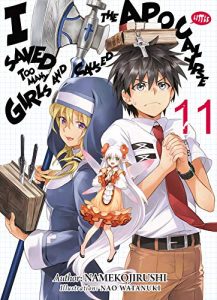
Satsuki is not on the cover, of course. The interesting thing, though, is that both girls on the cover, while heroines that Rekka “solves”, are not romantic heroines that we can see. Yulia is a nun who, like many Japanese nuns in fiction, is also an exorcist and a bit of a fanatic. Given she’s ended up in Rekka’s hometown, which is teeming with otherworldly inhabitants, particularly the vampire Rosalind, you can see why Yulia is flipping out a bit. In fact, dialing back her fanaticism is the point – she’s mistaking the Church’s vendetta for her own, and Rekka has an actual Angel to tell her “no, God says the Church is wrong”. (A very common thing in light novels lately.) As for Poppy the fairy, “staying hidden” and avoiding a group of kids trying to capture her is the sole goal she has. Compared to prior volumes, the stakes are very low key here.

Back to Satsuki, a surprise in this volume was that we not only see her parents, but get art showing what they look like. (In fact, the author wondered if there were enough interesting scenes for the artist, which may be why we see her parents as well as the kids harassing the fairy.) The other plot-heavy part of the book involves L, who has been abandoned by her villain friends and is on her own in the past, and essentially homeless till she gets picked up and adopted, for the moment, by Satsuki’s family. She’s still trying to kill Rekka technically, but it is interesting that whereas R is going for “hammer Rekka with as many heroines as possible to create a crisis point”, L is more “I am in one heroine’s corner”. And that heroine is Satsuki.

Will she win? Likely we won’t know till Book 16. Will R ever be seen? And of course the one question that absolutely has to wait for the last book: will Rekka get a clue that everyone is in love with him and do something about it other than change the subject? We do apparently get a girl in a top hat, though, so that’s nice. If you’ve been reading this, keep reading it. It’s fun froth.

Filed Under: i saved too many girls and caused the apocalypse, REVIEWS

Silver Spoon, Vol. 6

January 5, 2019 by Sean Gaffney

By Hiromu Arakawa. Released in Japan as “Gin no Saji” by Shogakukan, serialization ongoing in the magazine Weekly Shonen Sunday. Released in North America by Yen Press. Translated by Amanda Haley.

It’s going to be very hard to discuss this volume without talking about the final chapter that overshadows the rest of it, but I will do my best to save that for later. In the meantime, there is still festival prep, and horse races! The racing is a highlight of the book, mostly as, despite getting distracted by family, studies, and Mikage, Hachiken is finally learning how to ride. This is despite the fact that he almost falls off Chestnut 3/4 of the way through, creating a dramatic moment when everyone panics he’s going to fall and get trampled. But he survives, and ends up in fourth place! Which is interesting, because it’s really good for a newbie, but it still irritates him. He wants more. He’s getting competitive spirit. This is especially good news given that he’s fallen for Mikage, who gets third in her own race and actually agrees to go on a date with him during the festival (though she may not have realized that’s what it was).

It would be remiss of me not to mention Ayame, who is introduced in this volume and is FABULOUS, in all senses of the word. Trying her hardest to have wandered in from a Rose of Versailles manga, and consumed with an intense rivalry with Mikage (who merely sees her as a good childhood friend), Ayame is pure hilarity the moment she steps onto the page. She’s basically the “ohohohohohoho” laugh given human form. She rides slowly and perfectly through her race, not understanding or even really caring that she’d doing it wrong. And when Hachiken manages to get fourth in a race (and thus finish ahead of her), Ayame admits that she’s rivals with him as well. For all that I praise Silver Spoon for its depiction of agriculture and compelling characters, there’s also no doubt that Arakawa can make things incredibly funny.

…and then Hachiken collapses and is taken to hospital, right before the festival begins. Frankly, the astute reader should have guessed this was going to happen. He hasn’t been brought up on a farm, and he got goaded into taking charge of eighty different things. He was ridiculously exhausted, and now he’s paying. That doesn’t make this any less depressing, though. His look as he wakes up in the hospital is almost heartbreaking. And that cliffhanger, showing the arrival of his dad, promises that the next volume is not going to be starting with laughs either. Still, I like that we are shown the start of the festival anyway – the manga is not just Hachiken, and I’ll lay you even money that his incredibly detailed and easy to understand festival plan is going to be noticed by someone at some point (there’s even a shot of the notebook sitting there like Chekhov’s gun.)

So the festival looks to be a success, but will Hachiken get to see any of it? And will his dad demand he pull out of the school? Can his dad, in fact, find it in him to not be a complete dick this time? I cannot wait to find out, because Silver Spoon is still amazingly addicting.

Filed Under: REVIEWS, silver spoon

The Asterisk War: Idol Showdown

January 4, 2019 by Sean Gaffney

By Yuu Miyazaki and okiura. Released in Japan by Media Factory. Released in North America by Yen On. Translated by Haydn Trowell.

I must admit, of all the minor characters introduced in the last book when Ayato toured the festivals, I was not expecting the comic relief idol band to be the most important. Yet here we are, with said band trying to shame Ayato for being a clueless harem protagonist, getting into fights with other, more delinquent contestants, discovering secret underground battle rings, and taking on our heroes in the final part of the book. Actually, possibly the most interesting part of their story is the fact that their weapon is so powerful, even divided into five bits, that it literally makes them more eccentric and difficult. They have weaponized being cloud cuckoolanders! They also put up a damn good fight, forcing Claudia to use a lot more of her precognitive powers than I think she wanted, which will no doubt come to haunt her in the end. That said, this is really Saya’s book. So I will save her for later.

But first, let’s stay with Claudia, who stuns everyone by announcing her goal in front of the press. This certainly unnerves many people in power, especially her mother, who it turns out if in charge of most everything. As you can imagine, Claudia and her mother do not get along, and yet their confrontation is a highlight of the book. It also seems to tie into what Sylvie is searching for – as does the aforementioned underground battle ring, which is shut down for now but I’ll bet you even money will be started up again in a few books so that Ayato and Julis can fight forbidden illegal battles. Much of the rest of the book is the start of this tournament, with various groups fighting and showing off their dangerous points. This includes Claudia’s team as well, usually with her as the ‘team captain’, though that changes for the final match of the book.

Which brings us to Saya, who gets a lot of focus here. She’s both the childhood friend love interest and the ‘stoic’ one, so brings a lot of popular cards to the table. Her stoicness masks a lot of emotion, though, both in her desire to be able to bring everything she can to the battles with her weapons (which works out wonderfully in the last battle with her homing bazooka thing), and in her desire to be closer to Ayato. She spends a lot of the middle of the book convincing the idol group girls that Ayato is not, in fact, a playboy (well, not deliberately) and explaining all the times he’s been there for her. Which seems to lead her to the big cliffhanger, where she confesses to him. Now, I have a feeling that Saya is aware of the cliches of harem novels like this, and knows that by both being a childhood friend *and* confessing first, she’s out of luck. Still, it’s super impressive, and I hope that Ayato is able to give her a response that’s not just hemming and hawing.

Asterisk War is still very light and fluffy, but this was a particularly strong volume of the series. If you only watched the anime to make fun of it, you might be surprised by this book.

Filed Under: asterisk war, REVIEWS

  • « Go to Previous Page
  • Page 1
  • Interim pages omitted …
  • Page 154
  • Page 155
  • Page 156
  • Page 157
  • Page 158
  • Interim pages omitted …
  • Page 346
  • Go to Next Page »
 | Log in
Copyright © 2010 Manga Bookshelf | Powered by WordPress & the Genesis Framework