The year is 1955. Twenty-year-old Masayo, an aspiring painter from Hakodate, apprentices herself to Goro Kawabuko, a handsome widower who teaches at a Tokyo art college. In exchange for a weekly lesson, Masayo agrees to keep house for Goro and tutor his daughter Momoko, a strange, withdrawn child whose only companion is a regal white cat named Lala.
Masayo, who comes from a humble background, finds the Kawabuko household enchanting. Or, more accurately, she finds Goro enchanting. Goro epitomizes urban chic, hosting lavish parties, listening to jazz, and wearing the latest Western fashions. Realizing that Goro is beyond her reach, Masayo instead focuses on Momoko; if she can gain the girl’s confidance, perhaps she’ll have a claim on Goro’s heart as well. Masayo must first demonstrate her affinity for Lala, however, as the cat exerts an almost maternal power over Momoko, responding to her mistress’ quicksilver moods with an emotional intelligence that borders on human.
Masayo’s tenure is threatened by the arrival of Chinatsu, a beautiful sophisticate who seems intent on marrying Goro. Chinatsu competes with Masayo for Momoko’s affections, touching off a battle royal between the two women. Watching their struggle unfold, we begin to see through Masayo’s guileless pose: she’s as masterful a manipulator as Chinatsu, using her relationship with Momoko to drive a wedge between Goro and his fiancee:
For a wicked moment, I savored the momentary discomfiture that flickered across the faces of Goro and Chinatsu. Momoko had shown precious little interest in Chintasu; indeed, she had all but ignored her. And then she came running to me. It occurred to me then that aside from Goro, nobody was closer to Momoko than I was. That thought made me feel even more elated.
Like Henry James’s “The Turn of the Screw,” The Cat in the Coffin draws its power from “the strange and sinister embroidered on the very type of the normal and easy,” presenting itself as a domestic drama about a naive young woman who falls for her worldly employer. Yet the book has an oppressive, eerie quality that lends itself to several tantalizing readings: that Lala may be possessed by Momoko’s dead mother, that Momoko herself is a bad seed. By the novel’s end, the reader may believe Masayo’s account of events — and even feel great compassion for her — while questioning her involvement in them.
It’s this level of narrative complexity that elevates The Cat in the Coffin from romantic pot boiler to literature: we’re seduced by Masayo’s modest, self-effacing comments before we recognize that she’s an unreliable witness. One can certainly read The Cat in the Coffin as an atmospheric mystery, but it works on many other levels as well: as a meditation on jealousy, as a young woman’s sexual awakening, as a portrait of life in occupied Japan, as a parody of the Victorian governess novel. I’d love to see Vertical translate more work by Mariko Koike, as she brings an uncommon level of wisdom and literary sophistication to a pulpy genre.
Review copy provided by Vertical, Inc.
THE CAT IN THE COFFIN • BY MARIKO KOIKE, TRANSLATED BY DEBORAH BOLIVER BOEHM • VERTICAL, INC. • 190 pp.
 Given the current economic climate, any book with the subtitle The Last Career Guide You’ll Ever Need sounds like a worthwhile investment. Job seekers should be warned, however, that The Adventures of Johnny Bunko isn’t about crafting the perfect resume, networking, or nailing the interview, but finding a career path that suits your strengths and personal values. Readers should also note that Johnny Bunko’s format defies easy categorization, straddling the fence between graphic novel and self-help book. Some readers may find Johnny Bunko’s mixture of slapstick humor and advice charming, while others may find the presentation too gimmicky for their tastes.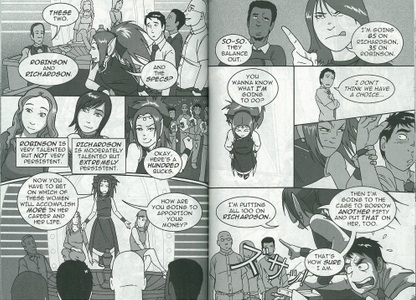
 Night of the Beasts may not be Chika Shiomi’s best work, but it’s certainly her most ambitious, a sweeping horror-fantasy with detailed artwork and nakedly emotional dialogue reminiscent of CLAMP’s Tokyo Babylon and X/1999 .
 The eponymous heroine of Canon is a smart, tough-talking vigilante who’s saving the world, one vampire at a time. For most of her life, Canon was a sickly but otherwise unremarkable human — that is, until a nosferatu decided to make Lunchables™ of her high school class. Canon, the sole survivor of the attack, was transformed into a vampire whose blood has an amazing property: it can restore other victims to their former human selves. She’s determined to rescue as many human-vampire converts as she can, prowling the streets of Tokyo in search of others like her. She’s also resolved to find and kill Rod, the handsome blonde vampire whom she believes murdered her friends. Joining her are two vampires with agendas of their own: Fuui, a talking crow who’s always scavenging for blood, and Sakaki, a half-vamp who harbors an even deeper grudge against Rod for killing his family.
 Though some authors get it right on their very first try – say, Ralph Ellison or Harper Lee – most take a few books to develop their voice and storytelling chops. Chika Shiomi is no exception to this rule, as Queen of Ragtonia, an early series, demonstrates.
 Rasetsu is a popcorn movie in manga form, a tasty mix of suspense, humor, and sexual tension with a sprinkling of supernatural elements. Though billed as a sequel to
  Common to all of Chika Shiomi’s supernatural thrillers are her butt-kicking heroines. Whether taming demons or hunting vampires, these unapologetically tough cookies always bag a fetching fellow, personality flaws and conflicting allegiances be damned.
 While Yurara’s premise isn’t particularly novel, I found it a nice bit of wish fulfillment: who wouldn’t want the power to transform into a more competent, attractive version of themselves when the occasion warranted? Shiomi has the good sense to exploit her set-up for laughs as well as chills, milking her awkward love triangle for all its comic potential and populating her story with some goofy ghosts. In volume three, for example, Shiomi introduces us to the spirit of Yurara’s grandfather. Thrilled to be among the living again, he dudes himself out as a seventies hipster — about the decade he would have been in his masculine prime — and swaggers through the streets of Tokyo, oblivious to the fact that only Mei, Yako, and Yurara can actually see his youthful new appearance.
 is a rude, raunchy comedy that’s both a satire of death metal culture and a loving portrait of the folks who labor in its trenches.
 Forget what you know about the Russian Revolution. The real cause of the Romanov’s demise wasn’t growing unrest among the proletariat, the intelligentsia, or the military; nor the high cost of World War I; nor the famines of 1906 and 1911, but something far more sinister: vampires. At least, that’s the central thesis of Blood+ Adagio, a prequel to the popular anime/manga series about an immortal, vampire-slaying schoolgirl and her handsome, enigmatic handler. The first volume of Adagio transplants Saya and Hagi from the steamy jungles of present-day Okinawa and Vietnam — where they’ve battled US military forces and the myserious Cinq Flèches Group — to the chilly halls of Nicholas II’s Winter Palace in St. Petersburg — where they discover a nest of Chiropterans (a.k.a vampires who are more beast than bishie) as well as a host of schemers, sycophants, and crazy folk in the tsar’s orbit. Let the slayage begin!
 To a casual observer, Asuka Masamune epitomizes masculinity. Not only is he the captain of the kendo team and a star student, he’s also tall, handsome, and quick to defend weaker students from bullies — the kind of stoic, principled guy that boys and girls admire. That macho exterior belies Asuka’s true nature as a sensitive young man with girly hobbies such as making elaborate bento boxes, sewing stuffed animals (the cuter, the better), and reading Love Chick, a shojo manga serialized in his favorite magazine, Hana to Mame (literally, “Flowers and Beans,” a pun on Hana to Yume, or “Flowers and Dreams”).