• Skip to primary navigation
  • Skip to main content
  • Skip to primary sidebar
  • Home
  • About Us
    • Privacy Policy
    • Comment Policy
    • Disclosures & Disclaimers
  • Resources
    • Links, Essays & Articles
    • Fandomology!
    • CLAMP Directory
    • BlogRoll
  • Features & Columns
    • 3 Things Thursday
    • Adventures in the Key of Shoujo
    • Bit & Blips (game reviews)
    • BL BOOKRACK
    • Bookshelf Briefs
    • Bringing the Drama
    • Comic Conversion
    • Fanservice Friday
    • Going Digital
    • It Came From the Sinosphere
    • License This!
    • Magazine no Mori
    • My Week in Manga
    • OFF THE SHELF
    • Not By Manga Alone
    • PICK OF THE WEEK
    • Subtitles & Sensibility
    • Weekly Shonen Jump Recaps
  • Manga Moveable Feast
    • MMF Full Archive
    • Yun Kouga
    • CLAMP
    • Shojo Beat
    • Osamu Tezuka
    • Sailor Moon
    • Fruits Basket
    • Takehiko Inoue
    • Wild Adapter
    • One Piece
    • After School Nightmare
    • Karakuri Odette
    • Paradise Kiss
    • The Color Trilogy
    • To Terra…
    • Sexy Voice & Robo
  • Browse by Author
    • Sean Gaffney
    • Anna Neatrour
    • Michelle Smith
    • Katherine Dacey
    • MJ
    • Brigid Alverson
    • Travis Anderson
    • Phillip Anthony
    • Derek Bown
    • Jaci Dahlvang
    • Angela Eastman
    • Erica Friedman
    • Sara K.
    • Megan Purdy
    • Emily Snodgrass
    • Nancy Thistlethwaite
    • Eva Volin
    • David Welsh
  • MB Blogs
    • A Case Suitable For Treatment
    • Experiments in Manga
    • MangaBlog
    • The Manga Critic
    • Manga Report
    • Soliloquy in Blue
    • Manga Curmudgeon (archive)

Manga Bookshelf

Discussion, Resources, Roundtables, & Reviews

Manga Critic

The Best Manga You’re Not Reading: Presents

October 29, 2010 by Katherine Dacey

Back in 2007, John Jakala coined the trademark-worthy phrase “comeuppance theater” to describe horror stories in which a mean, violent, or greedy person gets his just desserts: a vain woman becomes visibly grotesque, a murderer dies at the hands of his victim’s ghost. In order for comeuppance theater to be dramatically persuasive, the author needs to do more than just dream up a suitably ironic punishment for the villain; he needs to convince us that the villain is sufficiently deserving of said punishment, that the villain is, in fact, monstrous in his desires or behavior and not simply an average joe exercising bad judgment. We may not be rooting for the villain’s demise — we may even feel a twinge of sympathy for him or self-identification with his plight — but if the author has done his job, the villain’s punishment seems necessary for restoring the social order.

In Presents (CMX), Kananko Inuki puts an interesting spin on the material, using our love of gifts as the jumping-off point for some funny, nasty, and intelligent episodes of comeuppance theater. The series’ host is Kurumi, a strange little girl who doles out presents to bad people and victims alike. Some gifts prove the recipients’ undoing: in “Present of Love,” for example, a manipulative college student goads her suitor into buying expensive jewelry that he can’t afford, even though she loathes him. His last gift to her — a set of earrings that Kurumi promised would “bring them together” — initiates a chain of events that unite the foolish pair in death. Other gifts provide victims a tool for payback: in “The Scary Present,” Kurumi gives a giant, man-eating box to a girl whose big sister gives horrific, mean-spirited gifts, while in “The Return Present,” Kurumi helps a bullied teen find an appropriate present for her tormentor.

Not all the stories follow this exact template; Kurumi becomes less central to the plots in volumes two or three, sometimes functioning as a passive observer, other times not appearing in the story at all. Volume two, for example, opens with a peculiar — and not entirely successful — trio of stories about Christmas gifts’ potential to corrupt little kids. Other stories read more like fairy tales: in “Dream Present,” a young woman endures a series of painful rituals in order to win a prince’s hand in marriage (in homage to Cinderella’s stepsisters, she even dispenses with a few toes), while in “Konotori” (or “stork”), magical cabbages bestow fertility on deserving couples.

The most potent stories shed light on the indignities of childhood, especially playground politics. Many of Presents‘ female characters are preoccupied with their place in the school’s pecking order, selecting uglier or quieter classmates to serve as foils more than friends. Rinko, the mean-girl villain of “The Return Gift,” is a classic example, calmly admitting that her friendship with the shy, slow Suzuko makes her “relax and feel better about herself,” then quietly fuming when Suzuko begins coming into her own socially and academically. The principal characters in “The Keepsake” and “The Most Wanted Present” are similarly opportunistic, demanding extreme fealty from lonely, passive classmates; when these eager-to-please girls die in an effort to honor their promises, their tormentors suffer retribution from beyond the grave.

Frenemies are a staple of young adult literature, of course, but the bald presentation of the issue in Presents conveys the cruelty of the behavior more effectively than a more restrained, realistic depiction could, capturing the intensity of both the bully and the victim’s feelings in an immediate, visceral fashion. Inuki’s imagery in all three stories is cartoonishly grotesque: Rinko, for example, develops monster zits that look more like the handiwork of an alien virus than P. acnes, while Mamiko, the manipulative frenemy in “The Keepsake,” winds up with a grotesque scar on her chest in the shape of her dead friend’s profile. (Mamiko coveted Sakiko’s cameo brooch.) The pimples and the scars make visible Rinko and Mamiko’s true selves; though both are fully aware of what they’re doing (“I was happy to see the look of distress on Sakiko’s face,” Mamiko narrates), it’s not until they see their deformed likenesses that they grasp how hurtful their behavior really is.

The fact that bullies, mean girls, and big sisters factor so prominently into Presents suggests that Inuki was writing for a younger audience, a supposition borne out by her fondness for goosing the story with fleeting but gross images: a box of cockroaches, pus-covered wounds, rotting corpses. It’s a pity, then, that CMX opted for a Mature rating, as I think the series works well for teens, depicting the emotional horrors of childhood in a vivid, gruesomely funny way. The stories are varied enough to sustain an adult’s interest as well; readers with fond memories of Tales from the Crypt or The Twilight Zone will find a lot to like about Inuki’s work, from the efficiently of her storytelling — many of Presents‘ best chapters are less than twenty pages — to the pointedness of her punishments.

PRESENTS, VOLS. 1-3 • BY KANAKO INUKI • CMX • RATING: MATURE (18+)

The Best Manga You’re Not Reading is an occasional feature that highlights titles that aren’t getting the critical attention — or readership — they deserve. Click here for the inaugural column; click here for the series archive.

Filed Under: Manga, Manga Critic, Recommended Reading, REVIEWS Tagged With: cmx, Horror/Supernatural, Kanako Inuki

My 10 Favorite Spooky Manga

October 24, 2010 by Katherine Dacey 38 Comments

Whether by accident or design, the very first manga I read and liked were horror titles: “The Laughing Target,” Mermaid Saga, Uzumaki. I’m not sure why I find spooky stories so compelling in manga form; I don’t generally read horror novels, and I don’t have the constitution for gory movies. But manga about zombies? Or vampires? Or angry spirits seeking to avenge their own deaths? Well, there’s always room on my bookshelf for another one, even if the stories sometimes feel overly familiar or — in the case of artists like Kanako Inuki and Kazuo Umezu — make no sense at all. Below is a list of my ten favorite scary manga, which run the gamut from psychological horror to straight-up ick.

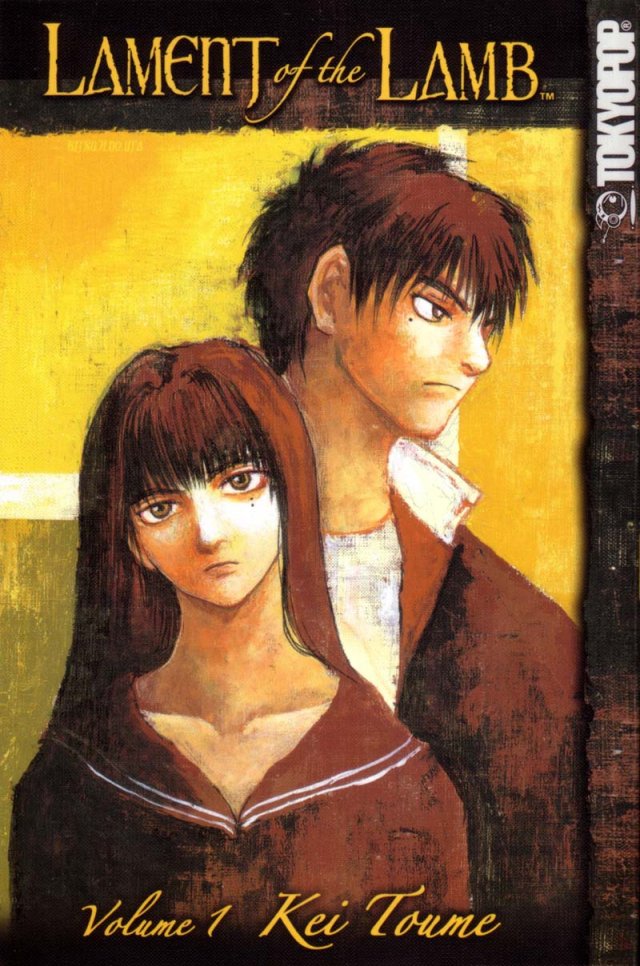
10. LAMENT OF THE LAMB

KEI TOUME • TOKYOPOP • 7 VOLUMES

Kei Toume puts a novel spin on vampirism, presenting it not as a supernatural phenomenon, but as a symptom of a rare genetic disorder. His brother-and-sister protagonists, Kazuna and Chizuna, begin exhibiting the same tendencies as their deceased mother, losing control at the sight or suggestion of blood, and enduring cravings so intense they induce temporary insanity. Long on atmosphere and short on plot, Lament of the Lamb won’t be every vampire lover’s idea of a rip-snortin’ read; the manga focuses primarily on the intense, unhealthy relationship between Kazuna and Chizuna, and very little on blood-sucking. What makes Lament of the Lamb so deeply unsettling, however, is the strong current of violence and fear that flows just beneath its surface; Kazuna and Chizuna may not be predators, but we see just how much self-control it takes for them to contain their bloodlust.

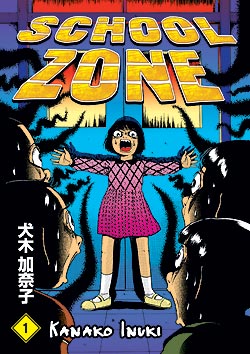
9. SCHOOL ZONE

KANAKO INUKI • DARK HORSE • 3 VOLUMES

In this odd, hallucinatory, and sometimes very funny series, a group of students summon the ghosts of people who died on school grounds, unleashing the spirits’ wrath on their unsuspecting classmates. School Zone is as much a meditation on childhood fears of being ridiculed or ostracized as it is a traditional ghost story; time and again, the students’ own response to the ghosts is often more horrific than the ghosts’ behavior. Inuki’s artwork isn’t as gory or imaginative as some of her peers’, though she demonstrates a genuine flair for comically gruesome thrills: one girl is dragged into a toilet, for example, while another is attacked by a scaly, long-armed creature that lives in the infirmary. Where Inuki really shines, however, is in her ability to capture the primal terror that a dark, empty building can inspire in the most rational person. Even when the story takes one its many silly detours — and yes, there are many WTF?! moments in School Zone — Inuki makes us feel her characters’ vulnerability as they explore the school grounds after hours. —Reviewed at The Manga Critic on 10/29/09

8. MAIL

HOUSUI YAMAKAZI • DARK HORSE • 3 VOLUMES

If you like you horror neat with a twist, Mail might be your kind of manga: a meticulously crafted selection of short, spooky tales in which a handsome exorcist goes toe-to-toe with all sort of ghosts. The stories are a mixture of urban legend and folklore: a GPS system which directs a woman to the scene of a crime, an accident victim who haunts the elevator shaft where he died, a possessed doll. Through precise linework and superb command of light, Hosui Yamakazi transforms everyday situations — returning home from work, logging onto a computer — into extraordinary ones in which shadows and corners harbor very nasty surprises. Best of all, Mail never overstays its welcome; it’s the manga equivalent of the Goldberg Variations, offering a number of short, trenchant variations on a single theme and then wrapping things up neatly.

7. AFTER SCHOOL NIGHTMARE

SETONA MITZUSHIRO • GO! COMI • 10 VOLUMES

Masahiro, a charming, popular high school student, harbors a terrible secret: though he appears to be male, the lower half of his body is female. At a nurse’s urging, he agrees to visit the school infirmary for a series of dream workshops in which he interacts with classmates who are also grappling with serious problems, from child abuse to pathological insecurity. The students’ collective dreams are vivid and strange, unfolding with the peculiar, fervid logic of a nightmare; buildings flood, stairwells lead to dead ends, and characters undergo sudden, dramatic transformations. Making the dream sequences extra creepy is the way Setona Mizushiro renders the students, choosing an avatar for each that represents their true selves: a black knight, a faceless body, a long, disembodied arm that grasps and slithers. Attentive readers will be rewarded for their patient observation with an unexpected but brilliant twist in the very final pages.

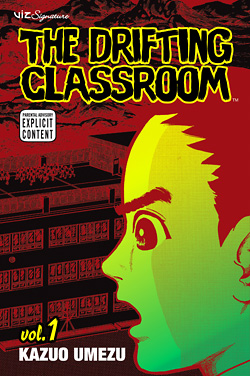
6. THE DRIFTING CLASSROOM

KAZUO UMEZU • VIZ • 11 VOLUMES

It’s sorely tempting to compare The Drifting Classroom to The Lord of the Flies, as both stories depict school children creating their own societies in the absence of adult authority. But Kazuo Umezu’s series is more sinister than Golding’s novel, as Classroom‘s youthful survivors have been forced to band together to defend themselves from their former teachers, many of whom have become unhinged at the realization that they may never return to their own time. (Their entire elementary school has slipped through a rift in the space-time continuum, depositing everyone in the distant future.) The story is as relentless as an episode of 24: characters are maimed or killed in every chapter, and almost every line of dialogue is shouted. (Sho’s petty arguments with his mother are delivered as emphatically as his later attempts to alert classmates to the dangers of their new surroundings.) Yet for all its obvious shortcomings, Umezu creates an atmosphere of almost unbearable tension that conveys both the hopelessness of the children’s situation and their terror at being abandoned by the grown-ups. If that isn’t the ultimate ten-year-old’s nightmare, I don’t know what is. —Reviewed at PopCultureShock on 10/15/06

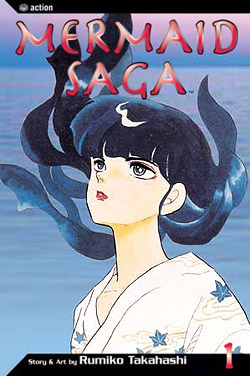
5. MERMAID SAGA

RUMIKO TAKAHASHI • VIZ • 4 VOLUMES

This four-volume series ran on and off in Shonen Sunday for nearly ten years, chronicling the adventures of Yuta, a fisherman who gained immortality by eating mermaid flesh. Desperate to live an ordinary existence, Yuta spends five hundred years wandering Japan in search of a mermaid who can restore his mortality, crossing paths with criminals, immortals, and “lost souls,” people reduced to a monstrous condition by the poison in mermaid flesh. Though the stories follow a somewhat predictable pattern, Takahashi’s writing is brisk and assured, propelled by snappy dialogue and genuinely creepy scenarios. The imagery is tame by horror standards, but Takahashi doesn’t shy away from the occasional grotesque or gory image, using them to underscore the ugly consequences of seeking immortality. –Reviewed at The Manga Critic on 10/29/09.

4. DORORO

OSAMU TEZUKA • VERTICAL, INC. • 3 VOLUMES

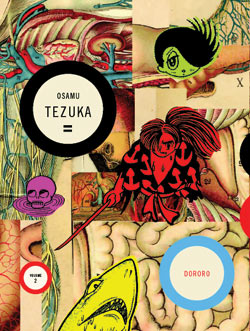
The next time you feel inclined to criticize your parents, remember Hyakkimaru’s plight: his father pledged Hyakkimaru’s body parts to forty-eight demons in exchange for political power, leaving his son blind, deaf, and limbless at birth. After being rescued and raised by a kindly doctor, Hyakkimaru embarks on a quest to reclaim his eyes and ears, wandering across a war-torn landscape where demons take advantage of the chaos to prey on humans. Some of these demons have obvious antecedents in Japanese folklore (e.g. a nine-tailed fox), while others seem to have sprung full-blown from Tezuka’s imagination (e.g. a shark who paralyzes his victims with sake breath). Though the story ostensibly unfolds during the Warring States period, Dororo wears its allegory lightly, focusing primarily on swordfights, monster lairs, and damsels in distress while using its historical setting to make a few modest points about the corrosive influence of greed, power, and fear. For my money, one of Tezuka’s best series, peroid. —Reviewed at The Manga Critic on 7/27/09

3. PARASYTE

HITOSHI IWAAKI • DEL REY • 8 VOLUMES

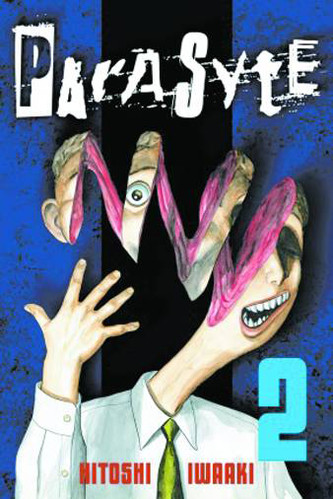
Part The Defiant Ones, part Invasion of the Body Snatchers, Parasyte focuses on the symbiotic relationship between Shin, a high school student, and Migi, the alien parasite that takes up residence in his right hand after failing to take control of Shin’s brain. The two go on the lam after another parasite kills Shin’s mother — and makes Shin and Migi look like the culprits. If the human character designs are a little blank and clumsy, the parasites are not; Hitoshi Iwaaki twists the human body into some of the most sinister-looking shapes since Pablo Picasso painted Dora Maar. The violence is graphic but not sadistic, as most of the action takes place between panels, with only the grisly aftermath represented in pictorial form. The best part of Parasyte, however, is the script; Shin and Migi trade barbs with the antagonistic affection of Oscar Madison and Felix Unger, revealing Migi to be smarter and more objective than his human host. Shin and Migi’s banter adds an element of levity to the story, to be sure, but their heated debates about survival are also a sly poke at the idea that human beings’ intellect and emotional attachments place them squarely atop the food chain. –Reviewed at The Manga Critic on 7/2/10

2. THE KUROSAGI CORPSE DELIVERY SERVICE

EIJI OTSUKI AND HOUSUI YAMAKAZI • DARK HORSE • 13+ VOLUMES

The Kurosagi Corpse Delivery Service is comprised of five members: Karatsu, a monk-in-training; Numata, a hipster with an encyclopedic knowledge of pop culture; Yata, an odd duck who communicates primarily through a puppet that he wears on his left hand; Makino, a chatty embalmer; and Sasaki, a hacker with an entrepreneurial streak. Working as a team, the quintet helps the dead cross over, using their myriad talents to locate bodies, speak with ghosts, and resolve the spirits’ unfinished business. The set-up is pure gold, giving the episodic series some structure, while allowing Eiji Otsuka and Housui Yamakazi the flexibility to stage grisly murders and discover corpses in a variety of unexpected places. Think Scooby Doo with less wholesome protagonists and scarier spooks and you have a good idea of what makes this offbeat series tick. And yes, the gang even has their own van. —Reviewed at The Manga Critic on 6/24/09

1. GYO

JUNJI ITO • VIZ • 2 VOLUMES

From the standpoint of craft, Uzumaki is a better manga, but it’s hard to top the sheer creepiness factor of Gyo, which taps into one of the most primordial of fears: being eaten! Here’s how I explained its appeal to David Welsh at The Comics Reporter:

Like many other children of the 1970s, Jaws left an indelible impression on me. I wasn’t just terrified of swimming in the ocean, I was reluctant to immerse myself in any standing body of water — swimming pools, bathtubs, ponds — that might conceivably harbor a shark. That irrational fear of encountering a great white somewhere it’s not supposed to be even led me to wonder what it might be like to bump into one on land — could I outrun it?

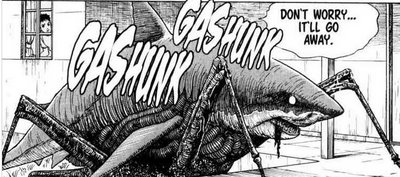
I’m guessing Junji Ito also suffers from icthyophobia, because Gyo looks like my worst nightmare, a world in which hideously deformed fish crawl out of the sea on mechanical legs and terrorize humans, spreading a disease that quickly jumps species. As horror stories go, many of Gyo‘s details aren’t terribly well explained — how, exactly, the fish acquired legs remains unclear despite talk of military experiments gone awry — but the imaginative artwork appeals on a visceral level. Gyo‘s highpoint comes midway through volume one, when a great white shark chases the hero and his girlfriend through a house, even scaling the stairs (no pun intended) in pursuit of its next meal. The scene is utterly ridiculous, but it works — for a few terrible, thrilling pages I learned the answer to my long-standing question, What would it be like to be chased by a shark on land? In a word: scary.

In other words, this is my worst nightmare:

So those are ten of my favorite spooky manga! What horror manga are on your top-ten list? Inquiring minds want to know!

Filed Under: Manga Critic Tagged With: Dark Horse, del rey, Eiji Otsuka, Go! Comi, Hitoshi Iwaaki, Horror/Supernatural, Housui Yamakazi, Junji Ito, Kanako Inuki, Kazuo Umezu, Kei Toume, Osamu Tezuka, Rumiko Takahashi, Setona Mizushiro, Tokyopop, vertical, VIZ

My 10 Favorite Spooky Manga

October 24, 2010 by Katherine Dacey

Whether by accident or design, the very first manga I read and liked were horror titles: “The Laughing Target,” Mermaid Saga, Uzumaki. I’m not sure why I find spooky stories so compelling in manga form; I don’t generally read horror novels, and I don’t have the constitution for gory movies. But manga about zombies? Or vampires? Or angry spirits seeking to avenge their own deaths? Well, there’s always room on my bookshelf for another one, even if the stories sometimes feel overly familiar or — in the case of artists like Kanako Inuki and Kazuo Umezu — make no sense at all. Below is a list of my ten favorite scary manga, which run the gamut from psychological horror to straight-up ick.

10. Lament of the Lamb
By Kei Toume • Tokyopop • 7 volumes
Kei Toume puts a novel spin on vampirism, presenting it not as a supernatural phenomenon, but as a symptom of a rare genetic disorder. His brother-and-sister protagonists, Kazuna and Chizuna, begin exhibiting the same tendencies as their deceased mother, losing control at the sight or suggestion of blood, and enduring cravings so intense they induce temporary insanity. Long on atmosphere and short on plot, Lament of the Lamb won’t be every vampire lover’s idea of a rip-snortin’ read; the manga focuses primarily on the intense, unhealthy relationship between Kazuna and Chizuna, and very little on blood-sucking. What makes Lament of the Lamb so deeply unsettling, however, is the strong current of violence and fear that flows just beneath its surface; Kazuna and Chizuna may not be predators, but we see just how much self-control it takes for them to contain their bloodlust.

9. School Zone
By Kanako Inuki • Dark Horse • 3 volumes
In this odd, hallucinatory, and sometimes very funny series, a group of students summon the ghosts of people who died on school grounds, unleashing the spirits’ wrath on their unsuspecting classmates. School Zone is as much a meditation on childhood fears of being ridiculed or ostracized as it is a traditional ghost story; time and again, the students’ own response to the ghosts is often more horrific than the ghosts’ behavior. Inuki’s artwork isn’t as gory or imaginative as some of her peers’, though she demonstrates a genuine flair for comically gruesome thrills: one girl is dragged into a toilet, for example, while another is attacked by a scaly, long-armed creature that lives in the infirmary. Where Inuki really shines, however, is in her ability to capture the primal terror that a dark, empty building can inspire in the most rational person. Even when the story takes one its many silly detours — and yes, there are many WTF?! moments in School Zone — Inuki makes us feel her characters’ vulnerability as they explore the school grounds after hours. —Reviewed at The Manga Critic on 10/29/09

8. Mail
By Housui Yamazaki • Dark Horse • 3 volumes
If you like you horror neat with a twist, Mail might be your kind of manga: a meticulously crafted selection of short, spooky tales in which a handsome exorcist goes toe-to-toe with all sort of ghosts. The stories are a mixture of urban legend and folklore: a GPS system which directs a woman to the scene of a crime, an accident victim who haunts the elevator shaft where he died, a possessed doll. Through precise linework and superb command of light, Hosui Yamakazi transforms everyday situations — returning home from work, logging onto a computer — into extraordinary ones in which shadows and corners harbor very nasty surprises. Best of all, Mail never overstays its welcome; it’s the manga equivalent of the Goldberg Variations, offering a number of short, trenchant variations on a single theme and then wrapping things up neatly.

7. After School Nightmare
By Setona Mizushiro • Go! Comi • 10 volumes
Masahiro, a charming, popular high school student, harbors a terrible secret: though he appears to be male, the lower half of his body is female. At a nurse’s urging, he agrees to visit the school infirmary for a series of dream workshops in which he interacts with classmates who are also grappling with serious problems, from child abuse to pathological insecurity. The students’ collective dreams are vivid and strange, unfolding with the peculiar, fervid logic of a nightmare; buildings flood, stairwells lead to dead ends, and characters undergo sudden, dramatic transformations. Making the dream sequences extra creepy is the way Setona Mizushiro renders the students, choosing an avatar for each that represents their true selves: a black knight, a faceless body, a long, disembodied arm that grasps and slithers. Attentive readers will be rewarded for their patient observation with an unexpected but brilliant twist in the very final pages.

6. The Drifting Classroom
By Kazuo Umezu • VIZ Media • 11 volumes
It’s sorely tempting to compare The Drifting Classroom to The Lord of the Flies, as both stories depict school children creating their own societies in the absence of adult authority. But Kazuo Umezu’s series is more sinister than Golding’s novel, as Classroom‘s youthful survivors have been forced to band together to defend themselves from their former teachers, many of whom have become unhinged at the realization that they may never return to their own time. (Their entire elementary school has slipped through a rift in the space-time continuum, depositing everyone in the distant future.) The story is as relentless as an episode of 24: characters are maimed or killed in every chapter, and almost every line of dialogue is shouted. (Sho’s petty arguments with his mother are delivered as emphatically as his later attempts to alert classmates to the dangers of their new surroundings.) Yet for all its obvious shortcomings, Umezu creates an atmosphere of almost unbearable tension that conveys both the hopelessness of the children’s situation and their terror at being abandoned by the grown-ups. If that isn’t the ultimate ten-year-old’s nightmare, I don’t know what is. —Reviewed at PopCultureShock on 10/15/06

5. Mermaid Saga
By Rumiko Takahashi • VIZ Media • 4 volumes
This four-volume series ran on and off in Shonen Sunday for nearly ten years, chronicling the adventures of Yuta, a fisherman who gained immortality by eating mermaid flesh. Desperate to live an ordinary existence, Yuta spends five hundred years wandering Japan in search of a mermaid who can restore his mortality, crossing paths with criminals, immortals, and “lost souls,” people reduced to a monstrous condition by the poison in mermaid flesh. Though the stories follow a somewhat predictable pattern, Takahashi’s writing is brisk and assured, propelled by snappy dialogue and genuinely creepy scenarios. The imagery is tame by horror standards, but Takahashi doesn’t shy away from the occasional grotesque or gory image, using them to underscore the ugly consequences of seeking immortality. —Reviewed at The Manga Critic on 10/29/09.

4. Dororo
By Osamu Tezuka • Vertical, Inc. • 3 volumes
The next time you feel inclined to criticize your parents, remember Hyakkimaru’s plight: his father pledged Hyakkimaru’s body parts to forty-eight demons in exchange for political power, leaving his son blind, deaf, and limbless at birth. After being rescued and raised by a kindly doctor, Hyakkimaru embarks on a quest to reclaim his eyes and ears, wandering across a war-torn landscape where demons take advantage of the chaos to prey on humans. Some of these demons have obvious antecedents in Japanese folklore (e.g. a nine-tailed fox), while others seem to have sprung full-blown from Tezuka’s imagination (e.g. a shark who paralyzes his victims with sake breath). Though the story ostensibly unfolds during the Warring States period, Dororo wears its allegory lightly, focusing primarily on swordfights, monster lairs, and damsels in distress while using its historical setting to make a few modest points about the corrosive influence of greed, power, and fear. For my money, one of Tezuka’s best series, peroid. —Reviewed at The Manga Critic on 7/27/09

3. Parasyte
By Hitoshi Iwaaki • Del Rey • 8 volumes
Part The Defiant Ones, part Invasion of the Body Snatchers, Parasyte focuses on the symbiotic relationship between Shin, a high school student, and Migi, the alien parasite that takes up residence in his right hand after failing to take control of Shin’s brain. The two go on the lam after another parasite kills Shin’s mother — and makes Shin and Migi look like the culprits. If the human character designs are a little blank and clumsy, the parasites are not; Hitoshi Iwaaki twists the human body into some of the most sinister-looking shapes since Pablo Picasso painted Dora Maar. The violence is graphic but not sadistic, as most of the action takes place between panels, with only the grisly aftermath represented in pictorial form. The best part of Parasyte, however, is the script; Shin and Migi trade barbs with the antagonistic affection of Oscar Madison and Felix Unger, revealing Migi to be smarter and more objective than his human host. Shin and Migi’s banter adds an element of levity to the story, to be sure, but their heated debates about survival are also a sly poke at the idea that human beings’ intellect and emotional attachments place them squarely atop the food chain. —Reviewed at The Manga Critic on 7/2/10

2. The Kurosagi Corpse Delivery Service
By Eiji Otsuki and Housui Yamakazi • Dark Horse • 13+ volumes
The Kurosagi Corpse Delivery Service is comprised of five members: Karatsu, a monk-in-training; Numata, a hipster with an encyclopedic knowledge of pop culture; Yata, an odd duck who communicates primarily through a puppet that he wears on his left hand; Makino, a chatty embalmer; and Sasaki, a hacker with an entrepreneurial streak. Working as a team, the quintet helps the dead cross over, using their myriad talents to locate bodies, speak with ghosts, and resolve the spirits’ unfinished business. The set-up is pure gold, giving the episodic series some structure, while allowing Eiji Otsuka and Housui Yamakazi the flexibility to stage grisly murders and discover corpses in a variety of unexpected places. Think Scooby Doo with less wholesome protagonists and scarier spooks and you have a good idea of what makes this offbeat series tick. And yes, the gang even has their own van. —Reviewed at The Manga Critic on 6/24/09

1. Gyo
By Junji Ito • VIZ Media • 2 volumes
From the standpoint of craft, Uzumaki is a better manga, but it’s hard to top the sheer creepiness factor of Gyo, which taps into one of the most primordial of fears: being eaten! Here’s how I explained its appeal to David Welsh at The Comics Reporter:

Like many other children of the 1970s, Jaws left an indelible impression on me. I wasn’t just terrified of swimming in the ocean, I was reluctant to immerse myself in any standing body of water — swimming pools, bathtubs, ponds — that might conceivably harbor a shark. That irrational fear of encountering a great white somewhere it’s not supposed to be even led me to wonder what it might be like to bump into one on land — could I outrun it?

I’m guessing Junji Ito also suffers from icthyophobia, because Gyo looks like my worst nightmare, a world in which hideously deformed fish crawl out of the sea on mechanical legs and terrorize humans, spreading a disease that quickly jumps species. As horror stories go, many of Gyo‘s details aren’t terribly well explained — how, exactly, the fish acquired legs remains unclear despite talk of military experiments gone awry — but the imaginative artwork appeals on a visceral level. Gyo‘s highpoint comes midway through volume one, when a great white shark chases the hero and his girlfriend through a house, even scaling the stairs (no pun intended) in pursuit of its next meal. The scene is utterly ridiculous, but it works — for a few terrible, thrilling pages I learned the answer to my long-standing question, What would it be like to be chased by a shark on land? In a word: scary.

In other words, this is my worst nightmare:

So those are ten of my favorite spooky manga! What horror manga are on your top-ten list? Inquiring minds want to know!

Filed Under: Manga, Manga Critic, Recommended Reading Tagged With: Dark Horse, del rey, Eiji Otsuka, Go! Comi, Hitoshi Iwaaki, Horror/Supernatural, Junji Ito, Kanako Inuki, Kazuo Umezu, Kei Toume, Osamu Tezuka, Rumiko Takahashi, Setona Mizushiro, Tokyopop, Vertical Comics, VIZ

Summer, Fireworks, and My Corpse

October 14, 2010 by Katherine Dacey 6 Comments

At some point in your travels through high school English, a teacher probably made you read Shirley Jackson’s “The Lottery,” a short story about a rural community that routinely sacrifices one its members to ensure a good harvest. I remember writing a paper about “The Lottery” my freshman year. Like many of my classmates, I critiqued the story’s dramatic aspects — the shocking twist, the ethics of the townspeople’s ritual — and neglected to say much about Jackson’s prose. Re-reading “The Lottery” as an adult, it’s obvious what I missed the first time around: Jackson’s singular ability to make the banal sinister through the selective presentation and repetition of seemingly inconsequential details.

Consider “The Summer People,” a short story from 1950. Jackson lavishes considerable attention on the title characters’ day-to-day activities such as buying groceries in town; one might reasonably infer it was a slice-of-life story about New Yorkers experiencing mild culture shock in backwoods New England. By the story’s end, however, it becomes clear why Jackson documented the Allisons’ routine in such detail; the townspeople have been observing the Allisons, viewing every gesture or action as a further violation of the unspoken agreement between residents and summer people that the out-of-towners go home by Labor Day. We don’t know what, exactly, happens to the Allisons for breaking the contract — Jackson leaves that to the readers’ imagination — but we’re left feeling deceived and unsettled, as if we ourselves had been the target of the year-rounders’ wrath.

It seems fitting, then, that Japanese horror novelist Otsu-ichi was nominated for the 2009 Shirley Jackson Award, as he has a similar flair for transforming ordinary situations into extraordinary ones. In “Yuko,” the second entry in Summer, Fireworks, and My Corpse, for example, a young woman takes a job working for a childless couple, one of whom is bedridden. A small but noticeable change in their nightly dinner routine arouses her suspicion that something is amiss between her employers, setting in motion a chain of events that culminate in a scene of comic horror.

The title story, too, pivots on a few carefully chosen details, as two children conspire to hide the corpse of a playmate who fell to her death. Throughout the story, Otsu-ichi describes the children eating ice cream, a simple motif that seems, at first, to be offered as evidence of the children’s struggle to conceal their guilt by engaging in normal activities. In the final pages of the story, however, that seemingly benign habit is cast in an entirely different light, forcing us to reconsider everything we’d believed about one of the story’s secondary characters.

Only the third and final story of the collection, “Black Fairy Tale,” deviates from this pattern, instead offering a mixture of urban legend and B-movie horror in book form. It’s an ambitious story, with several interlaced threads, including a dark fable about a crow who befriends a blind girl, and a teenager who loses her eye and her memory in an accident, only to have them replaced with a murder victim’s. There’s also a subplot involving a serial killer who carries out ghastly experiments on people, transforming them into monsters and holding them captive in his basement. Though Otsu-ichi skillfully maneuvers among the various storylines, maintaining sufficient suspense throughout the story, “Black Fairy Tale” is a less rewarding read than “Summer, Fireworks, and My Corpse” or “Yuko,” both of which rely more on psychological manipulation than cheap shock tactics to scare the reader; Otsu-ichi’s descriptions of the killer’s surgeries elicit a visceral, immediate response, to be sure, but prove less unsettling or memorable than the behavior of “Summer”‘s true villain.

Good horror operates on a deeper level as well, showing us how greed, hypocrisy, and conformity tear at the very fabric of society. I think that’s one of the reasons we continue to read Jackson’s work; stories like “The Lottery” and “The Summer People” offer a window into the conservative, conformist culture of the 1950s, that brief moment before the Civil Rights Movement, feminism, the Pill, and the Vietnam War radically altered the American landscape. Jackson’s characters live in terror of upsetting the status quo; their greatest fear is to be exposed as an outsider or an outlier of any kind.

The pressure to conform to parental and peer expectations — a frequent motif in contemporary Japanese comics, cinema, and literature — plays a similar role in Otsu-ichi’s “Black Fairy Tale.” Nami, its amnesiac heroine, is an obvious example. Before her accident, she was a model student, musician, and daughter, basking in others’ approbation; when a head injury robs her of the the ability to do well in school or play a Chopin ballad, her peers and parents begin to ostracize her, writing her off as a shy, inept loser. Throughout the story, she wrestles with her desire to reconcile her new and old personalities; only by embracing and acting on the memories left behind by her left eye’s previous owner — a loner and a college dropout — does she begin to appreciate the possibility of living the life she chooses, rather than the one her parents had planned for her.

Would Jackson have recognized the parallels between her work and Otsu-ichi’s? Aside from Otsu-ichi’s occasional detour into Clive Barker-esque excess, I’d say yes; Summer, Fireworks, and My Corpse is a solidly crafted collection of psychological horror stories, the best of which prove as spooky and thought-provoking as “The Lottery” and “The Summer People,” not least for the way in which Otsu-ichi finds the uncanny in the everyday.

Review copy provided by VIZ Media, LLC.

SUMMER, FIREWORKS, AND MY CORPSE • BY OTSU-ICHI, TRANSLATED BY NATHAN COLLINS • VIZ (HAIKASORU) • 300 pp.

Filed Under: Manga Critic Tagged With: Haikasoru, Otsuichi, VIZ

Summer, Fireworks, and My Corpse

October 14, 2010 by Katherine Dacey

At some point in your travels through high school English, a teacher probably made you read Shirley Jackson’s “The Lottery,” a short story about a rural community that routinely sacrifices one its members to ensure a good harvest. I remember writing a paper about “The Lottery” my freshman year. Like many of my classmates, I critiqued the story’s dramatic aspects — the shocking twist, the ethics of the townspeople’s ritual — and neglected to say much about Jackson’s prose. Re-reading “The Lottery” as an adult, it’s obvious what I missed the first time around: Jackson’s singular ability to make the banal sinister through the selective presentation and repetition of seemingly inconsequential details.

Consider “The Summer People,” a short story from 1950. Jackson lavishes considerable attention on the title characters’ day-to-day activities such as buying groceries in town; one might reasonably infer it was a slice-of-life story about New Yorkers experiencing mild culture shock in backwoods New England. By the story’s end, however, it becomes clear why Jackson documented the Allisons’ routine in such detail; the townspeople have been observing the Allisons, viewing every gesture or action as a further violation of the unspoken agreement between residents and summer people that the out-of-towners go home by Labor Day. We don’t know what, exactly, happens to the Allisons for breaking the contract — Jackson leaves that to the readers’ imagination — but we’re left feeling deceived and unsettled, as if we ourselves had been the target of the year-rounders’ wrath.

It seems fitting, then, that Japanese horror novelist Otsu-ichi was nominated for the 2009 Shirley Jackson Award, as he has a similar flair for transforming ordinary situations into extraordinary ones. In “Yuko,” the second entry in Summer, Fireworks, and My Corpse, for example, a young woman takes a job working for a childless couple, one of whom is bedridden. A small but noticeable change in their nightly dinner routine arouses her suspicion that something is amiss between her employers, setting in motion a chain of events that culminate in a scene of comic horror.

The title story, too, pivots on a few carefully chosen details, as two children conspire to hide the corpse of a playmate who fell to her death. Throughout the story, Otsu-ichi describes the children eating ice cream, a simple motif that seems, at first, to be offered as evidence of the children’s struggle to conceal their guilt by engaging in normal activities. In the final pages of the story, however, that seemingly benign habit is cast in an entirely different light, forcing us to reconsider everything we’d believed about one of the story’s secondary characters.

Only the third and final story of the collection, “Black Fairy Tale,” deviates from this pattern, instead offering a mixture of urban legend and B-movie horror in book form. It’s an ambitious story, with several interlaced threads, including a dark fable about a crow who befriends a blind girl, and a teenager who loses her eye and her memory in an accident, only to have them replaced with a murder victim’s. There’s also a subplot involving a serial killer who carries out ghastly experiments on people, transforming them into monsters and holding them captive in his basement. Though Otsu-ichi skillfully maneuvers among the various storylines, maintaining sufficient suspense throughout the story, “Black Fairy Tale” is a less rewarding read than “Summer, Fireworks, and My Corpse” or “Yuko,” both of which rely more on psychological manipulation than cheap shock tactics to scare the reader; Otsu-ichi’s descriptions of the killer’s surgeries elicit a visceral, immediate response, to be sure, but prove less unsettling or memorable than the behavior of “Summer”‘s true villain.

Good horror operates on a deeper level as well, showing us how greed, hypocrisy, and conformity tear at the very fabric of society. I think that’s one of the reasons we continue to read Jackson’s work; stories like “The Lottery” and “The Summer People” offer a window into the conservative, conformist culture of the 1950s, that brief moment before the Civil Rights Movement, feminism, the Pill, and the Vietnam War radically altered the American landscape. Jackson’s characters live in terror of upsetting the status quo; their greatest fear is to be exposed as an outsider or an outlier of any kind.

The pressure to conform to parental and peer expectations — a frequent motif in contemporary Japanese comics, cinema, and literature — plays a similar role in Otsu-ichi’s “Black Fairy Tale.” Nami, its amnesiac heroine, is an obvious example. Before her accident, she was a model student, musician, and daughter, basking in others’ approbation; when a head injury robs her of the the ability to do well in school or play a Chopin ballad, her peers and parents begin to ostracize her, writing her off as a shy, inept loser. Throughout the story, she wrestles with her desire to reconcile her new and old personalities; only by embracing and acting on the memories left behind by her left eye’s previous owner — a loner and a college dropout — does she begin to appreciate the possibility of living the life she chooses, rather than the one her parents had planned for her.

Would Jackson have recognized the parallels between her work and Otsu-ichi’s? Aside from Otsu-ichi’s occasional detour into Clive Barker-esque excess, I’d say yes; Summer, Fireworks, and My Corpse is a solidly crafted collection of psychological horror stories, the best of which prove as spooky and thought-provoking as “The Lottery” and “The Summer People,” not least for the way in which Otsu-ichi finds the uncanny in the everyday.

Review copy provided by VIZ Media, LLC.

SUMMER, FIREWORKS, AND MY CORPSE • BY OTSU-ICHI, TRANSLATED BY NATHAN COLLINS • VIZ (HAIKASORU) • 300 pp.

Filed Under: Books, Manga Critic, REVIEWS Tagged With: Haikasoru, Horror/Supernatural, Otsuichi, Short Stories, VIZ

The 14th Dalai Lama: A Manga Biography

October 7, 2010 by Katherine Dacey

Reading The 14th Dalai Lama: A Manga Biography, I was irresistibly reminded of a quip attributed to Thomas Carlyle: “A well-written life is almost as rare as a well-spent one.” Though the Dalai Lama has lead one of the most exemplary lives in recent memory, demonstrating uncommon wisdom, patience, and pragmatism in his efforts to publicize Tibet’s plight, Tetsu Saiwai’s paint-by-numbers biography reduces the Dalai Lama from a worldly religious leader to a saintly cipher.

Saiwai’s work takes its inspiration from Freedom in Exile, the Dalai Lama’s 1991 autobiography, and Kundun, its subsequent adaptation by Martin Scorsese. Like Kundun, The 14th Dalai Lama focuses on the first twenty-odd years of Tenzin Gyatso’s life, from 1937, when he was pronounced the reincarnation of the previous Dalai Lama, to 1959, when he fled to Dharamsala, India, to escape escalating violence between Tibetan nationals and Chinese military forces. Many of the scenes in Saiwai’s book have analogues in Scorsese’s film: we see Tenzin Gyatso correctly identify objects that belonged to his predecessor, thus revealing himself to be the next Dalai Lama; we watch him spend time with Austrian mountaineer (and former SS officer) Heinrich Harrer, a relationship explored in the film Seven Years in Tibet; and we follow him to Beijing, where Chairman Mao exploits the Tibetan leader’s sincerity and youthful naivete for propaganda. Saiwai also offers numerous — if brief — scenes dramatizing the Chinese invasion of Tibet in 1950, showing us both the internal disagreement within the Dalai Lama’s advisory circle and the growing unrest in the streets of Lhasa.

Readers familiar with Scorsese’s film will experience deja vu reading Saiwai’s work, as the manga feels like a shot-by-shot remake. It isn’t, of course, but it’s hard to escape the feeling that Saiwai relied too heavily on Scorsese’s movie for guidance on what events to include in the narrative.

The comparison between the film and the manga reveals another drawback to The 14th Dalai Lama: it lacks the visual drama of Kundun. One of the movie’s most arresting aspects was its cinematography; though Scorsese’s crew wasn’t allowed to film in Tibet (most of the movie was shot in Morocco), the art director collaborated with Tibetan cast members to meticulously recreate the costumes, religious ceremonies, and interiors of the Potala Palace. Almost every frame of the movie was saturated in rich color — azure skies, crimson robes, golden objects — an almost painterly affectation that suggested the radiance of a Titian canvas. Saiwai’s unadorned, grayscale artwork, by contrast, seems impoverished; there’s very little detail, even in his depictions of religious rituals, and his efforts to represent Tibet’s rugged terrain barely suggest how dry and unforgiving the landscape can be.

What Kundun and The 14th Dalai Lama share, however, is an uncritical, even devotional, attitude to their subject. In his 1997 review of the film, Roger Ebert contrasted Scorsese’s saintly portrayal of the Dalai Lama in Kundun with his all-too-human depiction of Jesus in The Last Temptation of Christ:

Kundun is like one of the popularized lives of the saints that Scorsese must have studied as a boy in Catholic grade school. I studied the same lives, which reduced the saints to a series of anecdotes. At the end of a typical episode, the saint says something wise, pointing out the lesson, and his listeners fall back in amazement and gratitude. The saint seems to stand above time, already knowing the answers and the outcome, consciously shaping his life as a series of parables.

In Kundun, there is rarely the sense that a living, breathing and (dare I say?) fallible human inhabits the body of the Dalai Lama. Unlike Scorsese’s portrait of Jesus in The Last Temptation of Christ, this is not a man striving for perfection, but perfection in the shape of a man.

The same could be said for Saiwai’s work: in almost every scene, the Dalai Lama displays preternatural wisdom, sagely counseling those around him. We never see the Dalai Lama in exile, when he faced new challenges to his regime’s authority — moments that might reveal him to be a more human, more canny individual than is suggested by the carefully selected episodes from his early life. I say this not to criticize the Dalai Lama, but to recognize him as a spiritual leader with uncommon insight into the modern condition, as someone who regularly engages members of the scientific community, who intelligently uses mass media to disseminate Buddhist teaching, and who views his faith not as a set of practices to be unquestionably preserved and transmitted to future generations, but as a religion capable of evolving; can you imagine the Pope speculating that his successor might be a woman?

Like his portrayal of the Dalai Lama, Saiwai’s characterization of Chinese-Tibetan relations is devoid of nuance. Saiwai characters’ explain in simple, stark terms what Chinese “modernization” efforts meant for Tibet: devastation of natural resources, and systematic efforts to erradicate the indigenous language, agricultural practices, and religion. (In the introduction to Essential Tibetan Buddhism, Robert Thurman notes that fewer than twenty of the country’s 6,267 monasteries remain open.) Yet nowhere does Saiwai address the long and fraught relationship between China and Tibet — a serious omission, as this history helps explain why China viewed Tibet as part of its territory, and why other nations were reluctant to acknowledge Tibetan sovereignty. These historical facts in no way justify Chinese occupation of Tibet, or diminish the horror of what the Tibetan people have endured; as Thurman observes, nearly 1.3 million have perished under Chinese rule, some while performing hard labor, others for opposing the regime. A story as sad and complex as Tibet’s, however, deserves a more thoughtful treatment than it’s given in Saiwai’s book.

Given the limitations of the text, the best audience for The 14th Dalai Lama are young readers. The book’s directness and sincerity make it an engaging read, while its note of moral outrage over Chinese atrocities may prompt teens to learn more about the 1950 invasion. Readers already familiar with the conflict won’t find much here to enrich their understanding of the man or the region, though they may come away from the manga with a renewed sense of the Dalai Lama’s resilience and courage.

Review copy provided by Penguin Books.

THE 14TH DALAI LAMA: A MANGA BIOGRAPHY • BY TETSU SAIWAI • PENGUIN BOOKS • 208 pp.

Filed Under: Manga Critic Tagged With: Biography, Buddhism, Dalai Lama, Kundun, Penguin

The 14th Dalai Lama: A Manga Biography

October 7, 2010 by Katherine Dacey


Reading The 14th Dalai Lama: A Manga Biography, I was irresistibly reminded of a quip attributed to Thomas Carlyle: “A well-written life is almost as rare as a well-spent one.” Though the Dalai Lama has lead one of the most exemplary lives in recent memory, demonstrating uncommon wisdom, patience, and pragmatism in his efforts to publicize Tibet’s plight, Tetsu Saiwai’s paint-by-numbers biography reduces the Dalai Lama from a worldly religious leader to a saintly cipher.

Saiwai’s work takes its inspiration from Freedom in Exile, the Dalai Lama’s 1991 autobiography, and Kundun, its subsequent adaptation by Martin Scorsese. Like Kundun, The 14th Dalai Lama focuses on the first twenty-odd years of Tenzin Gyatso’s life, from 1937, when he was pronounced the reincarnation of the previous Dalai Lama, to 1959, when he fled to Dharamsala, India, to escape escalating violence between Tibetan nationals and Chinese military forces. Many of the scenes in Saiwai’s book have analogues in Scorsese’s film: we see Tenzin Gyatso correctly identify objects that belonged to his predecessor, thus revealing himself to be the next Dalai Lama; we watch him spend time with Austrian mountaineer (and former SS officer) Heinrich Harrer, a relationship explored in the film Seven Years in Tibet; and we follow him to Beijing, where Chairman Mao exploits the Tibetan leader’s sincerity and youthful naivete for propaganda. Saiwai also offers numerous — if brief — scenes dramatizing the Chinese invasion of Tibet in 1950, showing us both the internal disagreement within the Dalai Lama’s advisory circle and the growing unrest in the streets of Lhasa.

Readers familiar with Scorsese’s film will experience deja vu reading Saiwai’s work, as the manga feels like a shot-by-shot remake. It isn’t, of course, but it’s hard to escape the feeling that Saiwai relied too heavily on Scorsese’s movie for guidance on what events to include in the narrative.

The comparison between the film and the manga reveals another drawback to The 14th Dalai Lama: it lacks the visual drama of Kundun. One of the movie’s most arresting aspects was its cinematography; though Scorsese’s crew wasn’t allowed to film in Tibet (most of the movie was shot in Morocco), the art director collaborated with Tibetan cast members to meticulously recreate the costumes, religious ceremonies, and interiors of the Potala Palace. Almost every frame of the movie was saturated in rich color — azure skies, crimson robes, golden objects — an almost painterly affectation that suggested the radiance of a Titian canvas. Saiwai’s unadorned, grayscale artwork, by contrast, seems impoverished; there’s very little detail, even in his depictions of religious rituals, and his efforts to represent Tibet’s rugged terrain barely suggest how dry and unforgiving the landscape can be.

What Kundun and The 14th Dalai Lama share, however, is an uncritical, even devotional, attitude to their subject. In his 1997 review of the film, Roger Ebert contrasted Scorsese’s saintly portrayal of the Dalai Lama in Kundun with his all-too-human depiction of Jesus in The Last Temptation of Christ:

Kundun is like one of the popularized lives of the saints that Scorsese must have studied as a boy in Catholic grade school. I studied the same lives, which reduced the saints to a series of anecdotes. At the end of a typical episode, the saint says something wise, pointing out the lesson, and his listeners fall back in amazement and gratitude. The saint seems to stand above time, already knowing the answers and the outcome, consciously shaping his life as a series of parables.

In Kundun, there is rarely the sense that a living, breathing and (dare I say?) fallible human inhabits the body of the Dalai Lama. Unlike Scorsese’s portrait of Jesus in The Last Temptation of Christ, this is not a man striving for perfection, but perfection in the shape of a man.

The same could be said for Saiwai’s work: in almost every scene, the Dalai Lama displays preternatural wisdom, sagely counseling those around him. We never see the Dalai Lama in exile, when he faced new challenges to his regime’s authority — moments that might reveal him to be a more human, more canny individual than is suggested by the carefully selected episodes from his early life. I say this not to criticize the Dalai Lama, but to recognize him as a spiritual leader with uncommon insight into the modern condition, as someone who regularly engages members of the scientific community, who intelligently uses mass media to disseminate Buddhist teaching, and who views his faith not as a set of practices to be unquestionably preserved and transmitted to future generations, but as a religion capable of evolving; can you imagine the Pope speculating that his successor might be a woman?

Like his portrayal of the Dalai Lama, Saiwai’s characterization of Chinese-Tibetan relations is devoid of nuance. Saiwai characters’ explain in simple, stark terms what Chinese “modernization” efforts meant for Tibet: devastation of natural resources, and systematic efforts to erradicate the indigenous language, agricultural practices, and religion. (In the introduction to Essential Tibetan Buddhism, Robert Thurman notes that fewer than twenty of the country’s 6,267 monasteries remain open.) Yet nowhere does Saiwai address the long and fraught relationship between China and Tibet — a serious omission, as this history helps explain why China viewed Tibet as part of its territory, and why other nations were reluctant to acknowledge Tibetan sovereignty. These historical facts in no way justify Chinese occupation of Tibet, or diminish the horror of what the Tibetan people have endured; as Thurman observes, nearly 1.3 million have perished under Chinese rule, some while performing hard labor, others for opposing the regime. A story as sad and complex as Tibet’s, however, deserves a more thoughtful treatment than it’s given in Saiwai’s book.

Given the limitations of the text, the best audience for The 14th Dalai Lama are young readers. The book’s directness and sincerity make it an engaging read, while its note of moral outrage over Chinese atrocities may prompt teens to learn more about the 1950 invasion. Readers already familiar with the conflict won’t find much here to enrich their understanding of the man or the region, though they may come away from the manga with a renewed sense of the Dalai Lama’s resilience and courage.

Review copy provided by Penguin Books.

THE 14TH DALAI LAMA: A MANGA BIOGRAPHY • BY TETSU SAIWAI • PENGUIN BOOKS • 208 pp.

Filed Under: Manga, Manga Critic, REVIEWS Tagged With: Biography, Buddhism, Dalai Lama, Kundun, Penguin

Cat-Eyed Boy, Vols. 1-2

October 3, 2010 by Katherine Dacey 4 Comments

Kazuo Umezu’s writing defies easy categorization. His horror stories unfold in an almost haphazard fashion, seldom offering Western readers the kind of inevitable showdown between supernatural menace and righteous avenger that’s de rigeur in grindhouse flicks. In a less charitable mood, I might suggest that Umezu was simply making it up as he went along, adding whatever Grand Guignol flourishes tickled his fancy; in a more critically responsible frame of mind, I’d argue that Umezu uses non-sequitors, heightened realism, and Freudian imagery to create a hallucinatory atmosphere that thumbs its nose at logic or teleology.

In the afterword to Cat-Eyed Boy, artist Mizuho Hiroyama offers a more geneorus assessment of Umezu’s approach to storytelling:

But just what is this unforgettable bizarreness that lies at the core of Umezu’s world? Is it a child’s nightmare? I think that this probably the best way to describe it. It’s simply fear. The escalating fear and imagination of a child who is unable to fall asleep in a pitch-dark room late at night, thinking about the worst-case scenarios and wondering, “What would I do if this happened?”

I think Hiroyama is on to something here: as anyone who’s read The Drifting Classroom knows, that entire series reads like a child’s nightmare, filled with terrifying monsters, barren wastelands, and irresponsible, ineffectual adults whose inability to save the day forces the stranded students to rely on themselves.

These same motifs recur throughout Umezu’s oeuvre. The eleven stories that comprise Cat-Eyed Boy, for example, are chock-full of demons — some grotesque, some comic — vengeful spirits, dead parents, and spiteful adults. Cat-Eyed Boy, a child-like creature who’s half-human, half-demon, finds himself relegated to the margins of both worlds, making him especially vulnerable to predation, in spite of his obvious strength and cunning. Like Sho and his Drifting Classroom peers, Cat-Eyed Boy must frequently outsmart unscrupulous adults (and a few monsters) to save his own skin.

Cat-Eyed Boy’s role varies from story to story: in some, he’s an active participant, a trickster figure who cajoles or deceives, while in others, he’s an observer. The strongest entry of the collection, “The Tsunami Summoners,” is, not coincidentally, the one in which Umezu portrays his odd little hero as a truly grotesque figure, one whose liminal status arouses genuine pity in readers. On one level, “Summoners” is an origin story, explaining where Cat-Eyed Boy came from, how he was exiled from the demon world, and why humans greet him with such suspicion, despite his frequent efforts to intervene on their behalf. On another, it’s a superb example of Umezu-style comeuppance theater, as a small coastal village is punished not only for mistreating one of their own members but for ignoring an ancient warning about a sea-borne menace. Everything about the story works beautifully: the crack pacing, the unforeseen plot twists, and the genuine pathos of Cat-Eyed Boy’s situation as he tries to protect the same villagers who tormented his sole human friend. The summoners are a particularly effective menace, as their initial appearance is relatively benign – they look like brain-shaped rocks, perfect for building walls and houses – allowing them to insinuate themselves into every aspect of the villagers’ lives before anyone is aware of the danger they pose.

Other standouts include “The One-Legged Monster of Ondai,” a cautionary tale about the evils of lepidoptery; “The Thousand-Handed Demon,” a blood bath in which a evil spirit possesses a statue of the Buddhist deity Kwannon; and “The Stairs,” a story about a boy so eager to be see his late mother that he ignores all warnings about the perils of crossing between the lands of the living and the dead.

Several stories were simply too long or scattershot to leave much of an impression. The chief offender is “The Band of One Hundred Monsters,” a rambling tale in which a group of hideously deformed humans aspire to become demons. I thought it was going to be an extended riff on the creative process, as the story initially focuses on the interaction between the “monsters” and a manga-ka known for his bizarre horror tales. Instead, Umezu quickly dispatches the manga-ka and steers the narrative in a wholly unanticipated direction, with the Band of One Hundred murdering pretty yet soulless people. That narrative u-turn does little to bind the two halves of the story together, nor does it take the story in a particularly interesting direction; the notion that beauty is only skin-deep has been explored in countless horror stories to better effect, as Umezu’s earlier work “The Mirror” attests.

Viz presents Cat-Eyed Boy in two generously sized volumes, totaling almost 1,000 pages of story. Both are beautifully packaged, with French flaps, creamy paper stock, and color pages. I particularly liked the endpapers, which catalog the various demons found in both volumes. And what a rogue’s gallery it is — these monsters are considerably more grotesque than anything Umezu conjured for earlier series, sporting myriad eyes, warty skin, tentacles, and grossly misshapen bodies. Most of the stories aren’t terribly spooky or shocking by contemporary standards, but the sheer oddness of the character designs will get under your skin like images from a particularly vivid nightmare.

This is a revised version of a review that appeared at PopCultureShock on August 12, 2008.

CAT-EYED BOY, VOLS. 1 – 2 • BY KAZUO UMEZU • VIZ • RATING: OLDER TEEN (16+)

Filed Under: Manga Critic Tagged With: Classic, Kazuo Umezu, Shonen, VIZ

Cat-Eyed Boy, Vols. 1-2

October 3, 2010 by Katherine Dacey

Kazuo Umezu’s writing defies easy categorization. His horror stories unfold in an almost haphazard fashion, seldom offering Western readers the kind of inevitable showdown between supernatural menace and righteous avenger that’s de rigeur in grindhouse flicks. In a less charitable mood, I might suggest that Umezu was simply making it up as he went along, adding whatever Grand Guignol flourishes tickled his fancy; in a more critically responsible frame of mind, I’d argue that Umezu uses non-sequitors, heightened realism, and Freudian imagery to create a hallucinatory atmosphere that thumbs its nose at logic or teleology.

In the afterword to Cat-Eyed Boy, artist Mizuho Hiroyama offers a more geneorus assessment of Umezu’s approach to storytelling:

But just what is this unforgettable bizarreness that lies at the core of Umezu’s world? Is it a child’s nightmare? I think that this probably the best way to describe it. It’s simply fear. The escalating fear and imagination of a child who is unable to fall asleep in a pitch-dark room late at night, thinking about the worst-case scenarios and wondering, “What would I do if this happened?”

I think Hiroyama is on to something here: as anyone who’s read The Drifting Classroom knows, that entire series reads like a child’s nightmare, filled with terrifying monsters, barren wastelands, and irresponsible, ineffectual adults whose inability to save the day forces the stranded students to rely on themselves.

These same motifs recur throughout Umezu’s oeuvre. The eleven stories that comprise Cat-Eyed Boy, for example, are chock-full of demons — some grotesque, some comic — vengeful spirits, dead parents, and spiteful adults. Cat-Eyed Boy, a child-like creature who’s half-human, half-demon, finds himself relegated to the margins of both worlds, making him especially vulnerable to predation, in spite of his obvious strength and cunning. Like Sho and his Drifting Classroom peers, Cat-Eyed Boy must frequently outsmart unscrupulous adults (and a few monsters) to save his own skin.

Cat-Eyed Boy’s role varies from story to story: in some, he’s an active participant, a trickster figure who cajoles or deceives, while in others, he’s an observer. The strongest entry of the collection, “The Tsunami Summoners,” is, not coincidentally, the one in which Umezu portrays his odd little hero as a truly grotesque figure, one whose liminal status arouses genuine pity in readers. On one level, “Summoners” is an origin story, explaining where Cat-Eyed Boy came from, how he was exiled from the demon world, and why humans greet him with such suspicion, despite his frequent efforts to intervene on their behalf. On another, it’s a superb example of Umezu-style comeuppance theater, as a small coastal village is punished not only for mistreating one of their own members but for ignoring an ancient warning about a sea-borne menace. Everything about the story works beautifully: the crack pacing, the unforeseen plot twists, and the genuine pathos of Cat-Eyed Boy’s situation as he tries to protect the same villagers who tormented his sole human friend. The summoners are a particularly effective menace, as their initial appearance is relatively benign – they look like brain-shaped rocks, perfect for building walls and houses – allowing them to insinuate themselves into every aspect of the villagers’ lives before anyone is aware of the danger they pose.

Other standouts include “The One-Legged Monster of Ondai,” a cautionary tale about the evils of lepidoptery; “The Thousand-Handed Demon,” a blood bath in which a evil spirit possesses a statue of the Buddhist deity Kwannon; and “The Stairs,” a story about a boy so eager to be see his late mother that he ignores all warnings about the perils of crossing between the lands of the living and the dead.

Several stories were simply too long or scattershot to leave much of an impression. The chief offender is “The Band of One Hundred Monsters,” a rambling tale in which a group of hideously deformed humans aspire to become demons. I thought it was going to be an extended riff on the creative process, as the story initially focuses on the interaction between the “monsters” and a manga-ka known for his bizarre horror tales. Instead, Umezu quickly dispatches the manga-ka and steers the narrative in a wholly unanticipated direction, with the Band of One Hundred murdering pretty yet soulless people. That narrative u-turn does little to bind the two halves of the story together, nor does it take the story in a particularly interesting direction; the notion that beauty is only skin-deep has been explored in countless horror stories to better effect, as Umezu’s earlier work “The Mirror” attests.

Viz presents Cat-Eyed Boy in two generously sized volumes, totaling almost 1,000 pages of story. Both are beautifully packaged, with French flaps, creamy paper stock, and color pages. I particularly liked the endpapers, which catalog the various demons found in both volumes. And what a rogue’s gallery it is — these monsters are considerably more grotesque than anything Umezu conjured for earlier series, sporting myriad eyes, warty skin, tentacles, and grossly misshapen bodies. Most of the stories aren’t terribly spooky or shocking by contemporary standards, but the sheer oddness of the character designs will get under your skin like images from a particularly vivid nightmare.

This is a revised version of a review that appeared at PopCultureShock on August 12, 2008.

CAT-EYED BOY, VOLS. 1 – 2 • BY KAZUO UMEZU • VIZ • RATING: OLDER TEEN (16+)

Filed Under: Manga, Manga Critic, REVIEWS Tagged With: Classic, Horror/Supernatural, Kazuo Umezu, VIZ

Demon Sacred, Vols. 1-2

September 28, 2010 by Katherine Dacey

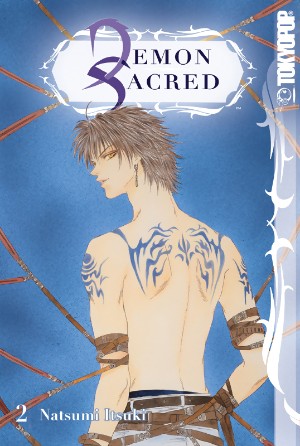
Demon Sacred is shojo manga’s answer to the everything bagel, substituting hot scientists, dragons, pop idols, twins, secret government research facilities, and time-traveling aliens for garlic chips and sesame seeds. That such an unlikely combination of ingredients proves complimentary is nothing sort of miraculous — it’s hard to imagine how rock stars and rifts in the space-time continuum could co-exist in the same manga without the whole enterprise descending into complete silliness, but Natsumi Itsuki walks the fine line between stupid and clever with the grace of a high-wire acrobat.

Consider the first three chapters of the series: in them, we’re introduced to Rena, the sole survivor of an incident involving unicorns; her fourteen-year-old daughters Rina and Mona, one of whom has developed a disease that causes her to age backwards; and the girls’ guardian Shinobu, a handsome, pony-tailed researcher who is toiling away on a cure for Return Syndrome and — natch — earned a PhD from Harvard before his eighteenth birthday. Those three storylines alone provide ample material for a good shojo fantasy, but Itsuki cranks up the narrative nuttiness to eleven in subsequent chapters, tossing in a handsome “demon” — in fact, a shape-shifting alien from another dimension — who knew the twins’ mother, and a second, more powerful demon who assumes the form of the girls’ favorite pop singer.

…

Read More

Filed Under: Manga Critic Tagged With: shojo, Tokyopop

Demon Sacred, Vols. 1-2

September 28, 2010 by Katherine Dacey

Demon Sacred is shojo manga’s answer to the everything bagel, substituting hot scientists, dragons, pop idols, twins, secret government research facilities, and time-traveling aliens for garlic chips and sesame seeds. That such an unlikely combination of ingredients proves complimentary is nothing sort of miraculous — it’s hard to imagine how rock stars and rifts in the space-time continuum could co-exist in the same manga without the whole enterprise descending into complete silliness, but Natsumi Itsuki walks the fine line between stupid and clever with the grace of a high-wire acrobat.

Consider the first three chapters of the series: in them, we’re introduced to Rena, the sole survivor of an incident involving unicorns; her fourteen-year-old daughters Rina and Mona, one of whom has developed a disease that causes her to age backwards; and the girls’ guardian Shinobu, a handsome, pony-tailed researcher who is toiling away on a cure for Return Syndrome and — natch — earned a PhD from Harvard before his eighteenth birthday. Those three storylines alone provide ample material for a good shojo fantasy, but Itsuki cranks up the narrative nuttiness to eleven in subsequent chapters, tossing in a handsome “demon” — in fact, a shape-shifting alien from another dimension — who knew the twins’ mother, and a second, more powerful demon who assumes the form of the girls’ favorite pop singer.

A cynic might dismiss these additional characters as pandering to teen girl taste, but Mika and K2 serve an important role in advancing the plot, shedding light on Rina and Mona’s past (Mom disappeared when they were four) and offering a potential cure for Rina’s condition. Ditto for some of the comic-relief episodes, in which K2 impersonates a real-life idol; if Itsuki always played it straight, the story would seem positively ludicrous instead of charmingly overstuffed. Remember, the opening pages of the series involve a stampede of unicorns emerging from the aurora borealis and trampling a group of tourists in the Finnish countryside. Even Madeline L’Engle didn’t have the guts to try that.

I’d be the first to admit that Demon Sacred isn’t as well constructed as Itsuki’s Jyu-Oh-Sei, a tight, logical exercise in hard science fiction; if anything, Demon Sacred feels freer and messier than her earlier work. That impression of spontaneity stems from the casual way in which Itsuki assembles plot elements, like a chef rummaging through the refrigerator and grabbing whatever looks appetizing. There’s no obvious rationale for inter-dimensional, time-traveling aliens to assume the form of mythical Earth-beasts, other than the fact it tickled Itsuki’s authorial fancy. Yet that kitchen-sink quality is a big part of Demon Sacred‘s appeal; I’d be lying if I denied my pleasure in seeing a character quote from the Book of Revelations, or imagining a universe in which griffins, unicorns, and fire-breathing dragons could assume the form of popular singers.

It’s hard to guess how Itsuki will resolve the myriad subplots introduced in the first two volumes, but the story unfolds in such a feverish, urgent fashion that it’s easy to forgive the occasional narrative shortcuts or capitulations to shojo convention. (See “hot young scientist” and “pop idols,” above.) Demon Sacred may not be the best new manga of 2010, but it’s a strong contender for most addictive.

Review copies provided by Tokyopop.

DEMON SACRED, VOLS. 1-2 • BY NATSUMI ITSUKI • TOKYOPOP • RATING: TEEN (13+)

Filed Under: Manga, Manga Critic, REVIEWS Tagged With: Natsumi Itsuki, Sci-Fi, Tokyopop

Manga Artifacts: Magical Mates

September 23, 2010 by Katherine Dacey

It’s hard to remember a time when the only translated manga featured explosions, monsters, and naked women, but for most of the 1980s and 1990s, manly-man manga was the norm; American publishers barely acknowledged that female comic fans existed in or outside Japan. There were licensed manga with female protagonists, to be sure, but The Legend of Mother Sarah and Mai The Psychic Girl were clearly written for male audiences, as the reductive tagline on Mai‘s front cover attests: “She is pretty. She is psychic. She is Japanese.” (Read: “She might go out with you.”) That began to change in the mid-1990s, when a few publishers made the then-radical decision to introduce manga for girls. VIZ released Moto Hagio’s They Were Eleven (1995) and A, A’ (1997); Mixx made a hit out of Naoko Takeuchi’s Sailor Moon (1997); and Antarctic Press, home of Ninja High School and Hurricane Girls, dabbled in shojo with Mio Odagi’s Magical Mates (1996).

If VIZ took the high road, introducing readers to one of Japan’s most influential and beloved creators, and Mixx took the middle road, courting female fans of Mighty Morphin’ Power Rangers and the Sailor Moon anime, Antarctic took the cheap road, licensing a self-published work by an obscure artist. The fact that Magical Mates reached American shores at all had more to do with who Odagi knew than the quality of her work. As Jason Thompson explains in a recent House of 1000 Manga column, Odagi was a member of Studio Do-Do, a small group of artists that had an inside connection at Antarctic Press: Ippongi Bang, whose friendship with Antarctic staffers helped open the door for her fellow Studio Do-Do artists.

Flipping through the six issues that comprise Magical Mates, Mio Odagi’s lack of skill is painfully obvious. The stories — which focus on a trio of tarot-reading, spell-casting teens — abound in the kind of poorly drawn panels and non-sequitors that would make a Hana to Yume editor pull out her hair. Odagi lavishes considerable attention on her characters’ eyes, rendering their irises and lashes with a meticulous precision that’s fundamentally at odds with the slapdash way she draws the rest of their bodies. She also struggles with backgrounds; her characters often appear to be floating above the picture plane, unencumbered by gravity.

Each story revolves around a romantic entanglement of one sort or another: in “Love on a Friendship Bracelet,” for example, Rinko, Kana, and Noemi help the manager of the boys’ soccer team express her feelings to the arrogant star player, while in “The Priestesses’ Love Letter,” the girls play matchmaker for the class brain and the rock guitarist she secretly adores. Not much connects the episodes, save for running gags about Rinko’s vanity — she vies with Kana and Noemi to be the “star” of the series — and about Rinko’s long-suffering suitor Eiji, a short, bespectacled nerd with an alter ego: The Student President of Darkness, a malicious teen who carries out Eiji’s darker wishes.

The Student President of Darkness gag embodies what’s good and bad about Magical Mates. Eiji’s frequent transformations are the kind of problem that could easily be fixed by logic or a lanyard; the fact that he’s always absent when the President is sabotaging a soccer match or flooding a water park doesn’t seem to register with Rinko or her friends. Yet for all the suspension of disbelief that Eiji’s Jekyll-and-Hyde persona demands, these transformations serve an important function, adding a badly needed element of emotional authenticity to Magical Mates; Eiji’s jealousy feels more real than anything else in the series, providing a reliable source of comic relief and dramatic conflict.

More striking than the stories themselves is Antarctic Press’ attempt to position Magical Mates as a comedy that older male readers would enjoy. Each issue featured advertisements for comics such as Warrior Nun Areala, Codename: Scorpio, and the NC-17 vampire comic Tabou, which had a tie-in with an adult film. Though the covers seem less deliberately calculated to appeal to male readers than the advertising, issue four is a notable exception: all three girls have been given a sexy makeover with super-long legs, savage tans, and skimpy bathing suits that are completely out of character. The one fan letter that Antarctic published — which appears on the back page of issue four — comes from a male reader who complains that he doesn’t like Magical Mates‘ cover art or title. “It’s got that Sailor Moon stigma,” he notes. “I hope readership picks up, and that people don’t get the wrong idea and think this is some sort of bland children’s comic.”

With the benefit of hindsight, it’s easy to fault Antarctic for treating Magical Mates as something other than a “children’s comic,” as its tone and episodic structure seem best suited for young readers. Yet at the time Mates debuted, there was no obvious market for girls’ manga. The Sailor Moon anime was just beginning to reach female audiences here in the US — it was still two years away from becoming a big hit — and American publishers had been neglecting the female comics market for decades. Antarctic made a logical gamble, presenting Mates as a wacky comedy starring three cute girls rather than a wacky comedy written for girls, never acknowledging that Odagi’s artwork, plotlines, and sensibility owed a significant debt to the magical girl genre.

Had it been marketed differently, Magical Mates still might not have found an audience — Moto Hagio, after all, bombed with readers, despite her impeccable pedigree and formidable talent. Yet Mates is significant because it anticipated the kind of shojo that caught on with American girls in the following decade, with its focus on romance, wacky hijinks, and unabashedly teen pursuits, from telling fortunes and swapping love charms to visiting amusement parks.

Readers curious about Magical Mates can find inexpensive copies of all six issues on eBay; note that Antarctic initially planned a nine-issue series, but canceled the last three.

Manga Artifacts is a monthly feature exploring older, out-of-print manga published in the 1980s and 1990s. For a fuller description of the series’ purpose, see the inaugural column.

Filed Under: Manga Critic

Manga Artifacts: Magical Mates

September 23, 2010 by Katherine Dacey

It’s hard to remember a time when the only translated manga featured explosions, monsters, and naked women, but for most of the 1980s and 1990s, manly-man manga was the norm; American publishers barely acknowledged that female comic fans existed in or outside Japan. There were licensed manga with female protagonists, to be sure, but The Legend of Mother Sarah and Mai The Psychic Girl were clearly written for male audiences, as the reductive tagline on Mai‘s front cover attests: “She is pretty. She is psychic. She is Japanese.” (Read: “She might go out with you.”) That began to change in the mid-1990s, when a few publishers made the then-radical decision to introduce manga for girls. VIZ released Moto Hagio’s They Were Eleven (1995) and A, A’ (1997); Mixx made a hit out of Naoko Takeuchi’s Sailor Moon (1997); and Antarctic Press, home of Ninja High School and Hurricane Girls, dabbled in shojo with Mio Odagi’s Magical Mates (1996).

If VIZ took the high road, introducing readers to one of Japan’s most influential and beloved creators, and Mixx took the middle road, courting female fans of Mighty Morphin’ Power Rangers and the Sailor Moon anime, Antarctic took the cheap road, licensing a self-published work by an obscure artist. The fact that Magical Mates reached American shores at all had more to do with who Odagi knew than the quality of her work. As Jason Thompson explains in a recent House of 1000 Manga column, Odagi was a member of Studio Do-Do, a small group of artists that had an inside connection at Antarctic Press: Ippongi Bang, whose friendship with Antarctic staffers helped open the door for her fellow Studio Do-Do artists.

Flipping through the six issues that comprise Magical Mates, Mio Odagi’s lack of skill is painfully obvious. The stories — which focus on a trio of tarot-reading, spell-casting teens — abound in the kind of poorly drawn panels and non-sequitors that would make a Hana to Yume editor pull out her hair. Odagi lavishes considerable attention on her characters’ eyes, rendering their irises and lashes with a meticulous precision that’s fundamentally at odds with the slapdash way she draws the rest of their bodies. She also struggles with backgrounds; her characters often appear to be floating above the picture plane, unencumbered by gravity.

Each story revolves around a romantic entanglement of one sort or another: in “Love on a Friendship Bracelet,” for example, Rinko, Kana, and Noemi help the manager of the boys’ soccer team express her feelings to the arrogant star player, while in “The Priestesses’ Love Letter,” the girls play matchmaker for the class brain and the rock guitarist she secretly adores. Not much connects the episodes, save for running gags about Rinko’s vanity — she vies with Kana and Noemi to be the “star” of the series — and about Rinko’s long-suffering suitor Eiji, a short, bespectacled nerd with an alter ego: The Student President of Darkness, a malicious teen who carries out Eiji’s darker wishes.

The Student President of Darkness gag embodies what’s good and bad about Magical Mates. Eiji’s frequent transformations are the kind of problem that could easily be fixed by logic or a lanyard; the fact that he’s always absent when the President is sabotaging a soccer match or flooding a water park doesn’t seem to register with Rinko or her friends. Yet for all the suspension of disbelief that Eiji’s Jekyll-and-Hyde persona demands, these transformations serve an important function, adding a badly needed element of emotional authenticity to Magical Mates; Eiji’s jealousy feels more real than anything else in the series, providing a reliable source of comic relief and dramatic conflict.

More striking than the stories themselves is Antarctic Press’ attempt to position Magical Mates as a comedy that older male readers would enjoy. Each issue featured advertisements for comics such as Warrior Nun Areala, Codename: Scorpio, and the NC-17 vampire comic Tabou, which had a tie-in with an adult film. Though the covers seem less deliberately calculated to appeal to male readers than the advertising, issue four is a notable exception: all three girls have been given a sexy makeover with super-long legs, savage tans, and skimpy bathing suits that are completely out of character. The one fan letter that Antarctic published — which appears on the back page of issue four — comes from a male reader who complains that he doesn’t like Magical Mates‘ cover art or title. “It’s got that Sailor Moon stigma,” he notes. “I hope readership picks up, and that people don’t get the wrong idea and think this is some sort of bland children’s comic.”

With the benefit of hindsight, it’s easy to fault Antarctic for treating Magical Mates as something other than a “children’s comic,” as its tone and episodic structure seem best suited for young readers. Yet at the time Mates debuted, there was no obvious market for girls’ manga. The Sailor Moon anime was just beginning to reach female audiences here in the US — it was still two years away from becoming a big hit — and American publishers had been neglecting the female comics market for decades. Antarctic made a logical gamble, presenting Mates as a wacky comedy starring three cute girls rather than a wacky comedy written for girls, never acknowledging that Odagi’s artwork, plotlines, and sensibility owed a significant debt to the magical girl genre.

Had it been marketed differently, Magical Mates still might not have found an audience — Moto Hagio, after all, bombed with readers, despite her impeccable pedigree and formidable talent. Yet Mates is significant because it anticipated the kind of shojo that caught on with American girls in the following decade, with its focus on romance, wacky hijinks, and unabashedly teen pursuits, from telling fortunes and swapping love charms to visiting amusement parks.

Readers curious about Magical Mates can find inexpensive copies of all six issues on eBay; note that Antarctic initially planned a nine-issue series, but canceled the last three.

Manga Artifacts is a monthly feature exploring older, out-of-print manga published in the 1980s and 1990s. For a fuller description of the series’ purpose, see the inaugural column.

Filed Under: Manga, Manga Critic, REVIEWS Tagged With: Antarctic Press, Mio Odagi, Studio Do-Do

Hetalia: Axis Powers, Vol. 1

September 19, 2010 by Katherine Dacey

To say that Hetalia: Axis Powers has a devoted fanbase is like saying that Cookie Monster is partial to Oreos; it’s the kind of series that inspires fans to write their own Hetalia stories by the truckload (there are over 14,000 posted at FanFiction.net), dress up as their favorite countries, and debate the virtues of various characters with quasi-religious intensity.

Part of Hetalia‘s appeal lies with the artwork: manga-ka Hidekaz Himeyura populates his stories with cute, attractive young men in lavishly detailed military costumes that are tailor-made for cosplay. The other part of Hetalia‘s appeal lies with its cheerfully subversive premise: all the major participants in World War II are represented as petulant bishies whose behavior mimics the way these countries interacted in the 1930s, and whose personalities conform to well-rehearsed national stereotypes. Whether or not you cotton to Hetalia will depend largely on whether you find the underlying concept a stellar example of the Japanese ability to kawaii-ify anything or proof that Japan’s younger generation doesn’t grasp just how terrible World War II really was.

…

Read More

Filed Under: Manga Critic Tagged With: 4-koma, Tokyopop

Hetalia: Axis Powers, Vol. 1

September 19, 2010 by Katherine Dacey

To say that Hetalia: Axis Powers has a devoted fanbase is like saying that Cookie Monster is partial to Oreos; it’s the kind of series that inspires fans to write their own Hetalia stories by the truckload (there are over 14,000 posted at FanFiction.net), dress up as their favorite countries, and debate the virtues of various characters with quasi-religious intensity.

Part of Hetalia‘s appeal lies with the artwork: manga-ka Hidekaz Himeyura populates his stories with cute, attractive young men in lavishly detailed military costumes that are tailor-made for cosplay. The other part of Hetalia‘s appeal lies with its cheerfully subversive premise: all the major participants in World War II are represented as petulant bishies whose behavior mimics the way these countries interacted in the 1930s, and whose personalities conform to well-rehearsed national stereotypes. Whether or not you cotton to Hetalia will depend largely on whether you find the underlying concept a stellar example of the Japanese ability to kawaii-ify anything or proof that Japan’s younger generation doesn’t grasp just how terrible World War II really was.

I fall somewhere in the middle of the continuum: I’m not offended by Hetalia, but I’m not amused, either. Himaruya has certainly done his homework, seeding the dialogue with salacious historical tidbits and inserting flashbacks to major European wars of the eighteenth and nineteenth centuries, yet he never challenges the basic stereotypes that guide all the characterizations: Japan is prissy and horrified by European cuisine, England views America as his ill-behaved offspring, America loves hamburgers and talks with his mouth full, Germany is efficient and belligerent, and Northern Italy adores pasta and shirks responsibility. The endless stream of nationality-as-destiny jokes grows tiresome quickly; imagine spending an afternoon with someone who insists on referring to the French as “cheese-eating surrender monkeys” every time you mention a recent trip to Paris, and you have some idea of how stale the better gags become on their third or tenth repetition.

From time to time, Himaruya inserts the kind of pointed, tasteless joke that suggests at true subversion. In one scene, for example, Germany finds himself at a supermarket check-out, fuming because Korea is holding up the line, demanding reparations and an apology for how he’s been treated. A more skilled writer could have done something with this moment, perhaps using it as a jumping off point for exploring the complicated relationship between Japan and Korea. Instead, Himaruya treats this moment as just another wacky example of a country behaving according to national character, as if Korea’s legitimate protests over Japanese occupation were akin to Italians loving red wine or Russians placing ineffectual curses on their enemies. I’m mildly horrified to contemplate how Himaruya will treat German anti-Semitism — a personal quirk?

Which brings me to my biggest criticism of Hetalia: Axis Powers: there’s a strong whiff of pointlessness about the whole enterprise. Himaruya goes to great pains to get the history right, but it’s never clear what the series’ underlying message really is; why depict one of the ugliest, most brutal periods in human history as a cute, interpersonal drama if you’re not trying to make some greater point about the folly of international alliances, or the dangers of aggressive nationalism? I have no doubt that Trey Parker and Matt Stone could run with the Hetalia premise and turn it into something genuinely funny, rude, and intelligent, but Himaruya just doesn’t have the historical insight or the courage to do much with the material except make all the participants look very pretty.

Review copy provided by Tokyopop. Volume one of Hetalia: Axis Powers will be released on September 21, 2010.

HETALIA: AXIS POWERS, VOL. 1 • BY HIDEKAZ HIMARUYA • TOKYOPOP • 152 pp. • RATING: OLDER TEEN (16+)

Filed Under: Manga, Manga Critic, REVIEWS Tagged With: 4-koma, Comedy, Tokyopop

  • « Go to Previous Page
  • Page 1
  • Interim pages omitted …
  • Page 24
  • Page 25
  • Page 26
  • Page 27
  • Page 28
  • Interim pages omitted …
  • Page 39
  • Go to Next Page »
 | Log in
Copyright © 2010 Manga Bookshelf | Powered by WordPress & the Genesis Framework